THE SPANIARDS
        AS
COLONIAL MASTERS
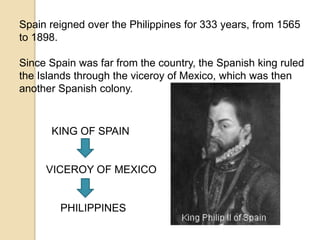
Spain reigned over the Philippines for 333 years, from 1565
to 1898.

Since Spain was far from the country, the Spanish king ruled
the Islands through the viceroy of Mexico, which was then
another Spanish colony.


      KING OF SPAIN


     VICEROY OF MEXICO


        PHILIPPINES
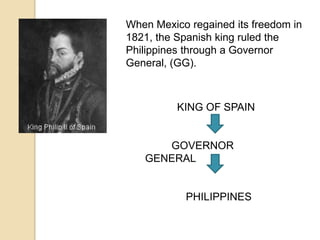
When Mexico regained its freedom in
1821, the Spanish king ruled the
Philippines through a Governor
General, (GG).


          KING OF SPAIN


      GOVERNOR
   GENERAL


           PHILIPPINES
THE POLITICAL STRUCTURE

Spain established a centralized colonial
government in the Philippines that was composed
of a NATIONAL GOVERNMENT and the LOCAL
GOVERNMENTS that administered
provinces, cities, towns and municipalities.

NATIONAL GOVERNMENT:

     maintained peace and order
     collected taxes
     built schools and other public works
THE GOVERNOR
      GENERAL

The King's representative and the highest-ranking
official in the Philippines

Royal decrees and laws emanating from Spain
were implemented in the Philippines

Had the power to appoint and dismiss public
officials, except those personally chosen by the
King
THE GOVERNOR
      GENERAL

Supervised all government offices and the
collection of taxes

Exercised certain legislative powers

Issued proclamations to facilitate the
implementation of laws
THE GOVERNOR
     GENERAL

REQUIREMENT:

    Must be a PENINSULARES
         or A SPANIARD BORN IN SPAIN
THE POLITICAL STRUCTURE
    THE GOVERNOR
      GENERAL
    The Governor General and other
    government officials had so much
    power that it was commonly abused.
            To investigate the abuses, there
            were bodies created:

                   THE RESIDENCIA

      THE VISITA           THE ROYAL AUDENCIA
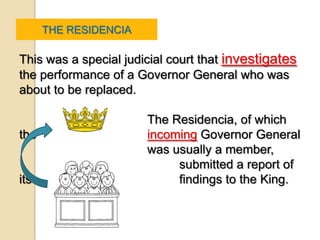
THE RESIDENCIA

This was a special judicial court that investigates
the performance of a Governor General who was
about to be replaced.

                       The Residencia, of which
the                    incoming Governor General
                       was usually a member,
                            submitted a report of
its                         findings to the King.
THE VISITA

The Council of the Indies in Spain sent a
government official called the VISITADOR
GENERAL to observe conditions in the colony.

                          The Visitador General
                          reported his findings
                          directly to the King.
The highest court in
THE ROYAL AUDENCIA
                               the land
Served as an advisory body to the Governor
General

Had the power to check and report on his
abuses

The Audiencia also audited the expenditures of
the colonial government

Sent a yearly report to Spain

The Archbishop and other government officials
THE ROYAL AUDENCIA


  Despite all these checks, however, an
  abusive governor general often managed
  to escape stiff fines, suspension, or
  dismissal by simply bribing the Visitador
  and other investigators.
THE PROVINCIAL
     GOVERNMENT

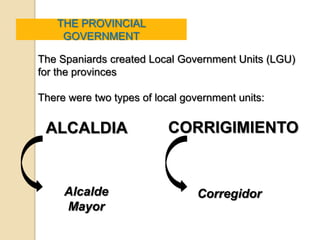
The Spaniards created Local Government Units (LGU)
for the provinces

There were two types of local government units:


 ALCALDIA                  CORRIGIMIENTO


     Alcalde                     Corregidor
     Mayor
THE PROVINCIAL
 GOVERNMENT

  The ALCADIA, led by the
             Alcalde Mayor
  governed the provinces that had
  been fully subjugated:

  UNDER SPANISH CONTROL
  ALREADY

  SALARY: P300 A MONTH
THE PROVINCIAL
   GOVERNMENT

DUTIES OF THE ALCALDE MAYOR:

They represented the Spanish king and the
Governor-General

They managed the day-to-day operations of the
provincial government

Implemented laws and supervised the collection
of taxes
THE PROVINCIAL
 GOVERNMENT


  The CORREGIMIENTO, headed by

            Corregidor

  governed the provinces that were
  not yet entirely under Spanish
  control.
THE PROVINCIAL
    GOVERNMENT

The ALCADIA and the CORREGIMIENTO

Though they were paid a small
salary, they enjoyed privileges such as the

     INDULTO DE COMERCIO

or the right to participate in the

           GALLEON TRADE.
THE MUNICIPAL GOVERNMENT

Each province was divided into several towns or
pueblos headed by GOBERNADORDCILLOS (Little
Governor)

MAIN DUTIES: Efficient governance and tax
collection.

Four lieutenants aided the Governardorcillo:
the Teniente Mayor (chief lieutenant),
the Teniente de Policia (police lieutenant),
the Teniente de Sementeras (lieutenant of the
fields)
THE MUNICIPAL GOVERNMENT

  GOBERNADORDCILLOS

  They had SMALL SALARIES but were exempted
  from PAYING TAXES

  QUALIFICATIONS:
  Any NATIVE or CHINESE MEZTIZO
  25 years old
  Literate in ORAL or WRITTEN SPANISH
  Cabeza de Barangay for 4 years

  Ex: Emilio Aguinaldo
THE MUNICIPAL GOVERNMENT

  CABEZA DE BARANGAY OR
      (Barrio Administrator or Barangay
                Captain)

  -Responsible for the peace and order of the
  barrio
  -Recruited men for public works

  QUALIFICATIONS:
  Cabezas should be literate in Spanish
  Have good moral character and property
  Cabezas who served for 25 years were
THE CITY GOVERNMENT

Larger towns became cities called:
           AYUNTAMIENTO
It became the center of trade and industry.

The ayuntamiento had a city council called the
            CABILDO

CABILDO is composed of:
    ALCALDE (MAYOR)
      REGIDORES (COUNCILLORS)
       ALGUACIL MAYOR (POLICE CHIEF)
         ESCRIBANDO (SECRETARY)
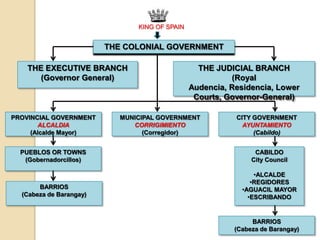
KING OF SPAIN


                         THE COLONIAL GOVERNMENT

    THE EXECUTIVE BRANCH                         THE JUDICIAL BRANCH
       (Governor General)                                (Royal
                                               Audencia, Residencia, Lower
                                                Courts, Governor-General)

PROVINCIAL GOVERNMENT      MUNICIPAL GOVERNMENT           CITY GOVERNMENT
       ALCALDIA               CORRIGIMIENTO                 AYUNTAMIENTO
     (Alcalde Mayor)             (Corregidor)                  (Cabildo)


  PUEBLOS OR TOWNS                                              CABILDO
   (Gobernadorcillos)                                          City Council

                                                                •ALCALDE
                                                               •REGIDORES
       BARRIOS                                              •AGUACIL MAYOR
  (Cabeza de Barangay)                                        •ESCRIBANDO


                                                               BARRIOS
                                                          (Cabeza de Barangay)

Spanish Colonial Government

  • 1.
    THE SPANIARDS AS COLONIAL MASTERS
  • 2.
    Spain reigned overthe Philippines for 333 years, from 1565 to 1898. Since Spain was far from the country, the Spanish king ruled the Islands through the viceroy of Mexico, which was then another Spanish colony. KING OF SPAIN VICEROY OF MEXICO PHILIPPINES
  • 3.
    When Mexico regainedits freedom in 1821, the Spanish king ruled the Philippines through a Governor General, (GG). KING OF SPAIN GOVERNOR GENERAL PHILIPPINES
  • 4.
    THE POLITICAL STRUCTURE Spainestablished a centralized colonial government in the Philippines that was composed of a NATIONAL GOVERNMENT and the LOCAL GOVERNMENTS that administered provinces, cities, towns and municipalities. NATIONAL GOVERNMENT: maintained peace and order collected taxes built schools and other public works
  • 5.
    THE GOVERNOR GENERAL The King's representative and the highest-ranking official in the Philippines Royal decrees and laws emanating from Spain were implemented in the Philippines Had the power to appoint and dismiss public officials, except those personally chosen by the King
  • 6.
    THE GOVERNOR GENERAL Supervised all government offices and the collection of taxes Exercised certain legislative powers Issued proclamations to facilitate the implementation of laws
  • 7.
    THE GOVERNOR GENERAL REQUIREMENT: Must be a PENINSULARES or A SPANIARD BORN IN SPAIN
  • 8.
    THE POLITICAL STRUCTURE THE GOVERNOR GENERAL The Governor General and other government officials had so much power that it was commonly abused. To investigate the abuses, there were bodies created: THE RESIDENCIA THE VISITA THE ROYAL AUDENCIA
  • 9.
    THE RESIDENCIA This wasa special judicial court that investigates the performance of a Governor General who was about to be replaced. The Residencia, of which the incoming Governor General was usually a member, submitted a report of its findings to the King.
  • 10.
    THE VISITA The Councilof the Indies in Spain sent a government official called the VISITADOR GENERAL to observe conditions in the colony. The Visitador General reported his findings directly to the King.
  • 11.
    The highest courtin THE ROYAL AUDENCIA the land Served as an advisory body to the Governor General Had the power to check and report on his abuses The Audiencia also audited the expenditures of the colonial government Sent a yearly report to Spain The Archbishop and other government officials
  • 12.
    THE ROYAL AUDENCIA Despite all these checks, however, an abusive governor general often managed to escape stiff fines, suspension, or dismissal by simply bribing the Visitador and other investigators.
  • 13.
    THE PROVINCIAL GOVERNMENT The Spaniards created Local Government Units (LGU) for the provinces There were two types of local government units: ALCALDIA CORRIGIMIENTO Alcalde Corregidor Mayor
  • 14.
    THE PROVINCIAL GOVERNMENT The ALCADIA, led by the Alcalde Mayor governed the provinces that had been fully subjugated: UNDER SPANISH CONTROL ALREADY SALARY: P300 A MONTH
  • 15.
    THE PROVINCIAL GOVERNMENT DUTIES OF THE ALCALDE MAYOR: They represented the Spanish king and the Governor-General They managed the day-to-day operations of the provincial government Implemented laws and supervised the collection of taxes
  • 16.
    THE PROVINCIAL GOVERNMENT The CORREGIMIENTO, headed by Corregidor governed the provinces that were not yet entirely under Spanish control.
  • 17.
    THE PROVINCIAL GOVERNMENT The ALCADIA and the CORREGIMIENTO Though they were paid a small salary, they enjoyed privileges such as the INDULTO DE COMERCIO or the right to participate in the GALLEON TRADE.
  • 18.
    THE MUNICIPAL GOVERNMENT Eachprovince was divided into several towns or pueblos headed by GOBERNADORDCILLOS (Little Governor) MAIN DUTIES: Efficient governance and tax collection. Four lieutenants aided the Governardorcillo: the Teniente Mayor (chief lieutenant), the Teniente de Policia (police lieutenant), the Teniente de Sementeras (lieutenant of the fields)
  • 19.
    THE MUNICIPAL GOVERNMENT GOBERNADORDCILLOS They had SMALL SALARIES but were exempted from PAYING TAXES QUALIFICATIONS: Any NATIVE or CHINESE MEZTIZO 25 years old Literate in ORAL or WRITTEN SPANISH Cabeza de Barangay for 4 years Ex: Emilio Aguinaldo
  • 20.
    THE MUNICIPAL GOVERNMENT CABEZA DE BARANGAY OR (Barrio Administrator or Barangay Captain) -Responsible for the peace and order of the barrio -Recruited men for public works QUALIFICATIONS: Cabezas should be literate in Spanish Have good moral character and property Cabezas who served for 25 years were
  • 21.
    THE CITY GOVERNMENT Largertowns became cities called: AYUNTAMIENTO It became the center of trade and industry. The ayuntamiento had a city council called the CABILDO CABILDO is composed of: ALCALDE (MAYOR) REGIDORES (COUNCILLORS) ALGUACIL MAYOR (POLICE CHIEF) ESCRIBANDO (SECRETARY)
  • 22.
    KING OF SPAIN THE COLONIAL GOVERNMENT THE EXECUTIVE BRANCH THE JUDICIAL BRANCH (Governor General) (Royal Audencia, Residencia, Lower Courts, Governor-General) PROVINCIAL GOVERNMENT MUNICIPAL GOVERNMENT CITY GOVERNMENT ALCALDIA CORRIGIMIENTO AYUNTAMIENTO (Alcalde Mayor) (Corregidor) (Cabildo) PUEBLOS OR TOWNS CABILDO (Gobernadorcillos) City Council •ALCALDE •REGIDORES BARRIOS •AGUACIL MAYOR (Cabeza de Barangay) •ESCRIBANDO BARRIOS (Cabeza de Barangay)