RELIGION IN THE
COLONIES
CHAPTER 4
ELIZABETHAN SETTLEMENT
Queen
Elizabeth

Puritan
• Purify church of
England
• Clean it of
unbiblical
practices

Anglican
• Low = agree
with puritans;
don’t have a
problem with
unbiblical
practices
• High= believe
unbiblical
practices are
biblical

Separatists
• Must
separate
from church
of England
completely
• Pilgrims
• Baptists,
etc.
PILGRIMS VS. PURITANS
Few

Many

Early (1620)

Later (1629-30)

Poor class

Upper middle class

Uneducated

Educated

Separatists from state church

Loyal

Settled in Plymouth

Salem, Boston

Wm. Bradford, Wm. Brewster

John Endicott, Miles Standish,
4
John Winthrop
PURITAN: MYTHS VS. REALITY
“Haunting fear that someone,
somewhere may be happy”
Wore black

Books, music, beer, rum,
swam, skated, bowled
Blue, violet, green, yellow

Narrow minded

+100: Oxford & Cambridge

“Dumme Doggs”

Established Harvard after 6 years

Women sheltered

Literate, well read, managed household

Song-less

A capella, in unison

Minority

1776: 75% of Puritan roots
5
POLITY (CHURCH ORGANIZATION)
Episcopal
• Monarch
appoints
archbishop
• Archbishop
• bishop
• parish (vicar)
• Ex. Church of
England

Presbyterian

Congregationalist

• Church
members vote
for church
leadership
• Vote for
presbytery and
synod
• Governed by
church Assembly
• Ex. Church of
Scotland

• Congregation
elects officials of
church
• Churches
independent of
each other
• Ex. Most Puritans
in American
colonies
PURITAN DECLINE
• Religious zeal decline with each generation
• More concerned with monetary gain than spiritual gain

• Halfway Covenant
• Accept membership of non converted (but outwardly pure) to fill
increase membership
• Allows non-saved people into churches
• Compromise on principles of puritan ancestors

• Salem Witch Trials 1692
•
•
•
•
•

Fanaticism and hysteria
Girls accuse witches of afflicting them
20 innocent people killed
Later people confessed accusations
Spiritual depression until Great Awakening
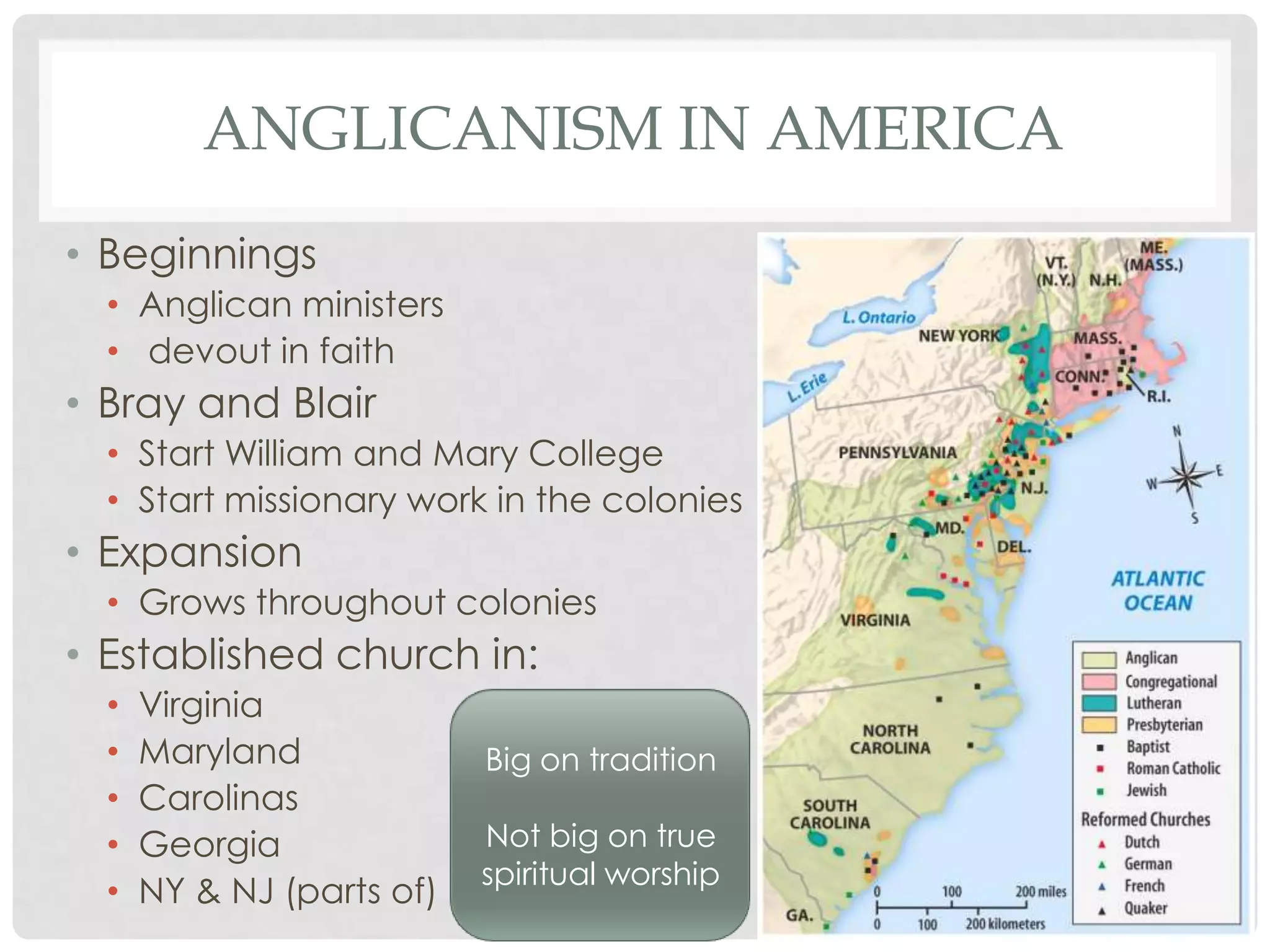
ANGLICANISM IN AMERICA
• Beginnings
• Anglican ministers
• devout in faith

• Bray and Blair
• Start William and Mary College
• Start missionary work in the colonies

• Expansion
• Grows throughout colonies

• Established church in:
•
•
•
•
•

Virginia
Maryland
Carolinas
Georgia
NY & NJ (parts of)

Big on tradition
Not big on true
spiritual worship
NON-ESTABLISHED
DENOMINATIONS
BAPTISTS
• Roger Williams = founder
•
•
•
•
•

Rhode Island
Him and a friend baptized each other
Baptize only truly repentant
No baptize babies
Largest number in Pennsylvania
QUAKERS
•
•
•
•
•
•
•
•

George Fox
―Friends‖
Shake while worshipping
Guided by ―inner light‖  salvation
Simple worship
No ministers
No Baptism or Communion
Welcome in:
• Pennsylvania and Rhode Island
PRESBYTERIANS
• Last major separatist group to come to America
• Doctrine similar to Congregationalist but
Presbyterian polity (organization)
• Francis Makemie
• Founder
• Won court cases to ensure
religious freedom of worship
in colonies
LUTHERANS
•
•
•
•

Follow teachings of Martin Luther
New Sweden (Delaware)
New Amsterdam ( NY)
Pennsylvania (mostly)

• Henry Muhlenberg
• Lay foundation for Lutheran church in America
• Encouraged unity between Lutherans from Delaware, NY
and Pennsylvania
WHERE ARE THE LUTHERANS TODAY?
ANABAPTIST GROUPS
MENNONITE & AMISH
• Refused to have anything to do with the state
• No military service (no buttons)
• No voting or political activity
• No modern technology

• Simple and holy life
• Mennonites = followers of Menno Sims
• Amish = conservative Mennonites
•
•
•
•

No electricity
Old language (High German)
Reject modern ways of life
Little contact with outsiders
MORAVIANS
• Follow teachings of John Huss from Bohemia
• Conducted missionary work to slaves in Caribbean
and slaves in America
• Emphasis on
• conversion
• leading a holy life

• Not on: doctrine
• Legacy:
• Lead to John Wesley conversion
• Easter Sunrise Service

• Settled:
• North Carolina
• Pennsylvania
ROMAN CATHOLIC
• Center  Maryland
• Haven for Catholics

• Minority until Irish migration in 1840s
• Feared by many colonists
• Catholic countries (Spain and France) threatened existence
of colonies
• WHY???

• Found in:
• Maryland
• Pennsylvania
• NY
WHERE ARE THE CATHOLICS?
WORSHIP
MUSIC
• Singing important during services
• Many adapted from Psalms

• Book of Psalms (1640)

• First published book in America

―The Whole Booke of Psalmes
Faithfully
TRANSLATED into
ENGLISH
Metre.
Whereunto is prefixed a
discourse
declaring not only the lawfullnes,
but also
the necessity of the heavenly
Ordinance
of singing Scripture Psalmes
in
the Churches of God.
Imprinted, 1640‖
•
•
•
•
•
•

Long prayer
Long sermon
No instruments
Hard wooden benches
No heat
Ushers
PEWS FOR RENT
GREAT AWAKENING
Social
Political

Religious

Great Awakening 1720s – 60s
BACKGROUND
• Religious life is in decline
• Church attendance as a tradition

• Some ministers are not really converted
EARLY STIRRINGS
• 1720 Dutch reformer – Frelinghuysen
• Gr. Awakening begins in New Jersey
• Friend Gilbert Tennent
• Preaches throughout colonies

―Old Lights‖
•Oppose
awakening
•No emotions
towards
religion

―New Lights‖
•Support
awakening
•Tripled in size

Presbyterians
JONATHAN EDWARDS
•
•
•
•

―Greatest Theologian of Great Awakening‖
Passionate devotion to God
Lived what he preached
Justification through faith not works
• Opposed to Anglican, Catholic, etc.

• Famous sermon: ―Sinners in the Hands of an Angry
God‖
GEORGE WHITEFIELD
• ―Greatest Evangelist of Gr. Awakening‖
• 30 year ministry
• 7 preaching tours throughout colonies

• Powerful voice
• Could reach 30,000 people with no amplification
GR. AWAKENING IN THE SOUTH
• Samuel Doak
• Pastor in Virginia &Tennessee
• Pioneer for abolishment of slavery
• Founded school in Tennessee
• Washington College1795
RESULTS OF GREAT
AWAKENING
CHURCHES
• Growth
• Membership
• # of churches

• Especially Presbyterians
and Baptists
COLLEGES
• Growth
• Princeton, Brown, Rutgers, Dartmouth formed
• Yale grew

Under the Protection of
God She Flourishes
SPIRITUAL LIFE
• Brought true repentance to many thousands
• Brought unity to the Americans

Paved the way for unity between the colonies needed for the
revolution against England
DIVISION
• Within denominations
• Presbyterians
• Dutch

• Oppositions to awakening:
• Upset ―good church order‖
• Oppose personal experience with God
• Mostly from Anglican Church
Many colonists
associated
Anglican Church
with British govt.
POLITICAL
• First national movement in America
• Affected every:
• race
• gender
• social class
PERSONAL
• Increase in personal liberty
• All equal before God
• Greater freedom of worship *

• Freedom of speech *
• Freedom of assembly *
NEGATIVE
• Authority of ministers diminished
• Cults appeared in 19th century
• Mormons (Latter Day Saints)
• Jehovah’s Witnesses
•

#5.) Polygamy: ―The only men who become Gods, even the Sons of God, are those who enter into polygamy.‖
(Journal of Discourse, Volume 11, Page 269, 1866)

•

#4.) Adam is God: ―Now hear it, O inhabitants of the earth, Jew and Gentile, Saint and sinner! When our father
Adam came into the garden of Eden, he came into it with a celestial body, and brought Eve, one of his wives,
with him. He helped to make and organize this world. He is MICHAEL, the archangel, the ANCIENT OF DAYS!
About whom holy men have written and spoken—HE is our FATHER and our GOD, and the only God with whom
WE have to do. Every man upon the earth, professing Christians or non-professing, must hear it, and will know it
sooner or later.‖ (Journal of Discourse, Volume 1, Page 50, 1852, and The Millennial Star, Volume 15, Page 769)

•

#3.) Men on the moon and sun: ―Who can tell us of the inhabitants of this little planet that shines of an evening,
called the moon? When we view its face we may see what is termed ―the man in the moon,‖ and what some
philosophers declare are the shadows of mountains. But these sayings are very vague, and amount to nothing;
and when you inquire about the inhabitants of that sphere you find that the most learned are as ignorant in
regard to them as the most ignorant of their fellows. So it is with regard to the inhabitants of the sun. Do you think
it is inhabited? I rather think it is. Do you think there is any life there? No question of it; it was not made in vain.‖
(Journal of Discourses,Volume 13, Page 271, 1870)

•

#2.) Blood Atonement: ―Now take a person in this congregation who has knowledge with regard to being saved
in the kingdom . . . and suppose that he is overtaken in a gross fault, that he has committed a sin that he knows
will deprive him of that exaltation which he desires, and he cannot attain to it without the shedding of his blood,
and also knows that by having his blood shed he will atone for that sin, and be saved and exalted with the Gods,
is there a man or woman in this house but what would say, ―shed my blood that I may be saved and exalted with
the Gods?‖ All mankind love themselves, and let these principles be known by an individual, and he would be
glad to have his blood shed. That would be loving themselves, even unto an eternal exaltation. Will you love your
brothers or sisters likewise, when they have committed a sin that cannot be atoned for without the shedding of
their blood? Will you love that man or woman well enough to shed their blood?‖ (Journal of Discourse, Volume 4,
Page 219, 1857)

•

#1.) The Black Race is Cursed: ―You see some classes of the human family that are black, uncouth, uncomely,
disagreeable, and low in their habits, wild, and seemingly deprived of nearly all the blessings of the intelligence
that is generally bestowed upon mankind. . . . Cain slew his brother. Cain might have been killed, and that would
have put a termination to that line of human beings. This was not to be, and the Lord put a mark upon him, which
is the flat nose and black skin.‖ (Journal of Discourses, Volume 7, Page 291, 1859)
Many movements
started in the Great
Awakening that would
be fully developed in the
American Revolution

Chapter4- Religion in the 13 Colonies

  • 1.
  • 3.
    ELIZABETHAN SETTLEMENT Queen Elizabeth Puritan • Purifychurch of England • Clean it of unbiblical practices Anglican • Low = agree with puritans; don’t have a problem with unbiblical practices • High= believe unbiblical practices are biblical Separatists • Must separate from church of England completely • Pilgrims • Baptists, etc.
  • 4.
    PILGRIMS VS. PURITANS Few Many Early(1620) Later (1629-30) Poor class Upper middle class Uneducated Educated Separatists from state church Loyal Settled in Plymouth Salem, Boston Wm. Bradford, Wm. Brewster John Endicott, Miles Standish, 4 John Winthrop
  • 5.
    PURITAN: MYTHS VS.REALITY “Haunting fear that someone, somewhere may be happy” Wore black Books, music, beer, rum, swam, skated, bowled Blue, violet, green, yellow Narrow minded +100: Oxford & Cambridge “Dumme Doggs” Established Harvard after 6 years Women sheltered Literate, well read, managed household Song-less A capella, in unison Minority 1776: 75% of Puritan roots 5
  • 6.
    POLITY (CHURCH ORGANIZATION) Episcopal •Monarch appoints archbishop • Archbishop • bishop • parish (vicar) • Ex. Church of England Presbyterian Congregationalist • Church members vote for church leadership • Vote for presbytery and synod • Governed by church Assembly • Ex. Church of Scotland • Congregation elects officials of church • Churches independent of each other • Ex. Most Puritans in American colonies
  • 7.
    PURITAN DECLINE • Religiouszeal decline with each generation • More concerned with monetary gain than spiritual gain • Halfway Covenant • Accept membership of non converted (but outwardly pure) to fill increase membership • Allows non-saved people into churches • Compromise on principles of puritan ancestors • Salem Witch Trials 1692 • • • • • Fanaticism and hysteria Girls accuse witches of afflicting them 20 innocent people killed Later people confessed accusations Spiritual depression until Great Awakening
  • 8.
    ANGLICANISM IN AMERICA •Beginnings • Anglican ministers • devout in faith • Bray and Blair • Start William and Mary College • Start missionary work in the colonies • Expansion • Grows throughout colonies • Established church in: • • • • • Virginia Maryland Carolinas Georgia NY & NJ (parts of) Big on tradition Not big on true spiritual worship
  • 9.
  • 10.
    BAPTISTS • Roger Williams= founder • • • • • Rhode Island Him and a friend baptized each other Baptize only truly repentant No baptize babies Largest number in Pennsylvania
  • 11.
    QUAKERS • • • • • • • • George Fox ―Friends‖ Shake whileworshipping Guided by ―inner light‖  salvation Simple worship No ministers No Baptism or Communion Welcome in: • Pennsylvania and Rhode Island
  • 12.
    PRESBYTERIANS • Last majorseparatist group to come to America • Doctrine similar to Congregationalist but Presbyterian polity (organization) • Francis Makemie • Founder • Won court cases to ensure religious freedom of worship in colonies
  • 13.
    LUTHERANS • • • • Follow teachings ofMartin Luther New Sweden (Delaware) New Amsterdam ( NY) Pennsylvania (mostly) • Henry Muhlenberg • Lay foundation for Lutheran church in America • Encouraged unity between Lutherans from Delaware, NY and Pennsylvania
  • 14.
    WHERE ARE THELUTHERANS TODAY?
  • 15.
  • 16.
    MENNONITE & AMISH •Refused to have anything to do with the state • No military service (no buttons) • No voting or political activity • No modern technology • Simple and holy life • Mennonites = followers of Menno Sims • Amish = conservative Mennonites • • • • No electricity Old language (High German) Reject modern ways of life Little contact with outsiders
  • 17.
    MORAVIANS • Follow teachingsof John Huss from Bohemia • Conducted missionary work to slaves in Caribbean and slaves in America • Emphasis on • conversion • leading a holy life • Not on: doctrine • Legacy: • Lead to John Wesley conversion • Easter Sunrise Service • Settled: • North Carolina • Pennsylvania
  • 18.
    ROMAN CATHOLIC • Center Maryland • Haven for Catholics • Minority until Irish migration in 1840s • Feared by many colonists • Catholic countries (Spain and France) threatened existence of colonies • WHY??? • Found in: • Maryland • Pennsylvania • NY
  • 19.
    WHERE ARE THECATHOLICS?
  • 20.
  • 21.
    MUSIC • Singing importantduring services • Many adapted from Psalms • Book of Psalms (1640) • First published book in America ―The Whole Booke of Psalmes Faithfully
TRANSLATED into ENGLISH
Metre.
Whereunto is prefixed a discourse
declaring not only the lawfullnes, but also
the necessity of the heavenly Ordinance
of singing Scripture Psalmes in
the Churches of God. Imprinted, 1640‖
  • 22.
    • • • • • • Long prayer Long sermon Noinstruments Hard wooden benches No heat Ushers
  • 23.
  • 24.
  • 25.
  • 26.
    BACKGROUND • Religious lifeis in decline • Church attendance as a tradition • Some ministers are not really converted
  • 27.
    EARLY STIRRINGS • 1720Dutch reformer – Frelinghuysen • Gr. Awakening begins in New Jersey • Friend Gilbert Tennent • Preaches throughout colonies ―Old Lights‖ •Oppose awakening •No emotions towards religion ―New Lights‖ •Support awakening •Tripled in size Presbyterians
  • 28.
    JONATHAN EDWARDS • • • • ―Greatest Theologianof Great Awakening‖ Passionate devotion to God Lived what he preached Justification through faith not works • Opposed to Anglican, Catholic, etc. • Famous sermon: ―Sinners in the Hands of an Angry God‖
  • 29.
    GEORGE WHITEFIELD • ―GreatestEvangelist of Gr. Awakening‖ • 30 year ministry • 7 preaching tours throughout colonies • Powerful voice • Could reach 30,000 people with no amplification
  • 30.
    GR. AWAKENING INTHE SOUTH • Samuel Doak • Pastor in Virginia &Tennessee • Pioneer for abolishment of slavery • Founded school in Tennessee • Washington College1795
  • 31.
  • 32.
    CHURCHES • Growth • Membership •# of churches • Especially Presbyterians and Baptists
  • 33.
    COLLEGES • Growth • Princeton,Brown, Rutgers, Dartmouth formed • Yale grew Under the Protection of God She Flourishes
  • 34.
    SPIRITUAL LIFE • Broughttrue repentance to many thousands • Brought unity to the Americans Paved the way for unity between the colonies needed for the revolution against England
  • 35.
    DIVISION • Within denominations •Presbyterians • Dutch • Oppositions to awakening: • Upset ―good church order‖ • Oppose personal experience with God • Mostly from Anglican Church Many colonists associated Anglican Church with British govt.
  • 36.
    POLITICAL • First nationalmovement in America • Affected every: • race • gender • social class
  • 37.
    PERSONAL • Increase inpersonal liberty • All equal before God • Greater freedom of worship * • Freedom of speech * • Freedom of assembly *
  • 38.
    NEGATIVE • Authority ofministers diminished • Cults appeared in 19th century • Mormons (Latter Day Saints) • Jehovah’s Witnesses
  • 39.
    • #5.) Polygamy: ―Theonly men who become Gods, even the Sons of God, are those who enter into polygamy.‖ (Journal of Discourse, Volume 11, Page 269, 1866) • #4.) Adam is God: ―Now hear it, O inhabitants of the earth, Jew and Gentile, Saint and sinner! When our father Adam came into the garden of Eden, he came into it with a celestial body, and brought Eve, one of his wives, with him. He helped to make and organize this world. He is MICHAEL, the archangel, the ANCIENT OF DAYS! About whom holy men have written and spoken—HE is our FATHER and our GOD, and the only God with whom WE have to do. Every man upon the earth, professing Christians or non-professing, must hear it, and will know it sooner or later.‖ (Journal of Discourse, Volume 1, Page 50, 1852, and The Millennial Star, Volume 15, Page 769) • #3.) Men on the moon and sun: ―Who can tell us of the inhabitants of this little planet that shines of an evening, called the moon? When we view its face we may see what is termed ―the man in the moon,‖ and what some philosophers declare are the shadows of mountains. But these sayings are very vague, and amount to nothing; and when you inquire about the inhabitants of that sphere you find that the most learned are as ignorant in regard to them as the most ignorant of their fellows. So it is with regard to the inhabitants of the sun. Do you think it is inhabited? I rather think it is. Do you think there is any life there? No question of it; it was not made in vain.‖ (Journal of Discourses,Volume 13, Page 271, 1870) • #2.) Blood Atonement: ―Now take a person in this congregation who has knowledge with regard to being saved in the kingdom . . . and suppose that he is overtaken in a gross fault, that he has committed a sin that he knows will deprive him of that exaltation which he desires, and he cannot attain to it without the shedding of his blood, and also knows that by having his blood shed he will atone for that sin, and be saved and exalted with the Gods, is there a man or woman in this house but what would say, ―shed my blood that I may be saved and exalted with the Gods?‖ All mankind love themselves, and let these principles be known by an individual, and he would be glad to have his blood shed. That would be loving themselves, even unto an eternal exaltation. Will you love your brothers or sisters likewise, when they have committed a sin that cannot be atoned for without the shedding of their blood? Will you love that man or woman well enough to shed their blood?‖ (Journal of Discourse, Volume 4, Page 219, 1857) • #1.) The Black Race is Cursed: ―You see some classes of the human family that are black, uncouth, uncomely, disagreeable, and low in their habits, wild, and seemingly deprived of nearly all the blessings of the intelligence that is generally bestowed upon mankind. . . . Cain slew his brother. Cain might have been killed, and that would have put a termination to that line of human beings. This was not to be, and the Lord put a mark upon him, which is the flat nose and black skin.‖ (Journal of Discourses, Volume 7, Page 291, 1859)
  • 40.
    Many movements started inthe Great Awakening that would be fully developed in the American Revolution