
Rome: Importance
Rome: Importance
 “successor” to Greece
 “carrier” of Greek civilization
 political model for later Europe
 measure of success for nations and
 individuals
Importance, con’t
Importance, con’t
 model for later monarchies
 model for later, mixed constitutions
 – Great Britain, U.S., etc.
 model for most European legal systems
 model for the concept of citizenship
Roman History
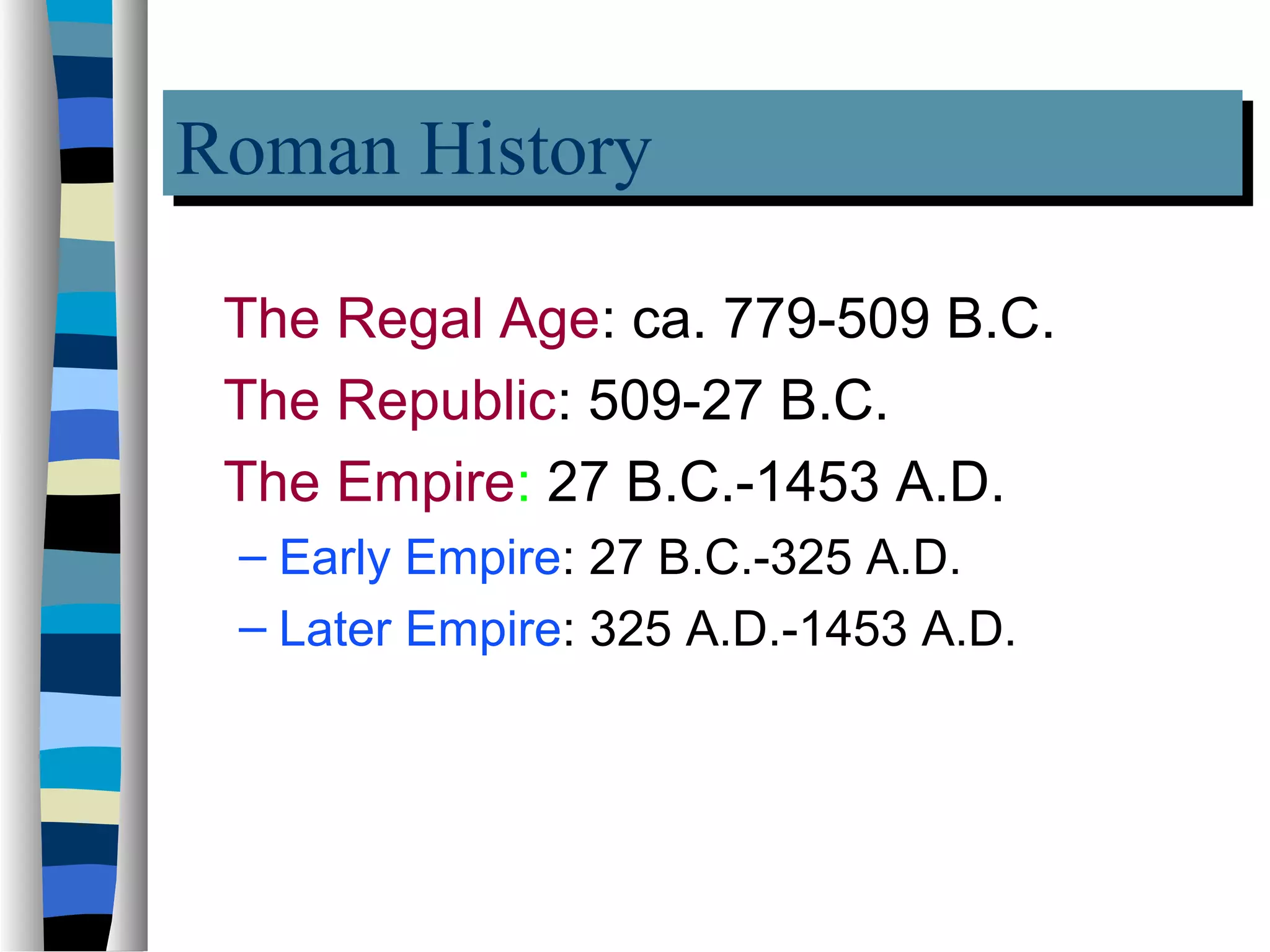
Roman History
 The Regal Age: ca. 779-509 B.C.
 The Republic: 509-27 B.C.
 The Empire: 27 B.C.-1453 A.D.
 – Early Empire: 27 B.C.-325 A.D.
 – Later Empire: 325 A.D.-1453 A.D.
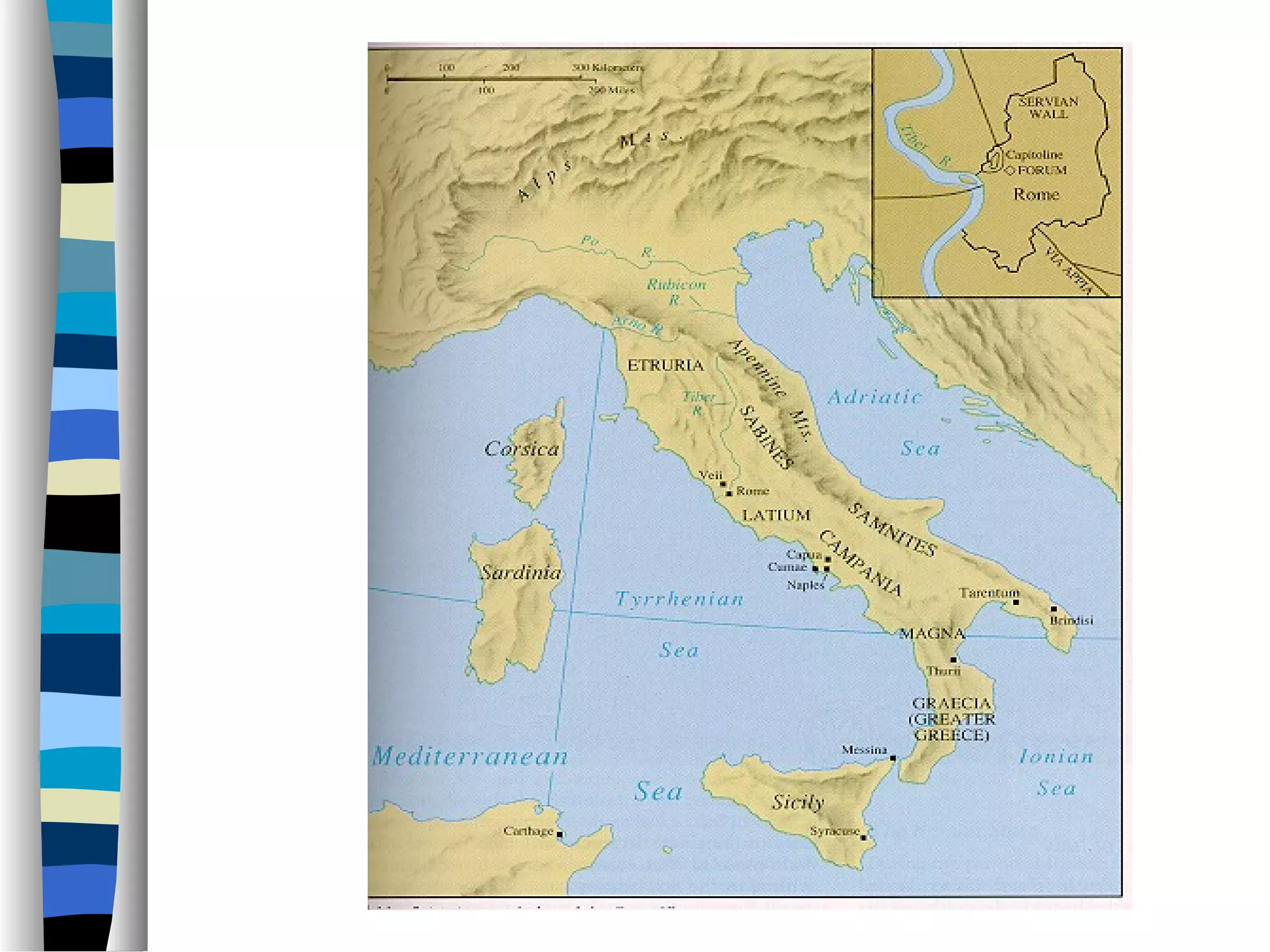
Location
Location
 Italy
 Tiber River
 between Etruscan and Greek cities
 part of the Latin League
Early history
Early history
 Indo-European
 entered Italy ca. 2000 B.C.
 settled south of the Tiber
 primitive institutions
The Kings
The Kings
 Seven kings
 Romulus
 historical kings?
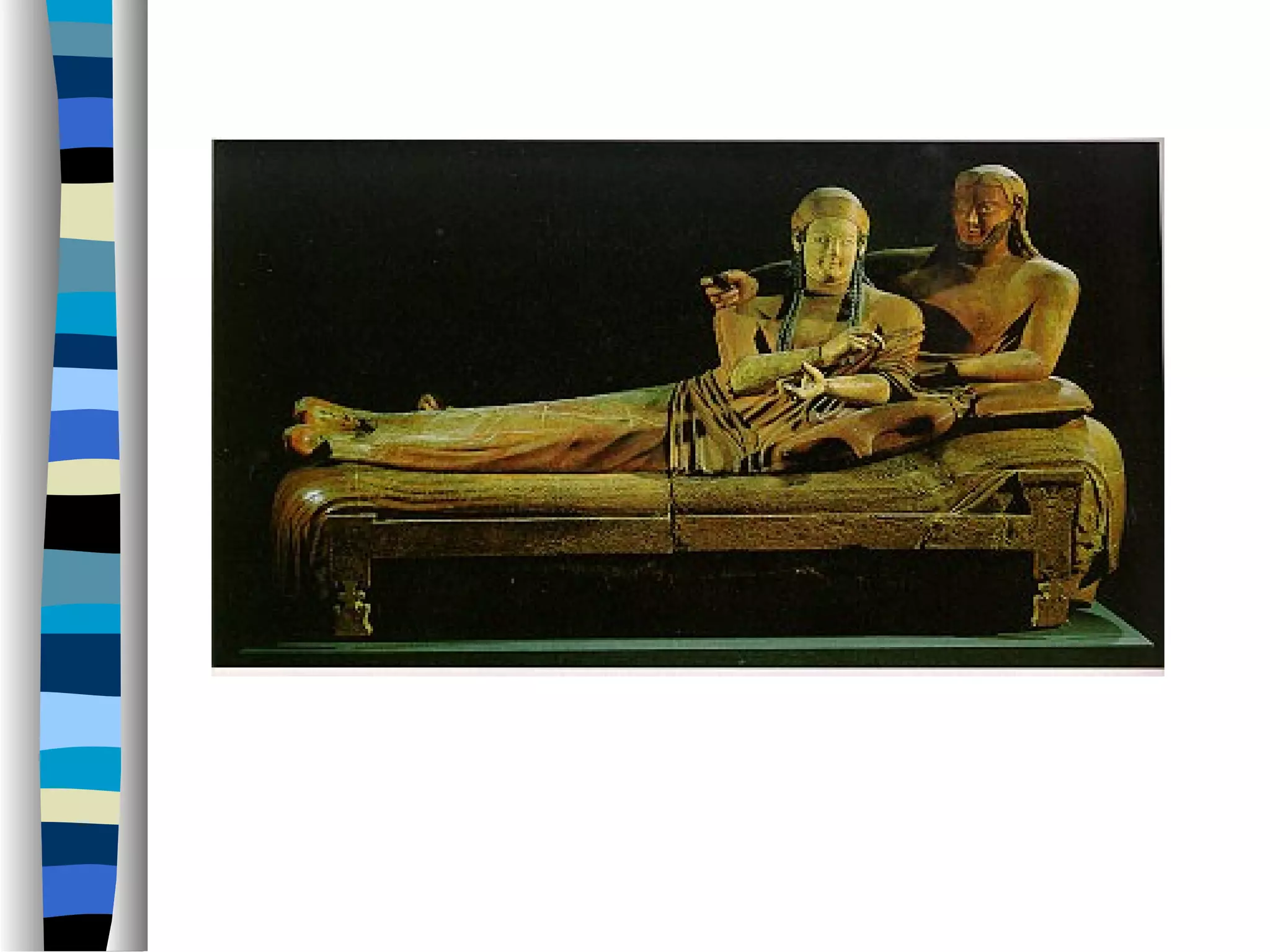
 – the Etruscan kings
 – the last three
The Republic
The Republic
 revolution
 patricians (2-4%) and plebeians (96-
 98%)
 constitutional government
 – influenced by Athens?
 – the constitution of Cleisthenes?
Offices
Offices
 2 consuls
 2 praetors
 aediles
 quaestors
 dictator
Important institutions
 the assemblies
 the elective offices
 patron-client relationships
 The Twelve Tables
Struggle of the Orders
 struggle for political participation
 plebeian institutions: the tribunes
 the secessions
 the compromises
 – no political violence until 133 B.C.
Roman Expansion
Roman Expansion
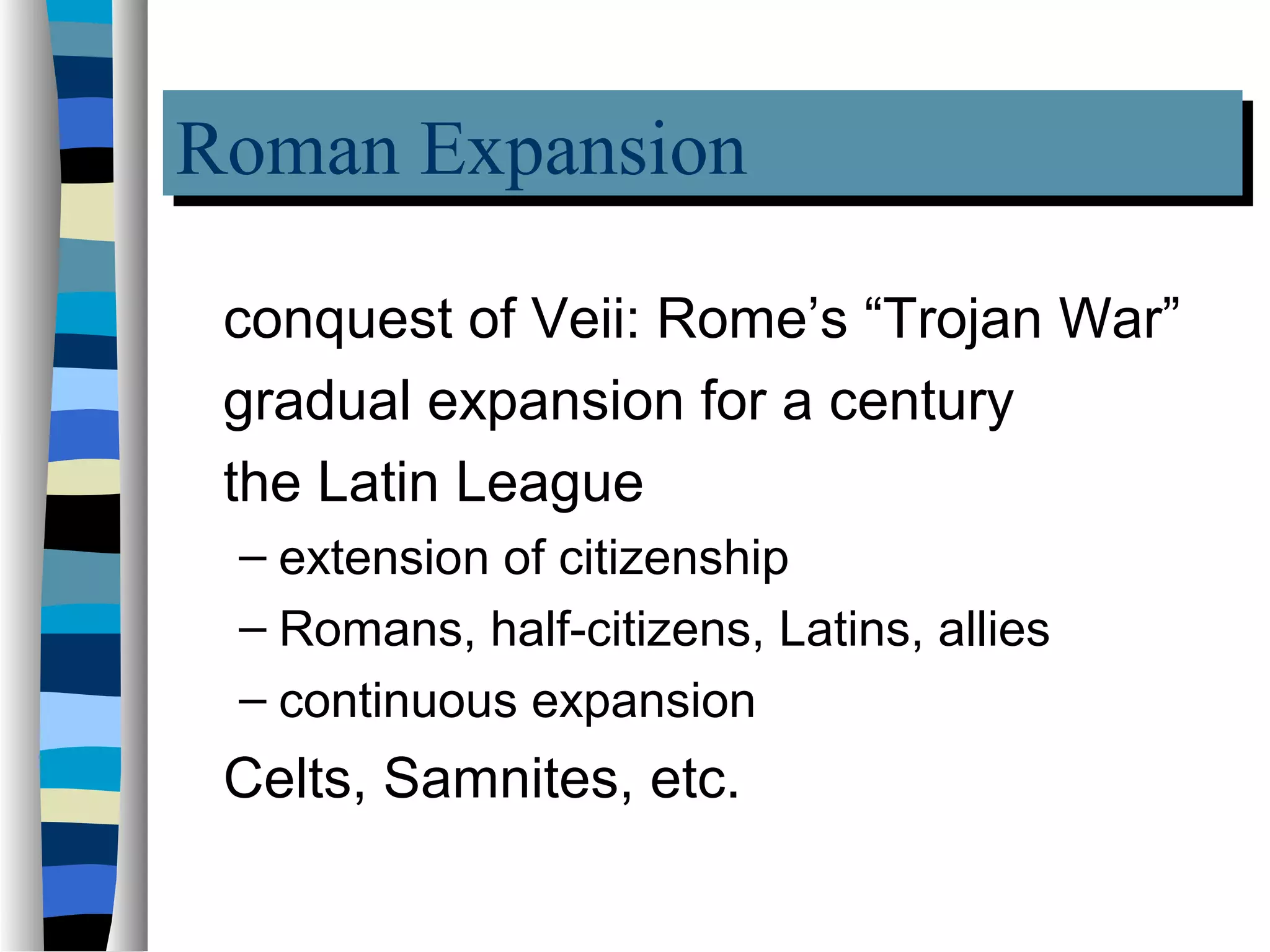
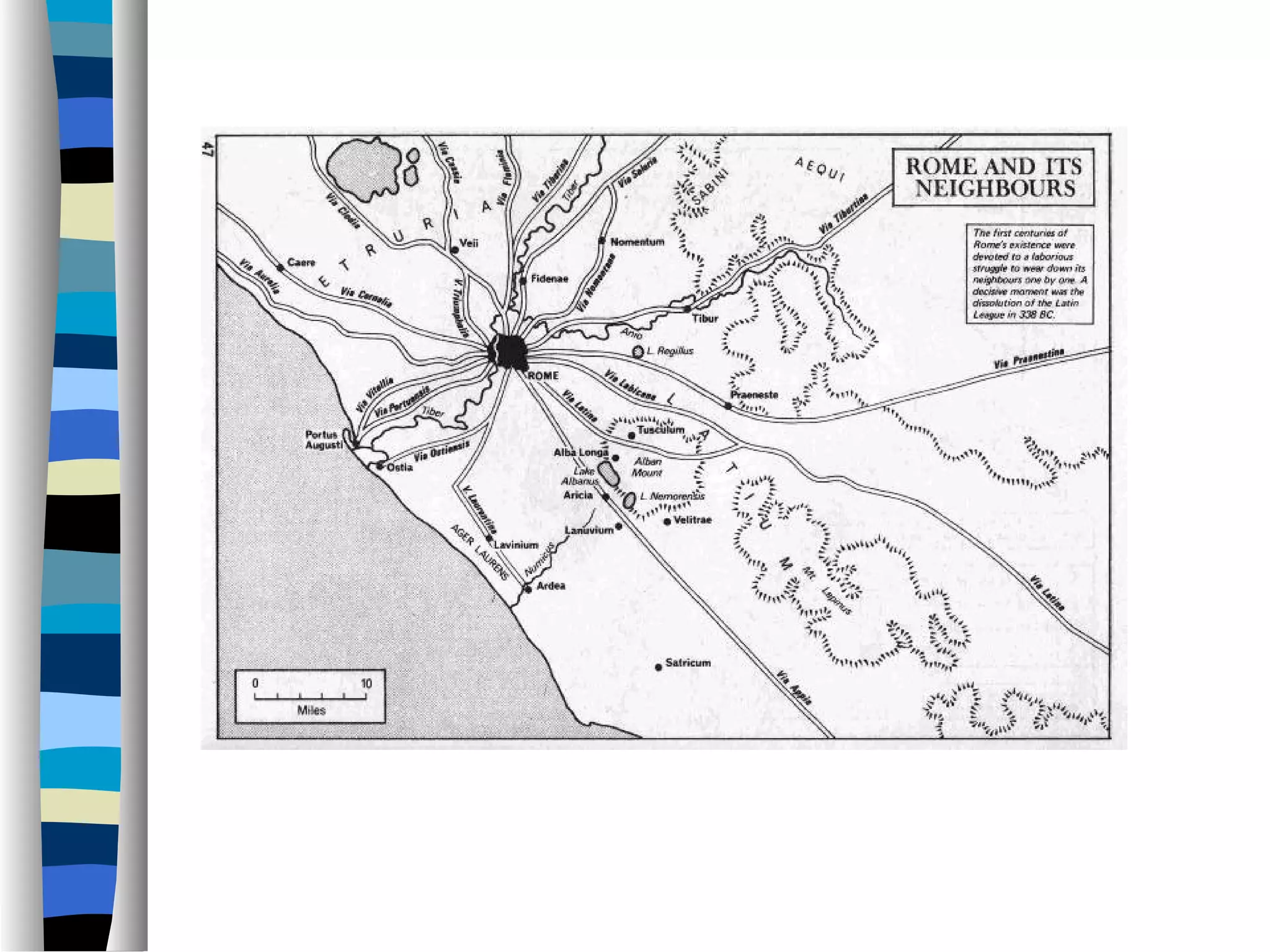
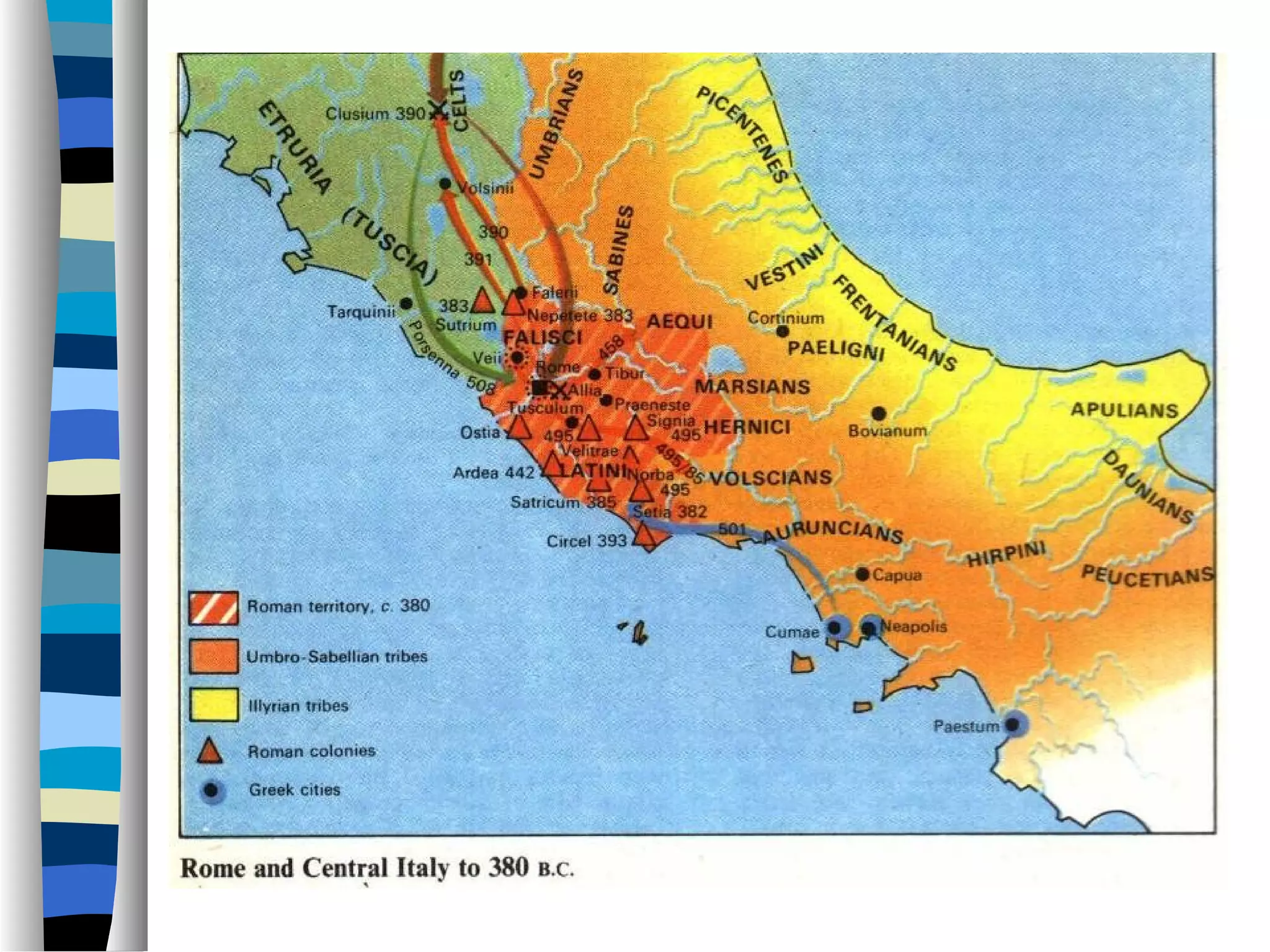
 conquest of Veii: Rome’s “Trojan War”
 gradual expansion for a century
 the Latin League
 – extension of citizenship
 – Romans, half-citizens, Latins, allies
 – continuous expansion
 Celts, Samnites, etc.
Expansion, con’t
Expansion, con’t
 Etruscans
 Greeks
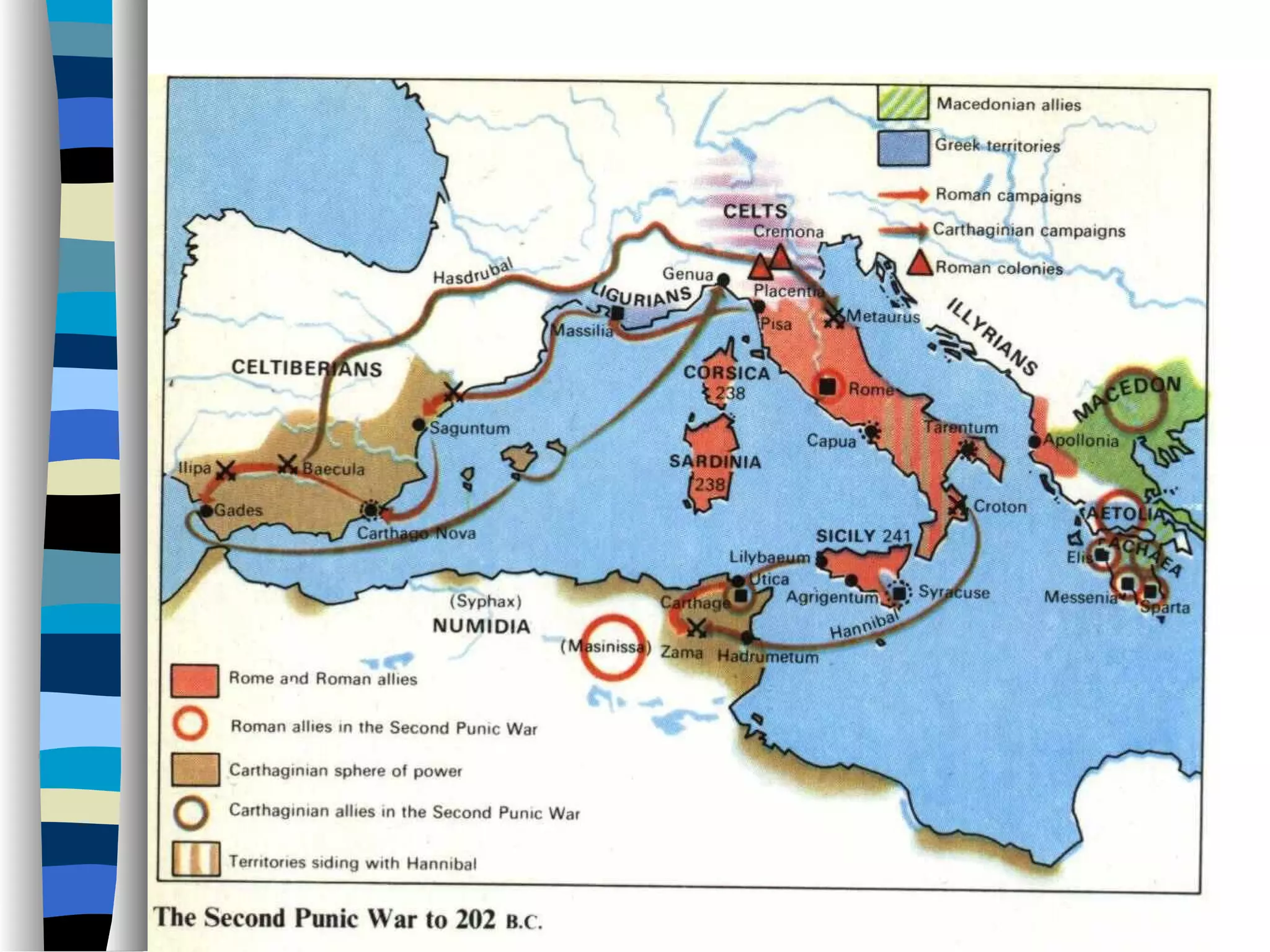
 Carthage ???
 – three Punic Wars
 – 254, 220, 146 B.C.
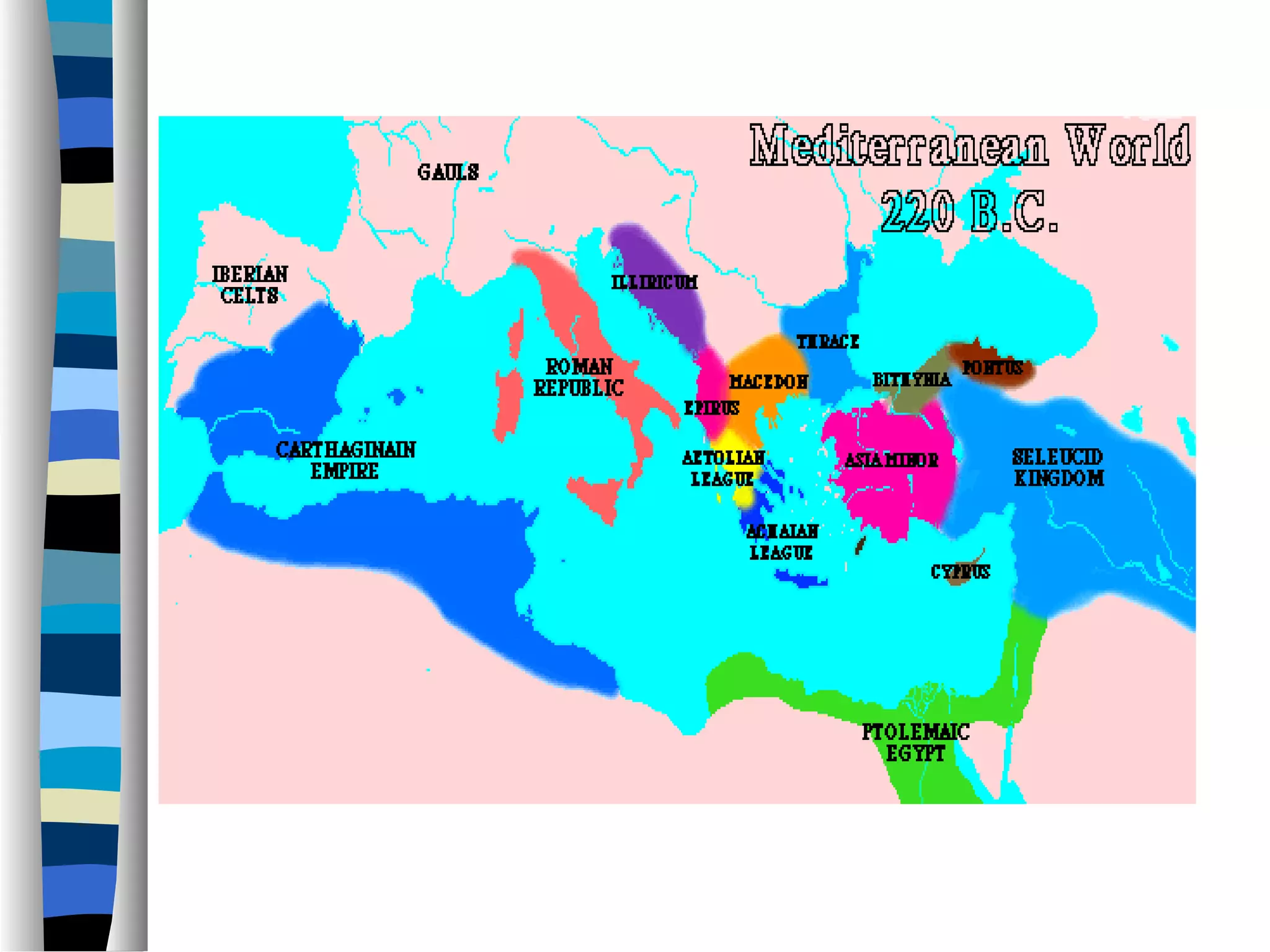
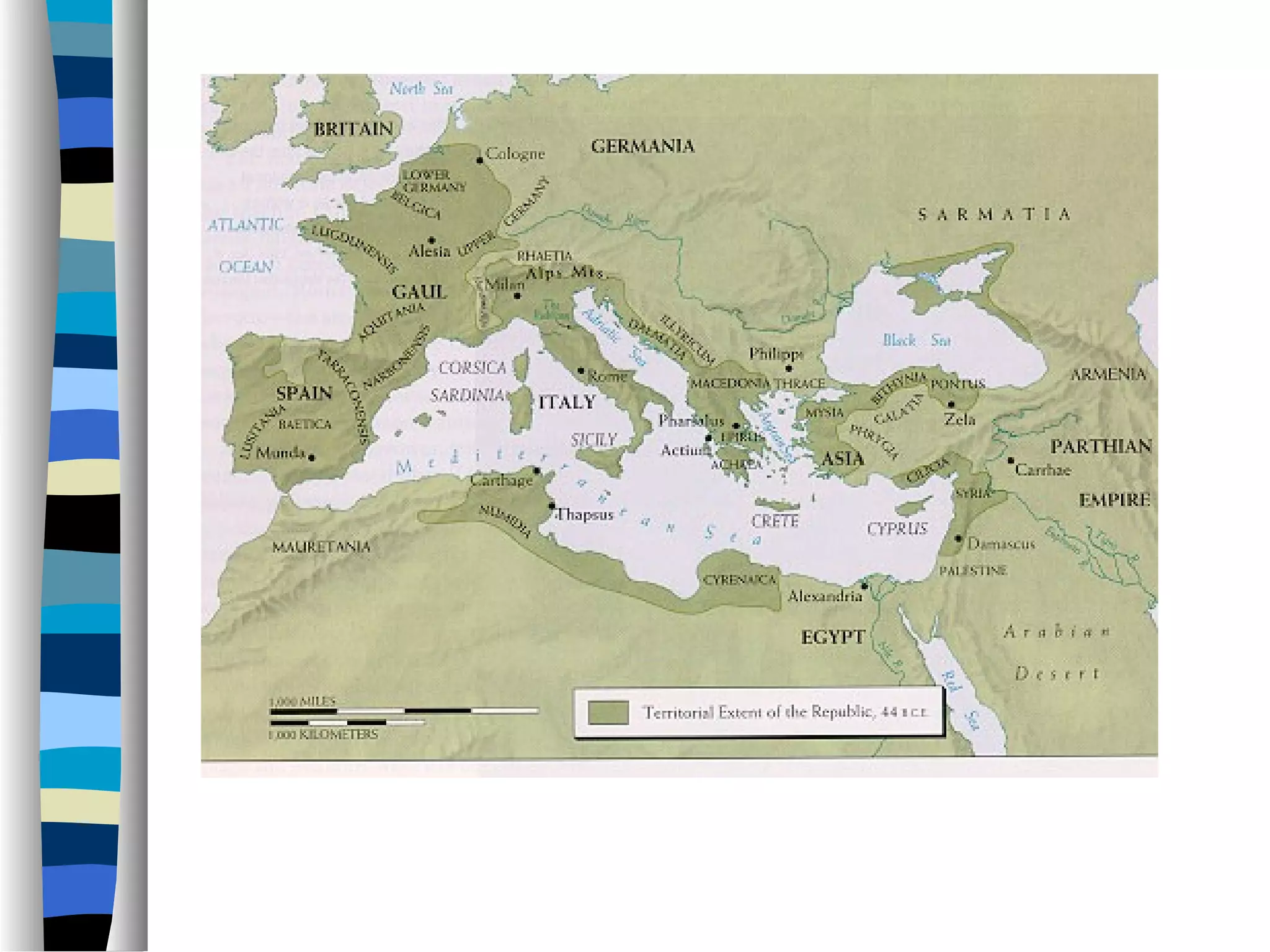
 control of Western Mediterranean
Expansion, con’t
Expansion, con’t
 the Hellenistic Monarchies
 the Greek Federal Leagues
 lots of wars, Romans are dragged in...a
 lot
 Romans get tired of it
 control of most of the Med. basin by
 100 B.C.
 but still essentially a city-state
Roman Religion
Roman Religion
 rustic Italian cults
 overlay of Greek religion
 Etruscan influences
 Romans as “pack rats”
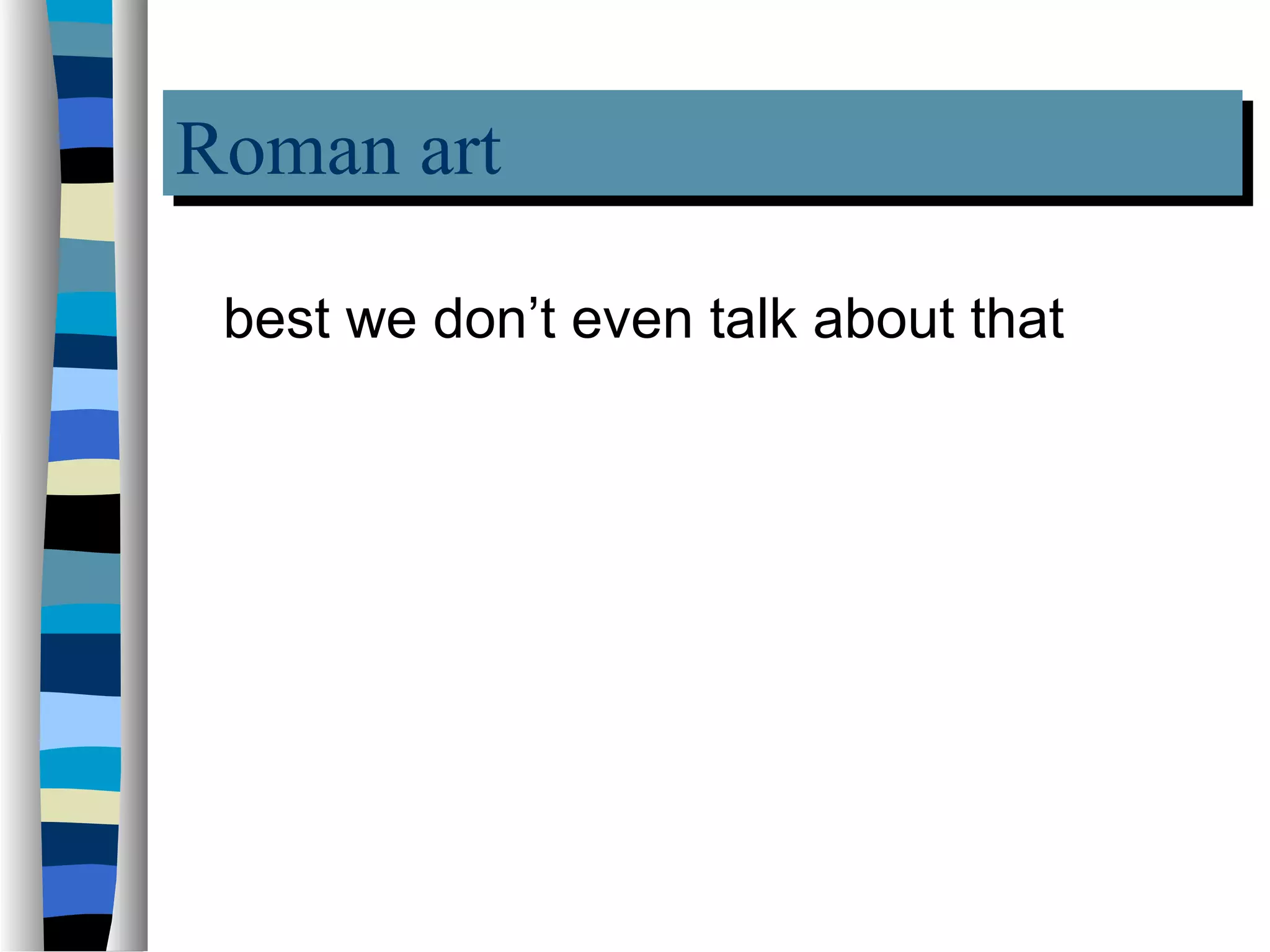
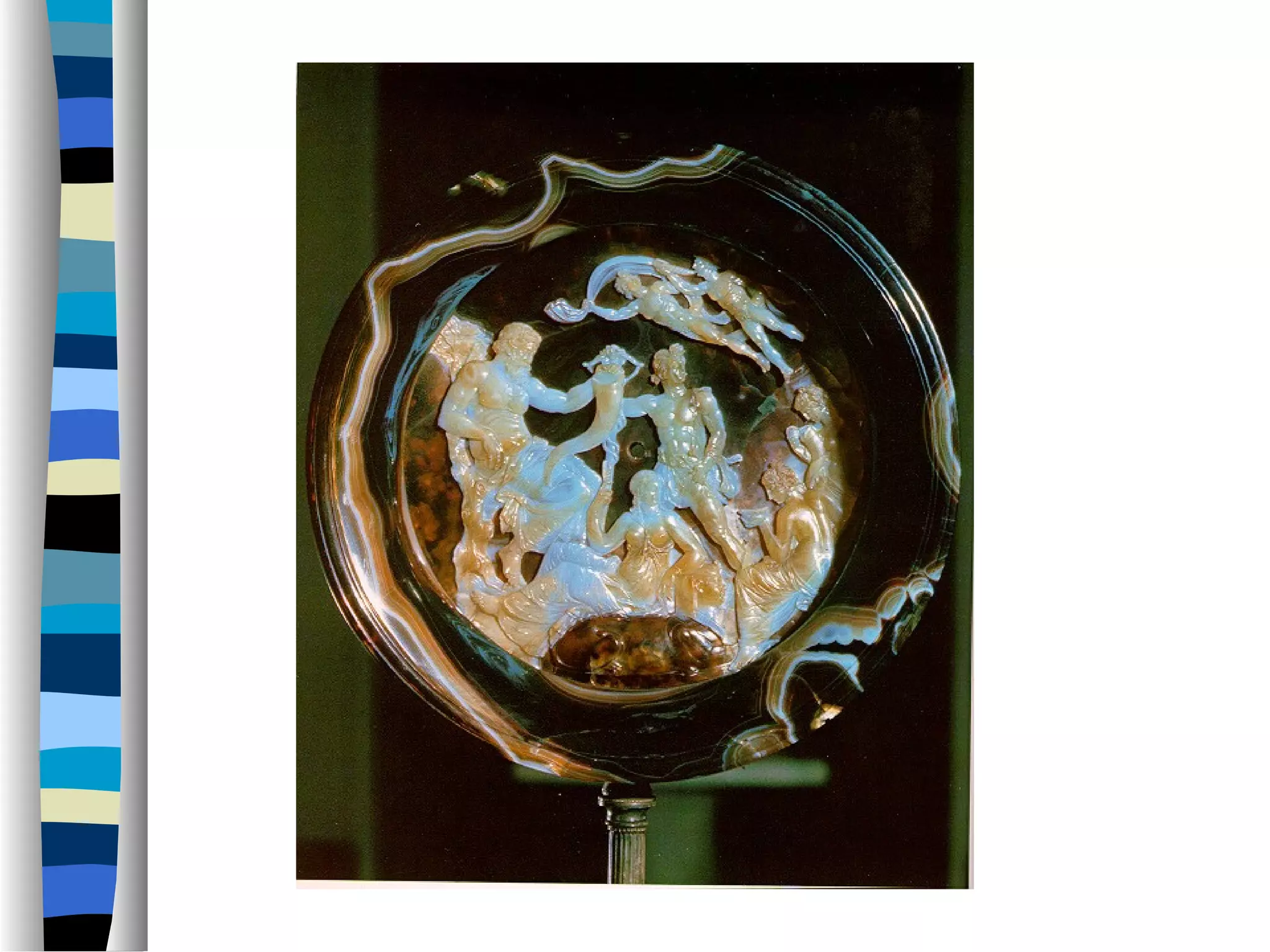
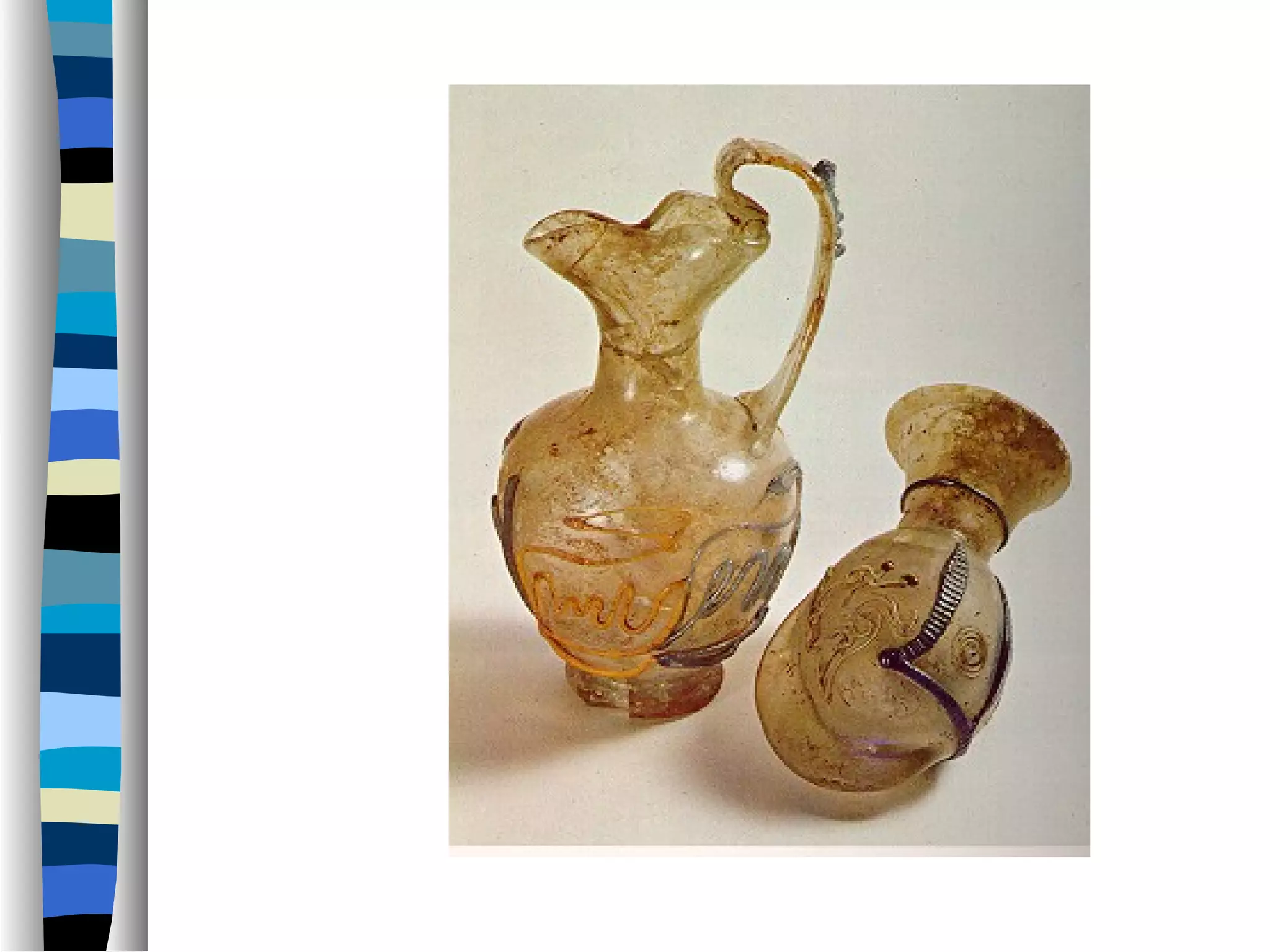
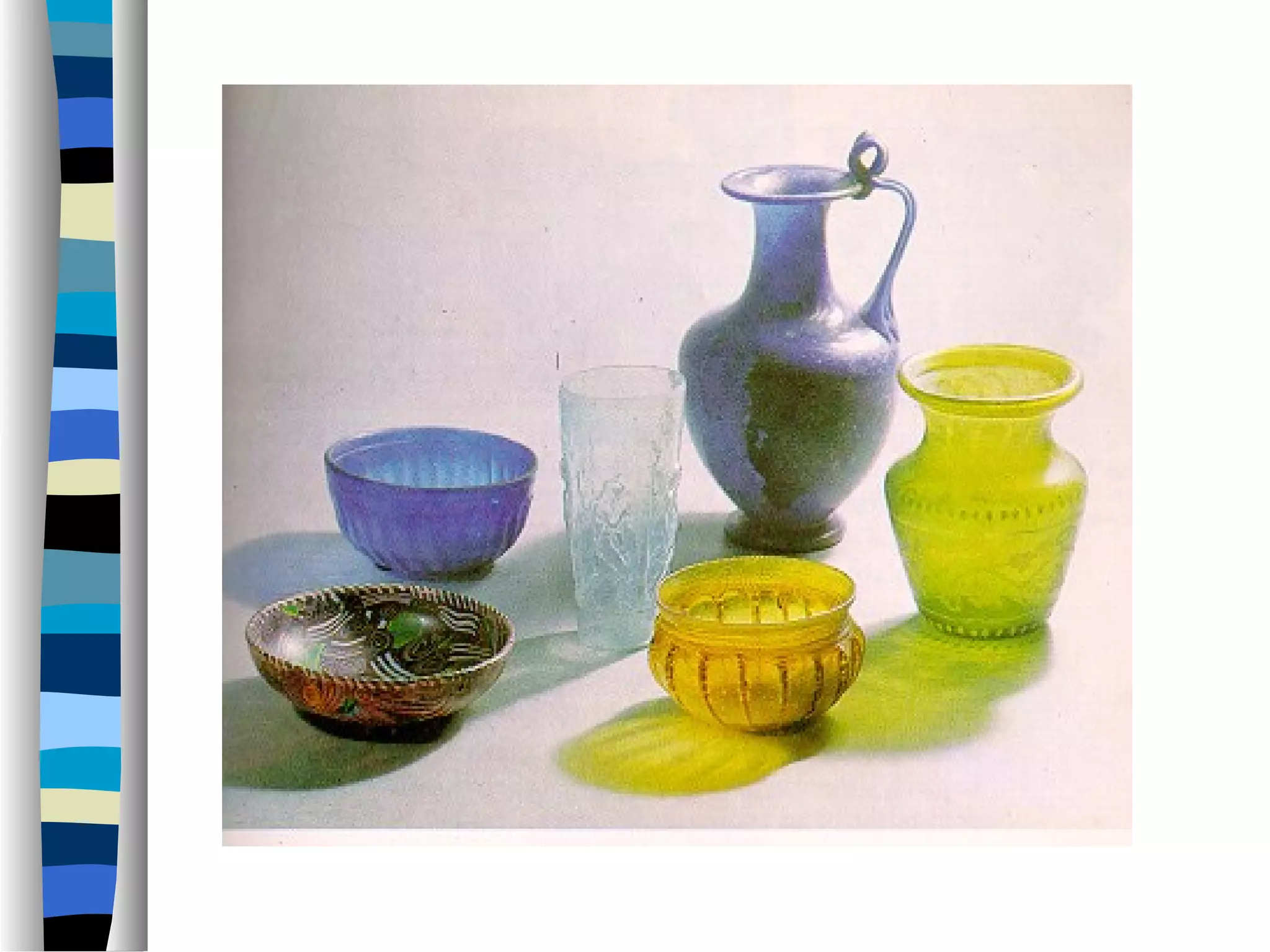
Roman art
Roman art
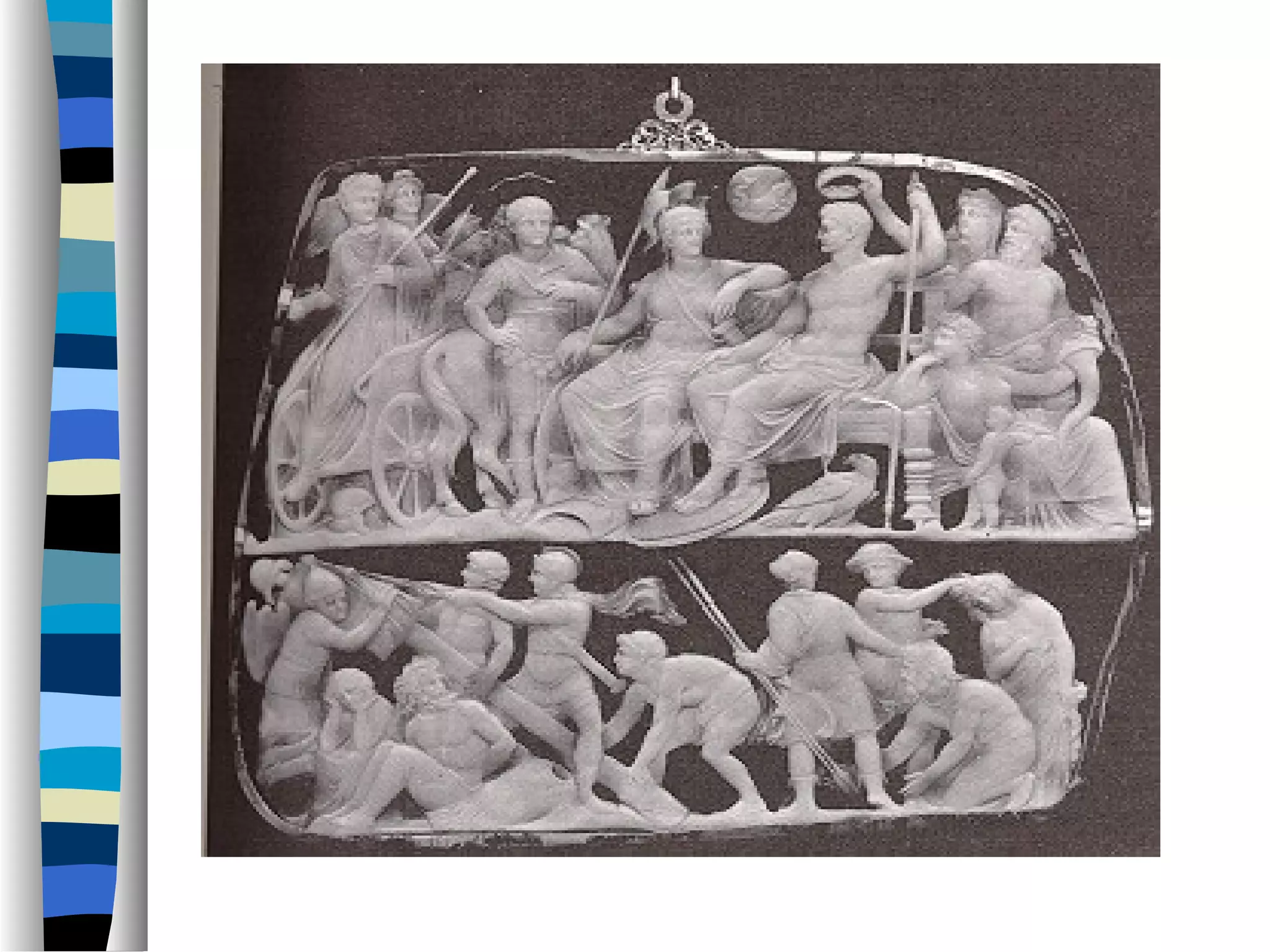
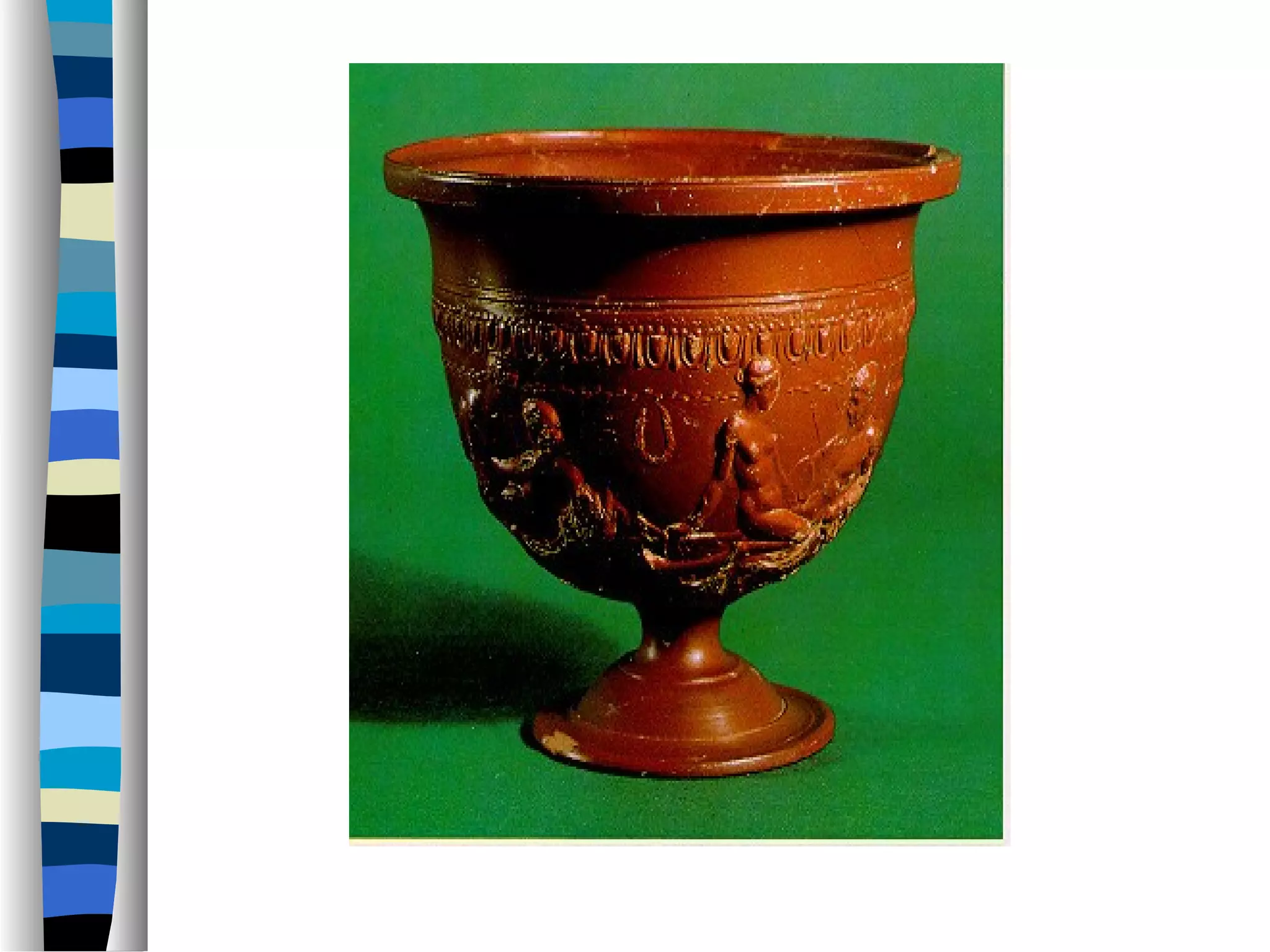
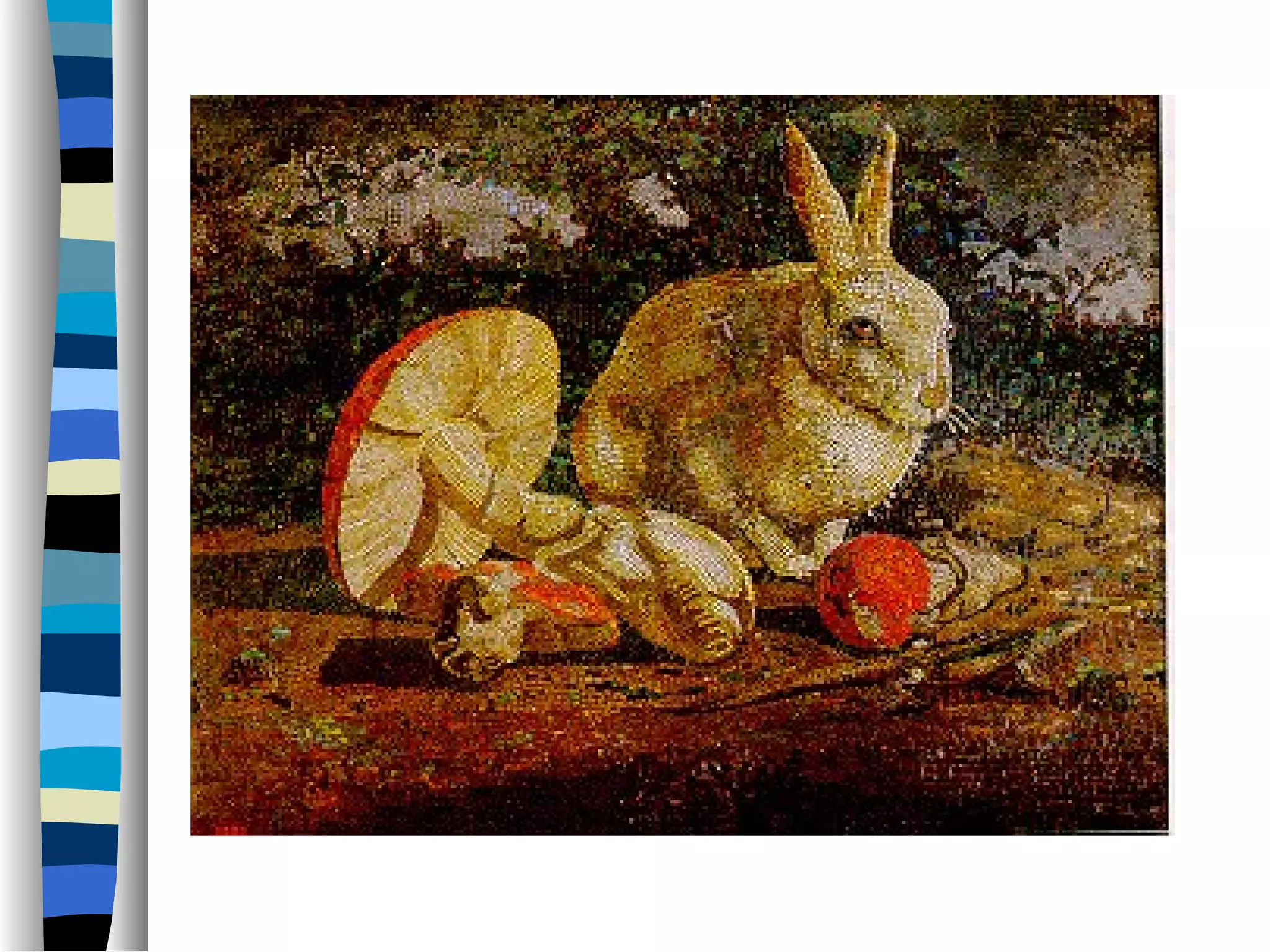
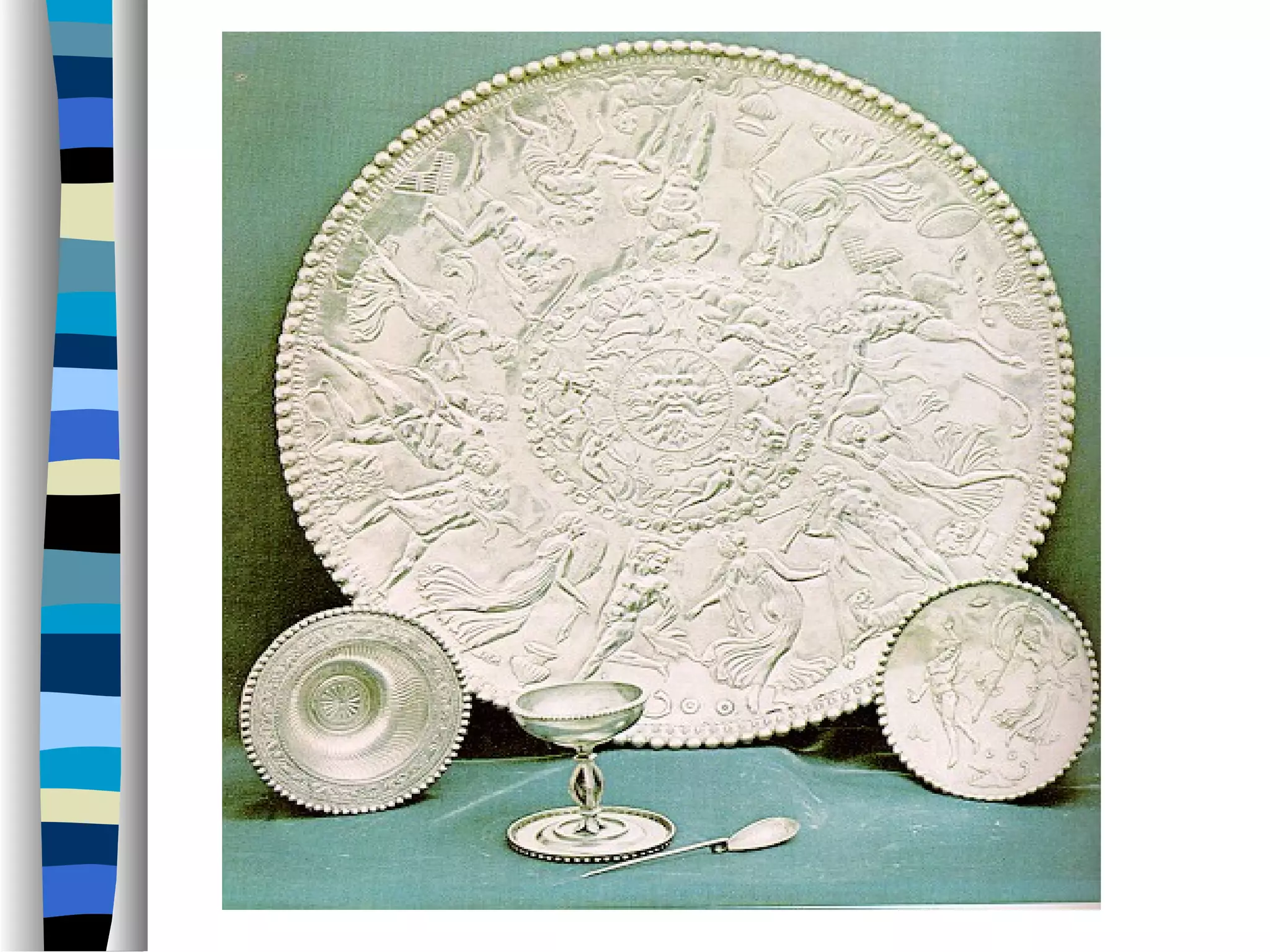
 best we don’t even talk about that
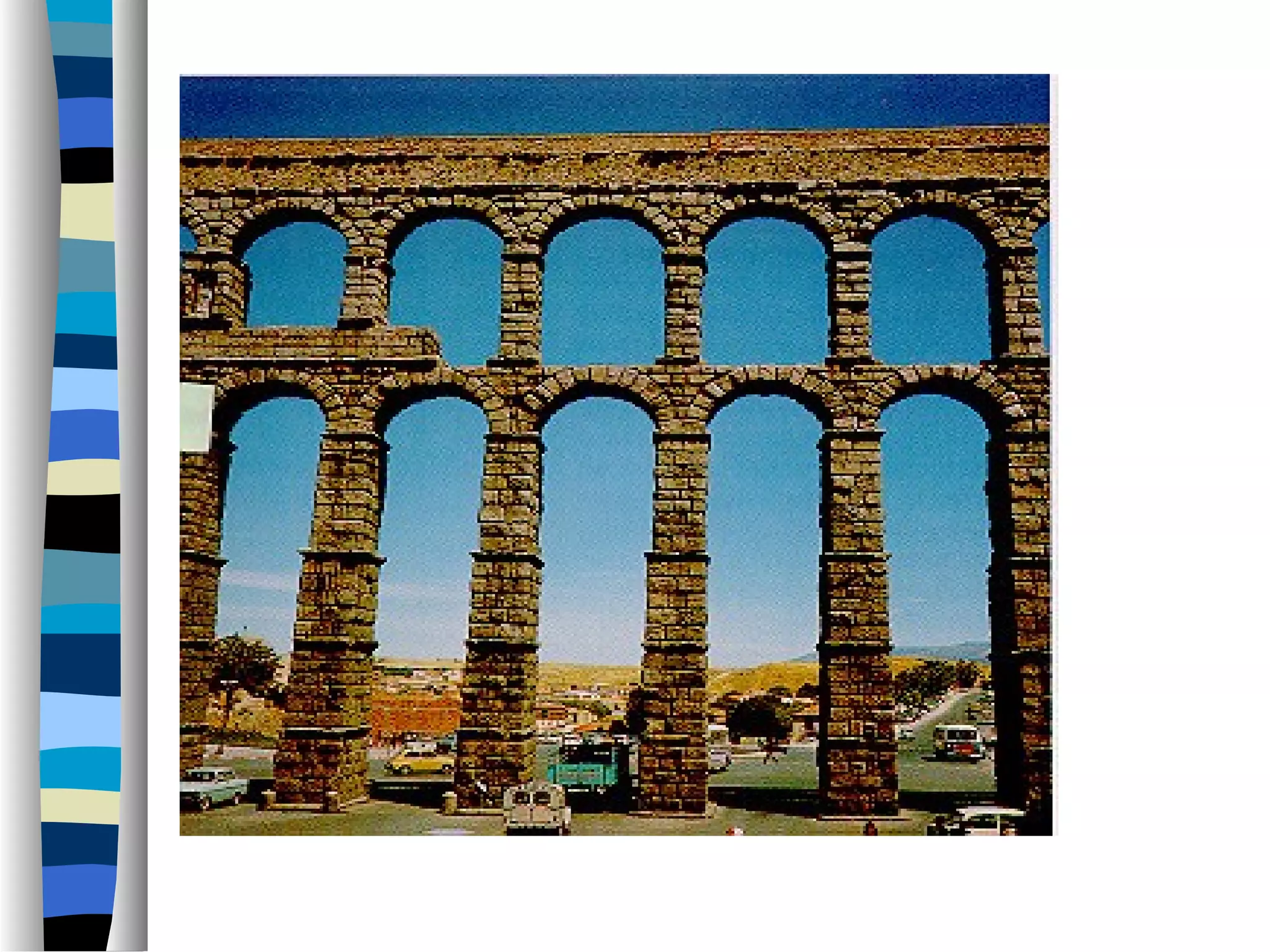
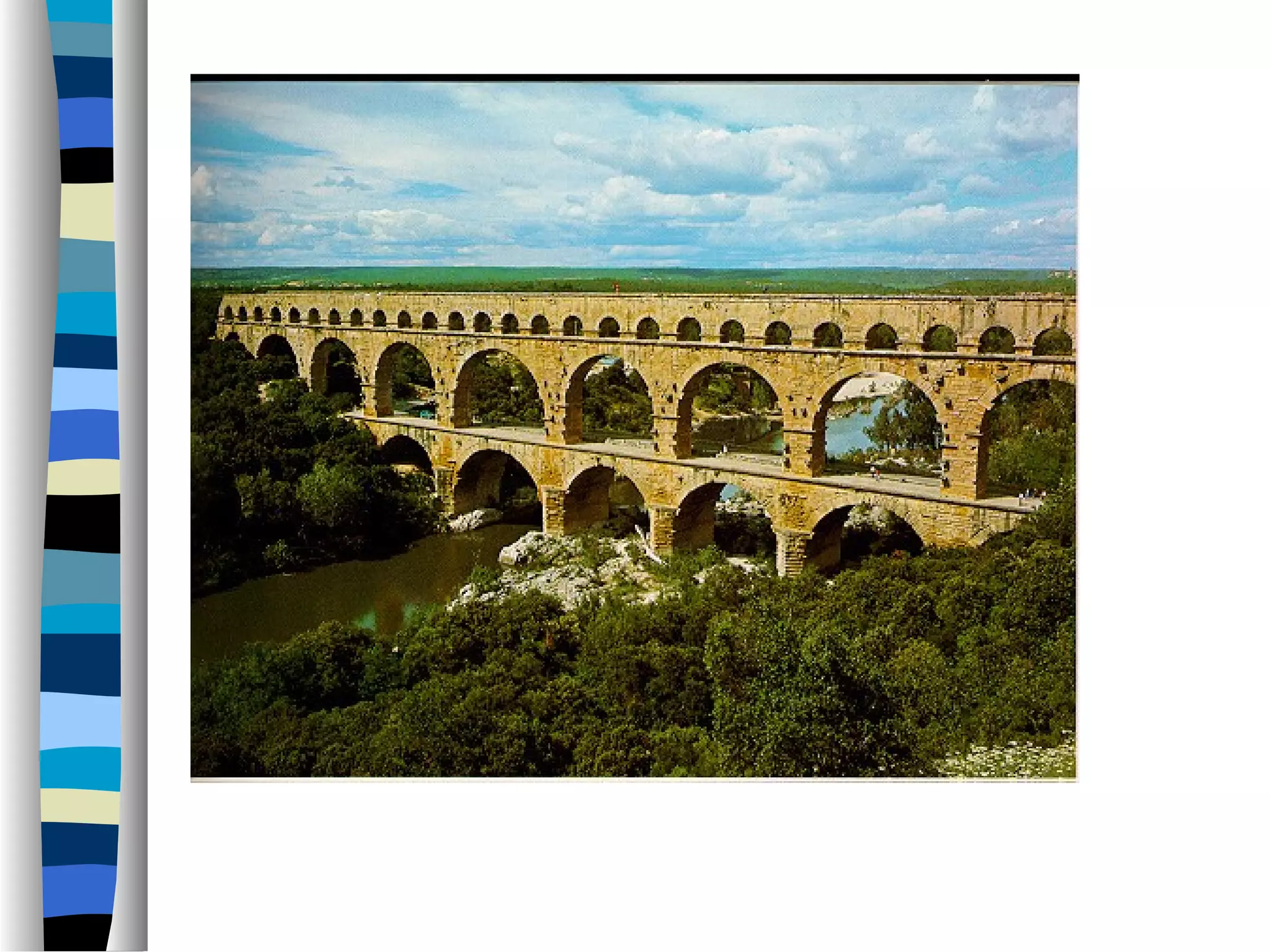
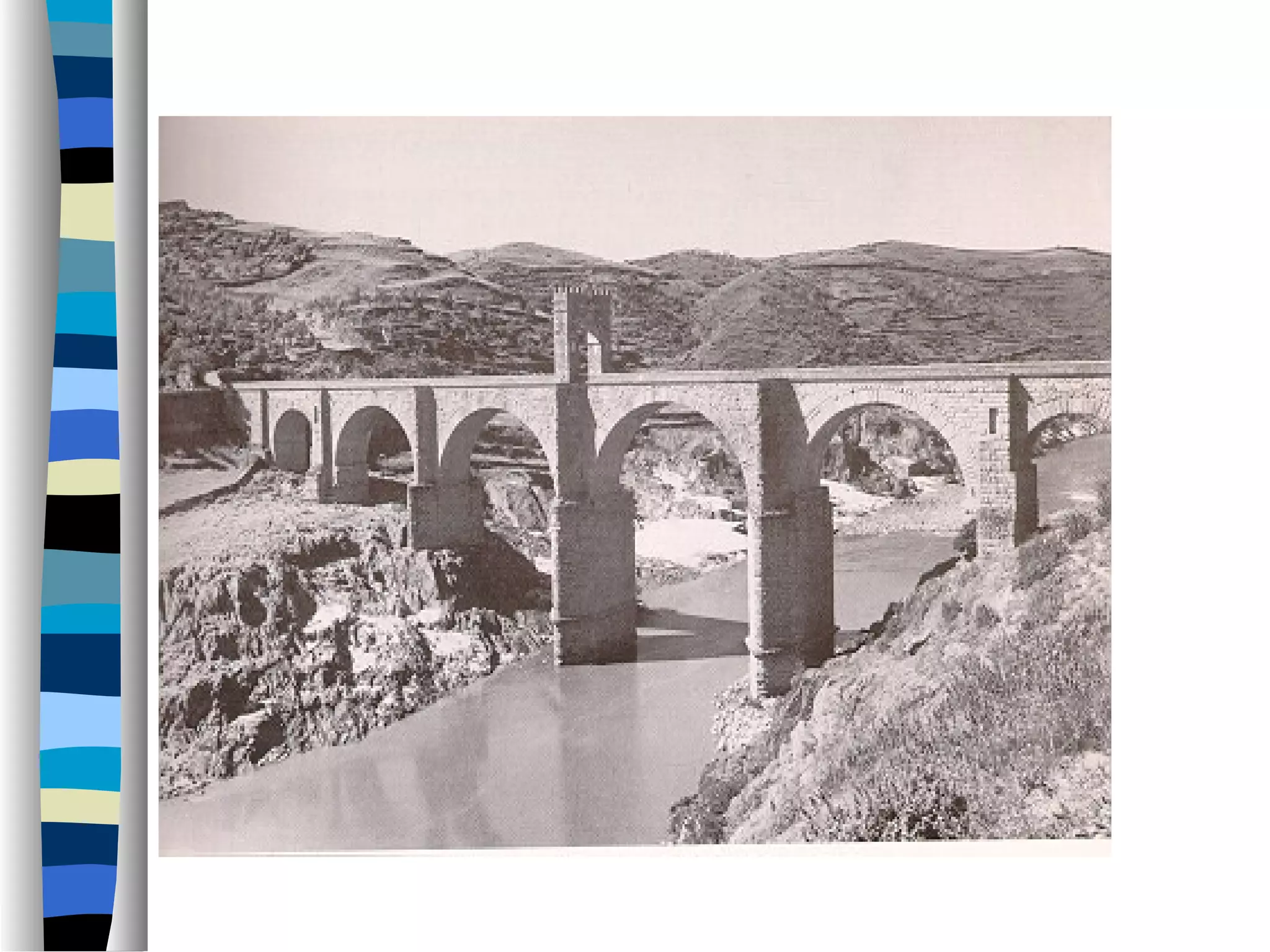
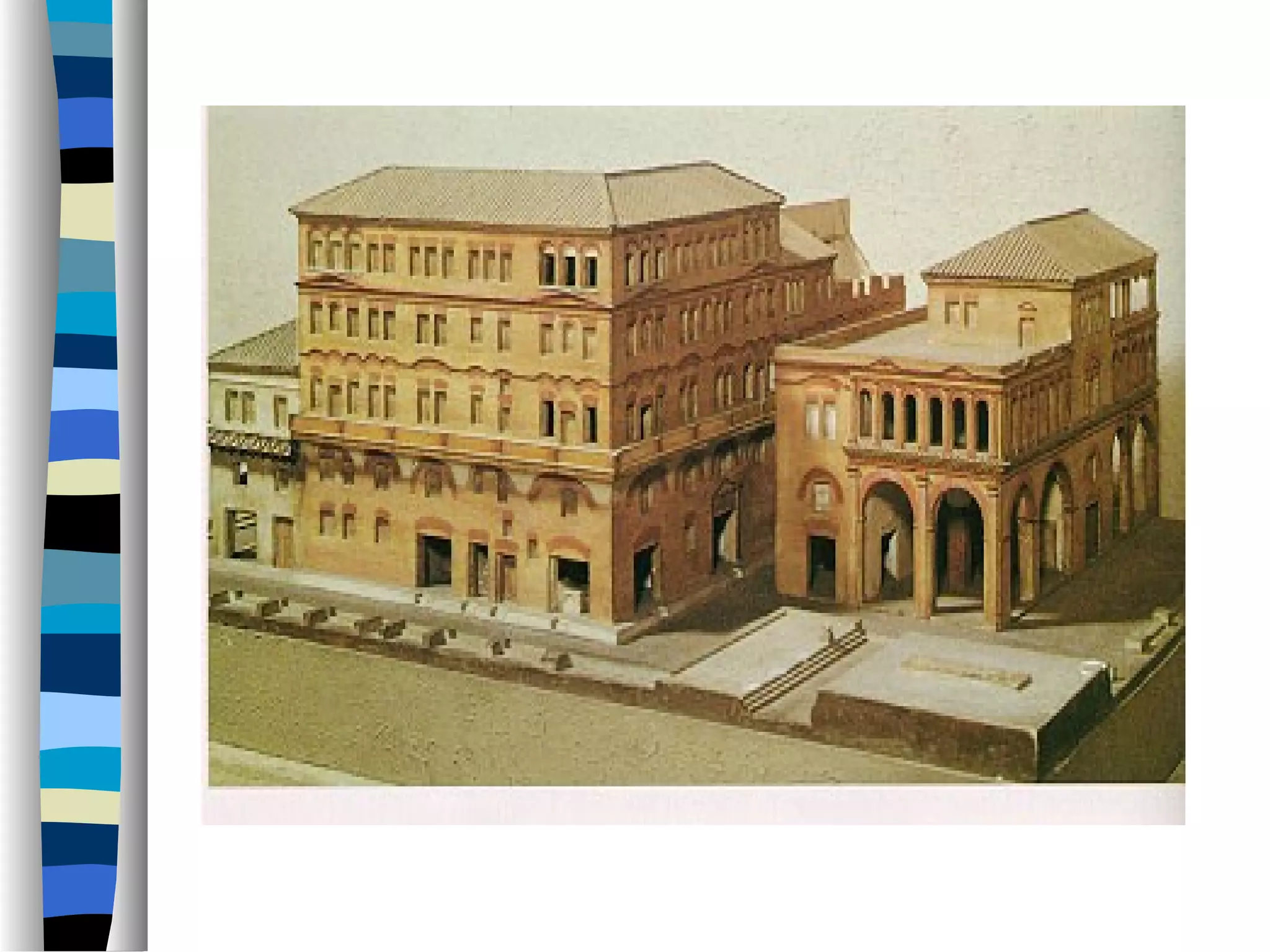
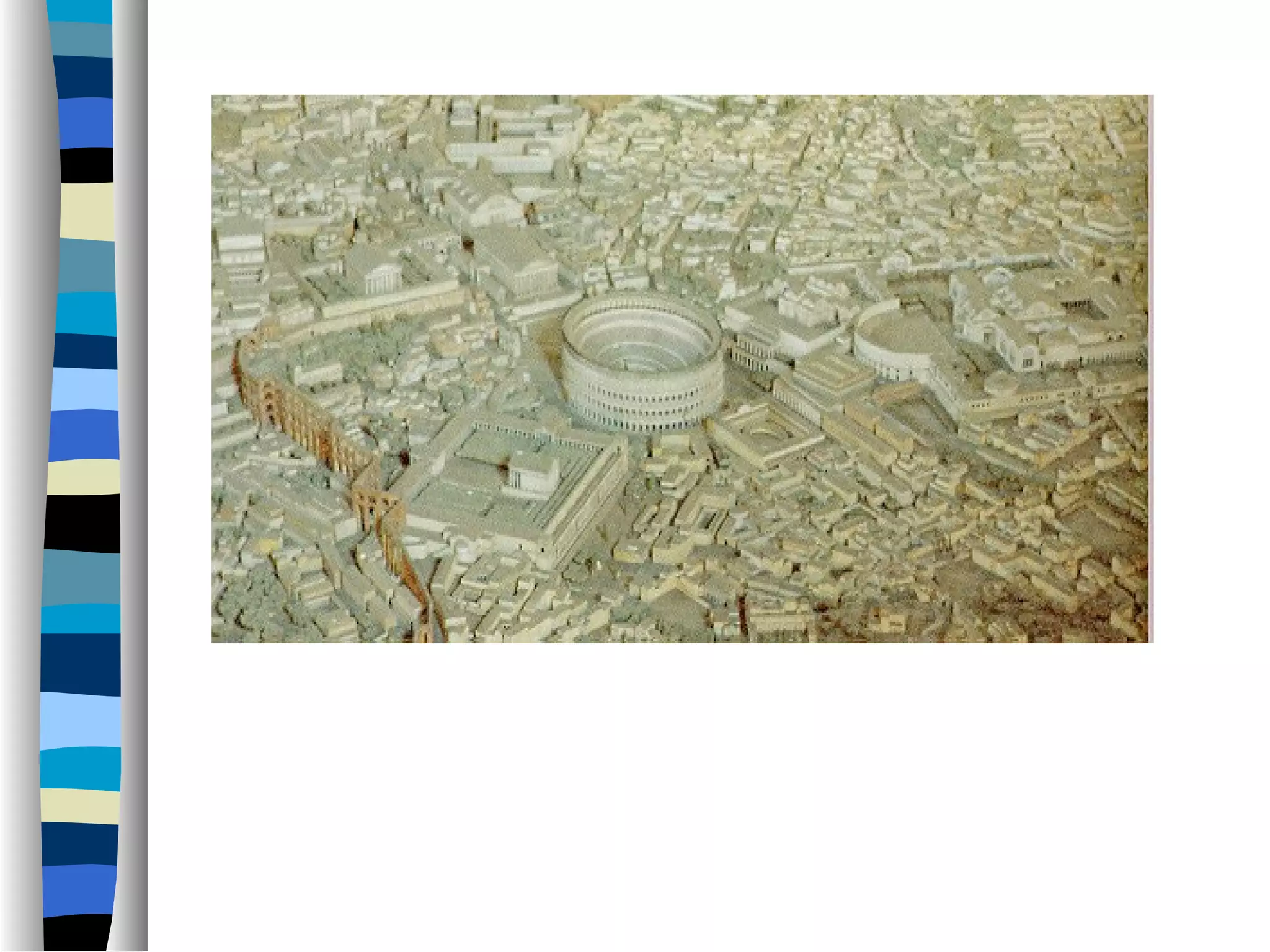
Roman architecture
Roman architecture
 great skill
 engineers and architects
 roads, cities
 concrete
Roman Literature
Roman Literature
 copied from Greek models
 interests in rhetoric, law, and satire
 Stoic and Epicurean philosophy
The Late Republic: 133-27 B.C.
 introduction of violence into domestic
 politics
 competition for status and recognition
 civil war
Important Figures
Important Figures
 Tiberius and Gaius Gracchus
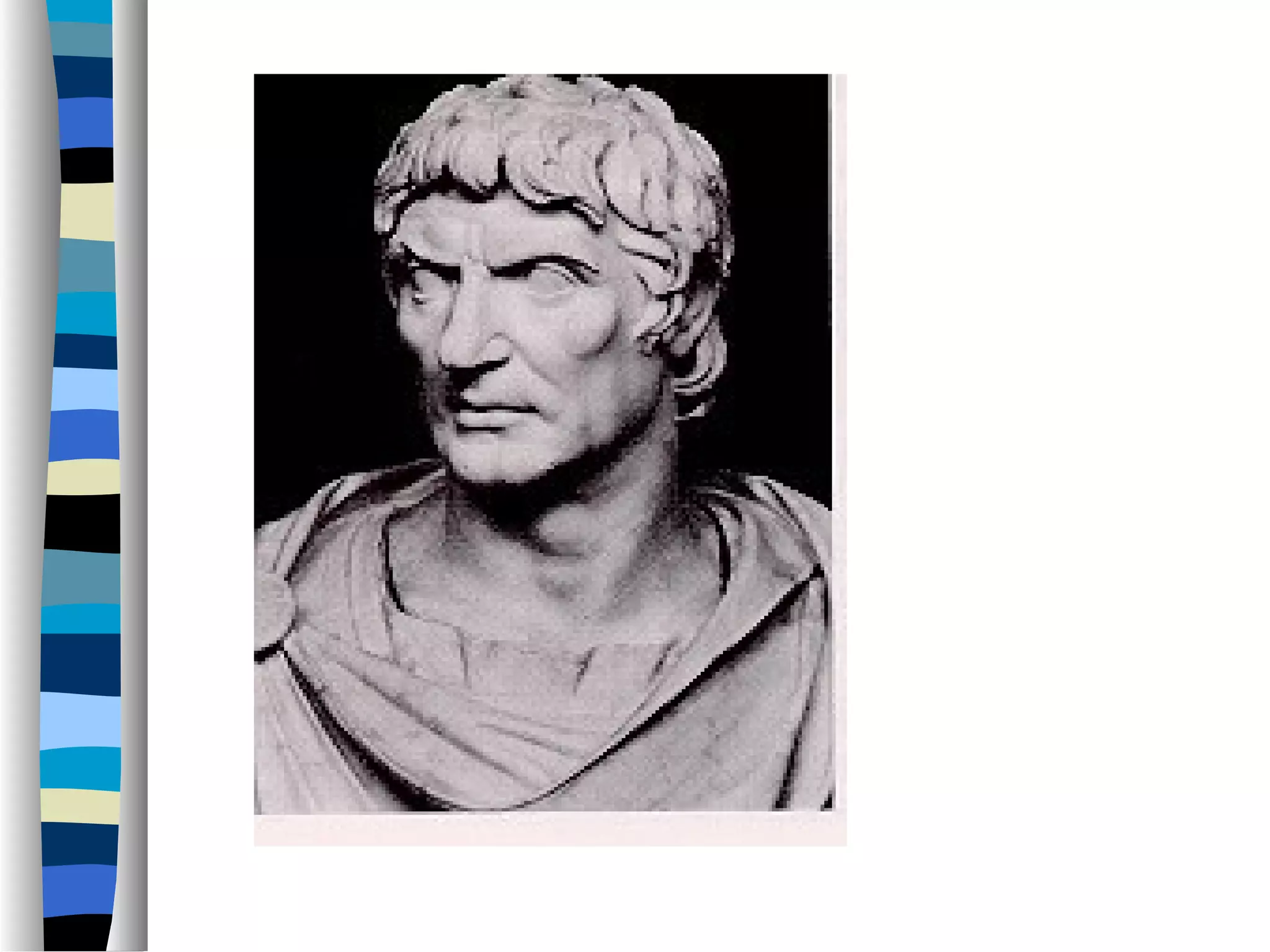
 Marius and Sulla
 Pompey the Great, Marcus Crassus,
 Julius Caesar
 – First Triumvirate
 Marc Antony, Marcus Lepidus, Octavian
 Caesar
 – Second Triumvirate
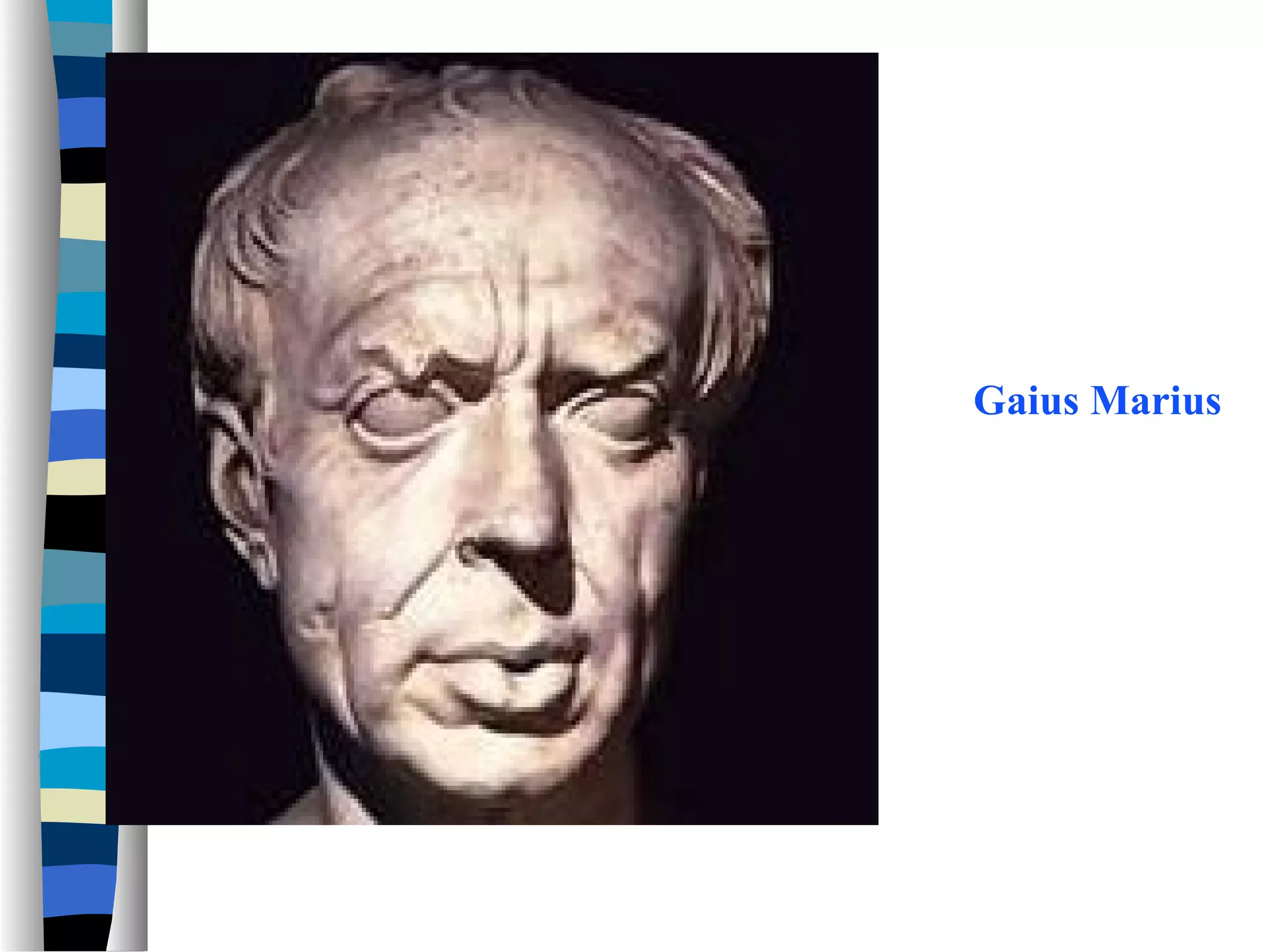
Gaius Marius
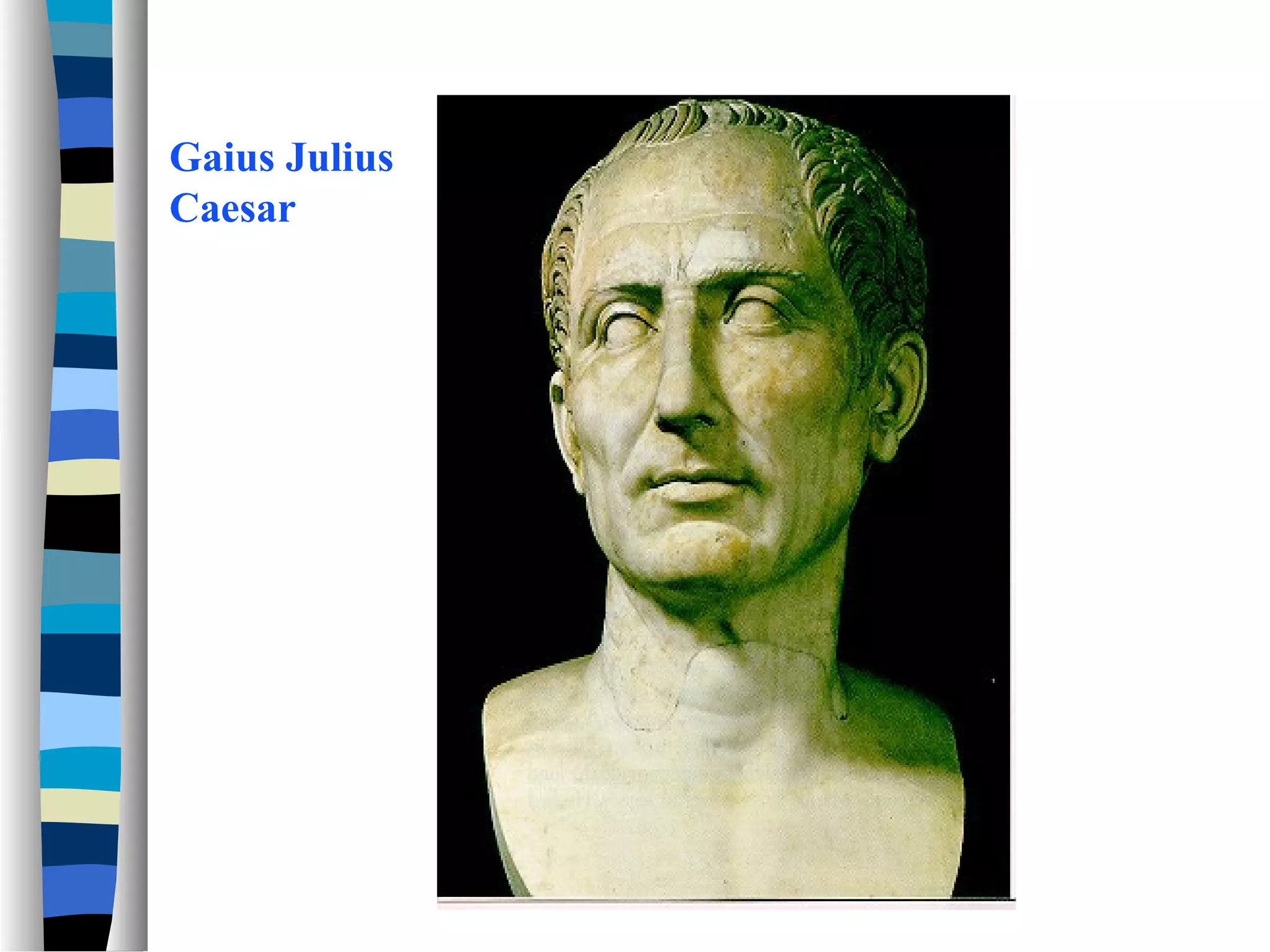
Gaius Julius
Caesar
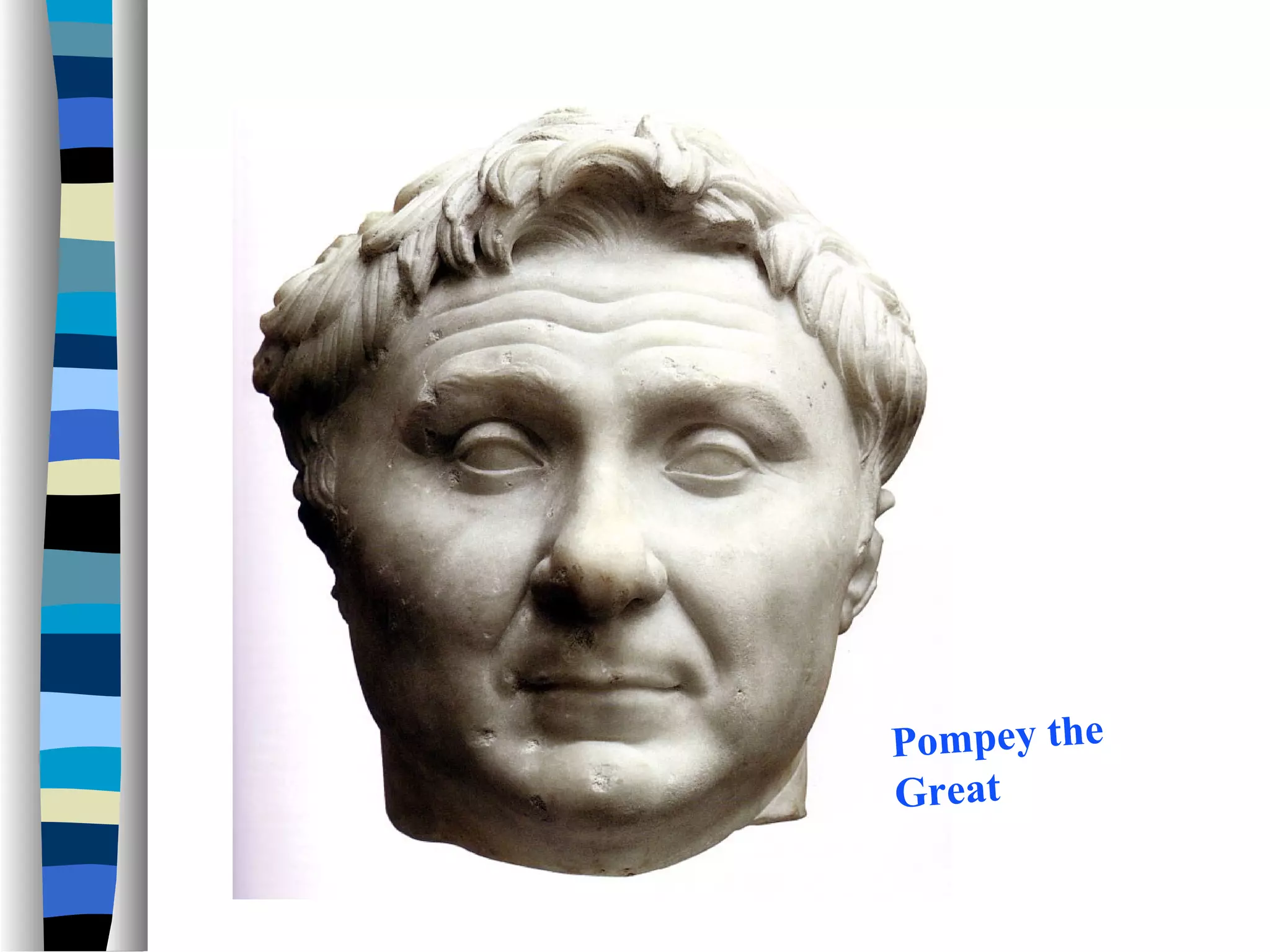
Pompey the
Great
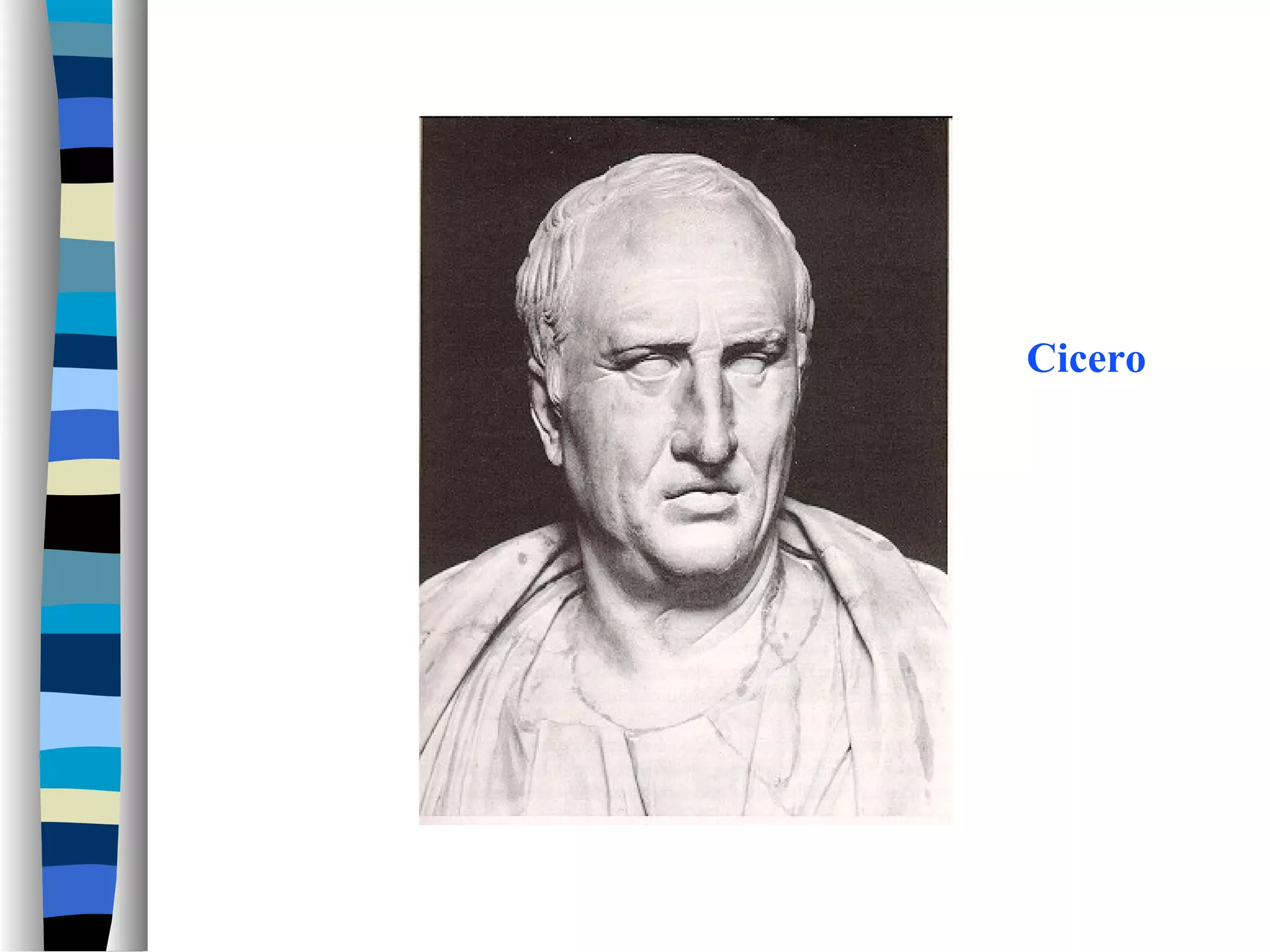
Cicero
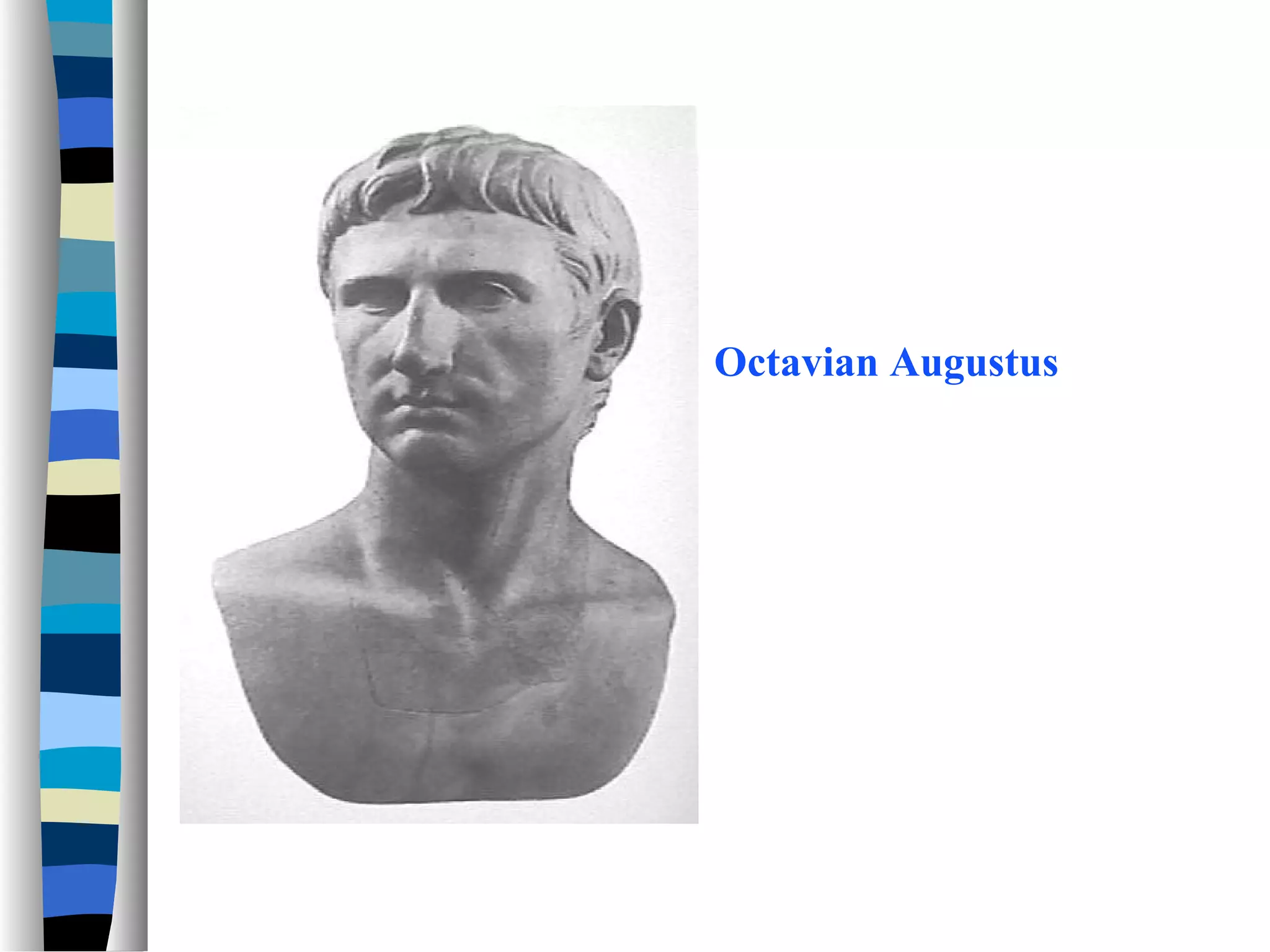
Octavian Augustus
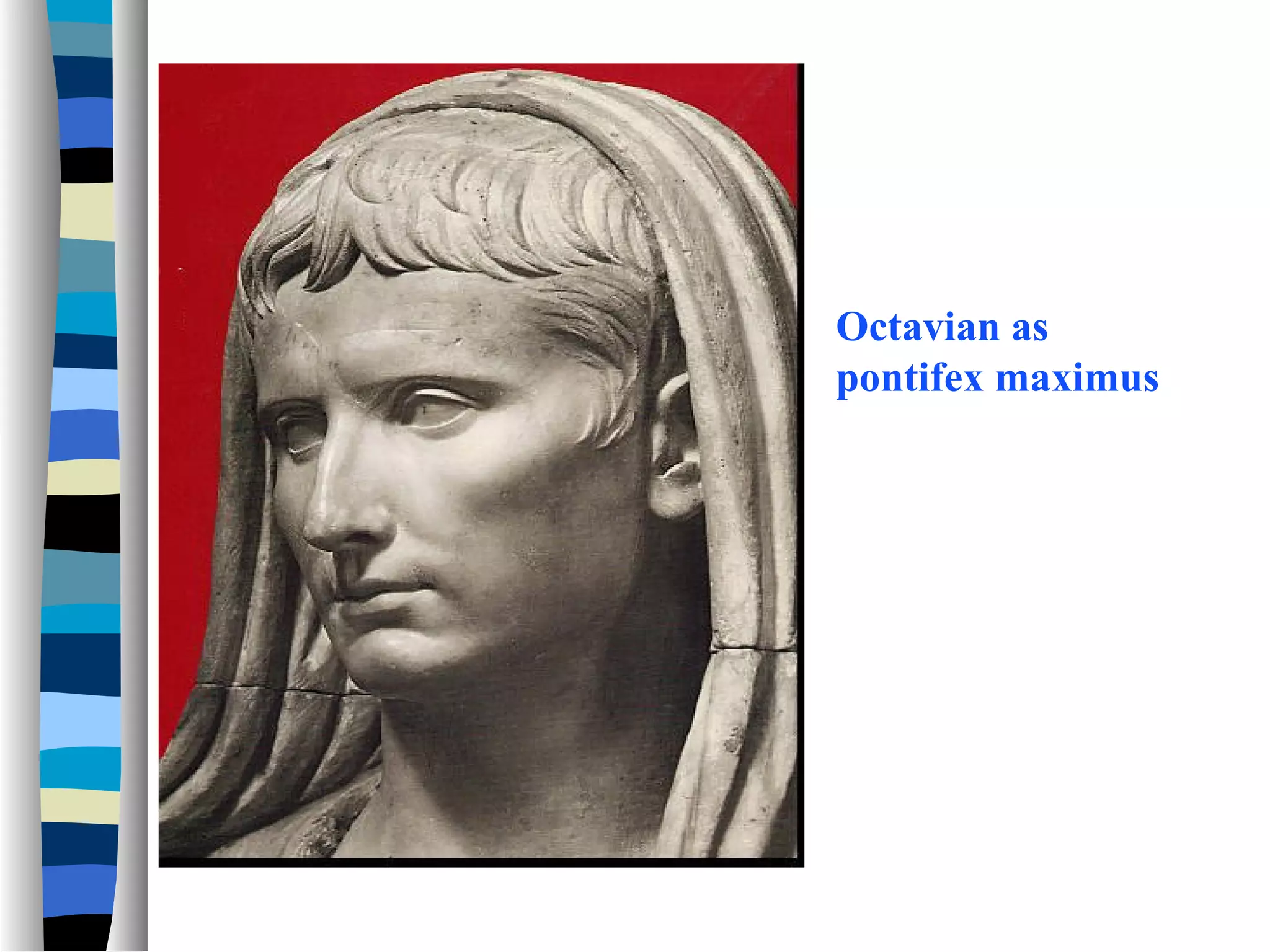
Octavian as
pontifex maximus
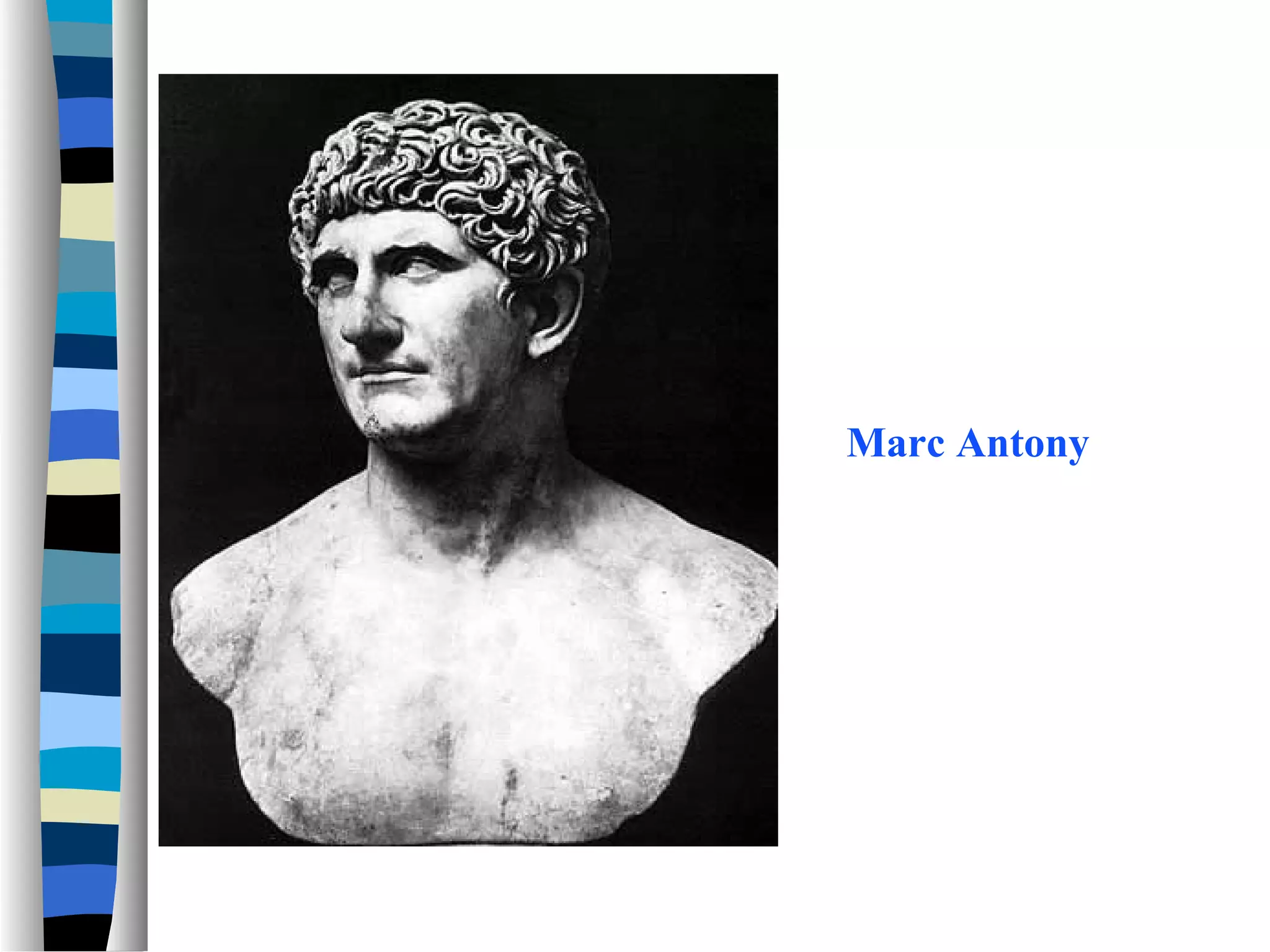
Marc Antony
The Empire
The Empire
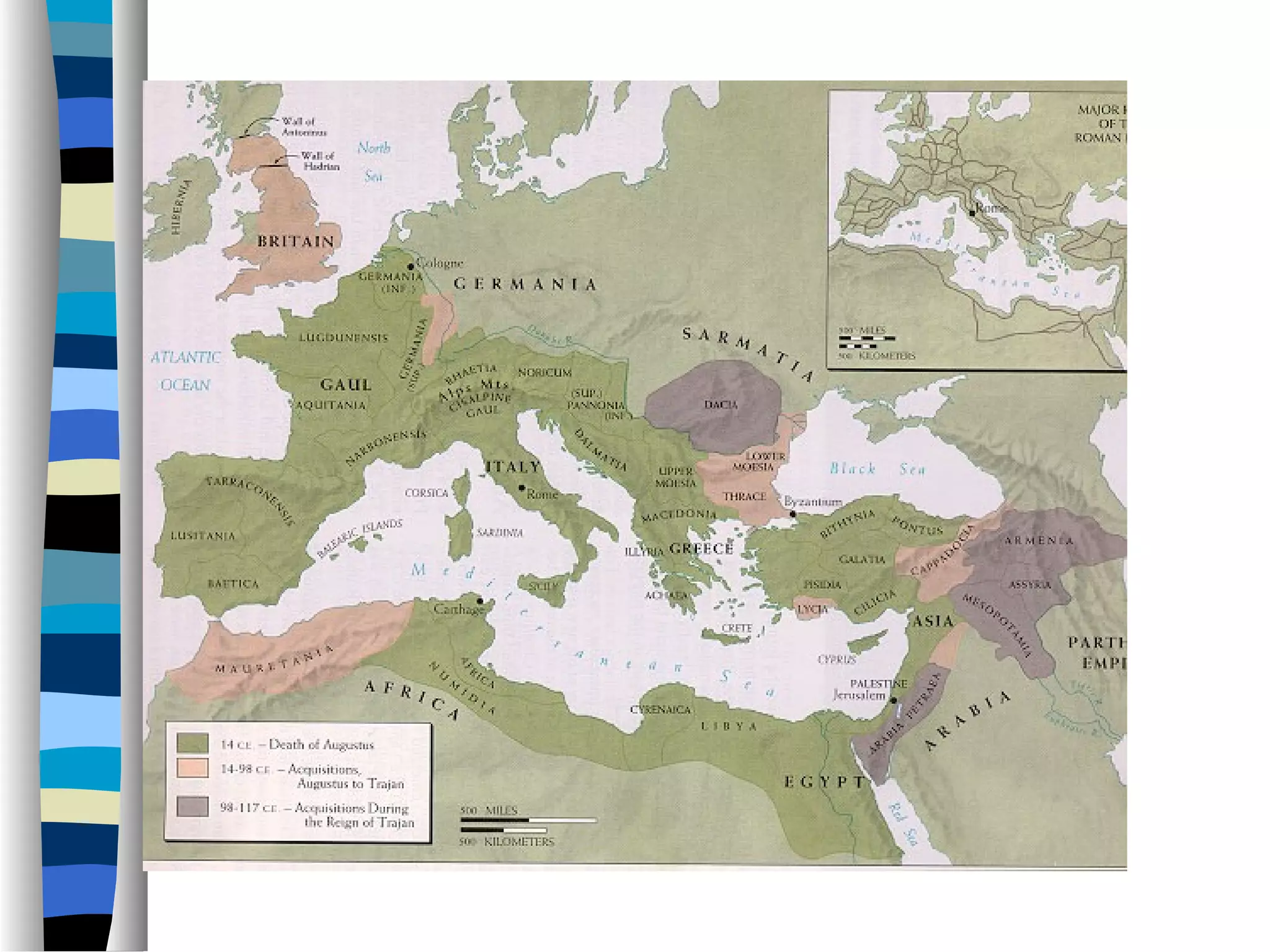
 unification of the Mediterranean basin
 and western Europe
 extended citizenship
 empire-wide commerce
 Roman law
 tolerance for local autonomy
The Julio-Claudians
The Julio-Claudians
 Augustus
 Tiberius
 Caligula
 Claudius
 Nero
Changes
Changes
 reduction of political competition
 end to expansion
 reduction in the army
 further extension of citizenship
The Flavians
The Flavians
 Year of the Four Emperors (69 A.D.)
 Vespasian
 Titus
 Domitian
The Antonines: the Good
Emperors
Emperors
 Edward Gibbon
 the height of the Empire
 the culmination of the pax Romana
 succession by adoption of the most
 competent
The Good Emperors
The Good Emperors
 Nerva
 Trajan
 – strong military leader
 Hadrian
 – excellent administrator
 – Hellenophile
 Antoninus Pius
 Marcus Aurelius
 – the embodiment of the philosopher king
The Rise of Christianity
 Jesus of Nazareth
  – teacher, prophet, revolutionary
  – the Jesus Movement
 Paul of Tarsus
  – cultural mixture: Jewish and Greek
  – founder of Christianity
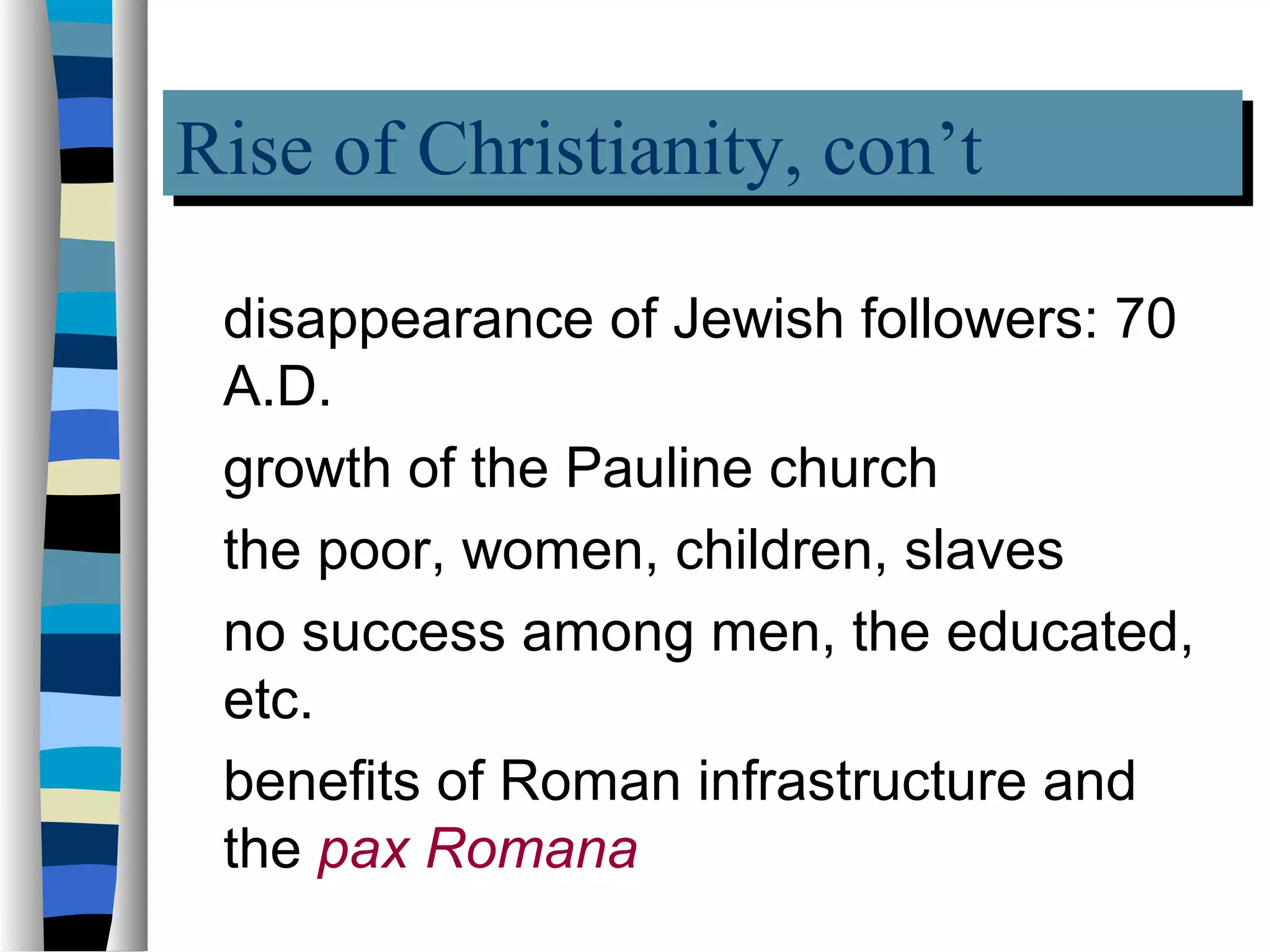
Rise of Christianity, con’t
 disappearance of Jewish followers: 70
 A.D.
 growth of the Pauline church
 the poor, women, children, slaves
 no success among men, the educated,
 etc.
 benefits of Roman infrastructure and
 the pax Romana
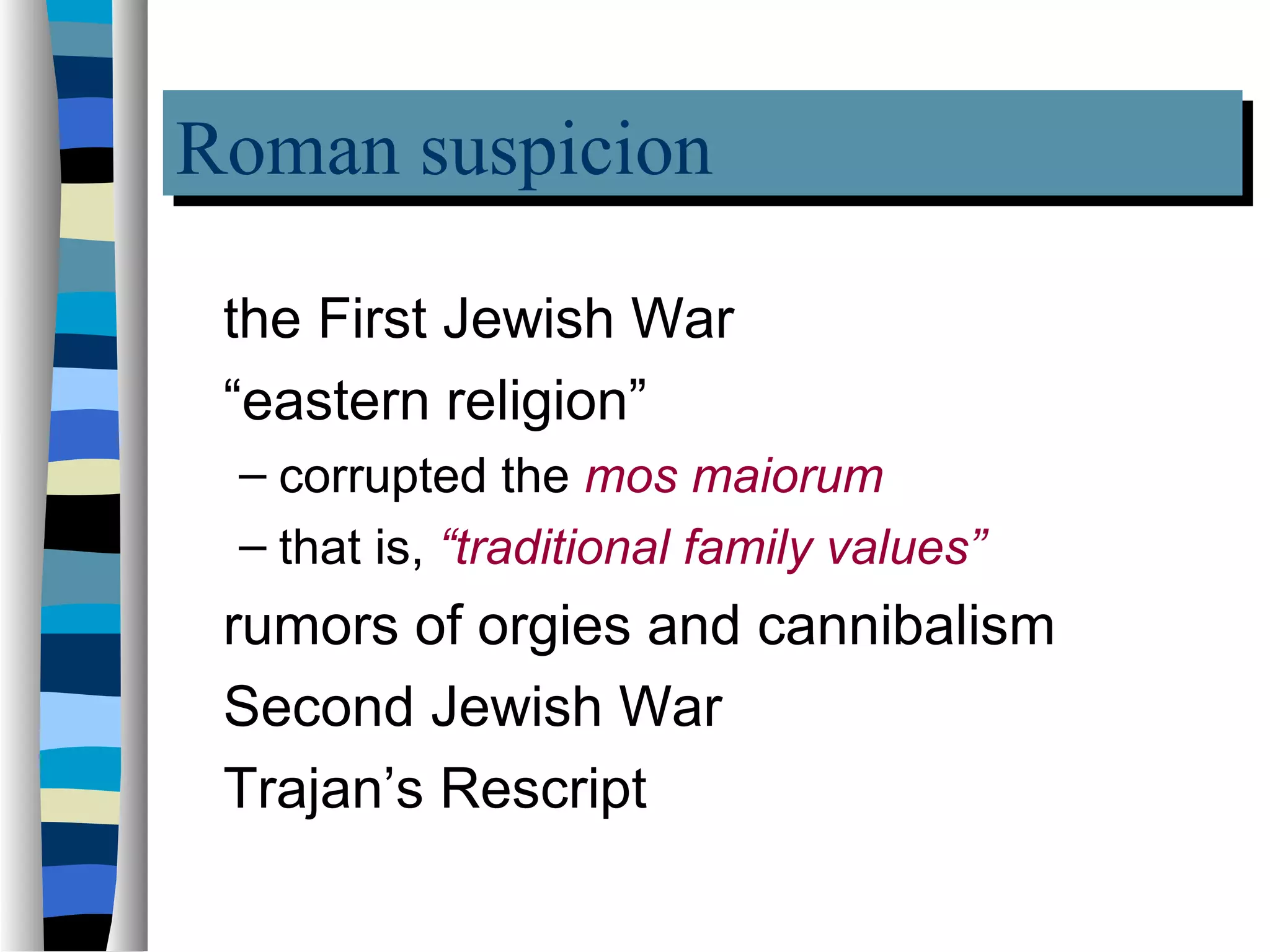
Roman suspicion
Roman suspicion
 the First Jewish War
 “eastern religion”
 – corrupted the mos maiorum
 – that is, “traditional family values”
 rumors of orgies and cannibalism
 Second Jewish War
 Trajan’s Rescript
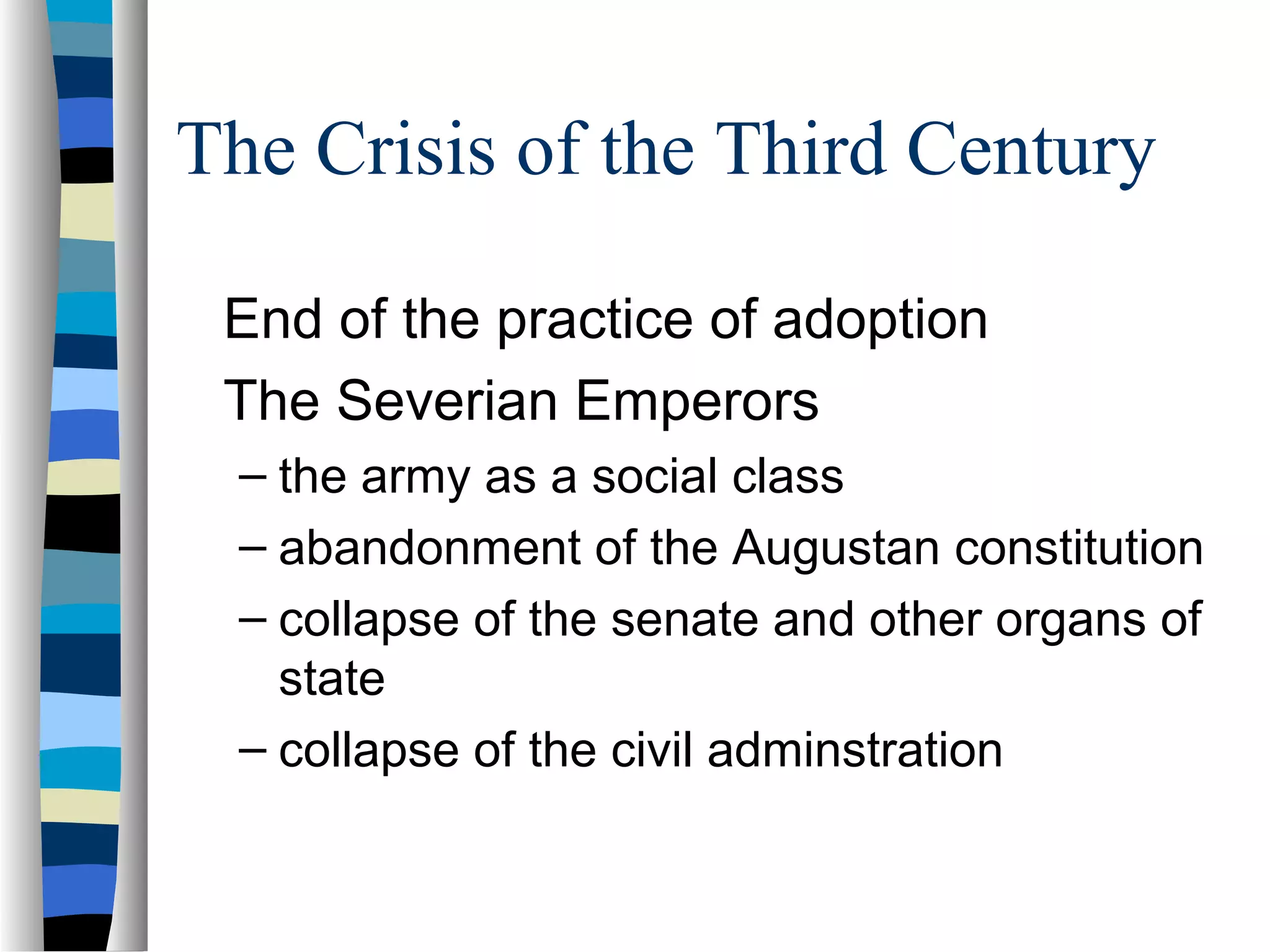
The Crisis of the Third Century

 End of the practice of adoption
 The Severian Emperors
  – the army as a social class
  – abandonment of the Augustan constitution
  – collapse of the senate and other organs of
    state
  – collapse of the civil adminstration
Crisis, con’t

 collapse of society
  – breakdown of social classes
 collapse of the economy
  – collapse of trade and coinage
 barbarian invasions
 civil wars
  – Thirty emperors
  – The Danubian emperors (soldiers)
Crisis, con’t

 Aurelian - restituor orbis
 Decius - persecutions of those who
 corrupt traditional family values
 Diocletian
Diocletian and Reform

 The Tetrarchy
 The Annona
 The Edict of Maximum Prices
 The “new provinces”
 The “eastern frontiers”
 The “new capitals”
 The “persecutions”
 – Edict of Toleration, 311
Constantine

 The divided empire, united
 The Battle of the Milvian Bridge
 The “conversion of Constantine”
 The Edict of Milan - 314
 The First Ecumenical Council
 The New Capital
 – Constantinople
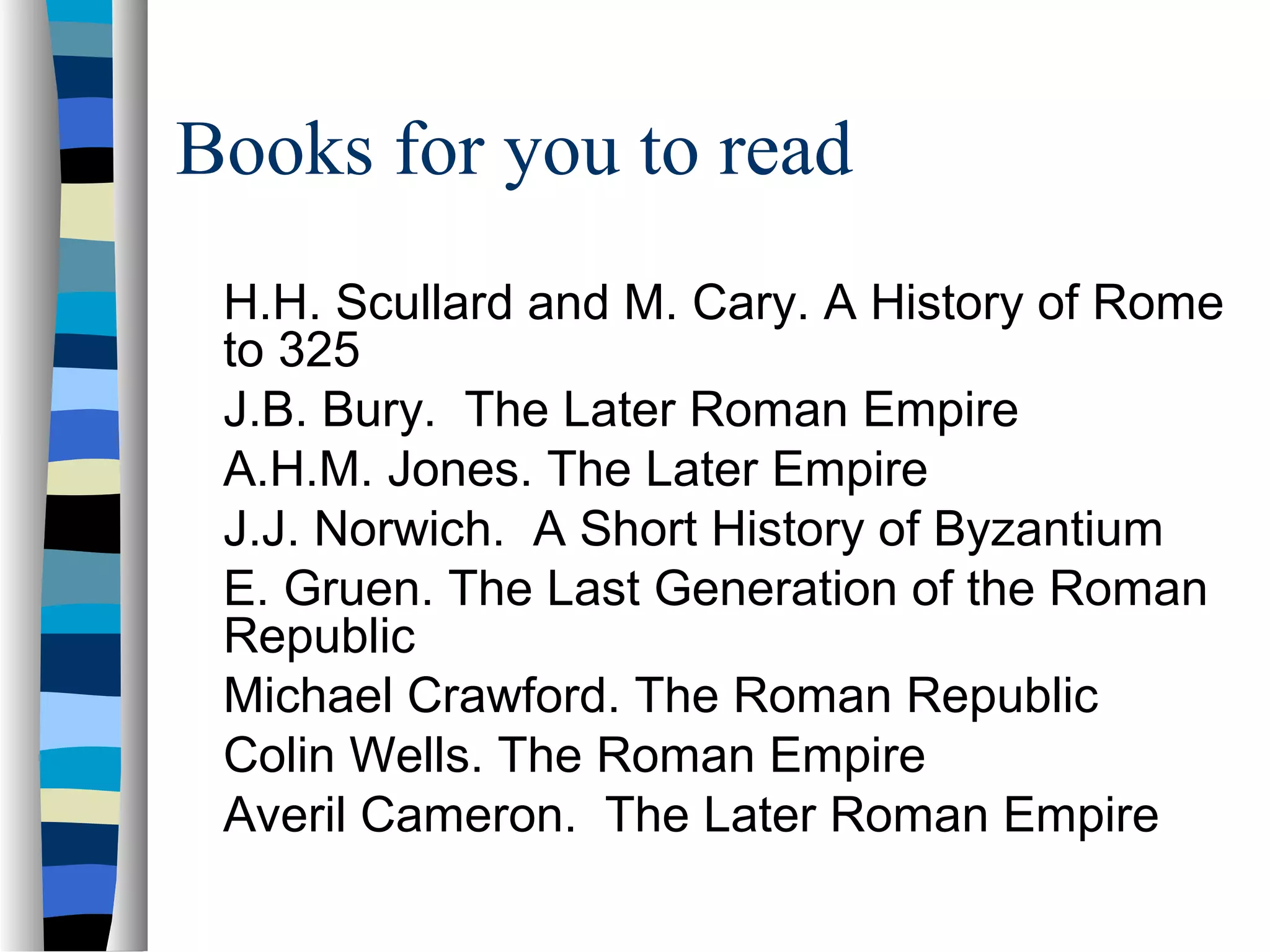
Books for you to read
 H.H. Scullard and M. Cary. A History of Rome
 to 325
 J.B. Bury. The Later Roman Empire
 A.H.M. Jones. The Later Empire
 J.J. Norwich. A Short History of Byzantium
 E. Gruen. The Last Generation of the Roman
 Republic
 Michael Crawford. The Roman Republic
 Colin Wells. The Roman Empire
 Averil Cameron. The Later Roman Empire
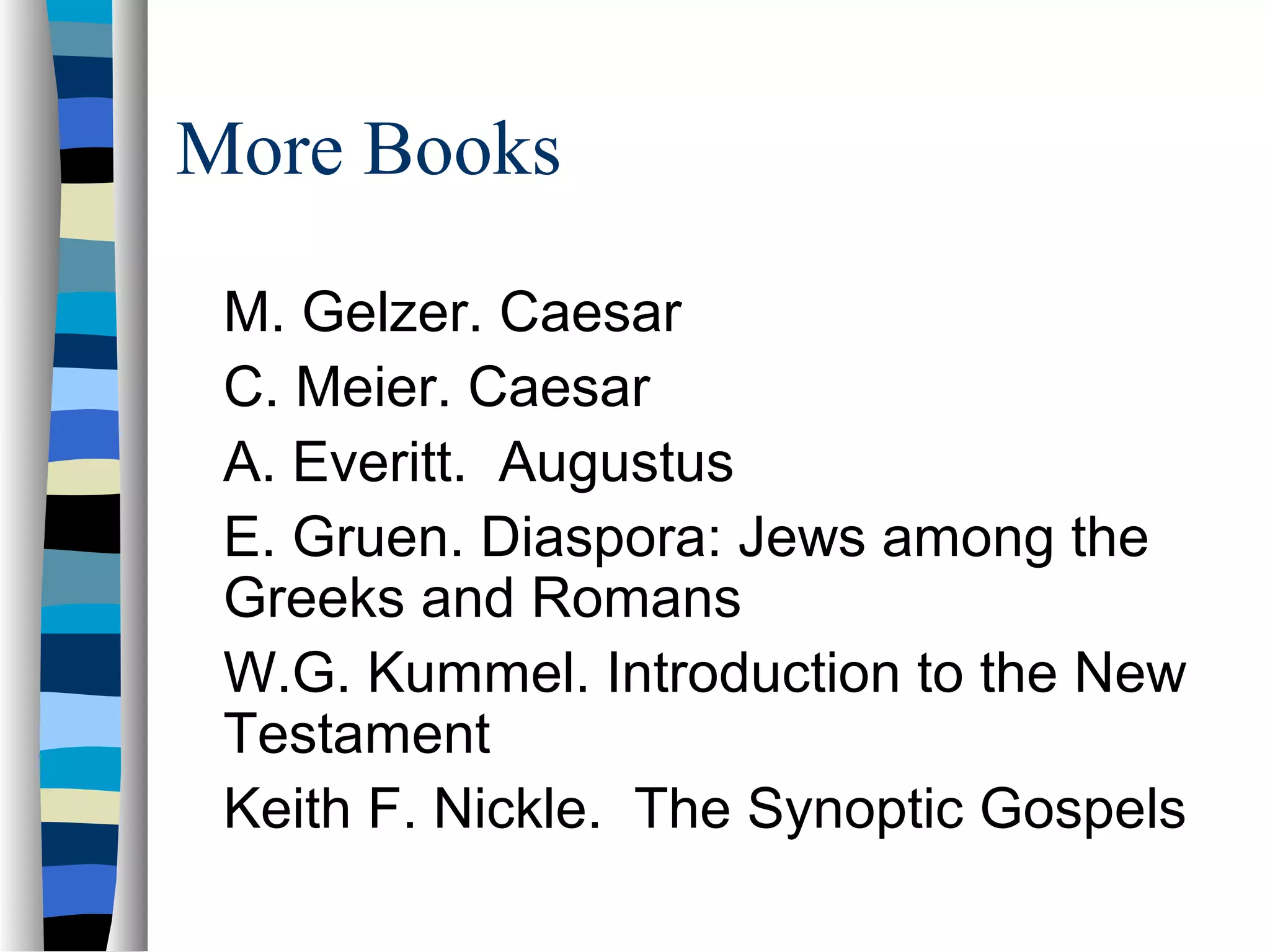
More Books

 M. Gelzer. Caesar
 C. Meier. Caesar
 A. Everitt. Augustus
 E. Gruen. Diaspora: Jews among the
 Greeks and Romans
 W.G. Kummel. Introduction to the New
 Testament
 Keith F. Nickle. The Synoptic Gospels
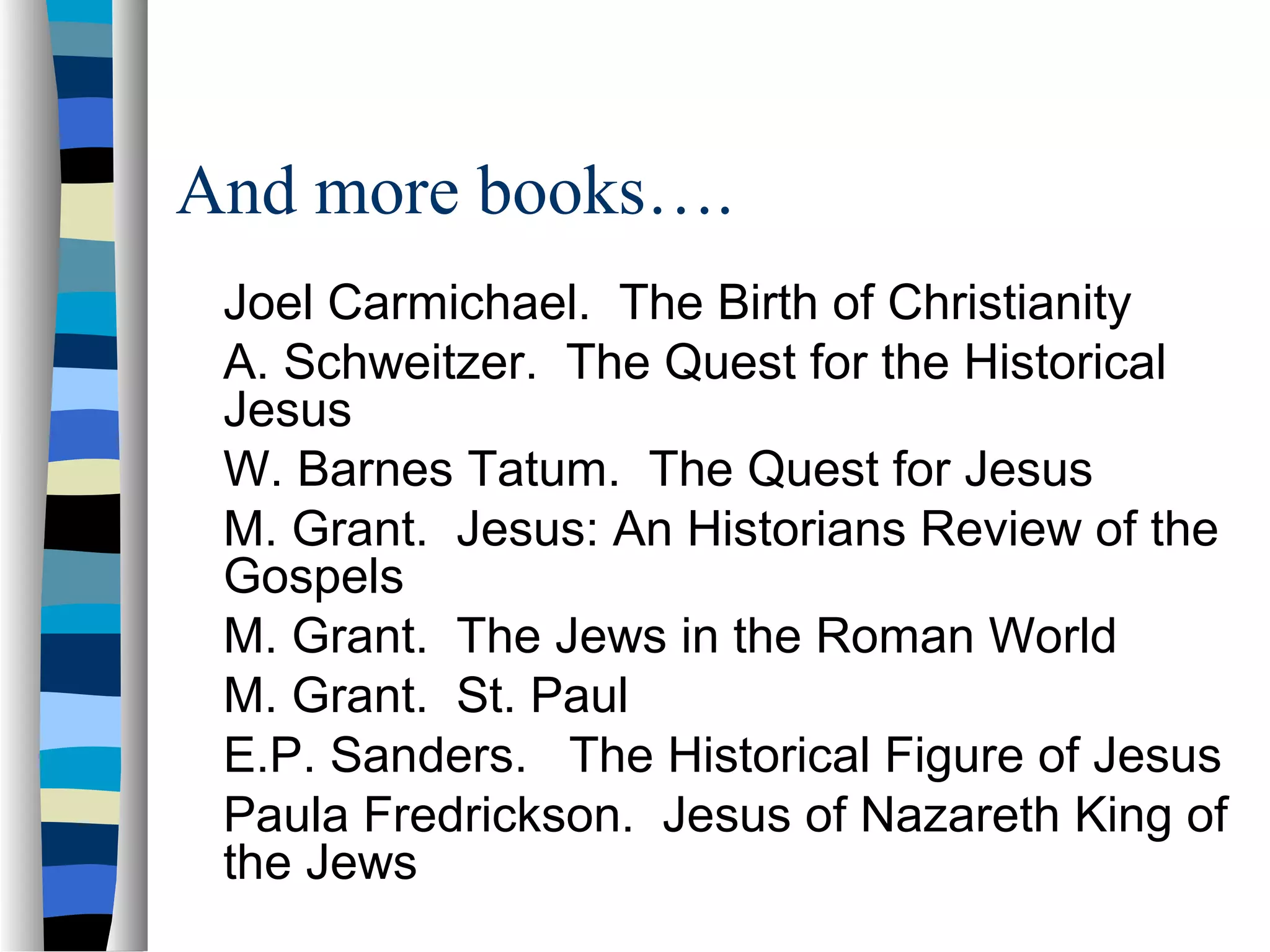
And more books….
 Joel Carmichael. The Birth of Christianity
 A. Schweitzer. The Quest for the Historical
 Jesus
 W. Barnes Tatum. The Quest for Jesus
 M. Grant. Jesus: An Historians Review of the
 Gospels
 M. Grant. The Jews in the Roman World
 M. Grant. St. Paul
 E.P. Sanders. The Historical Figure of Jesus
 Paula Fredrickson. Jesus of Nazareth King of
 the Jews
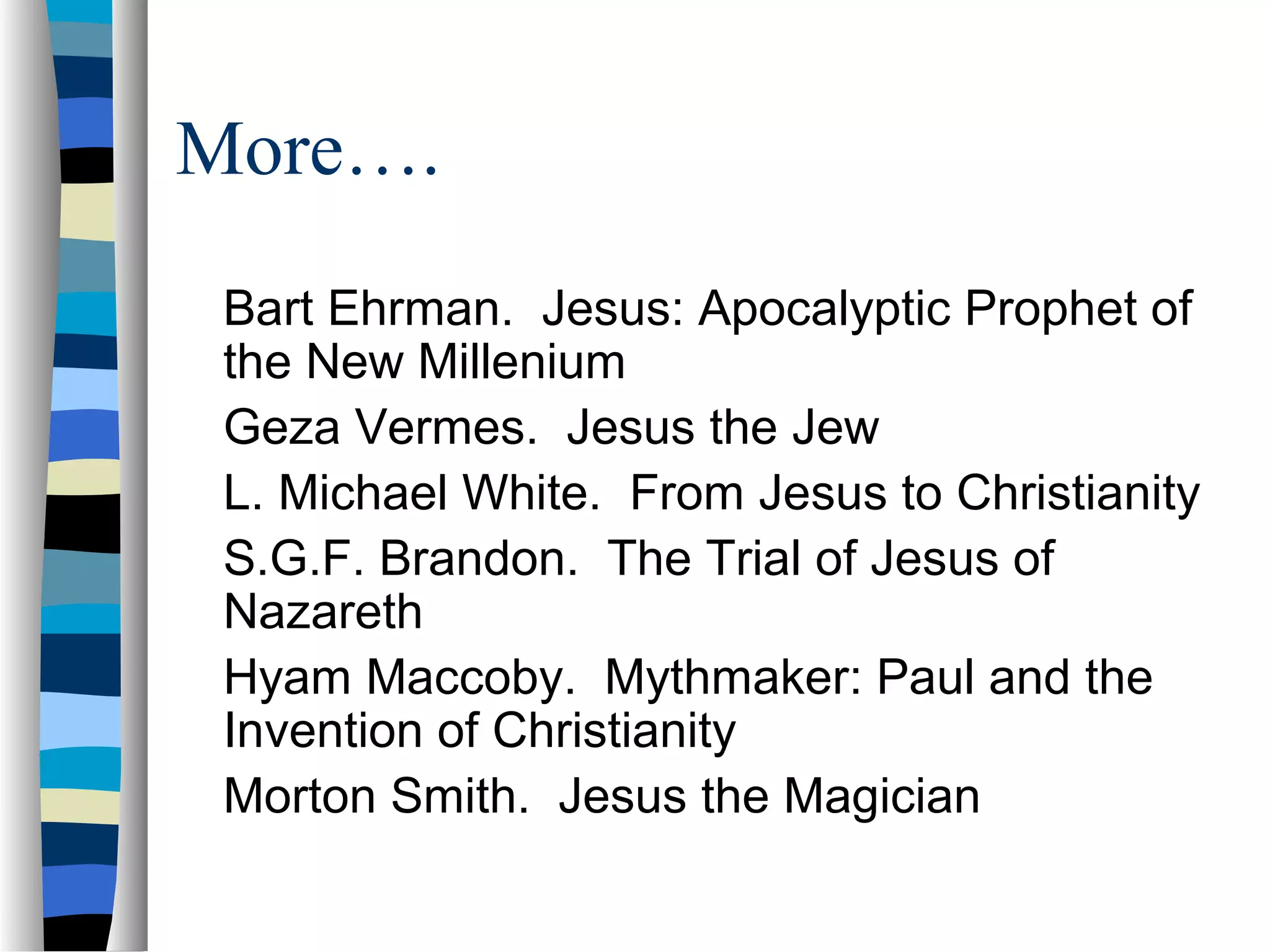
More….
 Bart Ehrman. Jesus: Apocalyptic Prophet of
 the New Millenium
 Geza Vermes. Jesus the Jew
 L. Michael White. From Jesus to Christianity
 S.G.F. Brandon. The Trial of Jesus of
 Nazareth
 Hyam Maccoby. Mythmaker: Paul and the
 Invention of Christianity
 Morton Smith. Jesus the Magician
And yet more…
 www.etsu.edu/cas/history/religionsbib.htm
 R. Helms. Gospel Fictions
 R. Helms. Who Wrote the Gospels
 H.Y. Gamble. The Canon of the New
 Testament
 D.A. Carson. The King James Debate:
 A plea for realism

Ancient Rome

  • 1.
    Rome: Importance Rome: Importance “successor” to Greece “carrier” of Greek civilization political model for later Europe measure of success for nations and individuals
  • 2.
    Importance, con’t Importance, con’t model for later monarchies model for later, mixed constitutions – Great Britain, U.S., etc. model for most European legal systems model for the concept of citizenship
  • 3.
    Roman History Roman History The Regal Age: ca. 779-509 B.C. The Republic: 509-27 B.C. The Empire: 27 B.C.-1453 A.D. – Early Empire: 27 B.C.-325 A.D. – Later Empire: 325 A.D.-1453 A.D.
  • 4.
    Location Location Italy TiberRiver between Etruscan and Greek cities part of the Latin League
  • 7.
    Early history Early history Indo-European entered Italy ca. 2000 B.C. settled south of the Tiber primitive institutions
  • 8.
    The Kings The Kings Seven kings Romulus historical kings? – the Etruscan kings – the last three
  • 9.
    The Republic The Republic revolution patricians (2-4%) and plebeians (96- 98%) constitutional government – influenced by Athens? – the constitution of Cleisthenes?
  • 10.
    Offices Offices 2 consuls 2 praetors aediles quaestors dictator
  • 11.
    Important institutions Important institutions the assemblies the elective offices patron-client relationships The Twelve Tables
  • 12.
    Struggle of theOrders Struggle of the Orders struggle for political participation plebeian institutions: the tribunes the secessions the compromises – no political violence until 133 B.C.
  • 13.
    Roman Expansion Roman Expansion conquest of Veii: Rome’s “Trojan War” gradual expansion for a century the Latin League – extension of citizenship – Romans, half-citizens, Latins, allies – continuous expansion Celts, Samnites, etc.
  • 17.
    Expansion, con’t Expansion, con’t Etruscans Greeks Carthage ??? – three Punic Wars – 254, 220, 146 B.C. control of Western Mediterranean
  • 19.
    Expansion, con’t Expansion, con’t the Hellenistic Monarchies the Greek Federal Leagues lots of wars, Romans are dragged in...a lot Romans get tired of it control of most of the Med. basin by 100 B.C. but still essentially a city-state
  • 20.
    Roman Religion Roman Religion rustic Italian cults overlay of Greek religion Etruscan influences Romans as “pack rats”
  • 21.
    Roman art Roman art best we don’t even talk about that
  • 29.
    Roman architecture Roman architecture great skill engineers and architects roads, cities concrete
  • 36.
    Roman Literature Roman Literature copied from Greek models interests in rhetoric, law, and satire Stoic and Epicurean philosophy
  • 37.
    The Late Republic:133-27 B.C. The Late Republic: 133-27 B.C. introduction of violence into domestic politics competition for status and recognition civil war
  • 39.
    Important Figures Important Figures Tiberius and Gaius Gracchus Marius and Sulla Pompey the Great, Marcus Crassus, Julius Caesar – First Triumvirate Marc Antony, Marcus Lepidus, Octavian Caesar – Second Triumvirate
  • 41.
  • 42.
  • 43.
  • 44.
  • 45.
  • 46.
  • 47.
  • 48.
    The Empire The Empire unification of the Mediterranean basin and western Europe extended citizenship empire-wide commerce Roman law tolerance for local autonomy
  • 52.
    The Julio-Claudians The Julio-Claudians Augustus Tiberius Caligula Claudius Nero
  • 53.
    Changes Changes reduction ofpolitical competition end to expansion reduction in the army further extension of citizenship
  • 54.
    The Flavians The Flavians Year of the Four Emperors (69 A.D.) Vespasian Titus Domitian
  • 55.
    The Antonines: theGood The Antonines: the Good Emperors Emperors Edward Gibbon the height of the Empire the culmination of the pax Romana succession by adoption of the most competent
  • 56.
    The Good Emperors TheGood Emperors Nerva Trajan – strong military leader Hadrian – excellent administrator – Hellenophile Antoninus Pius Marcus Aurelius – the embodiment of the philosopher king
  • 57.
    The Rise ofChristianity The Rise of Christianity Jesus of Nazareth – teacher, prophet, revolutionary – the Jesus Movement Paul of Tarsus – cultural mixture: Jewish and Greek – founder of Christianity
  • 58.
    Rise of Christianity,con’t Rise of Christianity, con’t disappearance of Jewish followers: 70 A.D. growth of the Pauline church the poor, women, children, slaves no success among men, the educated, etc. benefits of Roman infrastructure and the pax Romana
  • 59.
    Roman suspicion Roman suspicion the First Jewish War “eastern religion” – corrupted the mos maiorum – that is, “traditional family values” rumors of orgies and cannibalism Second Jewish War Trajan’s Rescript
  • 61.
    The Crisis ofthe Third Century End of the practice of adoption The Severian Emperors – the army as a social class – abandonment of the Augustan constitution – collapse of the senate and other organs of state – collapse of the civil adminstration
  • 62.
    Crisis, con’t collapseof society – breakdown of social classes collapse of the economy – collapse of trade and coinage barbarian invasions civil wars – Thirty emperors – The Danubian emperors (soldiers)
  • 63.
    Crisis, con’t Aurelian- restituor orbis Decius - persecutions of those who corrupt traditional family values Diocletian
  • 64.
    Diocletian and Reform The Tetrarchy The Annona The Edict of Maximum Prices The “new provinces” The “eastern frontiers” The “new capitals” The “persecutions” – Edict of Toleration, 311
  • 65.
    Constantine The dividedempire, united The Battle of the Milvian Bridge The “conversion of Constantine” The Edict of Milan - 314 The First Ecumenical Council The New Capital – Constantinople
  • 66.
    Books for youto read H.H. Scullard and M. Cary. A History of Rome to 325 J.B. Bury. The Later Roman Empire A.H.M. Jones. The Later Empire J.J. Norwich. A Short History of Byzantium E. Gruen. The Last Generation of the Roman Republic Michael Crawford. The Roman Republic Colin Wells. The Roman Empire Averil Cameron. The Later Roman Empire
  • 67.
    More Books M.Gelzer. Caesar C. Meier. Caesar A. Everitt. Augustus E. Gruen. Diaspora: Jews among the Greeks and Romans W.G. Kummel. Introduction to the New Testament Keith F. Nickle. The Synoptic Gospels
  • 68.
    And more books…. Joel Carmichael. The Birth of Christianity A. Schweitzer. The Quest for the Historical Jesus W. Barnes Tatum. The Quest for Jesus M. Grant. Jesus: An Historians Review of the Gospels M. Grant. The Jews in the Roman World M. Grant. St. Paul E.P. Sanders. The Historical Figure of Jesus Paula Fredrickson. Jesus of Nazareth King of the Jews
  • 69.
    More…. Bart Ehrman.Jesus: Apocalyptic Prophet of the New Millenium Geza Vermes. Jesus the Jew L. Michael White. From Jesus to Christianity S.G.F. Brandon. The Trial of Jesus of Nazareth Hyam Maccoby. Mythmaker: Paul and the Invention of Christianity Morton Smith. Jesus the Magician
  • 70.
    And yet more… www.etsu.edu/cas/history/religionsbib.htm R. Helms. Gospel Fictions R. Helms. Who Wrote the Gospels H.Y. Gamble. The Canon of the New Testament D.A. Carson. The King James Debate: A plea for realism