Chapter 5 Large and Fast: Exploiting Memory Hierarchy
Memory Technology Static RAM (SRAM) 0.5ns – 2.5ns, $2000 – $5000 per GB Dynamic RAM (DRAM) 50ns – 70ns, $20 – $75 per GB Magnetic disk 5ms – 20ms, $0.20 – $2 per GB Ideal memory Access time of SRAM Capacity and cost/GB of disk Chapter 5 — Large and Fast: Exploiting Memory Hierarchy —  §5.1 Introduction
Principle of Locality Programs access a small proportion of their address space at any time Temporal locality Items accessed recently are likely to be accessed again soon e.g., instructions in a loop, induction variables Spatial locality Items near those accessed recently are likely to be accessed soon E.g., sequential instruction access, array data Chapter 5 — Large and Fast: Exploiting Memory Hierarchy —
Taking Advantage of Locality Memory hierarchy Store everything on disk Copy recently accessed (and nearby) items from disk to smaller DRAM memory Main memory Copy more recently accessed (and nearby) items from DRAM to smaller SRAM memory Cache memory attached to CPU Chapter 5 — Large and Fast: Exploiting Memory Hierarchy —
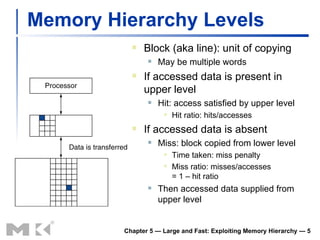
Memory Hierarchy Levels Block (aka line): unit of copying May be multiple words If accessed data is present in upper level Hit: access satisfied by upper level Hit ratio: hits/accesses If accessed data is absent Miss: block copied from lower level Time taken: miss penalty Miss ratio: misses/accesses = 1 – hit ratio Then accessed data supplied from upper level Chapter 5 — Large and Fast: Exploiting Memory Hierarchy —
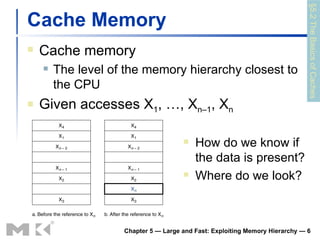
Cache Memory Cache memory The level of the memory hierarchy closest to the CPU Given accesses X 1 , …, X n–1 , X n Chapter 5 — Large and Fast: Exploiting Memory Hierarchy —  §5.2 The Basics of Caches How do we know if the data is present? Where do we look?
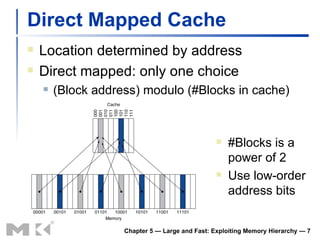
Direct Mapped Cache Location determined by address Direct mapped: only one choice (Block address) modulo (#Blocks in cache) Chapter 5 — Large and Fast: Exploiting Memory Hierarchy —  #Blocks is a power of 2 Use low-order address bits
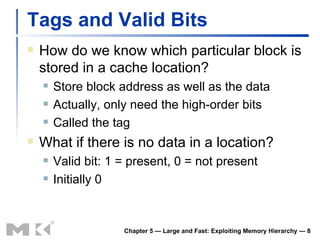
Tags and Valid Bits How do we know which particular block is stored in a cache location? Store block address as well as the data Actually, only need the high-order bits Called the tag What if there is no data in a location? Valid bit: 1 = present, 0 = not present Initially 0 Chapter 5 — Large and Fast: Exploiting Memory Hierarchy —
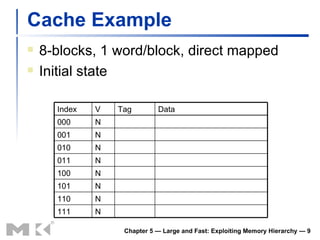
Cache Example 8-blocks, 1 word/block, direct mapped Initial state Chapter 5 — Large and Fast: Exploiting Memory Hierarchy —  Index V Tag Data 000 N 001 N 010 N 011 N 100 N 101 N 110 N 111 N
Cache Example Chapter 5 — Large and Fast: Exploiting Memory Hierarchy —  Index V Tag Data 000 N 001 N 010 N 011 N 100 N 101 N 110 Y 10 Mem[10110] 111 N Word addr Binary addr Hit/miss Cache block 22 10 110 Miss 110
Cache Example Chapter 5 — Large and Fast: Exploiting Memory Hierarchy —  Index V Tag Data 000 N 001 N 010 Y 11 Mem[11010] 011 N 100 N 101 N 110 Y 10 Mem[10110] 111 N Word addr Binary addr Hit/miss Cache block 26 11 010 Miss 010
Cache Example Chapter 5 — Large and Fast: Exploiting Memory Hierarchy —  Index V Tag Data 000 N 001 N 010 Y 11 Mem[11010] 011 N 100 N 101 N 110 Y 10 Mem[10110] 111 N Word addr Binary addr Hit/miss Cache block 22 10 110 Hit 110 26 11 010 Hit 010
Cache Example Chapter 5 — Large and Fast: Exploiting Memory Hierarchy —  Index V Tag Data 000 Y 10 Mem[10000] 001 N 010 Y 11 Mem[11010] 011 Y 00 Mem[00011] 100 N 101 N 110 Y 10 Mem[10110] 111 N Word addr Binary addr Hit/miss Cache block 16 10 000 Miss 000 3 00 011 Miss 011 16 10 000 Hit 000
Cache Example Chapter 5 — Large and Fast: Exploiting Memory Hierarchy —  Index V Tag Data 000 Y 10 Mem[10000] 001 N 010 Y 10 Mem[10010] 011 Y 00 Mem[00011] 100 N 101 N 110 Y 10 Mem[10110] 111 N Word addr Binary addr Hit/miss Cache block 18 10 010 Miss 010
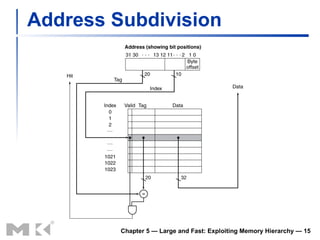
Address Subdivision Chapter 5 — Large and Fast: Exploiting Memory Hierarchy —
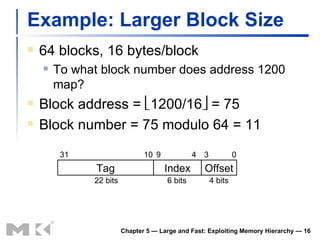
Example: Larger Block Size 64 blocks, 16 bytes/block To what block number does address 1200 map? Block address =   1200/16   = 75 Block number = 75 modulo 64 = 11 Chapter 5 — Large and Fast: Exploiting Memory Hierarchy —  Tag Index Offset 0 3 4 9 10 31 4 bits 6 bits 22 bits
Block Size Considerations Larger blocks should reduce miss rate Due to spatial locality But in a fixed-sized cache Larger blocks    fewer of them More competition    increased miss rate Larger blocks    pollution Larger miss penalty Can override benefit of reduced miss rate Early restart and critical-word-first can help Chapter 5 — Large and Fast: Exploiting Memory Hierarchy —
Cache Misses On cache hit, CPU proceeds normally On cache miss Stall the CPU pipeline Fetch block from next level of hierarchy Instruction cache miss Restart instruction fetch Data cache miss Complete data access Chapter 5 — Large and Fast: Exploiting Memory Hierarchy —
Write-Through On data-write hit, could just update the block in cache But then cache and memory would be inconsistent Write through: also update memory But makes writes take longer e.g., if base CPI = 1, 10% of instructions are stores, write to memory takes 100 cycles Effective CPI = 1 + 0.1×100 = 11 Solution: write buffer Holds data waiting to be written to memory CPU continues immediately Only stalls on write if write buffer is already full Chapter 5 — Large and Fast: Exploiting Memory Hierarchy —
Write-Back Alternative: On data-write hit, just update the block in cache Keep track of whether each block is dirty When a dirty block is replaced Write it back to memory Can use a write buffer to allow replacing block to be read first Chapter 5 — Large and Fast: Exploiting Memory Hierarchy —
Write Allocation What should happen on a write miss? Alternatives for write-through Allocate on miss: fetch the block Write around: don’t fetch the block Since programs often write a whole block before reading it (e.g., initialization) For write-back Usually fetch the block Chapter 5 — Large and Fast: Exploiting Memory Hierarchy —
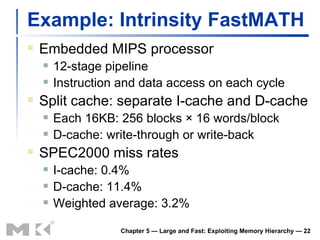
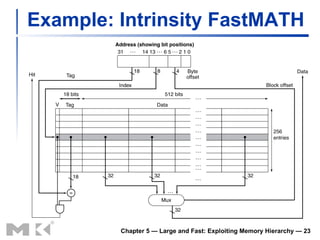
Example: Intrinsity FastMATH Embedded MIPS processor 12-stage pipeline Instruction and data access on each cycle Split cache: separate I-cache and D-cache Each 16KB: 256 blocks  ×  16 words/block D-cache: write-through or write-back SPEC2000 miss rates I-cache: 0.4% D-cache: 11.4% Weighted average: 3.2% Chapter 5 — Large and Fast: Exploiting Memory Hierarchy —
Example: Intrinsity FastMATH Chapter 5 — Large and Fast: Exploiting Memory Hierarchy —
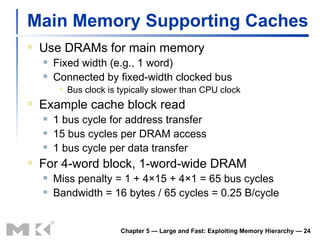
Main Memory Supporting Caches Use DRAMs for main memory Fixed width (e.g., 1 word) Connected by fixed-width clocked bus Bus clock is typically slower than CPU clock Example cache block read 1 bus cycle for address transfer 15 bus cycles per DRAM access 1 bus cycle per data transfer For 4-word block, 1-word-wide DRAM Miss penalty = 1 + 4×15 + 4×1 = 65 bus cycles Bandwidth = 16 bytes / 65 cycles = 0.25 B/cycle Chapter 5 — Large and Fast: Exploiting Memory Hierarchy —
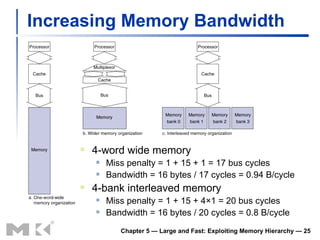
Increasing Memory Bandwidth Chapter 5 — Large and Fast: Exploiting Memory Hierarchy —  4-word wide memory Miss penalty = 1 + 15 + 1 = 17 bus cycles Bandwidth = 16 bytes / 17 cycles = 0.94 B/cycle 4-bank interleaved memory Miss penalty = 1 + 15 + 4×1 = 20 bus cycles Bandwidth = 16 bytes / 20 cycles = 0.8 B/cycle
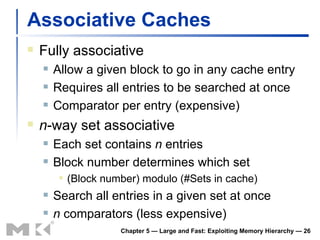
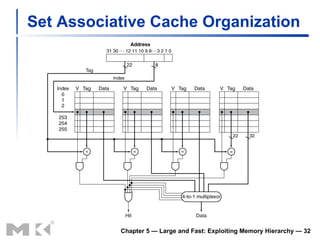
Associative Caches Fully associative Allow a given block to go in any cache entry Requires all entries to be searched at once Comparator per entry (expensive) n -way set associative Each set contains  n  entries Block number determines which set (Block number) modulo (#Sets in cache) Search all entries in a given set at once n  comparators (less expensive) Chapter 5 — Large and Fast: Exploiting Memory Hierarchy —
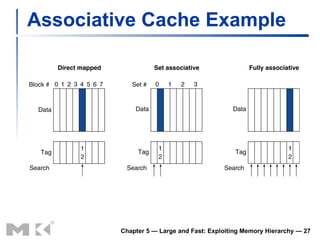
Associative Cache Example Chapter 5 — Large and Fast: Exploiting Memory Hierarchy —
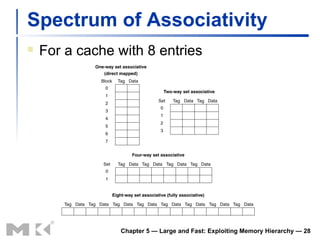
Spectrum of Associativity For a cache with 8 entries Chapter 5 — Large and Fast: Exploiting Memory Hierarchy —
Associativity Example Compare 4-block caches Direct mapped, 2-way set associative, fully associative Block access sequence: 0, 8, 0, 6, 8 Direct mapped Chapter 5 — Large and Fast: Exploiting Memory Hierarchy —  Block address Cache index Hit/miss Cache content after access 0 1 2 3 0 0 miss Mem[0] 8 0 miss Mem[8] 0 0 miss Mem[0] 6 2 miss Mem[0] Mem[6] 8 0 miss Mem[8] Mem[6]
Associativity Example 2-way set associative Chapter 5 — Large and Fast: Exploiting Memory Hierarchy —  Fully associative Block address Cache index Hit/miss Cache content after access Set 0 Set 1 0 0 miss Mem[0] 8 0 miss Mem[0] Mem[8] 0 0 hit Mem[0] Mem[8] 6 0 miss Mem[0] Mem[6] 8 0 miss Mem[8] Mem[6] Block address Hit/miss Cache content after access 0 miss Mem[0] 8 miss Mem[0] Mem[8] 0 hit Mem[0] Mem[8] 6 miss Mem[0] Mem[8] Mem[6] 8 hit Mem[0] Mem[8] Mem[6]
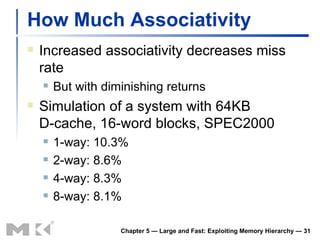
How Much Associativity Increased associativity decreases miss rate But with diminishing returns Simulation of a system with 64KB D-cache, 16-word blocks, SPEC2000 1-way: 10.3% 2-way: 8.6% 4-way: 8.3% 8-way: 8.1% Chapter 5 — Large and Fast: Exploiting Memory Hierarchy —
Set Associative Cache Organization Chapter 5 — Large and Fast: Exploiting Memory Hierarchy —
Replacement Policy Direct mapped: no choice Set associative Prefer non-valid entry, if there is one Otherwise, choose among entries in the set Least-recently used (LRU) Choose the one unused for the longest time Simple for 2-way, manageable for 4-way, too hard beyond that Random Gives approximately the same performance as LRU for high associativity Chapter 5 — Large and Fast: Exploiting Memory Hierarchy —
Multilevel Caches Primary cache attached to CPU Small, but fast Level-2 cache services misses from primary cache Larger, slower, but still faster than main memory Main memory services L-2 cache misses Some high-end systems include L-3 cache Chapter 5 — Large and Fast: Exploiting Memory Hierarchy —

Chapter 5 b

  • 1.
    Chapter 5 Largeand Fast: Exploiting Memory Hierarchy
  • 2.
    Memory Technology StaticRAM (SRAM) 0.5ns – 2.5ns, $2000 – $5000 per GB Dynamic RAM (DRAM) 50ns – 70ns, $20 – $75 per GB Magnetic disk 5ms – 20ms, $0.20 – $2 per GB Ideal memory Access time of SRAM Capacity and cost/GB of disk Chapter 5 — Large and Fast: Exploiting Memory Hierarchy — §5.1 Introduction
  • 3.
    Principle of LocalityPrograms access a small proportion of their address space at any time Temporal locality Items accessed recently are likely to be accessed again soon e.g., instructions in a loop, induction variables Spatial locality Items near those accessed recently are likely to be accessed soon E.g., sequential instruction access, array data Chapter 5 — Large and Fast: Exploiting Memory Hierarchy —
  • 4.
    Taking Advantage ofLocality Memory hierarchy Store everything on disk Copy recently accessed (and nearby) items from disk to smaller DRAM memory Main memory Copy more recently accessed (and nearby) items from DRAM to smaller SRAM memory Cache memory attached to CPU Chapter 5 — Large and Fast: Exploiting Memory Hierarchy —
  • 5.
    Memory Hierarchy LevelsBlock (aka line): unit of copying May be multiple words If accessed data is present in upper level Hit: access satisfied by upper level Hit ratio: hits/accesses If accessed data is absent Miss: block copied from lower level Time taken: miss penalty Miss ratio: misses/accesses = 1 – hit ratio Then accessed data supplied from upper level Chapter 5 — Large and Fast: Exploiting Memory Hierarchy —
  • 6.
    Cache Memory Cachememory The level of the memory hierarchy closest to the CPU Given accesses X 1 , …, X n–1 , X n Chapter 5 — Large and Fast: Exploiting Memory Hierarchy — §5.2 The Basics of Caches How do we know if the data is present? Where do we look?
  • 7.
    Direct Mapped CacheLocation determined by address Direct mapped: only one choice (Block address) modulo (#Blocks in cache) Chapter 5 — Large and Fast: Exploiting Memory Hierarchy — #Blocks is a power of 2 Use low-order address bits
  • 8.
    Tags and ValidBits How do we know which particular block is stored in a cache location? Store block address as well as the data Actually, only need the high-order bits Called the tag What if there is no data in a location? Valid bit: 1 = present, 0 = not present Initially 0 Chapter 5 — Large and Fast: Exploiting Memory Hierarchy —
  • 9.
    Cache Example 8-blocks,1 word/block, direct mapped Initial state Chapter 5 — Large and Fast: Exploiting Memory Hierarchy — Index V Tag Data 000 N 001 N 010 N 011 N 100 N 101 N 110 N 111 N
  • 10.
    Cache Example Chapter5 — Large and Fast: Exploiting Memory Hierarchy — Index V Tag Data 000 N 001 N 010 N 011 N 100 N 101 N 110 Y 10 Mem[10110] 111 N Word addr Binary addr Hit/miss Cache block 22 10 110 Miss 110
  • 11.
    Cache Example Chapter5 — Large and Fast: Exploiting Memory Hierarchy — Index V Tag Data 000 N 001 N 010 Y 11 Mem[11010] 011 N 100 N 101 N 110 Y 10 Mem[10110] 111 N Word addr Binary addr Hit/miss Cache block 26 11 010 Miss 010
  • 12.
    Cache Example Chapter5 — Large and Fast: Exploiting Memory Hierarchy — Index V Tag Data 000 N 001 N 010 Y 11 Mem[11010] 011 N 100 N 101 N 110 Y 10 Mem[10110] 111 N Word addr Binary addr Hit/miss Cache block 22 10 110 Hit 110 26 11 010 Hit 010
  • 13.
    Cache Example Chapter5 — Large and Fast: Exploiting Memory Hierarchy — Index V Tag Data 000 Y 10 Mem[10000] 001 N 010 Y 11 Mem[11010] 011 Y 00 Mem[00011] 100 N 101 N 110 Y 10 Mem[10110] 111 N Word addr Binary addr Hit/miss Cache block 16 10 000 Miss 000 3 00 011 Miss 011 16 10 000 Hit 000
  • 14.
    Cache Example Chapter5 — Large and Fast: Exploiting Memory Hierarchy — Index V Tag Data 000 Y 10 Mem[10000] 001 N 010 Y 10 Mem[10010] 011 Y 00 Mem[00011] 100 N 101 N 110 Y 10 Mem[10110] 111 N Word addr Binary addr Hit/miss Cache block 18 10 010 Miss 010
  • 15.
    Address Subdivision Chapter5 — Large and Fast: Exploiting Memory Hierarchy —
  • 16.
    Example: Larger BlockSize 64 blocks, 16 bytes/block To what block number does address 1200 map? Block address =  1200/16  = 75 Block number = 75 modulo 64 = 11 Chapter 5 — Large and Fast: Exploiting Memory Hierarchy — Tag Index Offset 0 3 4 9 10 31 4 bits 6 bits 22 bits
  • 17.
    Block Size ConsiderationsLarger blocks should reduce miss rate Due to spatial locality But in a fixed-sized cache Larger blocks  fewer of them More competition  increased miss rate Larger blocks  pollution Larger miss penalty Can override benefit of reduced miss rate Early restart and critical-word-first can help Chapter 5 — Large and Fast: Exploiting Memory Hierarchy —
  • 18.
    Cache Misses Oncache hit, CPU proceeds normally On cache miss Stall the CPU pipeline Fetch block from next level of hierarchy Instruction cache miss Restart instruction fetch Data cache miss Complete data access Chapter 5 — Large and Fast: Exploiting Memory Hierarchy —
  • 19.
    Write-Through On data-writehit, could just update the block in cache But then cache and memory would be inconsistent Write through: also update memory But makes writes take longer e.g., if base CPI = 1, 10% of instructions are stores, write to memory takes 100 cycles Effective CPI = 1 + 0.1×100 = 11 Solution: write buffer Holds data waiting to be written to memory CPU continues immediately Only stalls on write if write buffer is already full Chapter 5 — Large and Fast: Exploiting Memory Hierarchy —
  • 20.
    Write-Back Alternative: Ondata-write hit, just update the block in cache Keep track of whether each block is dirty When a dirty block is replaced Write it back to memory Can use a write buffer to allow replacing block to be read first Chapter 5 — Large and Fast: Exploiting Memory Hierarchy —
  • 21.
    Write Allocation Whatshould happen on a write miss? Alternatives for write-through Allocate on miss: fetch the block Write around: don’t fetch the block Since programs often write a whole block before reading it (e.g., initialization) For write-back Usually fetch the block Chapter 5 — Large and Fast: Exploiting Memory Hierarchy —
  • 22.
    Example: Intrinsity FastMATHEmbedded MIPS processor 12-stage pipeline Instruction and data access on each cycle Split cache: separate I-cache and D-cache Each 16KB: 256 blocks × 16 words/block D-cache: write-through or write-back SPEC2000 miss rates I-cache: 0.4% D-cache: 11.4% Weighted average: 3.2% Chapter 5 — Large and Fast: Exploiting Memory Hierarchy —
  • 23.
    Example: Intrinsity FastMATHChapter 5 — Large and Fast: Exploiting Memory Hierarchy —
  • 24.
    Main Memory SupportingCaches Use DRAMs for main memory Fixed width (e.g., 1 word) Connected by fixed-width clocked bus Bus clock is typically slower than CPU clock Example cache block read 1 bus cycle for address transfer 15 bus cycles per DRAM access 1 bus cycle per data transfer For 4-word block, 1-word-wide DRAM Miss penalty = 1 + 4×15 + 4×1 = 65 bus cycles Bandwidth = 16 bytes / 65 cycles = 0.25 B/cycle Chapter 5 — Large and Fast: Exploiting Memory Hierarchy —
  • 25.
    Increasing Memory BandwidthChapter 5 — Large and Fast: Exploiting Memory Hierarchy — 4-word wide memory Miss penalty = 1 + 15 + 1 = 17 bus cycles Bandwidth = 16 bytes / 17 cycles = 0.94 B/cycle 4-bank interleaved memory Miss penalty = 1 + 15 + 4×1 = 20 bus cycles Bandwidth = 16 bytes / 20 cycles = 0.8 B/cycle
  • 26.
    Associative Caches Fullyassociative Allow a given block to go in any cache entry Requires all entries to be searched at once Comparator per entry (expensive) n -way set associative Each set contains n entries Block number determines which set (Block number) modulo (#Sets in cache) Search all entries in a given set at once n comparators (less expensive) Chapter 5 — Large and Fast: Exploiting Memory Hierarchy —
  • 27.
    Associative Cache ExampleChapter 5 — Large and Fast: Exploiting Memory Hierarchy —
  • 28.
    Spectrum of AssociativityFor a cache with 8 entries Chapter 5 — Large and Fast: Exploiting Memory Hierarchy —
  • 29.
    Associativity Example Compare4-block caches Direct mapped, 2-way set associative, fully associative Block access sequence: 0, 8, 0, 6, 8 Direct mapped Chapter 5 — Large and Fast: Exploiting Memory Hierarchy — Block address Cache index Hit/miss Cache content after access 0 1 2 3 0 0 miss Mem[0] 8 0 miss Mem[8] 0 0 miss Mem[0] 6 2 miss Mem[0] Mem[6] 8 0 miss Mem[8] Mem[6]
  • 30.
    Associativity Example 2-wayset associative Chapter 5 — Large and Fast: Exploiting Memory Hierarchy — Fully associative Block address Cache index Hit/miss Cache content after access Set 0 Set 1 0 0 miss Mem[0] 8 0 miss Mem[0] Mem[8] 0 0 hit Mem[0] Mem[8] 6 0 miss Mem[0] Mem[6] 8 0 miss Mem[8] Mem[6] Block address Hit/miss Cache content after access 0 miss Mem[0] 8 miss Mem[0] Mem[8] 0 hit Mem[0] Mem[8] 6 miss Mem[0] Mem[8] Mem[6] 8 hit Mem[0] Mem[8] Mem[6]
  • 31.
    How Much AssociativityIncreased associativity decreases miss rate But with diminishing returns Simulation of a system with 64KB D-cache, 16-word blocks, SPEC2000 1-way: 10.3% 2-way: 8.6% 4-way: 8.3% 8-way: 8.1% Chapter 5 — Large and Fast: Exploiting Memory Hierarchy —
  • 32.
    Set Associative CacheOrganization Chapter 5 — Large and Fast: Exploiting Memory Hierarchy —
  • 33.
    Replacement Policy Directmapped: no choice Set associative Prefer non-valid entry, if there is one Otherwise, choose among entries in the set Least-recently used (LRU) Choose the one unused for the longest time Simple for 2-way, manageable for 4-way, too hard beyond that Random Gives approximately the same performance as LRU for high associativity Chapter 5 — Large and Fast: Exploiting Memory Hierarchy —
  • 34.
    Multilevel Caches Primarycache attached to CPU Small, but fast Level-2 cache services misses from primary cache Larger, slower, but still faster than main memory Main memory services L-2 cache misses Some high-end systems include L-3 cache Chapter 5 — Large and Fast: Exploiting Memory Hierarchy —

Editor's Notes

  • #2 Morgan Kaufmann Publishers 9 March 2010 Chapter 5 — Large and Fast: Exploiting Memory Hierarchy
  • #3 Morgan Kaufmann Publishers 9 March 2010 Chapter 5 — Large and Fast: Exploiting Memory Hierarchy
  • #4 Morgan Kaufmann Publishers 9 March 2010 Chapter 5 — Large and Fast: Exploiting Memory Hierarchy
  • #5 Morgan Kaufmann Publishers 9 March 2010 Chapter 5 — Large and Fast: Exploiting Memory Hierarchy
  • #6 Morgan Kaufmann Publishers 9 March 2010 Chapter 5 — Large and Fast: Exploiting Memory Hierarchy
  • #7 Morgan Kaufmann Publishers 9 March 2010 Chapter 5 — Large and Fast: Exploiting Memory Hierarchy
  • #8 Morgan Kaufmann Publishers 9 March 2010 Chapter 5 — Large and Fast: Exploiting Memory Hierarchy
  • #9 Morgan Kaufmann Publishers 9 March 2010 Chapter 5 — Large and Fast: Exploiting Memory Hierarchy
  • #10 Morgan Kaufmann Publishers 9 March 2010 Chapter 5 — Large and Fast: Exploiting Memory Hierarchy
  • #11 Morgan Kaufmann Publishers 9 March 2010 Chapter 5 — Large and Fast: Exploiting Memory Hierarchy
  • #12 Morgan Kaufmann Publishers 9 March 2010 Chapter 5 — Large and Fast: Exploiting Memory Hierarchy
  • #13 Morgan Kaufmann Publishers 9 March 2010 Chapter 5 — Large and Fast: Exploiting Memory Hierarchy
  • #14 Morgan Kaufmann Publishers 9 March 2010 Chapter 5 — Large and Fast: Exploiting Memory Hierarchy
  • #15 Morgan Kaufmann Publishers 9 March 2010 Chapter 5 — Large and Fast: Exploiting Memory Hierarchy
  • #16 Morgan Kaufmann Publishers 9 March 2010 Chapter 5 — Large and Fast: Exploiting Memory Hierarchy
  • #17 Morgan Kaufmann Publishers 9 March 2010 Chapter 5 — Large and Fast: Exploiting Memory Hierarchy
  • #18 Morgan Kaufmann Publishers 9 March 2010 Chapter 5 — Large and Fast: Exploiting Memory Hierarchy
  • #19 Morgan Kaufmann Publishers 9 March 2010 Chapter 5 — Large and Fast: Exploiting Memory Hierarchy
  • #20 Morgan Kaufmann Publishers 9 March 2010 Chapter 5 — Large and Fast: Exploiting Memory Hierarchy
  • #21 Morgan Kaufmann Publishers 9 March 2010 Chapter 5 — Large and Fast: Exploiting Memory Hierarchy
  • #22 Morgan Kaufmann Publishers 9 March 2010 Chapter 5 — Large and Fast: Exploiting Memory Hierarchy
  • #23 Morgan Kaufmann Publishers 9 March 2010 Chapter 5 — Large and Fast: Exploiting Memory Hierarchy
  • #24 Morgan Kaufmann Publishers 9 March 2010 Chapter 5 — Large and Fast: Exploiting Memory Hierarchy
  • #25 Morgan Kaufmann Publishers 9 March 2010 Chapter 5 — Large and Fast: Exploiting Memory Hierarchy
  • #26 Morgan Kaufmann Publishers 9 March 2010 Chapter 5 — Large and Fast: Exploiting Memory Hierarchy
  • #27 Morgan Kaufmann Publishers 9 March 2010 Chapter 5 — Large and Fast: Exploiting Memory Hierarchy
  • #28 Morgan Kaufmann Publishers 9 March 2010 Chapter 5 — Large and Fast: Exploiting Memory Hierarchy
  • #29 Morgan Kaufmann Publishers 9 March 2010 Chapter 5 — Large and Fast: Exploiting Memory Hierarchy
  • #30 Morgan Kaufmann Publishers 9 March 2010 Chapter 5 — Large and Fast: Exploiting Memory Hierarchy
  • #31 Morgan Kaufmann Publishers 9 March 2010 Chapter 5 — Large and Fast: Exploiting Memory Hierarchy
  • #32 Morgan Kaufmann Publishers 9 March 2010 Chapter 5 — Large and Fast: Exploiting Memory Hierarchy
  • #33 Morgan Kaufmann Publishers 9 March 2010 Chapter 5 — Large and Fast: Exploiting Memory Hierarchy
  • #34 Morgan Kaufmann Publishers 9 March 2010 Chapter 5 — Large and Fast: Exploiting Memory Hierarchy
  • #35 Morgan Kaufmann Publishers 9 March 2010 Chapter 5 — Large and Fast: Exploiting Memory Hierarchy