Memory
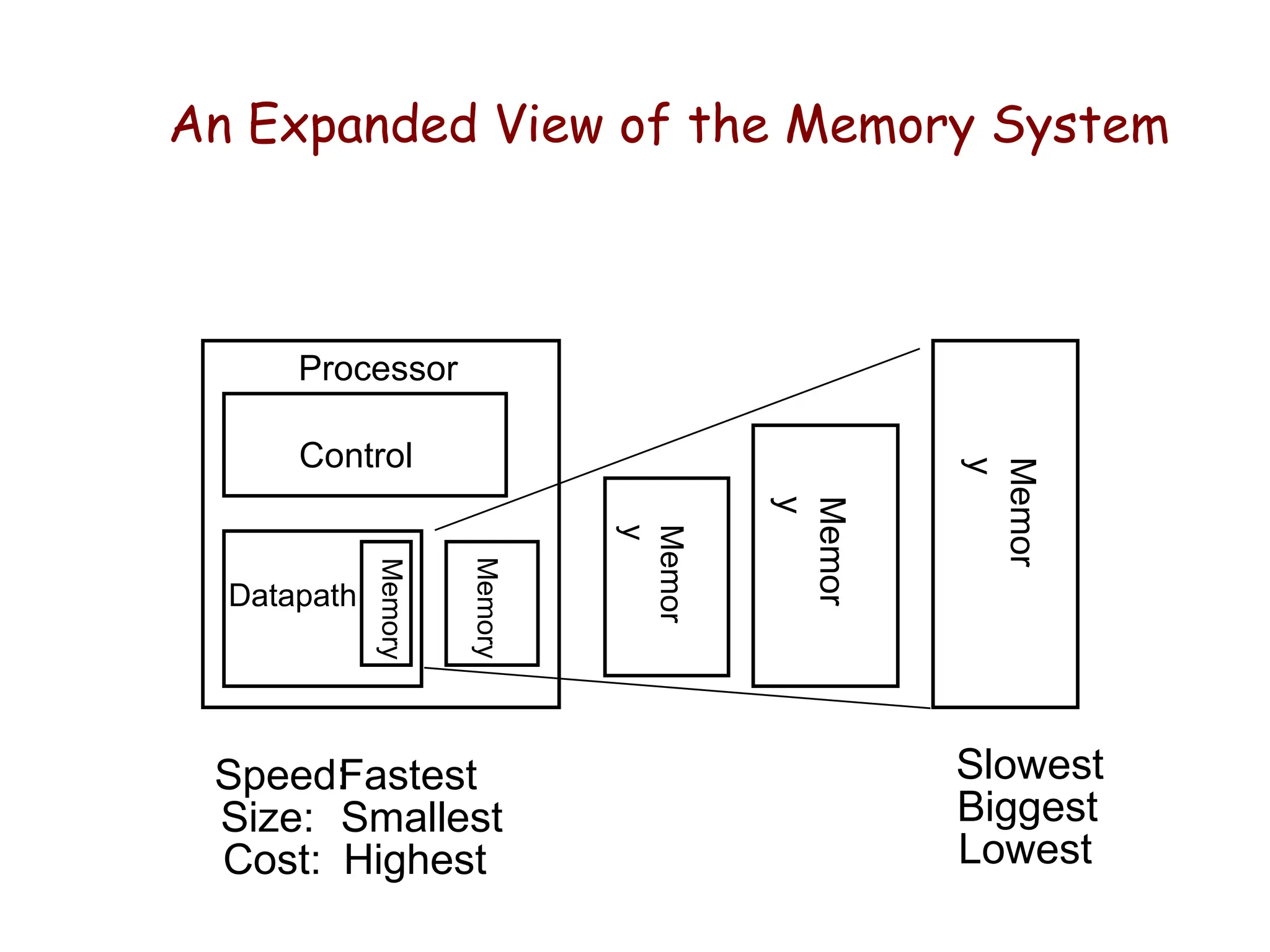
An Expanded View of the Memory System
Control
Datapath
Memor
y
Processor
Memory
Memor
y
Memor
y
Memory
Fastest Slowest
Smallest Biggest
Highest Lowest
Speed:
Size:
Cost:
How can one get fast memory with less expense?
• It is possible to build a computer which uses only
static RAM (large capacity of fast memory)
– This would be a very fast computer
– But, this would be very costly
• It also can be built using a small fast memory for
present reads and writes.
– Add a Cache memory
Cache Memories
Cache memories are small, fast SRAM-based memories
managed automatically in hardware.
 Hold frequently accessed blocks of main memory
CPU looks first for data in L1, then in L2, then in main
memory.
Typical bus structure:
main
memory
I/O
bridge
bus interface
L2 cache
ALU
register file
CPU chip
cache bus system bus memory bus
L1
cache
How Does Cache Work?
The Principle of Locality:
– Program access a relatively small portion of the address space at any instant of time.
There are 2 types of locality:
1. Temporal Locality (Locality in Time): If an item is referenced, it will tend to be referenced
again soon.
– Keep more recently accessed data items closer to the processor
2. Spatial Locality (Locality in Space): If an item is referenced, items whose addresses are
close by tend to be referenced soon.
– Move blocks consisting of contiguous words to the cache
Lower Level
Memory
Upper Level
Cache
To Processor
From Processor
Block X
Block Y
Cache Memory Organization
• Cache - Small amount of fast memory
– Sits between normal main memory and CPU
– May be located on CPU chip or in system
– Objective is to make slower memory system look like fast memory.
There may be more levels of cache (L1, L2,..)
Cache Read Operation - Flowchart
Cache Design Parameters
• Size of Cache
• Size of Blocks in Cache
• Mapping Function – how to assign blocks
• Write Policy - Replacement Algorithm when blocks
need to be replaced
Size Does Matter
• Cost
– More cache is expensive
• Speed
– More cache is faster (up to a point)
– Checking cache for data takes time
Typical Cache Organization
Cache Terminology
• Hit - a cache access finds data
resident in the cache memory
• Miss - a cache access does not find
data resident, forcing access to next
layer down in memory hierarchy
Terminology
• Miss ratio - percent of misses compared to
all accesses = Pmiss
– When performing analysis, always refer to miss
ratio!
• Hit access time - number of clocks to return
a cache hit
• Miss penalty - number of clocks to process a
cache miss (typically, in addition to at least
one clock of the hit time)
Lines & Tags
• Cache is partitioned into lines (also called
blocks). Each line has 2i
(i>1) bytes in it.
• During data transfer, a whole line is read or
written.
• Each line has a tag that indicates the address
of the Main memory from where the line has
been copied.
Cache/Main Memory Structure
Example: Direct Mapping
• Consider a direct mapped cache consisting of
– 128 lines of 16 words each
– Total 2K words
• Assume that the main memory is addressable by 16
bit address.
– Main memory is 64K having 4K blocks
Example: Direct Mapping
• In Direct Mapping: block J of the main memory maps
on to block J modulo 128 of the cache.
• Thus main memory blocks 0,128,256,…. loaded into
cache will stored at block 0; Block 1,129,257,….are
stored at block 1 and so on…
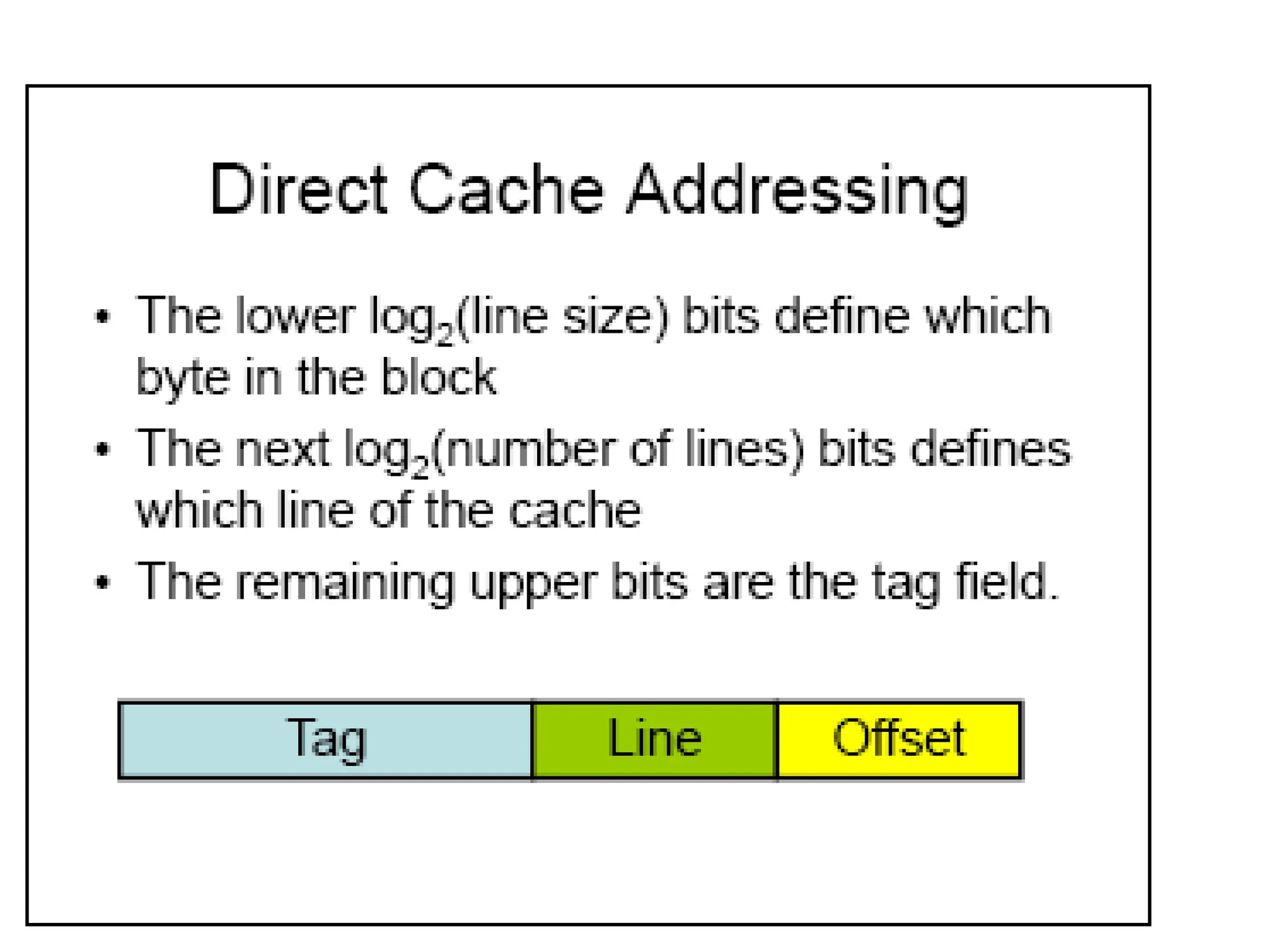
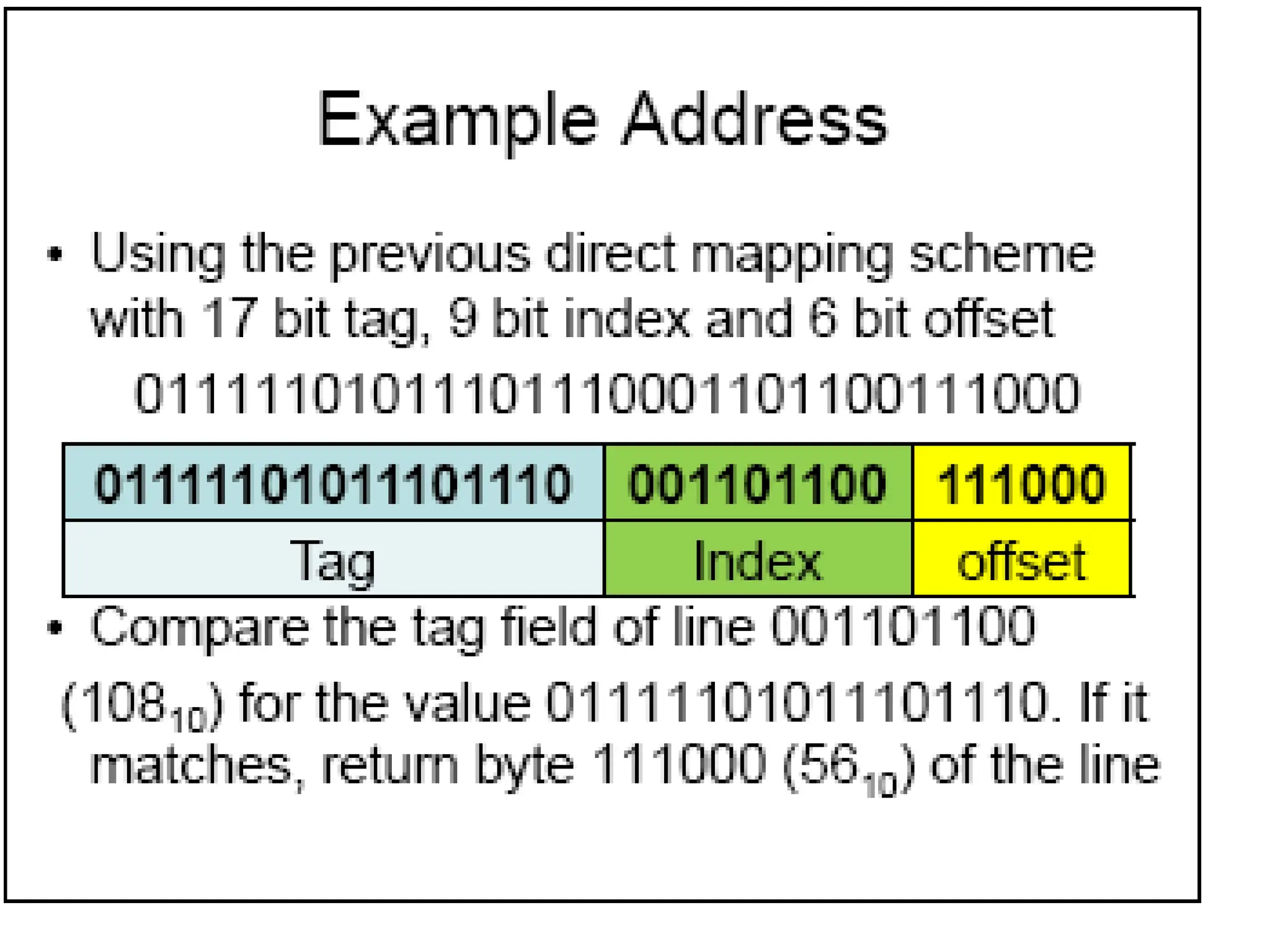
• Placement of a block in the cache is determined from
memory address. Memory address is divided into 3
fields:
• Tag
• Line/Index
• Offset/Word
Direct Mapping Cache Organization
Example: Associative Mapping
• Consider a cache consisting of
– 128 lines(or blocks) of 16 words each
– Total 2K words
• Assume that the main memory is addressable by 16
bit address.
– Main memory is 64K having 4K blocks
Example: Associative Mapping
• This is more flexible mapping method, main memory
block can be placed into any cache block position.
• The tag bits of an address received from the
processor are compared to the tag bits of each block
of the cache to see, if the desired block is present.
– Here, 12 tag bits are required to identify a memory block
when it resides in the cache.
Cost of an associated mapped cache is higher than the cost of
direct-mapped because of the need to search all 128 tag
patterns to determine whether a block is in cache.
– This is known as associative search.
Fully Associative Cache Organization
Associative Caching Example
Example: Set Associative Mapping
• Consider a cache with 2 lines per set
– 128 lines of 16 words each
– Total 2K words
• Assume that the main memory is addressable by 16
bit address.
– Main memory is 64K having 4K blocks
Example: Set Associative Mapping
• Cache blocks are grouped into sets and mapping allow
block of main memory reside into any block of a
specific set.
– Hence contention problem of direct mapping is eased , at the
same time , hardware cost is reduced by decreasing the size
of associative search.
• In this example, memory block 0, 64, 128,…..,4032 map
into cache set 0 and they can occupy any two block
within this set.
– Having 64 sets means that the 6 bit set field of the address
determines which set of the cache might contain the desired
block.
The tag bits of address must be associatively compared to the
tags of the two blocks of the set to check if desired block is
present. This is two way associative search.
Example 2: SA
• Consider a 32-bit computer that has an on-chip 16-Kbyte four-way set associative
cache. Assume that the cache has a line size of four 32-bit words. Show how the
different address fields are used with the cache. Determine where in the cache the word
from memory location ABCDE8F8 is mapped?
• Solution:
• A four-way set => 4 lines/set in the cache;
• ‘16-KByte cache’ AND ‘the cache has a line size of four 32-bit words’ =>
There are 16K*8/4*32 = 214
*23
/22
*25
= 210
= 1024 lines in the cache.
• ‘4 lines/set’ AND ‘1024 lines in the cache’ => There are 1024/4 = 256 = 28
sets in the cache=> Set length is 8 bits.
• Since each byte is addressable in every word, there will be 4*4= 16 bytes
(or 24
bytes) in a line => word(offset) length is 4 bits.
• ABCDE8F8 => memory address is 32 bits. So, the tag length is 32-8-4 = 20
bits.
• ABCDE8F8: bit no. 29 to 32 (last hex digit represents the word field => 3rd
word
• ABCDE8F8: bit no. 21 to 28 (2 hex digits) represent the set field => 143rd
set.
Two Way Set Associative Cache Organization
2 Way Set Assoc Example
Types of Cache Misses
Compulsory Miss
•It is also known as cold start misses or first references misses.
•Occur when the first access to a block happens. Block must be brought into
the cache.
Capacity Miss
•Occur when the program working set is much larger than the cache
capacity.
•Since Cache can not contain all blocks needed for program execution, so
cache discards these blocks.
Conflict Miss
•Also known as collision misses or interference misses.
•These misses occur when several blocks are mapped to the same set or
block frame.
– These misses occur in the set associative or direct mapped block placement strategies.
Replacement Algorithms (1)
Direct mapping
• No choice
• Each block only maps to one line
• Replace that line
Replacement Algorithms (2)
Associative & Set Associative
Likely Hardware implemented algorithm (for speed)
• First in first out (FIFO) ?
– replace block that has been in cache longest
• Least frequently used (LFU) ?
– replace block which has had fewest hits
• Least Recently used (LRU) ?
– Discards the least recently used items first
• Random ?
Pseudo LRU: 4-Way SA example
• each bit represents one branch point in a binary
decision tree
• let 1 represent that the left side has been
referenced more recently than the right side, and 0
vice-versa
Write Policy Challenges
• Must not overwrite a cache block unless main memory
is correct
• Multiple CPUs/Processes may have the block cached
• I/O may address main memory directly ?
(may not allow I/O buffers to be cached)
Write through
• Data is simultaneously updated to cache and memory.
• This process is simpler and more reliable. This is used
when there are no frequent writes to the cache
(Typically 15% or less of memory references are writes)
• It Solves the inconsistency problem
Challenges:
• A data write will experience latency (delay) as we have
to write to two locations (both Memory and Cache)
• Potentially slows down writes
Write back
• Updates initially made in cache only and updated into
the memory in later time
(Update bit for cache slot is set when update occurs)
• If block is to be replaced, memory overwritten only if
update bit is set
( 15% or less of memory references are writes )
• I/O must access main memory through cache or
update cache
References
• M. Morris Mano, Computer System Architecture,
Prentice Hall of India Pvt Ltd, 3rd
Edition (upda ted) ,
30 June 2017.
• William Stallings, Computer Organization and
Architecture–Designing for Performance, Ninth
Edition, Pearson Education, 2013.

Memory Organization and Cache mapping.ppt

  • 1.
  • 2.
    An Expanded Viewof the Memory System Control Datapath Memor y Processor Memory Memor y Memor y Memory Fastest Slowest Smallest Biggest Highest Lowest Speed: Size: Cost:
  • 3.
    How can oneget fast memory with less expense? • It is possible to build a computer which uses only static RAM (large capacity of fast memory) – This would be a very fast computer – But, this would be very costly • It also can be built using a small fast memory for present reads and writes. – Add a Cache memory
  • 4.
    Cache Memories Cache memoriesare small, fast SRAM-based memories managed automatically in hardware.  Hold frequently accessed blocks of main memory CPU looks first for data in L1, then in L2, then in main memory. Typical bus structure: main memory I/O bridge bus interface L2 cache ALU register file CPU chip cache bus system bus memory bus L1 cache
  • 5.
    How Does CacheWork? The Principle of Locality: – Program access a relatively small portion of the address space at any instant of time. There are 2 types of locality: 1. Temporal Locality (Locality in Time): If an item is referenced, it will tend to be referenced again soon. – Keep more recently accessed data items closer to the processor 2. Spatial Locality (Locality in Space): If an item is referenced, items whose addresses are close by tend to be referenced soon. – Move blocks consisting of contiguous words to the cache Lower Level Memory Upper Level Cache To Processor From Processor Block X Block Y
  • 6.
    Cache Memory Organization •Cache - Small amount of fast memory – Sits between normal main memory and CPU – May be located on CPU chip or in system – Objective is to make slower memory system look like fast memory. There may be more levels of cache (L1, L2,..)
  • 7.
  • 8.
    Cache Design Parameters •Size of Cache • Size of Blocks in Cache • Mapping Function – how to assign blocks • Write Policy - Replacement Algorithm when blocks need to be replaced
  • 9.
    Size Does Matter •Cost – More cache is expensive • Speed – More cache is faster (up to a point) – Checking cache for data takes time
  • 10.
  • 11.
    Cache Terminology • Hit- a cache access finds data resident in the cache memory • Miss - a cache access does not find data resident, forcing access to next layer down in memory hierarchy
  • 12.
    Terminology • Miss ratio- percent of misses compared to all accesses = Pmiss – When performing analysis, always refer to miss ratio! • Hit access time - number of clocks to return a cache hit • Miss penalty - number of clocks to process a cache miss (typically, in addition to at least one clock of the hit time)
  • 15.
    Lines & Tags •Cache is partitioned into lines (also called blocks). Each line has 2i (i>1) bytes in it. • During data transfer, a whole line is read or written. • Each line has a tag that indicates the address of the Main memory from where the line has been copied.
  • 17.
  • 20.
    Example: Direct Mapping •Consider a direct mapped cache consisting of – 128 lines of 16 words each – Total 2K words • Assume that the main memory is addressable by 16 bit address. – Main memory is 64K having 4K blocks
  • 21.
  • 22.
    Example: Direct Mapping •In Direct Mapping: block J of the main memory maps on to block J modulo 128 of the cache. • Thus main memory blocks 0,128,256,…. loaded into cache will stored at block 0; Block 1,129,257,….are stored at block 1 and so on… • Placement of a block in the cache is determined from memory address. Memory address is divided into 3 fields: • Tag • Line/Index • Offset/Word
  • 25.
  • 28.
    Example: Associative Mapping •Consider a cache consisting of – 128 lines(or blocks) of 16 words each – Total 2K words • Assume that the main memory is addressable by 16 bit address. – Main memory is 64K having 4K blocks
  • 29.
  • 30.
    Example: Associative Mapping •This is more flexible mapping method, main memory block can be placed into any cache block position. • The tag bits of an address received from the processor are compared to the tag bits of each block of the cache to see, if the desired block is present. – Here, 12 tag bits are required to identify a memory block when it resides in the cache. Cost of an associated mapped cache is higher than the cost of direct-mapped because of the need to search all 128 tag patterns to determine whether a block is in cache. – This is known as associative search.
  • 33.
  • 34.
  • 37.
    Example: Set AssociativeMapping • Consider a cache with 2 lines per set – 128 lines of 16 words each – Total 2K words • Assume that the main memory is addressable by 16 bit address. – Main memory is 64K having 4K blocks
  • 38.
  • 39.
    Example: Set AssociativeMapping • Cache blocks are grouped into sets and mapping allow block of main memory reside into any block of a specific set. – Hence contention problem of direct mapping is eased , at the same time , hardware cost is reduced by decreasing the size of associative search. • In this example, memory block 0, 64, 128,…..,4032 map into cache set 0 and they can occupy any two block within this set. – Having 64 sets means that the 6 bit set field of the address determines which set of the cache might contain the desired block. The tag bits of address must be associatively compared to the tags of the two blocks of the set to check if desired block is present. This is two way associative search.
  • 42.
    Example 2: SA •Consider a 32-bit computer that has an on-chip 16-Kbyte four-way set associative cache. Assume that the cache has a line size of four 32-bit words. Show how the different address fields are used with the cache. Determine where in the cache the word from memory location ABCDE8F8 is mapped? • Solution: • A four-way set => 4 lines/set in the cache; • ‘16-KByte cache’ AND ‘the cache has a line size of four 32-bit words’ => There are 16K*8/4*32 = 214 *23 /22 *25 = 210 = 1024 lines in the cache. • ‘4 lines/set’ AND ‘1024 lines in the cache’ => There are 1024/4 = 256 = 28 sets in the cache=> Set length is 8 bits. • Since each byte is addressable in every word, there will be 4*4= 16 bytes (or 24 bytes) in a line => word(offset) length is 4 bits. • ABCDE8F8 => memory address is 32 bits. So, the tag length is 32-8-4 = 20 bits. • ABCDE8F8: bit no. 29 to 32 (last hex digit represents the word field => 3rd word • ABCDE8F8: bit no. 21 to 28 (2 hex digits) represent the set field => 143rd set.
  • 44.
    Two Way SetAssociative Cache Organization
  • 45.
    2 Way SetAssoc Example
  • 50.
    Types of CacheMisses Compulsory Miss •It is also known as cold start misses or first references misses. •Occur when the first access to a block happens. Block must be brought into the cache. Capacity Miss •Occur when the program working set is much larger than the cache capacity. •Since Cache can not contain all blocks needed for program execution, so cache discards these blocks. Conflict Miss •Also known as collision misses or interference misses. •These misses occur when several blocks are mapped to the same set or block frame. – These misses occur in the set associative or direct mapped block placement strategies.
  • 52.
    Replacement Algorithms (1) Directmapping • No choice • Each block only maps to one line • Replace that line
  • 53.
    Replacement Algorithms (2) Associative& Set Associative Likely Hardware implemented algorithm (for speed) • First in first out (FIFO) ? – replace block that has been in cache longest • Least frequently used (LFU) ? – replace block which has had fewest hits • Least Recently used (LRU) ? – Discards the least recently used items first • Random ?
  • 56.
    Pseudo LRU: 4-WaySA example • each bit represents one branch point in a binary decision tree • let 1 represent that the left side has been referenced more recently than the right side, and 0 vice-versa
  • 57.
    Write Policy Challenges •Must not overwrite a cache block unless main memory is correct • Multiple CPUs/Processes may have the block cached • I/O may address main memory directly ? (may not allow I/O buffers to be cached)
  • 58.
    Write through • Datais simultaneously updated to cache and memory. • This process is simpler and more reliable. This is used when there are no frequent writes to the cache (Typically 15% or less of memory references are writes) • It Solves the inconsistency problem Challenges: • A data write will experience latency (delay) as we have to write to two locations (both Memory and Cache) • Potentially slows down writes
  • 59.
    Write back • Updatesinitially made in cache only and updated into the memory in later time (Update bit for cache slot is set when update occurs) • If block is to be replaced, memory overwritten only if update bit is set ( 15% or less of memory references are writes ) • I/O must access main memory through cache or update cache
  • 60.
    References • M. MorrisMano, Computer System Architecture, Prentice Hall of India Pvt Ltd, 3rd Edition (upda ted) , 30 June 2017. • William Stallings, Computer Organization and Architecture–Designing for Performance, Ninth Edition, Pearson Education, 2013.

Editor's Notes

  • #5 Here is a simple overview of how cache works. Cache works on the principle of locality. It takes advantage of the temporal locality by keeping the more recently addressed words in the cache. In order to take advantage of spatial locality, on a cache miss, we will move an entire block of data that contains the missing word from the lower level into the cache. This way, we are not ONLY storing the most recently touched data in the cache but also the data that are adjacent to them.