
Alexander the Great
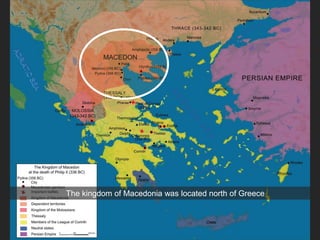
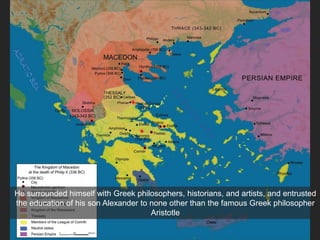
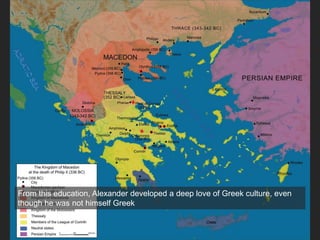
The kingdom of Macedonia was located north of Greece
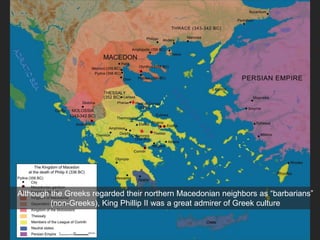
Although the Greeks regarded their northern Macedonian neighbors as “barbarians”
(non-Greeks), King Phillip II was a great admirer of Greek culture
He surrounded himself with Greek philosophers, historians, and artists, and entrusted
the education of his son Alexander to none other than the famous Greek philosopher
Aristotle
From this education, Alexander developed a deep love of Greek culture, even
though he was not himself Greek
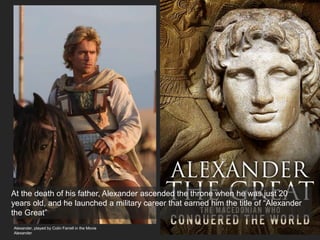
At the death of his father, Alexander ascended the throne when he was just 20
years old, and he launched a military career that earned him the title of “Alexander
the Great”
Alexander, played by Colin Farrell in the Movie
Alexander
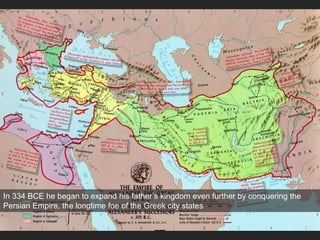
Alexander’s Empire
Macedon
In 334 BCE he began to expand his father’s kingdom even further by conquering the
Persian Empire, the longtime foe of the Greek city states
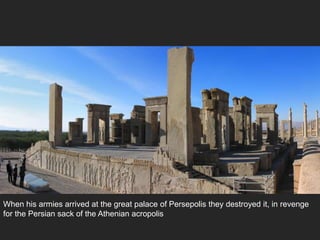
When his armies arrived at the great palace of Persepolis they destroyed it, in revenge
for the Persian sack of the Athenian acropolis
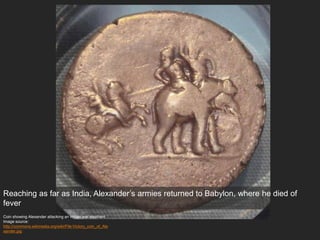
Coin showing Alexander attacking an Indian war elephant
Image source:
http://commons.wikimedia.org/wiki/File:Victory_coin_of_Ale
xander.jpg
Reaching as far as India, Alexander’s armies returned to Babylon, where he died of
fever
Alexander’s Empire
Macedon
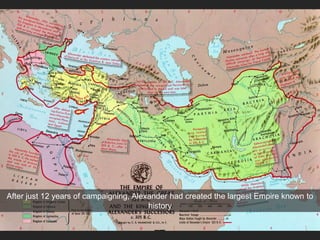
After just 12 years of campaigning, Alexander had created the largest Empire known to
history
Alexander’s Empire
Macedon
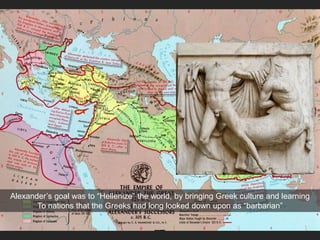
Alexander’s goal was to “Hellenize” the world, by bringing Greek culture and learning
To nations that the Greeks had long looked down upon as “barbarian”
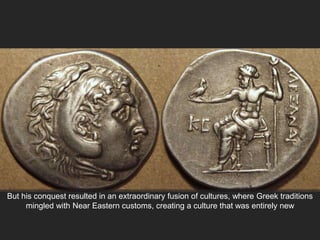
But his conquest resulted in an extraordinary fusion of cultures, where Greek traditions
mingled with Near Eastern customs, creating a culture that was entirely new
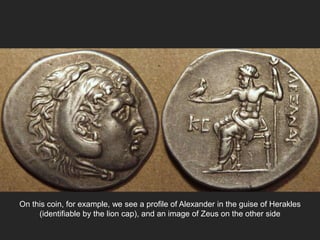
On this coin, for example, we see a profile of Alexander in the guise of Herakles
(identifiable by the lion cap), and an image of Zeus on the other side
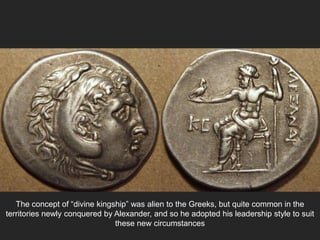
The concept of “divine kingship” was alien to the Greeks, but quite common in the
territories newly conquered by Alexander, and so he adopted his leadership style to suit
these new circumstances
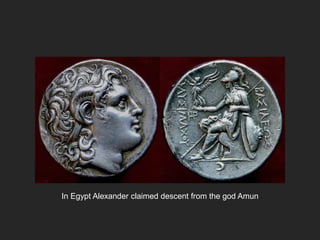
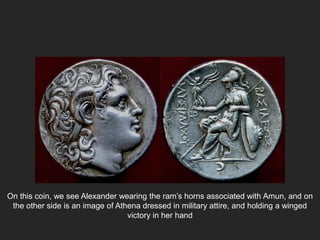
In Egypt Alexander claimed descent from the god Amun
On this coin, we see Alexander wearing the ram’s horns associated with Amun, and on
the other side is an image of Athena dressed in military attire, and holding a winged
victory in her hand
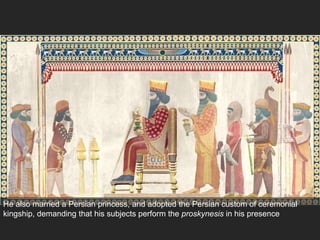
He also married a Persian princess, and adopted the Persian custom of ceremonial
kingship, demanding that his subjects perform the proskynesis in his presence
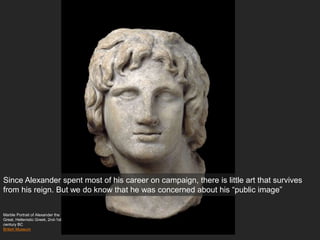
Marble Portrait of Alexander the
Great, Hellenistic Greek, 2nd-1st
century BC
British Museum
Since Alexander spent most of his career on campaign, there is little art that survives
from his reign. But we do know that he was concerned about his “public image”
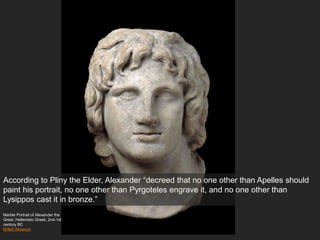
Marble Portrait of Alexander the
Great, Hellenistic Greek, 2nd-1st
century BC
British Museum
According to Pliny the Elder, Alexander “decreed that no one other than Apelles should
paint his portrait, no one other than Pyrgoteles engrave it, and no one other than
Lysippos cast it in bronze.”
Portrait of Alexander, Roman copy after original by Lysippos
c. 330 BCE, Louvre
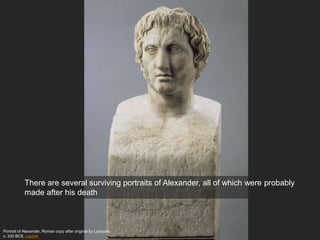
There are several surviving portraits of Alexander, all of which were probably
made after his death
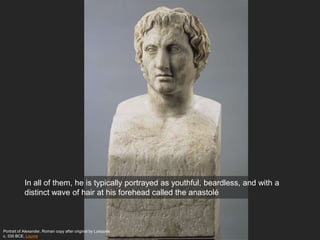
Portrait of Alexander, Roman copy after original by Lysippos
c. 330 BCE, Louvre
In all of them, he is typically portrayed as youthful, beardless, and with a
distinct wave of hair at his forehead called the anastolé
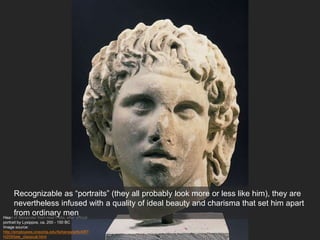
Head of Alexander from near Pella, after official
portrait by Lysippos, ca. 200 - 150 BC
Image source:
http://employees.oneonta.edu/farberas/arth/ART
H209/late_classical.html
Recognizable as “portraits” (they all probably look more or less like him), they are
nevertheless infused with a quality of ideal beauty and charisma that set him apart
from ordinary men
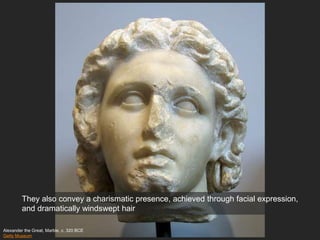
Alexander the Great, Marble, c. 320 BCE
Getty Museum
They also convey a charismatic presence, achieved through facial expression,
and dramatically windswept hair
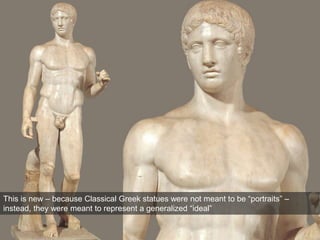
This is new – because Classical Greek statues were not meant to be “portraits” –
instead, they were meant to represent a generalized “ideal”
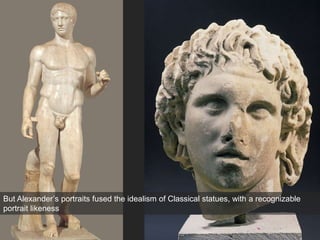
But Alexander’s portraits fused the idealism of Classical statues, with a recognizable
portrait likeness
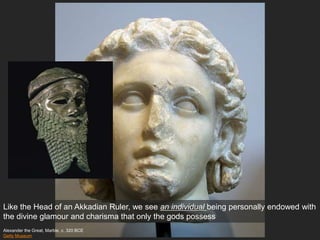
Alexander the Great, Marble, c. 320 BCE
Getty Museum
Like the Head of an Akkadian Ruler, we see an individual being personally endowed with
the divine glamour and charisma that only the gods possess
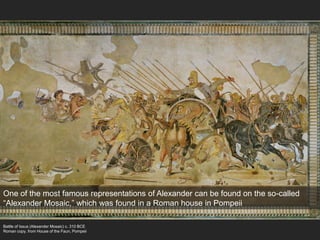
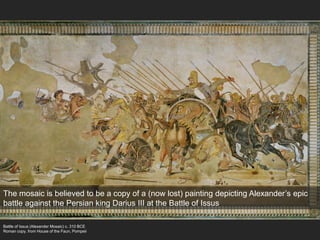
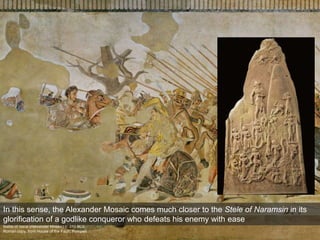
Battle of Issus (Alexander Mosaic) c. 310 BCE
Roman copy, from House of the Faun, Pompeii
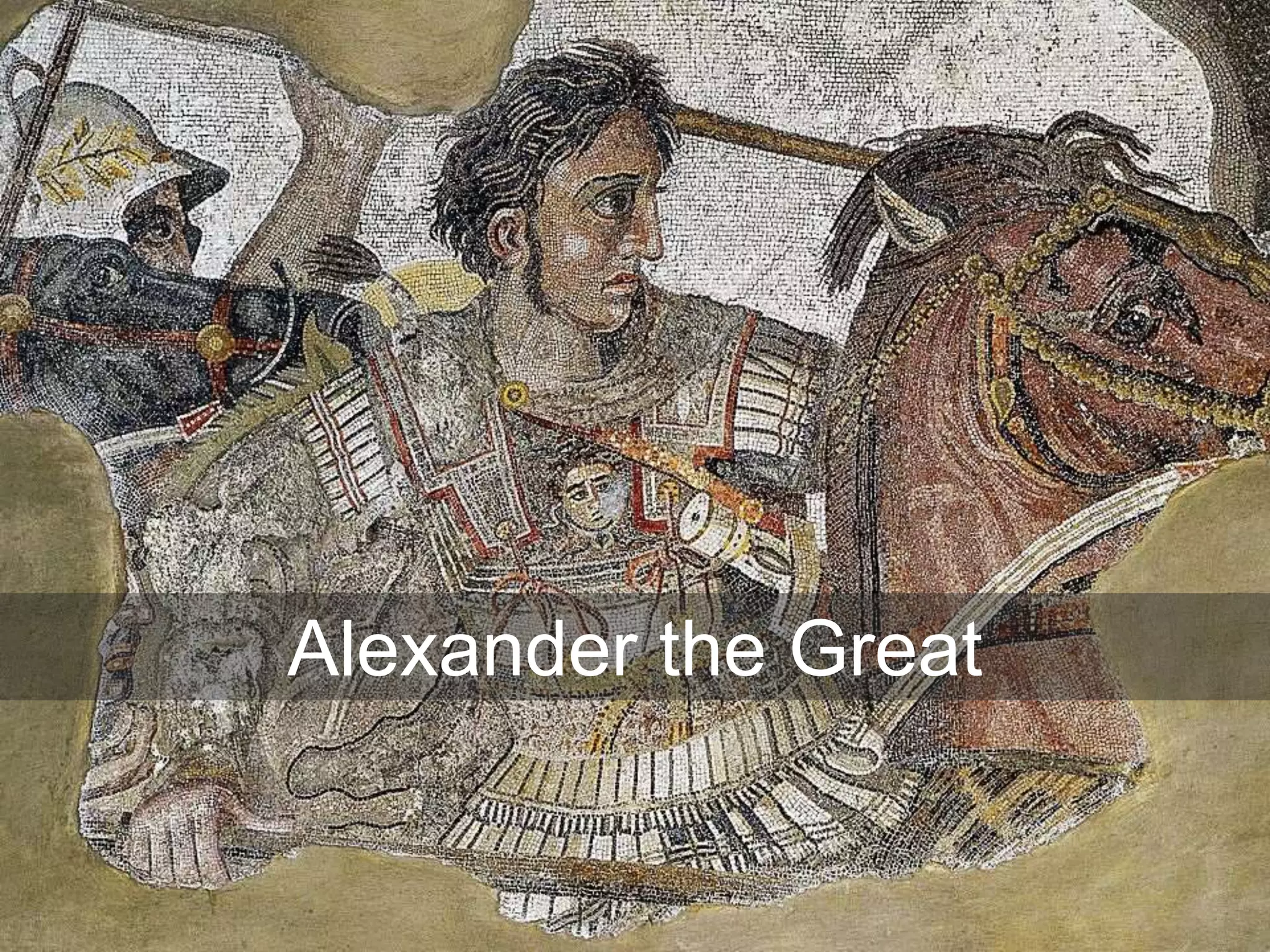
One of the most famous representations of Alexander can be found on the so-called
“Alexander Mosaic,” which was found in a Roman house in Pompeii
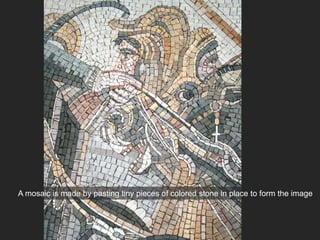
A mosaic is made by pasting tiny pieces of colored stone in place to form the image
Battle of Issus (Alexander Mosaic) c. 310 BCE
Roman copy, from House of the Faun, Pompeii
The mosaic is believed to be a copy of a (now lost) painting depicting Alexander’s epic
battle against the Persian king Darius III at the Battle of Issus
Battle of Issus (Alexander Mosaic) c. 310 BCE
Roman copy, from House of the Faun, Pompeii
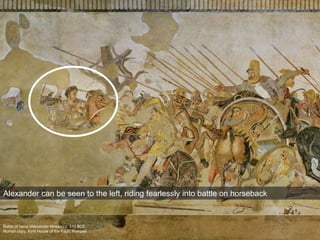
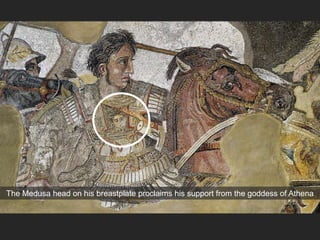
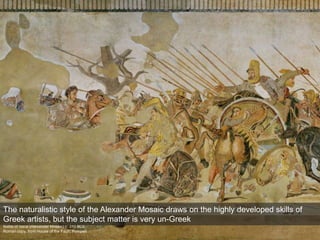
Alexander can be seen to the left, riding fearlessly into battle on horseback
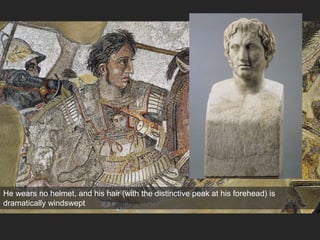
He wears no helmet, and his hair (with the distinctive peak at his forehead) is
dramatically windswept
The Medusa head on his breastplate proclaims his support from the goddess of Athena
Battle of Issus (Alexander Mosaic) c. 310 BCE
Roman copy, from House of the Faun, Pompeii
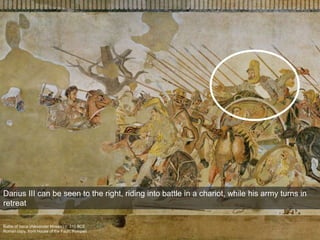
Darius III can be seen to the right, riding into battle in a chariot, while his army turns in
retreat
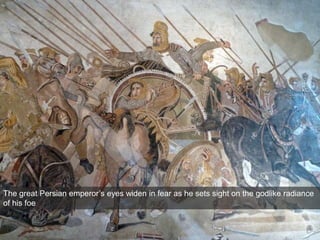
The great Persian emperor’s eyes widen in fear as he sets sight on the godlike radiance
of his foe
Battle of Issus (Alexander Mosaic) c. 310 BCE
Roman copy, from House of the Faun, Pompeii
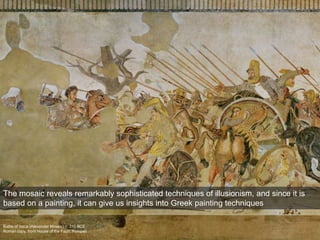
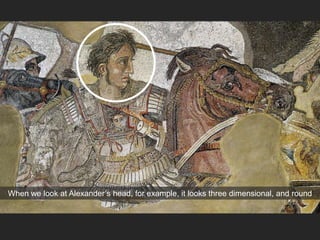
The mosaic reveals remarkably sophisticated techniques of illusionism, and since it is
based on a painting, it can give us insights into Greek painting techniques
When we look at Alexander’s head, for example, it looks three dimensional, and round
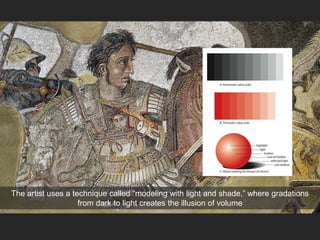
The artist uses a technique called “modeling with light and shade,” where gradations
from dark to light creates the illusion of volume
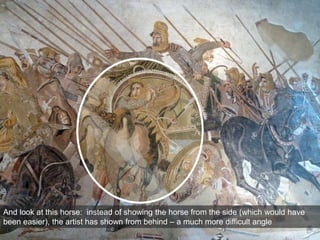
And look at this horse: instead of showing the horse from the side (which would have
been easier), the artist has shown from behind – a much more difficult angle
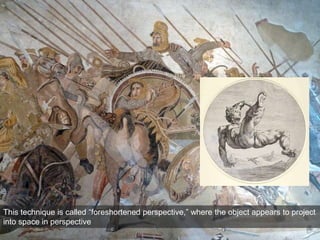
This technique is called “foreshortened perspective,” where the object appears to project
into space in perspective
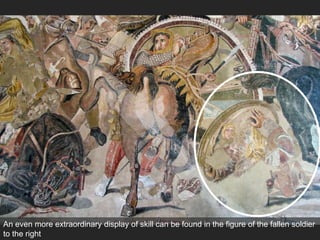
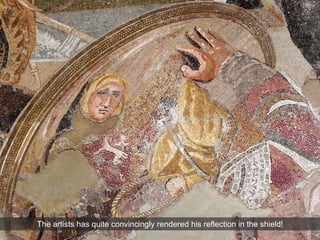
An even more extraordinary display of skill can be found in the figure of the fallen soldier
to the right
The artists has quite convincingly rendered his reflection in the shield!
Battle of Issus (Alexander Mosaic) c. 310 BCE
Roman copy, from House of the Faun, Pompeii
The naturalistic style of the Alexander Mosaic draws on the highly developed skills of
Greek artists, but the subject matter is very un-Greek
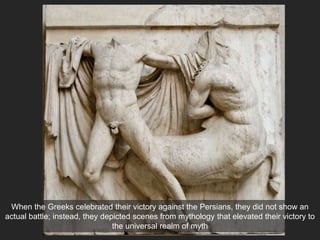
When the Greeks celebrated their victory against the Persians, they did not show an
actual battle; instead, they depicted scenes from mythology that elevated their victory to
the universal realm of myth
Battle of Issus (Alexander Mosaic) c. 310 BCE
Roman copy, from House of the Faun, Pompeii
In this sense, the Alexander Mosaic comes much closer to the Stele of Naramsin in its
glorification of a godlike conqueror who defeats his enemy with ease
Thanks for listening!

Late Classical Art: Alexander the Great

  • 1.
  • 2.
    The kingdom ofMacedonia was located north of Greece
  • 3.
    Although the Greeksregarded their northern Macedonian neighbors as “barbarians” (non-Greeks), King Phillip II was a great admirer of Greek culture
  • 4.
    He surrounded himselfwith Greek philosophers, historians, and artists, and entrusted the education of his son Alexander to none other than the famous Greek philosopher Aristotle
  • 5.
    From this education,Alexander developed a deep love of Greek culture, even though he was not himself Greek
  • 6.
    At the deathof his father, Alexander ascended the throne when he was just 20 years old, and he launched a military career that earned him the title of “Alexander the Great” Alexander, played by Colin Farrell in the Movie Alexander
  • 7.
    Alexander’s Empire Macedon In 334BCE he began to expand his father’s kingdom even further by conquering the Persian Empire, the longtime foe of the Greek city states
  • 8.
    When his armiesarrived at the great palace of Persepolis they destroyed it, in revenge for the Persian sack of the Athenian acropolis
  • 9.
    Coin showing Alexanderattacking an Indian war elephant Image source: http://commons.wikimedia.org/wiki/File:Victory_coin_of_Ale xander.jpg Reaching as far as India, Alexander’s armies returned to Babylon, where he died of fever
  • 10.
    Alexander’s Empire Macedon After just12 years of campaigning, Alexander had created the largest Empire known to history
  • 11.
    Alexander’s Empire Macedon Alexander’s goalwas to “Hellenize” the world, by bringing Greek culture and learning To nations that the Greeks had long looked down upon as “barbarian”
  • 12.
    But his conquestresulted in an extraordinary fusion of cultures, where Greek traditions mingled with Near Eastern customs, creating a culture that was entirely new
  • 13.
    On this coin,for example, we see a profile of Alexander in the guise of Herakles (identifiable by the lion cap), and an image of Zeus on the other side
  • 14.
    The concept of“divine kingship” was alien to the Greeks, but quite common in the territories newly conquered by Alexander, and so he adopted his leadership style to suit these new circumstances
  • 15.
    In Egypt Alexanderclaimed descent from the god Amun
  • 16.
    On this coin,we see Alexander wearing the ram’s horns associated with Amun, and on the other side is an image of Athena dressed in military attire, and holding a winged victory in her hand
  • 17.
    He also marrieda Persian princess, and adopted the Persian custom of ceremonial kingship, demanding that his subjects perform the proskynesis in his presence
  • 18.
    Marble Portrait ofAlexander the Great, Hellenistic Greek, 2nd-1st century BC British Museum Since Alexander spent most of his career on campaign, there is little art that survives from his reign. But we do know that he was concerned about his “public image”
  • 19.
    Marble Portrait ofAlexander the Great, Hellenistic Greek, 2nd-1st century BC British Museum According to Pliny the Elder, Alexander “decreed that no one other than Apelles should paint his portrait, no one other than Pyrgoteles engrave it, and no one other than Lysippos cast it in bronze.”
  • 20.
    Portrait of Alexander,Roman copy after original by Lysippos c. 330 BCE, Louvre There are several surviving portraits of Alexander, all of which were probably made after his death
  • 21.
    Portrait of Alexander,Roman copy after original by Lysippos c. 330 BCE, Louvre In all of them, he is typically portrayed as youthful, beardless, and with a distinct wave of hair at his forehead called the anastolé
  • 22.
    Head of Alexanderfrom near Pella, after official portrait by Lysippos, ca. 200 - 150 BC Image source: http://employees.oneonta.edu/farberas/arth/ART H209/late_classical.html Recognizable as “portraits” (they all probably look more or less like him), they are nevertheless infused with a quality of ideal beauty and charisma that set him apart from ordinary men
  • 23.
    Alexander the Great,Marble, c. 320 BCE Getty Museum They also convey a charismatic presence, achieved through facial expression, and dramatically windswept hair
  • 24.
    This is new– because Classical Greek statues were not meant to be “portraits” – instead, they were meant to represent a generalized “ideal”
  • 25.
    But Alexander’s portraitsfused the idealism of Classical statues, with a recognizable portrait likeness
  • 26.
    Alexander the Great,Marble, c. 320 BCE Getty Museum Like the Head of an Akkadian Ruler, we see an individual being personally endowed with the divine glamour and charisma that only the gods possess
  • 27.
    Battle of Issus(Alexander Mosaic) c. 310 BCE Roman copy, from House of the Faun, Pompeii One of the most famous representations of Alexander can be found on the so-called “Alexander Mosaic,” which was found in a Roman house in Pompeii
  • 28.
    A mosaic ismade by pasting tiny pieces of colored stone in place to form the image
  • 29.
    Battle of Issus(Alexander Mosaic) c. 310 BCE Roman copy, from House of the Faun, Pompeii The mosaic is believed to be a copy of a (now lost) painting depicting Alexander’s epic battle against the Persian king Darius III at the Battle of Issus
  • 30.
    Battle of Issus(Alexander Mosaic) c. 310 BCE Roman copy, from House of the Faun, Pompeii Alexander can be seen to the left, riding fearlessly into battle on horseback
  • 31.
    He wears nohelmet, and his hair (with the distinctive peak at his forehead) is dramatically windswept
  • 32.
    The Medusa headon his breastplate proclaims his support from the goddess of Athena
  • 33.
    Battle of Issus(Alexander Mosaic) c. 310 BCE Roman copy, from House of the Faun, Pompeii Darius III can be seen to the right, riding into battle in a chariot, while his army turns in retreat
  • 34.
    The great Persianemperor’s eyes widen in fear as he sets sight on the godlike radiance of his foe
  • 35.
    Battle of Issus(Alexander Mosaic) c. 310 BCE Roman copy, from House of the Faun, Pompeii The mosaic reveals remarkably sophisticated techniques of illusionism, and since it is based on a painting, it can give us insights into Greek painting techniques
  • 36.
    When we lookat Alexander’s head, for example, it looks three dimensional, and round
  • 37.
    The artist usesa technique called “modeling with light and shade,” where gradations from dark to light creates the illusion of volume
  • 38.
    And look atthis horse: instead of showing the horse from the side (which would have been easier), the artist has shown from behind – a much more difficult angle
  • 39.
    This technique iscalled “foreshortened perspective,” where the object appears to project into space in perspective
  • 40.
    An even moreextraordinary display of skill can be found in the figure of the fallen soldier to the right
  • 41.
    The artists hasquite convincingly rendered his reflection in the shield!
  • 42.
    Battle of Issus(Alexander Mosaic) c. 310 BCE Roman copy, from House of the Faun, Pompeii The naturalistic style of the Alexander Mosaic draws on the highly developed skills of Greek artists, but the subject matter is very un-Greek
  • 43.
    When the Greekscelebrated their victory against the Persians, they did not show an actual battle; instead, they depicted scenes from mythology that elevated their victory to the universal realm of myth
  • 44.
    Battle of Issus(Alexander Mosaic) c. 310 BCE Roman copy, from House of the Faun, Pompeii In this sense, the Alexander Mosaic comes much closer to the Stele of Naramsin in its glorification of a godlike conqueror who defeats his enemy with ease
  • 45.