Ex :
Alexander the Great built a huge empire and helped spread Greek
culture into Egypt and Asia. in the 300s BC was from
Macedonia, a kingdom just north of Greece. The
Greeks thought the Macedonians were barbarians
and tried to avoid them. Eventually Macedonia
would overtake Greece.
Explain the first year of Philip’s rule ?306
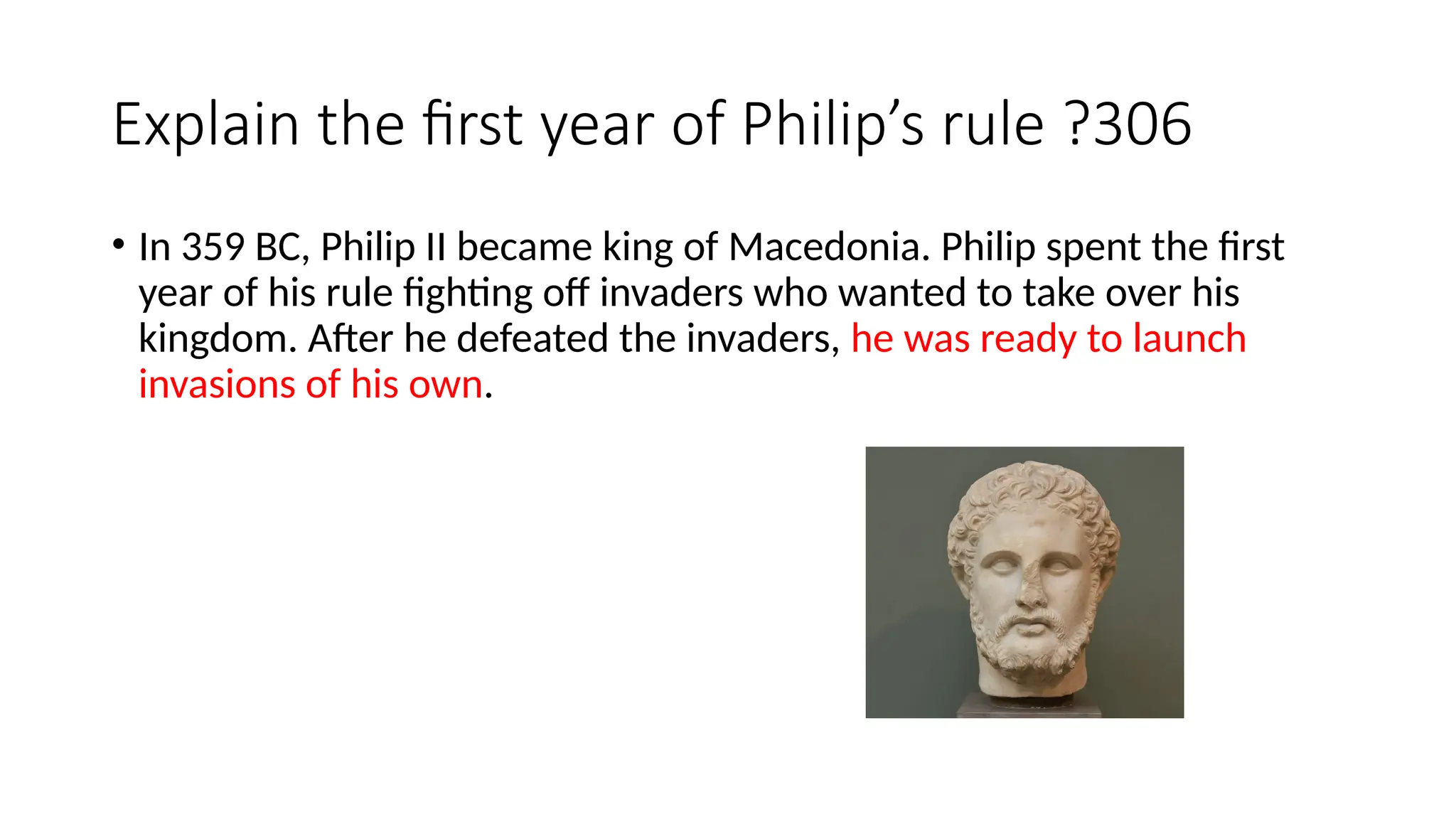
• In 359 BC, Philip II became king of Macedonia. Philip spent the first
year of his rule fighting off invaders who wanted to take over his
kingdom. After he defeated the invaders, he was ready to launch
invasions of his own.
What was Philip target?306
• Philip’s main target was Greece. The leaders of Athens, knowing they
were the target of Philip’s powerful army.
Who did win the war between Greece and
Macedonians ?306
• The armies of Athens and its chief ally, Thebes, were easily defeated
by the Macedonians. Having witnessed this defeat, the rest of the
Greeks agreed to make Philip their leader.
How did Philip defeat Greeks ?306
• Philip defeated the Greeks because he was a brilliant military leader.
He borrowed and improved many of the strategies Greek armies used
in battle.
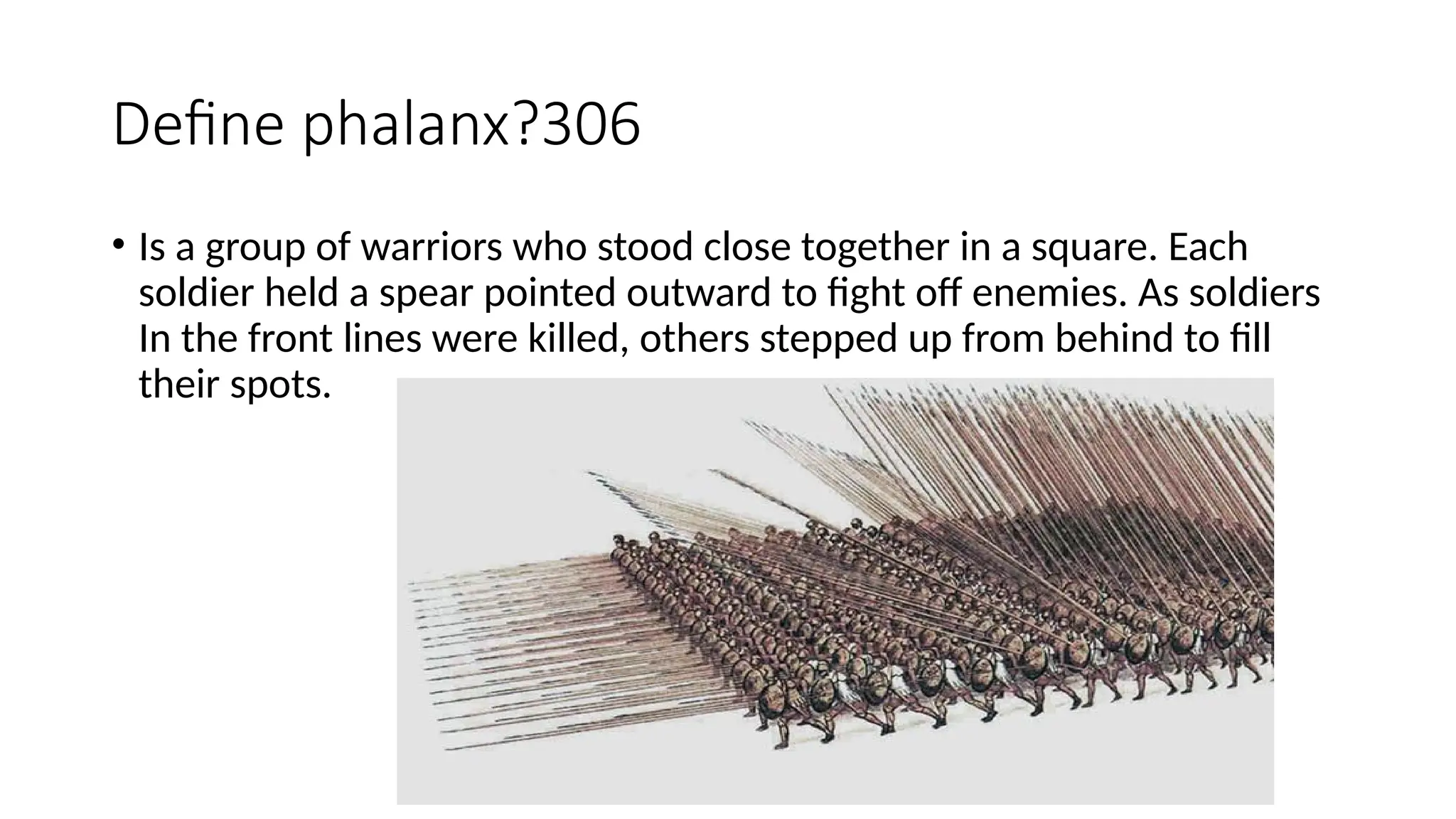
Define phalanx?306
• Is a group of warriors who stood close together in a square. Each
soldier held a spear pointed outward to fight off enemies. As soldiers
In the front lines were killed, others stepped up from behind to fill
their spots.
Define some of the strategies that Philip
used ?306
• Philip’s soldiers, like the Greeks, fought as a phalanx
• Philip improved the Greeks’ idea. He gave his
• soldiers spears that were much longer than those of his opponents.
This allowed his army to attack effectively in any battle.
• Philip also sent cavalry and archers into battle to support the phalanx.
Activity 1
•
Have students write a short speech either supporting or opposing
Alexander the Great from your point of view
.
Did Philip success in conquering Persian?307
• No, He planned to march east and conquer the Persian Empire, but he
never made it. He was murdered while celebrating his daughter’s
wedding. When Philip died, his throne—and his plans—passed to his
son, Alexander.
Why did the people of Thebes rebel?307
• They thought that the Macedonians would not have a leader strong
enough to keep the kingdom together, but They were wrong.
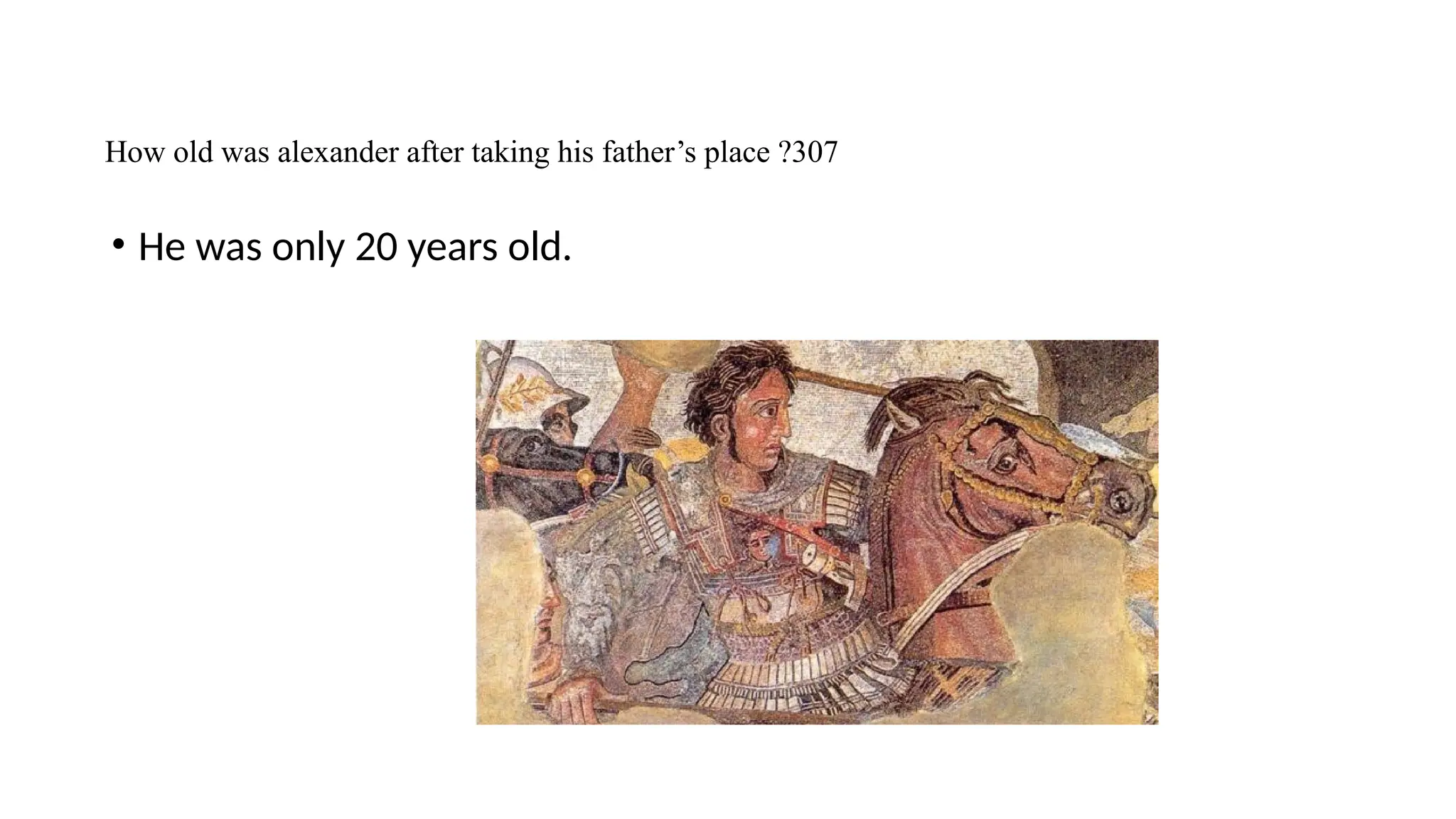
How old was alexander after taking his father’s place ?307
• He was only 20 years old.
What did he achieve after the death of his father?
307
• He immediately went south to end the revolt in Thebes.
• Alexander had destroyed Thebes and enslaved the Theban people. He
used Thebes as an example to other Greeks of what would happen if
they turned against him.
• He set out to build an empire, to make sure the Greeks would not
rebel again.
Why is Alexander called “the Great”?307
• He took over his father’s throne at 20 and then built one of the largest
empires the world has ever seen.
Summaries the legend tale of alexander ?
(critical thinking)
• According to legend, Alexander visited a town called Gordius in Asia
Minor while he was fighting the Persians. There he heard an ancient
tale about a knot tied by an ancient king.
• The tale said that whoever untied the knot would rule all of Asia.
According to the legend, Alexander pulled out his sword and cut right
through the knot. Taking this as a good sign, he and his army set out
again.
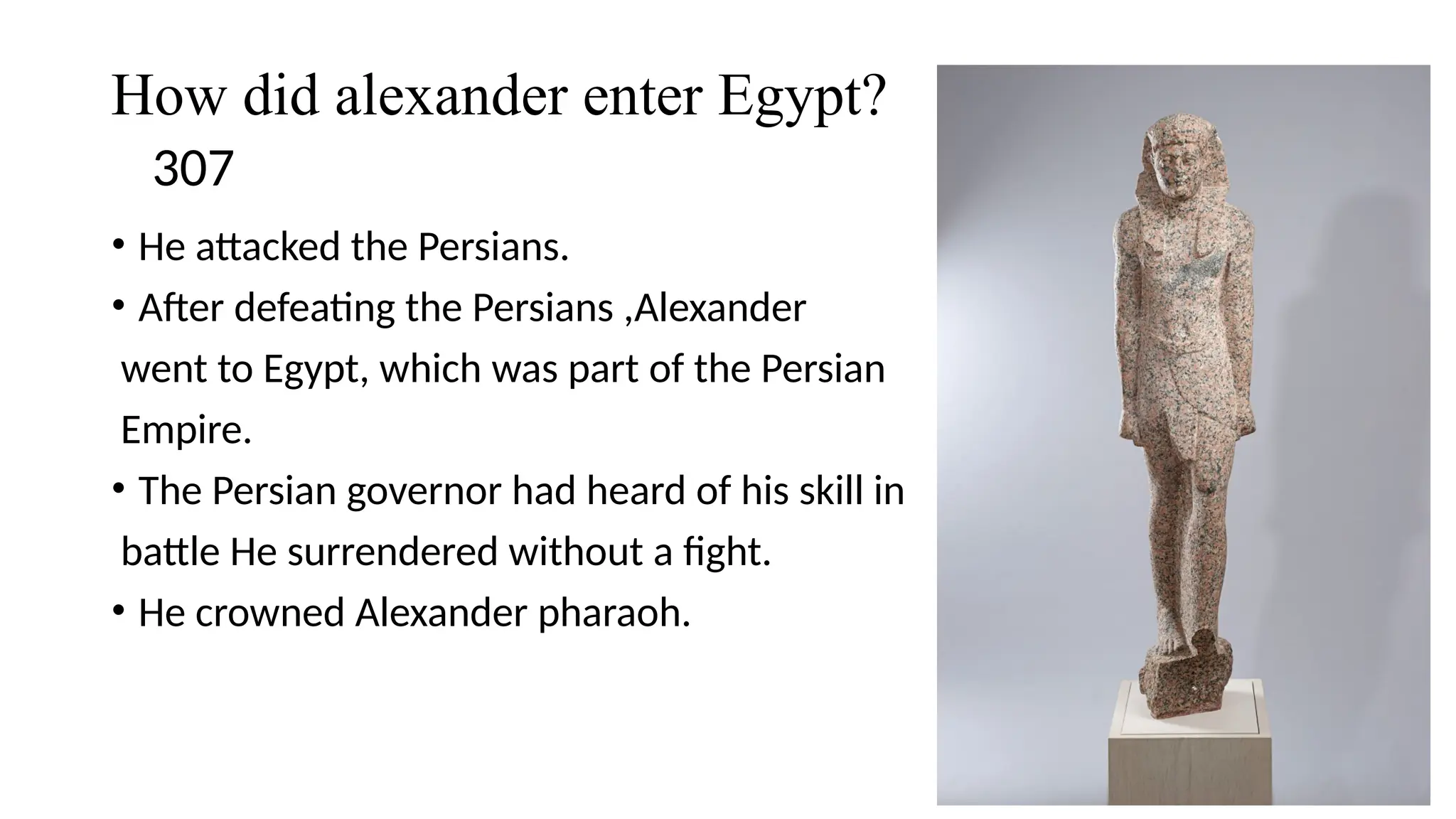
How did alexander enter Egypt?
307
• He attacked the Persians.
• After defeating the Persians ,Alexander
went to Egypt, which was part of the Persian
Empire.
• The Persian governor had heard of his skill in
battle He surrendered without a fight.
• He crowned Alexander pharaoh.
Activity 2
•
1
.
Organize the class into four or five groups
.
•
2
.
Have each group make an illustrated timeline showing the major
events in Alexander’s life, including his birth and death. Dates for each
event should be clearly shown
.
What was the last battle between Persian and Alexander?308
• Alexander set out again. Near the town of Gaugamela (gaw-guh-MEE-
luh), he defeated the Persian army for the lasttime.
What happened to the Persian king fled?308
• After the battle, the Persian king fled. The king soon died, killed by
one of his nobles. With the king’s death, Alexander became the ruler of
The Persian Empire.
Describe the death of Alexander?308
• Alexander led his army through Central Asia. and wanted to push
deeper into India. But his exhausted soldiers refused.
• Alexander began the long march home.
• On his way back, Alexander visited the city of Babylon and became
• sick. He died a few days later at age 33. After he died, Alexander’s
body was taken to Egypt and buried in a golden coffin.
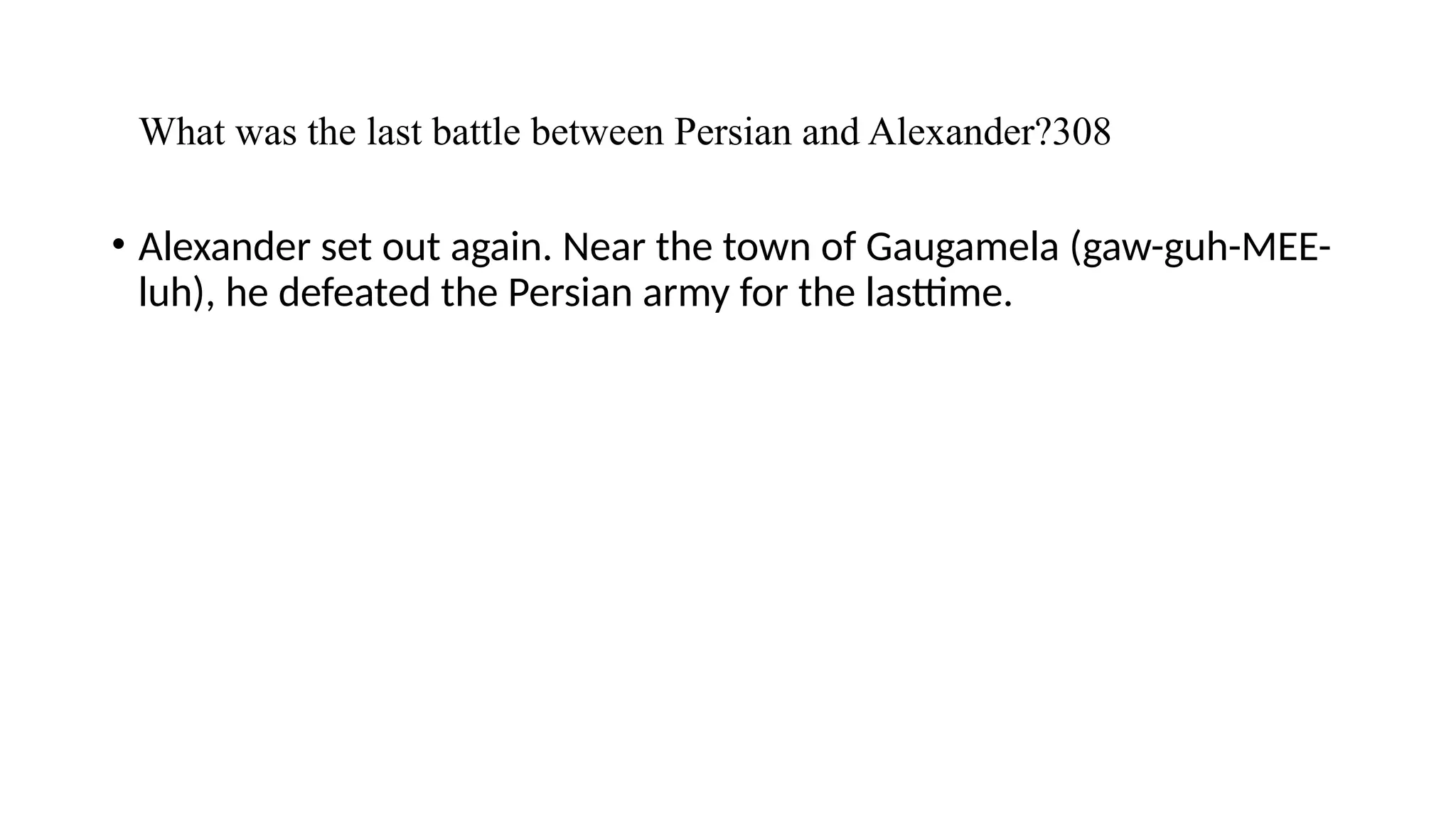
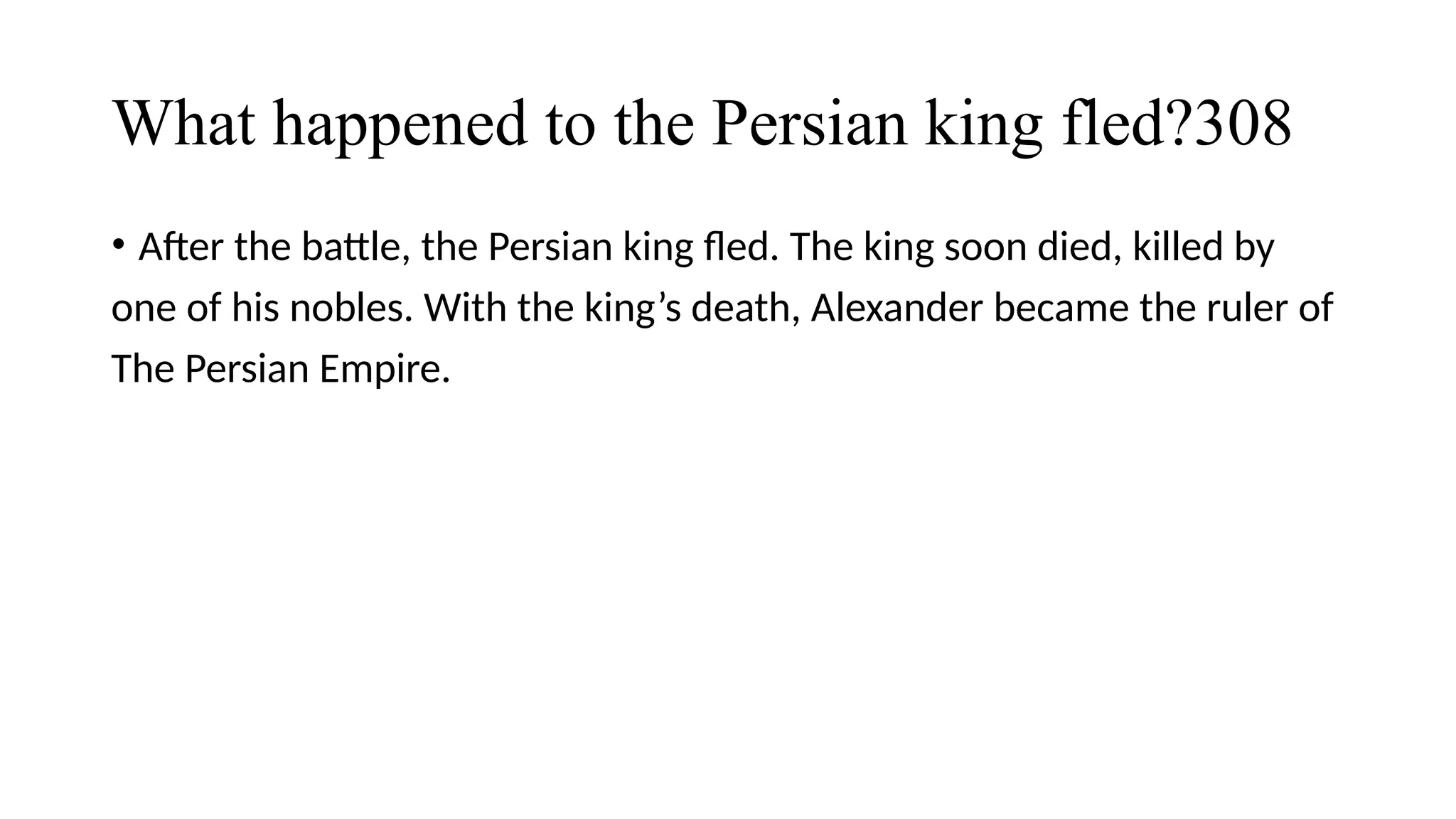
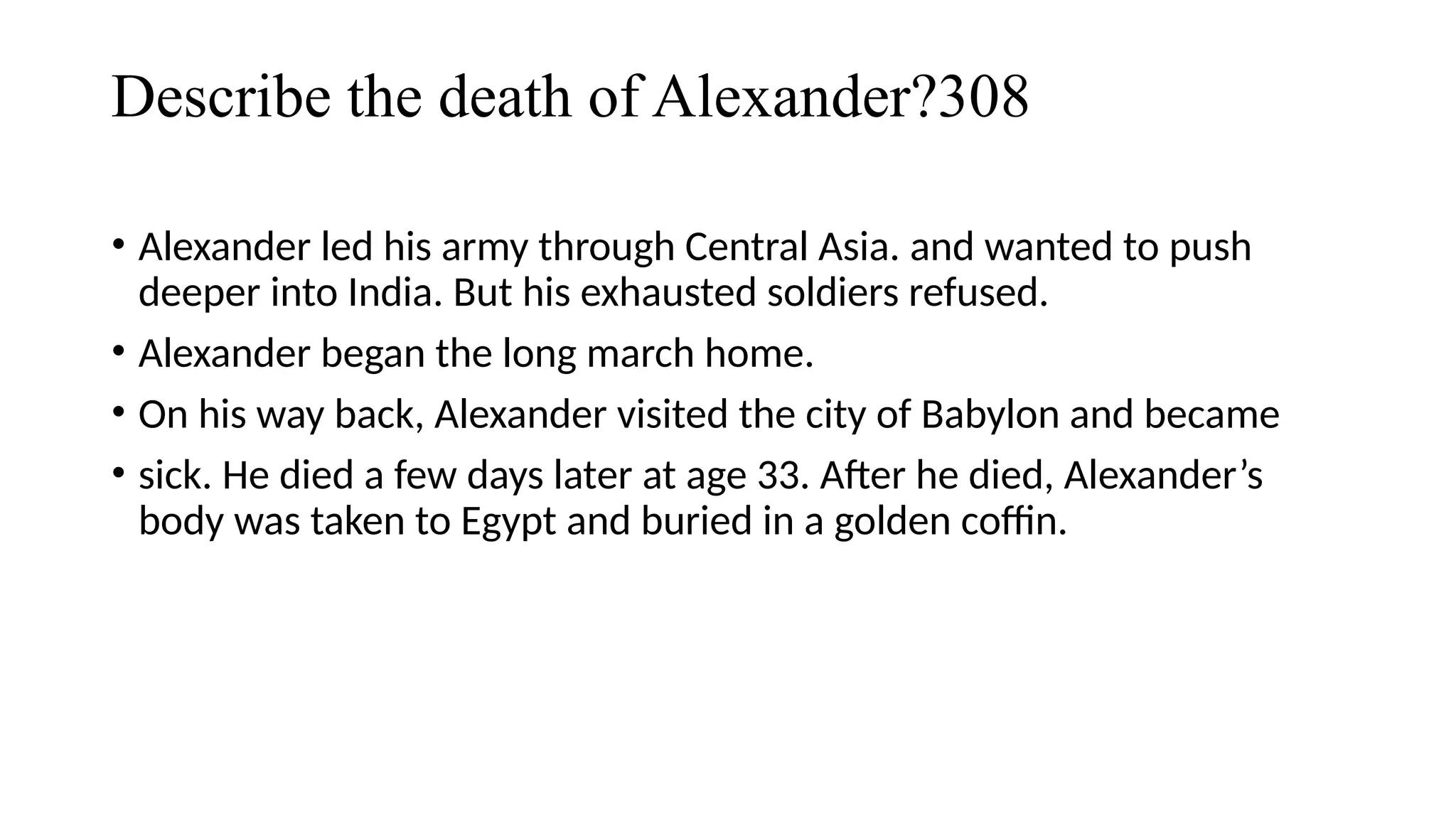
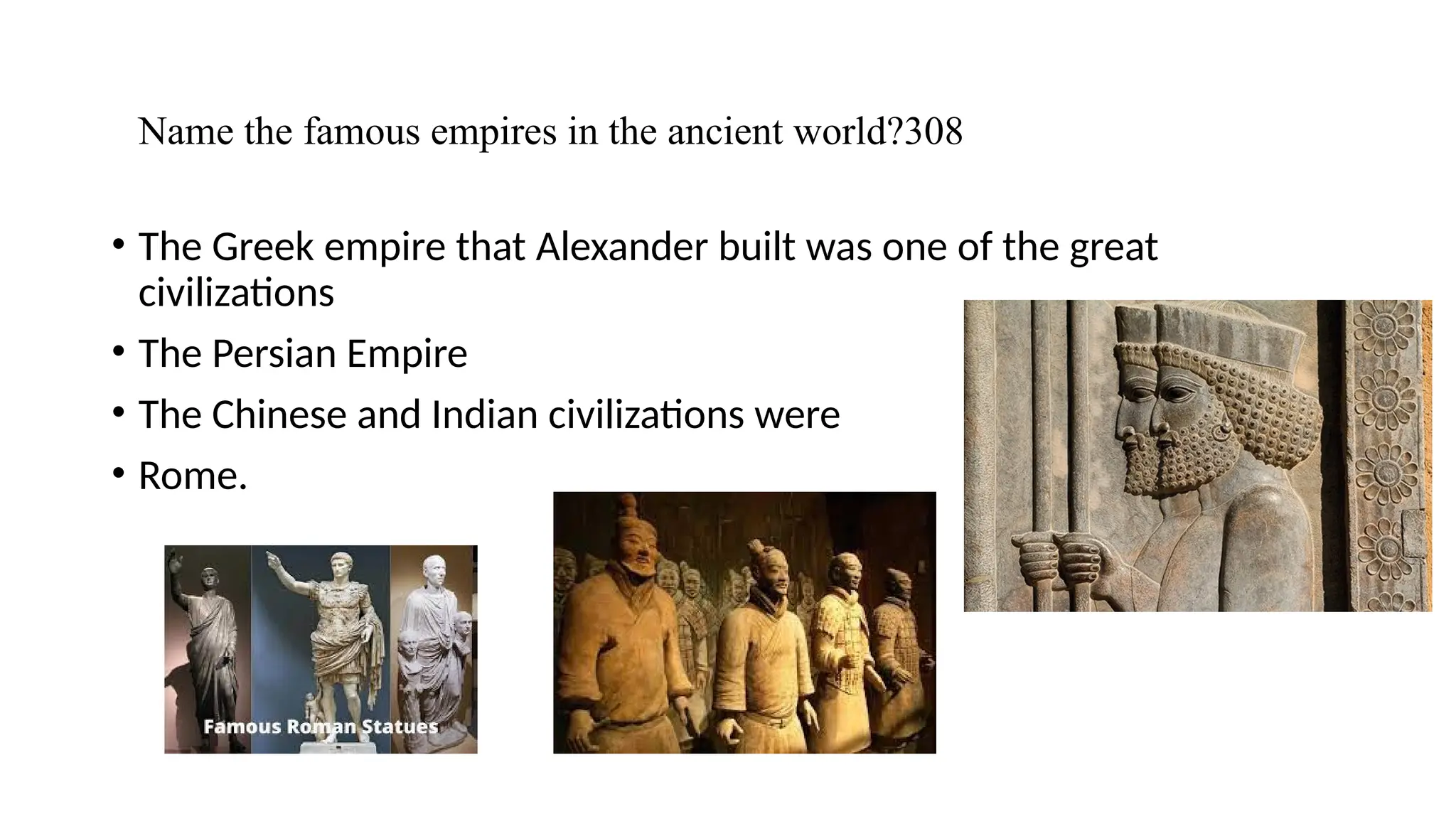
Name the famous empires in the ancient world?308
• The Greek empire that Alexander built was one of the great
civilizations
• The Persian Empire
• The Chinese and Indian civilizations were
• Rome.
What steps did Alexander take
to create his empire? Critical thinking
• Alexander destroyed Thebes, attacked the Persian Empire in Asia
Minor.
• He went to Egypt and was crowned pharaoh, and defeated the
Persian army for the final time.
• As he traveled, he built new cities modeled after Greek cities and
encouraged Greek settlers to move to them.
How did alexander rule his empire ?308
• Alexander’s empire was the largest the world had ever seen. He ruled
his empire as an absolute dictator.
How did Alexander help spread Greek
Culture throughout his empire?308
• By founding cities in the lands he conquered. He modeled his new
cities after the cities of Greece.
• He named many of them Alexandria, after himself.
• He built temples and theaters like those in Greece.
• He encouraged Greek settlers to move to the new cities., Greek art,
literature, and science spread into surrounding lands.
Why did Alexander model new cities after the
cities of Greece? critical thinking
• Alexander admired Greek culture; wanted the cities to resemble
Greek
How was the currency in time of Alexander?
309
• Alexander established standardized coins of silver and gold .On these
coins, called “Alexanders.
How did the new blended empire form?309
• Alexander encouraged conquered people to keep their own customs
and traditions, so As a result, a new blended culture developed in
Alexander’s empire.
Why did historians call this culture
Hellenistic?309
• Because this new culture was not completely Greek, or Hellenic,
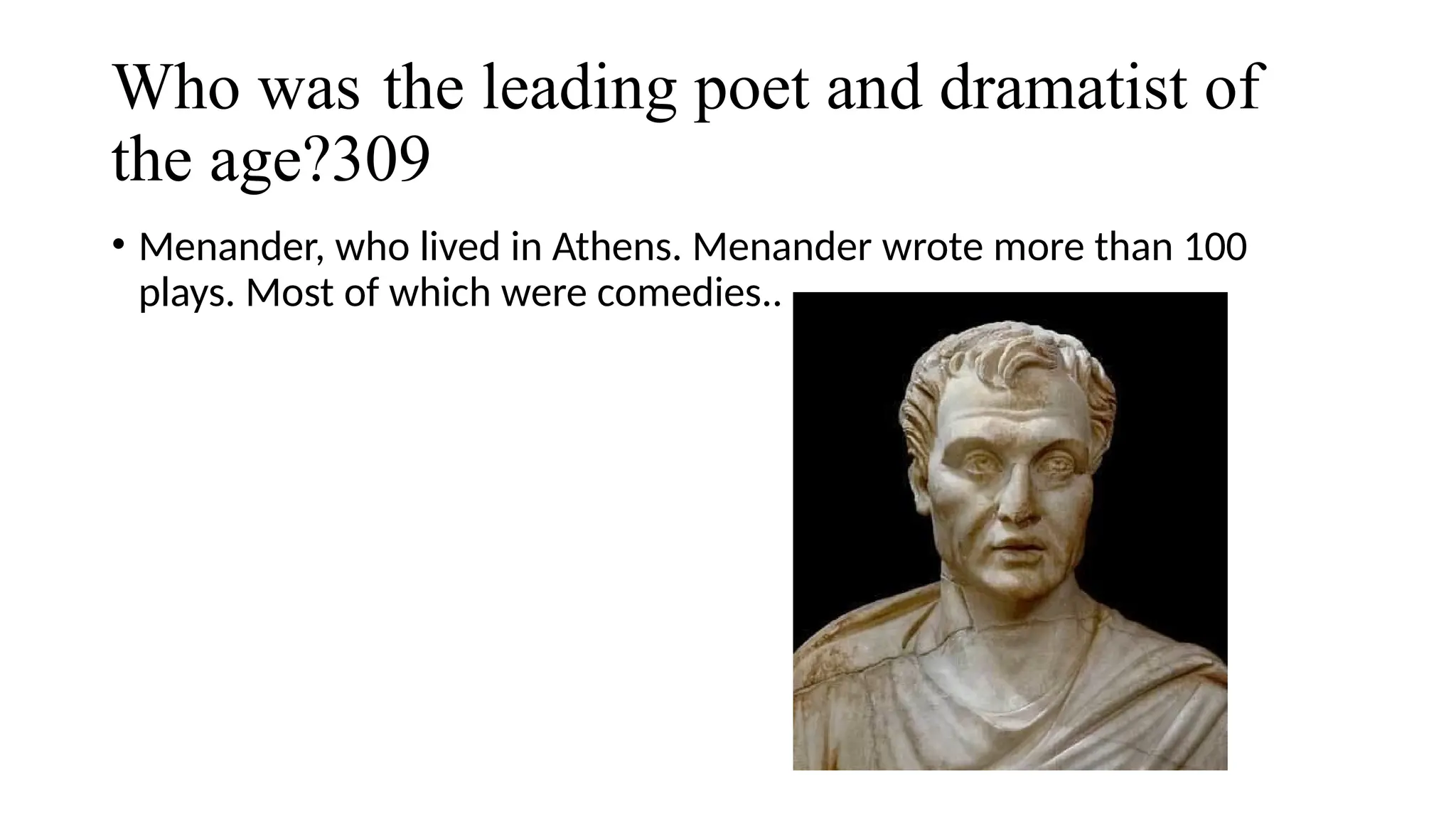
Who was the leading poet and dramatist of
the age?309
• Menander, who lived in Athens. Menander wrote more than 100
plays. Most of which were comedies..
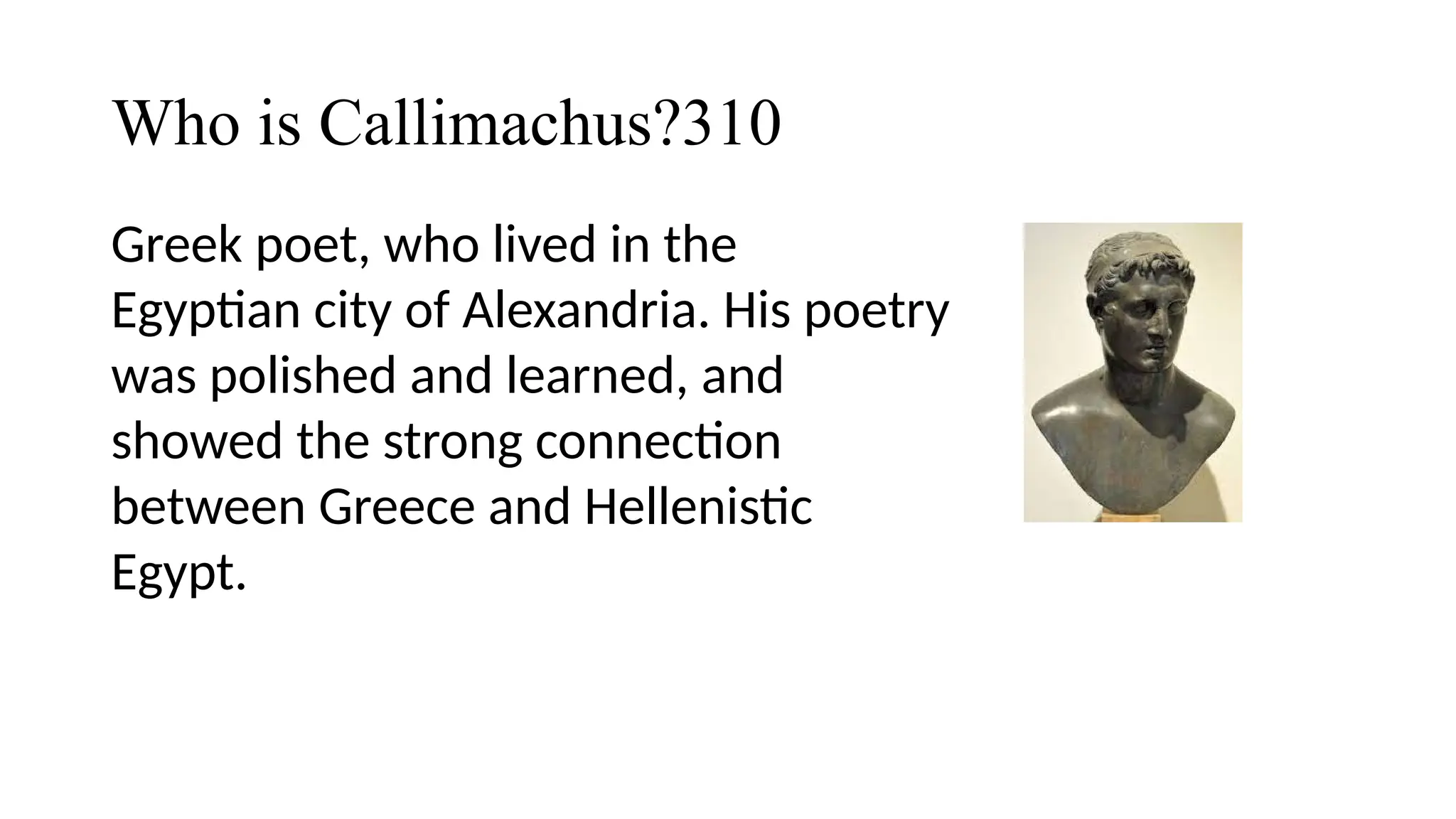
Who is Callimachus?310
Greek poet, who lived in the
Egyptian city of Alexandria. His poetry
was polished and learned, and
showed the strong connection
between Greece and Hellenistic
Egypt.
Name the famous Hellenistic historians ?310
• Polybius, who lived in Greece.
• Strabo, a Greek geographer who lived later during the Hellenistic
period, wrote a book called Geography, which describes the people
and countries known to the Greeks at that time
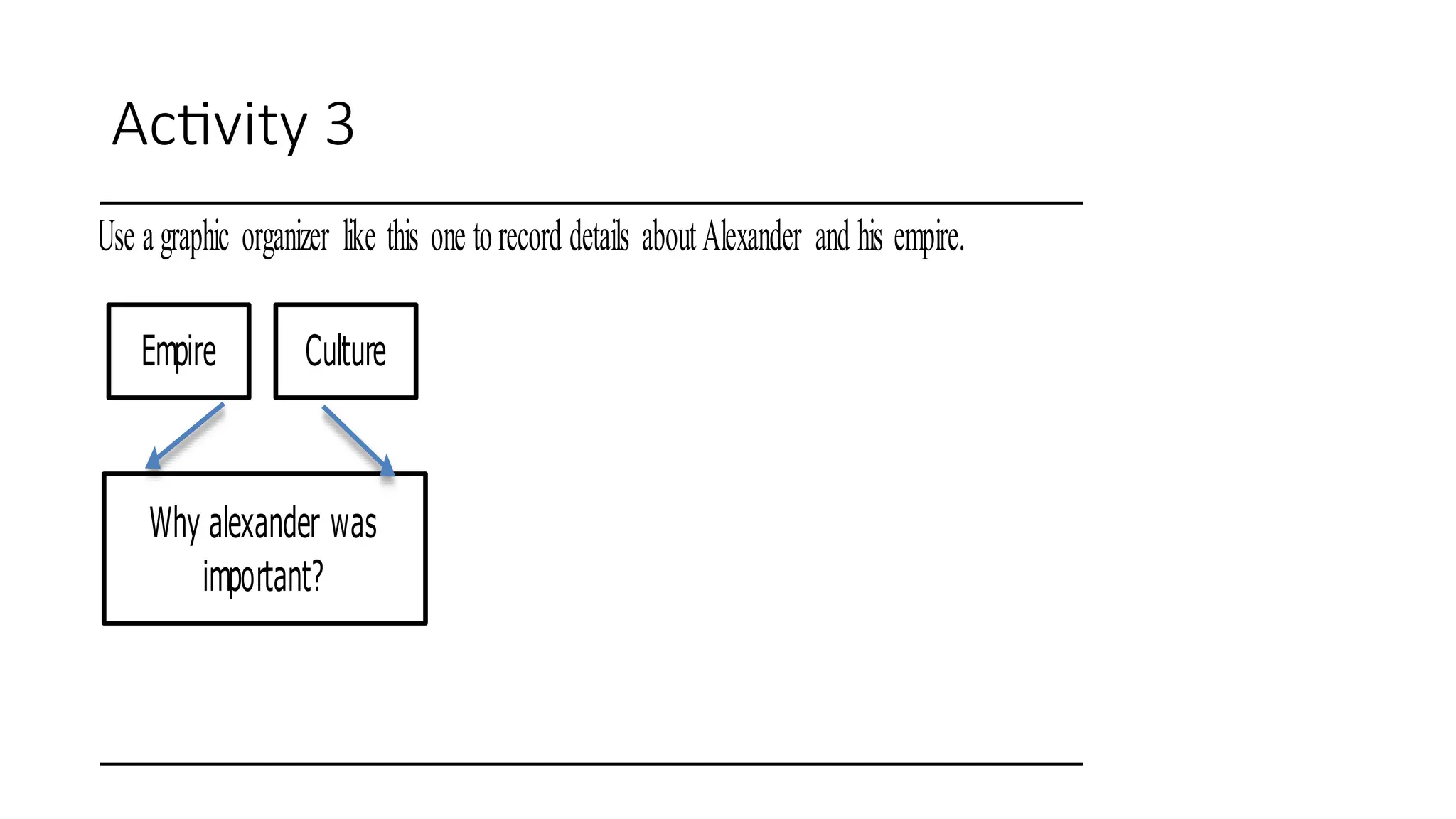
Activity 3
Use agraphic organizer like this one torecord details aboutAlexander and his empire.
Empire Culture
Why alexander was
important?

Alexander the greater.pptx why this is the name why should i add anything eles

  • 1.
    Ex : Alexander theGreat built a huge empire and helped spread Greek culture into Egypt and Asia. in the 300s BC was from Macedonia, a kingdom just north of Greece. The Greeks thought the Macedonians were barbarians and tried to avoid them. Eventually Macedonia would overtake Greece.
  • 2.
    Explain the firstyear of Philip’s rule ?306 • In 359 BC, Philip II became king of Macedonia. Philip spent the first year of his rule fighting off invaders who wanted to take over his kingdom. After he defeated the invaders, he was ready to launch invasions of his own.
  • 3.
    What was Philiptarget?306 • Philip’s main target was Greece. The leaders of Athens, knowing they were the target of Philip’s powerful army.
  • 4.
    Who did winthe war between Greece and Macedonians ?306 • The armies of Athens and its chief ally, Thebes, were easily defeated by the Macedonians. Having witnessed this defeat, the rest of the Greeks agreed to make Philip their leader.
  • 5.
    How did Philipdefeat Greeks ?306 • Philip defeated the Greeks because he was a brilliant military leader. He borrowed and improved many of the strategies Greek armies used in battle.
  • 6.
    Define phalanx?306 • Isa group of warriors who stood close together in a square. Each soldier held a spear pointed outward to fight off enemies. As soldiers In the front lines were killed, others stepped up from behind to fill their spots.
  • 7.
    Define some ofthe strategies that Philip used ?306 • Philip’s soldiers, like the Greeks, fought as a phalanx • Philip improved the Greeks’ idea. He gave his • soldiers spears that were much longer than those of his opponents. This allowed his army to attack effectively in any battle. • Philip also sent cavalry and archers into battle to support the phalanx.
  • 8.
    Activity 1 • Have studentswrite a short speech either supporting or opposing Alexander the Great from your point of view .
  • 9.
    Did Philip successin conquering Persian?307 • No, He planned to march east and conquer the Persian Empire, but he never made it. He was murdered while celebrating his daughter’s wedding. When Philip died, his throne—and his plans—passed to his son, Alexander.
  • 10.
    Why did thepeople of Thebes rebel?307 • They thought that the Macedonians would not have a leader strong enough to keep the kingdom together, but They were wrong.
  • 11.
    How old wasalexander after taking his father’s place ?307 • He was only 20 years old.
  • 12.
    What did heachieve after the death of his father? 307 • He immediately went south to end the revolt in Thebes. • Alexander had destroyed Thebes and enslaved the Theban people. He used Thebes as an example to other Greeks of what would happen if they turned against him. • He set out to build an empire, to make sure the Greeks would not rebel again.
  • 13.
    Why is Alexandercalled “the Great”?307 • He took over his father’s throne at 20 and then built one of the largest empires the world has ever seen.
  • 14.
    Summaries the legendtale of alexander ? (critical thinking) • According to legend, Alexander visited a town called Gordius in Asia Minor while he was fighting the Persians. There he heard an ancient tale about a knot tied by an ancient king. • The tale said that whoever untied the knot would rule all of Asia. According to the legend, Alexander pulled out his sword and cut right through the knot. Taking this as a good sign, he and his army set out again.
  • 15.
    How did alexanderenter Egypt? 307 • He attacked the Persians. • After defeating the Persians ,Alexander went to Egypt, which was part of the Persian Empire. • The Persian governor had heard of his skill in battle He surrendered without a fight. • He crowned Alexander pharaoh.
  • 16.
    Activity 2 • 1 . Organize theclass into four or five groups . • 2 . Have each group make an illustrated timeline showing the major events in Alexander’s life, including his birth and death. Dates for each event should be clearly shown .
  • 17.
    What was thelast battle between Persian and Alexander?308 • Alexander set out again. Near the town of Gaugamela (gaw-guh-MEE- luh), he defeated the Persian army for the lasttime.
  • 18.
    What happened tothe Persian king fled?308 • After the battle, the Persian king fled. The king soon died, killed by one of his nobles. With the king’s death, Alexander became the ruler of The Persian Empire.
  • 19.
    Describe the deathof Alexander?308 • Alexander led his army through Central Asia. and wanted to push deeper into India. But his exhausted soldiers refused. • Alexander began the long march home. • On his way back, Alexander visited the city of Babylon and became • sick. He died a few days later at age 33. After he died, Alexander’s body was taken to Egypt and buried in a golden coffin.
  • 20.
    Name the famousempires in the ancient world?308 • The Greek empire that Alexander built was one of the great civilizations • The Persian Empire • The Chinese and Indian civilizations were • Rome.
  • 21.
    What steps didAlexander take to create his empire? Critical thinking • Alexander destroyed Thebes, attacked the Persian Empire in Asia Minor. • He went to Egypt and was crowned pharaoh, and defeated the Persian army for the final time. • As he traveled, he built new cities modeled after Greek cities and encouraged Greek settlers to move to them.
  • 22.
    How did alexanderrule his empire ?308 • Alexander’s empire was the largest the world had ever seen. He ruled his empire as an absolute dictator.
  • 23.
    How did Alexanderhelp spread Greek Culture throughout his empire?308 • By founding cities in the lands he conquered. He modeled his new cities after the cities of Greece. • He named many of them Alexandria, after himself. • He built temples and theaters like those in Greece. • He encouraged Greek settlers to move to the new cities., Greek art, literature, and science spread into surrounding lands.
  • 24.
    Why did Alexandermodel new cities after the cities of Greece? critical thinking • Alexander admired Greek culture; wanted the cities to resemble Greek
  • 25.
    How was thecurrency in time of Alexander? 309 • Alexander established standardized coins of silver and gold .On these coins, called “Alexanders.
  • 26.
    How did thenew blended empire form?309 • Alexander encouraged conquered people to keep their own customs and traditions, so As a result, a new blended culture developed in Alexander’s empire.
  • 27.
    Why did historianscall this culture Hellenistic?309 • Because this new culture was not completely Greek, or Hellenic,
  • 28.
    Who was theleading poet and dramatist of the age?309 • Menander, who lived in Athens. Menander wrote more than 100 plays. Most of which were comedies..
  • 29.
    Who is Callimachus?310 Greekpoet, who lived in the Egyptian city of Alexandria. His poetry was polished and learned, and showed the strong connection between Greece and Hellenistic Egypt.
  • 30.
    Name the famousHellenistic historians ?310 • Polybius, who lived in Greece. • Strabo, a Greek geographer who lived later during the Hellenistic period, wrote a book called Geography, which describes the people and countries known to the Greeks at that time
  • 31.
    Activity 3 Use agraphicorganizer like this one torecord details aboutAlexander and his empire. Empire Culture Why alexander was important?