Alexander the Great
The Peloponnesian Wars ended with Athens’ defeat in 404 BC.But, heck, why let that stop good bickering and fighting?
The city-states continued to fight each other.
Some of Sparta’s former allies joined with Athens and fought Sparta.
Later on, Athens and Sparta united to fight Thebes.
The point is, because the major Greek city-states had been in a near constant state of periodic war for nearly 80 years, they were weakened – in wealth, military ability, and manpower.
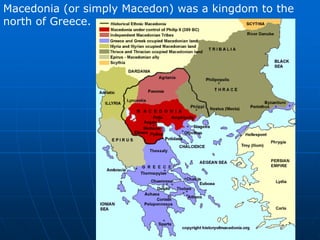
This made them ripe for conquering. . . Macedonia (or simply Macedon) was a kingdom to the north of Greece.
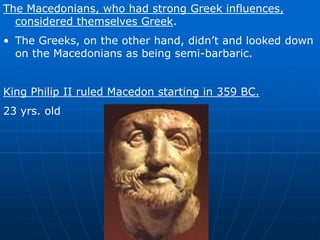
The Macedonians, who had strong Greek influences, considered themselves Greek.The Greeks, on the other hand, didn’t and looked down on the Macedonians as being semi-barbaric.King Philip II ruled Macedon starting in 359 BC. 23 yrs. old
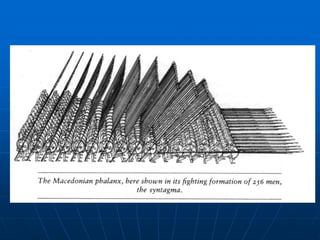
The Macedonian phalanx did away with the heavily armed and armored hoplite shock troops.  It introduced the phalangites.These soldiers were armed with 18 foot pikes with iron spear heads and butt spikes.
They would line up in square formation of 16 by 16 men.
Also introduced fast-moving cavalry (horses)
So Philip takes advantage of the Greece’s weakness and attack.He defeats a combined Athens-Theban force in 338 BC.
The fiercely independent Greek city-states become part of the new Macedonian empire.
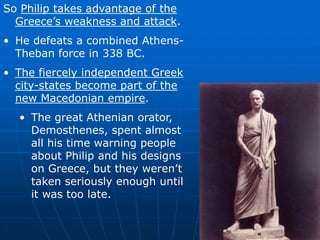
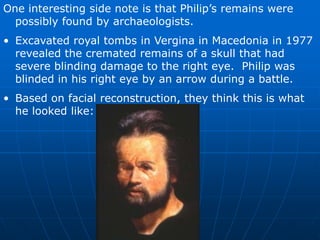
The great Athenian orator, Demosthenes, spent almost all his time warning people about Philip and his designs on Greece, but they weren’t taken seriously enough until it was too late.Unfortunately for Philip, he’s assassinated in 336 BC by one of his bodyguards while at his daughter’s wedding (it was after the chicken dance, but before YMCA).Not sure why.  One theory is that Alexander and his mother, Olympias, were behind it.One interesting side note is that Philip’s remains were possibly found by archaeologists.Excavated royal tombs in Vergina in Macedonia in 1977 revealed the cremated remains of a skull that had severe blinding damage to the right eye.  Philip was blinded in his right eye by an arrow during a battle.
Based on facial reconstruction, they think this is what he looked like:Philip’s son, Alexander, becomes king.Or he should be Philip’s son.
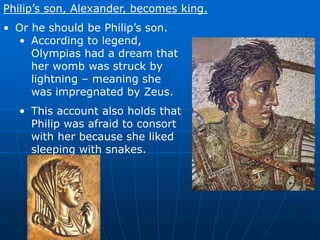
According to legend, Olympias had a dream that her womb was struck by lightning – meaning she was impregnated by Zeus.
This account also holds that Philip was afraid to consort with her because she liked sleeping with snakes.He was personally tutored by the philosopher Aristotle (who was Plato’s student and Plato was Socrates’ student).Aristotle taught him philosophy, ethics, rhetoric, literature, etc.
For his part, Alexander helped Aristotle amass a sizable library and financed his work.Anyway, Alexander becomes king and immediately gains the full support of the army (the most important thing).Though he was only 20 at the time, he had already proved himself in battle as both an effective warrior and a good commander.His first job was to put down the rebellion of the Greek city-states which occurred after Philip’s death.
First they submitted and then they later rebelled again.
The second time around, most hesitated while Thebes decided to resist.  The Thebans were crushed.
As punishment and as a warning to others, Alexander destroyed Thebes and sold the populace into slavery (6,000 killed and 30,000 sold for 440 talents of silver).
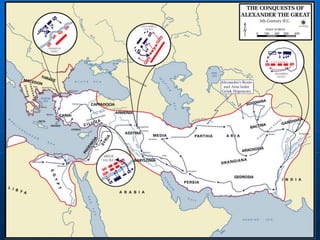
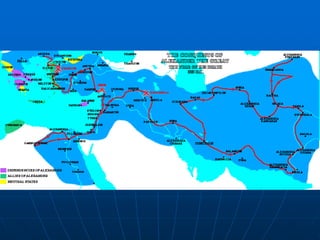
Everybody else got the message and submitted.  In 334 BC, Alexander invades the Persian empire with 30,000 men. This had been Philip’s ambition.Not only did Alexander thirst for power, adventure, and especially glory, but he also wanted to get revenge on Persia for its ill-treatment of Greece.
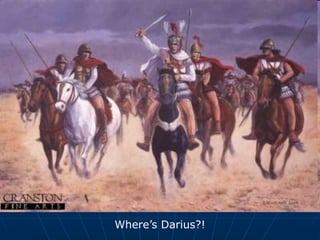
Alexander was also a lead from the front type of commander.  He didn’t stay at the back of the army where he’d be safest.  He rode with the cavalry and actively engaged in hand to hand combat.The Persian king, Darius III, at first doesn’t take Alexander all that seriously.Alexander wins Battle of Granicus (uses cavalry to attack first)
At Issus, the Hellenes were outnumbered by around 10 to 1.  Victory for Alexander!
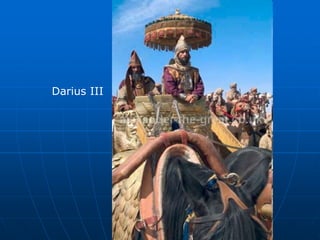
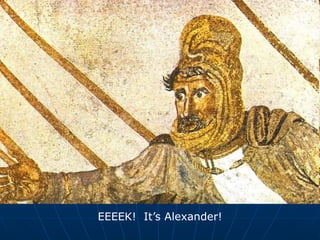
Alexander rejects offer from Darius III for Western 1/3 of Persian Empire. He planned to conquer the whole thing!Darius III

5.4 alexander the great

  • 1.
  • 2.
    The Peloponnesian Warsended with Athens’ defeat in 404 BC.But, heck, why let that stop good bickering and fighting?
  • 3.
    The city-states continuedto fight each other.
  • 4.
    Some of Sparta’sformer allies joined with Athens and fought Sparta.
  • 5.
    Later on, Athensand Sparta united to fight Thebes.
  • 6.
    The point is,because the major Greek city-states had been in a near constant state of periodic war for nearly 80 years, they were weakened – in wealth, military ability, and manpower.
  • 7.
    This made themripe for conquering. . . Macedonia (or simply Macedon) was a kingdom to the north of Greece.
  • 8.
    The Macedonians, whohad strong Greek influences, considered themselves Greek.The Greeks, on the other hand, didn’t and looked down on the Macedonians as being semi-barbaric.King Philip II ruled Macedon starting in 359 BC. 23 yrs. old
  • 9.
    The Macedonian phalanxdid away with the heavily armed and armored hoplite shock troops. It introduced the phalangites.These soldiers were armed with 18 foot pikes with iron spear heads and butt spikes.
  • 10.
    They would lineup in square formation of 16 by 16 men.
  • 11.
  • 12.
    So Philip takesadvantage of the Greece’s weakness and attack.He defeats a combined Athens-Theban force in 338 BC.
  • 13.
    The fiercely independentGreek city-states become part of the new Macedonian empire.
  • 14.
    The great Athenianorator, Demosthenes, spent almost all his time warning people about Philip and his designs on Greece, but they weren’t taken seriously enough until it was too late.Unfortunately for Philip, he’s assassinated in 336 BC by one of his bodyguards while at his daughter’s wedding (it was after the chicken dance, but before YMCA).Not sure why. One theory is that Alexander and his mother, Olympias, were behind it.One interesting side note is that Philip’s remains were possibly found by archaeologists.Excavated royal tombs in Vergina in Macedonia in 1977 revealed the cremated remains of a skull that had severe blinding damage to the right eye. Philip was blinded in his right eye by an arrow during a battle.
  • 15.
    Based on facialreconstruction, they think this is what he looked like:Philip’s son, Alexander, becomes king.Or he should be Philip’s son.
  • 16.
    According to legend,Olympias had a dream that her womb was struck by lightning – meaning she was impregnated by Zeus.
  • 17.
    This account alsoholds that Philip was afraid to consort with her because she liked sleeping with snakes.He was personally tutored by the philosopher Aristotle (who was Plato’s student and Plato was Socrates’ student).Aristotle taught him philosophy, ethics, rhetoric, literature, etc.
  • 18.
    For his part,Alexander helped Aristotle amass a sizable library and financed his work.Anyway, Alexander becomes king and immediately gains the full support of the army (the most important thing).Though he was only 20 at the time, he had already proved himself in battle as both an effective warrior and a good commander.His first job was to put down the rebellion of the Greek city-states which occurred after Philip’s death.
  • 19.
    First they submittedand then they later rebelled again.
  • 20.
    The second timearound, most hesitated while Thebes decided to resist. The Thebans were crushed.
  • 21.
    As punishment andas a warning to others, Alexander destroyed Thebes and sold the populace into slavery (6,000 killed and 30,000 sold for 440 talents of silver).
  • 22.
    Everybody else gotthe message and submitted. In 334 BC, Alexander invades the Persian empire with 30,000 men. This had been Philip’s ambition.Not only did Alexander thirst for power, adventure, and especially glory, but he also wanted to get revenge on Persia for its ill-treatment of Greece.
  • 23.
    Alexander was alsoa lead from the front type of commander. He didn’t stay at the back of the army where he’d be safest. He rode with the cavalry and actively engaged in hand to hand combat.The Persian king, Darius III, at first doesn’t take Alexander all that seriously.Alexander wins Battle of Granicus (uses cavalry to attack first)
  • 24.
    At Issus, theHellenes were outnumbered by around 10 to 1. Victory for Alexander!
  • 25.
    Alexander rejects offerfrom Darius III for Western 1/3 of Persian Empire. He planned to conquer the whole thing!Darius III