9

Defensive
Operations
9
    Learning Objectives (1 of 9)
• Compare and contrast a defensive
  versus offensive fire attack, explaining
  the key differences.
• Explain why an offensive attack is
  preferred over a defensive attack.
• Enumerate conditions that would lead to
  a defensive attack.
9
     Learning Objectives (2 of 9)
• Describe how collapse zone dimensions are
  determined.
• Evaluate the effectiveness of master streams
  operated from distances required to maintain
  a safe collapse zone.
• Discuss the positive and negative effects of
  operating a hose stream into a window or roof
  opening.
9
    Learning Objectives (3 of 9)
• Describe conditions when a direct
  defensive attack is preferred as
  compared to an indirect defensive
  attack (i.e., covering exposures).
• Describe how water should be applied
  when protecting an exposure from
  radiant heat.
9
     Learning Objectives (4 of 9)
• Compare and contrast the use of
  handheld hose streams versus master
  stream appliances during defensive
  operations.
• List two ways the water utility may be
  able to increase the total water supply
  at the incident scene.
9
    Learning Objectives (5 of 9)
• Compare and contrast the use of fog
  versus solid streams during a defensive
  attack.
• Estimate staffing and apparatus needs
  when operating master streams.
• Define conflagrations and group fires.
9
     Learning Objectives (6 of 9)
• List common problems leading to
  conflagrations.
• Explain tactics used to control a
  conflagration.
• Discuss why conflagrations are likely to
  occur immediately after a natural
  disaster.
9
     Learning Objectives (7 of 9)
• List reasons for a non-attack strategy.
• Given a scenario, calculate the
  dimensions of the collapse zone.
• Prioritize exposures based on fire
  conditions, occupancy, and weather
  factors.
9
    Learning Objectives (8 of 9)
• Develop an incident action plan for a
  defensive fire.
• Develop an incident action plan for a
  conflagration.
• Apply defensive tactics to a defensive
  fire attack.
9
     Learning Objectives (9 of 9)
• Apply defensive tactics to a conflagration.
• Evaluate staffing, water supply, and
  apparatus needs for a large-scale defensive
  fire.
• Apply NIMS to a defensive fire scenario.
• Determine the probability of a conflagration
  for a specified response area.
9
             Overview (1 of 2)
• Offensive fire attack
  – Preferred strategy
• Defensive fire attack
  – Limits operations to the exterior
  – Results in larger property loss
  – Limits rescue options
9
              Overview (2 of 2)
• Offensive/defensive decision based on:
  – Risk-versus-benefit analysis
     • Solid fire-ground information
     • Training and experience
• Staffing available to accomplish interior
  attack, water supply, ventilation
9
       Defensive Attack (1 of 2)
• Objective: save property and/or protect
  the environment
• Easier to handle
• Pose fewer risks if the proper
  precautions are taken
9
       Defensive Attack (2 of 2)
• Situations:
  – Structural integrity concerns, fire
    conditions, or other hazards prohibit entry
  – Resource needs outweigh resource
    capabilities.
  – Risk-versus-benefit analysis indicates that
    the risk is too great.
9
         Collapse Zone (1 of 2)
• Equal to the height of the building plus
  an allowance for debris to scatter
  – Anything less = calculated risk
• Distance equal to 1½ times the height of
  the building
• Can be pre-planned
  – Estimated floor height = 12′ per floor
9
         Collapse Zone (2 of 2)
• Non-attack strategy: tall buildings
  – Water application distance for master
    streams
• Width of street = limiting factor
  – Building evaluated to determine safest
    position
• IC must consider expected benefits.
  – Risk-versus-benefit analysis
9
      Evaluating Exposures
• Two types: internal and external
• Internal
  – Fire extends from one area to another
    within a structure.
• External
  – Surrounding buildings/property
9
        Defensive Streams
• May spread the fire inside the building
• Fog streams may push fire.
  – May also fill an area with steam, helping
    the suppression effort
• Exterior streams may push fire into
  concealed spaces.
• Elevated streams may push vented fires
  back into the building.
9
        External Exposures
• Protecting external exposures is critical.
• Should be evaluated in terms of:
  – Life safety
  – Extinguishment
  – Property conservation
9
      Prioritizing Exposures
• Based on:
  – Distance between exposed structures
  – Volume and location of fire
• Radiant heat increases as flame front
  increases.
  – Extinguish main volume of fire
9
             Radiant Heat
• Inversely proportional to the square of
  the distance between the heat source
  and the exposure
  – Closer the buildings = greater radiant heat
  – Exposures higher than the fire are also at
    greater risk.
9
       Protecting Exposures
• Options depend on:
  – Available staffing
  – Apparatus resources
• Wetting the exposure is most effective way.
• Directing a stream between buildings is less
  effective.
  – Radiant heat travels through transparent materials
    such as water.
9
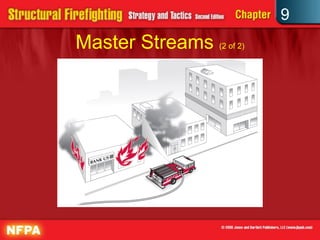
       Master Streams (1 of 2)
• Defensive operations
  – Can apply more water from a greater
    distance with fewer personnel
9
Master Streams (2 of 2)
9
   Elevated Master Streams
• May hinder upward and outward
  movement of heat and smoke
  – Usually detrimental to the operation
• May push fire back into the building
  – Spreads fire into uninvolved areas.
  – Reverses positive effects of ventilation
9
      Water Supply Needs
• Defensive operations may be more
  challenging than offensive attacks.
• Master streams can require total pump
  capacity of apparatus.
  – Even reliable water systems can be
    exhausted.
  – Large-diameter hose is effective.
  – Water relay remains a possibility.
9
    Exterior Stream Position
• Considerations:
  – Safety
  – Ability to apply water to exposures and
    interior of the building
    • Preferably will not push fire into uninvolved
      areas
9
               Nozzle Type
• IC should know the
  advantages/disadvantages of nozzles.
• Solid-stream nozzle
  – Greatest reach and penetrating ability
  – Best suited for attack on main body of the fire
• Variable-stream nozzle
  – Fog pattern
  – Straight stream
9
   Staffing/Apparatus Needs
• Offensive attack: personnel intense
  – More fire fighters for hand lines
• Defensive attack: apparatus intense
  – Master streams handled by one person
  – Pumpers for water supply or drafting
  – Tankers for water shuttle operation
9
         Conflagrations (1 of 3)
• A fire with major building-to-building
  flame spread over some distance
• Departments should recognize the
  challenge.
  – Determine the probability in their area.
• Special tactics needed
9
         Conflagrations (2 of 3)
• Historical
  – Rome, London, Constantinople
  – Jamestown, Virginia
  – Plymouth, Massachusetts
  – Boston
9
        Conflagrations (3 of 3)
• Recent
  – Oakland/Berkeley, California
  – San Jose, California
9
   Wildland/Urban Interface
• Fires spreading from wildlands into an
  urban area, destroying large numbers of
  buildings
  – Peshtigo, Wisconsin
    • October 7, 1871
    • Same day as The Great Chicago Fire
    • Killed 1200 people (some estimate as many as
      2000 fatalities) and destroyed 17 towns.
9
    Contributing Factors (1 of 2)
• Closely built structures
• Wood shingle roofs (most often cited
  cause)
• Poor water supplies
• Dilapidated structures
9
    Contributing Factors (2 of 2)
• Large-scale, combustible construction
  projects
• Developments near wildlands
• Built-up areas near high-hazard
  locations
9
             Group Fires
• Similar to conflagrations
  – Fire is confined within a complex or among
    adjacent buildings.
  – Potential to become conflagrations
  – Smaller in scale
9
     Strategies and Tactics
• Important to understand how fires
  spread
  – High convected heat
  – Flying brands
  – High radiant heat
     • Primary means of fire extension
9
               Priorities
• Life safety
• Extinguishment
• Evacuating people before they are
  threatened is key to success
  – Proactive measure
9
               Evacuation
• Area must be beyond the secondary
  line of defense
  – Wide-perimeter should be maintained
• Evacuation should be handled by police
  department.
  – A police branch in the IMS is a good
    organizational tactic at large-scale fires.
9
            Water Supply
• Will be challenged by large-fire tactics
• Priorities:
  – Water conservation
  – Maintaining fire break
  – Protecting exposures
9
      Tactical Elements (1 of 2)
• Evacuate and rescue people in
  imminent danger
• Evacuate people in the endangered
  area beyond the secondary line of
  defense
• Set up a line of defense with natural or
  artificial fire breaks
9
      Tactical Elements (2 of 2)
• Establish a secondary line of defense
• Narrow the flame front
• Maintain brand patrol
9
              Non-Attack
• Seldom used strategy
• ICs fail to recognize a total loss.
• Used when:
  – Environmental concerns are paramount.
  – Safe offensive attack is not possible.
  – Defensive attack is not practical.
9
            Summary (1 of 4)
• Three possible operations at a structure
  fire:
  – Offensive
  – Defensive
  – Non-attack
• A proper size-up will indicate which
  operation is appropriate.
9
            Summary (2 of 4)
• Offensive attack
  – Best chance of saving lives and property
  – Operation of choice when justified by
    proper size-up
9
             Summary (3 of 4)
• Defensive attack
  – Rarely an effective means of saving lives in
    the building of origin.
  – May be the IC’s only reasonable option
  – Indicated by proper size-up
  – Strategic objectives:
    • To protect internal and external exposures
      while extinguishing the fire
9
             Summary (4 of 4)
• Non-attack posture
  – May be best option when:
    • Offensive attack is not possible
    • Building and surroundings are a total loss

Chapter 9

  • 1.
  • 2.
    9 Learning Objectives (1 of 9) • Compare and contrast a defensive versus offensive fire attack, explaining the key differences. • Explain why an offensive attack is preferred over a defensive attack. • Enumerate conditions that would lead to a defensive attack.
  • 3.
    9 Learning Objectives (2 of 9) • Describe how collapse zone dimensions are determined. • Evaluate the effectiveness of master streams operated from distances required to maintain a safe collapse zone. • Discuss the positive and negative effects of operating a hose stream into a window or roof opening.
  • 4.
    9 Learning Objectives (3 of 9) • Describe conditions when a direct defensive attack is preferred as compared to an indirect defensive attack (i.e., covering exposures). • Describe how water should be applied when protecting an exposure from radiant heat.
  • 5.
    9 Learning Objectives (4 of 9) • Compare and contrast the use of handheld hose streams versus master stream appliances during defensive operations. • List two ways the water utility may be able to increase the total water supply at the incident scene.
  • 6.
    9 Learning Objectives (5 of 9) • Compare and contrast the use of fog versus solid streams during a defensive attack. • Estimate staffing and apparatus needs when operating master streams. • Define conflagrations and group fires.
  • 7.
    9 Learning Objectives (6 of 9) • List common problems leading to conflagrations. • Explain tactics used to control a conflagration. • Discuss why conflagrations are likely to occur immediately after a natural disaster.
  • 8.
    9 Learning Objectives (7 of 9) • List reasons for a non-attack strategy. • Given a scenario, calculate the dimensions of the collapse zone. • Prioritize exposures based on fire conditions, occupancy, and weather factors.
  • 9.
    9 Learning Objectives (8 of 9) • Develop an incident action plan for a defensive fire. • Develop an incident action plan for a conflagration. • Apply defensive tactics to a defensive fire attack.
  • 10.
    9 Learning Objectives (9 of 9) • Apply defensive tactics to a conflagration. • Evaluate staffing, water supply, and apparatus needs for a large-scale defensive fire. • Apply NIMS to a defensive fire scenario. • Determine the probability of a conflagration for a specified response area.
  • 11.
    9 Overview (1 of 2) • Offensive fire attack – Preferred strategy • Defensive fire attack – Limits operations to the exterior – Results in larger property loss – Limits rescue options
  • 12.
    9 Overview (2 of 2) • Offensive/defensive decision based on: – Risk-versus-benefit analysis • Solid fire-ground information • Training and experience • Staffing available to accomplish interior attack, water supply, ventilation
  • 13.
    9 Defensive Attack (1 of 2) • Objective: save property and/or protect the environment • Easier to handle • Pose fewer risks if the proper precautions are taken
  • 14.
    9 Defensive Attack (2 of 2) • Situations: – Structural integrity concerns, fire conditions, or other hazards prohibit entry – Resource needs outweigh resource capabilities. – Risk-versus-benefit analysis indicates that the risk is too great.
  • 15.
    9 Collapse Zone (1 of 2) • Equal to the height of the building plus an allowance for debris to scatter – Anything less = calculated risk • Distance equal to 1½ times the height of the building • Can be pre-planned – Estimated floor height = 12′ per floor
  • 16.
    9 Collapse Zone (2 of 2) • Non-attack strategy: tall buildings – Water application distance for master streams • Width of street = limiting factor – Building evaluated to determine safest position • IC must consider expected benefits. – Risk-versus-benefit analysis
  • 17.
    9 Evaluating Exposures • Two types: internal and external • Internal – Fire extends from one area to another within a structure. • External – Surrounding buildings/property
  • 18.
    9 Defensive Streams • May spread the fire inside the building • Fog streams may push fire. – May also fill an area with steam, helping the suppression effort • Exterior streams may push fire into concealed spaces. • Elevated streams may push vented fires back into the building.
  • 19.
    9 External Exposures • Protecting external exposures is critical. • Should be evaluated in terms of: – Life safety – Extinguishment – Property conservation
  • 20.
    9 Prioritizing Exposures • Based on: – Distance between exposed structures – Volume and location of fire • Radiant heat increases as flame front increases. – Extinguish main volume of fire
  • 21.
    9 Radiant Heat • Inversely proportional to the square of the distance between the heat source and the exposure – Closer the buildings = greater radiant heat – Exposures higher than the fire are also at greater risk.
  • 22.
    9 Protecting Exposures • Options depend on: – Available staffing – Apparatus resources • Wetting the exposure is most effective way. • Directing a stream between buildings is less effective. – Radiant heat travels through transparent materials such as water.
  • 23.
    9 Master Streams (1 of 2) • Defensive operations – Can apply more water from a greater distance with fewer personnel
  • 24.
  • 25.
    9 Elevated Master Streams • May hinder upward and outward movement of heat and smoke – Usually detrimental to the operation • May push fire back into the building – Spreads fire into uninvolved areas. – Reverses positive effects of ventilation
  • 26.
    9 Water Supply Needs • Defensive operations may be more challenging than offensive attacks. • Master streams can require total pump capacity of apparatus. – Even reliable water systems can be exhausted. – Large-diameter hose is effective. – Water relay remains a possibility.
  • 27.
    9 Exterior Stream Position • Considerations: – Safety – Ability to apply water to exposures and interior of the building • Preferably will not push fire into uninvolved areas
  • 28.
    9 Nozzle Type • IC should know the advantages/disadvantages of nozzles. • Solid-stream nozzle – Greatest reach and penetrating ability – Best suited for attack on main body of the fire • Variable-stream nozzle – Fog pattern – Straight stream
  • 29.
    9 Staffing/Apparatus Needs • Offensive attack: personnel intense – More fire fighters for hand lines • Defensive attack: apparatus intense – Master streams handled by one person – Pumpers for water supply or drafting – Tankers for water shuttle operation
  • 30.
    9 Conflagrations (1 of 3) • A fire with major building-to-building flame spread over some distance • Departments should recognize the challenge. – Determine the probability in their area. • Special tactics needed
  • 31.
    9 Conflagrations (2 of 3) • Historical – Rome, London, Constantinople – Jamestown, Virginia – Plymouth, Massachusetts – Boston
  • 32.
    9 Conflagrations (3 of 3) • Recent – Oakland/Berkeley, California – San Jose, California
  • 33.
    9 Wildland/Urban Interface • Fires spreading from wildlands into an urban area, destroying large numbers of buildings – Peshtigo, Wisconsin • October 7, 1871 • Same day as The Great Chicago Fire • Killed 1200 people (some estimate as many as 2000 fatalities) and destroyed 17 towns.
  • 34.
    9 Contributing Factors (1 of 2) • Closely built structures • Wood shingle roofs (most often cited cause) • Poor water supplies • Dilapidated structures
  • 35.
    9 Contributing Factors (2 of 2) • Large-scale, combustible construction projects • Developments near wildlands • Built-up areas near high-hazard locations
  • 36.
    9 Group Fires • Similar to conflagrations – Fire is confined within a complex or among adjacent buildings. – Potential to become conflagrations – Smaller in scale
  • 37.
    9 Strategies and Tactics • Important to understand how fires spread – High convected heat – Flying brands – High radiant heat • Primary means of fire extension
  • 38.
    9 Priorities • Life safety • Extinguishment • Evacuating people before they are threatened is key to success – Proactive measure
  • 39.
    9 Evacuation • Area must be beyond the secondary line of defense – Wide-perimeter should be maintained • Evacuation should be handled by police department. – A police branch in the IMS is a good organizational tactic at large-scale fires.
  • 40.
    9 Water Supply • Will be challenged by large-fire tactics • Priorities: – Water conservation – Maintaining fire break – Protecting exposures
  • 41.
    9 Tactical Elements (1 of 2) • Evacuate and rescue people in imminent danger • Evacuate people in the endangered area beyond the secondary line of defense • Set up a line of defense with natural or artificial fire breaks
  • 42.
    9 Tactical Elements (2 of 2) • Establish a secondary line of defense • Narrow the flame front • Maintain brand patrol
  • 43.
    9 Non-Attack • Seldom used strategy • ICs fail to recognize a total loss. • Used when: – Environmental concerns are paramount. – Safe offensive attack is not possible. – Defensive attack is not practical.
  • 44.
    9 Summary (1 of 4) • Three possible operations at a structure fire: – Offensive – Defensive – Non-attack • A proper size-up will indicate which operation is appropriate.
  • 45.
    9 Summary (2 of 4) • Offensive attack – Best chance of saving lives and property – Operation of choice when justified by proper size-up
  • 46.
    9 Summary (3 of 4) • Defensive attack – Rarely an effective means of saving lives in the building of origin. – May be the IC’s only reasonable option – Indicated by proper size-up – Strategic objectives: • To protect internal and external exposures while extinguishing the fire
  • 47.
    9 Summary (4 of 4) • Non-attack posture – May be best option when: • Offensive attack is not possible • Building and surroundings are a total loss