3

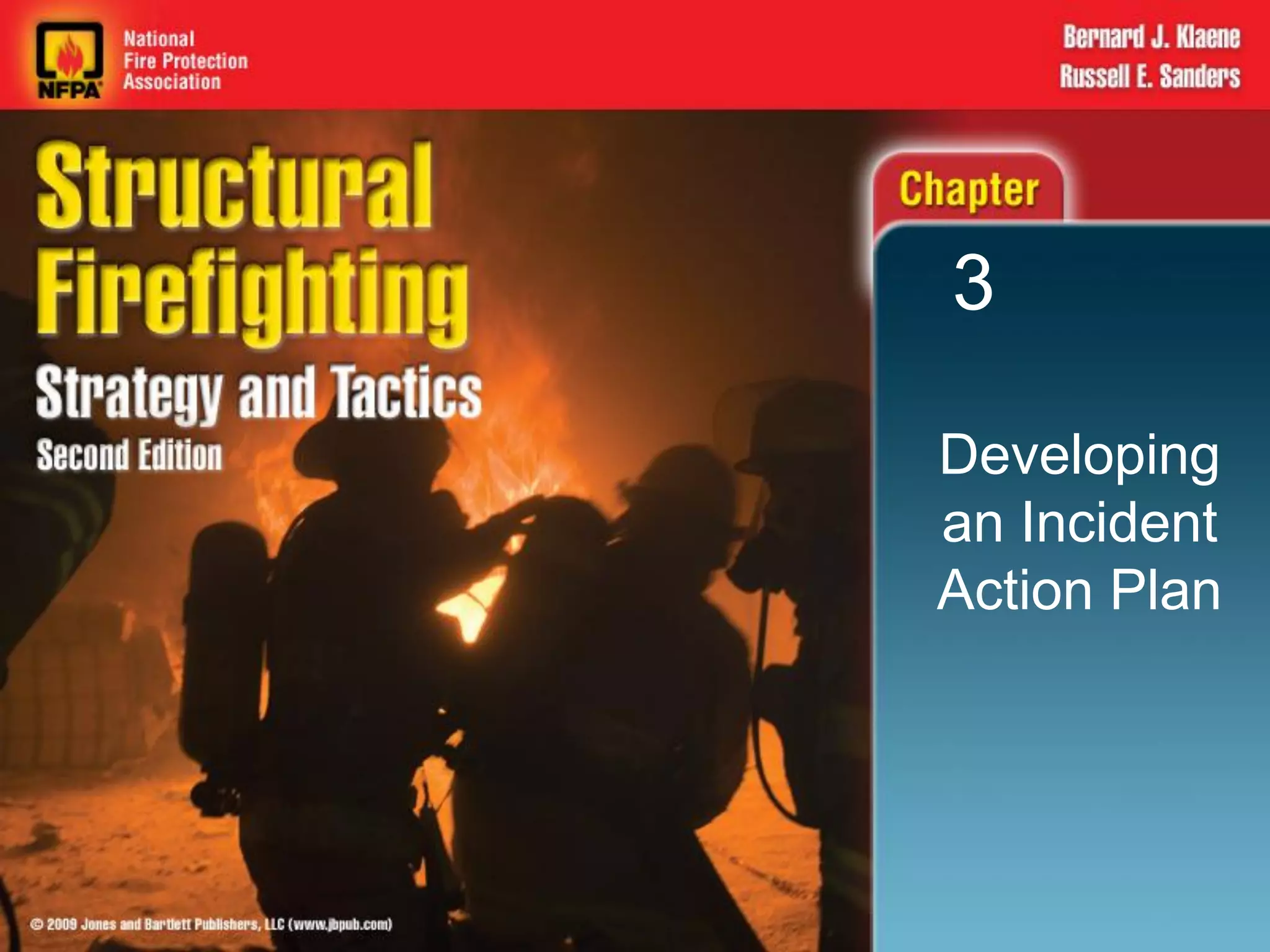
Developing
an Incident
Action Plan
3
     Learning Objectives (1 of 2)
• Describe how extinguishment is both an
  operational priority and tactical objective
  with an emphasis on the relationship
  between life safety and extinguishment.
• Evaluate conditions leading to an
  offensive or defensive operation.
3
     Learning Objectives (2 of 2)
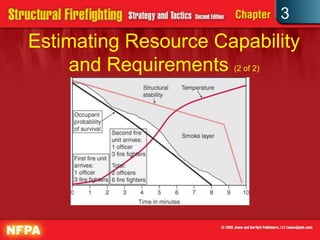
• Compare probability of occupant
  survival to fire and building conditions.
• List situations when a written incident
  action plan is needed.
• Use a case study or actual fire to
  develop an incident action plan based
  on a risk-versus-benefit analysis.
3
             Overview (1 of 3)
• Incident Action Plan (IAP) development
  – Leads to offensive or defensive tactics
  – Derived from an analytical approach to
    information gained through size-up
  – Should be a simple, concise,
    straightforward, easy-to-understand
  – Outlines major tactical objectives
  – Provides the central focus for operations
3
            Overview (2 of 3)
• Size-up
  – Continuous process
  – IAP must remain flexible
  – Tactics modified as conditions change
• All activities should lead to completion
  of major objectives identified in the IAP.
3
            Overview (3 of 3)
• Primary strategic considerations
  – Life safety
  – Extinguishment
  – Property conservation
• With sufficient resources, priorities can
  be handled simultaneously.
• Extinguishment is normally the most
  important life safety tactic.
3
Determining Life Safety Needs
• Structural firefighting primary objective:
  saving lives
  – Life safety is the first consideration.
3
      Evaluating Structural
           Conditions
• Structural conditions bear heavily on
  offensive/defensive decision.
• Interior attack should not be conducted
  in an unsafe building.
• Offensive attack is conducted to assist
  occupants from the building.
  – Reevaluation is necessary once the
    building is evacuated.
3
Estimating Resource Capability
    and Requirements (1 of 2)
• Comparing resource capability to
  incident requirements during size-up
• The IC must
  – Apply sound risk management principles to
    ensure fire fighter safety
  – When developing a plan, decide what will
    be needed to conduct an offensive attack
3
Estimating Resource Capability
    and Requirements (2 of 2)
3
      Offensive Fire Attack
• Lives and property are best saved by
  conducting an offensive attack.
• A lack of resources could lead to a
  defensive decision.
3
       Developing an
 Offensive/Defensive IAP (1 of 3)
• Entire operation is governed by the
  offensive/defensive decision
  – Initiate an offensive attack whenever it is
    safe to do so.
3
       Developing an
 Offensive/Defensive IAP (2 of 3)
• Master stream appliances used to:
  – Support rescue efforts
  – Push fire away from critical evacuation
    routes
  – Cover exposures
• During an offensive operation,
  coordinate through command.
3
       Developing an
 Offensive/Defensive IAP (3 of 3)
• Offensive changes to defensive
  – Actions must be coordinated
  – Must never be both
3
       Formulating an IAP (1 of 3)
• IC
  – Sets the objectives
  – Decides on tactics necessary to achieve
    those objectives
  – Assigns units to complete the tasks
    associated with each objective and tactic
3
     Formulating an IAP (2 of 3)
• Focus of the entire operation
• Tactics are directed toward completing
  the objectives.
• Objectives are directed toward
  accomplishing the overall IAP.
• Should be simple and understandable
3
     Formulating an IAP (3 of 3)
• Every incident needs some form of
  incident action plan.
  – Small incidents of short duration: unwritten
    plan.
  – Larger, more complex incidents: written
    plan provides a central focus, eliminates
    confusion, and reduces disputes
3
              Written IAP
• Written action plan should be used
  when:
  – Resources from multiple agencies are
    being used.
  – Several jurisdictions are involved.
  – Incident requires more than initial transfer
    of command.
3
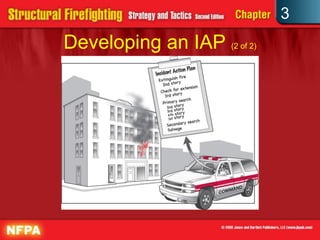
     Developing an IAP (1 of 2)
• IC establishes objectives.
• Unified command: objectives must
  reflect the policies and needs of all
  agencies
• IAP becomes more important as the
  incident grows in size.
3
Developing an IAP (2 of 2)
3
            Deployment
• Writing tactical objectives is useless
  without sufficient resources.
• ICs must follow up and request status
  reports.
• Company-level officers must provide
  status reports.
3
 Risk Versus Benefit Analysis
• Risk refers to the risk to fire fighters, not
  the risk to occupants.
• Benefit is the expected or potential
  benefit to occupants or owners.
  – Rescuing occupants would be a life safety
    benefit.
3

   Scenario 1: Single Family
    Detached Dwelling (1 of 2)
• Majority of fires in the US
• SOPs may spell out duties of first alarm
  assignment.
  – IC may need to modify operations
     • When SOPs are not being followed
     • When the procedures do not fit circumstances
3

   Scenario 1: Single Family
    Detached Dwelling (2 of 2)
• No fire should ever be considered
  routine.
  – Primary reason for conducting an offensive
    operation is life safety.
  – Risk is associated with any offensive
    operation.
    • Usually less in a single-family dwelling versus a
      larger occupancy
3
      Structural Stability (1 of 2)
• Frame building
  – Fairly unstable structure and contributes
    significant fuel to fire.
  – Will have considerable fire involvement
    before collapse
    • Exception of truss roof and floor construction
  – Combustible characteristics of building
    provide stability clues.
3
      Structural Stability (2 of 2)
• Caution should be used when venting
  roofs of modern residential buildings.
• Roof ventilation not normally required if
  the fire is not in upper floor or attic
  – Stable platform or a roof ladder for roof
    access
3

     Scenario 2: High-Rise
     Apartment Building (1 of 5)
• Greater risk than single-family detached
  dwelling due to:
  – Number and location of occupants beyond
    the reach of aerial ladders and towers
  – Difficulty in ventilating building
3

       Scenario 2: High-Rise
       Apartment Building (2 of 5)
• Size, complexity and danger increase.
• Operations are complicated by:
  –   Extreme temperatures
  –   Strong winds
  –   Blocked stairways
  –   Locked passageways
  –   Other factors
• Properly installed, working sprinkler system
  reduces danger.
3

     Scenario 2: High-Rise
     Apartment Building (3 of 5)
• Buildings pose extreme life hazards due
  to type of occupancy.
  – Office buildings (thousands of people)
  – Large residential buildings (hundreds of
    families, elderly residents)
• Evacuation is more labor-intensive.
3

     Scenario 2: High-Rise
     Apartment Building (4 of 5)
• Fire conditions could be similar to single
  family detached dwelling.
  – Challenges will be more complex.
     • Occupants on fire floor and floors above can be
       threatened by the smoke and fire.
  – Resource needs are much greater.
3

     Scenario 2: High-Rise
     Apartment Building (5 of 5)
• Fire could be located several floors
  above grade level.
  – More complex and difficult
• Many floors above fire could be
  occupied.
  – Search and rescue necessary on many
    different levels
3
 Scenario 3: Church Fires (1 of 3)
• Large, open area to accommodate the
  congregation and altar.
• Structural collapse is probable if fire
  reaches roof structure.
• Require an unusually high rate of flow
• Use 2½″ (64-mm) or 3″ (76-mm) hand
  lines with solid streams to obtain the
  necessary reach.
3
 Scenario 3: Church Fires (2 of 3)
• During times when people congregate,
  life safety is a key tactical consideration.
• Long periods of time when the buildings
  are unoccupied
  – Fire can gain considerable headway before
    it is noticed
3
 Scenario 3: Church Fires (3 of 3)
• Many are not protected by fire
  suppression systems or automatic
  alarms.
• Older churches may house priceless
  valuables.
3
            Summary (1 of 2)
• An IAP is critical to meeting the three
  priorities:
  – Life safety
  – Extinguishment
  – Property conservation
3
            Summary (2 of 2)
• Safety can be addressed while meeting
  these priorities.
  – Requires sound application of risk
    management techniques

Chapter 3

  • 1.
  • 2.
    3 Learning Objectives (1 of 2) • Describe how extinguishment is both an operational priority and tactical objective with an emphasis on the relationship between life safety and extinguishment. • Evaluate conditions leading to an offensive or defensive operation.
  • 3.
    3 Learning Objectives (2 of 2) • Compare probability of occupant survival to fire and building conditions. • List situations when a written incident action plan is needed. • Use a case study or actual fire to develop an incident action plan based on a risk-versus-benefit analysis.
  • 4.
    3 Overview (1 of 3) • Incident Action Plan (IAP) development – Leads to offensive or defensive tactics – Derived from an analytical approach to information gained through size-up – Should be a simple, concise, straightforward, easy-to-understand – Outlines major tactical objectives – Provides the central focus for operations
  • 5.
    3 Overview (2 of 3) • Size-up – Continuous process – IAP must remain flexible – Tactics modified as conditions change • All activities should lead to completion of major objectives identified in the IAP.
  • 6.
    3 Overview (3 of 3) • Primary strategic considerations – Life safety – Extinguishment – Property conservation • With sufficient resources, priorities can be handled simultaneously. • Extinguishment is normally the most important life safety tactic.
  • 7.
    3 Determining Life SafetyNeeds • Structural firefighting primary objective: saving lives – Life safety is the first consideration.
  • 8.
    3 Evaluating Structural Conditions • Structural conditions bear heavily on offensive/defensive decision. • Interior attack should not be conducted in an unsafe building. • Offensive attack is conducted to assist occupants from the building. – Reevaluation is necessary once the building is evacuated.
  • 9.
    3 Estimating Resource Capability and Requirements (1 of 2) • Comparing resource capability to incident requirements during size-up • The IC must – Apply sound risk management principles to ensure fire fighter safety – When developing a plan, decide what will be needed to conduct an offensive attack
  • 10.
    3 Estimating Resource Capability and Requirements (2 of 2)
  • 11.
    3 Offensive Fire Attack • Lives and property are best saved by conducting an offensive attack. • A lack of resources could lead to a defensive decision.
  • 12.
    3 Developing an Offensive/Defensive IAP (1 of 3) • Entire operation is governed by the offensive/defensive decision – Initiate an offensive attack whenever it is safe to do so.
  • 13.
    3 Developing an Offensive/Defensive IAP (2 of 3) • Master stream appliances used to: – Support rescue efforts – Push fire away from critical evacuation routes – Cover exposures • During an offensive operation, coordinate through command.
  • 14.
    3 Developing an Offensive/Defensive IAP (3 of 3) • Offensive changes to defensive – Actions must be coordinated – Must never be both
  • 15.
    3 Formulating an IAP (1 of 3) • IC – Sets the objectives – Decides on tactics necessary to achieve those objectives – Assigns units to complete the tasks associated with each objective and tactic
  • 16.
    3 Formulating an IAP (2 of 3) • Focus of the entire operation • Tactics are directed toward completing the objectives. • Objectives are directed toward accomplishing the overall IAP. • Should be simple and understandable
  • 17.
    3 Formulating an IAP (3 of 3) • Every incident needs some form of incident action plan. – Small incidents of short duration: unwritten plan. – Larger, more complex incidents: written plan provides a central focus, eliminates confusion, and reduces disputes
  • 18.
    3 Written IAP • Written action plan should be used when: – Resources from multiple agencies are being used. – Several jurisdictions are involved. – Incident requires more than initial transfer of command.
  • 19.
    3 Developing an IAP (1 of 2) • IC establishes objectives. • Unified command: objectives must reflect the policies and needs of all agencies • IAP becomes more important as the incident grows in size.
  • 20.
  • 21.
    3 Deployment • Writing tactical objectives is useless without sufficient resources. • ICs must follow up and request status reports. • Company-level officers must provide status reports.
  • 22.
    3 Risk VersusBenefit Analysis • Risk refers to the risk to fire fighters, not the risk to occupants. • Benefit is the expected or potential benefit to occupants or owners. – Rescuing occupants would be a life safety benefit.
  • 23.
    3 Scenario 1: Single Family Detached Dwelling (1 of 2) • Majority of fires in the US • SOPs may spell out duties of first alarm assignment. – IC may need to modify operations • When SOPs are not being followed • When the procedures do not fit circumstances
  • 24.
    3 Scenario 1: Single Family Detached Dwelling (2 of 2) • No fire should ever be considered routine. – Primary reason for conducting an offensive operation is life safety. – Risk is associated with any offensive operation. • Usually less in a single-family dwelling versus a larger occupancy
  • 25.
    3 Structural Stability (1 of 2) • Frame building – Fairly unstable structure and contributes significant fuel to fire. – Will have considerable fire involvement before collapse • Exception of truss roof and floor construction – Combustible characteristics of building provide stability clues.
  • 26.
    3 Structural Stability (2 of 2) • Caution should be used when venting roofs of modern residential buildings. • Roof ventilation not normally required if the fire is not in upper floor or attic – Stable platform or a roof ladder for roof access
  • 27.
    3 Scenario 2: High-Rise Apartment Building (1 of 5) • Greater risk than single-family detached dwelling due to: – Number and location of occupants beyond the reach of aerial ladders and towers – Difficulty in ventilating building
  • 28.
    3 Scenario 2: High-Rise Apartment Building (2 of 5) • Size, complexity and danger increase. • Operations are complicated by: – Extreme temperatures – Strong winds – Blocked stairways – Locked passageways – Other factors • Properly installed, working sprinkler system reduces danger.
  • 29.
    3 Scenario 2: High-Rise Apartment Building (3 of 5) • Buildings pose extreme life hazards due to type of occupancy. – Office buildings (thousands of people) – Large residential buildings (hundreds of families, elderly residents) • Evacuation is more labor-intensive.
  • 30.
    3 Scenario 2: High-Rise Apartment Building (4 of 5) • Fire conditions could be similar to single family detached dwelling. – Challenges will be more complex. • Occupants on fire floor and floors above can be threatened by the smoke and fire. – Resource needs are much greater.
  • 31.
    3 Scenario 2: High-Rise Apartment Building (5 of 5) • Fire could be located several floors above grade level. – More complex and difficult • Many floors above fire could be occupied. – Search and rescue necessary on many different levels
  • 32.
    3 Scenario 3:Church Fires (1 of 3) • Large, open area to accommodate the congregation and altar. • Structural collapse is probable if fire reaches roof structure. • Require an unusually high rate of flow • Use 2½″ (64-mm) or 3″ (76-mm) hand lines with solid streams to obtain the necessary reach.
  • 33.
    3 Scenario 3:Church Fires (2 of 3) • During times when people congregate, life safety is a key tactical consideration. • Long periods of time when the buildings are unoccupied – Fire can gain considerable headway before it is noticed
  • 34.
    3 Scenario 3:Church Fires (3 of 3) • Many are not protected by fire suppression systems or automatic alarms. • Older churches may house priceless valuables.
  • 35.
    3 Summary (1 of 2) • An IAP is critical to meeting the three priorities: – Life safety – Extinguishment – Property conservation
  • 36.
    3 Summary (2 of 2) • Safety can be addressed while meeting these priorities. – Requires sound application of risk management techniques