6
Life Safety
6
Learning Objectives (1 of 6)
• Explain the relationship between life
safety and extinguishment.
• Discuss the positive and negative
aspects of ventilation in regard to life
safety.
6
Learning Objectives (2 of 6)
• Evaluate ventilation options as they
relate to fire location and select the best
option given a scenario with several
vent options.
• List and evaluate rescue options.
• List rescue priorities in terms of
occupant proximity to fire.
6
Learning Objectives (3 of 6)
• Define a mass-casualty incident.
• Explain the medical (EMS) function at a
large structure fire with multiple
casualties.
• Describe conditions that affect life
safety staffing requirements.
6
Learning Objectives (4 of 6)
• Evaluate tactics at a fire scenario where
a large number of occupants need to be
rescued.
• Compare and contrast the positive and
negative effects of entering an enclosed
fire area.
6
Learning Objectives (5 of 6)
• Use a scenario to select and describe
proper ventilation techniques.
• Use a scenario to describe and apply
rescue options.
6
Learning Objectives (6 of 6)
• Use a scenario to evaluate priorities as
they relate to occupant proximity to the
fire.
• Use a scenario to estimate staffing
requirements at a structure fire
occupied by a large number of people.
6
Overview (1 of 2)
• Life safety: ultimate challenge to the IC
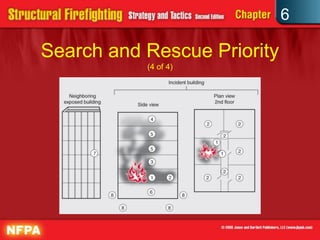
• Assigning initial resources is difficult.
– Control the fire
– Remove the victims
– Both
– Quick decision
6
Overview (2 of 2)
• Life safety priority: best tactic is to
suppress the fire
– Ventilation also used
• Fire extinguishment: second priority
– Essential part of most rescue operations
• Fire fighter safety is critical.
6
Probability of Extinguishment
• Major factor in life safety decisions
– Required rate of flow
• Controlling or extinguishing the fire
often best tactic
6
Prioritizing Victims
• Common tactical error
– Prioritizing victims according to visibility
– Occupants inside building may be in grave
danger.
– May be best to rescue visible victims via
the interior stairs
• After the fire is under control or extinguished
6
Defend-In-Place Strategy
• Useful if the fire can be quickly
controlled
• Calculated risk based on:
– Fire conditions
– Available resources
– Extent of danger to victims
6
Large-Volume Flows
• Large interior flow requirements
– Greater staffing needs, more time to assemble
resources
• Fire doors and fire walls
– Extend available evacuation time
– Provide a barrier between the victims and the fire
• Sufficient personnel and resources must be
available.
6
Hose Line Placement
• Hose line must get into position to
extinguish the fire.
– Can also protect egress routes
– First-in engine
• Focus on advancing attack line
• Control the fire, save lives
• Only hope for occupants in the immediate fire
area
6
First-In Crew
• Advancing crew will assist victims they
come upon.
– Can’t be expected to perform a complete
primary search
• Responsibility is extinguishment
6
Search and Rescue
• Floors above the fire are critical areas.
• Number of crews depends on:
– Number of floors to be searched
– Size of the building
– Fire intensity
– Smoke conditions
– Occupant status
6
High-Rise Buildings
• Floor areas are generally large.
• May need to search several floors
• One company into all areas on the fire
floor and above
– Determine fire and smoke conditions and
evacuation needs.
6
Ventilation
• Relieves the products of combustion
– Allows fire fighters to advance on the fire
– Must be coordinated with attack lines
• Very effective life safety procedure
– Pulls the fire, heat, smoke, and toxic gases
away from victims, stairs, and other egress
routes
6
Venting to Support
Suppression
• Important to coordinate with hose line
placement
• Makes the job of finding fire and victims
easier
6
Improper Ventilation
• May produce a backdraft
– Fire fighters or occupants could be
seriously injured or killed.
• Vent opening in path of egress could
prove fatal.
6
Venting to Save Lives
• May be necessary to vent before having
a hose line ready
• Use building features
– Retard fire growth
– Prevent extension
• Position charged hose lines before
opening doors and windows
6
Venting While Searching
• Often necessary
– Better to open windows rather than
breaking
• Reversible venting is preferred.
– Negative consequences can be reversed
by closing the window or door.
6
Positive Pressure Ventilation
(PPV)
• Key is controlling outlet openings
– Ineffective if there are too many
• Negative side
– Fire can be directed toward victims, toward
their escape routes, or into unburned areas
6
Rescue Options
• Interior stairways
– Safest and easiest way to move occupants
• Above or below grade level
– Preferred means from upper floors
– Alternative methods
6
Defend-In-Place
• Occupants are moved away from the
fire area.
– Remain in the structure
– High-rise buildings and healthcare facilities
• Large buildings are built to allow this
strategy.
6
Fire Escapes
• Poor substitutes for interior stairs
• Structural integrity questionable
• If structurally sound, preferred over
other alternative methods
6
Aerial Devices
• Individual benefits:
– Aerial ladders
– Elevated platforms
– Articulating platforms
6
Ground Ladders (1 of 2)
• Less stable and reach
• Require more personnel
• Preferred over aerial devices
– When buildings are set back from the
street
– When fire fighters need to quickly access
second or third floor
6
Ground Ladders (2 of 2)
• People at windows may not need
rescue.
– Reassure them.
– Determine whether they must be moved
and if stairways are available.
• Use stairways and corridors if they are
relatively clear of smoke.
6
Elevator Rescue
• Can be used under fire department’s
control
• Elevators should be located:
– In buildings that are subdivided with good,
fire-resistive construction
– Remote and separate from the fire area
• Use in the immediate fire area is
hazardous.
6
Rope Rescue
• Last resort
– Justifiable only in extreme cases
• Interior rescue should be attempted
first.
• Extremely slow and dangerous
– Require specialized equipment and
expertise
6
Helicopter Rescue
• IC should ask if occupants are safe
where they’re at.
• Most roofs provide a difficult operating
platform.
– Obstructions
– Hot air currents caused by an intense fire
6
Occupant Status
• Occupants who escape on their own
• Victims who may not be aware of the
fire or of egress routes
• Immobile or unconscious victims
6
Occupant Information
• Occupants not reliable
• Staff may not account for visitors in the
building.
• The only reliable way to verify is to
systematically check every room.
6
Rescue Size-Up
• The IC should see all sides of the fire
building.
• Fire crews should view the exterior.
• Reports from occupants may be
unreliable, but they should not be
ignored.
– May be able to direct rescuers
6
Flashover
• The critical landmark:
– Before flashover, rescue is possible.
– After flashover, rescue is highly improbable
within the flashover compartment.
• Recognizing the signs of flashover is
important.
6
Fire Conditions
• Related to many factors:
– Elapsed time before fire was detected
– Time it takes to notify the fire department
– Response time
6
Threat to Occupants
• Directly related to:
– Their awareness of the fire
– Their ability to escape
– Construction of the building
– Provisions made for egress
• IC has little control over these factors.
6
Critical Time
• Time until structure becomes untenable
– Varies depending on numerous building
factors and fuel load
• Fires spread rapidly upward in any
construction that allows unimpeded
vertical fire spread.
– Lessens the critical time
6
Fire Control
• Fire control tactics = critical strategy
– Implemented whenever possible
• Fire fighters and victims have a better
chance to evacuate if the fire is
extinguished or knocked down.
6
Forcible Entry
• Search-and-rescue crews should have
forcible entry tools.
– Heavy metal doors will extend the time and
effort required for the primary search.
– It is important to consider the value of the
opening being forced.
• Fire doors
6
Fire Doors
• Designed to:
– Resist and contain the fire
– Keep fire from extending
• Fire doors should be closed after search
is complete.
• Charged hose lines should be in place
before forcing doors to fire areas.
6
Personnel Requirements
• Sized-up by considering the:
– Physical condition of the occupants
– Number of occupants on the fire floor
– Travel distance to safety
– Estimated fire growth
6
Floor Layout and Size
• Organized search effort considers:
– Size of the area to be searched and
evacuated
– Location of stairways, halls, and fire
escapes
6
Large Building Search
• Assign floors to each search team
• May be further subdivided by wing or
building side
6
Multi-Story Buildings
• Survey uninvolved floor
– Layout may be different from floor to floor
– Some building features remain constant:
stairs, elevators, and standpipes
6
Floor Numbering
• Buildings constructed on a grade may
have unusual floor numbers.
– First floor on one side can actually be a
higher or lower floor.
• Should be listed in pre-plans
6
Small Buildings
• Exterior size-up reveals interior layout
– Large windows = common areas
– Small windows = bedrooms
• Buildings of similar construction typically
will have similar floor layouts.
– Stairway location
– Can be difficult to search
6
Larger Buildings
• Reduced visibility
• Using small building tactics and
procedures could be fatal.
6
Search
• Small room search in a right- or left-
hand pattern
• Larger area requires rope or other guide
line and different search techniques
• Thermal imaging camera
6
Search and Rescue Priority
(1 of 4)
• Established after:
– Determining the total number of occupants
– Developing a strategy for full or partial
evacuation
• Determined by deciding who is in the
greatest danger
6
Search and Rescue Priority
(2 of 4)
• On the fire floor nearest to the
immediate fire area
• In proximity to the fire area on the same
level
• On the floor above the fire, especially
immediately over the fire area
• On the top floor, unless fire conditions
result in smoke stratification
6
Search and Rescue Priority
(3 of 4)
• On the floors between the floor above
the fire and the top floor
• On the floors below the fire
• In nearby buildings
• Outside
– In the collapse or falling glass zones
6
Search and Rescue Priority
(4 of 4)
6
Rescue Priorities
• When it is not possible to save
everyone
– IC must save the largest number of people
possible
• The key to successful search operations
is to be systematic.
6
Primary Search
• Quick, thorough
• Mark and record areas that have been
searched
– Assures that areas are checked before the
secondary search begins
6
Secondary Search
• Ensures that no one was missed the
first time through
• If conditions allow, should be conducted
as soon as the primary search is
complete
• Use a different crew.
6
Medical Status of Victims
• IC must have wide discretion in calling
medical assistance.
• Need for EMS at an incident scene is
dictated by:
– Relative hazard
– Number of potential victims
– Type of incident
• If you think you need help, you do.
6
Medical Unit Set-up
• Set up within the cold zone or beyond
– Personnel should remain with their
ambulance.
– Near the rehab area
6
Mass-Casualty Incidents
(MCI) (1 of 2)
• Occurs when:
– Number of victims and nature of injuries
make normal stabilization and care
unattainable.
– Available trained personnel and
transportation vehicles are insufficient.
– Hospital capabilities are insufficient.
6
Mass-Casualty Incidents
(MCI) (2 of 2)
• Specific incidents:
– Transportation accidents, hazardous
materials releases, or natural disasters
• Fires in buildings with large numbers of
occupants have the potential to become
MCIs.
6
Triage, Prioritizing, Transport
• Triage: first medical priority in managing
an MCI
• First-arriving EMS personnel should not
leave the scene until relieved of triage
responsibilities.
6
Medical Teams
• Accustomed to treating one or more
individuals, followed by immediate
transport
• Triaging without treatment and
transportation runs contrary to normal
role
• Once triage teams have prioritized the
victims, treatment teams will follow.
6
Treatment Teams
• First treat those needing immediate
care and arrange for their
transportation.
• If sufficient personnel are on the scene,
multiple teams can be formed.
– Treat as many patients as possible.
6
Medical Transportation Officer
• Manages transportation needs
• Directs incoming EMS vehicles to
staging area
• Determines mode of transportation
– May be possible to transport in vehicles
other than ambulances
6
Communications with
Hospitals
• Need to know how many patients and
what types of injuries can be treated at
each facility.
• Patients directed to hospitals and
trauma centers according to their
capabilities.
6
Hospital Response
• Hospitals determine their limits based
on:
– Personnel
– Staff expertise
– Space
• Must be prepared to exceed their
normal patient capacity
6
Medical Planning Officer
• Functions similar to planning section
• Can be assigned to medical branch or
group
• Documents where and when each
patient is transported
6
Evaluating the Need for
Shelter
• Weather extremes
– Need to rehab fire fighters
– Provide shelter for occupants
• Nearby building could be used as
shelter.
– Outside the fire zone
6
Outside Assistance
• Red Cross
– Response times may be fairly long.
– Makes it necessary to assign crews to this
task until they arrive
6
Estimating Staffing
Requirements
• Staffing must be sufficient to:
– Extinguish or contain the fire
– Conduct search-and-rescue operations
– Treat and transport the injured
– Remove victims to a place of safety
– Prevent re-entry
6
Staffing Needs (1 of 2)
• Depends on several factors:
– Number of victims
– Rescue methods used
– Condition of victims
– Fire conditions
6
Staffing Needs (2 of 2)
• Depends on several factors (continued)
– Smoke conditions
– Victim mobility
– Weather conditions
– Accessibility
6
Additional Staffing
• Needed in the following situations:
– Victims close to the fire area
– Victims have physical impairments
– Fire occurs during weather extremes
– Evacuation routes other than the interior
stairs must be used
– Forcible entry required
6
Evacuation Status
• Determined by:
– Pre-incident planning information
– Occupant information
– Visual observation
– Reconnaissance
– Alarm information
6
Fire-Ground Tasks
• Division-of-labor approach
• Actions can be delayed and/or
duplicated without pre-assignment of
duties.
6
Fire-Ground Duties (1 of 2)
• Water supply and application (engine
company duties)
• Ventilation, entry, search and rescue,
and property conservation (ladder
company duties)
• Search, rescue, and rapid intervention
(rescue company duties)
6
Fire-Ground Duties (2 of 2)
• Triage, treatment, transportation, and
rehabilitation (emergency medical
duties)
• Planning, organizing, coordinating, and
establishing command (IC duties)
6
Summary (1 of 2)
• The most important fire-ground activity
is saving lives.
• Sound risk-management principles must
be applied.
6
Summary (2 of 2)
• IC considerations:
– Department SOPs
– Pre-incident plans
– Size-up factors
– Number and location of victims

Chapter 6

  • 1.
  • 2.
    6 Learning Objectives (1of 6) • Explain the relationship between life safety and extinguishment. • Discuss the positive and negative aspects of ventilation in regard to life safety.
  • 3.
    6 Learning Objectives (2of 6) • Evaluate ventilation options as they relate to fire location and select the best option given a scenario with several vent options. • List and evaluate rescue options. • List rescue priorities in terms of occupant proximity to fire.
  • 4.
    6 Learning Objectives (3of 6) • Define a mass-casualty incident. • Explain the medical (EMS) function at a large structure fire with multiple casualties. • Describe conditions that affect life safety staffing requirements.
  • 5.
    6 Learning Objectives (4of 6) • Evaluate tactics at a fire scenario where a large number of occupants need to be rescued. • Compare and contrast the positive and negative effects of entering an enclosed fire area.
  • 6.
    6 Learning Objectives (5of 6) • Use a scenario to select and describe proper ventilation techniques. • Use a scenario to describe and apply rescue options.
  • 7.
    6 Learning Objectives (6of 6) • Use a scenario to evaluate priorities as they relate to occupant proximity to the fire. • Use a scenario to estimate staffing requirements at a structure fire occupied by a large number of people.
  • 8.
    6 Overview (1 of2) • Life safety: ultimate challenge to the IC • Assigning initial resources is difficult. – Control the fire – Remove the victims – Both – Quick decision
  • 9.
    6 Overview (2 of2) • Life safety priority: best tactic is to suppress the fire – Ventilation also used • Fire extinguishment: second priority – Essential part of most rescue operations • Fire fighter safety is critical.
  • 10.
    6 Probability of Extinguishment •Major factor in life safety decisions – Required rate of flow • Controlling or extinguishing the fire often best tactic
  • 11.
    6 Prioritizing Victims • Commontactical error – Prioritizing victims according to visibility – Occupants inside building may be in grave danger. – May be best to rescue visible victims via the interior stairs • After the fire is under control or extinguished
  • 12.
    6 Defend-In-Place Strategy • Usefulif the fire can be quickly controlled • Calculated risk based on: – Fire conditions – Available resources – Extent of danger to victims
  • 13.
    6 Large-Volume Flows • Largeinterior flow requirements – Greater staffing needs, more time to assemble resources • Fire doors and fire walls – Extend available evacuation time – Provide a barrier between the victims and the fire • Sufficient personnel and resources must be available.
  • 14.
    6 Hose Line Placement •Hose line must get into position to extinguish the fire. – Can also protect egress routes – First-in engine • Focus on advancing attack line • Control the fire, save lives • Only hope for occupants in the immediate fire area
  • 15.
    6 First-In Crew • Advancingcrew will assist victims they come upon. – Can’t be expected to perform a complete primary search • Responsibility is extinguishment
  • 16.
    6 Search and Rescue •Floors above the fire are critical areas. • Number of crews depends on: – Number of floors to be searched – Size of the building – Fire intensity – Smoke conditions – Occupant status
  • 17.
    6 High-Rise Buildings • Floorareas are generally large. • May need to search several floors • One company into all areas on the fire floor and above – Determine fire and smoke conditions and evacuation needs.
  • 18.
    6 Ventilation • Relieves theproducts of combustion – Allows fire fighters to advance on the fire – Must be coordinated with attack lines • Very effective life safety procedure – Pulls the fire, heat, smoke, and toxic gases away from victims, stairs, and other egress routes
  • 19.
    6 Venting to Support Suppression •Important to coordinate with hose line placement • Makes the job of finding fire and victims easier
  • 20.
    6 Improper Ventilation • Mayproduce a backdraft – Fire fighters or occupants could be seriously injured or killed. • Vent opening in path of egress could prove fatal.
  • 21.
    6 Venting to SaveLives • May be necessary to vent before having a hose line ready • Use building features – Retard fire growth – Prevent extension • Position charged hose lines before opening doors and windows
  • 22.
    6 Venting While Searching •Often necessary – Better to open windows rather than breaking • Reversible venting is preferred. – Negative consequences can be reversed by closing the window or door.
  • 23.
    6 Positive Pressure Ventilation (PPV) •Key is controlling outlet openings – Ineffective if there are too many • Negative side – Fire can be directed toward victims, toward their escape routes, or into unburned areas
  • 24.
    6 Rescue Options • Interiorstairways – Safest and easiest way to move occupants • Above or below grade level – Preferred means from upper floors – Alternative methods
  • 25.
    6 Defend-In-Place • Occupants aremoved away from the fire area. – Remain in the structure – High-rise buildings and healthcare facilities • Large buildings are built to allow this strategy.
  • 26.
    6 Fire Escapes • Poorsubstitutes for interior stairs • Structural integrity questionable • If structurally sound, preferred over other alternative methods
  • 27.
    6 Aerial Devices • Individualbenefits: – Aerial ladders – Elevated platforms – Articulating platforms
  • 28.
    6 Ground Ladders (1of 2) • Less stable and reach • Require more personnel • Preferred over aerial devices – When buildings are set back from the street – When fire fighters need to quickly access second or third floor
  • 29.
    6 Ground Ladders (2of 2) • People at windows may not need rescue. – Reassure them. – Determine whether they must be moved and if stairways are available. • Use stairways and corridors if they are relatively clear of smoke.
  • 30.
    6 Elevator Rescue • Canbe used under fire department’s control • Elevators should be located: – In buildings that are subdivided with good, fire-resistive construction – Remote and separate from the fire area • Use in the immediate fire area is hazardous.
  • 31.
    6 Rope Rescue • Lastresort – Justifiable only in extreme cases • Interior rescue should be attempted first. • Extremely slow and dangerous – Require specialized equipment and expertise
  • 32.
    6 Helicopter Rescue • ICshould ask if occupants are safe where they’re at. • Most roofs provide a difficult operating platform. – Obstructions – Hot air currents caused by an intense fire
  • 33.
    6 Occupant Status • Occupantswho escape on their own • Victims who may not be aware of the fire or of egress routes • Immobile or unconscious victims
  • 34.
    6 Occupant Information • Occupantsnot reliable • Staff may not account for visitors in the building. • The only reliable way to verify is to systematically check every room.
  • 35.
    6 Rescue Size-Up • TheIC should see all sides of the fire building. • Fire crews should view the exterior. • Reports from occupants may be unreliable, but they should not be ignored. – May be able to direct rescuers
  • 36.
    6 Flashover • The criticallandmark: – Before flashover, rescue is possible. – After flashover, rescue is highly improbable within the flashover compartment. • Recognizing the signs of flashover is important.
  • 37.
    6 Fire Conditions • Relatedto many factors: – Elapsed time before fire was detected – Time it takes to notify the fire department – Response time
  • 38.
    6 Threat to Occupants •Directly related to: – Their awareness of the fire – Their ability to escape – Construction of the building – Provisions made for egress • IC has little control over these factors.
  • 39.
    6 Critical Time • Timeuntil structure becomes untenable – Varies depending on numerous building factors and fuel load • Fires spread rapidly upward in any construction that allows unimpeded vertical fire spread. – Lessens the critical time
  • 40.
    6 Fire Control • Firecontrol tactics = critical strategy – Implemented whenever possible • Fire fighters and victims have a better chance to evacuate if the fire is extinguished or knocked down.
  • 41.
    6 Forcible Entry • Search-and-rescuecrews should have forcible entry tools. – Heavy metal doors will extend the time and effort required for the primary search. – It is important to consider the value of the opening being forced. • Fire doors
  • 42.
    6 Fire Doors • Designedto: – Resist and contain the fire – Keep fire from extending • Fire doors should be closed after search is complete. • Charged hose lines should be in place before forcing doors to fire areas.
  • 43.
    6 Personnel Requirements • Sized-upby considering the: – Physical condition of the occupants – Number of occupants on the fire floor – Travel distance to safety – Estimated fire growth
  • 44.
    6 Floor Layout andSize • Organized search effort considers: – Size of the area to be searched and evacuated – Location of stairways, halls, and fire escapes
  • 45.
    6 Large Building Search •Assign floors to each search team • May be further subdivided by wing or building side
  • 46.
    6 Multi-Story Buildings • Surveyuninvolved floor – Layout may be different from floor to floor – Some building features remain constant: stairs, elevators, and standpipes
  • 47.
    6 Floor Numbering • Buildingsconstructed on a grade may have unusual floor numbers. – First floor on one side can actually be a higher or lower floor. • Should be listed in pre-plans
  • 48.
    6 Small Buildings • Exteriorsize-up reveals interior layout – Large windows = common areas – Small windows = bedrooms • Buildings of similar construction typically will have similar floor layouts. – Stairway location – Can be difficult to search
  • 49.
    6 Larger Buildings • Reducedvisibility • Using small building tactics and procedures could be fatal.
  • 50.
    6 Search • Small roomsearch in a right- or left- hand pattern • Larger area requires rope or other guide line and different search techniques • Thermal imaging camera
  • 51.
    6 Search and RescuePriority (1 of 4) • Established after: – Determining the total number of occupants – Developing a strategy for full or partial evacuation • Determined by deciding who is in the greatest danger
  • 52.
    6 Search and RescuePriority (2 of 4) • On the fire floor nearest to the immediate fire area • In proximity to the fire area on the same level • On the floor above the fire, especially immediately over the fire area • On the top floor, unless fire conditions result in smoke stratification
  • 53.
    6 Search and RescuePriority (3 of 4) • On the floors between the floor above the fire and the top floor • On the floors below the fire • In nearby buildings • Outside – In the collapse or falling glass zones
  • 54.
    6 Search and RescuePriority (4 of 4)
  • 55.
    6 Rescue Priorities • Whenit is not possible to save everyone – IC must save the largest number of people possible • The key to successful search operations is to be systematic.
  • 56.
    6 Primary Search • Quick,thorough • Mark and record areas that have been searched – Assures that areas are checked before the secondary search begins
  • 57.
    6 Secondary Search • Ensuresthat no one was missed the first time through • If conditions allow, should be conducted as soon as the primary search is complete • Use a different crew.
  • 58.
    6 Medical Status ofVictims • IC must have wide discretion in calling medical assistance. • Need for EMS at an incident scene is dictated by: – Relative hazard – Number of potential victims – Type of incident • If you think you need help, you do.
  • 59.
    6 Medical Unit Set-up •Set up within the cold zone or beyond – Personnel should remain with their ambulance. – Near the rehab area
  • 60.
    6 Mass-Casualty Incidents (MCI) (1of 2) • Occurs when: – Number of victims and nature of injuries make normal stabilization and care unattainable. – Available trained personnel and transportation vehicles are insufficient. – Hospital capabilities are insufficient.
  • 61.
    6 Mass-Casualty Incidents (MCI) (2of 2) • Specific incidents: – Transportation accidents, hazardous materials releases, or natural disasters • Fires in buildings with large numbers of occupants have the potential to become MCIs.
  • 62.
    6 Triage, Prioritizing, Transport •Triage: first medical priority in managing an MCI • First-arriving EMS personnel should not leave the scene until relieved of triage responsibilities.
  • 63.
    6 Medical Teams • Accustomedto treating one or more individuals, followed by immediate transport • Triaging without treatment and transportation runs contrary to normal role • Once triage teams have prioritized the victims, treatment teams will follow.
  • 64.
    6 Treatment Teams • Firsttreat those needing immediate care and arrange for their transportation. • If sufficient personnel are on the scene, multiple teams can be formed. – Treat as many patients as possible.
  • 65.
    6 Medical Transportation Officer •Manages transportation needs • Directs incoming EMS vehicles to staging area • Determines mode of transportation – May be possible to transport in vehicles other than ambulances
  • 66.
    6 Communications with Hospitals • Needto know how many patients and what types of injuries can be treated at each facility. • Patients directed to hospitals and trauma centers according to their capabilities.
  • 67.
    6 Hospital Response • Hospitalsdetermine their limits based on: – Personnel – Staff expertise – Space • Must be prepared to exceed their normal patient capacity
  • 68.
    6 Medical Planning Officer •Functions similar to planning section • Can be assigned to medical branch or group • Documents where and when each patient is transported
  • 69.
    6 Evaluating the Needfor Shelter • Weather extremes – Need to rehab fire fighters – Provide shelter for occupants • Nearby building could be used as shelter. – Outside the fire zone
  • 70.
    6 Outside Assistance • RedCross – Response times may be fairly long. – Makes it necessary to assign crews to this task until they arrive
  • 71.
    6 Estimating Staffing Requirements • Staffingmust be sufficient to: – Extinguish or contain the fire – Conduct search-and-rescue operations – Treat and transport the injured – Remove victims to a place of safety – Prevent re-entry
  • 72.
    6 Staffing Needs (1of 2) • Depends on several factors: – Number of victims – Rescue methods used – Condition of victims – Fire conditions
  • 73.
    6 Staffing Needs (2of 2) • Depends on several factors (continued) – Smoke conditions – Victim mobility – Weather conditions – Accessibility
  • 74.
    6 Additional Staffing • Neededin the following situations: – Victims close to the fire area – Victims have physical impairments – Fire occurs during weather extremes – Evacuation routes other than the interior stairs must be used – Forcible entry required
  • 75.
    6 Evacuation Status • Determinedby: – Pre-incident planning information – Occupant information – Visual observation – Reconnaissance – Alarm information
  • 76.
    6 Fire-Ground Tasks • Division-of-laborapproach • Actions can be delayed and/or duplicated without pre-assignment of duties.
  • 77.
    6 Fire-Ground Duties (1of 2) • Water supply and application (engine company duties) • Ventilation, entry, search and rescue, and property conservation (ladder company duties) • Search, rescue, and rapid intervention (rescue company duties)
  • 78.
    6 Fire-Ground Duties (2of 2) • Triage, treatment, transportation, and rehabilitation (emergency medical duties) • Planning, organizing, coordinating, and establishing command (IC duties)
  • 79.
    6 Summary (1 of2) • The most important fire-ground activity is saving lives. • Sound risk-management principles must be applied.
  • 80.
    6 Summary (2 of2) • IC considerations: – Department SOPs – Pre-incident plans – Size-up factors – Number and location of victims