Fundamental Of
                 Marketing
                  MKT243
                         Chapter 4
          Market Segmentation and
                  Targeting Market


DHD2011         MKT243 Fundamental Of Marketing   1
Segmenting and Targeting Market
                 Topic Outline

 Definition of segmenting
 Reasons for segmenting

 Criteria for Successful segmentation

 Market Targeting

 Differentiation and Positioning


DHD2011          MKT243 Fundamental Of Marketing   2
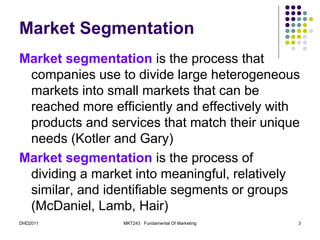
Market Segmentation
Market segmentation is the process that
 companies use to divide large heterogeneous
 markets into small markets that can be
 reached more efficiently and effectively with
 products and services that match their unique
 needs (Kotler and Gary)
Market segmentation is the process of
 dividing a market into meaningful, relatively
 similar, and identifiable segments or groups
 (McDaniel, Lamb, Hair)
DHD2011          MKT243 Fundamental Of Marketing   3
Market Segmentation
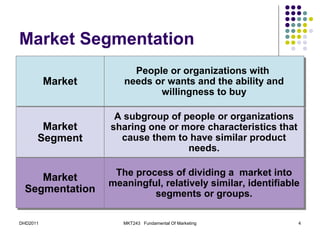
                        People or organizations with
                        People or organizations with
          Market
          Market      needs or wants and the ability and
                      needs or wants and the ability and
                             willingness to buy
                              willingness to buy

                    A subgroup of people or organizations
                    A subgroup of people or organizations
       Market
       Market      sharing one or more characteristics that
                   sharing one or more characteristics that
      Segment
      Segment        cause them to have similar product
                      cause them to have similar product
                                   needs.
                                   needs.

                    The process of dividing a market into
                    The process of dividing a market into
     Market
     Market        meaningful, relatively similar, identifiable
                   meaningful, relatively similar, identifiable
  Segmentation
  Segmentation              segments or groups.
                            segments or groups.

DHD2011               MKT243 Fundamental Of Marketing         4
A Market Is...

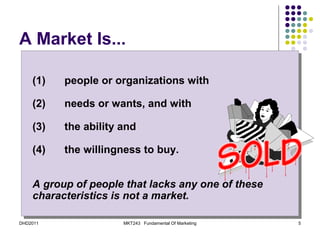
    (1)   people or organizations with

    (2)   needs or wants, and with

    (3)   the ability and

    (4)   the willingness to buy.


    A group of people that lacks any one of these
    characteristics is not a market.

DHD2011               MKT243 Fundamental Of Marketing   5
The Importance of Market
Segmentation

 Markets have a variety of product
      needs and preferences.

 Marketers can better define
      customer needs.

 Decision makers can define objectives
      and allocate resources more accurately.


DHD2011                 MKT243 Fundamental Of Marketing   6
Criteria for Successful
               Segmentation
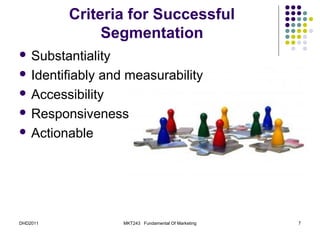
 Substantiality

 Identifiablyand measurability
 Accessibility

 Responsiveness

 Actionable


DHD2011            MKT243 Fundamental Of Marketing   7
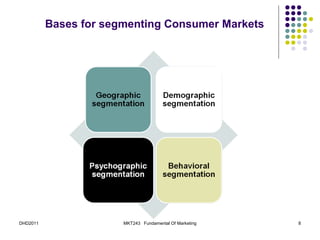
Bases for segmenting Consumer Markets


DHD2011                MKT243 Fundamental Of Marketing   8
Market Segmentation
           Segmenting Consumer Markets
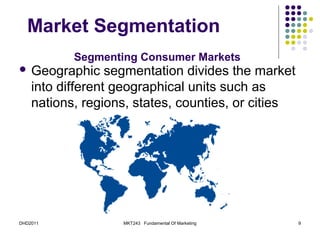
 Geographic      segmentation divides the market
    into different geographical units such as
    nations, regions, states, counties, or cities


DHD2011            MKT243 Fundamental Of Marketing   9
Market Segmentation
           Segmenting Consumer Markets
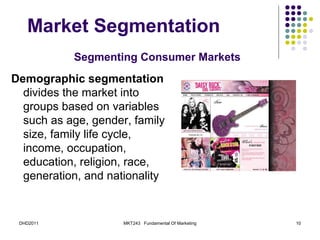
Demographic segmentation
  divides the market into
  groups based on variables
  such as age, gender, family
  size, family life cycle,
  income, occupation,
  education, religion, race,
  generation, and nationality


 DHD2011             MKT243 Fundamental Of Marketing   10
Market Segmentation
   (Demographic Segmentation)
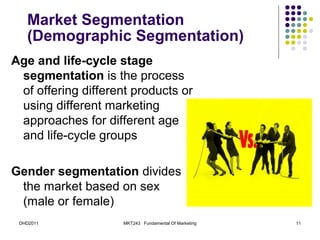
Age and life-cycle stage
 segmentation is the process
 of offering different products or
 using different marketing
 approaches for different age
 and life-cycle groups

Gender segmentation divides
 the market based on sex
 (male or female)
 DHD2011             MKT243 Fundamental Of Marketing   11
Market Segmentation
                  (Demographic Segmentation)
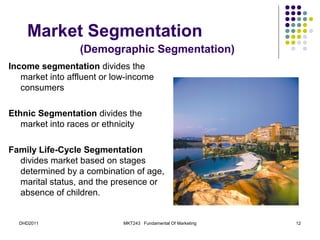
Income segmentation divides the
   market into affluent or low-income
   consumers

Ethnic Segmentation divides the
   market into races or ethnicity

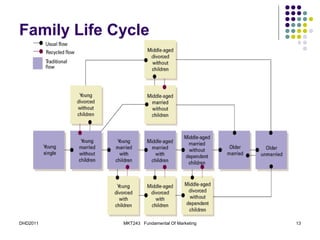
Family Life-Cycle Segmentation
  divides market based on stages
  determined by a combination of age,
  marital status, and the presence or
  absence of children.


  DHD2011                    MKT243 Fundamental Of Marketing   12
Family Life Cycle


DHD2011      MKT243 Fundamental Of Marketing   13
Market Segmentation
Psychographic segmentation divides buyers into
   different groups based on social class, lifestyle, or
   personality traits

         The basis for Psychographic segmentation are as
          follow:

1.  Personality
-Reflects a person’s traits, attitudes and habits. According
    to national survey by Roper, almost half of Americans
    believe their cars match their personality.

DHD2011                  MKT243 Fundamental Of Marketing       14
Cont…
2.  Motives
-Marketers of baby products and life insurance appeal to consumers’
    emotional motives-namely, to care for their loved ones

3.   Lifestyles
-Divides people into groups according to the way they spend their time,
     the importance of the things around them, their beliefs, and
     socioeconomic characteristics such as income and education.

4.    Geodemographic
-Segmenting potential customers into neighborhood lifestyles
      categories
-It combines geographic and demographic and lifestyles
      segmentations.

DHD2011                   MKT243 Fundamental Of Marketing             15
Market Segmentation
          Segmenting Consumer Markets

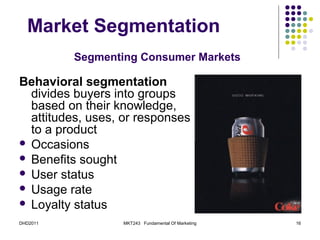
Behavioral segmentation
  divides buyers into groups
  based on their knowledge,
  attitudes, uses, or responses
  to a product
 Occasions
 Benefits sought
 User status
 Usage rate
 Loyalty status

DHD2011           MKT243 Fundamental Of Marketing   16
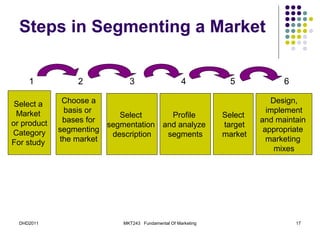
Steps in Segmenting a Market


     1           2            3                     4          5             6

 Select a     Choose a                                                    Design,
 Market       basis or                                                   implement
                           Select      Profile                Select
or product    bases for                                                and maintain
                        segmentation and analyze              target
Category     segmenting                                                 appropriate
                         description  segments                market
For study    the market                                                  marketing
                                                                           mixes


  DHD2011                   MKT243 Fundamental Of Marketing                      17
Market Targeting
          Selecting Target Market Segments
 Target   market consists of a set of buyers who
    share common needs or characteristics that
    the company decides to serve


DHD2011             MKT243 Fundamental Of Marketing   18
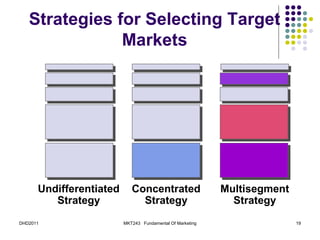
Strategies for Selecting Target
               Markets


      Undifferentiated      Concentrated                   Multisegment
         Strategy             Strategy                       Strategy
DHD2011                  MKT243 Fundamental Of Marketing                  19
Undifferentiated Targeting
Strategy

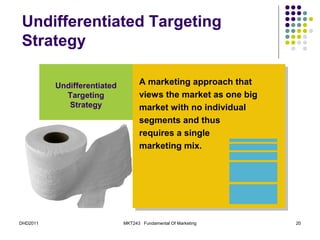
          Undifferentiated         A marketing approach that
          Undifferentiated
            Targeting
             Targeting             views the market as one big
             Strategy
              Strategy             market with no individual
                                   segments and thus
                                   requires a single
                                   marketing mix.


DHD2011                      MKT243 Fundamental Of Marketing     20
Concentrated Targeting Strategy


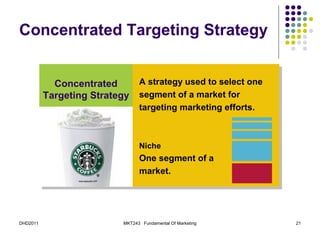
            Concentrated     A strategy used to select one
             Concentrated
          Targeting Strategy segment of a market for
          Targeting Strategy
                                 targeting marketing efforts.


                                 Niche
                                 One segment of a
                                 market.


DHD2011                    MKT243 Fundamental Of Marketing      21
Multisegment Targeting Strategy


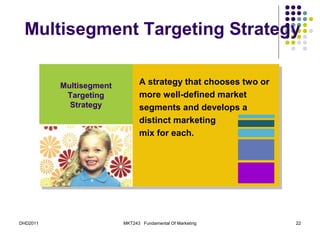
          Multisegment         A strategy that chooses two or
          Multisegment
           Targeting
            Targeting          more well-defined market
            Strategy
             Strategy          segments and develops a
                               distinct marketing
                               mix for each.


DHD2011                  MKT243 Fundamental Of Marketing        22
Advantages and Disadvantages of
Target Marketing Strategies
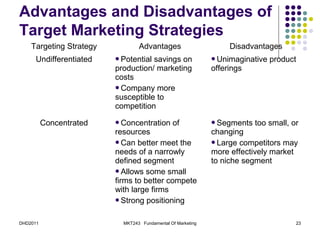
    Targeting Strategy           Advantages                       Disadvantages
      Undifferentiated   Potential savings on               Unimaginative   product
                         production/ marketing               offerings
                         costs
                         Company more
                         susceptible to
                         competition

          Concentrated   Concentration        of            Segments   too small, or
                         resources                           changing
                         Can better meet the                Large competitors may
                         needs of a narrowly                 more effectively market
                         defined segment                     to niche segment
                         Allows some small
                         firms to better compete
                         with large firms
                         Strong positioning


DHD2011                    MKT243 Fundamental Of Marketing                           23
Cont…
    Targeting Strategy           Advantages                      Disadvantages
          Multisegment   Greater     financial              Highcosts
                         success                             Cannibalization
                         Economies of scale in
                         producing/ marketing


DHD2011                    MKT243 Fundamental Of Marketing                       24
Marketing Targeting
             Target Market Strategies

  Micromarketing is the practice of tailoring
    products and marketing programs to suit
    the tastes of specific individuals and
    locations
   Local marketing

   Individual marketing


DHD2011           MKT243 Fundamental Of Marketing   25
Market Targeting
            Target Market Strategies

  Local marketing involves tailoring brands
    and promotion to the needs and wants of
    local customer groups
   Cities

   Neighborhoods

   Stores


DHD2011          MKT243 Fundamental Of Marketing   26
Market Targeting
                  Target Market Strategies

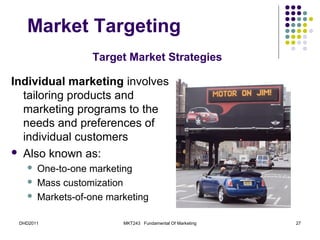
Individual marketing involves
  tailoring products and
  marketing programs to the
  needs and preferences of
  individual customers
 Also known as:
      One-to-one marketing
      Mass customization
      Markets-of-one marketing

 DHD2011                 MKT243 Fundamental Of Marketing   27
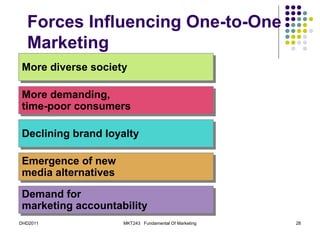
Forces Influencing One-to-One
  Marketing
More diverse society

More demanding,
 More demanding,
time-poor consumers
 time-poor consumers

Declining brand loyalty

Emergence of new
Emergence of new
media alternatives
media alternatives
Demand for
Demand for
marketing accountability
DHD2011              MKT243 Fundamental Of Marketing   28
Positioning
   Def: Developing specific marketing mix to influence
    potential customer’s over all perception of a brand,
    product line, or organization in general

   Product position
    The way the product is defined by consumers on
    important attributes-the place the product occupies
    in consumers’ minds relative to competing products

   Product differentiation
    A positioning strategy that some firms use to
    distinguish their products from those of competitors.

DHD2011               MKT243 Fundamental Of Marketing      29
Effective Positioning

          1.   Assess the positions occupied by
               competing products

          2.   Determine the dimensions of these
               positions

          3.   Choose an effective market position


DHD2011                   MKT243 Fundamental Of Marketing   30
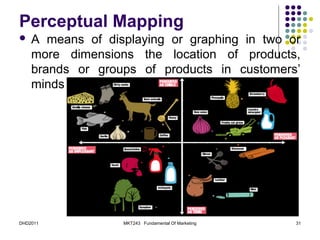
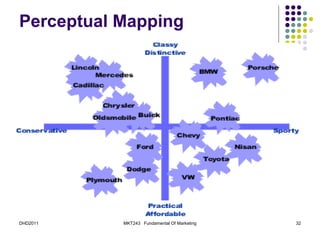
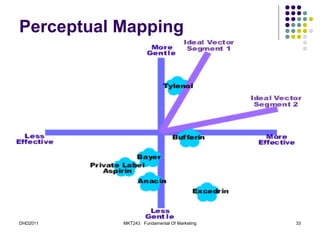
Perceptual Mapping
   A means of displaying or graphing in two or
    more dimensions the location of products,
    brands or groups of products in customers’
    minds


DHD2011           MKT243 Fundamental Of Marketing   31
Perceptual Mapping


DHD2011    MKT243 Fundamental Of Marketing   32
Perceptual Mapping


DHD2011    MKT243 Fundamental Of Marketing   33
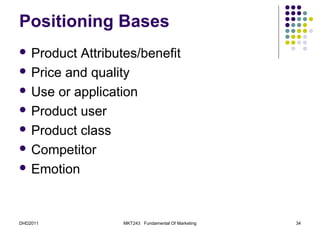
Positioning Bases
 Product Attributes/benefit
 Price and quality

 Use or application

 Product user

 Product class

 Competitor

 Emotion


DHD2011           MKT243 Fundamental Of Marketing   34

Chapter 4(my) copy

  • 1.
    Fundamental Of Marketing MKT243 Chapter 4 Market Segmentation and Targeting Market DHD2011 MKT243 Fundamental Of Marketing 1
  • 2.
    Segmenting and TargetingMarket Topic Outline  Definition of segmenting  Reasons for segmenting  Criteria for Successful segmentation  Market Targeting  Differentiation and Positioning DHD2011 MKT243 Fundamental Of Marketing 2
  • 3.
    Market Segmentation Market segmentationis the process that companies use to divide large heterogeneous markets into small markets that can be reached more efficiently and effectively with products and services that match their unique needs (Kotler and Gary) Market segmentation is the process of dividing a market into meaningful, relatively similar, and identifiable segments or groups (McDaniel, Lamb, Hair) DHD2011 MKT243 Fundamental Of Marketing 3
  • 4.
    Market Segmentation People or organizations with People or organizations with Market Market needs or wants and the ability and needs or wants and the ability and willingness to buy willingness to buy A subgroup of people or organizations A subgroup of people or organizations Market Market sharing one or more characteristics that sharing one or more characteristics that Segment Segment cause them to have similar product cause them to have similar product needs. needs. The process of dividing a market into The process of dividing a market into Market Market meaningful, relatively similar, identifiable meaningful, relatively similar, identifiable Segmentation Segmentation segments or groups. segments or groups. DHD2011 MKT243 Fundamental Of Marketing 4
  • 5.
    A Market Is... (1) people or organizations with (2) needs or wants, and with (3) the ability and (4) the willingness to buy. A group of people that lacks any one of these characteristics is not a market. DHD2011 MKT243 Fundamental Of Marketing 5
  • 6.
    The Importance ofMarket Segmentation  Markets have a variety of product needs and preferences.  Marketers can better define customer needs.  Decision makers can define objectives and allocate resources more accurately. DHD2011 MKT243 Fundamental Of Marketing 6
  • 7.
    Criteria for Successful Segmentation  Substantiality  Identifiablyand measurability  Accessibility  Responsiveness  Actionable DHD2011 MKT243 Fundamental Of Marketing 7
  • 8.
    Bases for segmentingConsumer Markets DHD2011 MKT243 Fundamental Of Marketing 8
  • 9.
    Market Segmentation Segmenting Consumer Markets  Geographic segmentation divides the market into different geographical units such as nations, regions, states, counties, or cities DHD2011 MKT243 Fundamental Of Marketing 9
  • 10.
    Market Segmentation Segmenting Consumer Markets Demographic segmentation divides the market into groups based on variables such as age, gender, family size, family life cycle, income, occupation, education, religion, race, generation, and nationality DHD2011 MKT243 Fundamental Of Marketing 10
  • 11.
    Market Segmentation (Demographic Segmentation) Age and life-cycle stage segmentation is the process of offering different products or using different marketing approaches for different age and life-cycle groups Gender segmentation divides the market based on sex (male or female) DHD2011 MKT243 Fundamental Of Marketing 11
  • 12.
    Market Segmentation (Demographic Segmentation) Income segmentation divides the market into affluent or low-income consumers Ethnic Segmentation divides the market into races or ethnicity Family Life-Cycle Segmentation divides market based on stages determined by a combination of age, marital status, and the presence or absence of children. DHD2011 MKT243 Fundamental Of Marketing 12
  • 13.
    Family Life Cycle DHD2011 MKT243 Fundamental Of Marketing 13
  • 14.
    Market Segmentation Psychographic segmentationdivides buyers into different groups based on social class, lifestyle, or personality traits  The basis for Psychographic segmentation are as follow: 1. Personality -Reflects a person’s traits, attitudes and habits. According to national survey by Roper, almost half of Americans believe their cars match their personality. DHD2011 MKT243 Fundamental Of Marketing 14
  • 15.
    Cont… 2. Motives -Marketersof baby products and life insurance appeal to consumers’ emotional motives-namely, to care for their loved ones 3. Lifestyles -Divides people into groups according to the way they spend their time, the importance of the things around them, their beliefs, and socioeconomic characteristics such as income and education. 4. Geodemographic -Segmenting potential customers into neighborhood lifestyles categories -It combines geographic and demographic and lifestyles segmentations. DHD2011 MKT243 Fundamental Of Marketing 15
  • 16.
    Market Segmentation Segmenting Consumer Markets Behavioral segmentation divides buyers into groups based on their knowledge, attitudes, uses, or responses to a product  Occasions  Benefits sought  User status  Usage rate  Loyalty status DHD2011 MKT243 Fundamental Of Marketing 16
  • 17.
    Steps in Segmentinga Market 1 2 3 4 5 6 Select a Choose a Design, Market basis or implement Select Profile Select or product bases for and maintain segmentation and analyze target Category segmenting appropriate description segments market For study the market marketing mixes DHD2011 MKT243 Fundamental Of Marketing 17
  • 18.
    Market Targeting Selecting Target Market Segments  Target market consists of a set of buyers who share common needs or characteristics that the company decides to serve DHD2011 MKT243 Fundamental Of Marketing 18
  • 19.
    Strategies for SelectingTarget Markets Undifferentiated Concentrated Multisegment Strategy Strategy Strategy DHD2011 MKT243 Fundamental Of Marketing 19
  • 20.
    Undifferentiated Targeting Strategy Undifferentiated A marketing approach that Undifferentiated Targeting Targeting views the market as one big Strategy Strategy market with no individual segments and thus requires a single marketing mix. DHD2011 MKT243 Fundamental Of Marketing 20
  • 21.
    Concentrated Targeting Strategy Concentrated A strategy used to select one Concentrated Targeting Strategy segment of a market for Targeting Strategy targeting marketing efforts. Niche One segment of a market. DHD2011 MKT243 Fundamental Of Marketing 21
  • 22.
    Multisegment Targeting Strategy Multisegment A strategy that chooses two or Multisegment Targeting Targeting more well-defined market Strategy Strategy segments and develops a distinct marketing mix for each. DHD2011 MKT243 Fundamental Of Marketing 22
  • 23.
    Advantages and Disadvantagesof Target Marketing Strategies Targeting Strategy Advantages Disadvantages Undifferentiated Potential savings on Unimaginative product production/ marketing offerings costs Company more susceptible to competition Concentrated Concentration of Segments too small, or resources changing Can better meet the Large competitors may needs of a narrowly more effectively market defined segment to niche segment Allows some small firms to better compete with large firms Strong positioning DHD2011 MKT243 Fundamental Of Marketing 23
  • 24.
    Cont… Targeting Strategy Advantages Disadvantages Multisegment Greater financial Highcosts success Cannibalization Economies of scale in producing/ marketing DHD2011 MKT243 Fundamental Of Marketing 24
  • 25.
    Marketing Targeting Target Market Strategies Micromarketing is the practice of tailoring products and marketing programs to suit the tastes of specific individuals and locations  Local marketing  Individual marketing DHD2011 MKT243 Fundamental Of Marketing 25
  • 26.
    Market Targeting Target Market Strategies Local marketing involves tailoring brands and promotion to the needs and wants of local customer groups  Cities  Neighborhoods  Stores DHD2011 MKT243 Fundamental Of Marketing 26
  • 27.
    Market Targeting Target Market Strategies Individual marketing involves tailoring products and marketing programs to the needs and preferences of individual customers  Also known as:  One-to-one marketing  Mass customization  Markets-of-one marketing DHD2011 MKT243 Fundamental Of Marketing 27
  • 28.
    Forces Influencing One-to-One Marketing More diverse society More diverse society More demanding, More demanding, time-poor consumers time-poor consumers Declining brand loyalty Declining brand loyalty Emergence of new Emergence of new media alternatives media alternatives Demand for Demand for marketing accountability marketing accountability DHD2011 MKT243 Fundamental Of Marketing 28
  • 29.
    Positioning  Def: Developing specific marketing mix to influence potential customer’s over all perception of a brand, product line, or organization in general  Product position The way the product is defined by consumers on important attributes-the place the product occupies in consumers’ minds relative to competing products  Product differentiation A positioning strategy that some firms use to distinguish their products from those of competitors. DHD2011 MKT243 Fundamental Of Marketing 29
  • 30.
    Effective Positioning 1. Assess the positions occupied by competing products 2. Determine the dimensions of these positions 3. Choose an effective market position DHD2011 MKT243 Fundamental Of Marketing 30
  • 31.
    Perceptual Mapping  A means of displaying or graphing in two or more dimensions the location of products, brands or groups of products in customers’ minds DHD2011 MKT243 Fundamental Of Marketing 31
  • 32.
    Perceptual Mapping DHD2011 MKT243 Fundamental Of Marketing 32
  • 33.
    Perceptual Mapping DHD2011 MKT243 Fundamental Of Marketing 33
  • 34.
    Positioning Bases  ProductAttributes/benefit  Price and quality  Use or application  Product user  Product class  Competitor  Emotion DHD2011 MKT243 Fundamental Of Marketing 34

Editor's Notes

  • #7 Chapter 8 Segmenting and Targeting Markets Notes: Market segmentation was rare before the 1960’s. Consider Coca-Cola with its one product aimed at the entire soft drink market. Today over a dozen different products are marketed by the company to different market segments. Market segmentation plays a key role in the marketing strategy of organizations, leading to competitive advantage. The benefits are described on this slide. Discussion/Team Activity: Discuss how Coca-Cola’s product lines fit the needs of different market segments. Name different fashion retailers and identify their marketing segmentation strategies.
  • #12 Note to Instructor This link goes to gurl.com, a Web site for female teenagers and young adults. It is interesting to browse with the students to note what kind of content is of interest to this group. A look at the advertisers with banner ads, sponsorships, or contests on the site shows the importance of targeted locations to these advertisers.
  • #13 Note to Instructor There are a whole group of products which are targeted to the affluent including hotels like Four Seasons, which is mentioned in the book.Their products offerings are deluxe: Kids in the City package for $520 a night and, among other things, enjoy a visit in their room from the Ice Cream Man, who arrives with all the fixings to make any concoction they desire. The Benjamin Hotel in New York City provides dog beds in a variety of styles and doggie bathrobes, as well as canine room service and DVDs for dogs. At the Ritz-Carlton, Lake Las Vegas in Henderson, Nevada, the Love at Lake Las Vegas weekend package includes two nights in the 2,400 square foot presidential suite, helicopter and gondola rides, a champagne-tasting party on a yacht complete with rose petals strewn about and a string trio, use of a luxury car throughout the stay, in-room couples spa treatment, a $5,000 casino line of credit, a $50,000 shopping spree at Neiman Marcus, 14 dozen roses, and a butler-drawn Cristal champagne bath.
  • #14 Chapter 8 Segmenting and Targeting Markets Notes: Exhibit 8.2 demonstrates both traditional and contemporary FLC patterns and shows how families’ needs, incomes, etc. differ at each stage. Married couples make up just 50.7% of the U.S. population. Unmarried Americans make up 42% of the workforce and 40% of home buyers. Discussion/Team Activity: Find examples of advertisements that target different stages of the family life cycle.
  • #17 Note to Instructor Students often get confused with the difference between behavioral and psychographic segmentation. Behavior is more tied into how consumers use the product. A good illustration is greeting cards—ask students how their purchasing would be different when buying a birthday card for their mother versus one for a new boyfriend. In addition, ask them how people might look for different benefits when purchasing a car? Some might look for safety while others will look for the best gas mileage.
  • #21 Chapter 8 Segmenting and Targeting Markets Notes: An undifferentiated targeting strategy is essentially a mass-market philosophy—viewing the market as one big market and using one marketing mix.
  • #22 Chapter 8 Segmenting and Targeting Markets Notes: 1. With a concentrated targeting strategy, a firm selects a niche for targeting its efforts.
  • #23 Chapter 8 Segmenting and Targeting Markets
  • #26 Note to Instructor In slideshow view, click on movie icon to launch Meredith video snippet. See accompanying DVD for full video segment.
  • #27 Note to Instructor Advances in communications technology have given rise to a new high-tech version of location-based marketing. By coupling mobile phone services with GPS devices, many marketers are now targeting customers wherever they are with what they want. This might include marketers reaching people near their stores, looking to make a decision. Discussion Question What are the drawbacks of local marketing? It can drive up manufacturing and marketing costs by reducing economies of scale. It can also create logistics problems as companies try to meet the varied requirements of different regional and local markets. Further, a brand’s overall image might be diluted if the product and message vary too much in different localities.
  • #28 Note to Instructor Mass customization is the process through which firms interact one-to-one with masses of customers to design products and services tailor-made to meet individual needs. Has made relationships with customers important in the new economy. Provides a way to distinguish the company against competitors.