ACC 106

Chapter 3


            Accounting Equation and
                      Classification
Learning Objectives:
After going through this chapter, you should be able to:
    Define & explain the balance sheet, assets, liabilities and owner’s equity.

    Define & understand the use of the accounting equation in analyzing
     transactions

    Define revenue & expenses

    Identify the relationship of profit to the to the accounting equation

    Show the effect of the transaction on the accounting equation

    Identify the movement of stock
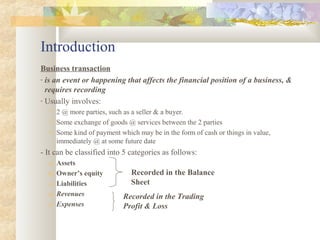
Introduction
Business transaction
- is an event or happening that affects the financial position of a business, &
  requires recording
- Usually involves:
      2 @ more parties, such as a seller & a buyer.
      Some exchange of goods @ services between the 2 parties
      Some kind of payment which may be in the form of cash or things in value,
       immediately @ at some future date
- It can be classified into 5 categories as follows:
  a)   Assets
  b)   Owner’s equity           Recorded in the Balance
  c)   Liabilities              Sheet
  d)   Revenues              Recorded in the Trading
  e)   Expenses              Profit & Loss
The Balance Sheet Presentation
                Sole Proprietorship
Dr.             Balance Sheet as at 31 December 20xx            Cr.
Assets:         RM                      Owner’s equity:        RM
Fixed Assets:                           Opening Capital        xxx
Land & Building xxx                     Add: Net Profit        xxx
Machinery       xxx                     Less: Drawings        (xxx)
                xxx                                            xxx
Current Asset:                          Liabilities:
Stock           xxx                     Long Term Liabilities xxx
Debtors         xxx                     Current Liabilities:
Cash            xxx                     Creditors              xxx
                                        TOTAL LIABILITIES
TOTAL ASSETS XXX                        & OWNER’S EQUITY XXX
BS (Assets = Owner’s Equity+Liabilities)
                Assets                              Owner’s Equity                       Liabilities
- Economic resources which are of         -   It is represents owner-           - It is financial obligation
  the value to the business                   supplied fund to the business       of the business to the
- are property own by the business            for the acquisitions of assets      external parties
                                              for the business
- 2 types of assets:                      -     it is financial obligation of   - 2 types of liabilities:
i) Fixed Assets/ Non Current Assets             the business to the owner.      i) Long term Liabilities
- assets acquired / bought not for             Owner’s Equity                  - it is an amount owing by
resale and it is to be used in the              = Capital + Profit/ (-)           the business that have
running of the business.                        (Losses) - drawings               repayment period > 1 yr
Tangible Fixed Assets - i.e                                                    - i.e Long term loan
Land&Building,Machinery                                                         ii) Current liabilities
Intangible Fixed Assets- i .e                                                  - it is an amount owing by
Goodwill,Trademark                                                                the business that is to be
Investment – i.e Fixed deposit                                                   paid in within 1 yr
ii)Current Assets – assets that are                                             - i.e Creditors, bank
either cash or those that can be                                                  overdraft
converted in to cash i.e debtors,stock.

                                               (See pg14 textbook)
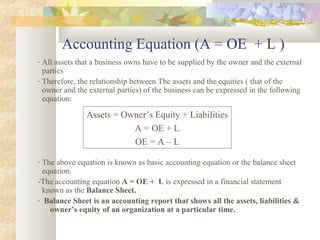
Accounting Equation (A = OE + L )
- All assets that a business owns have to be supplied by the owner and the external
  parties
- Therefore, the relationship between The assets and the equities ( that of the
  owner and the external parties) of the business can be expressed in the following
  equation:

               Assets = Owner’s Equity + Liabilities
                          A = OE + L
                          OE = A – L

- The above equation is known as basic accounting equation or the balance sheet
  equation.
-The accounting equation A = OE + L is expressed in a financial statement
  known as the Balance Sheet.
- Balance Sheet is an accounting report that shows all the assets, liabilities &
    owner’s equity of an organization at a particular time.
The Balance Sheet & The Effects of Business
                    Transaction
2.5.1 The Introduction of Capital
On 1st January 20XX, Beckham started business & invested RM50,000 cash to the
business. i)The Balance sheet would appear as follows:
                             Beckham Enterprise
Dr.                Balance Sheet as at 01 January 20XX           Cr.
Assets:                      RM        Owner’s equity:           RM
Cash                      50,000       Opening Capital         50,000

ii)The effect on the accounting equation
   Date           Assets(A)        =       Owner’s Equity(OE)   +    Liabilities(L)
 2006     Cash increase by             Capital increase by                 -
 01/01    RM50,000                     RM50,000
          Effect: Increase A           Effect:Increase OE           Effect: NO
The Balance Sheet & The Effects of Business
                     Transaction (Cont’d)
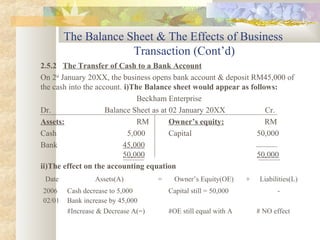
2.5.2 The Transfer of Cash to a Bank Account
On 2nd January 20XX, the business opens bank account & deposit RM45,000 of
the cash into the account. i)The Balance sheet would appear as follows:
                               Beckham Enterprise
Dr.                  Balance Sheet as at 02 January 20XX            Cr.
Assets:                        RM        Owner’s equity:            RM
Cash                        5,000        Capital                 50,000
Bank                      45,000
                          50,000                                 50,000
ii)The effect on the accounting equation
 Date            Assets(A)          =     Owner’s Equity(OE)     +    Liabilities(L)
2006    Cash decrease to 5,000          Capital still = 50,000              -
02/01   Bank increase by 45,000
        #Increase & Decrease A(=)       #OE still equal with A       # NO effect
The Balance Sheet & The Effects of Business
                     Transaction (Cont’d)
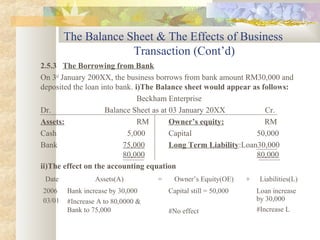
2.5.3 The Borrowing from Bank
On 3rd January 200XX, the business borrows from bank amount RM30,000 and
deposited the loan into bank. i)The Balance sheet would appear as follows:
                               Beckham Enterprise
Dr.                 Balance Sheet as at 03 January 20XX            Cr.
Assets:                        RM       Owner’s equity:            RM
Cash                       5,000        Capital                 50,000
Bank                      75,000        Long Term Liability:Loan30,000
                          80,000                                80,000
ii)The effect on the accounting equation
 Date            Assets(A)         =     Owner’s Equity(OE)     +    Liabilities(L)
2006    Bank increase by 30,000        Capital still = 50,000       Loan increase
03/01   #Increase A to 80,0000 &                                    by 30,000
        Bank to 75,000                 #No effect                   #Increase L
The Balance Sheet & The Effects of Business
                      Transaction (Cont’d)
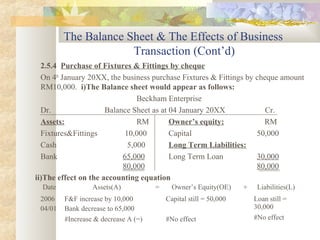
  2.5.4 Purchase of Fixtures & Fittings by cheque
  On 4th January 20XX, the business purchase Fixtures & Fittings by cheque amount
  RM10,000. i)The Balance sheet would appear as follows:
                               Beckham Enterprise
  Dr.                 Balance Sheet as at 04 January 20XX              Cr.
  Assets:                      RM         Owner’s equity:             RM
  Fixtures&Fittings        10,000         Capital                   50,000
  Cash                      5,000         Long Term Liabilities:
  Bank                     65,000         Long Term Loan            30,000
                           80,000                                   80,000
ii)The effect on the accounting equation
  Date            Assets(A)           =     Owner’s Equity(OE)     +    Liabilities(L)
 2006    F&F increase by 10,000           Capital still = 50,000       Loan still =
 04/01   Bank decrease to 65,000                                       30,000
         #Increase & decrease A (=)       #No effect                   #No effect
The Balance Sheet & The Effects of Business
                   Transaction (Cont’d)
2.5.5 Purchase of Stock of Goods on Credit
On 5th January 20XX, the business purchase Stock of Goods on credit amount
RM18,000.
 i)The Balance sheet would appear as follows:
                              Beckham Enterprise
Dr.                Balance Sheet as at 05 January 20XX              Cr.
Assets:                       RM       Owner’s equity:              RM
Fixtures&Fittings         10,000       Capital                   50,000
Cash                       5,000       Long Term Liabilities:
Bank                     65,000        Long Term Loan            30,000
Stock                    18,000        Creditors                 18,000
                         98,000                                  98,000
The Balance Sheet & The Effects of Business
                      Transaction (Cont’d)
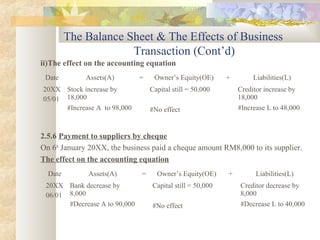
ii)The effect on the accounting equation
 Date        Assets(A)         =    Owner’s Equity(OE)      +        Liabilities(L)
20XX Stock increase by             Capital still = 50,000       Creditor increase by
05/01 18,000                                                    18,000
      #Increase A to 98,000        #No effect                   #Increase L to 48,000


2.5.6 Payment to suppliers by cheque
On 6th January 20XX, the business paid a cheque amount RM8,000 to its supplier.
The effect on the accounting equation
  Date        Assets(A)        =     Owner’s Equity(OE)     +         Liabilities(L)
 20XX Bank decrease by             Capital still = 50,000       Creditor decrease by
 06/01 8,000                                                    8,000
       #Decrease A to 90,000       #No effect                   #Decrease L to 40,000
The Balance Sheet & The Effects of Business
                   Transaction (Cont’d)
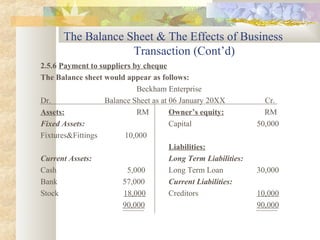
2.5.6 Payment to suppliers by cheque
The Balance sheet would appear as follows:
                             Beckham Enterprise
Dr.               Balance Sheet as at 06 January 20XX            Cr.
Assets:                      RM       Owner’s equity:            RM
Fixed Assets:                         Capital                  50,000
Fixtures&Fittings        10,000
                                      Liabilities:
Current Assets:                       Long Term Liabilities:
Cash                      5,000       Long Term Loan           30,000
Bank                    57,000        Current Liabilities:
Stock                   18,000        Creditors                10,000
                        90,000                                 90,000
Trading Profit & Loss Presentation
                                   Beckham Enterprise
  Trading and Profit and Loss Accounts for the year ended 31st December 20xx
Opening Stock              RM 14,000           Sales                  RM100,000
Purchases                       60,000
                                74,000
Less: Closing Stock            (14,000)
Cost of Goods Sold              60,000
Gross Profit c/d                40,000
                               100,000                                    100,000
Telephone & Electricity            200         Gross Profit b/d            40,000
Salary                           5,000         Rent received                  800
Stationery                         100         Commission Received            500
Net Profit                       36,000
                                 41,300                                   41,300
TPL(P) = Revenue(R) – Expenses(E)
- Profit is the differences between revenue & expenses
- the relationship of profit to the accounting equation is that profit belongs
  to owner of the business, so it should be added to the capital of the
  business.
A = OE + P + L ,         A = OE + R – E + L,       A + E = OE + R + L

              Revenue                                 Expenses
- is the gross increase in owner’s      - are the cost of assets consumed or
  equity resulting from business          services used in the process of
  activities entered into for the         earning revenue.
  purpose of earning income

- i.e sales of goods, services,         - i.e purchased of goods, salary,
  commission received interest            interest expense, rent expense,
  received etc.                           discount allowed etc.


                              See pg 54 textbook
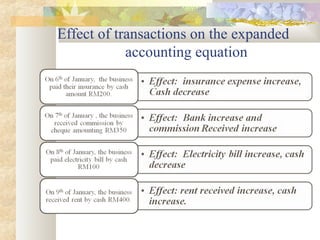
Effect of transactions on the expanded
            accounting equation
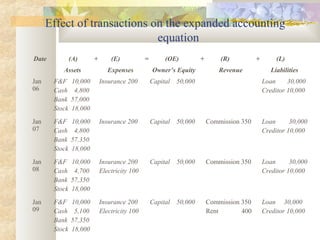
Effect of transactions on the expanded accounting
                              equation
Date           (A)      +       (E)           =       (OE)         +       (R)          +        (L)
          Assets               Expenses           Owner’s Equity           Revenue             Liabilities
Jan    F&F     10,000       Insurance 200         Capital 50,000                            Loan     30,000
06     Cash     4,800                                                                       Creditor 10,000
       Bank    57,000
       Stock   18,000
Jan    F&F     10,000       Insurance 200         Capital 50,000       Commission 350       Loan      30,000
07     Cash     4,800                                                                       Creditor 10,000
       Bank    57,350
       Stock   18,000
Jan    F&F     10,000       Insurance 200         Capital 50,000       Commission 350       Loan      30,000
08     Cash     4,700       Electricity 100                                                 Creditor 10,000
       Bank    57,350
       Stock   18,000
Jan    F&F     10,000       Insurance 200         Capital 50,000       Commission 350       Loan 30,000
09     Cash     5,100       Electricity 100                            Rent       400       Creditor 10,000
       Bank    57,350
       Stock   18,000
Accounting for stock
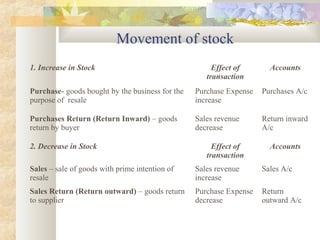
Movement of stock
1. Increase in Stock                                  Effect of       Accounts
                                                    transaction
Purchase- goods bought by the business for the   Purchase Expense   Purchases A/c
purpose of resale                                increase

Purchases Return (Return Inward) – goods         Sales revenue      Return inward
return by buyer                                  decrease           A/c

2. Decrease in Stock                                  Effect of       Accounts
                                                    transaction
Sales – sale of goods with prime intention of    Sales revenue      Sales A/c
resale                                           increase
Sales Return (Return outward) – goods return     Purchase Expense   Return
to supplier                                      decrease           outward A/c
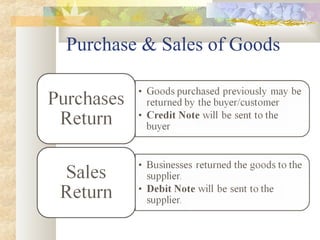
Purchase & Sales of Goods
Purchase and sales of goods can be divided into 2 categories:

       Transactions                   Accounts Involved
 a. Cash Purchase      Cash Account & Purchase Account
 b. Credit Purchase    Creditors Account & Purchases Account
 c. Cash Sales         Cash Account & Sales Account
 d. Credit Sales       Debtors Account & Sales Account
Purchase & Sales of Goods
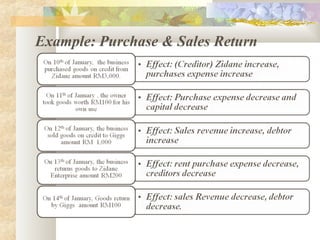
Example: Purchase & Sales Return
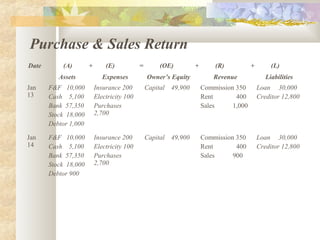
Purchase & Sales Return
Date           (A)      +       (E)           =      (OE)          +       (R)           +        (L)
          Assets               Expenses           Owner’s Equity           Revenue              Liabilities
Jan    F&F     10,000       Insurance 200         Capital 50,000       Commission 350        Loan 30,000
10     Cash     5,100       Electricity 100                            Rent       400        Creditor 13,000
       Bank    57,350       Purchases 3,000
       Stock   18,000
Jan    F&F     10,000       Insurance 200         Capital 49,900       Commission 350        Loan 30,000
11     Cash     5,100       Electricity 100                            Rent       400        Creditor 13,000
       Bank    57,350       Purchases 2,900
       Stock   18,000
Jan    F&F 10,000           Insurance 200         Capital 49,900       Commission 350        Loan 30,000
12     Cash 5,100           Electricity 100                            Rent       400        Creditor 13,000
       Bank 57,350          Purchases 2,900                            Sales     1,000
       Stock 18,000
       Debtor 1,000
Purchase & Sales Return
Date       (A)        +       (E)           =       (OE)         +       (R)           +        (L)
          Assets             Expenses           Owner’s Equity           Revenue              Liabilities
Jan    F&F 10,000         Insurance 200         Capital 49,900       Commission 350        Loan 30,000
13     Cash 5,100         Electricity 100                            Rent       400        Creditor 12,800
       Bank 57,350        Purchases                                  Sales     1,000
       Stock 18,000       2,700
       Debtor 1,000

Jan    F&F 10,000         Insurance 200         Capital 49,900       Commission 350        Loan 30,000
14     Cash 5,100         Electricity 100                            Rent       400        Creditor 12,800
       Bank 57,350        Purchases                                  Sales     900
       Stock 18,000       2,700
       Debtor 900

Ch 3 accounting equation & classification

  • 1.
    ACC 106 Chapter 3 Accounting Equation and Classification
  • 2.
    Learning Objectives: After goingthrough this chapter, you should be able to:  Define & explain the balance sheet, assets, liabilities and owner’s equity.  Define & understand the use of the accounting equation in analyzing transactions  Define revenue & expenses  Identify the relationship of profit to the to the accounting equation  Show the effect of the transaction on the accounting equation  Identify the movement of stock
  • 3.
    Introduction Business transaction - isan event or happening that affects the financial position of a business, & requires recording - Usually involves:  2 @ more parties, such as a seller & a buyer.  Some exchange of goods @ services between the 2 parties  Some kind of payment which may be in the form of cash or things in value, immediately @ at some future date - It can be classified into 5 categories as follows: a) Assets b) Owner’s equity Recorded in the Balance c) Liabilities Sheet d) Revenues Recorded in the Trading e) Expenses Profit & Loss
  • 4.
    The Balance SheetPresentation Sole Proprietorship Dr. Balance Sheet as at 31 December 20xx Cr. Assets: RM Owner’s equity: RM Fixed Assets: Opening Capital xxx Land & Building xxx Add: Net Profit xxx Machinery xxx Less: Drawings (xxx) xxx xxx Current Asset: Liabilities: Stock xxx Long Term Liabilities xxx Debtors xxx Current Liabilities: Cash xxx Creditors xxx TOTAL LIABILITIES TOTAL ASSETS XXX & OWNER’S EQUITY XXX
  • 5.
    BS (Assets =Owner’s Equity+Liabilities) Assets Owner’s Equity Liabilities - Economic resources which are of - It is represents owner- - It is financial obligation the value to the business supplied fund to the business of the business to the - are property own by the business for the acquisitions of assets external parties for the business - 2 types of assets: - it is financial obligation of - 2 types of liabilities: i) Fixed Assets/ Non Current Assets the business to the owner. i) Long term Liabilities - assets acquired / bought not for  Owner’s Equity - it is an amount owing by resale and it is to be used in the = Capital + Profit/ (-) the business that have running of the business. (Losses) - drawings repayment period > 1 yr Tangible Fixed Assets - i.e - i.e Long term loan Land&Building,Machinery ii) Current liabilities Intangible Fixed Assets- i .e - it is an amount owing by Goodwill,Trademark the business that is to be Investment – i.e Fixed deposit paid in within 1 yr ii)Current Assets – assets that are - i.e Creditors, bank either cash or those that can be overdraft converted in to cash i.e debtors,stock. (See pg14 textbook)
  • 6.
    Accounting Equation (A= OE + L ) - All assets that a business owns have to be supplied by the owner and the external parties - Therefore, the relationship between The assets and the equities ( that of the owner and the external parties) of the business can be expressed in the following equation: Assets = Owner’s Equity + Liabilities A = OE + L OE = A – L - The above equation is known as basic accounting equation or the balance sheet equation. -The accounting equation A = OE + L is expressed in a financial statement known as the Balance Sheet. - Balance Sheet is an accounting report that shows all the assets, liabilities & owner’s equity of an organization at a particular time.
  • 7.
    The Balance Sheet& The Effects of Business Transaction 2.5.1 The Introduction of Capital On 1st January 20XX, Beckham started business & invested RM50,000 cash to the business. i)The Balance sheet would appear as follows: Beckham Enterprise Dr. Balance Sheet as at 01 January 20XX Cr. Assets: RM Owner’s equity: RM Cash 50,000 Opening Capital 50,000 ii)The effect on the accounting equation Date Assets(A) = Owner’s Equity(OE) + Liabilities(L) 2006 Cash increase by Capital increase by - 01/01 RM50,000 RM50,000 Effect: Increase A Effect:Increase OE Effect: NO
  • 8.
    The Balance Sheet& The Effects of Business Transaction (Cont’d) 2.5.2 The Transfer of Cash to a Bank Account On 2nd January 20XX, the business opens bank account & deposit RM45,000 of the cash into the account. i)The Balance sheet would appear as follows: Beckham Enterprise Dr. Balance Sheet as at 02 January 20XX Cr. Assets: RM Owner’s equity: RM Cash 5,000 Capital 50,000 Bank 45,000 50,000 50,000 ii)The effect on the accounting equation Date Assets(A) = Owner’s Equity(OE) + Liabilities(L) 2006 Cash decrease to 5,000 Capital still = 50,000 - 02/01 Bank increase by 45,000 #Increase & Decrease A(=) #OE still equal with A # NO effect
  • 9.
    The Balance Sheet& The Effects of Business Transaction (Cont’d) 2.5.3 The Borrowing from Bank On 3rd January 200XX, the business borrows from bank amount RM30,000 and deposited the loan into bank. i)The Balance sheet would appear as follows: Beckham Enterprise Dr. Balance Sheet as at 03 January 20XX Cr. Assets: RM Owner’s equity: RM Cash 5,000 Capital 50,000 Bank 75,000 Long Term Liability:Loan30,000 80,000 80,000 ii)The effect on the accounting equation Date Assets(A) = Owner’s Equity(OE) + Liabilities(L) 2006 Bank increase by 30,000 Capital still = 50,000 Loan increase 03/01 #Increase A to 80,0000 & by 30,000 Bank to 75,000 #No effect #Increase L
  • 10.
    The Balance Sheet& The Effects of Business Transaction (Cont’d) 2.5.4 Purchase of Fixtures & Fittings by cheque On 4th January 20XX, the business purchase Fixtures & Fittings by cheque amount RM10,000. i)The Balance sheet would appear as follows: Beckham Enterprise Dr. Balance Sheet as at 04 January 20XX Cr. Assets: RM Owner’s equity: RM Fixtures&Fittings 10,000 Capital 50,000 Cash 5,000 Long Term Liabilities: Bank 65,000 Long Term Loan 30,000 80,000 80,000 ii)The effect on the accounting equation Date Assets(A) = Owner’s Equity(OE) + Liabilities(L) 2006 F&F increase by 10,000 Capital still = 50,000 Loan still = 04/01 Bank decrease to 65,000 30,000 #Increase & decrease A (=) #No effect #No effect
  • 11.
    The Balance Sheet& The Effects of Business Transaction (Cont’d) 2.5.5 Purchase of Stock of Goods on Credit On 5th January 20XX, the business purchase Stock of Goods on credit amount RM18,000. i)The Balance sheet would appear as follows: Beckham Enterprise Dr. Balance Sheet as at 05 January 20XX Cr. Assets: RM Owner’s equity: RM Fixtures&Fittings 10,000 Capital 50,000 Cash 5,000 Long Term Liabilities: Bank 65,000 Long Term Loan 30,000 Stock 18,000 Creditors 18,000 98,000 98,000
  • 12.
    The Balance Sheet& The Effects of Business Transaction (Cont’d) ii)The effect on the accounting equation Date Assets(A) = Owner’s Equity(OE) + Liabilities(L) 20XX Stock increase by Capital still = 50,000 Creditor increase by 05/01 18,000 18,000 #Increase A to 98,000 #No effect #Increase L to 48,000 2.5.6 Payment to suppliers by cheque On 6th January 20XX, the business paid a cheque amount RM8,000 to its supplier. The effect on the accounting equation Date Assets(A) = Owner’s Equity(OE) + Liabilities(L) 20XX Bank decrease by Capital still = 50,000 Creditor decrease by 06/01 8,000 8,000 #Decrease A to 90,000 #No effect #Decrease L to 40,000
  • 13.
    The Balance Sheet& The Effects of Business Transaction (Cont’d) 2.5.6 Payment to suppliers by cheque The Balance sheet would appear as follows: Beckham Enterprise Dr. Balance Sheet as at 06 January 20XX Cr. Assets: RM Owner’s equity: RM Fixed Assets: Capital 50,000 Fixtures&Fittings 10,000 Liabilities: Current Assets: Long Term Liabilities: Cash 5,000 Long Term Loan 30,000 Bank 57,000 Current Liabilities: Stock 18,000 Creditors 10,000 90,000 90,000
  • 14.
    Trading Profit &Loss Presentation Beckham Enterprise Trading and Profit and Loss Accounts for the year ended 31st December 20xx Opening Stock RM 14,000 Sales RM100,000 Purchases 60,000 74,000 Less: Closing Stock (14,000) Cost of Goods Sold 60,000 Gross Profit c/d 40,000 100,000 100,000 Telephone & Electricity 200 Gross Profit b/d 40,000 Salary 5,000 Rent received 800 Stationery 100 Commission Received 500 Net Profit 36,000 41,300 41,300
  • 15.
    TPL(P) = Revenue(R)– Expenses(E) - Profit is the differences between revenue & expenses - the relationship of profit to the accounting equation is that profit belongs to owner of the business, so it should be added to the capital of the business. A = OE + P + L , A = OE + R – E + L, A + E = OE + R + L Revenue Expenses - is the gross increase in owner’s - are the cost of assets consumed or equity resulting from business services used in the process of activities entered into for the earning revenue. purpose of earning income - i.e sales of goods, services, - i.e purchased of goods, salary, commission received interest interest expense, rent expense, received etc. discount allowed etc. See pg 54 textbook
  • 16.
    Effect of transactionson the expanded accounting equation
  • 17.
    Effect of transactionson the expanded accounting equation Date (A) + (E) = (OE) + (R) + (L) Assets Expenses Owner’s Equity Revenue Liabilities Jan F&F 10,000 Insurance 200 Capital 50,000 Loan 30,000 06 Cash 4,800 Creditor 10,000 Bank 57,000 Stock 18,000 Jan F&F 10,000 Insurance 200 Capital 50,000 Commission 350 Loan 30,000 07 Cash 4,800 Creditor 10,000 Bank 57,350 Stock 18,000 Jan F&F 10,000 Insurance 200 Capital 50,000 Commission 350 Loan 30,000 08 Cash 4,700 Electricity 100 Creditor 10,000 Bank 57,350 Stock 18,000 Jan F&F 10,000 Insurance 200 Capital 50,000 Commission 350 Loan 30,000 09 Cash 5,100 Electricity 100 Rent 400 Creditor 10,000 Bank 57,350 Stock 18,000
  • 18.
  • 19.
  • 20.
    Movement of stock 1.Increase in Stock Effect of Accounts transaction Purchase- goods bought by the business for the Purchase Expense Purchases A/c purpose of resale increase Purchases Return (Return Inward) – goods Sales revenue Return inward return by buyer decrease A/c 2. Decrease in Stock Effect of Accounts transaction Sales – sale of goods with prime intention of Sales revenue Sales A/c resale increase Sales Return (Return outward) – goods return Purchase Expense Return to supplier decrease outward A/c
  • 21.
    Purchase & Salesof Goods Purchase and sales of goods can be divided into 2 categories: Transactions Accounts Involved a. Cash Purchase Cash Account & Purchase Account b. Credit Purchase Creditors Account & Purchases Account c. Cash Sales Cash Account & Sales Account d. Credit Sales Debtors Account & Sales Account
  • 22.
  • 23.
    Example: Purchase &Sales Return
  • 24.
    Purchase & SalesReturn Date (A) + (E) = (OE) + (R) + (L) Assets Expenses Owner’s Equity Revenue Liabilities Jan F&F 10,000 Insurance 200 Capital 50,000 Commission 350 Loan 30,000 10 Cash 5,100 Electricity 100 Rent 400 Creditor 13,000 Bank 57,350 Purchases 3,000 Stock 18,000 Jan F&F 10,000 Insurance 200 Capital 49,900 Commission 350 Loan 30,000 11 Cash 5,100 Electricity 100 Rent 400 Creditor 13,000 Bank 57,350 Purchases 2,900 Stock 18,000 Jan F&F 10,000 Insurance 200 Capital 49,900 Commission 350 Loan 30,000 12 Cash 5,100 Electricity 100 Rent 400 Creditor 13,000 Bank 57,350 Purchases 2,900 Sales 1,000 Stock 18,000 Debtor 1,000
  • 25.
    Purchase & SalesReturn Date (A) + (E) = (OE) + (R) + (L) Assets Expenses Owner’s Equity Revenue Liabilities Jan F&F 10,000 Insurance 200 Capital 49,900 Commission 350 Loan 30,000 13 Cash 5,100 Electricity 100 Rent 400 Creditor 12,800 Bank 57,350 Purchases Sales 1,000 Stock 18,000 2,700 Debtor 1,000 Jan F&F 10,000 Insurance 200 Capital 49,900 Commission 350 Loan 30,000 14 Cash 5,100 Electricity 100 Rent 400 Creditor 12,800 Bank 57,350 Purchases Sales 900 Stock 18,000 2,700 Debtor 900