ACC 106
      CHAPTER 4

BALANCING THE ACCOUNTS
           &
    TRIAL BALANCE
BALANCING THE ACCOUNTS &
TRIAL BALANCE
KNOWLEDGE OBJECTIVES:
 Balance off the accounts for assets, liabilities, capital,
  revenues & expenses.
 Distinguish between debit balance, credit balance & zero
  balance.
 To understand why trial balance totals should equal one
  another
 Be able to draw up a trial balance from a given set of
  accounts
 Appreciate that some kinds of error can be made but the
  trial balance totals will still equal one another
INTRODUCTION
 To check whether all transactions have been recorded correctly based
  on the double entry rules, the accounts have to be balance off & the
  trial balance is being prepared.
 The purpose/objectives of preparing trial balance are:
     Determining the arithmetical accuracy of the double entry rules
     It helps to detect errors within a given time period
     To facilitate the process of preparing the final accounts -
      (financial statements)
 Trial balance is a list of all ledger accounts with balances at a
  particular date.
 Ledger accounts with zero balances are excluded from the trial
  balance.
 Trial balance is normally prepared at the end of each month.
BALANCING THE ACCOUNTS
 Accounts are normally balance off at the end of each month.
 The purpose of balancing off the accounts is to determine how much is
    the balance left in each of the account.
   Therefore, the debit & credit sides of the account will be compared.
   If the total debit is more than total credit, the account is said to have a
    debit balance.
   On the other hand, if total credit is more than total debit, so the
    account has a credit balance.
   However, if the total debit is equal to total credit, the account has a
    zero balance.
BALANCING THE ACCOUNTS
              (cont’d)
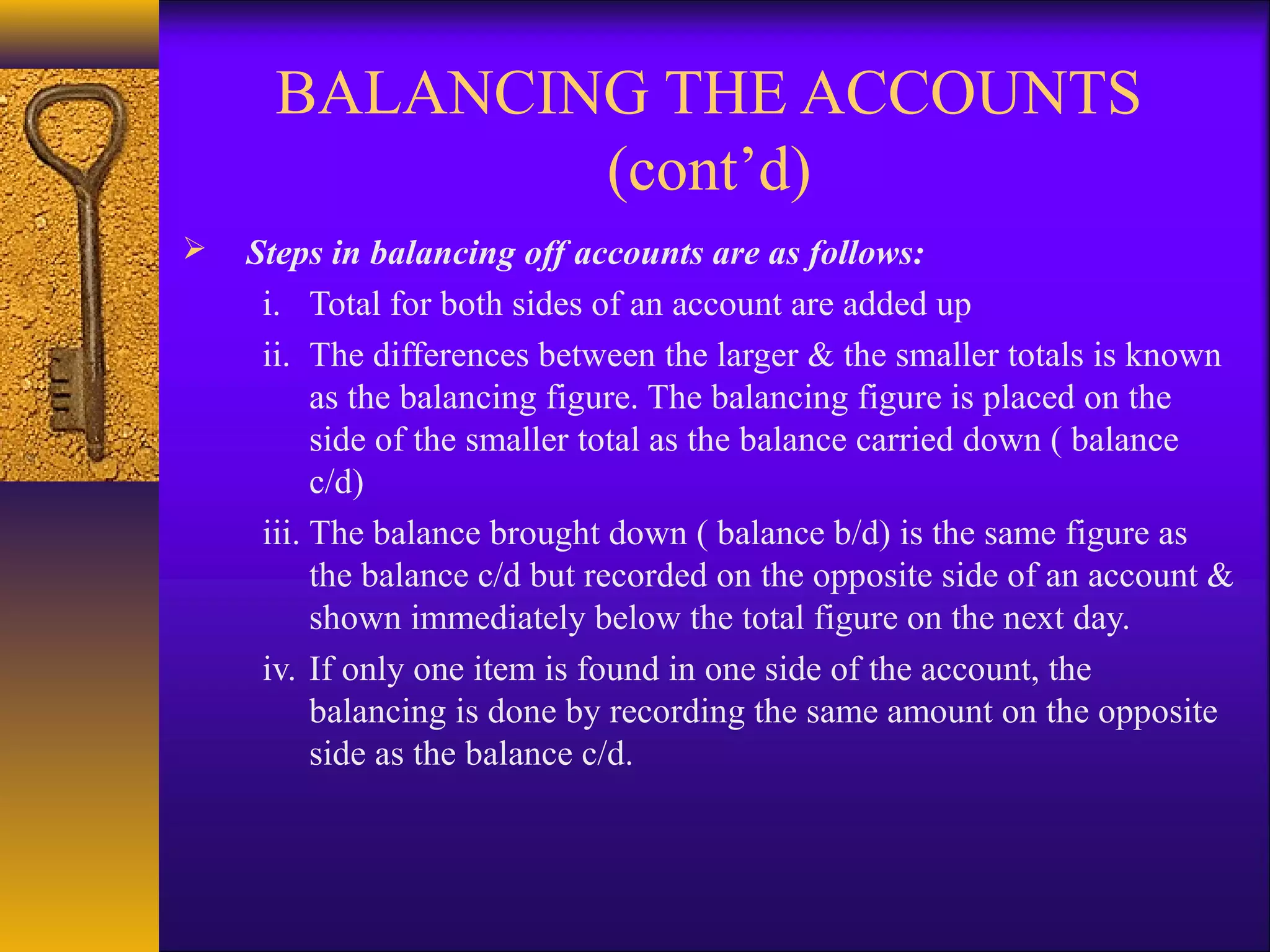
   Steps in balancing off accounts are as follows:
     i. Total for both sides of an account are added up
     ii. The differences between the larger & the smaller totals is known
          as the balancing figure. The balancing figure is placed on the
          side of the smaller total as the balance carried down ( balance
          c/d)
     iii. The balance brought down ( balance b/d) is the same figure as
          the balance c/d but recorded on the opposite side of an account &
          shown immediately below the total figure on the next day.
     iv. If only one item is found in one side of the account, the
          balancing is done by recording the same amount on the opposite
          side as the balance c/d.
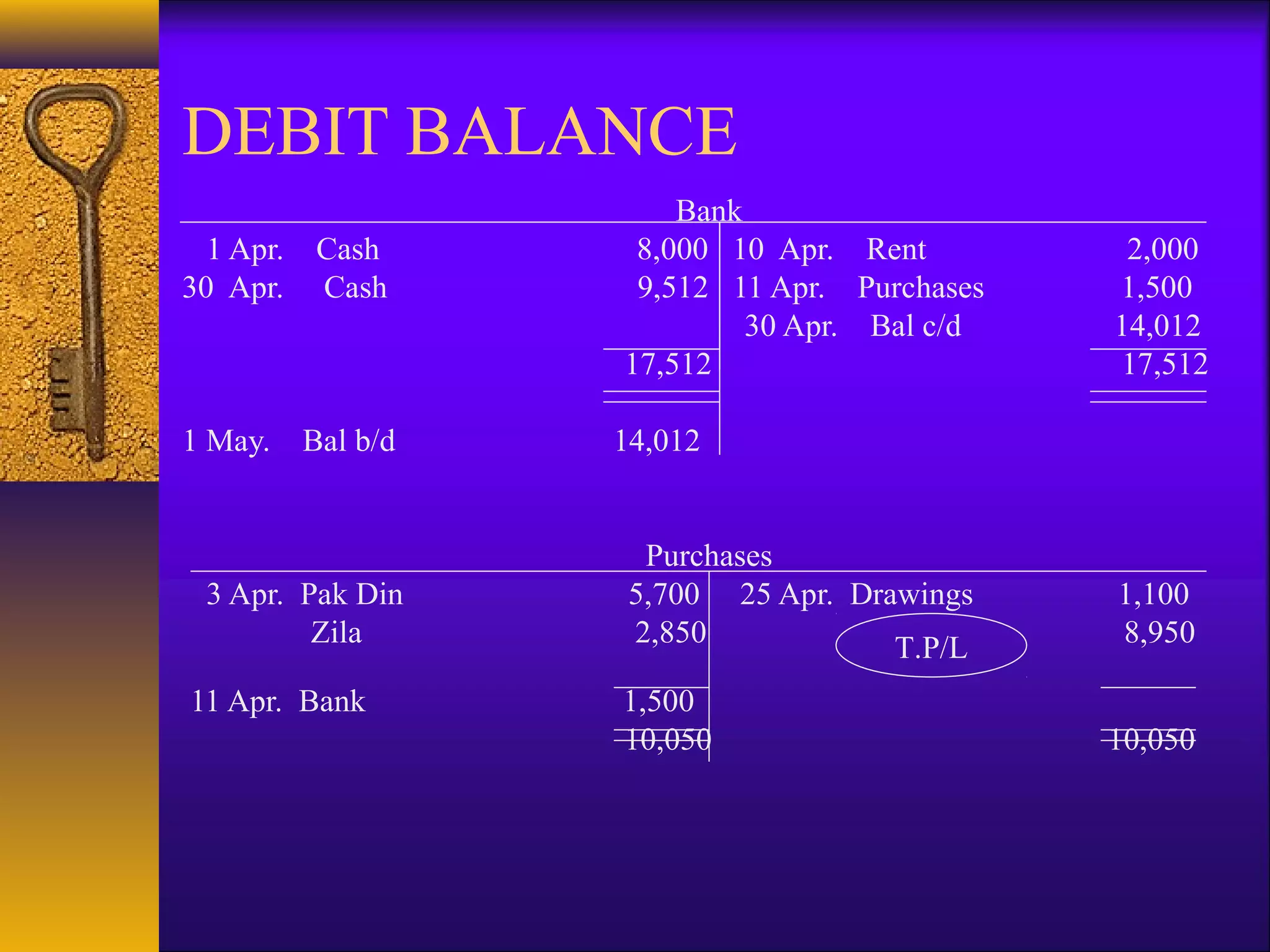
DEBIT BALANCE
                         Bank
  1 Apr.    Cash      8,000 10 Apr. Rent         2,000
30 Apr.     Cash      9,512 11 Apr. Purchases   1,500
                              30 Apr. Bal c/d   14,012
                     17,512                     17,512

1 May.     Bal b/d   14,012


                       Purchases
 3 Apr. Pak Din       5,700 25 Apr. Drawings    1,100
         Zila         2,850            T.P/L    8,950

11 Apr. Bank         1,500
                     10,050                     10,050
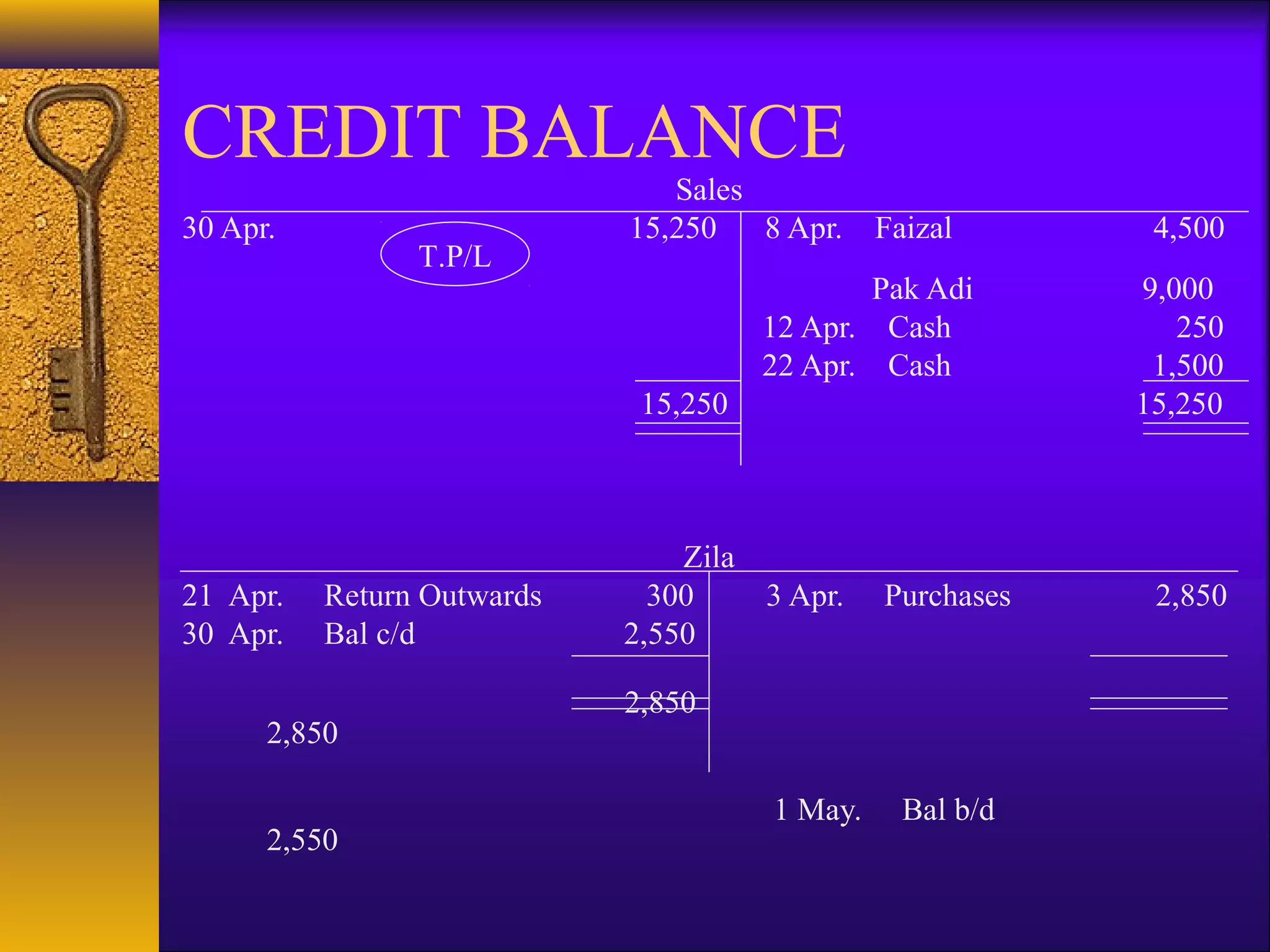
CREDIT BALANCE
                               Sales
30 Apr.                     15,250   8 Apr.    Faizal       4,500
                T.P/L
                                             Pak Adi       9,000
                                      12 Apr. Cash            250
                                      22 Apr. Cash          1,500
                             15,250                        15,250


                                Zila
21 Apr.   Return Outwards     300    3 Apr.    Purchases    2,850
30 Apr.   Bal c/d           2,550

                            2,850
      2,850

                                      1 May.     Bal b/d
      2,550
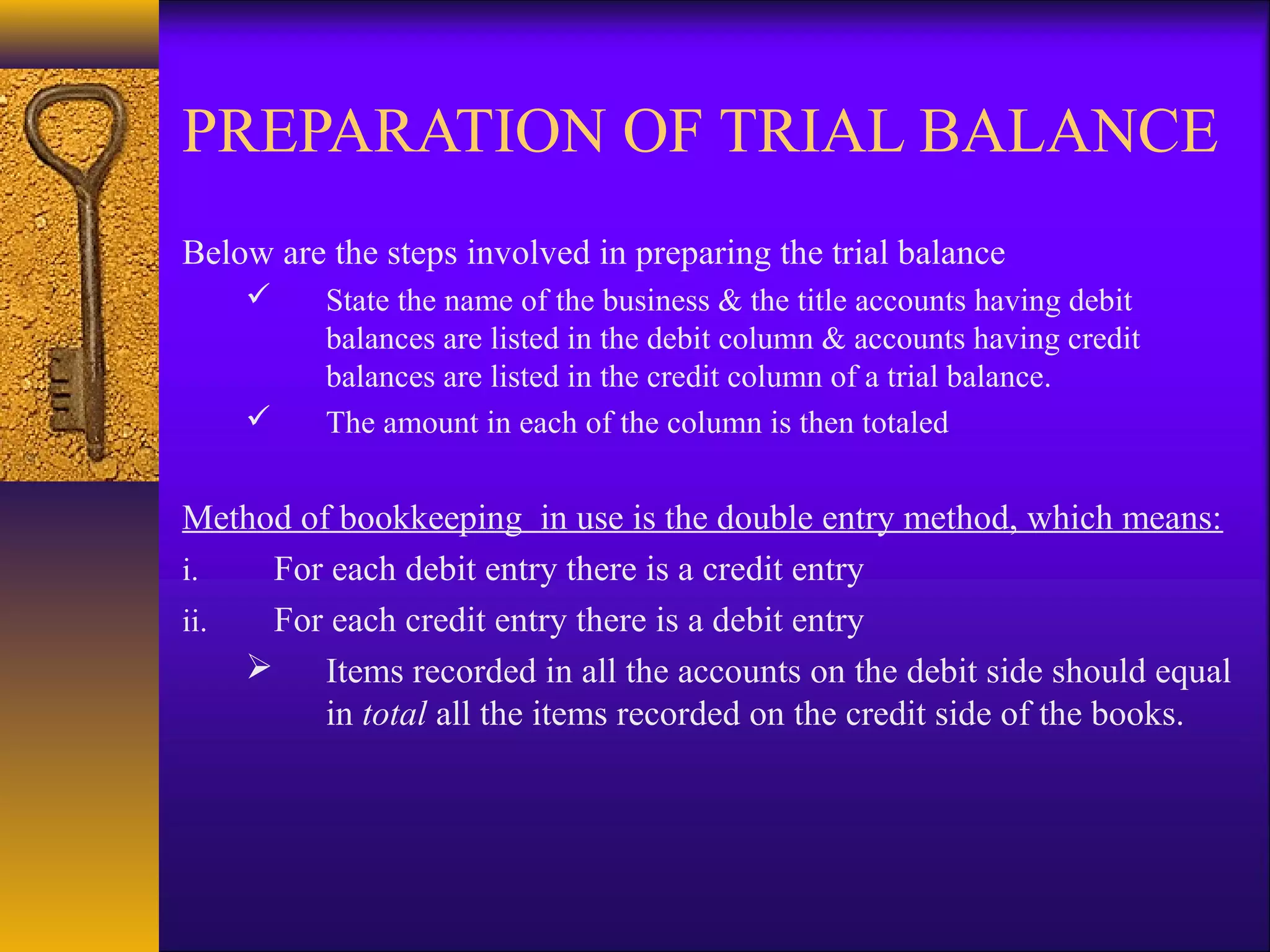
PREPARATION OF TRIAL BALANCE
Below are the steps involved in preparing the trial balance
         State the name of the business & the title accounts having debit
          balances are listed in the debit column & accounts having credit
          balances are listed in the credit column of a trial balance.
         The amount in each of the column is then totaled


Method of bookkeeping in use is the double entry method, which means:
i.   For each debit entry there is a credit entry
ii.  For each credit entry there is a debit entry
     Items recorded in all the accounts on the debit side should equal
         in total all the items recorded on the credit side of the books.
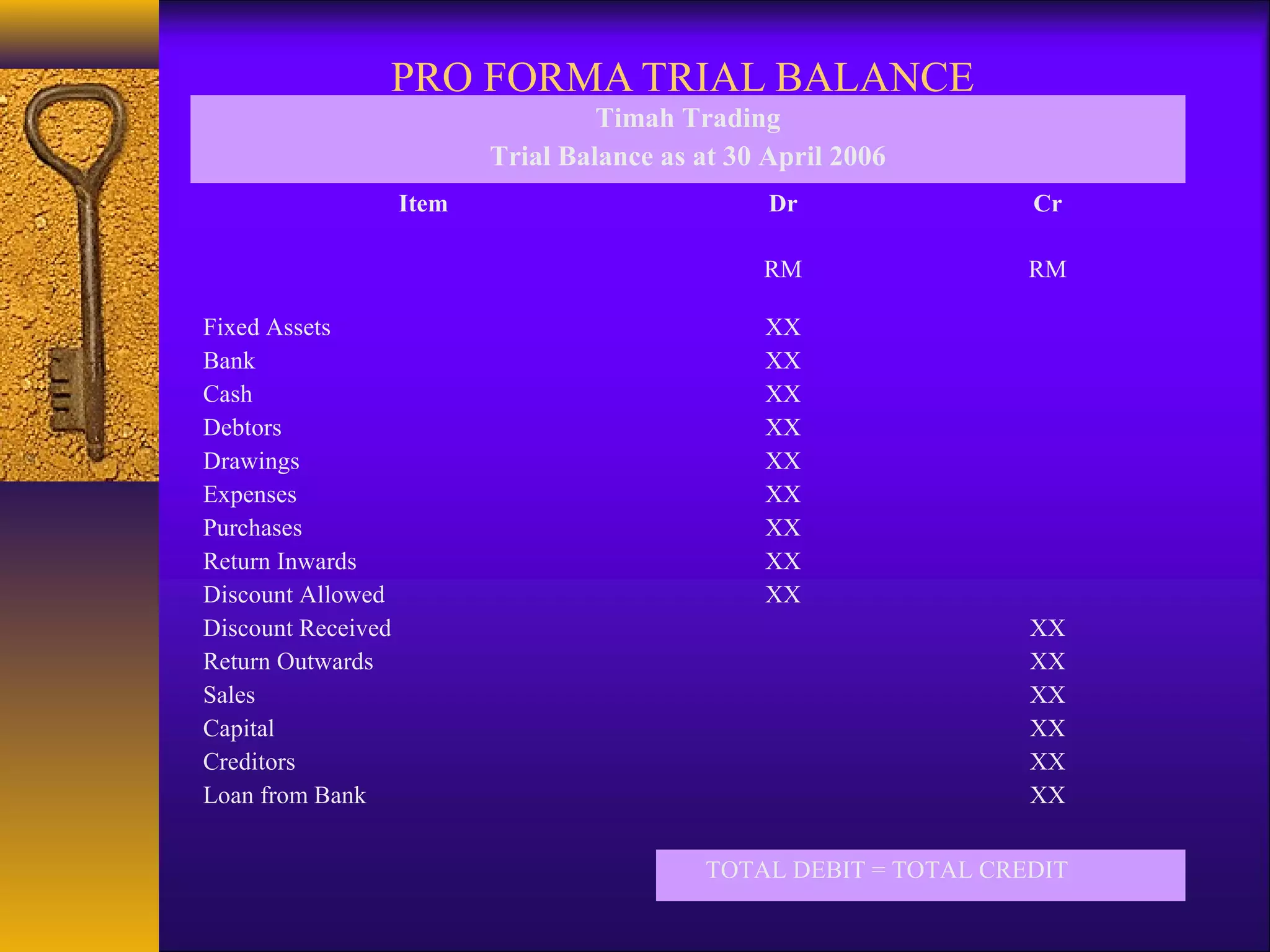
PRO FORMA TRIAL BALANCE
                                    Timah Trading
                           Trial Balance as at 30 April 2006
                    Item                          Dr               Cr

                                                 RM                RM

Fixed Assets                                     XX
Bank                                             XX
Cash                                             XX
Debtors                                          XX
Drawings                                         XX
Expenses                                         XX
Purchases                                        XX
Return Inwards                                   XX
Discount Allowed                                 XX
Discount Received                                                  XX
Return Outwards                                                    XX
Sales                                                              XX
Capital                                                            XX
Creditors                                                          XX
Loan from Bank                                                     XX


                                            TOTAL DEBIT = TOTAL CREDIT
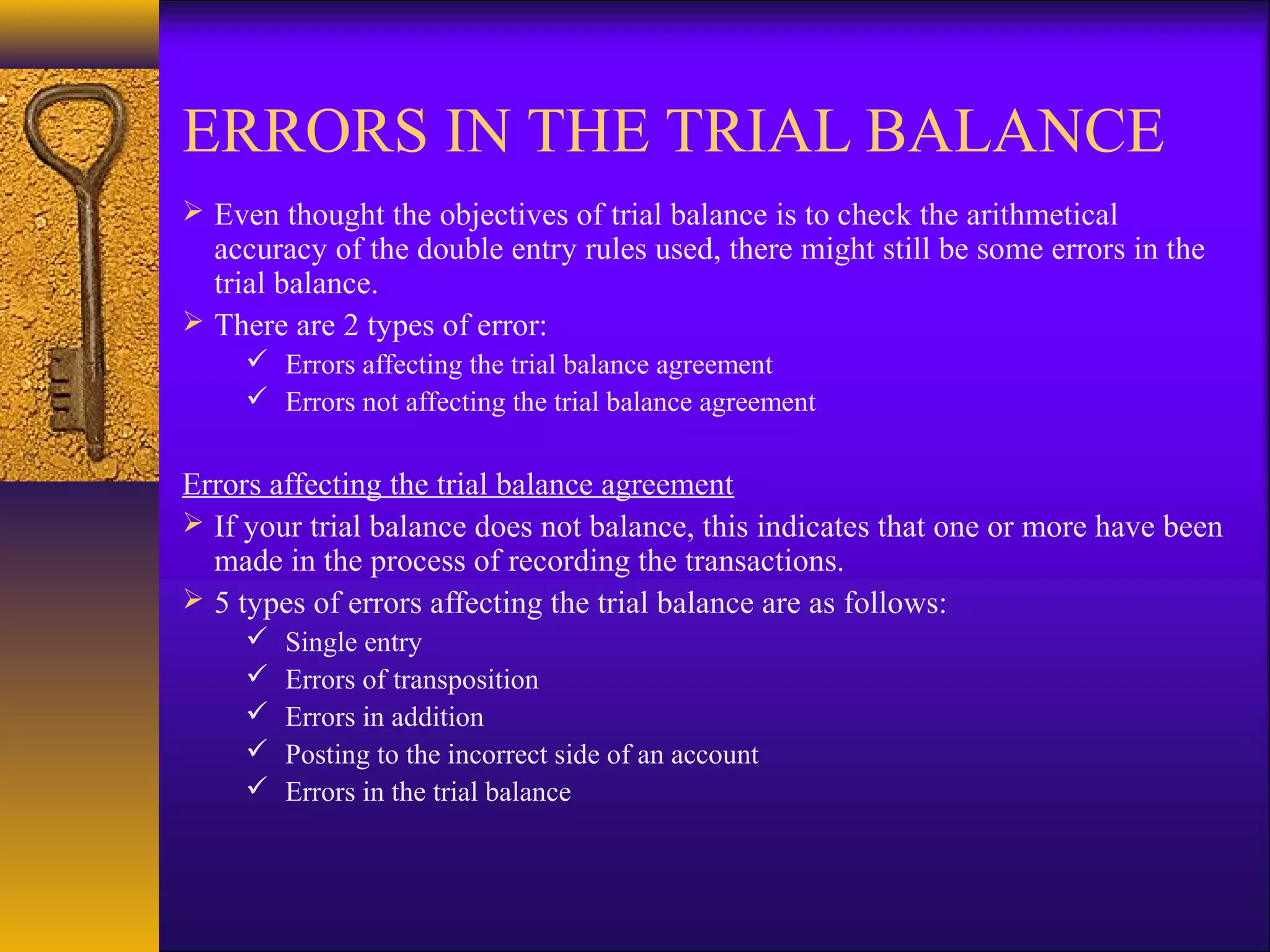
ERRORS IN THE TRIAL BALANCE
 Even thought the objectives of trial balance is to check the arithmetical
  accuracy of the double entry rules used, there might still be some errors in the
  trial balance.
 There are 2 types of error:
      Errors affecting the trial balance agreement
      Errors not affecting the trial balance agreement


Errors affecting the trial balance agreement
 If your trial balance does not balance, this indicates that one or more have been
  made in the process of recording the transactions.
 5 types of errors affecting the trial balance are as follows:
        Single entry
        Errors of transposition
        Errors in addition
        Posting to the incorrect side of an account
        Errors in the trial balance
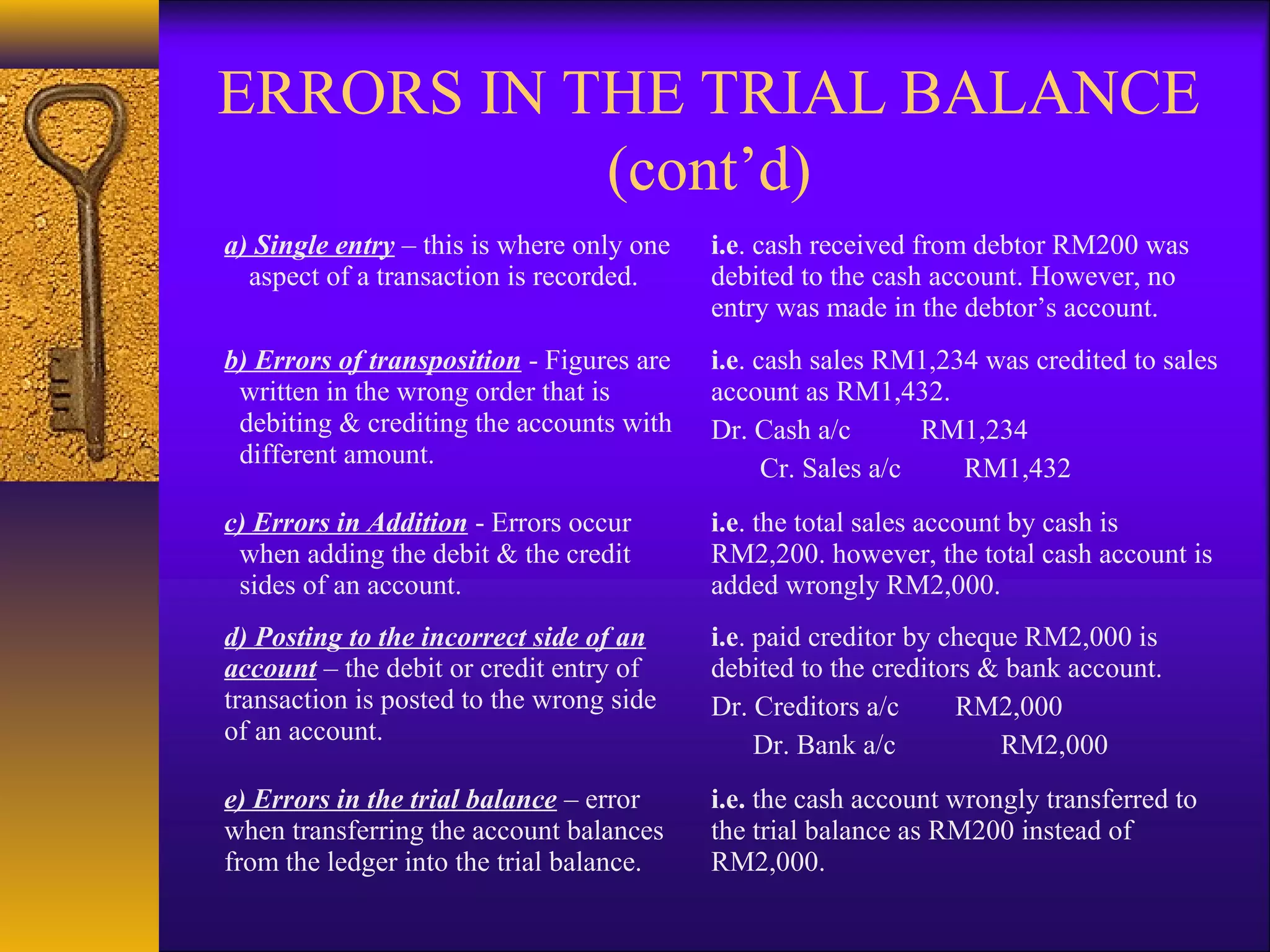
ERRORS IN THE TRIAL BALANCE
           (cont’d)
a) Single entry – this is where only one   i.e. cash received from debtor RM200 was
  aspect of a transaction is recorded.     debited to the cash account. However, no
                                           entry was made in the debtor’s account.
b) Errors of transposition - Figures are   i.e. cash sales RM1,234 was credited to sales
 written in the wrong order that is        account as RM1,432.
 debiting & crediting the accounts with    Dr. Cash a/c        RM1,234
 different amount.                               Cr. Sales a/c   RM1,432
c) Errors in Addition - Errors occur       i.e. the total sales account by cash is
 when adding the debit & the credit        RM2,200. however, the total cash account is
 sides of an account.                      added wrongly RM2,000.
d) Posting to the incorrect side of an     i.e. paid creditor by cheque RM2,000 is
account – the debit or credit entry of     debited to the creditors & bank account.
transaction is posted to the wrong side    Dr. Creditors a/c      RM2,000
of an account.                                  Dr. Bank a/c          RM2,000
e) Errors in the trial balance – error     i.e. the cash account wrongly transferred to
when transferring the account balances     the trial balance as RM200 instead of
from the ledger into the trial balance.    RM2,000.
ERRORS IN THE TRIAL BALANCE
             (cont’d)
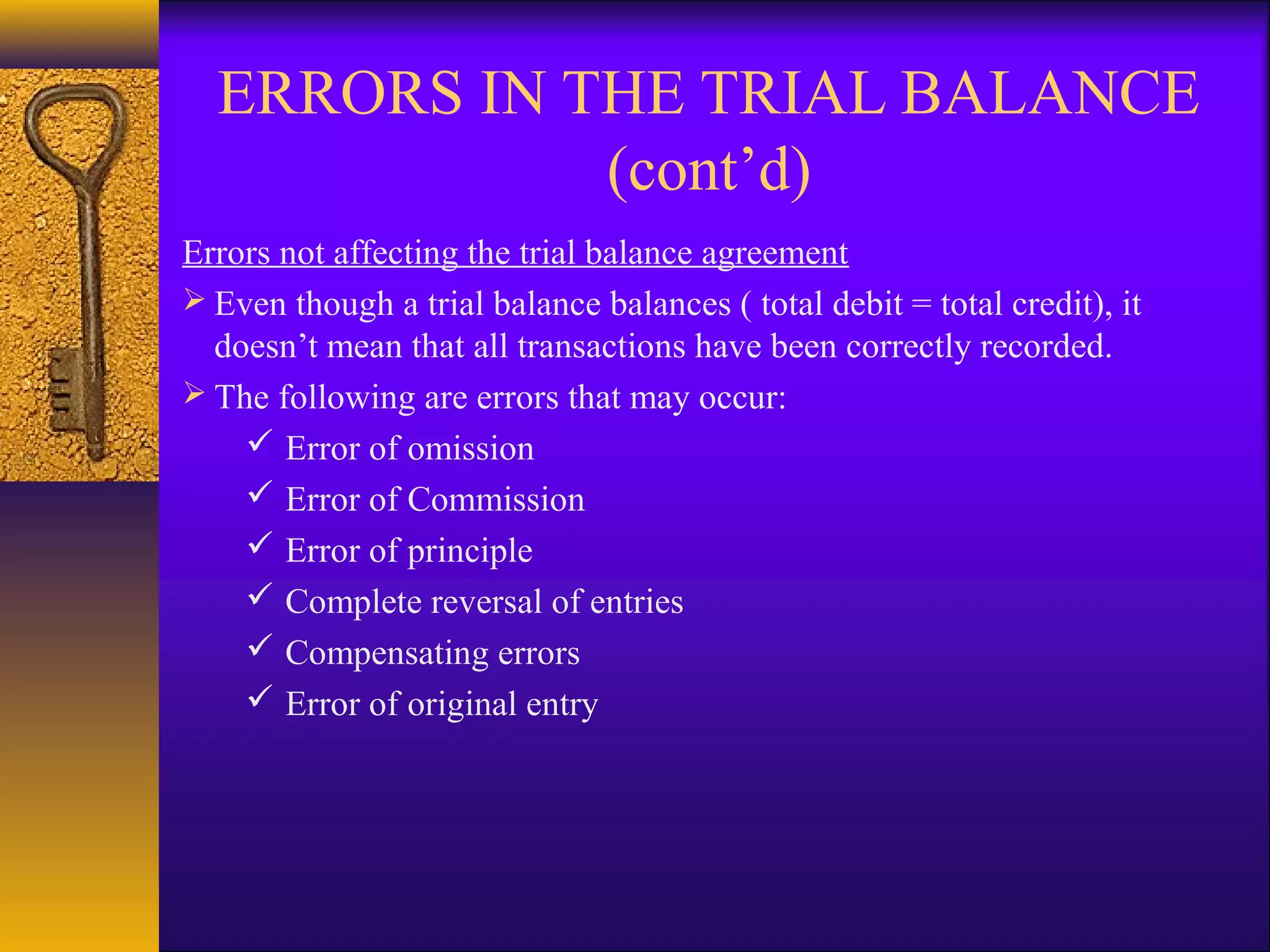
Errors not affecting the trial balance agreement
 Even though a trial balance balances ( total debit = total credit), it
  doesn’t mean that all transactions have been correctly recorded.
 The following are errors that may occur:
     Error of omission
     Error of Commission
     Error of principle
     Complete reversal of entries
     Compensating errors
     Error of original entry
ERRORS IN THE TRIAL BALANCE
               (cont’d)
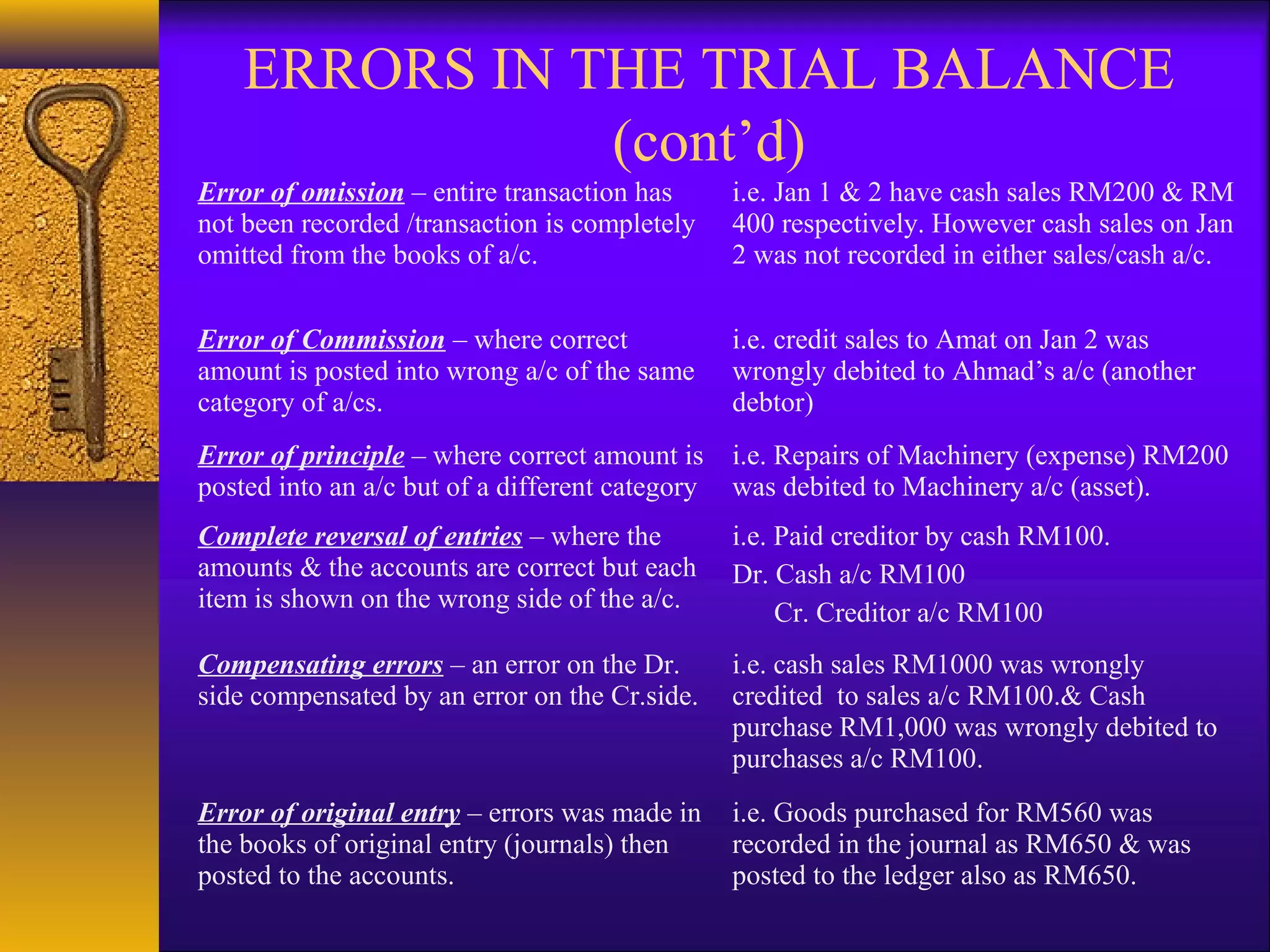
Error of omission – entire transaction has       i.e. Jan 1 & 2 have cash sales RM200 & RM
not been recorded /transaction is completely     400 respectively. However cash sales on Jan
omitted from the books of a/c.                   2 was not recorded in either sales/cash a/c.


Error of Commission – where correct              i.e. credit sales to Amat on Jan 2 was
amount is posted into wrong a/c of the same      wrongly debited to Ahmad’s a/c (another
category of a/cs.                                debtor)
Error of principle – where correct amount is     i.e. Repairs of Machinery (expense) RM200
posted into an a/c but of a different category   was debited to Machinery a/c (asset).
Complete reversal of entries – where the         i.e. Paid creditor by cash RM100.
amounts & the accounts are correct but each      Dr. Cash a/c RM100
item is shown on the wrong side of the a/c.           Cr. Creditor a/c RM100
Compensating errors – an error on the Dr.        i.e. cash sales RM1000 was wrongly
side compensated by an error on the Cr.side.     credited to sales a/c RM100.& Cash
                                                 purchase RM1,000 was wrongly debited to
                                                 purchases a/c RM100.
Error of original entry – errors was made in     i.e. Goods purchased for RM560 was
the books of original entry (journals) then      recorded in the journal as RM650 & was
posted to the accounts.                          posted to the ledger also as RM650.
The end

Always learn by heart…then you will gain the
                  knowledge!

Ch 5 balancing the account and trial balance

  • 1.
    ACC 106 CHAPTER 4 BALANCING THE ACCOUNTS & TRIAL BALANCE
  • 2.
    BALANCING THE ACCOUNTS& TRIAL BALANCE KNOWLEDGE OBJECTIVES:  Balance off the accounts for assets, liabilities, capital, revenues & expenses.  Distinguish between debit balance, credit balance & zero balance.  To understand why trial balance totals should equal one another  Be able to draw up a trial balance from a given set of accounts  Appreciate that some kinds of error can be made but the trial balance totals will still equal one another
  • 3.
    INTRODUCTION  To checkwhether all transactions have been recorded correctly based on the double entry rules, the accounts have to be balance off & the trial balance is being prepared.  The purpose/objectives of preparing trial balance are:  Determining the arithmetical accuracy of the double entry rules  It helps to detect errors within a given time period  To facilitate the process of preparing the final accounts - (financial statements)  Trial balance is a list of all ledger accounts with balances at a particular date.  Ledger accounts with zero balances are excluded from the trial balance.  Trial balance is normally prepared at the end of each month.
  • 4.
    BALANCING THE ACCOUNTS Accounts are normally balance off at the end of each month.  The purpose of balancing off the accounts is to determine how much is the balance left in each of the account.  Therefore, the debit & credit sides of the account will be compared.  If the total debit is more than total credit, the account is said to have a debit balance.  On the other hand, if total credit is more than total debit, so the account has a credit balance.  However, if the total debit is equal to total credit, the account has a zero balance.
  • 5.
    BALANCING THE ACCOUNTS (cont’d)  Steps in balancing off accounts are as follows: i. Total for both sides of an account are added up ii. The differences between the larger & the smaller totals is known as the balancing figure. The balancing figure is placed on the side of the smaller total as the balance carried down ( balance c/d) iii. The balance brought down ( balance b/d) is the same figure as the balance c/d but recorded on the opposite side of an account & shown immediately below the total figure on the next day. iv. If only one item is found in one side of the account, the balancing is done by recording the same amount on the opposite side as the balance c/d.
  • 6.
    DEBIT BALANCE Bank 1 Apr. Cash 8,000 10 Apr. Rent 2,000 30 Apr. Cash 9,512 11 Apr. Purchases 1,500 30 Apr. Bal c/d 14,012 17,512 17,512 1 May. Bal b/d 14,012 Purchases 3 Apr. Pak Din 5,700 25 Apr. Drawings 1,100 Zila 2,850 T.P/L 8,950 11 Apr. Bank 1,500 10,050 10,050
  • 7.
    CREDIT BALANCE Sales 30 Apr. 15,250 8 Apr. Faizal 4,500 T.P/L Pak Adi 9,000 12 Apr. Cash 250 22 Apr. Cash 1,500 15,250 15,250 Zila 21 Apr. Return Outwards 300 3 Apr. Purchases 2,850 30 Apr. Bal c/d 2,550 2,850 2,850 1 May. Bal b/d 2,550
  • 8.
    PREPARATION OF TRIALBALANCE Below are the steps involved in preparing the trial balance  State the name of the business & the title accounts having debit balances are listed in the debit column & accounts having credit balances are listed in the credit column of a trial balance.  The amount in each of the column is then totaled Method of bookkeeping in use is the double entry method, which means: i. For each debit entry there is a credit entry ii. For each credit entry there is a debit entry  Items recorded in all the accounts on the debit side should equal in total all the items recorded on the credit side of the books.
  • 9.
    PRO FORMA TRIALBALANCE Timah Trading Trial Balance as at 30 April 2006 Item Dr Cr RM RM Fixed Assets XX Bank XX Cash XX Debtors XX Drawings XX Expenses XX Purchases XX Return Inwards XX Discount Allowed XX Discount Received XX Return Outwards XX Sales XX Capital XX Creditors XX Loan from Bank XX TOTAL DEBIT = TOTAL CREDIT
  • 10.
    ERRORS IN THETRIAL BALANCE  Even thought the objectives of trial balance is to check the arithmetical accuracy of the double entry rules used, there might still be some errors in the trial balance.  There are 2 types of error:  Errors affecting the trial balance agreement  Errors not affecting the trial balance agreement Errors affecting the trial balance agreement  If your trial balance does not balance, this indicates that one or more have been made in the process of recording the transactions.  5 types of errors affecting the trial balance are as follows:  Single entry  Errors of transposition  Errors in addition  Posting to the incorrect side of an account  Errors in the trial balance
  • 11.
    ERRORS IN THETRIAL BALANCE (cont’d) a) Single entry – this is where only one i.e. cash received from debtor RM200 was aspect of a transaction is recorded. debited to the cash account. However, no entry was made in the debtor’s account. b) Errors of transposition - Figures are i.e. cash sales RM1,234 was credited to sales written in the wrong order that is account as RM1,432. debiting & crediting the accounts with Dr. Cash a/c RM1,234 different amount. Cr. Sales a/c RM1,432 c) Errors in Addition - Errors occur i.e. the total sales account by cash is when adding the debit & the credit RM2,200. however, the total cash account is sides of an account. added wrongly RM2,000. d) Posting to the incorrect side of an i.e. paid creditor by cheque RM2,000 is account – the debit or credit entry of debited to the creditors & bank account. transaction is posted to the wrong side Dr. Creditors a/c RM2,000 of an account. Dr. Bank a/c RM2,000 e) Errors in the trial balance – error i.e. the cash account wrongly transferred to when transferring the account balances the trial balance as RM200 instead of from the ledger into the trial balance. RM2,000.
  • 12.
    ERRORS IN THETRIAL BALANCE (cont’d) Errors not affecting the trial balance agreement  Even though a trial balance balances ( total debit = total credit), it doesn’t mean that all transactions have been correctly recorded.  The following are errors that may occur:  Error of omission  Error of Commission  Error of principle  Complete reversal of entries  Compensating errors  Error of original entry
  • 13.
    ERRORS IN THETRIAL BALANCE (cont’d) Error of omission – entire transaction has i.e. Jan 1 & 2 have cash sales RM200 & RM not been recorded /transaction is completely 400 respectively. However cash sales on Jan omitted from the books of a/c. 2 was not recorded in either sales/cash a/c. Error of Commission – where correct i.e. credit sales to Amat on Jan 2 was amount is posted into wrong a/c of the same wrongly debited to Ahmad’s a/c (another category of a/cs. debtor) Error of principle – where correct amount is i.e. Repairs of Machinery (expense) RM200 posted into an a/c but of a different category was debited to Machinery a/c (asset). Complete reversal of entries – where the i.e. Paid creditor by cash RM100. amounts & the accounts are correct but each Dr. Cash a/c RM100 item is shown on the wrong side of the a/c. Cr. Creditor a/c RM100 Compensating errors – an error on the Dr. i.e. cash sales RM1000 was wrongly side compensated by an error on the Cr.side. credited to sales a/c RM100.& Cash purchase RM1,000 was wrongly debited to purchases a/c RM100. Error of original entry – errors was made in i.e. Goods purchased for RM560 was the books of original entry (journals) then recorded in the journal as RM650 & was posted to the accounts. posted to the ledger also as RM650.
  • 14.
    The end Always learnby heart…then you will gain the knowledge!

Editor's Notes

  • #13 Dgku.acc114/115.2006