CUSTOMER DRIVEN
MARKETING STRATEGY
MARKE SEGMENTATION
Mahesh Weeratunge
Senior Lecturer and Examiner
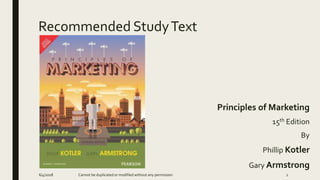
Recommended StudyText
Principles of Marketing
15th Edition
By
Phillip Kotler
Gary Armstrong
Cannot be duplicated or modified without any permission6/4/2018 2
Coverage… (Chapter 7)
■ Defining the customer driven marketing strategy
■ Marketing Segmentation
■ MarketTargeting
■ Market Differentiation
■ Market Positioning
Cannot be duplicated or modified without any permission6/4/2018 3
Designing the customer driven
marketing strategy
■ Customer driven marketing strategy focuses on selecting the right customer to serve
by;
– Segmentation Strategy
– Targeting Strategy
■ DecideValue preposition by;
– Managing Differentiation
– Managing Positioning
6/4/2018 Cannot be duplicated or modified without any permission 4
Market Segmentation
■ Dividing the market in to smaller groups of buyers with distinct needs, characteristics or
behavior that might require separate marketing strategies or mixes.
■ OR, we can define it as dividing the entire market in to mutually exclusive groups using
unique characteristics/variables or parameters namely
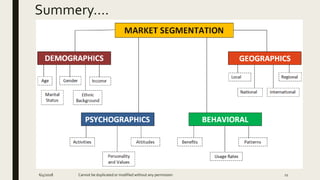
– Demographic Characteristics
– Geographic Characteristics
– Behavioral Characteristics
– Psychographic Characteristics
6/4/2018 Cannot be duplicated or modified without any permission 5
Segmenting the Consumer Market
■ There are four main variables/bases/parameters or characteristics can be
used to segment the consumer market namely;
– Demographic Characteristics
– Geographic Characteristics
– Behavioral Characteristics
– PsychographicCharacteristics
6/4/2018 Cannot be duplicated or modified without any permission 6
Demographic Segmentation
■ Dividing the market in to segments based on the
variables such as
– Age and Family life cycle
– Gender
– Generation
■ Baby Boomers (until mid 1960’s from the
end of IIWorld War)
■ Gen X (Mid 1960’s to mid 1970’s)
■ GenY ( Mid 1970’s to mid 1990’s)
■ Gen Z (Mid 1990’s to early 2000’s)
– Occupation
– Family Size
– Income – Disposable and Discretionary.
– Education
– Ethnicity
– Nationality
– Religion
– Social class
6/4/2018 Cannot be duplicated or modified without any permission 7
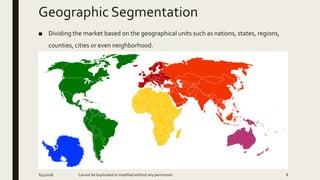
Geographic Segmentation
■ Dividing the market based on the geographical units such as nations, states, regions,
counties, cities or even neighborhood.
6/4/2018 Cannot be duplicated or modified without any permission 8
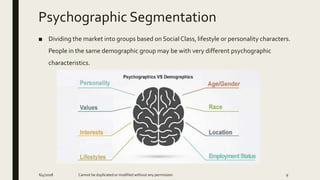
Psychographic Segmentation
■ Dividing the market into groups based on Social Class, lifestyle or personality characters.
People in the same demographic group may be with very different psychographic
characteristics.
6/4/2018 Cannot be duplicated or modified without any permission 9
Behavioral Segmentation
■ Dividing the market in to segments based on the consumer knowledge, attitude, uses or
response to a product.
– Occasion Segmentation
■ Dividing the market in to groups based on the occasions when buyers get the idea to buy,
actually make their purchase or use the purchase product
– Benefit Segmentation
■ Dividing the market in to segments according to the different benefits that consumer seek
from the product.
6/4/2018 Cannot be duplicated or modified without any permission 10
Summery….
6/4/2018 Cannot be duplicated or modified without any permission 11
Requirement for Effective Segmentation
■ Measurable
– The size, needs, purchasing power, and characteristics of the customers in the segment
should be measurable. Quantification should be possible.
■ Divisible
– The segments should be differentiable.There must be clear-cut basis for dividing customers
into meaningful homogeneous groups.They should respond differently to different marketing
mixes.There should be differences in buyer's needs, characteristics and behavior for dividing
in groups.
6/4/2018 Cannot be duplicated or modified without any permission 12
Requirement for Effective Segmentation
Cont….
■ Accessible
– The segment should be reachable and serviceable. It should be accessible through existing
marketing institutions, such as distribution channels, advertising media and sales force.
There should be middlemen to distribute the products.
■ Substantial
– The segment should be substantial. It should be large enough in terms of customers and
profit potential. IT should justify the costs of developing a separate marketing mix.
6/4/2018 Cannot be duplicated or modified without any permission 13
Requirement for Effective Segmentation
Cont….
■ Actionable
– It should be actionable for marketing purposes. Organizations should be able to design
and implement the marketing mix to serve the chosen segment.
6/4/2018 Cannot be duplicated or modified without any permission 14
MarketTargeting
■ Market targeting is identified as selecting the right segment or segments to cater with
company’s product and services.
■ Segmentation must be properly evaluated to identify the right segment or segments to target
for the business. It is highly important to focus on following to target the right segment
– Segment size and growth – segment must be sizeable enough to make profit and selected
segment must be a growing one
– Segment must be structurally attractive – to implement marketing mix strategies
– Segment must match with organizational objectives and resources.
6/4/2018 Cannot be duplicated or modified without any permission 15
Selecting theTarget Market Segment
■ Target market is defined as a set buyers sharing common needs or characteristics that
company decides to serve.
■ Target Marketing Strategies can be visualized very broadly (Undifferentiated
Marketing) or very narrowly (micromarketing) or somewhere in between
(differentiated or concentrated marketing)
6/4/2018 Cannot be duplicated or modified without any permission 16
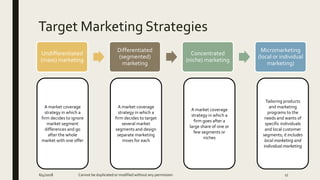
Target Marketing Strategies
Undifferentiated
(mass) marketing
Differentiated
(segmented)
marketing
Concentrated
(niche) marketing
Micromarketing
(local or individual
marketing)
6/4/2018 Cannot be duplicated or modified without any permission 17
A market coverage
strategy in which a
firm decides to ignore
market segment
differences and go
after the whole
market with one offer
A market coverage
strategy in which a
firm decides to target
several market
segments and design
separate marketing
mixes for each
A market coverage
strategy in which a
firm goes after a
large share of one or
few segments or
niches
Tailoring products
and marketing
programs to the
needs and wants of
specific individuals
and local customer
segments; it includes
local marketing and
individual marketing
Differentiation and Positioning
■ Differentiation is define as; differentiating the market offerings to create superior
customer values.
■ Positioning referred as; arranging for a market offering to occupy a clear, distinctive,
and desirable, place relative to competing products in the mind of the target
consumers
6/4/2018 Cannot be duplicated or modified without any permission 18

SEGMENTATION, TARGETING AND POSITIONING

  • 1.
    CUSTOMER DRIVEN MARKETING STRATEGY MARKESEGMENTATION Mahesh Weeratunge Senior Lecturer and Examiner
  • 2.
    Recommended StudyText Principles ofMarketing 15th Edition By Phillip Kotler Gary Armstrong Cannot be duplicated or modified without any permission6/4/2018 2
  • 3.
    Coverage… (Chapter 7) ■Defining the customer driven marketing strategy ■ Marketing Segmentation ■ MarketTargeting ■ Market Differentiation ■ Market Positioning Cannot be duplicated or modified without any permission6/4/2018 3
  • 4.
    Designing the customerdriven marketing strategy ■ Customer driven marketing strategy focuses on selecting the right customer to serve by; – Segmentation Strategy – Targeting Strategy ■ DecideValue preposition by; – Managing Differentiation – Managing Positioning 6/4/2018 Cannot be duplicated or modified without any permission 4
  • 5.
    Market Segmentation ■ Dividingthe market in to smaller groups of buyers with distinct needs, characteristics or behavior that might require separate marketing strategies or mixes. ■ OR, we can define it as dividing the entire market in to mutually exclusive groups using unique characteristics/variables or parameters namely – Demographic Characteristics – Geographic Characteristics – Behavioral Characteristics – Psychographic Characteristics 6/4/2018 Cannot be duplicated or modified without any permission 5
  • 6.
    Segmenting the ConsumerMarket ■ There are four main variables/bases/parameters or characteristics can be used to segment the consumer market namely; – Demographic Characteristics – Geographic Characteristics – Behavioral Characteristics – PsychographicCharacteristics 6/4/2018 Cannot be duplicated or modified without any permission 6
  • 7.
    Demographic Segmentation ■ Dividingthe market in to segments based on the variables such as – Age and Family life cycle – Gender – Generation ■ Baby Boomers (until mid 1960’s from the end of IIWorld War) ■ Gen X (Mid 1960’s to mid 1970’s) ■ GenY ( Mid 1970’s to mid 1990’s) ■ Gen Z (Mid 1990’s to early 2000’s) – Occupation – Family Size – Income – Disposable and Discretionary. – Education – Ethnicity – Nationality – Religion – Social class 6/4/2018 Cannot be duplicated or modified without any permission 7
  • 8.
    Geographic Segmentation ■ Dividingthe market based on the geographical units such as nations, states, regions, counties, cities or even neighborhood. 6/4/2018 Cannot be duplicated or modified without any permission 8
  • 9.
    Psychographic Segmentation ■ Dividingthe market into groups based on Social Class, lifestyle or personality characters. People in the same demographic group may be with very different psychographic characteristics. 6/4/2018 Cannot be duplicated or modified without any permission 9
  • 10.
    Behavioral Segmentation ■ Dividingthe market in to segments based on the consumer knowledge, attitude, uses or response to a product. – Occasion Segmentation ■ Dividing the market in to groups based on the occasions when buyers get the idea to buy, actually make their purchase or use the purchase product – Benefit Segmentation ■ Dividing the market in to segments according to the different benefits that consumer seek from the product. 6/4/2018 Cannot be duplicated or modified without any permission 10
  • 11.
    Summery…. 6/4/2018 Cannot beduplicated or modified without any permission 11
  • 12.
    Requirement for EffectiveSegmentation ■ Measurable – The size, needs, purchasing power, and characteristics of the customers in the segment should be measurable. Quantification should be possible. ■ Divisible – The segments should be differentiable.There must be clear-cut basis for dividing customers into meaningful homogeneous groups.They should respond differently to different marketing mixes.There should be differences in buyer's needs, characteristics and behavior for dividing in groups. 6/4/2018 Cannot be duplicated or modified without any permission 12
  • 13.
    Requirement for EffectiveSegmentation Cont…. ■ Accessible – The segment should be reachable and serviceable. It should be accessible through existing marketing institutions, such as distribution channels, advertising media and sales force. There should be middlemen to distribute the products. ■ Substantial – The segment should be substantial. It should be large enough in terms of customers and profit potential. IT should justify the costs of developing a separate marketing mix. 6/4/2018 Cannot be duplicated or modified without any permission 13
  • 14.
    Requirement for EffectiveSegmentation Cont…. ■ Actionable – It should be actionable for marketing purposes. Organizations should be able to design and implement the marketing mix to serve the chosen segment. 6/4/2018 Cannot be duplicated or modified without any permission 14
  • 15.
    MarketTargeting ■ Market targetingis identified as selecting the right segment or segments to cater with company’s product and services. ■ Segmentation must be properly evaluated to identify the right segment or segments to target for the business. It is highly important to focus on following to target the right segment – Segment size and growth – segment must be sizeable enough to make profit and selected segment must be a growing one – Segment must be structurally attractive – to implement marketing mix strategies – Segment must match with organizational objectives and resources. 6/4/2018 Cannot be duplicated or modified without any permission 15
  • 16.
    Selecting theTarget MarketSegment ■ Target market is defined as a set buyers sharing common needs or characteristics that company decides to serve. ■ Target Marketing Strategies can be visualized very broadly (Undifferentiated Marketing) or very narrowly (micromarketing) or somewhere in between (differentiated or concentrated marketing) 6/4/2018 Cannot be duplicated or modified without any permission 16
  • 17.
    Target Marketing Strategies Undifferentiated (mass)marketing Differentiated (segmented) marketing Concentrated (niche) marketing Micromarketing (local or individual marketing) 6/4/2018 Cannot be duplicated or modified without any permission 17 A market coverage strategy in which a firm decides to ignore market segment differences and go after the whole market with one offer A market coverage strategy in which a firm decides to target several market segments and design separate marketing mixes for each A market coverage strategy in which a firm goes after a large share of one or few segments or niches Tailoring products and marketing programs to the needs and wants of specific individuals and local customer segments; it includes local marketing and individual marketing
  • 18.
    Differentiation and Positioning ■Differentiation is define as; differentiating the market offerings to create superior customer values. ■ Positioning referred as; arranging for a market offering to occupy a clear, distinctive, and desirable, place relative to competing products in the mind of the target consumers 6/4/2018 Cannot be duplicated or modified without any permission 18