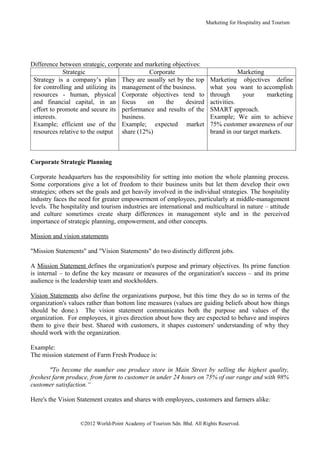
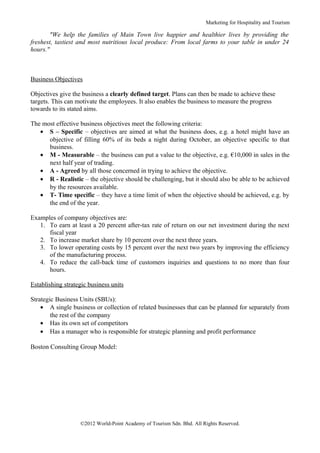
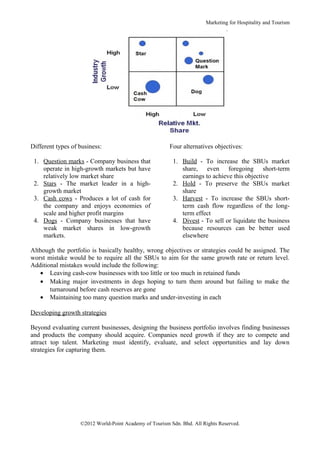
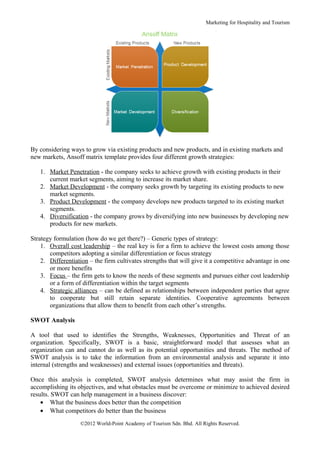
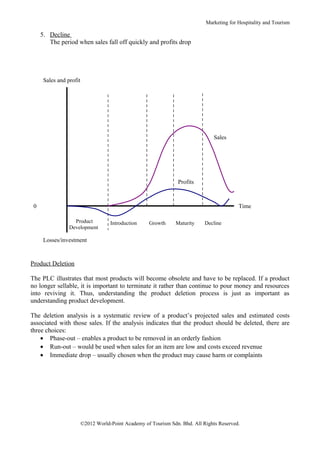
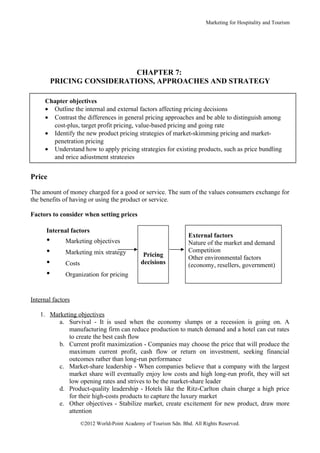
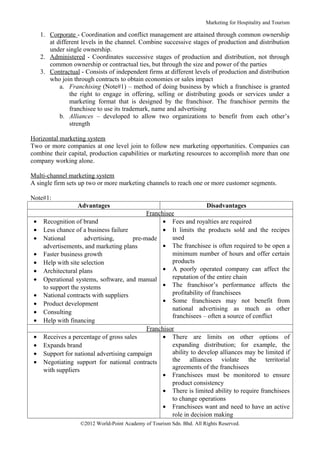
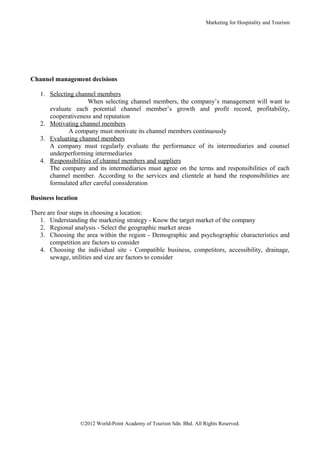
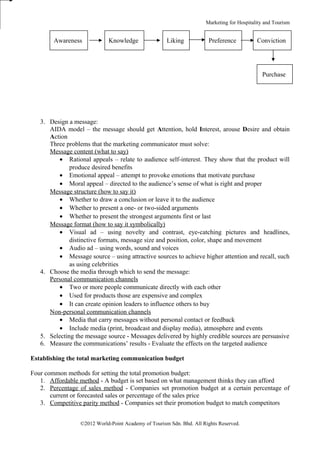
Marketing for Hospitality and Tourism


                       CHAPTER 1:
   INTRODUCTION: MARKETING FOR HOSPITALITY AND TOURISM


     Chapter objectives
     • Understand the relationships between the hospitality and travel industry
     • Define the role of marketing and discuss its core concepts
     • Discuss how marketing managers go about developing profitable customer relationships
     • Understand how the marketing concept calls for a customer orientation
     • Explain marketing strategies that are useful in the hospitality and travel industries


Introduction

Today marketing isn’t simply a business function: it’s a philosophy, a way of thinking, and a way of
structuring your business and your mind. Marketing is much more than a new ad campaign.
Marketing, more than any business function, deals with customers – creating customer value and
satisfaction are at the heart of hospitality and travel industry marketing. Many factors contribute to
making a business successful. However, today’s successful companies at all levels have one thing in
common: they are strongly customer focused and heavily committed to marketing. As a manager,
you will be motivating your employees to create superior value for your customers.

Marketing’s tasks:
      • To design a product-service combination that provides real value to targeted customers
      • Motivates purchase
      • Fulfills genuine consumer needs

Customer orientation:
      • The purpose of a business is to create and maintain profitable customers. Customer
          satisfaction leading to profit is the central goal of hospitality marketing

Marketing definition:
      • Marketing is a social and managerial process by which individuals and groups obtain
          what they need and want through creating and exchanging products and value with
          others

Customer Orientation

Successful managers understand that profits are best seen as the result of running a business well
rather than as its sole purpose. When a business satisfies its customers, the customers will pay a fair
price for the product – a fair price includes a profit for the firm. Managers who forever try to
maximize short-run profits are short-selling both the customer and the company.

The alternative management approach is to put the customer first and reward employees for serving
the customer well. It is wise to assess the customer’s long-term value and take appropriate actions
to ensure a customer’s long-term support.


                   ©2012 World-Point Academy of Tourism Sdn. Bhd. All Rights Reserved.
Marketing for Hospitality and Tourism

The importance of customer orientation and its implication for marketing planning:
   a. providing information to the customers
   b. understanding customer needs
   c. fulfilling customer needs
   d. creating and delivering customer value
   e. sustaining customer satisfaction
   f. maintaining long-term relationship with customers
   g. obtaining customer loyalty


Marketing

In the hospitality industry, marketing and sales are often thought to be the same, and no wonders:
the sales department is one of the most visible. Sales managers provide prospective clients with
tours and entertain them, thus the sales function is highly visible. Whereas, most of the non-
promotional areas of the marketing function take place behind closed doors. The four-P framework
calls upon marketing professionals to decide on the product and its characteristics, set the price,
decide how to distribute their product, and choose methods for promoting their product. If
marketers do a good job of identifying consumer needs, developing a good product, and pricing,
distributing, and promoting it effectively, the result will be attractive products and satisfied
customers.

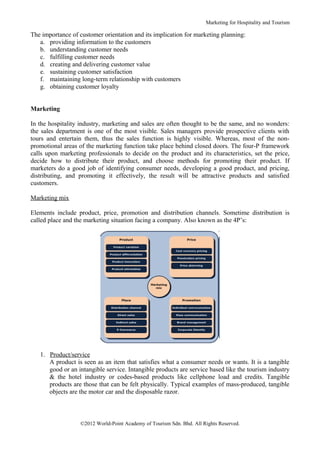
Marketing mix

Elements include product, price, promotion and distribution channels. Sometime distribution is
called place and the marketing situation facing a company. Also known as the 4P’s:


   1. Product/service
      A product is seen as an item that satisfies what a consumer needs or wants. It is a tangible
      good or an intangible service. Intangible products are service based like the tourism industry
      & the hotel industry or codes-based products like cellphone load and credits. Tangible
      products are those that can be felt physically. Typical examples of mass-produced, tangible
      objects are the motor car and the disposable razor.


                   ©2012 World-Point Academy of Tourism Sdn. Bhd. All Rights Reserved.
Marketing for Hospitality and Tourism

   2. Price
      The price is the amount a customer pays for the product. The price is very important as it
      determines the company's profit and hence, survival. Adjusting the price has a profound
      impact on the marketing strategy, and depending on the price elasticity of the product, often,
      it will affect the demand and sales as well. When setting a price, the marketer must be aware
      of the customer perceived value for the product.

   3. Place (distribution channel)
      Refers to providing the product at a place which is convenient for consumers to access.
      Place is synonymous with distribution. Various strategies such as intensive distribution,
      selective distribution, exclusive distribution, franchising can be used by the marketer to
      complement the other aspects of the marketing mix.

   4. Promotion
      Represents all of the methods of communication that a marketer may use to provide
      information to different parties about the product. Promotion comprises elements such as:
      advertising, public relations, personal selling and sales promotion.
      • Advertising covers any communication that is paid for, from cinema commercials, radio
          and Internet advertisements through print media and billboards.
      • Public relations is where the communication is not directly paid for and includes press
          releases, sponsorship deals, exhibitions, conferences, seminars or trade fairs and events.
      • Word-of-mouth is any apparently informal communication about the product by
          ordinary individuals, satisfied customers or people specifically engaged to create word
          of mouth momentum.
      • Sales staff often plays an important role in word of mouth and public relations

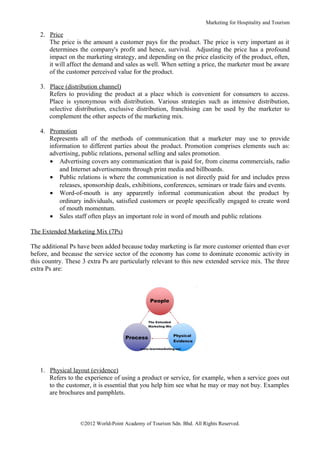
The Extended Marketing Mix (7Ps)

The additional Ps have been added because today marketing is far more customer oriented than ever
before, and because the service sector of the economy has come to dominate economic activity in
this country. These 3 extra Ps are particularly relevant to this new extended service mix. The three
extra Ps are:


   1. Physical layout (evidence)
      Refers to the experience of using a product or service, for example, when a service goes out
      to the customer, it is essential that you help him see what he may or may not buy. Examples
      are brochures and pamphlets.


                   ©2012 World-Point Academy of Tourism Sdn. Bhd. All Rights Reserved.
Marketing for Hospitality and Tourism

   2. People (provision of customer service)
      Refers to the customers, employees, management and everybody else involved in it. In
      tourism industry especially, it is essential for everyone to realize that the reputation of the
      brand is in the people’s hand. Example; a FOA service is the first impression of the hotel.

   3. Processes
      Refers to the methods and process of providing a service and is hence essential to have a
      thorough knowledge on whether the services are helpful to the customers. Example; how the
      customer services handle customer complaints.

Travel industry marketing

Travel industry marketing is about the marketing effort done in introducing and distributing tourist
destinations to the domestic and international customers (tourists). The aim is to ensure that the
known destination will become one of the top chosen destination in the world. Travel marketing
also will ensure that the destinations available resources and consumption level is properly
monitored, so that the industry can be deem as successful.

Successful hospitality marketing is highly dependent on the entire travel industry. Government or
quasi-government agencies play an important role in travel industry marketing through legislation
aimed at enhancing the industry and through promotion of regions, states and nations. Few
industries are as interdependent as the travel and hospitality industries.

Importance of marketing

The entrances of corporate giants into the hospitality market and the marketing skills these
companies have brought to the industry have increased the importance of marketing within the
industry. Analysts predict that the hotel industry will consolidate in much the same way as the
airline industry has, with five or six major chains dominating the market. Such consolidation will
create a market that is highly competitive. The firms that survive this consolidation will be the ones
that understand their customers. In response to growing competitive pressures, hotel chains are
relying on the expertise of the marketing director.

Understanding marketing

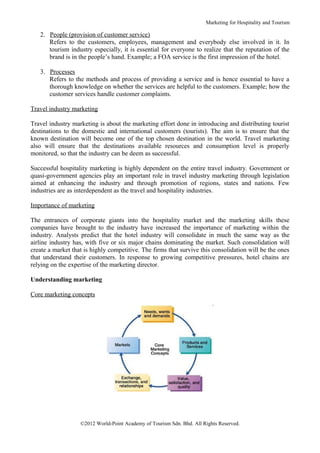
Core marketing concepts


                   ©2012 World-Point Academy of Tourism Sdn. Bhd. All Rights Reserved.
Marketing for Hospitality and Tourism

1. Needs, wants and demands
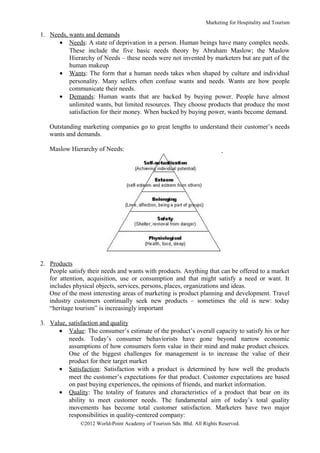
      • Needs: A state of deprivation in a person. Human beings have many complex needs.
          These include the five basic needs theory by Abraham Maslow; the Maslow
          Hierarchy of Needs – these needs were not invented by marketers but are part of the
          human makeup
      • Wants: The form that a human needs takes when shaped by culture and individual
          personality. Many sellers often confuse wants and needs. Wants are how people
          communicate their needs.
      • Demands: Human wants that are backed by buying power. People have almost
          unlimited wants, but limited resources. They choose products that produce the most
          satisfaction for their money. When backed by buying power, wants become demand.

   Outstanding marketing companies go to great lengths to understand their customer’s needs
   wants and demands.

   Maslow Hierarchy of Needs:


2. Products
   People satisfy their needs and wants with products. Anything that can be offered to a market
   for attention, acquisition, use or consumption and that might satisfy a need or want. It
   includes physical objects, services, persons, places, organizations and ideas.
   One of the most interesting areas of marketing is product planning and development. Travel
   industry customers continually seek new products – sometimes the old is new: today
   “heritage tourism” is increasingly important

3. Value, satisfaction and quality
      • Value: The consumer’s estimate of the product’s overall capacity to satisfy his or her
          needs. Today’s consumer behaviorists have gone beyond narrow economic
          assumptions of how consumers form value in their mind and make product choices.
          One of the biggest challenges for management is to increase the value of their
          product for their target market
      • Satisfaction: Satisfaction with a product is determined by how well the products
          meet the customer’s expectations for that product. Customer expectations are based
          on past buying experiences, the opinions of friends, and market information.
      • Quality: The totality of features and characteristics of a product that bear on its
          ability to meet customer needs. The fundamental aim of today’s total quality
          movements has become total customer satisfaction. Marketers have two major
          responsibilities in quality-centered company:
               ©2012 World-Point Academy of Tourism Sdn. Bhd. All Rights Reserved.
Marketing for Hospitality and Tourism

                  i. They must participate in forming strategies
                 ii. They must perform each marketing activity to high standards

   4. Exchange, transactions and relationships
         • Exchange: The act of obtaining a desired object from someone by offering
            something in return. Exchange is only one of several ways people can obtain a
            desired object.
         • Transaction: Marketing’s unit of measurement. A transaction consists of a trade of
            values between two parties. A transaction involves at least two things of value, a
            time of agreement, and a place of agreement.
         • Relationships marketing: Focuses on building a relationship with a company’s
            profitable customers. Most companies are finding that they earn a higher return from
            resources invested in getting repeat sales from current customers than from money
            spent to attract new customers. Smart marketers work at building relationships with
            valued customers, distributors, dealers and suppliers.

      Relationship marketing within the hospitality industry is particularly important in the
      following areas:
          • Between hospitality organizations and their customers
          • Between hospitality organizations and their employees
          • Between retailers of travel-hospitality services, such as hotels or airlines, and
             marketing intermediaries, such as tour wholesalers, incentive houses, and travel
             agency conglomerates
          • Between retailers of travel-hospitality services and key customers, such as large
             corporations and government agencies
          • Between retailers of food service such as ARAMARK or McDonald’s and
             organizations such as universities, bus terminals, and large corporations in which this
             food chain is one of a handful of providers
          • Between retailers of one type of travel-hospitality service, such as a motel chain and
             a restaurant chain. (both are mutually interdependent)
          • Between retailers of travel-hospitality services and key suppliers
          • Between hospitality organizations and their marketing agencies, banks, and law
             firms

   5. Markets
      A set of actual and potential buyers who might transact with a seller. The size of a market
      depends on the number of persons who exhibit a common need, have the money or other
      resources that interest others, and are willing to offer these resources in exchange for what
      they want. The fact is that modern economies operate on the principle of the division of
      labor by which each person specializes in the production of something, receives payment,
      and buys needed things with money.

Marketing management

Definition: The analysis, planning, implementation and control of programs designed to create,
build and maintain beneficial exchanges with target buyers for the purpose of achieving
organizational objectives.

Marketing means working with markets to bring about exchanges for satisfying human needs and
wants. Most people think of a marketing manager as someone who finds enough customers to buy

                  ©2012 World-Point Academy of Tourism Sdn. Bhd. All Rights Reserved.
Marketing for Hospitality and Tourism

the company’s current output – but, it is too limited. The marketing manager is interested in shaping
the level, time, and composition of demand for the company’s products and services.

Marketing management philosophies:

   1. Manufacturing concept
      Also called the production concept - Holds that customers will favor products that are
      available and highly affordable, and therefore management should focus on production and
      distribution efficiency. The problem is that management may become so focused on
      manufacturing systems that they forget the customer.

   2. Product concept
      Holds that customers prefer existing products and product forms, and the job of management
      is to develop good versions of these products. This misses the point that consumers are
      trying to satisfy needs and might turn to entirely different products to better satisfy those
      needs.

   3. Selling concept
      Holds that consumer will not buy enough of the organization’s product unless the
      organization undertakes a large selling and promotion effort. Does not establish a long-term
      relationship with the customer, because the focus is on getting rid of what one has rather
      than creating a product to meet the needs of the market.

       The selling concept exists within the hospitality industry – a major contributing factor is
       overcapacity. Why do major sectors continuously face overcapacity?
          • Pride in being the biggest, having the most capacity
          • A false belief that economies of scale will occur as size increases
          • Tax laws that encourage real estate developers to overbuild properties because of the
              generous tax write-offs
          • Etc.

   4. Marketing concept
      Holds that achieving organizational goals depends on determining the needs and wants of
      target markets and delivering the desired satisfaction more effectively and efficiently than
      competitors.

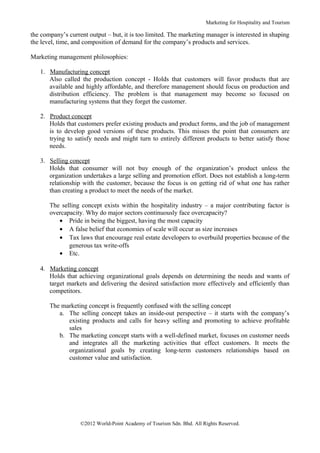
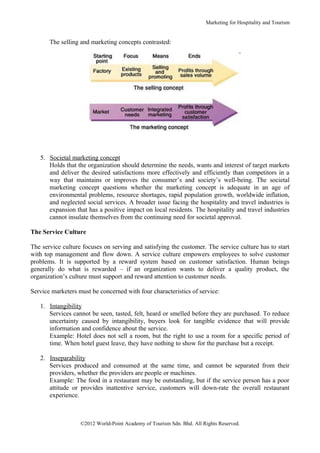
       The marketing concept is frequently confused with the selling concept
          a. The selling concept takes an inside-out perspective – it starts with the company’s
             existing products and calls for heavy selling and promoting to achieve profitable
             sales
          b. The marketing concept starts with a well-defined market, focuses on customer needs
             and integrates all the marketing activities that effect customers. It meets the
             organizational goals by creating long-term customers relationships based on
             customer value and satisfaction.


                   ©2012 World-Point Academy of Tourism Sdn. Bhd. All Rights Reserved.
Marketing for Hospitality and Tourism


       The selling and marketing concepts contrasted:


   5. Societal marketing concept
      Holds that the organization should determine the needs, wants and interest of target markets
      and deliver the desired satisfactions more effectively and efficiently than competitors in a
      way that maintains or improves the consumer’s and society’s well-being. The societal
      marketing concept questions whether the marketing concept is adequate in an age of
      environmental problems, resource shortages, rapid population growth, worldwide inflation,
      and neglected social services. A broader issue facing the hospitality and travel industries is
      expansion that has a positive impact on local residents. The hospitality and travel industries
      cannot insulate themselves from the continuing need for societal approval.

The Service Culture

The service culture focuses on serving and satisfying the customer. The service culture has to start
with top management and flow down. A service culture empowers employees to solve customer
problems. It is supported by a reward system based on customer satisfaction. Human beings
generally do what is rewarded – if an organization wants to deliver a quality product, the
organization’s culture must support and reward attention to customer needs.

Service marketers must be concerned with four characteristics of service:

   1. Intangibility
      Services cannot be seen, tasted, felt, heard or smelled before they are purchased. To reduce
      uncertainty caused by intangibility, buyers look for tangible evidence that will provide
      information and confidence about the service.
      Example: Hotel does not sell a room, but the right to use a room for a specific period of
      time. When hotel guest leave, they have nothing to show for the purchase but a receipt.

   2. Inseparability
      Services produced and consumed at the same time, and cannot be separated from their
      providers, whether the providers are people or machines.
      Example: The food in a restaurant may be outstanding, but if the service person has a poor
      attitude or provides inattentive service, customers will down-rate the overall restaurant
      experience.


                   ©2012 World-Point Academy of Tourism Sdn. Bhd. All Rights Reserved.
Marketing for Hospitality and Tourism


   3. Variability
      Service quality depends on who provides the services and when and where they are
   provided.
      Example: A guest can receive excellent service one day, and mediocre service from the
      same person the next day; the service person may not have felt well or perhaps experienced
      an emotional problem.

   4. Perishability
      Services cannot be stored. If service providers are to maximize revenue, they must manage
      capacity and demand because they cannot carry forward unsold inventory
      Example: A 100-room hotel that sells only 60 rooms on a particular night cannot inventory
      the 40 unused rooms and then sell 140 rooms the next night. Revenue loss from not selling
      40 rooms is gone forever.

Management strategies for service businesses

Service marketers can do several things to increase service effectiveness in the face of intrinsic
service characteristics. Just like manufacturing business, good service firms use marketing to
position themselves strongly in chosen target markets. However, services differ from tangible
products and often require additional marketing approaches.

In a service business, the customer and frontline service employee interact effectively with
customers to create superior value during service encounters. Successful service companies focus
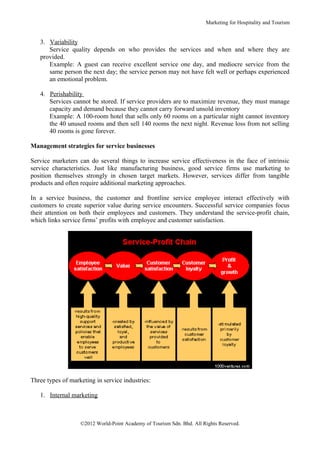
their attention on both their employees and customers. They understand the service-profit chain,
which links service firms’ profits with employee and customer satisfaction.


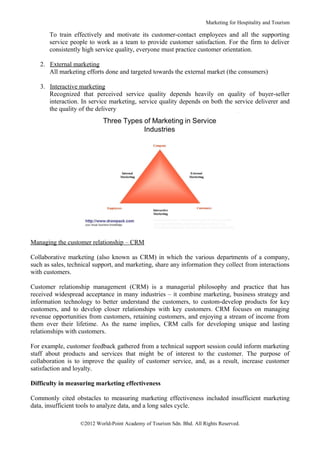
Three types of marketing in service industries:

   1. Internal marketing


                   ©2012 World-Point Academy of Tourism Sdn. Bhd. All Rights Reserved.
Marketing for Hospitality and Tourism

       To train effectively and motivate its customer-contact employees and all the supporting
       service people to work as a team to provide customer satisfaction. For the firm to deliver
       consistently high service quality, everyone must practice customer orientation.

   2. External marketing
      All marketing efforts done and targeted towards the external market (the consumers)

   3. Interactive marketing
      Recognized that perceived service quality depends heavily on quality of buyer-seller
      interaction. In service marketing, service quality depends on both the service deliverer and
      the quality of the delivery


Managing the customer relationship – CRM

Collaborative marketing (also known as CRM) in which the various departments of a company,
such as sales, technical support, and marketing, share any information they collect from interactions
with customers.

Customer relationship management (CRM) is a managerial philosophy and practice that has
received widespread acceptance in many industries – it combine marketing, business strategy and
information technology to better understand the customers, to custom-develop products for key
customers, and to develop closer relationships with key customers. CRM focuses on managing
revenue opportunities from customers, retaining customers, and enjoying a stream of income from
them over their lifetime. As the name implies, CRM calls for developing unique and lasting
relationships with customers.

For example, customer feedback gathered from a technical support session could inform marketing
staff about products and services that might be of interest to the customer. The purpose of
collaboration is to improve the quality of customer service, and, as a result, increase customer
satisfaction and loyalty.

Difficulty in measuring marketing effectiveness

Commonly cited obstacles to measuring marketing effectiveness included insufficient marketing
data, insufficient tools to analyze data, and a long sales cycle.

                   ©2012 World-Point Academy of Tourism Sdn. Bhd. All Rights Reserved.
Marketing for Hospitality and Tourism


                             CHAPTER 2:
             THE ROLE OF MARKETING IN STRATEGIC PLANNING


     Chapter objectives
     • Understand the processes involved in defining a company mission and setting goals and
       objectives
     • Discuss how to design business portfolios and growth strategies
     • Explain the steps involved in the business strategy planning process
     • Identify the micro- and macro-environment (PEST) factors in marketing


Strategic Planning

The aim of strategic planning is to help a company select and organizes its business in a manner that
keeps the company healthy despite unexpected upsets in any of its specific business or product
lines. Three ideas that define strategic planning:
    • Managing a company’s business as an investment portfolio to determine which business
        entities deserve to be built, maintained, phased down or terminated
    • Assessing accurately the future profit potential of each business by considering the market’s
        growth rate and the company’s position and fit
    • Underlying strategic planning is that of strategy and developing a game plan for achieving
        long-run objectives

Four major organizational levels:

   1. Corporate level
      Responsible for designing a corporate strategic plan to guide the entire enterprise. It makes
      decision on how much resource support to allocate to each division, as well as which
      businesses to start or eliminate

   2. Division level
      Each division establishes a plan covering the allocation of funds to support that business unit
      within that division

   3. Business level
      Each business unit in turn develop its business unit’s strategic plan to carry that business
      unit into profitable future

   4. Product level
      Each product level within a business unit develops a marketing plan for achieving its
      objectives in its product market


                   ©2012 World-Point Academy of Tourism Sdn. Bhd. All Rights Reserved.
Marketing for Hospitality and Tourism


Difference between strategic, corporate and marketing objectives:
             Strategic                        Corporate                              Marketing
 Strategy is a company’s plan They are usually set by the top            Marketing objectives define
 for controlling and utilizing its management of the business.           what you want to accomplish
 resources - human, physical Corporate objectives tend to                through      your     marketing
 and financial capital, in an focus          on    the     desired       activities.
 effort to promote and secure its performance and results of the         SMART approach.
 interests.                        business.                             Example; We aim to achieve
 Example; efficient use of the Example; expected market                  75% customer awareness of our
 resources relative to the output share (12%)                            brand in our target markets.


Corporate Strategic Planning

Corporate headquarters has the responsibility for setting into motion the whole planning process.
Some corporations give a lot of freedom to their business units but let them develop their own
strategies; others set the goals and get heavily involved in the individual strategies. The hospitality
industry faces the need for greater empowerment of employees, particularly at middle-management
levels. The hospitality and tourism industries are international and multicultural in nature – attitude
and culture sometimes create sharp differences in management style and in the perceived
importance of strategic planning, empowerment, and other concepts.

Mission and vision statements

"Mission Statements" and "Vision Statements" do two distinctly different jobs.

A Mission Statement defines the organization's purpose and primary objectives. Its prime function
is internal – to define the key measure or measures of the organization's success – and its prime
audience is the leadership team and stockholders.

Vision Statements also define the organizations purpose, but this time they do so in terms of the
organization's values rather than bottom line measures (values are guiding beliefs about how things
should be done.) The vision statement communicates both the purpose and values of the
organization. For employees, it gives direction about how they are expected to behave and inspires
them to give their best. Shared with customers, it shapes customers' understanding of why they
should work with the organization.

Example:
The mission statement of Farm Fresh Produce is:

       "To become the number one produce store in Main Street by selling the highest quality,
freshest farm produce, from farm to customer in under 24 hours on 75% of our range and with 98%
customer satisfaction.“

Here's the Vision Statement creates and shares with employees, customers and farmers alike:


                   ©2012 World-Point Academy of Tourism Sdn. Bhd. All Rights Reserved.
Marketing for Hospitality and Tourism

        "We help the families of Main Town live happier and healthier lives by providing the
freshest, tastiest and most nutritious local produce: From local farms to your table in under 24
hours."


Business Objectives

Objectives give the business a clearly defined target. Plans can then be made to achieve these
targets. This can motivate the employees. It also enables the business to measure the progress
towards to its stated aims.

The most effective business objectives meet the following criteria:
   • S – Specific – objectives are aimed at what the business does, e.g. a hotel might have an
      objective of filling 60% of its beds a night during October, an objective specific to that
      business.
   • M - Measurable – the business can put a value to the objective, e.g. €10,000 in sales in the
      next half year of trading.
   • A - Agreed by all those concerned in trying to achieve the objective.
   • R - Realistic – the objective should be challenging, but it should also be able to be achieved
      by the resources available.
   • T- Time specific – they have a time limit of when the objective should be achieved, e.g. by
      the end of the year.

Examples of company objectives are:
   1. To earn at least a 20 percent after-tax rate of return on our net investment during the next
      fiscal year
   2. To increase market share by 10 percent over the next three years.
   3. To lower operating costs by 15 percent over the next two years by improving the efficiency
      of the manufacturing process.
   4. To reduce the call-back time of customers inquiries and questions to no more than four
      hours.

Establishing strategic business units

Strategic Business Units (SBUs):
    • A single business or collection of related businesses that can be planned for separately from
        the rest of the company
    • Has its own set of competitors
    • Has a manager who is responsible for strategic planning and profit performance

Boston Consulting Group Model:


                   ©2012 World-Point Academy of Tourism Sdn. Bhd. All Rights Reserved.
Marketing for Hospitality and Tourism


Different types of business:                            Four alternatives objectives:

 1. Question marks - Company business that               1. Build - To increase the SBUs market
    operate in high-growth markets but have                 share, even foregoing short-term
    relatively low market share                             earnings to achieve this objective
 2. Stars - The market leader in a high-                 2. Hold - To preserve the SBUs market
    growth market                                           share
 3. Cash cows - Produces a lot of cash for               3. Harvest - To increase the SBUs short-
    the company and enjoys economies of                     term cash flow regardless of the long-
    scale and higher profit margins                         term effect
 4. Dogs - Company businesses that have                  4. Divest - To sell or liquidate the business
    weak market shares in low-growth                        because resources can be better used
    markets.                                                elsewhere

Although the portfolio is basically healthy, wrong objectives or strategies could be assigned. The
worst mistake would be to require all the SBUs to aim for the same growth rate or return level.
Additional mistakes would include the following:
   • Leaving cash-cow businesses with too little or too much in retained funds
   • Making major investments in dogs hoping to turn them around but failing to make the
       turnaround before cash reserves are gone
   • Maintaining too many question marks and under-investing in each

Developing growth strategies

Beyond evaluating current businesses, designing the business portfolio involves finding businesses
and products the company should acquire. Companies need growth if they are to compete and
attract top talent. Marketing must identify, evaluate, and select opportunities and lay down
strategies for capturing them.


                   ©2012 World-Point Academy of Tourism Sdn. Bhd. All Rights Reserved.
Marketing for Hospitality and Tourism


By considering ways to grow via existing products and new products, and in existing markets and
new markets, Ansoff matrix template provides four different growth strategies:

   1. Market Penetration - the company seeks to achieve growth with existing products in their
      current market segments, aiming to increase its market share.
   2. Market Development - the company seeks growth by targeting its existing products to new
      market segments.
   3. Product Development - the company develops new products targeted to its existing market
      segments.
   4. Diversification - the company grows by diversifying into new businesses by developing new
      products for new markets.

Strategy formulation (how do we get there?) – Generic types of strategy:
    1. Overall cost leadership – the real key is for a firm to achieve the lowest costs among those
       competitors adopting a similar differentiation or focus strategy
    2. Differentiation – the firm cultivates strengths that will give it a competitive advantage in one
       or more benefits
    3. Focus – the firm gets to know the needs of these segments and pursues either cost leadership
       or a form of differentiation within the target segments
    4. Strategic alliances – can be defined as relationships between independent parties that agree
       to cooperate but still retain separate identities. Cooperative agreements between
       organizations that allow them to benefit from each other’s strengths.

SWOT Analysis

A tool that used to identifies the Strengths, Weaknesses, Opportunities and Threat of an
organization. Specifically, SWOT is a basic, straightforward model that assesses what an
organization can and cannot do as well as its potential opportunities and threats. The method of
SWOT analysis is to take the information from an environmental analysis and separate it into
internal (strengths and weaknesses) and external issues (opportunities and threats).

Once this analysis is completed, SWOT analysis determines what may assist the firm in
accomplishing its objectives, and what obstacles must be overcome or minimize to achieved desired
results. SWOT can help management in a business discover:
    • What the business does better than the competition
    • What competitors do better than the business
                   ©2012 World-Point Academy of Tourism Sdn. Bhd. All Rights Reserved.
Marketing for Hospitality and Tourism

      •   Whether the business is making the most of the opportunities available
      •   How a business should respond to changes in its external environment

  The result of the analysis is a matrix of positive and negative factors for management to address:

                                     Positive factors                       Negative factors
  Internal factors                    Strengths                               Weaknesses
  External factors                   Opportunities                             Threats

  The key point to remember about SWOT is that:

  Strengths and weaknesses:                             Opportunities and threats:
      • Are internal to the business                       • Are external to the business
      • Relate to the present situation                    • Relate to changes in the environment
                                                              which will impact the business


      1. Strengths are:
             • Things a business is good at
             • A characteristic giving a business an important capability
             • Sources of clear advantage over rivals
             • Distinctive competencies and resources that will help the business achieve its
                 objectives
      2. Weaknesses are:
             • A source of competitive disadvantage
             • Things the business lacks or does poorly
             • Factors that place a business at a disadvantage
             • Issues that may hinder or constrain the business in achieving its objectives
      3. An opportunity is any feature of the external environment which creates positive potential
         for the business to achieve its objectives.
      4. Threats are any external development that may hinder or prevent the business from
         achieving its objectives.

  Differences between internal and external factors:

  • Internal factors include the strengths and weaknesses of the business. These aspects relate to the
    present situation and contain within the company environment itself, example the financial
    availability and the employees capability.
  • External factors relate to changes in the large environment which will impact the whole business
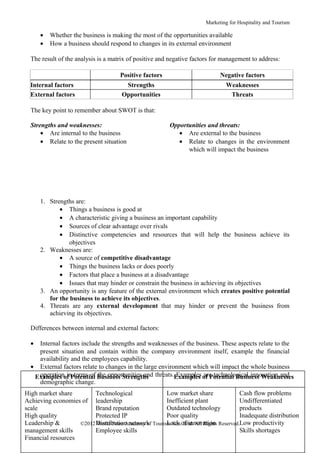
   Examples of Potential Business Strengths threats.Examples of Potential Business Weaknesses
    operation in terms of the opportunities and           Examples are technological innovation and
    demographic change.
High market share         Technological              Low market share             Cash flow problems
Achieving economies of leadership                    Inefficient plant            Undifferentiated
scale                     Brand reputation           Outdated technology          products
High quality              Protected IP               Poor quality                 Inadequate distribution
Leadership &        ©2012 Distribution network Tourism Sdn.of innovation Reserved.Low productivity
                          World-Point Academy of     Lack Bhd. All Rights
management skills         Employee skills                                         Skills shortages
Financial resources
Marketing for Hospitality and Tourism


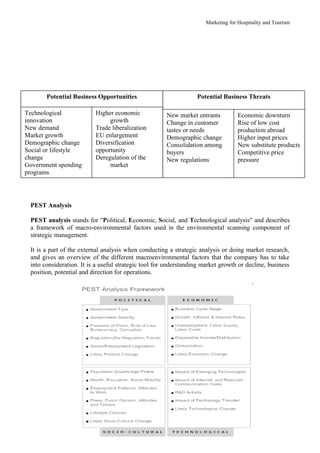
       Potential Business Opportunities                              Potential Business Threats

Technological             Higher economic               New market entrants           Economic downturn
innovation                     growth                   Change in customer            Rise of low cost
New demand                Trade liberalization          tastes or needs               production abroad
Market growth             EU enlargement                Demographic change            Higher input prices
Demographic change        Diversification               Consolidation among           New substitute products
Social or lifestyle       opportunity                   buyers                        Competitive price
change                    Deregulation of the           New regulations               pressure
Government spending            market
programs


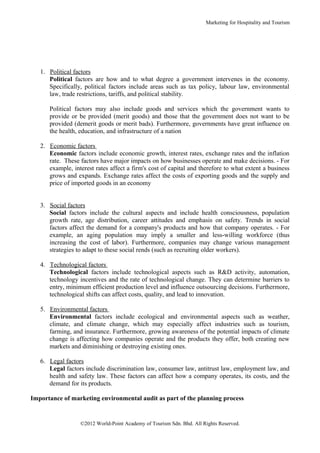
 PEST Analysis

 PEST analysis stands for "Political, Economic, Social, and Technological analysis" and describes
 a framework of macro-environmental factors used in the environmental scanning component of
 strategic management.

 It is a part of the external analysis when conducting a strategic analysis or doing market research,
 and gives an overview of the different macroenvironmental factors that the company has to take
 into consideration. It is a useful strategic tool for understanding market growth or decline, business
 position, potential and direction for operations.


                    ©2012 World-Point Academy of Tourism Sdn. Bhd. All Rights Reserved.
Marketing for Hospitality and Tourism


   1. Political factors
      Political factors are how and to what degree a government intervenes in the economy.
      Specifically, political factors include areas such as tax policy, labour law, environmental
      law, trade restrictions, tariffs, and political stability.

      Political factors may also include goods and services which the government wants to
      provide or be provided (merit goods) and those that the government does not want to be
      provided (demerit goods or merit bads). Furthermore, governments have great influence on
      the health, education, and infrastructure of a nation

   2. Economic factors
      Economic factors include economic growth, interest rates, exchange rates and the inflation
      rate. These factors have major impacts on how businesses operate and make decisions. - For
      example, interest rates affect a firm's cost of capital and therefore to what extent a business
      grows and expands. Exchange rates affect the costs of exporting goods and the supply and
      price of imported goods in an economy


   3. Social factors
      Social factors include the cultural aspects and include health consciousness, population
      growth rate, age distribution, career attitudes and emphasis on safety. Trends in social
      factors affect the demand for a company's products and how that company operates. - For
      example, an aging population may imply a smaller and less-willing workforce (thus
      increasing the cost of labor). Furthermore, companies may change various management
      strategies to adapt to these social rends (such as recruiting older workers).

   4. Technological factors
      Technological factors include technological aspects such as R&D activity, automation,
      technology incentives and the rate of technological change. They can determine barriers to
      entry, minimum efficient production level and influence outsourcing decisions. Furthermore,
      technological shifts can affect costs, quality, and lead to innovation.

   5. Environmental factors
      Environmental factors include ecological and environmental aspects such as weather,
      climate, and climate change, which may especially affect industries such as tourism,
      farming, and insurance. Furthermore, growing awareness of the potential impacts of climate
      change is affecting how companies operate and the products they offer, both creating new
      markets and diminishing or destroying existing ones.

   6. Legal factors
      Legal factors include discrimination law, consumer law, antitrust law, employment law, and
      health and safety law. These factors can affect how a company operates, its costs, and the
      demand for its products.

Importance of marketing environmental audit as part of the planning process


                  ©2012 World-Point Academy of Tourism Sdn. Bhd. All Rights Reserved.
Marketing for Hospitality and Tourism

   a. The audit provides the marketers with an in depth view of the marketing activities that are
      going around in the concern. It brings out a complete picture of the entire operations of the
      concern.
   b. A marketing audit can help a company refine its business practices and improve its
      productivity and profitability.
   c. Marketing audit helps to marketing executives, top management and investors to ensure that
      they are doing the right things to help drive growth for their organizations.
   d. A marketing audit is a careful examination and evaluation of marketing practices and
      results. It offers a baseline for performance measurements and a framework for effective
      business planning to maximize positive external perception and demand generation.
   e. An audit helps the company determine the value of a sale and a sales lead.


                     CHAPTER 3:
MARKETING INFORMATION SYSTEMS AND MARKETING RESEARCH


     Chapter objectives
     • Explain the concept of the marketing information system
     • Identify the different kinds of information the company might use
     • Outline the marketing research process, including defining the problem and research plan,
       implementing the research plan, and interpreting and reporting the findings


The Marketing Information System (MIS)

An MIS consists of people, equipment and procedures to gather, sort, analyze, evaluate and
distribute needed, timely and accurate information to marketing decision makers. The MIS begins
and ends with marketing managers, but managers throughout the organization should be involved in
the MIS.

   1. The MIS interacts with managers to assess their information needs
   2. It develops needed information from internal company records, marketing intelligence
      activities and the marketing research process - Information analysts process information to
      make it more useful
   3. The MIS distributes information to managers in the right form and at the right time to help
      in marketing planning, implementation and control.
                  ©2012 World-Point Academy of Tourism Sdn. Bhd. All Rights Reserved.
Marketing for Hospitality and Tourism


Internal company records

Internal records – internal records information consists of information gathered from sources within
the company to evaluate marketing performance and to detect marketing problems and
opportunities
    • Many companies use internal records to build extensive internal databases, computerized
        collections of information obtained from data sources within the company
    • Marketing managers can readily access and work with information in the database to
        identify marketing opportunities and problems, plan programs, and evaluate performance

Marketing intelligence

Marketing intelligence – marketing intelligence includes everyday information about developments
in the marketing environment that help managers to prepare and adjust marketing plans and short-
run tactics. Marketing intelligence can come from internal sources or external sources
    1. Internal sources – include the company’s executives, owners and employees
        The company must sell the employees on their role as intelligence gatherers and train them
        to spot and report new developments
    2. External sources – include competitors, government agencies, suppliers, trade magazines,
        newspapers, business magazines, trade association newsletters and meetings, and databases
        available on the internet.
        Three types: (1) macro-market information, (2) competitive information, and (3) new
        innovation and trends.
Marketing research process

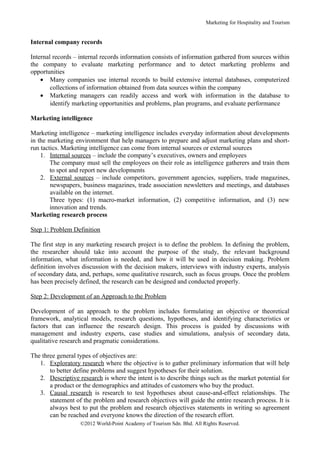
Step 1: Problem Definition

The first step in any marketing research project is to define the problem. In defining the problem,
the researcher should take into account the purpose of the study, the relevant background
information, what information is needed, and how it will be used in decision making. Problem
definition involves discussion with the decision makers, interviews with industry experts, analysis
of secondary data, and, perhaps, some qualitative research, such as focus groups. Once the problem
has been precisely defined, the research can be designed and conducted properly.

Step 2: Development of an Approach to the Problem

Development of an approach to the problem includes formulating an objective or theoretical
framework, analytical models, research questions, hypotheses, and identifying characteristics or
factors that can influence the research design. This process is guided by discussions with
management and industry experts, case studies and simulations, analysis of secondary data,
qualitative research and pragmatic considerations.

The three general types of objectives are:
   1. Exploratory research where the objective is to gather preliminary information that will help
       to better define problems and suggest hypotheses for their solution.
   2. Descriptive research is where the intent is to describe things such as the market potential for
       a product or the demographics and attitudes of customers who buy the product.
   3. Causal research is research to test hypotheses about cause-and-effect relationships. The
       statement of the problem and research objectives will guide the entire research process. It is
       always best to put the problem and research objectives statements in writing so agreement
       can be reached and everyone knows the direction of the research effort.
                   ©2012 World-Point Academy of Tourism Sdn. Bhd. All Rights Reserved.
Marketing for Hospitality and Tourism


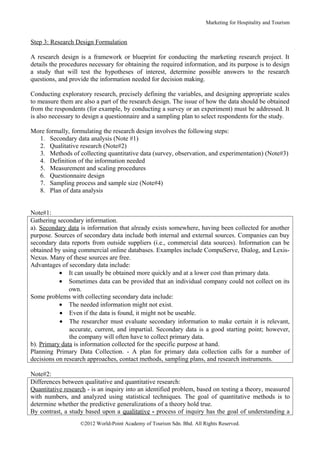
Step 3: Research Design Formulation

A research design is a framework or blueprint for conducting the marketing research project. It
details the procedures necessary for obtaining the required information, and its purpose is to design
a study that will test the hypotheses of interest, determine possible answers to the research
questions, and provide the information needed for decision making.

Conducting exploratory research, precisely defining the variables, and designing appropriate scales
to measure them are also a part of the research design. The issue of how the data should be obtained
from the respondents (for example, by conducting a survey or an experiment) must be addressed. It
is also necessary to design a questionnaire and a sampling plan to select respondents for the study.

More formally, formulating the research design involves the following steps:
  1. Secondary data analysis (Note #1)
  2. Qualitative research (Note#2)
  3. Methods of collecting quantitative data (survey, observation, and experimentation) (Note#3)
  4. Definition of the information needed
  5. Measurement and scaling procedures
  6. Questionnaire design
  7. Sampling process and sample size (Note#4)
  8. Plan of data analysis


Note#1:
Gathering secondary information.
a). Secondary data is information that already exists somewhere, having been collected for another
purpose. Sources of secondary data include both internal and external sources. Companies can buy
secondary data reports from outside suppliers (i.e., commercial data sources). Information can be
obtained by using commercial online databases. Examples include CompuServe, Dialog, and Lexis-
Nexus. Many of these sources are free.
Advantages of secondary data include:
           • It can usually be obtained more quickly and at a lower cost than primary data.
           • Sometimes data can be provided that an individual company could not collect on its
               own.
Some problems with collecting secondary data include:
           • The needed information might not exist.
           • Even if the data is found, it might not be useable.
           • The researcher must evaluate secondary information to make certain it is relevant,
               accurate, current, and impartial. Secondary data is a good starting point; however,
               the company will often have to collect primary data.
b). Primary data is information collected for the specific purpose at hand.
Planning Primary Data Collection. - A plan for primary data collection calls for a number of
decisions on research approaches, contact methods, sampling plans, and research instruments.

Note#2:
Differences between qualitative and quantitative research:
Quantitative research - is an inquiry into an identified problem, based on testing a theory, measured
with numbers, and analyzed using statistical techniques. The goal of quantitative methods is to
determine whether the predictive generalizations of a theory hold true.
By contrast, a study based upon a qualitative - process of inquiry has the goal of understanding a
                   ©2012 World-Point Academy of Tourism Sdn. Bhd. All Rights Reserved.
Marketing for Hospitality and Tourism

social or human problem from multiple perspectives. Qualitative research is conducted in a natural
setting and involves a process of building a complex and holistic picture of the phenomenon of
interest.

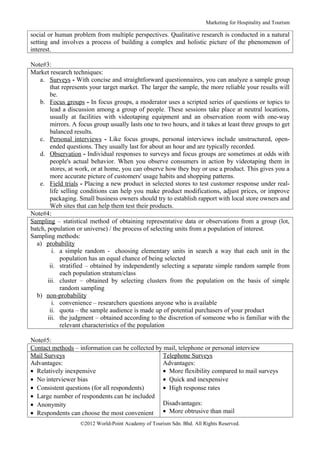
Note#3:
Market research techniques:
    a. Surveys - With concise and straightforward questionnaires, you can analyze a sample group
        that represents your target market. The larger the sample, the more reliable your results will
        be.
    b. Focus groups - In focus groups, a moderator uses a scripted series of questions or topics to
        lead a discussion among a group of people. These sessions take place at neutral locations,
        usually at facilities with videotaping equipment and an observation room with one-way
        mirrors. A focus group usually lasts one to two hours, and it takes at least three groups to get
        balanced results.
    c. Personal interviews - Like focus groups, personal interviews include unstructured, open-
        ended questions. They usually last for about an hour and are typically recorded.
    d. Observation - Individual responses to surveys and focus groups are sometimes at odds with
        people's actual behavior. When you observe consumers in action by videotaping them in
        stores, at work, or at home, you can observe how they buy or use a product. This gives you a
        more accurate picture of customers' usage habits and shopping patterns.
    e. Field trials - Placing a new product in selected stores to test customer response under real-
        life selling conditions can help you make product modifications, adjust prices, or improve
        packaging. Small business owners should try to establish rapport with local store owners and
        Web sites that can help them test their products.
Note#4:
Sampling – statistical method of obtaining representative data or observations from a group (lot,
batch, population or universe) / the process of selecting units from a population of interest.
Sampling methods:
  a) probability
         i. a simple random - choosing elementary units in search a way that each unit in the
            population has an equal chance of being selected
        ii. stratified – obtained by independently selecting a separate simple random sample from
            each population stratum/class
       iii. cluster – obtained by selecting clusters from the population on the basis of simple
            random sampling
  b) non-probability
         i. convenience – researchers questions anyone who is available
        ii. quota – the sample audience is made up of potential purchasers of your product
       iii. the judgment – obtained according to the discretion of someone who is familiar with the
            relevant characteristics of the population

Note#5:
Contact methods – information can be collected by mail, telephone or personal interview
Mail Surveys                                     Telephone Surveys
Advantages:                                      Advantages:
• Relatively inexpensive                         • More flexibility compared to mail surveys
• No interviewer bias                            • Quick and inexpensive
• Consistent questions (for all respondents)     • High response rates
• Large number of respondents can be included
• Anonymity                                      Disadvantages:
• Respondents can choose the most convenient • More obtrusive than mail
                    ©2012 World-Point Academy of Tourism Sdn. Bhd. All Rights Reserved.
Marketing for Hospitality and Tourism

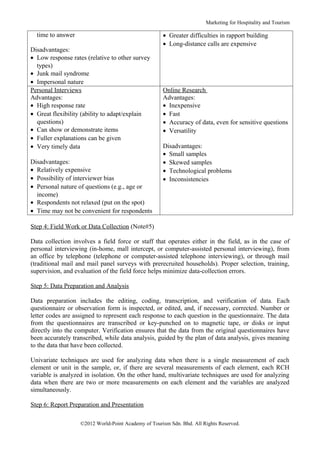
  time to answer                                     • Greater difficulties in rapport building
                                                     • Long-distance calls are expensive
Disadvantages:
• Low response rates (relative to other survey
  types)
• Junk mail syndrome
• Impersonal nature
Personal Interviews                                  Online Research
Advantages:                                          Advantages:
• High response rate                                 • Inexpensive
• Great flexibility (ability to adapt/explain        • Fast
  questions)                                         • Accuracy of data, even for sensitive questions
• Can show or demonstrate items                      • Versatility
• Fuller explanations can be given
• Very timely data                                   Disadvantages:
                                                     • Small samples
Disadvantages:                                       • Skewed samples
• Relatively expensive                               • Technological problems
• Possibility of interviewer bias                    • Inconsistencies
• Personal nature of questions (e.g., age or
  income)
• Respondents not relaxed (put on the spot)
• Time may not be convenient for respondents

Step 4: Field Work or Data Collection (Note#5)

Data collection involves a field force or staff that operates either in the field, as in the case of
personal interviewing (in-home, mall intercept, or computer-assisted personal interviewing), from
an office by telephone (telephone or computer-assisted telephone interviewing), or through mail
(traditional mail and mail panel surveys with prerecruited households). Proper selection, training,
supervision, and evaluation of the field force helps minimize data-collection errors.

Step 5: Data Preparation and Analysis

Data preparation includes the editing, coding, transcription, and verification of data. Each
questionnaire or observation form is inspected, or edited, and, if necessary, corrected. Number or
letter codes are assigned to represent each response to each question in the questionnaire. The data
from the questionnaires are transcribed or key-punched on to magnetic tape, or disks or input
directly into the computer. Verification ensures that the data from the original questionnaires have
been accurately transcribed, while data analysis, guided by the plan of data analysis, gives meaning
to the data that have been collected.

Univariate techniques are used for analyzing data when there is a single measurement of each
element or unit in the sample, or, if there are several measurements of each element, each RCH
variable is analyzed in isolation. On the other hand, multivariate techniques are used for analyzing
data when there are two or more measurements on each element and the variables are analyzed
simultaneously.

Step 6: Report Preparation and Presentation

                   ©2012 World-Point Academy of Tourism Sdn. Bhd. All Rights Reserved.
Marketing for Hospitality and Tourism

The entire project should be documented in a written report which addresses the specific research
questions identified, describes the approach, the research design, data collection, and data analysis
procedures adopted, and presents the results and the major findings. The findings should be
presented in a comprehensible format so that they can be readily used in the decision making
process. In addition, an oral presentation should be made to management using tables, figures, and
graphs to enhance clarity and impact.

For these reasons, interviews with experts are more useful in conducting marketing research for
industrial firms and for products of a technical nature, where it is relatively easy to identify and
approach the experts. This method is also helpful in situations where little information is available
from other sources, as in the case of radically new products.


                       CHAPTER 4:
      CONSUMER AND ORGANIZATIONAL MARKETS AND BUYING
                        BEHAVIOR


     Chapter objectives
     • Name the elements of the stimulus-response model of consumer and organizational
       behavior
     • Outline the major characteristics affecting consumer and organizational behavior
     • Explain the buyer and organizational decision process


Model of consumer behavior

The company that really understands how consumers will respond to different product features,
prices and advertising appeals has a great advantage over its competitors. As a result, researchers
from companies and universities have heavily studied the relationship between marketing stimuli
and consumer response.
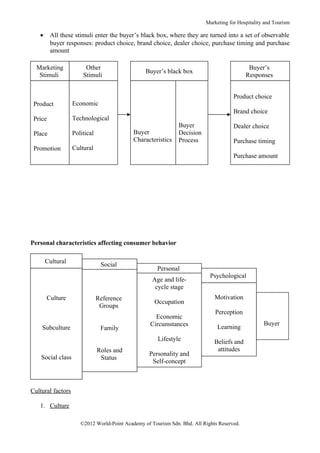
    • The marketing stimuli consist of the 4P’s
    • Other stimuli include major forces and events in the buyer’s environment: economic,
        technological, political and cultural


                   ©2012 World-Point Academy of Tourism Sdn. Bhd. All Rights Reserved.
Marketing for Hospitality and Tourism

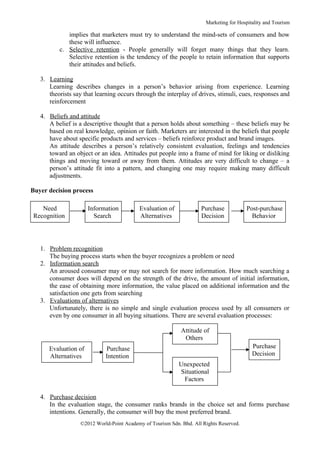
   •     All these stimuli enter the buyer’s black box, where they are turned into a set of observable
         buyer responses: product choice, brand choice, dealer choice, purchase timing and purchase
         amount

  Marketing             Other                                                                Buyer’s
                                                 Buyer’s black box
   Stimuli             Stimuli                                                              Responses


                                                                                      Product choice
 Product           Economic
                                                                                      Brand choice
 Price             Technological
                                                               Buyer                  Dealer choice
 Place             Political                Buyer              Decision
                                            Characteristics    Process                Purchase timing
 Promotion         Cultural
                                                                                      Purchase amount


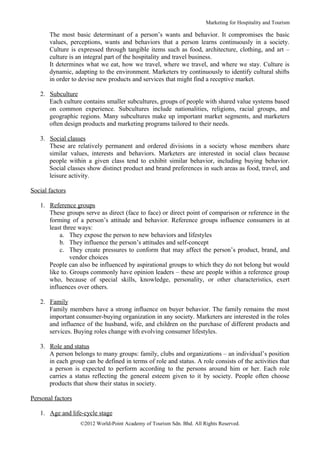
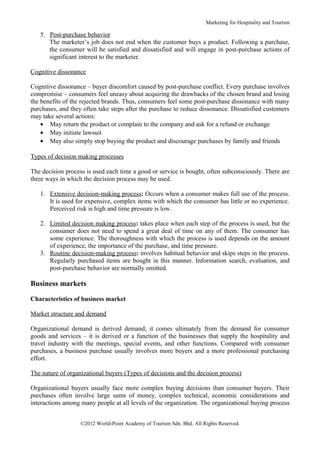
Personal characteristics affecting consumer behavior

       Cultural                 Social
                                                      Personal
                                                                            Psychological
                                                    Age and life-
                                                     cycle stage
       Culture                 Reference                                      Motivation
                                                     Occupation
                                Groups
                                                                              Perception
                                                     Economic
                                                   Circumstances                                   Buyer
    Subculture                  Family                                         Learning
                                                      Lifestyle               Beliefs and
                               Roles and                                       attitudes
                                                  Personality and
    Social class                Status
                                                   Self-concept


Cultural factors

   1. Culture

                      ©2012 World-Point Academy of Tourism Sdn. Bhd. All Rights Reserved.
Marketing for Hospitality and Tourism

       The most basic determinant of a person’s wants and behavior. It compromises the basic
       values, perceptions, wants and behaviors that a person learns continuously in a society.
       Culture is expressed through tangible items such as food, architecture, clothing, and art –
       culture is an integral part of the hospitality and travel business.
       It determines what we eat, how we travel, where we travel, and where we stay. Culture is
       dynamic, adapting to the environment. Marketers try continuously to identify cultural shifts
       in order to devise new products and services that might find a receptive market.

   2. Subculture
      Each culture contains smaller subcultures, groups of people with shared value systems based
      on common experience. Subcultures include nationalities, religions, racial groups, and
      geographic regions. Many subcultures make up important market segments, and marketers
      often design products and marketing programs tailored to their needs.

   3. Social classes
      These are relatively permanent and ordered divisions in a society whose members share
      similar values, interests and behaviors. Marketers are interested in social class because
      people within a given class tend to exhibit similar behavior, including buying behavior.
      Social classes show distinct product and brand preferences in such areas as food, travel, and
      leisure activity.

Social factors

   1. Reference groups
      These groups serve as direct (face to face) or direct point of comparison or reference in the
      forming of a person’s attitude and behavior. Reference groups influence consumers in at
      least three ways:
          a. They expose the person to new behaviors and lifestyles
          b. They influence the person’s attitudes and self-concept
          c. They create pressures to conform that may affect the person’s product, brand, and
               vendor choices
      People can also be influenced by aspirational groups to which they do not belong but would
      like to. Groups commonly have opinion leaders – these are people within a reference group
      who, because of special skills, knowledge, personality, or other characteristics, exert
      influences over others.

   2. Family
      Family members have a strong influence on buyer behavior. The family remains the most
      important consumer-buying organization in any society. Marketers are interested in the roles
      and influence of the husband, wife, and children on the purchase of different products and
      services. Buying roles change with evolving consumer lifestyles.

   3. Role and status
      A person belongs to many groups: family, clubs and organizations – an individual’s position
      in each group can be defined in terms of role and status. A role consists of the activities that
      a person is expected to perform according to the persons around him or her. Each role
      carries a status reflecting the general esteem given to it by society. People often choose
      products that show their status in society.

Personal factors

   1. Age and life-cycle stage
                   ©2012 World-Point Academy of Tourism Sdn. Bhd. All Rights Reserved.
Marketing for Hospitality and Tourism

       The types of goods and services people buy change during their lifetimes – preferences for
       leisure activities, travel destinations, food, and entertainment are often age related. As
       people grow older and mature, the products they desire change. The makeup of the family
       also affects purchasing behavior. Successful marketing to various age segments may require
       specialized and targeted strategies.

   2. Occupation
      A person’s occupation affects the goods and services bought. Marketers try to identify
      occupational groups that have above-average interest in their products

   3. Economic situation
      A person’s economic situation greatly affects product choice and the decision to purchase a
      particular product. Marketers need to watch trends in personal income, savings and interest
      rates.

   4. Lifestyle
      Lifestyle profiles a person’s whole pattern of acting and interacting in the world. Lifestyle
      portrays the “whole person” interacting with his/her environment. Marketers search for
      relationships between their products and people who are achievement oriented. When used
      carefully, the lifestyle concept can help the marketer understand changing consumer values
      and how they affect buying behavior.

   5. Personality and self-concept
      Each person’s personality influences his or her buying behavior. By personality we mean
      distinguishing psychological characteristics that disclose a person’s relatively
      individualized, consistent and enduring responses to the environment. Personality can be
      useful in analyzing consumer behavior for some product or brand choices.

       Many marketers use a concept related to personality: a person’s self-concept (also called
       self-image). Each of us has a complex mental self-picture, and our behavior tends to be
       consistent with that self-image. The role of self-concept obviously has a strong bearing on
       the selection of recreational pursuits such as golf, sailing, fishing and hunting.

Psychological factors

   1. Motivation
      A need becomes a motive when it is aroused to a sufficient level of intensity. Creating a
      tension state causes a person to act to release the tension. Most popular theory of motivation:
      is Maslow’s Theory (refer to Chapter#1).

   2. Perception
      Perception is the process by which a person selects, organizes and interprets information to
      create a meaningful picture of the world. There are three perceptual processes:
          a. Selective attention - Selective attention is the tendency for people to screen out most
              of the information to which they are exposed. For example, the average person may
              be exposed to more than 500 ads in all these stimuli. It implies that marketers have to
              act carefully to attract the consumer’s attention. Their message will not reach the
              most people who are not in the market. Even people who are in the market may miss
              the message unless it is distinctive from other advertisements.
          b. Selective distortion - Selective distortion explains the tendency of people to interpret
              information in a way that will support their existing belief. Selective distortion

                  ©2012 World-Point Academy of Tourism Sdn. Bhd. All Rights Reserved.
Marketing for Hospitality and Tourism

             implies that marketers must try to understand the mind-sets of consumers and how
             these will influence.
          c. Selective retention - People generally will forget many things that they learn.
             Selective retention is the tendency of the people to retain information that supports
             their attitudes and beliefs.

   3. Learning
      Learning describes changes in a person’s behavior arising from experience. Learning
      theorists say that learning occurs through the interplay of drives, stimuli, cues, responses and
      reinforcement

   4. Beliefs and attitude
      A belief is a descriptive thought that a person holds about something – these beliefs may be
      based on real knowledge, opinion or faith. Marketers are interested in the beliefs that people
      have about specific products and services – beliefs reinforce product and brand images.
      An attitude describes a person’s relatively consistent evaluation, feelings and tendencies
      toward an object or an idea. Attitudes put people into a frame of mind for liking or disliking
      things and moving toward or away from them. Attitudes are very difficult to change – a
      person’s attitude fit into a pattern, and changing one may require making many difficult
      adjustments.

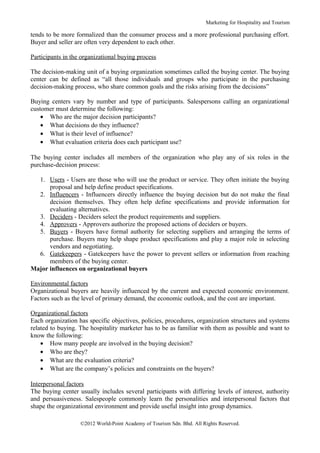
Buyer decision process

   Need               Information         Evaluation of             Purchase            Post-purchase
Recognition             Search            Alternatives              Decision              Behavior


   1. Problem recognition
      The buying process starts when the buyer recognizes a problem or need
   2. Information search
      An aroused consumer may or may not search for more information. How much searching a
      consumer does will depend on the strength of the drive, the amount of initial information,
      the ease of obtaining more information, the value placed on additional information and the
      satisfaction one gets from searching
   3. Evaluations of alternatives
      Unfortunately, there is no simple and single evaluation process used by all consumers or
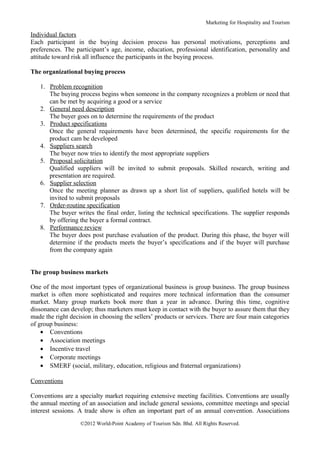
      even by one consumer in all buying situations. There are several evaluation processes:

                                                            Attitude of
                                                             Others
      Evaluation of         Purchase                                                      Purchase
      Alternatives          Intention                                                     Decision
                                                           Unexpected
                                                           Situational
                                                            Factors

   4. Purchase decision
      In the evaluation stage, the consumer ranks brands in the choice set and forms purchase
      intentions. Generally, the consumer will buy the most preferred brand.
                  ©2012 World-Point Academy of Tourism Sdn. Bhd. All Rights Reserved.
Marketing for Hospitality and Tourism

   5. Post-purchase behavior
      The marketer’s job does not end when the customer buys a product. Following a purchase,
      the consumer will be satisfied and dissatisfied and will engage in post-purchase actions of
      significant interest to the marketer.

Cognitive dissonance

Cognitive dissonance – buyer discomfort caused by post-purchase conflict. Every purchase involves
compromise – consumers feel uneasy about acquiring the drawbacks of the chosen brand and losing
the benefits of the rejected brands. Thus, consumers feel some post-purchase dissonance with many
purchases, and they often take steps after the purchase to reduce dissonance. Dissatisfied customers
may take several actions:
    • May return the product or complain to the company and ask for a refund or exchange
    • May initiate lawsuit
    • May also simply stop buying the product and discourage purchases by family and friends

Types of decision making processes

The decision process is used each time a good or service is bought, often subconsciously. There are
three ways in which the decision process may be used.

   1. Extensive decision-making process: Occurs when a consumer makes full use of the process.
      It is used for expensive, complex items with which the consumer has little or no experience.
      Perceived risk is high and time pressure is low.

   2. Limited decision making process: takes place when each step of the process is used, but the
      consumer does not need to spend a great deal of time on any of them. The consumer has
      some experience. The thoroughness with which the process is used depends on the amount
      of experience, the importance of the purchase, and time pressure.
   3. Routine decision-making process: involves habitual behavior and skips steps in the process.
      Regularly purchased items are bought in this manner. Information search, evaluation, and
      post-purchase behavior are normally omitted.

Business markets

Characteristics of business market

Market structure and demand

Organizational demand is derived demand; it comes ultimately from the demand for consumer
goods and services – it is derived or a function of the businesses that supply the hospitality and
travel industry with the meetings, special events, and other functions. Compared with consumer
purchases, a business purchase usually involves more buyers and a more professional purchasing
effort.

The nature of organizational buyers (Types of decisions and the decision process)

Organizational buyers usually face more complex buying decisions than consumer buyers. Their
purchases often involve large sums of money, complex technical, economic considerations and
interactions among many people at all levels of the organization. The organizational buying process


                   ©2012 World-Point Academy of Tourism Sdn. Bhd. All Rights Reserved.
Marketing for Hospitality and Tourism

tends to be more formalized than the consumer process and a more professional purchasing effort.
Buyer and seller are often very dependent to each other.

Participants in the organizational buying process

The decision-making unit of a buying organization sometimes called the buying center. The buying
center can be defined as “all those individuals and groups who participate in the purchasing
decision-making process, who share common goals and the risks arising from the decisions”

Buying centers vary by number and type of participants. Salespersons calling an organizational
customer must determine the following:
    • Who are the major decision participants?
    • What decisions do they influence?
    • What is their level of influence?
    • What evaluation criteria does each participant use?

The buying center includes all members of the organization who play any of six roles in the
purchase-decision process:

  1. Users - Users are those who will use the product or service. They often initiate the buying
      proposal and help define product specifications.
  2. Influencers - Influencers directly influence the buying decision but do not make the final
      decision themselves. They often help define specifications and provide information for
      evaluating alternatives.
  3. Deciders - Deciders select the product requirements and suppliers.
  4. Approvers - Approvers authorize the proposed actions of deciders or buyers.
  5. Buyers - Buyers have formal authority for selecting suppliers and arranging the terms of
      purchase. Buyers may help shape product specifications and play a major role in selecting
      vendors and negotiating.
  6. Gatekeepers - Gatekeepers have the power to prevent sellers or information from reaching
      members of the buying center.
Major influences on organizational buyers

Environmental factors
Organizational buyers are heavily influenced by the current and expected economic environment.
Factors such as the level of primary demand, the economic outlook, and the cost are important.

Organizational factors
Each organization has specific objectives, policies, procedures, organization structures and systems
related to buying. The hospitality marketer has to be as familiar with them as possible and want to
know the following:
    • How many people are involved in the buying decision?
    • Who are they?
    • What are the evaluation criteria?
    • What are the company’s policies and constraints on the buyers?

Interpersonal factors
The buying center usually includes several participants with differing levels of interest, authority
and persuasiveness. Salespeople commonly learn the personalities and interpersonal factors that
shape the organizational environment and provide useful insight into group dynamics.

                   ©2012 World-Point Academy of Tourism Sdn. Bhd. All Rights Reserved.
Marketing for Hospitality and Tourism

Individual factors
Each participant in the buying decision process has personal motivations, perceptions and
preferences. The participant’s age, income, education, professional identification, personality and
attitude toward risk all influence the participants in the buying process.

The organizational buying process

   1. Problem recognition
      The buying process begins when someone in the company recognizes a problem or need that
      can be met by acquiring a good or a service
   2. General need description
      The buyer goes on to determine the requirements of the product
   3. Product specifications
      Once the general requirements have been determined, the specific requirements for the
      product cam be developed
   4. Suppliers search
      The buyer now tries to identify the most appropriate suppliers
   5. Proposal solicitation
      Qualified suppliers will be invited to submit proposals. Skilled research, writing and
      presentation are required.
   6. Supplier selection
      Once the meeting planner as drawn up a short list of suppliers, qualified hotels will be
      invited to submit proposals
   7. Order-routine specification
      The buyer writes the final order, listing the technical specifications. The supplier responds
      by offering the buyer a formal contract.
   8. Performance review
      The buyer does post purchase evaluation of the product. During this phase, the buyer will
      determine if the products meets the buyer’s specifications and if the buyer will purchase
      from the company again


The group business markets

One of the most important types of organizational business is group business. The group business
market is often more sophisticated and requires more technical information than the consumer
market. Many group markets book more than a year in advance. During this time, cognitive
dissonance can develop; thus marketers must keep in contact with the buyer to assure them that they
made the right decision in choosing the sellers’ products or services. There are four main categories
of group business:
    • Conventions
    • Association meetings
    • Incentive travel
    • Corporate meetings
    • SMERF (social, military, education, religious and fraternal organizations)

Conventions

Conventions are a specialty market requiring extensive meeting facilities. Conventions are usually
the annual meeting of an association and include general sessions, committee meetings and special
interest sessions. A trade show is often an important part of an annual convention. Associations
                   ©2012 World-Point Academy of Tourism Sdn. Bhd. All Rights Reserved.
Marketing for Hospitality and Tourism

usually select convention sites two to five years in advance, with some large conventions planned
ten to fifteen years before the event. Important attributes for a convention planner other than
facilities and rates are food quality, billing procedures, and the professionalism and attention of the
staff. Convention bureaus – non-profit marketing organizations that help hotels sign conventions
and meetings.

Association meetings

Associations sponsor many types of meetings, including regional, special interest, educational and
board meetings. The most important attributes of a destination for an association meeting planner
are availability of hotel and facilities, ease of transportation, distance from attendees, and
transportation costs. Members attend association meetings voluntarily. The hotel should work with
meeting planners to make the destination seem as attractive as possible. Making sure that the
meeting planner is aware of local attractions, offering suggestions for spousal activities, and
assisting in the development of after-convention activities can be useful to the hotel and the meeting
planner.

Corporate meetings

A corporate meeting is a command performance for employees of a company – they are directed to
attend the meeting without choice. The corporation’s major concern is that the meeting be
productive and accomplish the company’s objectives. Types of corporate meetings include training,
management and planning; another type is the incentive meeting. The most important attributes of a
destination are availability of hotel and facilities, ease of transportation, distance from attendees,
and transportation costs. Corporate culture also plays an important part in the choice of a hotel.

Small groups - Meetings of less than fifty rooms are gaining the attention of hotels and hotel chains

Incentive travel

Incentive travel, a unique subset of corporate group business, is a reward participants receive for
achieving or exceeding a goal - Companies give awards for both individual and team performance.
Because travel serves as the reward, participants must perceive the destination the hotel as
something special. Climate, recreational facilities, and sightseeing opportunities are high on an
incentive meeting planners’ list of attributes looked for in a site.

Incentive travel is handled in house or by incentive houses, travel agencies, consultants, and travel
fulfillment firms that handle only the travel arrangements. Incentive houses usually provide a choice
of several locations to the company, so the ultimate choice of location is made by the company,
even when it uses an incentive house.

SMERF groups

Stands for social, military, education, religious and fraternal organizations. This group of specialty
markets has a common price-sensitive thread. On the positive side, they are willing to be flexible to
ensure a lower room rate – they are willing to meet during the off-season or on week-ends.
Someone new to hotel sales will often start with the SMERF market.

Dealing with meeting planners

When negotiating with meeting planners, it is important to try to develop a win-win relationship.
Meeting planners like to return to the same property. One successful technique for negotiating with
                   ©2012 World-Point Academy of Tourism Sdn. Bhd. All Rights Reserved.
Marketing for Hospitality and Tourism

a meeting planner is to determine the group’s requirement and work out a package based on needs
and budget - Taking a consultative approach is more effective.

Most meeting planners maintain a history of the group for the purpose of planning future meetings –
a salesperson can gain valuable information by asking questions about past conferences. Ultimately,
when dealing with group business, the hotel has to please both the meeting planner and the meeting
planner’s clients. One of the most important aspects creating successful function is a pre-function
meeting between the hotel staff and the meeting planner before the function

The corporate account and travel manager

A non-group form of organizational business is the individual business traveler. Most hotels offer a
corporate rate, which is intended to provide an incentive for corporations to use the hotel. When
negotiating a corporate contract, it is important to understand what creates value for the company.
The corporate business traveler is a sought-after segment. In addition to paying a good rate, the
business travelers also on an expense account and makes use of the hotel’s restaurants, health club,
laundry and business center facilities.

The most important attributes to the travel managers when negotiating a hotel contract are:
   • A favorable image of the hotel’s brand by the company’s travelers
   • Guaranteed availability of negotiated rate
   • Location
   • Reputation of the hotel’s brand
   • Negotiated rate
   • Flexibility on charges for late cancellation of room reservations


                        CHAPTER 5:
       MARKET SEGMENTATION, TARGETING AND POSITIONING

     Chapter objectives
     • Explain market segmentation, and identify several possible bases for segmenting consumer
       markets, business markets and international markets
     • List and distinguish among the requirements for effective segmentation: measurability,
       accessibility, substantially and actionability
     • Outline the process of evaluating market segments and suggest some methods for selecting
       market segments
     • Illustrate the concept of positioning for competitive advantage by offering specific
       examples
     • Discuss choosing and implementing a positioning strategy and contrast positioning based
       on product, service, personnel and image differentiation


                   ©2012 World-Point Academy of Tourism Sdn. Bhd. All Rights Reserved.
Marketing for Hospitality and Tourism

Markets

Market: a market is the set of all actual and potential buyers of products

Market stages:
   • Mass marketing (no segmentation) - The seller mass produces, mass distributes and mass
      promotes one product to all buyers
   • Segment marketing (some segmentation) - The seller produces two or more products that
      have different features, styles, quality, sizes and so on
   • Micromarketing (complete segmentation) - The sellers offer products to suit the tastes of
      individuals and location
   • Customized marketing (niche segmentation) - Offer different products to subgroups within
      segment

Target marketing

Target marketing: the seller identifies market segments, selects one or more, and develops
products and marketing mixes tailored to each selected segment

Market segmentation
The process of dividing a market into distinct groups of buyers who might require separate products
and/or marketing mixes

Market targeting
The process of evaluating each segment’s attractiveness and selecting one or more of the market
segments

Positioning
The process of developing a competitive positioning for the product and an appropriate marketing
mix


Steps in segmentation, targeting and positioning:
 Identify bases for
                                            Develop measures of                    Develop positioning for
 segmenting the market
                                            segment attractiveness                 each target segment
 Develop profiles of
                                            Select the target                      Develop marketing mix for
 resulting segments
                                            segment (s)                            each target segment
      Market segmentation                                                              Market positioning
                                               Market targeting


Market segmentation

There is no single way to segment a market. A marketer has to try different segmentation variables,
alone and in combination, hoping to find the best way to view the market structure

   1. Geographic segmentation

                   ©2012 World-Point Academy of Tourism Sdn. Bhd. All Rights Reserved.
Marketing for Hospitality and Tourism

   Dividing the market into different geographic units, such as nations, states, regions,
   counties, cities or neighborhoods. Geographic location also relates to culture, language and
   business attitudes. For example, Middle Eastern,European, North American, South
   American and Asiancompanies will all have different sets of businessstandards and
   communication requirements. Knowledge of geographic customer preferences permits a
   company to modify or change its product offering. For example pizza, KFC, banks
   extending there business by opening different branches. The success of local and regional
   tourism depends upon creative geographical segmentation.

2. Demographic segmentation

   Dividing the market into groups based on demographic variables such as age, gender, family
   life cycle, income, occupation, education, religion, race and nationality. Major factors are:
        a. Age and life-cycle stage – consumer preferences change with age. Some companies
           offer different products or marketing strategies to penetrate various age and life-
           cycle segments.
        b. Gender – Gender marketing is by no means simplistic. Gender marketing is most
           effective when combined with lifestyle and demographic information.
        c. Income – the lodging industry is particularly effective in using income segmentation.
           Income does not always predict which customers will buy a given product or service.
           Income segmentation is commonly believed to be one of the primary variables
           affecting pricing strategies.

3. Psychographic segmentation

   Divides buyers into different groups based on social class, lifestyle and personality
   characteristics.
      a. Social class – relatively permanent and ordered divisions in a society whose
          members share similar values, interests and behaviors.
      b. Lifestyle – profile a person’s pattern of acting and interacting in the world. When
          used carefully, the lifestyle concept can help the marketer understand changing
          consumer values and how they affect buying behavior.
      c. Personality – marketers use personality variables to segment markets, endowing their
          products and personalities. Many companies within the hospitality industry have
          been developed as an extension of the founder’s personality

4. Behavior segmentation

   Divides buyers into groups based on their knowledge, attitude, use or response to a product
      a. User status – many markets can be segmented into non-users, former users, potential
          users, first-time users, and regular users of a product. Potential users and regular
          users often require different marketing appeals.
      b. Usage rate – markets can be segmented into light-, medium-, and heavy-user groups.
          Many hospitality firms spread their marketing resources evenly across all potential
          customers.
      c. Loyalty status – a market can also be segmented on the basis of consumer loyalty. In
          the hospitality and travel industries, marketers attempt to build brand loyalty through
          relationship marketing.
      d. Buyer readiness stage (refer to chapter#9) – at any given time, people are in different
          stages of readiness to buy a product. Some are unaware of the product; some are
          aware; some are informed; some want the product; and some intend to buy. The

               ©2012 World-Point Academy of Tourism Sdn. Bhd. All Rights Reserved.
Marketing for Hospitality and Tourism

               relative number in each stage makes a big difference in designing a marketing
               program.

   5. Special occasion segmentation

       Special occasion segmentation – buyers can be grouped according to occasions when they
       make a purchase or use a product. Occasion segmentation helps firms build product use. For
       example, air travel is triggered by occasions related to business, vacation, or family.

   6. Benefits sought

       Benefits sought – buyers can also be grouped according to the product benefits they seek.
       Knowing the benefits sought by customers is useful in two ways:
          a. Managers can develop products with features that provide the benefits their
              customers are seeking
          b. Managers communicate more effectively with their customers if they know what
              benefits they seek

   7. ‘Positive’ segmentation

       ‘Positive’ - dividing the market into groups of individual markets with similar wants or
       needs that a company divides into distinct groups which have distinct needs, wants, behavior
       or which might want different products & services

   8. Multivariable segmentation

          a.   Use multiple Demographic Variables such as age,gender, income & education.
          a.   Use various Demographic, Psychographic,Geographic, and Behaviorist Variables
          b.   Geodemographic Segmentation (Combines Geographic and Demographic info)
          c.   Psychographics and Demographics Variables(VALS, based on values, attitudes,
               lifestyles,and demographic. Therefore, combines Psychographic and Demographic
               variables)

Requirements for effective segmentation

   •   Measurability - The degree to which the segment’s size and purchasing power can be
       measured. Certain segmentation variables are difficult to measure.
   •   Accessibility - Segments can be accessed and served.
   •   Substantiality - Segments are large or profitable enough to serve as markets. A segment
       should be the largest possible homogeneous group economically feasible to support a
       tailored marketing program.
   •   Actionability - Effective programs can be designed for attracting and serving segments.
   •   Differential - Segment must respond differently to different marketing mix elements and
       programs.

Evaluating market segments

Segment size and growth

Companies will analyze the segment size and growth and choose the segment that provides the best
opportunity. A company must first collect and analyze data on current segment sales growth rates
                  ©2012 World-Point Academy of Tourism Sdn. Bhd. All Rights Reserved.
Marketing for Hospitality and Tourism

and expected profitability for various segments. It will be interested in segments that have the right
size and growth characteristics, but “right size and growth” is a relative matter.

Segment structural attractiveness

A company must examine major structural factors that affect long-run segment attractiveness. For
example, a segment is less attractive if it already contains many strong and aggressive competitors.
The relative power of buyers also affects segment attractiveness – if the buyers in a segment possess
strong bargaining power relative to sellers, they will force prices down, demand more quality
services, and set competitors against one another. Finally, a segment may not be attractive if it
contains powerful suppliers who control prices and reduce the quality of ordered goods and
services.

Company objectives and resources

The company must consider its own objectives and resources in relation to a market segment. Some
attractive segments can be dismissed quickly because they do not mesh with the company’s long-
run objectives. Although such segments might be tempting in themselves, they might divert a
company’s attention and energies away from its main goal. A company should enter segments only
where it can gain sustainable advantages over competitors.

Selecting market segments

Segmentation reveals market opportunities available to a firm. The company then selects the most
attractive segment or segments to serve as targets for marketing strategies to achieve desired
objectives

Market-coverage alternatives

     1. Undifferentiated marketing strategy - Ignores market segmentation differences and goes
        after the whole market with one market offer
     2. Differentiated marketing strategy - The firm targets several market segments and designs
        separate offers for each
     3. Concentrated marketing strategy - Especially appealing to companies with limited
        resources. Instead of going for a small share of a large market, the firms pursue a large
        share of one or more small markets


                   ©2012 World-Point Academy of Tourism Sdn. Bhd. All Rights Reserved.
Marketing for Hospitality and Tourism


Choosing a market-coverage strategy

Companies need to consider several factors in choosing a market-coverage strategy:
  1. Company resources - When the company’s resources are limited, concentrated marketing
     makes the most sense
  2. Degree of product homogeneity - Undifferentiated marketing is more suited for homogenous
     products. Products that can vary in design, such as restaurants and hotels, are more suited to
     differentiation or concentration.
  3. Market homogeneity - If buyers have the same tastes, buy the products in the same amounts
     and react to the same way of marketing efforts, undifferentiated marketing is appropriate
  4. Competitor’s strategies - When competitors use segmentation, undifferentiated marketing
     can be suicidal. Conversely, when competitors use undifferentiated marketing, a firm can
     gain an advantage by using differentiated or concentrated marketing.

Market positioning

A product’s position is the way the product is defined by consumers on important attributes – the
place the product occupies in consumer’s minds in relative to competing products

The positioning tasks consist of three steps:
   • Identifying a set of possible competitive advantages upon which to build a position
   • Selecting the right competitive advantages
   • Effectively communicating and delivering the chosen position to a carefully selected target
       market

For example - A company can differentiate itself from competitors by bundling competitive
advantage; it gains competitive advantage by offering consumers lower prices than competitors for
similar products or by providing more benefits that justify higher prices


                                CHAPTER 6:
                     DESIGNING AND MANAGING PRODUCT
                   ©2012 World-Point Academy of Tourism Sdn. Bhd. All Rights Reserved.
Marketing for Hospitality and Tourism


     Chapter objectives
     • Define the term product, including the core, facilitating, supporting and augmented
       product
     • Explain how atmosphere, customer interaction with the service delivery system, customer
       interaction with other customers and customer co-production are all elements with which
       one needs to be concerned when designing a product
     • Understand branding and the conditions that support branding
     • Explain the new product development process
     • Understand how the product life cycle can be applied to the hospitality industry


Product

A product is anything that can be offered to a market for attention, acquisition, use or consumption
that might satisfy a want or need. It includes physical objects, service, places, organizations and
ideas

Product levels

   1. Core product
      Answers the question of what the buyer is really buying. Every product is a package of
      problem-solving services

   2. Facilitating product
      Are those services or goods that must be present for the guest to use the core product

   3. Supporting product
      Extra products offered to add value to the core product and to help to differentiate it from
      the competition

   4. Augmented product
      Include accessibility (geographic location and hours of operation), atmosphere (visual, aural,
      olfactory, and tactile dimensions), customer interaction with the service organization
      (joining, consumption and detachment), customer participation and customer’s interaction
      with each other


                   ©2012 World-Point Academy of Tourism Sdn. Bhd. All Rights Reserved.
Marketing for Hospitality and Tourism


Product classification: consumer products

   1. Convenience - These refer to items that the consumer buys with minimum shopping effort.
      Essentially these are goods that are habitual with the consumers. They are bought frequently
      but not in large quantities because they are non-durable good. In other words they are ‘used
      up” goods. The buying decision of the consumers for convenience goods is ignited by habit
      and he knows all the retail outlets.

   2. Specialty - These refer to goods for which consumers are habitually willing to make a
      special purchasing effort. These categories of goods possess unique characteristics or high
      degree of brand identification. Examples include specific brands and types of fanny foods,
      cars, stereo components, photographic equipment and suits. Specialty goods do not involve
      buyer in making comparisons buyers invest time only to reach the dealers of the specialty
      goods.

   3. Shopping - These set of product are selected by consumers based on certain yardsticks such
      as suitability, quality, price and style. All, products that involve shopping comparison before
      selection fall into this category. Such goods are, furniture, rugs, dresses, computers, shoes
      and household appliances. Before a consumer makes up his mind to buy a shopping good, a
      lot of exercise must have been carried out to know the different prices of the various stores
      that sell the product.

   4. Unsought - These are goods that the consumer does not know about or know about but does
      not normally think of buying. Examples are insurance, cemetery plots, coffin and
      encyclopedia. For consumers to be attracted to these products substantial marketing effort is
      required in form of advertising and personal selling.


                  ©2012 World-Point Academy of Tourism Sdn. Bhd. All Rights Reserved.
Marketing for Hospitality and Tourism

Product considerations

   1. Accessibility - This refer to how accessible the product is in terms of location and hours of
      operation
   2. Atmosphere (Note#1)
   3. Customer interactions with the service system (Note#2)
   4. Customer interactions with other customers (Note#3)
   5. Co-production - Involving the guest in service delivery; can increase capacity, improve
      customer satisfaction and reduce costs

Note#1:
Atmosphere: the physical environment
Atmosphere is appreciated through the senses – sensory terms provide descriptions for the
atmosphere of a particular set of surroundings:
   • The main visual dimensions of atmosphere are color, brightness, size and shape
   • The main aural dimensions of atmosphere are volume and pitch
   • The main olfactory dimensions of atmosphere are scent and freshness
   • The main tactile dimensions of atmosphere are softness, smoothness and temperature
Atmosphere can affect purchase behavior in at least four (4) ways:
   • Atmosphere may serve as an attention-creating medium
   • Atmosphere may serve as a message-creating medium to the potential customers
   • Atmosphere may serve as an effect-creating medium
   • Environment can be a mood-creating medium

Note#2:
Customer interaction with the service delivery system
The customer participates in the delivery of most hospitality and travel products. There are three (3)
phases to this involvement:
   • Joining – the customer makes the initial inquiry contact. When designing products, we must
       make it easy for people to learn about the new product. The joining phase is often enhanced
       through sampling.
   • Consumption – takes place when the service is consumed. Designers of hospitality products
       must understand how guests will interact with the product. The employees, customers, and
       physical facilities are all part of the product.
   • Detachment – when the customer is through using a product and departs

Note#3:
Customer interaction with other customers
An area that is drawing the interest of hospitality researchers is the interaction of customers with
each other. The issue of customer interaction is a serious problem for hotels and resorts – the
independent non-tour guest consistently objects to the presence of large group-inclusive tours
(GITs). This problem is magnified if the GIT guests represent a different culture, speak a foreign
language, or are from an age group years different from that of independent, non-tour guests.
Many hotels provide free wine and cheese for guests during a set time period in the evening – these
hotels commonly report that this act of hospitality has an added benefit of bringing guests together;
lasting friendships and business deals have resulted from the evening wine and cheese.


                   ©2012 World-Point Academy of Tourism Sdn. Bhd. All Rights Reserved.
Marketing for Hospitality and Tourism


Individual product decision

 1. Product attributes
    Developing a product/service involves defining the benefits that it will offer such as:
       • Product quality – ability of a product to perform its functions; includes levels and
           consistency
       • Product features – differentiates the product from from competitors’ products
       • Product style and design – process of designing a product style and usefulness

 2. Branding
    Brand: A name, term, sign, symbol, design or a combination of these elements that is intended
    to identify the goods or services of a seller and differentiate them from those of competitors

    A trademark is a brand or part of a brand that is given legal protection; it protects the seller’s
    exclusive rights to use the brand name or brand mark. Brands are increasingly important to
    tourist destinations even if they are not registered as such. If we look at the value of a brand as
    a percentage of market capitalization, we can see that some brands are very valuable. Some,
    like Starbucks, Disney, and McDonald’s are estimated to be worth billions of dollars

    Conditions that support branding:
      • The product is easy to identify by brand or trademark
      • The product is perceived as the best value for the price
      • Quality and standards are easy to maintain
      • The demand for the general product class is large enough to support a regional or
         national chain
      • There are economies of scale

 3. Packaging
    Designing and producing the whole visual image of products/services. Steps in developing a
    good package:
       • Packaging concept
       • Develop apecific elements of the package
       • elements must support product position and marketing strategy
    Main functions of packaging are:
       • utilitarian – example; protect breakable products, or keep many small parts safely
           together
       • implement strategy – example; changing the consumers perceptions of your product
           through the visual image it projects through the package
       • to increase profit – example; cosmetics and perfumes cost very little to make but pretty
           packaging allows a huge markup and profit

 4. Labeling
    Printed information appearing on or with the package. It perform several functions:
        • identifies product and brands
        • describes several things about the product
        • promotes the product through attractive graphics


                  ©2012 World-Point Academy of Tourism Sdn. Bhd. All Rights Reserved.
Marketing for Hospitality and Tourism


 5. Product support services
    Companies use product support services as a major tool in gaining competitive advantage.
    How?
       • Step 1 – survey customer to assess the value of current services and to obtain ideas for
           nes services
       • Step 2 – assess costs of providing desired services
       • Step 3 – develop a package of services to delight customers and yield profits to the
           company

Product development

Product development is about developing the product concept into a physical product to ensure that
the product idea can be turned into a workable product. Product development can be obtained
through acquisition (acquired company, acquired patents and acquired licenses) and new product
development (existing product, product improvement or modification and new product
development).

New product development


   1. Idea generation
                     New product development starts with idea generation, the systematic search
      for new ideas. The company should carefully define the new product development strategy;
          • The strategy should start with what products and markets to emphasize
          • It should also state what the company wants from its new products (i.e. high cash
              flow, market share and etc.)
      Ideas are gained from internal sources, customers, competitors, distributors and suppliers.

                  ©2012 World-Point Academy of Tourism Sdn. Bhd. All Rights Reserved.
Marketing for Hospitality and Tourism

       •   Companies can find new ideas through formal research and development, or
           brainstorm session
       •   Consumer needs and wants can be examined through consumer surveys
       •   A company can also watch competitor’s ads and other communications to obtain
           clues about new products
       •   Distributors and suppliers can tell about new concepts, techniques, and materials that
           can be used to develop new products

2. Idea screening
          The purpose of screening is to spot good ideas and drop poor ones as soon as
   possible. The idea or concept screening stage is the appropriate time to review carefully the
   question of product line compatibility. A common error in new product development is to
   introduce products that are incompatible with the company. The following describes major
   compatibility issues. How will the product assist us to:
       • Fulfill our mission?
       • Meet corporate objectives?
       • Meet property objectives?
       • Protect and promote our core business?
       • Protect and please our key customers?
       • Better utilize existing resources?
       • Support and enhance existing product lines?

3. Concept development and testing
           Surviving ideas must now be developed into product concepts. These concepts are
   tested with target customers. It is important to distinguish between a product idea, product
   concept and product image:
       • Product idea: envisions a possible product that company managers might offer to the
           market
       • Product concept: a detailed version of the idea stated in meaningful consumer terms
       • Product image: the way that consumers picture an actual or potential product
   New product concepts may be presented through word or picture descriptions – in most
   cases, however, simpler consumer attitude surveys are used. For new product with large
   capital investments, the expenditure of a few thousand dollars and a few extra months for
   concept testing might prove invaluable in the long run.

4. Marketing strategy development
   Where by designing an initial marketing strategy for introducing the product into the market.
   There are three parts of the marketing statement:
      • Describes the target market, the planned product positioning and the sales, market
          share and profit goals for the first two years
      • Outlines the product’s planned price, distribution and marketing budget for the first
          year
      • Describes the planned long-run sales, profit and the market-mix strategy over time

5. Business analysis
   Involves a review of the sales, costs and profit projections to determine whether they satisfy
   the company’s objectives. To estimate sales, the company should look at the sales history,
   similar products, and should survey market opinion – it should estimate minimum and
   maximum sales to learn the range of risk. The analysis includes the estimated marketing
   costs – the company then uses the sales and cost figures to analyze the new product’s
               ©2012 World-Point Academy of Tourism Sdn. Bhd. All Rights Reserved.
Marketing for Hospitality and Tourism

       financial attractiveness. Visitors’ products supported by tax money, such as museums, zoos
       and convention centers should be developed only after careful and unbiased business
       analysis, including a professional marketing plan.

   6. Product development
      Product development turns the concept into a prototype of the product. A prototype that
      hopefully meets the following criteria:
         • Consumers perceive it as having the key features described in the product concept
             statement
         • It performs safely under normal use
         • It can be produced for the budgeted costs
      Developing a successful prototype can take days, weeks, months or even years. One
      problem with developing a prototype is that the prototype is often limited to the core
      product; many of the intangible aspects of the product, such as the performance of the
      employees, cannot be included.

   7. Market testing
      The stage in which the product and marketing program are introduced into more realistic
      market settings. Market testing allows the marketer to gain experience in marketing the
      product, to find potential problems, and to learn where more information is needed before
      the company goes to the great expense of full introduction.

   8. Commercialization
      The product is brought into the market place. In launching a new product, the company must
      make four decisions:
         • When is the right time to launch?
         • Where is the most suitable location to begin the distribution?
         • To whom the product is targeted?
         • How the actions plan is developed?

Product life cycle stages

   1. Product development
            Begins when the company finds and develops a new product idea. During product
      development, sales are zero and the company’s investment costs add up

   2. Introduction
      A period of slow sales growth as the product is being introduced into he market. Profits are
      non-existent at this stage because of the heavy expenses of product introduction

   3. Growth
      A period of rapid market acceptance and increasing profits

   4. Maturity
      A period of slow down in sales growth because the product has achieved acceptance by
      most of its potential buyers. Profits level off or decline because of increased marketing
      outlays to defend the product against competition. Three strategies that can be used:
          • Market modification
          • Product modification
          • Marketing mix modification

                  ©2012 World-Point Academy of Tourism Sdn. Bhd. All Rights Reserved.
Marketing for Hospitality and Tourism

     5. Decline
        The period when sales fall off quickly and profits drop


      Sales and profit


                                                                                 Sales


                                                                  Profits


 0                                                                                         Time

                   Product           Introduction    Growth      Maturity    Decline
                 Development

      Losses/investment


Product Deletion

The PLC illustrates that most products will become obsolete and have to be replaced. If a product
no longer sellable, it is important to terminate it rather than continue to pour money and resources
into reviving it. Thus, understanding the product deletion process is just as important as
understanding product development.

The deletion analysis is a systematic review of a product’s projected sales and estimated costs
associated with those sales. If the analysis indicates that the product should be deleted, there are
three choices:
    • Phase-out – enables a product to be removed in an orderly fashion
    • Run-out – would be used when sales for an item are low and costs exceed revenue
    • Immediate drop – usually chosen when the product may cause harm or complaints


                         ©2012 World-Point Academy of Tourism Sdn. Bhd. All Rights Reserved.
Marketing for Hospitality and Tourism


                             CHAPTER 7:
          PRICING CONSIDERATIONS, APPROACHES AND STRATEGY

     Chapter objectives
     • Outline the internal and external factors affecting pricing decisions
     • Contrast the differences in general pricing approaches and be able to distinguish among
       cost-plus, target profit pricing, value-based pricing and going rate
     • Identify the new product pricing strategies of market-skimming pricing and market-
       penetration pricing
     • Understand how to apply pricing strategies for existing products, such as price bundling
       and price adjustment strategies


Price

The amount of money charged for a good or service. The sum of the values consumers exchange for
the benefits of having or using the product or service.

Factors to consider when setting prices

      Internal factors
                                                                   External factors
      •       Marketing objectives                                 Nature of the market and demand
      •       Marketing mix strategy            Pricing
                                                                   Competition
                                                                   Other environmental factors
      •       Costs                            decisions           (economy, resellers, government)
      •       Organization for pricing


Internal factors

   1. Marketing objectives
         a. Survival - It is used when the economy slumps or a recession is going on. A
            manufacturing firm can reduce production to match demand and a hotel can cut rates
            to create the best cash flow
         b. Current profit maximization - Companies may choose the price that will produce the
            maximum current profit, cash flow or return on investment, seeking financial
            outcomes rather than long-run performance
         c. Market-share leadership - When companies believe that a company with the largest
            market share will eventually enjoy low costs and high long-run profit, they will set
            low opening rates and strives to be the market-share leader
         d. Product-quality leadership - Hotels like the Ritz-Carlton chain charge a high price
            for their high-costs products to capture the luxury market
         e. Other objectives - Stabilize market, create excitement for new product, draw more
            attention
                      ©2012 World-Point Academy of Tourism Sdn. Bhd. All Rights Reserved.
Marketing for Hospitality and Tourism


   2. Marketing mix strategy
             Price must be coordinated with product design, distribution and promotion decision
      to form a consistent and effective marketing program. A firms’ promotional mix also
      influences price

   3. Costs
              Costs set the floor for the price a company can charge for its product
           a. Fixed costs - Costs that do not vary production or sales level
           b. Variable costs - Costs that vary directly with the level of production

   4. Organizational considerations
      Management must decide who within the organization should set prices. In small
      companies, pricing is typically handled by a corporate department or by regional or unit
      manager under guidelines established by corporate management.

External factors

   1. Nature of the market and demand
         a. Cross selling - The company’s other products are sold to the guest
         b. Up-selling - This occurs through training of sales and reservation employees to offer
             continuously a higher-priced product that will be better meet the customer’s needs,
             rather than settling for the lowest price

   2. Pricing in different markets – there are four types of markets:
          a. Pure competition - The market consists of many buyers and sellers trading in a
             uniform commodity
          b. Monopolistic competition - The market consists of many buyers and sellers who
             trade over a range of prices rather than a single market price
          c. Oligopolistic competition - The market consists of a few sellers who are highly
             sensitive to each other’s pricing and marketing strategies
          d. Pure monopoly - The market consists of one seller, it could be a government
             monopoly, a private regulated monopoly, or a private non-regulated monopoly

   3. Consumer perception of price and value
      It is the consumer who decides whether a product’s price is right. The price must be buyer
      oriented. The price decision requires a creative awareness of the target market and
      recognition of the buyers’ differences

   4. Analyzing the price demand relationship
      Demand and price are inversely related; the higher the price, the lower the demand. Most
      demand curves slope downward in either a straight or a curved line. The prestige goods
      demand curve sometimes slopes upward

   5. Price elasticity of demand
      If demand hardly varies with a small change in price, we say that the demand is inelastic; if
      demand changes greatly, we say that the demand is elastic. Buyers are less price sensitive
      when the product is unique or when it is high in quality, prestige or exclusiveness.

                   ©2012 World-Point Academy of Tourism Sdn. Bhd. All Rights Reserved.
Marketing for Hospitality and Tourism

       Consumers are also less price sensitive when substitute products are hard to find. If demand
       is elastic, sellers will generally consider lowering their prices to produce more total revenue.


       The following factors affect price sensitivity:
          a. Unique value effect - Creating the perception that your offering is different from
              those of your competitors avoid price competition
          b. Substitute awareness effect - Lack of the awareness of the existence of the
              alternatives reduces price sensitivity
          c. Business expenditure effect - When someone else pays the bill, the customer is less
              price sensitive
          d. End-benefit effect - Consumers are more price sensitive when the price of the
              product accounts for a large share of the total cost of the end benefit
          e. Total expenditure effect - The more someone spends on a product, the more sensitive
              he or she is to the product’s price
          f. Shared cost effect - Purchasers are less price sensitive when they are sharing the cost
              of the purchase with someone else
          g. Sunk investment effect - Purchasers who have an investment in products that they
              are currently using are less likely to change for price reasons
          h. Price quality effect - Consumers tend to equate price with quality, especially when
              they lack any prior experience with the product

   6. Competitors’ price and offers
      When a company is aware of its competitors’ price and offers, it can use this information as
      a starting point for deciding its own pricing

   7. Other environmental factors
      Other factors include inflations, boom or recession, interest rates, government purchasing,
      birth of new technology

General pricing approaches

   1. Cost-based pricing - Cost-plus pricing: a standard markup is added to the cost of the product
   2. Break-even analysis - Price is set to break even on the costs of making and marketing a
      product
   3. Target profit pricing - To make a desired profit (target a certain return on investments)
   4. Value-based pricing - Companies base their prices on the product’s perceived value.
      Perceived value pricing uses the buyer’s perceptions of value, not the seller’s cost, as the
      key to pricing
   5. Competition-based pricing - Based on the establishment of price largely against those of
      competitors, with less attention paid to costs or demand

Pricing strategies

   1. Prestige pricing - Hotels or restaurants seeking to position themselves as luxurious and
      elegant will enter the market with a high price that will support this position
   2. Market-skimming pricing - Setting a high price when the market is price insensitive. It is
      common in the industries with high research and development costs, such as pharmaceutical
      companies and computer firms
   3. Marketing-penetration pricing - Companies set a low initial price to penetrate the market
      quickly and deeply, attracting many buyers and winning a large market share
                     ©2012 World-Point Academy of Tourism Sdn. Bhd. All Rights Reserved.
Marketing for Hospitality and Tourism

   4. Product-bundle pricing - Sellers using product-bundle pricing combine several of their
       products and offer the bundle at a reduced price. Most used by cruise lines
   5. Discounts based on time of purchase - A seasonal discount is a price reduction to buyers
       who purchase services out of season when the demand is lower. Seasonal discounts allow
       the hotel to keep demand steady during the year
   6. Volume discounts - Hotels have special rates to attract customers who are likely to purchase
       a large quantity of hotel rooms, either for a single period or throughout the year
   7. Discriminatory pricing - This refers to segmentation of the market and pricing differences
       based on price elasticity characteristics of the segments. In discriminatory pricing, the
       company sells a product or service at two or more prices, although the difference in price is
       not based on differences in cost. It maximizes the amount that each customer pays
               Yield management: a yield management system is used to maximize a hotel’s yield or
       contribution margin
   8. Last minute pricing - Provides an outlet for unsold inventory, it is not a substitute for
       effective marketing and a well-devised pricing strategy
   9. Psychological pricing - Psychological aspects such as prestige, reference prices, round
       figures and ignoring end figures are used in pricing
   10. Promotional pricing - Hotels temporarily price their products below list price, and
       sometimes even below cost, for special occasions, such as introductions or festivities.
       Promotional pricing gives guests a reason to come and promotes a positive image for the
       hotel

Price changes

   1. Initiating price cuts
      Reasons for a company to cut price are excess capacity, unable to increase business through
      promotional efforts, product improvement, follow-the-leader pricing, and to dominate the
      market
   2. Initiating price increases
      Reasons for a company to increase price are cost inflation or excess demand
   3. Buyer reactions to price changes
      Competitors, distributors, suppliers and other buyers will associate price with quality when
      evaluating hospitality products they have not experienced directly
   4. Competitor reactions to price changes
      Competitors are most likely to react when the number of firms involved is small, when the
      product is uniform, and when buyers are well informed
   5. Responding to price changes
      Issues to consider are reason, market share, excess capacity, meet changing cost conditions,
      lead an industry-wide program change, temporary versus permanent


                  ©2012 World-Point Academy of Tourism Sdn. Bhd. All Rights Reserved.
Marketing for Hospitality and Tourism


                                    CHAPTER 8:
                              DISTRIBUTION CHANNELS

     Chapter objectives
     • Describe the nature of distribution channels, and tell why marketing intermediaries are
       used
     • Understand the different marketing intermediaries available to the hospitality industry and
       the benefits each of these intermediate offers
     • Know how to use the internet as a distribution channel
     • Discuss channel behavior and organization, explaining corporate, contractual and vertical
       marketing systems, including franchising

Nature of distribution channels

A distribution channel is a set of independent organizations involved in the process of making a
product or service available to the consumer or business user.

Reasons that marketing intermediaries are used

   1. Greater efficiency in making goods available to target markets
   2. Offer the firm more than it can achieve on its through the intermediaries:
         a. Contacts
         b. Experience
         c. Specialization
         d. Scale of operation
   3. Match supply and demand

Distribution channel functions

   1. Information - Gathering and distributing marketing research and intelligence information
      about the marketing environment
   2. Promotion - Developing and spreading persuasive communications about an offer
   3. Contact - Finding and communicating with prospective buyers
   4. Matching - Shaping and fitting the offer to the buyer’s needs
   5. Negotiation - Agreeing on price and other terms of the offer so that ownership or possession
      can be transferred
   6. Physical distribution - Transporting and storing goods
   7. Financing - Acquiring and using funds to cover the cost of channel work
   8. Risk taking - Assuming financial risks, such as the inability to sell inventory at full margin

Number of channel levels

The number of channel levels can vary from direct marketing, through which the manufacturer sells
directly to the consumer, to complex distribution systems involving four or more channel members.
                  ©2012 World-Point Academy of Tourism Sdn. Bhd. All Rights Reserved.
Marketing for Hospitality and Tourism


 Manufacturer                                                                              Consumer


 Manufacturer                                                     Retailer                 Consumer

 Manufacturer        Wholesaler                                    Retailer                Consumer


 Manufacturer        Wholesaler            Jobber                  Retailer                Consumer


                           Customer marketing channels


                                                                                         Business
 Business                                                                                Customer


                                                           Business                      Business
 Business                                                 Distributor                    Customer

                              Business
                            Representatives
                               Or sales                                                  Business
 Business                                                                                Customer
                               Branch

                              Business
                            Representatives
                               Or sales                    Business                      Business
 Business                                                 Distributor                    Customer
                               Branch

                                    Industrial marketing channels


Marketing intermediaries

Marketing intermediaries available to the hospitality industry and travel industry include travel
agents, tour operators, tour wholesalers, specialists, hotel sales representatives, incentive travel
agents, government tourist associations, consortia and reservation systems and electronic
distribution systems.

Internet

The internet is an effective marketing tool for hospitality and travel companies. Companies can use
pictures, both still and moving, to display their product. Customers can make reservations and pay
for products directly from the internet.


                   ©2012 World-Point Academy of Tourism Sdn. Bhd. All Rights Reserved.
Marketing for Hospitality and Tourism


Channel behavior

Channel conflict

Although channel members depend on each other, they often act alone in their own short-run best
interests. They frequently disagree on the roles each should play on who should do what for which
rewards. The channel will be most effective when;
    • Each member is assigned tasks it can do best
    • All members cooperate to attain overall channel goals to satisfy the target market
Types of conflict:
    • Horizontal conflict - Conflict between firms at the same level
    • Vertical conflict - Conflict between different levels of the same channel

Channel organization

Distribution channels are shifting from loose collections of independent companies to unified
systems.

  Conventional marketing                                     Vertical marketing system
         Channel


        Manufacturer
                                                              Manufacturer


         Wholesaler                                                     Wholesaler


                                                                                    Retailer
            Retailer


                                                                           Consumer
           Consumer

Conventional marketing system
Consist of one or more independent producers, wholesalers and retailers. Each is a separate business
seeking to maximize its own profits, even at the expense of profits for the system as a whole.

Vertical marketing system
Consist of producers, wholesalers and retailers acting as unified system. VMSs were developed to
control channel behavior and manage channel conflict and its economies through size, bargaining
power and elimination of duplicated services. There are three major types of VMSs:
                   ©2012 World-Point Academy of Tourism Sdn. Bhd. All Rights Reserved.
Marketing for Hospitality and Tourism

     1. Corporate - Coordination and conflict management are attained through common ownership
        at different levels in the channel. Combine successive stages of production and distribution
        under single ownership.
     2. Administered - Coordinates successive stages of production and distribution, not through
        common ownership or contractual ties, but through the size and power of the parties
     3. Contractual - Consists of independent firms at different levels of production and distribution
        who join through contracts to obtain economies or sales impact
            a. Franchising (Note#1) – method of doing business by which a franchisee is granted
                the right to engage in offering, selling or distributing goods or services under a
                marketing format that is designed by the franchisor. The franchisor permits the
                franchisee to use its trademark, name and advertising
            b. Alliances – developed to allow two organizations to benefit from each other’s
                strength

Horizontal marketing system
Two or more companies at one level join to follow new marketing opportunities. Companies can
combine their capital, production capabilities or marketing resources to accomplish more than one
company working alone.

Multi-channel marketing system
A single firm sets up two or more marketing channels to reach one or more customer segments.

Note#1:
                   Advantages                                            Disadvantages
                                              Franchisee
 •    Recognition of brand                          • Fees and royalties are required
 •    Less chance of a business failure             • It limits the products sold and the recipes
 •    National        advertising,       pre-made      used
      advertisements, and marketing plans           • The franchisee is often required to be open a
 •    Faster business growth                           minimum number of hours and offer certain
 •    Help with site selection                         products
 •    Architectural plans                           • A poorly operated company can affect the
 •    Operational systems, software, and manual        reputation of the entire chain
      to support the systems                        • The franchisor’s performance affects the
 •    National contracts with suppliers                profitability of franchisees
 •    Product development                           • Some franchisees may not benefit from
                                                       national advertising as much as other
 •    Consulting
                                                       franchisees – often a source of conflict
 •    Help with financing
                                              Franchisor
 •    Receives a percentage of gross sales          • There are limits on other options of
 •    Expands brand                                    expanding distribution; for example, the
 •    Support for national advertising campaign        ability to develop alliances may be limited if
 •    Negotiating support for national contracts       the alliances violate the territorial
      with suppliers                                   agreements of the franchisees
                                                    • Franchisees must be monitored to ensure
                                                       product consistency
                                                    • There is limited ability to require franchisees
                                                       to change operations
                                                    • Franchisees want and need to have an active
                                                       role in decision making
                    ©2012 World-Point Academy of Tourism Sdn. Bhd. All Rights Reserved.
Marketing for Hospitality and Tourism


Channel management decisions

   1. Selecting channel members
                     When selecting channel members, the company’s management will want to
      evaluate each potential channel member’s growth and profit record, profitability,
      cooperativeness and reputation
   2. Motivating channel members
             A company must motivate its channel members continuously
   3. Evaluating channel members
      A company must regularly evaluate the performance of its intermediaries and counsel
      underperforming intermediaries
   4. Responsibilities of channel members and suppliers
      The company and its intermediaries must agree on the terms and responsibilities of each
      channel member. According to the services and clientele at hand the responsibilities are
      formulated after careful consideration

Business location

There are four steps in choosing a location:
   1. Understanding the marketing strategy - Know the target market of the company
   2. Regional analysis - Select the geographic market areas
   3. Choosing the area within the region - Demographic and psychographic characteristics and
       competition are factors to consider
   4. Choosing the individual site - Compatible business, competitors, accessibility, drainage,
       sewage, utilities and size are factors to consider


                    ©2012 World-Point Academy of Tourism Sdn. Bhd. All Rights Reserved.
Marketing for Hospitality and Tourism


                        CHAPTER 9:
     PROMOTING PRODUCTS: COMMUNICATION AND PROMOTION
                          POLICY

     Chapter objectives
     • Outline the six steps in developing effective communications
     • Define the ways of setting a total promotional budget: affordable, percentage-of-sales,
       competitive-parity, and objective and task method
     • Explain each promotional tool – advertising, personal selling, sales promotion and public
       relations – and the factors in setting the promotion mix: type of product and market, push
       versus pull strategies, buyer readiness states and product-life-cycle stage


Communication and promotion

Introduction

A company's total marketing communication, called its promotion mix or communication mix,
consists of a specific blend of advertising, sales promotion, public relations, and personal selling to
achieve advertising and marketing objectives.

The four (4) major promotion tools can be defined as:
   • Advertising – any form of non-personal presentation and promotion of ideas, goods, or
       services by an identified sponsor
   • Sales promotion – short-term incentives to encourage the purchase or sales of a product or
       service
   • Public relations – building good relations with the company’s various publics by obtaining
       favorable publicity, developing a good corporate image, and handling or heading off
       unfavorable rumors, stories, events
   • Personal selling – oral presentation in a conversation with one more prospective purchasers
       for the purpose of making sales

The communication process

   1. Identify the target audience
   2. Determine the response sought:
      Six buyer readiness state


                   ©2012 World-Point Academy of Tourism Sdn. Bhd. All Rights Reserved.
Marketing for Hospitality and Tourism


        Awareness            Knowledge                Liking           Preference           Conviction


                                                                                              Purchase


   3. Design a message:
      AIDA model – the message should get Attention, hold Interest, arouse Desire and obtain
      Action
      Three problems that the marketing communicator must solve:
      Message content (what to say)
          • Rational appeals – relate to audience self-interest. They show that the product will
              produce desired benefits
          • Emotional appeal – attempt to provoke emotions that motivate purchase
          • Moral appeal – directed to the audience’s sense of what is right and proper
      Message structure (how to say it)
          • Whether to draw a conclusion or leave it to the audience
          • Whether to present a one- or two-sided arguments
          • Whether to present the strongest arguments first or last
      Message format (how to say it symbolically)
          • Visual ad – using novelty and contrast, eye-catching pictures and headlines,
              distinctive formats, message size and position, color, shape and movement
          • Audio ad – using words, sound and voices
          • Message source – using attractive sources to achieve higher attention and recall, such
              as using celebrities
   4. Choose the media through which to send the message:
      Personal communication channels
          • Two or more people communicate directly with each other
          • Used for products those are expensive and complex
          • It can create opinion leaders to influence others to buy
      Non-personal communication channels
          • Media that carry messages without personal contact or feedback
          • Include media (print, broadcast and display media), atmosphere and events
   5. Selecting the message source - Messages delivered by highly credible sources are persuasive
   6. Measure the communications’ results - Evaluate the effects on the targeted audience

Establishing the total marketing communication budget

Four common methods for setting the total promotion budget:
   1. Affordable method - A budget is set based on what management thinks they can afford
   2. Percentage of sales method - Companies set promotion budget at a certain percentage of
       current or forecasted sales or percentage of the sales price
   3. Competitive parity method - Companies set their promotion budget to match competitors


                  ©2012 World-Point Academy of Tourism Sdn. Bhd. All Rights Reserved.
Marketing for Hospitality and Tourism

   4. Objective and task method - Companies develop their promotion budget by (1) defining
      specific objectives, (2) determining the tasks that must be performed to achieve these
      objectives and (3) estimating the costs of performing them

Managing and coordinating integrated marketing communications

   1. Advertising
      Suggest that the advertised product is standard and legitimate; it is used to build a long-term
      image for a product and to stimulate quick sales. However, it is also considered impersonal,
      one-way communication.
      Advantages:
         • Used to build a long-term image for a product
         • Stimulate quick sales
         • Reach masses of geographically dispersed buyers at a low cost per exposure
      Disadvantages:
         • Impersonal
         • Only a one-way communication
         • Can be very costly

   2. Personal selling
      Builds personal relationship, keeps the customer’s interests at heart to build long-term
      relationships and allows personal interactions with customers. It is also considered the most
      expensive promotion tool per contact.
      Advantages:
          • Involves personal interaction
          • All kind of relationship spring up
          • Keep the customer’s interest at heart to build a long-term relationship
          • Buyer usually feels a greater need to listen and respond
      Disadvantages:
          • A sales force requires a longer-term company commitment than advertising

   3. Sales promotion
      Include assortments of tools: coupons, contests, cents-off deals, premiums and others – short
      term incentives. Sales promotions offer strong incentives to purchase by providing
      inducements or contributions that give additional value to consumers
      Advantages:
          • It attracts consumers attention and provides information
          • It creates a stronger and quicker response
          • It dramatizes product offers and boosts sagging sales
      Disadvantages:
          • It is also considered short-lived
          • Not effective in building long-run brand preference

   4. Public relations
      Messages get to buyers as news rather than as a sales-directed communication
      Advantages:
         • Has believability
         • It reaches prospective buyers
         • Dramatizes a company or product

                  ©2012 World-Point Academy of Tourism Sdn. Bhd. All Rights Reserved.
Marketing for Hospitality and Tourism

      Disadvantages:
          • Time and cost consuming
      A relatively new addition is the infomercial – hybrid between advertising and public
      relations

Factors in setting the promotion mix

   1. Type of product and market - The importance of different promotional tools varies among
      consumers and commercial markets
   2. Buyer readiness state - Promotional tools vary in their effects at different stages of buyer
      readiness
   3. Product life cycle stage - The effects of different promotion tools also vary with stages of
      the product life cycle


   4. Push versus pull strategy
         a. Push strategy - The Company directs its marketing activities at channel members to
             induce them to order carry and promote the product

                                       Push strategy

                Producer marketing                            Reseller marketing
                     Activities                                    Activities
                 (personal selling,                           (personal selling,
                 trade promotion,                              trade promotion,
                       other)                                        other)
                                         Retailers and
    Producer                                                                            Consumers
                                         Wholesalers


          b. Pull strategy - A company directs its marketing activities toward final consumers to
             induce them to buy the product

                                        Pull strategy


                       Demand                                      Demand

    Producer                             Retailers and
                                                                                        Consumers
                                         Wholesalers


                                  Producer marketing activities
                           (consumer advertising, sales promotion, others)

Advertising

Major decisions in advertising

   1. Setting objectives
      Objectives should be based on information about the target market, positioning and market
      mix. Advertising objectives can be classified by their aim:
                  ©2012 World-Point Academy of Tourism Sdn. Bhd. All Rights Reserved.
Marketing for Hospitality and Tourism

       •   Informative advertising - Used to introduce a new product category or when the
           objective is to build primary demand
       •   Persuasive advertising - Used as competition increases and a company’s objective
           becomes building selective demand
       •   Reminder advertising - Used for mature products, because it keeps the consumers
           thinking about the product

2. Setting the advertising budget
   Factors to be consider in setting a budget are the stage in the product life-cycle, market
   share, competition and clutter, advertising frequency and product differentiation

3. Creating the advertising message
   Messages must be better planned and more imaginative, entertaining and rewarding to
   consumers. Advertising can only succeed if its message gains attention and communicates
   well.

       •   Message generation - Marketing managers must help the advertising agency create a
           message that will be effective with their target markets
       •   Message evaluation and selection - Messages should be meaningful, distinctive and
           believable
       •   Message execution - The impact of the message depends on what is said and how it
           is said. Creative staff must find a style, tone, words, and format for executing the
           message; example – slice of life, lifestyle, fantasy, and etc.

4. Media decisions
   a. Deciding on reach, frequency and impact
   b. Choosing among major media types (Note#1) - Choose among newspaper, television,
      direct mail, radio, magazines and outdoor
   c. Selecting specific media vehicles - Costs should be balanced against the media vehicles:
      audience quality, ability to gain attention and editorial quality
   d. Deciding on media timing
      • The advertiser must decide on how to schedule advertising over the course of a year
          based on seasonal fluctuation in demand, lead time in making reservations, and if
          they want to use continuity in their scheduling or if they want to use a pulsing format
      • Road blocking – where by advertisers use a tactic that help ensure that an intended
          audience receives the advertising message

5. Advertising evaluation
   These are three major methods of adverting pre-testing and two popular methods of post-
   testing ads.
   a. Pre-testing
           • Direct rating – the advertiser exposes a consumer panel to alternative ads and
                asks them to rate the ads
           • Portfolio tests – the interviewer asks the respondent to recall all ads and their
                contests after letting them listen to a portfolio of advertisements
           • Laboratory tests – use equipment to measure consumers’ physiological reactions
                to an ad
   b. Post-testing


               ©2012 World-Point Academy of Tourism Sdn. Bhd. All Rights Reserved.
Marketing for Hospitality and Tourism

               • Recall tests – the advertiser asks people who have been exposed to magazines or
                 television programs to recall everything that they can about the advertisers and
                 products that they saw
              • Recognition tests – the researcher asks people exposed to media to point out the
                 advertisements that they have seen
        c. Measuring the sales effect
              The sales effect can be measured by comparing past sales with past advertising
           expenditures and through experiments


Note#1
 MEDIUM                     ADVANTAGES                                        LIMITATION
Newspaper Flexibility; timeliness; good local market           Short lift; poor reproduction quality; small
          coverage; broad acceptance; high                     pass-along audience
          believability

Television     Combines sight, sound and motion;               High absolute cost; high clutter; fleeting
               appealing to the senses; high attention,        exposure; less audience selectivity
               high reach

Direct mail Audience selectivity; flexibility; no ad           Relatively high cost; junk mail image
            competition within the same medium;
            personalization

Radio          Mass use; high geographic and                   Audio presentation only; lowers attention
               demographic selectivity; low cost               than television; non-standardized rate
                                                               structures; fleeting exposure

Magazines      High geographic and demographic                 Long ad purchase lead time; some waste
               selectivity; credibility and prestige; high-    circulation; no guarantee of position
               quality reproduction; long life; good pass-
               along readership

Outdoor        Flexibility; high repeat exposure; low          No audience selectivity; creative
               cost; low competition                           limitations

E-mail         Audience selectivity; personalization; low      Need to gain permission; message must be
               cost                                            relevant or it will be viewed as junk mail


Public relations
                   ©2012 World-Point Academy of Tourism Sdn. Bhd. All Rights Reserved.
Marketing for Hospitality and Tourism


Definition

Definition: the process by which we create a positive image and customer preference through third-
party endorsement

Five public relations activities:
   • Press relations - The aim is to place newsworthy information into the news medias to attract
       attention to a person, product or service
   • Product publicity - Product publicity involves efforts to publicize specific products
   • Corporate communication - Covers internal and external communications and promotes
       understanding of the organization
   • Lobbying - Involves dealing with legislators and government officials to promote or defeat
       legislation and regulation
   • Counseling - Involves advising management about public issues and company positions and
       image


Marketing public relations

Publicity is the task of securing editorial space; marketing PR goes beyond simple publicity.

Marketing PR can contribute to the following tasks:
   • Assist in the launch of new products
   • Assist in repositioning a mature product
   • Build up interest in a product category
   • Influence specific target groups
   • Defend products that have encountered public problems
   • Build corporate image in a way that projects favorably on its products

The public relations process

   1. Researching to understand the firm’s mission, culture and target of the communication
   2. Establishing marketing objectives
          • Build awareness
          • Build credibility
          • Stimulate the sales force and channel intermediaries
          • Hold down promotion costs
   3. Defining the target audience
   4. Choosing the PR message and vehicles, such as event creation
   5. Implementing the marketing PR plan
   6. Evaluating PR results
          • Exposures
          • Awareness/comprehension/attitude change
          • Sales-and-profit contribution

Overview of the major tools in public relations


                   ©2012 World-Point Academy of Tourism Sdn. Bhd. All Rights Reserved.
Marketing for Hospitality and Tourism

   1. Publications - Companies can reach and influence their target market via annual reports,
      brochures, cards, articles, audiovisual materials and company newsletters and magazines
   2. Events - Companies can draw attention to new products or other company activities by
      arranging special events
   3. News - PR professionals cultivates the press to increase better coverage to the company
   4. Speeches - Speeches create products and companies publicity. The possibility is
      accomplished by printing copies of the speech or excerpts for distribution to the press,
      stockholders, employees and other publics
   5. Public service activities - Companies can improve public goodwill by contributing money
      and time to good causes such as supporting community affairs
   6. Identity media - Companies can create a visual identity that the public immediately
      recognizes, such as with company’s logos, stationary, signs, business forms, business cards,
      buildings, uniforms, dress code and rolling stock

Public relations opportunities for individual properties

   1. Build PR around the owner/operator
   2. Build PR around the location
         a. For instance, the isolation and obscurity of an enterprise can be used as a PR tactic
   3. Build PR around the product or service

Crisis management
Take all precautions to prevent negative events from occurring. When a crisis does occur:
    • Appoint a spokesperson. This to ensures that the company is giving a consistent story based
        on facts
    • Contact the firm’s public relations agency if it has one
    • The company should notify the press when a crisis does

Crisis communication Dos and Don’ts:


                  ©2012 World-Point Academy of Tourism Sdn. Bhd. All Rights Reserved.
Marketing for Hospitality and Tourism

Sales promotion

   1. Setting sales promotion objectives
      Vary widely and can include increasing short-term sales, increasing long-term sales, getting
      consumers to try a new product, luring customers away from competitors or creating loyal
      customers

   2. Selecting sales promotion tools
      The promotion planner should consider the type of market, the sales promotion objectives,
      the competition and the costs and effectiveness of each tool. Common sales-promotion tools
      include samples, coupons, premiums, patronage rewards, point-of-purchase (POP), contests,
      sweepstakes and games

   3. Developing the sales promotion program
      The following steps are involved in developing a sales-promotion program:
         • Decide on the size of the incentive
         • Set the conditions for participation
         • Decide how to promote and distribute the promotion program
         • Set promotion dates
         • Decide on the sales promotion budget

   4. Pre-testing and implementing the plan
      Whenever possible, sales promotion tools should be pre-tested to determine if they are
      appropriate and of the right incentive size

   5. Evaluating the results
      The company should evaluate the results against the objectives of the program

Personal Selling

The Sales Process

Most business owners would like to focus all their energy on daily business operations and serving
existing client demands. It's critical to your success, however, to focus on gaining new business
from current and potential customers in order to grow and sustain your company.
The selling process has six key steps. Virtually every sales interaction will follow these steps,
whether it lasts several minutes or several months:

   1. Prospecting
      Finding qualified prospects for your products or services is a necessary first step in the sales
      process. You need to have someone to sell to before you make a sale. But, making certain
      that there is a good possibility that they will buy is what makes them "qualified prospects."

       Once you've identified prospects, you will want to learn all you can before you approach
       them. Contacting each prospect takes a lot of time and energy so look at each potential
       prospect carefully to:
           a. determine your sales approach and plan your sales calls
           b. determine which products and services best suit particular prospects
           c. uncover reasons why you should not pursue some prospects, saving you valuable
              time and resources

                    ©2012 World-Point Academy of Tourism Sdn. Bhd. All Rights Reserved.
Marketing for Hospitality and Tourism

2. Initial Contact
   When the Prospect Initiates the Contact
   Prospects will visit you during normal business hours if you have a store or business
   location. If you do not have a store, they might contact you by phone, mail, email, or
   through your website to request information, ask questions and/or to make a purchase.
   Prospects might also call at odd hours to find out when you're open or where your store is
   located. Be sure your answering machine message, answering service or website answers
   these questions.

   When You Initiate the Contact
   One of the most common initial contacts is a "cold call" conducted by phone or in person. A
   cold call refers to a contact made with prospects who have not indicated they desire the call.
   It's obviously much more efficient - and most say more successful - to conduct cold calls on
   the telephone rather than to drive around town, but you might have a reason that warrants an
   in-person cold call on occasion.
   Make an appointment, giving them choices of appointment times and meeting locations.
   Here are some ideas to help turn cold calls into warm prospects:
   • First, determine your objective and the purpose of your call.
   • Try to do a little homework before the call.
   • Send a fax or mail some information prior to the cold call.
   • When you're ready to make the call, make sure you have all the materials you need at
      hand. For example, if the purpose of your call is to make an appointment, have your
      appointment book open and a working pen or pencil in front of you.
   • State your purpose quickly - within 15 seconds.
   • Get prospects interested by asking questions that make them think.
   • Make statements that build rapport and confidence.
   • Use humor - people love to laugh.
   • Be sincere.
   • Be friendly - people like to buy from people they like.
   • Keep your eye on the prize - never lose sight of your objective, regardless of the
      outcome of the call.

3. Sales Presentation
   Many sales people feel the most exciting part of the sales process is presenting products or
   services to prospects. Finally, the vast amount of knowledge you have about your products,
   services and your company comes into play!

   Here are some suggestions for putting your best foot forward in your sales presentation:
   • Don't be afraid to be excited about your product.
   • During presentations, focus on the benefits of your products and services.
   • Set objectives for sales calls.
   • Be on time for sales appointments. If you are unavoidably delayed, call before the
      appointment to let the prospect know your estimated time of arrival.
   • Be prepared for your call. Have your sales brochures, demonstration materials, and other
      supplementary information available.
   • Be relaxed during sales calls.
   • Let prospects talk 90 percent of the time; they'll tell you how to sell to them. You just
      need to listen.
   • Use testimonials. Your best selling tool is a reference from a satisfied customer.
   • Don't be afraid to ask for their business.

               ©2012 World-Point Academy of Tourism Sdn. Bhd. All Rights Reserved.
Marketing for Hospitality and Tourism

   •   Invite prospects to interact with products. For example, encourage customers to try a
       watch on, operate a device or smell the bubble bath.
   •   Limit the choices during a sales presentation. Most experts advise sales people to show
       prospects only three options at a time.
   •   Adapt your sales presentation to your prospect. For example, a travel agent would
       provide different types of information about a cruise package to a couple going on their
       first cruise than to a couple that has been on dozens of cruises.
   •   Rate yourself after sales calls. Determine what you did well and what you need to
       improve upon. Develop action steps for improvement.
   •   Always follow through on promises.
   •   Determine what your prospect seemed most interested in and work that into your follow-
       up plan.
   •   Follow up, follow up, follow up. It often takes five to 10 exposures to get a sale.

4. Handling Objections
   During the sales process, you will most likely meet objections. Objections are prospects'
   comments about the reasons why they don't plan to buy your product or service. It may be
   something like "I already buy those products from ABC Company and am happy with their
   product."

   Don't be put off by an objection; it is a normal part of the sales process. In fact, objections
   sometimes are a signal that the sale is progressing and you're getting closer to a positive
   response. When a prospect voices an objection, they may simply be asking for more
   information about your product - and their objection tells you in what area they need more
   information. For instance, if they say they are happy with a product from another
   competitor, that is your opening to explain how your product differs from your competitor's
   product.
   Anticipate objections. Rehearse answers to standard objections. Learn to ask questions of
   prospects to get to their real questions.

   Here are a few proven techniques for overcoming objections. Treat every objection with
   respect and a thoughtful response.
   • Acknowledge your customers' position and then offer them new information.
   • Question prospects when they make statements about why they won't buy or what they
       don't like about your product. Try to learn why they feel as they do; this will help you
       get to the root cause of their concerns.
   • Restate the objection so the customer can hear it. This tends to reduce the magnitude of
       an objection and allows prospects to modify your statement to more accurately express
       their true objection.
   • Tactfully respond directly to the customer's statement. If you must contradict what they
       are saying because you honestly believe they are wrong, provide factual information that
       can help them see where they may have a misunderstanding.

5. Closing the Sale
   Although you should never be shy about asking for business, prospects will probably give
   you some signals when they are ready to become customers. Here are some signals that
   suggest they are ready to buy:
   • Asking about availability
   • Asking specific questions about rates, prices or affordability
   • Asking about features, options, quality, guarantees or warranties
   • Asking positive questions about your business
   • Asking for something to be repeated
               ©2012 World-Point Academy of Tourism Sdn. Bhd. All Rights Reserved.
Marketing for Hospitality and Tourism

   •   Making statements about problems with previous vendors; they may be seeking
       reassurance from you that you won't pose the same problems
   •   Asking about follow-up service or other products you carry
   •   Requesting a sample or asking you to repeat a demonstration for them or for others in
       their company or family
   •   Asking about other satisfied customers. You should have a list of satisfied customers
       ready to give to prospects who ask. (Make sure you've already contacted these customers
       about serving as references)

   These are some techniques that often help prospects make the decision to buy.
   • Quit talking after you ask a closing question. Give prospects the opportunity to say yes.
   • Offer an added service, such as delivery.
   • Offer a choice, such as "would you prefer the blue one or green one?"
   • Offer an incentive such as a 10 percent discount for purchases made now.
   • Lead the customer through a series of minor decisions about such factors as their
      preferred color or model that are easier to make and that lead to make the bigger
      decision to actually purchase.
   • Don't give up too soon. Learn to understand prospects' buying styles; some people take
      longer than others to make a decision.


6. Follow-Up and Service after the Sale
   You have made the sale. Now what? Some sales people believe that follow-up after the sale
   is just as important as making the sale. That's when your relationship with a customer can
   mature and develop into loyalty to your product.

   Building long-term relationships with customers allows you to leverage or make additional
   use of your initial investment of time and money spent selling to that customer. In other
   words, you don't have to spend time prospecting, qualifying and conducting other pre-sales
   activities for that particular customer again.

   There is no better advertising than a satisfied customer. Good follow-up and service after the
   sale will:
   • establish and maintain your good reputation,
   • build goodwill between you customers and your business,
   • and generate repeat and referral business.

   As you develop a sales process that is right for you and your business, here are some other
   pointers to keep in mind:
   • Continuously improve your sales skills, learn from others and stay open to new ideas.
   • Be sincere about your desire to help the prospect. Making the sale should be your
       secondary objective. This attitude will come through in every encounter and will help
       you build long-term relationships.
   • Contribute more than just your product. Provide industry news updates, creative ideas,
       and business advice as part of the service you offer.
   • Be direct with your communication. Beating around the bush only frustrates people.
       Answer all questions. Never patronize.
   • Enclose your business card with every letter and note.
   • Thank people who refer prospects to you. If the referral results in business, send a small,
       business-related thank-you gift also.
               ©2012 World-Point Academy of Tourism Sdn. Bhd. All Rights Reserved.
Marketing for Hospitality and Tourism

       •   Never lie. Don't badmouth the competition or say negative things about their clients.
           Don't gossip.
       •   Don't overbook yourself so much that you don't have time to listen and be available to
           your customer for their questions and comments.

Importance of personal selling
   a. built personal relationship
   b. allow personal interactions with customers
   c. keep the customer’s interest at heart to build a long-term relationship (customized
       information)
   d. buyer usually feels a greater need to listen and respond
   e. reaching customers who are not easily reached through other methods especially business
       market


                      CHAPTER 10:
   ELECTRONIC MARKETING: INTERNET MARKETING, DATABASE
            MARKETING AND DIRECT MARKETING

     Chapter objectives
     • Describe the relationship between internet marketing, database marketing and direct
       marketing
     • Evaluate a company’s web site and comment on its marketing potential
     • Describe how to set up an effective database
     • Discuss the growth of e-mail marketing
     • Understand how databases can be used to develop direct marketing campaigns


Internet marketing

The internet represents an untapped opportunity for many companies. It is not only useful as a sales
outlet, but it also provides a medium for communication between a company and its customers.

Underlying electronic business are two phenomena:
  1. Digitalization – consists of converting text, data, sound and image into a stream of bits that
     can be dispatched at incredible speeds from one location to another
  2. Connectivity – involves building networks and expresses the fact that much of the world’s
     business is carried over networks connecting people and company
          • Intranets – connect people within a company
          • Extranets – connect a company with its suppliers and customers
          • Internet – connect users to an amazingly large “information superhighway”

                   ©2012 World-Point Academy of Tourism Sdn. Bhd. All Rights Reserved.
Marketing for Hospitality and Tourism

Internet marketing activities:

  1. Sales - One of the advantages of the internet as a sales channel is the customer does the work
  2. Communication - Web sites have the chance to communicate information to a number of
     different segments. The home page can provide information targeted to reach a number of
     different audiences
  3. Providing content - It is important to give customers a reason to come back to your site by
     providing useful content
  4. Web site development - The site should also be organized so the users can quickly get to the
     information they need and project an image that supports the product or brand.
      Three basic principles of electronic marketing:
          a. Build and actively manage a customer database
          b. Develop a clear concept on how the company should take advantage of the internet
          c. Be easily accessible and quick in responding to customer calls


Sales benefits of internet marketing:


                    ©2012 World-Point Academy of Tourism Sdn. Bhd. All Rights Reserved.
Marketing for Hospitality and Tourism

   a. addressability – enables a company to individually address consumers in its marketing
      communication (personalize marketing)
   b. interactivity – capable of giving feedback in response to the action users perform in the
      computer (relationship marketing)
   c. flexibility – can gather fresh and updated information based on the direct feedback received
      from customers
   d. accessibility – improve the information availability and user interaction
   e. service improvement - web-based distribution systems for easy access to transparent and
      easy to compare information, immediate confirmation and speedy documentation
   f. cost saving – reduce sales cost, staff training cost, distribution cost


How electronic marketing will change marketing:

    Marketing
                            Traditional marketing                           Cyber marketing
    Activity
 Advertising      Prepare print, video or voice copy and use   Design extensive information and put it on
                  standard media vehicles such as              the company’s web page; CD brochures
                  television, radio, newspapers and            linked to your site; distribution of public
                  magazines.                                   relations information over the internet
                  Usually only very limited information can
                  be presented.

 Customer         Provide service five days a week, eight      Provide seven day, twenty-four hour
 service          hours a day in the store or over the phone   service response; send phone, fax or e-mail
                  in response to customer calls; provide on-   solutions; allow customers to co-produce
                  site visit                                   their customer service; access to frequent
                                                               guest diner and flyer information over the
                                                               internet

 Selling          Phoning or visiting prospects and            Video conferencing with prospect;
                  customers and demonstrating product          showing the product on the computer
                  physically or by projective equipment        screen; enabling customer to purchase their
                                                               own hospitality and travel products

 Marketing        Use of individual interviews, focus groups   Use of newsgroups for conversation and
 research         and mailed or phones surveys                 interviewing; e-mail questionnaires; access
                                                               to focus groups over the internet


Developing a marketing database system

A marketing database is an organized collection of data about individual customers, prospects or
suspects that is accessible and actionable for such marketing purposes as lead generation, lead
qualification, sale of a product or service or maintenance of customer relationships (Refer to CRM).

Why would a customer want to be on your database?
                   ©2012 World-Point Academy of Tourism Sdn. Bhd. All Rights Reserved.
Marketing for Hospitality and Tourism

If you were a customer, why would you want to be on your database? By answering this question,
you find out whether your database has a strategic focus or is mainly used for tactical purposes.

Direct marketing

Direct marketing is an interactive system of marketing that uses one or more advertising media to
affect a measurable response and/or transaction at any location

Reasons for the growth of direct marketing:
   • Precision marketing
   • Personalization - Offers to fit the target market and timing offers to fit the needs of the
      consumer, such as offers associated with a birthday
   • Privacy - The offer is not visible to competitors
   • Immediate results
   • Measurability


Types of direct marketing
  1. Telemarketing - A form of direct marketing that combines aspects of advertising, marketing
     research and personal sales
  2. E-mail - Can be both low cost and effective
  3. CDs - Both full size and miniature CDs about the size of a business card, are replacing color
     brochures as a marketing communication
  4. Relationship marketing - Direct marketing can be used to develop a relationship with
     customers. It costs four to seven times as mush to create a customer as it does to maintain a
     customer
  5. Integrated direct marketing - A more powerful approach to direct marketing through a
     multiple-vehicle, multiple-stage campaign

Advantages and disadvantages for direct selling

                    Advantages                                      Disadvantages
                                           The Organization
    •   Potential to earn an unlimited amount of • Promoting this type of business can be
        money                                           very time consuming
    •   Initial cost is fairly cheap                • This type of business is highly competitive
    •   Opportunities to meet new people            • Unpredictable source of income
    •   Can use the internet to increase your sales • Will get quite a bit of rejection before
    •   E-mail potential customers                      finding people who will buy what you
    •   Can create a marketing list easily by           have to offer
        having an internet site by offering free    • Sometimes you have to sell so many
        information to people who subscribe to          products or a set dollar amount to remain
        your site                                       in good standing with the business

                                            Consumers
    •   Customers can ask questions and get • Inconvenience or obtrusive
        advice in a relaxed environment
    •   Products are delivered to the customer at
        home directly to their door
    •   There is usually a money-back guarantee
                   ©2012 World-Point Academy of Tourism Sdn. Bhd. All Rights Reserved.
Marketing for Hospitality and Tourism

        for the customer


                                     CHAPTER 11:
                                 INTERNAL MARKETING
     Chapter objectives
     • Understand why internal marketing is an important part of a marketing program
     • Explain what the service culture is and why it is important to have a company where
       everyone is focused on serving the customer
     • Describe the four step process involved in implementing an internal marketing program
     • Explain why the management of non-routine transactions can create the image of being an
       excellent service provider


Internal marketing

The hospitality industry is unique in that employees are part of the product. Terms: moment of
truth – occurs when employee and customer have contact; it is the skill, motivation, and tools
employed by the firm’s representative and the expectations and behavior of the client together that
create the service delivery process.

Marketers must develop techniques and procedures to ensure that employees are able and willing to
deliver quality service. Internal marketing is marketing aimed internally at the firm’s employees.
Employee satisfaction and customer satisfaction are correlated.

Employee satisfaction and customer satisfaction are linked:

Good internal programs create employee satisfaction, which in turn creates customer satisfaction.
There is a two-way relationship between customer satisfaction and employee satisfaction – when
customer satisfaction increases, employee satisfaction increases; however, when customer
satisfaction decrease, employee satisfaction decrease.

There is also a relationship between quality and employee satisfaction. Some employees who leave
companies do so because of the poor level of service being given to customers and the overall
negative attitude of the organization. The human resource function and marketing are inseparable in
                   ©2012 World-Point Academy of Tourism Sdn. Bhd. All Rights Reserved.
Marketing for Hospitality and Tourism

hospitality and travel organizations – they must work together to create both satisfied employees
and satisfied customers.

Establishment of a service culture

A service marketing program is doomed to fail if its organizational culture does not support serving
the customer.
    • A service culture is an organizational cultural that supports customer service through
        policies, procedures, reward systems and actions
    • An organizational culture is a pattern of shared values and beliefs that gives members of
        an organization meaning, providing them with the rules for behavior in the organization

A strong culture helps organizations in two ways: (1) it direct behavior and (2) give employees a
sense of purpose and makes them feel good about their company. Developing a customer-oriented
organization requires a commitment from management of both time and financial resources. The
change to a customer-oriented system may require changes in hiring, training, reward systems, and
customer complaint resolution, as well as empowerment of employees.
Turning the organizational chart upside down

Service organizations should create an organization that supports those employees who serve the
customers.


Development of a marketing approach to HRM

   •   Create positions that attract goods employees
   •   Use a hiring process that identifies and results in hiring service-oriented employees
   •   Provide initial employee training designed to share the company’s vision with the employee
       and supply the employee with product knowledge
   •   Provide continuous employee training programs
   •   Uniforms can affect an employee’s attitude. Employees should be involved in the selection
       of uniforms

                   ©2012 World-Point Academy of Tourism Sdn. Bhd. All Rights Reserved.
Marketing for Hospitality and Tourism

   •   Employees must be able to maintain a positive attitude. Managing emotional labor helps
       maintain a good attitude

Creating jobs that attract good people

Managers must use the principles of marketing to attract and retain employees. Marketers can use
marketing research techniques to segment the employee market, choosing the best segments for the
firm and developing a marketing mix to attract those segments. For employees, the marketing mix
is the job, pay, benefits, location, transportation, parking, hours, and intangible rewards, such as
prestige and perceived advancement opportunities.

The hiring process

Service organizations need to hire for attitude and train for skills – this idea means that service
firms place more emphasis on personality, energy, and attitude than on education, training and
experience in their recruitment, selection, and training strategies.


The importance of initial training

To be effective, employees must receive information regularly about their company – the
company’s history, current businesses, and its mission statement and vision are important for
employees to know. They must be encouraged to fell proud of their new employer. Employees than
receive specific training for their particular assignments.

In addition, there is the orientation process – the purpose is to create an inspiring atmosphere and
build a solid work commitment that helps reduce turnover. Properly trained employees can deliver
quality service, which helps the image of the firm, attracting more guests and employees to the
organization.

Managing emotional labor

In the hospitality industry, managers require employees to display friendliness and courtesy toward
guests. The term emotional labor can be defined as the necessary involvement of the service
provider’s emotion in the delivery of the service. The display of service can strongly influence the
customer’s perception of service quality.

To manage emotional labor, managers must hire employees who can cope with the stress caused by
dealing with customers. Some common techniques used to manage emotional labor include:
   • Monitoring overtime and avoiding double shifts
   • Encouraging work breaks
   • Support from fellow workers and managers

Dissemination of marketing information to employees

Often, the most effective way of communicating with customers is through customer-contact
employees. Employees should hear about promotions and new products from management, not
from advertisements meant for external customers. Management at all levels must understand that
employees are watching them for cues about expected behavior.


                     ©2012 World-Point Academy of Tourism Sdn. Bhd. All Rights Reserved.
Marketing for Hospitality and Tourism

Hospitality organizations should use printed publications as part of their internal communication.
Hotels can use technology and training to provide employees with product knowledge. Employees
should receive information on new products and products changes, marketing campaigns and
changes in the service delivery process.

Implementation of a reward and recognition system

Employees must know how they are doing to perform effectively. Communication must be
designed to give them feedback on their performance. An internal marketing program includes
service standards and methods of measuring how well the organization is meeting these standards.
If you want customer-oriented employees, seek out ways to catch them serving the customer, and
reward and recognize them for making the effort.

Non-routine transactions
A good internal marketing program should result in employees who can handle non-routine
transactions. One benefit of an internal marketing program is that it provides employees with the
right attitude, knowledge, communication skills and authority to deal with non-routine transactions.
A non-routine transaction is a guest transaction that is unique and usually experienced for the first
time by the employees. Management must be willing to give employees the authority to make
decisions that will solve guest’s problem.

                          CHAPTER 12:
           BUILDING CUSTOMER LOYALTY THROUGH QUALITY

     Chapter objectives
     • Define customer value and customer satisfaction
     • Understand the difference between customer satisfaction and customer loyalty
     • Discuss attracting new users and retaining current customers by developing relationship
       marketing
     • Know tactics for resolving customer complaints and understand the importance of
       resolving complaints
     • Define quality and discuss the importance of the benefits of quality

Defining customer value and satisfaction

To win in today’s marketplace, companies must be customer-centered: they must deliver superior
value to their target customers. Consumers buy from the firm that they believe offers the highest
customer-delivered value, the difference between total customer value and total customer cost. The
customer derives value from the core products, the service delivery system and the company’s
image. Costs to the customer include money, time, energy and physic costs.

Customer satisfaction with a purchase depends on the product’s performance relative to a buyer’s
expectations
Customer loyalty, on the other hand, measures how likely a customer is to return and their
willingness to perform partner shipping activities for the organization

Relationship marketing involves creating, maintaining and enhancing strong relationships with
customers. Retaining customers:
    • The cost of lost customers. Companies should know how much it costs when a customer
       defects, this is the same as the customer’s lifetime value
                   ©2012 World-Point Academy of Tourism Sdn. Bhd. All Rights Reserved.
Marketing for Hospitality and Tourism

   •   Resolving customer complaints. Resolving customer complaints is a critical component of
       customer retention


The consumers’ assessment of the product’s overall capacity to satisfy his/her needs determines
customer value. The difference between total customer value and total customer cost of a marketing
offer is ‘profit’ to the customer or customer-delivered value.

   •   Total customer value is the total of all product, services, personnel and image values that a
       buyer receives from a marketing offer
   •   Total customer cost is the total of all the monetary, time, energy, and psychic costs
       associated with a marketing offer

Example; a business traveler will value a non-stop flight over a direct flight that makes a stop
because of the reduced travel time. They may avoid certain airports as connecting points because
they are large and require a lot of walking. The business traveler will prefer the non-stop because it
has a higher customer-delivered value

Customer satisfaction

Consumers form judgments about the value of marketing offers and make their buying decisions
based on these judgments. Customer satisfaction with a purchase depends on the product’s
performance relative to a buyer’s expectation. A customer might experience various degree of
satisfaction.
    • If the product’s performance fall short of expectations, the customer is dissatisfied
    • If performance matches expectations, the customer is satisfied
    • If performance exceed expectations, the customer is highly satisfied or delight
Expectations are based on the customer’s past buying experiences, the opinions of friends and
associates, and marketer and competitors’ information and promises.

Customer satisfaction versus customer loyalty

Customer loyalty – measures how likely customers are to return and their willing ness to perform
partner shipping activities for the organization. Customer satisfaction is a requisite for loyalty- the
customer’s expectation must be met or exceeded in order to build loyalty.
                   ©2012 World-Point Academy of Tourism Sdn. Bhd. All Rights Reserved.
Marketing for Hospitality and Tourism


However, there are several reasons why satisfied customers may not become loyal customers:
   • Some travelers do not return to an area on a regular basis
   • Some customers like to experience different hotels and restaurants when they return to an
      area
   • Some guests are price sensitive and will shop for the best deal
Customers expect to be satisfied with their purchase; if not, they would not have made the purchase

Relationship Marketing

Once a manager has identified patrons who are likely to become loyal customers, the manager must
identify ways of creating a relationship with these customers – relationship that leads to customer
loyalty. Relationship marketing involves creating, maintaining and enhancing strong relationship
with customers. Relationship marketing is oriented more toward the long term – the goal is to
deliver long term value to customers, and the measure of success is long term customer satisfaction.

Five (5) different levels of relationships that can be formed with customers:
   • Basic – the company sells the product but does not follow up in any way
   • Reactive – the company sells the product and encourages the customer to call whenever he
       or she has any questions or problems
   • Accountable – the company’s representative phones the customer a short time after the
       booking to check with the customer and answer questions. During and after the event, the
       salesperson solicits from the customer any product improvement suggestions and any
       specific disappointments
   • Proactive – the salesperson or others in the company phone the customer from time to time
       with suggestions about improvements that have been made or creative suggestions for future
       events
   • Partnership – the company works continuously with the customer and with other customers
       to discover ways to deliver better value

There are three (3) customer value-binding approaches:
   • Relies primarily on adding financial benefits to the customer relationship
   • To add social benefits, as well as financial benefits
   • To build strong customer relationships is to add structural ties, as well as financial and social
       benefits

Main steps in establishing a relationship marketing program in a company:
   • Identify the key customers meriting relationship management – choose the largest or best
       customers and designate them for relationship management. Other customers can be added
       who show exceptional growth or who pioneer new industry developments
   • Assign a skilled relationship manager to each key customer – the salesperson currently
       servicing the customer should receive training in relationship management or be replaced by
       someone more skilled in relationship management
   • Develop a clear job description for relationship managers – describe their reporting
       relationships, objectives, responsibilities, and evaluation criteria
   • Have each relationship manager develop annual and long-range customer relationship plans
       – these plans should state objectives, strategies, specific actions, and required resources
   • Appoint an overall manager to supervise the relationship managers

The link between marketing and quality
                   ©2012 World-Point Academy of Tourism Sdn. Bhd. All Rights Reserved.
Marketing for Hospitality and Tourism


The pursuit of high quality is the never-ending journey that hospitality organizations must take in
order to achieve a link between the product and their customers.

What is quality? There are several views of product quality.

   1. Product features. Some view product features that enhance customer satisfaction as a way of
      measuring quality. According to this, a luxury hotel has a higher level of quality than that of
      a limited-service hotel
   2. Freedom from deficiencies. Freedom from deficiencies is another way of viewing quality.
      According to this view, a limited-service hotel and a luxury hotel could both be quality
      products if the product they offered was free of deficiencies
   3. Three categories of service quality. A third view divides quality into three categories:
          a. Technical quality refers to what the customer is left with after the customer-
              employee interactions have been completed
          b. Functional quality is the process of delivering the service or product
          c. Societal quality is a credence quality; it cannot be evaluated by the consumer before
              purchase and is often impossible to evaluate after purchase


Benefits of service quality

   1. Retaining customers - High quality builds loyal customers and creates positive word of
      mouth
   2. Avoidance of price competition - High quality can help to avoid price competition and help
      to maximize potential revenue
   3. Retention of good employees - Employees appreciate working in operations that are well
      run and produce high-quality products. When an operation has good quality, it can retain
      good employees. Recruiting is easier and training costs are reduced.
   4. Reduction of costs
          a. Internal cost are those associated with correcting problems discovered by the firm
             before the product reaches the customers
          b. External costs are associated with errors that the customers experience
          c. Quality systems costs are costs viewed as investment in the future of the company to
             ensure that customers returns

Managing capacity

Corporate management is responsible for matching capacity with demand on a long-term basis,
whereas units’ managers are responsible for matching capacity with fluctuations in short-term
demand.

   •   Involve the customer in the service delivery system
   •   Cross-train employees
   •   Use part-time employees
   •   Rent or share extra facilities and equipment
   •   Schedule downtime during periods of low capacity
   •   Extend service hours
   •   Use technology
   •   Use price
                    ©2012 World-Point Academy of Tourism Sdn. Bhd. All Rights Reserved.
Marketing for Hospitality and Tourism


Managing demand

   •   Use price to create or reduce demand
   •   Use reservations
   •   Overbook
   •   Use booking curve analysis
   •   Use queuing
   •   Shift demand
   •   Change the salesperson’s assignment
   •   Create promotional events


                  ©2012 World-Point Academy of Tourism Sdn. Bhd. All Rights Reserved.

Notes mkt

  • 1.
    Marketing for Hospitalityand Tourism CHAPTER 1: INTRODUCTION: MARKETING FOR HOSPITALITY AND TOURISM Chapter objectives • Understand the relationships between the hospitality and travel industry • Define the role of marketing and discuss its core concepts • Discuss how marketing managers go about developing profitable customer relationships • Understand how the marketing concept calls for a customer orientation • Explain marketing strategies that are useful in the hospitality and travel industries Introduction Today marketing isn’t simply a business function: it’s a philosophy, a way of thinking, and a way of structuring your business and your mind. Marketing is much more than a new ad campaign. Marketing, more than any business function, deals with customers – creating customer value and satisfaction are at the heart of hospitality and travel industry marketing. Many factors contribute to making a business successful. However, today’s successful companies at all levels have one thing in common: they are strongly customer focused and heavily committed to marketing. As a manager, you will be motivating your employees to create superior value for your customers. Marketing’s tasks: • To design a product-service combination that provides real value to targeted customers • Motivates purchase • Fulfills genuine consumer needs Customer orientation: • The purpose of a business is to create and maintain profitable customers. Customer satisfaction leading to profit is the central goal of hospitality marketing Marketing definition: • Marketing is a social and managerial process by which individuals and groups obtain what they need and want through creating and exchanging products and value with others Customer Orientation Successful managers understand that profits are best seen as the result of running a business well rather than as its sole purpose. When a business satisfies its customers, the customers will pay a fair price for the product – a fair price includes a profit for the firm. Managers who forever try to maximize short-run profits are short-selling both the customer and the company. The alternative management approach is to put the customer first and reward employees for serving the customer well. It is wise to assess the customer’s long-term value and take appropriate actions to ensure a customer’s long-term support. ©2012 World-Point Academy of Tourism Sdn. Bhd. All Rights Reserved.
  • 2.
    Marketing for Hospitalityand Tourism The importance of customer orientation and its implication for marketing planning: a. providing information to the customers b. understanding customer needs c. fulfilling customer needs d. creating and delivering customer value e. sustaining customer satisfaction f. maintaining long-term relationship with customers g. obtaining customer loyalty Marketing In the hospitality industry, marketing and sales are often thought to be the same, and no wonders: the sales department is one of the most visible. Sales managers provide prospective clients with tours and entertain them, thus the sales function is highly visible. Whereas, most of the non- promotional areas of the marketing function take place behind closed doors. The four-P framework calls upon marketing professionals to decide on the product and its characteristics, set the price, decide how to distribute their product, and choose methods for promoting their product. If marketers do a good job of identifying consumer needs, developing a good product, and pricing, distributing, and promoting it effectively, the result will be attractive products and satisfied customers. Marketing mix Elements include product, price, promotion and distribution channels. Sometime distribution is called place and the marketing situation facing a company. Also known as the 4P’s: 1. Product/service A product is seen as an item that satisfies what a consumer needs or wants. It is a tangible good or an intangible service. Intangible products are service based like the tourism industry & the hotel industry or codes-based products like cellphone load and credits. Tangible products are those that can be felt physically. Typical examples of mass-produced, tangible objects are the motor car and the disposable razor. ©2012 World-Point Academy of Tourism Sdn. Bhd. All Rights Reserved.
  • 3.
    Marketing for Hospitalityand Tourism 2. Price The price is the amount a customer pays for the product. The price is very important as it determines the company's profit and hence, survival. Adjusting the price has a profound impact on the marketing strategy, and depending on the price elasticity of the product, often, it will affect the demand and sales as well. When setting a price, the marketer must be aware of the customer perceived value for the product. 3. Place (distribution channel) Refers to providing the product at a place which is convenient for consumers to access. Place is synonymous with distribution. Various strategies such as intensive distribution, selective distribution, exclusive distribution, franchising can be used by the marketer to complement the other aspects of the marketing mix. 4. Promotion Represents all of the methods of communication that a marketer may use to provide information to different parties about the product. Promotion comprises elements such as: advertising, public relations, personal selling and sales promotion. • Advertising covers any communication that is paid for, from cinema commercials, radio and Internet advertisements through print media and billboards. • Public relations is where the communication is not directly paid for and includes press releases, sponsorship deals, exhibitions, conferences, seminars or trade fairs and events. • Word-of-mouth is any apparently informal communication about the product by ordinary individuals, satisfied customers or people specifically engaged to create word of mouth momentum. • Sales staff often plays an important role in word of mouth and public relations The Extended Marketing Mix (7Ps) The additional Ps have been added because today marketing is far more customer oriented than ever before, and because the service sector of the economy has come to dominate economic activity in this country. These 3 extra Ps are particularly relevant to this new extended service mix. The three extra Ps are: 1. Physical layout (evidence) Refers to the experience of using a product or service, for example, when a service goes out to the customer, it is essential that you help him see what he may or may not buy. Examples are brochures and pamphlets. ©2012 World-Point Academy of Tourism Sdn. Bhd. All Rights Reserved.
  • 4.
    Marketing for Hospitalityand Tourism 2. People (provision of customer service) Refers to the customers, employees, management and everybody else involved in it. In tourism industry especially, it is essential for everyone to realize that the reputation of the brand is in the people’s hand. Example; a FOA service is the first impression of the hotel. 3. Processes Refers to the methods and process of providing a service and is hence essential to have a thorough knowledge on whether the services are helpful to the customers. Example; how the customer services handle customer complaints. Travel industry marketing Travel industry marketing is about the marketing effort done in introducing and distributing tourist destinations to the domestic and international customers (tourists). The aim is to ensure that the known destination will become one of the top chosen destination in the world. Travel marketing also will ensure that the destinations available resources and consumption level is properly monitored, so that the industry can be deem as successful. Successful hospitality marketing is highly dependent on the entire travel industry. Government or quasi-government agencies play an important role in travel industry marketing through legislation aimed at enhancing the industry and through promotion of regions, states and nations. Few industries are as interdependent as the travel and hospitality industries. Importance of marketing The entrances of corporate giants into the hospitality market and the marketing skills these companies have brought to the industry have increased the importance of marketing within the industry. Analysts predict that the hotel industry will consolidate in much the same way as the airline industry has, with five or six major chains dominating the market. Such consolidation will create a market that is highly competitive. The firms that survive this consolidation will be the ones that understand their customers. In response to growing competitive pressures, hotel chains are relying on the expertise of the marketing director. Understanding marketing Core marketing concepts ©2012 World-Point Academy of Tourism Sdn. Bhd. All Rights Reserved.
  • 5.
    Marketing for Hospitalityand Tourism 1. Needs, wants and demands • Needs: A state of deprivation in a person. Human beings have many complex needs. These include the five basic needs theory by Abraham Maslow; the Maslow Hierarchy of Needs – these needs were not invented by marketers but are part of the human makeup • Wants: The form that a human needs takes when shaped by culture and individual personality. Many sellers often confuse wants and needs. Wants are how people communicate their needs. • Demands: Human wants that are backed by buying power. People have almost unlimited wants, but limited resources. They choose products that produce the most satisfaction for their money. When backed by buying power, wants become demand. Outstanding marketing companies go to great lengths to understand their customer’s needs wants and demands. Maslow Hierarchy of Needs: 2. Products People satisfy their needs and wants with products. Anything that can be offered to a market for attention, acquisition, use or consumption and that might satisfy a need or want. It includes physical objects, services, persons, places, organizations and ideas. One of the most interesting areas of marketing is product planning and development. Travel industry customers continually seek new products – sometimes the old is new: today “heritage tourism” is increasingly important 3. Value, satisfaction and quality • Value: The consumer’s estimate of the product’s overall capacity to satisfy his or her needs. Today’s consumer behaviorists have gone beyond narrow economic assumptions of how consumers form value in their mind and make product choices. One of the biggest challenges for management is to increase the value of their product for their target market • Satisfaction: Satisfaction with a product is determined by how well the products meet the customer’s expectations for that product. Customer expectations are based on past buying experiences, the opinions of friends, and market information. • Quality: The totality of features and characteristics of a product that bear on its ability to meet customer needs. The fundamental aim of today’s total quality movements has become total customer satisfaction. Marketers have two major responsibilities in quality-centered company: ©2012 World-Point Academy of Tourism Sdn. Bhd. All Rights Reserved.
  • 6.
    Marketing for Hospitalityand Tourism i. They must participate in forming strategies ii. They must perform each marketing activity to high standards 4. Exchange, transactions and relationships • Exchange: The act of obtaining a desired object from someone by offering something in return. Exchange is only one of several ways people can obtain a desired object. • Transaction: Marketing’s unit of measurement. A transaction consists of a trade of values between two parties. A transaction involves at least two things of value, a time of agreement, and a place of agreement. • Relationships marketing: Focuses on building a relationship with a company’s profitable customers. Most companies are finding that they earn a higher return from resources invested in getting repeat sales from current customers than from money spent to attract new customers. Smart marketers work at building relationships with valued customers, distributors, dealers and suppliers. Relationship marketing within the hospitality industry is particularly important in the following areas: • Between hospitality organizations and their customers • Between hospitality organizations and their employees • Between retailers of travel-hospitality services, such as hotels or airlines, and marketing intermediaries, such as tour wholesalers, incentive houses, and travel agency conglomerates • Between retailers of travel-hospitality services and key customers, such as large corporations and government agencies • Between retailers of food service such as ARAMARK or McDonald’s and organizations such as universities, bus terminals, and large corporations in which this food chain is one of a handful of providers • Between retailers of one type of travel-hospitality service, such as a motel chain and a restaurant chain. (both are mutually interdependent) • Between retailers of travel-hospitality services and key suppliers • Between hospitality organizations and their marketing agencies, banks, and law firms 5. Markets A set of actual and potential buyers who might transact with a seller. The size of a market depends on the number of persons who exhibit a common need, have the money or other resources that interest others, and are willing to offer these resources in exchange for what they want. The fact is that modern economies operate on the principle of the division of labor by which each person specializes in the production of something, receives payment, and buys needed things with money. Marketing management Definition: The analysis, planning, implementation and control of programs designed to create, build and maintain beneficial exchanges with target buyers for the purpose of achieving organizational objectives. Marketing means working with markets to bring about exchanges for satisfying human needs and wants. Most people think of a marketing manager as someone who finds enough customers to buy ©2012 World-Point Academy of Tourism Sdn. Bhd. All Rights Reserved.
  • 7.
    Marketing for Hospitalityand Tourism the company’s current output – but, it is too limited. The marketing manager is interested in shaping the level, time, and composition of demand for the company’s products and services. Marketing management philosophies: 1. Manufacturing concept Also called the production concept - Holds that customers will favor products that are available and highly affordable, and therefore management should focus on production and distribution efficiency. The problem is that management may become so focused on manufacturing systems that they forget the customer. 2. Product concept Holds that customers prefer existing products and product forms, and the job of management is to develop good versions of these products. This misses the point that consumers are trying to satisfy needs and might turn to entirely different products to better satisfy those needs. 3. Selling concept Holds that consumer will not buy enough of the organization’s product unless the organization undertakes a large selling and promotion effort. Does not establish a long-term relationship with the customer, because the focus is on getting rid of what one has rather than creating a product to meet the needs of the market. The selling concept exists within the hospitality industry – a major contributing factor is overcapacity. Why do major sectors continuously face overcapacity? • Pride in being the biggest, having the most capacity • A false belief that economies of scale will occur as size increases • Tax laws that encourage real estate developers to overbuild properties because of the generous tax write-offs • Etc. 4. Marketing concept Holds that achieving organizational goals depends on determining the needs and wants of target markets and delivering the desired satisfaction more effectively and efficiently than competitors. The marketing concept is frequently confused with the selling concept a. The selling concept takes an inside-out perspective – it starts with the company’s existing products and calls for heavy selling and promoting to achieve profitable sales b. The marketing concept starts with a well-defined market, focuses on customer needs and integrates all the marketing activities that effect customers. It meets the organizational goals by creating long-term customers relationships based on customer value and satisfaction. ©2012 World-Point Academy of Tourism Sdn. Bhd. All Rights Reserved.
  • 8.
    Marketing for Hospitalityand Tourism The selling and marketing concepts contrasted: 5. Societal marketing concept Holds that the organization should determine the needs, wants and interest of target markets and deliver the desired satisfactions more effectively and efficiently than competitors in a way that maintains or improves the consumer’s and society’s well-being. The societal marketing concept questions whether the marketing concept is adequate in an age of environmental problems, resource shortages, rapid population growth, worldwide inflation, and neglected social services. A broader issue facing the hospitality and travel industries is expansion that has a positive impact on local residents. The hospitality and travel industries cannot insulate themselves from the continuing need for societal approval. The Service Culture The service culture focuses on serving and satisfying the customer. The service culture has to start with top management and flow down. A service culture empowers employees to solve customer problems. It is supported by a reward system based on customer satisfaction. Human beings generally do what is rewarded – if an organization wants to deliver a quality product, the organization’s culture must support and reward attention to customer needs. Service marketers must be concerned with four characteristics of service: 1. Intangibility Services cannot be seen, tasted, felt, heard or smelled before they are purchased. To reduce uncertainty caused by intangibility, buyers look for tangible evidence that will provide information and confidence about the service. Example: Hotel does not sell a room, but the right to use a room for a specific period of time. When hotel guest leave, they have nothing to show for the purchase but a receipt. 2. Inseparability Services produced and consumed at the same time, and cannot be separated from their providers, whether the providers are people or machines. Example: The food in a restaurant may be outstanding, but if the service person has a poor attitude or provides inattentive service, customers will down-rate the overall restaurant experience. ©2012 World-Point Academy of Tourism Sdn. Bhd. All Rights Reserved.
  • 9.
    Marketing for Hospitalityand Tourism 3. Variability Service quality depends on who provides the services and when and where they are provided. Example: A guest can receive excellent service one day, and mediocre service from the same person the next day; the service person may not have felt well or perhaps experienced an emotional problem. 4. Perishability Services cannot be stored. If service providers are to maximize revenue, they must manage capacity and demand because they cannot carry forward unsold inventory Example: A 100-room hotel that sells only 60 rooms on a particular night cannot inventory the 40 unused rooms and then sell 140 rooms the next night. Revenue loss from not selling 40 rooms is gone forever. Management strategies for service businesses Service marketers can do several things to increase service effectiveness in the face of intrinsic service characteristics. Just like manufacturing business, good service firms use marketing to position themselves strongly in chosen target markets. However, services differ from tangible products and often require additional marketing approaches. In a service business, the customer and frontline service employee interact effectively with customers to create superior value during service encounters. Successful service companies focus their attention on both their employees and customers. They understand the service-profit chain, which links service firms’ profits with employee and customer satisfaction. Three types of marketing in service industries: 1. Internal marketing ©2012 World-Point Academy of Tourism Sdn. Bhd. All Rights Reserved.
  • 10.
    Marketing for Hospitalityand Tourism To train effectively and motivate its customer-contact employees and all the supporting service people to work as a team to provide customer satisfaction. For the firm to deliver consistently high service quality, everyone must practice customer orientation. 2. External marketing All marketing efforts done and targeted towards the external market (the consumers) 3. Interactive marketing Recognized that perceived service quality depends heavily on quality of buyer-seller interaction. In service marketing, service quality depends on both the service deliverer and the quality of the delivery Managing the customer relationship – CRM Collaborative marketing (also known as CRM) in which the various departments of a company, such as sales, technical support, and marketing, share any information they collect from interactions with customers. Customer relationship management (CRM) is a managerial philosophy and practice that has received widespread acceptance in many industries – it combine marketing, business strategy and information technology to better understand the customers, to custom-develop products for key customers, and to develop closer relationships with key customers. CRM focuses on managing revenue opportunities from customers, retaining customers, and enjoying a stream of income from them over their lifetime. As the name implies, CRM calls for developing unique and lasting relationships with customers. For example, customer feedback gathered from a technical support session could inform marketing staff about products and services that might be of interest to the customer. The purpose of collaboration is to improve the quality of customer service, and, as a result, increase customer satisfaction and loyalty. Difficulty in measuring marketing effectiveness Commonly cited obstacles to measuring marketing effectiveness included insufficient marketing data, insufficient tools to analyze data, and a long sales cycle. ©2012 World-Point Academy of Tourism Sdn. Bhd. All Rights Reserved.
  • 11.
    Marketing for Hospitalityand Tourism CHAPTER 2: THE ROLE OF MARKETING IN STRATEGIC PLANNING Chapter objectives • Understand the processes involved in defining a company mission and setting goals and objectives • Discuss how to design business portfolios and growth strategies • Explain the steps involved in the business strategy planning process • Identify the micro- and macro-environment (PEST) factors in marketing Strategic Planning The aim of strategic planning is to help a company select and organizes its business in a manner that keeps the company healthy despite unexpected upsets in any of its specific business or product lines. Three ideas that define strategic planning: • Managing a company’s business as an investment portfolio to determine which business entities deserve to be built, maintained, phased down or terminated • Assessing accurately the future profit potential of each business by considering the market’s growth rate and the company’s position and fit • Underlying strategic planning is that of strategy and developing a game plan for achieving long-run objectives Four major organizational levels: 1. Corporate level Responsible for designing a corporate strategic plan to guide the entire enterprise. It makes decision on how much resource support to allocate to each division, as well as which businesses to start or eliminate 2. Division level Each division establishes a plan covering the allocation of funds to support that business unit within that division 3. Business level Each business unit in turn develop its business unit’s strategic plan to carry that business unit into profitable future 4. Product level Each product level within a business unit develops a marketing plan for achieving its objectives in its product market ©2012 World-Point Academy of Tourism Sdn. Bhd. All Rights Reserved.
  • 12.
    Marketing for Hospitalityand Tourism Difference between strategic, corporate and marketing objectives: Strategic Corporate Marketing Strategy is a company’s plan They are usually set by the top Marketing objectives define for controlling and utilizing its management of the business. what you want to accomplish resources - human, physical Corporate objectives tend to through your marketing and financial capital, in an focus on the desired activities. effort to promote and secure its performance and results of the SMART approach. interests. business. Example; We aim to achieve Example; efficient use of the Example; expected market 75% customer awareness of our resources relative to the output share (12%) brand in our target markets. Corporate Strategic Planning Corporate headquarters has the responsibility for setting into motion the whole planning process. Some corporations give a lot of freedom to their business units but let them develop their own strategies; others set the goals and get heavily involved in the individual strategies. The hospitality industry faces the need for greater empowerment of employees, particularly at middle-management levels. The hospitality and tourism industries are international and multicultural in nature – attitude and culture sometimes create sharp differences in management style and in the perceived importance of strategic planning, empowerment, and other concepts. Mission and vision statements "Mission Statements" and "Vision Statements" do two distinctly different jobs. A Mission Statement defines the organization's purpose and primary objectives. Its prime function is internal – to define the key measure or measures of the organization's success – and its prime audience is the leadership team and stockholders. Vision Statements also define the organizations purpose, but this time they do so in terms of the organization's values rather than bottom line measures (values are guiding beliefs about how things should be done.) The vision statement communicates both the purpose and values of the organization. For employees, it gives direction about how they are expected to behave and inspires them to give their best. Shared with customers, it shapes customers' understanding of why they should work with the organization. Example: The mission statement of Farm Fresh Produce is: "To become the number one produce store in Main Street by selling the highest quality, freshest farm produce, from farm to customer in under 24 hours on 75% of our range and with 98% customer satisfaction.“ Here's the Vision Statement creates and shares with employees, customers and farmers alike: ©2012 World-Point Academy of Tourism Sdn. Bhd. All Rights Reserved.
  • 13.
    Marketing for Hospitalityand Tourism "We help the families of Main Town live happier and healthier lives by providing the freshest, tastiest and most nutritious local produce: From local farms to your table in under 24 hours." Business Objectives Objectives give the business a clearly defined target. Plans can then be made to achieve these targets. This can motivate the employees. It also enables the business to measure the progress towards to its stated aims. The most effective business objectives meet the following criteria: • S – Specific – objectives are aimed at what the business does, e.g. a hotel might have an objective of filling 60% of its beds a night during October, an objective specific to that business. • M - Measurable – the business can put a value to the objective, e.g. €10,000 in sales in the next half year of trading. • A - Agreed by all those concerned in trying to achieve the objective. • R - Realistic – the objective should be challenging, but it should also be able to be achieved by the resources available. • T- Time specific – they have a time limit of when the objective should be achieved, e.g. by the end of the year. Examples of company objectives are: 1. To earn at least a 20 percent after-tax rate of return on our net investment during the next fiscal year 2. To increase market share by 10 percent over the next three years. 3. To lower operating costs by 15 percent over the next two years by improving the efficiency of the manufacturing process. 4. To reduce the call-back time of customers inquiries and questions to no more than four hours. Establishing strategic business units Strategic Business Units (SBUs): • A single business or collection of related businesses that can be planned for separately from the rest of the company • Has its own set of competitors • Has a manager who is responsible for strategic planning and profit performance Boston Consulting Group Model: ©2012 World-Point Academy of Tourism Sdn. Bhd. All Rights Reserved.
  • 14.
    Marketing for Hospitalityand Tourism Different types of business: Four alternatives objectives: 1. Question marks - Company business that 1. Build - To increase the SBUs market operate in high-growth markets but have share, even foregoing short-term relatively low market share earnings to achieve this objective 2. Stars - The market leader in a high- 2. Hold - To preserve the SBUs market growth market share 3. Cash cows - Produces a lot of cash for 3. Harvest - To increase the SBUs short- the company and enjoys economies of term cash flow regardless of the long- scale and higher profit margins term effect 4. Dogs - Company businesses that have 4. Divest - To sell or liquidate the business weak market shares in low-growth because resources can be better used markets. elsewhere Although the portfolio is basically healthy, wrong objectives or strategies could be assigned. The worst mistake would be to require all the SBUs to aim for the same growth rate or return level. Additional mistakes would include the following: • Leaving cash-cow businesses with too little or too much in retained funds • Making major investments in dogs hoping to turn them around but failing to make the turnaround before cash reserves are gone • Maintaining too many question marks and under-investing in each Developing growth strategies Beyond evaluating current businesses, designing the business portfolio involves finding businesses and products the company should acquire. Companies need growth if they are to compete and attract top talent. Marketing must identify, evaluate, and select opportunities and lay down strategies for capturing them. ©2012 World-Point Academy of Tourism Sdn. Bhd. All Rights Reserved.
  • 15.
    Marketing for Hospitalityand Tourism By considering ways to grow via existing products and new products, and in existing markets and new markets, Ansoff matrix template provides four different growth strategies: 1. Market Penetration - the company seeks to achieve growth with existing products in their current market segments, aiming to increase its market share. 2. Market Development - the company seeks growth by targeting its existing products to new market segments. 3. Product Development - the company develops new products targeted to its existing market segments. 4. Diversification - the company grows by diversifying into new businesses by developing new products for new markets. Strategy formulation (how do we get there?) – Generic types of strategy: 1. Overall cost leadership – the real key is for a firm to achieve the lowest costs among those competitors adopting a similar differentiation or focus strategy 2. Differentiation – the firm cultivates strengths that will give it a competitive advantage in one or more benefits 3. Focus – the firm gets to know the needs of these segments and pursues either cost leadership or a form of differentiation within the target segments 4. Strategic alliances – can be defined as relationships between independent parties that agree to cooperate but still retain separate identities. Cooperative agreements between organizations that allow them to benefit from each other’s strengths. SWOT Analysis A tool that used to identifies the Strengths, Weaknesses, Opportunities and Threat of an organization. Specifically, SWOT is a basic, straightforward model that assesses what an organization can and cannot do as well as its potential opportunities and threats. The method of SWOT analysis is to take the information from an environmental analysis and separate it into internal (strengths and weaknesses) and external issues (opportunities and threats). Once this analysis is completed, SWOT analysis determines what may assist the firm in accomplishing its objectives, and what obstacles must be overcome or minimize to achieved desired results. SWOT can help management in a business discover: • What the business does better than the competition • What competitors do better than the business ©2012 World-Point Academy of Tourism Sdn. Bhd. All Rights Reserved.
  • 16.
    Marketing for Hospitalityand Tourism • Whether the business is making the most of the opportunities available • How a business should respond to changes in its external environment The result of the analysis is a matrix of positive and negative factors for management to address: Positive factors Negative factors Internal factors Strengths Weaknesses External factors Opportunities Threats The key point to remember about SWOT is that: Strengths and weaknesses: Opportunities and threats: • Are internal to the business • Are external to the business • Relate to the present situation • Relate to changes in the environment which will impact the business 1. Strengths are: • Things a business is good at • A characteristic giving a business an important capability • Sources of clear advantage over rivals • Distinctive competencies and resources that will help the business achieve its objectives 2. Weaknesses are: • A source of competitive disadvantage • Things the business lacks or does poorly • Factors that place a business at a disadvantage • Issues that may hinder or constrain the business in achieving its objectives 3. An opportunity is any feature of the external environment which creates positive potential for the business to achieve its objectives. 4. Threats are any external development that may hinder or prevent the business from achieving its objectives. Differences between internal and external factors: • Internal factors include the strengths and weaknesses of the business. These aspects relate to the present situation and contain within the company environment itself, example the financial availability and the employees capability. • External factors relate to changes in the large environment which will impact the whole business Examples of Potential Business Strengths threats.Examples of Potential Business Weaknesses operation in terms of the opportunities and Examples are technological innovation and demographic change. High market share Technological Low market share Cash flow problems Achieving economies of leadership Inefficient plant Undifferentiated scale Brand reputation Outdated technology products High quality Protected IP Poor quality Inadequate distribution Leadership & ©2012 Distribution network Tourism Sdn.of innovation Reserved.Low productivity World-Point Academy of Lack Bhd. All Rights management skills Employee skills Skills shortages Financial resources
  • 17.
    Marketing for Hospitalityand Tourism Potential Business Opportunities Potential Business Threats Technological Higher economic New market entrants Economic downturn innovation growth Change in customer Rise of low cost New demand Trade liberalization tastes or needs production abroad Market growth EU enlargement Demographic change Higher input prices Demographic change Diversification Consolidation among New substitute products Social or lifestyle opportunity buyers Competitive price change Deregulation of the New regulations pressure Government spending market programs PEST Analysis PEST analysis stands for "Political, Economic, Social, and Technological analysis" and describes a framework of macro-environmental factors used in the environmental scanning component of strategic management. It is a part of the external analysis when conducting a strategic analysis or doing market research, and gives an overview of the different macroenvironmental factors that the company has to take into consideration. It is a useful strategic tool for understanding market growth or decline, business position, potential and direction for operations. ©2012 World-Point Academy of Tourism Sdn. Bhd. All Rights Reserved.
  • 18.
    Marketing for Hospitalityand Tourism 1. Political factors Political factors are how and to what degree a government intervenes in the economy. Specifically, political factors include areas such as tax policy, labour law, environmental law, trade restrictions, tariffs, and political stability. Political factors may also include goods and services which the government wants to provide or be provided (merit goods) and those that the government does not want to be provided (demerit goods or merit bads). Furthermore, governments have great influence on the health, education, and infrastructure of a nation 2. Economic factors Economic factors include economic growth, interest rates, exchange rates and the inflation rate. These factors have major impacts on how businesses operate and make decisions. - For example, interest rates affect a firm's cost of capital and therefore to what extent a business grows and expands. Exchange rates affect the costs of exporting goods and the supply and price of imported goods in an economy 3. Social factors Social factors include the cultural aspects and include health consciousness, population growth rate, age distribution, career attitudes and emphasis on safety. Trends in social factors affect the demand for a company's products and how that company operates. - For example, an aging population may imply a smaller and less-willing workforce (thus increasing the cost of labor). Furthermore, companies may change various management strategies to adapt to these social rends (such as recruiting older workers). 4. Technological factors Technological factors include technological aspects such as R&D activity, automation, technology incentives and the rate of technological change. They can determine barriers to entry, minimum efficient production level and influence outsourcing decisions. Furthermore, technological shifts can affect costs, quality, and lead to innovation. 5. Environmental factors Environmental factors include ecological and environmental aspects such as weather, climate, and climate change, which may especially affect industries such as tourism, farming, and insurance. Furthermore, growing awareness of the potential impacts of climate change is affecting how companies operate and the products they offer, both creating new markets and diminishing or destroying existing ones. 6. Legal factors Legal factors include discrimination law, consumer law, antitrust law, employment law, and health and safety law. These factors can affect how a company operates, its costs, and the demand for its products. Importance of marketing environmental audit as part of the planning process ©2012 World-Point Academy of Tourism Sdn. Bhd. All Rights Reserved.
  • 19.
    Marketing for Hospitalityand Tourism a. The audit provides the marketers with an in depth view of the marketing activities that are going around in the concern. It brings out a complete picture of the entire operations of the concern. b. A marketing audit can help a company refine its business practices and improve its productivity and profitability. c. Marketing audit helps to marketing executives, top management and investors to ensure that they are doing the right things to help drive growth for their organizations. d. A marketing audit is a careful examination and evaluation of marketing practices and results. It offers a baseline for performance measurements and a framework for effective business planning to maximize positive external perception and demand generation. e. An audit helps the company determine the value of a sale and a sales lead. CHAPTER 3: MARKETING INFORMATION SYSTEMS AND MARKETING RESEARCH Chapter objectives • Explain the concept of the marketing information system • Identify the different kinds of information the company might use • Outline the marketing research process, including defining the problem and research plan, implementing the research plan, and interpreting and reporting the findings The Marketing Information System (MIS) An MIS consists of people, equipment and procedures to gather, sort, analyze, evaluate and distribute needed, timely and accurate information to marketing decision makers. The MIS begins and ends with marketing managers, but managers throughout the organization should be involved in the MIS. 1. The MIS interacts with managers to assess their information needs 2. It develops needed information from internal company records, marketing intelligence activities and the marketing research process - Information analysts process information to make it more useful 3. The MIS distributes information to managers in the right form and at the right time to help in marketing planning, implementation and control. ©2012 World-Point Academy of Tourism Sdn. Bhd. All Rights Reserved.
  • 20.
    Marketing for Hospitalityand Tourism Internal company records Internal records – internal records information consists of information gathered from sources within the company to evaluate marketing performance and to detect marketing problems and opportunities • Many companies use internal records to build extensive internal databases, computerized collections of information obtained from data sources within the company • Marketing managers can readily access and work with information in the database to identify marketing opportunities and problems, plan programs, and evaluate performance Marketing intelligence Marketing intelligence – marketing intelligence includes everyday information about developments in the marketing environment that help managers to prepare and adjust marketing plans and short- run tactics. Marketing intelligence can come from internal sources or external sources 1. Internal sources – include the company’s executives, owners and employees The company must sell the employees on their role as intelligence gatherers and train them to spot and report new developments 2. External sources – include competitors, government agencies, suppliers, trade magazines, newspapers, business magazines, trade association newsletters and meetings, and databases available on the internet. Three types: (1) macro-market information, (2) competitive information, and (3) new innovation and trends. Marketing research process Step 1: Problem Definition The first step in any marketing research project is to define the problem. In defining the problem, the researcher should take into account the purpose of the study, the relevant background information, what information is needed, and how it will be used in decision making. Problem definition involves discussion with the decision makers, interviews with industry experts, analysis of secondary data, and, perhaps, some qualitative research, such as focus groups. Once the problem has been precisely defined, the research can be designed and conducted properly. Step 2: Development of an Approach to the Problem Development of an approach to the problem includes formulating an objective or theoretical framework, analytical models, research questions, hypotheses, and identifying characteristics or factors that can influence the research design. This process is guided by discussions with management and industry experts, case studies and simulations, analysis of secondary data, qualitative research and pragmatic considerations. The three general types of objectives are: 1. Exploratory research where the objective is to gather preliminary information that will help to better define problems and suggest hypotheses for their solution. 2. Descriptive research is where the intent is to describe things such as the market potential for a product or the demographics and attitudes of customers who buy the product. 3. Causal research is research to test hypotheses about cause-and-effect relationships. The statement of the problem and research objectives will guide the entire research process. It is always best to put the problem and research objectives statements in writing so agreement can be reached and everyone knows the direction of the research effort. ©2012 World-Point Academy of Tourism Sdn. Bhd. All Rights Reserved.
  • 21.
    Marketing for Hospitalityand Tourism Step 3: Research Design Formulation A research design is a framework or blueprint for conducting the marketing research project. It details the procedures necessary for obtaining the required information, and its purpose is to design a study that will test the hypotheses of interest, determine possible answers to the research questions, and provide the information needed for decision making. Conducting exploratory research, precisely defining the variables, and designing appropriate scales to measure them are also a part of the research design. The issue of how the data should be obtained from the respondents (for example, by conducting a survey or an experiment) must be addressed. It is also necessary to design a questionnaire and a sampling plan to select respondents for the study. More formally, formulating the research design involves the following steps: 1. Secondary data analysis (Note #1) 2. Qualitative research (Note#2) 3. Methods of collecting quantitative data (survey, observation, and experimentation) (Note#3) 4. Definition of the information needed 5. Measurement and scaling procedures 6. Questionnaire design 7. Sampling process and sample size (Note#4) 8. Plan of data analysis Note#1: Gathering secondary information. a). Secondary data is information that already exists somewhere, having been collected for another purpose. Sources of secondary data include both internal and external sources. Companies can buy secondary data reports from outside suppliers (i.e., commercial data sources). Information can be obtained by using commercial online databases. Examples include CompuServe, Dialog, and Lexis- Nexus. Many of these sources are free. Advantages of secondary data include: • It can usually be obtained more quickly and at a lower cost than primary data. • Sometimes data can be provided that an individual company could not collect on its own. Some problems with collecting secondary data include: • The needed information might not exist. • Even if the data is found, it might not be useable. • The researcher must evaluate secondary information to make certain it is relevant, accurate, current, and impartial. Secondary data is a good starting point; however, the company will often have to collect primary data. b). Primary data is information collected for the specific purpose at hand. Planning Primary Data Collection. - A plan for primary data collection calls for a number of decisions on research approaches, contact methods, sampling plans, and research instruments. Note#2: Differences between qualitative and quantitative research: Quantitative research - is an inquiry into an identified problem, based on testing a theory, measured with numbers, and analyzed using statistical techniques. The goal of quantitative methods is to determine whether the predictive generalizations of a theory hold true. By contrast, a study based upon a qualitative - process of inquiry has the goal of understanding a ©2012 World-Point Academy of Tourism Sdn. Bhd. All Rights Reserved.
  • 22.
    Marketing for Hospitalityand Tourism social or human problem from multiple perspectives. Qualitative research is conducted in a natural setting and involves a process of building a complex and holistic picture of the phenomenon of interest. Note#3: Market research techniques: a. Surveys - With concise and straightforward questionnaires, you can analyze a sample group that represents your target market. The larger the sample, the more reliable your results will be. b. Focus groups - In focus groups, a moderator uses a scripted series of questions or topics to lead a discussion among a group of people. These sessions take place at neutral locations, usually at facilities with videotaping equipment and an observation room with one-way mirrors. A focus group usually lasts one to two hours, and it takes at least three groups to get balanced results. c. Personal interviews - Like focus groups, personal interviews include unstructured, open- ended questions. They usually last for about an hour and are typically recorded. d. Observation - Individual responses to surveys and focus groups are sometimes at odds with people's actual behavior. When you observe consumers in action by videotaping them in stores, at work, or at home, you can observe how they buy or use a product. This gives you a more accurate picture of customers' usage habits and shopping patterns. e. Field trials - Placing a new product in selected stores to test customer response under real- life selling conditions can help you make product modifications, adjust prices, or improve packaging. Small business owners should try to establish rapport with local store owners and Web sites that can help them test their products. Note#4: Sampling – statistical method of obtaining representative data or observations from a group (lot, batch, population or universe) / the process of selecting units from a population of interest. Sampling methods: a) probability i. a simple random - choosing elementary units in search a way that each unit in the population has an equal chance of being selected ii. stratified – obtained by independently selecting a separate simple random sample from each population stratum/class iii. cluster – obtained by selecting clusters from the population on the basis of simple random sampling b) non-probability i. convenience – researchers questions anyone who is available ii. quota – the sample audience is made up of potential purchasers of your product iii. the judgment – obtained according to the discretion of someone who is familiar with the relevant characteristics of the population Note#5: Contact methods – information can be collected by mail, telephone or personal interview Mail Surveys Telephone Surveys Advantages: Advantages: • Relatively inexpensive • More flexibility compared to mail surveys • No interviewer bias • Quick and inexpensive • Consistent questions (for all respondents) • High response rates • Large number of respondents can be included • Anonymity Disadvantages: • Respondents can choose the most convenient • More obtrusive than mail ©2012 World-Point Academy of Tourism Sdn. Bhd. All Rights Reserved.
  • 23.
    Marketing for Hospitalityand Tourism time to answer • Greater difficulties in rapport building • Long-distance calls are expensive Disadvantages: • Low response rates (relative to other survey types) • Junk mail syndrome • Impersonal nature Personal Interviews Online Research Advantages: Advantages: • High response rate • Inexpensive • Great flexibility (ability to adapt/explain • Fast questions) • Accuracy of data, even for sensitive questions • Can show or demonstrate items • Versatility • Fuller explanations can be given • Very timely data Disadvantages: • Small samples Disadvantages: • Skewed samples • Relatively expensive • Technological problems • Possibility of interviewer bias • Inconsistencies • Personal nature of questions (e.g., age or income) • Respondents not relaxed (put on the spot) • Time may not be convenient for respondents Step 4: Field Work or Data Collection (Note#5) Data collection involves a field force or staff that operates either in the field, as in the case of personal interviewing (in-home, mall intercept, or computer-assisted personal interviewing), from an office by telephone (telephone or computer-assisted telephone interviewing), or through mail (traditional mail and mail panel surveys with prerecruited households). Proper selection, training, supervision, and evaluation of the field force helps minimize data-collection errors. Step 5: Data Preparation and Analysis Data preparation includes the editing, coding, transcription, and verification of data. Each questionnaire or observation form is inspected, or edited, and, if necessary, corrected. Number or letter codes are assigned to represent each response to each question in the questionnaire. The data from the questionnaires are transcribed or key-punched on to magnetic tape, or disks or input directly into the computer. Verification ensures that the data from the original questionnaires have been accurately transcribed, while data analysis, guided by the plan of data analysis, gives meaning to the data that have been collected. Univariate techniques are used for analyzing data when there is a single measurement of each element or unit in the sample, or, if there are several measurements of each element, each RCH variable is analyzed in isolation. On the other hand, multivariate techniques are used for analyzing data when there are two or more measurements on each element and the variables are analyzed simultaneously. Step 6: Report Preparation and Presentation ©2012 World-Point Academy of Tourism Sdn. Bhd. All Rights Reserved.
  • 24.
    Marketing for Hospitalityand Tourism The entire project should be documented in a written report which addresses the specific research questions identified, describes the approach, the research design, data collection, and data analysis procedures adopted, and presents the results and the major findings. The findings should be presented in a comprehensible format so that they can be readily used in the decision making process. In addition, an oral presentation should be made to management using tables, figures, and graphs to enhance clarity and impact. For these reasons, interviews with experts are more useful in conducting marketing research for industrial firms and for products of a technical nature, where it is relatively easy to identify and approach the experts. This method is also helpful in situations where little information is available from other sources, as in the case of radically new products. CHAPTER 4: CONSUMER AND ORGANIZATIONAL MARKETS AND BUYING BEHAVIOR Chapter objectives • Name the elements of the stimulus-response model of consumer and organizational behavior • Outline the major characteristics affecting consumer and organizational behavior • Explain the buyer and organizational decision process Model of consumer behavior The company that really understands how consumers will respond to different product features, prices and advertising appeals has a great advantage over its competitors. As a result, researchers from companies and universities have heavily studied the relationship between marketing stimuli and consumer response. • The marketing stimuli consist of the 4P’s • Other stimuli include major forces and events in the buyer’s environment: economic, technological, political and cultural ©2012 World-Point Academy of Tourism Sdn. Bhd. All Rights Reserved.
  • 25.
    Marketing for Hospitalityand Tourism • All these stimuli enter the buyer’s black box, where they are turned into a set of observable buyer responses: product choice, brand choice, dealer choice, purchase timing and purchase amount Marketing Other Buyer’s Buyer’s black box Stimuli Stimuli Responses Product choice Product Economic Brand choice Price Technological Buyer Dealer choice Place Political Buyer Decision Characteristics Process Purchase timing Promotion Cultural Purchase amount Personal characteristics affecting consumer behavior Cultural Social Personal Psychological Age and life- cycle stage Culture Reference Motivation Occupation Groups Perception Economic Circumstances Buyer Subculture Family Learning Lifestyle Beliefs and Roles and attitudes Personality and Social class Status Self-concept Cultural factors 1. Culture ©2012 World-Point Academy of Tourism Sdn. Bhd. All Rights Reserved.
  • 26.
    Marketing for Hospitalityand Tourism The most basic determinant of a person’s wants and behavior. It compromises the basic values, perceptions, wants and behaviors that a person learns continuously in a society. Culture is expressed through tangible items such as food, architecture, clothing, and art – culture is an integral part of the hospitality and travel business. It determines what we eat, how we travel, where we travel, and where we stay. Culture is dynamic, adapting to the environment. Marketers try continuously to identify cultural shifts in order to devise new products and services that might find a receptive market. 2. Subculture Each culture contains smaller subcultures, groups of people with shared value systems based on common experience. Subcultures include nationalities, religions, racial groups, and geographic regions. Many subcultures make up important market segments, and marketers often design products and marketing programs tailored to their needs. 3. Social classes These are relatively permanent and ordered divisions in a society whose members share similar values, interests and behaviors. Marketers are interested in social class because people within a given class tend to exhibit similar behavior, including buying behavior. Social classes show distinct product and brand preferences in such areas as food, travel, and leisure activity. Social factors 1. Reference groups These groups serve as direct (face to face) or direct point of comparison or reference in the forming of a person’s attitude and behavior. Reference groups influence consumers in at least three ways: a. They expose the person to new behaviors and lifestyles b. They influence the person’s attitudes and self-concept c. They create pressures to conform that may affect the person’s product, brand, and vendor choices People can also be influenced by aspirational groups to which they do not belong but would like to. Groups commonly have opinion leaders – these are people within a reference group who, because of special skills, knowledge, personality, or other characteristics, exert influences over others. 2. Family Family members have a strong influence on buyer behavior. The family remains the most important consumer-buying organization in any society. Marketers are interested in the roles and influence of the husband, wife, and children on the purchase of different products and services. Buying roles change with evolving consumer lifestyles. 3. Role and status A person belongs to many groups: family, clubs and organizations – an individual’s position in each group can be defined in terms of role and status. A role consists of the activities that a person is expected to perform according to the persons around him or her. Each role carries a status reflecting the general esteem given to it by society. People often choose products that show their status in society. Personal factors 1. Age and life-cycle stage ©2012 World-Point Academy of Tourism Sdn. Bhd. All Rights Reserved.
  • 27.
    Marketing for Hospitalityand Tourism The types of goods and services people buy change during their lifetimes – preferences for leisure activities, travel destinations, food, and entertainment are often age related. As people grow older and mature, the products they desire change. The makeup of the family also affects purchasing behavior. Successful marketing to various age segments may require specialized and targeted strategies. 2. Occupation A person’s occupation affects the goods and services bought. Marketers try to identify occupational groups that have above-average interest in their products 3. Economic situation A person’s economic situation greatly affects product choice and the decision to purchase a particular product. Marketers need to watch trends in personal income, savings and interest rates. 4. Lifestyle Lifestyle profiles a person’s whole pattern of acting and interacting in the world. Lifestyle portrays the “whole person” interacting with his/her environment. Marketers search for relationships between their products and people who are achievement oriented. When used carefully, the lifestyle concept can help the marketer understand changing consumer values and how they affect buying behavior. 5. Personality and self-concept Each person’s personality influences his or her buying behavior. By personality we mean distinguishing psychological characteristics that disclose a person’s relatively individualized, consistent and enduring responses to the environment. Personality can be useful in analyzing consumer behavior for some product or brand choices. Many marketers use a concept related to personality: a person’s self-concept (also called self-image). Each of us has a complex mental self-picture, and our behavior tends to be consistent with that self-image. The role of self-concept obviously has a strong bearing on the selection of recreational pursuits such as golf, sailing, fishing and hunting. Psychological factors 1. Motivation A need becomes a motive when it is aroused to a sufficient level of intensity. Creating a tension state causes a person to act to release the tension. Most popular theory of motivation: is Maslow’s Theory (refer to Chapter#1). 2. Perception Perception is the process by which a person selects, organizes and interprets information to create a meaningful picture of the world. There are three perceptual processes: a. Selective attention - Selective attention is the tendency for people to screen out most of the information to which they are exposed. For example, the average person may be exposed to more than 500 ads in all these stimuli. It implies that marketers have to act carefully to attract the consumer’s attention. Their message will not reach the most people who are not in the market. Even people who are in the market may miss the message unless it is distinctive from other advertisements. b. Selective distortion - Selective distortion explains the tendency of people to interpret information in a way that will support their existing belief. Selective distortion ©2012 World-Point Academy of Tourism Sdn. Bhd. All Rights Reserved.
  • 28.
    Marketing for Hospitalityand Tourism implies that marketers must try to understand the mind-sets of consumers and how these will influence. c. Selective retention - People generally will forget many things that they learn. Selective retention is the tendency of the people to retain information that supports their attitudes and beliefs. 3. Learning Learning describes changes in a person’s behavior arising from experience. Learning theorists say that learning occurs through the interplay of drives, stimuli, cues, responses and reinforcement 4. Beliefs and attitude A belief is a descriptive thought that a person holds about something – these beliefs may be based on real knowledge, opinion or faith. Marketers are interested in the beliefs that people have about specific products and services – beliefs reinforce product and brand images. An attitude describes a person’s relatively consistent evaluation, feelings and tendencies toward an object or an idea. Attitudes put people into a frame of mind for liking or disliking things and moving toward or away from them. Attitudes are very difficult to change – a person’s attitude fit into a pattern, and changing one may require making many difficult adjustments. Buyer decision process Need Information Evaluation of Purchase Post-purchase Recognition Search Alternatives Decision Behavior 1. Problem recognition The buying process starts when the buyer recognizes a problem or need 2. Information search An aroused consumer may or may not search for more information. How much searching a consumer does will depend on the strength of the drive, the amount of initial information, the ease of obtaining more information, the value placed on additional information and the satisfaction one gets from searching 3. Evaluations of alternatives Unfortunately, there is no simple and single evaluation process used by all consumers or even by one consumer in all buying situations. There are several evaluation processes: Attitude of Others Evaluation of Purchase Purchase Alternatives Intention Decision Unexpected Situational Factors 4. Purchase decision In the evaluation stage, the consumer ranks brands in the choice set and forms purchase intentions. Generally, the consumer will buy the most preferred brand. ©2012 World-Point Academy of Tourism Sdn. Bhd. All Rights Reserved.
  • 29.
    Marketing for Hospitalityand Tourism 5. Post-purchase behavior The marketer’s job does not end when the customer buys a product. Following a purchase, the consumer will be satisfied and dissatisfied and will engage in post-purchase actions of significant interest to the marketer. Cognitive dissonance Cognitive dissonance – buyer discomfort caused by post-purchase conflict. Every purchase involves compromise – consumers feel uneasy about acquiring the drawbacks of the chosen brand and losing the benefits of the rejected brands. Thus, consumers feel some post-purchase dissonance with many purchases, and they often take steps after the purchase to reduce dissonance. Dissatisfied customers may take several actions: • May return the product or complain to the company and ask for a refund or exchange • May initiate lawsuit • May also simply stop buying the product and discourage purchases by family and friends Types of decision making processes The decision process is used each time a good or service is bought, often subconsciously. There are three ways in which the decision process may be used. 1. Extensive decision-making process: Occurs when a consumer makes full use of the process. It is used for expensive, complex items with which the consumer has little or no experience. Perceived risk is high and time pressure is low. 2. Limited decision making process: takes place when each step of the process is used, but the consumer does not need to spend a great deal of time on any of them. The consumer has some experience. The thoroughness with which the process is used depends on the amount of experience, the importance of the purchase, and time pressure. 3. Routine decision-making process: involves habitual behavior and skips steps in the process. Regularly purchased items are bought in this manner. Information search, evaluation, and post-purchase behavior are normally omitted. Business markets Characteristics of business market Market structure and demand Organizational demand is derived demand; it comes ultimately from the demand for consumer goods and services – it is derived or a function of the businesses that supply the hospitality and travel industry with the meetings, special events, and other functions. Compared with consumer purchases, a business purchase usually involves more buyers and a more professional purchasing effort. The nature of organizational buyers (Types of decisions and the decision process) Organizational buyers usually face more complex buying decisions than consumer buyers. Their purchases often involve large sums of money, complex technical, economic considerations and interactions among many people at all levels of the organization. The organizational buying process ©2012 World-Point Academy of Tourism Sdn. Bhd. All Rights Reserved.
  • 30.
    Marketing for Hospitalityand Tourism tends to be more formalized than the consumer process and a more professional purchasing effort. Buyer and seller are often very dependent to each other. Participants in the organizational buying process The decision-making unit of a buying organization sometimes called the buying center. The buying center can be defined as “all those individuals and groups who participate in the purchasing decision-making process, who share common goals and the risks arising from the decisions” Buying centers vary by number and type of participants. Salespersons calling an organizational customer must determine the following: • Who are the major decision participants? • What decisions do they influence? • What is their level of influence? • What evaluation criteria does each participant use? The buying center includes all members of the organization who play any of six roles in the purchase-decision process: 1. Users - Users are those who will use the product or service. They often initiate the buying proposal and help define product specifications. 2. Influencers - Influencers directly influence the buying decision but do not make the final decision themselves. They often help define specifications and provide information for evaluating alternatives. 3. Deciders - Deciders select the product requirements and suppliers. 4. Approvers - Approvers authorize the proposed actions of deciders or buyers. 5. Buyers - Buyers have formal authority for selecting suppliers and arranging the terms of purchase. Buyers may help shape product specifications and play a major role in selecting vendors and negotiating. 6. Gatekeepers - Gatekeepers have the power to prevent sellers or information from reaching members of the buying center. Major influences on organizational buyers Environmental factors Organizational buyers are heavily influenced by the current and expected economic environment. Factors such as the level of primary demand, the economic outlook, and the cost are important. Organizational factors Each organization has specific objectives, policies, procedures, organization structures and systems related to buying. The hospitality marketer has to be as familiar with them as possible and want to know the following: • How many people are involved in the buying decision? • Who are they? • What are the evaluation criteria? • What are the company’s policies and constraints on the buyers? Interpersonal factors The buying center usually includes several participants with differing levels of interest, authority and persuasiveness. Salespeople commonly learn the personalities and interpersonal factors that shape the organizational environment and provide useful insight into group dynamics. ©2012 World-Point Academy of Tourism Sdn. Bhd. All Rights Reserved.
  • 31.
    Marketing for Hospitalityand Tourism Individual factors Each participant in the buying decision process has personal motivations, perceptions and preferences. The participant’s age, income, education, professional identification, personality and attitude toward risk all influence the participants in the buying process. The organizational buying process 1. Problem recognition The buying process begins when someone in the company recognizes a problem or need that can be met by acquiring a good or a service 2. General need description The buyer goes on to determine the requirements of the product 3. Product specifications Once the general requirements have been determined, the specific requirements for the product cam be developed 4. Suppliers search The buyer now tries to identify the most appropriate suppliers 5. Proposal solicitation Qualified suppliers will be invited to submit proposals. Skilled research, writing and presentation are required. 6. Supplier selection Once the meeting planner as drawn up a short list of suppliers, qualified hotels will be invited to submit proposals 7. Order-routine specification The buyer writes the final order, listing the technical specifications. The supplier responds by offering the buyer a formal contract. 8. Performance review The buyer does post purchase evaluation of the product. During this phase, the buyer will determine if the products meets the buyer’s specifications and if the buyer will purchase from the company again The group business markets One of the most important types of organizational business is group business. The group business market is often more sophisticated and requires more technical information than the consumer market. Many group markets book more than a year in advance. During this time, cognitive dissonance can develop; thus marketers must keep in contact with the buyer to assure them that they made the right decision in choosing the sellers’ products or services. There are four main categories of group business: • Conventions • Association meetings • Incentive travel • Corporate meetings • SMERF (social, military, education, religious and fraternal organizations) Conventions Conventions are a specialty market requiring extensive meeting facilities. Conventions are usually the annual meeting of an association and include general sessions, committee meetings and special interest sessions. A trade show is often an important part of an annual convention. Associations ©2012 World-Point Academy of Tourism Sdn. Bhd. All Rights Reserved.
  • 32.
    Marketing for Hospitalityand Tourism usually select convention sites two to five years in advance, with some large conventions planned ten to fifteen years before the event. Important attributes for a convention planner other than facilities and rates are food quality, billing procedures, and the professionalism and attention of the staff. Convention bureaus – non-profit marketing organizations that help hotels sign conventions and meetings. Association meetings Associations sponsor many types of meetings, including regional, special interest, educational and board meetings. The most important attributes of a destination for an association meeting planner are availability of hotel and facilities, ease of transportation, distance from attendees, and transportation costs. Members attend association meetings voluntarily. The hotel should work with meeting planners to make the destination seem as attractive as possible. Making sure that the meeting planner is aware of local attractions, offering suggestions for spousal activities, and assisting in the development of after-convention activities can be useful to the hotel and the meeting planner. Corporate meetings A corporate meeting is a command performance for employees of a company – they are directed to attend the meeting without choice. The corporation’s major concern is that the meeting be productive and accomplish the company’s objectives. Types of corporate meetings include training, management and planning; another type is the incentive meeting. The most important attributes of a destination are availability of hotel and facilities, ease of transportation, distance from attendees, and transportation costs. Corporate culture also plays an important part in the choice of a hotel. Small groups - Meetings of less than fifty rooms are gaining the attention of hotels and hotel chains Incentive travel Incentive travel, a unique subset of corporate group business, is a reward participants receive for achieving or exceeding a goal - Companies give awards for both individual and team performance. Because travel serves as the reward, participants must perceive the destination the hotel as something special. Climate, recreational facilities, and sightseeing opportunities are high on an incentive meeting planners’ list of attributes looked for in a site. Incentive travel is handled in house or by incentive houses, travel agencies, consultants, and travel fulfillment firms that handle only the travel arrangements. Incentive houses usually provide a choice of several locations to the company, so the ultimate choice of location is made by the company, even when it uses an incentive house. SMERF groups Stands for social, military, education, religious and fraternal organizations. This group of specialty markets has a common price-sensitive thread. On the positive side, they are willing to be flexible to ensure a lower room rate – they are willing to meet during the off-season or on week-ends. Someone new to hotel sales will often start with the SMERF market. Dealing with meeting planners When negotiating with meeting planners, it is important to try to develop a win-win relationship. Meeting planners like to return to the same property. One successful technique for negotiating with ©2012 World-Point Academy of Tourism Sdn. Bhd. All Rights Reserved.
  • 33.
    Marketing for Hospitalityand Tourism a meeting planner is to determine the group’s requirement and work out a package based on needs and budget - Taking a consultative approach is more effective. Most meeting planners maintain a history of the group for the purpose of planning future meetings – a salesperson can gain valuable information by asking questions about past conferences. Ultimately, when dealing with group business, the hotel has to please both the meeting planner and the meeting planner’s clients. One of the most important aspects creating successful function is a pre-function meeting between the hotel staff and the meeting planner before the function The corporate account and travel manager A non-group form of organizational business is the individual business traveler. Most hotels offer a corporate rate, which is intended to provide an incentive for corporations to use the hotel. When negotiating a corporate contract, it is important to understand what creates value for the company. The corporate business traveler is a sought-after segment. In addition to paying a good rate, the business travelers also on an expense account and makes use of the hotel’s restaurants, health club, laundry and business center facilities. The most important attributes to the travel managers when negotiating a hotel contract are: • A favorable image of the hotel’s brand by the company’s travelers • Guaranteed availability of negotiated rate • Location • Reputation of the hotel’s brand • Negotiated rate • Flexibility on charges for late cancellation of room reservations CHAPTER 5: MARKET SEGMENTATION, TARGETING AND POSITIONING Chapter objectives • Explain market segmentation, and identify several possible bases for segmenting consumer markets, business markets and international markets • List and distinguish among the requirements for effective segmentation: measurability, accessibility, substantially and actionability • Outline the process of evaluating market segments and suggest some methods for selecting market segments • Illustrate the concept of positioning for competitive advantage by offering specific examples • Discuss choosing and implementing a positioning strategy and contrast positioning based on product, service, personnel and image differentiation ©2012 World-Point Academy of Tourism Sdn. Bhd. All Rights Reserved.
  • 34.
    Marketing for Hospitalityand Tourism Markets Market: a market is the set of all actual and potential buyers of products Market stages: • Mass marketing (no segmentation) - The seller mass produces, mass distributes and mass promotes one product to all buyers • Segment marketing (some segmentation) - The seller produces two or more products that have different features, styles, quality, sizes and so on • Micromarketing (complete segmentation) - The sellers offer products to suit the tastes of individuals and location • Customized marketing (niche segmentation) - Offer different products to subgroups within segment Target marketing Target marketing: the seller identifies market segments, selects one or more, and develops products and marketing mixes tailored to each selected segment Market segmentation The process of dividing a market into distinct groups of buyers who might require separate products and/or marketing mixes Market targeting The process of evaluating each segment’s attractiveness and selecting one or more of the market segments Positioning The process of developing a competitive positioning for the product and an appropriate marketing mix Steps in segmentation, targeting and positioning: Identify bases for Develop measures of Develop positioning for segmenting the market segment attractiveness each target segment Develop profiles of Select the target Develop marketing mix for resulting segments segment (s) each target segment Market segmentation Market positioning Market targeting Market segmentation There is no single way to segment a market. A marketer has to try different segmentation variables, alone and in combination, hoping to find the best way to view the market structure 1. Geographic segmentation ©2012 World-Point Academy of Tourism Sdn. Bhd. All Rights Reserved.
  • 35.
    Marketing for Hospitalityand Tourism Dividing the market into different geographic units, such as nations, states, regions, counties, cities or neighborhoods. Geographic location also relates to culture, language and business attitudes. For example, Middle Eastern,European, North American, South American and Asiancompanies will all have different sets of businessstandards and communication requirements. Knowledge of geographic customer preferences permits a company to modify or change its product offering. For example pizza, KFC, banks extending there business by opening different branches. The success of local and regional tourism depends upon creative geographical segmentation. 2. Demographic segmentation Dividing the market into groups based on demographic variables such as age, gender, family life cycle, income, occupation, education, religion, race and nationality. Major factors are: a. Age and life-cycle stage – consumer preferences change with age. Some companies offer different products or marketing strategies to penetrate various age and life- cycle segments. b. Gender – Gender marketing is by no means simplistic. Gender marketing is most effective when combined with lifestyle and demographic information. c. Income – the lodging industry is particularly effective in using income segmentation. Income does not always predict which customers will buy a given product or service. Income segmentation is commonly believed to be one of the primary variables affecting pricing strategies. 3. Psychographic segmentation Divides buyers into different groups based on social class, lifestyle and personality characteristics. a. Social class – relatively permanent and ordered divisions in a society whose members share similar values, interests and behaviors. b. Lifestyle – profile a person’s pattern of acting and interacting in the world. When used carefully, the lifestyle concept can help the marketer understand changing consumer values and how they affect buying behavior. c. Personality – marketers use personality variables to segment markets, endowing their products and personalities. Many companies within the hospitality industry have been developed as an extension of the founder’s personality 4. Behavior segmentation Divides buyers into groups based on their knowledge, attitude, use or response to a product a. User status – many markets can be segmented into non-users, former users, potential users, first-time users, and regular users of a product. Potential users and regular users often require different marketing appeals. b. Usage rate – markets can be segmented into light-, medium-, and heavy-user groups. Many hospitality firms spread their marketing resources evenly across all potential customers. c. Loyalty status – a market can also be segmented on the basis of consumer loyalty. In the hospitality and travel industries, marketers attempt to build brand loyalty through relationship marketing. d. Buyer readiness stage (refer to chapter#9) – at any given time, people are in different stages of readiness to buy a product. Some are unaware of the product; some are aware; some are informed; some want the product; and some intend to buy. The ©2012 World-Point Academy of Tourism Sdn. Bhd. All Rights Reserved.
  • 36.
    Marketing for Hospitalityand Tourism relative number in each stage makes a big difference in designing a marketing program. 5. Special occasion segmentation Special occasion segmentation – buyers can be grouped according to occasions when they make a purchase or use a product. Occasion segmentation helps firms build product use. For example, air travel is triggered by occasions related to business, vacation, or family. 6. Benefits sought Benefits sought – buyers can also be grouped according to the product benefits they seek. Knowing the benefits sought by customers is useful in two ways: a. Managers can develop products with features that provide the benefits their customers are seeking b. Managers communicate more effectively with their customers if they know what benefits they seek 7. ‘Positive’ segmentation ‘Positive’ - dividing the market into groups of individual markets with similar wants or needs that a company divides into distinct groups which have distinct needs, wants, behavior or which might want different products & services 8. Multivariable segmentation a. Use multiple Demographic Variables such as age,gender, income & education. a. Use various Demographic, Psychographic,Geographic, and Behaviorist Variables b. Geodemographic Segmentation (Combines Geographic and Demographic info) c. Psychographics and Demographics Variables(VALS, based on values, attitudes, lifestyles,and demographic. Therefore, combines Psychographic and Demographic variables) Requirements for effective segmentation • Measurability - The degree to which the segment’s size and purchasing power can be measured. Certain segmentation variables are difficult to measure. • Accessibility - Segments can be accessed and served. • Substantiality - Segments are large or profitable enough to serve as markets. A segment should be the largest possible homogeneous group economically feasible to support a tailored marketing program. • Actionability - Effective programs can be designed for attracting and serving segments. • Differential - Segment must respond differently to different marketing mix elements and programs. Evaluating market segments Segment size and growth Companies will analyze the segment size and growth and choose the segment that provides the best opportunity. A company must first collect and analyze data on current segment sales growth rates ©2012 World-Point Academy of Tourism Sdn. Bhd. All Rights Reserved.
  • 37.
    Marketing for Hospitalityand Tourism and expected profitability for various segments. It will be interested in segments that have the right size and growth characteristics, but “right size and growth” is a relative matter. Segment structural attractiveness A company must examine major structural factors that affect long-run segment attractiveness. For example, a segment is less attractive if it already contains many strong and aggressive competitors. The relative power of buyers also affects segment attractiveness – if the buyers in a segment possess strong bargaining power relative to sellers, they will force prices down, demand more quality services, and set competitors against one another. Finally, a segment may not be attractive if it contains powerful suppliers who control prices and reduce the quality of ordered goods and services. Company objectives and resources The company must consider its own objectives and resources in relation to a market segment. Some attractive segments can be dismissed quickly because they do not mesh with the company’s long- run objectives. Although such segments might be tempting in themselves, they might divert a company’s attention and energies away from its main goal. A company should enter segments only where it can gain sustainable advantages over competitors. Selecting market segments Segmentation reveals market opportunities available to a firm. The company then selects the most attractive segment or segments to serve as targets for marketing strategies to achieve desired objectives Market-coverage alternatives 1. Undifferentiated marketing strategy - Ignores market segmentation differences and goes after the whole market with one market offer 2. Differentiated marketing strategy - The firm targets several market segments and designs separate offers for each 3. Concentrated marketing strategy - Especially appealing to companies with limited resources. Instead of going for a small share of a large market, the firms pursue a large share of one or more small markets ©2012 World-Point Academy of Tourism Sdn. Bhd. All Rights Reserved.
  • 38.
    Marketing for Hospitalityand Tourism Choosing a market-coverage strategy Companies need to consider several factors in choosing a market-coverage strategy: 1. Company resources - When the company’s resources are limited, concentrated marketing makes the most sense 2. Degree of product homogeneity - Undifferentiated marketing is more suited for homogenous products. Products that can vary in design, such as restaurants and hotels, are more suited to differentiation or concentration. 3. Market homogeneity - If buyers have the same tastes, buy the products in the same amounts and react to the same way of marketing efforts, undifferentiated marketing is appropriate 4. Competitor’s strategies - When competitors use segmentation, undifferentiated marketing can be suicidal. Conversely, when competitors use undifferentiated marketing, a firm can gain an advantage by using differentiated or concentrated marketing. Market positioning A product’s position is the way the product is defined by consumers on important attributes – the place the product occupies in consumer’s minds in relative to competing products The positioning tasks consist of three steps: • Identifying a set of possible competitive advantages upon which to build a position • Selecting the right competitive advantages • Effectively communicating and delivering the chosen position to a carefully selected target market For example - A company can differentiate itself from competitors by bundling competitive advantage; it gains competitive advantage by offering consumers lower prices than competitors for similar products or by providing more benefits that justify higher prices CHAPTER 6: DESIGNING AND MANAGING PRODUCT ©2012 World-Point Academy of Tourism Sdn. Bhd. All Rights Reserved.
  • 39.
    Marketing for Hospitalityand Tourism Chapter objectives • Define the term product, including the core, facilitating, supporting and augmented product • Explain how atmosphere, customer interaction with the service delivery system, customer interaction with other customers and customer co-production are all elements with which one needs to be concerned when designing a product • Understand branding and the conditions that support branding • Explain the new product development process • Understand how the product life cycle can be applied to the hospitality industry Product A product is anything that can be offered to a market for attention, acquisition, use or consumption that might satisfy a want or need. It includes physical objects, service, places, organizations and ideas Product levels 1. Core product Answers the question of what the buyer is really buying. Every product is a package of problem-solving services 2. Facilitating product Are those services or goods that must be present for the guest to use the core product 3. Supporting product Extra products offered to add value to the core product and to help to differentiate it from the competition 4. Augmented product Include accessibility (geographic location and hours of operation), atmosphere (visual, aural, olfactory, and tactile dimensions), customer interaction with the service organization (joining, consumption and detachment), customer participation and customer’s interaction with each other ©2012 World-Point Academy of Tourism Sdn. Bhd. All Rights Reserved.
  • 40.
    Marketing for Hospitalityand Tourism Product classification: consumer products 1. Convenience - These refer to items that the consumer buys with minimum shopping effort. Essentially these are goods that are habitual with the consumers. They are bought frequently but not in large quantities because they are non-durable good. In other words they are ‘used up” goods. The buying decision of the consumers for convenience goods is ignited by habit and he knows all the retail outlets. 2. Specialty - These refer to goods for which consumers are habitually willing to make a special purchasing effort. These categories of goods possess unique characteristics or high degree of brand identification. Examples include specific brands and types of fanny foods, cars, stereo components, photographic equipment and suits. Specialty goods do not involve buyer in making comparisons buyers invest time only to reach the dealers of the specialty goods. 3. Shopping - These set of product are selected by consumers based on certain yardsticks such as suitability, quality, price and style. All, products that involve shopping comparison before selection fall into this category. Such goods are, furniture, rugs, dresses, computers, shoes and household appliances. Before a consumer makes up his mind to buy a shopping good, a lot of exercise must have been carried out to know the different prices of the various stores that sell the product. 4. Unsought - These are goods that the consumer does not know about or know about but does not normally think of buying. Examples are insurance, cemetery plots, coffin and encyclopedia. For consumers to be attracted to these products substantial marketing effort is required in form of advertising and personal selling. ©2012 World-Point Academy of Tourism Sdn. Bhd. All Rights Reserved.
  • 41.
    Marketing for Hospitalityand Tourism Product considerations 1. Accessibility - This refer to how accessible the product is in terms of location and hours of operation 2. Atmosphere (Note#1) 3. Customer interactions with the service system (Note#2) 4. Customer interactions with other customers (Note#3) 5. Co-production - Involving the guest in service delivery; can increase capacity, improve customer satisfaction and reduce costs Note#1: Atmosphere: the physical environment Atmosphere is appreciated through the senses – sensory terms provide descriptions for the atmosphere of a particular set of surroundings: • The main visual dimensions of atmosphere are color, brightness, size and shape • The main aural dimensions of atmosphere are volume and pitch • The main olfactory dimensions of atmosphere are scent and freshness • The main tactile dimensions of atmosphere are softness, smoothness and temperature Atmosphere can affect purchase behavior in at least four (4) ways: • Atmosphere may serve as an attention-creating medium • Atmosphere may serve as a message-creating medium to the potential customers • Atmosphere may serve as an effect-creating medium • Environment can be a mood-creating medium Note#2: Customer interaction with the service delivery system The customer participates in the delivery of most hospitality and travel products. There are three (3) phases to this involvement: • Joining – the customer makes the initial inquiry contact. When designing products, we must make it easy for people to learn about the new product. The joining phase is often enhanced through sampling. • Consumption – takes place when the service is consumed. Designers of hospitality products must understand how guests will interact with the product. The employees, customers, and physical facilities are all part of the product. • Detachment – when the customer is through using a product and departs Note#3: Customer interaction with other customers An area that is drawing the interest of hospitality researchers is the interaction of customers with each other. The issue of customer interaction is a serious problem for hotels and resorts – the independent non-tour guest consistently objects to the presence of large group-inclusive tours (GITs). This problem is magnified if the GIT guests represent a different culture, speak a foreign language, or are from an age group years different from that of independent, non-tour guests. Many hotels provide free wine and cheese for guests during a set time period in the evening – these hotels commonly report that this act of hospitality has an added benefit of bringing guests together; lasting friendships and business deals have resulted from the evening wine and cheese. ©2012 World-Point Academy of Tourism Sdn. Bhd. All Rights Reserved.
  • 42.
    Marketing for Hospitalityand Tourism Individual product decision 1. Product attributes Developing a product/service involves defining the benefits that it will offer such as: • Product quality – ability of a product to perform its functions; includes levels and consistency • Product features – differentiates the product from from competitors’ products • Product style and design – process of designing a product style and usefulness 2. Branding Brand: A name, term, sign, symbol, design or a combination of these elements that is intended to identify the goods or services of a seller and differentiate them from those of competitors A trademark is a brand or part of a brand that is given legal protection; it protects the seller’s exclusive rights to use the brand name or brand mark. Brands are increasingly important to tourist destinations even if they are not registered as such. If we look at the value of a brand as a percentage of market capitalization, we can see that some brands are very valuable. Some, like Starbucks, Disney, and McDonald’s are estimated to be worth billions of dollars Conditions that support branding: • The product is easy to identify by brand or trademark • The product is perceived as the best value for the price • Quality and standards are easy to maintain • The demand for the general product class is large enough to support a regional or national chain • There are economies of scale 3. Packaging Designing and producing the whole visual image of products/services. Steps in developing a good package: • Packaging concept • Develop apecific elements of the package • elements must support product position and marketing strategy Main functions of packaging are: • utilitarian – example; protect breakable products, or keep many small parts safely together • implement strategy – example; changing the consumers perceptions of your product through the visual image it projects through the package • to increase profit – example; cosmetics and perfumes cost very little to make but pretty packaging allows a huge markup and profit 4. Labeling Printed information appearing on or with the package. It perform several functions: • identifies product and brands • describes several things about the product • promotes the product through attractive graphics ©2012 World-Point Academy of Tourism Sdn. Bhd. All Rights Reserved.
  • 43.
    Marketing for Hospitalityand Tourism 5. Product support services Companies use product support services as a major tool in gaining competitive advantage. How? • Step 1 – survey customer to assess the value of current services and to obtain ideas for nes services • Step 2 – assess costs of providing desired services • Step 3 – develop a package of services to delight customers and yield profits to the company Product development Product development is about developing the product concept into a physical product to ensure that the product idea can be turned into a workable product. Product development can be obtained through acquisition (acquired company, acquired patents and acquired licenses) and new product development (existing product, product improvement or modification and new product development). New product development 1. Idea generation New product development starts with idea generation, the systematic search for new ideas. The company should carefully define the new product development strategy; • The strategy should start with what products and markets to emphasize • It should also state what the company wants from its new products (i.e. high cash flow, market share and etc.) Ideas are gained from internal sources, customers, competitors, distributors and suppliers. ©2012 World-Point Academy of Tourism Sdn. Bhd. All Rights Reserved.
  • 44.
    Marketing for Hospitalityand Tourism • Companies can find new ideas through formal research and development, or brainstorm session • Consumer needs and wants can be examined through consumer surveys • A company can also watch competitor’s ads and other communications to obtain clues about new products • Distributors and suppliers can tell about new concepts, techniques, and materials that can be used to develop new products 2. Idea screening The purpose of screening is to spot good ideas and drop poor ones as soon as possible. The idea or concept screening stage is the appropriate time to review carefully the question of product line compatibility. A common error in new product development is to introduce products that are incompatible with the company. The following describes major compatibility issues. How will the product assist us to: • Fulfill our mission? • Meet corporate objectives? • Meet property objectives? • Protect and promote our core business? • Protect and please our key customers? • Better utilize existing resources? • Support and enhance existing product lines? 3. Concept development and testing Surviving ideas must now be developed into product concepts. These concepts are tested with target customers. It is important to distinguish between a product idea, product concept and product image: • Product idea: envisions a possible product that company managers might offer to the market • Product concept: a detailed version of the idea stated in meaningful consumer terms • Product image: the way that consumers picture an actual or potential product New product concepts may be presented through word or picture descriptions – in most cases, however, simpler consumer attitude surveys are used. For new product with large capital investments, the expenditure of a few thousand dollars and a few extra months for concept testing might prove invaluable in the long run. 4. Marketing strategy development Where by designing an initial marketing strategy for introducing the product into the market. There are three parts of the marketing statement: • Describes the target market, the planned product positioning and the sales, market share and profit goals for the first two years • Outlines the product’s planned price, distribution and marketing budget for the first year • Describes the planned long-run sales, profit and the market-mix strategy over time 5. Business analysis Involves a review of the sales, costs and profit projections to determine whether they satisfy the company’s objectives. To estimate sales, the company should look at the sales history, similar products, and should survey market opinion – it should estimate minimum and maximum sales to learn the range of risk. The analysis includes the estimated marketing costs – the company then uses the sales and cost figures to analyze the new product’s ©2012 World-Point Academy of Tourism Sdn. Bhd. All Rights Reserved.
  • 45.
    Marketing for Hospitalityand Tourism financial attractiveness. Visitors’ products supported by tax money, such as museums, zoos and convention centers should be developed only after careful and unbiased business analysis, including a professional marketing plan. 6. Product development Product development turns the concept into a prototype of the product. A prototype that hopefully meets the following criteria: • Consumers perceive it as having the key features described in the product concept statement • It performs safely under normal use • It can be produced for the budgeted costs Developing a successful prototype can take days, weeks, months or even years. One problem with developing a prototype is that the prototype is often limited to the core product; many of the intangible aspects of the product, such as the performance of the employees, cannot be included. 7. Market testing The stage in which the product and marketing program are introduced into more realistic market settings. Market testing allows the marketer to gain experience in marketing the product, to find potential problems, and to learn where more information is needed before the company goes to the great expense of full introduction. 8. Commercialization The product is brought into the market place. In launching a new product, the company must make four decisions: • When is the right time to launch? • Where is the most suitable location to begin the distribution? • To whom the product is targeted? • How the actions plan is developed? Product life cycle stages 1. Product development Begins when the company finds and develops a new product idea. During product development, sales are zero and the company’s investment costs add up 2. Introduction A period of slow sales growth as the product is being introduced into he market. Profits are non-existent at this stage because of the heavy expenses of product introduction 3. Growth A period of rapid market acceptance and increasing profits 4. Maturity A period of slow down in sales growth because the product has achieved acceptance by most of its potential buyers. Profits level off or decline because of increased marketing outlays to defend the product against competition. Three strategies that can be used: • Market modification • Product modification • Marketing mix modification ©2012 World-Point Academy of Tourism Sdn. Bhd. All Rights Reserved.
  • 46.
    Marketing for Hospitalityand Tourism 5. Decline The period when sales fall off quickly and profits drop Sales and profit Sales Profits 0 Time Product Introduction Growth Maturity Decline Development Losses/investment Product Deletion The PLC illustrates that most products will become obsolete and have to be replaced. If a product no longer sellable, it is important to terminate it rather than continue to pour money and resources into reviving it. Thus, understanding the product deletion process is just as important as understanding product development. The deletion analysis is a systematic review of a product’s projected sales and estimated costs associated with those sales. If the analysis indicates that the product should be deleted, there are three choices: • Phase-out – enables a product to be removed in an orderly fashion • Run-out – would be used when sales for an item are low and costs exceed revenue • Immediate drop – usually chosen when the product may cause harm or complaints ©2012 World-Point Academy of Tourism Sdn. Bhd. All Rights Reserved.
  • 47.
    Marketing for Hospitalityand Tourism CHAPTER 7: PRICING CONSIDERATIONS, APPROACHES AND STRATEGY Chapter objectives • Outline the internal and external factors affecting pricing decisions • Contrast the differences in general pricing approaches and be able to distinguish among cost-plus, target profit pricing, value-based pricing and going rate • Identify the new product pricing strategies of market-skimming pricing and market- penetration pricing • Understand how to apply pricing strategies for existing products, such as price bundling and price adjustment strategies Price The amount of money charged for a good or service. The sum of the values consumers exchange for the benefits of having or using the product or service. Factors to consider when setting prices Internal factors External factors • Marketing objectives Nature of the market and demand • Marketing mix strategy Pricing Competition Other environmental factors • Costs decisions (economy, resellers, government) • Organization for pricing Internal factors 1. Marketing objectives a. Survival - It is used when the economy slumps or a recession is going on. A manufacturing firm can reduce production to match demand and a hotel can cut rates to create the best cash flow b. Current profit maximization - Companies may choose the price that will produce the maximum current profit, cash flow or return on investment, seeking financial outcomes rather than long-run performance c. Market-share leadership - When companies believe that a company with the largest market share will eventually enjoy low costs and high long-run profit, they will set low opening rates and strives to be the market-share leader d. Product-quality leadership - Hotels like the Ritz-Carlton chain charge a high price for their high-costs products to capture the luxury market e. Other objectives - Stabilize market, create excitement for new product, draw more attention ©2012 World-Point Academy of Tourism Sdn. Bhd. All Rights Reserved.
  • 48.
    Marketing for Hospitalityand Tourism 2. Marketing mix strategy Price must be coordinated with product design, distribution and promotion decision to form a consistent and effective marketing program. A firms’ promotional mix also influences price 3. Costs Costs set the floor for the price a company can charge for its product a. Fixed costs - Costs that do not vary production or sales level b. Variable costs - Costs that vary directly with the level of production 4. Organizational considerations Management must decide who within the organization should set prices. In small companies, pricing is typically handled by a corporate department or by regional or unit manager under guidelines established by corporate management. External factors 1. Nature of the market and demand a. Cross selling - The company’s other products are sold to the guest b. Up-selling - This occurs through training of sales and reservation employees to offer continuously a higher-priced product that will be better meet the customer’s needs, rather than settling for the lowest price 2. Pricing in different markets – there are four types of markets: a. Pure competition - The market consists of many buyers and sellers trading in a uniform commodity b. Monopolistic competition - The market consists of many buyers and sellers who trade over a range of prices rather than a single market price c. Oligopolistic competition - The market consists of a few sellers who are highly sensitive to each other’s pricing and marketing strategies d. Pure monopoly - The market consists of one seller, it could be a government monopoly, a private regulated monopoly, or a private non-regulated monopoly 3. Consumer perception of price and value It is the consumer who decides whether a product’s price is right. The price must be buyer oriented. The price decision requires a creative awareness of the target market and recognition of the buyers’ differences 4. Analyzing the price demand relationship Demand and price are inversely related; the higher the price, the lower the demand. Most demand curves slope downward in either a straight or a curved line. The prestige goods demand curve sometimes slopes upward 5. Price elasticity of demand If demand hardly varies with a small change in price, we say that the demand is inelastic; if demand changes greatly, we say that the demand is elastic. Buyers are less price sensitive when the product is unique or when it is high in quality, prestige or exclusiveness. ©2012 World-Point Academy of Tourism Sdn. Bhd. All Rights Reserved.
  • 49.
    Marketing for Hospitalityand Tourism Consumers are also less price sensitive when substitute products are hard to find. If demand is elastic, sellers will generally consider lowering their prices to produce more total revenue. The following factors affect price sensitivity: a. Unique value effect - Creating the perception that your offering is different from those of your competitors avoid price competition b. Substitute awareness effect - Lack of the awareness of the existence of the alternatives reduces price sensitivity c. Business expenditure effect - When someone else pays the bill, the customer is less price sensitive d. End-benefit effect - Consumers are more price sensitive when the price of the product accounts for a large share of the total cost of the end benefit e. Total expenditure effect - The more someone spends on a product, the more sensitive he or she is to the product’s price f. Shared cost effect - Purchasers are less price sensitive when they are sharing the cost of the purchase with someone else g. Sunk investment effect - Purchasers who have an investment in products that they are currently using are less likely to change for price reasons h. Price quality effect - Consumers tend to equate price with quality, especially when they lack any prior experience with the product 6. Competitors’ price and offers When a company is aware of its competitors’ price and offers, it can use this information as a starting point for deciding its own pricing 7. Other environmental factors Other factors include inflations, boom or recession, interest rates, government purchasing, birth of new technology General pricing approaches 1. Cost-based pricing - Cost-plus pricing: a standard markup is added to the cost of the product 2. Break-even analysis - Price is set to break even on the costs of making and marketing a product 3. Target profit pricing - To make a desired profit (target a certain return on investments) 4. Value-based pricing - Companies base their prices on the product’s perceived value. Perceived value pricing uses the buyer’s perceptions of value, not the seller’s cost, as the key to pricing 5. Competition-based pricing - Based on the establishment of price largely against those of competitors, with less attention paid to costs or demand Pricing strategies 1. Prestige pricing - Hotels or restaurants seeking to position themselves as luxurious and elegant will enter the market with a high price that will support this position 2. Market-skimming pricing - Setting a high price when the market is price insensitive. It is common in the industries with high research and development costs, such as pharmaceutical companies and computer firms 3. Marketing-penetration pricing - Companies set a low initial price to penetrate the market quickly and deeply, attracting many buyers and winning a large market share ©2012 World-Point Academy of Tourism Sdn. Bhd. All Rights Reserved.
  • 50.
    Marketing for Hospitalityand Tourism 4. Product-bundle pricing - Sellers using product-bundle pricing combine several of their products and offer the bundle at a reduced price. Most used by cruise lines 5. Discounts based on time of purchase - A seasonal discount is a price reduction to buyers who purchase services out of season when the demand is lower. Seasonal discounts allow the hotel to keep demand steady during the year 6. Volume discounts - Hotels have special rates to attract customers who are likely to purchase a large quantity of hotel rooms, either for a single period or throughout the year 7. Discriminatory pricing - This refers to segmentation of the market and pricing differences based on price elasticity characteristics of the segments. In discriminatory pricing, the company sells a product or service at two or more prices, although the difference in price is not based on differences in cost. It maximizes the amount that each customer pays Yield management: a yield management system is used to maximize a hotel’s yield or contribution margin 8. Last minute pricing - Provides an outlet for unsold inventory, it is not a substitute for effective marketing and a well-devised pricing strategy 9. Psychological pricing - Psychological aspects such as prestige, reference prices, round figures and ignoring end figures are used in pricing 10. Promotional pricing - Hotels temporarily price their products below list price, and sometimes even below cost, for special occasions, such as introductions or festivities. Promotional pricing gives guests a reason to come and promotes a positive image for the hotel Price changes 1. Initiating price cuts Reasons for a company to cut price are excess capacity, unable to increase business through promotional efforts, product improvement, follow-the-leader pricing, and to dominate the market 2. Initiating price increases Reasons for a company to increase price are cost inflation or excess demand 3. Buyer reactions to price changes Competitors, distributors, suppliers and other buyers will associate price with quality when evaluating hospitality products they have not experienced directly 4. Competitor reactions to price changes Competitors are most likely to react when the number of firms involved is small, when the product is uniform, and when buyers are well informed 5. Responding to price changes Issues to consider are reason, market share, excess capacity, meet changing cost conditions, lead an industry-wide program change, temporary versus permanent ©2012 World-Point Academy of Tourism Sdn. Bhd. All Rights Reserved.
  • 51.
    Marketing for Hospitalityand Tourism CHAPTER 8: DISTRIBUTION CHANNELS Chapter objectives • Describe the nature of distribution channels, and tell why marketing intermediaries are used • Understand the different marketing intermediaries available to the hospitality industry and the benefits each of these intermediate offers • Know how to use the internet as a distribution channel • Discuss channel behavior and organization, explaining corporate, contractual and vertical marketing systems, including franchising Nature of distribution channels A distribution channel is a set of independent organizations involved in the process of making a product or service available to the consumer or business user. Reasons that marketing intermediaries are used 1. Greater efficiency in making goods available to target markets 2. Offer the firm more than it can achieve on its through the intermediaries: a. Contacts b. Experience c. Specialization d. Scale of operation 3. Match supply and demand Distribution channel functions 1. Information - Gathering and distributing marketing research and intelligence information about the marketing environment 2. Promotion - Developing and spreading persuasive communications about an offer 3. Contact - Finding and communicating with prospective buyers 4. Matching - Shaping and fitting the offer to the buyer’s needs 5. Negotiation - Agreeing on price and other terms of the offer so that ownership or possession can be transferred 6. Physical distribution - Transporting and storing goods 7. Financing - Acquiring and using funds to cover the cost of channel work 8. Risk taking - Assuming financial risks, such as the inability to sell inventory at full margin Number of channel levels The number of channel levels can vary from direct marketing, through which the manufacturer sells directly to the consumer, to complex distribution systems involving four or more channel members. ©2012 World-Point Academy of Tourism Sdn. Bhd. All Rights Reserved.
  • 52.
    Marketing for Hospitalityand Tourism Manufacturer Consumer Manufacturer Retailer Consumer Manufacturer Wholesaler Retailer Consumer Manufacturer Wholesaler Jobber Retailer Consumer Customer marketing channels Business Business Customer Business Business Business Distributor Customer Business Representatives Or sales Business Business Customer Branch Business Representatives Or sales Business Business Business Distributor Customer Branch Industrial marketing channels Marketing intermediaries Marketing intermediaries available to the hospitality industry and travel industry include travel agents, tour operators, tour wholesalers, specialists, hotel sales representatives, incentive travel agents, government tourist associations, consortia and reservation systems and electronic distribution systems. Internet The internet is an effective marketing tool for hospitality and travel companies. Companies can use pictures, both still and moving, to display their product. Customers can make reservations and pay for products directly from the internet. ©2012 World-Point Academy of Tourism Sdn. Bhd. All Rights Reserved.
  • 53.
    Marketing for Hospitalityand Tourism Channel behavior Channel conflict Although channel members depend on each other, they often act alone in their own short-run best interests. They frequently disagree on the roles each should play on who should do what for which rewards. The channel will be most effective when; • Each member is assigned tasks it can do best • All members cooperate to attain overall channel goals to satisfy the target market Types of conflict: • Horizontal conflict - Conflict between firms at the same level • Vertical conflict - Conflict between different levels of the same channel Channel organization Distribution channels are shifting from loose collections of independent companies to unified systems. Conventional marketing Vertical marketing system Channel Manufacturer Manufacturer Wholesaler Wholesaler Retailer Retailer Consumer Consumer Conventional marketing system Consist of one or more independent producers, wholesalers and retailers. Each is a separate business seeking to maximize its own profits, even at the expense of profits for the system as a whole. Vertical marketing system Consist of producers, wholesalers and retailers acting as unified system. VMSs were developed to control channel behavior and manage channel conflict and its economies through size, bargaining power and elimination of duplicated services. There are three major types of VMSs: ©2012 World-Point Academy of Tourism Sdn. Bhd. All Rights Reserved.
  • 54.
    Marketing for Hospitalityand Tourism 1. Corporate - Coordination and conflict management are attained through common ownership at different levels in the channel. Combine successive stages of production and distribution under single ownership. 2. Administered - Coordinates successive stages of production and distribution, not through common ownership or contractual ties, but through the size and power of the parties 3. Contractual - Consists of independent firms at different levels of production and distribution who join through contracts to obtain economies or sales impact a. Franchising (Note#1) – method of doing business by which a franchisee is granted the right to engage in offering, selling or distributing goods or services under a marketing format that is designed by the franchisor. The franchisor permits the franchisee to use its trademark, name and advertising b. Alliances – developed to allow two organizations to benefit from each other’s strength Horizontal marketing system Two or more companies at one level join to follow new marketing opportunities. Companies can combine their capital, production capabilities or marketing resources to accomplish more than one company working alone. Multi-channel marketing system A single firm sets up two or more marketing channels to reach one or more customer segments. Note#1: Advantages Disadvantages Franchisee • Recognition of brand • Fees and royalties are required • Less chance of a business failure • It limits the products sold and the recipes • National advertising, pre-made used advertisements, and marketing plans • The franchisee is often required to be open a • Faster business growth minimum number of hours and offer certain • Help with site selection products • Architectural plans • A poorly operated company can affect the • Operational systems, software, and manual reputation of the entire chain to support the systems • The franchisor’s performance affects the • National contracts with suppliers profitability of franchisees • Product development • Some franchisees may not benefit from national advertising as much as other • Consulting franchisees – often a source of conflict • Help with financing Franchisor • Receives a percentage of gross sales • There are limits on other options of • Expands brand expanding distribution; for example, the • Support for national advertising campaign ability to develop alliances may be limited if • Negotiating support for national contracts the alliances violate the territorial with suppliers agreements of the franchisees • Franchisees must be monitored to ensure product consistency • There is limited ability to require franchisees to change operations • Franchisees want and need to have an active role in decision making ©2012 World-Point Academy of Tourism Sdn. Bhd. All Rights Reserved.
  • 55.
    Marketing for Hospitalityand Tourism Channel management decisions 1. Selecting channel members When selecting channel members, the company’s management will want to evaluate each potential channel member’s growth and profit record, profitability, cooperativeness and reputation 2. Motivating channel members A company must motivate its channel members continuously 3. Evaluating channel members A company must regularly evaluate the performance of its intermediaries and counsel underperforming intermediaries 4. Responsibilities of channel members and suppliers The company and its intermediaries must agree on the terms and responsibilities of each channel member. According to the services and clientele at hand the responsibilities are formulated after careful consideration Business location There are four steps in choosing a location: 1. Understanding the marketing strategy - Know the target market of the company 2. Regional analysis - Select the geographic market areas 3. Choosing the area within the region - Demographic and psychographic characteristics and competition are factors to consider 4. Choosing the individual site - Compatible business, competitors, accessibility, drainage, sewage, utilities and size are factors to consider ©2012 World-Point Academy of Tourism Sdn. Bhd. All Rights Reserved.
  • 56.
    Marketing for Hospitalityand Tourism CHAPTER 9: PROMOTING PRODUCTS: COMMUNICATION AND PROMOTION POLICY Chapter objectives • Outline the six steps in developing effective communications • Define the ways of setting a total promotional budget: affordable, percentage-of-sales, competitive-parity, and objective and task method • Explain each promotional tool – advertising, personal selling, sales promotion and public relations – and the factors in setting the promotion mix: type of product and market, push versus pull strategies, buyer readiness states and product-life-cycle stage Communication and promotion Introduction A company's total marketing communication, called its promotion mix or communication mix, consists of a specific blend of advertising, sales promotion, public relations, and personal selling to achieve advertising and marketing objectives. The four (4) major promotion tools can be defined as: • Advertising – any form of non-personal presentation and promotion of ideas, goods, or services by an identified sponsor • Sales promotion – short-term incentives to encourage the purchase or sales of a product or service • Public relations – building good relations with the company’s various publics by obtaining favorable publicity, developing a good corporate image, and handling or heading off unfavorable rumors, stories, events • Personal selling – oral presentation in a conversation with one more prospective purchasers for the purpose of making sales The communication process 1. Identify the target audience 2. Determine the response sought: Six buyer readiness state ©2012 World-Point Academy of Tourism Sdn. Bhd. All Rights Reserved.
  • 57.
    Marketing for Hospitalityand Tourism Awareness Knowledge Liking Preference Conviction Purchase 3. Design a message: AIDA model – the message should get Attention, hold Interest, arouse Desire and obtain Action Three problems that the marketing communicator must solve: Message content (what to say) • Rational appeals – relate to audience self-interest. They show that the product will produce desired benefits • Emotional appeal – attempt to provoke emotions that motivate purchase • Moral appeal – directed to the audience’s sense of what is right and proper Message structure (how to say it) • Whether to draw a conclusion or leave it to the audience • Whether to present a one- or two-sided arguments • Whether to present the strongest arguments first or last Message format (how to say it symbolically) • Visual ad – using novelty and contrast, eye-catching pictures and headlines, distinctive formats, message size and position, color, shape and movement • Audio ad – using words, sound and voices • Message source – using attractive sources to achieve higher attention and recall, such as using celebrities 4. Choose the media through which to send the message: Personal communication channels • Two or more people communicate directly with each other • Used for products those are expensive and complex • It can create opinion leaders to influence others to buy Non-personal communication channels • Media that carry messages without personal contact or feedback • Include media (print, broadcast and display media), atmosphere and events 5. Selecting the message source - Messages delivered by highly credible sources are persuasive 6. Measure the communications’ results - Evaluate the effects on the targeted audience Establishing the total marketing communication budget Four common methods for setting the total promotion budget: 1. Affordable method - A budget is set based on what management thinks they can afford 2. Percentage of sales method - Companies set promotion budget at a certain percentage of current or forecasted sales or percentage of the sales price 3. Competitive parity method - Companies set their promotion budget to match competitors ©2012 World-Point Academy of Tourism Sdn. Bhd. All Rights Reserved.
  • 58.
    Marketing for Hospitalityand Tourism 4. Objective and task method - Companies develop their promotion budget by (1) defining specific objectives, (2) determining the tasks that must be performed to achieve these objectives and (3) estimating the costs of performing them Managing and coordinating integrated marketing communications 1. Advertising Suggest that the advertised product is standard and legitimate; it is used to build a long-term image for a product and to stimulate quick sales. However, it is also considered impersonal, one-way communication. Advantages: • Used to build a long-term image for a product • Stimulate quick sales • Reach masses of geographically dispersed buyers at a low cost per exposure Disadvantages: • Impersonal • Only a one-way communication • Can be very costly 2. Personal selling Builds personal relationship, keeps the customer’s interests at heart to build long-term relationships and allows personal interactions with customers. It is also considered the most expensive promotion tool per contact. Advantages: • Involves personal interaction • All kind of relationship spring up • Keep the customer’s interest at heart to build a long-term relationship • Buyer usually feels a greater need to listen and respond Disadvantages: • A sales force requires a longer-term company commitment than advertising 3. Sales promotion Include assortments of tools: coupons, contests, cents-off deals, premiums and others – short term incentives. Sales promotions offer strong incentives to purchase by providing inducements or contributions that give additional value to consumers Advantages: • It attracts consumers attention and provides information • It creates a stronger and quicker response • It dramatizes product offers and boosts sagging sales Disadvantages: • It is also considered short-lived • Not effective in building long-run brand preference 4. Public relations Messages get to buyers as news rather than as a sales-directed communication Advantages: • Has believability • It reaches prospective buyers • Dramatizes a company or product ©2012 World-Point Academy of Tourism Sdn. Bhd. All Rights Reserved.
  • 59.
    Marketing for Hospitalityand Tourism Disadvantages: • Time and cost consuming A relatively new addition is the infomercial – hybrid between advertising and public relations Factors in setting the promotion mix 1. Type of product and market - The importance of different promotional tools varies among consumers and commercial markets 2. Buyer readiness state - Promotional tools vary in their effects at different stages of buyer readiness 3. Product life cycle stage - The effects of different promotion tools also vary with stages of the product life cycle 4. Push versus pull strategy a. Push strategy - The Company directs its marketing activities at channel members to induce them to order carry and promote the product Push strategy Producer marketing Reseller marketing Activities Activities (personal selling, (personal selling, trade promotion, trade promotion, other) other) Retailers and Producer Consumers Wholesalers b. Pull strategy - A company directs its marketing activities toward final consumers to induce them to buy the product Pull strategy Demand Demand Producer Retailers and Consumers Wholesalers Producer marketing activities (consumer advertising, sales promotion, others) Advertising Major decisions in advertising 1. Setting objectives Objectives should be based on information about the target market, positioning and market mix. Advertising objectives can be classified by their aim: ©2012 World-Point Academy of Tourism Sdn. Bhd. All Rights Reserved.
  • 60.
    Marketing for Hospitalityand Tourism • Informative advertising - Used to introduce a new product category or when the objective is to build primary demand • Persuasive advertising - Used as competition increases and a company’s objective becomes building selective demand • Reminder advertising - Used for mature products, because it keeps the consumers thinking about the product 2. Setting the advertising budget Factors to be consider in setting a budget are the stage in the product life-cycle, market share, competition and clutter, advertising frequency and product differentiation 3. Creating the advertising message Messages must be better planned and more imaginative, entertaining and rewarding to consumers. Advertising can only succeed if its message gains attention and communicates well. • Message generation - Marketing managers must help the advertising agency create a message that will be effective with their target markets • Message evaluation and selection - Messages should be meaningful, distinctive and believable • Message execution - The impact of the message depends on what is said and how it is said. Creative staff must find a style, tone, words, and format for executing the message; example – slice of life, lifestyle, fantasy, and etc. 4. Media decisions a. Deciding on reach, frequency and impact b. Choosing among major media types (Note#1) - Choose among newspaper, television, direct mail, radio, magazines and outdoor c. Selecting specific media vehicles - Costs should be balanced against the media vehicles: audience quality, ability to gain attention and editorial quality d. Deciding on media timing • The advertiser must decide on how to schedule advertising over the course of a year based on seasonal fluctuation in demand, lead time in making reservations, and if they want to use continuity in their scheduling or if they want to use a pulsing format • Road blocking – where by advertisers use a tactic that help ensure that an intended audience receives the advertising message 5. Advertising evaluation These are three major methods of adverting pre-testing and two popular methods of post- testing ads. a. Pre-testing • Direct rating – the advertiser exposes a consumer panel to alternative ads and asks them to rate the ads • Portfolio tests – the interviewer asks the respondent to recall all ads and their contests after letting them listen to a portfolio of advertisements • Laboratory tests – use equipment to measure consumers’ physiological reactions to an ad b. Post-testing ©2012 World-Point Academy of Tourism Sdn. Bhd. All Rights Reserved.
  • 61.
    Marketing for Hospitalityand Tourism • Recall tests – the advertiser asks people who have been exposed to magazines or television programs to recall everything that they can about the advertisers and products that they saw • Recognition tests – the researcher asks people exposed to media to point out the advertisements that they have seen c. Measuring the sales effect The sales effect can be measured by comparing past sales with past advertising expenditures and through experiments Note#1 MEDIUM ADVANTAGES LIMITATION Newspaper Flexibility; timeliness; good local market Short lift; poor reproduction quality; small coverage; broad acceptance; high pass-along audience believability Television Combines sight, sound and motion; High absolute cost; high clutter; fleeting appealing to the senses; high attention, exposure; less audience selectivity high reach Direct mail Audience selectivity; flexibility; no ad Relatively high cost; junk mail image competition within the same medium; personalization Radio Mass use; high geographic and Audio presentation only; lowers attention demographic selectivity; low cost than television; non-standardized rate structures; fleeting exposure Magazines High geographic and demographic Long ad purchase lead time; some waste selectivity; credibility and prestige; high- circulation; no guarantee of position quality reproduction; long life; good pass- along readership Outdoor Flexibility; high repeat exposure; low No audience selectivity; creative cost; low competition limitations E-mail Audience selectivity; personalization; low Need to gain permission; message must be cost relevant or it will be viewed as junk mail Public relations ©2012 World-Point Academy of Tourism Sdn. Bhd. All Rights Reserved.
  • 62.
    Marketing for Hospitalityand Tourism Definition Definition: the process by which we create a positive image and customer preference through third- party endorsement Five public relations activities: • Press relations - The aim is to place newsworthy information into the news medias to attract attention to a person, product or service • Product publicity - Product publicity involves efforts to publicize specific products • Corporate communication - Covers internal and external communications and promotes understanding of the organization • Lobbying - Involves dealing with legislators and government officials to promote or defeat legislation and regulation • Counseling - Involves advising management about public issues and company positions and image Marketing public relations Publicity is the task of securing editorial space; marketing PR goes beyond simple publicity. Marketing PR can contribute to the following tasks: • Assist in the launch of new products • Assist in repositioning a mature product • Build up interest in a product category • Influence specific target groups • Defend products that have encountered public problems • Build corporate image in a way that projects favorably on its products The public relations process 1. Researching to understand the firm’s mission, culture and target of the communication 2. Establishing marketing objectives • Build awareness • Build credibility • Stimulate the sales force and channel intermediaries • Hold down promotion costs 3. Defining the target audience 4. Choosing the PR message and vehicles, such as event creation 5. Implementing the marketing PR plan 6. Evaluating PR results • Exposures • Awareness/comprehension/attitude change • Sales-and-profit contribution Overview of the major tools in public relations ©2012 World-Point Academy of Tourism Sdn. Bhd. All Rights Reserved.
  • 63.
    Marketing for Hospitalityand Tourism 1. Publications - Companies can reach and influence their target market via annual reports, brochures, cards, articles, audiovisual materials and company newsletters and magazines 2. Events - Companies can draw attention to new products or other company activities by arranging special events 3. News - PR professionals cultivates the press to increase better coverage to the company 4. Speeches - Speeches create products and companies publicity. The possibility is accomplished by printing copies of the speech or excerpts for distribution to the press, stockholders, employees and other publics 5. Public service activities - Companies can improve public goodwill by contributing money and time to good causes such as supporting community affairs 6. Identity media - Companies can create a visual identity that the public immediately recognizes, such as with company’s logos, stationary, signs, business forms, business cards, buildings, uniforms, dress code and rolling stock Public relations opportunities for individual properties 1. Build PR around the owner/operator 2. Build PR around the location a. For instance, the isolation and obscurity of an enterprise can be used as a PR tactic 3. Build PR around the product or service Crisis management Take all precautions to prevent negative events from occurring. When a crisis does occur: • Appoint a spokesperson. This to ensures that the company is giving a consistent story based on facts • Contact the firm’s public relations agency if it has one • The company should notify the press when a crisis does Crisis communication Dos and Don’ts: ©2012 World-Point Academy of Tourism Sdn. Bhd. All Rights Reserved.
  • 64.
    Marketing for Hospitalityand Tourism Sales promotion 1. Setting sales promotion objectives Vary widely and can include increasing short-term sales, increasing long-term sales, getting consumers to try a new product, luring customers away from competitors or creating loyal customers 2. Selecting sales promotion tools The promotion planner should consider the type of market, the sales promotion objectives, the competition and the costs and effectiveness of each tool. Common sales-promotion tools include samples, coupons, premiums, patronage rewards, point-of-purchase (POP), contests, sweepstakes and games 3. Developing the sales promotion program The following steps are involved in developing a sales-promotion program: • Decide on the size of the incentive • Set the conditions for participation • Decide how to promote and distribute the promotion program • Set promotion dates • Decide on the sales promotion budget 4. Pre-testing and implementing the plan Whenever possible, sales promotion tools should be pre-tested to determine if they are appropriate and of the right incentive size 5. Evaluating the results The company should evaluate the results against the objectives of the program Personal Selling The Sales Process Most business owners would like to focus all their energy on daily business operations and serving existing client demands. It's critical to your success, however, to focus on gaining new business from current and potential customers in order to grow and sustain your company. The selling process has six key steps. Virtually every sales interaction will follow these steps, whether it lasts several minutes or several months: 1. Prospecting Finding qualified prospects for your products or services is a necessary first step in the sales process. You need to have someone to sell to before you make a sale. But, making certain that there is a good possibility that they will buy is what makes them "qualified prospects." Once you've identified prospects, you will want to learn all you can before you approach them. Contacting each prospect takes a lot of time and energy so look at each potential prospect carefully to: a. determine your sales approach and plan your sales calls b. determine which products and services best suit particular prospects c. uncover reasons why you should not pursue some prospects, saving you valuable time and resources ©2012 World-Point Academy of Tourism Sdn. Bhd. All Rights Reserved.
  • 65.
    Marketing for Hospitalityand Tourism 2. Initial Contact When the Prospect Initiates the Contact Prospects will visit you during normal business hours if you have a store or business location. If you do not have a store, they might contact you by phone, mail, email, or through your website to request information, ask questions and/or to make a purchase. Prospects might also call at odd hours to find out when you're open or where your store is located. Be sure your answering machine message, answering service or website answers these questions. When You Initiate the Contact One of the most common initial contacts is a "cold call" conducted by phone or in person. A cold call refers to a contact made with prospects who have not indicated they desire the call. It's obviously much more efficient - and most say more successful - to conduct cold calls on the telephone rather than to drive around town, but you might have a reason that warrants an in-person cold call on occasion. Make an appointment, giving them choices of appointment times and meeting locations. Here are some ideas to help turn cold calls into warm prospects: • First, determine your objective and the purpose of your call. • Try to do a little homework before the call. • Send a fax or mail some information prior to the cold call. • When you're ready to make the call, make sure you have all the materials you need at hand. For example, if the purpose of your call is to make an appointment, have your appointment book open and a working pen or pencil in front of you. • State your purpose quickly - within 15 seconds. • Get prospects interested by asking questions that make them think. • Make statements that build rapport and confidence. • Use humor - people love to laugh. • Be sincere. • Be friendly - people like to buy from people they like. • Keep your eye on the prize - never lose sight of your objective, regardless of the outcome of the call. 3. Sales Presentation Many sales people feel the most exciting part of the sales process is presenting products or services to prospects. Finally, the vast amount of knowledge you have about your products, services and your company comes into play! Here are some suggestions for putting your best foot forward in your sales presentation: • Don't be afraid to be excited about your product. • During presentations, focus on the benefits of your products and services. • Set objectives for sales calls. • Be on time for sales appointments. If you are unavoidably delayed, call before the appointment to let the prospect know your estimated time of arrival. • Be prepared for your call. Have your sales brochures, demonstration materials, and other supplementary information available. • Be relaxed during sales calls. • Let prospects talk 90 percent of the time; they'll tell you how to sell to them. You just need to listen. • Use testimonials. Your best selling tool is a reference from a satisfied customer. • Don't be afraid to ask for their business. ©2012 World-Point Academy of Tourism Sdn. Bhd. All Rights Reserved.
  • 66.
    Marketing for Hospitalityand Tourism • Invite prospects to interact with products. For example, encourage customers to try a watch on, operate a device or smell the bubble bath. • Limit the choices during a sales presentation. Most experts advise sales people to show prospects only three options at a time. • Adapt your sales presentation to your prospect. For example, a travel agent would provide different types of information about a cruise package to a couple going on their first cruise than to a couple that has been on dozens of cruises. • Rate yourself after sales calls. Determine what you did well and what you need to improve upon. Develop action steps for improvement. • Always follow through on promises. • Determine what your prospect seemed most interested in and work that into your follow- up plan. • Follow up, follow up, follow up. It often takes five to 10 exposures to get a sale. 4. Handling Objections During the sales process, you will most likely meet objections. Objections are prospects' comments about the reasons why they don't plan to buy your product or service. It may be something like "I already buy those products from ABC Company and am happy with their product." Don't be put off by an objection; it is a normal part of the sales process. In fact, objections sometimes are a signal that the sale is progressing and you're getting closer to a positive response. When a prospect voices an objection, they may simply be asking for more information about your product - and their objection tells you in what area they need more information. For instance, if they say they are happy with a product from another competitor, that is your opening to explain how your product differs from your competitor's product. Anticipate objections. Rehearse answers to standard objections. Learn to ask questions of prospects to get to their real questions. Here are a few proven techniques for overcoming objections. Treat every objection with respect and a thoughtful response. • Acknowledge your customers' position and then offer them new information. • Question prospects when they make statements about why they won't buy or what they don't like about your product. Try to learn why they feel as they do; this will help you get to the root cause of their concerns. • Restate the objection so the customer can hear it. This tends to reduce the magnitude of an objection and allows prospects to modify your statement to more accurately express their true objection. • Tactfully respond directly to the customer's statement. If you must contradict what they are saying because you honestly believe they are wrong, provide factual information that can help them see where they may have a misunderstanding. 5. Closing the Sale Although you should never be shy about asking for business, prospects will probably give you some signals when they are ready to become customers. Here are some signals that suggest they are ready to buy: • Asking about availability • Asking specific questions about rates, prices or affordability • Asking about features, options, quality, guarantees or warranties • Asking positive questions about your business • Asking for something to be repeated ©2012 World-Point Academy of Tourism Sdn. Bhd. All Rights Reserved.
  • 67.
    Marketing for Hospitalityand Tourism • Making statements about problems with previous vendors; they may be seeking reassurance from you that you won't pose the same problems • Asking about follow-up service or other products you carry • Requesting a sample or asking you to repeat a demonstration for them or for others in their company or family • Asking about other satisfied customers. You should have a list of satisfied customers ready to give to prospects who ask. (Make sure you've already contacted these customers about serving as references) These are some techniques that often help prospects make the decision to buy. • Quit talking after you ask a closing question. Give prospects the opportunity to say yes. • Offer an added service, such as delivery. • Offer a choice, such as "would you prefer the blue one or green one?" • Offer an incentive such as a 10 percent discount for purchases made now. • Lead the customer through a series of minor decisions about such factors as their preferred color or model that are easier to make and that lead to make the bigger decision to actually purchase. • Don't give up too soon. Learn to understand prospects' buying styles; some people take longer than others to make a decision. 6. Follow-Up and Service after the Sale You have made the sale. Now what? Some sales people believe that follow-up after the sale is just as important as making the sale. That's when your relationship with a customer can mature and develop into loyalty to your product. Building long-term relationships with customers allows you to leverage or make additional use of your initial investment of time and money spent selling to that customer. In other words, you don't have to spend time prospecting, qualifying and conducting other pre-sales activities for that particular customer again. There is no better advertising than a satisfied customer. Good follow-up and service after the sale will: • establish and maintain your good reputation, • build goodwill between you customers and your business, • and generate repeat and referral business. As you develop a sales process that is right for you and your business, here are some other pointers to keep in mind: • Continuously improve your sales skills, learn from others and stay open to new ideas. • Be sincere about your desire to help the prospect. Making the sale should be your secondary objective. This attitude will come through in every encounter and will help you build long-term relationships. • Contribute more than just your product. Provide industry news updates, creative ideas, and business advice as part of the service you offer. • Be direct with your communication. Beating around the bush only frustrates people. Answer all questions. Never patronize. • Enclose your business card with every letter and note. • Thank people who refer prospects to you. If the referral results in business, send a small, business-related thank-you gift also. ©2012 World-Point Academy of Tourism Sdn. Bhd. All Rights Reserved.
  • 68.
    Marketing for Hospitalityand Tourism • Never lie. Don't badmouth the competition or say negative things about their clients. Don't gossip. • Don't overbook yourself so much that you don't have time to listen and be available to your customer for their questions and comments. Importance of personal selling a. built personal relationship b. allow personal interactions with customers c. keep the customer’s interest at heart to build a long-term relationship (customized information) d. buyer usually feels a greater need to listen and respond e. reaching customers who are not easily reached through other methods especially business market CHAPTER 10: ELECTRONIC MARKETING: INTERNET MARKETING, DATABASE MARKETING AND DIRECT MARKETING Chapter objectives • Describe the relationship between internet marketing, database marketing and direct marketing • Evaluate a company’s web site and comment on its marketing potential • Describe how to set up an effective database • Discuss the growth of e-mail marketing • Understand how databases can be used to develop direct marketing campaigns Internet marketing The internet represents an untapped opportunity for many companies. It is not only useful as a sales outlet, but it also provides a medium for communication between a company and its customers. Underlying electronic business are two phenomena: 1. Digitalization – consists of converting text, data, sound and image into a stream of bits that can be dispatched at incredible speeds from one location to another 2. Connectivity – involves building networks and expresses the fact that much of the world’s business is carried over networks connecting people and company • Intranets – connect people within a company • Extranets – connect a company with its suppliers and customers • Internet – connect users to an amazingly large “information superhighway” ©2012 World-Point Academy of Tourism Sdn. Bhd. All Rights Reserved.
  • 69.
    Marketing for Hospitalityand Tourism Internet marketing activities: 1. Sales - One of the advantages of the internet as a sales channel is the customer does the work 2. Communication - Web sites have the chance to communicate information to a number of different segments. The home page can provide information targeted to reach a number of different audiences 3. Providing content - It is important to give customers a reason to come back to your site by providing useful content 4. Web site development - The site should also be organized so the users can quickly get to the information they need and project an image that supports the product or brand. Three basic principles of electronic marketing: a. Build and actively manage a customer database b. Develop a clear concept on how the company should take advantage of the internet c. Be easily accessible and quick in responding to customer calls Sales benefits of internet marketing: ©2012 World-Point Academy of Tourism Sdn. Bhd. All Rights Reserved.
  • 70.
    Marketing for Hospitalityand Tourism a. addressability – enables a company to individually address consumers in its marketing communication (personalize marketing) b. interactivity – capable of giving feedback in response to the action users perform in the computer (relationship marketing) c. flexibility – can gather fresh and updated information based on the direct feedback received from customers d. accessibility – improve the information availability and user interaction e. service improvement - web-based distribution systems for easy access to transparent and easy to compare information, immediate confirmation and speedy documentation f. cost saving – reduce sales cost, staff training cost, distribution cost How electronic marketing will change marketing: Marketing Traditional marketing Cyber marketing Activity Advertising Prepare print, video or voice copy and use Design extensive information and put it on standard media vehicles such as the company’s web page; CD brochures television, radio, newspapers and linked to your site; distribution of public magazines. relations information over the internet Usually only very limited information can be presented. Customer Provide service five days a week, eight Provide seven day, twenty-four hour service hours a day in the store or over the phone service response; send phone, fax or e-mail in response to customer calls; provide on- solutions; allow customers to co-produce site visit their customer service; access to frequent guest diner and flyer information over the internet Selling Phoning or visiting prospects and Video conferencing with prospect; customers and demonstrating product showing the product on the computer physically or by projective equipment screen; enabling customer to purchase their own hospitality and travel products Marketing Use of individual interviews, focus groups Use of newsgroups for conversation and research and mailed or phones surveys interviewing; e-mail questionnaires; access to focus groups over the internet Developing a marketing database system A marketing database is an organized collection of data about individual customers, prospects or suspects that is accessible and actionable for such marketing purposes as lead generation, lead qualification, sale of a product or service or maintenance of customer relationships (Refer to CRM). Why would a customer want to be on your database? ©2012 World-Point Academy of Tourism Sdn. Bhd. All Rights Reserved.
  • 71.
    Marketing for Hospitalityand Tourism If you were a customer, why would you want to be on your database? By answering this question, you find out whether your database has a strategic focus or is mainly used for tactical purposes. Direct marketing Direct marketing is an interactive system of marketing that uses one or more advertising media to affect a measurable response and/or transaction at any location Reasons for the growth of direct marketing: • Precision marketing • Personalization - Offers to fit the target market and timing offers to fit the needs of the consumer, such as offers associated with a birthday • Privacy - The offer is not visible to competitors • Immediate results • Measurability Types of direct marketing 1. Telemarketing - A form of direct marketing that combines aspects of advertising, marketing research and personal sales 2. E-mail - Can be both low cost and effective 3. CDs - Both full size and miniature CDs about the size of a business card, are replacing color brochures as a marketing communication 4. Relationship marketing - Direct marketing can be used to develop a relationship with customers. It costs four to seven times as mush to create a customer as it does to maintain a customer 5. Integrated direct marketing - A more powerful approach to direct marketing through a multiple-vehicle, multiple-stage campaign Advantages and disadvantages for direct selling Advantages Disadvantages The Organization • Potential to earn an unlimited amount of • Promoting this type of business can be money very time consuming • Initial cost is fairly cheap • This type of business is highly competitive • Opportunities to meet new people • Unpredictable source of income • Can use the internet to increase your sales • Will get quite a bit of rejection before • E-mail potential customers finding people who will buy what you • Can create a marketing list easily by have to offer having an internet site by offering free • Sometimes you have to sell so many information to people who subscribe to products or a set dollar amount to remain your site in good standing with the business Consumers • Customers can ask questions and get • Inconvenience or obtrusive advice in a relaxed environment • Products are delivered to the customer at home directly to their door • There is usually a money-back guarantee ©2012 World-Point Academy of Tourism Sdn. Bhd. All Rights Reserved.
  • 72.
    Marketing for Hospitalityand Tourism for the customer CHAPTER 11: INTERNAL MARKETING Chapter objectives • Understand why internal marketing is an important part of a marketing program • Explain what the service culture is and why it is important to have a company where everyone is focused on serving the customer • Describe the four step process involved in implementing an internal marketing program • Explain why the management of non-routine transactions can create the image of being an excellent service provider Internal marketing The hospitality industry is unique in that employees are part of the product. Terms: moment of truth – occurs when employee and customer have contact; it is the skill, motivation, and tools employed by the firm’s representative and the expectations and behavior of the client together that create the service delivery process. Marketers must develop techniques and procedures to ensure that employees are able and willing to deliver quality service. Internal marketing is marketing aimed internally at the firm’s employees. Employee satisfaction and customer satisfaction are correlated. Employee satisfaction and customer satisfaction are linked: Good internal programs create employee satisfaction, which in turn creates customer satisfaction. There is a two-way relationship between customer satisfaction and employee satisfaction – when customer satisfaction increases, employee satisfaction increases; however, when customer satisfaction decrease, employee satisfaction decrease. There is also a relationship between quality and employee satisfaction. Some employees who leave companies do so because of the poor level of service being given to customers and the overall negative attitude of the organization. The human resource function and marketing are inseparable in ©2012 World-Point Academy of Tourism Sdn. Bhd. All Rights Reserved.
  • 73.
    Marketing for Hospitalityand Tourism hospitality and travel organizations – they must work together to create both satisfied employees and satisfied customers. Establishment of a service culture A service marketing program is doomed to fail if its organizational culture does not support serving the customer. • A service culture is an organizational cultural that supports customer service through policies, procedures, reward systems and actions • An organizational culture is a pattern of shared values and beliefs that gives members of an organization meaning, providing them with the rules for behavior in the organization A strong culture helps organizations in two ways: (1) it direct behavior and (2) give employees a sense of purpose and makes them feel good about their company. Developing a customer-oriented organization requires a commitment from management of both time and financial resources. The change to a customer-oriented system may require changes in hiring, training, reward systems, and customer complaint resolution, as well as empowerment of employees. Turning the organizational chart upside down Service organizations should create an organization that supports those employees who serve the customers. Development of a marketing approach to HRM • Create positions that attract goods employees • Use a hiring process that identifies and results in hiring service-oriented employees • Provide initial employee training designed to share the company’s vision with the employee and supply the employee with product knowledge • Provide continuous employee training programs • Uniforms can affect an employee’s attitude. Employees should be involved in the selection of uniforms ©2012 World-Point Academy of Tourism Sdn. Bhd. All Rights Reserved.
  • 74.
    Marketing for Hospitalityand Tourism • Employees must be able to maintain a positive attitude. Managing emotional labor helps maintain a good attitude Creating jobs that attract good people Managers must use the principles of marketing to attract and retain employees. Marketers can use marketing research techniques to segment the employee market, choosing the best segments for the firm and developing a marketing mix to attract those segments. For employees, the marketing mix is the job, pay, benefits, location, transportation, parking, hours, and intangible rewards, such as prestige and perceived advancement opportunities. The hiring process Service organizations need to hire for attitude and train for skills – this idea means that service firms place more emphasis on personality, energy, and attitude than on education, training and experience in their recruitment, selection, and training strategies. The importance of initial training To be effective, employees must receive information regularly about their company – the company’s history, current businesses, and its mission statement and vision are important for employees to know. They must be encouraged to fell proud of their new employer. Employees than receive specific training for their particular assignments. In addition, there is the orientation process – the purpose is to create an inspiring atmosphere and build a solid work commitment that helps reduce turnover. Properly trained employees can deliver quality service, which helps the image of the firm, attracting more guests and employees to the organization. Managing emotional labor In the hospitality industry, managers require employees to display friendliness and courtesy toward guests. The term emotional labor can be defined as the necessary involvement of the service provider’s emotion in the delivery of the service. The display of service can strongly influence the customer’s perception of service quality. To manage emotional labor, managers must hire employees who can cope with the stress caused by dealing with customers. Some common techniques used to manage emotional labor include: • Monitoring overtime and avoiding double shifts • Encouraging work breaks • Support from fellow workers and managers Dissemination of marketing information to employees Often, the most effective way of communicating with customers is through customer-contact employees. Employees should hear about promotions and new products from management, not from advertisements meant for external customers. Management at all levels must understand that employees are watching them for cues about expected behavior. ©2012 World-Point Academy of Tourism Sdn. Bhd. All Rights Reserved.
  • 75.
    Marketing for Hospitalityand Tourism Hospitality organizations should use printed publications as part of their internal communication. Hotels can use technology and training to provide employees with product knowledge. Employees should receive information on new products and products changes, marketing campaigns and changes in the service delivery process. Implementation of a reward and recognition system Employees must know how they are doing to perform effectively. Communication must be designed to give them feedback on their performance. An internal marketing program includes service standards and methods of measuring how well the organization is meeting these standards. If you want customer-oriented employees, seek out ways to catch them serving the customer, and reward and recognize them for making the effort. Non-routine transactions A good internal marketing program should result in employees who can handle non-routine transactions. One benefit of an internal marketing program is that it provides employees with the right attitude, knowledge, communication skills and authority to deal with non-routine transactions. A non-routine transaction is a guest transaction that is unique and usually experienced for the first time by the employees. Management must be willing to give employees the authority to make decisions that will solve guest’s problem. CHAPTER 12: BUILDING CUSTOMER LOYALTY THROUGH QUALITY Chapter objectives • Define customer value and customer satisfaction • Understand the difference between customer satisfaction and customer loyalty • Discuss attracting new users and retaining current customers by developing relationship marketing • Know tactics for resolving customer complaints and understand the importance of resolving complaints • Define quality and discuss the importance of the benefits of quality Defining customer value and satisfaction To win in today’s marketplace, companies must be customer-centered: they must deliver superior value to their target customers. Consumers buy from the firm that they believe offers the highest customer-delivered value, the difference between total customer value and total customer cost. The customer derives value from the core products, the service delivery system and the company’s image. Costs to the customer include money, time, energy and physic costs. Customer satisfaction with a purchase depends on the product’s performance relative to a buyer’s expectations Customer loyalty, on the other hand, measures how likely a customer is to return and their willingness to perform partner shipping activities for the organization Relationship marketing involves creating, maintaining and enhancing strong relationships with customers. Retaining customers: • The cost of lost customers. Companies should know how much it costs when a customer defects, this is the same as the customer’s lifetime value ©2012 World-Point Academy of Tourism Sdn. Bhd. All Rights Reserved.
  • 76.
    Marketing for Hospitalityand Tourism • Resolving customer complaints. Resolving customer complaints is a critical component of customer retention The consumers’ assessment of the product’s overall capacity to satisfy his/her needs determines customer value. The difference between total customer value and total customer cost of a marketing offer is ‘profit’ to the customer or customer-delivered value. • Total customer value is the total of all product, services, personnel and image values that a buyer receives from a marketing offer • Total customer cost is the total of all the monetary, time, energy, and psychic costs associated with a marketing offer Example; a business traveler will value a non-stop flight over a direct flight that makes a stop because of the reduced travel time. They may avoid certain airports as connecting points because they are large and require a lot of walking. The business traveler will prefer the non-stop because it has a higher customer-delivered value Customer satisfaction Consumers form judgments about the value of marketing offers and make their buying decisions based on these judgments. Customer satisfaction with a purchase depends on the product’s performance relative to a buyer’s expectation. A customer might experience various degree of satisfaction. • If the product’s performance fall short of expectations, the customer is dissatisfied • If performance matches expectations, the customer is satisfied • If performance exceed expectations, the customer is highly satisfied or delight Expectations are based on the customer’s past buying experiences, the opinions of friends and associates, and marketer and competitors’ information and promises. Customer satisfaction versus customer loyalty Customer loyalty – measures how likely customers are to return and their willing ness to perform partner shipping activities for the organization. Customer satisfaction is a requisite for loyalty- the customer’s expectation must be met or exceeded in order to build loyalty. ©2012 World-Point Academy of Tourism Sdn. Bhd. All Rights Reserved.
  • 77.
    Marketing for Hospitalityand Tourism However, there are several reasons why satisfied customers may not become loyal customers: • Some travelers do not return to an area on a regular basis • Some customers like to experience different hotels and restaurants when they return to an area • Some guests are price sensitive and will shop for the best deal Customers expect to be satisfied with their purchase; if not, they would not have made the purchase Relationship Marketing Once a manager has identified patrons who are likely to become loyal customers, the manager must identify ways of creating a relationship with these customers – relationship that leads to customer loyalty. Relationship marketing involves creating, maintaining and enhancing strong relationship with customers. Relationship marketing is oriented more toward the long term – the goal is to deliver long term value to customers, and the measure of success is long term customer satisfaction. Five (5) different levels of relationships that can be formed with customers: • Basic – the company sells the product but does not follow up in any way • Reactive – the company sells the product and encourages the customer to call whenever he or she has any questions or problems • Accountable – the company’s representative phones the customer a short time after the booking to check with the customer and answer questions. During and after the event, the salesperson solicits from the customer any product improvement suggestions and any specific disappointments • Proactive – the salesperson or others in the company phone the customer from time to time with suggestions about improvements that have been made or creative suggestions for future events • Partnership – the company works continuously with the customer and with other customers to discover ways to deliver better value There are three (3) customer value-binding approaches: • Relies primarily on adding financial benefits to the customer relationship • To add social benefits, as well as financial benefits • To build strong customer relationships is to add structural ties, as well as financial and social benefits Main steps in establishing a relationship marketing program in a company: • Identify the key customers meriting relationship management – choose the largest or best customers and designate them for relationship management. Other customers can be added who show exceptional growth or who pioneer new industry developments • Assign a skilled relationship manager to each key customer – the salesperson currently servicing the customer should receive training in relationship management or be replaced by someone more skilled in relationship management • Develop a clear job description for relationship managers – describe their reporting relationships, objectives, responsibilities, and evaluation criteria • Have each relationship manager develop annual and long-range customer relationship plans – these plans should state objectives, strategies, specific actions, and required resources • Appoint an overall manager to supervise the relationship managers The link between marketing and quality ©2012 World-Point Academy of Tourism Sdn. Bhd. All Rights Reserved.
  • 78.
    Marketing for Hospitalityand Tourism The pursuit of high quality is the never-ending journey that hospitality organizations must take in order to achieve a link between the product and their customers. What is quality? There are several views of product quality. 1. Product features. Some view product features that enhance customer satisfaction as a way of measuring quality. According to this, a luxury hotel has a higher level of quality than that of a limited-service hotel 2. Freedom from deficiencies. Freedom from deficiencies is another way of viewing quality. According to this view, a limited-service hotel and a luxury hotel could both be quality products if the product they offered was free of deficiencies 3. Three categories of service quality. A third view divides quality into three categories: a. Technical quality refers to what the customer is left with after the customer- employee interactions have been completed b. Functional quality is the process of delivering the service or product c. Societal quality is a credence quality; it cannot be evaluated by the consumer before purchase and is often impossible to evaluate after purchase Benefits of service quality 1. Retaining customers - High quality builds loyal customers and creates positive word of mouth 2. Avoidance of price competition - High quality can help to avoid price competition and help to maximize potential revenue 3. Retention of good employees - Employees appreciate working in operations that are well run and produce high-quality products. When an operation has good quality, it can retain good employees. Recruiting is easier and training costs are reduced. 4. Reduction of costs a. Internal cost are those associated with correcting problems discovered by the firm before the product reaches the customers b. External costs are associated with errors that the customers experience c. Quality systems costs are costs viewed as investment in the future of the company to ensure that customers returns Managing capacity Corporate management is responsible for matching capacity with demand on a long-term basis, whereas units’ managers are responsible for matching capacity with fluctuations in short-term demand. • Involve the customer in the service delivery system • Cross-train employees • Use part-time employees • Rent or share extra facilities and equipment • Schedule downtime during periods of low capacity • Extend service hours • Use technology • Use price ©2012 World-Point Academy of Tourism Sdn. Bhd. All Rights Reserved.
  • 79.
    Marketing for Hospitalityand Tourism Managing demand • Use price to create or reduce demand • Use reservations • Overbook • Use booking curve analysis • Use queuing • Shift demand • Change the salesperson’s assignment • Create promotional events ©2012 World-Point Academy of Tourism Sdn. Bhd. All Rights Reserved.