Chapter 3 
Introduce 
Theory: 
Understanding 
Crime and 
Victimization
Introduction 
Theory conceptualization is difficult for most 
intro / first year students 
 We do not expect you to memorize all of them 
Theory can be a semester long class itself – In 
our class, we are just introducing theory to you 
 You will study theory further in: 
 Intro to Criminology, Research Methods, Senior 
Seminar… more in Masters / PHD. 
 Goal for us – as we learn, simply think about the 
theories, what theory represents your view, which 
theories seem accurate, which seems flawed…
The Cause of Crime 
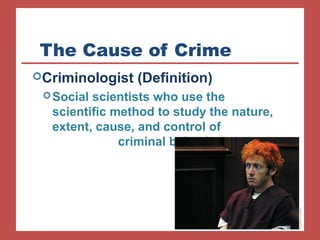
Criminologist (Definition) 
Social scientists who use the 
scientific method to study the nature, 
extent, cause, and control of 
criminal behavior
Choice Theory 
People choose to commit crime after 
weighing the potential benefits and 
consequences of their criminal act 
 People will commit a crime if they believe 
it will provide immediate benefits without 
the threat of long-term risks 
If the rewards are great, the perceived risks 
small, and the excitement high, the 
likelihood of committing additional crimes 
increases
Video: Air marshals 
Choice Theory
Video: Discussion 
Questions 
Does having air marshals on 
airplanes deter crime?
Recap - Choice Theory 
 Crime is a matter of rational choice, 
involving a calculated decision made after a 
motivated offender weighs the potential 
costs and benefits of illegal activity 
 The decision to commit a specific crime is a 
matter of personal decision based on the 
evaluation of available 
information 
 Even predatory street 
criminals exhibit stealth 
and planning in their 
criminal acts
Crime Prevention 
Situational Prevention 
General Deterrence 
Specific Deterrence
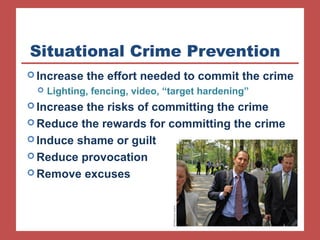
Situational Crime Prevention 
Increase the effort needed to commit the crime 
 Lighting, fencing, video, “target hardening” 
Increase the risks of committing the crime 
Reduce the rewards for committing the crime 
Induce shame or guilt 
Reduce provocation 
Remove excuses
Situational Crime Prevention 
Situational crime prevention strategies 
are designed to convince would-be 
criminals to avoid specific targets 
If crime is rational, then painful punishment 
should reduce its future allure 
Techniques of painful punishment include 
harsh prisons, long sentences, and stiff fines
General Deterrence 
If crime is a matter of choice, it follows 
that it can be controlled by convincing 
criminals that breaking the law is a bad 
or dangerous choice to make 
 General deterrence is designed to make 
potential criminals fear the consequences of 
crime 
 The threat of punishment can convince rational 
criminals that crime does not pay 
 Potential criminal fears punishment because 
they know of someone else who was punished
General Deterrence 
Inhibiting Factors: 
 One of the factors that inhibits the 
deterrent power of the criminal law is the 
lack of efficiency of the justice system. 
80 percent of serious reported crimes do not 
result in an arrest.
Specific Deterrence 
Specific deterrence strategies punish 
known criminals so severely that they 
will never be tempted to repeat their 
offenses 
 Problems with these strategies are that 
criminals do not fear punishment, and the 
certainty of arrest and punishment is low 
 Techniques include death penalty, mandatory 
sentences, and aggressive policing
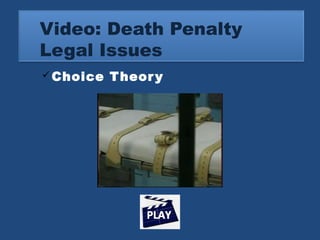
Video: Death Penalty 
Legal Issues 
Choice Theory
Video: Discussion 
Questions 
 In what ways do criminological 
theories impact whether or not the 
death penalty is considered 
acceptable by majority of society? 
 Do any criminological theories make 
it acceptable to put someone to 
death even if it is a painful death? 
 What is your position on the death 
penalty? Do you view this as 
impacted by a criminological theory? 
Why or why not?
Trait Theories 
Biochemical Factors 
Neurological Factors 
Genetic Factors
Trait Theories 
Crime is caused (not by choice... but) 
by inherited and uncontrollable 
biological and psychological traits: 
 Intelligence 
 Body build 
 Personality 
 Biomedical makeup 
Assumes that variation in human 
physical traits can explain behavior
Biochemical Factors 
Environmental contaminants has 
been shown to influence brain 
functioning and intelligence levels 
 Some research efforts have linked 
antisocial behavior to vitamin and mineral 
deficiencies, food additives, and improper 
diet 
Hypoglycemia 
Excessive levels of testosterone have been 
linked to violence and aggression
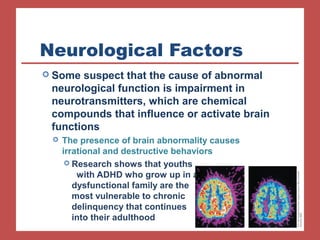
Neurological Factors 
 Some suspect that the cause of abnormal 
neurological function is impairment in 
neurotransmitters, which are chemical 
compounds that influence or activate brain 
functions 
 The presence of brain abnormality causes 
irrational and destructive behaviors 
 Research shows that youths 
with ADHD who grow up in a 
dysfunctional family are the 
most vulnerable to chronic 
delinquency that continues 
into their adulthood
Genetic Factors 
Modern bio-criminologists are 
concerned with the role of heredity in 
producing crime-prone people 
 Your genes 
 Your DNA 
Minnesota Twin study 
 Despite growing up separate – display 
same traits and behaviors
Psychological Theories 
Psychodynamic Theory 
Behavioral Theory 
Cognitive Theory 
Personality and Crime 
IQ and Crime
Psychological Theories 
Psychological theories suggest that 
criminals may be suffering from a 
psychological abnormality or stress 
that has a long history
Psychodynamic Theory 
Some people encounter problems 
during their early development that 
cause an imbalance in their 
personality 
 Theorists believe that law violators may 
have suffered damage to their egos, or 
superegos, early in their development that 
renders them powerless to control their 
impulses
Behavioral Theory 
View behavior as learned through 
interactions with others 
 Behavior that is rewarded becomes 
habitual 
 Behavior that is punished becomes 
extinguished
Video: Violent Crime 
Theoretical Explanations
Video: Discussion 
Questions 
According to the media clip, 
what are the reasons for the 
rise in violent crime? 
How would each theory 
explain violent crime? 
What theory of crime BEST 
explains violent crime?
Cognitive Theory 
Concerned with the way people 
perceive and mentally represent the 
world in which they live 
 Another area is moral development theory
Personality and Crime 
Some psychologists view criminal 
behavior as a function of a disturbed 
personality structure 
 Antisocial personality 
Failure to conform to social norms 
Deceitfulness 
Impulsivity 
Irritability 
Disregard for safety 
Irresponsibility 
Lack of remorse
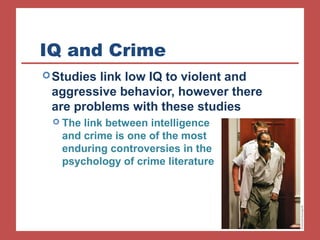
IQ and Crime 
Studies link low IQ to violent and 
aggressive behavior, however there 
are problems with these studies 
 The link between intelligence 
and crime is one of the most 
enduring controversies in the 
psychology of crime literature
Sociological Theories 
Social Structure Theory 
The Disorganized Neighborhood 
Social Process Theories
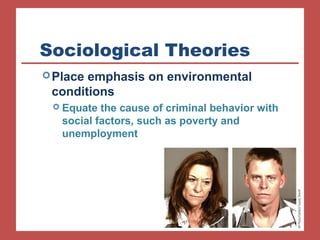
Sociological Theories 
Place emphasis on environmental 
conditions 
 Equate the cause of criminal behavior with 
social factors, such as poverty and 
unemployment
Social Structure Theory 
Suggest that people’s place in the 
socioeconomic structure influences 
their chances of becoming a criminal 
 Poor individual’s are more likely to commit 
crimes because they are unable to achieve 
monetary or social success in any other 
way 
 Racial disparity 
The problems of lower-class culture are 
particularly acute for racial and ethnic 
minorities
The Disorganized 
Neighborhood 
The effects of income inequality, 
poverty, racism, and despair are a key 
cause of youth crime and drug abuse
Social Process Theories 
Social Learning Theory 
 Suggests that people learn the techniques and 
attitudes of crime from close relationships 
with criminal peers 
 People become violent because they model 
their behavior after others and have had that 
behavior positively reinforced 
Social Control Theory 
 Maintains that everyone has the potential to 
become a criminal but that most people are 
controlled by their bonds to society; crime 
occurs when the forces that bind people to 
society are weakened or broken
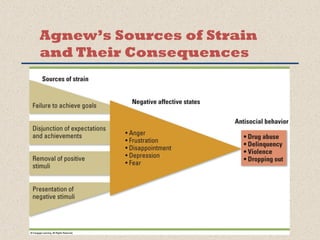
Agnew’s Sources of Strain 
and Their Consequences
Social Process Theories 
Social Reaction / Labeling Theory 
 Suggests that people become criminals 
when significant members of society label 
them as such and they accept those labels 
as a personal identity
The Labeling 
Process
Critical Criminology 
Social Inequality
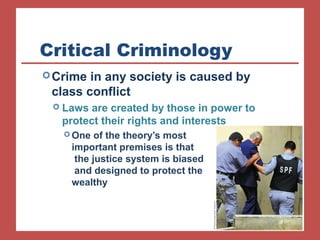
Critical Criminology 
Crime in any society is caused by 
class conflict 
 Laws are created by those in power to 
protect their rights and interests 
One of the theory’s most 
important premises is that 
the justice system is biased 
and designed to protect the 
wealthy
Developmental Theories 
Life Course Theory 
Latent Trait Theory 
The General Theory of Crime
Developmental Theories 
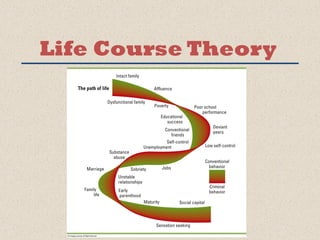
Life course theories suggest that events 
take place over the life course to 
influence criminal choices 
 The causes of crime constantly change as 
people mature 
 At first the nuclear family influences behavior 
 In adolescence, the peer group dominates 
 In adulthood, marriage and career are critical 
 According to Sampson and Laub, the two most 
critical turning points in a criminal career are 
Marriage and Employment
Life Course Theory
Developmental Theories 
Latent Trait Theory 
 Suggests that a master trait guides people 
over the life course 
The General Theory of Crime 
 Suggests that impulsive people have low 
self-control and a weak bond to society; 
they often cannot resist criminal 
opportunities
Victimization Theories 
Lifestyle Theory 
Routine Activities Theory 
(We are NOT blaming the Victims) 
- however - 
There is some theoretical support for placing 
oneself in a situation where we can easily become 
a victim
Theories of Victimization 
Victim precipitation theory looks at the 
victim’s role in the criminal incident 
 Lifestyle Theories 
Suggest that victims put themselves in danger by 
engaging in high-risk activities 
 More Danger: Someone who goes out late at night 
 Less Danger: Someone married who stays in at night
Theories of Victimization 
 The Routine Activities Theory 
Maintains that a pool of motivated offenders exists 
and that these offenders will take advantages of 
suitable, unguarded targets 
 Motivated Offenders 
 Suitable Targets 
 Capable Guardians (Includes Police Officers)
Routine Activities 
Theory
End 
End of Chapter 3

Chapter 3 - Updated

  • 1.
    Chapter 3 Introduce Theory: Understanding Crime and Victimization
  • 2.
    Introduction Theory conceptualizationis difficult for most intro / first year students  We do not expect you to memorize all of them Theory can be a semester long class itself – In our class, we are just introducing theory to you  You will study theory further in:  Intro to Criminology, Research Methods, Senior Seminar… more in Masters / PHD.  Goal for us – as we learn, simply think about the theories, what theory represents your view, which theories seem accurate, which seems flawed…
  • 3.
    The Cause ofCrime Criminologist (Definition) Social scientists who use the scientific method to study the nature, extent, cause, and control of criminal behavior
  • 4.
    Choice Theory Peoplechoose to commit crime after weighing the potential benefits and consequences of their criminal act  People will commit a crime if they believe it will provide immediate benefits without the threat of long-term risks If the rewards are great, the perceived risks small, and the excitement high, the likelihood of committing additional crimes increases
  • 5.
    Video: Air marshals Choice Theory
  • 6.
    Video: Discussion Questions Does having air marshals on airplanes deter crime?
  • 7.
    Recap - ChoiceTheory  Crime is a matter of rational choice, involving a calculated decision made after a motivated offender weighs the potential costs and benefits of illegal activity  The decision to commit a specific crime is a matter of personal decision based on the evaluation of available information  Even predatory street criminals exhibit stealth and planning in their criminal acts
  • 8.
    Crime Prevention SituationalPrevention General Deterrence Specific Deterrence
  • 9.
    Situational Crime Prevention Increase the effort needed to commit the crime  Lighting, fencing, video, “target hardening” Increase the risks of committing the crime Reduce the rewards for committing the crime Induce shame or guilt Reduce provocation Remove excuses
  • 10.
    Situational Crime Prevention Situational crime prevention strategies are designed to convince would-be criminals to avoid specific targets If crime is rational, then painful punishment should reduce its future allure Techniques of painful punishment include harsh prisons, long sentences, and stiff fines
  • 11.
    General Deterrence Ifcrime is a matter of choice, it follows that it can be controlled by convincing criminals that breaking the law is a bad or dangerous choice to make  General deterrence is designed to make potential criminals fear the consequences of crime  The threat of punishment can convince rational criminals that crime does not pay  Potential criminal fears punishment because they know of someone else who was punished
  • 12.
    General Deterrence InhibitingFactors:  One of the factors that inhibits the deterrent power of the criminal law is the lack of efficiency of the justice system. 80 percent of serious reported crimes do not result in an arrest.
  • 13.
    Specific Deterrence Specificdeterrence strategies punish known criminals so severely that they will never be tempted to repeat their offenses  Problems with these strategies are that criminals do not fear punishment, and the certainty of arrest and punishment is low  Techniques include death penalty, mandatory sentences, and aggressive policing
  • 14.
    Video: Death Penalty Legal Issues Choice Theory
  • 15.
    Video: Discussion Questions  In what ways do criminological theories impact whether or not the death penalty is considered acceptable by majority of society?  Do any criminological theories make it acceptable to put someone to death even if it is a painful death?  What is your position on the death penalty? Do you view this as impacted by a criminological theory? Why or why not?
  • 16.
    Trait Theories BiochemicalFactors Neurological Factors Genetic Factors
  • 17.
    Trait Theories Crimeis caused (not by choice... but) by inherited and uncontrollable biological and psychological traits:  Intelligence  Body build  Personality  Biomedical makeup Assumes that variation in human physical traits can explain behavior
  • 18.
    Biochemical Factors Environmentalcontaminants has been shown to influence brain functioning and intelligence levels  Some research efforts have linked antisocial behavior to vitamin and mineral deficiencies, food additives, and improper diet Hypoglycemia Excessive levels of testosterone have been linked to violence and aggression
  • 19.
    Neurological Factors Some suspect that the cause of abnormal neurological function is impairment in neurotransmitters, which are chemical compounds that influence or activate brain functions  The presence of brain abnormality causes irrational and destructive behaviors  Research shows that youths with ADHD who grow up in a dysfunctional family are the most vulnerable to chronic delinquency that continues into their adulthood
  • 20.
    Genetic Factors Modernbio-criminologists are concerned with the role of heredity in producing crime-prone people  Your genes  Your DNA Minnesota Twin study  Despite growing up separate – display same traits and behaviors
  • 21.
    Psychological Theories PsychodynamicTheory Behavioral Theory Cognitive Theory Personality and Crime IQ and Crime
  • 22.
    Psychological Theories Psychologicaltheories suggest that criminals may be suffering from a psychological abnormality or stress that has a long history
  • 23.
    Psychodynamic Theory Somepeople encounter problems during their early development that cause an imbalance in their personality  Theorists believe that law violators may have suffered damage to their egos, or superegos, early in their development that renders them powerless to control their impulses
  • 24.
    Behavioral Theory Viewbehavior as learned through interactions with others  Behavior that is rewarded becomes habitual  Behavior that is punished becomes extinguished
  • 25.
    Video: Violent Crime Theoretical Explanations
  • 26.
    Video: Discussion Questions According to the media clip, what are the reasons for the rise in violent crime? How would each theory explain violent crime? What theory of crime BEST explains violent crime?
  • 27.
    Cognitive Theory Concernedwith the way people perceive and mentally represent the world in which they live  Another area is moral development theory
  • 28.
    Personality and Crime Some psychologists view criminal behavior as a function of a disturbed personality structure  Antisocial personality Failure to conform to social norms Deceitfulness Impulsivity Irritability Disregard for safety Irresponsibility Lack of remorse
  • 29.
    IQ and Crime Studies link low IQ to violent and aggressive behavior, however there are problems with these studies  The link between intelligence and crime is one of the most enduring controversies in the psychology of crime literature
  • 30.
    Sociological Theories SocialStructure Theory The Disorganized Neighborhood Social Process Theories
  • 31.
    Sociological Theories Placeemphasis on environmental conditions  Equate the cause of criminal behavior with social factors, such as poverty and unemployment
  • 32.
    Social Structure Theory Suggest that people’s place in the socioeconomic structure influences their chances of becoming a criminal  Poor individual’s are more likely to commit crimes because they are unable to achieve monetary or social success in any other way  Racial disparity The problems of lower-class culture are particularly acute for racial and ethnic minorities
  • 33.
    The Disorganized Neighborhood The effects of income inequality, poverty, racism, and despair are a key cause of youth crime and drug abuse
  • 34.
    Social Process Theories Social Learning Theory  Suggests that people learn the techniques and attitudes of crime from close relationships with criminal peers  People become violent because they model their behavior after others and have had that behavior positively reinforced Social Control Theory  Maintains that everyone has the potential to become a criminal but that most people are controlled by their bonds to society; crime occurs when the forces that bind people to society are weakened or broken
  • 35.
    Agnew’s Sources ofStrain and Their Consequences
  • 36.
    Social Process Theories Social Reaction / Labeling Theory  Suggests that people become criminals when significant members of society label them as such and they accept those labels as a personal identity
  • 37.
  • 38.
  • 39.
    Critical Criminology Crimein any society is caused by class conflict  Laws are created by those in power to protect their rights and interests One of the theory’s most important premises is that the justice system is biased and designed to protect the wealthy
  • 40.
    Developmental Theories LifeCourse Theory Latent Trait Theory The General Theory of Crime
  • 41.
    Developmental Theories Lifecourse theories suggest that events take place over the life course to influence criminal choices  The causes of crime constantly change as people mature  At first the nuclear family influences behavior  In adolescence, the peer group dominates  In adulthood, marriage and career are critical  According to Sampson and Laub, the two most critical turning points in a criminal career are Marriage and Employment
  • 42.
  • 43.
    Developmental Theories LatentTrait Theory  Suggests that a master trait guides people over the life course The General Theory of Crime  Suggests that impulsive people have low self-control and a weak bond to society; they often cannot resist criminal opportunities
  • 44.
    Victimization Theories LifestyleTheory Routine Activities Theory (We are NOT blaming the Victims) - however - There is some theoretical support for placing oneself in a situation where we can easily become a victim
  • 45.
    Theories of Victimization Victim precipitation theory looks at the victim’s role in the criminal incident  Lifestyle Theories Suggest that victims put themselves in danger by engaging in high-risk activities  More Danger: Someone who goes out late at night  Less Danger: Someone married who stays in at night
  • 46.
    Theories of Victimization  The Routine Activities Theory Maintains that a pool of motivated offenders exists and that these offenders will take advantages of suitable, unguarded targets  Motivated Offenders  Suitable Targets  Capable Guardians (Includes Police Officers)
  • 47.
  • 48.
    End End ofChapter 3

Editor's Notes

  • #4 Learning Objective One
  • #5 Learning Objective One
  • #6 Learning Objective Two
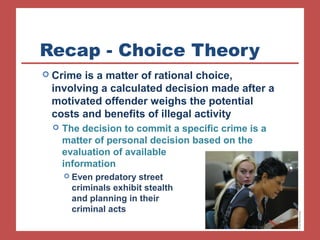
  • #8 Actress Lindsay Lohan (left) sits in a Los Angeles court with her lawyer, Shawn Chapman Holley, during a compliance check to report her progress on 480 hours of community service for shoplifting a necklace from a Venice jeweler. Did Lindsay, who has had a long history of run-ins with the law, choose to commit a crime? If not, how else can we explain her behavior? A repentant Lindsay told an interviewer, “I’ve learned how to live my life in a way that I’m happy and can do the things I want to do,” a statement that indicates a rational approach to decision making.
  • #9 The fact that some criminals “choose” crime is clear in cases involving high-level corporate and white-collar crimes. Matthew Tannin (center), former hedge fund manager for the investment firm Bear Stearns, enters a Brooklyn federal court for a hearing on July 18, 2008. He was charged with securities fraud in the wake of the collapse of the subprime mortgage market, which foreshadowed Bear Stearns’ own downfall. Whereas some violent crimes may seem impulsive and unplanned, is it possible to say that perpetrating a complex securities fraud scheme did not involve rational choice?
  • #10 The fact that some criminals “choose” crime is clear in cases involving high-level corporate and white-collar crimes. Matthew Tannin (center), former hedge fund manager for the investment firm Bear Stearns, enters a Brooklyn federal court for a hearing on July 18, 2008. He was charged with securities fraud in the wake of the collapse of the subprime mortgage market, which foreshadowed Bear Stearns’ own downfall. Whereas some violent crimes may seem impulsive and unplanned, is it possible to say that perpetrating a complex securities fraud scheme did not involve rational choice?
  • #15 Learning Objective Two
  • #17 The fact that some criminals “choose” crime is clear in cases involving high-level corporate and white-collar crimes. Matthew Tannin (center), former hedge fund manager for the investment firm Bear Stearns, enters a Brooklyn federal court for a hearing on July 18, 2008. He was charged with securities fraud in the wake of the collapse of the subprime mortgage market, which foreshadowed Bear Stearns’ own downfall. Whereas some violent crimes may seem impulsive and unplanned, is it possible to say that perpetrating a complex securities fraud scheme did not involve rational choice?
  • #19 Learning Objective Three
  • #20 Learning Objective Three - This scan compares a normal brain (left) and the brain of an individual with ADHD (right). The areas of orange and white demonstrate a higher rate of metabolism; the areas of blue and green represent an abnormally low metabolic rate. Why is ADHD so prevalent in the United States today? Some experts believe our immigrant forebears were risk-takers who impulsively left their homelands for a life in the new world. They may have brought with them a genetic predisposition to ADHD.

  • #21 Learning Objective Three
  • #22 The fact that some criminals “choose” crime is clear in cases involving high-level corporate and white-collar crimes. Matthew Tannin (center), former hedge fund manager for the investment firm Bear Stearns, enters a Brooklyn federal court for a hearing on July 18, 2008. He was charged with securities fraud in the wake of the collapse of the subprime mortgage market, which foreshadowed Bear Stearns’ own downfall. Whereas some violent crimes may seem impulsive and unplanned, is it possible to say that perpetrating a complex securities fraud scheme did not involve rational choice?
  • #23 Learning Objective Four
  • #25 Learning Objective Four
  • #26 Learning Objective Four
  • #28 Learning Objective Four
  • #29 Learning Objectives Four & Five
  • #30 Learning Objectives Four - Although some research shows that people who act aggressively in social settings have lower IQ scores than their peers, other findings suggest that the association between intelligence and crime is insignificant. Should mentally challenged offenders be punished in the same manner as those who are not intellectually impaired? Here, Daryl Atkins walks into the York-Poquoson courtroom in York, Virginia. Atkins’ 2002 case led the U.S. Supreme Court to bar execution of the mentally retarded as cruel and unusual - and hence unconstitutional. Ironically, upon rehearing the case in July 2005, a jury in Virginia decided that Atkins was intelligent enough to be executed and that the stimulation of the trial process had raised his IQ above 70, rendering him competent to be put to death under Virginia law. In January 2008, his sentence was commuted to life in prison as a consequence of prosecutorial misconduct in the original case.
  • #31 The fact that some criminals “choose” crime is clear in cases involving high-level corporate and white-collar crimes. Matthew Tannin (center), former hedge fund manager for the investment firm Bear Stearns, enters a Brooklyn federal court for a hearing on July 18, 2008. He was charged with securities fraud in the wake of the collapse of the subprime mortgage market, which foreshadowed Bear Stearns’ own downfall. Whereas some violent crimes may seem impulsive and unplanned, is it possible to say that perpetrating a complex securities fraud scheme did not involve rational choice?
  • #32 Learning Objectives Six & Seven - Is crime learned? These booking photos show Patricia Marion Gray, 53, and her son Nathan Gray, 32, who were arrested near Rifle, Colorado, after a meeting with an undercover agent for a purported deal involving weapons, marijuana, and money. Did Nathan learn his criminal ways from his mom? Or can there be another explanation for their co-offending?
  • #35 Learning Objectives Six & Seven
  • #36 Figure 3.1 Agnew’s Sources of Strain and Their Consequences
  • #38 Figure 3.2 The Labeling Process
  • #39 The fact that some criminals “choose” crime is clear in cases involving high-level corporate and white-collar crimes. Matthew Tannin (center), former hedge fund manager for the investment firm Bear Stearns, enters a Brooklyn federal court for a hearing on July 18, 2008. He was charged with securities fraud in the wake of the collapse of the subprime mortgage market, which foreshadowed Bear Stearns’ own downfall. Whereas some violent crimes may seem impulsive and unplanned, is it possible to say that perpetrating a complex securities fraud scheme did not involve rational choice?
  • #40 Learning Objective Eight - State-organized crimes are crimes inflicted by those in power upon their political opponents. Here, on March 17, 2010, Argentina’s former dictator Jorge Rafael Videla is escorted by prison guards into a courthouse for a hearing in Buenos Aires. He faced charges for crimes he committed during Argentina’s 1976-1983 military dictatorship, including the murders of 31 political prisoners who were pulled from their jail cells shortly after his 1976 military coup and, according to the official story, shot while trying to escape. In December 2010, at age 84, Videla was sentenced to life in prison.
  • #41 The fact that some criminals “choose” crime is clear in cases involving high-level corporate and white-collar crimes. Matthew Tannin (center), former hedge fund manager for the investment firm Bear Stearns, enters a Brooklyn federal court for a hearing on July 18, 2008. He was charged with securities fraud in the wake of the collapse of the subprime mortgage market, which foreshadowed Bear Stearns’ own downfall. Whereas some violent crimes may seem impulsive and unplanned, is it possible to say that perpetrating a complex securities fraud scheme did not involve rational choice?
  • #42 Learning Objective Nine
  • #43 Figure 3.3 Life Course Theory
  • #44 Learning Objective Nine
  • #45 The fact that some criminals “choose” crime is clear in cases involving high-level corporate and white-collar crimes. Matthew Tannin (center), former hedge fund manager for the investment firm Bear Stearns, enters a Brooklyn federal court for a hearing on July 18, 2008. He was charged with securities fraud in the wake of the collapse of the subprime mortgage market, which foreshadowed Bear Stearns’ own downfall. Whereas some violent crimes may seem impulsive and unplanned, is it possible to say that perpetrating a complex securities fraud scheme did not involve rational choice?
  • #46 Learning Objective Ten
  • #47 Learning Objective Ten
  • #48 Figure 3.4 Routine Activities Theory
  • #49 The fact that some criminals “choose” crime is clear in cases involving high-level corporate and white-collar crimes. Matthew Tannin (center), former hedge fund manager for the investment firm Bear Stearns, enters a Brooklyn federal court for a hearing on July 18, 2008. He was charged with securities fraud in the wake of the collapse of the subprime mortgage market, which foreshadowed Bear Stearns’ own downfall. Whereas some violent crimes may seem impulsive and unplanned, is it possible to say that perpetrating a complex securities fraud scheme did not involve rational choice?