The document provides a history of correctional institutions in the United States from the 17th century to present day. It discusses the origins of early jails and prisons, the development of different incarceration systems like Pennsylvania and Auburn models, and reforms over time focused on more humane treatment of inmates. The document also outlines different types of facilities that exist today including maximum, medium, and minimum security prisons as well as alternative facilities like boot camps, halfway houses, private prisons and others.
An overview of the evolution of correctional institutions, highlighting key developments and historical punishments from early systems to prison reform.
Defines jails, their primary purposes, population trends, and conditions, emphasizing the need for reform and the emergence of new-generation jails.
Examines various prison types (maximum, supermax, medium, minimum security), focusing on security levels, inmate populations, and their operational philosophies.
Explores alternative correctional options, including prison farms, boot camps, community facilities, and private prisons, discussing their benefits and challenges.
The History of
Correctional Institutions
Original legal punishments included:
Banishment
Slavery
Restitution
Corporal punishment
Execution
The first penal institutions were foul
places devoid of proper care, food,
and medical treatment
4.
The History of
Correctional Institutions
The first American jail was built in James
City in the early 17th century
The origin of corrections in the United
States is usually traced to 18th century
developments in PA
Under pressure from the
Quakers, the PA legislature in
1790 called for renovation of the
prison systems
Use of mutilation and physical punishment
5.
The History of
Correctional Institutions
The Pennsylvania System (1818)
Placed each inmate in a single cell for the
duration of his sentence
Based on total isolation and individual penitence
Reflected the influence of religion and religious
philosophy on corrections
Eastern State
penitentiary
built in 1829
outside
Philadelphia, PA
6.
The History of
Correctional Institutions
The Auburn System (1816)
New York
Tier system
Cells were built vertically on 5 floors of the
structure
Congregate system
Most prisoners ate and worked in groups
Philosophy of Auburn System:
Crime Prevention though fear of punishment and
silent confinement
7.
The History of
Correctional Institutions
Types of prison systems/themes
Contract system
Officials sold the labor of prison inmates to private business
for use either inside or outside the prison
Convict lease system
Contract system in which a private business leased
prisoners from the state for a fixed annual fee and assumed
full responsibility for their supervision and control
Public account system
Employment was directed by the state and the products of
the prisoners’ labor were sold for the benefit of the state
8.
The History of
Correctional Institutions
Prison Reform Efforts @ 1870
The National Congress of Penitentiary and
Reformatory Discipline
Zebulon Brockway
Warden of Elmira Reformatory (NY)
He was an advocated for:
Individualized treatment
Indeterminate sentencing
Parole
greatest achievement in his
rehabilitation style model was to
bring a degree of humanitarianism
into the prison environment
9.
The History of
Correctional Institutions
Prisons in the 20th Century
Time for prison reform…
No more stripes
No more code of silence
No more lockstep shuffle
Movies, radio, visiting, mail
Specialized prisons
Prison industries
Great Depression
significant event in history made it mandatory to limit
the amount of prison made goods allowed for sale in
the late 1920s and early 1930s.
Jails
What isa Jail
Populations
Conditions
New Generations
13.
Jails
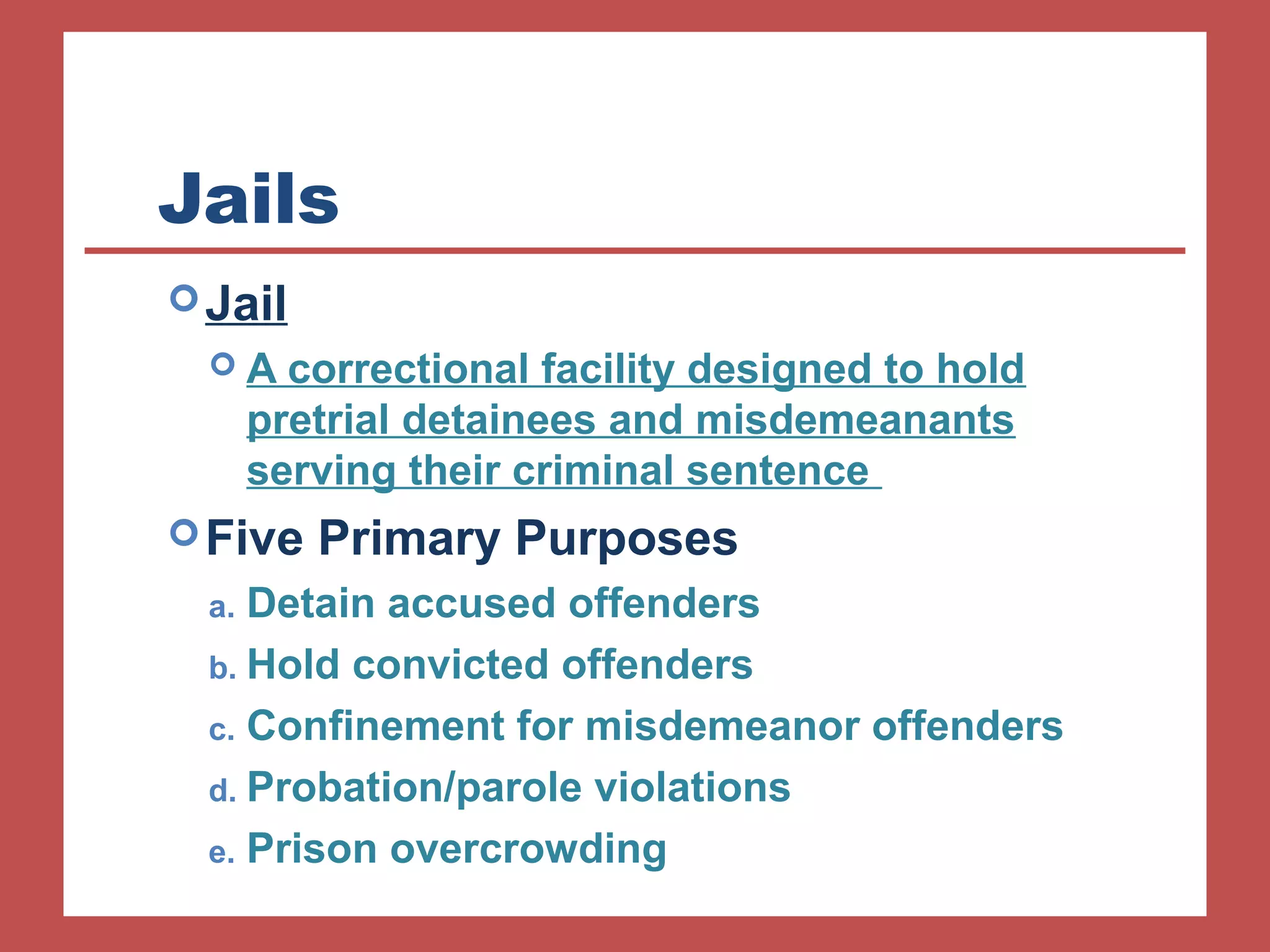
Jail
A correctional facility designed to hold
pretrial detainees and misdemeanants
serving their criminal sentence
Five Primary Purposes
a. Detain accused offenders
b. Hold convicted offenders
c. Confinement for misdemeanor offenders
d. Probation/parole violations
e. Prison overcrowding
Jails
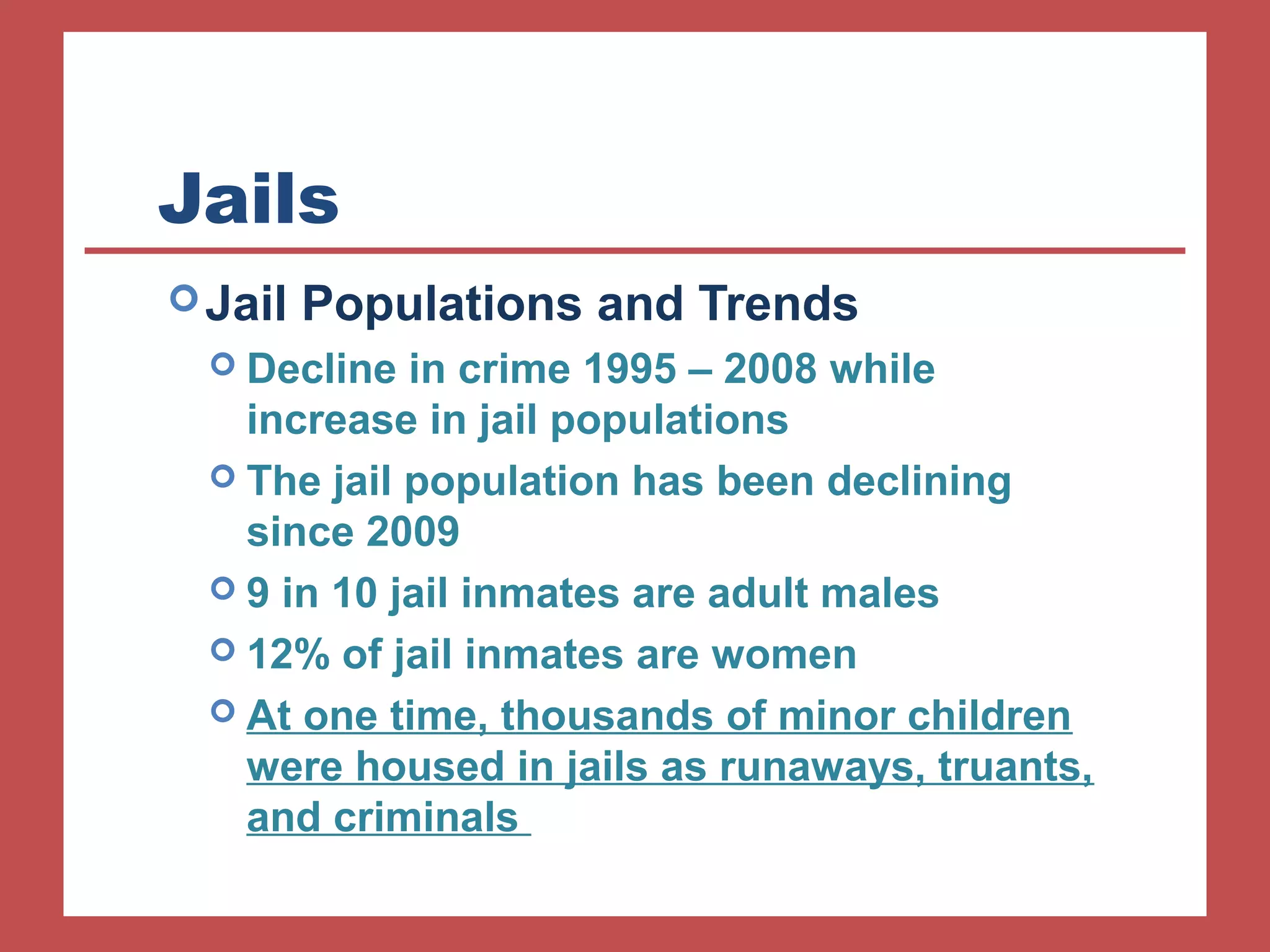
Jail Populationsand Trends
Decline in crime 1995 – 2008 while
increase in jail populations
The jail population has been declining
since 2009
9 in 10 jail inmates are adult males
12% of jail inmates are women
At one time, thousands of minor children
were housed in jails as runaways, truants,
and criminals
16.
Jails
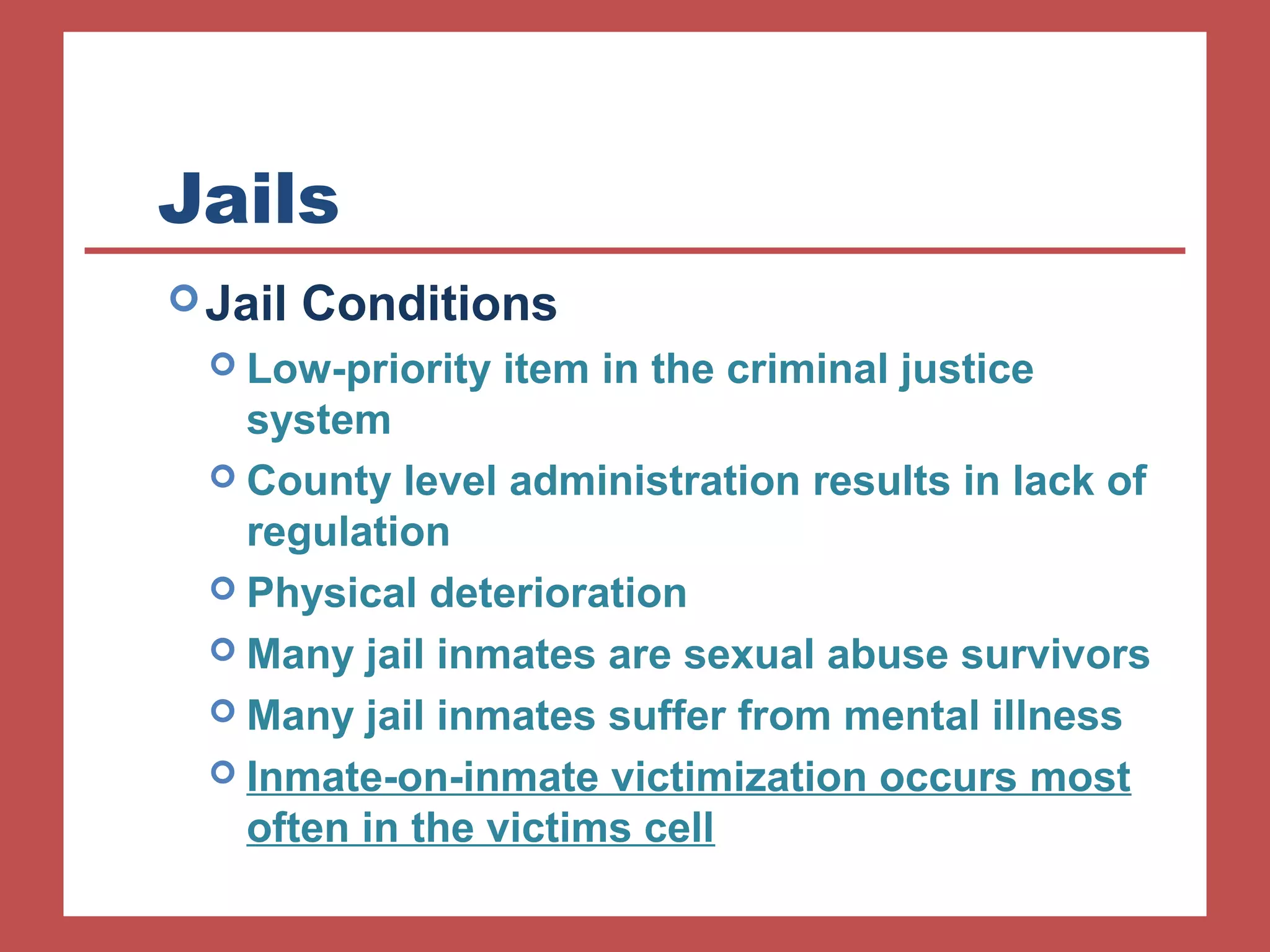
Jail Conditions
Low-priority item in the criminal justice
system
County level administration results in lack of
regulation
Physical deterioration
Many jail inmates are sexual abuse survivors
Many jail inmates suffer from mental illness
Inmate-on-inmate victimization occurs most
often in the victims cell
17.
Jails
New-Generation Jails
Modern designs to improve effectiveness
Continuous observation, both direct and
indirect
Prisons
Types ofPrisons
Maximum security prisons
Super maximum security prisons
Medium security prisons
Minimum security prisons
20.
Prisons
Maximum SecurityPrisons
Houses dangerous felons and maintains
strict security measures, high walls, and
limited contact with the outside world
Byword is security
Prisons are designed to eliminate hidden
corners where people can congregate
21.
Prisons
Super MaximumSecurity Prison
Houses the most predatory criminals
Can be independent correctional centers
or locked wings of existing prisons
Lock inmates in their cells 22 to 24 hours
a day
Effectiveness has achieved mixed review
Fear that long hours of isolation may be
associated with mental illness and
psychological disturbances
22.
Prisons
Medium SecurityPrisons
Less secure institution that houses
nonviolent offenders and provides more
opportunities for contact with the outside
world
Promote greater treatment efforts
23.
Prisons
Minimum SecurityPrisons
Least secure correctional institution which
houses white-collar and nonviolent
offenders, maintains few security
measures, and has liberal furlough and
visitation policies
Inmates are allowed a great deal of
personal freedom
Criticized for being like country clubs
24.
Alternatives
Alternative CorrectionalInstitutions
Prison Farms and Camps
Shock Incarceration in Boot Camps
Community Correctional Facilities
Private Prisons
25.
Alternative Correctional
Institutions
Prison Farms and Camps
Found primarily in the South and the West
Been in operation since the 19th century
26.
Alternative Correctional
Facilities
Shock Incarceration in Boot Camps
Shock incarceration
Short term correctional program based on a
boot camp approach that makes use of a
military like regime of high intensity
physical training
Boot camp
A short term militaristic correction
facility in which inmates undergo
intensive physical conditioning
and discipline
27.
Alternative Correctional
Facilities
Community Correctional Facilities
Community treatment
The attempt by correctional agencies to
maintain convicted offenders in the
community rather than in a secure facility
Includes probation, parole, and residential
programs
Halfway house
A community based correctional facility that
houses inmates before their outright release
so that they can become gradually
acclimated to conventional society
28.
Alternative Correctional
Institutions
Private Prisons
Corrections Corporations of America
There are about 450 correctional facilities
run by private firms
Little sound evidence that private prisons
are cheaper to run and/or produce better
results
Some state governments still view private
prisons as a low cost alternative
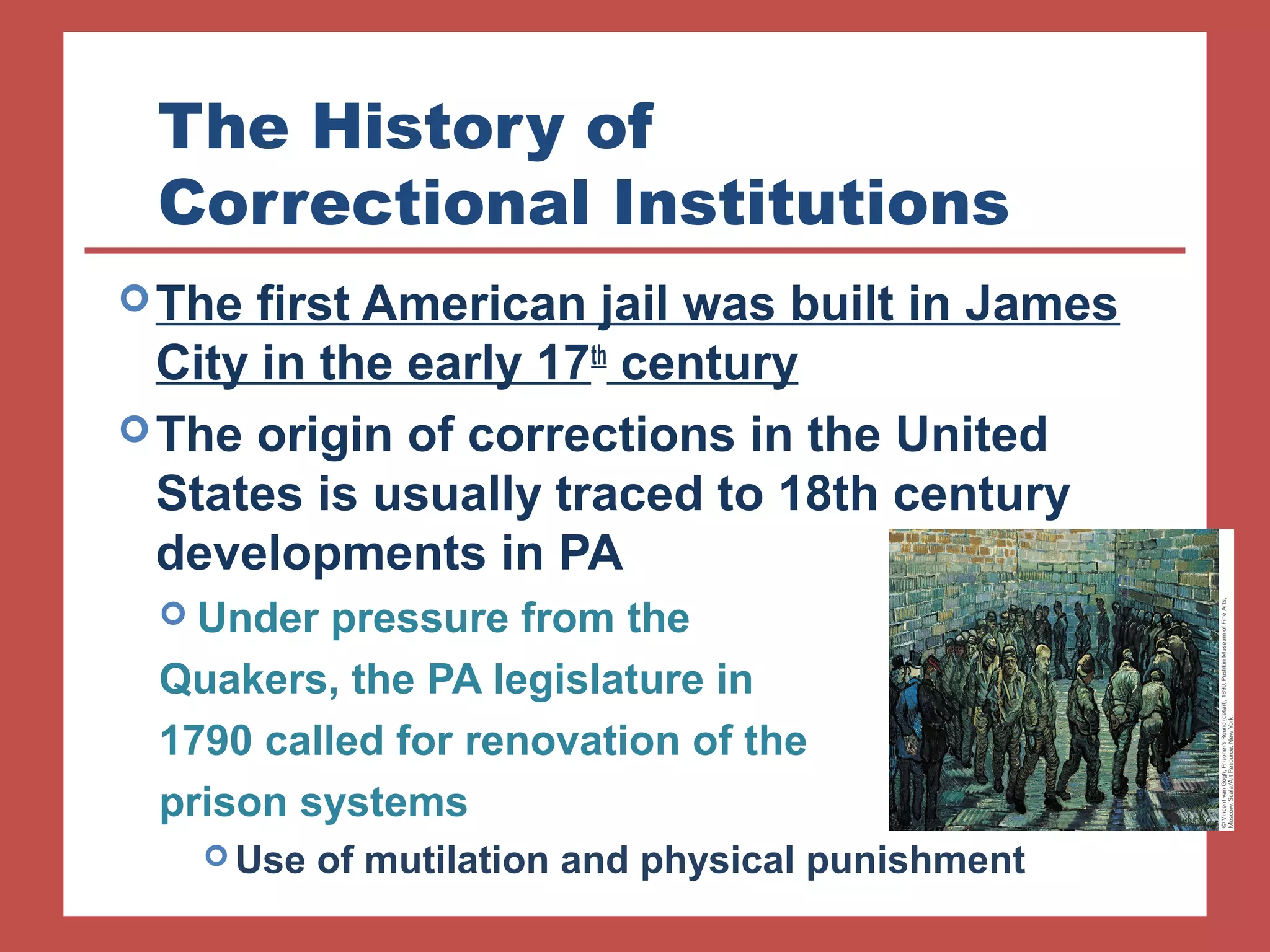
#5 Learning Objectives One & Two - Even though he himself was voluntarily committed to the asylum shown here, Vincent van Gogh captured the despair of the nineteenth-century penal institution in this detail from an 1890 painting sometimes titled Prisoners Exercising. The face of the prisoner near the center of the picture looking at the viewer is van Gogh’s.
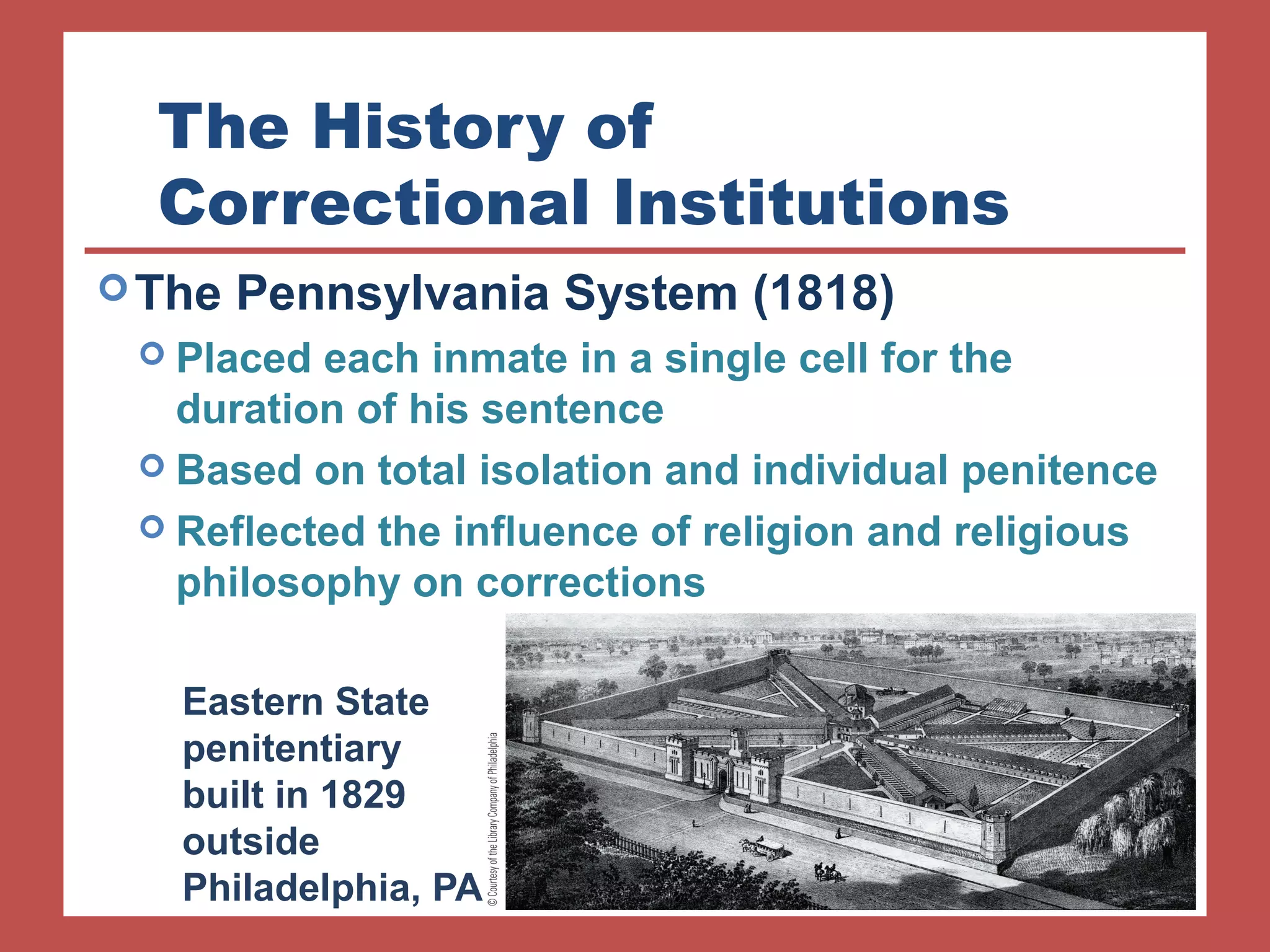
#6 Learning Objectives One & Five - Eastern State Penitentiary, built in 1829, was at the time the largest and most expensive public structure in the country. Designed by John Haviland, it consisted of an octagonal center connected by corridors to seven radiating single-story cell blocks. Each cell had hot water heating, a water tap, toilet, and an individual exercise yard the same width as the cell. There were rectangular openings in the cell wall through which food and work materials could be passed to the prisoner, as well as peepholes for guards to observe prisoners without being seen. Each cell contained a skylight so that the inmate could look to the heavens.
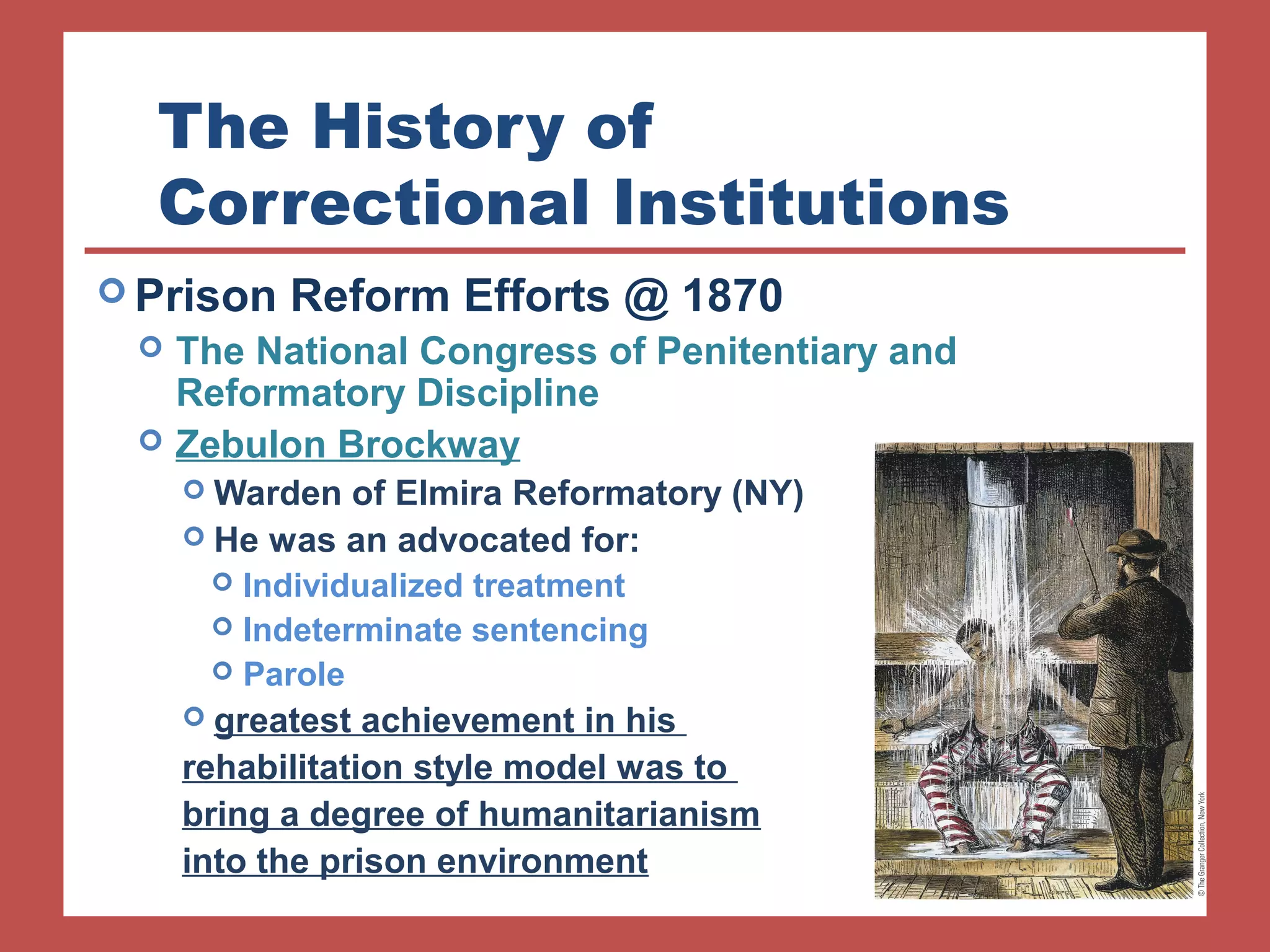
#9 Learning Objective One - Prison in the late nineteenth century was a brutal place. This line engraving from 1869 shows an inmate undergoing water torture in New York’s Sing Sing Prison.
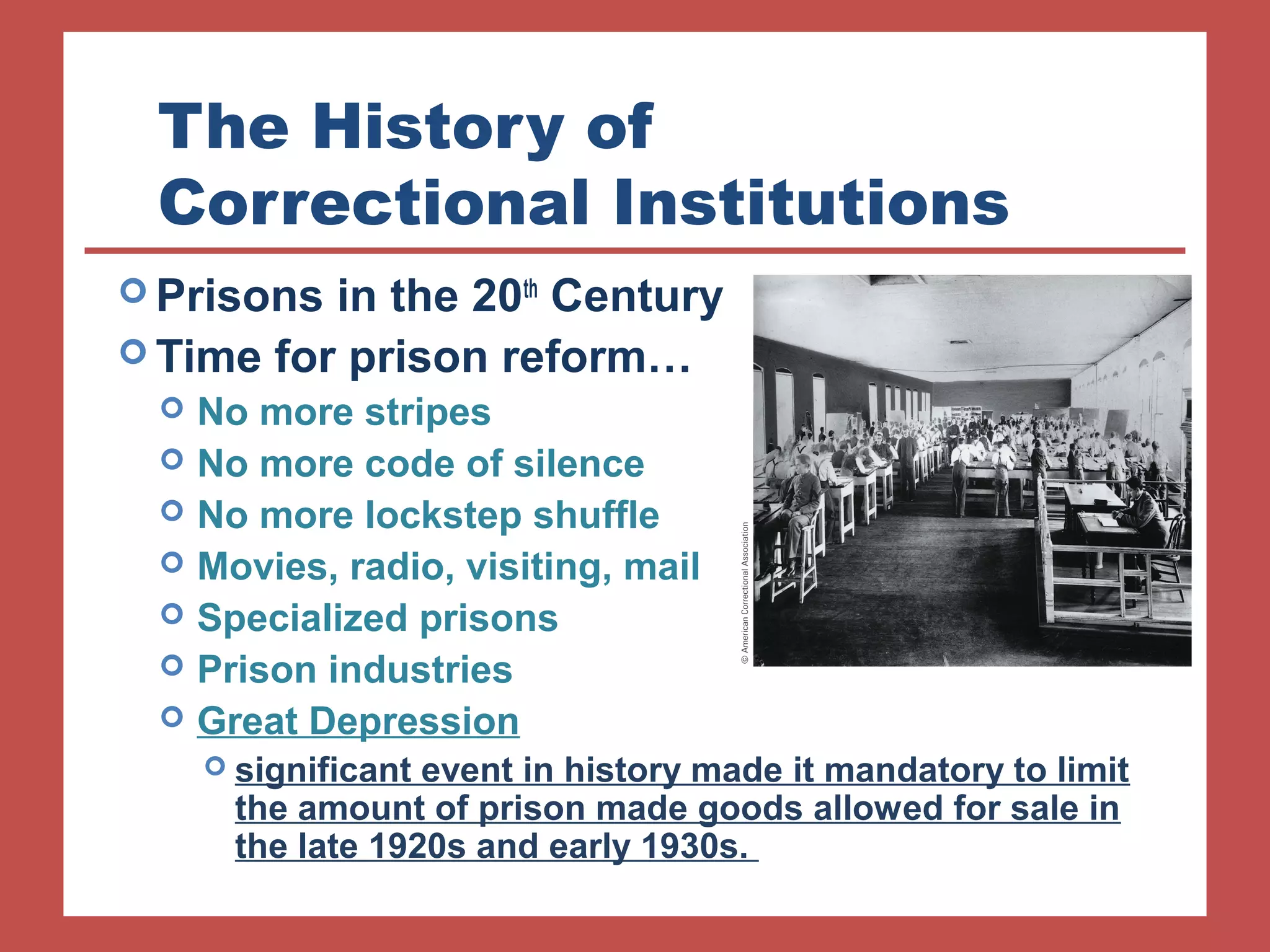
#10 Learning Objective One - Elmira Reformatory, training course in drafting, 1909. Inmates stand at drafting tables as guards watch and a supervisor sits at a fenced-off desk at the front of the hall. Elmira was one of the first penal institutions to employ education and training programs.
#16 Learning Objective Seven - One problem faced by female inmates is forced separation from their children and families. A number of institutions have created programs to remedy this loss. Here, Harris County, Texas, inmate Gwendolyn Jackson and her son Jarell, 8, share a laugh together during a Christmas event for 15 female inmates in the Harris County Sheriff’s Office Reentry Services Program. The inmates had presents donated by Navidad en el Barrio to give their children. The women are minimum risk inmates who have had good relationships with their children. The female inmates are also working with Reentry Services in setting goals for a successful transition back into the community in efforts to reduce recidivism. Children accompanied by adults can visit inmates on routine visitation days but without physical contact.
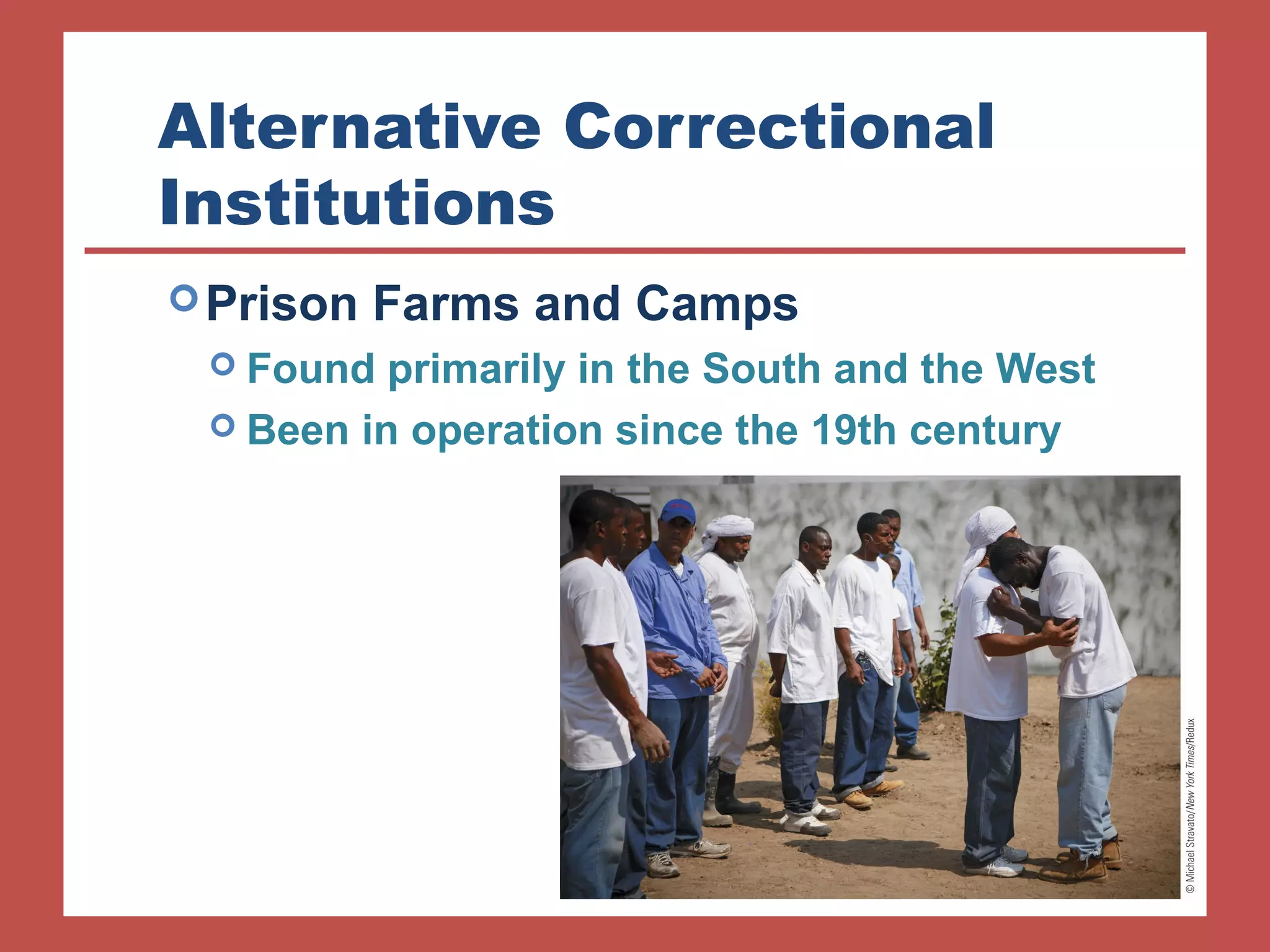
#26 “The Life of Jesus Christ” - a three-and-a-half-hour play with a cast of 70, plus a mule, two horses, a lamb, and a camel - made its debut in a three-day run at the prison farm at the Louisiana State Penitentiary. The production featured men from Angola and women from the Louisiana Correctional Institute for Women, who traveled nearly two hours by bus each morning to this 18,000-acre prison farm on the Mississippi River. Much of the cast was in rehearsal on and off for two years. Shown here on right is Levelle Tolliver, who plays Judas. Tolliver, a talented actor, shot a man in the head in 1993.
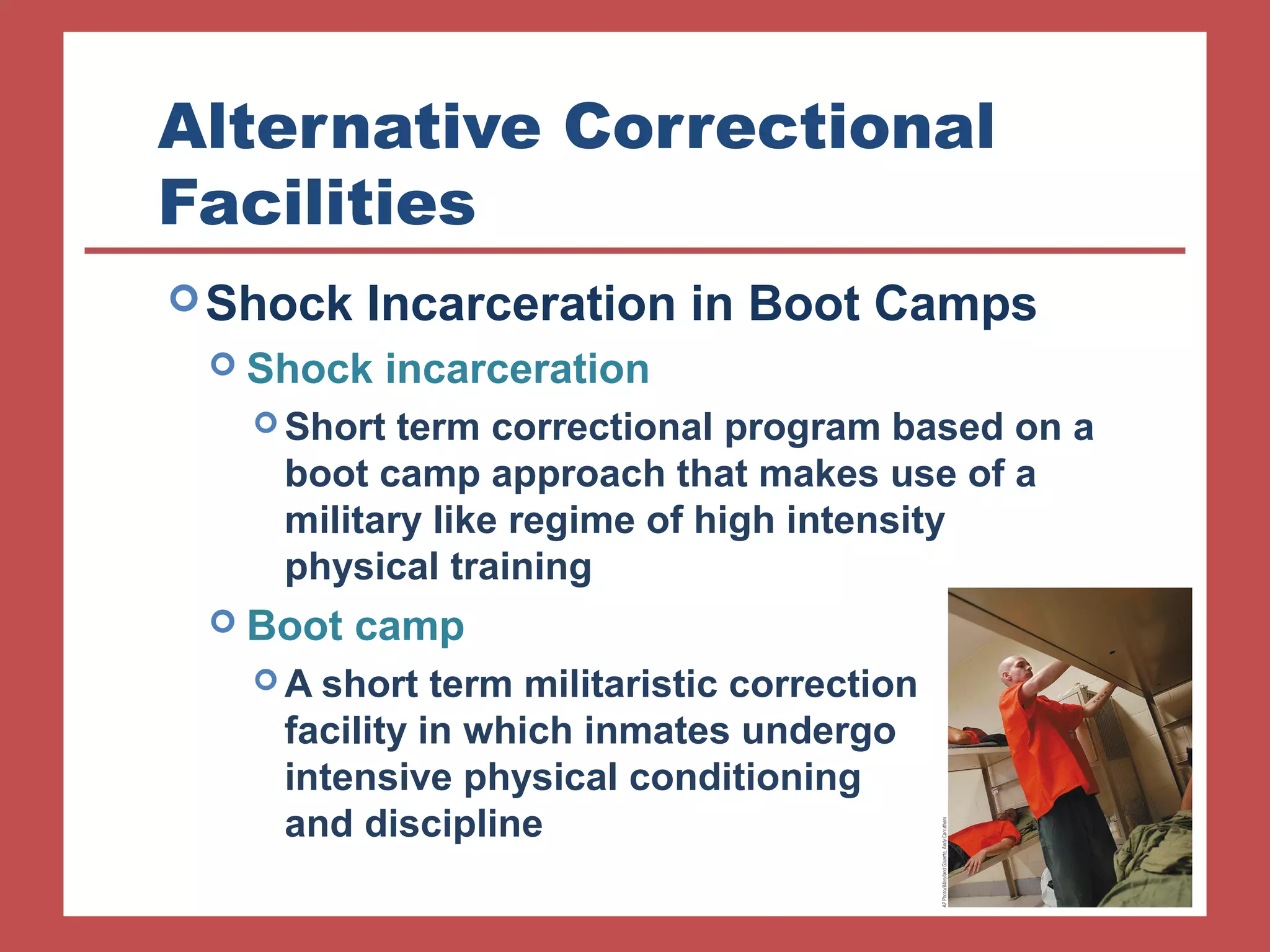
#27 Inside the Ordnance Road Correctional Center in Glen Burnie, Maryland, 19-year-old inmate Kenneth Lee puts sheets on his plastic covered mattress. He serves his prison sentence one weekend at a time, living in a dormitory-style room housing a dozen men. Alternative correctional institutions have sprung up around the nation as a response to overcrowding and high recidivism rates.