CHAPTER 7
Police Corruption and
Misconduct
Abuse of Power by Police
The majority of police officers are professional and
ethical. However, a small minority abuse their power.
This leads to close scrutiny by the public of all police.
Police officers have tremendous power in our society:
• The power to arrest
• The power to mediate or to charge
• The power to use force
• The power of life and death
Police Corruption:
A Worldwide
ProblemBaksheesh – another word for graft
Frank
Serpico
NYPD
(1970)
• Became police officer in 1959.
• After 12 years became a detective.
• Discovered corruption was
rampant in the NYPD.
• He & a fellow officer went to the
media & participated in an exposé
of the corruption.
• Experienced retaliation & and was
shot in the face before he could
testify.
• Left department for 10 years &
later came back to speak out
against police corruption.
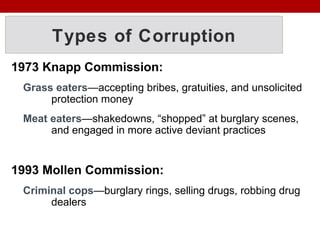
Types of Corruption
1973 Knapp Commission:
Grass eaters—accepting bribes, gratuities, and unsolicited
protection money
Meat eaters—shakedowns, “shopped” at burglary scenes,
and engaged in more active deviant practices
1993 Mollen Commission:
Criminal cops—burglary rings, selling drugs, robbing drug
dealers
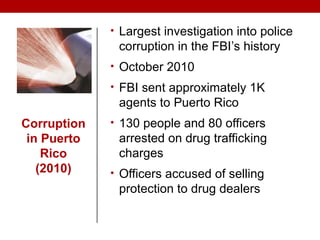
Corruption
in Puerto
Rico
(2010)
• Largest investigation into police
corruption in the FBI’s history
• October 2010
• FBI sent approximately 1K
agents to Puerto Rico
• 130 people and 80 officers
arrested on drug trafficking
charges
• Officers accused of selling
protection to drug dealers
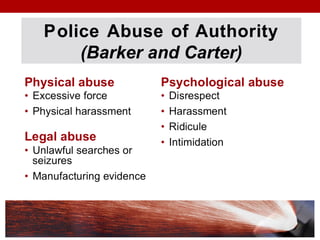
Police Abuse of Authority
(Barker and Carter)
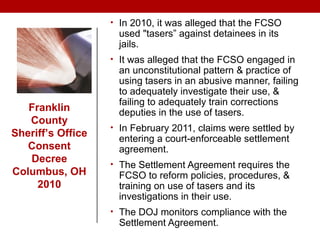
• In 2010, it was alleged that the FCSO
used "tasers” against detainees in its
jails.
• It was alleged that the FCSO engaged in
an unconstitutional pattern & practice of
using tasers in an abusive manner, failing
to adequately investigate their use, &
failing to adequately train corrections
deputies in the use of tasers.
• In February 2011, claims were settled by
entering a court-enforceable settlement
agreement.
• The Settlement Agreement requires the
FCSO to reform policies, procedures, &
training on use of tasers and its
investigations in their use.
• The DOJ monitors compliance with the
Settlement Agreement.
Franklin
County
Sheriff’s Office
Consent
Decree
Columbus, OH
2010
Corruption (Fyfe and Kane)
• Police crime —police officers violate criminal statutes.
• Police corruption —officer uses his or her position,
by act or omission, to obtain improper financial benefit,
bribes, extra-job policy abuse, gratuities (may be
criminal or not).
• Abuse of power —officers physically injure or offend
a citizen’s sense of dignity (“brutality” or unnecessary
force, deception in interrogation, intimidation on the
street, perjury, planting evidence, and hiding
exculpatory evidence, off-duty misconduct).
Apodaca
Prison
Mexico
(2010)
• Zetas drug cartel stabbed and
bludgeoned 44 members of the rival
Gulf cartel to death and then staged
a mass escape.
• Prisoners were given guns and cars
and ordered to go and kill rival drug
cartel members.
• They killed 17 people and are
suspected of 3 more mass killings.
• Top prison officials were implicated.
• Illustration of how much control drug
cartels have over criminal justice in
Mexico.
Gratuities
Items of value given because of role or
position, rather than personal relationship.
•A gift is personal and has no strings attached.
•Common police gratuities include:
oFree coffee
oFree movie/sports tickets
oDiscounted or free meals
oDiscounted or free merchandise
Professional Courtesy
• The practice of not ticketing an
officer who is stopped for speeding
or for other driving violations.
Police work factors that foster drug use:
• Exposure to a criminal element
• Relative freedom from supervision
• Uncontrolled availability of contraband
Drinking on duty:
• Creates less vulnerability to corruption than drug use
• Creates an ethical dilemma for other officers
• May lead other officers to isolate themselves from or avoid
working with those who drink
Using Drugs/Alcohol on Duty
Graft
Exploitation of one’s role by accepting bribes
or protection money.
• Also applies to kickbacks from defense attorneys,
bail bond companies, etc.
• Bribes rated in one study as second most serious
ethical transgression (after theft from burglary
scene).
Sexual Misconduct (Kraska &
Kappeler)
• Viewing a victim's
photos, etc., for prurient
purposes
• Strip searches
• Illegal detentions
• Deception to gain sex
• Trading favors for sex
• Sexual harassment
• Sexual contact
• Sexual assault
• Rape
Criminal Cops
• “Buddy boys” (NYC)
• Mafia Cops (Eppolito & Caracappa)
• Boston (Pulido)
• Cleveland cocaine cops
• Chicago (robbery, extortion, theft)
• Miami River Rats
• Drug crimes (in all cities: protection, theft,
robbery)
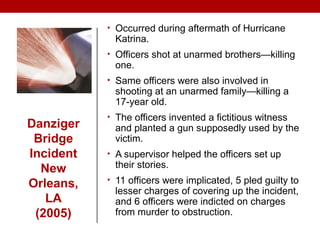
Danziger
Bridge
Incident
New
Orleans,
LA
(2005)
• Occurred during aftermath of Hurricane
Katrina.
• Officers shot at unarmed brothers—killing
one.
• Same officers were also involved in
shooting at an unarmed family—killing a
17-year old.
• The officers invented a fictitious witness
and planted a gun supposedly used by the
victim.
• A supervisor helped the officers set up
their stories.
• 11 officers were implicated, 5 pled guilty to
lesser charges of covering up the incident,
and 6 officers were indicted on charges
from murder to obstruction.
Explanations
Individual:
• “Rotten-apple” argument (Officer was deviant before hiring)
• Development of a police personality (Officer became
deviant after hiring)
• Possible predictors: gender, age, education, race, military
experience, academy performance, prior history of
wrongdoing
Target: screening/recruiting process; training
Explanations
Institutional/Organizational:
• Poor management and supervision
• “Noble Cause” (improper rewards)
• Corruption continuum (Trautman)
o Administrative indifference toward integrity
o Ignoring ethical problems
o Hypocrisy and fear
o “Survival of the fittest”
• Continuum of compromise (Gilmartin & Harris)
o Sense of victimization
o Cynicism and entitlement
o Wrongdoing
Explanations
Systemic/Societal:
• If the public does not comply with the law, officers
may rationalize non-enforcement of the law.
• If the public engages in illegal activities, officers
may feel justified in doing the same.
• If the public believes crime control is more
important than due process, police will act on that
message.
• Increase pay
• Eliminate unenforceable laws
• Establish civilian review boards
• Improve training
• Improve leadership
Reducing Corruption (Malloy)
• Set realistic goals and objectives
• Provide ethical leadership
• Provide a written code of ethics
• Provide a whistle-blowing procedure that
ensures fair treatment for all parties
• Provide training in law enforcement ethics
Reducing Corruption
(Metz)
Education and Training
• Higher formal education standards are not,
themselves, the key to ethical behavior.
• Academy and in-service ethics training are common
and recommended for all departments.
• Many courses use a moral reasoning approach.
• Some advocate an emphasis on character.
• Others recommend case studies.
• Very controversial
• Not well-received by most officers
• Comparing integrity testing to undercover
operations reveals that:
o Most officers oppose integrity testing
o Most officers support undercover operations
Integrity Testing
Early Warning or Audit Systems
• Seek to identify problem officers by trends of
abuse or corruption complaints
• Identified officers may be subject to:
o Reassignment, retraining, or transfer
o Referral to an employee assistance program
o A fitness-for-duty evaluation
o Dismissal
• Police investigate themselves
• Police use an internal discipline system
• Widely seen as ineffective
• May discourage civilian complaints
• Does not evoke public confidence
Internal Affairs
Model
Civilian Review/Complaint
Model
• An independent civilian agency audits complaints
and investigations
• Police still investigate and conduct discipline
proceeding
• Using departments receive more civilian
complaints
• Internal and external substantiation rates about
the same—approximately ten percent
 Mistrust of police administration is pervasive
among the rank-and file.
 Two cultures of policing: street cops and
management.
 Most agree that supervisor behavior has greater
influence on employee behavior than directives
or ethics.
 Leaders lead most effectively by example.
Ethical Leadership

Chapter 7

  • 1.
  • 2.
    Abuse of Powerby Police The majority of police officers are professional and ethical. However, a small minority abuse their power. This leads to close scrutiny by the public of all police. Police officers have tremendous power in our society: • The power to arrest • The power to mediate or to charge • The power to use force • The power of life and death
  • 3.
  • 4.
    Frank Serpico NYPD (1970) • Became policeofficer in 1959. • After 12 years became a detective. • Discovered corruption was rampant in the NYPD. • He & a fellow officer went to the media & participated in an exposé of the corruption. • Experienced retaliation & and was shot in the face before he could testify. • Left department for 10 years & later came back to speak out against police corruption.
  • 5.
    Types of Corruption 1973Knapp Commission: Grass eaters—accepting bribes, gratuities, and unsolicited protection money Meat eaters—shakedowns, “shopped” at burglary scenes, and engaged in more active deviant practices 1993 Mollen Commission: Criminal cops—burglary rings, selling drugs, robbing drug dealers
  • 6.
    Corruption in Puerto Rico (2010) • Largestinvestigation into police corruption in the FBI’s history • October 2010 • FBI sent approximately 1K agents to Puerto Rico • 130 people and 80 officers arrested on drug trafficking charges • Officers accused of selling protection to drug dealers
  • 7.
    Police Abuse ofAuthority (Barker and Carter)
  • 8.
    • In 2010,it was alleged that the FCSO used "tasers” against detainees in its jails. • It was alleged that the FCSO engaged in an unconstitutional pattern & practice of using tasers in an abusive manner, failing to adequately investigate their use, & failing to adequately train corrections deputies in the use of tasers. • In February 2011, claims were settled by entering a court-enforceable settlement agreement. • The Settlement Agreement requires the FCSO to reform policies, procedures, & training on use of tasers and its investigations in their use. • The DOJ monitors compliance with the Settlement Agreement. Franklin County Sheriff’s Office Consent Decree Columbus, OH 2010
  • 9.
    Corruption (Fyfe andKane) • Police crime —police officers violate criminal statutes. • Police corruption —officer uses his or her position, by act or omission, to obtain improper financial benefit, bribes, extra-job policy abuse, gratuities (may be criminal or not). • Abuse of power —officers physically injure or offend a citizen’s sense of dignity (“brutality” or unnecessary force, deception in interrogation, intimidation on the street, perjury, planting evidence, and hiding exculpatory evidence, off-duty misconduct).
  • 10.
    Apodaca Prison Mexico (2010) • Zetas drugcartel stabbed and bludgeoned 44 members of the rival Gulf cartel to death and then staged a mass escape. • Prisoners were given guns and cars and ordered to go and kill rival drug cartel members. • They killed 17 people and are suspected of 3 more mass killings. • Top prison officials were implicated. • Illustration of how much control drug cartels have over criminal justice in Mexico.
  • 11.
    Gratuities Items of valuegiven because of role or position, rather than personal relationship. •A gift is personal and has no strings attached. •Common police gratuities include: oFree coffee oFree movie/sports tickets oDiscounted or free meals oDiscounted or free merchandise
  • 12.
    Professional Courtesy • Thepractice of not ticketing an officer who is stopped for speeding or for other driving violations.
  • 13.
    Police work factorsthat foster drug use: • Exposure to a criminal element • Relative freedom from supervision • Uncontrolled availability of contraband Drinking on duty: • Creates less vulnerability to corruption than drug use • Creates an ethical dilemma for other officers • May lead other officers to isolate themselves from or avoid working with those who drink Using Drugs/Alcohol on Duty
  • 14.
    Graft Exploitation of one’srole by accepting bribes or protection money. • Also applies to kickbacks from defense attorneys, bail bond companies, etc. • Bribes rated in one study as second most serious ethical transgression (after theft from burglary scene).
  • 15.
    Sexual Misconduct (Kraska& Kappeler) • Viewing a victim's photos, etc., for prurient purposes • Strip searches • Illegal detentions • Deception to gain sex • Trading favors for sex • Sexual harassment • Sexual contact • Sexual assault • Rape
  • 16.
    Criminal Cops • “Buddyboys” (NYC) • Mafia Cops (Eppolito & Caracappa) • Boston (Pulido) • Cleveland cocaine cops • Chicago (robbery, extortion, theft) • Miami River Rats • Drug crimes (in all cities: protection, theft, robbery)
  • 17.
    Danziger Bridge Incident New Orleans, LA (2005) • Occurred duringaftermath of Hurricane Katrina. • Officers shot at unarmed brothers—killing one. • Same officers were also involved in shooting at an unarmed family—killing a 17-year old. • The officers invented a fictitious witness and planted a gun supposedly used by the victim. • A supervisor helped the officers set up their stories. • 11 officers were implicated, 5 pled guilty to lesser charges of covering up the incident, and 6 officers were indicted on charges from murder to obstruction.
  • 18.
    Explanations Individual: • “Rotten-apple” argument(Officer was deviant before hiring) • Development of a police personality (Officer became deviant after hiring) • Possible predictors: gender, age, education, race, military experience, academy performance, prior history of wrongdoing Target: screening/recruiting process; training
  • 19.
    Explanations Institutional/Organizational: • Poor managementand supervision • “Noble Cause” (improper rewards) • Corruption continuum (Trautman) o Administrative indifference toward integrity o Ignoring ethical problems o Hypocrisy and fear o “Survival of the fittest” • Continuum of compromise (Gilmartin & Harris) o Sense of victimization o Cynicism and entitlement o Wrongdoing
  • 20.
    Explanations Systemic/Societal: • If thepublic does not comply with the law, officers may rationalize non-enforcement of the law. • If the public engages in illegal activities, officers may feel justified in doing the same. • If the public believes crime control is more important than due process, police will act on that message.
  • 21.
    • Increase pay •Eliminate unenforceable laws • Establish civilian review boards • Improve training • Improve leadership Reducing Corruption (Malloy)
  • 22.
    • Set realisticgoals and objectives • Provide ethical leadership • Provide a written code of ethics • Provide a whistle-blowing procedure that ensures fair treatment for all parties • Provide training in law enforcement ethics Reducing Corruption (Metz)
  • 23.
    Education and Training •Higher formal education standards are not, themselves, the key to ethical behavior. • Academy and in-service ethics training are common and recommended for all departments. • Many courses use a moral reasoning approach. • Some advocate an emphasis on character. • Others recommend case studies.
  • 24.
    • Very controversial •Not well-received by most officers • Comparing integrity testing to undercover operations reveals that: o Most officers oppose integrity testing o Most officers support undercover operations Integrity Testing
  • 25.
    Early Warning orAudit Systems • Seek to identify problem officers by trends of abuse or corruption complaints • Identified officers may be subject to: o Reassignment, retraining, or transfer o Referral to an employee assistance program o A fitness-for-duty evaluation o Dismissal
  • 26.
    • Police investigatethemselves • Police use an internal discipline system • Widely seen as ineffective • May discourage civilian complaints • Does not evoke public confidence Internal Affairs Model
  • 27.
    Civilian Review/Complaint Model • Anindependent civilian agency audits complaints and investigations • Police still investigate and conduct discipline proceeding • Using departments receive more civilian complaints • Internal and external substantiation rates about the same—approximately ten percent
  • 28.
     Mistrust ofpolice administration is pervasive among the rank-and file.  Two cultures of policing: street cops and management.  Most agree that supervisor behavior has greater influence on employee behavior than directives or ethics.  Leaders lead most effectively by example. Ethical Leadership

Editor's Notes

  • #5 Watch movie trailer from the movie, “Serpico” at http://www.traileraddict.com/trailer/serpico/trailer The real Serpico on the movie, “Serpico” http://www.youtube.com/watch?v=i3dGWoScAnw Class discussion – Is Serpico now viewed as a hero or a “rat? “ By whom? Why?
  • #7 News article from the NY Times regarding case - http://www.nytimes.com/2010/10/07/us/07fbi.html Did the police department/s sustain significant damage as a result of this case? Class discussion – what occurred in terms of public trust?
  • #9 http://www.justice.gov/crt/about/spl/casesummaries.php#franklin-summ
  • #11 http://www.foxnews.com/world/2012/02/19/prison-riot-in-mexico-leaves-at-least-20-dead/ Class discussion - why are Mexican prison guards and other members of the criminal justice system so susceptible to corruption?
  • #12 Class discussion - Is it ever acceptable to take gratuities? What about coffee at a gas station that is free to anyone who purchases fuel? Would it be wrong for a law enforcement officer to take the coffee if he or she purchased fuel?
  • #13 Class discussion – Read article - http://livermore.patch.com/articles/officer-arrested-for-dui Should this officer be given “professional courtesy?” What could perhaps be the ramifications for doing so? Should officers be given “professional courtesy” for minor offenses (such as speed, etc.)? Do physicians, attorneys, or other professionals give professional courtesy to their colleagues?
  • #18 Read article - http://www.nola.com/crime/index.ssf/2011/08/danziger_bridge_verdict_do_not.html Class discussion – Is the supervisor just as culpable as the officers who fired upon unarmed individuals?