M ASURING
 E
and E L
     XP AINING
CRIM E
   Identify the publication in which the FBI reports
    crime data and list the three ways in which the
    data are reported.
17,500 policing agencies         The data is then reported
send data to the FBI each        as:
year, including:
   Number of arrests.              A rate per 100,000 persons.
   Number of crimes reported.      As a percentage change
   Number of officers and           from previous years.
    support specialists.
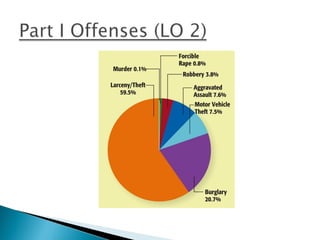
   Distinguish between Part I and Part II offenses as
    defined in the Uniform Crime Report (UCR).
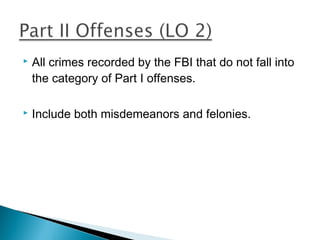
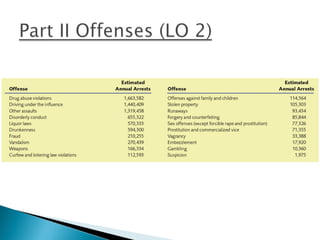
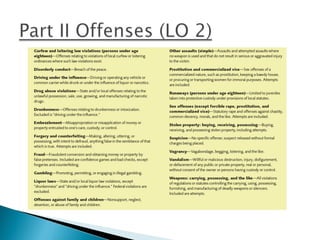
   All crimes recorded by the FBI that do not fall into
    the category of Part I offenses.

   Include both misdemeanors and felonies.
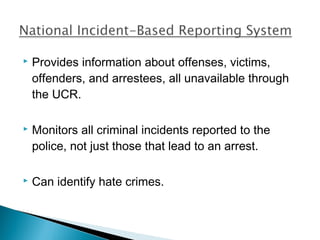
   Provides information about offenses, victims,
    offenders, and arrestees, all unavailable through
    the UCR.

   Monitors all criminal incidents reported to the
    police, not just those that lead to an arrest.

   Can identify hate crimes.
   Distinguish between the National Crime
    Victimization Survey (NCVS) and self-reported
    surveys.
   A method of gathering crime data that directly
    surveys participants to determine their
    experiences as victims of crime.

   Gives a better understanding of the dark figure of
    crime, or the actual amount of crime that occurs in
    the country but is not reported to the police.
   Advantages over UCR:

    ◦ Measures both reported and unreported crime.

    ◦ Unaffected by police bias and distortions in reporting to
      the FBI.

    ◦ Does not rely on victims directly reporting to the police.
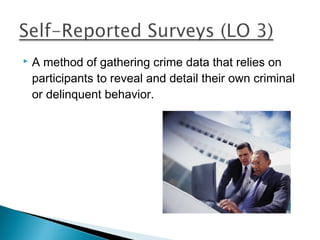
   A method of gathering crime data that relies on
    participants to reveal and detail their own criminal
    or delinquent behavior.
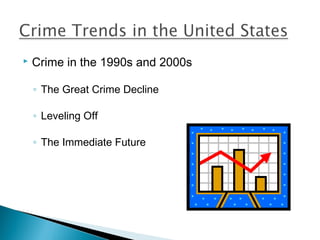
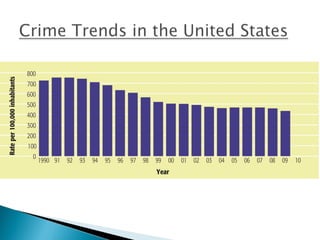
   Crime in the 1990s and 2000s

    ◦ The Great Crime Decline
    ◦ Leveling Off

    ◦ The Immediate Future
   Crime, Race, and Poverty

    ◦ Race and Crime

    ◦ Class and Crime

    ◦ Ethnicity and Crime
   Discuss the prevailing explanation for the rising
    number of women incarcerated in the United
    States.
   In the past decade, the rate of arrests for women
    has risen much more rapidly than that for men.

   Explanations:
    ◦ The life circumstances and behavior of women have
      changed dramatically in the past 40 years.
    ◦ The criminal justice system’s attitude toward women
      has changed over the past 40 years.
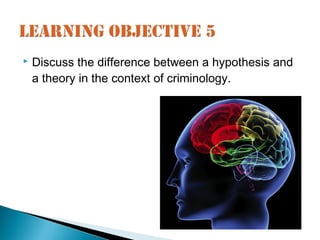
   Discuss the difference between a hypothesis and
    a theory in the context of criminology.
Hypothesis:                      Theory:

   A possible explanation for      An explanation of a
    an observed occurrence           happening or
    that can be tested by            circumstance that is
    further investigation.           based on observation,
                                     experimentation, and
                                     reasoning.
    Criminology:
    The scientific study of crime and the
    causes of criminal behavior.
   People have free will to choose their behavior.
   Criminals find crime more attractive than law
    abiding behavior.
   Threat of punishment is the only deterrent to crime.
   “Thrill offenders”
   Choice Theory and Public Policy
   Behavior is the result of biological, psychological, and
    social forces.
   Criminals are driven to crime by external factors.
   Rehabilitation and treatment is the only deterrent to
    crime.
   Biochemical Conditions and Crime
   The Brain and Crime
   Psychology and Crime
   Trait Theory and Public Policy
   Questions:
    ◦ Do you believe someone can be insane if it is drug-
      induced?

    ◦ Do you believe there should be a specified length of time
      an insane individual should serve in a mental facility if
      this defense is successful?
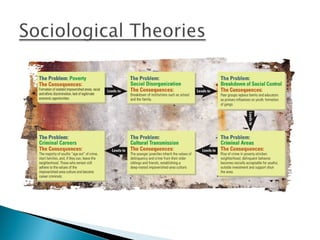
   Social disorganization theory suggests that
    deviant behavior is more likely in communities
    where social institutions such as the family,
    schools, and the criminal justice system fail to
    exert control over the population.
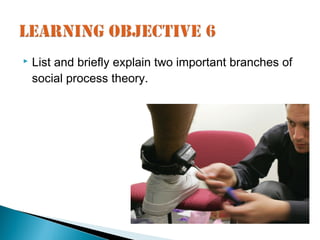
   List and briefly explain two important branches of
    social process theory.
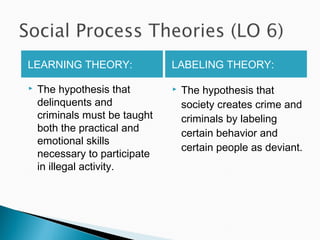
LEARNING THEORY:               LABELING THEORY:

   The hypothesis that           The hypothesis that
    delinquents and                society creates crime and
    criminals must be taught       criminals by labeling
    both the practical and         certain behavior and
    emotional skills
                                   certain people as deviant.
    necessary to participate
    in illegal activity.
   A group of theories that view criminal behavior as
    the result of class conflict.
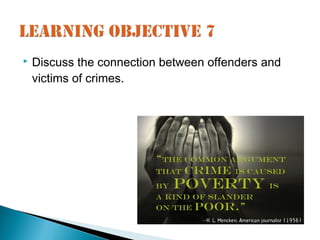
   Discuss the connection between offenders and
    victims of crimes.
   The Risks of Victimization
    ◦ Most criminal acts require:
      A likely offender.
      A suitable target.
      The absence of a capable guardian.


   Repeat Victimization

   The Victim-Offender Connection
   The Criminology of Drug Use

   Drug Addiction and Dependency
    ◦ Drug Use and Drug Abuse
    ◦ Addiction Basics

   The Drug-Crime Relationship
    ◦ The Psychoparmacological Model
    ◦ The Economically Impulsive Model
    ◦ The Systemic Model
   Explain the theory of the chronic offender and its
    importance for the criminal justice system.
   A delinquent or criminal who commits multiple
    offenses and is considered part of a small group
    of wrongdoers who are responsible for a majority
    of the antisocial activity in any given community.

   The notion of a “chronic 6 percent.”
   Debate continues as to whether or not criminology
    has done enough for the criminal justice system.

   Research must be accessible to practitioners and
    policymakers.

Chapter2

  • 1.
    M ASURING E andE L XP AINING CRIM E
  • 2.
    Identify the publication in which the FBI reports crime data and list the three ways in which the data are reported.
  • 3.
    17,500 policing agencies The data is then reported send data to the FBI each as: year, including:  Number of arrests.  A rate per 100,000 persons.  Number of crimes reported.  As a percentage change  Number of officers and from previous years. support specialists.
  • 4.
    Distinguish between Part I and Part II offenses as defined in the Uniform Crime Report (UCR).
  • 6.
    All crimes recorded by the FBI that do not fall into the category of Part I offenses.  Include both misdemeanors and felonies.
  • 9.
    Provides information about offenses, victims, offenders, and arrestees, all unavailable through the UCR.  Monitors all criminal incidents reported to the police, not just those that lead to an arrest.  Can identify hate crimes.
  • 10.
    Distinguish between the National Crime Victimization Survey (NCVS) and self-reported surveys.
  • 11.
    A method of gathering crime data that directly surveys participants to determine their experiences as victims of crime.  Gives a better understanding of the dark figure of crime, or the actual amount of crime that occurs in the country but is not reported to the police.
  • 12.
    Advantages over UCR: ◦ Measures both reported and unreported crime. ◦ Unaffected by police bias and distortions in reporting to the FBI. ◦ Does not rely on victims directly reporting to the police.
  • 13.
    A method of gathering crime data that relies on participants to reveal and detail their own criminal or delinquent behavior.
  • 14.
    Crime in the 1990s and 2000s ◦ The Great Crime Decline ◦ Leveling Off ◦ The Immediate Future
  • 16.
    Crime, Race, and Poverty ◦ Race and Crime ◦ Class and Crime ◦ Ethnicity and Crime
  • 17.
    Discuss the prevailing explanation for the rising number of women incarcerated in the United States.
  • 18.
    In the past decade, the rate of arrests for women has risen much more rapidly than that for men.  Explanations: ◦ The life circumstances and behavior of women have changed dramatically in the past 40 years. ◦ The criminal justice system’s attitude toward women has changed over the past 40 years.
  • 19.
    Discuss the difference between a hypothesis and a theory in the context of criminology.
  • 20.
    Hypothesis: Theory:  A possible explanation for  An explanation of a an observed occurrence happening or that can be tested by circumstance that is further investigation. based on observation, experimentation, and reasoning. Criminology: The scientific study of crime and the causes of criminal behavior.
  • 21.
    People have free will to choose their behavior.  Criminals find crime more attractive than law abiding behavior.  Threat of punishment is the only deterrent to crime.  “Thrill offenders”  Choice Theory and Public Policy
  • 22.
    Behavior is the result of biological, psychological, and social forces.  Criminals are driven to crime by external factors.  Rehabilitation and treatment is the only deterrent to crime.  Biochemical Conditions and Crime  The Brain and Crime  Psychology and Crime  Trait Theory and Public Policy
  • 24.
    Questions: ◦ Do you believe someone can be insane if it is drug- induced? ◦ Do you believe there should be a specified length of time an insane individual should serve in a mental facility if this defense is successful?
  • 25.
    Social disorganization theory suggests that deviant behavior is more likely in communities where social institutions such as the family, schools, and the criminal justice system fail to exert control over the population.
  • 27.
    List and briefly explain two important branches of social process theory.
  • 28.
    LEARNING THEORY: LABELING THEORY:  The hypothesis that  The hypothesis that delinquents and society creates crime and criminals must be taught criminals by labeling both the practical and certain behavior and emotional skills certain people as deviant. necessary to participate in illegal activity.
  • 29.
    A group of theories that view criminal behavior as the result of class conflict.
  • 30.
    Discuss the connection between offenders and victims of crimes.
  • 31.
    The Risks of Victimization ◦ Most criminal acts require:  A likely offender.  A suitable target.  The absence of a capable guardian.  Repeat Victimization  The Victim-Offender Connection
  • 32.
    The Criminology of Drug Use  Drug Addiction and Dependency ◦ Drug Use and Drug Abuse ◦ Addiction Basics  The Drug-Crime Relationship ◦ The Psychoparmacological Model ◦ The Economically Impulsive Model ◦ The Systemic Model
  • 33.
    Explain the theory of the chronic offender and its importance for the criminal justice system.
  • 34.
    A delinquent or criminal who commits multiple offenses and is considered part of a small group of wrongdoers who are responsible for a majority of the antisocial activity in any given community.  The notion of a “chronic 6 percent.”
  • 35.
    Debate continues as to whether or not criminology has done enough for the criminal justice system.  Research must be accessible to practitioners and policymakers.