Theories of Human Development
       Integrative Perspectives

THE CONTEXTUALISTIC WORLDVIEW – Part
                 IV

       Dale Goldhaer
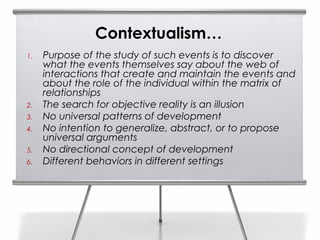
Contextualism…
1.   Purpose of the study of such events is to discover
     what the events themselves say about the web of
     interactions that create and maintain the events and
     about the role of the individual within the matrix of
     relationships
2.   The search for objective reality is an illusion
3.   No universal patterns of development
4.   No intention to generalize, abstract, or to propose
     universal arguments
5.   No directional concept of development
6.   Different behaviors in different settings
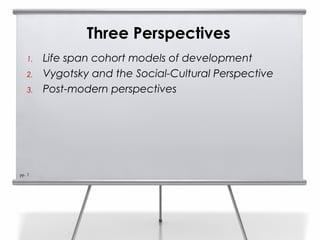
Three Perspectives
   1.   Life span cohort models of development
   2.   Vygotsky and the Social-Cultural Perspective
   3.   Post-modern perspectives


pp. 2
Life span cohort models
     of development

       Glen Elder
Life Span Cohort Models
1.   Emergence of models traced to 3 related
     developments: (a) the changing demographics
     of old age, (b) the aging of the participants in
     the longitudinal studies begun in 1920s and
     1930s, and ( c)the growing interest in
     multidisciplinary research
2.   Three interrelated basic assumptions that
     underlie life span cohort models:
        Development as an open process
        Development as a situated process
        Development as a successive sequence
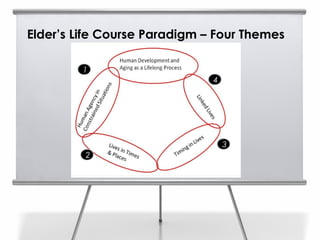
Elder’s Life Course Paradigm – Four Themes

         1
                              4


                                  3
         2
Vygotsky and the
  Sociocultural
   perspective
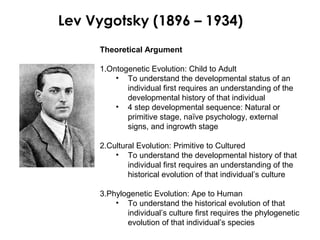
Lev Vygotsky (1896 – 1934)
     Theoretical Argument

     1.Ontogenetic Evolution: Child to Adult
         • To understand the developmental status of an
            individual first requires an understanding of the
            developmental history of that individual
         • 4 step developmental sequence: Natural or
            primitive stage, naïve psychology, external
            signs, and ingrowth stage

     2.Cultural Evolution: Primitive to Cultured
         • To understand the developmental history of that
             individual first requires an understanding of the
             historical evolution of that individual’s culture

     3.Phylogenetic Evolution: Ape to Human
         • To understand the historical evolution of that
            individual’s culture first requires the phylogenetic
            evolution of that individual’s species
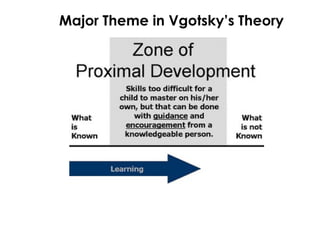
Major Theme in Vgotsky’s Theory
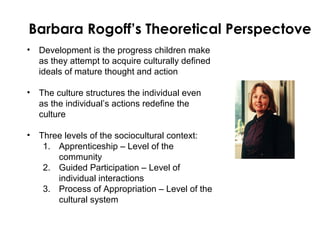
Barbara Rogoff’s Theoretical Perspectove
• Development is the progress children make
  as they attempt to acquire culturally defined
  ideals of mature thought and action

• The culture structures the individual even
  as the individual’s actions redefine the
  culture

• Three levels of the sociocultural context:
   1. Apprenticeship – Level of the
      community
   2. Guided Participation – Level of
      individual interactions
   3. Process of Appropriation – Level of the
      cultural system
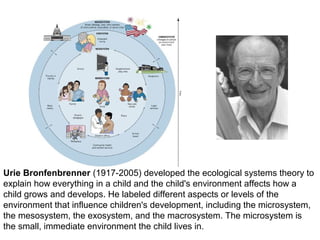
Urie Bronfenbrenner (1917-2005) developed the ecological systems theory to
explain how everything in a child and the child's environment affects how a
child grows and develops. He labeled different aspects or levels of the
environment that influence children's development, including the microsystem,
the mesosystem, the exosystem, and the macrosystem. The microsystem is
the small, immediate environment the child lives in.
Postmodern
Perspectives
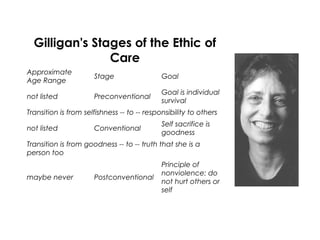
Gilligan's Stages of the Ethic of
                Care
Approximate
                      Stage                  Goal
Age Range
                                             Goal is individual
not listed            Preconventional
                                             survival
Transition is from selfishness -- to -- responsibility to others
                                             Self sacrifice is
not listed            Conventional
                                             goodness
Transition is from goodness -- to -- truth that she is a
person too
                                             Principle of
                                             nonviolence: do
maybe never           Postconventional
                                             not hurt others or
                                             self

Human development the contextualistic world view (part iv)

  • 1.
    Theories of HumanDevelopment Integrative Perspectives THE CONTEXTUALISTIC WORLDVIEW – Part IV Dale Goldhaer
  • 2.
    Contextualism… 1. Purpose of the study of such events is to discover what the events themselves say about the web of interactions that create and maintain the events and about the role of the individual within the matrix of relationships 2. The search for objective reality is an illusion 3. No universal patterns of development 4. No intention to generalize, abstract, or to propose universal arguments 5. No directional concept of development 6. Different behaviors in different settings
  • 3.
    Three Perspectives 1. Life span cohort models of development 2. Vygotsky and the Social-Cultural Perspective 3. Post-modern perspectives pp. 2
  • 4.
    Life span cohortmodels of development Glen Elder
  • 5.
    Life Span CohortModels 1. Emergence of models traced to 3 related developments: (a) the changing demographics of old age, (b) the aging of the participants in the longitudinal studies begun in 1920s and 1930s, and ( c)the growing interest in multidisciplinary research 2. Three interrelated basic assumptions that underlie life span cohort models:  Development as an open process  Development as a situated process  Development as a successive sequence
  • 6.
    Elder’s Life CourseParadigm – Four Themes 1 4 3 2
  • 7.
    Vygotsky and the Sociocultural perspective
  • 8.
    Lev Vygotsky (1896– 1934) Theoretical Argument 1.Ontogenetic Evolution: Child to Adult • To understand the developmental status of an individual first requires an understanding of the developmental history of that individual • 4 step developmental sequence: Natural or primitive stage, naïve psychology, external signs, and ingrowth stage 2.Cultural Evolution: Primitive to Cultured • To understand the developmental history of that individual first requires an understanding of the historical evolution of that individual’s culture 3.Phylogenetic Evolution: Ape to Human • To understand the historical evolution of that individual’s culture first requires the phylogenetic evolution of that individual’s species
  • 9.
    Major Theme inVgotsky’s Theory
  • 10.
    Barbara Rogoff’s TheoreticalPerspectove • Development is the progress children make as they attempt to acquire culturally defined ideals of mature thought and action • The culture structures the individual even as the individual’s actions redefine the culture • Three levels of the sociocultural context: 1. Apprenticeship – Level of the community 2. Guided Participation – Level of individual interactions 3. Process of Appropriation – Level of the cultural system
  • 11.
    Urie Bronfenbrenner (1917-2005)developed the ecological systems theory to explain how everything in a child and the child's environment affects how a child grows and develops. He labeled different aspects or levels of the environment that influence children's development, including the microsystem, the mesosystem, the exosystem, and the macrosystem. The microsystem is the small, immediate environment the child lives in.
  • 12.
  • 13.
    Gilligan's Stages ofthe Ethic of Care Approximate Stage Goal Age Range Goal is individual not listed Preconventional survival Transition is from selfishness -- to -- responsibility to others Self sacrifice is not listed Conventional goodness Transition is from goodness -- to -- truth that she is a person too Principle of nonviolence: do maybe never Postconventional not hurt others or self