Chapter 3
Victim and Victimizations
Group 8
Criminology (SSWD3623)
Siti Fadzlikha Asyifa
Nur Diana
Prepared for:
Prof Madya Dr. Jamaludin bin Mustaffa
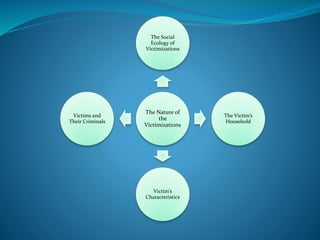
The Nature of
the
Victimizations
The Social
Ecology of
Victimizations
The Victim’s
Household
Victim’s
Characteristics
Victims and
Their Criminals
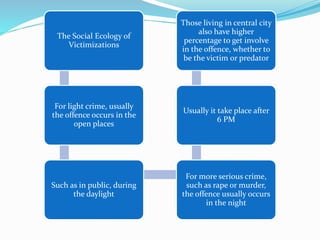
The Social Ecology of
Victimizations
For light crime, usually
the offence occurs in the
open places
Such as in public, during
the daylight
For more serious crime,
such as rape or murder,
the offence usually occurs
in the night
Usually it take place after
6 PM
Those living in central city
also have higher
percentage to get involve
in the offence, whether to
be the victim or predator
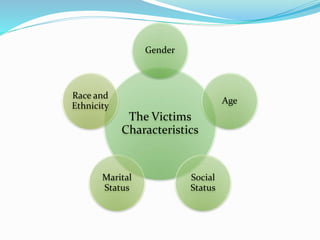
The Victims
Characteristics
Gender
Age
Social
Status
Marital
Status
Race and
Ethnicity
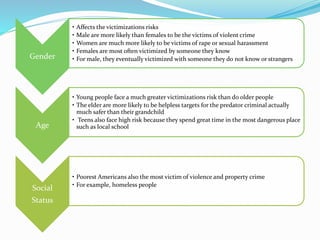
Gender
• Affects the victimizations risks
• Male are more likely than females to be the victims of violent crime
• Women are much more likely to be victims of rape or sexual harassment
• Females are most often victimized by someone they know
• For male, they eventually victimized with someone they do not know or strangers
Age
• Young people face a much greater victimizations risk than do older people
• The elder are more likely to be helpless targets for the predator criminal actually
much safer than their grandchild
• Teens also face high risk because they spend great time in the most dangerous place
such as local school
Social
Status
• Poorest Americans also the most victim of violence and property crime
• For example, homeless people
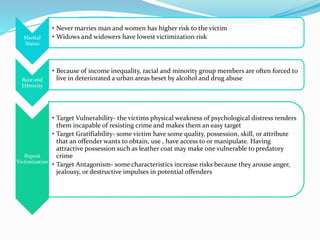
Marital
Status
• Never marries man and women has higher risk to the victim
• Widows and widowers have lowest victimization risk
Race and
Ethnicity
• Because of income inequality, racial and minority group members are often forced to
live in deteriorated a urban areas beset by alcohol and drug abuse
Repeat
Victimization
• Target Vulnerability- the victims physical weakness of psychological distress renders
them incapable of resisting crime and makes them an easy target
• Target Gratifiability- some victim have some quality, possession, skill, or attribute
that an offender wants to obtain, use , have access to or manipulate. Having
attractive possession such as leather coat may make one vulnerable to predatory
crime
• Target Antagonism- some characteristics increase risks because they arouse anger,
jealousy, or destructive impulses in potential offenders
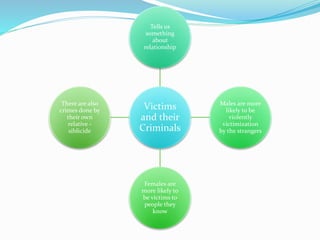
Victims
and their
Criminals
Tells us
something
about
relationship
Males are more
likely to be
violently
victimization
by the strangers
Females are
more likely to
be victims to
people they
know
There are also
crimes done by
their own
relative -
siblicide
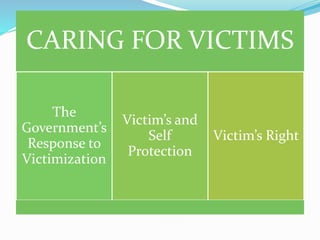
CARING FOR VICTIMS
The
Government’s
Response to
Victimization
Victim’s and
Self
Protection
Victim’s Right
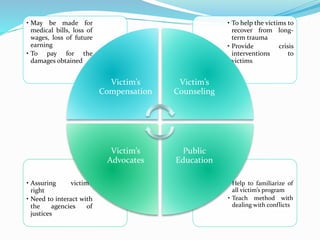
• Help to familiarize of
all victim’s program
• Teach method with
dealing with conflicts
• Assuring victim’s
right
• Need to interact with
the agencies of
justices
• To help the victims to
recover from long-
term trauma
• Provide crisis
interventions to
victims
• May be made for
medical bills, loss of
wages, loss of future
earning
• To pay for the
damages obtained
Victim’s
Compensation
Victim’s
Counseling
Public
Education
Victim’s
Advocates
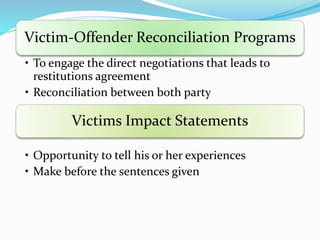
Victim-Offender Reconciliation Programs
• To engage the direct negotiations that leads to
restitutions agreement
• Reconciliation between both party
Victims Impact Statements
• Opportunity to tell his or her experiences
• Make before the sentences given
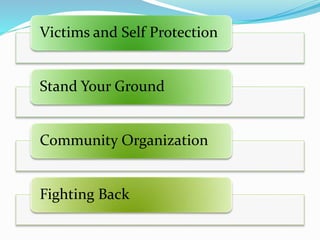
Victims and Self Protection
Stand Your Ground
Community Organization
Fighting Back
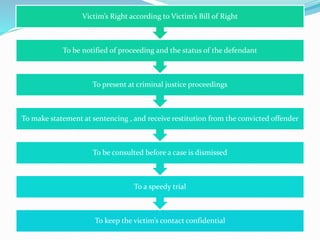
To keep the victim’s contact confidential
To a speedy trial
To be consulted before a case is dismissed
To make statement at sentencing , and receive restitution from the convicted offender
To present at criminal justice proceedings
To be notified of proceeding and the status of the defendant
Victim’s Right according to Victim’s Bill of Right
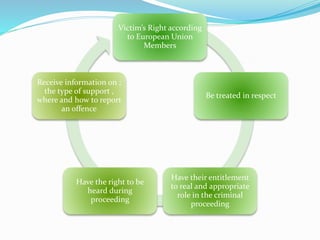
Victim’s Right according
to European Union
Members
Be treated in respect
Have their entitlement
to real and appropriate
role in the criminal
proceeding
Have the right to be
heard during
proceeding
Receive information on ;
the type of support ,
where and how to report
an offence
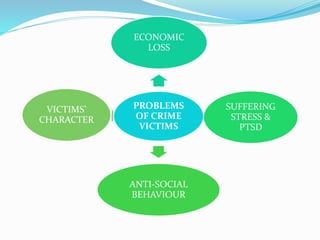
PROBLEMS
OF CRIME
VICTIMS
ECONOMIC
LOSS
SUFFERING
STRESS &
PTSD
ANTI-SOCIAL
BEHAVIOUR
VICTIMS’
CHARACTER
ECONOMIC LOSS
COSTS OF
GOODS
PRODUCTIVITY
LOSS
COSTS OF
VICTIMIZATION
A] SYSTEM COSTS B] INDIVIDUAL
COSTS
Criminologists use this below method which is similar to determine
civil damages, to estimate the costs of victimization:
A] SYSTEM COSTS
 Effected party: Society at large, taxpayer, federal and
state government.
 Cost incurred to:
• Early prevention program
• Organization to combat crimes
Reduce
crime
• Medical treatment for injuries
• Services for victims
• Loss wages, pain and suffering, also
reduced quality of life
Victims
• Legal costs
• Treatment costs
Justice
system
• Abused product
• Treatments and care centre
Social
costs
B] INDIVIDUAL COSTS
 Earning and occupational attainment affected.
 If happen to have physical disabled during the
incidents of crime but victims had no
insurance financial devastating occur due to the
costs of special treatment.
 Victims may bear psychological and physical ills
that may inhibit academic achievement and later
their economic and professional success.
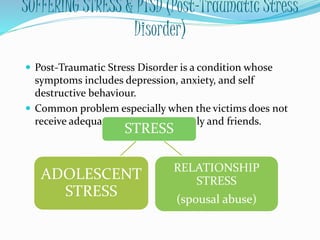
SUFFERING STRESS & PTSD (Post-Traumatic Stress
Disorder)
 Post-Traumatic Stress Disorder is a condition whose
symptoms includes depression, anxiety, and self
destructive behaviour.
 Common problem especially when the victims does not
receive adequate support from family and friends.
STRESS
RELATIONSHIP
STRESS
(spousal abuse)
ADOLESCENT
STRESS
ADOLESCENT STRESS Younger victims are prone to suffer stress.
Meanwhile, adolescent victims are particularly at
risks to PTSD.
 Kids victim may suffer psychological deficits which
was significantly associated with visual, auditory
and tactile hallucination.
 This may give effect on long-term mental health,
low self-esteem and be more suicidal as adults.
 They also risked to be re-abused as adults which
may lead to despair, depression, and even
homelessness.
ANTI-SOCIAL BEHAVIOUR
 The abuse-crime phenomenon is referred to as cycle of
violence.
 Research shows that both boys and girls are more likely
to engage in violent behavior if they were the targets of
physical abuse.
 They more likely to smoke, drink, and take drugs than
are non-abused youth.
 Links between victimization and crime:
1. Victimization causes social problem
2. Victimization causes stress and anger
3. Victimization prompts revenge
4. Victimization and crime are spurious association.
VICTIMS’ CHARACTER - FEAR
 Victims of violent crime are the most deeply fear a
repeat of their attack.
 Many go through a fundamental life change,
viewing the world more suspiciously and a less safe,
controllable and meaningful place.
 Trauma may disrupted memory, cutting off events
that happened before the incident and eliminated
ability to conceive a happy and productive future.
 Vicarious Fear- hearing about another’s
victimization may make people timid and cautious.
They will make preparation after hearing news of
crime happen within their circle.
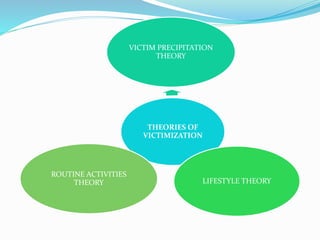
THEORIES OF
VICTIMIZATION
VICTIM PRECIPITATION
THEORY
LIFESTYLE THEORY
ROUTINE ACTIVITIES
THEORY
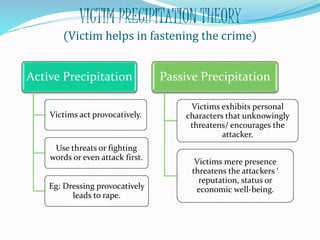
VICTIM PRECIPITATION THEORY
(Victim helps in fastening the crime)
Active Precipitation
Victims act provocatively.
Use threats or fighting
words or even attack first.
Eg: Dressing provocatively
leads to rape.
Passive Precipitation
Victims exhibits personal
characters that unknowingly
threatens/ encourages the
attacker.
Victims mere presence
threatens the attackers ‘
reputation, status or
economic well-being.
LIFESTYLE THEORY
 The basis of this theory is that the crime is not a
random occurrence but rather a function of the
victim’s lifestyle.
 Victimization risk is increased by such behaviors as
associating with young men, going out in public
places late at night and living in an urban area.
 Conversely, the risk reduced by staying home at
night,l moving to a rural area, staying out of public
places, earning more money and getting married.
 Factors that also lead to victimization are risky life
(homeless and runaway), status, getting involved in
criminality and college lifestyle.
ROUTINE ACTIVITIES THEORY
 Lawrence Cohen and Marcus Felson (1979), the volume
and distribution of predatory crime are closely related to
the interaction of three variables that reflect the routine
activities. They are:
1. The availability of suitable targets
2. The absence of capable guardians
3. The presence of motivated offenders
 Routine Activities and Lifestyle rely on four basic
concepts:
a) Proximity to criminals
b) Time of exposure to criminals
c) Target attractiveness
d) guardianship
ROUTINE ACTIVITIES THEORY
 These two theories share five predictions that
people increase their victimization risk if they:
1) Live in high-crime areas
2) Go out late at night
3) Carry valuable things
4) Engage in risky behavior
5) Without friends and family to watch or help them.

Victimization - Criminology

  • 1.
    Chapter 3 Victim andVictimizations Group 8 Criminology (SSWD3623) Siti Fadzlikha Asyifa Nur Diana Prepared for: Prof Madya Dr. Jamaludin bin Mustaffa
  • 2.
    The Nature of the Victimizations TheSocial Ecology of Victimizations The Victim’s Household Victim’s Characteristics Victims and Their Criminals
  • 3.
    The Social Ecologyof Victimizations For light crime, usually the offence occurs in the open places Such as in public, during the daylight For more serious crime, such as rape or murder, the offence usually occurs in the night Usually it take place after 6 PM Those living in central city also have higher percentage to get involve in the offence, whether to be the victim or predator
  • 4.
  • 5.
    Gender • Affects thevictimizations risks • Male are more likely than females to be the victims of violent crime • Women are much more likely to be victims of rape or sexual harassment • Females are most often victimized by someone they know • For male, they eventually victimized with someone they do not know or strangers Age • Young people face a much greater victimizations risk than do older people • The elder are more likely to be helpless targets for the predator criminal actually much safer than their grandchild • Teens also face high risk because they spend great time in the most dangerous place such as local school Social Status • Poorest Americans also the most victim of violence and property crime • For example, homeless people
  • 6.
    Marital Status • Never marriesman and women has higher risk to the victim • Widows and widowers have lowest victimization risk Race and Ethnicity • Because of income inequality, racial and minority group members are often forced to live in deteriorated a urban areas beset by alcohol and drug abuse Repeat Victimization • Target Vulnerability- the victims physical weakness of psychological distress renders them incapable of resisting crime and makes them an easy target • Target Gratifiability- some victim have some quality, possession, skill, or attribute that an offender wants to obtain, use , have access to or manipulate. Having attractive possession such as leather coat may make one vulnerable to predatory crime • Target Antagonism- some characteristics increase risks because they arouse anger, jealousy, or destructive impulses in potential offenders
  • 7.
    Victims and their Criminals Tells us something about relationship Malesare more likely to be violently victimization by the strangers Females are more likely to be victims to people they know There are also crimes done by their own relative - siblicide
  • 8.
    CARING FOR VICTIMS The Government’s Responseto Victimization Victim’s and Self Protection Victim’s Right
  • 9.
    • Help tofamiliarize of all victim’s program • Teach method with dealing with conflicts • Assuring victim’s right • Need to interact with the agencies of justices • To help the victims to recover from long- term trauma • Provide crisis interventions to victims • May be made for medical bills, loss of wages, loss of future earning • To pay for the damages obtained Victim’s Compensation Victim’s Counseling Public Education Victim’s Advocates
  • 10.
    Victim-Offender Reconciliation Programs •To engage the direct negotiations that leads to restitutions agreement • Reconciliation between both party Victims Impact Statements • Opportunity to tell his or her experiences • Make before the sentences given
  • 11.
    Victims and SelfProtection Stand Your Ground Community Organization Fighting Back
  • 12.
    To keep thevictim’s contact confidential To a speedy trial To be consulted before a case is dismissed To make statement at sentencing , and receive restitution from the convicted offender To present at criminal justice proceedings To be notified of proceeding and the status of the defendant Victim’s Right according to Victim’s Bill of Right
  • 13.
    Victim’s Right according toEuropean Union Members Be treated in respect Have their entitlement to real and appropriate role in the criminal proceeding Have the right to be heard during proceeding Receive information on ; the type of support , where and how to report an offence
  • 14.
  • 15.
    ECONOMIC LOSS COSTS OF GOODS PRODUCTIVITY LOSS COSTSOF VICTIMIZATION A] SYSTEM COSTS B] INDIVIDUAL COSTS Criminologists use this below method which is similar to determine civil damages, to estimate the costs of victimization:
  • 16.
    A] SYSTEM COSTS Effected party: Society at large, taxpayer, federal and state government.  Cost incurred to: • Early prevention program • Organization to combat crimes Reduce crime • Medical treatment for injuries • Services for victims • Loss wages, pain and suffering, also reduced quality of life Victims • Legal costs • Treatment costs Justice system • Abused product • Treatments and care centre Social costs
  • 17.
    B] INDIVIDUAL COSTS Earning and occupational attainment affected.  If happen to have physical disabled during the incidents of crime but victims had no insurance financial devastating occur due to the costs of special treatment.  Victims may bear psychological and physical ills that may inhibit academic achievement and later their economic and professional success.
  • 18.
    SUFFERING STRESS &PTSD (Post-Traumatic Stress Disorder)  Post-Traumatic Stress Disorder is a condition whose symptoms includes depression, anxiety, and self destructive behaviour.  Common problem especially when the victims does not receive adequate support from family and friends. STRESS RELATIONSHIP STRESS (spousal abuse) ADOLESCENT STRESS
  • 19.
    ADOLESCENT STRESS Youngervictims are prone to suffer stress. Meanwhile, adolescent victims are particularly at risks to PTSD.  Kids victim may suffer psychological deficits which was significantly associated with visual, auditory and tactile hallucination.  This may give effect on long-term mental health, low self-esteem and be more suicidal as adults.  They also risked to be re-abused as adults which may lead to despair, depression, and even homelessness.
  • 20.
    ANTI-SOCIAL BEHAVIOUR  Theabuse-crime phenomenon is referred to as cycle of violence.  Research shows that both boys and girls are more likely to engage in violent behavior if they were the targets of physical abuse.  They more likely to smoke, drink, and take drugs than are non-abused youth.  Links between victimization and crime: 1. Victimization causes social problem 2. Victimization causes stress and anger 3. Victimization prompts revenge 4. Victimization and crime are spurious association.
  • 21.
    VICTIMS’ CHARACTER -FEAR  Victims of violent crime are the most deeply fear a repeat of their attack.  Many go through a fundamental life change, viewing the world more suspiciously and a less safe, controllable and meaningful place.  Trauma may disrupted memory, cutting off events that happened before the incident and eliminated ability to conceive a happy and productive future.  Vicarious Fear- hearing about another’s victimization may make people timid and cautious. They will make preparation after hearing news of crime happen within their circle.
  • 22.
  • 23.
    VICTIM PRECIPITATION THEORY (Victimhelps in fastening the crime) Active Precipitation Victims act provocatively. Use threats or fighting words or even attack first. Eg: Dressing provocatively leads to rape. Passive Precipitation Victims exhibits personal characters that unknowingly threatens/ encourages the attacker. Victims mere presence threatens the attackers ‘ reputation, status or economic well-being.
  • 24.
    LIFESTYLE THEORY  Thebasis of this theory is that the crime is not a random occurrence but rather a function of the victim’s lifestyle.  Victimization risk is increased by such behaviors as associating with young men, going out in public places late at night and living in an urban area.  Conversely, the risk reduced by staying home at night,l moving to a rural area, staying out of public places, earning more money and getting married.  Factors that also lead to victimization are risky life (homeless and runaway), status, getting involved in criminality and college lifestyle.
  • 25.
    ROUTINE ACTIVITIES THEORY Lawrence Cohen and Marcus Felson (1979), the volume and distribution of predatory crime are closely related to the interaction of three variables that reflect the routine activities. They are: 1. The availability of suitable targets 2. The absence of capable guardians 3. The presence of motivated offenders  Routine Activities and Lifestyle rely on four basic concepts: a) Proximity to criminals b) Time of exposure to criminals c) Target attractiveness d) guardianship
  • 26.
    ROUTINE ACTIVITIES THEORY These two theories share five predictions that people increase their victimization risk if they: 1) Live in high-crime areas 2) Go out late at night 3) Carry valuable things 4) Engage in risky behavior 5) Without friends and family to watch or help them.