Prison Life:
Living in
and Leaving
Prison
Chapter
14
Entering Prison
Classification
No Frills Policy
Entering Prison
Classification
 Before entering prison, inmates go through a
battery of psychological and personality tests
No Frills Policy
 A correctional policy that stipulates that
prisons are meant to punish, not coddle,
inmates
Men Imprisoned
Total Institutions
Living in Prison
Adjusting to Prison
Inmate Subculture / Social Code
Prisonization
Men Imprisoned
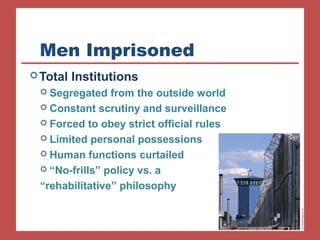
Total Institutions
 Segregated from the outside world
 Constant scrutiny and surveillance
 Forced to obey strict official rules
 Limited personal possessions
 Human functions curtailed
 “No-frills” policy vs. a
“rehabilitative” philosophy
Video: War on Drugs
Men Imprisoned
Living in Prison
 Stripped, searched, shorn, assigned living
quarters
 Deprivation of liberty, goods and services,
heterosexual relationships, autonomy, and
security
 Overcrowded prisons are filled with
young, aggressive men who are
responsible for majority of inmate-on-
inmate assaults
Men Imprisoned
Adjusting to Prison
 Variety of attitude and behavior changes
as their sentence unfolds
 Many inmates learn to adapt to the prison
routine
 Some inmates routinely
violate institutional rules
Men Imprisoned
Inmate subculture is the loosely defined
culture that pervades prisons and has its
own norms, rules, and language
 Elements of the Inmate Social Code
 An unwritten code of behavior, passed from older
inmates to younger ones, that serves as a
guideline for appropriate inmate behavior
 Don’t interfere with inmates’ interests
 Don’t lose your head
 Don’t exploit inmates
 Be tough and don’t lose your dignity
 Don’t be a sucker
Men Imprisoned
Prisonization is assimilation into the
separate culture of the prison
 In the new inmate culture, African
American and Latino inmates are much
more cohesively organized than whites
Interesting Issues
Sex Offenders
 find it difficult to adjust to prison due to
the dislike by guards and inmates
Inmate Health
 Inmates health is generally worse then the
health of general population
Video: Women in Prison
– Entering the Prison
Women Imprisoned
Female Institutions
Female Inmates
Adapting
Women Imprisoned
Female Institutions
 Smaller than male institutions
 Non-secure
 Lack of adequate training for inmates
 Counseling by laypeople
 Lack of parenting programs
 Lack of job training
Physical/sexual
abuse
Substance abuse
Health issues
Mental health
issues
Suicide
Young
Minorities
Unmarried
Parents
Undereducated
Unemployed or
underemployed
Troubled family lives
Female Inmates
Women Imprisoned
Adapting to the Female Institution
 Different from male institutions
 Less danger to staff
 Less violent behavior
 Less aggressive sexual behavior
 More social support both internal and
external
Women Imprisoned
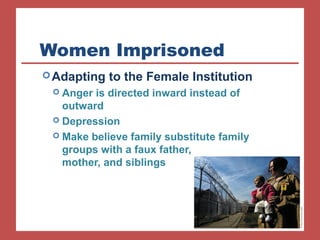
Adapting to the Female Institution
 Anger is directed inward instead of
outward
 Depression
 Make believe family substitute family
groups with a faux father,
mother, and siblings
Prison Violence
Individual Violence
Collective Violence
Sexual Violence
Prison Violence
 Individual Violence
 History of prior violence
 Psychological malady
 Prison conditions
 Lack of dispute resolution mechanisms
 Basic survival
 Collective Violence
 Inmate-balance theory
 Administrative-control theory
 Prison overcrowding theory
Prison Violence
Sexual Violence
 Young males may be raped and kept as
sexual slaves by older, more aggressive
inmates
 Weaker inmates may agree to such
arrangements for protection
 Difficult to get an accurate reading of the
true incidence of prison rape
Prison Violence
 What factors lead to sexual victimization?
 White inmates are attacked more than any
other race
 Victims are generally younger than their
assailants
 Mentally ill or intellectually impaired inmates
are more likely to be victimized
 Cellblocks with solid cell fronts may
contribute to sexual assault
 In women’s prisons, sexual assault may be at
the hands of correctional officers
Prison Violence
Sexual Violence
 Reasons for not reporting
 Embarrassment
 Personal matter
 Fear of harassment
 Retaliation from perpetrator
 Don’t want to be put in safekeeping
Video: Women in Maximum
Security Prison – Sex and Love
Correctional Rehabilitation
Counseling
Educational Programs
Vocational Programs
Does it Work
Correctional Rehabilitation
 Individual and group counseling
 May involve:
 Cognitive Behavior Therapy
 Anger Management Programs
 Designed to help inmates cope with their violent
behavioral urges and tendencies
 Faith based programs
 Drug treatment programs
 Frequently a 12-step program
 Methadone
 A narcotic analgesic that is an effective substitute for
heroin, morphine, codeine, and other opiates and is
used in association with drug treatment programs
Correctional Rehabilitation
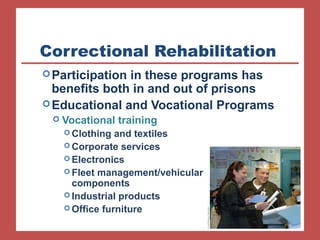
Participation in these programs has
benefits both in and out of prisons
Educational and Vocational Programs
 Vocational training
 Clothing and textiles
 Corporate services
 Electronics
 Fleet management/vehicular
components
 Industrial products
 Office furniture
Correctional Rehabilitation
Educational and Vocational Programs
 Work release
 Allows inmates to be released during the
day to work in the community, returning to
prison at night
 Furlough
 Allows inmates to leave the institution for
vocational or educational training, for
employment, or to maintain family ties
 Private prison enterprise
 Post-release programs
Correctional Rehabilitation
 Can Rehabilitation Work?
 Rehabilitation does work
 Elements of successful programs
 Teach interpersonal skills
 Provide individual counseling
 Make use of behavior modification
techniques
 Use cognitive-behavioral therapy
 Stress improving moral reasoning
 Combine in-prison therapeutic communities
with follow-up community treatment
Guarding the Institution
Correctional Officers
Guarding the Institution
Guarding the institution is a complex
task
 Roles of correctional officers include:
 Supervision of inmates
 Sit on disciplinary boards
 Escort inmates to/from court
 Greatest problem is the conflict between
security and treatment
Guarding the Institution
Female Correctional Officers
 Little difference in behavior or use of
aggressive tactics
 Discipline has not suffered
 Beneficial effect
 Assignment to male institutions may
boost career
Prisoners Rights
Hands-off doctrine
Substantive Rights
Freedom of Religion
Prisoners’ Rights
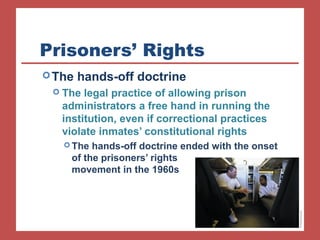
The hands-off doctrine
 The legal practice of allowing prison
administrators a free hand in running the
institution, even if correctional practices
violate inmates’ constitutional rights
 The hands-off doctrine ended with the onset
of the prisoners’ rights
movement in the 1960s
Prisoners’ Rights
Substantive Rights
 Access to courts, legal services, and
materials
 Freedom of the press and of expression
 Freedom of religion
 Medical rights
 Cruel and unusual punishment
 Physical abuse
 Racial segregation
 Overall prison conditions
Prisoners’ Rights
Freedom of Religion
 A fundamental right
 Guaranteed by the First Amendment
 Courts have ruled that inmates have the
right to practice religion as long as it
doesn’t hinder security efforts.
Leaving Prison
Parole
Parole Board
Risks of Reentry
Leaving Prison
 Parole
 The early release of a prisoner from imprisonment
subject to conditions set by correctional
authorities
 The parole board’s primary functions:
 Select and place prisoners on parole
 Aid, supervise, and provide continuing control of
parolees in the community
 Determine when the parole function is completed
and to discharge parolees
 Determine whether parole should be revoked if
violations of conditions occur
National Estimates of
Parole Entries and Exits
Leaving Prison
Parole Hearings
 Review of cases differs across
jurisdictions
 Factors that are considered are the
inmate’s crime, their institutional record,
and their willingness to accept
responsibility
 Inmates rights vary across jurisdictions
 No federal right to legal representation
 Exclusionary rule does not apply
Leaving Prison
Risks of Reentry
 Many are ill prepared for life in
conventional society
 For women, nearly half are either
reconvicted or reincarcerated soon after
parole release
 Having a history of drug
abuse is particularly harmful
Leaving Prison
Risks of Reentry
 At the federal and state levels a number of
initiatives have been taken to help prepare
inmates for reentry
 Offender notification forums
 Reentry courts
 Community based interventions
 Legal restrictions on former inmates

Chapter 14

  • 1.
    Prison Life: Living in andLeaving Prison Chapter 14
  • 2.
  • 3.
    Entering Prison Classification  Beforeentering prison, inmates go through a battery of psychological and personality tests No Frills Policy  A correctional policy that stipulates that prisons are meant to punish, not coddle, inmates
  • 4.
    Men Imprisoned Total Institutions Livingin Prison Adjusting to Prison Inmate Subculture / Social Code Prisonization
  • 5.
    Men Imprisoned Total Institutions Segregated from the outside world  Constant scrutiny and surveillance  Forced to obey strict official rules  Limited personal possessions  Human functions curtailed  “No-frills” policy vs. a “rehabilitative” philosophy
  • 6.
  • 7.
    Men Imprisoned Living inPrison  Stripped, searched, shorn, assigned living quarters  Deprivation of liberty, goods and services, heterosexual relationships, autonomy, and security  Overcrowded prisons are filled with young, aggressive men who are responsible for majority of inmate-on- inmate assaults
  • 8.
    Men Imprisoned Adjusting toPrison  Variety of attitude and behavior changes as their sentence unfolds  Many inmates learn to adapt to the prison routine  Some inmates routinely violate institutional rules
  • 9.
    Men Imprisoned Inmate subcultureis the loosely defined culture that pervades prisons and has its own norms, rules, and language  Elements of the Inmate Social Code  An unwritten code of behavior, passed from older inmates to younger ones, that serves as a guideline for appropriate inmate behavior  Don’t interfere with inmates’ interests  Don’t lose your head  Don’t exploit inmates  Be tough and don’t lose your dignity  Don’t be a sucker
  • 10.
    Men Imprisoned Prisonization isassimilation into the separate culture of the prison  In the new inmate culture, African American and Latino inmates are much more cohesively organized than whites
  • 11.
    Interesting Issues Sex Offenders find it difficult to adjust to prison due to the dislike by guards and inmates Inmate Health  Inmates health is generally worse then the health of general population
  • 12.
    Video: Women inPrison – Entering the Prison
  • 13.
  • 14.
    Women Imprisoned Female Institutions Smaller than male institutions  Non-secure  Lack of adequate training for inmates  Counseling by laypeople  Lack of parenting programs  Lack of job training
  • 15.
    Physical/sexual abuse Substance abuse Health issues Mentalhealth issues Suicide Young Minorities Unmarried Parents Undereducated Unemployed or underemployed Troubled family lives Female Inmates
  • 16.
    Women Imprisoned Adapting tothe Female Institution  Different from male institutions  Less danger to staff  Less violent behavior  Less aggressive sexual behavior  More social support both internal and external
  • 17.
    Women Imprisoned Adapting tothe Female Institution  Anger is directed inward instead of outward  Depression  Make believe family substitute family groups with a faux father, mother, and siblings
  • 18.
  • 19.
    Prison Violence  IndividualViolence  History of prior violence  Psychological malady  Prison conditions  Lack of dispute resolution mechanisms  Basic survival  Collective Violence  Inmate-balance theory  Administrative-control theory  Prison overcrowding theory
  • 20.
    Prison Violence Sexual Violence Young males may be raped and kept as sexual slaves by older, more aggressive inmates  Weaker inmates may agree to such arrangements for protection  Difficult to get an accurate reading of the true incidence of prison rape
  • 21.
    Prison Violence  Whatfactors lead to sexual victimization?  White inmates are attacked more than any other race  Victims are generally younger than their assailants  Mentally ill or intellectually impaired inmates are more likely to be victimized  Cellblocks with solid cell fronts may contribute to sexual assault  In women’s prisons, sexual assault may be at the hands of correctional officers
  • 22.
    Prison Violence Sexual Violence Reasons for not reporting  Embarrassment  Personal matter  Fear of harassment  Retaliation from perpetrator  Don’t want to be put in safekeeping
  • 23.
    Video: Women inMaximum Security Prison – Sex and Love
  • 24.
  • 25.
    Correctional Rehabilitation  Individualand group counseling  May involve:  Cognitive Behavior Therapy  Anger Management Programs  Designed to help inmates cope with their violent behavioral urges and tendencies  Faith based programs  Drug treatment programs  Frequently a 12-step program  Methadone  A narcotic analgesic that is an effective substitute for heroin, morphine, codeine, and other opiates and is used in association with drug treatment programs
  • 26.
    Correctional Rehabilitation Participation inthese programs has benefits both in and out of prisons Educational and Vocational Programs  Vocational training  Clothing and textiles  Corporate services  Electronics  Fleet management/vehicular components  Industrial products  Office furniture
  • 27.
    Correctional Rehabilitation Educational andVocational Programs  Work release  Allows inmates to be released during the day to work in the community, returning to prison at night  Furlough  Allows inmates to leave the institution for vocational or educational training, for employment, or to maintain family ties  Private prison enterprise  Post-release programs
  • 28.
    Correctional Rehabilitation  CanRehabilitation Work?  Rehabilitation does work  Elements of successful programs  Teach interpersonal skills  Provide individual counseling  Make use of behavior modification techniques  Use cognitive-behavioral therapy  Stress improving moral reasoning  Combine in-prison therapeutic communities with follow-up community treatment
  • 29.
  • 30.
    Guarding the Institution Guardingthe institution is a complex task  Roles of correctional officers include:  Supervision of inmates  Sit on disciplinary boards  Escort inmates to/from court  Greatest problem is the conflict between security and treatment
  • 31.
    Guarding the Institution FemaleCorrectional Officers  Little difference in behavior or use of aggressive tactics  Discipline has not suffered  Beneficial effect  Assignment to male institutions may boost career
  • 32.
  • 33.
    Prisoners’ Rights The hands-offdoctrine  The legal practice of allowing prison administrators a free hand in running the institution, even if correctional practices violate inmates’ constitutional rights  The hands-off doctrine ended with the onset of the prisoners’ rights movement in the 1960s
  • 34.
    Prisoners’ Rights Substantive Rights Access to courts, legal services, and materials  Freedom of the press and of expression  Freedom of religion  Medical rights  Cruel and unusual punishment  Physical abuse  Racial segregation  Overall prison conditions
  • 35.
    Prisoners’ Rights Freedom ofReligion  A fundamental right  Guaranteed by the First Amendment  Courts have ruled that inmates have the right to practice religion as long as it doesn’t hinder security efforts.
  • 36.
  • 37.
    Leaving Prison  Parole The early release of a prisoner from imprisonment subject to conditions set by correctional authorities  The parole board’s primary functions:  Select and place prisoners on parole  Aid, supervise, and provide continuing control of parolees in the community  Determine when the parole function is completed and to discharge parolees  Determine whether parole should be revoked if violations of conditions occur
  • 38.
  • 39.
    Leaving Prison Parole Hearings Review of cases differs across jurisdictions  Factors that are considered are the inmate’s crime, their institutional record, and their willingness to accept responsibility  Inmates rights vary across jurisdictions  No federal right to legal representation  Exclusionary rule does not apply
  • 40.
    Leaving Prison Risks ofReentry  Many are ill prepared for life in conventional society  For women, nearly half are either reconvicted or reincarcerated soon after parole release  Having a history of drug abuse is particularly harmful
  • 41.
    Leaving Prison Risks ofReentry  At the federal and state levels a number of initiatives have been taken to help prepare inmates for reentry  Offender notification forums  Reentry courts  Community based interventions  Legal restrictions on former inmates

Editor's Notes

  • #3 Learning Objective Two
  • #4 Learning Objective Two
  • #5 Learning Objective Two
  • #6 Learning Objective Two
  • #8 Learning Objective Two
  • #9 Learning Objective Two - Living in prison is a total experience. Personal privacy and freedom are quickly stripped away in today’s overcrowded institutions. Here, an inmate sits in a cage at the California Institution for Men state prison in Chino, California. Cages are used for prisoners waiting for medical appointments, counseling, or permanent cells. The Supreme Court has ordered California to release more than 30,000 inmates or take other steps to ease overcrowding in its prisons to prevent “needless suffering and death.” California’s 33 adult prisons were designed to hold about 80,000 inmates but contained about 145,000 before the court order.
  • #10 Learning Objective Four
  • #11 Learning Objective Four
  • #12 Learning Objective Four
  • #14 Learning Objective Two
  • #15 Learning Objective Five -Incarcerated women inhabit a distinct social world that is quite different from that of male inmates. Amanda Espinoza stands in the Dakota Women’s Correctional Rehabilitation Center in New England, North Dakota, on May 10, 2006. The 21-year-old Grand Forks native said she wants to raise her son and attend college once she completes her three-year prison term for failing to comply with the terms of her probation on an auto theft conviction. Oklahoma, Mississippi, and the mountain states have set the pace in increasing the imprisonment of women, while several northeastern states have reduced the number of women behind bars.
  • #17 Learning Objective Five
  • #18 Learning Objective Five - Many incarcerated women are mothers, and keeping them in contact with their children is considered important for their rehabilitation. Alicia Stenzel stands with her child at the fence of the Indiana Women’s Prison (IWP), where she is currently incarcerated. Her child’s visit is made possible by the Family Preservation Program. The program has expanded to include the Wee Ones Nursery, which enables eligible offenders who deliver while incarcerated at IWP to reside with their infant at the facility for up to18 months or until the mother’s earliest possible release date, whichever is sooner.
  • #19 Learning Objective Two
  • #20 Learning Objective Eight
  • #23 Learning Objective Eight
  • #24 Learning Objective Five
  • #25 Learning Objective Two
  • #26 Learning Objective Six
  • #27 Learning Objective Six - Prison treatment efforts like to reward the successful completion of program objectives, even holding graduation ceremonies. Here, Community Education Center counselor Stephanie Fagan presents drug treatment program graduate Jose Rodriguez with his diploma during a graduation ceremony at Northampton County Prison.
  • #28 Learning Objective Six
  • #29 Learning Objective Six
  • #30 Learning Objective Two
  • #31 Learning Objective Seven
  • #32 Learning Objective Seven
  • #33 Learning Objective Two
  • #34 Racial conflict is an ever-present danger in the nation’s prison system. Consequently, in some institutions inmates prefer segregated housing units. Here, inmates Tim Heffernan, left, and Daniel Mabson talk while sitting on their adjacent bunks at the Sierra Conservation Center in Jamestown, California. Despite efforts by California prison officials to end institutionalized, government- mandated racial segregation, powerful race-based gangs violently oppose desegregation in prison housing units. Blacks, whites, and Hispanics are willing to sleep side by side in bunk beds spaced an arm’s length apart, but they would brawl or risk longer sentences rather than accept an inmate of another race in a bed above or below them in the same bunk bed stack.
  • #35 Learning Objective Nine
  • #36 Learning Objective Nine
  • #37 Learning Objective Two
  • #38 Learning Objective Ten
  • #39 Figure 14.1 National Estimates of Parole Entries and Exits
  • #40 Learning Objective Ten
  • #41 Learning Objective Ten - Many inmates fail on parole, and making good is often a challenge. One way to ease reentry is through restoration programs. Here,Glen Mitchell (left), founder of Compassionate Families, and Ellis Curry talk in Mitchell痴 Jacksonville, Florida, office, where photos of murder victims hang on the wall. Mitchell’s 14-year-old son Jeff was shot and killed by Curry and three other young men 13 years ago. But Mitchell harbors no ill feelings toward Curry, because he has expressed remorse for causing Jeff Mitchell’s death. Curry is now out of prison and is making joint appearances with Mitchell, spreading the message that violence is not the answer.