Chapter 1 
Crime 
and 
Criminal 
Justice
Define the Concept of 
Criminal Justice 
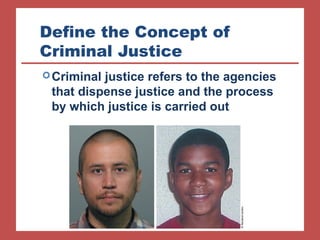
Criminal justice refers to the agencies 
that dispense justice and the process 
by which justice is carried out 
© Reuters/Landov
Define the Concept of 
Criminal Justice 
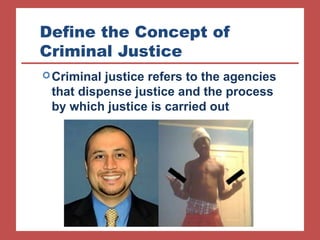
Criminal justice refers to the agencies 
that dispense justice and the process 
by which justice is carried out
Is Crime a Recent 
Development? 
Crime and violence have been 
common since the nation was first 
formed 
 Crime in the Old West 
 Crime in the Cities 
From 1900 to 1935, the nation experienced a 
sustained increase in criminal activity 
 First Police Agency – Not in the U.S. 
London Metropolitan Police
Creating Criminal Justice 
Chicago Crime Commission 
 Created in 1919 
 It was a professional association funded 
by private contributions, which was 
integral in getting agencies of justice to 
work together, and getting the work of the 
criminal justice system recognized.
Creating Criminal Justice 
Federal Involvement 
 The LEAA provided technical assistance 
and hundreds of millions of dollars in aid 
to state and local justice agencies 
between 1969 and 1982 
Evidence-Based Justice 
 Determining through the use of the 
scientific method whether criminal justice 
programs actually reduce crime rates and 
offender recidivism
The Contemporary 
Criminal Justice System 
Today’s instrument of social control 
 Social control is a society’s ability to 
control individual behavior in order to 
serve the best interests and welfare of the 
society as a whole 
Divided into three main components: 
a. Law enforcement agencies (cops) 
b. Court system (courts) 
c. Correctional system (corrections)
Video: Questions 
• Please introduce yourself 
• How led you towards a career in law enforcement 
• Why do you want to be a police officer 
• What education do you have 
• What do you do on a daily basis 
• What are some of the skills/traits you need to be a good officer 
• What skill/trait has helped you the most on the job 
• Who do you try to have a positive impact on 
• What was a exciting case you worked on 
• What is a common issue or cause you see in your calls, give us 
an example of this in a call you have handled 
• What advise do you have for people looking at a career in law 
enforcement
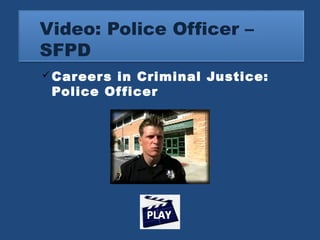
Video: Police Officer – 
SFPD 
Careers in Criminal Justice: 
Police Officer
Video: Discussion 
Questions 
How did what the officer said 
about his job as a police 
officer compare to your initial 
conceptions of police work? 
Did anything said by the 
officer result in you thinking 
differently about police work?
Scope of the System 
 The contemporary criminal justice system in 
the United States is monumental in size 
 It now costs federal, state, and local governments 
about $200 billion per year for civil and criminal 
justice 
 It is massive because it must process, treat, and 
care for millions of people 
 Although the crime rate has declined in the past 
decade, more than 13 million people are still being 
arrested each year 
 More than 7 million people are under some form of 
correctional supervision
Direct Expenditure By 
Level of Government 
Source: Bureau of Justice Statistics, Justice Expenditure and Employment Extracts, http://bjs.ojp.usdoj.gov/content/glance/exptyp.cfm (accessed June 6, 2012).
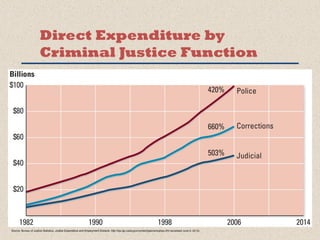
Direct Expenditure by 
Criminal Justice Function 
Source: Bureau of Justice Statistics, Justice Expenditure and Employment Extracts, http://bjs.ojp.usdoj.gov/content/glance/exptyp.cfm (accessed June 6, 2012).
The Formal Criminal 
Justice Process 
The process consists of the actual 
steps the offender takes from the 
initial investigation through trial, 
sentencing, and appeal 
 The justice process contains 15 stages, 
each of which is a decision point through 
which cases flow 
Extralegal factors such as the suspect’s 
race, gender, class, and age may influence 
decision outcomes
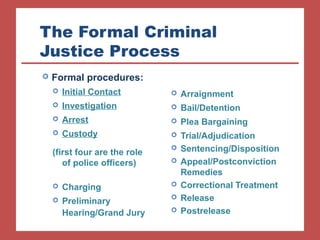
The Formal Criminal 
Justice Process 
 Arraignment 
 Bail/Detention 
 Plea Bargaining 
 Trial/Adjudication 
 Sentencing/Disposition 
 Appeal/Postconviction 
Remedies 
 Correctional Treatment 
 Release 
 Postrelease 
 Formal procedures: 
 Initial Contact 
 Investigation 
 Arrest 
 Custody 
(first four are the role 
of police officers) 
 Charging 
 Preliminary 
Hearing/Grand Jury
The Formal Criminal 
Justice Process - Myths 
Miranda Warnings 
 There is a myth that Miranda Warnings 
must be read to all suspects 
In Custody 
Interrogation 
Grand Juries 
 Open to the public 
Closed and secret 
 Hard to indict 
Indict a ham sandwich
The Criminal Justice 
Assembly Line - Herber t 
Packer 
The criminal justice system can be 
viewed as an assembly-line conveyor 
belt, down which moves an endless 
stream of cases 
 Each stage is a decision point through 
which cases flow 
 Each decision can have a critical effect on 
the defendant, the justice system, and 
society 
If an error is made, an innocent person may 
suffer or a dangerous individual may be 
released to continue to prey on society
The Criminal Justice 
Assembly Line 
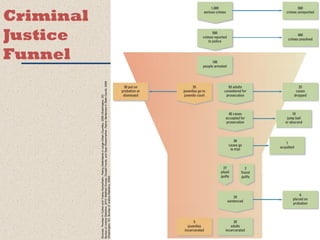
The system acts as a “funnel”: 
 Most people who commit crime escape 
detention, and of those who do not, 
relatively few are bound over trial, 
convicted, and eventually sentenced to 
prison 
(most people are NOT punished for their crimes)
Criminal 
Justice 
Funnel 
Sources: Thomas H. Cohen and Tracey Kyckelhahn, Felony Defendants in Large Urban Counties, 2006 (Washington, DC: 
Bureau of Justice Statistics, 2010; Matthew Durose, Donald Farole, and Sean Rosenmerkel, Felony Sentences in State Courts, 2006 
(Washington, DC: Bureau of Justice Statistics, 2009).
The Informal Criminal 
Justice System 
Courtroom Work Group 
 Implies that all parties in the justice 
process work together in a cooperative 
effort to settle cases efficiently, rather 
than to engage in a true adversarial 
procedure 
Defense Attorney – Judge – Prosecutor
The Informal Criminal 
Justice System 
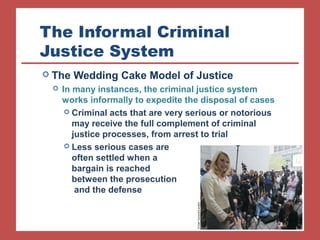
 The Wedding Cake Model of Justice 
 In many instances, the criminal justice system 
works informally to expedite the disposal of cases 
 Criminal acts that are very serious or notorious 
may receive the full complement of criminal 
justice processes, from arrest to trial 
 Less serious cases are 
often settled when a 
bargain is reached 
between the prosecution 
and the defense 
© Earl Gurlock/Landov
The Wedding Cake 
Model 
Source: Based on Samuel Walker’s Sense and Nonsense about Crime (Monterey, CA: Brooks/Cole, 1983).
Thinking Point 
• According to the wedding cake 
model, high-profile cases receive 
the most attention from the justice 
system and the media. 
Discuss why you believe sexual offenses are 
considered by the criminal justice system and 
the media to be high profile cases and 
therefore at the top of the wedding cake 
model? 
Find an example of a recent sexual offense 
and discuss it in terms of the wedding cake 
model.
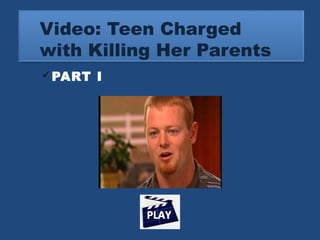
Video: Teen Charged 
with Killing Her Parents 
PART I
Video: Discussion 
Questions 
In terms of the wedding 
cake model of informal 
justice, where do you believe 
this case would be located? 
Why? 
What makes these types of 
cases of interest to the 
public?
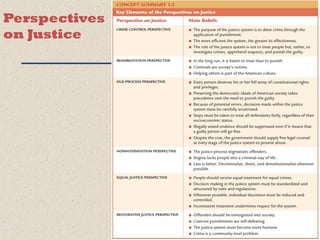
Perspectives on Justice 
The role of criminal justice can be 
interpreted in many ways 
 There are a number of different 
perspectives on criminal justice 
People who study the field, or work in its 
agencies, bring their own ideas and feelings 
to bear when they try to decide on the right 
course of action to take or recommend
Perspective on Justice 
The Crime Control Perspective 
 Oriented toward deterring criminal 
behavior and incapacitating serious 
criminal offenders 
The Rehabilitation Perspective 
 Views the justice system as a treatment 
agency focused on helping offenders 
 Counseling programs are stressed over 
punishment and deterrence strategies
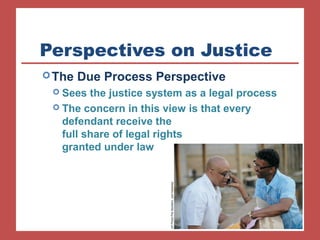
Perspectives on Justice 
The Due Process Perspective 
 Sees the justice system as a legal process 
 The concern in this view is that every 
defendant receive the 
full share of legal rights 
granted under law 
AP Photo/The Southern, Joel Hawksley
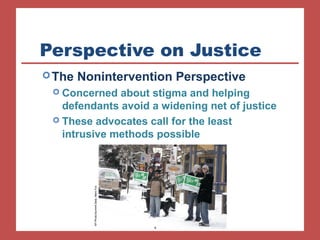
Perspective on Justice 
The Nonintervention Perspective 
 Concerned about stigma and helping 
defendants avoid a widening net of justice 
 These advocates call for the least 
intrusive methods possible 
AP Photo/Summit Daily, Mark Fox
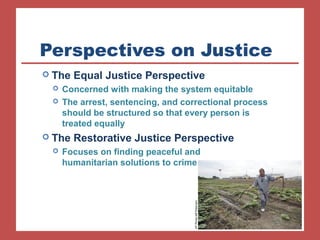
Perspectives on Justice 
 The Equal Justice Perspective 
 Concerned with making the system equitable 
 The arrest, sentencing, and correctional process 
should be structured so that every person is 
treated equally 
 The Restorative Justice Perspective 
 Focuses on finding peaceful and 
humanitarian solutions to crime 
AP Photo/Jeff Roberson
Perspectives 
on Justice
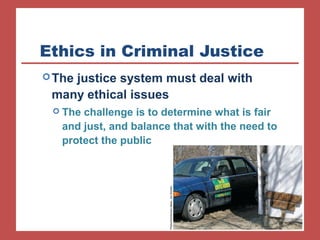
Ethics in Criminal Justice 
The justice system must deal with 
many ethical issues 
 The challenge is to determine what is fair 
and just, and balance that with the need to 
protect the public 
Photo/Hutchinson News, Jon Ruhlen
Thinking Points 
• Read the Evidence-Based Justice 
box on page 30 of your text, 
regarding monitoring of sexual 
offenders 
Do you believe monitoring sex offenders 
is an effective way to lower recidivism? 
• Evidence suggests that these 
laws are not especially effective 
at lowering recidivism 
If these studies are accurate, why does 
such monitoring continue?
Ethics in Criminal Justice 
Ethics and Law Enforcement 
 Particularly important because police have 
the ability to deprive people of their liberty 
 Considerable discretion 
 Various national organizations have 
produced model codes of conduct for law 
enforcement that can serve as behavioral 
guides
Ethics in Criminal Justice 
Ethics and the Court Process 
 Prosecutorial ethics may be tested when 
the dual role of a prosecutor causes one 
to experience role conflict 
 The defense attorney, in a dual role of 
being both an advocate for defendants 
and an officer of the court, may 
experience conflicting obligations to client 
and profession
Ethics in Criminal 
Justice 
• Ethics and Corrections 
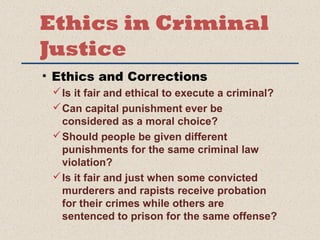
Is it fair and ethical to execute a criminal? 
Can capital punishment ever be 
considered as a moral choice? 
Should people be given different 
punishments for the same criminal law 
violation? 
Is it fair and just when some convicted 
murderers and rapists receive probation 
for their crimes while others are 
sentenced to prison for the same offense?
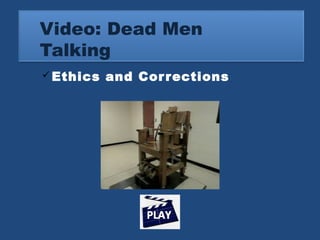
Video: Dead Men 
Talking 
Ethics and Cor rections
Video: Discussion 
Questions 
 Is it ethically permissible to 
implement a punishment that 
cannot be undone should the 
defendant later be found not 
guilty? 
 Did the statistics provided in the 
video surprise you? Why or why 
not? 
 How can the system balance the 
need to implement a serious 
punishment with the concern for
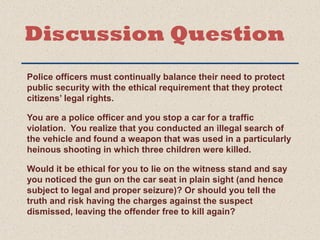
Discussion Question 
Police officers must continually balance their need to protect 
public security with the ethical requirement that they protect 
citizens’ legal rights. 
You are a police officer and you stop a car for a traffic 
violation. You realize that you conducted an illegal search of 
the vehicle and found a weapon that was used in a particularly 
heinous shooting in which three children were killed. 
Would it be ethical for you to lie on the witness stand and say 
you noticed the gun on the car seat in plain sight (and hence 
subject to legal and proper seizure)? Or should you tell the 
truth and risk having the charges against the suspect 
dismissed, leaving the offender free to kill again?

Chapter 1

  • 1.
    Chapter 1 Crime and Criminal Justice
  • 2.
    Define the Conceptof Criminal Justice Criminal justice refers to the agencies that dispense justice and the process by which justice is carried out © Reuters/Landov
  • 3.
    Define the Conceptof Criminal Justice Criminal justice refers to the agencies that dispense justice and the process by which justice is carried out
  • 4.
    Is Crime aRecent Development? Crime and violence have been common since the nation was first formed  Crime in the Old West  Crime in the Cities From 1900 to 1935, the nation experienced a sustained increase in criminal activity  First Police Agency – Not in the U.S. London Metropolitan Police
  • 5.
    Creating Criminal Justice Chicago Crime Commission  Created in 1919  It was a professional association funded by private contributions, which was integral in getting agencies of justice to work together, and getting the work of the criminal justice system recognized.
  • 6.
    Creating Criminal Justice Federal Involvement  The LEAA provided technical assistance and hundreds of millions of dollars in aid to state and local justice agencies between 1969 and 1982 Evidence-Based Justice  Determining through the use of the scientific method whether criminal justice programs actually reduce crime rates and offender recidivism
  • 7.
    The Contemporary CriminalJustice System Today’s instrument of social control  Social control is a society’s ability to control individual behavior in order to serve the best interests and welfare of the society as a whole Divided into three main components: a. Law enforcement agencies (cops) b. Court system (courts) c. Correctional system (corrections)
  • 8.
    Video: Questions •Please introduce yourself • How led you towards a career in law enforcement • Why do you want to be a police officer • What education do you have • What do you do on a daily basis • What are some of the skills/traits you need to be a good officer • What skill/trait has helped you the most on the job • Who do you try to have a positive impact on • What was a exciting case you worked on • What is a common issue or cause you see in your calls, give us an example of this in a call you have handled • What advise do you have for people looking at a career in law enforcement
  • 9.
    Video: Police Officer– SFPD Careers in Criminal Justice: Police Officer
  • 10.
    Video: Discussion Questions How did what the officer said about his job as a police officer compare to your initial conceptions of police work? Did anything said by the officer result in you thinking differently about police work?
  • 11.
    Scope of theSystem  The contemporary criminal justice system in the United States is monumental in size  It now costs federal, state, and local governments about $200 billion per year for civil and criminal justice  It is massive because it must process, treat, and care for millions of people  Although the crime rate has declined in the past decade, more than 13 million people are still being arrested each year  More than 7 million people are under some form of correctional supervision
  • 12.
    Direct Expenditure By Level of Government Source: Bureau of Justice Statistics, Justice Expenditure and Employment Extracts, http://bjs.ojp.usdoj.gov/content/glance/exptyp.cfm (accessed June 6, 2012).
  • 13.
    Direct Expenditure by Criminal Justice Function Source: Bureau of Justice Statistics, Justice Expenditure and Employment Extracts, http://bjs.ojp.usdoj.gov/content/glance/exptyp.cfm (accessed June 6, 2012).
  • 14.
    The Formal Criminal Justice Process The process consists of the actual steps the offender takes from the initial investigation through trial, sentencing, and appeal  The justice process contains 15 stages, each of which is a decision point through which cases flow Extralegal factors such as the suspect’s race, gender, class, and age may influence decision outcomes
  • 15.
    The Formal Criminal Justice Process  Arraignment  Bail/Detention  Plea Bargaining  Trial/Adjudication  Sentencing/Disposition  Appeal/Postconviction Remedies  Correctional Treatment  Release  Postrelease  Formal procedures:  Initial Contact  Investigation  Arrest  Custody (first four are the role of police officers)  Charging  Preliminary Hearing/Grand Jury
  • 16.
    The Formal Criminal Justice Process - Myths Miranda Warnings  There is a myth that Miranda Warnings must be read to all suspects In Custody Interrogation Grand Juries  Open to the public Closed and secret  Hard to indict Indict a ham sandwich
  • 17.
    The Criminal Justice Assembly Line - Herber t Packer The criminal justice system can be viewed as an assembly-line conveyor belt, down which moves an endless stream of cases  Each stage is a decision point through which cases flow  Each decision can have a critical effect on the defendant, the justice system, and society If an error is made, an innocent person may suffer or a dangerous individual may be released to continue to prey on society
  • 18.
    The Criminal Justice Assembly Line The system acts as a “funnel”:  Most people who commit crime escape detention, and of those who do not, relatively few are bound over trial, convicted, and eventually sentenced to prison (most people are NOT punished for their crimes)
  • 19.
    Criminal Justice Funnel Sources: Thomas H. Cohen and Tracey Kyckelhahn, Felony Defendants in Large Urban Counties, 2006 (Washington, DC: Bureau of Justice Statistics, 2010; Matthew Durose, Donald Farole, and Sean Rosenmerkel, Felony Sentences in State Courts, 2006 (Washington, DC: Bureau of Justice Statistics, 2009).
  • 20.
    The Informal Criminal Justice System Courtroom Work Group  Implies that all parties in the justice process work together in a cooperative effort to settle cases efficiently, rather than to engage in a true adversarial procedure Defense Attorney – Judge – Prosecutor
  • 21.
    The Informal Criminal Justice System  The Wedding Cake Model of Justice  In many instances, the criminal justice system works informally to expedite the disposal of cases  Criminal acts that are very serious or notorious may receive the full complement of criminal justice processes, from arrest to trial  Less serious cases are often settled when a bargain is reached between the prosecution and the defense © Earl Gurlock/Landov
  • 22.
    The Wedding Cake Model Source: Based on Samuel Walker’s Sense and Nonsense about Crime (Monterey, CA: Brooks/Cole, 1983).
  • 23.
    Thinking Point •According to the wedding cake model, high-profile cases receive the most attention from the justice system and the media. Discuss why you believe sexual offenses are considered by the criminal justice system and the media to be high profile cases and therefore at the top of the wedding cake model? Find an example of a recent sexual offense and discuss it in terms of the wedding cake model.
  • 24.
    Video: Teen Charged with Killing Her Parents PART I
  • 25.
    Video: Discussion Questions In terms of the wedding cake model of informal justice, where do you believe this case would be located? Why? What makes these types of cases of interest to the public?
  • 26.
    Perspectives on Justice The role of criminal justice can be interpreted in many ways  There are a number of different perspectives on criminal justice People who study the field, or work in its agencies, bring their own ideas and feelings to bear when they try to decide on the right course of action to take or recommend
  • 27.
    Perspective on Justice The Crime Control Perspective  Oriented toward deterring criminal behavior and incapacitating serious criminal offenders The Rehabilitation Perspective  Views the justice system as a treatment agency focused on helping offenders  Counseling programs are stressed over punishment and deterrence strategies
  • 28.
    Perspectives on Justice The Due Process Perspective  Sees the justice system as a legal process  The concern in this view is that every defendant receive the full share of legal rights granted under law AP Photo/The Southern, Joel Hawksley
  • 29.
    Perspective on Justice The Nonintervention Perspective  Concerned about stigma and helping defendants avoid a widening net of justice  These advocates call for the least intrusive methods possible AP Photo/Summit Daily, Mark Fox
  • 30.
    Perspectives on Justice  The Equal Justice Perspective  Concerned with making the system equitable  The arrest, sentencing, and correctional process should be structured so that every person is treated equally  The Restorative Justice Perspective  Focuses on finding peaceful and humanitarian solutions to crime AP Photo/Jeff Roberson
  • 31.
  • 32.
    Ethics in CriminalJustice The justice system must deal with many ethical issues  The challenge is to determine what is fair and just, and balance that with the need to protect the public Photo/Hutchinson News, Jon Ruhlen
  • 33.
    Thinking Points •Read the Evidence-Based Justice box on page 30 of your text, regarding monitoring of sexual offenders Do you believe monitoring sex offenders is an effective way to lower recidivism? • Evidence suggests that these laws are not especially effective at lowering recidivism If these studies are accurate, why does such monitoring continue?
  • 34.
    Ethics in CriminalJustice Ethics and Law Enforcement  Particularly important because police have the ability to deprive people of their liberty  Considerable discretion  Various national organizations have produced model codes of conduct for law enforcement that can serve as behavioral guides
  • 35.
    Ethics in CriminalJustice Ethics and the Court Process  Prosecutorial ethics may be tested when the dual role of a prosecutor causes one to experience role conflict  The defense attorney, in a dual role of being both an advocate for defendants and an officer of the court, may experience conflicting obligations to client and profession
  • 36.
    Ethics in Criminal Justice • Ethics and Corrections Is it fair and ethical to execute a criminal? Can capital punishment ever be considered as a moral choice? Should people be given different punishments for the same criminal law violation? Is it fair and just when some convicted murderers and rapists receive probation for their crimes while others are sentenced to prison for the same offense?
  • 37.
    Video: Dead Men Talking Ethics and Cor rections
  • 38.
    Video: Discussion Questions  Is it ethically permissible to implement a punishment that cannot be undone should the defendant later be found not guilty?  Did the statistics provided in the video surprise you? Why or why not?  How can the system balance the need to implement a serious punishment with the concern for
  • 39.
    Discussion Question Policeofficers must continually balance their need to protect public security with the ethical requirement that they protect citizens’ legal rights. You are a police officer and you stop a car for a traffic violation. You realize that you conducted an illegal search of the vehicle and found a weapon that was used in a particularly heinous shooting in which three children were killed. Would it be ethical for you to lie on the witness stand and say you noticed the gun on the car seat in plain sight (and hence subject to legal and proper seizure)? Or should you tell the truth and risk having the charges against the suspect dismissed, leaving the offender free to kill again?

Editor's Notes

  • #3 George Zimmerman Trayvon Martin Why do they show a very young photo of Trayvon Martin?
  • #4 would this make a difference?
  • #5 Students must understand that crime is not a new development. All societies, including America, have experienced crime throughout most of its history. Crime rates rise and fall over periods of time. Crime was certainly present in the West and in most eastern U.S. cities as well. Police agencies in the U.S. are modeled after the first police agency, the London Metropolitan Police. As criminal justice developed over the next century, the agencies were fragmented and rarely worked together. As the function of the criminal justice system began to be recognized, the federal government began to subsidize state and local agencies.
  • #6 Government agencies have been created to control and prevent crime. These agencies make up the criminal justice system. LEAA = Law Enforcement Assistance Association Through the recognition and funding of various criminal justice agencies, evidence-based justice began to emerge; this entails using scientific method to determine whether criminal justice programs are effective in reducing crime rates and offender recidivism.
  • #7 Government agencies have been created to control and prevent crime. These agencies make up the criminal justice system. LEAA = Law Enforcement Assistance Association Through the recognition and funding of various criminal justice agencies, evidence-based justice began to emerge; this entails using scientific method to determine whether criminal justice programs are effective in reducing crime rates and offender recidivism.
  • #8 The contemporary criminal justice system is now society’s instrument of social control. Only the criminal justice system has the power to control crime and punish illegal behavior through enforcement of the criminal law. Law enforcement agencies investigate crimes and apprehend suspects. The court system charges, tries, and sentences offenders who have been found guilty of a crime. The correctional system incapacitates offenders and attempts to facilitate rehabilitation of offenders.
  • #10 Learning Objective Five
  • #12 Protecting the public costs money Cars, officers salaries, fuel, guns, ammo. The public continually calls for greater technology, such a body cameras, but who pays for that?
  • #13 Figure 1.2 Direct Expenditure by Level of Government
  • #14 Figure 1.3 Direct Expenditure by Criminal Justice Function
  • #16 On November 5, 2011, former Penn State football defensive coordinator Gerald “Jerry” Sandusky (center) is escorted to the office of Centre County Magisterial District Judge Leslie A. Dutchcot by Pennsylvania state police and attorney general’s office officials in State College, Pennsylvania. Sandusky was indicted in a 23-page grand jury report in regard to preying upon vulnerable children he lured with gifts and the prestige of his connection with Penn State University. Sandusky was convicted in 2012 and received a life sentence for his crimes.
  • #17 Cook County Grand Jury 12 members Unlike daily juries, grand juries sit for 30 days Paid 17.20 per day
  • #18 Lets look at the book intro page and discuss
  • #20 Figure 1.4 The Criminal Justice Funnel
  • #21 Some recognize an informal criminal justice system where the concept of the courtroom workgroup is analyzed in addition to the wedding cake model. The courtroom workgroup is a term used to imply that all parties in the justice process work together in a cooperative effort to settle cases efficiently, as opposed to being truly adversarial with one another.
  • #22 Samuel Walker describes the informal criminal justice system as a four-layer cake. According to the wedding cake model, high-profile cases receive the most attention from the justice system and the media. They are still being investigated even when the trail runs cold. Here, Elizabeth Smart talks to the press after her kidnapper, Brian David Mitchell, was sentenced to life in prison in federal court on May 25, 2011, in Salt Lake City, Utah. The Smart case riveted the nation from the time she was kidnapped on June 5, 2002, until March 12, 2003, when she was rescued due to a tip to the police from an alert biker, who had heard of the kidnapping on America’s Most Wanted the night before.
  • #23 Figure 1.5 The Criminal Justice Wedding Cake
  • #28 We are going over each models concepts in the next few slides
  • #29 Due process advocates are concerned about errors in justice that may cause an innocent person permanent harm. Here, Andre Davis speaks with his mother as his father, Richard Davis, holds a cell phone to his ear outside the Tamms Correctional Center in Illinois, after being released on July 6, 2012. Davis, who spent the last 30 years in prison, was released after his conviction was overturned based on new DNA evidence.
  • #30 On October 28, 2009, a group of sign-waving supporters demonstrate for Measure 2F, a reform to legalize private possession of up to an ounce of marijuana by adults 21 and older in the town of Breckenridge, Colorado. Supporters urged people to pass 2F, which would legalize possession of smoking paraphernalia and of up to 7 ounces of marijuana. Pot possession would still be a state crime, but rather than making an arrest, town police officers would have to take users to the county sheriff’s department to be cited.The measure passed overwhelmingly in the November election. Do you believe that pot should be legalized?
  • #31 Inmate James Burton Jr. waters the “Restorative Justice Gardens” at the Southeast Correctional Center in Charleston, Missouri, on September 5, 2007. Inmates have produced tens of thousands of pounds of fresh vegetables from a six-acre garden at the state prison complex, all of it donated to the Bootheel Food Bank in Sikeston, Missouri, which serves some of the poorest counties in the state. Should society attempt to restore law violators to the community, or should violators merely be punished for their misdeeds?
  • #33 As part of his probation, Leroy Schad must have signs on his car and home stating that he is a sex offender. He’s allowed to leave his Hudson, Kansas, home only for counseling, for doctors’ appointments, and to register as a sex offender at the sheriff’s office. Schad, 72, was convicted in March 2007 of aggravated indecent solicitation of a child. Is it ethical to punish people through labeling and humiliation, and does ethics apply even to those who prey upon children? The American Civil Liberties Union, an opponent of registration, has said, “Sex offender registration becomes a lifelong invasion of a person’s privacy, . . . ability to resume a normal life, and . . . ability to assimilate with mainstream society. Sex offender registration causes hysteria and suspicion without solving the problem. Instead, it is counterproductive, pushing the sex offender into a different neighborhood, or even worse, underground.” Do you agree?
  • #34 OR we could just look at the illinois sex offender website and show the students how to check their home areas and protect themselves.
  • #35 Learning Objective Ten
  • #36 Learning Objective Ten
  • #37 Learning Objective Ten
  • #38 Learning Objective Ten
  • #40 Question I pose to the class