Crime and Justice
    in the US
Crime in the United States
• Crime is a top concern of the American
  public.
• Crimes presented by the media are usually
  more sensational than the crimes routinely
  committed.
Crime in the United States
Most police calls involve responding to
complaints of disturbances:
• Domestic quarrels
• Neighbor squabbles
• Gang altercations
• Loud music
Criminal Justice:
    An Institution of Social
            Control
There are a variety of responses to crime in
the United States, from punishment to
prevention.
Criminal Justice:
      An Institution of Social
              Control
Criminal justice is an institution of social
control, as are:
  –   The family
  –   Schools
  –   Organized religion
  –   The media
  –   The law
institution of social control
An organization that persuades people, through
subtle and not-so-subtle means, to abide by the
          dominant values of society.
Criminal Justice:
  An Institution of Social
          Control
Criminal justice differs because:
  – It is concerned only with behavior that
    is actually criminal.
  – It is society’s “last line of defense.”
Criminal Justice:
           The System
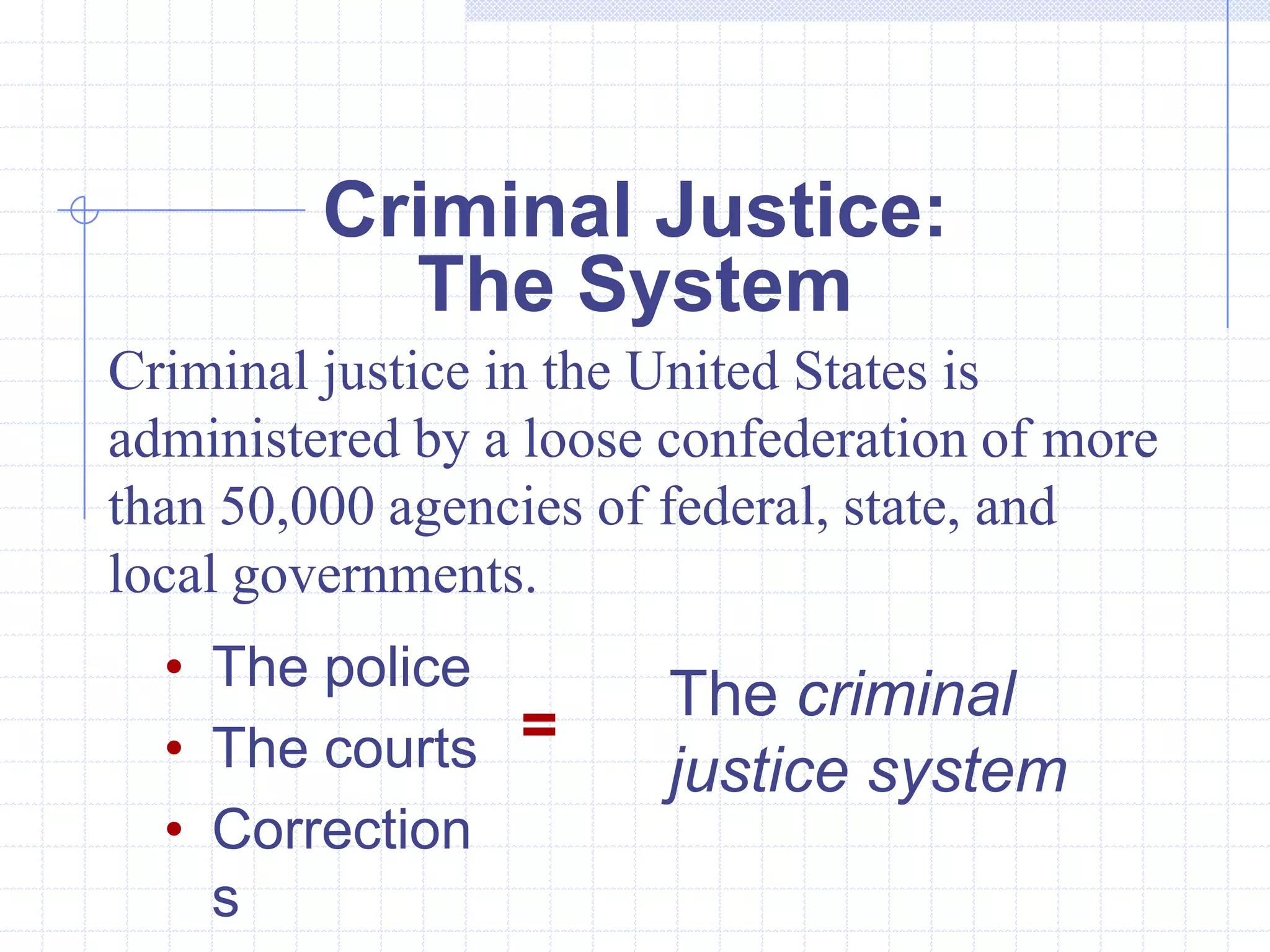
Criminal justice in the United States is
administered by a loose confederation of more
than 50,000 agencies of federal, state, and
local governments.
  • The police
                        The criminal
  • The courts =        justice system
  • Correction
    s
Criminal Justice:
           The System
The criminal justice system operates
differently in some jurisdictions, but there
are also similarities.

                jurisdictions
     A politically defined geographical area.
Police
The criminal justice response to crime begins
when a crime is reported to the police, or
when the police discover a crime has been
committed.
Arrest Warrant
On rare occasions, police may obtain an
arrest warrant from a lower-court judge
before making an arrest.
               arrest warrant
A written order directing law enforcement
officers to arrest a person.
Courts
• After a suspect has been arrested and
  booked, a prosecutor reviews the facts of
  the case and decides whether to charge the
  suspect with a crime.
• If no charges are filed, the suspect must be
  released.
Pretrial Stages
About 90 percent of criminal defendants plead
guilty to the charges against them, in an
arrangement called plea bargaining.
plea bargaining
The practice whereby a specific sentence is
imposed if the accused pleads guilty to an
agreed-upon charge or charges instead of going
to trial.
Trial
10 percent of criminal cases go to trial.
5 percent of criminal cases are decided in a bench
     trial.


                   bench trial
      A trial before a judge, without a jury.
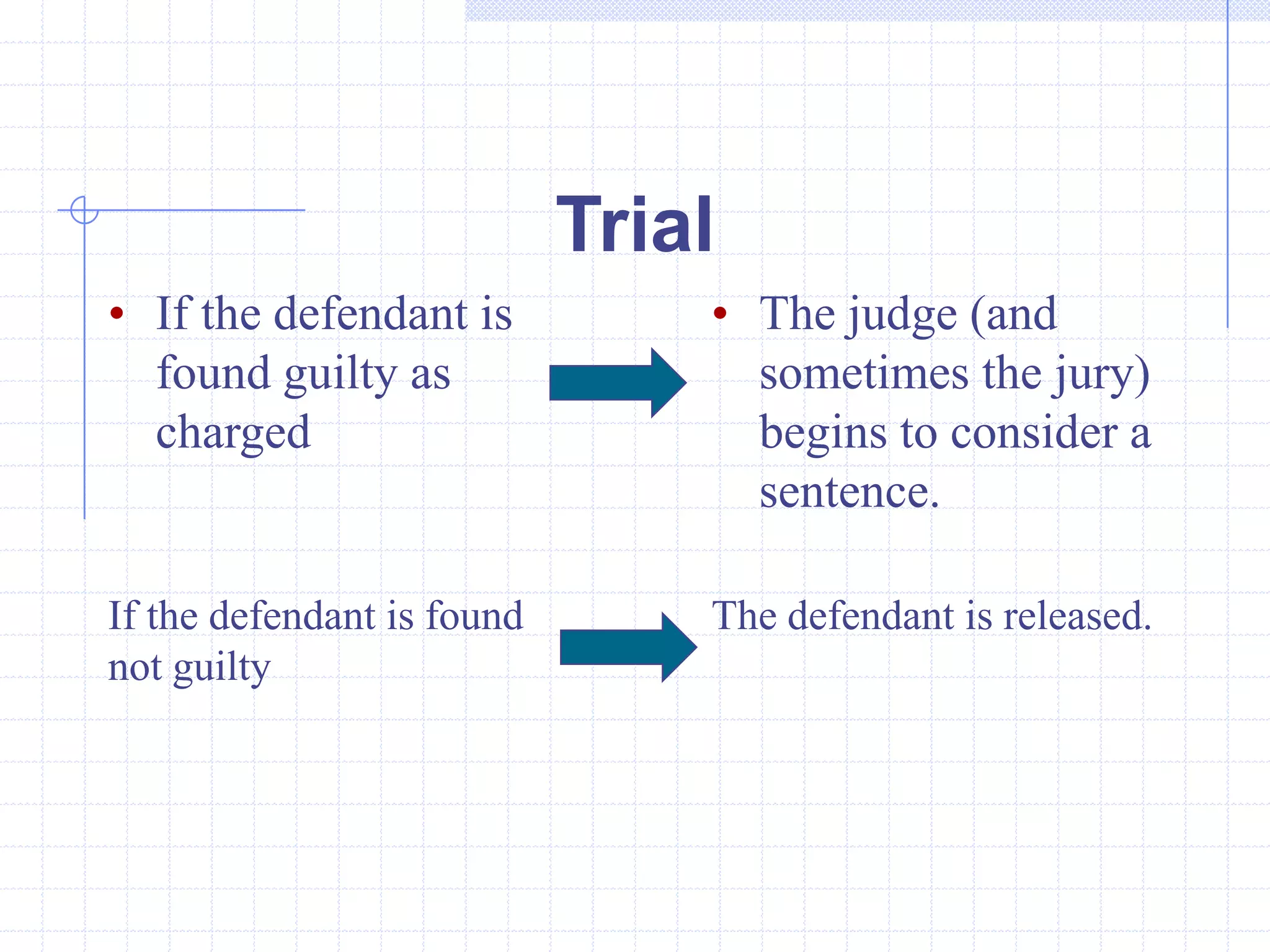
Trial
• If the defendant is           • The judge (and
  found guilty as                 sometimes the jury)
  charged                         begins to consider a
                                  sentence.

If the defendant is found       The defendant is released.
not guilty
Corrections
Currently, five types of punishment are used
in the United States:
      –Fines
      –Probation
      –Intermediate punishments
      –Imprisonment
      –Death
Judges must impose sentences according to
statutory guidelines.
Corrections
 Defendants can appeal their convictions either
      on legal or constitutional grounds.

Legal Grounds                 Constitutional Grounds
• Defects in jury selection   • Illegal search and seizure
• Improper admission of       • Improper questioning by
  evidence at trial             police
• Mistaken interpretations    • Incompetent assistance
  of law                        from counsel
Criminal Justice:
            The Nonsystem
 The “criminal justice system” in the United States is
 really a “nonsystem.” Each agency works
 independently, and often in conflict with others.
                       system
A smoothly operating set of arrangements and
institutions directed toward the achievement of
common goals.
Criminal Justice:
           The Nonsystem
• Judges impose prison sentences when there
isn’t room in prisons to hold the offenders.

• In every state, there is a separate process for
juvenile offenders.

• Police often say sentencing does not match
the crime.
Criminal Justice:
           The Nonsystem
• Prosecutors complain about shoddy police
work.

• Police complain that offenders are not
prosecuted.
Costs of Criminal Justice
• Each year in the United States an enormous
  amount of money is spent on criminal
  justice.
• In 1999, local, state, and federal
  governments spent a total of $146 billion on
  civil and criminal justice.
Costs of Criminal Justice
State and local governments pay most of the cost of
criminal justice. Generally speaking:

Local governments pay for police.
The federal government works strategically to
influence criminal justice policies at other
levels of government.
Costs of Criminal Justice
• About 4 cents out of    • Roughly two-thirds of
  every tax dollar is       the American public
  spent on crime control.   thinks the government
                            should spend more.
Myths About Crime and
        Criminal Justice
Much of the American public’s understanding
of crime and criminal justice is wrong; it is
based on myths.
                    myths
 Beliefs based on emotion rather than analysis.

Introduction to the U.S. Criminal Justice System

  • 1.
  • 2.
    Crime in theUnited States • Crime is a top concern of the American public. • Crimes presented by the media are usually more sensational than the crimes routinely committed.
  • 3.
    Crime in theUnited States Most police calls involve responding to complaints of disturbances: • Domestic quarrels • Neighbor squabbles • Gang altercations • Loud music
  • 4.
    Criminal Justice: An Institution of Social Control There are a variety of responses to crime in the United States, from punishment to prevention.
  • 5.
    Criminal Justice: An Institution of Social Control Criminal justice is an institution of social control, as are: – The family – Schools – Organized religion – The media – The law
  • 6.
    institution of socialcontrol An organization that persuades people, through subtle and not-so-subtle means, to abide by the dominant values of society.
  • 7.
    Criminal Justice: An Institution of Social Control Criminal justice differs because: – It is concerned only with behavior that is actually criminal. – It is society’s “last line of defense.”
  • 8.
    Criminal Justice: The System Criminal justice in the United States is administered by a loose confederation of more than 50,000 agencies of federal, state, and local governments. • The police The criminal • The courts = justice system • Correction s
  • 9.
    Criminal Justice: The System The criminal justice system operates differently in some jurisdictions, but there are also similarities. jurisdictions A politically defined geographical area.
  • 10.
    Police The criminal justiceresponse to crime begins when a crime is reported to the police, or when the police discover a crime has been committed.
  • 11.
    Arrest Warrant On rareoccasions, police may obtain an arrest warrant from a lower-court judge before making an arrest. arrest warrant A written order directing law enforcement officers to arrest a person.
  • 12.
    Courts • After asuspect has been arrested and booked, a prosecutor reviews the facts of the case and decides whether to charge the suspect with a crime. • If no charges are filed, the suspect must be released.
  • 13.
    Pretrial Stages About 90percent of criminal defendants plead guilty to the charges against them, in an arrangement called plea bargaining.
  • 14.
    plea bargaining The practicewhereby a specific sentence is imposed if the accused pleads guilty to an agreed-upon charge or charges instead of going to trial.
  • 15.
    Trial 10 percent ofcriminal cases go to trial. 5 percent of criminal cases are decided in a bench trial. bench trial A trial before a judge, without a jury.
  • 16.
    Trial • If thedefendant is • The judge (and found guilty as sometimes the jury) charged begins to consider a sentence. If the defendant is found The defendant is released. not guilty
  • 17.
    Corrections Currently, five typesof punishment are used in the United States: –Fines –Probation –Intermediate punishments –Imprisonment –Death Judges must impose sentences according to statutory guidelines.
  • 18.
    Corrections Defendants canappeal their convictions either on legal or constitutional grounds. Legal Grounds Constitutional Grounds • Defects in jury selection • Illegal search and seizure • Improper admission of • Improper questioning by evidence at trial police • Mistaken interpretations • Incompetent assistance of law from counsel
  • 19.
    Criminal Justice: The Nonsystem The “criminal justice system” in the United States is really a “nonsystem.” Each agency works independently, and often in conflict with others. system A smoothly operating set of arrangements and institutions directed toward the achievement of common goals.
  • 20.
    Criminal Justice: The Nonsystem • Judges impose prison sentences when there isn’t room in prisons to hold the offenders. • In every state, there is a separate process for juvenile offenders. • Police often say sentencing does not match the crime.
  • 21.
    Criminal Justice: The Nonsystem • Prosecutors complain about shoddy police work. • Police complain that offenders are not prosecuted.
  • 22.
    Costs of CriminalJustice • Each year in the United States an enormous amount of money is spent on criminal justice. • In 1999, local, state, and federal governments spent a total of $146 billion on civil and criminal justice.
  • 23.
    Costs of CriminalJustice State and local governments pay most of the cost of criminal justice. Generally speaking: Local governments pay for police. The federal government works strategically to influence criminal justice policies at other levels of government.
  • 24.
    Costs of CriminalJustice • About 4 cents out of • Roughly two-thirds of every tax dollar is the American public spent on crime control. thinks the government should spend more.
  • 25.
    Myths About Crimeand Criminal Justice Much of the American public’s understanding of crime and criminal justice is wrong; it is based on myths. myths Beliefs based on emotion rather than analysis.