Overview on Research and
Statistics
Arvin Kim A. Arnilla, PhD
from the old French word cerchier, which
means to “seek or search.”
“Search” = investigate
prefix “re” means “again”
research is “to investigate again.”
“RESEARCH”
“Research is a blind
date with the unknown”
– Dr. Nilo S. Rosas
is a purposive, systematic, and scientific
process of gathering, analyzing, classifying,
organizing, presenting and interpreting data
for the solution of a problem, for
prediction for intention, for the discovery
of truth, or for the expansion or
verification of existing knowledge, all for
the preservation and improvement of the
quality of human life.
Definition of Research
Research is…
a purposive, systematic, and
scientific process
gathering, analyzing,
classifying, organizing,
presenting and interpreting
data
for the solution of a problem
for prediction for intention
for the discovery of truth
for the expansion or
verification of existing
knowledge
for the preservation and
improvement of the quality of
human life
Other Definition of
Research
Research is the process of
gathering data of information
to solve a particular or
specific problem in scientific
manner
Halpin:
GOALS OF RESEARCH
What is the main
purpose of
research?to serve man
1.Achievement of good life
Main Goals of Research:
2. Satisfaction of man’s craving for more
understanding
3. Improve his judgment
4. Add to his power
5. Reduce burden of work
7. Relieve suffering;
6. Increase satisfaction in countless ways
Main Goals of Research:
Specific Purposes &
Goals of Research:
1. Discover new facts about known phenomenon
2. Find answer to problems
3. Discover previously unrecognized substances and
elements
4. Improve existing techniques and develop new
instrument or products
5. Discover pathways of action of known substances or
elements
6. Validate generalizations into systematizes science
7. Satisfy curiosity
8. Provide basis for decision – making
9. Find answer to questions
10. Acquire better and deeper understanding about
phenomenon
11. Expand or verify knowledge
12. Improve educational practices
13. Improve man with more of the basic needs
14. Promote health and prolong life
15. Make work, travel and communication faster, easier,
and more comfortable
Specific Purposes &
Goals of Research:
SCOPE OF
CRIMINOLOGICAL
RESEARCH
Criminal Law and
Jurisprudence
Criminal
Investigation
Criminology
Forensic Sciences
(Criminalistics)
Law enforcement
Administration
Criminal Sociology
Correctional
Administration
TYPES OF RESEARCH
It is an in – depth study of naturally
occurring behavior within a culture or
social group.
Social scientists sometimes call
ethnography as “field research” because it
is conducted on a natural setting or “field.”
The researcher observes behavior as it
occurs naturally, without any stimulation
or imposed structure.
Ethnography
It requires a variety of data – gathering
procedures such as prolonged observation
of the setting, interviewing members of the
culture, and studying documents and
artifacts.
Researchers interpret the data in the
context of the situation in which they
gathered the data.
Ethnography is rooted in anthropology
You are new in a snatchers –
infested area in Tondo, Manila. The
streets never run out of people –
criminals and potential victims
alike. You are interested on finding
out how the criminal and potential
victim behave during attack. You
posted yourself to become a victim.
It is an in- depth study of a single unit, such as one
individual, one group, one organization, one
program, and so on.
Case Study
The goal is to arrive at a detailed description and
understanding of the entity.
Case studies use multiple methods, such as
interviews, observations, and archives to gather data
Jun-jun is a child in conflict with
the law (CICL). He was referred to
the social welfare office. Mary Ann,
a social worker, would like to have
an in- depth knowledge on Jun-jun
regarding his family, friends and
behavior. What is the most
appropriate type of research she
should use?
It focuses on analyzing and interpreting recorded
material within its own context.
Content Analysis or Document Analysis
The materials may be public records, textbooks,
letters, films tapes, diaries, themes, reports, etc.
When using such documentary sources, the
researcher must establish the authenticity of the
document itself, as well as the validity of its
contents
Your classmate would like to find
out the traffic violations recorded
in the traffic violation receipts of
the Auxiliary Police (MAP). What
type of research would you advise
him to use?
Researcher seeks to make entirely
unobtrusive observations of a setting
without altering the situation in any
way.
Naturalistic
Observations
The goal is to observe and study
behavior as it normally occurs.
Researchers use hidden cameras, one –
way mirrors, and other unobtrusive
techniques so that people being
observed are unaware of the
investigation
The jail warden wanted to observe the
behavior of inmates. But he wanted them to
act naturally without becoming conscious
of being observed.
It asks questions designed to draw out subject’s
responses on a topic of interest.
Focused Interview
Subjects are free to answer in their own words
rather than having to choose from
predetermined options, as in a survey.
The unstructured, open – ended
formats permits greater flexibility and
responsiveness for merging issues for
the participants
Religious – oriented activities
flourish in jail. You would like to
find out its contribution to the
rehabilitation of inmates. You
carefully selected interviewees/
informants from among the inmates.
It begins with the assumption that
multiple realities are rooted in the
subjects’ perspective.
Phenomenological Studies
an example has different meanings
for each person
Through unstructured interviews, the
investigator explores the subjects’ thoughts
and feelings to elicit the essence of an
individual’s experience.
A phenomenological study might be conducted
to answer the question “What does the
experience mean to the newly appointed
police officers?”
Linda is incarcerated for 10 years. She
has a husband and 3 children. You would
like to find out how she becomes/
functions both as a wife and as a
mother.
It is designed to develop a theory of
social phenomenon based on the field
data collected in a study.
Grounded
Theory
Experience with the data generates
insights, hypotheses, and questions,
which researchers pursue with
further data collection
You would like to develop a new
theory on how the informal settlers
(squatters) view the nature of work
of demolition team.
It analyzes documents and artifacts to gain
insights into what has happened in the past
Historical Research
Its success depends in the accuracy and
completeness of these records
You are fascinated of the
performance of the PAST chiefs of
police in your local police office.
It involves a study of the effect of the
systematic manipulations of one variable or
another variable.
Experimental Research
The manipulated variable is call
experimental treatment or independent
variable. The observed and measured
variable is called the dependent variable
PO3 Sagun would like to find out
the velocity of a cal. 45 bullet
when fired in freezing conditions.
It seeks to examine the strength and
direction of relationships among two
or more variables.
Correlational Research
The extent of relationship is
expressed in numeric index
Co - RELATION
You want to determine whether police
officers’ AGE is related to their JOB
PERFORMANCE.
Age
Job
Performance
is related or not related
with
It uses instruments such as
questionnaires and
interviews to gather
information from group of
subjects.
Survey Research
Surveys permit the
researcher to summarize the
characteristics of
different groups or to
measure their attitudes and
opinions towards some
issue.
Researchers in the social
sciences use surveys widely
Population
Sample
Population VS. Sample
1. Cross-sectional survey: collects
information from a sample that has been
drawn from a predetermined population.
2. Longitudinal survey: collects
information from different points in time
in order to study changes over time.
Two (2) Types of Surveys
Three (3) Types of Longitudinal
Surveys
1. Trend Study
2. Cohort Study
3. Panel Study
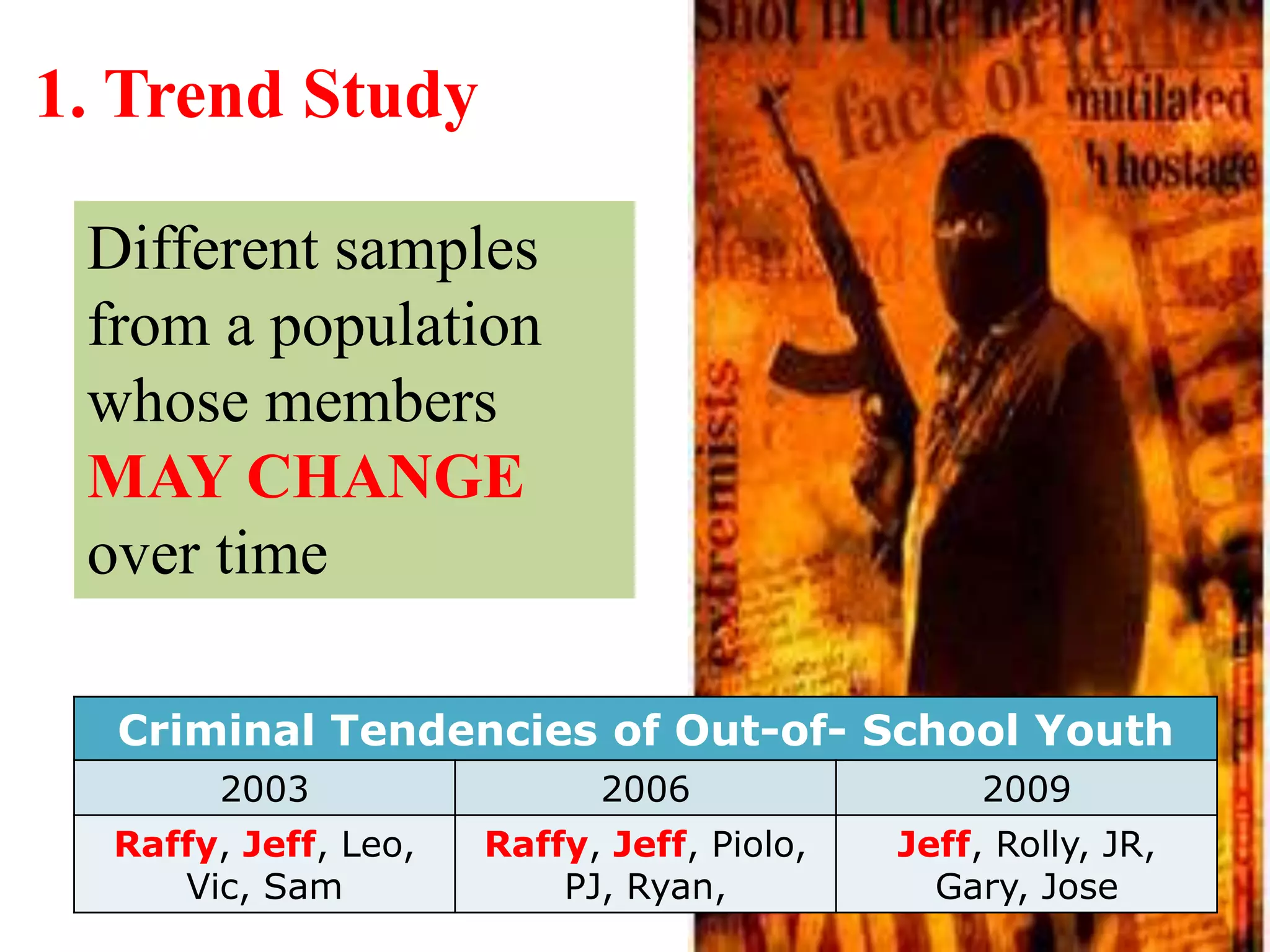
1. Trend Study
Different samples
from a population
whose members
MAY CHANGE
over time
Criminal Tendencies of Out-of- School Youth
2003 2006 2009
Raffy, Jeff, Leo,
Vic, Sam
Raffy, Jeff, Piolo,
PJ, Ryan,
Jeff, Rolly, JR,
Gary, Jose
2. Cohort Study
Samples a particular
population whose members
DO NOT change over the
course of the survey
Coping Mechanisms Among Women – Inmates
Year 2003 2006 2009
Population Inmates at Aklan
District Jail
Inmates at Aklan
District Jail
Inmates at Aklan
District Jail
3. Panel Study
Surveys the same SAMPLE OF
INDIVIDUALS at different times
during the course of the study.
Study Habits of Selected Criminology Students
June 2010 Aug 2010 Oct. 2010
Gregory, Vincent,
Enrico, Alexis
Gregory, Vincent,
Enrico, Alexis
Gregory, Vincent,
Enrico, Alexis
Survey vs. Census
“Sample”
“entire
population”
J/SInsp. Lagos would like to
determine the opinion of inmates on
a new policy on conjugal visits.
The research is conducted in
artificial or controlled conditions by
isolating the study in rigorous
specified and operationalized area.
Laboratory
Research
The purposes are:
a) to test the hypotheses derived from
theory;
b) to control variance under research
conditions; and
c) to discover the relations between
the dependent and independent
variables
Sources of Problem
Trend
Existing Theory
Experts
Criteria in the Selection
of Research Problems
1. Originality. Are you the first researcher to
come up with such a research problem? Are you
sure that no one has ever done a study on that
topic?
2. Importance to Criminology. If you were to study
that topic, what good could it give to the
Criminology profession? Are there any contributions
to the field?
3. Interest over the topic. Why are you interested
over the topic? Do you know that interest will help
you strive to finish the research project? Your
interest will sustain you despite obstacles that may
come your way.
4. Special Qualification. If you were
interested of studying the behavior of
Badjaos, you should speak their language. Do
you speak their language? That’s the catch!
5. Available data.
You are interested
of finding out the
volume of firearm
– related incidents
in your town.
Surely, there is a
readily available
data for this type
of study.
6. Special
equipment. Your
chosen study entails
you to take video
footages of a public
park. Do you have a
video camera? A
cellphone camera
surely helps but it
has limitations.
7. Sponsorship and Administrative Cooperation.
Research needs people. Do you have their support?
For example, you want to run a survey of barangay
officials. Do you think you can have them respond
to your survey tool?
8. Financial Capability. Do you have enough cash
to pay for computer rentals, printing cost,
photocopying, and binding? Do you have enough
cash to pay for transportation in going to your
respondents?
9. Patience. Sometimes people around you could be
tough. Dealing with them is difficult. Are you prepared to
accommodate their whims and caprices? Remember, it’s
YOU who needs THEM. So patience and more patience
please!
10. Time. Do you think you
can finish your research in
less ten months?
Criminological
Statistics
Basic Terms:
Descriptive Statistics – is the statistical procedure
concerned with the describing of the characteristics and
properties of a group or persons, places, events or objects.
CATEGORIES OF STATISTICS
 Mean
 Median
 Mode
 Frequency
 Percentage
Statistical Tools:
Mean or average = sum up all the values
and divide by the number of values
1 2 3 4 5
5 + 6 + 7 + 8 + 9 = 35/5 = 7
No. of
values
Values
Median = the score found at the exact
middle of the set of score
7 4 1 6 8
1 4 6 7 8
Median
Mode = the most frequently occurring
value in the set of scores
7 4 1 8 4 8 6 4 1 4 9 4
Mode = 4
Inferential Statistics – is the statistical procedure that is
used it draw information about the characteristics or
properties of a large group.
 t- Test
z-Test
F- Test (One way/ Two – way ANOVA)
 Pearson r
Chi –Square (ᵪ2)
Statistical Tools:
Inferential Statistics is used when it is impossible to study
the large group.
Population – refers to the totality of objects, persons, places
or things used in particular study of research
Sample – small portion of the population
Ex.: all inmates of the Aklan District Jail
all police officers of Capiz Police Provincial Office
Ex.: inmates who committed crimes against person in the
Aklan District Jail
police officers assigned in Second Congressional
District of Capiz
ALL INMATES
at the Aklan District
Jail
Inmates who
committed crimes
against persons
Sample
Population
Just to Recap…
Variable – is a characteristics or a property
of a population sample that differentiated a
particular member from the rest
Ex.: age, sex, color of the skin, intelligence,
attitudes
Constant – characteristic or a property of a
population or a sample which is common to
all members of the group
Ex.: Women’s & Children’s Desk = Female Police
Officer
Formula to Remember:
1. Population Density
2. Crime Density
3. Monthly Crime Rate
4. Average Monthly Crime Rate
5. Crime Solution Efficiency
6. Frequency of Crime
7. Arrest Rate
8. Percentage Distribution
Thank you!

Criminological research and statistics

  • 1.
    Overview on Researchand Statistics Arvin Kim A. Arnilla, PhD
  • 2.
    from the oldFrench word cerchier, which means to “seek or search.” “Search” = investigate prefix “re” means “again” research is “to investigate again.” “RESEARCH”
  • 3.
    “Research is ablind date with the unknown” – Dr. Nilo S. Rosas
  • 4.
    is a purposive,systematic, and scientific process of gathering, analyzing, classifying, organizing, presenting and interpreting data for the solution of a problem, for prediction for intention, for the discovery of truth, or for the expansion or verification of existing knowledge, all for the preservation and improvement of the quality of human life. Definition of Research
  • 5.
    Research is… a purposive,systematic, and scientific process gathering, analyzing, classifying, organizing, presenting and interpreting data for the solution of a problem for prediction for intention for the discovery of truth for the expansion or verification of existing knowledge for the preservation and improvement of the quality of human life
  • 6.
  • 7.
    Research is theprocess of gathering data of information to solve a particular or specific problem in scientific manner Halpin:
  • 8.
  • 9.
    What is themain purpose of research?to serve man
  • 10.
    1.Achievement of goodlife Main Goals of Research: 2. Satisfaction of man’s craving for more understanding 3. Improve his judgment 4. Add to his power
  • 11.
    5. Reduce burdenof work 7. Relieve suffering; 6. Increase satisfaction in countless ways Main Goals of Research:
  • 12.
    Specific Purposes & Goalsof Research: 1. Discover new facts about known phenomenon 2. Find answer to problems 3. Discover previously unrecognized substances and elements 4. Improve existing techniques and develop new instrument or products 5. Discover pathways of action of known substances or elements 6. Validate generalizations into systematizes science
  • 13.
    7. Satisfy curiosity 8.Provide basis for decision – making 9. Find answer to questions 10. Acquire better and deeper understanding about phenomenon 11. Expand or verify knowledge 12. Improve educational practices 13. Improve man with more of the basic needs 14. Promote health and prolong life 15. Make work, travel and communication faster, easier, and more comfortable Specific Purposes & Goals of Research:
  • 14.
  • 15.
    Criminal Law and Jurisprudence Criminal Investigation Criminology ForensicSciences (Criminalistics) Law enforcement Administration Criminal Sociology Correctional Administration
  • 16.
  • 17.
    It is anin – depth study of naturally occurring behavior within a culture or social group. Social scientists sometimes call ethnography as “field research” because it is conducted on a natural setting or “field.” The researcher observes behavior as it occurs naturally, without any stimulation or imposed structure. Ethnography
  • 18.
    It requires avariety of data – gathering procedures such as prolonged observation of the setting, interviewing members of the culture, and studying documents and artifacts. Researchers interpret the data in the context of the situation in which they gathered the data. Ethnography is rooted in anthropology
  • 19.
    You are newin a snatchers – infested area in Tondo, Manila. The streets never run out of people – criminals and potential victims alike. You are interested on finding out how the criminal and potential victim behave during attack. You posted yourself to become a victim.
  • 20.
    It is anin- depth study of a single unit, such as one individual, one group, one organization, one program, and so on. Case Study The goal is to arrive at a detailed description and understanding of the entity. Case studies use multiple methods, such as interviews, observations, and archives to gather data
  • 21.
    Jun-jun is achild in conflict with the law (CICL). He was referred to the social welfare office. Mary Ann, a social worker, would like to have an in- depth knowledge on Jun-jun regarding his family, friends and behavior. What is the most appropriate type of research she should use?
  • 22.
    It focuses onanalyzing and interpreting recorded material within its own context. Content Analysis or Document Analysis The materials may be public records, textbooks, letters, films tapes, diaries, themes, reports, etc. When using such documentary sources, the researcher must establish the authenticity of the document itself, as well as the validity of its contents
  • 23.
    Your classmate wouldlike to find out the traffic violations recorded in the traffic violation receipts of the Auxiliary Police (MAP). What type of research would you advise him to use?
  • 24.
    Researcher seeks tomake entirely unobtrusive observations of a setting without altering the situation in any way. Naturalistic Observations
  • 25.
    The goal isto observe and study behavior as it normally occurs. Researchers use hidden cameras, one – way mirrors, and other unobtrusive techniques so that people being observed are unaware of the investigation
  • 26.
    The jail wardenwanted to observe the behavior of inmates. But he wanted them to act naturally without becoming conscious of being observed.
  • 27.
    It asks questionsdesigned to draw out subject’s responses on a topic of interest. Focused Interview Subjects are free to answer in their own words rather than having to choose from predetermined options, as in a survey.
  • 28.
    The unstructured, open– ended formats permits greater flexibility and responsiveness for merging issues for the participants
  • 29.
    Religious – orientedactivities flourish in jail. You would like to find out its contribution to the rehabilitation of inmates. You carefully selected interviewees/ informants from among the inmates.
  • 30.
    It begins withthe assumption that multiple realities are rooted in the subjects’ perspective. Phenomenological Studies an example has different meanings for each person
  • 31.
    Through unstructured interviews,the investigator explores the subjects’ thoughts and feelings to elicit the essence of an individual’s experience. A phenomenological study might be conducted to answer the question “What does the experience mean to the newly appointed police officers?”
  • 32.
    Linda is incarceratedfor 10 years. She has a husband and 3 children. You would like to find out how she becomes/ functions both as a wife and as a mother.
  • 33.
    It is designedto develop a theory of social phenomenon based on the field data collected in a study. Grounded Theory Experience with the data generates insights, hypotheses, and questions, which researchers pursue with further data collection
  • 34.
    You would liketo develop a new theory on how the informal settlers (squatters) view the nature of work of demolition team.
  • 35.
    It analyzes documentsand artifacts to gain insights into what has happened in the past Historical Research Its success depends in the accuracy and completeness of these records
  • 36.
    You are fascinatedof the performance of the PAST chiefs of police in your local police office.
  • 37.
    It involves astudy of the effect of the systematic manipulations of one variable or another variable. Experimental Research The manipulated variable is call experimental treatment or independent variable. The observed and measured variable is called the dependent variable
  • 38.
    PO3 Sagun wouldlike to find out the velocity of a cal. 45 bullet when fired in freezing conditions.
  • 39.
    It seeks toexamine the strength and direction of relationships among two or more variables. Correlational Research The extent of relationship is expressed in numeric index Co - RELATION
  • 40.
    You want todetermine whether police officers’ AGE is related to their JOB PERFORMANCE.
  • 41.
  • 42.
    It uses instrumentssuch as questionnaires and interviews to gather information from group of subjects. Survey Research
  • 43.
    Surveys permit the researcherto summarize the characteristics of different groups or to measure their attitudes and opinions towards some issue. Researchers in the social sciences use surveys widely
  • 44.
  • 45.
    1. Cross-sectional survey:collects information from a sample that has been drawn from a predetermined population. 2. Longitudinal survey: collects information from different points in time in order to study changes over time. Two (2) Types of Surveys
  • 46.
    Three (3) Typesof Longitudinal Surveys 1. Trend Study 2. Cohort Study 3. Panel Study
  • 47.
    1. Trend Study Differentsamples from a population whose members MAY CHANGE over time Criminal Tendencies of Out-of- School Youth 2003 2006 2009 Raffy, Jeff, Leo, Vic, Sam Raffy, Jeff, Piolo, PJ, Ryan, Jeff, Rolly, JR, Gary, Jose
  • 48.
    2. Cohort Study Samplesa particular population whose members DO NOT change over the course of the survey Coping Mechanisms Among Women – Inmates Year 2003 2006 2009 Population Inmates at Aklan District Jail Inmates at Aklan District Jail Inmates at Aklan District Jail
  • 49.
    3. Panel Study Surveysthe same SAMPLE OF INDIVIDUALS at different times during the course of the study. Study Habits of Selected Criminology Students June 2010 Aug 2010 Oct. 2010 Gregory, Vincent, Enrico, Alexis Gregory, Vincent, Enrico, Alexis Gregory, Vincent, Enrico, Alexis
  • 50.
  • 51.
    J/SInsp. Lagos wouldlike to determine the opinion of inmates on a new policy on conjugal visits.
  • 52.
    The research isconducted in artificial or controlled conditions by isolating the study in rigorous specified and operationalized area. Laboratory Research
  • 53.
    The purposes are: a)to test the hypotheses derived from theory; b) to control variance under research conditions; and c) to discover the relations between the dependent and independent variables
  • 54.
  • 56.
  • 57.
  • 58.
  • 59.
    Criteria in theSelection of Research Problems
  • 60.
    1. Originality. Areyou the first researcher to come up with such a research problem? Are you sure that no one has ever done a study on that topic?
  • 61.
    2. Importance toCriminology. If you were to study that topic, what good could it give to the Criminology profession? Are there any contributions to the field?
  • 62.
    3. Interest overthe topic. Why are you interested over the topic? Do you know that interest will help you strive to finish the research project? Your interest will sustain you despite obstacles that may come your way.
  • 63.
    4. Special Qualification.If you were interested of studying the behavior of Badjaos, you should speak their language. Do you speak their language? That’s the catch!
  • 64.
    5. Available data. Youare interested of finding out the volume of firearm – related incidents in your town. Surely, there is a readily available data for this type of study.
  • 65.
    6. Special equipment. Your chosenstudy entails you to take video footages of a public park. Do you have a video camera? A cellphone camera surely helps but it has limitations.
  • 66.
    7. Sponsorship andAdministrative Cooperation. Research needs people. Do you have their support? For example, you want to run a survey of barangay officials. Do you think you can have them respond to your survey tool?
  • 67.
    8. Financial Capability.Do you have enough cash to pay for computer rentals, printing cost, photocopying, and binding? Do you have enough cash to pay for transportation in going to your respondents?
  • 68.
    9. Patience. Sometimespeople around you could be tough. Dealing with them is difficult. Are you prepared to accommodate their whims and caprices? Remember, it’s YOU who needs THEM. So patience and more patience please!
  • 69.
    10. Time. Doyou think you can finish your research in less ten months?
  • 70.
  • 71.
    Basic Terms: Descriptive Statistics– is the statistical procedure concerned with the describing of the characteristics and properties of a group or persons, places, events or objects. CATEGORIES OF STATISTICS  Mean  Median  Mode  Frequency  Percentage Statistical Tools:
  • 72.
    Mean or average= sum up all the values and divide by the number of values 1 2 3 4 5 5 + 6 + 7 + 8 + 9 = 35/5 = 7 No. of values Values
  • 73.
    Median = thescore found at the exact middle of the set of score 7 4 1 6 8 1 4 6 7 8 Median
  • 74.
    Mode = themost frequently occurring value in the set of scores 7 4 1 8 4 8 6 4 1 4 9 4 Mode = 4
  • 75.
    Inferential Statistics –is the statistical procedure that is used it draw information about the characteristics or properties of a large group.  t- Test z-Test F- Test (One way/ Two – way ANOVA)  Pearson r Chi –Square (ᵪ2) Statistical Tools: Inferential Statistics is used when it is impossible to study the large group.
  • 76.
    Population – refersto the totality of objects, persons, places or things used in particular study of research Sample – small portion of the population Ex.: all inmates of the Aklan District Jail all police officers of Capiz Police Provincial Office Ex.: inmates who committed crimes against person in the Aklan District Jail police officers assigned in Second Congressional District of Capiz
  • 77.
    ALL INMATES at theAklan District Jail Inmates who committed crimes against persons Sample Population Just to Recap…
  • 78.
    Variable – isa characteristics or a property of a population sample that differentiated a particular member from the rest Ex.: age, sex, color of the skin, intelligence, attitudes
  • 79.
    Constant – characteristicor a property of a population or a sample which is common to all members of the group Ex.: Women’s & Children’s Desk = Female Police Officer
  • 80.
    Formula to Remember: 1.Population Density 2. Crime Density 3. Monthly Crime Rate 4. Average Monthly Crime Rate 5. Crime Solution Efficiency 6. Frequency of Crime 7. Arrest Rate 8. Percentage Distribution
  • 81.