Police in America
Chapter Two
The History of the
American Police

McGraw-Hill

© 2013 McGraw-Hill Companies. All Rights Reserved.
The Relevance of History




Knowledge of the development of policing
contributes to our understanding of
contemporary practices and problems.
Police organization, reforms, and policecommunity relations today are deeply rooted in
the past.

2-2
The Relevance of History


The study of police history can:
1.
2.
3.

Dramatize the fact of change
Put current problems into perspective
Help us understand what reforms have
worked
4. Alerts us to the unintended consequences of
reforms

2-3
The English Heritage





The Constable, Sheriff,
and Justice of the Peace
The Watch System
Sir Robert Peel
London Metropolitan
Police (1829)
 Mission, Strategy,
Organizational Structure

2-4
First Modern America Police
 New York - first police department with a

day and night shift (1844)
 Did not wear uniforms but had a hat and
badge
 Did not carry firearms
 Officers hired based on who they knew

2-5
Three Eras of American Policing




The political era (1830s-1900)
The professional era (1900-1960s)
The era of conflicting pressures (1960spresent)

2-6
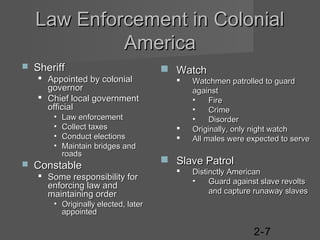
Law Enforcement in Colonial
America


Sheriff
 Appointed by colonial
governor
 Chief local government
official
•
•
•
•



Law enforcement
Collect taxes
Conduct elections
Maintain bridges and
roads

Constable
 Some responsibility for
enforcing law and
maintaining order

 Watch





Watchmen patrolled to guard
against
•
Fire
•
Crime
•
Disorder
Originally, only night watch
All males were expected to serve

 Slave Patrol


Distinctly American
•
Guard against slave revolts
and capture runaway slaves

• Originally elected, later
appointed

2-7
American Policing in the 19th
Century


Establishment of Modern Police Forces
 Urbanization, Industrialization, Immigration
 Breakdown in Law and Order




The Political Era
Police Personnel
 Selection based on political connection

2-8
Patrol
 Foot patrol
 No communications system
 In time, call boxes emerged

 Weak supervision
 Major social welfare institution
 Corruption
 Reforms

2-9
American Policing in the 20th
Century
 Police Professionalism






August Vollmer, the “Father of American
Police Professionalism”
Advocated higher education for police
officers
Chief of Berkeley, California
Wrote Wickersham Commission Report
(1931)
2-10
Professionalization Movement
 Reformers sought to define policing as a

profession
 Sought to eliminate the influence of
politics on policing
 Argued for hiring qualified police chiefs
 Tried to raise standards for patrol officers
 Applied modern management principles
 Create specialized units like traffic, vice
2-11
The Diary of a Police Officer:
Boston, 1895
The recently discovered 1895 diary of Boston police officer Stillman S.
Wakeman provides a revealing glimpse into actual police work 100
years ago.
Officer Wakeman was “an officer of the neighborhood.” He spent most
of his time on patrol responding to little problems that neighborhood
residents brought to him: disputes, minor property crimes, and so
on. He spent relatively little time on major offenses: murder, rape,
robbery. He resolved most of the problems informally, acting as a
neighborhood magistrate.
Officer Wakeman’s role was remarkably similar to that of contemporary
patrol officers. He was reactive and a problem solver. The major
difference was the absence of modern police technology: the patrol
car and the 911 telephone system.

2-12
Important Issues in American
Policing in the 20th Century





State Police Agencies
Federal Bureau of
Investigation
New Technology
Supreme Court
Decisions






Police Subculture
Racial/Ethnic Conflict
Crisis of the 1960s
The Research
Revolution

2-13
New Technologies
 Patrol car just before WWI
 Two-way radio, late 1930s
 Telephone for citizens to call police

2-14
New Developments


Changing police officer
 Race and gender



Control of police discretion
 Policies and SOP
 Lawsuits



Unions
 Significant improvement in salaries and benefits



Community policing and problem-oriented
policing
2-15

Walker-8-chapter-2

  • 1.
    Police in America ChapterTwo The History of the American Police McGraw-Hill © 2013 McGraw-Hill Companies. All Rights Reserved.
  • 2.
    The Relevance ofHistory   Knowledge of the development of policing contributes to our understanding of contemporary practices and problems. Police organization, reforms, and policecommunity relations today are deeply rooted in the past. 2-2
  • 3.
    The Relevance ofHistory  The study of police history can: 1. 2. 3. Dramatize the fact of change Put current problems into perspective Help us understand what reforms have worked 4. Alerts us to the unintended consequences of reforms 2-3
  • 4.
    The English Heritage     TheConstable, Sheriff, and Justice of the Peace The Watch System Sir Robert Peel London Metropolitan Police (1829)  Mission, Strategy, Organizational Structure 2-4
  • 5.
    First Modern AmericaPolice  New York - first police department with a day and night shift (1844)  Did not wear uniforms but had a hat and badge  Did not carry firearms  Officers hired based on who they knew 2-5
  • 6.
    Three Eras ofAmerican Policing    The political era (1830s-1900) The professional era (1900-1960s) The era of conflicting pressures (1960spresent) 2-6
  • 7.
    Law Enforcement inColonial America  Sheriff  Appointed by colonial governor  Chief local government official • • • •  Law enforcement Collect taxes Conduct elections Maintain bridges and roads Constable  Some responsibility for enforcing law and maintaining order  Watch    Watchmen patrolled to guard against • Fire • Crime • Disorder Originally, only night watch All males were expected to serve  Slave Patrol  Distinctly American • Guard against slave revolts and capture runaway slaves • Originally elected, later appointed 2-7
  • 8.
    American Policing inthe 19th Century  Establishment of Modern Police Forces  Urbanization, Industrialization, Immigration  Breakdown in Law and Order   The Political Era Police Personnel  Selection based on political connection 2-8
  • 9.
    Patrol  Foot patrol No communications system  In time, call boxes emerged  Weak supervision  Major social welfare institution  Corruption  Reforms 2-9
  • 10.
    American Policing inthe 20th Century  Police Professionalism     August Vollmer, the “Father of American Police Professionalism” Advocated higher education for police officers Chief of Berkeley, California Wrote Wickersham Commission Report (1931) 2-10
  • 11.
    Professionalization Movement  Reformerssought to define policing as a profession  Sought to eliminate the influence of politics on policing  Argued for hiring qualified police chiefs  Tried to raise standards for patrol officers  Applied modern management principles  Create specialized units like traffic, vice 2-11
  • 12.
    The Diary ofa Police Officer: Boston, 1895 The recently discovered 1895 diary of Boston police officer Stillman S. Wakeman provides a revealing glimpse into actual police work 100 years ago. Officer Wakeman was “an officer of the neighborhood.” He spent most of his time on patrol responding to little problems that neighborhood residents brought to him: disputes, minor property crimes, and so on. He spent relatively little time on major offenses: murder, rape, robbery. He resolved most of the problems informally, acting as a neighborhood magistrate. Officer Wakeman’s role was remarkably similar to that of contemporary patrol officers. He was reactive and a problem solver. The major difference was the absence of modern police technology: the patrol car and the 911 telephone system. 2-12
  • 13.
    Important Issues inAmerican Policing in the 20th Century     State Police Agencies Federal Bureau of Investigation New Technology Supreme Court Decisions     Police Subculture Racial/Ethnic Conflict Crisis of the 1960s The Research Revolution 2-13
  • 14.
    New Technologies  Patrolcar just before WWI  Two-way radio, late 1930s  Telephone for citizens to call police 2-14
  • 15.
    New Developments  Changing policeofficer  Race and gender  Control of police discretion  Policies and SOP  Lawsuits  Unions  Significant improvement in salaries and benefits  Community policing and problem-oriented policing 2-15