Interprocesses Communication
Processes
• Cooperating Processes
• Independent processes
Interprocess Communication
• Processes within a system may be independent or
cooperating
• Independent process cannot affect or be affected by the
execution of another process
• Cooperating process can affect or be affected by the
execution of another process
• Advantages of process cooperation
– Information sharing
– Computation speed-up
– Modularity
– Convenience
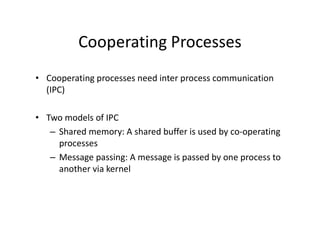
Cooperating Processes
• Cooperating processes need inter process communication
(IPC)
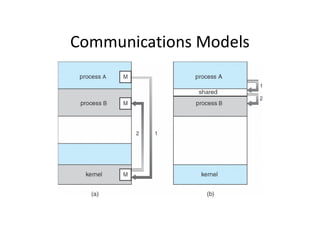
• Two models of IPC
– Shared memory: A shared buffer is used by co-operating
processes
– Message passing: A message is passed by one process to
another via kernel
Communications Models
Producer-Consumer Problem
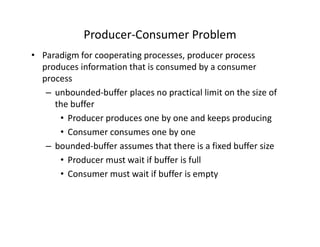
• Paradigm for cooperating processes, producer process
produces information that is consumed by a consumer
process
– unbounded-buffer places no practical limit on the size of
the buffer
• Producer produces one by one and keeps producing
• Consumer consumes one by one
– bounded-buffer assumes that there is a fixed buffer size
• Producer must wait if buffer is full
• Consumer must wait if buffer is empty
Bounded-Buffer –
Shared-Memory Solution
 Shared data
#define BUFFER_SIZE 10
typedef struct {
. . .
} item;
item buffer[BUFFER_SIZE];
int in = 0;
int out = 0;
Bounded-Buffer – Producer
while (true) {
/* Produce an item */
while (((in = (in + 1) % BUFFER SIZE) == out)
; /* do nothing -- no free buffers */
buffer[in] = item;
in = (in + 1) % BUFFER SIZE;
}
Bounded Buffer – Consumer
while (true) {
while (in == out)
; // do nothing -- nothing to consume
// remove an item from the buffer
item = buffer[out];
out = (out + 1) % BUFFER SIZE;
return item;
}
Interprocess Communication – Message Passing
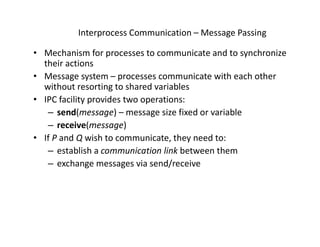
• Mechanism for processes to communicate and to synchronize
their actions
• Message system – processes communicate with each other
without resorting to shared variables
• IPC facility provides two operations:
– send(message) – message size fixed or variable
– receive(message)
• If P and Q wish to communicate, they need to:
– establish a communication link between them
– exchange messages via send/receive
Interprocess Communication – Message Passing
• Implementation of communication link
– Physical:
• Shared memory
• Hardware bus
• Network
– Logical:
• Direct or indirect
• Synchronous or asynchronous
• Automatic or explicit buffering
Direct Communication
• Processes must name each other explicitly:
– send (P, message) – send a message to process P
– receive(Q, message) – receive a message from
process Q
• Properties of communication link
– Links are established automatically
– A link is associated with exactly one pair of
communicating processes
– Between each pair there exists exactly one link
– The link may be unidirectional, but is usually bi-
directional
Indirect Communication
• Messages are directed and received from mailboxes
(also referred to as ports)
– Each mailbox has a unique id
– Processes can communicate only if they share a
mailbox
• Properties of communication link
– Link established only if processes share a common
mailbox
– A link may be associated with many processes
– Each pair of processes may share several
communication links
– Link may be unidirectional or bi-directional
Indirect Communication
• Operations
– create a new mailbox (port)
– send and receive messages through mailbox
– destroy a mailbox
• Primitives are defined as:
send(A, message) – send a message to mailbox A
receive(A, message) – receive a message from
mailbox A
Implementation Questions
1. How are links established?
2. Can a link be associated with more than two processes?
3. How many links can there be between every pair of
communicating processes?
4. What is the capacity of a link?
5. Is the size of a message that the link can accommodate fixed
or variable?
6. Is a link unidirectional or bi-directional?
Synchronization
• Message passing may be either blocking or non-blocking
• Blocking is considered synchronous
– Blocking send -- the sender is blocked until the message is
received
– Blocking receive -- the receiver is blocked until a message
is available
• Non-blocking is considered asynchronous
– Non-blocking send -- the sender sends the message and
continue
– Non-blocking receive -- the receiver receives:
• A valid message, or
• Null message
Buffering
• Queue of messages attached to the link; implemented in
one of three ways
1. Zero capacity – 0 messages
Sender must wait for receiver (rendezvous)
2. Bounded capacity – finite length of n messages
Sender must wait if link full
3. Unbounded capacity – infinite length
Sender never waits

interprocess-communication.pdf

  • 1.
  • 2.
  • 3.
    Interprocess Communication • Processeswithin a system may be independent or cooperating • Independent process cannot affect or be affected by the execution of another process • Cooperating process can affect or be affected by the execution of another process • Advantages of process cooperation – Information sharing – Computation speed-up – Modularity – Convenience
  • 4.
    Cooperating Processes • Cooperatingprocesses need inter process communication (IPC) • Two models of IPC – Shared memory: A shared buffer is used by co-operating processes – Message passing: A message is passed by one process to another via kernel
  • 5.
  • 6.
    Producer-Consumer Problem • Paradigmfor cooperating processes, producer process produces information that is consumed by a consumer process – unbounded-buffer places no practical limit on the size of the buffer • Producer produces one by one and keeps producing • Consumer consumes one by one – bounded-buffer assumes that there is a fixed buffer size • Producer must wait if buffer is full • Consumer must wait if buffer is empty
  • 7.
    Bounded-Buffer – Shared-Memory Solution Shared data #define BUFFER_SIZE 10 typedef struct { . . . } item; item buffer[BUFFER_SIZE]; int in = 0; int out = 0;
  • 8.
    Bounded-Buffer – Producer while(true) { /* Produce an item */ while (((in = (in + 1) % BUFFER SIZE) == out) ; /* do nothing -- no free buffers */ buffer[in] = item; in = (in + 1) % BUFFER SIZE; }
  • 9.
    Bounded Buffer –Consumer while (true) { while (in == out) ; // do nothing -- nothing to consume // remove an item from the buffer item = buffer[out]; out = (out + 1) % BUFFER SIZE; return item; }
  • 10.
    Interprocess Communication –Message Passing • Mechanism for processes to communicate and to synchronize their actions • Message system – processes communicate with each other without resorting to shared variables • IPC facility provides two operations: – send(message) – message size fixed or variable – receive(message) • If P and Q wish to communicate, they need to: – establish a communication link between them – exchange messages via send/receive
  • 11.
    Interprocess Communication –Message Passing • Implementation of communication link – Physical: • Shared memory • Hardware bus • Network – Logical: • Direct or indirect • Synchronous or asynchronous • Automatic or explicit buffering
  • 12.
    Direct Communication • Processesmust name each other explicitly: – send (P, message) – send a message to process P – receive(Q, message) – receive a message from process Q • Properties of communication link – Links are established automatically – A link is associated with exactly one pair of communicating processes – Between each pair there exists exactly one link – The link may be unidirectional, but is usually bi- directional
  • 13.
    Indirect Communication • Messagesare directed and received from mailboxes (also referred to as ports) – Each mailbox has a unique id – Processes can communicate only if they share a mailbox • Properties of communication link – Link established only if processes share a common mailbox – A link may be associated with many processes – Each pair of processes may share several communication links – Link may be unidirectional or bi-directional
  • 14.
    Indirect Communication • Operations –create a new mailbox (port) – send and receive messages through mailbox – destroy a mailbox • Primitives are defined as: send(A, message) – send a message to mailbox A receive(A, message) – receive a message from mailbox A
  • 15.
    Implementation Questions 1. Howare links established? 2. Can a link be associated with more than two processes? 3. How many links can there be between every pair of communicating processes? 4. What is the capacity of a link? 5. Is the size of a message that the link can accommodate fixed or variable? 6. Is a link unidirectional or bi-directional?
  • 16.
    Synchronization • Message passingmay be either blocking or non-blocking • Blocking is considered synchronous – Blocking send -- the sender is blocked until the message is received – Blocking receive -- the receiver is blocked until a message is available • Non-blocking is considered asynchronous – Non-blocking send -- the sender sends the message and continue – Non-blocking receive -- the receiver receives: • A valid message, or • Null message
  • 17.
    Buffering • Queue ofmessages attached to the link; implemented in one of three ways 1. Zero capacity – 0 messages Sender must wait for receiver (rendezvous) 2. Bounded capacity – finite length of n messages Sender must wait if link full 3. Unbounded capacity – infinite length Sender never waits