Development Across the Lifespan
Chapter 7
Chapter 7 Learning Objective Menu
•
•
•
•
•
•
•
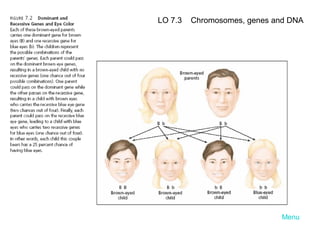
•
•
•
•
•
•
•
•
•
•
•
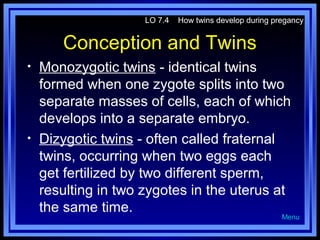
•
•

LO 7.1
LO 7.2
LO 7.3
LO 7.4
LO 7.5
LO 7.6
LO 7.7
LO 7.8
LO 7.9
LO 7.10
LO 7.11
LO 7.12
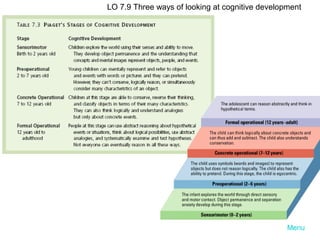
LO 7.13
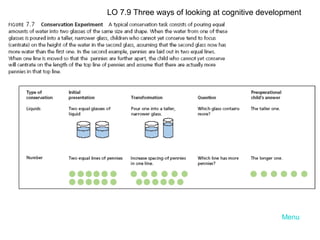
LO 7.14
LO 7.15
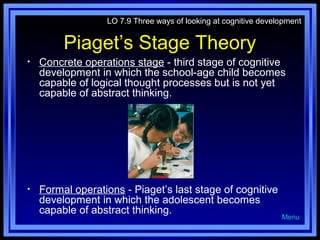
LO 7.16
LO 7.17
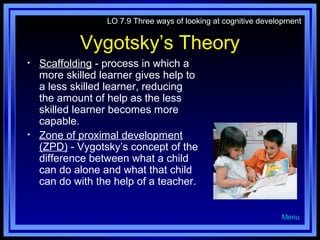
LO 7.18
LO 7.19
LO 7.20

Special research methods used to study development
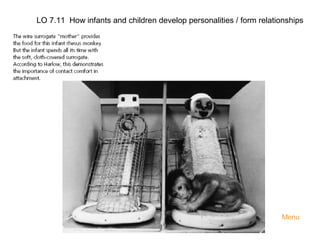
Relationship between heredity and environmental factors
Chromosomes, genes and DNA
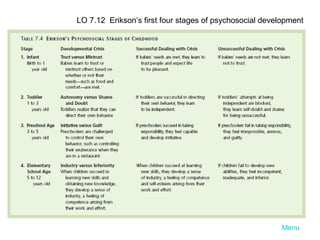
How twins develop during pregnancy
How conjoined twins adjust to being connected
Germinal, embryonic, and fetal periods of pregnancy
Physical changes in infancy and childhood
Facts and myths concerning infant immunizations
Three ways of looking at cognitive development
How language develops
How infants and children develop personalities and form relationships

Erikson’s first four stages of psychosocial development
Changes in puberty
How adolescents develop formal operation and moral thinking
Adolescent’s search for identity
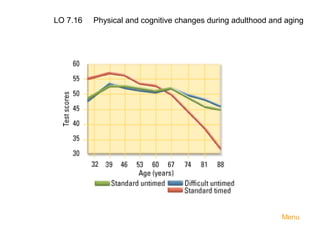
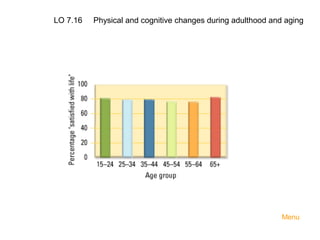
Physical and cognitive changes during adulthood and aging
Work, relationships, parenting, aging, and death
Theories of why aging occurs
Stages of death and dying
How attention-deficit/hyperactivity disorder affects adults
LO 7.1 Special research methods used to study development

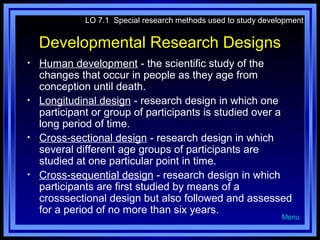
Developmental Research Designs
•

•

•

•

Human development - the scientific study of the
changes that occur in people as they age from
conception until death.
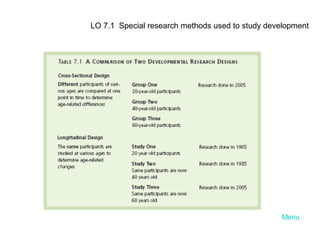
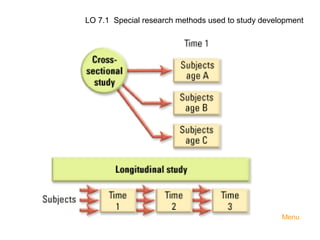
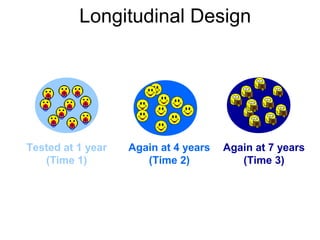
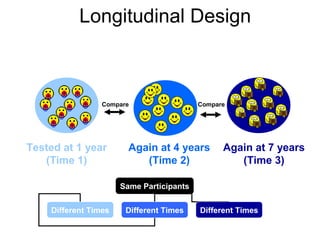
Longitudinal design - research design in which one
participant or group of participants is studied over a
long period of time.
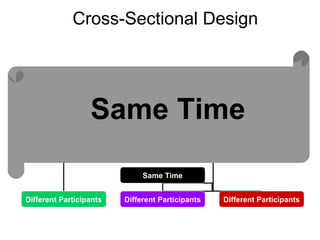
Cross-sectional design - research design in which
several different age groups of participants are
studied at one particular point in time.
Cross-sequential design - research design in which
participants are first studied by means of a
crosssectional design but also followed and assessed
for a period of no more than six years.

Menu
LO 7.1 Special research methods used to study development

Menu
LO 7.1 Special research methods used to study development

Menu
Longitudinal Design

Tested at 1 year
(Time 1)

Again at 4 years
(Time 2)

Again at 7 years
(Time 3)
Longitudinal Design

Compare

Tested at 1 year
(Time 1)

Compare

Again at 4 years
(Time 2)

Again at 7 years
(Time 3)

Same Participants
Different Times

Different Times

Different Times
Cross-Sectional Design

Same Time
Compare

1-year-olds

Compare

4-year-olds

7-year-olds

Same Time
Different Participants

Different Participants

Different Participants
LO 7.2

Relationship between heredity and environmental factors

Nature versus Nurture
•

•

•

Nature - the influence of our inherited
characteristics on our personality,
physical growth, intellectual growth, and
social interactions.
Nurture - the influence of the
environment on personality, physical
growth, intellectual growth, and social
interactions.
Behavioral genetics – focuses on
nature vs. nurture.
Menu
LO 7.3

Chromosomes, genes and DNA

Genetics and Development
•
•

•

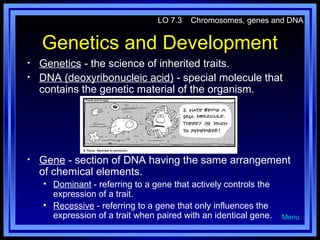
Genetics - the science of inherited traits.
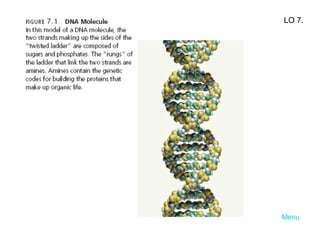
DNA (deoxyribonucleic acid) - special molecule that
contains the genetic material of the organism.

Gene - section of DNA having the same arrangement
of chemical elements.
• Dominant - referring to a gene that actively controls the
expression of a trait.
• Recessive - referring to a gene that only influences the
expression of a trait when paired with an identical gene.

Menu
LO 7.

Menu
LO 7.3

Chromosomes, genes and DNA

Menu
LO 7.3

Chromosomes, genes and DNA

Menu
LO 7.3
 

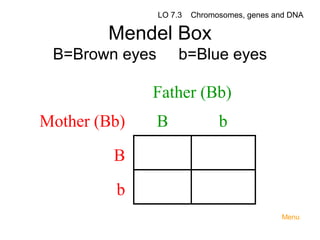
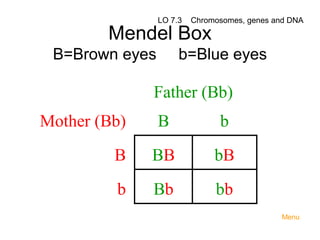
Mendel Box
B=Brown eyes


Chromosomes, genes and DNA


Mother (Bb)
B 
b 

b=Blue eyes

Father (Bb)
 
B
b


Menu


LO 7.3


Chromosomes, genes and DNA

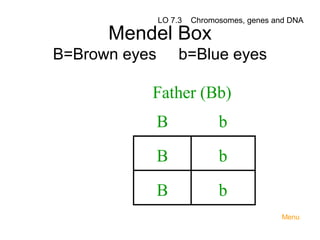
Mendel Box
B=Brown eyes


b=Blue eyes

Father (Bb)
B

b

B

b

B

b
Menu
LO 7.3


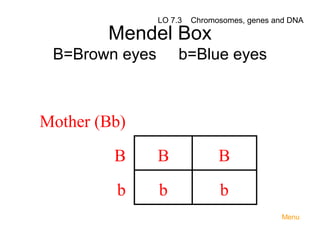
Mendel Box
B=Brown eyes


Chromosomes, genes and DNA

b=Blue eyes


Mother (Bb)
B 
b 


B 
b 


B 
b 
Menu
LO 7.3


Mendel Box
B=Brown eyes


Chromosomes, genes and DNA

b=Blue eyes


Father (Bb)
 
Mother (Bb)
B
b
 
 
B  BB 
bB 
 
 
b  Bb 
bb 
Menu
LO 7.3

Chromosomes, genes and DNA

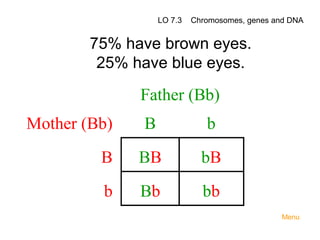
75% have brown eyes.
25% have blue eyes.


Father (Bb) 
 
 
Mother (Bb) 
B 
b 
 
 
B  BB 
bB 
 
 
b  Bb 
bb 


Menu
LO 7.3

Chromosomes, genes and DNA

Genetics and Development
•
•

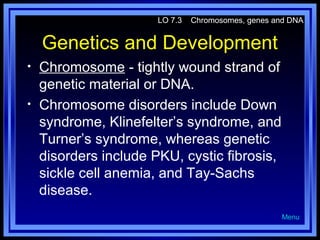
Chromosome - tightly wound strand of
genetic material or DNA.
Chromosome disorders include Down
syndrome, Klinefelter’s syndrome, and
Turner’s syndrome, whereas genetic
disorders include PKU, cystic fibrosis,
sickle cell anemia, and Tay-Sachs
disease.
Menu
LO 7.3

Chromosomes, genes and DNA

Genetics and Development
•
•
•
•

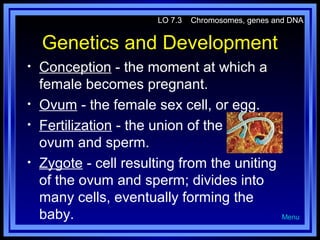
Conception - the moment at which a
female becomes pregnant.
Ovum - the female sex cell, or egg.
Fertilization - the union of the
ovum and sperm.
Zygote - cell resulting from the uniting
of the ovum and sperm; divides into
many cells, eventually forming the
baby.

Menu
LO 7.4

How twins develop during pregancy

Conception and Twins
•

•

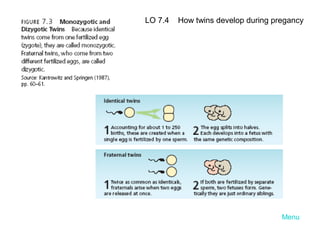
Monozygotic twins - identical twins
formed when one zygote splits into two
separate masses of cells, each of which
develops into a separate embryo.
Dizygotic twins - often called fraternal
twins, occurring when two eggs each
get fertilized by two different sperm,
resulting in two zygotes in the uterus at
the same time.

Menu
LO 7.4

How twins develop during pregancy

Menu
LO 7.5

How conjoined twins adjust to being connected

Conjoined Twins
•

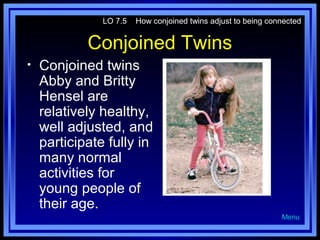
Conjoined twins
Abby and Britty
Hensel are
relatively healthy,
well adjusted, and
participate fully in
many normal
activities for
young people of
their age.
Menu
LO 7.6

•

•

Germinal, embryonic, and fetal periods of pregnancy

Periods of Pregnancy

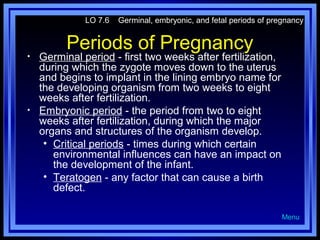
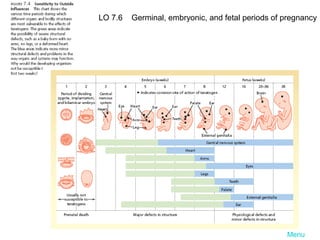
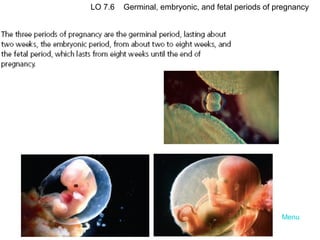
Germinal period - first two weeks after fertilization,
during which the zygote moves down to the uterus
and begins to implant in the lining embryo name for
the developing organism from two weeks to eight
weeks after fertilization.
Embryonic period - the period from two to eight
weeks after fertilization, during which the major
organs and structures of the organism develop.
• Critical periods - times during which certain
environmental influences can have an impact on
the development of the infant.
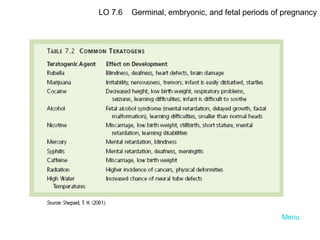
• Teratogen - any factor that can cause a birth
defect.
Menu
LO 7.6

Germinal, embryonic, and fetal periods of pregnancy

Menu
LO 7.6

Germinal, embryonic, and fetal periods of pregnancy

Menu
LO 7.6

Germinal, embryonic, and fetal periods of pregnancy

Periods of Pregnancy
•

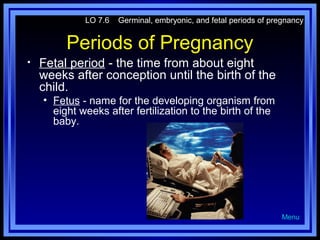
Fetal period - the time from about eight
weeks after conception until the birth of the
child.
• Fetus - name for the developing organism from
eight weeks after fertilization to the birth of the
baby.

Menu
LO 7.6

Germinal, embryonic, and fetal periods of pregnancy

Menu
LO 7.7

Physical changes in infancy and childhood

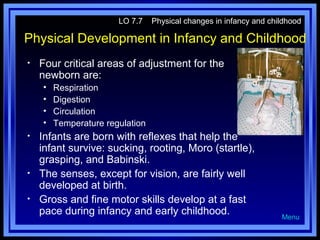
Physical Development in Infancy and Childhood
•

Four critical areas of adjustment for the
newborn are:
•
•
•
•

•

•
•

Respiration
Digestion
Circulation
Temperature regulation

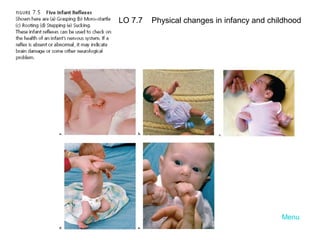
Infants are born with reflexes that help the
infant survive: sucking, rooting, Moro (startle),
grasping, and Babinski.
The senses, except for vision, are fairly well
developed at birth.
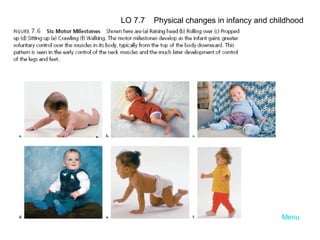
Gross and fine motor skills develop at a fast
pace during infancy and early childhood.

Menu
LO 7.7

Physical changes in infancy and childhood

Menu
LO 7.7

Physical changes in infancy and childhood

Menu
LO 7.7

Physical changes in infancy and childhood

Menu
LO 7.8 Facts and myths concerning infant immunizations

Immunizations
•

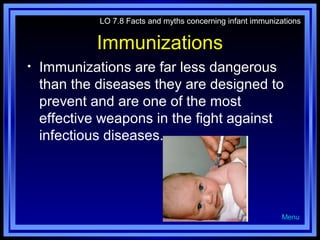
Immunizations are far less dangerous
than the diseases they are designed to
prevent and are one of the most
effective weapons in the fight against
infectious diseases.

Menu
LO 7.9 Three ways of looking at cognitive development

Cognitive Development
•

Cognitive development - the
development of thinking, problem
solving, and memory scheme (plural
schemas) a mental concept formed
through experiences with objects and
events.

Menu
LO 7.9 Three ways of looking at cognitive development

Piaget’s Stage Theory
•

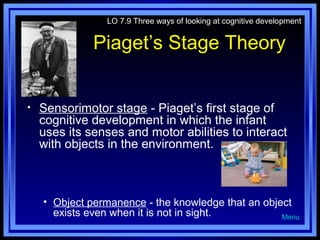
Sensorimotor stage - Piaget’s first stage of
cognitive development in which the infant
uses its senses and motor abilities to interact
with objects in the environment.

• Object permanence - the knowledge that an object
exists even when it is not in sight.
Menu
LO 7.9 Three ways of looking at cognitive development

Piaget’s Stage Theory
•

Preoperational stage - Piaget’s second stage
of cognitive development in which the
preschool child learns to use language as a
means of exploring the world.
• Egocentrism - the inability to see the world
through anyone else’s eyes.
• Centration - in Piaget’s theory, the tendency of a
young child to focus only on one feature of an
object while ignoring other relevant features.
• Conservation - in Piaget’s theory, the ability to
understand that simply changing the appearance
of an object does not change the object’s nature.
• Irreversibility - in Piaget’s theory, the inability of
the young child to mentally reverse an action. Menu
LO 7.9 Three ways of looking at cognitive development

Menu
LO 7.9 Three ways of looking at cognitive development

Piaget’s Stage Theory
•

Concrete operations stage - third stage of cognitive
development in which the school-age child becomes
capable of logical thought processes but is not yet
capable of abstract thinking.

•

Formal operations - Piaget’s last stage of cognitive
development in which the adolescent becomes
capable of abstract thinking.

Menu
LO 7.9 Three ways of looking at cognitive development

Menu
LO 7.9 Three ways of looking at cognitive development

Vygotsky’s Theory
•

•

Scaffolding - process in which a
more skilled learner gives help to
a less skilled learner, reducing
the amount of help as the less
skilled learner becomes more
capable.
Zone of proximal development
(ZPD) - Vygotsky’s concept of the
difference between what a child
can do alone and what that child
can do with the help of a teacher.
Menu
LO 7.9 Three ways of looking at cognitive development

Information Processing Theory
•

Metamemory – process by which
children improve in their memory
capacity as they age, learn to use
control strategies to improve memory
performance, and gain a better
understanding of how their own
memories work.

Menu
LO 7.10 How language develops

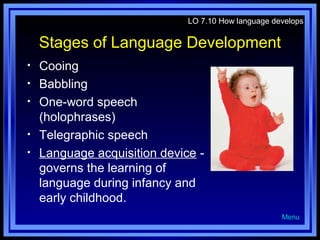
Stages of Language Development
•
•
•
•
•

Cooing
Babbling
One-word speech
(holophrases)
Telegraphic speech
Language acquisition device governs the learning of
language during infancy and
early childhood.
Menu
LO 7.11 How infants and children develop personalities / form relationships

Temperament
•

Temperament - the behavioral
characteristics that are fairly well
established at birth.
• Easy - regular, adaptable, and happy
• Difficult - irregular, nonadaptable, and
irritable
• Slow to warm up - need to adjust gradually
to change.
Menu
LO 7.11 How infants and children develop personalities / form relationships

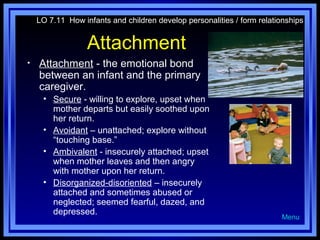
Attachment
•

Attachment - the emotional bond
between an infant and the primary
caregiver.
• Secure - willing to explore, upset when
mother departs but easily soothed upon
her return.
• Avoidant – unattached; explore without
“touching base.”
• Ambivalent - insecurely attached; upset
when mother leaves and then angry
with mother upon her return.
• Disorganized-disoriented – insecurely
attached and sometimes abused or
neglected; seemed fearful, dazed, and
depressed.

Menu
LO 7.11 How infants and children develop personalities / form relationships

Menu
LO 7.12 Erikson’s first four stages of psychosocial development

Erikson’s First Four Stages
•

•

Trust versus mistrust - first stage of
personality development in which the infant’s
basic sense of trust or mistrust develops as a
result of consistent or inconsistent care.
Autonomy versus shame and doubt - second
stage of personality development in which the
toddler strives for physical independence.

Menu
LO 7.12 Erikson’s first four stages of psychosocial development

Erikson’s First Four Stages
•

•

Initiative versus guilt - third stage of
personality development in which the
preschool-aged child strives for emotional
and psychological independence and attemps
to satisfy curiosity about the world.
Industry versus inferiority - fourth stage of
personality development in which the
adolescent strives for a sense of competence
and self-esteem.

Menu
LO 7.12 Erikson’s first four stages of psychosocial development

Menu
LO 7.12 Erikson’s first four stages of psychosocial development

Gender Role Development
•
•

Gender- the behavior associated with
being male or female.
Gender identity - perception of one’s
gender and the behavior that is
associated with that gender.

Menu
LO 7.13 Changes in puberty

Puberty and Adolescence
•

•

Adolescence - the period of life from
about age 13 to the early twenties,
during which a young person is no
longer physically a child but is not yet
an independent, self-supporting adult.
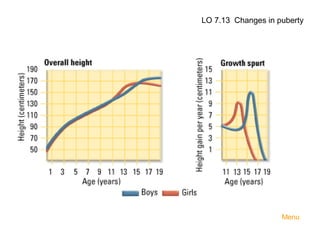
Puberty - the physical changes that
occur in the body as sexual
development reaches its peak.
• Period of about four years.

Menu
LO 7.13 Changes in puberty

Menu
LO 7.14 How adolescents develop formal operation and moral thinking

Egocentric Thinking
•

•

Personal fable - type of thought
common to adolescents in which young
people believe themselves to be unique
and protected from harm.
Imaginary audience - type of thought
common to adolescents in which young
people believe that other people are
just as concerned about the
adolescent’s thoughts and
characteristics as they themselves are.

Menu
LO 7.14 How adolescents develop formal operation and moral thinking

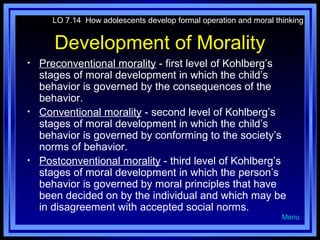
Development of Morality
•

•

•

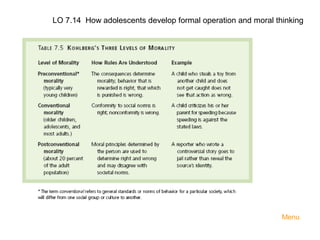
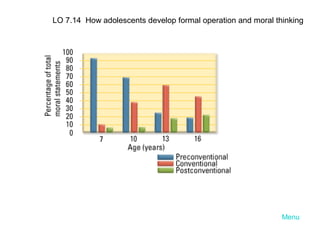
Preconventional morality - first level of Kohlberg’s
stages of moral development in which the child’s
behavior is governed by the consequences of the
behavior.
Conventional morality - second level of Kohlberg’s
stages of moral development in which the child’s
behavior is governed by conforming to the society’s
norms of behavior.
Postconventional morality - third level of Kohlberg’s
stages of moral development in which the person’s
behavior is governed by moral principles that have
been decided on by the individual and which may be
in disagreement with accepted social norms.
Menu
LO 7.14 How adolescents develop formal operation and moral thinking

Menu
LO 7.14 How adolescents develop formal operation and moral thinking

Menu
LO 7.14 How adolescents develop formal operation and moral thinking

Menu
LO 7.15 Adolescent’s search for identity

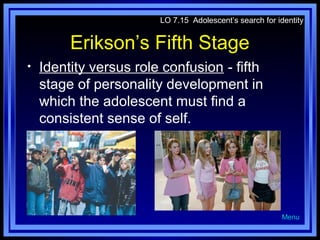
Erikson’s Fifth Stage
•

Identity versus role confusion - fifth
stage of personality development in
which the adolescent must find a
consistent sense of self.

Menu
LO 7.16

Physical and cognitive changes during adulthood and aging

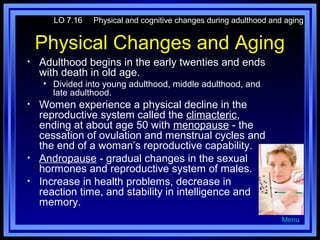
Physical Changes and Aging
•

Adulthood begins in the early twenties and ends
with death in old age.
• Divided into young adulthood, middle adulthood, and
late adulthood.

•

•
•

Women experience a physical decline in the
reproductive system called the climacteric,
ending at about age 50 with menopause - the
cessation of ovulation and menstrual cycles and
the end of a woman’s reproductive capability.
Andropause - gradual changes in the sexual
hormones and reproductive system of males.
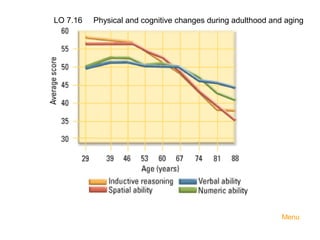
Increase in health problems, decrease in
reaction time, and stability in intelligence and
memory.
Menu
LO 7.16

Physical and cognitive changes during adulthood and aging

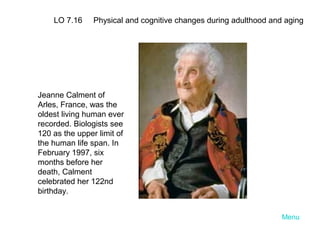
Jeanne Calment of
Arles, France, was the
oldest living human ever
recorded. Biologists see
120 as the upper limit of
the human life span. In
February 1997, six
months before her
death, Calment
celebrated her 122nd
birthday.
Menu
LO 7.16

Physical and cognitive changes during adulthood and aging

Menu
LO 7.16

Physical and cognitive changes during adulthood and aging

Menu
LO 7.16

Physical and cognitive changes during adulthood and aging

Menu
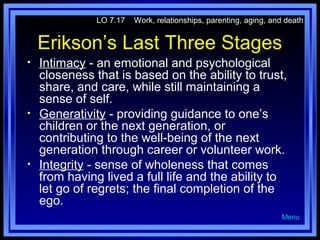
LO 7.17

Work, relationships, parenting, aging, and death

Erikson’s Last Three Stages
•

•

•

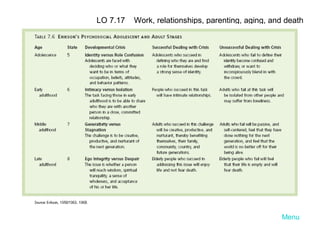
Intimacy - an emotional and psychological
closeness that is based on the ability to trust,
share, and care, while still maintaining a
sense of self.
Generativity - providing guidance to one’s
children or the next generation, or
contributing to the well-being of the next
generation through career or volunteer work.
Integrity - sense of wholeness that comes
from having lived a full life and the ability to
let go of regrets; the final completion of the
ego.
Menu
LO 7.17

Work, relationships, parenting, aging, and death

Menu
LO 7.18

Theories of why aging occurs

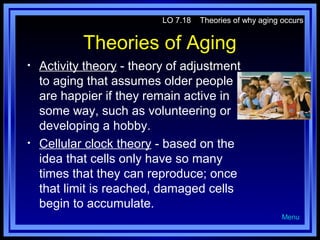
Theories of Aging
•

•

Activity theory - theory of adjustment
to aging that assumes older people
are happier if they remain active in
some way, such as volunteering or
developing a hobby.
Cellular clock theory - based on the
idea that cells only have so many
times that they can reproduce; once
that limit is reached, damaged cells
begin to accumulate.
Menu
LO 7.18

Theories of why aging occurs

Theories of Aging
•

•

Wear-and-tear theory - as time
goes by, repeated use and abuse
of the body’s tissues cause it to be
unable to repair all the damage.
Free radical theory - oxygen
molecules with an unstable
electron move around the cell,
damaging cell structures as they
go.

Menu
LO 7.19

Stages of death and dying

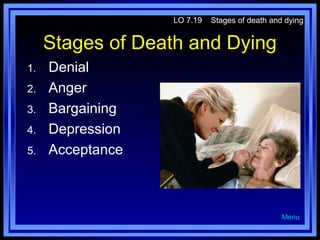
Stages of Death and Dying
1.
2.
3.
4.
5.

Denial
Anger
Bargaining
Depression
Acceptance

Menu
LO 7.20

How attention-deficit/hyperactivity disorder affects adults

Adult ADHD
•

•

Many children with ADHD grow up to be
adults with ADHD, affecting their work,
relationships, and emotional well-being.
ADHD in adults can be treated with
medication and/or therapy.

Menu

Chapter 3 human development

  • 1.
    Development Across theLifespan Chapter 7
  • 2.
    Chapter 7 LearningObjective Menu • • • • • • • • • • • • • • • • • • • • LO 7.1 LO 7.2 LO 7.3 LO 7.4 LO 7.5 LO 7.6 LO 7.7 LO 7.8 LO 7.9 LO 7.10 LO 7.11 LO 7.12 LO 7.13 LO 7.14 LO 7.15 LO 7.16 LO 7.17 LO 7.18 LO 7.19 LO 7.20 Special research methods used to study development Relationship between heredity and environmental factors Chromosomes, genes and DNA How twins develop during pregnancy How conjoined twins adjust to being connected Germinal, embryonic, and fetal periods of pregnancy Physical changes in infancy and childhood Facts and myths concerning infant immunizations Three ways of looking at cognitive development How language develops How infants and children develop personalities and form relationships Erikson’s first four stages of psychosocial development Changes in puberty How adolescents develop formal operation and moral thinking Adolescent’s search for identity Physical and cognitive changes during adulthood and aging Work, relationships, parenting, aging, and death Theories of why aging occurs Stages of death and dying How attention-deficit/hyperactivity disorder affects adults
  • 3.
    LO 7.1 Specialresearch methods used to study development Developmental Research Designs • • • • Human development - the scientific study of the changes that occur in people as they age from conception until death. Longitudinal design - research design in which one participant or group of participants is studied over a long period of time. Cross-sectional design - research design in which several different age groups of participants are studied at one particular point in time. Cross-sequential design - research design in which participants are first studied by means of a crosssectional design but also followed and assessed for a period of no more than six years. Menu
  • 4.
    LO 7.1 Specialresearch methods used to study development Menu
  • 5.
    LO 7.1 Specialresearch methods used to study development Menu
  • 6.
    Longitudinal Design Tested at1 year (Time 1) Again at 4 years (Time 2) Again at 7 years (Time 3)
  • 7.
    Longitudinal Design Compare Tested at1 year (Time 1) Compare Again at 4 years (Time 2) Again at 7 years (Time 3) Same Participants Different Times Different Times Different Times
  • 8.
    Cross-Sectional Design Same Time Compare 1-year-olds Compare 4-year-olds 7-year-olds SameTime Different Participants Different Participants Different Participants
  • 9.
    LO 7.2 Relationship betweenheredity and environmental factors Nature versus Nurture • • • Nature - the influence of our inherited characteristics on our personality, physical growth, intellectual growth, and social interactions. Nurture - the influence of the environment on personality, physical growth, intellectual growth, and social interactions. Behavioral genetics – focuses on nature vs. nurture. Menu
  • 10.
    LO 7.3 Chromosomes, genesand DNA Genetics and Development • • • Genetics - the science of inherited traits. DNA (deoxyribonucleic acid) - special molecule that contains the genetic material of the organism. Gene - section of DNA having the same arrangement of chemical elements. • Dominant - referring to a gene that actively controls the expression of a trait. • Recessive - referring to a gene that only influences the expression of a trait when paired with an identical gene. Menu
  • 11.
  • 12.
  • 13.
  • 14.
    LO 7.3   Mendel Box B=Browneyes           Chromosomes, genes and DNA   Mother (Bb) B  b  b=Blue eyes Father (Bb)   B b         Menu
  • 15.
        LO 7.3   Chromosomes, genesand DNA Mendel Box B=Brown eyes     b=Blue eyes Father (Bb) B b B b B b Menu
  • 16.
    LO 7.3   Mendel Box B=Browneyes           Chromosomes, genes and DNA b=Blue eyes   Mother (Bb) B  b        B  b        B  b  Menu
  • 17.
    LO 7.3   Mendel Box B=Browneyes           Chromosomes, genes and DNA b=Blue eyes   Father (Bb)   Mother (Bb) B b     B  BB  bB      b  Bb  bb  Menu
  • 18.
    LO 7.3 Chromosomes, genesand DNA 75% have brown eyes. 25% have blue eyes.     Father (Bb)      Mother (Bb)  B  b      B  BB  bB      b  Bb  bb      Menu
  • 19.
    LO 7.3 Chromosomes, genesand DNA Genetics and Development • • Chromosome - tightly wound strand of genetic material or DNA. Chromosome disorders include Down syndrome, Klinefelter’s syndrome, and Turner’s syndrome, whereas genetic disorders include PKU, cystic fibrosis, sickle cell anemia, and Tay-Sachs disease. Menu
  • 20.
    LO 7.3 Chromosomes, genesand DNA Genetics and Development • • • • Conception - the moment at which a female becomes pregnant. Ovum - the female sex cell, or egg. Fertilization - the union of the ovum and sperm. Zygote - cell resulting from the uniting of the ovum and sperm; divides into many cells, eventually forming the baby. Menu
  • 21.
    LO 7.4 How twinsdevelop during pregancy Conception and Twins • • Monozygotic twins - identical twins formed when one zygote splits into two separate masses of cells, each of which develops into a separate embryo. Dizygotic twins - often called fraternal twins, occurring when two eggs each get fertilized by two different sperm, resulting in two zygotes in the uterus at the same time. Menu
  • 22.
    LO 7.4 How twinsdevelop during pregancy Menu
  • 23.
    LO 7.5 How conjoinedtwins adjust to being connected Conjoined Twins • Conjoined twins Abby and Britty Hensel are relatively healthy, well adjusted, and participate fully in many normal activities for young people of their age. Menu
  • 24.
    LO 7.6 • • Germinal, embryonic,and fetal periods of pregnancy Periods of Pregnancy Germinal period - first two weeks after fertilization, during which the zygote moves down to the uterus and begins to implant in the lining embryo name for the developing organism from two weeks to eight weeks after fertilization. Embryonic period - the period from two to eight weeks after fertilization, during which the major organs and structures of the organism develop. • Critical periods - times during which certain environmental influences can have an impact on the development of the infant. • Teratogen - any factor that can cause a birth defect. Menu
  • 25.
    LO 7.6 Germinal, embryonic,and fetal periods of pregnancy Menu
  • 26.
    LO 7.6 Germinal, embryonic,and fetal periods of pregnancy Menu
  • 27.
    LO 7.6 Germinal, embryonic,and fetal periods of pregnancy Periods of Pregnancy • Fetal period - the time from about eight weeks after conception until the birth of the child. • Fetus - name for the developing organism from eight weeks after fertilization to the birth of the baby. Menu
  • 28.
    LO 7.6 Germinal, embryonic,and fetal periods of pregnancy Menu
  • 29.
    LO 7.7 Physical changesin infancy and childhood Physical Development in Infancy and Childhood • Four critical areas of adjustment for the newborn are: • • • • • • • Respiration Digestion Circulation Temperature regulation Infants are born with reflexes that help the infant survive: sucking, rooting, Moro (startle), grasping, and Babinski. The senses, except for vision, are fairly well developed at birth. Gross and fine motor skills develop at a fast pace during infancy and early childhood. Menu
  • 30.
    LO 7.7 Physical changesin infancy and childhood Menu
  • 31.
    LO 7.7 Physical changesin infancy and childhood Menu
  • 32.
    LO 7.7 Physical changesin infancy and childhood Menu
  • 33.
    LO 7.8 Factsand myths concerning infant immunizations Immunizations • Immunizations are far less dangerous than the diseases they are designed to prevent and are one of the most effective weapons in the fight against infectious diseases. Menu
  • 34.
    LO 7.9 Threeways of looking at cognitive development Cognitive Development • Cognitive development - the development of thinking, problem solving, and memory scheme (plural schemas) a mental concept formed through experiences with objects and events. Menu
  • 35.
    LO 7.9 Threeways of looking at cognitive development Piaget’s Stage Theory • Sensorimotor stage - Piaget’s first stage of cognitive development in which the infant uses its senses and motor abilities to interact with objects in the environment. • Object permanence - the knowledge that an object exists even when it is not in sight. Menu
  • 36.
    LO 7.9 Threeways of looking at cognitive development Piaget’s Stage Theory • Preoperational stage - Piaget’s second stage of cognitive development in which the preschool child learns to use language as a means of exploring the world. • Egocentrism - the inability to see the world through anyone else’s eyes. • Centration - in Piaget’s theory, the tendency of a young child to focus only on one feature of an object while ignoring other relevant features. • Conservation - in Piaget’s theory, the ability to understand that simply changing the appearance of an object does not change the object’s nature. • Irreversibility - in Piaget’s theory, the inability of the young child to mentally reverse an action. Menu
  • 37.
    LO 7.9 Threeways of looking at cognitive development Menu
  • 38.
    LO 7.9 Threeways of looking at cognitive development Piaget’s Stage Theory • Concrete operations stage - third stage of cognitive development in which the school-age child becomes capable of logical thought processes but is not yet capable of abstract thinking. • Formal operations - Piaget’s last stage of cognitive development in which the adolescent becomes capable of abstract thinking. Menu
  • 39.
    LO 7.9 Threeways of looking at cognitive development Menu
  • 40.
    LO 7.9 Threeways of looking at cognitive development Vygotsky’s Theory • • Scaffolding - process in which a more skilled learner gives help to a less skilled learner, reducing the amount of help as the less skilled learner becomes more capable. Zone of proximal development (ZPD) - Vygotsky’s concept of the difference between what a child can do alone and what that child can do with the help of a teacher. Menu
  • 41.
    LO 7.9 Threeways of looking at cognitive development Information Processing Theory • Metamemory – process by which children improve in their memory capacity as they age, learn to use control strategies to improve memory performance, and gain a better understanding of how their own memories work. Menu
  • 42.
    LO 7.10 Howlanguage develops Stages of Language Development • • • • • Cooing Babbling One-word speech (holophrases) Telegraphic speech Language acquisition device governs the learning of language during infancy and early childhood. Menu
  • 43.
    LO 7.11 Howinfants and children develop personalities / form relationships Temperament • Temperament - the behavioral characteristics that are fairly well established at birth. • Easy - regular, adaptable, and happy • Difficult - irregular, nonadaptable, and irritable • Slow to warm up - need to adjust gradually to change. Menu
  • 44.
    LO 7.11 Howinfants and children develop personalities / form relationships Attachment • Attachment - the emotional bond between an infant and the primary caregiver. • Secure - willing to explore, upset when mother departs but easily soothed upon her return. • Avoidant – unattached; explore without “touching base.” • Ambivalent - insecurely attached; upset when mother leaves and then angry with mother upon her return. • Disorganized-disoriented – insecurely attached and sometimes abused or neglected; seemed fearful, dazed, and depressed. Menu
  • 45.
    LO 7.11 Howinfants and children develop personalities / form relationships Menu
  • 46.
    LO 7.12 Erikson’sfirst four stages of psychosocial development Erikson’s First Four Stages • • Trust versus mistrust - first stage of personality development in which the infant’s basic sense of trust or mistrust develops as a result of consistent or inconsistent care. Autonomy versus shame and doubt - second stage of personality development in which the toddler strives for physical independence. Menu
  • 47.
    LO 7.12 Erikson’sfirst four stages of psychosocial development Erikson’s First Four Stages • • Initiative versus guilt - third stage of personality development in which the preschool-aged child strives for emotional and psychological independence and attemps to satisfy curiosity about the world. Industry versus inferiority - fourth stage of personality development in which the adolescent strives for a sense of competence and self-esteem. Menu
  • 48.
    LO 7.12 Erikson’sfirst four stages of psychosocial development Menu
  • 49.
    LO 7.12 Erikson’sfirst four stages of psychosocial development Gender Role Development • • Gender- the behavior associated with being male or female. Gender identity - perception of one’s gender and the behavior that is associated with that gender. Menu
  • 50.
    LO 7.13 Changesin puberty Puberty and Adolescence • • Adolescence - the period of life from about age 13 to the early twenties, during which a young person is no longer physically a child but is not yet an independent, self-supporting adult. Puberty - the physical changes that occur in the body as sexual development reaches its peak. • Period of about four years. Menu
  • 51.
    LO 7.13 Changesin puberty Menu
  • 52.
    LO 7.14 Howadolescents develop formal operation and moral thinking Egocentric Thinking • • Personal fable - type of thought common to adolescents in which young people believe themselves to be unique and protected from harm. Imaginary audience - type of thought common to adolescents in which young people believe that other people are just as concerned about the adolescent’s thoughts and characteristics as they themselves are. Menu
  • 53.
    LO 7.14 Howadolescents develop formal operation and moral thinking Development of Morality • • • Preconventional morality - first level of Kohlberg’s stages of moral development in which the child’s behavior is governed by the consequences of the behavior. Conventional morality - second level of Kohlberg’s stages of moral development in which the child’s behavior is governed by conforming to the society’s norms of behavior. Postconventional morality - third level of Kohlberg’s stages of moral development in which the person’s behavior is governed by moral principles that have been decided on by the individual and which may be in disagreement with accepted social norms. Menu
  • 54.
    LO 7.14 Howadolescents develop formal operation and moral thinking Menu
  • 55.
    LO 7.14 Howadolescents develop formal operation and moral thinking Menu
  • 56.
    LO 7.14 Howadolescents develop formal operation and moral thinking Menu
  • 57.
    LO 7.15 Adolescent’ssearch for identity Erikson’s Fifth Stage • Identity versus role confusion - fifth stage of personality development in which the adolescent must find a consistent sense of self. Menu
  • 58.
    LO 7.16 Physical andcognitive changes during adulthood and aging Physical Changes and Aging • Adulthood begins in the early twenties and ends with death in old age. • Divided into young adulthood, middle adulthood, and late adulthood. • • • Women experience a physical decline in the reproductive system called the climacteric, ending at about age 50 with menopause - the cessation of ovulation and menstrual cycles and the end of a woman’s reproductive capability. Andropause - gradual changes in the sexual hormones and reproductive system of males. Increase in health problems, decrease in reaction time, and stability in intelligence and memory. Menu
  • 59.
    LO 7.16 Physical andcognitive changes during adulthood and aging Jeanne Calment of Arles, France, was the oldest living human ever recorded. Biologists see 120 as the upper limit of the human life span. In February 1997, six months before her death, Calment celebrated her 122nd birthday. Menu
  • 60.
    LO 7.16 Physical andcognitive changes during adulthood and aging Menu
  • 61.
    LO 7.16 Physical andcognitive changes during adulthood and aging Menu
  • 62.
    LO 7.16 Physical andcognitive changes during adulthood and aging Menu
  • 63.
    LO 7.17 Work, relationships,parenting, aging, and death Erikson’s Last Three Stages • • • Intimacy - an emotional and psychological closeness that is based on the ability to trust, share, and care, while still maintaining a sense of self. Generativity - providing guidance to one’s children or the next generation, or contributing to the well-being of the next generation through career or volunteer work. Integrity - sense of wholeness that comes from having lived a full life and the ability to let go of regrets; the final completion of the ego. Menu
  • 64.
    LO 7.17 Work, relationships,parenting, aging, and death Menu
  • 65.
    LO 7.18 Theories ofwhy aging occurs Theories of Aging • • Activity theory - theory of adjustment to aging that assumes older people are happier if they remain active in some way, such as volunteering or developing a hobby. Cellular clock theory - based on the idea that cells only have so many times that they can reproduce; once that limit is reached, damaged cells begin to accumulate. Menu
  • 66.
    LO 7.18 Theories ofwhy aging occurs Theories of Aging • • Wear-and-tear theory - as time goes by, repeated use and abuse of the body’s tissues cause it to be unable to repair all the damage. Free radical theory - oxygen molecules with an unstable electron move around the cell, damaging cell structures as they go. Menu
  • 67.
    LO 7.19 Stages ofdeath and dying Stages of Death and Dying 1. 2. 3. 4. 5. Denial Anger Bargaining Depression Acceptance Menu
  • 68.
    LO 7.20 How attention-deficit/hyperactivitydisorder affects adults Adult ADHD • • Many children with ADHD grow up to be adults with ADHD, affecting their work, relationships, and emotional well-being. ADHD in adults can be treated with medication and/or therapy. Menu