Kohlberg’s Theory
Of
Moral Development
To examine the stages of moral
development as described by Lawrence
Kohlberg and accurately apply it to
specific moral dilemmas.
Purpose
Lawrence Kohlberg: Who Is He?
Lawrence Kohlberg was, for many years, a professor at
Harvard University.
He became famous for his work there beginning in the
early 1970s.
He started as a developmental psychologist and then
moved to the field of moral education.
He was particularly well-known for his theory of moral
development which he popularized through research
studies conducted at Harvard's Center for Moral
Education.
Lawrence Kohlberg
His theory of moral development was dependent
on the thinking of the Swiss psychologist Jean
Piaget and the American philosopher John
Dewey.
He was also inspired by James Mark Baldwin.
These men had emphasized that human beings
develop philosophically and psychologically in a
progressive fashion.
Kohlberg believed...and was able to demonstrate
through studies...that people progressed in their
moral reasoning (i.e., in their bases for ethical
behavior) through a series of stages.
He believed that there were six identifiable stages
which could be more generally classified into
three levels.
The stages include growth from self-
centeredness to other-centeredness.
Self-centeredness Other-centeredness
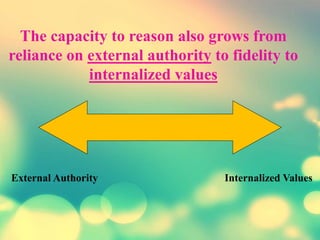
The capacity to reason also grows from
reliance on external authority to fidelity to
internalized values
External Authority Internalized Values
Stages of Moral Development
Lawrence Kohlberg
Level Stage Ages Social Orientation
Pre-Conventional 1 2-4 Obedience and Punishment
2 4-7
Individualism,
Instrumentalism
Conventional 3 7-10 Good Boy/Girl
4 10-12 Law and Order
Post-Conventional 5 Teens Social Contract
6 Adult Principled Conscience
Description
A person’s moral reasoning results from consequences
of actions, such as punishment, reward, or exchange of
favors, and from the physical power of authority figures.
The first level of moral thinking is that generally found
at the elementary school level.
Level One: Pre-conventional
(Self-Centered)
Stage 1: Fear of Punishment
Not law or justice, but cost to me
Conscience = self-protection
Stage 2: Profit
Minimize the pain; maximize the pleasure
Right behavior means acting in one's own best
interests.
Reasoning is largely based on an attitude of “You
scratch my back and I’ll scratch yours.”
Conscience = cunning
Level Two: The Conventional Level
(Group Centered)
Description:
A person’s moral reasoning involves
maintaining the expectations of one’s family,
peer group, or nation for one’s own sake
regardless of the immediate consequences, and
a desire to respect, maintain, support, and
justify the existing social order.
Stage 3: Group Loyalty
Obligation to ones family, gang, etc.
One earns acceptance by being “nice.”
Behavior is often judged by intention –
“Well, they mean well.”
Conscience = loyalty
Stage 4: Law and Order
Without laws, society would be chaos
Right behavior consists of doing one’s duty
and respecting authority.
Flaws in the system are due to the failure of
individuals who do not obey the system.
Conscience = good citizenship
Level Three: Post Conventional Level
(Internalized-Truth-Centered)
Description:
A person reasons according to moral values and
principles which are valid and applicable apart
from the authority of the groups.
Moral reasoning becomes more comprehensive,
reflects universal principles, and is based on
internalized norms.
Stage 5: The Common Good
Loyalty to truth
Conscience = reason
Stage 6: Universal Ethical
Principles-Integrity
Principles, no matter what the price
Choices are grounded in genuine moral interest
in the well-being of others, regardless of who
they are.
Conscience = personal integrity
One must progress through the stages in order
One cannot get to a higher stage without passing
through the stage immediately preceding it
Moral development is growth, and like all
growth, takes place according to a pre-
determined sequence.
Can’t walk before you crawl
Key Points of Lawrence Kohlberg’s Theory
 In stage development, subjects cannot comprehend
moral reasoning at a stage more than one stage beyond
their own.
 The moral maxim “It is better to give than to
receive” reflects a high level of development.
 For example, the child who honestly asks you why
it is better to give than to receive, does so because
he does not and cannot understand such thinking.
 To him “better” means better for him. And how
can it be better for him to give, than to get.
Key Points of Lawrence Kohlberg’s Theory
 In stage development, movement through the
stages is effected when cognitive disequilibrium is
created, that is, when a person’s cognitive outlook
is not adequate to cope with a given moral
dilemma.
 For example, the person who is growing, will look
for more adequate ways of solving problems. If he
has no problems or dilemmas, he is not likely to
look for solutions. He will not grow morally.
Key Points of Lawrence Kohlberg’s Theory
 It is quite possible for a human being to physically
mature but not morally mature.
 For example, If a child is spoiled, never having to
accommodate for others needs, he may never
generate enough questions to propel him to a
higher level of moral reasoning.
Key Points of Lawrence Kohlberg’s Theory
-
Kohlberg believed that
only about 25% of
persons ever grow to
level six, the majority
remaining at level
four.
Interestingly,
Moral development

Moral development

  • 1.
  • 2.
    To examine thestages of moral development as described by Lawrence Kohlberg and accurately apply it to specific moral dilemmas. Purpose
  • 3.
    Lawrence Kohlberg: WhoIs He? Lawrence Kohlberg was, for many years, a professor at Harvard University. He became famous for his work there beginning in the early 1970s. He started as a developmental psychologist and then moved to the field of moral education. He was particularly well-known for his theory of moral development which he popularized through research studies conducted at Harvard's Center for Moral Education.
  • 4.
    Lawrence Kohlberg His theoryof moral development was dependent on the thinking of the Swiss psychologist Jean Piaget and the American philosopher John Dewey. He was also inspired by James Mark Baldwin. These men had emphasized that human beings develop philosophically and psychologically in a progressive fashion.
  • 5.
    Kohlberg believed...and wasable to demonstrate through studies...that people progressed in their moral reasoning (i.e., in their bases for ethical behavior) through a series of stages. He believed that there were six identifiable stages which could be more generally classified into three levels.
  • 6.
    The stages includegrowth from self- centeredness to other-centeredness. Self-centeredness Other-centeredness
  • 7.
    The capacity toreason also grows from reliance on external authority to fidelity to internalized values External Authority Internalized Values
  • 8.
    Stages of MoralDevelopment Lawrence Kohlberg Level Stage Ages Social Orientation Pre-Conventional 1 2-4 Obedience and Punishment 2 4-7 Individualism, Instrumentalism Conventional 3 7-10 Good Boy/Girl 4 10-12 Law and Order Post-Conventional 5 Teens Social Contract 6 Adult Principled Conscience
  • 9.
    Description A person’s moralreasoning results from consequences of actions, such as punishment, reward, or exchange of favors, and from the physical power of authority figures. The first level of moral thinking is that generally found at the elementary school level. Level One: Pre-conventional (Self-Centered)
  • 10.
    Stage 1: Fearof Punishment Not law or justice, but cost to me Conscience = self-protection
  • 11.
    Stage 2: Profit Minimizethe pain; maximize the pleasure Right behavior means acting in one's own best interests. Reasoning is largely based on an attitude of “You scratch my back and I’ll scratch yours.” Conscience = cunning
  • 12.
    Level Two: TheConventional Level (Group Centered) Description: A person’s moral reasoning involves maintaining the expectations of one’s family, peer group, or nation for one’s own sake regardless of the immediate consequences, and a desire to respect, maintain, support, and justify the existing social order.
  • 13.
    Stage 3: GroupLoyalty Obligation to ones family, gang, etc. One earns acceptance by being “nice.” Behavior is often judged by intention – “Well, they mean well.” Conscience = loyalty
  • 14.
    Stage 4: Lawand Order Without laws, society would be chaos Right behavior consists of doing one’s duty and respecting authority. Flaws in the system are due to the failure of individuals who do not obey the system. Conscience = good citizenship
  • 15.
    Level Three: PostConventional Level (Internalized-Truth-Centered) Description: A person reasons according to moral values and principles which are valid and applicable apart from the authority of the groups. Moral reasoning becomes more comprehensive, reflects universal principles, and is based on internalized norms.
  • 16.
    Stage 5: TheCommon Good Loyalty to truth Conscience = reason
  • 17.
    Stage 6: UniversalEthical Principles-Integrity Principles, no matter what the price Choices are grounded in genuine moral interest in the well-being of others, regardless of who they are. Conscience = personal integrity
  • 18.
    One must progressthrough the stages in order One cannot get to a higher stage without passing through the stage immediately preceding it Moral development is growth, and like all growth, takes place according to a pre- determined sequence. Can’t walk before you crawl Key Points of Lawrence Kohlberg’s Theory
  • 19.
     In stagedevelopment, subjects cannot comprehend moral reasoning at a stage more than one stage beyond their own.  The moral maxim “It is better to give than to receive” reflects a high level of development.  For example, the child who honestly asks you why it is better to give than to receive, does so because he does not and cannot understand such thinking.  To him “better” means better for him. And how can it be better for him to give, than to get. Key Points of Lawrence Kohlberg’s Theory
  • 20.
     In stagedevelopment, movement through the stages is effected when cognitive disequilibrium is created, that is, when a person’s cognitive outlook is not adequate to cope with a given moral dilemma.  For example, the person who is growing, will look for more adequate ways of solving problems. If he has no problems or dilemmas, he is not likely to look for solutions. He will not grow morally. Key Points of Lawrence Kohlberg’s Theory
  • 21.
     It isquite possible for a human being to physically mature but not morally mature.  For example, If a child is spoiled, never having to accommodate for others needs, he may never generate enough questions to propel him to a higher level of moral reasoning. Key Points of Lawrence Kohlberg’s Theory -
  • 22.
    Kohlberg believed that onlyabout 25% of persons ever grow to level six, the majority remaining at level four. Interestingly,