Vietnam National University - Ho Chi Minh City
University of Technology
Faculty of Geology & Petroleum Engineering
Department of Drilling - Production Engineering
Course
Reservoir Simulation
Trần Nguyễn Thiện Tâm
trantam2512@hcmut.edu.vn
Chapter 3
Finite-Difference Calculus
9/14/2021 Reservoir Simulation 2
References
Turgay Ertekin, Jamal H. Abou-Kassem, Gregory R. King. Basic Applied Reservoir
Simulation. Society of Petroleum Engineers, 2001.
9/14/2021 Reservoir Simulation 3
Contents
❑ Finite-Difference Operators
❑ Relationship Between Derivate and Finite-Difference Operators
9/14/2021 Reservoir Simulation 4
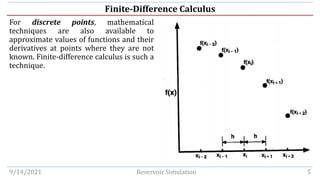
Finite-Difference Calculus
For discrete points, mathematical
techniques are also available to
approximate values of functions and their
derivatives at points where they are not
known. Finite-difference calculus is such a
technique.
9/14/2021 Reservoir Simulation 5
Finite-Difference Operators
The basis of finite-difference calculus is a group of operators that acts on discrete
points. An operator is a sequence of mathematical operations performed in a fixed
order that acts on any number of the discrete points and results in a final number. The
operators used in finite-difference calculus include:
• the forward-difference operator, Δ;
• the backward-difference operator, 𝛻;
• the central-difference operator, δ;
• the shift (translation) operator, E;
• and the average operator, A.
9/14/2021 Reservoir Simulation 6
Finite-Difference Operators
▪ Forward-Difference Operator
▪ Backward-Difference Operator
▪ Central-Difference Operator
▪ Shift (Translation) Operator
▪ Average Operator
9/14/2021 Reservoir Simulation 7
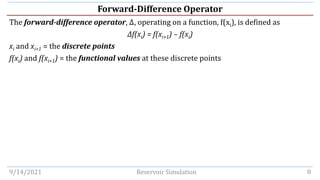
Forward-Difference Operator
The forward-difference operator, Δ, operating on a function, f(xi), is defined as
Δf(xi) = f(xi+1) – f(xi)
xi and xi+1 = the discrete points
f(xi) and f(xi+1) = the functional values at these discrete points
9/14/2021 Reservoir Simulation 8
Forward-Difference Operator
Similarly, the second-order forward-difference operator is defined as
Δ2f(xi) = Δ[Δf(xi)]
= Δ[f(xi+1) – f(xi)]
= Δf(xi+1) - Δf(xi)
= [f(xi+2) – f(xi+1)]- [f(xi+1) – f(xi)]
= f(xi+2) - 2f(xi+1) + f(xi)
9/14/2021 Reservoir Simulation 9
Example
With the series of values listed in Table
3.2. Note that the values in this table were
generated by the formulas f(xi) = sin(xi)
and g(xi) = cos(xi).
Calculate the Δf(xi), Δ2g(xi) and Δ[g(xi)f(xi)]
at x = π/4.
9/14/2021 Reservoir Simulation 10
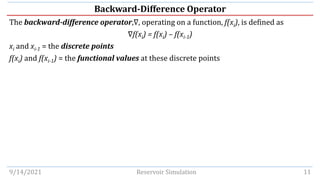
Backward-Difference Operator
The backward-difference operator,∇, operating on a function, f(xi), is defined as
∇f(xi) = f(xi) – f(xi-1)
xi and xi-1 = the discrete points
f(xi) and f(xi-1) = the functional values at these discrete points
9/14/2021 Reservoir Simulation 11
Backward-Difference Operator
Similarly, the second-order backward-difference operator is defined as
∇2f(xi) = ∇[∇f(xi)]
= ∇[f(xi) – f(xi-1)]
= ∇f(xi) - ∇f(xi-1)
= [f(xi) – f(xi-1)]- [f(xi-1) – f(xi-2)]
= f(xi) - 2f(xi-1) + f(xi-2)
9/14/2021 Reservoir Simulation 12
Example
With the series of values listed in Table
3.2. Note that the values in this table were
generated by the formulas f(xi) = sin(xi)
and g(xi) = cos(xi).
Calculate the ∇f(xi), ∇2g(xi) and ∇[g(xi)f(xi)]
at x = π/4.
9/14/2021 Reservoir Simulation 13
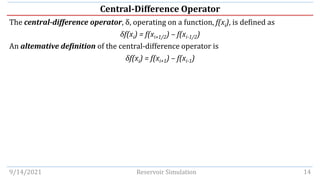
Central-Difference Operator
The central-difference operator, δ, operating on a function, f(xi), is defined as
δf(xi) = f(xi+1/2) – f(xi-1/2)
An altemative definition of the central-difference operator is
δf(xi) = f(xi+1) – f(xi-1)
9/14/2021 Reservoir Simulation 14
Central-Difference Operator
Similarly, the second-order central-difference operator is defined as
δ2f(xi) =δ[δf(xi)]
=δ[f(xi+1/2) – f(xi-1/2)]
= δf(xi+1/2) - δf(xi-1/2)
= [f(xi+1) – f(xi)]- [f(xi) – f(xi-1)]
= f(xi+1) - 2f(xi) + f(xi-1)
9/14/2021 Reservoir Simulation 15
Example
With the series of values listed in Table
3.2. Note that the values in this table were
generated by the formulas f(xi) = sin(xi)
and g(xi) = cos(xi).
Calculate the δf(xi), δ2g(xi) and δ[g(xi)f(xi)]
at x = π/4.
9/14/2021 Reservoir Simulation 16
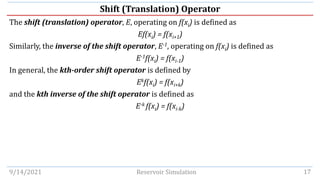
Shift (Translation) Operator
The shift (translation) operator, E, operating on f(xi) is defined as
Ef(xi) = f(xi+1)
Similarly, the inverse of the shift operator, E-1, operating on f(xi) is defined as
E-1f(xi) = f(xi-1)
In general, the kth-order shift operator is defined by
Ekf(xi) = f(xi+k)
and the kth inverse of the shift operator is defined as
E-k f(xi) = f(xi-k)
9/14/2021 Reservoir Simulation 17
Example
With the series of values listed in Table
3.2. Note that the values in this table were
generated by the formulas f(xi) = sin(xi)
and g(xi) = cos(xi).
Calculate the Ef(xi), E2g(xi) and E[g(xi)f(xi)]
at x = π/4.
9/14/2021 Reservoir Simulation 18
Average Operator
The average operator, A, operating on f(xi) is defined as
9/14/2021 Reservoir Simulation 19
1/2 1/2
( ) ( )
[ ( )]
2
i i
i
f x f x
A f x + −
+
=
Example
With the series of values listed in Table
3.2. Note that the values in this table were
generated by the formulas f(xi) = sin(xi)
and g(xi) = cos(xi).
Calculate the Af(xi), A2g(xi) and A[g(xi)f(xi)]
at x = π/4.
9/14/2021 Reservoir Simulation 20
Relationship Between Derivate and Finite-Difference Operators
▪ Taylor series expansion
▪ Finite-Difference Approximation
9/14/2021 Reservoir Simulation 21
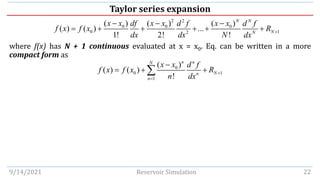
Taylor series expansion
where f(x) has N + 1 continuous evaluated at x = x0. Eq. can be written in a more
compact form as
9/14/2021 Reservoir Simulation 22
2 2
0 0 0
0 1
2
( ) ( ) ( )
( ) ( ) ...
1! 2! !
N N
N
N
x x x x x x
df d f d f
f x f x R
dx dx N dx
+
− − −
= + + + + +
0
0 1
1
( )
( ) ( )
!
n n
N
N
n
n
x x d f
f x f x R
n dx
+
=
−
= + +

Finite-Difference Approximation in 1D
• Forward-Difference Approximation
• Backward-Difference Approximation
• Central-Difference Approximation
• Approximation to the Second Derivative
9/14/2021 Reservoir Simulation 23
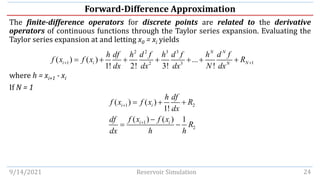
Forward-Difference Approximation
The finite-difference operators for discrete points are related to the derivative
operators of continuous functions through the Taylor series expansion. Evaluating the
Taylor series expansion at and letting x0 = xi yields
where h = xi+1 - xi
If N = 1
9/14/2021 Reservoir Simulation 24
2 2 3 3
1 1
2 3
( ) ( ) ...
1! 2! 3! !
N N
i i N
N
h df h d f h d f h d f
f x f x R
dx dx dx N dx
+ +
= + + + + + +
1 2
( ) ( )
1!
i i
h df
f x f x R
dx
+ = + +
1
2
( ) ( ) 1
i i
f x f x
df
R
dx h h
+ −
= −
Forward-Difference Approximation
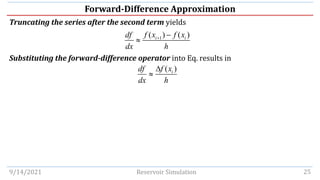
Truncating the series after the second term yields
Substituting the forward-difference operator into Eq. results in
9/14/2021 Reservoir Simulation 25
1
( ) ( )
i i
f x f x
df
dx h
+ −

( )
i
f x
df
dx h


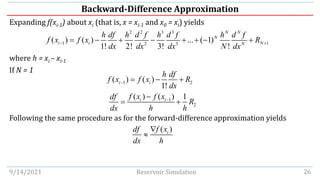
Backward-Difference Approximation
Expanding f(xi-1) about xi (that is, x = xi-1 and x0 = xi) yields
where h = xi – xi-1
If N = 1
Following the same procedure as for the forward-difference approximation yields
9/14/2021 Reservoir Simulation 26
2 2 3 3
1 1
2 3
( ) ( ) ... ( 1)
1! 2! 3! !
N N
N
i i N
N
h df h d f h d f h d f
f x f x R
dx dx dx N dx
− +
= − + − + + − +
1 2
( ) ( )
1!
i i
h df
f x f x R
dx
− = − +
1
2
( ) ( ) 1
i i
f x f x
df
R
dx h h
−
−
= +
( )
i
f x
df
dx h


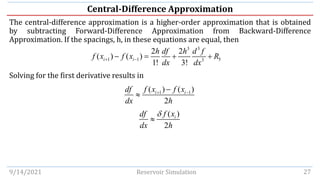
Central-Difference Approximation
The central-difference approximation is a higher-order approximation that is obtained
by subtracting Forward-Difference Approximation from Backward-Difference
Approximation. If the spacings, h, in these equations are equal, then
Solving for the first derivative results in
9/14/2021 Reservoir Simulation 27
3 3
1 1 5
3
2 2
( ) ( )
1! 3!
i i
h df h d f
f x f x R
dx dx
+ −
− = + +
1 1
( ) ( )
2
i i
f x f x
df
dx h
+ −
−

( )
2
i
f x
df
dx h


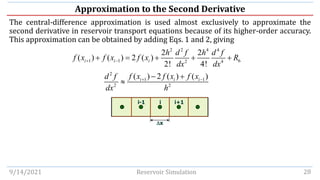
Approximation to the Second Derivative
The central-difference approximation is used almost exclusively to approximate the
second derivative in reservoir transport equations because of its higher-order accuracy.
This approximation can be obtained by adding Eqs. 1 and 2, giving
9/14/2021 Reservoir Simulation 28
2 2 4 4
1 1 6
2 4
2 2
( ) ( ) 2 ( )
2! 4!
i i i
h d f h d f
f x f x f x R
dx dx
+ −
+ = + + +
2
1 1
2 2
( ) 2 ( ) ( )
i i i
f x f x f x
d f
dx h
+ −
− +

i-1 i i+1
x
Finite-Difference Approximation in 2D
• Forward-Difference Approximation
• Backward-Difference Approximation
• Central-Difference Approximation
9/14/2021 Reservoir Simulation 29
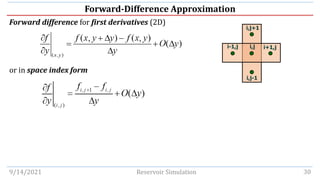
Forward-Difference Approximation
Forward difference for first derivatives (2D)
or in space index form
9/14/2021 Reservoir Simulation 30
i-1,j i,j i+1,j
i,j+1
i,j-1
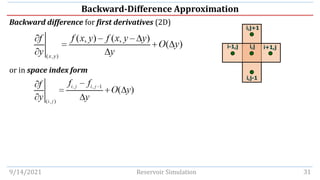
Backward-Difference Approximation
Backward difference for first derivatives (2D)
or in space index form
9/14/2021 Reservoir Simulation 31
i-1,j i,j i+1,j
i,j+1
i,j-1
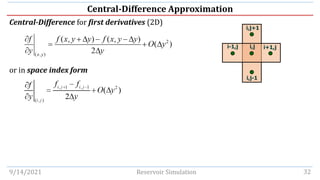
Central-Difference Approximation
Central-Difference for first derivatives (2D)
or in space index form
9/14/2021 Reservoir Simulation 32
i-1,j i,j i+1,j
i,j+1
i,j-1
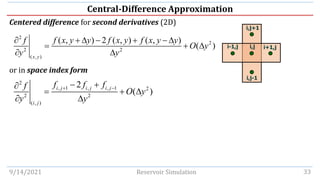
Central-Difference Approximation
Centered difference for second derivatives (2D)
or in space index form
9/14/2021 Reservoir Simulation 33
i-1,j i,j i+1,j
i,j+1
i,j-1
2
2
2 2
( , )
( , ) 2 ( , ) ( , )
( )
x y
f f x y y f x y f x y y
O y
y y
 +  − + − 
= + 
 
2
, 1 , , 1 2
2 2
( , )
2
( )
i j i j i j
i j
f f f
f
O y
y y
+ −
− +

= + 
 
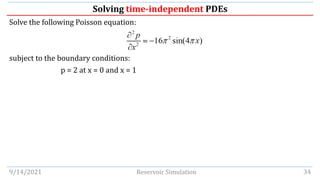
Solving time-independent PDEs
Solve the following Poisson equation:
subject to the boundary conditions:
p = 2 at x = 0 and x = 1
9/14/2021 Reservoir Simulation 34
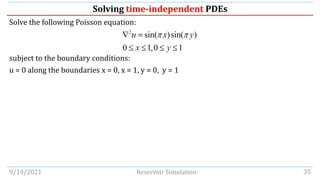
Solving time-independent PDEs
Solve the following Poisson equation:
subject to the boundary conditions:
u = 0 along the boundaries x = 0, x = 1, y = 0, y = 1
9/14/2021 Reservoir Simulation 35

Chapter 3 finite difference calculus (temporarily)

  • 1.
    Vietnam National University- Ho Chi Minh City University of Technology Faculty of Geology & Petroleum Engineering Department of Drilling - Production Engineering Course Reservoir Simulation Trần Nguyễn Thiện Tâm trantam2512@hcmut.edu.vn
  • 2.
  • 3.
    References Turgay Ertekin, JamalH. Abou-Kassem, Gregory R. King. Basic Applied Reservoir Simulation. Society of Petroleum Engineers, 2001. 9/14/2021 Reservoir Simulation 3
  • 4.
    Contents ❑ Finite-Difference Operators ❑Relationship Between Derivate and Finite-Difference Operators 9/14/2021 Reservoir Simulation 4
  • 5.
    Finite-Difference Calculus For discretepoints, mathematical techniques are also available to approximate values of functions and their derivatives at points where they are not known. Finite-difference calculus is such a technique. 9/14/2021 Reservoir Simulation 5
  • 6.
    Finite-Difference Operators The basisof finite-difference calculus is a group of operators that acts on discrete points. An operator is a sequence of mathematical operations performed in a fixed order that acts on any number of the discrete points and results in a final number. The operators used in finite-difference calculus include: • the forward-difference operator, Δ; • the backward-difference operator, 𝛻; • the central-difference operator, δ; • the shift (translation) operator, E; • and the average operator, A. 9/14/2021 Reservoir Simulation 6
  • 7.
    Finite-Difference Operators ▪ Forward-DifferenceOperator ▪ Backward-Difference Operator ▪ Central-Difference Operator ▪ Shift (Translation) Operator ▪ Average Operator 9/14/2021 Reservoir Simulation 7
  • 8.
    Forward-Difference Operator The forward-differenceoperator, Δ, operating on a function, f(xi), is defined as Δf(xi) = f(xi+1) – f(xi) xi and xi+1 = the discrete points f(xi) and f(xi+1) = the functional values at these discrete points 9/14/2021 Reservoir Simulation 8
  • 9.
    Forward-Difference Operator Similarly, thesecond-order forward-difference operator is defined as Δ2f(xi) = Δ[Δf(xi)] = Δ[f(xi+1) – f(xi)] = Δf(xi+1) - Δf(xi) = [f(xi+2) – f(xi+1)]- [f(xi+1) – f(xi)] = f(xi+2) - 2f(xi+1) + f(xi) 9/14/2021 Reservoir Simulation 9
  • 10.
    Example With the seriesof values listed in Table 3.2. Note that the values in this table were generated by the formulas f(xi) = sin(xi) and g(xi) = cos(xi). Calculate the Δf(xi), Δ2g(xi) and Δ[g(xi)f(xi)] at x = π/4. 9/14/2021 Reservoir Simulation 10
  • 11.
    Backward-Difference Operator The backward-differenceoperator,∇, operating on a function, f(xi), is defined as ∇f(xi) = f(xi) – f(xi-1) xi and xi-1 = the discrete points f(xi) and f(xi-1) = the functional values at these discrete points 9/14/2021 Reservoir Simulation 11
  • 12.
    Backward-Difference Operator Similarly, thesecond-order backward-difference operator is defined as ∇2f(xi) = ∇[∇f(xi)] = ∇[f(xi) – f(xi-1)] = ∇f(xi) - ∇f(xi-1) = [f(xi) – f(xi-1)]- [f(xi-1) – f(xi-2)] = f(xi) - 2f(xi-1) + f(xi-2) 9/14/2021 Reservoir Simulation 12
  • 13.
    Example With the seriesof values listed in Table 3.2. Note that the values in this table were generated by the formulas f(xi) = sin(xi) and g(xi) = cos(xi). Calculate the ∇f(xi), ∇2g(xi) and ∇[g(xi)f(xi)] at x = π/4. 9/14/2021 Reservoir Simulation 13
  • 14.
    Central-Difference Operator The central-differenceoperator, δ, operating on a function, f(xi), is defined as δf(xi) = f(xi+1/2) – f(xi-1/2) An altemative definition of the central-difference operator is δf(xi) = f(xi+1) – f(xi-1) 9/14/2021 Reservoir Simulation 14
  • 15.
    Central-Difference Operator Similarly, thesecond-order central-difference operator is defined as δ2f(xi) =δ[δf(xi)] =δ[f(xi+1/2) – f(xi-1/2)] = δf(xi+1/2) - δf(xi-1/2) = [f(xi+1) – f(xi)]- [f(xi) – f(xi-1)] = f(xi+1) - 2f(xi) + f(xi-1) 9/14/2021 Reservoir Simulation 15
  • 16.
    Example With the seriesof values listed in Table 3.2. Note that the values in this table were generated by the formulas f(xi) = sin(xi) and g(xi) = cos(xi). Calculate the δf(xi), δ2g(xi) and δ[g(xi)f(xi)] at x = π/4. 9/14/2021 Reservoir Simulation 16
  • 17.
    Shift (Translation) Operator Theshift (translation) operator, E, operating on f(xi) is defined as Ef(xi) = f(xi+1) Similarly, the inverse of the shift operator, E-1, operating on f(xi) is defined as E-1f(xi) = f(xi-1) In general, the kth-order shift operator is defined by Ekf(xi) = f(xi+k) and the kth inverse of the shift operator is defined as E-k f(xi) = f(xi-k) 9/14/2021 Reservoir Simulation 17
  • 18.
    Example With the seriesof values listed in Table 3.2. Note that the values in this table were generated by the formulas f(xi) = sin(xi) and g(xi) = cos(xi). Calculate the Ef(xi), E2g(xi) and E[g(xi)f(xi)] at x = π/4. 9/14/2021 Reservoir Simulation 18
  • 19.
    Average Operator The averageoperator, A, operating on f(xi) is defined as 9/14/2021 Reservoir Simulation 19 1/2 1/2 ( ) ( ) [ ( )] 2 i i i f x f x A f x + − + =
  • 20.
    Example With the seriesof values listed in Table 3.2. Note that the values in this table were generated by the formulas f(xi) = sin(xi) and g(xi) = cos(xi). Calculate the Af(xi), A2g(xi) and A[g(xi)f(xi)] at x = π/4. 9/14/2021 Reservoir Simulation 20
  • 21.
    Relationship Between Derivateand Finite-Difference Operators ▪ Taylor series expansion ▪ Finite-Difference Approximation 9/14/2021 Reservoir Simulation 21
  • 22.
    Taylor series expansion wheref(x) has N + 1 continuous evaluated at x = x0. Eq. can be written in a more compact form as 9/14/2021 Reservoir Simulation 22 2 2 0 0 0 0 1 2 ( ) ( ) ( ) ( ) ( ) ... 1! 2! ! N N N N x x x x x x df d f d f f x f x R dx dx N dx + − − − = + + + + + 0 0 1 1 ( ) ( ) ( ) ! n n N N n n x x d f f x f x R n dx + = − = + + 
  • 23.
    Finite-Difference Approximation in1D • Forward-Difference Approximation • Backward-Difference Approximation • Central-Difference Approximation • Approximation to the Second Derivative 9/14/2021 Reservoir Simulation 23
  • 24.
    Forward-Difference Approximation The finite-differenceoperators for discrete points are related to the derivative operators of continuous functions through the Taylor series expansion. Evaluating the Taylor series expansion at and letting x0 = xi yields where h = xi+1 - xi If N = 1 9/14/2021 Reservoir Simulation 24 2 2 3 3 1 1 2 3 ( ) ( ) ... 1! 2! 3! ! N N i i N N h df h d f h d f h d f f x f x R dx dx dx N dx + + = + + + + + + 1 2 ( ) ( ) 1! i i h df f x f x R dx + = + + 1 2 ( ) ( ) 1 i i f x f x df R dx h h + − = −
  • 25.
    Forward-Difference Approximation Truncating theseries after the second term yields Substituting the forward-difference operator into Eq. results in 9/14/2021 Reservoir Simulation 25 1 ( ) ( ) i i f x f x df dx h + −  ( ) i f x df dx h  
  • 26.
    Backward-Difference Approximation Expanding f(xi-1)about xi (that is, x = xi-1 and x0 = xi) yields where h = xi – xi-1 If N = 1 Following the same procedure as for the forward-difference approximation yields 9/14/2021 Reservoir Simulation 26 2 2 3 3 1 1 2 3 ( ) ( ) ... ( 1) 1! 2! 3! ! N N N i i N N h df h d f h d f h d f f x f x R dx dx dx N dx − + = − + − + + − + 1 2 ( ) ( ) 1! i i h df f x f x R dx − = − + 1 2 ( ) ( ) 1 i i f x f x df R dx h h − − = + ( ) i f x df dx h  
  • 27.
    Central-Difference Approximation The central-differenceapproximation is a higher-order approximation that is obtained by subtracting Forward-Difference Approximation from Backward-Difference Approximation. If the spacings, h, in these equations are equal, then Solving for the first derivative results in 9/14/2021 Reservoir Simulation 27 3 3 1 1 5 3 2 2 ( ) ( ) 1! 3! i i h df h d f f x f x R dx dx + − − = + + 1 1 ( ) ( ) 2 i i f x f x df dx h + − −  ( ) 2 i f x df dx h  
  • 28.
    Approximation to theSecond Derivative The central-difference approximation is used almost exclusively to approximate the second derivative in reservoir transport equations because of its higher-order accuracy. This approximation can be obtained by adding Eqs. 1 and 2, giving 9/14/2021 Reservoir Simulation 28 2 2 4 4 1 1 6 2 4 2 2 ( ) ( ) 2 ( ) 2! 4! i i i h d f h d f f x f x f x R dx dx + − + = + + + 2 1 1 2 2 ( ) 2 ( ) ( ) i i i f x f x f x d f dx h + − − +  i-1 i i+1 x
  • 29.
    Finite-Difference Approximation in2D • Forward-Difference Approximation • Backward-Difference Approximation • Central-Difference Approximation 9/14/2021 Reservoir Simulation 29
  • 30.
    Forward-Difference Approximation Forward differencefor first derivatives (2D) or in space index form 9/14/2021 Reservoir Simulation 30 i-1,j i,j i+1,j i,j+1 i,j-1
  • 31.
    Backward-Difference Approximation Backward differencefor first derivatives (2D) or in space index form 9/14/2021 Reservoir Simulation 31 i-1,j i,j i+1,j i,j+1 i,j-1
  • 32.
    Central-Difference Approximation Central-Difference forfirst derivatives (2D) or in space index form 9/14/2021 Reservoir Simulation 32 i-1,j i,j i+1,j i,j+1 i,j-1
  • 33.
    Central-Difference Approximation Centered differencefor second derivatives (2D) or in space index form 9/14/2021 Reservoir Simulation 33 i-1,j i,j i+1,j i,j+1 i,j-1 2 2 2 2 ( , ) ( , ) 2 ( , ) ( , ) ( ) x y f f x y y f x y f x y y O y y y  +  − + −  = +    2 , 1 , , 1 2 2 2 ( , ) 2 ( ) i j i j i j i j f f f f O y y y + − − +  = +   
  • 34.
    Solving time-independent PDEs Solvethe following Poisson equation: subject to the boundary conditions: p = 2 at x = 0 and x = 1 9/14/2021 Reservoir Simulation 34
  • 35.
    Solving time-independent PDEs Solvethe following Poisson equation: subject to the boundary conditions: u = 0 along the boundaries x = 0, x = 1, y = 0, y = 1 9/14/2021 Reservoir Simulation 35