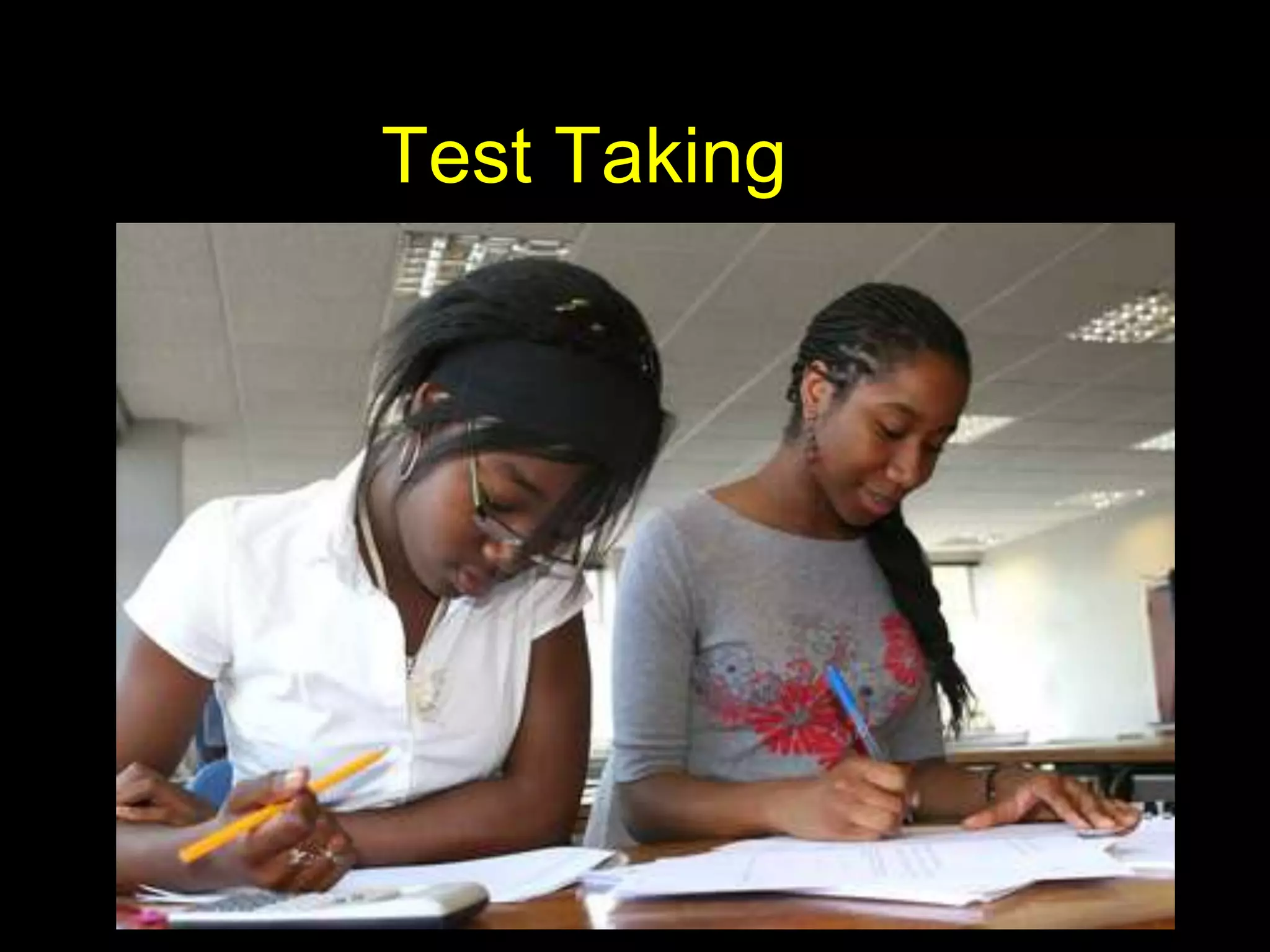
Test Taking
Strategies for Test Preparation
What doesn’t work in
preparing for tests?
 What has not worked well in the past?
 Think about it.
 Share your ideas with the person next
to you.
 Share with the class some of these
ideas.
Preparation for exams begins
the first day of class.
Preparation for exams begins
the first day of class.
 Attend class
 Read the chapters. Use SQ4R.
 Take notes and review them
 Review periodically.
Manage Your Time
 Schedule reading and review time.
 Break it into small parts.
 Use distributed practice.
 Get started. Avoid procrastination.
Find a Time and Place
to Study
Test Review Tools
Summary Sheets
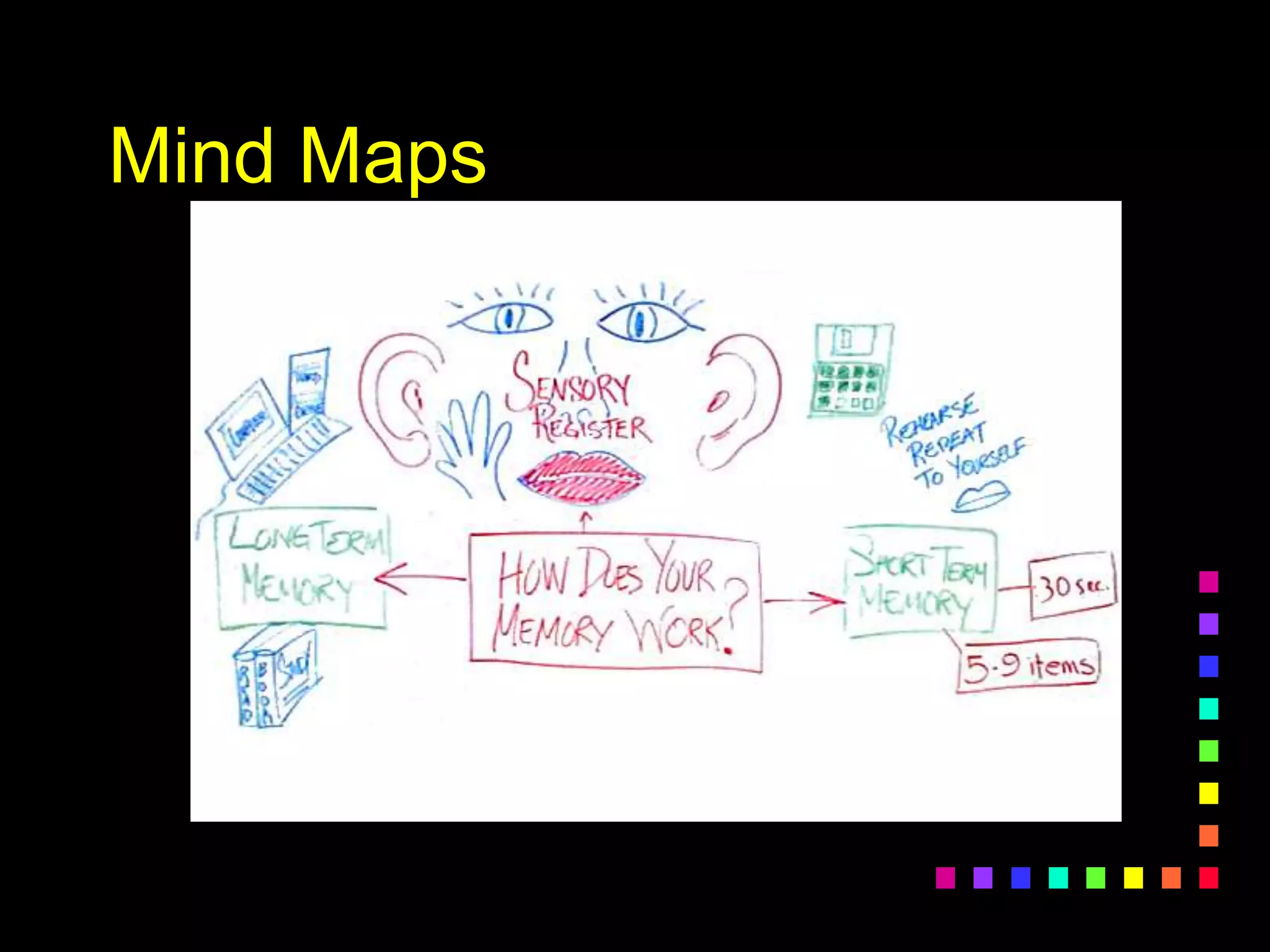
Mind Maps
Study Groups
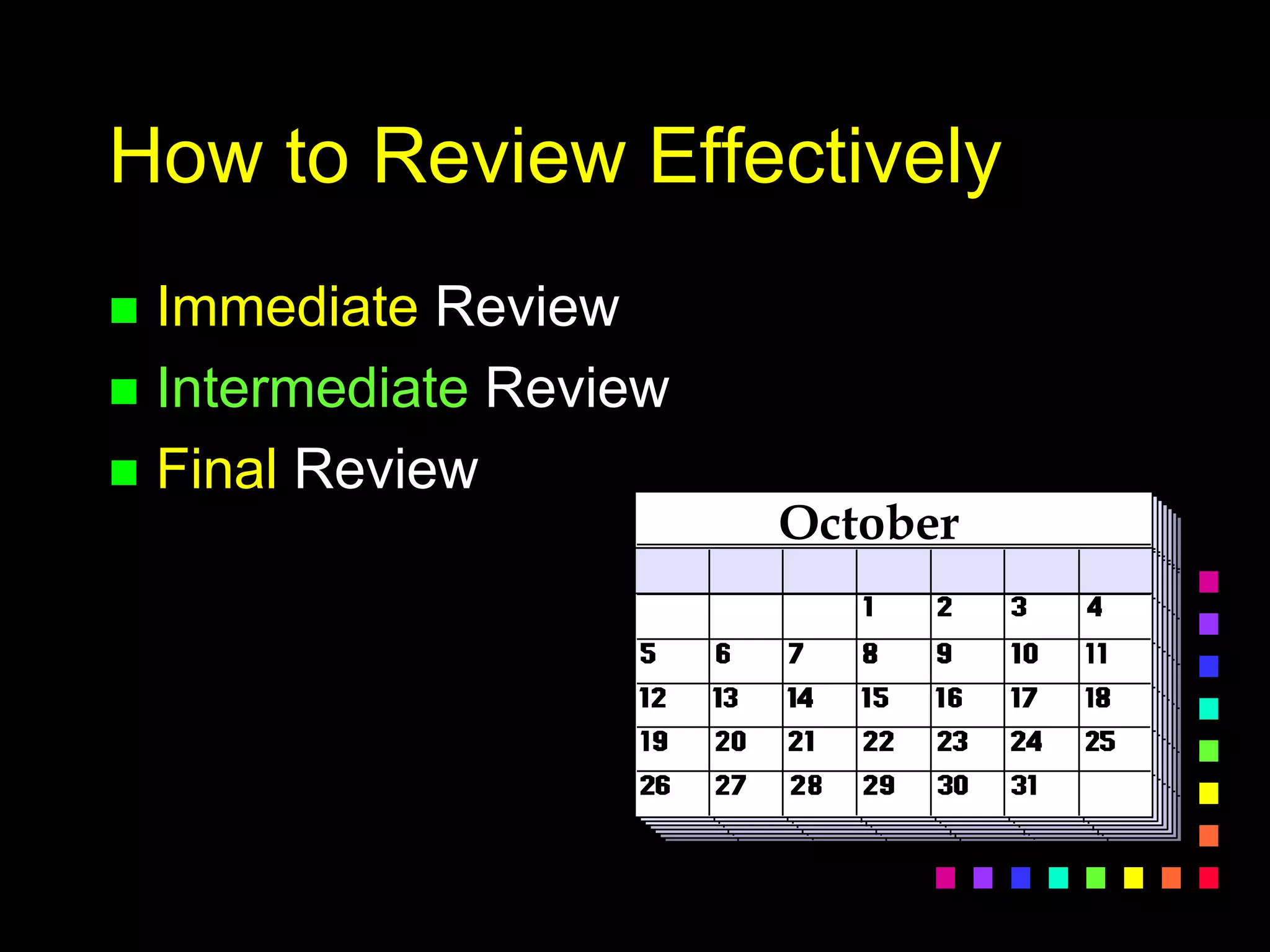
How to Review Effectively
 Immediate Review
 Intermediate Review
 Final Review
October
How to Predict the Test
Questions
Ask About the Test
 What does it cover?
 What types of questions?
 True-false
 Multiple choice
 Essay
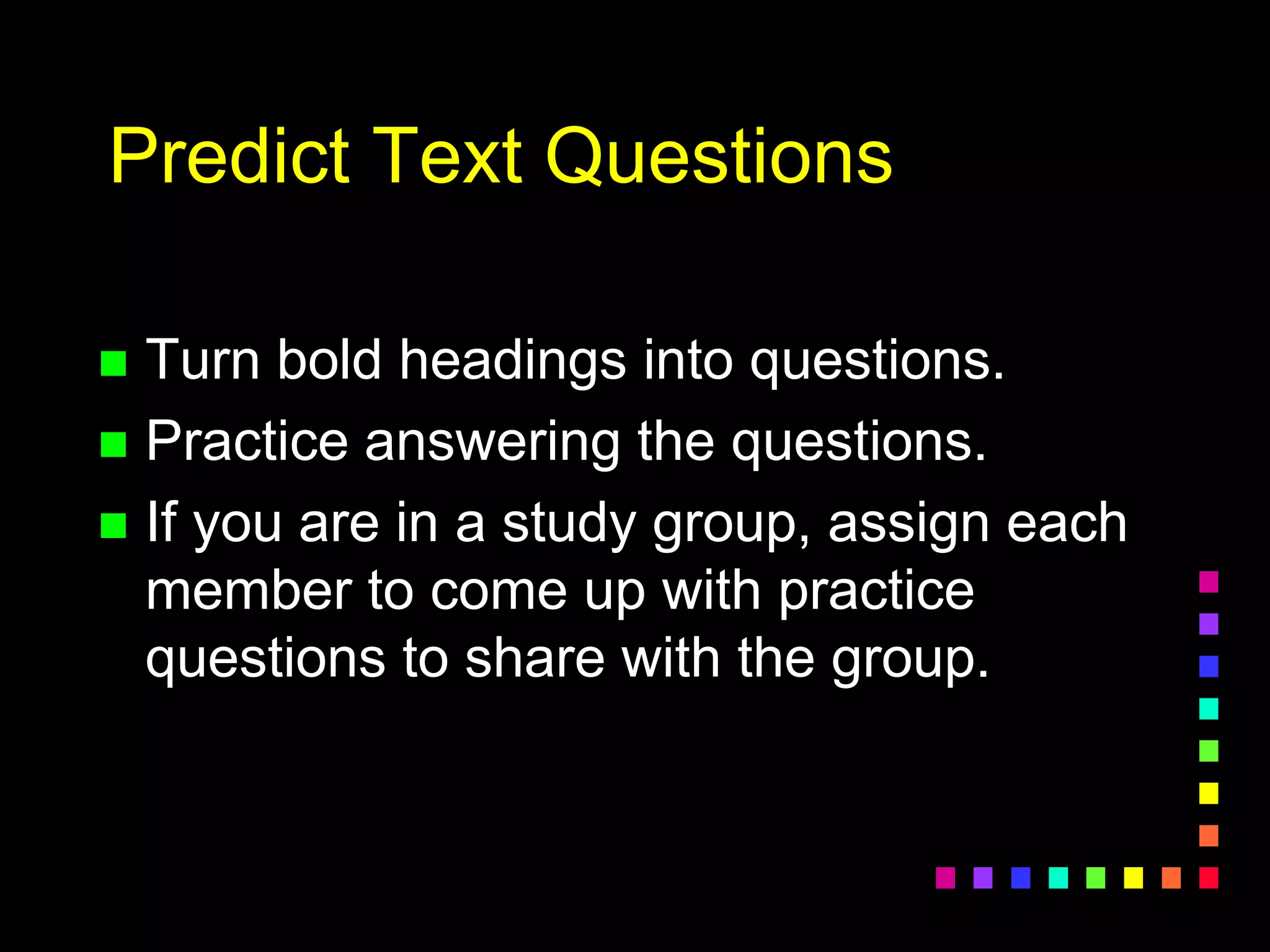
Predict Text Questions
 Turn bold headings into questions.
 Practice answering the questions.
 If you are in a study group, assign each
member to come up with practice
questions to share with the group.
Use the first test as a guide on
what to study on the next test.
Avoid Cramming!
Disadvantages of Cramming
 Test anxiety
 Poor use of mental ability
 Performance suffers
 You learn to dislike education
 It is not fun
Emergency Procedures
Cramming
 Be selective
 Review and recite lecture notes first
 Skim and search each chapter
 Prepare summary sheets with key
points
 Get enough rest
 Hope for the best
 Prepare in advance next time!
The Magical Seven
Emergency Procedure
 Start with 7 sheets of paper
 Write a key concept likely to be on the
test at the top of each sheet
 Check your notes and text to write a
definition, explanation or answer for
each key topic
 Review and recite from the 7 sheets.
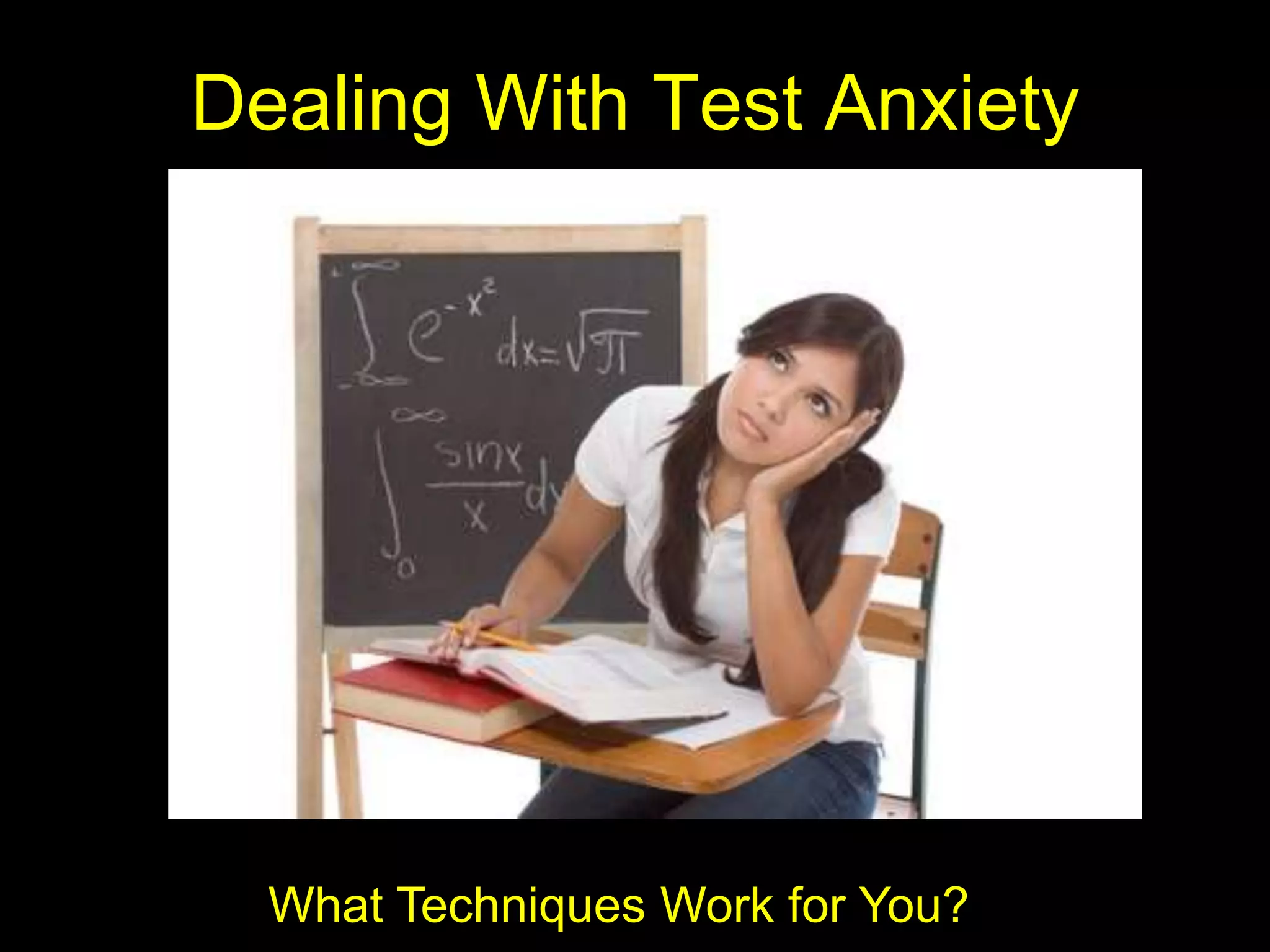
Dealing With Test Anxiety
What Techniques Work for You?
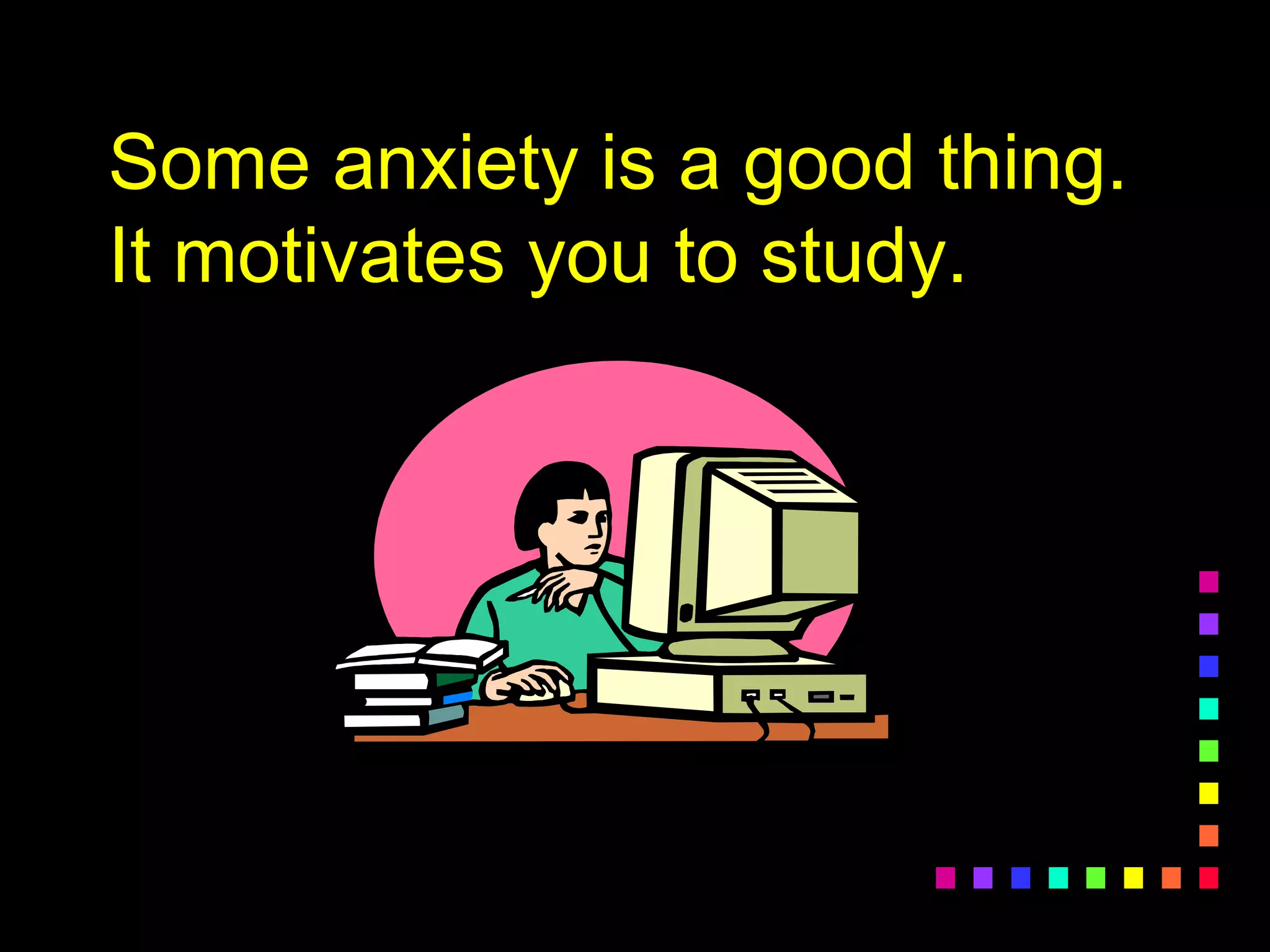
Some anxiety is a good thing.
It motivates you to study.
Grades just indicate how much or
how well you studied for the test.
 Be Successful by:
 Practicing relaxation techniques
 Being well-prepared
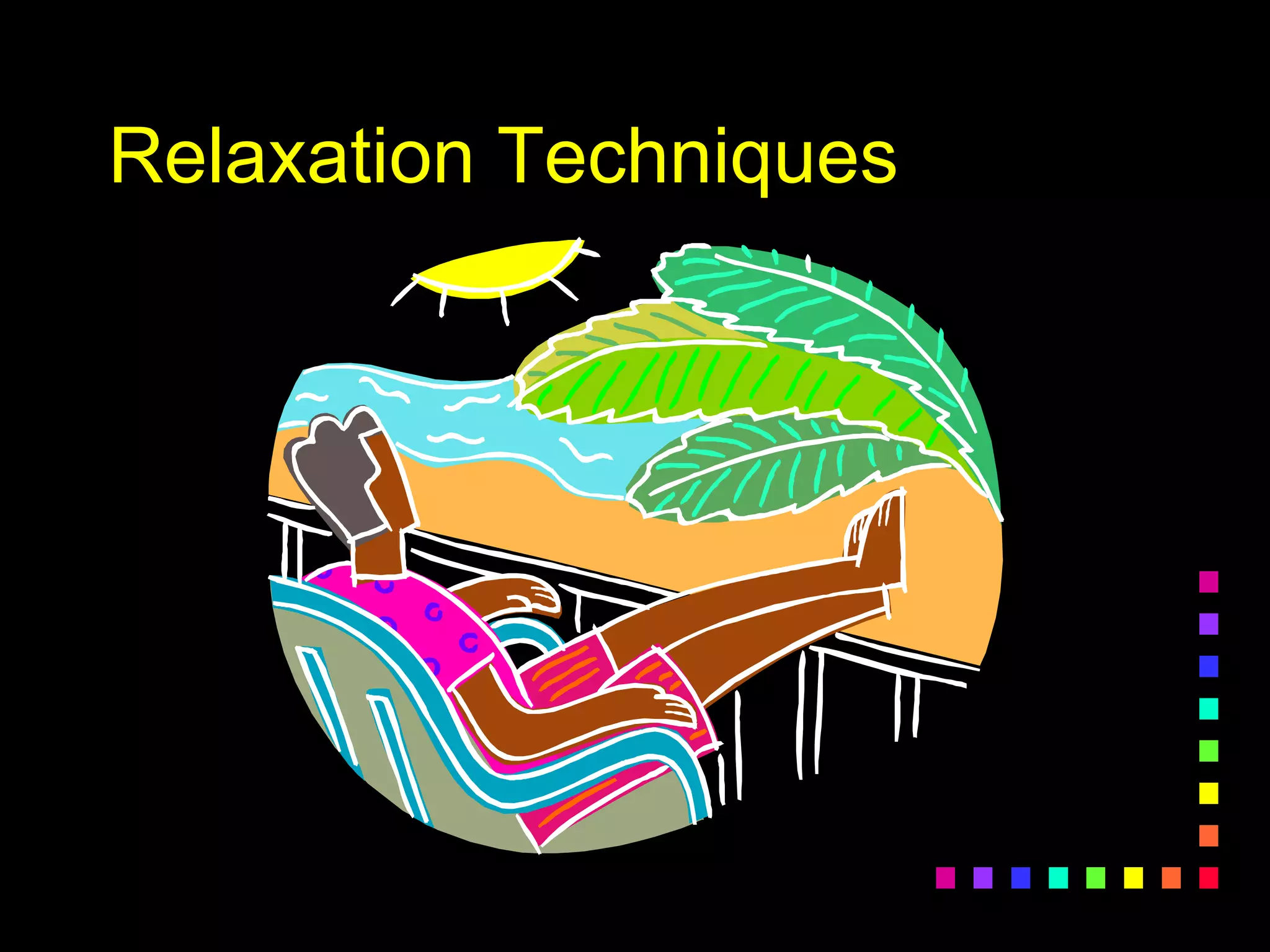
Relaxation Techniques
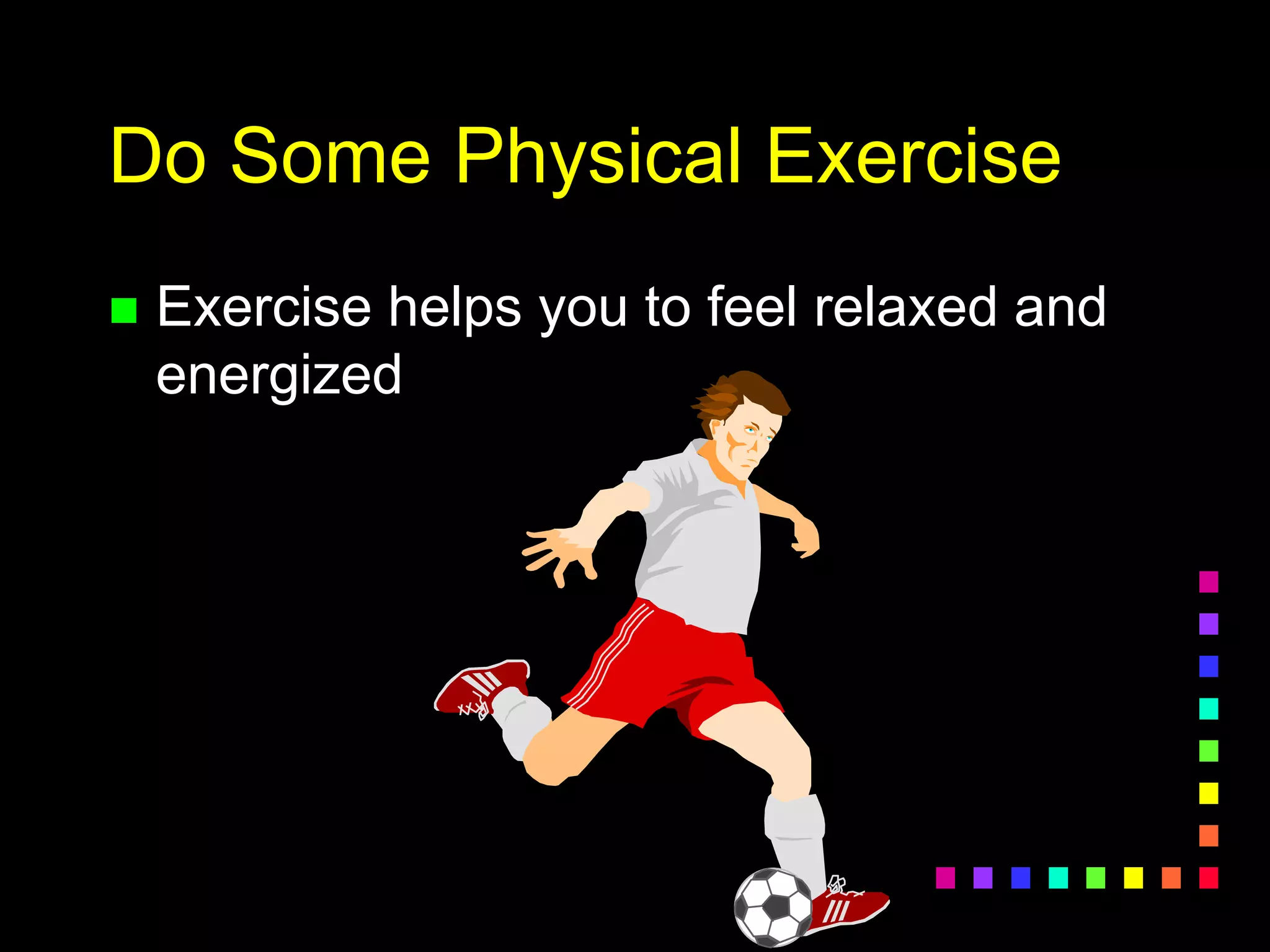
Do Some Physical Exercise
 Exercise helps you to feel relaxed and
energized
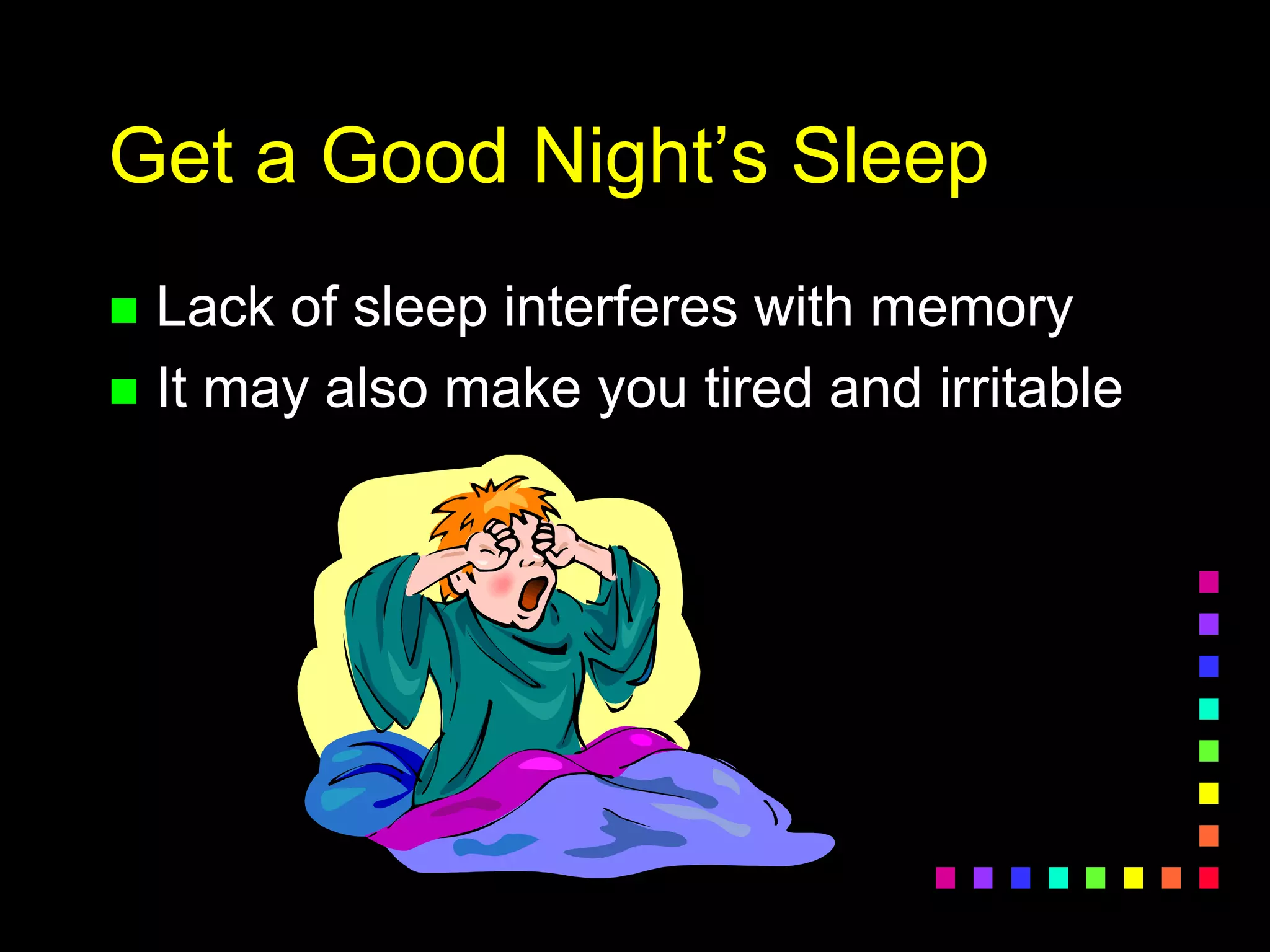
Get a Good Night’s Sleep
 Lack of sleep interferes with memory
 It may also make you tired and irritable
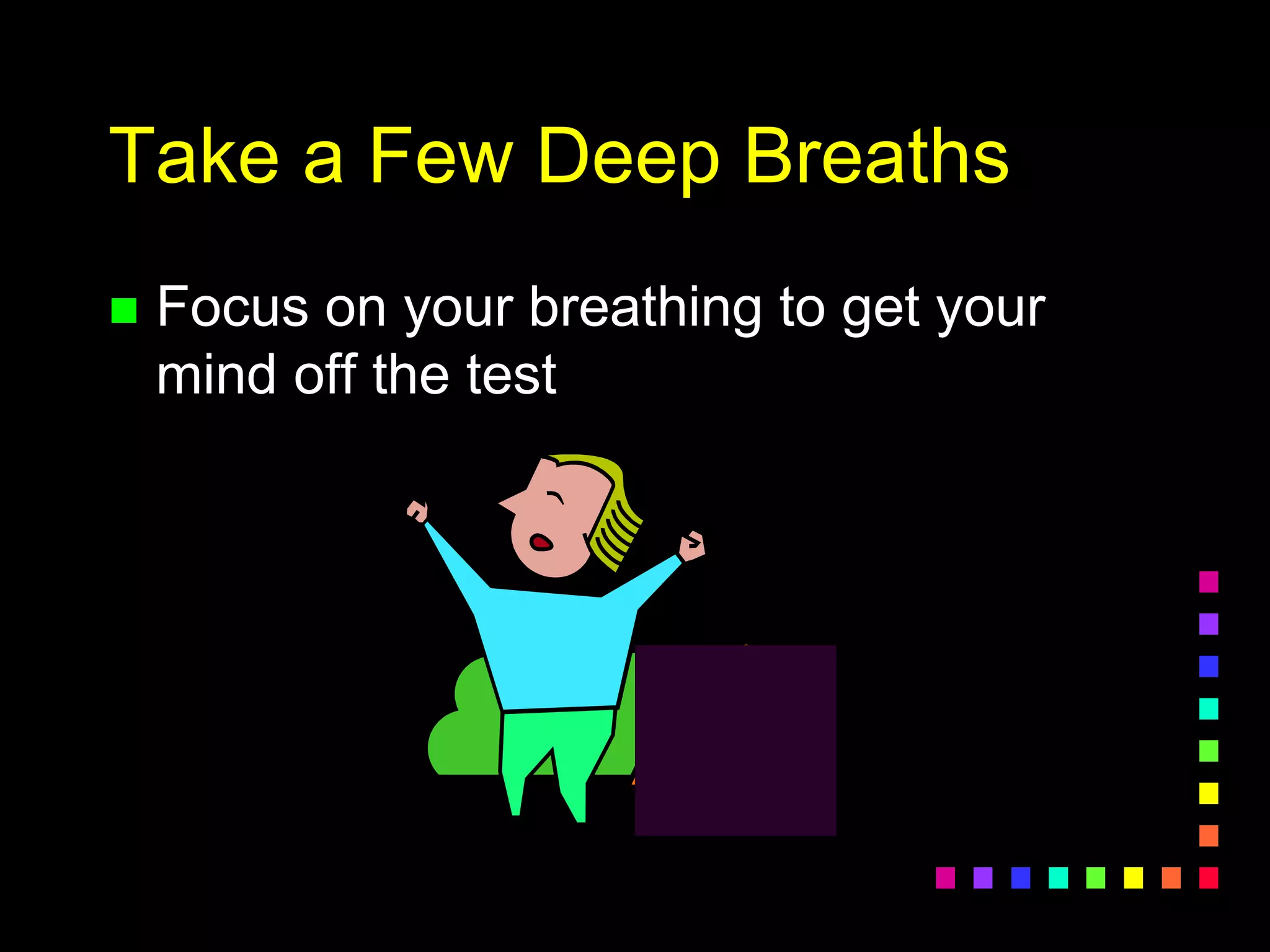
Take a Few Deep Breaths
 Focus on your breathing to get your
mind off the test
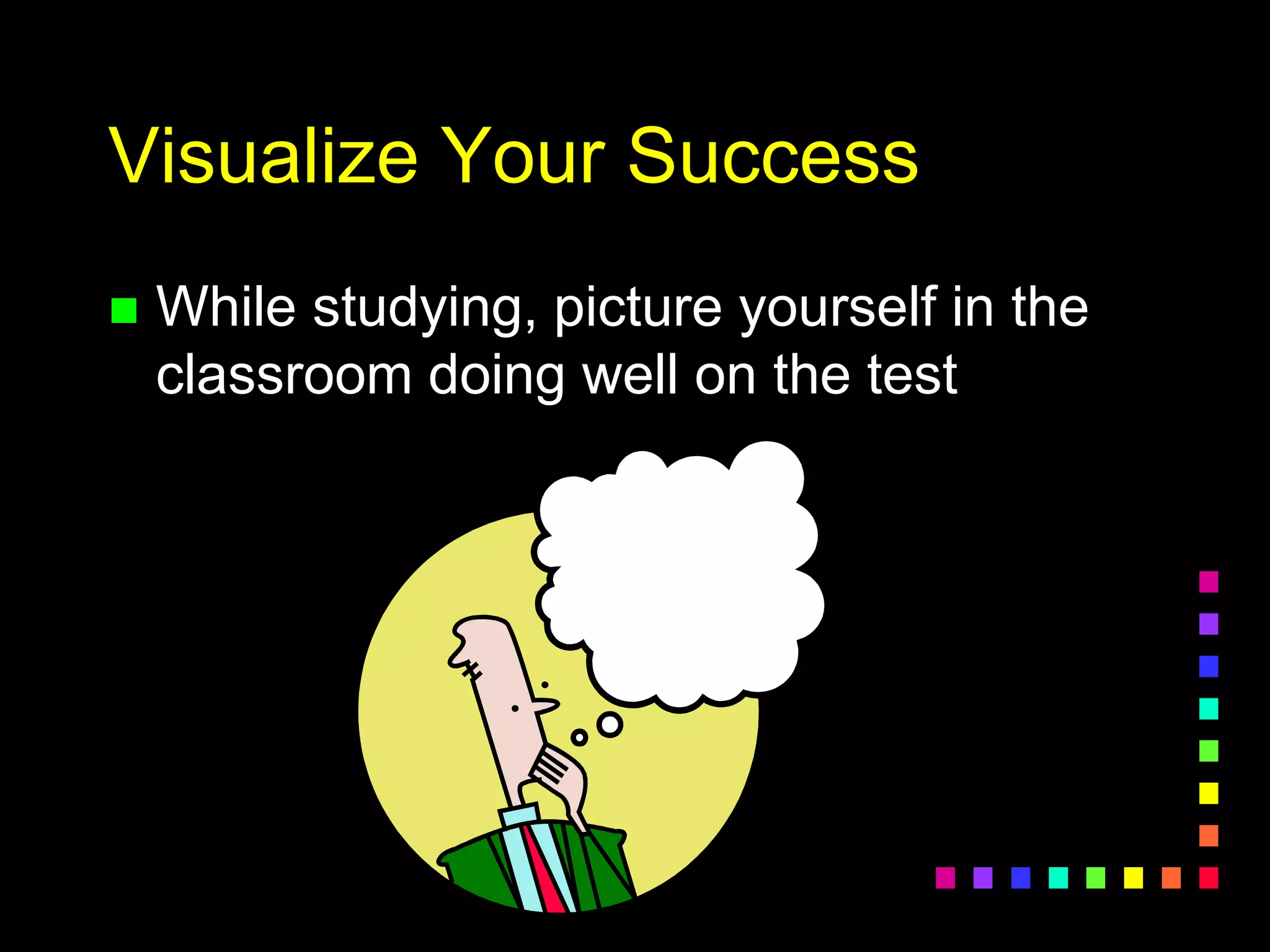
Visualize Your Success
 While studying, picture yourself in the
classroom doing well on the test
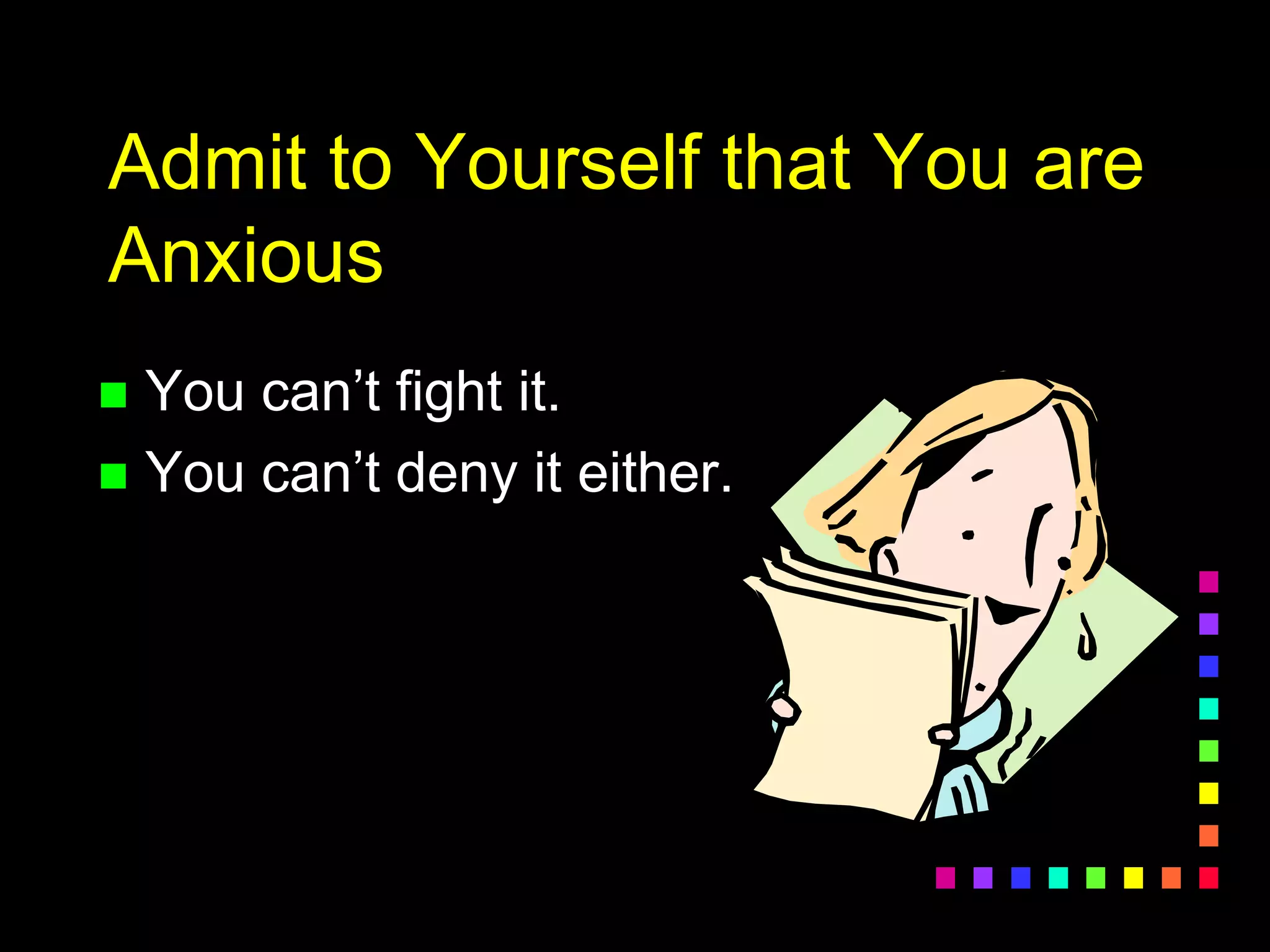
Admit to Yourself that You are
Anxious
 You can’t fight it.
 You can’t deny it either.
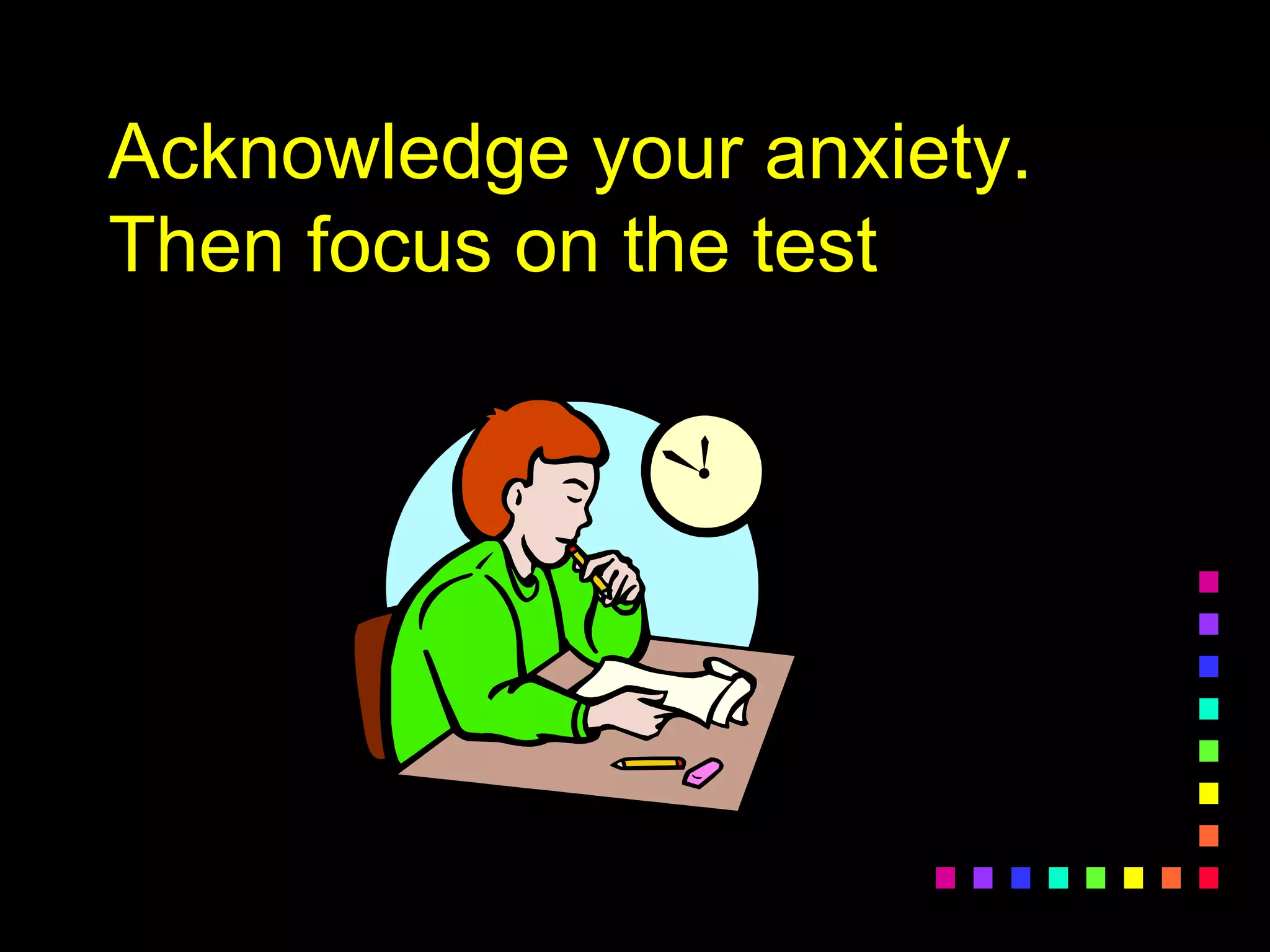
Acknowledge your anxiety.
Then focus on the test
Do the Easy Questions First
 This will help you relax
 When you are relaxed, your brain works
better.
 You may find the answers on the test or
something that triggers your memory so
that you can answer the question.
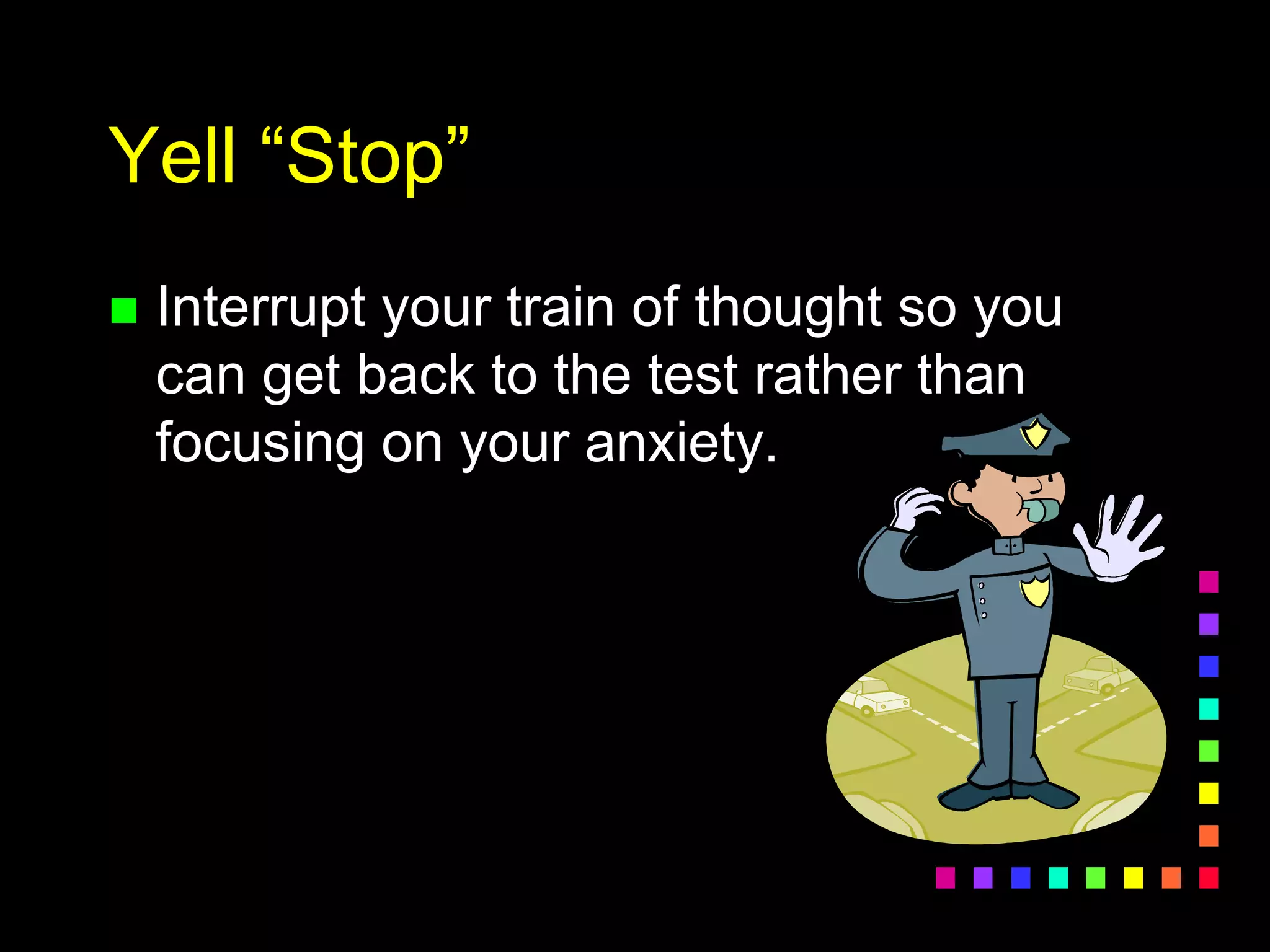
Yell “Stop”
 Interrupt your train of thought so you
can get back to the test rather than
focusing on your anxiety.
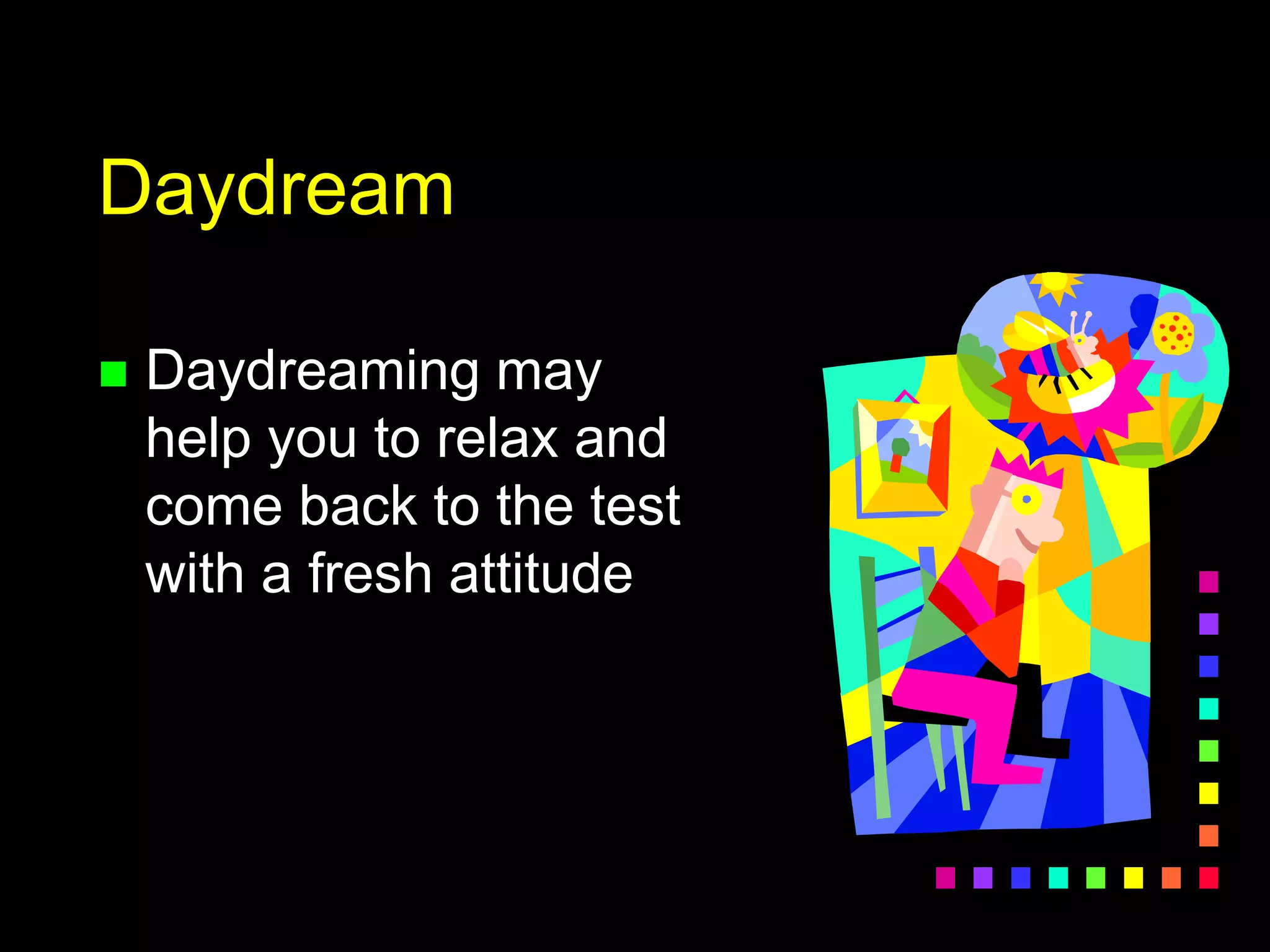
Daydream
 Daydreaming may
help you to relax and
come back to the test
with a fresh attitude
Practice Perspective
 It is just a grade.
 It is not the end of the world.
 It does not define who you are.
 Think about how you can improve your
performance next time.
Think Positively
 You may have a picture of failure in
your mind as a result of past
experience.
 Notice your mental pictures about math.
 Make a new mental picture of success if
necessary.
 The future can be different.
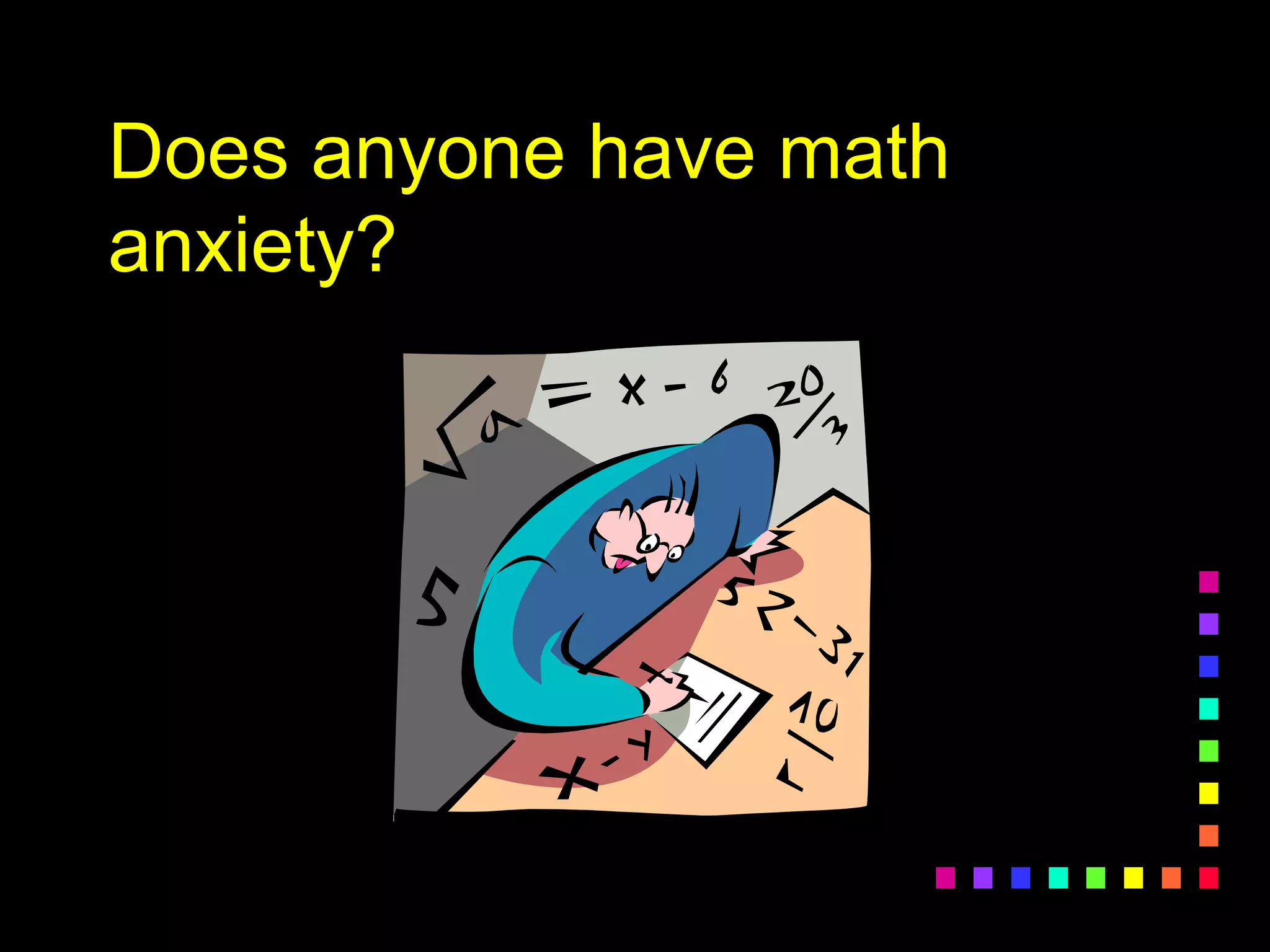
Does anyone have math
anxiety?
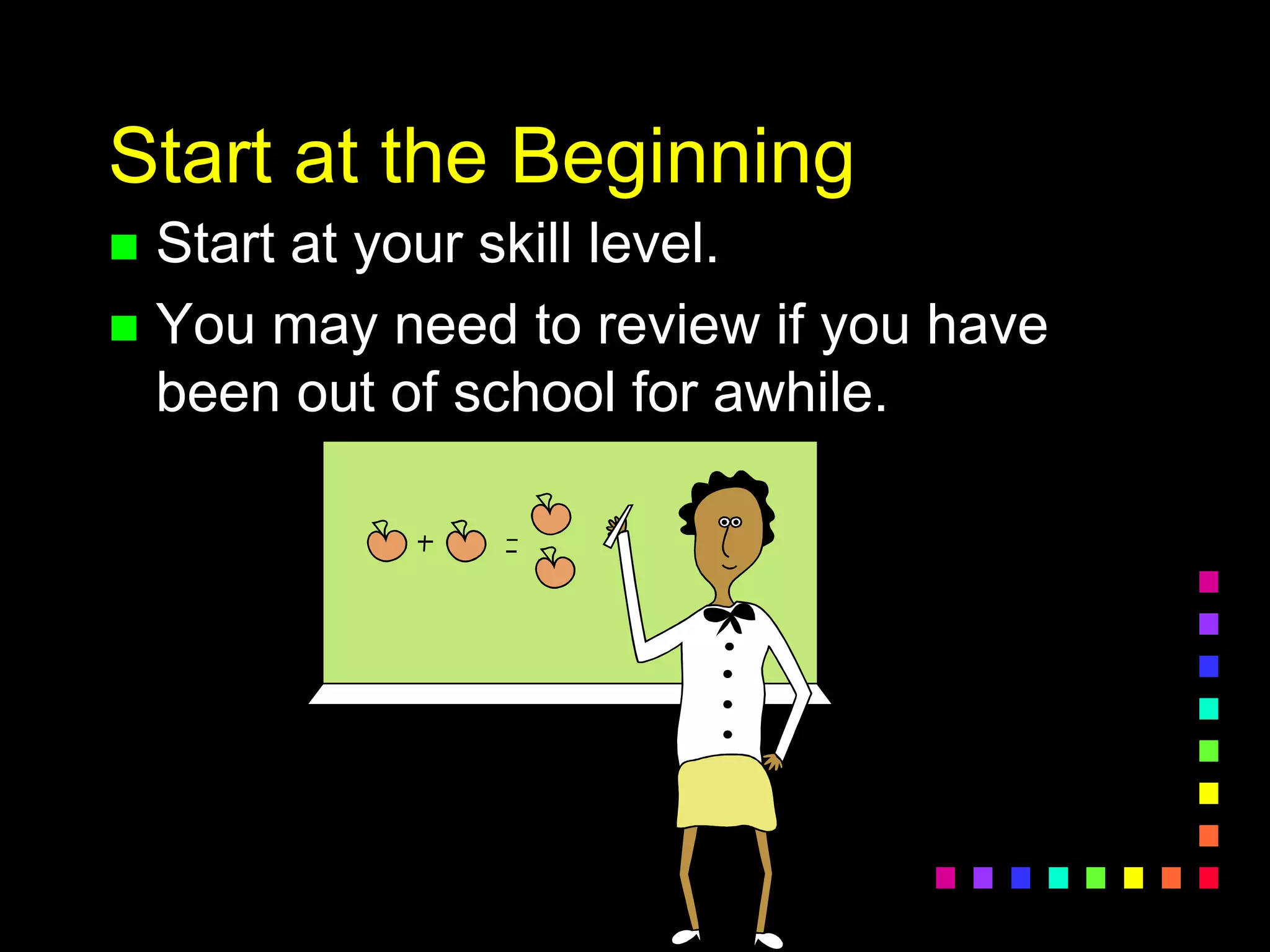
Start at the Beginning
 Start at your skill level.
 You may need to review if you have
been out of school for awhile.
Don’t Delay Taking Math
 You need math to graduate.
 You need math to transfer.
 You may need several math courses.
 Many good paying jobs require math.
Think Positively About Your
Ability to Succeed in Math
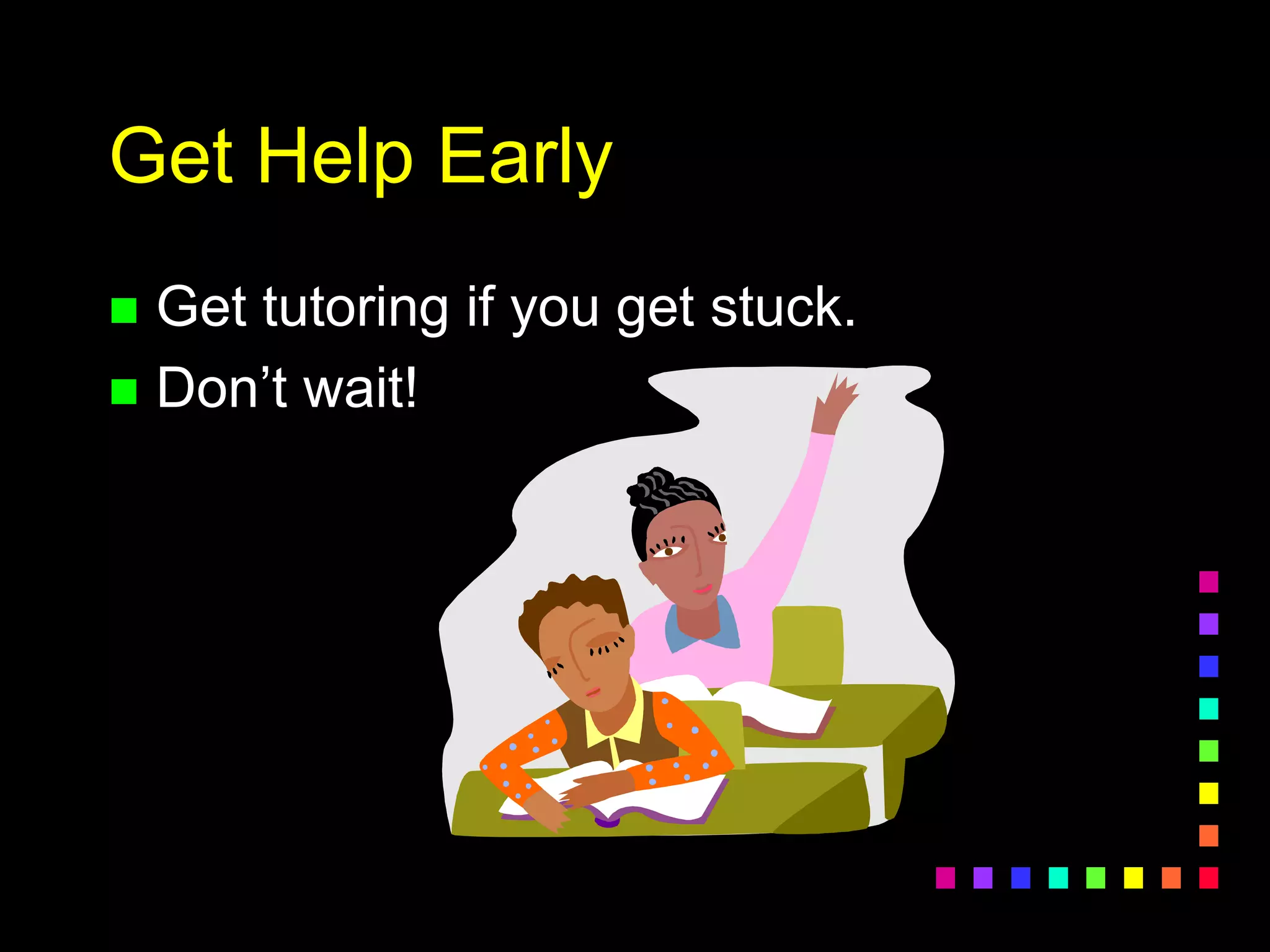
Get Help Early
 Get tutoring if you get stuck.
 Don’t wait!
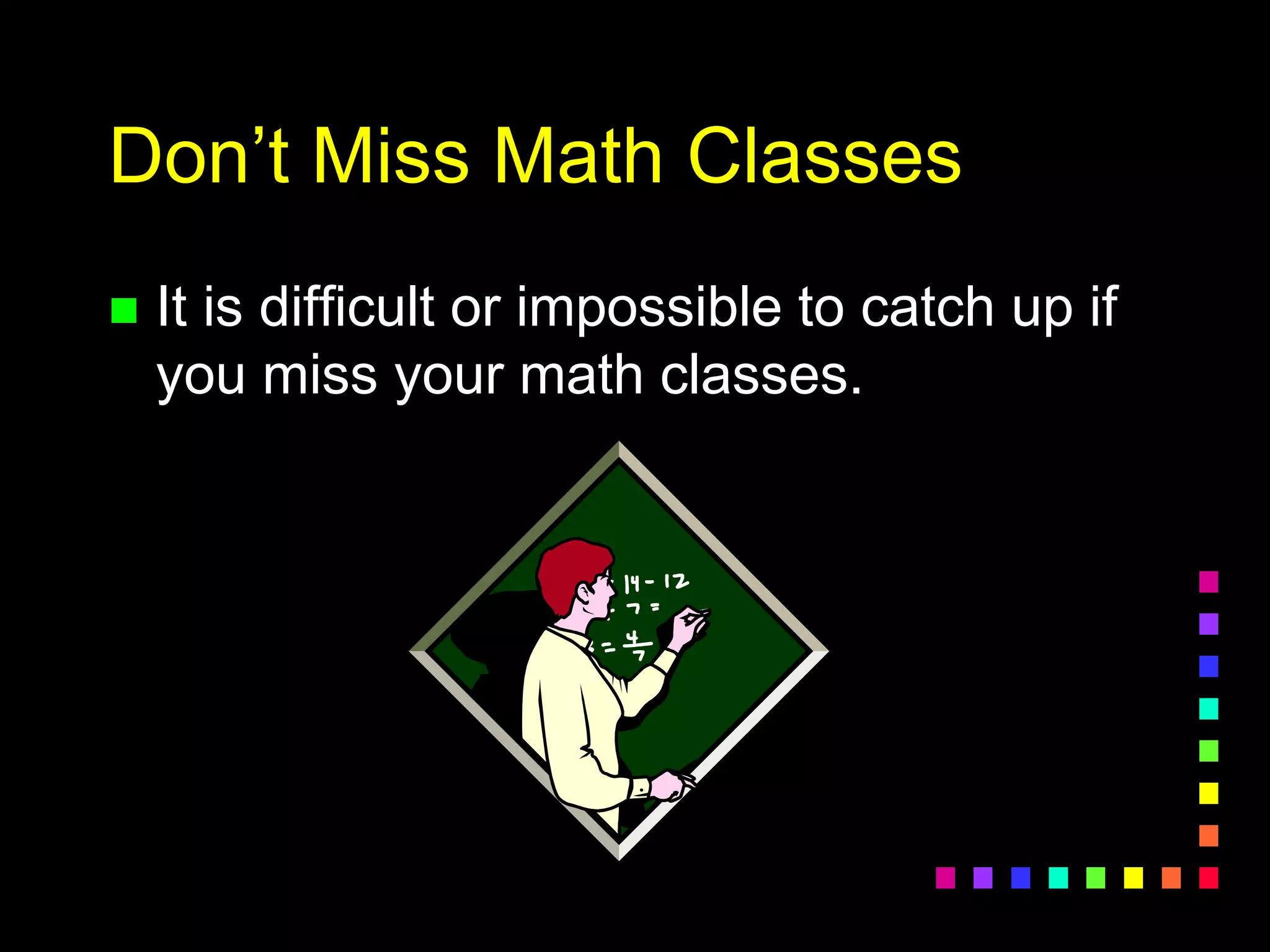
Don’t Miss Math Classes
 It is difficult or impossible to catch up if
you miss your math classes.
Do Your Homework Regularly
 Practice until you feel confident.
 You cannot cram for a math test.
Use a Study Group
 Other students can help you to
understand.
 You can help others and increase your
skill.
 The study group can become a support
group as well.
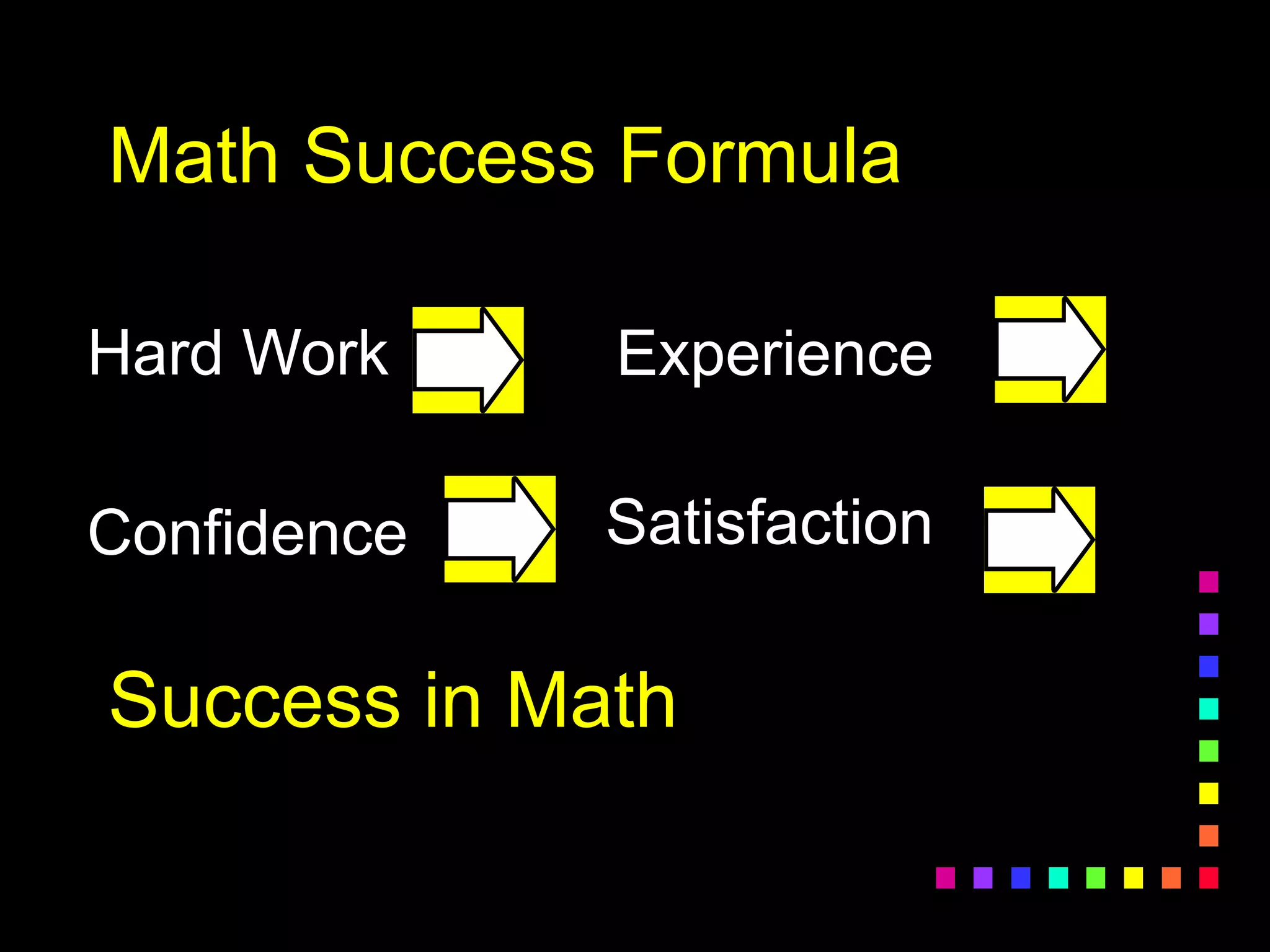
Math Success Formula
Hard Work Experience
Confidence Satisfaction
Success in Math
Rules for Success on Any
Exam
Wake Up On Time
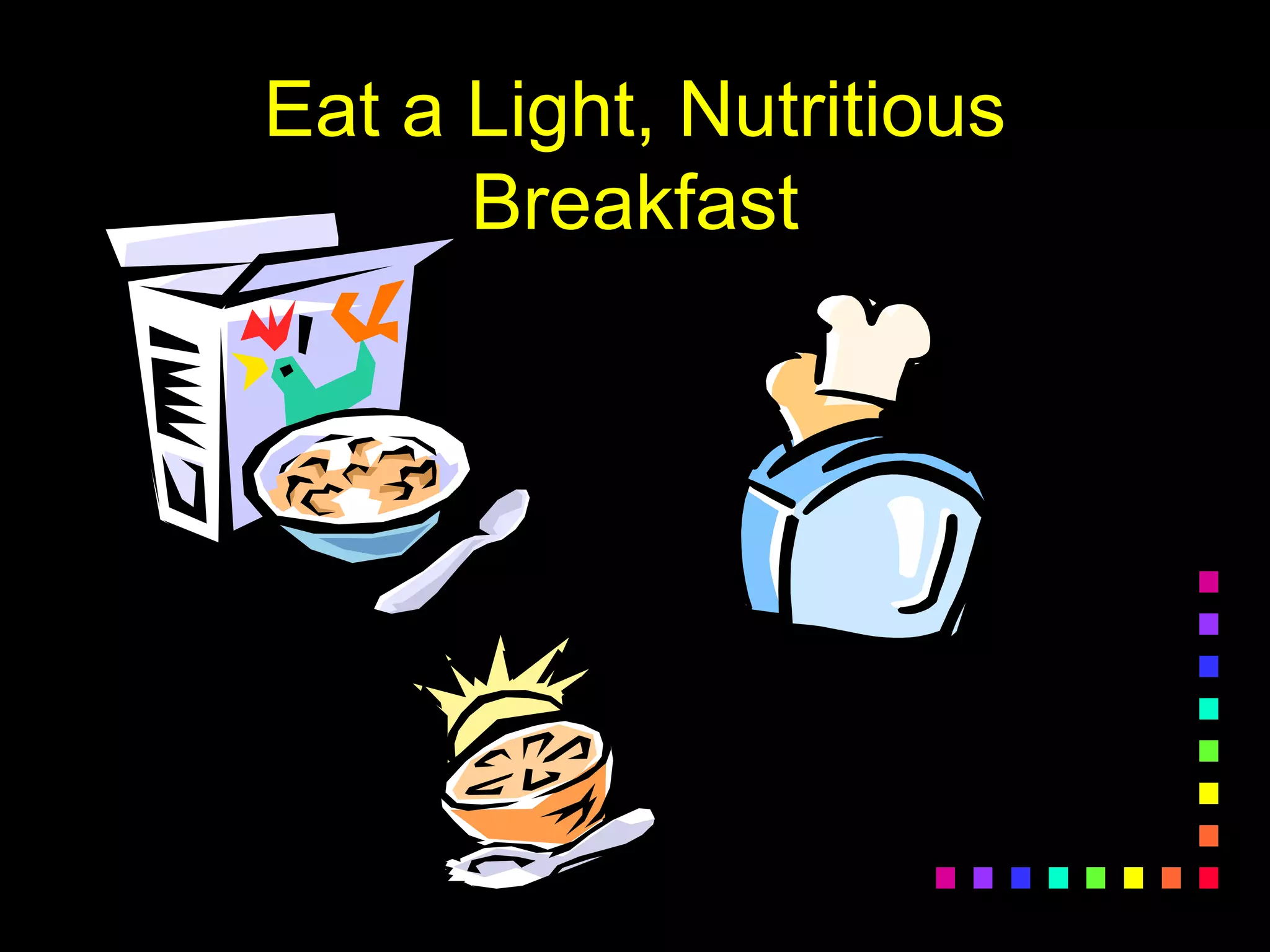
Eat a Light, Nutritious
Breakfast
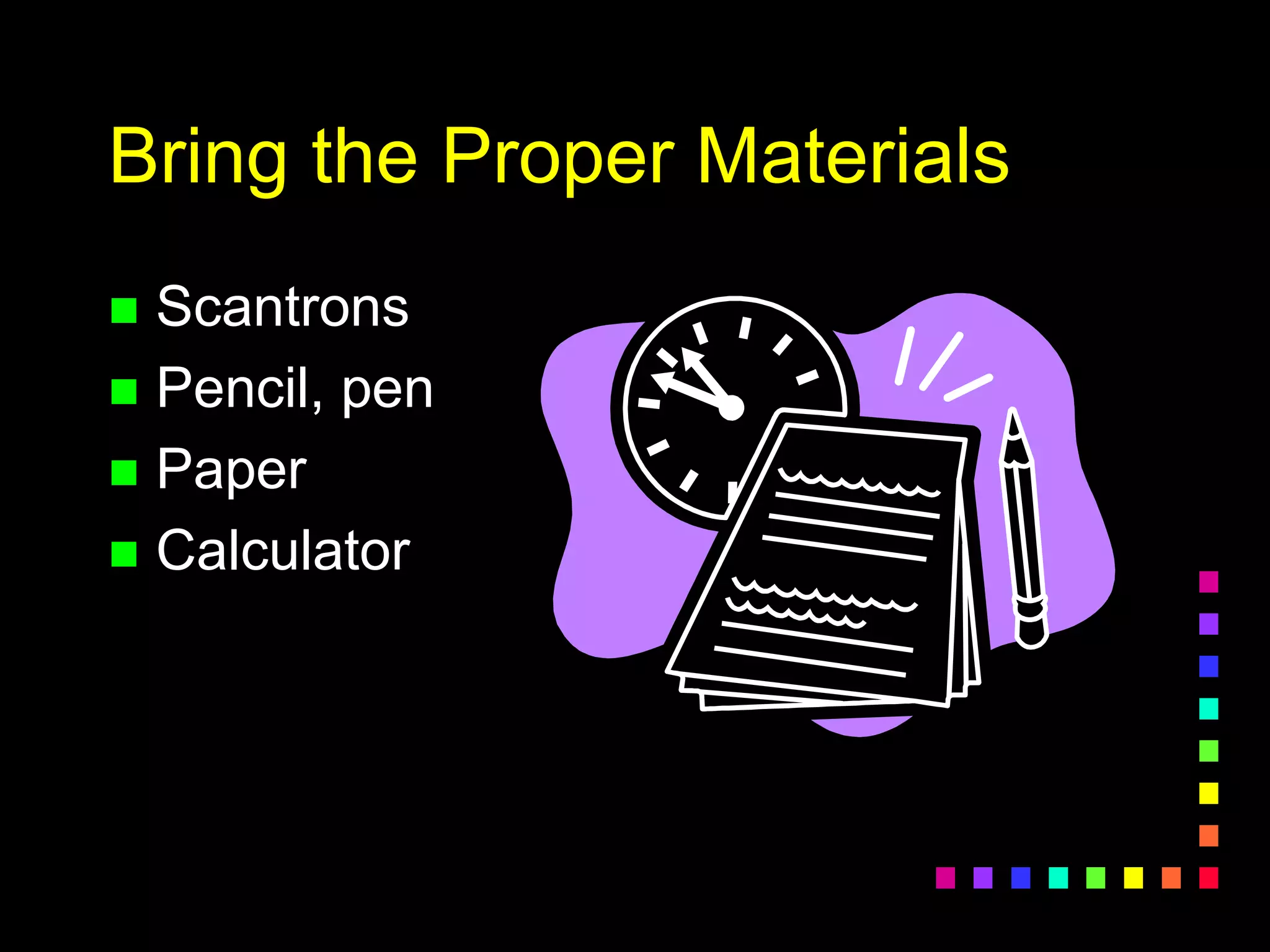
Bring the Proper Materials
 Scantrons
 Pencil, pen
 Paper
 Calculator
Arrive Early
Think Positively About the
Exam
Read the Directions
Survey the Test Before You
Start
Plan Your Time
Make Your Test Neat and
Legible
Answer the Easy Questions
First
 This helps you to relax.
 It builds your self-confidence too.
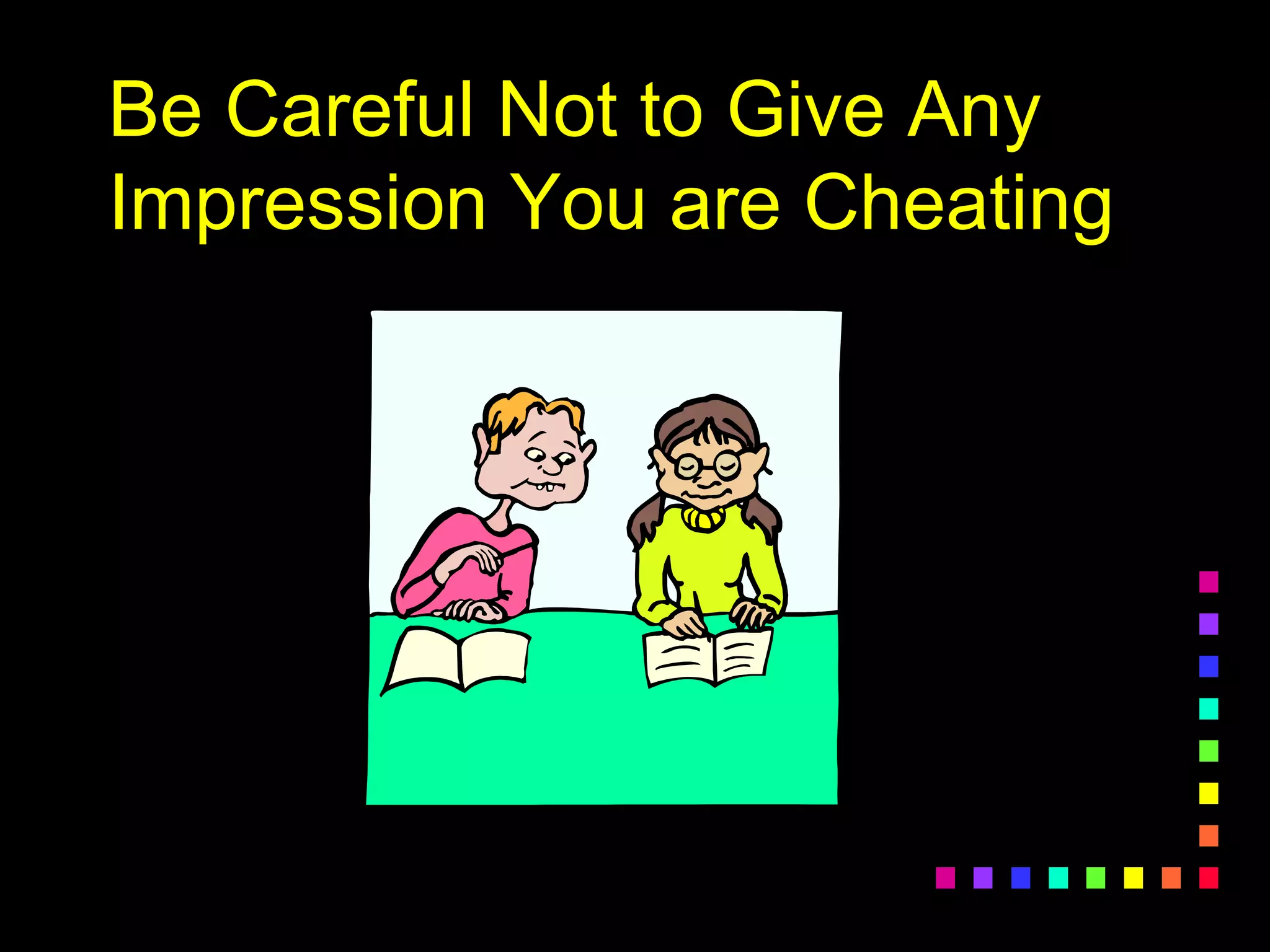
Be Careful Not to Give Any
Impression You are Cheating
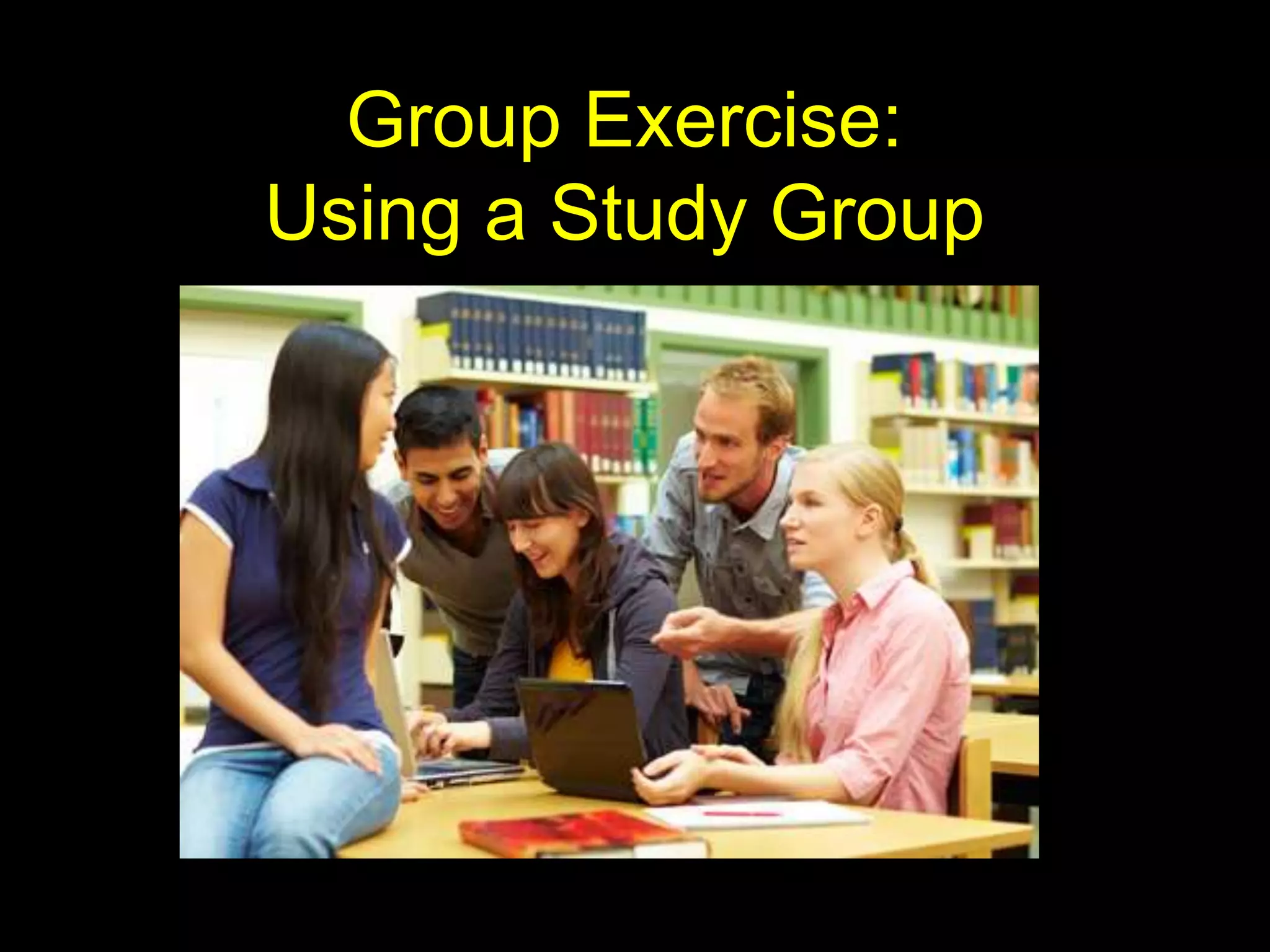
Group Exercise:
Using a Study Group
Test Taking Techniques
Part II
Meet the Decoy
The Best Way to Prepare:
 Study the key ideas
 Textbook
 Lecture notes
 Class handouts
Test Taking Techniques
Or how to guess if you need to
Or how to answer correctly after
you have studied
How Does An Instructor Write
a True False Question?
1. Find an important point
2. Write as is for true
3. Change or add a qualifier to make
it false
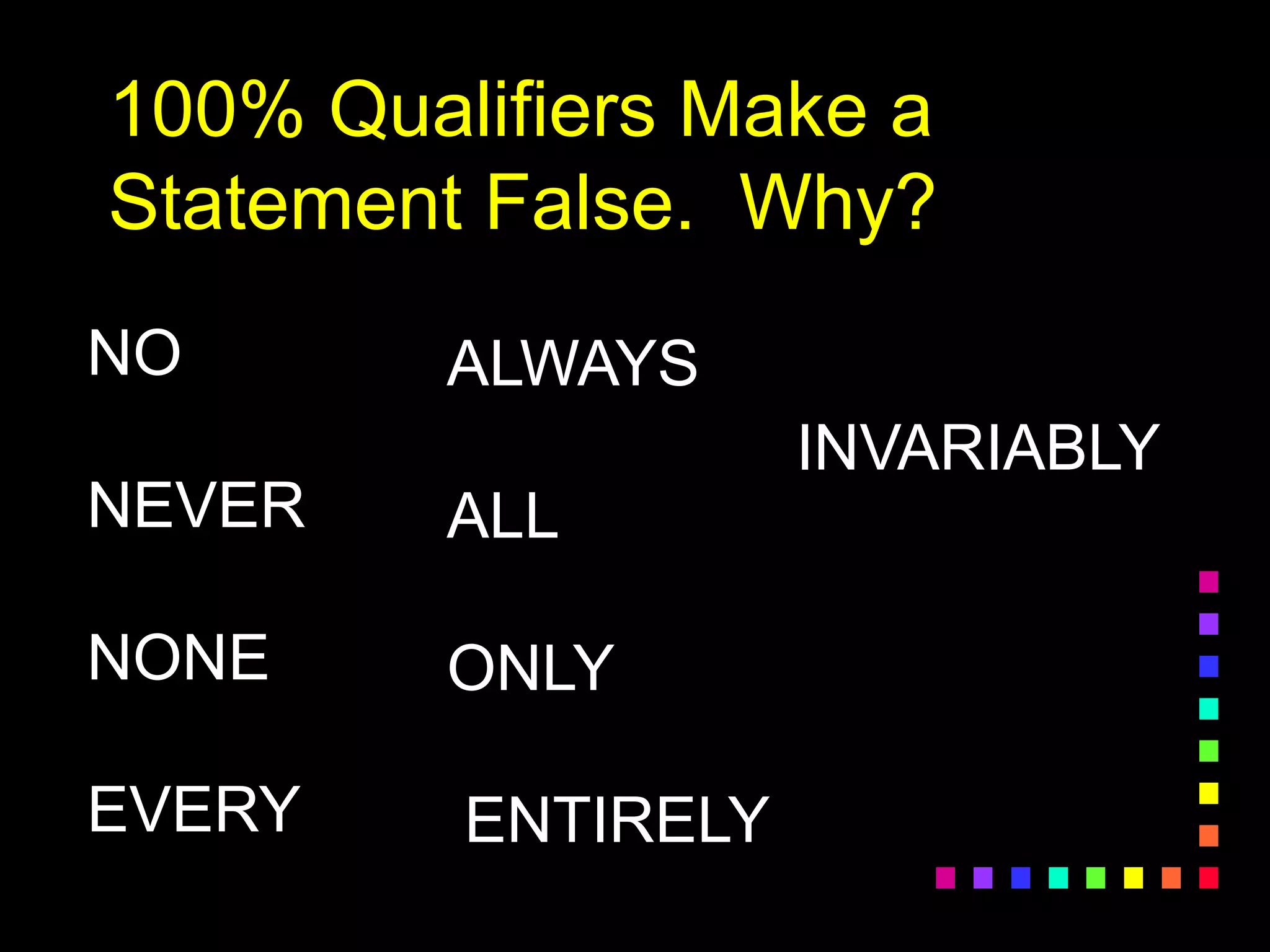
100% Qualifiers Make a
Statement False. Why?
NO
NEVER
NONE
EVERY
ALWAYS
ALL
ONLY
ENTIRELY
INVARIABLY
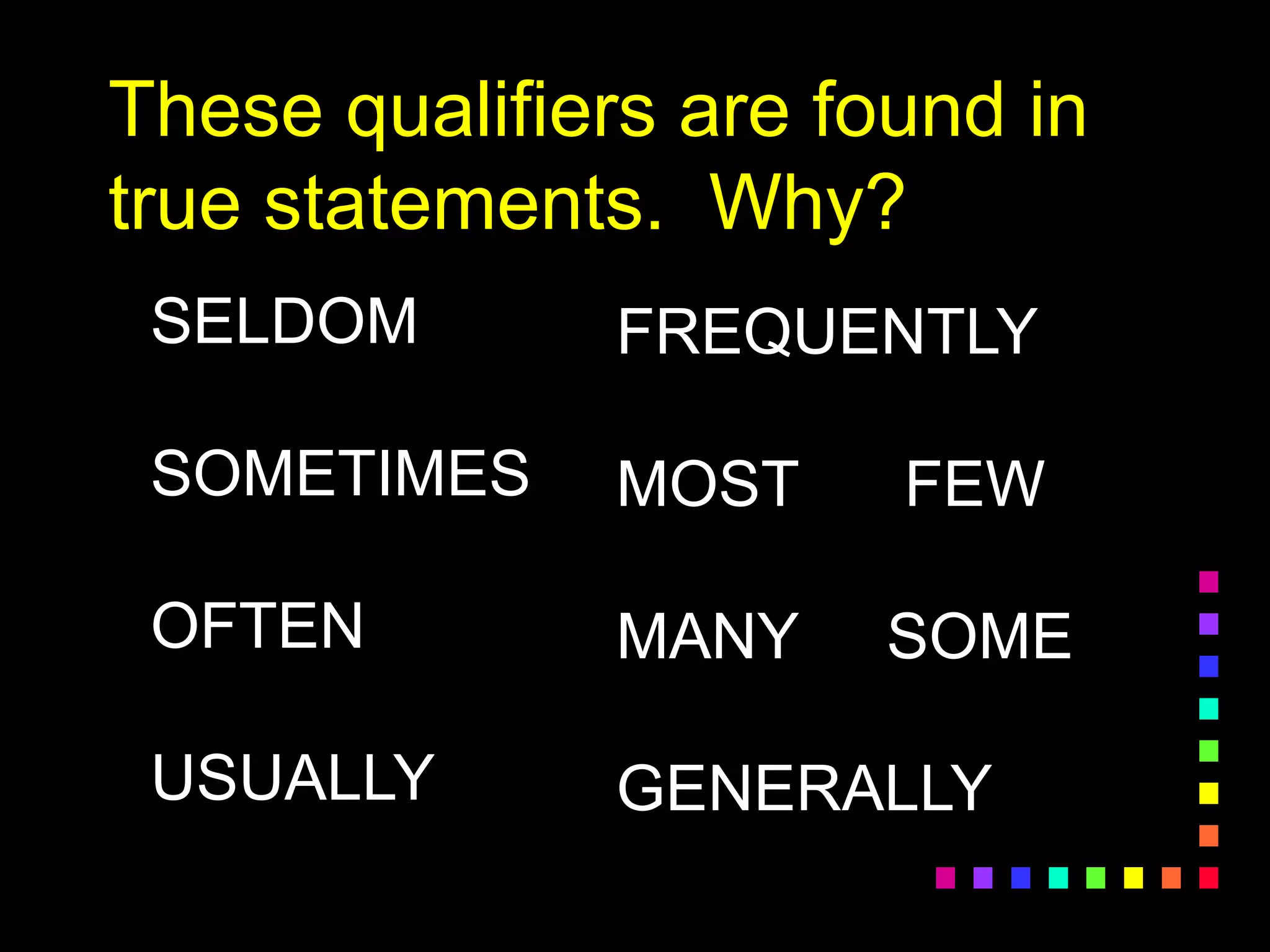
These qualifiers are found in
true statements. Why?
SELDOM
SOMETIMES
OFTEN
USUALLY
FREQUENTLY
MOST FEW
MANY SOME
GENERALLY
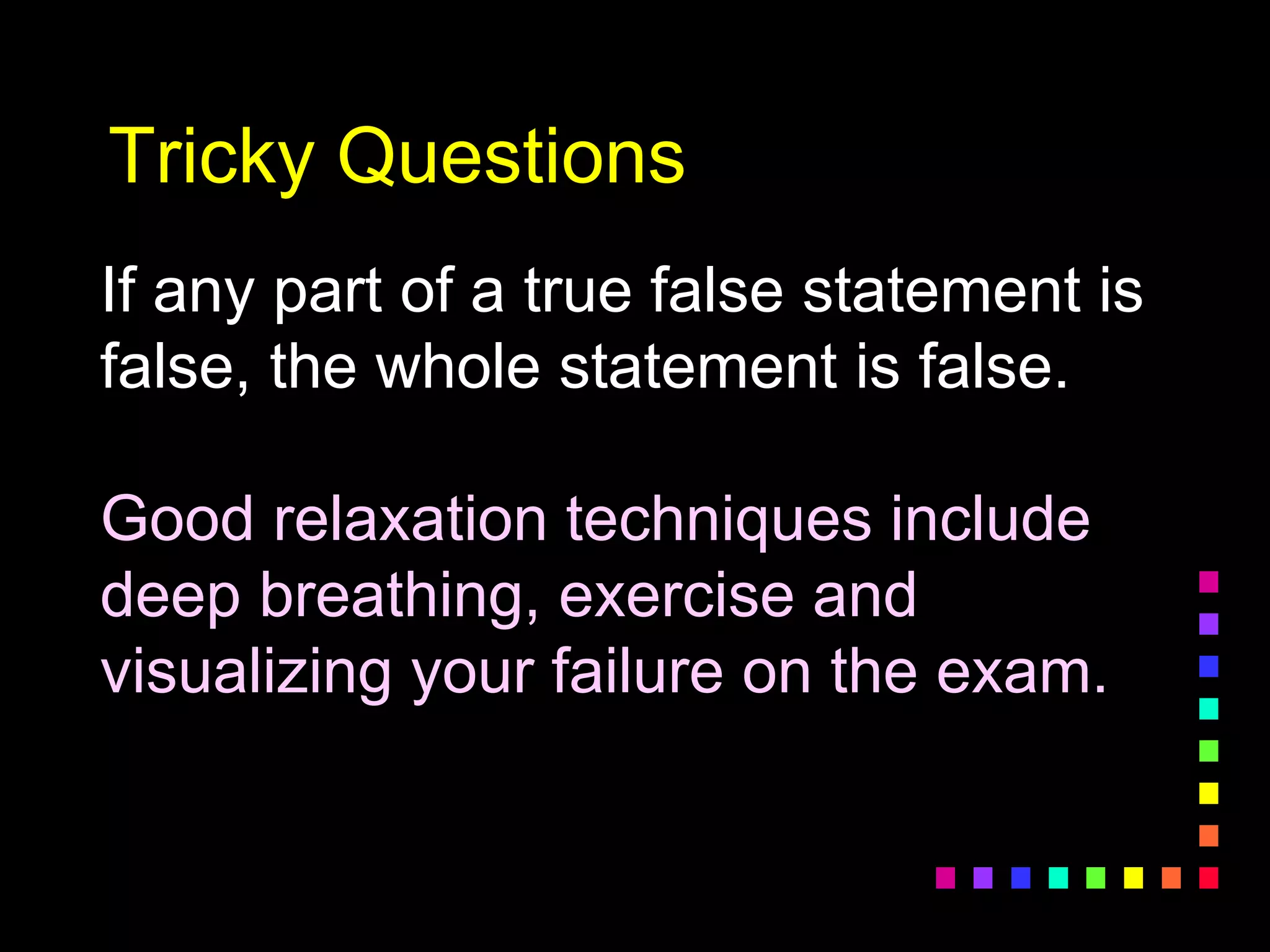
Tricky Questions
If any part of a true false statement is
false, the whole statement is false.
Good relaxation techniques include
deep breathing, exercise and
visualizing your failure on the exam.
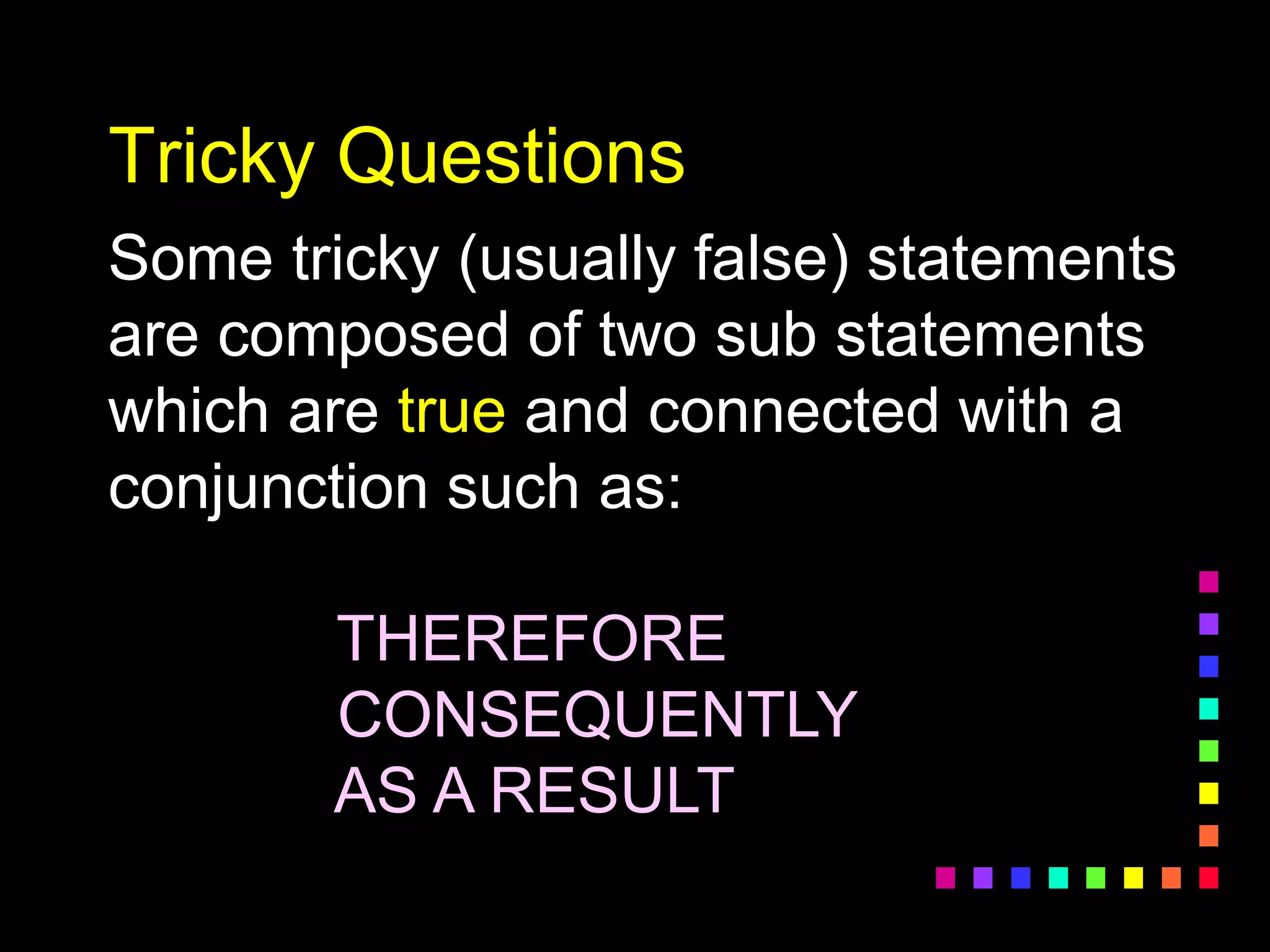
Tricky Questions
Some tricky (usually false) statements
are composed of two sub statements
which are true and connected with a
conjunction such as:
THEREFORE
CONSEQUENTLY
AS A RESULT
Example
Martha does not have test anxiety,
and as a result makes good
grades on tests.
The second sub statement does
not follow logically from the first
statement.
Martha does not have test anxiety,
and as a result makes good
grades on tests.
This statement is false because she
also has to prepare for the exam. Not
having test anxiety can even cause
her to lack motivation to study.
Tricky Questions
Beware of double negatives.
No + No = Yes
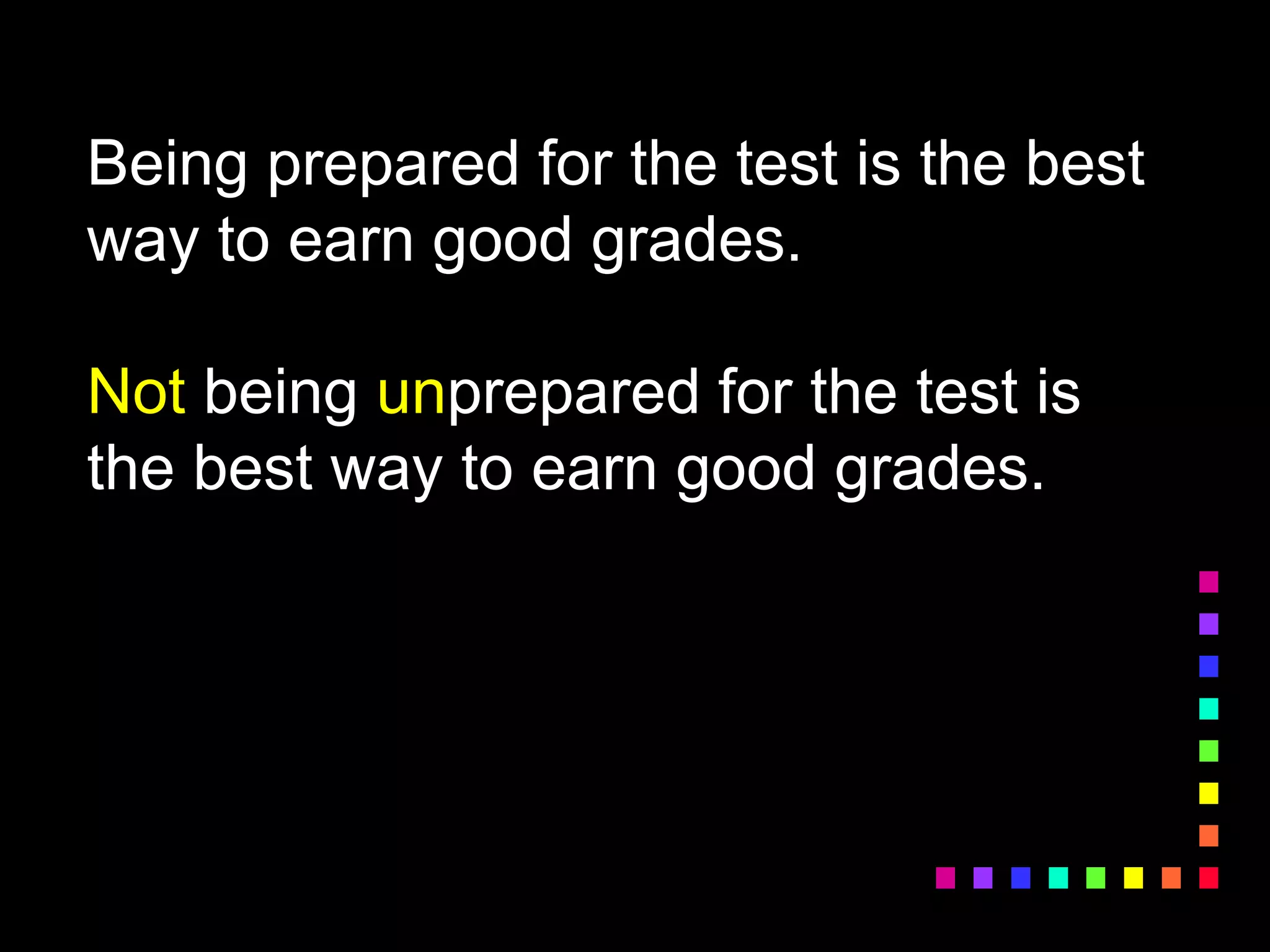
Being prepared for the test is the best
way to earn good grades.
Not being unprepared for the test is
the best way to earn good grades.
Tricky Questions
If you have to guess, guess TRUE.
Most exams have more true questions.
Why?
How To Take True-False
Tests
The Multiple Choice Question
Begin With a True or False
Question
Remember that multiple choice questions
are 4 true or false questions in a column.
How does the instructor write
a multiple choice question?
Meet the Decoy
1. Look for an important point.
2. Make a stem.
3. Write the correct answer.
4. Think or 3 or 4 decoys.
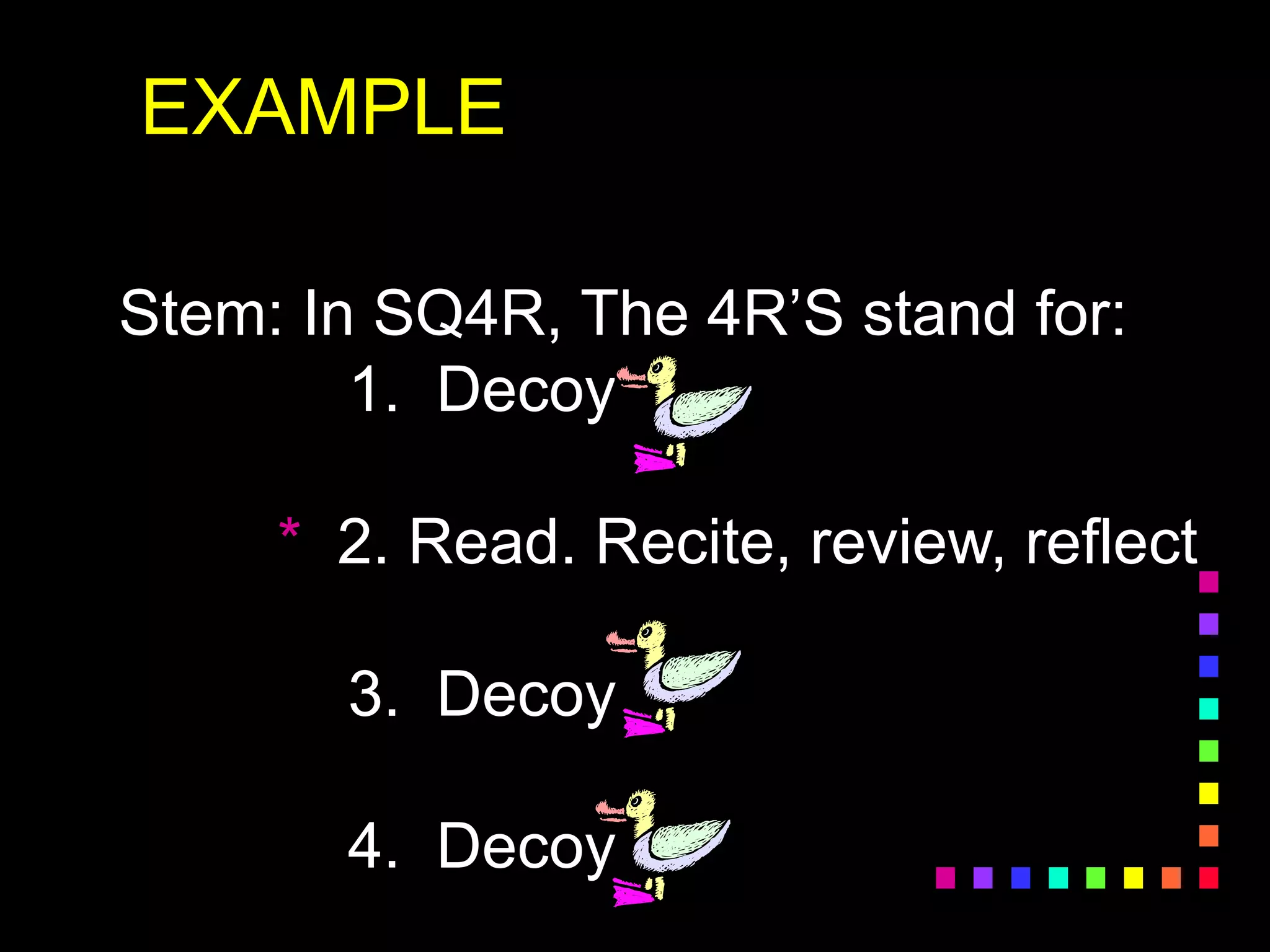
EXAMPLE
Stem: In SQ4R, The 4R’S stand for:
1. Decoy
* 2. Read. Recite, review, reflect
3. Decoy
4. Decoy
Decoys are false statements.
Read all options. Determine which
statements are false and which are
true. Choose the BEST answer.
Tricky Questions
1. Watch for negatives and
100% qualifiers
2. Foolish options are generally
incorrect.
Example
The Cornell Format is:
A. A system for taking notes
B. A type of floor mat
Tricky Questions
All of the above is usually correct.
Answers in the middle range are
more likely to be correct.
Tricky Questions
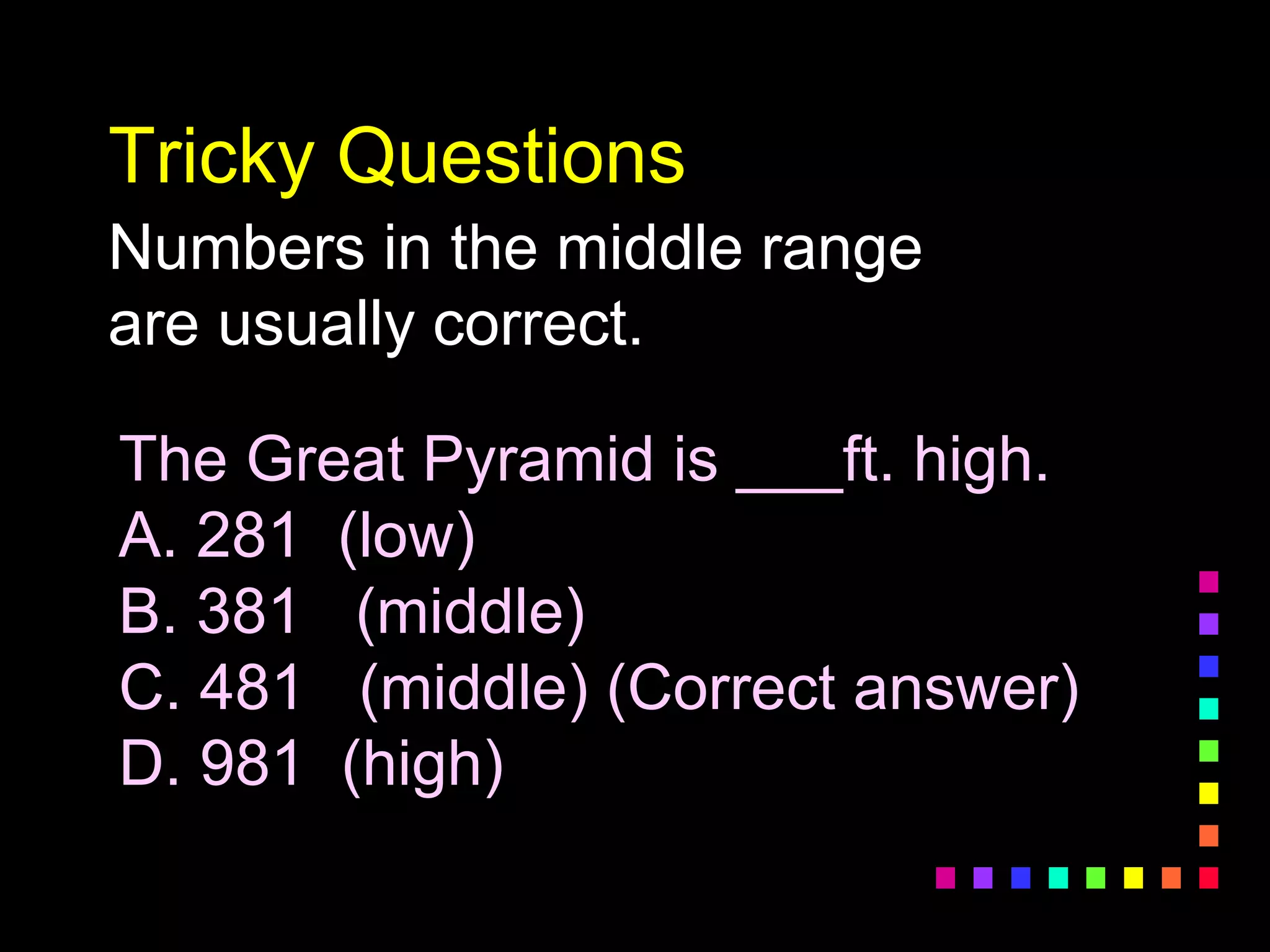
Numbers in the middle range
are usually correct.
The Great Pyramid is ___ft. high.
A. 281
B. 381
C. 481
D. 981
Tricky Questions
Numbers in the middle range
are usually correct.
The Great Pyramid is ___ft. high.
A. 281 (low)
B. 381 (middle)
C. 481 (middle) (Correct answer)
D. 981 (high)
Who wants to be a millionaire?
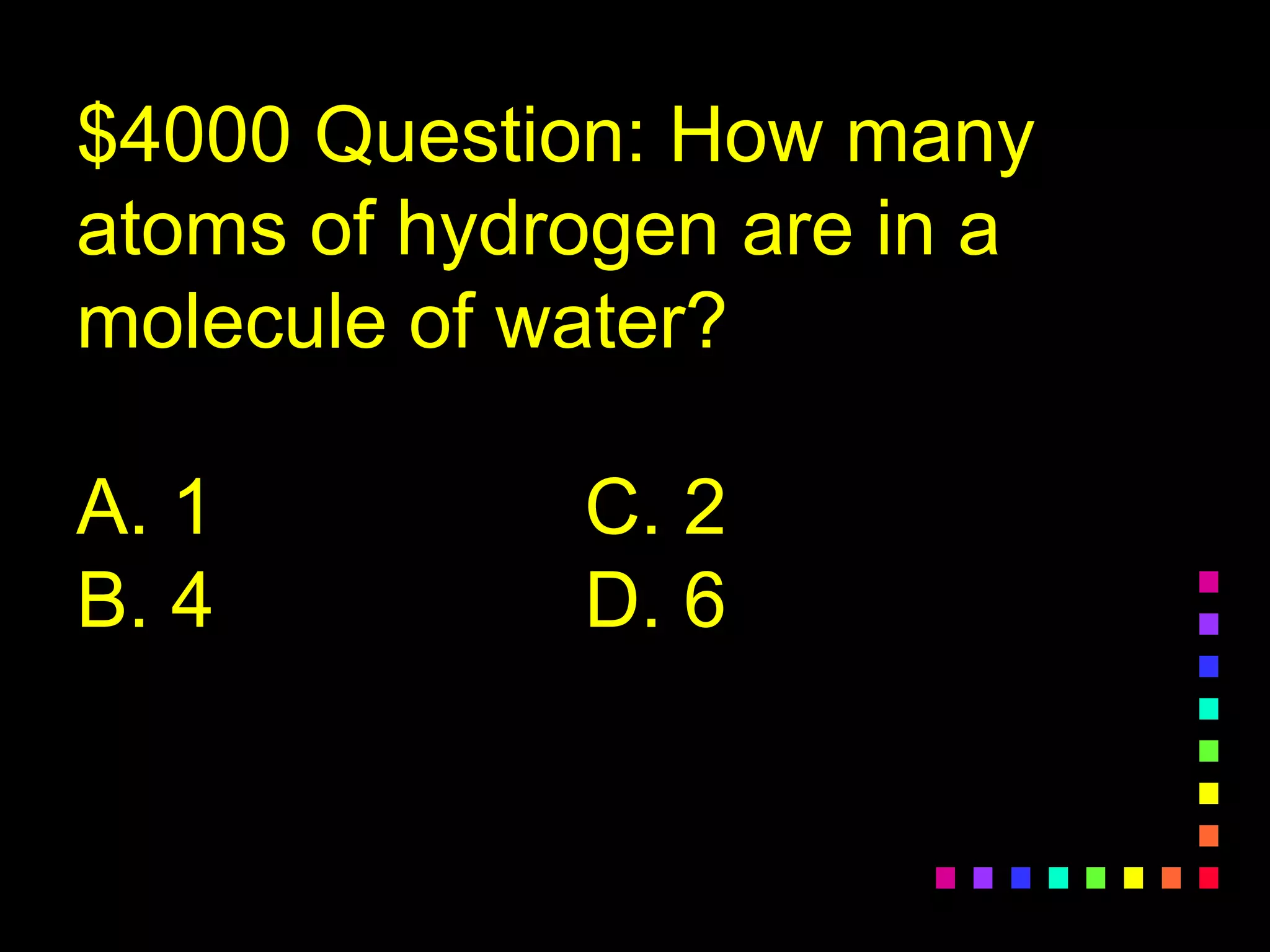
$4000 Question: How many
atoms of hydrogen are in a
molecule of water?
A. 1 C. 2
B. 4 D. 6
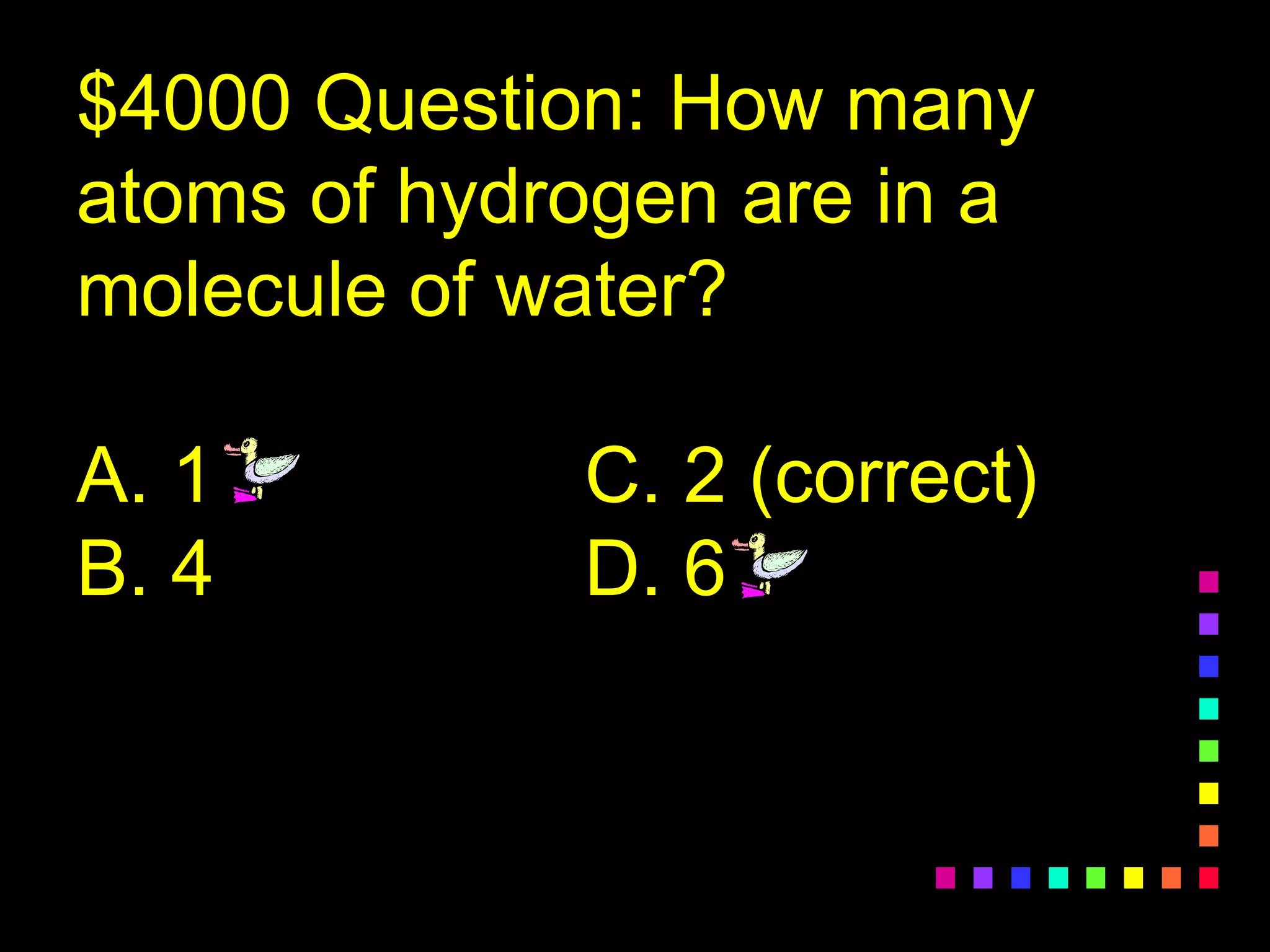
$4000 Question: How many
atoms of hydrogen are in a
molecule of water?
A. 1 C. 2 (correct)
B. 4 D. 6
Tricky Questions
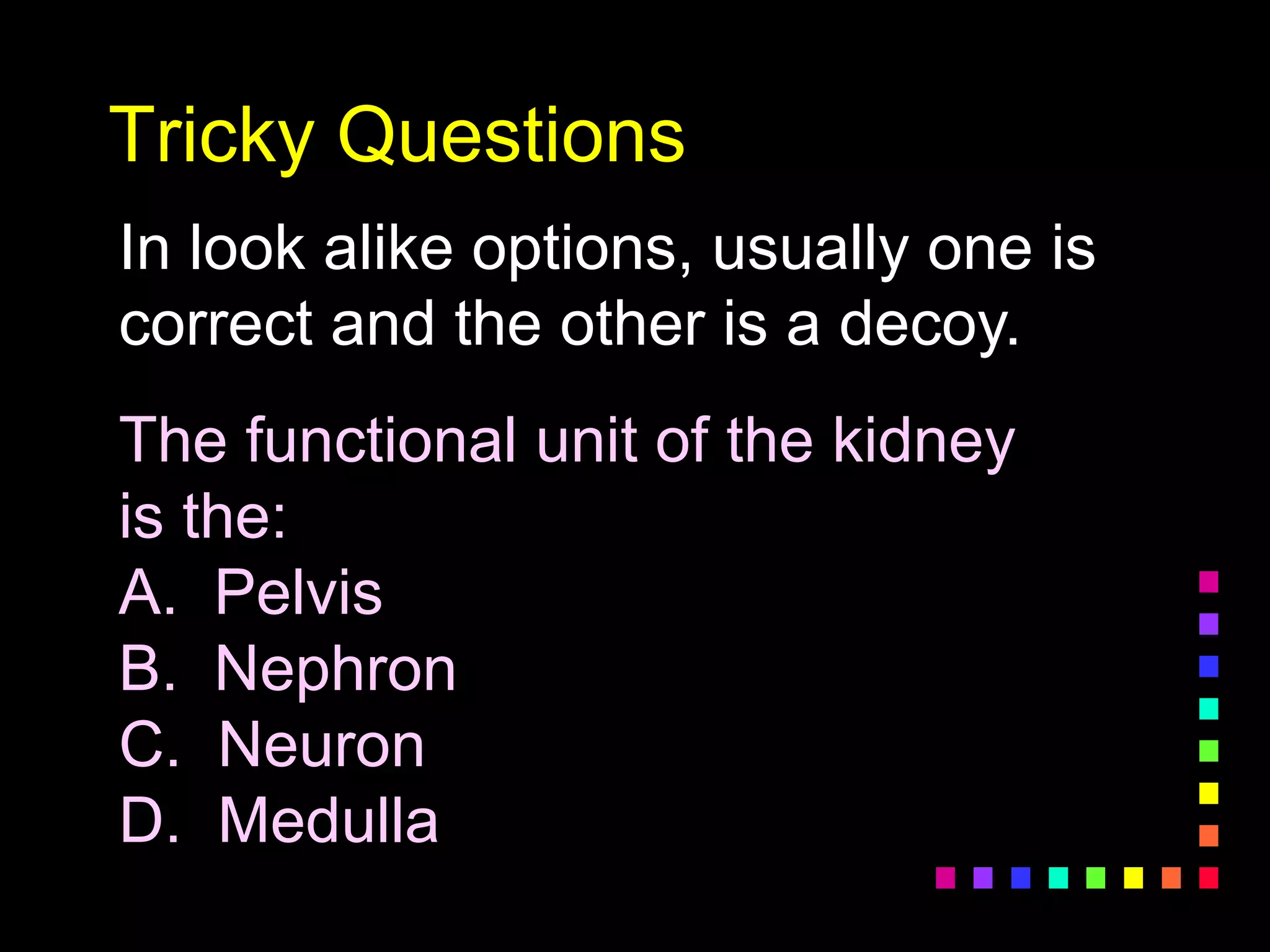
In look alike options, usually one is
correct and the other is a decoy.
The functional unit of the kidney
is the:
A. Pelvis
B. Nephron
C. Neuron
D. Medulla
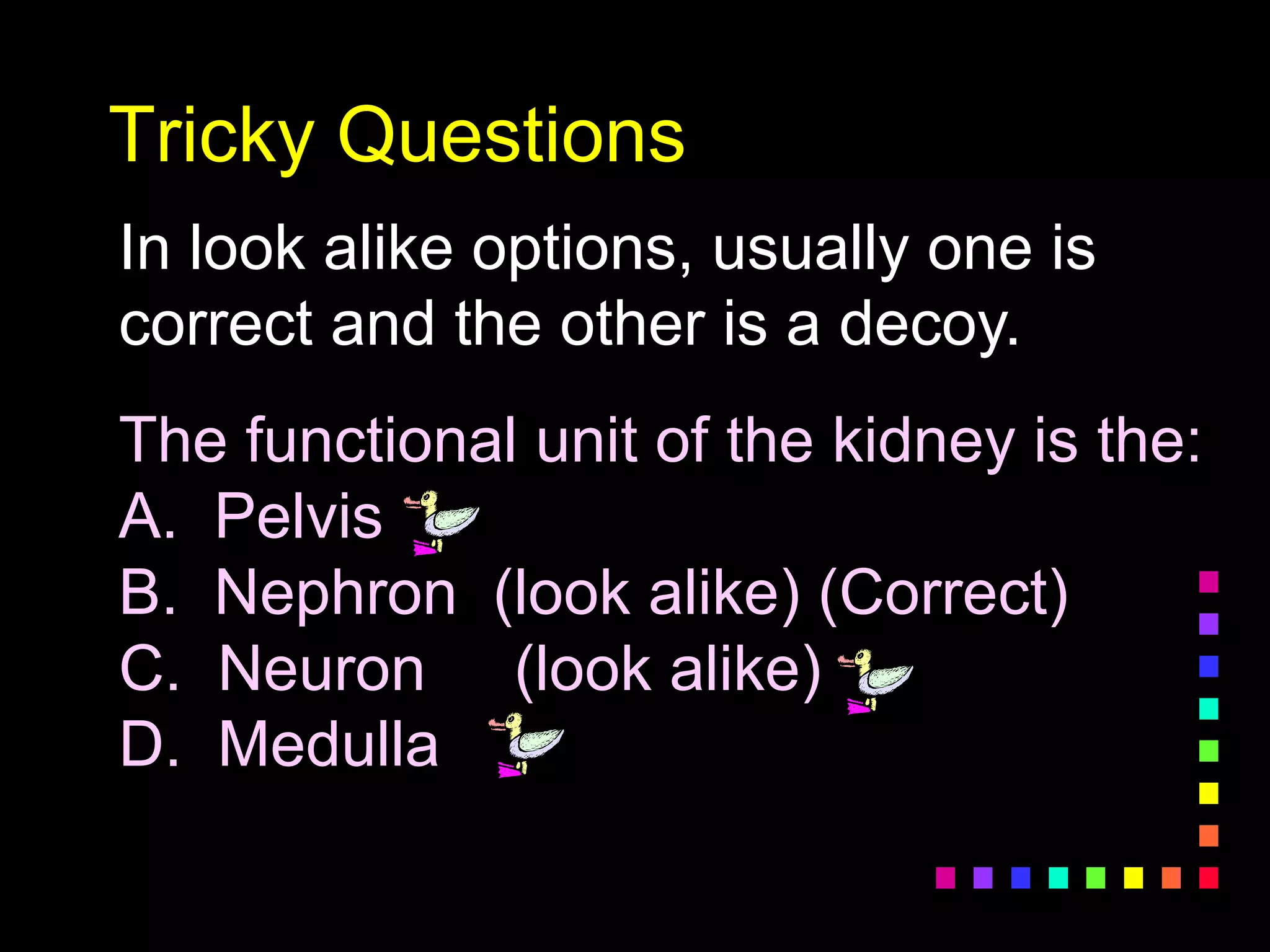
Tricky Questions
In look alike options, usually one is
correct and the other is a decoy.
The functional unit of the kidney is the:
A. Pelvis
B. Nephron (look alike) (Correct)
C. Neuron (look alike)
D. Medulla
Who wants to be a millionaire?
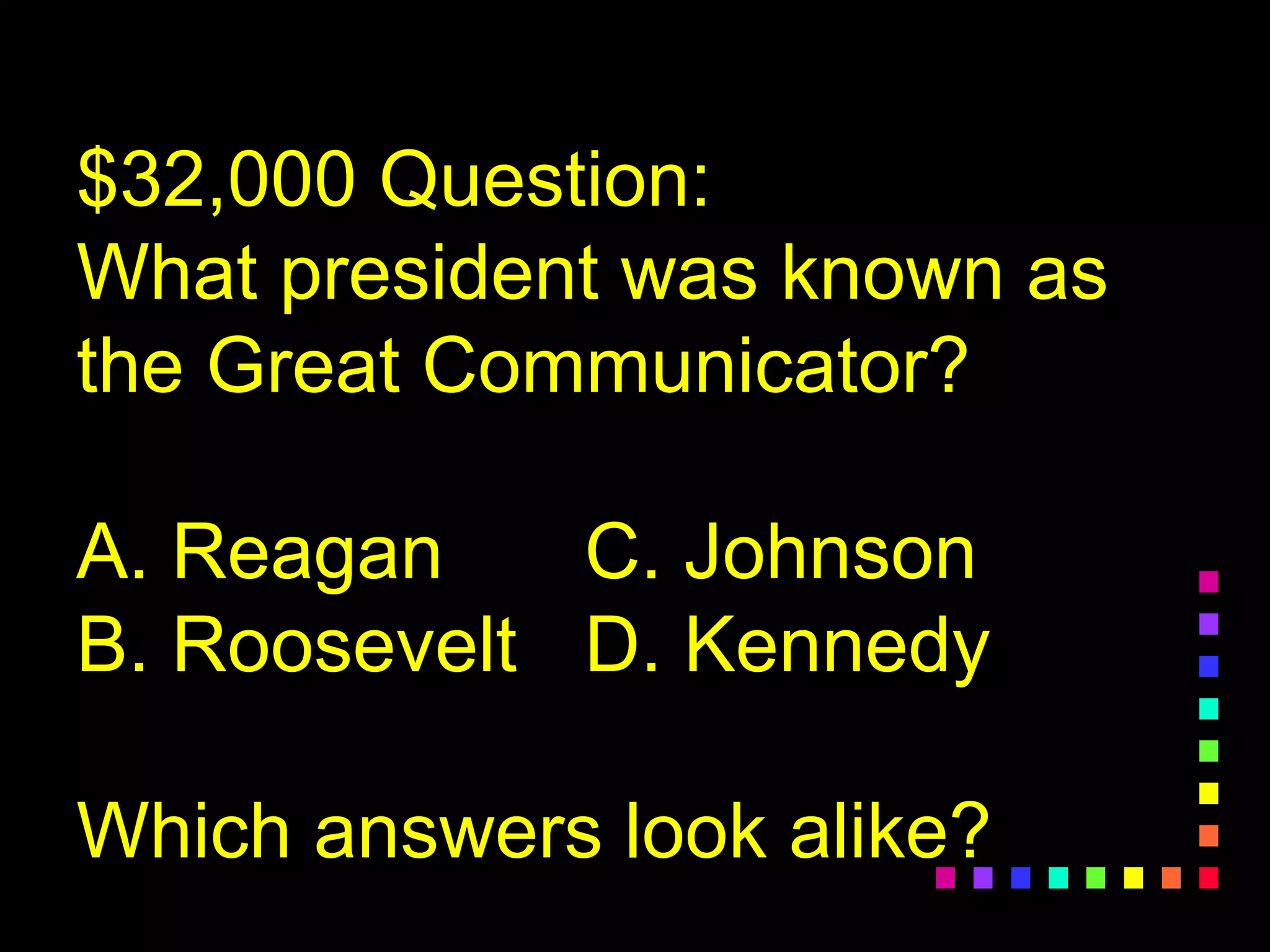
$32,000 Question:
What president was known as
the Great Communicator?
A. Reagan C. Johnson
B. Roosevelt D. Kennedy
Which answers look alike?
Reagan and Roosevelt look
alike. Reagan is the correct
answer.
Tricky Questions
Choose the option that is grammatically
correct.
Note:
Plurals
a/an
Tricky Questions
If you don’t know the answer, SKIP IT.
You may find the answer or something
that triggers your memory in the rest
of the test. Circle the ones you do not
know and come back to them later.
Tricky Questions
Choose the best or most complete
alternative.
When alternatives seem
equally good, select the longest one.
Why?
Tricky Questions
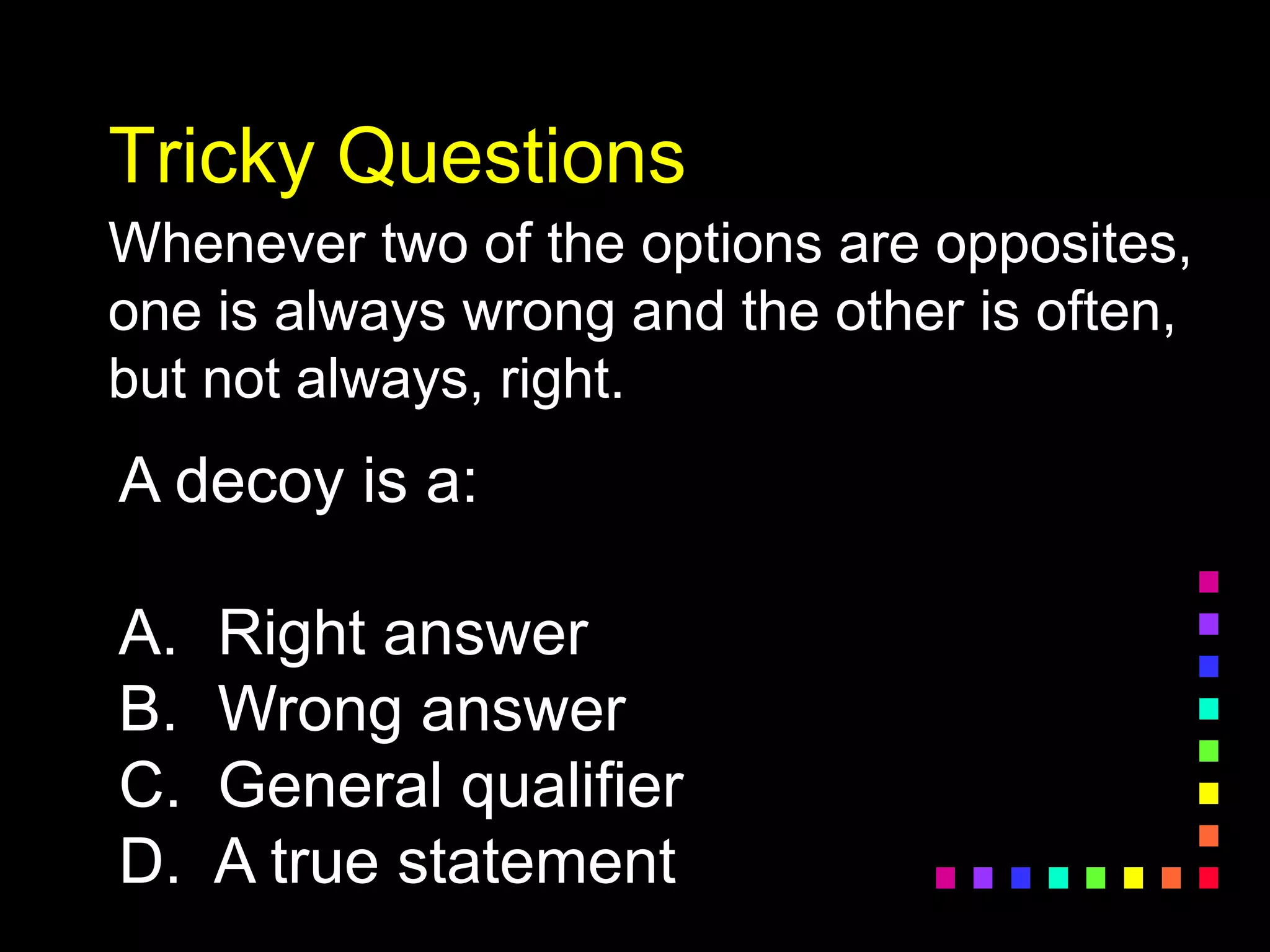
Whenever two of the options are opposites,
one is always wrong and the other is often,
but not always, right.
A decoy is a:
A. Right answer
B. Wrong answer
C. General qualifier
D. A true statement
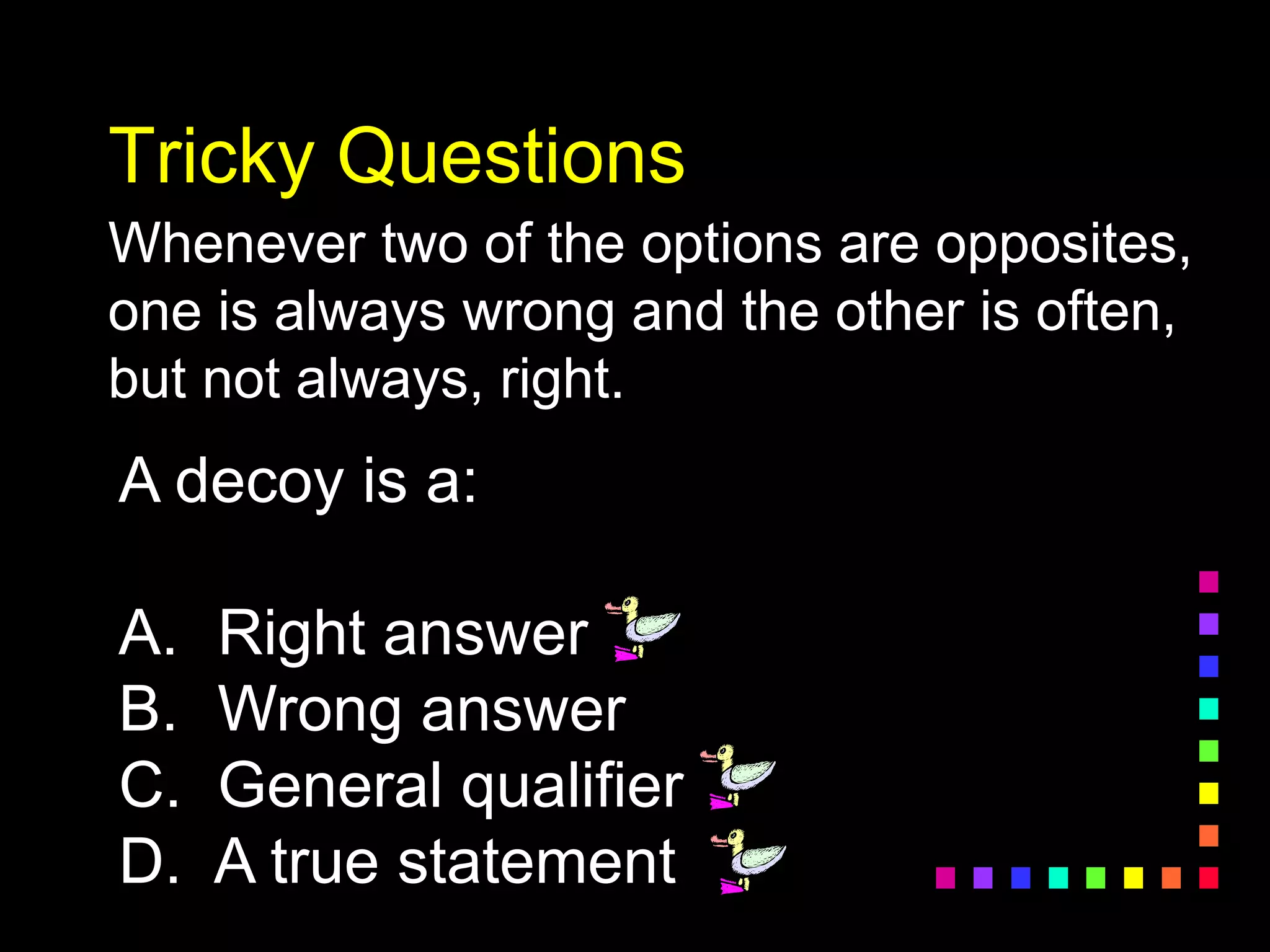
Tricky Questions
Whenever two of the options are opposites,
one is always wrong and the other is often,
but not always, right.
A decoy is a:
A. Right answer
B. Wrong answer
C. General qualifier
D. A true statement
Ready for the “Guess” test?
Tips for Matching Exams
 Read through both lists to discover
patterns and relationships.
 Count the items on each list. Are they
equal?
 First match the items you know for
certain
 Guess at the end, if you need to.
Tips for Sentence Completion
Exams
 Review facts such as definitions,
names, places and dates
 Use clues in the sentence to find an
answer that makes sense in the
sentence and fits the grammar of the
sentence.
Essay Exams
The question should be
answered directly in the first
statement. Repeating part of
the question is a good way to
stay on track.
Tips
 Manage your time so that you complete
all the questions needed.
 Read the directions.
 Make sure you understand the question.
 Jot down memory aids.
 Use good writing, grammar and
spelling.
 Write neatly!
Tips
 Never leave a question blank. Write
down what you know. You may get
partial credit.
Words to watch for in essay
questions
Words to watch for in essay
questions
analyze
compare
outline
illustrate
describe
trace
enumerate
explain
demonstrate
Words to watch for in essay
questions
contrast
compare
discuss
define
justify
evaluate
diagram
summarize
relate
Let’s try a short essay on test
preparation.
Let’s Warm Up for the Essay:
How to Prepare for Exams
 Intellectually
 Emotionally
 Physically
Exercise:
Practice with Short Essays
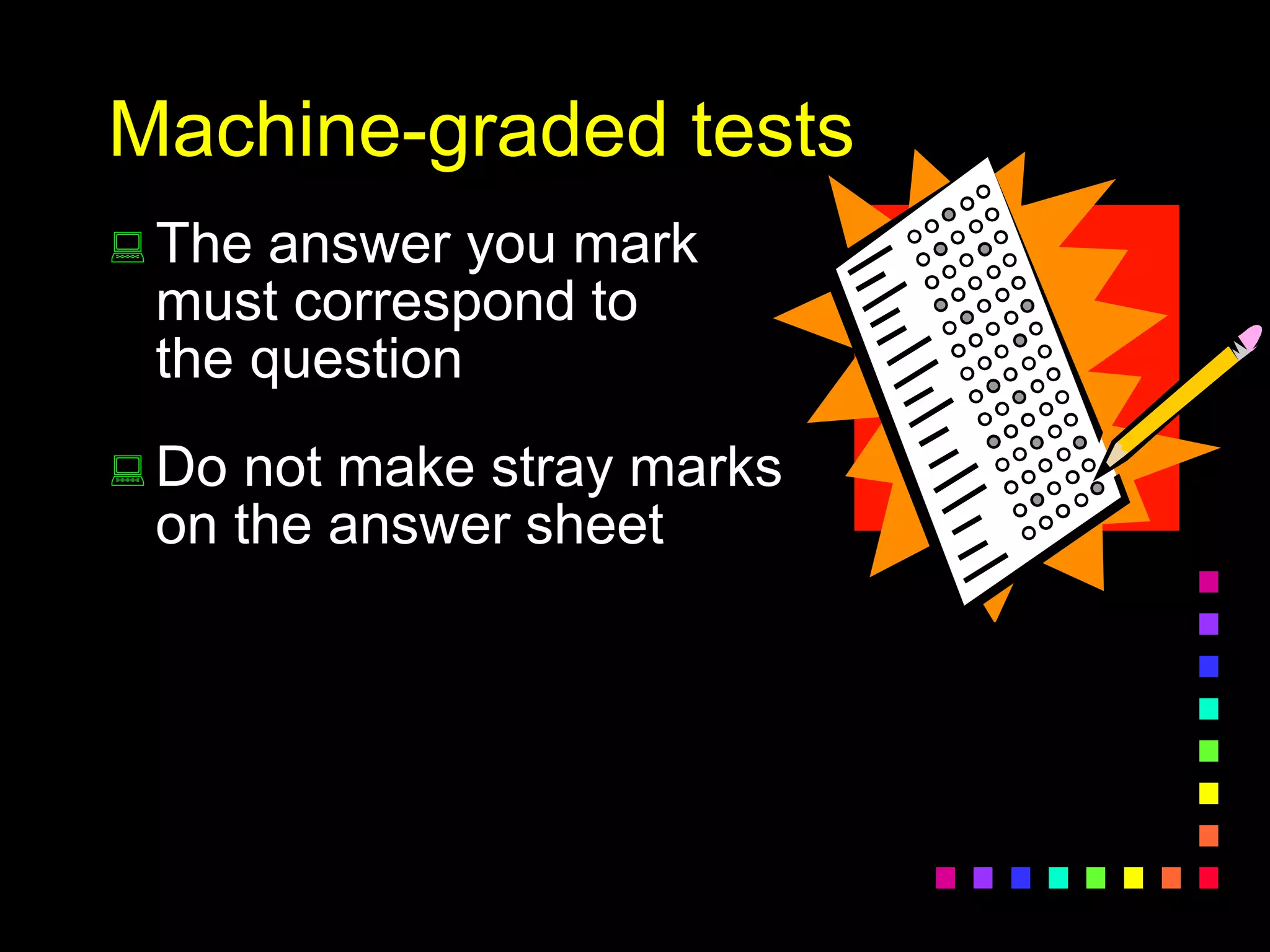
Machine-graded tests
 The answer you mark
must correspond to
the question
 Do not make stray marks
on the answer sheet
Open-book tests
 Write down formulas
 Place post-it notes or paper clips on
important pages
 Number your class notes and write a
short table of contents
Math Tests
 Check your work
 Do the first step again
 Estimate your answer
 Is the solution logical and does it make
sense?
When tests are returned:
 Use them as feedback for future study
 Do you need to improve your study
techniques?
Keys To Success:
Be Prepared
Success
 Begins with a vision of the future
 Becomes reality through hard work and
preparation
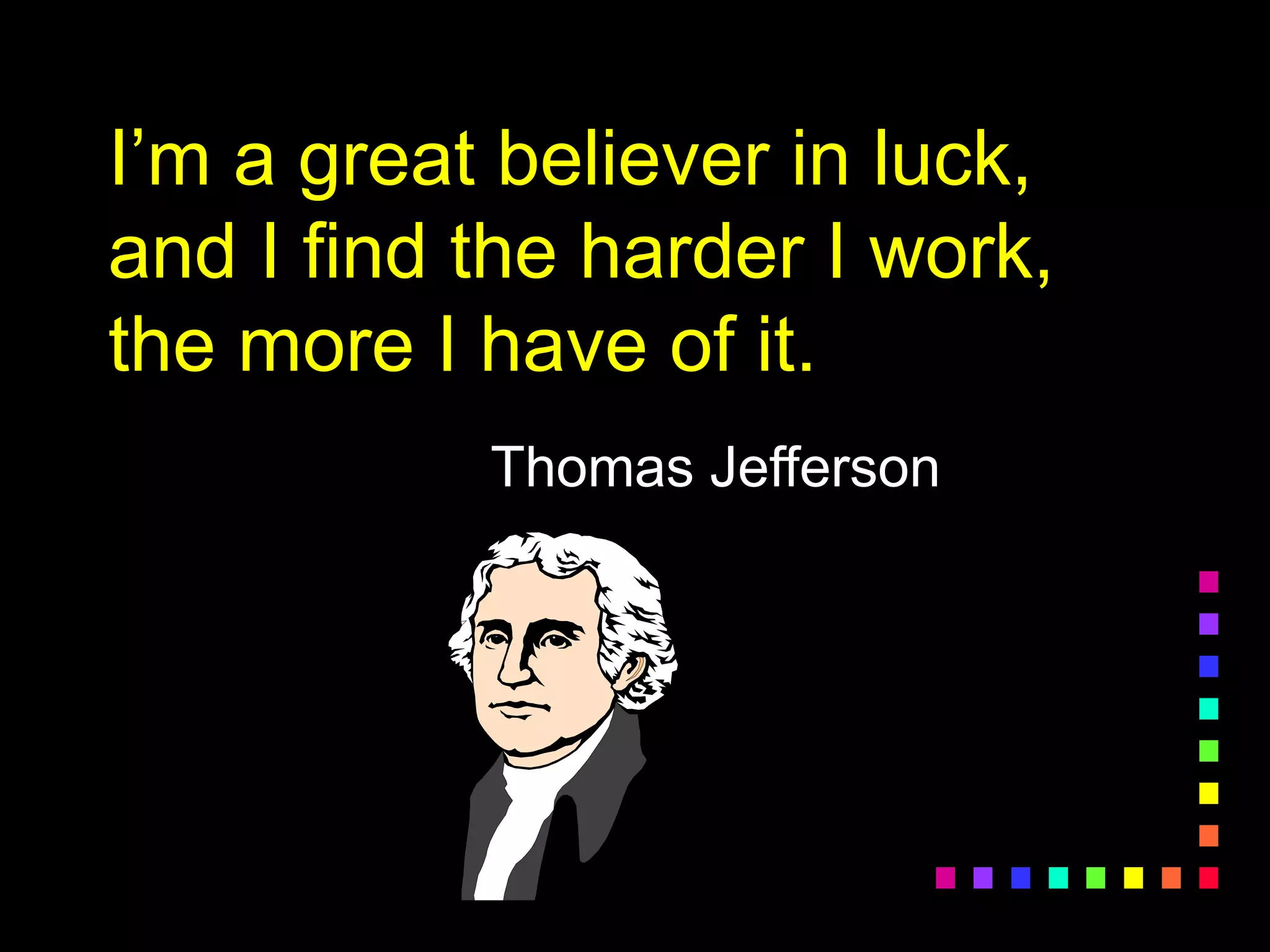
I’m a great believer in luck,
and I find the harder I work,
the more I have of it.
Thomas Jefferson
Remember,
good test preparation begins
the first day of class.
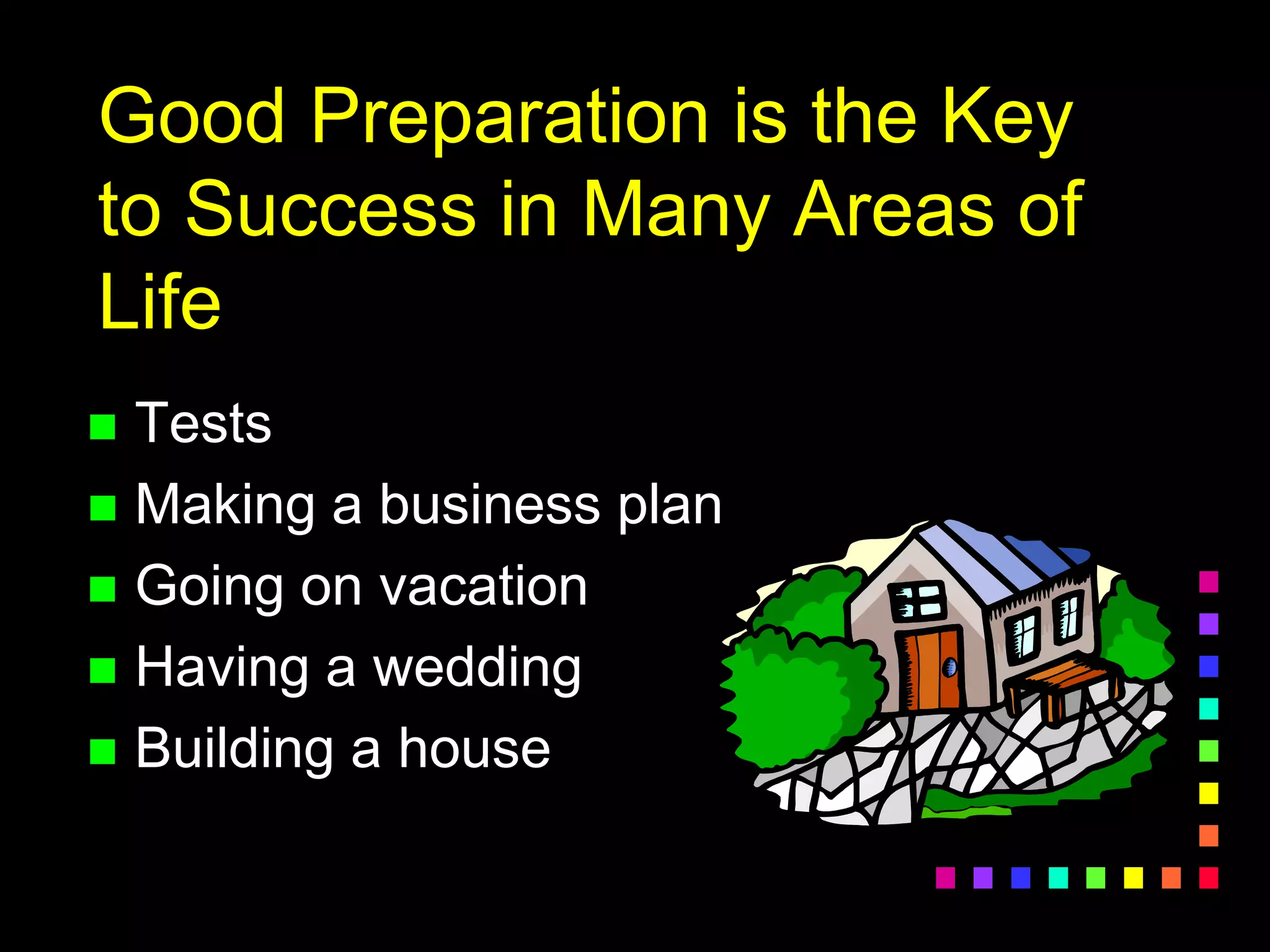
Good Preparation is the Key
to Success in Many Areas of
Life
 Tests
 Making a business plan
 Going on vacation
 Having a wedding
 Building a house
Exercises:
Test Taking Checklist
Analyze Your Test Taking
Skills

Chapter 9

  • 1.
  • 2.
  • 3.
    What doesn’t workin preparing for tests?  What has not worked well in the past?  Think about it.  Share your ideas with the person next to you.  Share with the class some of these ideas.
  • 4.
    Preparation for examsbegins the first day of class.
  • 5.
    Preparation for examsbegins the first day of class.  Attend class  Read the chapters. Use SQ4R.  Take notes and review them  Review periodically.
  • 6.
    Manage Your Time Schedule reading and review time.  Break it into small parts.  Use distributed practice.  Get started. Avoid procrastination.
  • 7.
    Find a Timeand Place to Study
  • 8.
  • 9.
  • 10.
  • 11.
  • 12.
    How to ReviewEffectively  Immediate Review  Intermediate Review  Final Review October
  • 13.
    How to Predictthe Test Questions
  • 14.
    Ask About theTest  What does it cover?  What types of questions?  True-false  Multiple choice  Essay
  • 15.
    Predict Text Questions Turn bold headings into questions.  Practice answering the questions.  If you are in a study group, assign each member to come up with practice questions to share with the group.
  • 16.
    Use the firsttest as a guide on what to study on the next test.
  • 17.
  • 18.
    Disadvantages of Cramming Test anxiety  Poor use of mental ability  Performance suffers  You learn to dislike education  It is not fun
  • 19.
    Emergency Procedures Cramming  Beselective  Review and recite lecture notes first  Skim and search each chapter  Prepare summary sheets with key points  Get enough rest  Hope for the best  Prepare in advance next time!
  • 20.
    The Magical Seven EmergencyProcedure  Start with 7 sheets of paper  Write a key concept likely to be on the test at the top of each sheet  Check your notes and text to write a definition, explanation or answer for each key topic  Review and recite from the 7 sheets.
  • 21.
    Dealing With TestAnxiety What Techniques Work for You?
  • 22.
    Some anxiety isa good thing. It motivates you to study.
  • 23.
    Grades just indicatehow much or how well you studied for the test.  Be Successful by:  Practicing relaxation techniques  Being well-prepared
  • 24.
  • 25.
    Do Some PhysicalExercise  Exercise helps you to feel relaxed and energized
  • 26.
    Get a GoodNight’s Sleep  Lack of sleep interferes with memory  It may also make you tired and irritable
  • 27.
    Take a FewDeep Breaths  Focus on your breathing to get your mind off the test
  • 28.
    Visualize Your Success While studying, picture yourself in the classroom doing well on the test
  • 29.
    Admit to Yourselfthat You are Anxious  You can’t fight it.  You can’t deny it either.
  • 30.
  • 31.
    Do the EasyQuestions First  This will help you relax  When you are relaxed, your brain works better.  You may find the answers on the test or something that triggers your memory so that you can answer the question.
  • 32.
    Yell “Stop”  Interruptyour train of thought so you can get back to the test rather than focusing on your anxiety.
  • 33.
    Daydream  Daydreaming may helpyou to relax and come back to the test with a fresh attitude
  • 34.
    Practice Perspective  Itis just a grade.  It is not the end of the world.  It does not define who you are.  Think about how you can improve your performance next time.
  • 35.
    Think Positively  Youmay have a picture of failure in your mind as a result of past experience.  Notice your mental pictures about math.  Make a new mental picture of success if necessary.  The future can be different.
  • 36.
    Does anyone havemath anxiety?
  • 37.
    Start at theBeginning  Start at your skill level.  You may need to review if you have been out of school for awhile.
  • 38.
    Don’t Delay TakingMath  You need math to graduate.  You need math to transfer.  You may need several math courses.  Many good paying jobs require math.
  • 39.
    Think Positively AboutYour Ability to Succeed in Math
  • 40.
    Get Help Early Get tutoring if you get stuck.  Don’t wait!
  • 41.
    Don’t Miss MathClasses  It is difficult or impossible to catch up if you miss your math classes.
  • 42.
    Do Your HomeworkRegularly  Practice until you feel confident.  You cannot cram for a math test.
  • 43.
    Use a StudyGroup  Other students can help you to understand.  You can help others and increase your skill.  The study group can become a support group as well.
  • 44.
    Math Success Formula HardWork Experience Confidence Satisfaction Success in Math
  • 45.
    Rules for Successon Any Exam
  • 46.
  • 47.
    Eat a Light,Nutritious Breakfast
  • 48.
    Bring the ProperMaterials  Scantrons  Pencil, pen  Paper  Calculator
  • 49.
  • 50.
  • 51.
  • 52.
    Survey the TestBefore You Start
  • 53.
  • 54.
    Make Your TestNeat and Legible
  • 55.
    Answer the EasyQuestions First  This helps you to relax.  It builds your self-confidence too.
  • 56.
    Be Careful Notto Give Any Impression You are Cheating
  • 57.
  • 58.
    Test Taking Techniques PartII Meet the Decoy
  • 59.
    The Best Wayto Prepare:  Study the key ideas  Textbook  Lecture notes  Class handouts
  • 60.
    Test Taking Techniques Orhow to guess if you need to Or how to answer correctly after you have studied
  • 61.
    How Does AnInstructor Write a True False Question? 1. Find an important point 2. Write as is for true 3. Change or add a qualifier to make it false
  • 62.
    100% Qualifiers Makea Statement False. Why? NO NEVER NONE EVERY ALWAYS ALL ONLY ENTIRELY INVARIABLY
  • 63.
    These qualifiers arefound in true statements. Why? SELDOM SOMETIMES OFTEN USUALLY FREQUENTLY MOST FEW MANY SOME GENERALLY
  • 64.
    Tricky Questions If anypart of a true false statement is false, the whole statement is false. Good relaxation techniques include deep breathing, exercise and visualizing your failure on the exam.
  • 65.
    Tricky Questions Some tricky(usually false) statements are composed of two sub statements which are true and connected with a conjunction such as: THEREFORE CONSEQUENTLY AS A RESULT
  • 66.
    Example Martha does nothave test anxiety, and as a result makes good grades on tests. The second sub statement does not follow logically from the first statement.
  • 67.
    Martha does nothave test anxiety, and as a result makes good grades on tests. This statement is false because she also has to prepare for the exam. Not having test anxiety can even cause her to lack motivation to study.
  • 68.
    Tricky Questions Beware ofdouble negatives. No + No = Yes
  • 69.
    Being prepared forthe test is the best way to earn good grades. Not being unprepared for the test is the best way to earn good grades.
  • 70.
    Tricky Questions If youhave to guess, guess TRUE. Most exams have more true questions. Why?
  • 71.
    How To TakeTrue-False Tests
  • 72.
  • 73.
    Begin With aTrue or False Question Remember that multiple choice questions are 4 true or false questions in a column.
  • 74.
    How does theinstructor write a multiple choice question?
  • 75.
  • 76.
    1. Look foran important point. 2. Make a stem. 3. Write the correct answer. 4. Think or 3 or 4 decoys.
  • 77.
    EXAMPLE Stem: In SQ4R,The 4R’S stand for: 1. Decoy * 2. Read. Recite, review, reflect 3. Decoy 4. Decoy
  • 78.
    Decoys are falsestatements. Read all options. Determine which statements are false and which are true. Choose the BEST answer.
  • 79.
    Tricky Questions 1. Watchfor negatives and 100% qualifiers 2. Foolish options are generally incorrect.
  • 80.
    Example The Cornell Formatis: A. A system for taking notes B. A type of floor mat
  • 81.
    Tricky Questions All ofthe above is usually correct. Answers in the middle range are more likely to be correct.
  • 82.
    Tricky Questions Numbers inthe middle range are usually correct. The Great Pyramid is ___ft. high. A. 281 B. 381 C. 481 D. 981
  • 83.
    Tricky Questions Numbers inthe middle range are usually correct. The Great Pyramid is ___ft. high. A. 281 (low) B. 381 (middle) C. 481 (middle) (Correct answer) D. 981 (high)
  • 84.
    Who wants tobe a millionaire?
  • 85.
    $4000 Question: Howmany atoms of hydrogen are in a molecule of water? A. 1 C. 2 B. 4 D. 6
  • 86.
    $4000 Question: Howmany atoms of hydrogen are in a molecule of water? A. 1 C. 2 (correct) B. 4 D. 6
  • 87.
    Tricky Questions In lookalike options, usually one is correct and the other is a decoy. The functional unit of the kidney is the: A. Pelvis B. Nephron C. Neuron D. Medulla
  • 88.
    Tricky Questions In lookalike options, usually one is correct and the other is a decoy. The functional unit of the kidney is the: A. Pelvis B. Nephron (look alike) (Correct) C. Neuron (look alike) D. Medulla
  • 89.
    Who wants tobe a millionaire?
  • 90.
    $32,000 Question: What presidentwas known as the Great Communicator? A. Reagan C. Johnson B. Roosevelt D. Kennedy Which answers look alike?
  • 91.
    Reagan and Rooseveltlook alike. Reagan is the correct answer.
  • 92.
    Tricky Questions Choose theoption that is grammatically correct. Note: Plurals a/an
  • 93.
    Tricky Questions If youdon’t know the answer, SKIP IT. You may find the answer or something that triggers your memory in the rest of the test. Circle the ones you do not know and come back to them later.
  • 94.
    Tricky Questions Choose thebest or most complete alternative. When alternatives seem equally good, select the longest one. Why?
  • 95.
    Tricky Questions Whenever twoof the options are opposites, one is always wrong and the other is often, but not always, right. A decoy is a: A. Right answer B. Wrong answer C. General qualifier D. A true statement
  • 96.
    Tricky Questions Whenever twoof the options are opposites, one is always wrong and the other is often, but not always, right. A decoy is a: A. Right answer B. Wrong answer C. General qualifier D. A true statement
  • 97.
    Ready for the“Guess” test?
  • 98.
    Tips for MatchingExams  Read through both lists to discover patterns and relationships.  Count the items on each list. Are they equal?  First match the items you know for certain  Guess at the end, if you need to.
  • 99.
    Tips for SentenceCompletion Exams  Review facts such as definitions, names, places and dates  Use clues in the sentence to find an answer that makes sense in the sentence and fits the grammar of the sentence.
  • 100.
  • 101.
    The question shouldbe answered directly in the first statement. Repeating part of the question is a good way to stay on track.
  • 102.
    Tips  Manage yourtime so that you complete all the questions needed.  Read the directions.  Make sure you understand the question.  Jot down memory aids.  Use good writing, grammar and spelling.  Write neatly!
  • 103.
    Tips  Never leavea question blank. Write down what you know. You may get partial credit.
  • 104.
    Words to watchfor in essay questions
  • 105.
    Words to watchfor in essay questions analyze compare outline illustrate describe trace enumerate explain demonstrate
  • 106.
    Words to watchfor in essay questions contrast compare discuss define justify evaluate diagram summarize relate
  • 107.
    Let’s try ashort essay on test preparation.
  • 108.
    Let’s Warm Upfor the Essay: How to Prepare for Exams  Intellectually  Emotionally  Physically
  • 109.
  • 110.
    Machine-graded tests  Theanswer you mark must correspond to the question  Do not make stray marks on the answer sheet
  • 111.
    Open-book tests  Writedown formulas  Place post-it notes or paper clips on important pages  Number your class notes and write a short table of contents
  • 112.
    Math Tests  Checkyour work  Do the first step again  Estimate your answer  Is the solution logical and does it make sense?
  • 113.
    When tests arereturned:  Use them as feedback for future study  Do you need to improve your study techniques?
  • 114.
  • 115.
    Success  Begins witha vision of the future  Becomes reality through hard work and preparation
  • 116.
    I’m a greatbeliever in luck, and I find the harder I work, the more I have of it. Thomas Jefferson
  • 117.
    Remember, good test preparationbegins the first day of class.
  • 118.
    Good Preparation isthe Key to Success in Many Areas of Life  Tests  Making a business plan  Going on vacation  Having a wedding  Building a house
  • 119.