STUDY SKills
    Lunch and Learn
    Student Success
Worried that you don’t really
know the best ways to study?


Concerned that you can study
“hard” and still not earn good
grades?


Think that you should study
biology the same way you study
history?
What is the
right way to study?
The Basic Rules

Studying is necessary to succeed.
You should approach You need to study at the
  studying in the way     right time, at the right
 you would approach       place, and under the
 a regular job, giving   right conditions so that
 class and study time      you will give yourself
 at least forty hours of adequate preparation
your time every week.        and maintain the
                             correct attitude.
“The Forty Hours Rule”
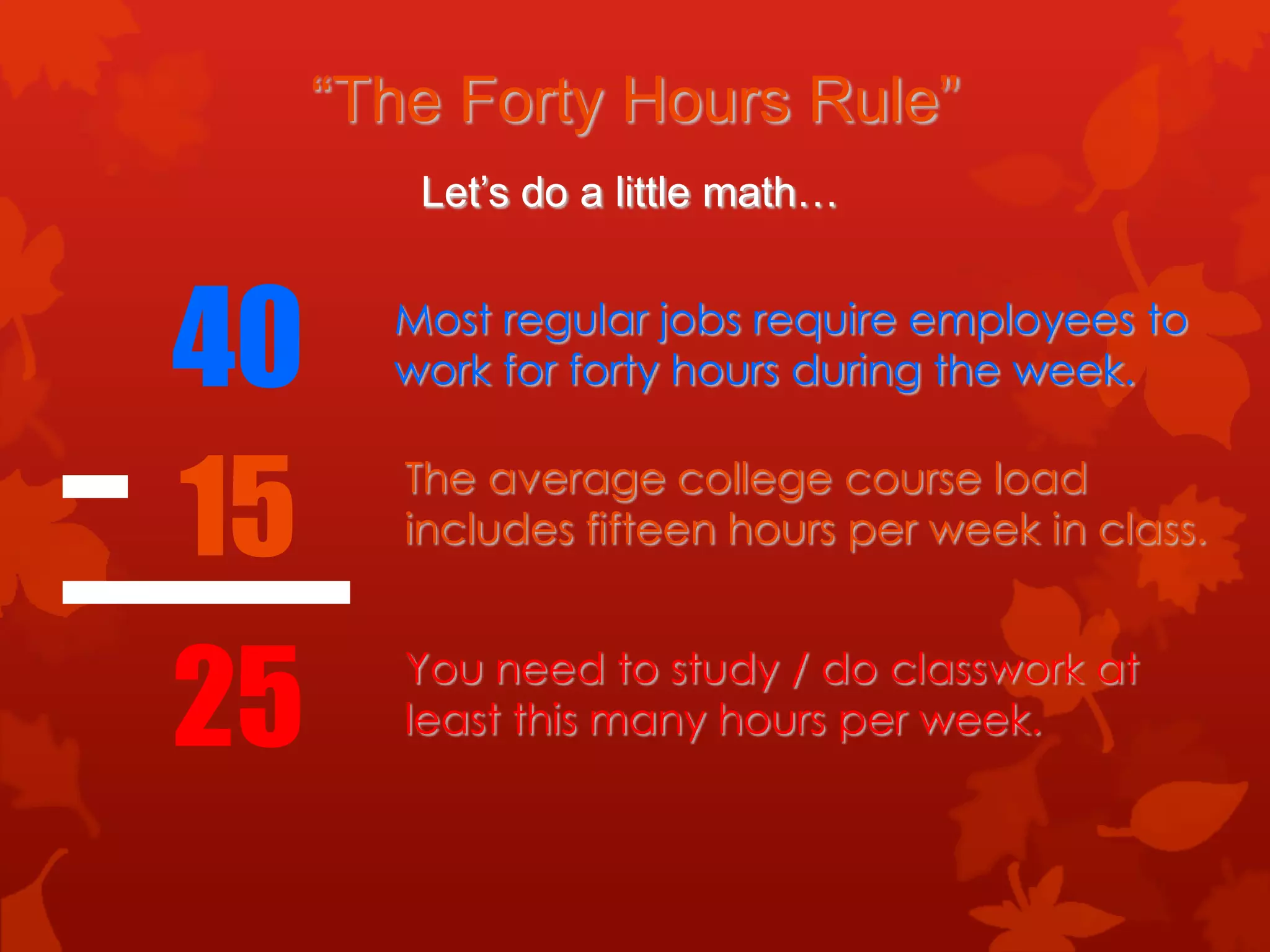
        Let’s do a little math…


40     Most regular jobs require employees to
       work for forty hours during the week.


15      The average college course load
        includes fifteen hours per week in class.


25      You need to study / do classwork at
        least this many hours per week.
The Requirements of Quality Studying


   Time                 Place          Conditions


          Preparation           Attitude
The Right Time
•Make and keep a regular study schedule.

•Set aside certain hours each day for class
 assignments.
•Remember “The Forty Hours Rule” – treat
 studying like a regular job.

•Manage how much time to study based on how
 well you know the material and how much you
 want to succeed.
The Right Place

•Study in the same place everyday.
•Choosing the correct place can eliminate
 concentration problems.
•Choose a place with ZERO distractions.
•Pick a spot for yourself – where do you study
 best?
•Group studying can be helpful, but remember
 you’re the one taking the test.
•Wherever you choose to study, make sure it is
 well-lit, quiet, and at a comfortable temperature.
The Right Conditions
•The right place is useless without the right
 surrounding conditions.
•You should study with ZERO distractions from:
       • music, television, movies, or video games
       • friends, classmates, and the telephone
       • computer, instant messenger
•Surrounding conditions include the proper
 equipment to study (chair, desk, light, notebooks,
 books, pens, and pencils – whatever you need).
•If you need a snack, take only a short break and
  eat something healthy, such as fruit.
Adequate Preparation
•Get organized before each study session. Ask
 yourself:
      •What am I going to study?
      •Do I have all the materials I need?

•Formulate a plan before you study. What is it that
 you are going to accomplish during this study
 time?
The Correct Attitude
•The only way to make studying successful is to
 recognize the need to study and then actually
 want to study because of it.
•Don’t wait for the great “Study Inspiration” - it is
 not coming!
•Don’t start to study while you’re stressed. You’ll
 get frustrated and it isn’t going to help de-stress
 you. Clear your mind for a little while and study
 when you can focus on studying.
•If you always do what you’ve always done, you’ll
  always get what you’ve always gotten!
Modifying Study Strategies for
      Different Classes
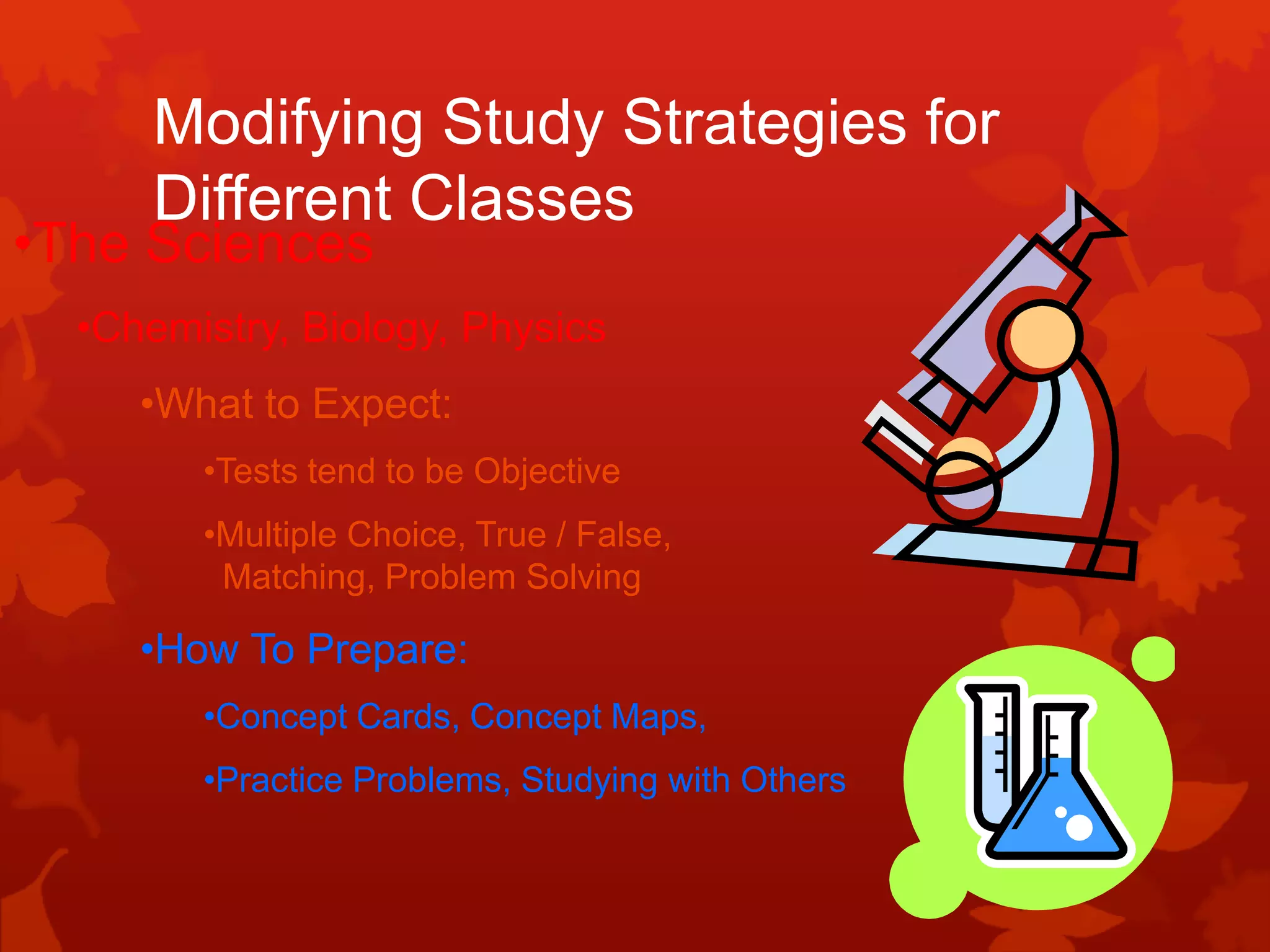
•The Sciences
  •Chemistry, Biology, Physics
     •What to Expect:
        •Tests tend to be Objective
        •Multiple Choice, True / False,
         Matching, Problem Solving

     •How To Prepare:
        •Concept Cards, Concept Maps,
        •Practice Problems, Studying with Others
Modifying Study Strategies for
   Different Classes
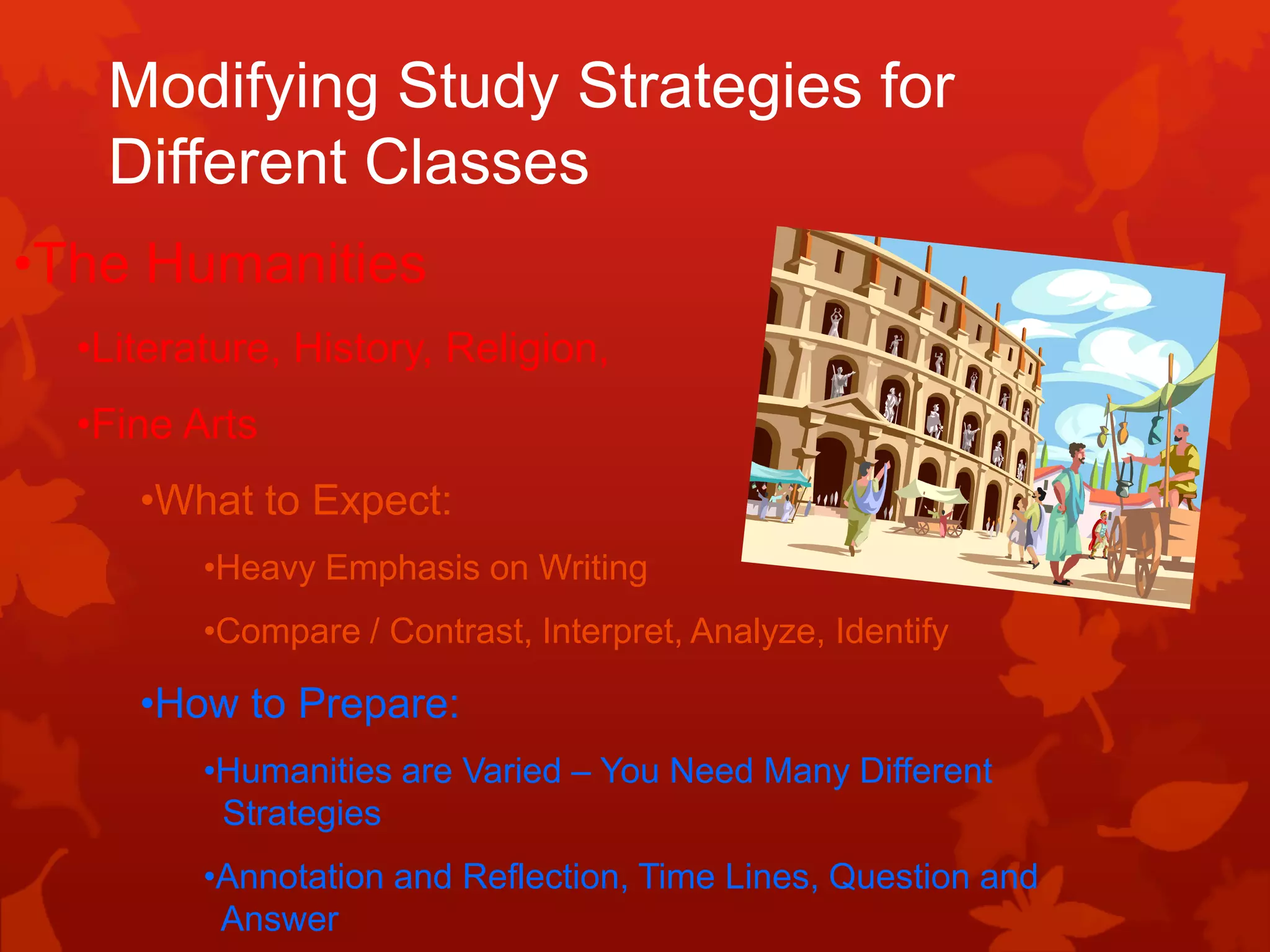
•The Humanities
  •Literature, History, Religion,
  •Fine Arts
     •What to Expect:
         •Heavy Emphasis on Writing
         •Compare / Contrast, Interpret, Analyze, Identify

     •How to Prepare:
         •Humanities are Varied – You Need Many Different
          Strategies
         •Annotation and Reflection, Time Lines, Question and
          Answer
Modifying Study Strategies for
   Different Classes
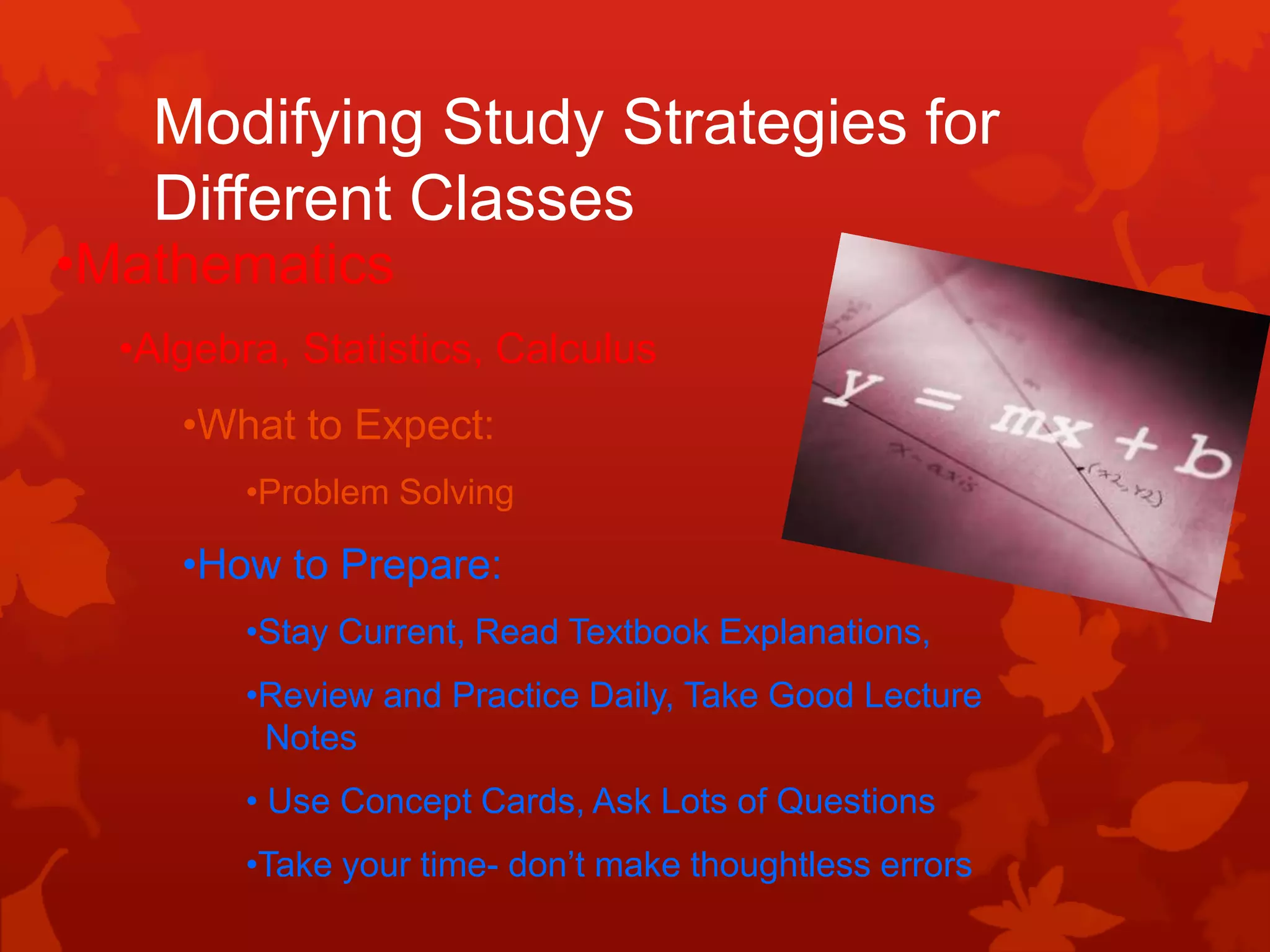
•Mathematics
  •Algebra, Statistics, Calculus
     •What to Expect:
         •Problem Solving

     •How to Prepare:
         •Stay Current, Read Textbook Explanations,
         •Review and Practice Daily, Take Good Lecture
          Notes
         • Use Concept Cards, Ask Lots of Questions
         •Take your time- don’t make thoughtless errors
Modifying Study Strategies for Different
  Classes
•Foreign Languages
  •Spanish, French, ASL
     •What to Expect:
        •Memorization
            Vocabulary, Grammar Rules, Sentence
             Construction
        •Dialogue

             Listening and Speaking

     •How to Prepare:
        •Do All Practice Activities,
        •Practice Speaking with Classmates,
        •Concept Cards, Get into the Culture with Festivals or Trips
Quick and Easy Study Tips
 Keep an organized              • Write notes in the margins of
  notebook.                        your textbook.
• Keep a careful record of
  assignments with the           • Become familiar with a
  syllabus and a planner.          chapter in the textbook
• Use flash cards to learn         before reading it - study the
  specialized vocabulary.          textbook in this order:
                                   titles, sub-titles, bold
• Use index dividers in your
                                   words, pictures, graphs, and
  notebook.
                                   then the text.
• Take good notes during
  lectures – the more you
                                 • Over-learn the material –
  write, the better!
                                   don’t just be able to recall it.
• Quiz yourself while studying
  – cover up the notes and see
  if you can repeat them out     • Review frequently.
  loud to yourself.              • Try acrostics, word
                                   associations, and jingles.
You’ve got to study to succeed!
We’re not all Rocket                     You can receive the
Scientists…most students                 grades you want by
won’t succeed in college             taking the time to study
without putting in the time             and prepare for your
and effort to study for their                        classes.
classes.


                        There are no miracle
                          secrets or magic
                      formulas for getting good
                              grades.

Study Skills

  • 1.
    STUDY SKills Lunch and Learn Student Success
  • 2.
    Worried that youdon’t really know the best ways to study? Concerned that you can study “hard” and still not earn good grades? Think that you should study biology the same way you study history?
  • 3.
    What is the rightway to study?
  • 4.
    The Basic Rules Studyingis necessary to succeed. You should approach You need to study at the studying in the way right time, at the right you would approach place, and under the a regular job, giving right conditions so that class and study time you will give yourself at least forty hours of adequate preparation your time every week. and maintain the correct attitude.
  • 5.
    “The Forty HoursRule” Let’s do a little math… 40 Most regular jobs require employees to work for forty hours during the week. 15 The average college course load includes fifteen hours per week in class. 25 You need to study / do classwork at least this many hours per week.
  • 6.
    The Requirements ofQuality Studying Time Place Conditions Preparation Attitude
  • 7.
    The Right Time •Makeand keep a regular study schedule. •Set aside certain hours each day for class assignments. •Remember “The Forty Hours Rule” – treat studying like a regular job. •Manage how much time to study based on how well you know the material and how much you want to succeed.
  • 8.
    The Right Place •Studyin the same place everyday. •Choosing the correct place can eliminate concentration problems. •Choose a place with ZERO distractions. •Pick a spot for yourself – where do you study best? •Group studying can be helpful, but remember you’re the one taking the test. •Wherever you choose to study, make sure it is well-lit, quiet, and at a comfortable temperature.
  • 9.
    The Right Conditions •Theright place is useless without the right surrounding conditions. •You should study with ZERO distractions from: • music, television, movies, or video games • friends, classmates, and the telephone • computer, instant messenger •Surrounding conditions include the proper equipment to study (chair, desk, light, notebooks, books, pens, and pencils – whatever you need). •If you need a snack, take only a short break and eat something healthy, such as fruit.
  • 10.
    Adequate Preparation •Get organizedbefore each study session. Ask yourself: •What am I going to study? •Do I have all the materials I need? •Formulate a plan before you study. What is it that you are going to accomplish during this study time?
  • 11.
    The Correct Attitude •Theonly way to make studying successful is to recognize the need to study and then actually want to study because of it. •Don’t wait for the great “Study Inspiration” - it is not coming! •Don’t start to study while you’re stressed. You’ll get frustrated and it isn’t going to help de-stress you. Clear your mind for a little while and study when you can focus on studying. •If you always do what you’ve always done, you’ll always get what you’ve always gotten!
  • 12.
    Modifying Study Strategiesfor Different Classes •The Sciences •Chemistry, Biology, Physics •What to Expect: •Tests tend to be Objective •Multiple Choice, True / False, Matching, Problem Solving •How To Prepare: •Concept Cards, Concept Maps, •Practice Problems, Studying with Others
  • 13.
    Modifying Study Strategiesfor Different Classes •The Humanities •Literature, History, Religion, •Fine Arts •What to Expect: •Heavy Emphasis on Writing •Compare / Contrast, Interpret, Analyze, Identify •How to Prepare: •Humanities are Varied – You Need Many Different Strategies •Annotation and Reflection, Time Lines, Question and Answer
  • 14.
    Modifying Study Strategiesfor Different Classes •Mathematics •Algebra, Statistics, Calculus •What to Expect: •Problem Solving •How to Prepare: •Stay Current, Read Textbook Explanations, •Review and Practice Daily, Take Good Lecture Notes • Use Concept Cards, Ask Lots of Questions •Take your time- don’t make thoughtless errors
  • 15.
    Modifying Study Strategiesfor Different Classes •Foreign Languages •Spanish, French, ASL •What to Expect: •Memorization Vocabulary, Grammar Rules, Sentence Construction •Dialogue  Listening and Speaking •How to Prepare: •Do All Practice Activities, •Practice Speaking with Classmates, •Concept Cards, Get into the Culture with Festivals or Trips
  • 16.
    Quick and EasyStudy Tips  Keep an organized • Write notes in the margins of notebook. your textbook. • Keep a careful record of assignments with the • Become familiar with a syllabus and a planner. chapter in the textbook • Use flash cards to learn before reading it - study the specialized vocabulary. textbook in this order: titles, sub-titles, bold • Use index dividers in your words, pictures, graphs, and notebook. then the text. • Take good notes during lectures – the more you • Over-learn the material – write, the better! don’t just be able to recall it. • Quiz yourself while studying – cover up the notes and see if you can repeat them out • Review frequently. loud to yourself. • Try acrostics, word associations, and jingles.
  • 17.
    You’ve got tostudy to succeed! We’re not all Rocket You can receive the Scientists…most students grades you want by won’t succeed in college taking the time to study without putting in the time and prepare for your and effort to study for their classes. classes. There are no miracle secrets or magic formulas for getting good grades.