Study Skills, Test-Taking Skills, and Test Anxiety How to Prepare for Trimester Exams
Planning for Success NO ONE PLANS TO FAIL… THEY JUST FAIL TO PLAN If you don’t have a study plan, you will not perform your best Persistent and responsible students achieve higher grades and score higher on tests Managing your study time is a key to success
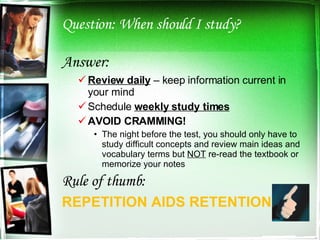
Question: When should I study? Answer: Review daily  – keep information current in your mind Schedule  weekly study times AVOID CRAMMING! The night before the test, you should only have to study difficult concepts and review main ideas and vocabulary terms but  NOT  re-read the textbook or memorize your notes Rule of thumb: REPETITION AIDS RETENTION
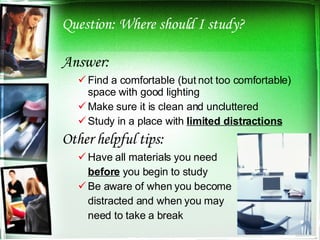
Question: Where should I study? Answer: Find a comfortable (but not too comfortable) space with good lighting Make sure it is clean and uncluttered Study in a place with  limited distractions Other helpful tips: Have all materials you need  before  you begin to study Be aware of when you become distracted and when you may  need to take a break
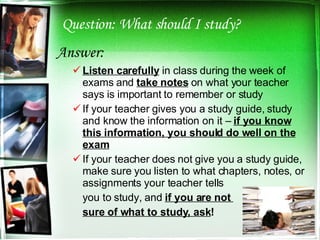
Question: What should I study? Answer: Listen carefully  in class during the week of exams and  take notes  on what your teacher says is important to remember or study If your teacher gives you a study guide, study and know the information on it –  if you know this information, you should do well on the exam If your teacher does not give you a study guide, make sure you listen to what chapters, notes, or assignments your teacher tells  you to study, and  if you are not  sure of what to study, ask !
Question: How should I study? Answer: Skim through  textbooks   and read through  notes  – try reading them aloud Re-write  notes and chapter summaries Examples: outlines, lists, flow charts, webs Review  study guides   and  quizzes Make  flashcards  for terms and key concepts Look for  connections  with what you already know Attend  review periods   held by  your teacher Organize a  study group   with  your friends – teach each other
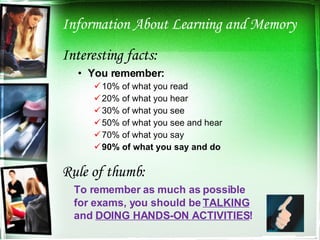
Information About Learning and Memory Interesting facts: You remember: 10% of what you read 20% of what you hear 30% of what you see 50% of what you see and hear 70% of what you say 90% of what you say and do Rule of thumb: To remember as much as possible  for exams, you should be  TALKING   and  DOING HANDS-ON ACTIVITIES !
General Test-Taking Strategies Glance through the entire test  before you begin Write down memory aids, formulas, equations, facts, or material you may forget  in the margins If you do not understand the directions or a question, raise your hand or go to your teacher and  ask for help Be sure you  read the question carefully  and that you are responding to the question asked Pace yourself  – don’t spend too  much time on any one question – when  stuck, do your best and move on Answer the  easiest questions first , then go back to questions you skipped
General Test-Taking Strategies (cont.) Underline the details  to help you focus on the important points of difficult questions Visualize  your notes, webs, flashcards, study guides, etc. when thinking about answers Check for clues  in other test questions If you are unsure of an answer, mark the item with a “?”  so you know to return to it later Don’t spend time rewriting answers  or worrying about neatness Don’t worry about who is finished before you Check all your answers  before  you turn in your test
Strategies for Multiple Choice Questions Read the  ENTIRE   question and  ALL  answer choices before marking an answer Underline key words  in the question Cross out choices  you know are incorrect Plug in your answer  – make sure it makes sense Do not change your answers unless you are certain your first answer choice is incorrect – in general,  your first instinct is usually correct Don’t look for answer patterns Answer every question ,  and if  you are unsure, make the most  intelligent guess you can – don’t leave any items blank!
Strategies for True/False Questions Read each question  carefully Words such as  no ,  none ,  never ,  every ,  only ,  all , and  always  tend to appear in statements that are  FALSE Example:   True or False?  It  always  snows in winter in St. Louis. Words such as  usually ,  not usually ,  most ,  some ,  generally ,  ordinarily ,  seldom ,  occasionally ,  often ,  sometimes , and  many   tend to appear in  TRUE  statements Example: True or False?  It  often  snows in  winter in St. Louis.
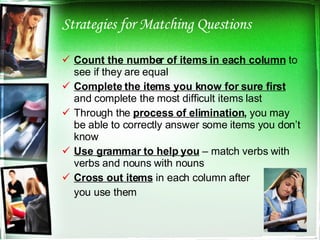
Strategies for Matching Questions Count the number of items in each column  to see if they are equal Complete the items you know for sure first  and complete the most difficult items last Through the  process of elimination ,  you may be able to correctly answer some items you don’t know Use grammar to help you  – match verbs with verbs and nouns with nouns Cross out items  in each column after you use them
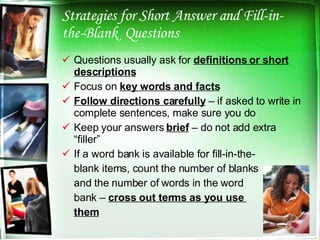
Strategies for Short Answer and Fill-in-the-Blank  Questions Questions usually ask for  definitions or short descriptions Focus on  key words and facts Follow directions carefully  – if asked to write in complete sentences, make sure you do Keep your answers  brief  – do not add extra “filler” If a word bank is available for fill-in-the- blank items, count the number of blanks and the number of words in the word bank –  cross out terms as you use  them
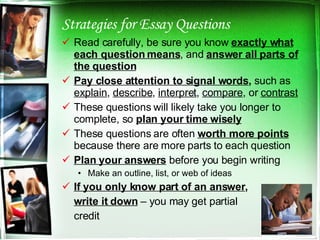
Strategies for Essay Questions Read carefully, be sure you know  exactly what each question means , and  answer all parts of the question Pay close attention to signal words ,  such as  explain ,  describe ,  interpret ,  compare , or  contrast These questions will likely take you longer to complete, so  plan your time wisely These questions are often  worth more points  because there are more parts to each question Plan your answers  before you begin writing Make an outline, list, or web of ideas If you only know part of an answer , write it down  – you may get partial credit
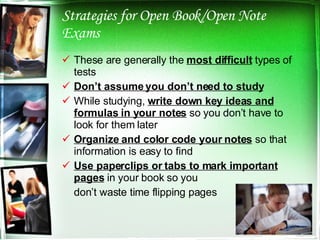
Strategies for Open Book/Open Note Exams These are generally the  most difficult  types of tests Don’t assume you don’t need to study While studying,  write down key ideas and formulas in your notes  so you don’t have to look for them later Organize and color code your notes  so that information is easy to find Use paperclips or tabs to mark important pages  in your book so you  don’t waste time flipping pages
Tips for Avoiding and Overcoming Test Anxiety Be  prepared  by studying a little each night Don’t wait until the last minute to study or ask for help Ask a parent or friend to quiz you with  practice tests Arrive a little bit early to class Think  positive  thoughts Visualize yourself in a peaceful place Relax  your muscles Take several  deep breaths
The Night and Morning Before Exams The night before: Review key concepts and any information that you have found difficult to remember Go to bed early, or at least on time, to make sure you get plenty of sleep The morning before: Eat a good breakfast Think positively  Try to leave home a little earlier than usual so that you arrive at school with plenty of time before exams begin
Key Points to Remember No one plans to fail, they just fail to plan Having a study plan in place will ensure that you are prepared, and when prepared, you will not fail Review study guides and study materials for short periods every day – don’t wait until the last minute! To maximize your memory for test material, recite information aloud, participate in study groups, and engage in hands-on activities Remember: You learn and remember the most from SAYING and DOING at the same time When stressed, relax and breathe deeply Read exam items carefully, ask for help when needed, pace yourself, and check your work
GOOD   LUCK   WITH   1 ST  TRIMESTER   EXAMS ! Questions or Comments? Remember to contact your teacher, advisor, or Mrs. O’Toole with any study or exam questions

Study Skills

  • 1.
    Study Skills, Test-TakingSkills, and Test Anxiety How to Prepare for Trimester Exams
  • 2.
    Planning for SuccessNO ONE PLANS TO FAIL… THEY JUST FAIL TO PLAN If you don’t have a study plan, you will not perform your best Persistent and responsible students achieve higher grades and score higher on tests Managing your study time is a key to success
  • 3.
    Question: When shouldI study? Answer: Review daily – keep information current in your mind Schedule weekly study times AVOID CRAMMING! The night before the test, you should only have to study difficult concepts and review main ideas and vocabulary terms but NOT re-read the textbook or memorize your notes Rule of thumb: REPETITION AIDS RETENTION
  • 4.
    Question: Where shouldI study? Answer: Find a comfortable (but not too comfortable) space with good lighting Make sure it is clean and uncluttered Study in a place with limited distractions Other helpful tips: Have all materials you need before you begin to study Be aware of when you become distracted and when you may need to take a break
  • 5.
    Question: What shouldI study? Answer: Listen carefully in class during the week of exams and take notes on what your teacher says is important to remember or study If your teacher gives you a study guide, study and know the information on it – if you know this information, you should do well on the exam If your teacher does not give you a study guide, make sure you listen to what chapters, notes, or assignments your teacher tells you to study, and if you are not sure of what to study, ask !
  • 6.
    Question: How shouldI study? Answer: Skim through textbooks and read through notes – try reading them aloud Re-write notes and chapter summaries Examples: outlines, lists, flow charts, webs Review study guides and quizzes Make flashcards for terms and key concepts Look for connections with what you already know Attend review periods held by your teacher Organize a study group with your friends – teach each other
  • 7.
    Information About Learningand Memory Interesting facts: You remember: 10% of what you read 20% of what you hear 30% of what you see 50% of what you see and hear 70% of what you say 90% of what you say and do Rule of thumb: To remember as much as possible for exams, you should be TALKING and DOING HANDS-ON ACTIVITIES !
  • 8.
    General Test-Taking StrategiesGlance through the entire test before you begin Write down memory aids, formulas, equations, facts, or material you may forget in the margins If you do not understand the directions or a question, raise your hand or go to your teacher and ask for help Be sure you read the question carefully and that you are responding to the question asked Pace yourself – don’t spend too much time on any one question – when stuck, do your best and move on Answer the easiest questions first , then go back to questions you skipped
  • 9.
    General Test-Taking Strategies(cont.) Underline the details to help you focus on the important points of difficult questions Visualize your notes, webs, flashcards, study guides, etc. when thinking about answers Check for clues in other test questions If you are unsure of an answer, mark the item with a “?” so you know to return to it later Don’t spend time rewriting answers or worrying about neatness Don’t worry about who is finished before you Check all your answers before you turn in your test
  • 10.
    Strategies for MultipleChoice Questions Read the ENTIRE question and ALL answer choices before marking an answer Underline key words in the question Cross out choices you know are incorrect Plug in your answer – make sure it makes sense Do not change your answers unless you are certain your first answer choice is incorrect – in general, your first instinct is usually correct Don’t look for answer patterns Answer every question , and if you are unsure, make the most intelligent guess you can – don’t leave any items blank!
  • 11.
    Strategies for True/FalseQuestions Read each question carefully Words such as no , none , never , every , only , all , and always tend to appear in statements that are FALSE Example: True or False? It always snows in winter in St. Louis. Words such as usually , not usually , most , some , generally , ordinarily , seldom , occasionally , often , sometimes , and many tend to appear in TRUE statements Example: True or False? It often snows in winter in St. Louis.
  • 12.
    Strategies for MatchingQuestions Count the number of items in each column to see if they are equal Complete the items you know for sure first and complete the most difficult items last Through the process of elimination , you may be able to correctly answer some items you don’t know Use grammar to help you – match verbs with verbs and nouns with nouns Cross out items in each column after you use them
  • 13.
    Strategies for ShortAnswer and Fill-in-the-Blank Questions Questions usually ask for definitions or short descriptions Focus on key words and facts Follow directions carefully – if asked to write in complete sentences, make sure you do Keep your answers brief – do not add extra “filler” If a word bank is available for fill-in-the- blank items, count the number of blanks and the number of words in the word bank – cross out terms as you use them
  • 14.
    Strategies for EssayQuestions Read carefully, be sure you know exactly what each question means , and answer all parts of the question Pay close attention to signal words , such as explain , describe , interpret , compare , or contrast These questions will likely take you longer to complete, so plan your time wisely These questions are often worth more points because there are more parts to each question Plan your answers before you begin writing Make an outline, list, or web of ideas If you only know part of an answer , write it down – you may get partial credit
  • 15.
    Strategies for OpenBook/Open Note Exams These are generally the most difficult types of tests Don’t assume you don’t need to study While studying, write down key ideas and formulas in your notes so you don’t have to look for them later Organize and color code your notes so that information is easy to find Use paperclips or tabs to mark important pages in your book so you don’t waste time flipping pages
  • 16.
    Tips for Avoidingand Overcoming Test Anxiety Be prepared by studying a little each night Don’t wait until the last minute to study or ask for help Ask a parent or friend to quiz you with practice tests Arrive a little bit early to class Think positive thoughts Visualize yourself in a peaceful place Relax your muscles Take several deep breaths
  • 17.
    The Night andMorning Before Exams The night before: Review key concepts and any information that you have found difficult to remember Go to bed early, or at least on time, to make sure you get plenty of sleep The morning before: Eat a good breakfast Think positively Try to leave home a little earlier than usual so that you arrive at school with plenty of time before exams begin
  • 18.
    Key Points toRemember No one plans to fail, they just fail to plan Having a study plan in place will ensure that you are prepared, and when prepared, you will not fail Review study guides and study materials for short periods every day – don’t wait until the last minute! To maximize your memory for test material, recite information aloud, participate in study groups, and engage in hands-on activities Remember: You learn and remember the most from SAYING and DOING at the same time When stressed, relax and breathe deeply Read exam items carefully, ask for help when needed, pace yourself, and check your work
  • 19.
    GOOD LUCK WITH 1 ST TRIMESTER EXAMS ! Questions or Comments? Remember to contact your teacher, advisor, or Mrs. O’Toole with any study or exam questions

Editor's Notes

  • #2 AO 2008-2009 11/3/2008