








Click to edit Master title style
I’m Not A Weed!
Study Smart –
Improving
Your Study
Skills
Study Smart –
Improving Your Study Skills
Proudly Presented by:
Alexandria von Ausdall, TAMUC
Petula Brown, Trinity
Randi Lou Franklin, Inter-Lingua
5
What’s getting in the way?
• Skill gaps
• Not knowing how to study
• Low self-confidence
• Disorganized
• Low motivation
• Lack of support
Understand your learning Style
• The auditive: You learn by listening.
• The visual: You learn by seeing text (reading) or by seeing
real or mental pictures.
• The tactual: You learn by using your hands and feet.
• The kinesthetic: You learn by using your whole body and / or
by involving yourself as a person.
Sensory modalities The Dunn & Dunn model.
10 Strategies
To Deal
With it All…
8
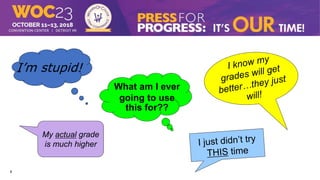
What am I ever
going to use
this for??
My actual grade
is much higher
I’m stupid!
9
1. BELIEVE IN YOURSELF !!
• Believe in your abilities
• Recognize your individual talents
• You have to want it!
• Develop the confidence to do well now AND for your future!
2. BE ORGANIZED
• Use an assignment notebook
• Use a 3-ring binder for class notes
• Use different folders for each class
• Have phone numbers for classmates; find out
what you’re missing
• Keep your study zone and backpack neat
• Get organized before going to bed
• Pick 1 day/week to reorganize yourself
11
3. MANAGE YOUR TIME WELL
• Use class time and study halls
• Create your own study plan
• Homework DOES NOT = Studying!
• Plan for a ½ hour of homework & studying PER DAY, PER SUBJECT!
• Prepare for things that may go wrong
• Make it fun! Get a group together and order pizza; studying is
not an ugly requirement – it’s a good investment
• Reward yourself!!!
12
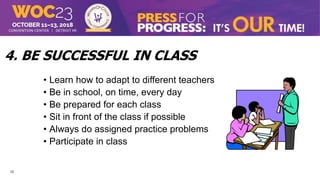
4. BE SUCCESSFUL IN CLASS
• Learn how to adapt to different teachers
• Be in school, on time, every day
• Be prepared for each class
• Sit in front of the class if possible
• Always do assigned practice problems
• Participate in class
13
5. TAKE GOOD NOTES
• Preview material the night before
• Be an active listener
• Are you only writing down what you see on this screen or are you
actually listening to the information being relayed?
• Recognize important information
• Get lecture notes if you are absent
• Create a mind map, make flash cards, use mnemonics
• Go over your notes as soon as possible
• Rewrite if necessary
14
6. USE GOOD READING TECHNIQUES
• SQ3R
• Survey: titles, headings, pictures, graphs, charts, etc.
• Question: turn boldfaced subtitles into questions
• Read: read with the purpose of answering your
questions
• Recite: stop periodically to check for your
understanding
• Review: go back to answer your questions, answer
chapter questions, review material a little
every night
Recall in the Hall
• Recall key points of previous lecture while going to
next location
• Relate material covered to past concepts and
future associations
• Use flash cards to test yourself while waiting in
lines, eating, at the gym, doing laundry etc. . .
• Use association and pictures as memory anchors
16
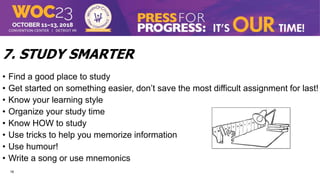
7. STUDY SMARTER
• Find a good place to study
• Get started on something easier, don’t save the most difficult assignment for last!
• Know your learning style
• Organize your study time
• Know HOW to study
• Use tricks to help you memorize information
• Use humour!
• Write a song or use mnemonics
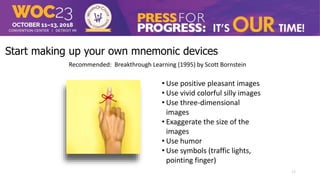
Start making up your own mnemonic devices
Recommended: Breakthrough Learning (1995) by Scott Bornstein
• Use positive pleasant images
• Use vivid colorful silly images
• Use three-dimensional
images
• Exaggerate the size of the
images
• Use humor
• Use symbols (traffic lights,
pointing finger)
17
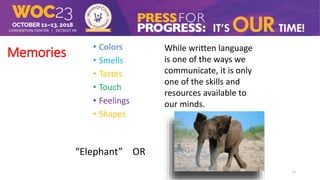
Memories • Colors
• Smells
• Tastes
• Touch
• Feelings
• Shapes
18
While written language
is one of the ways we
communicate, it is only
one of the skills and
resources available to
our minds.
“Elephant” OR
By using all your senses, but especially your ability to create
visual images, you can increase your power to memorize.
Researchers say:
DEVELOP TEST-TAKING STRATEGIES
• Do not cram, study material daily and methodically
• Be prepared … eat before test … then relax
• Develop a plan how to approach the test
• Read ALL your answer choices
• Mark questions you want to return to
• Don’t spend too much time on a single problem
• Increase your odds on multiple choice
• Try to “Predict”/estimate the answer first
• Eliminate choices you KNOW are incorrect
21
9. REDUCE TEST ANXIETY
• Study enough to feel confident
• Get a good night’s sleep
• Mentally practice going
through the test
• Be confident and think
positively!
22
10. GET HELP WHEN YOU NEED IT
• Professors
• Guidance counselor/ advisor
• Peers / study groups
• Parents / family (allow them to help)
• Library / Internet research
• Outside tutoring professionals
Questions?

Study Smart, Study Less – Improving Your Study Skills

  • 1.
    Click to editMaster title style
  • 2.
    I’m Not AWeed! Study Smart – Improving Your Study Skills
  • 3.
    Study Smart – ImprovingYour Study Skills Proudly Presented by: Alexandria von Ausdall, TAMUC Petula Brown, Trinity Randi Lou Franklin, Inter-Lingua
  • 4.
    5 What’s getting inthe way? • Skill gaps • Not knowing how to study • Low self-confidence • Disorganized • Low motivation • Lack of support
  • 5.
    Understand your learningStyle • The auditive: You learn by listening. • The visual: You learn by seeing text (reading) or by seeing real or mental pictures. • The tactual: You learn by using your hands and feet. • The kinesthetic: You learn by using your whole body and / or by involving yourself as a person. Sensory modalities The Dunn & Dunn model.
  • 6.
  • 7.
    8 What am Iever going to use this for?? My actual grade is much higher I’m stupid!
  • 8.
    9 1. BELIEVE INYOURSELF !! • Believe in your abilities • Recognize your individual talents • You have to want it! • Develop the confidence to do well now AND for your future!
  • 9.
    2. BE ORGANIZED •Use an assignment notebook • Use a 3-ring binder for class notes • Use different folders for each class • Have phone numbers for classmates; find out what you’re missing • Keep your study zone and backpack neat • Get organized before going to bed • Pick 1 day/week to reorganize yourself
  • 10.
    11 3. MANAGE YOURTIME WELL • Use class time and study halls • Create your own study plan • Homework DOES NOT = Studying! • Plan for a ½ hour of homework & studying PER DAY, PER SUBJECT! • Prepare for things that may go wrong • Make it fun! Get a group together and order pizza; studying is not an ugly requirement – it’s a good investment • Reward yourself!!!
  • 11.
    12 4. BE SUCCESSFULIN CLASS • Learn how to adapt to different teachers • Be in school, on time, every day • Be prepared for each class • Sit in front of the class if possible • Always do assigned practice problems • Participate in class
  • 12.
    13 5. TAKE GOODNOTES • Preview material the night before • Be an active listener • Are you only writing down what you see on this screen or are you actually listening to the information being relayed? • Recognize important information • Get lecture notes if you are absent • Create a mind map, make flash cards, use mnemonics • Go over your notes as soon as possible • Rewrite if necessary
  • 13.
    14 6. USE GOODREADING TECHNIQUES • SQ3R • Survey: titles, headings, pictures, graphs, charts, etc. • Question: turn boldfaced subtitles into questions • Read: read with the purpose of answering your questions • Recite: stop periodically to check for your understanding • Review: go back to answer your questions, answer chapter questions, review material a little every night
  • 14.
    Recall in theHall • Recall key points of previous lecture while going to next location • Relate material covered to past concepts and future associations • Use flash cards to test yourself while waiting in lines, eating, at the gym, doing laundry etc. . . • Use association and pictures as memory anchors
  • 15.
    16 7. STUDY SMARTER •Find a good place to study • Get started on something easier, don’t save the most difficult assignment for last! • Know your learning style • Organize your study time • Know HOW to study • Use tricks to help you memorize information • Use humour! • Write a song or use mnemonics
  • 16.
    Start making upyour own mnemonic devices Recommended: Breakthrough Learning (1995) by Scott Bornstein • Use positive pleasant images • Use vivid colorful silly images • Use three-dimensional images • Exaggerate the size of the images • Use humor • Use symbols (traffic lights, pointing finger) 17
  • 17.
    Memories • Colors •Smells • Tastes • Touch • Feelings • Shapes 18 While written language is one of the ways we communicate, it is only one of the skills and resources available to our minds. “Elephant” OR
  • 18.
    By using allyour senses, but especially your ability to create visual images, you can increase your power to memorize. Researchers say:
  • 19.
    DEVELOP TEST-TAKING STRATEGIES •Do not cram, study material daily and methodically • Be prepared … eat before test … then relax • Develop a plan how to approach the test • Read ALL your answer choices • Mark questions you want to return to • Don’t spend too much time on a single problem • Increase your odds on multiple choice • Try to “Predict”/estimate the answer first • Eliminate choices you KNOW are incorrect
  • 20.
    21 9. REDUCE TESTANXIETY • Study enough to feel confident • Get a good night’s sleep • Mentally practice going through the test • Be confident and think positively!
  • 21.
    22 10. GET HELPWHEN YOU NEED IT • Professors • Guidance counselor/ advisor • Peers / study groups • Parents / family (allow them to help) • Library / Internet research • Outside tutoring professionals
  • 22.

Editor's Notes

  • #3 Discuss and dispel the “weed out course” perception
  • #7 What time of day do you learn best? Understanding your circadian rhythm helps optimize learning ability
  • #9 We must take control of our self-talk.