Study Skills Study Skills Support for International Students
Becoming an independent learner While you are studying your vocational course YOU are responsible for your learning. You will need to be an independent learner. As an independent learner you are expected to:  process information evaluate what you read ask questions and form opinions manage your time effectively
Managing your time  What are your commitments: Work Classes Study Family/friends Relaxation
What is your current approach How do you manage your time? Do you like routine? Are you always on time? Do you like organising your time and writing up “to do” lists? Do you leave things to the last minute? Every person has a different method of study but there are some guidelines which help everyone’s study.
Planning your time  Yearly planner: for all important dates and deadlines  Weekly planning: use a chart divided into 1 hour blocks Daily timetable: use your diary and make ‘to do lists’
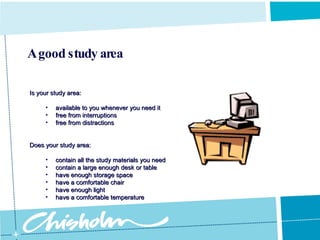
A good study area Is your study area: available to you whenever you need it free from interruptions free from distractions Does your study area: contain all the study materials you need contain a large enough desk or table have enough storage space have a comfortable chair have enough light have a comfortable temperature
Communication skills Planning and delivering an oral presentation Asking questions and being confident to speak up  Listening to lectures and understanding them  Working in a group  Planning and negotiating teamwork Communicating more confidently
Reading & note taking skills  Taking  fast  and  useful   lecture notes Reading effectively  Reading critically – asking questions like:  What position is the writer presenting? What evidence is the writer giving to support his/her position? Is the evidence presented accurately? Has the evidence been collected using appropriate methods? Do I agree or disagree with the writer’s point of view? Taking notes when reading – underline, annotate, summarise
Skills for completing assignments Understanding and meeting the assessment criteria Planning better essays and reports Researching, referencing, bibliographies –  Harvard referencing Avoiding  plagiarism
Plagiarism What is plagiarism? Plagiarism is when you copy someone else’s work without referencing or recognising that the work is not yours.  When should you reference?  Any time you use the work of someone else from a book, internet site, journal etc. Any time you use someone else’s ideas in your work. Plagiarism is a kind of stealing!

Study Skills Powerpoint

  • 1.
    Study Skills StudySkills Support for International Students
  • 2.
    Becoming an independentlearner While you are studying your vocational course YOU are responsible for your learning. You will need to be an independent learner. As an independent learner you are expected to: process information evaluate what you read ask questions and form opinions manage your time effectively
  • 3.
    Managing your time What are your commitments: Work Classes Study Family/friends Relaxation
  • 4.
    What is yourcurrent approach How do you manage your time? Do you like routine? Are you always on time? Do you like organising your time and writing up “to do” lists? Do you leave things to the last minute? Every person has a different method of study but there are some guidelines which help everyone’s study.
  • 5.
    Planning your time Yearly planner: for all important dates and deadlines Weekly planning: use a chart divided into 1 hour blocks Daily timetable: use your diary and make ‘to do lists’
  • 6.
    A good studyarea Is your study area: available to you whenever you need it free from interruptions free from distractions Does your study area: contain all the study materials you need contain a large enough desk or table have enough storage space have a comfortable chair have enough light have a comfortable temperature
  • 7.
    Communication skills Planningand delivering an oral presentation Asking questions and being confident to speak up Listening to lectures and understanding them Working in a group Planning and negotiating teamwork Communicating more confidently
  • 8.
    Reading & notetaking skills Taking fast and useful lecture notes Reading effectively Reading critically – asking questions like: What position is the writer presenting? What evidence is the writer giving to support his/her position? Is the evidence presented accurately? Has the evidence been collected using appropriate methods? Do I agree or disagree with the writer’s point of view? Taking notes when reading – underline, annotate, summarise
  • 9.
    Skills for completingassignments Understanding and meeting the assessment criteria Planning better essays and reports Researching, referencing, bibliographies – Harvard referencing Avoiding plagiarism
  • 10.
    Plagiarism What isplagiarism? Plagiarism is when you copy someone else’s work without referencing or recognising that the work is not yours. When should you reference? Any time you use the work of someone else from a book, internet site, journal etc. Any time you use someone else’s ideas in your work. Plagiarism is a kind of stealing!