Study Skills
Motivation
Motivation is influenced by both
internal and external factors.
Motivation is not a stable trait.
It is not an innate part of your character.
Motivation can be improved!
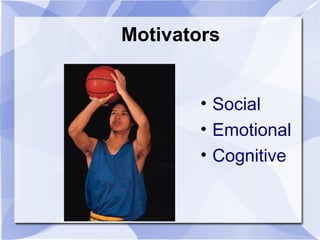
Motivators
• Social
• Emotional
• Cognitive
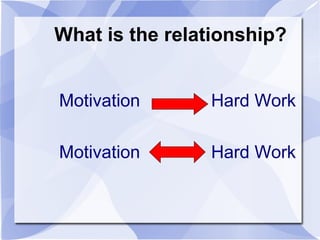
What is the relationship?
Motivation Hard Work
How to manage your time more
effectively
• Ownership of your time
• Planning your schedule
– Know your daily alertness pattern
– Allow sufficient time for each aspect/subject
– Long term
– Intermediate
– Short term
– Making your schedule work!
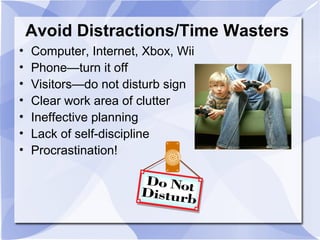
Avoid Distractions/Time Wasters
• Computer, Internet, Xbox, Wii
• Phone—turn it off
• Visitors—do not disturb sign
• Clear work area of clutter
• Ineffective planning
• Lack of self-discipline
• Procrastination!
Procrastination
• Why do we
procrastinate?
– Perfectionism
– Fear of failure
– Fear of success
– Laziness
– Rebellion
Tips on overcoming procrastination
• Set personal
contract/goals
• “Five minute” Plan
• Reminders
• Routine
• Do it when you think of it!
• Remind yourself of the
consequences of
procrastination
When to Review
• Frequently during
the semester
• Attend study
sessions run by the
professor
• Schedule several
final review sessions
—not one long one
• The night before–
briefly review main
points and get
some sleep
• Do not study
immediately before
test time
Ways to improve studying
• Develop a schedule
• Study one subject
for one hour at a
time
• Keep all materials
for one class in
same notebook
• Have a purpose
• Predict possible ?’s
• Go over previous
tests (if available)
• Make Charts
Ways to improve studying—continued
• Use visual aids
• Instead of
highlighting, use
SQ4R
– Summarize,
Question, Read,
Recite, Review,
‘Riting
• Avoid Cramming
• Make information
personally
meaningful
• Method of Loci
• Quiz yourself
frequently and in the
way you will be
tested
• Get help when
struggling
SQ4R Method
• S = Survey
Look for structure & organization of chapter
• Q = Question
Turn each heading into question
• 4 R’s = Reading, Reciting, Reviewing. & 'Riting
Read to answer above question
Recite the answer to question
• R = Review – immediate & delayed
Survey: Get the “Big Picture”
• What reader aids are included in the text?
• Read all the titles and subtitles.
• Read captions under pictures, charts,
graphs, or maps.
• Read the questions at the end of the chapter.
• If there is a summary read it.
• Get an overview of what the chapter is about.
Question: Reading for Specific
Purpose
• Turn each title and subtitle into a
question.
• What questions will the chapter
answer?
• Ask questions that your teacher would
ask.
• Ask yourself, "What did my teacher say
about this chapter or topic when it was
assigned?“
• What do I already know about this
topic?
Read: Active Search of
Answers
• What is the writer’s
purpose?
• Reduce your speed for
difficult passages.
• Stop and reread parts
that are not clear.
Recite: Put it your own words
• Ask yourself questions
about what was just
read and/or summarize,
in your own words,
what was read.
Review
• Students should study their
outlines and notes and be
able to retell what was read
in their own words.
• Read your notes and then
quiz yourself.
• Make frequent review part
of your study habits.
Reflect: Making Links
• Link to previous
knowledge
• How you can use this
information?
• What else you need
to know more about?
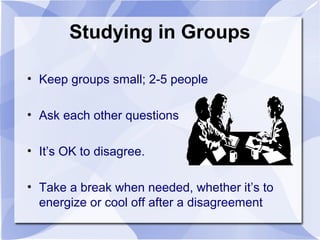
Studying in Groups
• Keep groups small; 2-5 people
• Ask each other questions
• It’s OK to disagree.
• Take a break when needed, whether it’s to
energize or cool off after a disagreement
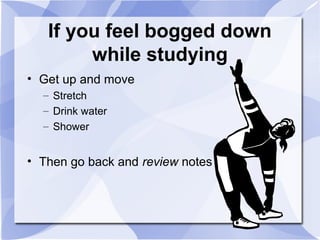
If you feel bogged down
while studying
• Get up and move
– Stretch
– Drink water
– Shower
• Then go back and review notes
Keep yourself in good
shape
• Get plenty of sleep
• Eat nutritious meals
• Exercise
• Take time out for fun
• Play hard, study hard, and don’t worry about
one while doing the other
Where to study
Set the right atmosphere
– Be comfortable
– Organized work area
– Assemble all required materials
– Use a clean, clear work space
– Avoid distractions: QUIET!
Study Environment
• Keep regular study hours
• Try to study in the same
place every time – this will
train your mind for “work
mode”
• Be comfortable, but not too
comfortable
• Try to study under same
conditions as when you will
take the exam

Study Skills

  • 1.
  • 2.
    Motivation Motivation is influencedby both internal and external factors. Motivation is not a stable trait. It is not an innate part of your character. Motivation can be improved!
  • 3.
  • 4.
    What is therelationship? Motivation Hard Work Motivation Hard Work
  • 5.
    How to manageyour time more effectively • Ownership of your time • Planning your schedule – Know your daily alertness pattern – Allow sufficient time for each aspect/subject – Long term – Intermediate – Short term – Making your schedule work!
  • 6.
    Avoid Distractions/Time Wasters •Computer, Internet, Xbox, Wii • Phone—turn it off • Visitors—do not disturb sign • Clear work area of clutter • Ineffective planning • Lack of self-discipline • Procrastination!
  • 7.
    Procrastination • Why dowe procrastinate? – Perfectionism – Fear of failure – Fear of success – Laziness – Rebellion
  • 8.
    Tips on overcomingprocrastination • Set personal contract/goals • “Five minute” Plan • Reminders • Routine • Do it when you think of it! • Remind yourself of the consequences of procrastination
  • 9.
    When to Review •Frequently during the semester • Attend study sessions run by the professor • Schedule several final review sessions —not one long one • The night before– briefly review main points and get some sleep • Do not study immediately before test time
  • 10.
    Ways to improvestudying • Develop a schedule • Study one subject for one hour at a time • Keep all materials for one class in same notebook • Have a purpose • Predict possible ?’s • Go over previous tests (if available) • Make Charts
  • 11.
    Ways to improvestudying—continued • Use visual aids • Instead of highlighting, use SQ4R – Summarize, Question, Read, Recite, Review, ‘Riting • Avoid Cramming • Make information personally meaningful • Method of Loci • Quiz yourself frequently and in the way you will be tested • Get help when struggling
  • 12.
    SQ4R Method • S= Survey Look for structure & organization of chapter • Q = Question Turn each heading into question • 4 R’s = Reading, Reciting, Reviewing. & 'Riting Read to answer above question Recite the answer to question • R = Review – immediate & delayed
  • 13.
    Survey: Get the“Big Picture” • What reader aids are included in the text? • Read all the titles and subtitles. • Read captions under pictures, charts, graphs, or maps. • Read the questions at the end of the chapter. • If there is a summary read it. • Get an overview of what the chapter is about.
  • 14.
    Question: Reading forSpecific Purpose • Turn each title and subtitle into a question. • What questions will the chapter answer? • Ask questions that your teacher would ask. • Ask yourself, "What did my teacher say about this chapter or topic when it was assigned?“ • What do I already know about this topic?
  • 15.
    Read: Active Searchof Answers • What is the writer’s purpose? • Reduce your speed for difficult passages. • Stop and reread parts that are not clear.
  • 16.
    Recite: Put ityour own words • Ask yourself questions about what was just read and/or summarize, in your own words, what was read.
  • 17.
    Review • Students shouldstudy their outlines and notes and be able to retell what was read in their own words. • Read your notes and then quiz yourself. • Make frequent review part of your study habits.
  • 18.
    Reflect: Making Links •Link to previous knowledge • How you can use this information? • What else you need to know more about?
  • 19.
    Studying in Groups •Keep groups small; 2-5 people • Ask each other questions • It’s OK to disagree. • Take a break when needed, whether it’s to energize or cool off after a disagreement
  • 20.
    If you feelbogged down while studying • Get up and move – Stretch – Drink water – Shower • Then go back and review notes
  • 21.
    Keep yourself ingood shape • Get plenty of sleep • Eat nutritious meals • Exercise • Take time out for fun • Play hard, study hard, and don’t worry about one while doing the other
  • 22.
    Where to study Setthe right atmosphere – Be comfortable – Organized work area – Assemble all required materials – Use a clean, clear work space – Avoid distractions: QUIET!
  • 23.
    Study Environment • Keepregular study hours • Try to study in the same place every time – this will train your mind for “work mode” • Be comfortable, but not too comfortable • Try to study under same conditions as when you will take the exam

Editor's Notes

  • #3 Things both inside you and outside you can affect your motivation level. Outside – peer pressure, parental pressure Inside – Your beliefs about your ability;sick Stable – does not stay the same Innate – not part of who you are at birth You can learn to adjust your motivation levels. “I’m just not motivated!” You are motivated to do something like sit on the couch and watch TV. We are all motivated to eat, sleep.
  • #4 Social – Your perception of pressures from people around you This BB player may feel pressure from coaches, parents or girlfriend to achieve – to be a starter.So, he is motivated to practice. Emotional- Bb player may feel appreciated/success on the BB court more than other places. Cognitive – BB player may believe this is his way to stay in college – scholarship. Without it he can not attend! Very motivating!
  • #5 There is a fundamental difference in the way students think about academic success. Most would say – Motivation leads to hard work –TRUE BUT, it is also true that Hard Work can lead to motivation! As you begin to taste success, you will want more of it and be MOTIVATED to get more. Discipline – Choosing to do something even though you don’t want to do it/don’t feel like it!
  • #9 Bits and pieces
  • #10 Review subjects daily and weekly anxiety and memory loss may develop if you study right before
  • #12 Get help when struggling Tutors, disability assistance, academic and/or personal counselors
  • #20 Explaining a concept to another person helps you learn more effectively People are going to have different ideas, especially when drawing conclusions
  • #24 Ask the students – Positive study environment? Study hours – set a weekly schedule (TIME MGMT) Comfortable – Library? Where else? Work space – not cluttered ; Materials: have everything you need so you will not be interrupted. Distractions – What are distractions for you? Computer email, telephone, radio, sleep