Chapter 3
Critical Thinking Fall 2013
Persuading or reasoning?
• What is this business about reason?
• What is the difference between believing
something because of psychological
factors and believing it because it is
worthy of belief?
Arguments
• How do the premises support the
conclusion (what kind of support do they
provide)?
– Deductive
– Inductive
Deductive arguments
• The premises are intended to provide
conclusive support for the conclusion.
• Do they?
– If the answer is “yes” then we call the
argument valid.
– If the answer is “no” we call the argument
invalid.
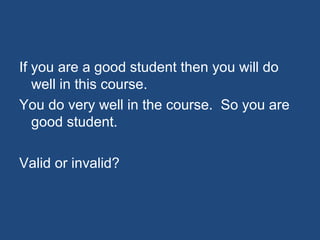
If you are a good student then you will do
well in this course.
You do very well in the course. So you are
good student.
Valid or invalid?
Validity
• The logical structure of the argument
guarantees the truth of the conclusion if
the premises are true.
• It’s not the content; it’s the structure.
Any combination of truth of the claims
EXCEPT…
• The conclusion cannot be false when the
premises are true in a valid argument.
Inductive arguments
• An inductive argument intends to provide
probable – not conclusive – support for
the conclusion.
– I am usually late if I stop for coffee. I stopped
for coffee so I am likely to be late this
morning.
• The intention is that the truth of the
premises makes it probable that the
conclusion is true.
• An inductive argument that carries out this
intention is strong.
Strong and weak inductive arguments
• An inductive argument is strong if the
conclusion is very probably true if the
premises are true.
• An inductive argument is weak if it is not
strong.
Sound or cogent?
• A deductive argument is sound if the
premises are true and the argument is
valid.
• An inductive argument is cogent if the
premises are true and the argument is
strong.
Judging Arguments: Four steps
• Step 1. Find the argument’s conclusion and
premises.
• Step 2. Ask: Is it deductive (if the premises were
true would the conclusion have to be true)? If so,
it is valid, but is it sound?
• Step 3. Ask: Is it inductive (if the premises were
true would the conclusion probably be true)? If
so, it is strong, but is it cogent?
• Step 4. Ask: Is the argument invalid or weak?
Missing premises
• Step 1. Search for credible premises that would
make the argument valid.
– Choose the premise that
a. is most plausible
b. fits best with the author’s intent
What you are doing is “repairing the argument”. But
not every argument can be repaired. Weak or invalid
arguments cannot be, nor can arguments that have
false conclusions or false premises that cannot be
eliminated.
• Step 2. Search for a credible premise that
would make the argument as strong as
possible.
• Step 3. Evaluate the reconstituted argument.
Common argument patterns
Arguments using conditional claims:
If p, then q.
Conditional claims are composed of two claims
joined by If…then… .
The “if” part is the antecedent and the “then”
part is the consequent.
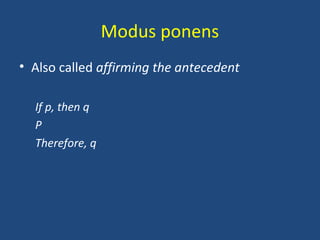
Modus ponens
• Also called affirming the antecedent
If p, then q
P
Therefore, q
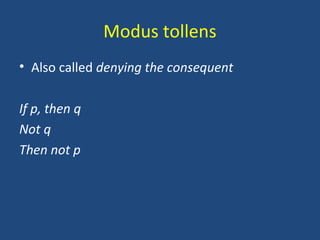
Modus tollens
• Also called denying the consequent
If p, then q
Not q
Then not p
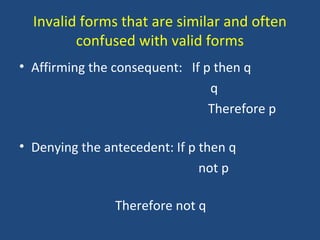
Invalid forms that are similar and often
confused with valid forms
• Affirming the consequent: If p then q
q
Therefore p
• Denying the antecedent: If p then q
not p
Therefore not q
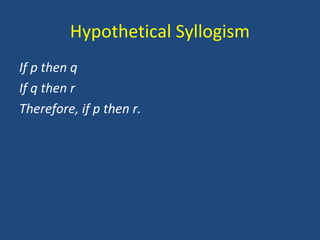
Hypothetical Syllogism
If p then q
If q then r
Therefore, if p then r.
Another form: Disjunctive claims
• Disjunctive syllogism:
Either p or q.
Not p.
Therefore q.

Chapter 3

  • 1.
  • 2.
    Persuading or reasoning? •What is this business about reason? • What is the difference between believing something because of psychological factors and believing it because it is worthy of belief?
  • 3.
    Arguments • How dothe premises support the conclusion (what kind of support do they provide)? – Deductive – Inductive
  • 4.
    Deductive arguments • Thepremises are intended to provide conclusive support for the conclusion. • Do they? – If the answer is “yes” then we call the argument valid. – If the answer is “no” we call the argument invalid.
  • 5.
    If you area good student then you will do well in this course. You do very well in the course. So you are good student. Valid or invalid?
  • 6.
    Validity • The logicalstructure of the argument guarantees the truth of the conclusion if the premises are true. • It’s not the content; it’s the structure.
  • 7.
    Any combination oftruth of the claims EXCEPT… • The conclusion cannot be false when the premises are true in a valid argument.
  • 8.
    Inductive arguments • Aninductive argument intends to provide probable – not conclusive – support for the conclusion. – I am usually late if I stop for coffee. I stopped for coffee so I am likely to be late this morning.
  • 9.
    • The intentionis that the truth of the premises makes it probable that the conclusion is true. • An inductive argument that carries out this intention is strong.
  • 10.
    Strong and weakinductive arguments • An inductive argument is strong if the conclusion is very probably true if the premises are true. • An inductive argument is weak if it is not strong.
  • 11.
    Sound or cogent? •A deductive argument is sound if the premises are true and the argument is valid. • An inductive argument is cogent if the premises are true and the argument is strong.
  • 12.
    Judging Arguments: Foursteps • Step 1. Find the argument’s conclusion and premises. • Step 2. Ask: Is it deductive (if the premises were true would the conclusion have to be true)? If so, it is valid, but is it sound? • Step 3. Ask: Is it inductive (if the premises were true would the conclusion probably be true)? If so, it is strong, but is it cogent? • Step 4. Ask: Is the argument invalid or weak?
  • 13.
    Missing premises • Step1. Search for credible premises that would make the argument valid. – Choose the premise that a. is most plausible b. fits best with the author’s intent What you are doing is “repairing the argument”. But not every argument can be repaired. Weak or invalid arguments cannot be, nor can arguments that have false conclusions or false premises that cannot be eliminated.
  • 14.
    • Step 2.Search for a credible premise that would make the argument as strong as possible. • Step 3. Evaluate the reconstituted argument.
  • 15.
    Common argument patterns Argumentsusing conditional claims: If p, then q. Conditional claims are composed of two claims joined by If…then… . The “if” part is the antecedent and the “then” part is the consequent.
  • 16.
    Modus ponens • Alsocalled affirming the antecedent If p, then q P Therefore, q
  • 17.
    Modus tollens • Alsocalled denying the consequent If p, then q Not q Then not p
  • 18.
    Invalid forms thatare similar and often confused with valid forms • Affirming the consequent: If p then q q Therefore p • Denying the antecedent: If p then q not p Therefore not q
  • 19.
    Hypothetical Syllogism If pthen q If q then r Therefore, if p then r.
  • 20.
    Another form: Disjunctiveclaims • Disjunctive syllogism: Either p or q. Not p. Therefore q.