Emerging Technologies
EMTE(1012)
Chapters
Chapter 1: Introduction to Emerging Technologies
Chapter 2: Data Science
Chapter 3: Artificial Intelligence (AI)
Chapter 4: Internet of Things (IoT)
Chapter 5: Augmented Reality (AR)
Chapter 6: Ethics and professionalism of emerging technologies
Chapter 7: Other emerging technologies
Chapter 1:
Introduction to Emerging Technologies
After completing this chapter, the students will be able to:
➢ Develop knowledge about the era of industrial evolutions
➢ Identify the technological advances that made the industrial revolution possible
➢ Analyze the changing conditions created by the industrial revolution in both Europe
and the united states
➢ Understand the causes of the Industrial Revolution in Great Britain, continental
Europe, and the United States.
➢ Describe the technological innovations that spurred industrialization
➢ Identifies and understand the programmable device
➢ Understand concepts relating to the design of human-computer interfaces in ways
making computer-based systems comprehensive, friendly and usable.
➢ Develop general knowledge about emerging technologies
Emerging technology
• A term generally used to describe a new technology, but it may
also refer to the continuing development of existing
technology;
• Different meanings when used in different areas, such as
media, business, science, or education.
• Technologies that are currently developing, or that are
expected to be available within the next five to ten years,
• Technological evolution is a theory of radical transformation of
society through technological development.
What is the root word of technology and
evolution?
• Technology: from Greek tekhnologia "systematic
treatment of an art, craft, or technique,"
• Tekhno- ( techno-) + -logy. The meaning "science of the
mechanical and industrial arts" is first recorded in 1859.
1859.
• Evolution: the process of developing by gradual changes.
• Latin evolutio, "an unrolling or opening," combined from
from the prefix e-, "out," plus volvere, "to roll."
List of some currently available
emerged technologies
• Artificial Intelligence(AI)
• Blockchain
• Augmented Reality and
Virtual Reality (AR&VR)
• Cloud Computing
• Angular and React
• DevOps
• Internet of Things (IoT)
• Intelligent Apps (I-Apps)
• Big Data
• Robotic Processor Automation
(RPA)
Introduction to the Industrial
Revolution (IR)
• The Industrial Revolution was a period of major
industrialization and innovation that took place during the late
1700s and early 1800s.
• Its core occurs when a society shifts from using tools to make
products to use new sources of energy, such as coal, to power
machines in factories.
• The revolution started in England, with a series of innovations
to make labor more efficient and productive.
• The Industrial Revolution was a time when the manufacturing
of goods moved from small shops and homes to large
factories.
Industrial Revolution (IR)
• The American Industrial Revolution commonly referred to as
the Second Industrial Revolution, started sometime between
1820 and 1870.
• The impact of changing the way items was manufactured had
a wide reach. Industries such as
• Textile manufacturing,
• Mining,
• Glass making, and
• Agriculture all had undergone changes.
The Most Important Inventions of the
Industrial Revolution
• Transportation: The Steam Engine, The Railroad, The Diesel
Engine, The Airplane.
• Communication: The Telegraph. The Transatlantic Cable. The
Phonograph. The Telephone.
• Industry: The Cotton Gin. The Sewing Machine. Electric Lights.
Historical Background
(IR 1.0, IR 2.0, IR 3.0)
• The industrial revolution began in Great Britain in the late 1770s
• The first European countries to be industrialized after England
were Belgium, France, and the German states.
• The final cause of the Industrial Revolution was the effects created
by the Agricultural Revolution.
• The four types of industries are:
• The primary industry involves getting raw materials e.g. mining, farming,
fishing.
• The secondary industry involves manufacturing e.g. making cars and steel.
• Tertiary industries provide a service e.g. teaching and nursing.
• The quaternary industry involves research and development industries e.g.
Industrial Revolution (IR 1.0)
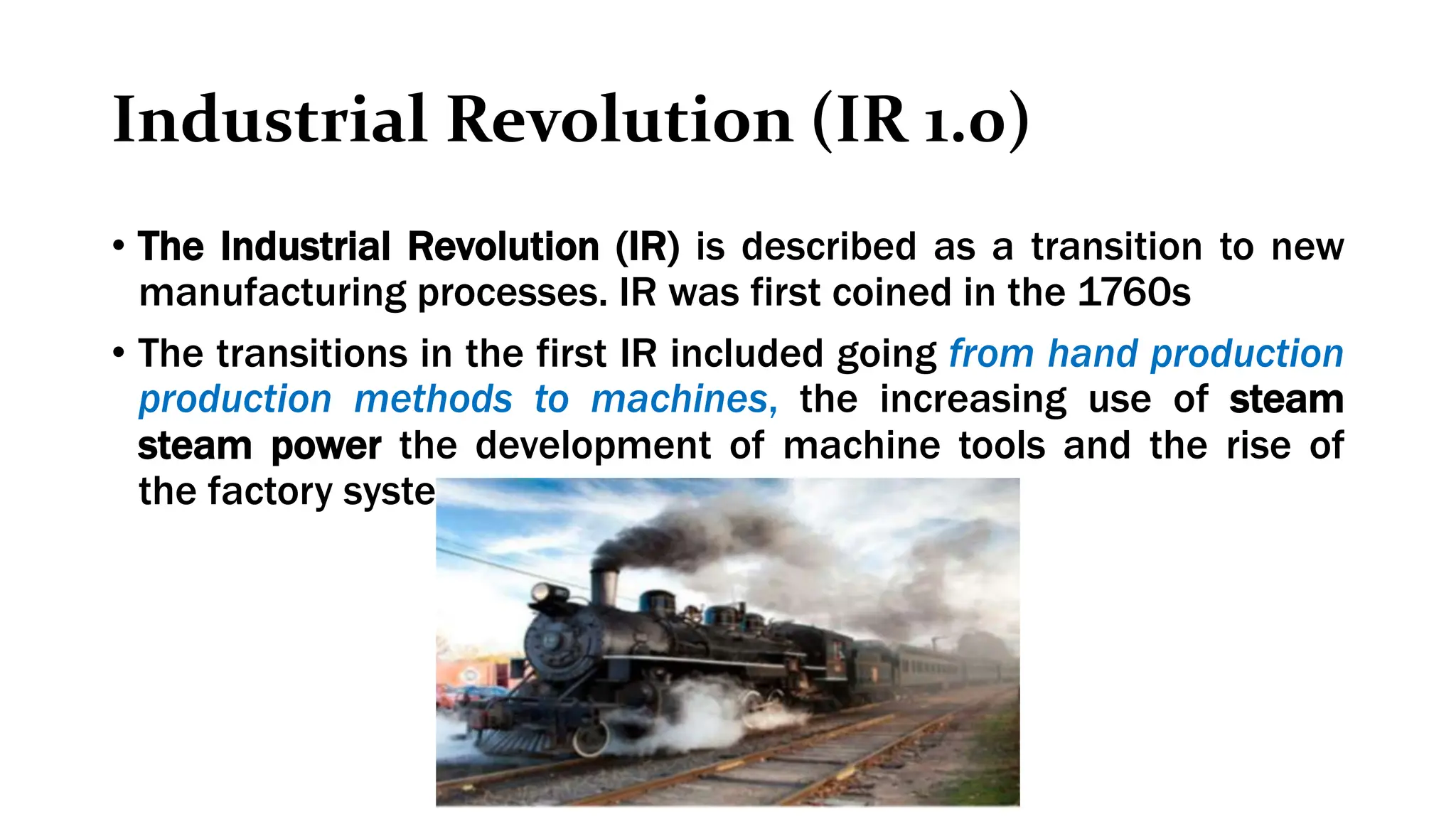
• The Industrial Revolution (IR) is described as a transition to new
manufacturing processes. IR was first coined in the 1760s
• The transitions in the first IR included going from hand production
production methods to machines, the increasing use of steam
steam power the development of machine tools and the rise of
the factory system.
Industrial Revolution (IR 2.0)
• The Second IR, also known as the Technological Revolution, began
somewhere in the 1870s.
• The advancements in IR 2.0 included the development of methods
for manufacturing interchangeable parts and widespread adoption
of pre-existing technological systems such as telegraph and
railroad networks.
• Allowed the vast movement of people and ideas, enhancing
communication.
• New technological systems were introduced, such as electrical
power and telephones.
Industrial Revolution (IR 3.0)
• Introduced the transition from mechanical and analog electronic
technology to digital electronics which began from the late 1950s.
• Due to the shift towards digitalization, IR 3.0 was given the
nickname, “Digital Revolution”.
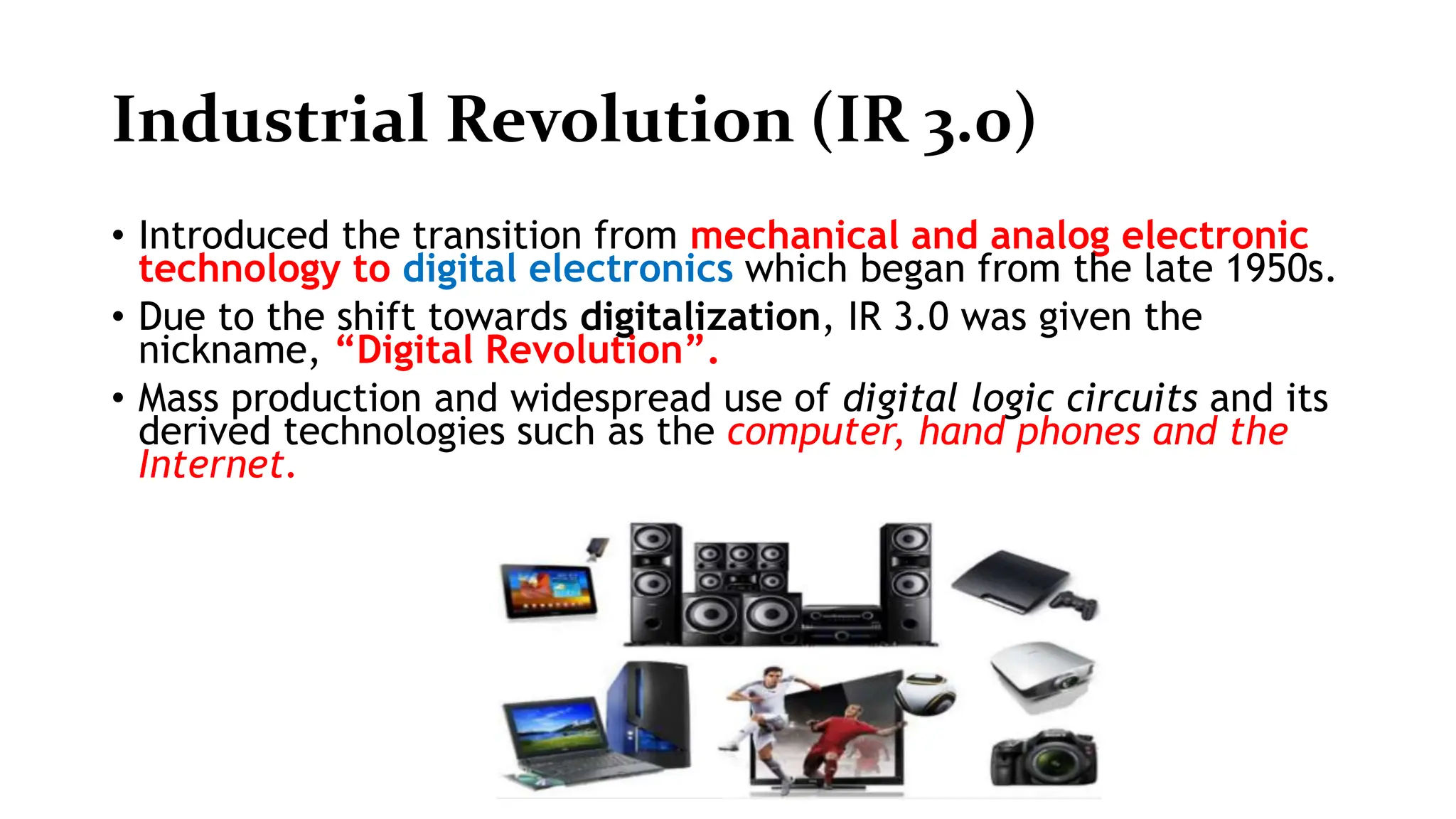
• Mass production and widespread use of digital logic circuits and its
derived technologies such as the computer, hand phones and the
Internet.
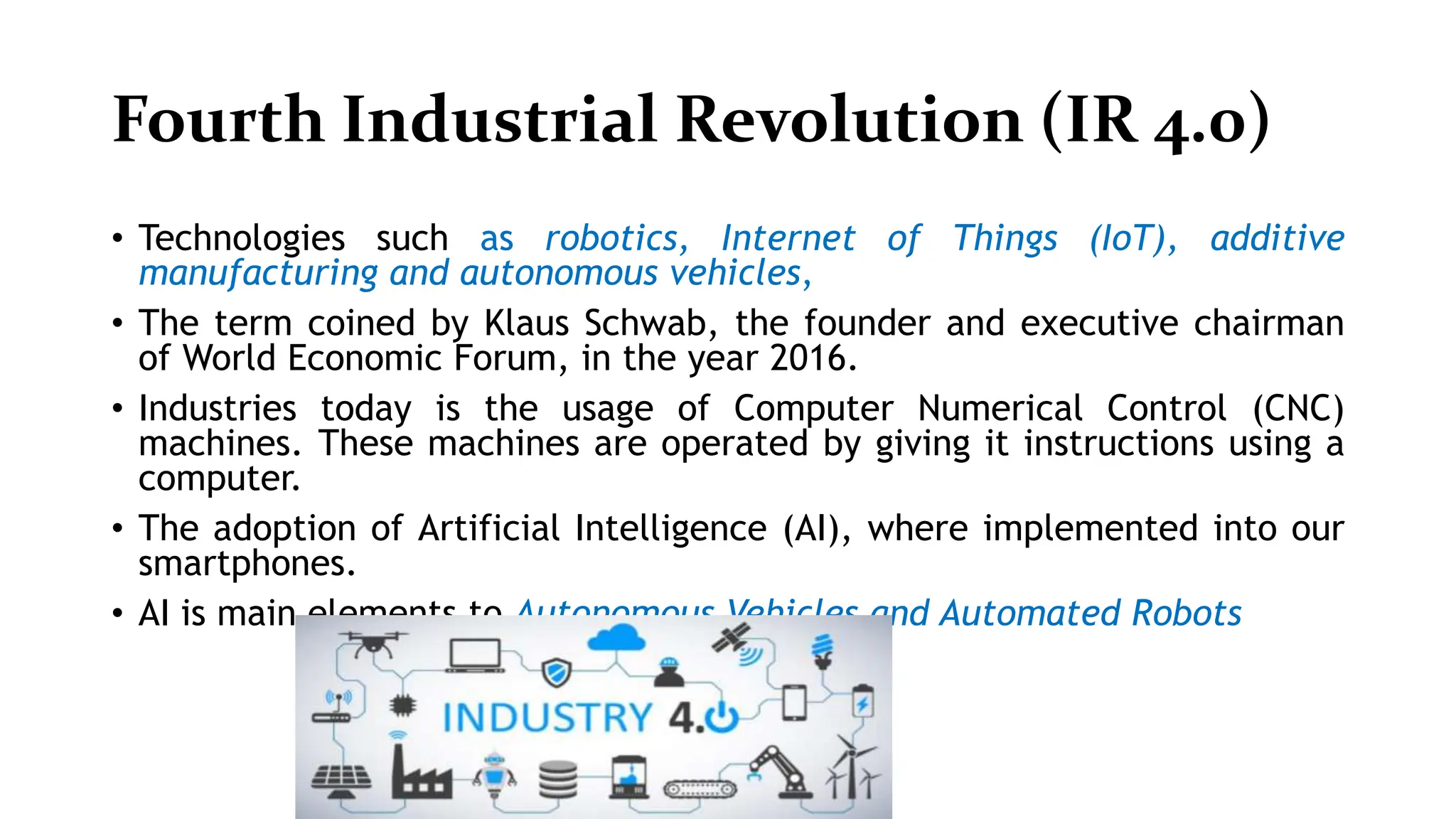
Fourth Industrial Revolution (IR 4.0)
• Technologies such as robotics, Internet of Things (IoT), additive
manufacturing and autonomous vehicles,
• The term coined by Klaus Schwab, the founder and executive chairman
of World Economic Forum, in the year 2016.
• Industries today is the usage of Computer Numerical Control (CNC)
machines. These machines are operated by giving it instructions using a
computer.
• The adoption of Artificial Intelligence (AI), where implemented into our
smartphones.
• AI is main elements to Autonomous Vehicles and Automated Robots
Role of Data for Emerging
Technologies
• Data is regarded as the new oil and strategic asset since we are
living in the age of big data, and drives or even determines the
future of science, technology, the economy, and possibly
everything in our world today and tomorrow.
• Triggered new debate about data-intensive scientific discovery as
an emerging technology, the so-called “fourth industrial
revolution,”
• Potential of data science and analytics to enable data-driven
theory, economy, and professional development is increasingly
being recognized.
• Not only core disciplines such as computing, informatics, and
statistics, but also the broad-based fields of business, social
science, and health/medical science.
Enabling devices and network
(Programmable devices)
• In the world of digital electronic systems, there are four basic kinds
of devices: Memory, Microprocessors, Logic, and Networks.
• Memory devices store random information such as the contents of a
spreadsheet or database.
• Microprocessors execute software instructions to perform a wide variety of
such as running a word processing program or video game.
• Logic devices provide specific functions, including device-to-device
data communication, signal processing, data display, timing and control
operations, and almost every other function a system must perform.
• The network is a collection of computers, servers, mainframes, network
devices, peripherals, or other devices connected to one another to allow
the sharing of data.
• An excellent example of a network is the Internet, which connects
millions of people all over the world
Programmable devices
• Refer to chips that incorporate field programmable logic
devices (FPGAs), complex programmable logic devices (CPLD)
and programmable logic devices (PLD).
• There are also devices that are the analog equivalent of these
called field programmable analog arrays.
Why is a computer referred to as a
programmable device?
• Because what makes a computer a computer is that it follows
a set of instructions.
• Many electronic devices are computers that perform only one
operation, but they are still following instructions that reside
permanently in the unit.
List of some Programmable devices
• Achronix Speedster SPD60
• Actel’s
• Altera Stratix IV GT and Arria II GX
• Atmel’s AT91CAP7L
• Cypress Semiconductor’s
programmable system-on-chip
(PSoC)
• Lattice Semiconductor’s ECP3
• Lime Microsystems’ LMS6002
• Silicon Blue Technologies
• Xilinx Virtex 6 and Spartan 6
• Xmos Semiconductor L series
• A full range of network-related
equipment referred to as Service
Enabling Devices (SEDs),
• Traditional channel service unit (CSU)
and data service unit (DSU)
• Modems
• Routers
• Switches
• Conferencing equipment
• Network appliances (NIDs and SIDs)
• Hosting equipment and servers
Human to Machine Interaction
• Refers to the communication and interaction between a
human and a machine via a user interface.
• Natural user interfaces such as gestures have gained increasing
attention as they allow humans to control machines through
natural and intuitive behaviors
• HCI (human-computer interaction) is the study of how people
interact with computers and to what extent computers are or
are not developed for successful interaction with human
beings.
• HCI consists of three parts: the user, the computer, and the
ways they work together.
The goal of HCI
• To improve the interaction between users and computers by making
computers more user-friendly and receptive to the user's needs.
• The main advantages of HCI are simplicity, ease of deployment &
operations and cost savings for smaller set-ups.
• They also reduce solution design time and integration complexity.
• Disciplines Contributing to Human-Computer Interaction (HCI)
• Cognitive psychology:
• Computer science: Including graphics, technology, prototyping tools, UI
• Linguistics.
• Engineering and design.
• Artificial intelligence.
• Human factors.
Future Trends in Emerging Technologies
Emerging technology trends in 2019
• 5G Networks
• Artificial Intelligence (AI)
• Autonomous Devices
• Blockchain
• Augmented Analytics
• Digital Twins
• Enhanced Edge Computing and
• Immersive Experiences in Smart Spaces
Some emerging technologies that will
shape the future of you and your business
• So-called emerging technologies are taking over our minds
more and more each day.
• They sound like tools that will only affect the top tier of
technology companies who employ the world’s top 1% of
geniuses.
• This is totally wrong.
• Chatbots, virtual/augmented reality, blockchain, Ephemeral
Apps and Artificial Intelligence are already shaping your life
whether you like it or not.
• At the end of the day, you can either adapt or
End
Chapter 1:: Introduction to Emerging Technologies
Chapter 2: Data Science
After completing this chapter, the students will be able to:
➢ Describe what data science is and the role of data scientists.
➢ Differentiate data and information.
➢ Describe data processing life cycle
➢ Understand different data types from diverse perspectives
➢ Describe data value chain in emerging era of big data.
➢ Understand the basics of Big Data.
➢ Describe the purpose of the Hadoop ecosystem components.
An Overview of Data Science
• Data science is a multi-disciplinary field that uses scientific
methods, processes, algorithms, and systems to extract knowledge
and insights from structured, semi-structured and unstructured
data.
• Data science is much more than simply analyzing data.
• Data scientists must master the full spectrum of the data science
life cycle
• They possess a strong quantitative background in statistics and
linear algebra as well as programming knowledge
• Focuses on data warehousing, mining, and modeling to build and
analyze algorithms.
What are data and information?
• Data is a representation of facts, concepts, or instructions
suitable for communication, interpretation, or processing,
by human or electronic machines.
• It can be described as unprocessed facts and figures. such as
alphabets (A-Z, a-z), digits (0-9) or special characters (+, -, /,
*, <,>, =, etc.).
• Information is the processed data on which decisions and
actions are based.
• Information is interpreted data; created from organized,
structured, and processed data in a particular context.
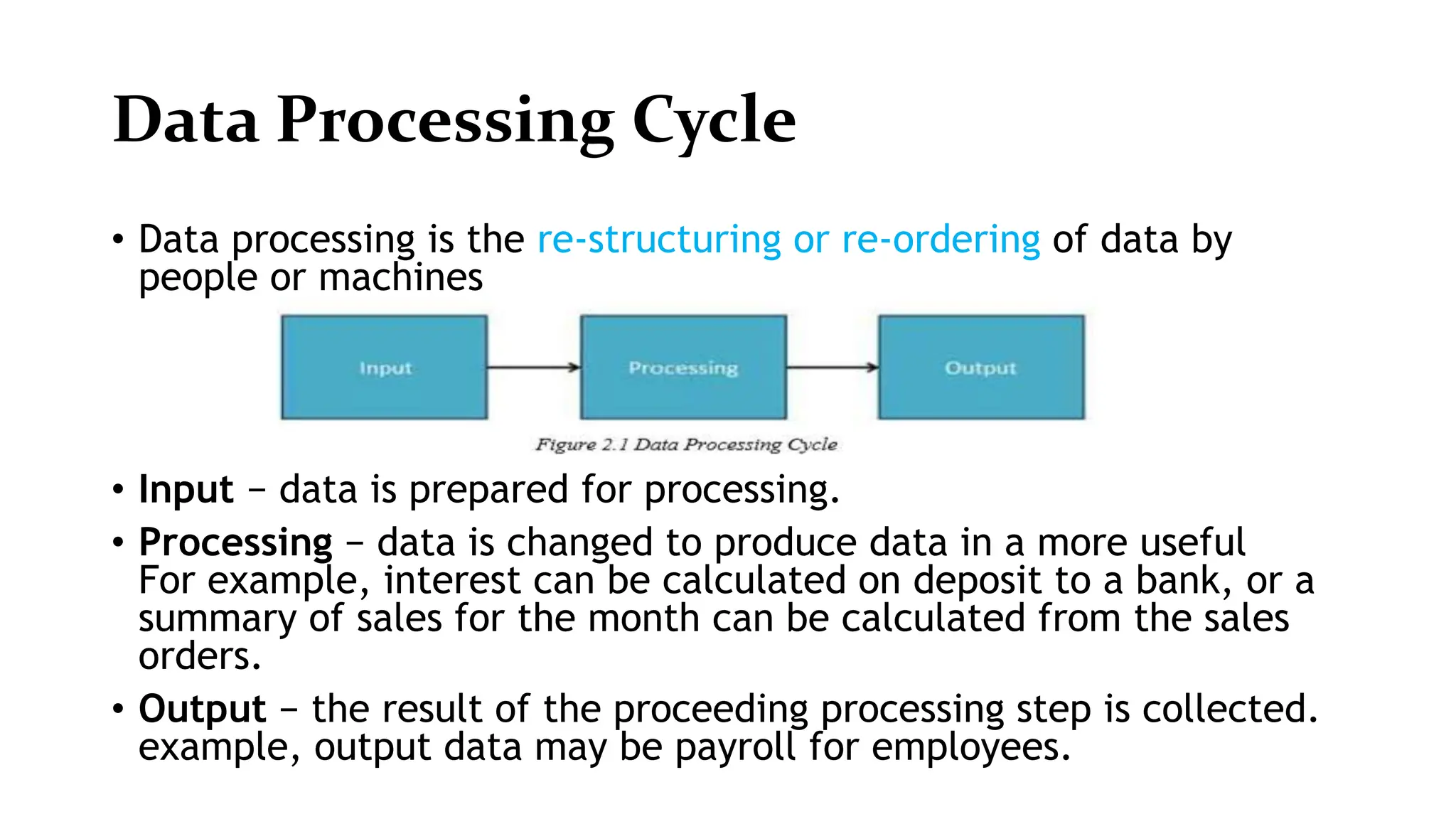
Data Processing Cycle
• Data processing is the re-structuring or re-ordering of data by
people or machines
• Input − data is prepared for processing.
• Processing − data is changed to produce data in a more useful
For example, interest can be calculated on deposit to a bank, or a
summary of sales for the month can be calculated from the sales
orders.
• Output − the result of the proceeding processing step is collected.
example, output data may be payroll for employees.
Data types and their representation
• In computer science and computer programming, a data type
is simply an attribute of data
• Common data types include:
• Integers(int)- is used to store whole numbers, known as
integers
• Booleans(bool)- is one of two values: true or false
• Characters(char)- is used to store a single character
• Floating-point numbers(float)- is used to store real
numbers
• Alphanumeric strings(string)- combination of characters
and numbers
Data types from Data Analytics perspective
• There are three common types of data types or structures:
Structured, Semi-structured, and Unstructured data types
Structured Data
• Structured data is data that adheres to a pre-defined data
model and is therefore straightforward to analyze.
• Structured data conforms to a tabular format with a
relationship between the different rows and columns.
• Common examples of structured data are Excel files or SQL
databases.
• Each of these has structured rows and columns that can be
sorted.
Semi-structured Data
• Semi-structured data is a form of structured data that does
not conform with the formal structure of data models
associated with relational databases or other forms of data
tables
• Contains tags or other markers to separate semantic elements
and enforce hierarchies of records and fields within the data.
• Also known as a self-describing structure.
• Examples include JSON and XML are forms of semi-structured
data.
Unstructured Data
• Unstructured data is information that either does not
have a predefined data model or is not organized in a
pre-defined manner.
• Unstructured information is typically text-heavy but
may contain data such as dates, numbers, and facts as
well.
• Examples of unstructured data include audio, video
files or NoSQL databases.
Metadata – Data about Data
• One of the most important elements for Big Data analysis and
big data solutions.
• Metadata is data about data.
• It provides additional information about a specific set of
data.
• In a set of photographs, for example, metadata could describe
when and where the photos were taken.
• The metadata then provides fields for dates and locations
which, by themselves, can be considered structured data.
• Metadata is frequently used by Big Data solutions for initial
analysis
Data value Chain
• The Data Value Chain is introduced to describe the information
flow within a big data system as a series of steps needed to
generate value and useful insights from data.
• The Big Data Value Chain identifies high-level activities
Basic concepts of Big Data
What Is Big Data?
• Big data is the term for a collection of data sets so large and
complex that it becomes difficult to process using on-hand
database management tools or traditional data processing
applications.
• A “large dataset” means a dataset too large to reasonably process
or store with traditional tooling or on a single computer.
• This means that the common scale of big datasets is constantly
shifting and may vary significantly from organization to
organization.
Big data is characterized by 3V and
more:
• Volume: large amounts of data Zeta bytes/Massive datasets
• Velocity: Data is live streaming or in motion
• Variety: data comes in many different forms from diverse
sources
• Veracity: can we trust the data? How accurate is it?
Clustered Computing and Hadoop
Ecosystem
Clustered Computing
• Because of the qualities of big data, individual computers are often
inadequate for handling the data at most stages.
• To better address the high storage and computational needs of big
data, computer clusters are a better fit.
• Big data clustering software combines the resources of many smaller
machines, seeking to provide a number of benefits:
• Resource Pooling
• High Availability
• Easy Scalability
• Cluster membership and resource allocation can be handled by
software like Hadoop’s YARN (which stands for Yet Another Resource
Resource Negotiator).
Hadoop and its Ecosystem
• Hadoop is an open-source framework intended to make
interaction with big data easier.
• It is a framework that allows for the distributed processing of
large datasets across clusters of computers using simple
programming models.
• The four key characteristics of Hadoop are:
• Economical
• Reliable
• Scalable
• Flexible
Hadoop ecosystem
• Hadoop has an ecosystem
that has evolved from its four
core components:
• Data management,
• Access,
• Processing
• Storage
It comprises the following components
• HDFS: Hadoop Distributed File System
• YARN: Yet Another Resource Negotiator
• MapReduce: Programming based Data Processing
• Spark: In-Memory data processing
• PIG, HIVE: Query-based processing of data services
• HBase: NoSQL Database
• Mahout, Spark MLLib: Machine Learning algorithm
libraries
• Solar, Lucene: Searching and Indexing
• Zookeeper: Managing cluster
• Oozie: Job Scheduling
Big Data Life Cycle with Hadoop
• Ingesting data into the system
• Processing the data in storage
• Computing and analyzing data
• Visualizing the results
End
Chapter Two: Data Science
Chapter 3: Artificial Intelligence (AI)
• After completing this chapter, the students will be able to:
➢ Explain what artificial intelligence (AI) is.
➢ Describe the eras of AI.
➢ Explain the types and approaches of AI.
➢ Describe the applications of AI in health, agriculture, business and
education
➢ List the factors that influenced the advancement of AI in recent
years.
➢ Understand the relationship between the human’s way of thinking
and AI systems
➢ Identify AI research focus areas.
➢ Identify real-world AI applications, some platforms, and tools.
What is Artificial Intelligence (AI)
• Artificial Intelligence is composed of two words Artificial and
Intelligence.
• Artificial defines "man-made," and intelligence defines "thinking
power", or “the ability to learn and solve problems” hence Artificial
Intelligence means "a man-made thinking power."
• Artificial Intelligence (AI) as the branch of computer science by
which we can create intelligent machines which can behave like a
human, think like humans, and able to make decisions.
• Intelligence is the ability to acquire and apply knowledge.
• Knowledge is the information acquired through experience.
• Experience is the knowledge gained through exposure (training)
Artificial Intelligence (AI)
• Artificial Intelligence exists when a machine can have human-
based skills such as learning, reasoning, and solving problems
• Artificial Intelligence no need to preprogram a machine to do
some work, despite that you can create a machine with
programmed algorithms which can work with own intelligence.
• Intelligence is composed of:
➢ Reasoning
➢ Learning
➢ Problem Solving
➢ Perception
➢ Linguistic Intelligence
AI system
• Composed of an agent and its environment.
• An agent (e.g., human or robot) is anything that can perceive its
environment through sensors and acts upon that environment through
effectors.
• Intelligent agents must be able to set goals and achieve them.
• Examples of AI include
• Autonomous vehicles (such as drones and self-driving cars),
• Medical diagnosis,
• creating art (such as poetry),
• Proving mathematical theorems,
• Playing games (such as Chess or Go),
• Search engines (such as Google search),
• Online assistants (such as Siri, alexa, cortana),
• Image recognition in photographs,
• Spam filtering, prediction of judicial decisions and targeting online
advertisements
Artificial Intelligence (AI), Machine
Learning (ML) and Deep Learning (DL)
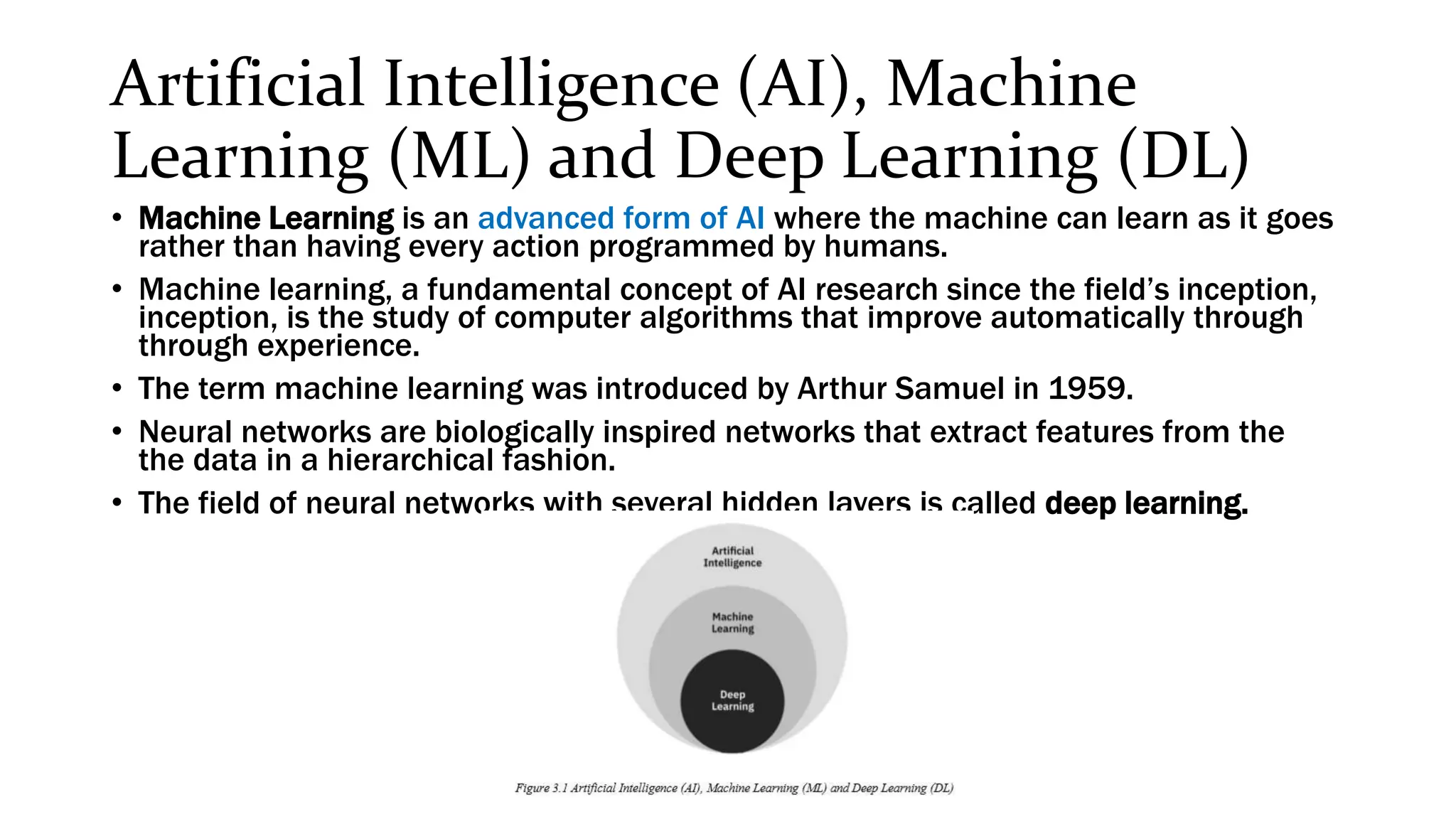
• Machine Learning is an advanced form of AI where the machine can learn as it goes
rather than having every action programmed by humans.
• Machine learning, a fundamental concept of AI research since the field’s inception,
inception, is the study of computer algorithms that improve automatically through
through experience.
• The term machine learning was introduced by Arthur Samuel in 1959.
• Neural networks are biologically inspired networks that extract features from the
the data in a hierarchical fashion.
• The field of neural networks with several hidden layers is called deep learning.
Need for Artificial Intelligence
• To create expert systems that exhibit intelligent behavior with
the capability to learn, demonstrate, explain and advice its
users.
• Helping machines find solutions to complex problems like
humans do and applying them as algorithms in a computer-
friendly manner.
Goals of Artificial Intelligence
The main goals of Artificial Intelligence:
1. Replicate human intelligence
2. Solve Knowledge-intensive tasks
3. An intelligent connection of perception and action
4. Building a machine which can perform tasks that requires human
intelligence such as:
✓ Proving a theorem
✓ Playing chess
✓ Plan some surgical operation
✓ Driving a car in traffic
5. Creating some system which can exhibit intelligent behavior, learn
new things by itself, demonstrate, explain, and can advise to its user.
What Comprises to Artificial Intelligence?
• Intelligence is an intangible part of our brain which is a
combination of Reasoning, learning, problem-solving, perception,
language understanding, etc.
• To achieve the above factors for a machine or software Artificial
Intelligence requires the following disciplines
✓ Mathematics
✓ Biology
✓ Psychology
✓ Sociology
✓ Computer Science
✓ Neurons Study
✓ Statistics
Advantages of Artificial Intelligence
• High Accuracy with fewer error
• High-Speed
• High reliability
• Useful for risky area
• Digital Assistant
• Useful as a public utility
Disadvantages of Artificial Intelligence
• High Cost
• Can't think out of the box
• No feelings and emotions
• Increase dependence on machines:
• No Original Creativity
History of AI
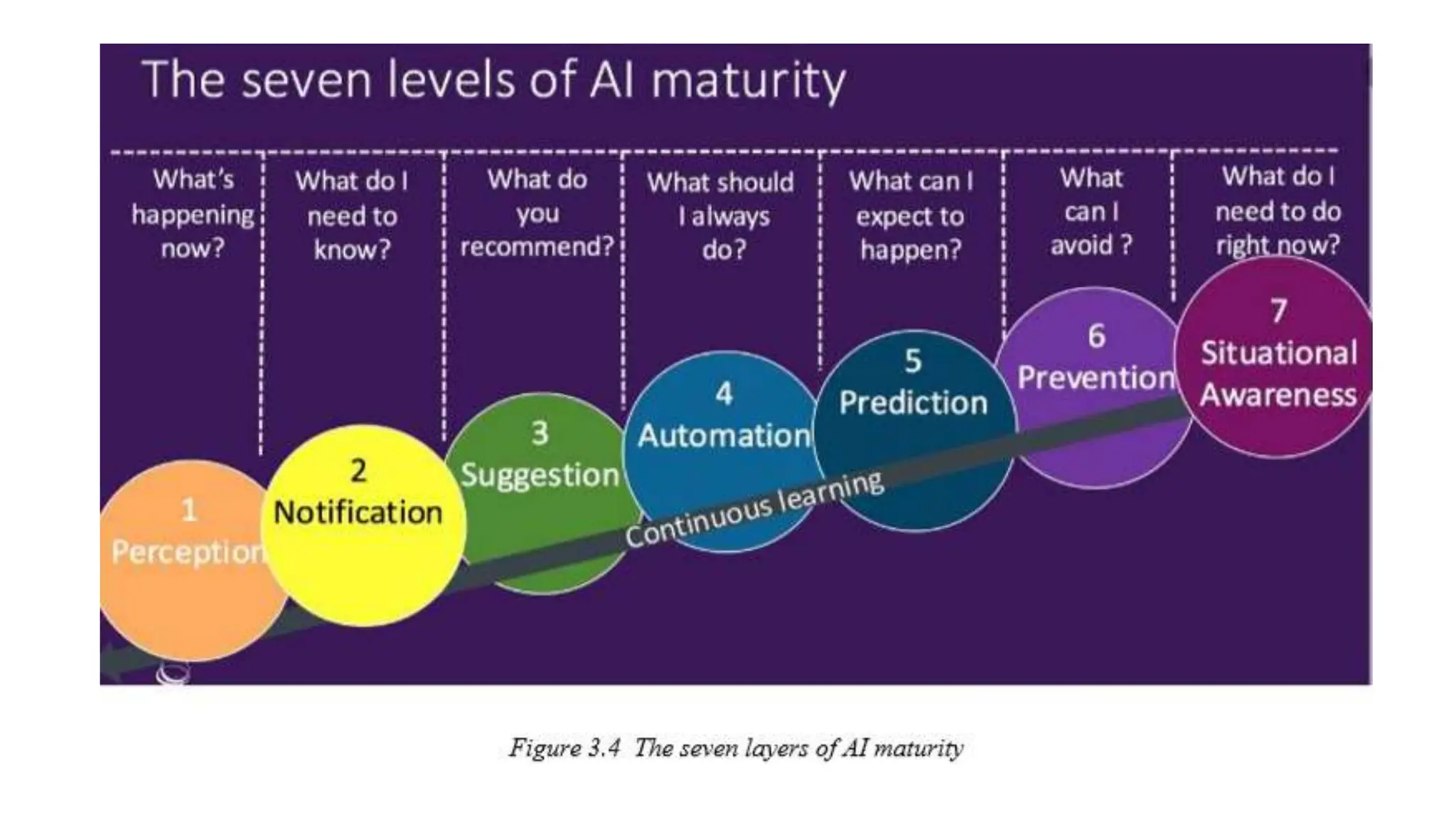
Levels of AI
• Stage 1 – Rule-Based Systems
• Stage 2 – Context Awareness and Retention
• Stage 3 – Domain-Specific Expertise
• Stage 4 – Reasoning Machines
• Stage 5 – Self Aware Systems / Artificial General Intelligence
(AGI)
• Stage 6 – Artificial Superintelligence (ASI)
• Stage 7 – Singularity and Transcendence
Types of AI
• The main categorization which are based on capabilities and
based on functionally of AI
How humans think
• Intelligence or the cognitive process is composed of three main
stages:
➢ Observe and input the information or data in the brain.
➢ Interpret and evaluate the input that is received from the surrounding
surrounding environment.
➢ Make decisions as a reaction towards what you received as input and
and interpreted and evaluated.
Influencers of artificial intelligence
• Influencers of AI are:
➢ Big data: Structured data versus unstructured data
➢ Advancements in computer processing speed and new chip
architectures
➢ Cloud computing and APIs
➢ The emergence of data science
Applications of AI
• AI in agriculture
• AI in Healthcare
• AI in education
• AI in Finance and E-
commerce
• AI in Gaming
• AI in Data Security
• AI in Social Media
• AI in Travel &Transport
• AI in the Automotive Industry
• AI in Robotics
• AI in Entertainment
AI tools and platforms
• Artificial intelligence (AI) platforms provide users a tool kit to build
intelligent applications.
• These platforms combine intelligent, decision-making algorithms
with data, which enables developers to create a business solution.
• Some platforms offer pre-built algorithms and simplistic workflows
with such features as drag-and-drop modeling and visual interfaces
that easily connect necessary data to the end solution
• The most common artificial intelligence platforms include
• Microsoft AZURE Machine Learning,
• Google Cloud Prediction API,
• IBM Watson,
• TensorFlow, Infosys Nia,
• Wipro HOLMES, API.AI,
• Premonition, Rainbird, Ayasdi, MindMeld, and Meya.
Simple AI application
• Commuting
➢ Google’s AI-Powered Predictions
➢ Ridesharing Apps Like Uber and
Lyft
➢ Commercial Flights Use an AI
Autopilot
• Email
➢ Spam Filters
➢ Smart Email Categorization
• Social Networking
➢ Facebook
➢ Pinterest
➢ Instagram
➢ Snapchat
• Online Shopping
➢ Search
➢ Recommendations
• Mobile Use
➢ Voice-to-Text
➢ Smart Personal Assistants
o Apple Siri
o Google Now
o Amazon Alexa
o Amazon Echo
o Microsoft Cortana
End
Chapter Three: AI
Chapter 4: Internet of Things (IoT)
• After accomplishing this chapter, Students will be able to:
➢ Describe IoT
➢ Explain the history of IoT
➢ Describe the pros and cons of IoT
➢ Explain how IoT works
➢ Explain the architecture of IoT
➢ Describe IoT tools and platforms
➢ Describe some of the application areas of IoT
Overview of IoT
The most important features of IoT include
• Artificial intelligence
• Connectivity
• Sensors
• Active engagement
• Small device
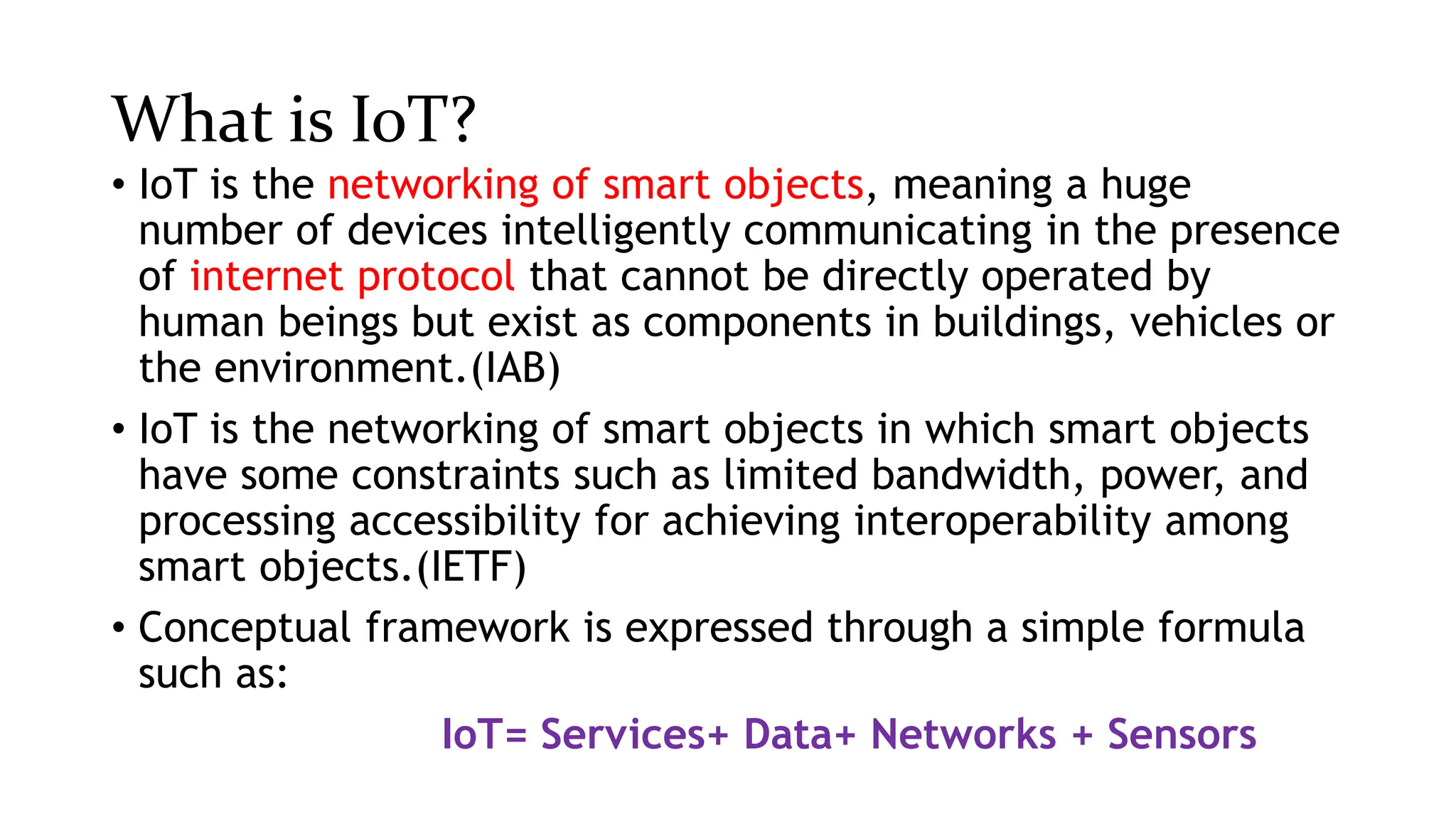
What is IoT?
• IoT is the networking of smart objects, meaning a huge
number of devices intelligently communicating in the presence
of internet protocol that cannot be directly operated by
human beings but exist as components in buildings, vehicles or
the environment.(IAB)
• IoT is the networking of smart objects in which smart objects
have some constraints such as limited bandwidth, power, and
processing accessibility for achieving interoperability among
smart objects.(IETF)
• Conceptual framework is expressed through a simple formula
such as:
IoT= Services+ Data+ Networks + Sensors
What is IoT?
• Generally, The Internet of Things (IoT) is the network of physical
objects or "things" embedded with electronics, software, sensors,
and network connectivity, which enables these objects to collect
collect and exchange data.
• The internet of things (IoT) has found its application in several
areas such as connected industry, smart-city, smart-home, smart-
energy, connected car, smart agriculture, connected building
campus, health care, logistics, among other domains
History of IoT
• Kevin Ashton, the Executive Director of Auto-ID Labs at MIT, was the
first to describe the Internet of Things, during his 1999 speech.
• Kevin Ashton stated that Radio Frequency Identification (RFID) was
a prerequisite for the Internet of Things.
• He concluded if all devices were “tagged,” computers could
manage, track, and inventory them.
• To some extent, the tagging of things has been achieved through
technologies such as digital watermarking, barcodes, and QR
codes.
• Inventory control is one of the more obvious advantages of the
Internet of Things.
IoT − Advantages
• Improved Customer Engagement
• Technology Optimization
• Reduced Waste
• Enhanced Data Collection
IoT – Disadvantages
• As the number of connected devices increases and more
information is shared between devices, the potential that a
hacker could steal confidential information also increases.
• If there’s a bug in the system, it’s likely that every connected
device will become corrupted.
• Since there’s no international standard of compatibility for IoT,
it’s difficult for devices from different manufacturers to
communicate with each other.
• Massive numbers maybe even millions of IoT devices and
collecting and managing the data from all those devices will
be challenging.
Challenges of IoT
• Security
• Privacy
• Complexity
• Flexibility
• Compliance
How does it work?
• An IoT ecosystem consists of web-enabled smart devices that
use embedded processors, sensors and communication
hardware to collect, send and act on data they acquire from
their environments.
• IoT devices share the sensor data they collect by connecting to
an IoT gateway or another edge device where data is either
sent to the cloud to be analyzed or analyzed locally
Architecture of IoT
• IoT device can be explained as a
network of things that consists of
hardware, software, network
connectivity, and sensors
• The architecture of IoT devices
comprises four major
components:
• sensing,
• network,
• data processing,
• application layers
Sensing Layer
• The main purpose of the sensing layer is to identify any
phenomena in the devices’ peripheral and obtain data from
the real world.
• A sensor hub is a common connection point for multiple
sensors that accumulate and forward sensor data to the
processing unit of a device.
• Actuators can also intervene to change the physical conditions
that generate the data.
• Motion Sensors
• Environmental Sensors
• Position sensors
Devices and Networks
• Consumer connected devices include
smart TVs, smart speakers, toys,
wearables, and smart appliances. smart
meters, commercial security systems and
and smart city technologies such as those
those used to monitor traffic and weather
conditions are examples of industrial and
enterprise IoT devices.
• Other technologies, including smart air
conditioning, smart thermostats, smart
lighting, and smart security, span home,
home, enterprise, and industrial uses.
IoT Tools and Platforms
• There are many vendors in the industrial
IoT platform marketplace, offering
remarkably similar capabilities and
methods of deployment.
• These IoT Platform Solutions are based on
the Internet of Things and cloud
technology.
• They can be used in areas of smart home,
city, enterprise, home automation,
healthcare or automotive, just to name a
few.
• KAA
• SiteWhere
• ThingSpeak
• DeviceHive
• Zetta
• ThingsBoard
Applications of IoT
• Agriculture
• Consumer Use
• Healthcare
• Insurance
• Manufacturing
• Retail
• Transportation
• Utilities
IoT Based Smart Home
• Smart Home initiative allows subscribers to remotely manage
and monitor different home devices from anywhere via
smartphones or over the web with no physical distance
limitations
• Remote Control Appliances
• Weather
• Smart Home Appliances
• Safety Monitoring
• Intrusion Detection Systems
• Energy and Water Use
IoT Based Smart City
In cities, the development of smart
grids, data analytics, and autonomous
vehicles will provide an intelligent
platform to deliver innovations in energy
management, traffic management, and
security, sharing the benefits of this
technology throughout society.
• Structural Health
• Lightning
• Safety
• Transportation
• Smart Parking:
• Waste Management
• Green Houses:
• Compost:
• Animal
Farming/Tracking:
• Offspring Care
• Field Monitoring
END
Chapter 4: Internet of Things (IoT)
Chapter 5: Augmented Reality (AR)
After accomplishing this chapter, Students will be able to:
➢ Explain augmented reality
➢ Explain the features of augmented reality
➢ Explain the difference between AR, VR, and MR
➢ Explain the architecture of augmented reality systems
➢ Describe the application areas of augmented reality
Overview of augmented reality
• The fundamental idea of AR is to combine, or mix, the view of
the real environment with additional, virtual content that is
presented through computer graphics.
• Augmented reality (AR) is a form of emerging technology that
users to overlay computer generated content in the real world.
• AR refers to a live view of a physical real-world environment
whose elements are merged with augmented computer-
generated images creating a mixed reality.
• Augmented reality is the integration of digital information with
the user's environment in realtime.
• A live direct or indirect view of a physical, real-world
environment whose elements are augmented by computer-
generated sensory input such as sound, video, graphics or GPS
data.
Virtual Reality (VR)
• VR is fully immersive, which tricks your senses into thinking you’re
in a different environment or world apart from the real world.
• Using a head-mounted display (HMD) or headset, you’ll experience
a computer-generated world of imagery and sounds in which you
can manipulate objects and move around using haptic controllers
while tethered to a console or PC
• It is also called a computer-simulated reality.
• Advanced VR environment will engage all five senses (taste, sight,
smell, touch, sound)
• Using VR devices such as HTC Vive, Oculus Rift or Google
Cardboard, users can be transported into a number of real-world
imagined environments.
Virtual Reality (VR)
• Most VR headsets are connected to a computer (Oculus Rift) or
a gaming console (PlayStation VR) but there are standalone
devices (Google Cardboard is among the most popular) as well.
Most standalone VR headsets work in combination with
smartphones – you insert a smartphone, wear a headset, and
immerse in the virtual reality
Augmented Reality (AR)
• In augmented reality, users see and interact with the real
world while digital content is added to it.
• If you own a modern smartphone, you can easily download an
AR app and try this technology.
• AR adds digital elements to a live view often by using the
camera on a smartphone
• Augmented Reality (AR) is a live, direct or indirect view of a
physical, real-world environment whose elements are
augmented (or supplemented) by computer-generated sensory
input such as sound, video, graphics or GPS data
Mixed Reality (MR)
• Referred to as hybrid reality, is the merging of real and virtual
worlds to produce new environments and visualizations where
physical and digital objects co-exist and interact in real-time.
• It means placing new imagery within a real space
• The key characteristic of MR is that the synthetic content and the
real-world content are able to react to each other in real-time
AR, VR, MR
• One of the most obvious differences among augmented reality, virtual reality,
and mixed reality is the hardware requirements and also
• VR is content which is 100% digital and can be enjoyed in a fully immersive
environment,
• AR overlays digital content on top of the real-world. and
• MR is a digital overlay that allows interactive virtual elements to integrate and
interact with the real-world environment.
• Numerous augmented reality apps and games can run on almost every
smartphone on the market.
• Some of the biggest names in VR tech
• Oculus Rift,
• HTC Vive, and
• PlayStation VR.
• Google Cardboard
Mixed reality hardware
• Microsoft HoloLens: - includes a built-in microphone array,
binaural sound capabilities, a built-in camera for recording, a
depth sensor, head-tracking cameras, and an inertial
measurement unit which helps track your head movement. On top
top of the traditional CPU and GPU, Microsoft also created a
Holographic Processing Unit to help track where the user is
looking and understand command gestures. Retail for over $2000
$2000 US
• Magic Leap One
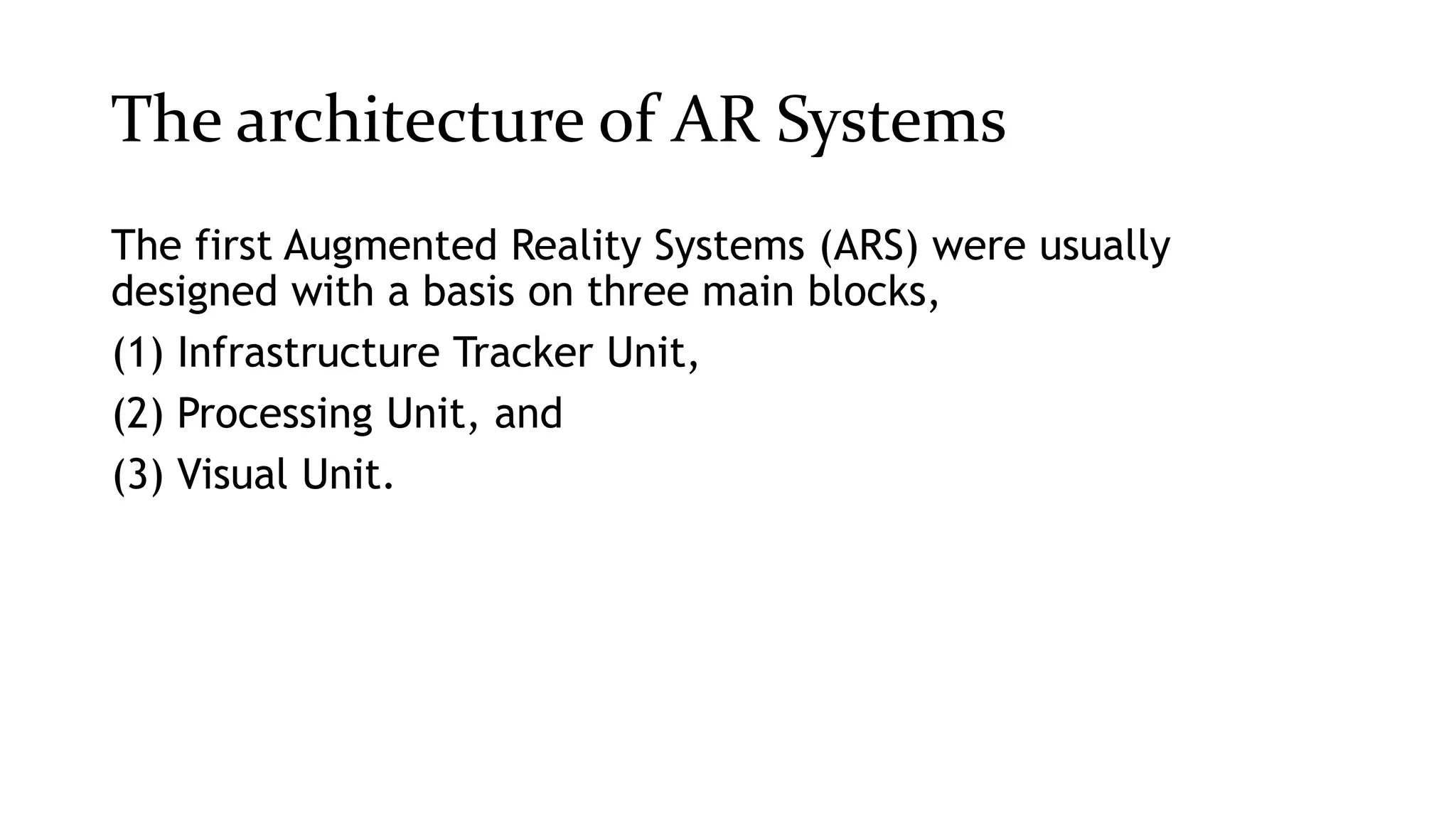
The architecture of AR Systems
The first Augmented Reality Systems (ARS) were usually
designed with a basis on three main blocks,
(1) Infrastructure Tracker Unit,
(2) Processing Unit, and
(3) Visual Unit.
Applications of AR Systems
Technology is ever-changing and ever-growing. One of the newest developing
technologies is augmented reality (AR), which can be applied to many
different disciplines such as
• AR In education
• Affordable learning materials
• Interactive lessons
• Higher engagement
• Boost intellectual curiosity
• AR In Medicine
• Describing symptoms
• Nursing care
• Surgery
• Ultrasounds
• Diabetes management
• Navigation
• AR In Entertainment
• AR in games
• AR in music
• AR on TV
• AR in eSports
• AR in the theater
END
Chapter 5: Augmented Reality (AR)
Chapter 6:
ETHICS AND PROFESSIONALISM OF EMERGING TECHNOLOGIES
After accomplishing this chapter, Students will be able to:
➢ Distinguish the link between ethics and technology.
➢ Understand general, professional and leadership ethical questions.
➢ Explain what digital privacy is, its components and why it is important.
➢ know the importance of accountability and trust in emerging
technologies.
➢ Identify the threats and challenges we face in developing and utilizing
emerging technologies.
Chapter 7: Other emerging technologies
• After accomplishing this chapter, Students will be able to:
➢ Explain nanotechnology and its application in different sectors.
➢ Explain biotechnology and its application in different sectors.
➢ Explain block-chain technology and its application.
➢ Has gain insights about the cloud, quantum and autonomic
computing, their differences, and applications.
➢ Explain how computer vision works and its application.
➢ Identify and explain embedded systems and their pros and cons.
➢ Describe cybersecurity, types of cybersecurity treat and its
benefits.
➢ Distinguish the difference between additive manufacturing and 3D
printing
Other emerging technologies
• Nanotechnology,
• Biotechnology,
• Block-chain technology,
• Cloud and quantum computing,
• Autonomic computing,
• Computer vision,
• Embedded systems,
• Cybersecurity,
• 3D printing.
Nanotechnology
• Nanotechnology is science, engineering, and technology
conducted at the nanoscale, which is about 1 to 100
nanometers.
• Nanoscience and nanotechnology are the study and application
of extremely small things and can be used across all the other
science fields, such as chemistry, biology, physics, materials
science, and engineering.
How it started
• physicist Richard Feynman described a process in which
scientists would be able to manipulate and control individual
atoms and molecules
• Professor Norio Taniguchi coined the term nanotechnology. It
wasn't until 1981, with the development of the scanning
tunneling microscope that could "see" individual atoms, that
modern nanotechnology began
Fundamental concepts in nanoscience and
nanotechnology
• It’s hard to imagine just how small nanotechnology is.
• One nanometer is a billionth of a meter or 10-9 of meters.
Here are a few illustrative examples:
➢ There are 25,400,000 nanometers in an inch
➢ A sheet of newspaper is about 100,000 nanometers thick
➢ On a comparative scale, if a marble were a nanometer, then one
meter would be the size of the Earth
• Everything on Earth is made up of atoms—the food we eat, the
clothes we wear, the buildings and houses we live in, and our
own bodies.
Atom
• An atom has a diameter of about 0.1 nm. An atom's nucleus is much
smaller about 0.00001 nm.
• Atoms are the building blocks for all matter in our universe.
• "Small Wonders: The World of Nanoscience," Nobel Prize winner Dr.
Horst Störmer said that the nanoscale is more interesting than the
atomic scale because the nanoscale is the first point where we can
assemble something
• Define nanoscience as the study of phenomena and manipulation
materials at atomic, molecular and macromolecular scales,
• Properties differ significantly from those at a larger scale;
• Nanotechnologies as the design, characterization, production, and
application of structures, devices, and systems by controlling shape
and size at the nanometer scale
Nanoscale
• Today's scientists and engineers are finding a wide variety of
ways to deliberately make materials at the nanoscale to take
advantage of their enhanced properties such as
• Higher strength, lighter weight,
• Increased control of light spectrum, and
• Greater chemical reactivity than their larger-scale counterparts.
• Materials can be produced that are nanoscale in one dimension
(for example, nanowires, nanorods, and nanotubes), in two
dimensions (plate-like shapes like nanocoating, nanolayers,
and graphene) or in all three dimensions (for example,
nanoparticles)
Applications of nanotechnology:
• Medicine
• Electronics
• Food
• Agriculture
• Vehicle manufacturers:
Biotechnology
• Biotechnology is technology based on biology
• Biotechnology harnesses cellular and biomolecular processes
to develop technologies and products that help improve our
lives and the health of our planet.
• We have used the biological processes of microorganisms for
more than 6,000 years to make useful food products, such as
bread and cheese, and to preserve dairy products.
• Brewing and baking bread are examples of processes that fall
within the concept of biotechnology (use of yeast (= living
organism) to produce the desired product)
Genetic engineering
• Genetic engineering is the process of transferring individual
genes between organisms or modifying the genes in an
organism to remove or add a desired trait or characteristic.
• One example of modern biotechnology is genetic engineering.
• Biotechnology covers many different disciplines (e.g. genetics,
biochemistry, molecular biology, etc.).
• New technologies and products are developed every year
within the areas of e.g.
• Medicine (development of new medicines and therapies),
• Agriculture (development of genetically modified plants, biofuels,
biological treatment) or
• Industrial biotechnology (production of chemicals, paper, textiles,
food).
History
• When he coined the term in 1919, the agriculturalist Karl
Ereky described ‘biotechnology’ as “all lines of work by which
products are produced from raw materials with the aid of
living things.”
• In modern biotechnology, researchers modify DNA and proteins
to shape the capabilities of living cells, plants, and animals
into something useful for humans.
• Biotechnologists do this by sequencing or reading, the DNA
found in nature, and then manipulating it in a test tube – or,
more recently, inside of living cells.
Application of biotechnology
• Agriculture (Green Biotechnology):modify the genes of the
organism known as Genetically Modified Organisms(GMO) such as
such as Crops, Animals, Plants, Fungi, Bacteria
• Medicine (Medicinal Biotechnology): This helps in the formation of
genetically modified insulin known as humulin. Gene therapy is a
is a technique to remove the genetic defect in an embryo or child.
child. This technique involves the transfer of a normal gene that
that works over the non-functional gene.
• Aquaculture Fisheries: It helps in improving the quality and
quantity of fishes
• Environment (Environmental biotechnology): is used in waste
treatment and pollution prevention.
Blockchain technology
• Blockchain is a growing list of records, called blocks, that are
linked using cryptography.
• Each block contains a cryptography hash of the previous block,
a timestamp, and transaction data
• A blockchain is, in the simplest of terms, a time-stamped
series of immutable records of data that is managed by a
cluster of computers not owned by any single entity
• Each of these blocks of data (i.e. block) is secured and bound
to each other using cryptographic principles (i.e. chain).
Blockchain
• “Blocks” on the blockchain are made up of digital pieces of
information.
• Specifically, they have three parts:
• Blocks store information about transactions like the date, time, and
dollar amount of your most recent purchase
• Blocks store information about who is participating in transactions
• Blocks store information that distinguishes them from other blocks.
Blockchain
• When a block stores new data it is added to the blockchain.
• Blockchain, as its name suggests, consists of multiple blocks
strung together.
• In order for a block to be added to the blockchain, however, four things
must happen
• A transaction must occur
• That transaction must be verified: a network of computers consist of
thousands (or in the case of Bitcoin, about five million ) computers
spread across the globe.
• That transaction must be stored in a block.
• That block must be given a hash.
Blockchain
• By design, a blockchain is resistant to modification of the
data. It is "an open, distributed ledger that can record
transactions between two parties efficiently and in a
verifiable and permanent way“
• The blockchain network has no central authority; it is the very
definition of a democratized system.
• Since it is a shared and immutable ledger, the information in it
is open for anyone and everyone to see
History
• The first blockchain was conceptualized by a person (or group of
people) known as Satoshi Nakamoto in 2008.
• Core component of the cryptocurrency bitcoin, where it serves as
the public ledger for all transactions on the network.
• In August 2014, the bitcoin blockchain file size, containing records
of all transactions that have occurred on the network, reached 20
GB (Gigabyte).
• In January 2015, the size had grown to almost 30 GB, and
• January 2016 to January 2017, the bitcoin blockchain grew from 50
GB to 100 GB in size
• The words block and chain were used separately in Satoshi
Nakamoto's original paper but were eventually popularized as a
single word, blockchain, by 2016.
The Three Pillars of Blockchain Technology
• Decentralization
➢ the information is not stored by one single entity. In fact, everyone in
everyone in the network owns the information.
➢ main ideology behind Bitcoins. You and only you alone are in charge
charge of your money. You can send your money to anyone you want
without having to go through a bank.
• Transparency
• A person’s identity is hidden via complex cryptography and
• represented only by their public address.
• if you were to look up a person’s transaction history, you will not see “Bob sent
The Three Pillars of Blockchain Technology
• Immutability
➢ Immutability, in the context of the blockchain, means that once
once something has been entered into the blockchain, it cannot be
be tampered with.
➢ Hashing means taking an input string of any length and giving
out an output of a fixed length.
In the context of cryptocurrencies like bitcoin, the transactions are
are taken as input and run through a hashing algorithm (Bitcoin
uses SHA-256) which gives an output of a fixed length.
SHA-256 (Secure Hashing Algorithm 256).
Why the blockchain
The reason has gained so much admiration is that:
➢ It is not owned by a single entity, hence it is decentralized
➢ The data is cryptographically stored inside
➢ The blockchain is immutable, so no one can tamper with the
data that is inside the blockchain
➢ The blockchain is transparent so one can track the data if
they want to
Application of blockchain
• The sharing economy
• Crowdfunding
• Governance
• Supply chain auditing
• File storage
Cloud and Quantum computing
• Cloud computing is a means of networking remote servers that are
hosted on the Internet.
• Rather than storing and processing data on a local server, or a PC's
hard drive,
• Three types of cloud infrastructure is used.
• Public Cloud
• Private Cloud
• Hybrid Cloud.
• Cloud computing services can focus on infrastructure, web
development or a cloud-based app. These are often regarded as a
stack;
• Infrastructure as a Service (IaaS)
• Platform as a Service (PaaS)
• Software as a Service (SaaS)
• Major players like IBM, Amazon, and Google
Quantum computing
• Quantum computers truly do represent the next generation of
computing. Unlike classic computers, they derive their
computing power by harnessing the power of quantum
physics.
• Currently, the only organization which provides a quantum
computer in the cloud is IBM.
• Google provided the fastest quantum computer with 53qubits
and speed of 200 seconds computation while the
supercomputer took 10000 years.
• Qubit is short for a sequence of quantum bits. a qubit can
exist in two states at the same time. This phenomenon is
called superposition
Advantages of quantum computing
• Quantum computing could help in the discovery of new drugs,
by unlocking the complex structure of chemical molecules.
• Uses include financial trading,
• Risk management, and
• Supply chain optimization.
• With its ability to handle more complex numbers, data could
be transferred over the internet with much safer encryption.
Autonomic computing (AC)
• Autonomic computing (AC) is an approach to address the
complexity and evolution problems in software systems.
• self-managing computing model named after, and patterned
on, the human body's autonomic nervous system.
• The goal of autonomic computing is to create systems that run
themselves, capable of high-level functioning while keeping
the system's complexity invisible to the user.
Characteristics of Autonomic Systems
• Self-Awareness:
• Self-Configuring:
• Self-Optimizing
• Self-Healing:
• Self-Protecting:
• Context-Aware
• Open
• Anticipatory:
Computer vision
• Interdisciplinary scientific field that deals with how computers
can be made to gain a high level understanding of digital
images or videos.
• Computer vision tasks include methods for acquiring,
processing, analyzing and understanding digital images, and
extraction of high-dimensional data from the real world in
order to produce numerical or symbolic information
• Computer vision is building algorithms that can understand the
content of images and use it for other applications.
How computer vision works
1. Acquiring an image: Images, even large sets, can be acquired in
real-time through video, photos or 3D technology for analysis.
Applications of computer vision
• Optical character recognition (OCR):
• Machine inspection:
• Retail:
• Medical imaging:
• Automotive safety:
• Surveillance:
• Fingerprint recognition and biometrics
Embedded systems
• Controller with a dedicated function within a larger
mechanical or electrical system, often with real-time
computing constraints
• embedded as part of a complete device often including
hardware and mechanical parts.
• Ninety-eight percent of all microprocessors manufactured are
used in embedded systems.
• Modern embedded systems are often based on
microcontrollers (i.e. microprocessors with integrated memory
and peripheral interfaces),
Advantages and disadvantages of
embedded system
• Advantages of Embedded
➢ Easily Customizable
➢ Low power consumption
➢ Low cost
➢ Enhanced performance
• Disadvantages of Embedded systems
➢ High development effort
➢ Larger time to market
Cybersecurity
• Protection of computer systems from the theft of or damage
to their hardware, software, or electronic data, as well as
from the disruption or misdirection of the services they
provide.
• Cybercrime is used to describe an unlawful activity in which
computer or computing devices such as smartphones, tablets,
Personal Digital Assistants (PDAs), which are standalone or a
part of a network are used as a tool or/and target of criminal
activity.
Cybersecurity measures
• Staff awareness training
• Application security:
• Network security
• Leadership commitment
• Password management:
Types of cybersecurity threats
• Ransomware
• Malware
• Social engineering
• Phishing
Benefits of cybersecurity
• Benefits of utilizing cybersecurity include:
➢ Business protection against malware, ransomware, phishing,
and social engineering.
➢ Protection for data and networks.
➢ Prevention of unauthorized users.
➢ Improves recovery time after a breach.
➢ Protection for end-users.
➢ Improved confidence in the product for both developers and
customers.
Cybersecurity vendors
• Vendors in cybersecurity fields will typically use endpoint,
network and advanced threat protection security as well as
data loss prevention.
• Three commonly known cybersecurity vendors include
• Cisco,
• McAfee, and
• Trend Micro.
Additive manufacturing (3D Printing)
• ➢ The American Society for Testing and Materials (ASTM)
equates the two terms in their definition: “Additive
manufacturing, also known as 3D printing, uses computer-
aided design to build objects layer by layer.”
• ➢ Wikipedia says, “Today, the precision, repeatability, and
material range has increased to the point that 3D printing is
considered as industrial production technology, with the name
of additive manufacturing.”
• ➢ Author Deve Turbide puts it simply, suggesting that additive
manufacturing is “the industrial version of 3D printing”
3D Printing: It's All About the Printer
• Concept of “3D printing” is much broader, but the term is
often associated with filament-based plastic printers, which
are the pride and joy of many a hobbyist and self described
maker.
• But there are also binder jet printers, laser metal 3D
printers, as well as glass and clay 3D printers
Additive Manufacturing:
A Bytes-to-Parts Supply Chain
• More about the manufacturing process transformed by 3D printing.
What is that transformation?
• AM changes the way we think about inventory and supply chain,
taking parts from the point of manufacture to the point of use?
• AM is flexible in the time it takes to load a file, from anywhere in
the world. It enables customized parts, in volume, and involves
stocking raw materials like filament and printing spare parts on
demand.
• Additive manufacturing (AM) describes types of advanced
manufacturing that are used to create three-dimensional
structures out of plastics, metals, polymers and other materials
can be sprayed through a nozzle or aggregated in a vat.
• These constructs are added layer by layer in realtime based on
digital design.

Emerging Technologies freshman c PPT.pptx

  • 1.
  • 2.
    Chapters Chapter 1: Introductionto Emerging Technologies Chapter 2: Data Science Chapter 3: Artificial Intelligence (AI) Chapter 4: Internet of Things (IoT) Chapter 5: Augmented Reality (AR) Chapter 6: Ethics and professionalism of emerging technologies Chapter 7: Other emerging technologies
  • 3.
    Chapter 1: Introduction toEmerging Technologies After completing this chapter, the students will be able to: ➢ Develop knowledge about the era of industrial evolutions ➢ Identify the technological advances that made the industrial revolution possible ➢ Analyze the changing conditions created by the industrial revolution in both Europe and the united states ➢ Understand the causes of the Industrial Revolution in Great Britain, continental Europe, and the United States. ➢ Describe the technological innovations that spurred industrialization ➢ Identifies and understand the programmable device ➢ Understand concepts relating to the design of human-computer interfaces in ways making computer-based systems comprehensive, friendly and usable. ➢ Develop general knowledge about emerging technologies
  • 4.
    Emerging technology • Aterm generally used to describe a new technology, but it may also refer to the continuing development of existing technology; • Different meanings when used in different areas, such as media, business, science, or education. • Technologies that are currently developing, or that are expected to be available within the next five to ten years, • Technological evolution is a theory of radical transformation of society through technological development.
  • 5.
    What is theroot word of technology and evolution? • Technology: from Greek tekhnologia "systematic treatment of an art, craft, or technique," • Tekhno- ( techno-) + -logy. The meaning "science of the mechanical and industrial arts" is first recorded in 1859. 1859. • Evolution: the process of developing by gradual changes. • Latin evolutio, "an unrolling or opening," combined from from the prefix e-, "out," plus volvere, "to roll."
  • 6.
    List of somecurrently available emerged technologies • Artificial Intelligence(AI) • Blockchain • Augmented Reality and Virtual Reality (AR&VR) • Cloud Computing • Angular and React • DevOps • Internet of Things (IoT) • Intelligent Apps (I-Apps) • Big Data • Robotic Processor Automation (RPA)
  • 7.
    Introduction to theIndustrial Revolution (IR) • The Industrial Revolution was a period of major industrialization and innovation that took place during the late 1700s and early 1800s. • Its core occurs when a society shifts from using tools to make products to use new sources of energy, such as coal, to power machines in factories. • The revolution started in England, with a series of innovations to make labor more efficient and productive. • The Industrial Revolution was a time when the manufacturing of goods moved from small shops and homes to large factories.
  • 8.
    Industrial Revolution (IR) •The American Industrial Revolution commonly referred to as the Second Industrial Revolution, started sometime between 1820 and 1870. • The impact of changing the way items was manufactured had a wide reach. Industries such as • Textile manufacturing, • Mining, • Glass making, and • Agriculture all had undergone changes.
  • 9.
    The Most ImportantInventions of the Industrial Revolution • Transportation: The Steam Engine, The Railroad, The Diesel Engine, The Airplane. • Communication: The Telegraph. The Transatlantic Cable. The Phonograph. The Telephone. • Industry: The Cotton Gin. The Sewing Machine. Electric Lights.
  • 10.
    Historical Background (IR 1.0,IR 2.0, IR 3.0) • The industrial revolution began in Great Britain in the late 1770s • The first European countries to be industrialized after England were Belgium, France, and the German states. • The final cause of the Industrial Revolution was the effects created by the Agricultural Revolution. • The four types of industries are: • The primary industry involves getting raw materials e.g. mining, farming, fishing. • The secondary industry involves manufacturing e.g. making cars and steel. • Tertiary industries provide a service e.g. teaching and nursing. • The quaternary industry involves research and development industries e.g.
  • 11.
    Industrial Revolution (IR1.0) • The Industrial Revolution (IR) is described as a transition to new manufacturing processes. IR was first coined in the 1760s • The transitions in the first IR included going from hand production production methods to machines, the increasing use of steam steam power the development of machine tools and the rise of the factory system.
  • 12.
    Industrial Revolution (IR2.0) • The Second IR, also known as the Technological Revolution, began somewhere in the 1870s. • The advancements in IR 2.0 included the development of methods for manufacturing interchangeable parts and widespread adoption of pre-existing technological systems such as telegraph and railroad networks. • Allowed the vast movement of people and ideas, enhancing communication. • New technological systems were introduced, such as electrical power and telephones.
  • 13.
    Industrial Revolution (IR3.0) • Introduced the transition from mechanical and analog electronic technology to digital electronics which began from the late 1950s. • Due to the shift towards digitalization, IR 3.0 was given the nickname, “Digital Revolution”. • Mass production and widespread use of digital logic circuits and its derived technologies such as the computer, hand phones and the Internet.
  • 14.
    Fourth Industrial Revolution(IR 4.0) • Technologies such as robotics, Internet of Things (IoT), additive manufacturing and autonomous vehicles, • The term coined by Klaus Schwab, the founder and executive chairman of World Economic Forum, in the year 2016. • Industries today is the usage of Computer Numerical Control (CNC) machines. These machines are operated by giving it instructions using a computer. • The adoption of Artificial Intelligence (AI), where implemented into our smartphones. • AI is main elements to Autonomous Vehicles and Automated Robots
  • 15.
    Role of Datafor Emerging Technologies • Data is regarded as the new oil and strategic asset since we are living in the age of big data, and drives or even determines the future of science, technology, the economy, and possibly everything in our world today and tomorrow. • Triggered new debate about data-intensive scientific discovery as an emerging technology, the so-called “fourth industrial revolution,” • Potential of data science and analytics to enable data-driven theory, economy, and professional development is increasingly being recognized. • Not only core disciplines such as computing, informatics, and statistics, but also the broad-based fields of business, social science, and health/medical science.
  • 16.
    Enabling devices andnetwork (Programmable devices) • In the world of digital electronic systems, there are four basic kinds of devices: Memory, Microprocessors, Logic, and Networks. • Memory devices store random information such as the contents of a spreadsheet or database. • Microprocessors execute software instructions to perform a wide variety of such as running a word processing program or video game. • Logic devices provide specific functions, including device-to-device data communication, signal processing, data display, timing and control operations, and almost every other function a system must perform. • The network is a collection of computers, servers, mainframes, network devices, peripherals, or other devices connected to one another to allow the sharing of data. • An excellent example of a network is the Internet, which connects millions of people all over the world
  • 17.
    Programmable devices • Referto chips that incorporate field programmable logic devices (FPGAs), complex programmable logic devices (CPLD) and programmable logic devices (PLD). • There are also devices that are the analog equivalent of these called field programmable analog arrays.
  • 18.
    Why is acomputer referred to as a programmable device? • Because what makes a computer a computer is that it follows a set of instructions. • Many electronic devices are computers that perform only one operation, but they are still following instructions that reside permanently in the unit.
  • 19.
    List of someProgrammable devices • Achronix Speedster SPD60 • Actel’s • Altera Stratix IV GT and Arria II GX • Atmel’s AT91CAP7L • Cypress Semiconductor’s programmable system-on-chip (PSoC) • Lattice Semiconductor’s ECP3 • Lime Microsystems’ LMS6002 • Silicon Blue Technologies • Xilinx Virtex 6 and Spartan 6 • Xmos Semiconductor L series • A full range of network-related equipment referred to as Service Enabling Devices (SEDs), • Traditional channel service unit (CSU) and data service unit (DSU) • Modems • Routers • Switches • Conferencing equipment • Network appliances (NIDs and SIDs) • Hosting equipment and servers
  • 20.
    Human to MachineInteraction • Refers to the communication and interaction between a human and a machine via a user interface. • Natural user interfaces such as gestures have gained increasing attention as they allow humans to control machines through natural and intuitive behaviors • HCI (human-computer interaction) is the study of how people interact with computers and to what extent computers are or are not developed for successful interaction with human beings. • HCI consists of three parts: the user, the computer, and the ways they work together.
  • 21.
    The goal ofHCI • To improve the interaction between users and computers by making computers more user-friendly and receptive to the user's needs. • The main advantages of HCI are simplicity, ease of deployment & operations and cost savings for smaller set-ups. • They also reduce solution design time and integration complexity. • Disciplines Contributing to Human-Computer Interaction (HCI) • Cognitive psychology: • Computer science: Including graphics, technology, prototyping tools, UI • Linguistics. • Engineering and design. • Artificial intelligence. • Human factors.
  • 22.
    Future Trends inEmerging Technologies Emerging technology trends in 2019 • 5G Networks • Artificial Intelligence (AI) • Autonomous Devices • Blockchain • Augmented Analytics • Digital Twins • Enhanced Edge Computing and • Immersive Experiences in Smart Spaces
  • 23.
    Some emerging technologiesthat will shape the future of you and your business • So-called emerging technologies are taking over our minds more and more each day. • They sound like tools that will only affect the top tier of technology companies who employ the world’s top 1% of geniuses. • This is totally wrong. • Chatbots, virtual/augmented reality, blockchain, Ephemeral Apps and Artificial Intelligence are already shaping your life whether you like it or not. • At the end of the day, you can either adapt or
  • 24.
    End Chapter 1:: Introductionto Emerging Technologies
  • 25.
    Chapter 2: DataScience After completing this chapter, the students will be able to: ➢ Describe what data science is and the role of data scientists. ➢ Differentiate data and information. ➢ Describe data processing life cycle ➢ Understand different data types from diverse perspectives ➢ Describe data value chain in emerging era of big data. ➢ Understand the basics of Big Data. ➢ Describe the purpose of the Hadoop ecosystem components.
  • 26.
    An Overview ofData Science • Data science is a multi-disciplinary field that uses scientific methods, processes, algorithms, and systems to extract knowledge and insights from structured, semi-structured and unstructured data. • Data science is much more than simply analyzing data. • Data scientists must master the full spectrum of the data science life cycle • They possess a strong quantitative background in statistics and linear algebra as well as programming knowledge • Focuses on data warehousing, mining, and modeling to build and analyze algorithms.
  • 27.
    What are dataand information? • Data is a representation of facts, concepts, or instructions suitable for communication, interpretation, or processing, by human or electronic machines. • It can be described as unprocessed facts and figures. such as alphabets (A-Z, a-z), digits (0-9) or special characters (+, -, /, *, <,>, =, etc.). • Information is the processed data on which decisions and actions are based. • Information is interpreted data; created from organized, structured, and processed data in a particular context.
  • 28.
    Data Processing Cycle •Data processing is the re-structuring or re-ordering of data by people or machines • Input − data is prepared for processing. • Processing − data is changed to produce data in a more useful For example, interest can be calculated on deposit to a bank, or a summary of sales for the month can be calculated from the sales orders. • Output − the result of the proceeding processing step is collected. example, output data may be payroll for employees.
  • 29.
    Data types andtheir representation • In computer science and computer programming, a data type is simply an attribute of data • Common data types include: • Integers(int)- is used to store whole numbers, known as integers • Booleans(bool)- is one of two values: true or false • Characters(char)- is used to store a single character • Floating-point numbers(float)- is used to store real numbers • Alphanumeric strings(string)- combination of characters and numbers
  • 30.
    Data types fromData Analytics perspective • There are three common types of data types or structures: Structured, Semi-structured, and Unstructured data types
  • 31.
    Structured Data • Structureddata is data that adheres to a pre-defined data model and is therefore straightforward to analyze. • Structured data conforms to a tabular format with a relationship between the different rows and columns. • Common examples of structured data are Excel files or SQL databases. • Each of these has structured rows and columns that can be sorted.
  • 32.
    Semi-structured Data • Semi-structureddata is a form of structured data that does not conform with the formal structure of data models associated with relational databases or other forms of data tables • Contains tags or other markers to separate semantic elements and enforce hierarchies of records and fields within the data. • Also known as a self-describing structure. • Examples include JSON and XML are forms of semi-structured data.
  • 33.
    Unstructured Data • Unstructureddata is information that either does not have a predefined data model or is not organized in a pre-defined manner. • Unstructured information is typically text-heavy but may contain data such as dates, numbers, and facts as well. • Examples of unstructured data include audio, video files or NoSQL databases.
  • 34.
    Metadata – Dataabout Data • One of the most important elements for Big Data analysis and big data solutions. • Metadata is data about data. • It provides additional information about a specific set of data. • In a set of photographs, for example, metadata could describe when and where the photos were taken. • The metadata then provides fields for dates and locations which, by themselves, can be considered structured data. • Metadata is frequently used by Big Data solutions for initial analysis
  • 35.
    Data value Chain •The Data Value Chain is introduced to describe the information flow within a big data system as a series of steps needed to generate value and useful insights from data. • The Big Data Value Chain identifies high-level activities
  • 36.
    Basic concepts ofBig Data What Is Big Data? • Big data is the term for a collection of data sets so large and complex that it becomes difficult to process using on-hand database management tools or traditional data processing applications. • A “large dataset” means a dataset too large to reasonably process or store with traditional tooling or on a single computer. • This means that the common scale of big datasets is constantly shifting and may vary significantly from organization to organization.
  • 37.
    Big data ischaracterized by 3V and more: • Volume: large amounts of data Zeta bytes/Massive datasets • Velocity: Data is live streaming or in motion • Variety: data comes in many different forms from diverse sources • Veracity: can we trust the data? How accurate is it?
  • 38.
    Clustered Computing andHadoop Ecosystem Clustered Computing • Because of the qualities of big data, individual computers are often inadequate for handling the data at most stages. • To better address the high storage and computational needs of big data, computer clusters are a better fit. • Big data clustering software combines the resources of many smaller machines, seeking to provide a number of benefits: • Resource Pooling • High Availability • Easy Scalability • Cluster membership and resource allocation can be handled by software like Hadoop’s YARN (which stands for Yet Another Resource Resource Negotiator).
  • 39.
    Hadoop and itsEcosystem • Hadoop is an open-source framework intended to make interaction with big data easier. • It is a framework that allows for the distributed processing of large datasets across clusters of computers using simple programming models. • The four key characteristics of Hadoop are: • Economical • Reliable • Scalable • Flexible
  • 40.
    Hadoop ecosystem • Hadoophas an ecosystem that has evolved from its four core components: • Data management, • Access, • Processing • Storage It comprises the following components • HDFS: Hadoop Distributed File System • YARN: Yet Another Resource Negotiator • MapReduce: Programming based Data Processing • Spark: In-Memory data processing • PIG, HIVE: Query-based processing of data services • HBase: NoSQL Database • Mahout, Spark MLLib: Machine Learning algorithm libraries • Solar, Lucene: Searching and Indexing • Zookeeper: Managing cluster • Oozie: Job Scheduling
  • 42.
    Big Data LifeCycle with Hadoop • Ingesting data into the system • Processing the data in storage • Computing and analyzing data • Visualizing the results
  • 43.
  • 44.
    Chapter 3: ArtificialIntelligence (AI) • After completing this chapter, the students will be able to: ➢ Explain what artificial intelligence (AI) is. ➢ Describe the eras of AI. ➢ Explain the types and approaches of AI. ➢ Describe the applications of AI in health, agriculture, business and education ➢ List the factors that influenced the advancement of AI in recent years. ➢ Understand the relationship between the human’s way of thinking and AI systems ➢ Identify AI research focus areas. ➢ Identify real-world AI applications, some platforms, and tools.
  • 45.
    What is ArtificialIntelligence (AI) • Artificial Intelligence is composed of two words Artificial and Intelligence. • Artificial defines "man-made," and intelligence defines "thinking power", or “the ability to learn and solve problems” hence Artificial Intelligence means "a man-made thinking power." • Artificial Intelligence (AI) as the branch of computer science by which we can create intelligent machines which can behave like a human, think like humans, and able to make decisions. • Intelligence is the ability to acquire and apply knowledge. • Knowledge is the information acquired through experience. • Experience is the knowledge gained through exposure (training)
  • 46.
    Artificial Intelligence (AI) •Artificial Intelligence exists when a machine can have human- based skills such as learning, reasoning, and solving problems • Artificial Intelligence no need to preprogram a machine to do some work, despite that you can create a machine with programmed algorithms which can work with own intelligence. • Intelligence is composed of: ➢ Reasoning ➢ Learning ➢ Problem Solving ➢ Perception ➢ Linguistic Intelligence
  • 47.
    AI system • Composedof an agent and its environment. • An agent (e.g., human or robot) is anything that can perceive its environment through sensors and acts upon that environment through effectors. • Intelligent agents must be able to set goals and achieve them. • Examples of AI include • Autonomous vehicles (such as drones and self-driving cars), • Medical diagnosis, • creating art (such as poetry), • Proving mathematical theorems, • Playing games (such as Chess or Go), • Search engines (such as Google search), • Online assistants (such as Siri, alexa, cortana), • Image recognition in photographs, • Spam filtering, prediction of judicial decisions and targeting online advertisements
  • 48.
    Artificial Intelligence (AI),Machine Learning (ML) and Deep Learning (DL) • Machine Learning is an advanced form of AI where the machine can learn as it goes rather than having every action programmed by humans. • Machine learning, a fundamental concept of AI research since the field’s inception, inception, is the study of computer algorithms that improve automatically through through experience. • The term machine learning was introduced by Arthur Samuel in 1959. • Neural networks are biologically inspired networks that extract features from the the data in a hierarchical fashion. • The field of neural networks with several hidden layers is called deep learning.
  • 49.
    Need for ArtificialIntelligence • To create expert systems that exhibit intelligent behavior with the capability to learn, demonstrate, explain and advice its users. • Helping machines find solutions to complex problems like humans do and applying them as algorithms in a computer- friendly manner.
  • 50.
    Goals of ArtificialIntelligence The main goals of Artificial Intelligence: 1. Replicate human intelligence 2. Solve Knowledge-intensive tasks 3. An intelligent connection of perception and action 4. Building a machine which can perform tasks that requires human intelligence such as: ✓ Proving a theorem ✓ Playing chess ✓ Plan some surgical operation ✓ Driving a car in traffic 5. Creating some system which can exhibit intelligent behavior, learn new things by itself, demonstrate, explain, and can advise to its user.
  • 51.
    What Comprises toArtificial Intelligence? • Intelligence is an intangible part of our brain which is a combination of Reasoning, learning, problem-solving, perception, language understanding, etc. • To achieve the above factors for a machine or software Artificial Intelligence requires the following disciplines ✓ Mathematics ✓ Biology ✓ Psychology ✓ Sociology ✓ Computer Science ✓ Neurons Study ✓ Statistics
  • 52.
    Advantages of ArtificialIntelligence • High Accuracy with fewer error • High-Speed • High reliability • Useful for risky area • Digital Assistant • Useful as a public utility
  • 53.
    Disadvantages of ArtificialIntelligence • High Cost • Can't think out of the box • No feelings and emotions • Increase dependence on machines: • No Original Creativity
  • 54.
  • 55.
    Levels of AI •Stage 1 – Rule-Based Systems • Stage 2 – Context Awareness and Retention • Stage 3 – Domain-Specific Expertise • Stage 4 – Reasoning Machines • Stage 5 – Self Aware Systems / Artificial General Intelligence (AGI) • Stage 6 – Artificial Superintelligence (ASI) • Stage 7 – Singularity and Transcendence
  • 57.
    Types of AI •The main categorization which are based on capabilities and based on functionally of AI
  • 58.
    How humans think •Intelligence or the cognitive process is composed of three main stages: ➢ Observe and input the information or data in the brain. ➢ Interpret and evaluate the input that is received from the surrounding surrounding environment. ➢ Make decisions as a reaction towards what you received as input and and interpreted and evaluated.
  • 59.
    Influencers of artificialintelligence • Influencers of AI are: ➢ Big data: Structured data versus unstructured data ➢ Advancements in computer processing speed and new chip architectures ➢ Cloud computing and APIs ➢ The emergence of data science
  • 60.
    Applications of AI •AI in agriculture • AI in Healthcare • AI in education • AI in Finance and E- commerce • AI in Gaming • AI in Data Security • AI in Social Media • AI in Travel &Transport • AI in the Automotive Industry • AI in Robotics • AI in Entertainment
  • 61.
    AI tools andplatforms • Artificial intelligence (AI) platforms provide users a tool kit to build intelligent applications. • These platforms combine intelligent, decision-making algorithms with data, which enables developers to create a business solution. • Some platforms offer pre-built algorithms and simplistic workflows with such features as drag-and-drop modeling and visual interfaces that easily connect necessary data to the end solution • The most common artificial intelligence platforms include • Microsoft AZURE Machine Learning, • Google Cloud Prediction API, • IBM Watson, • TensorFlow, Infosys Nia, • Wipro HOLMES, API.AI, • Premonition, Rainbird, Ayasdi, MindMeld, and Meya.
  • 62.
    Simple AI application •Commuting ➢ Google’s AI-Powered Predictions ➢ Ridesharing Apps Like Uber and Lyft ➢ Commercial Flights Use an AI Autopilot • Email ➢ Spam Filters ➢ Smart Email Categorization • Social Networking ➢ Facebook ➢ Pinterest ➢ Instagram ➢ Snapchat • Online Shopping ➢ Search ➢ Recommendations • Mobile Use ➢ Voice-to-Text ➢ Smart Personal Assistants o Apple Siri o Google Now o Amazon Alexa o Amazon Echo o Microsoft Cortana
  • 63.
  • 64.
    Chapter 4: Internetof Things (IoT) • After accomplishing this chapter, Students will be able to: ➢ Describe IoT ➢ Explain the history of IoT ➢ Describe the pros and cons of IoT ➢ Explain how IoT works ➢ Explain the architecture of IoT ➢ Describe IoT tools and platforms ➢ Describe some of the application areas of IoT
  • 65.
    Overview of IoT Themost important features of IoT include • Artificial intelligence • Connectivity • Sensors • Active engagement • Small device
  • 66.
    What is IoT? •IoT is the networking of smart objects, meaning a huge number of devices intelligently communicating in the presence of internet protocol that cannot be directly operated by human beings but exist as components in buildings, vehicles or the environment.(IAB) • IoT is the networking of smart objects in which smart objects have some constraints such as limited bandwidth, power, and processing accessibility for achieving interoperability among smart objects.(IETF) • Conceptual framework is expressed through a simple formula such as: IoT= Services+ Data+ Networks + Sensors
  • 67.
    What is IoT? •Generally, The Internet of Things (IoT) is the network of physical objects or "things" embedded with electronics, software, sensors, and network connectivity, which enables these objects to collect collect and exchange data. • The internet of things (IoT) has found its application in several areas such as connected industry, smart-city, smart-home, smart- energy, connected car, smart agriculture, connected building campus, health care, logistics, among other domains
  • 68.
    History of IoT •Kevin Ashton, the Executive Director of Auto-ID Labs at MIT, was the first to describe the Internet of Things, during his 1999 speech. • Kevin Ashton stated that Radio Frequency Identification (RFID) was a prerequisite for the Internet of Things. • He concluded if all devices were “tagged,” computers could manage, track, and inventory them. • To some extent, the tagging of things has been achieved through technologies such as digital watermarking, barcodes, and QR codes. • Inventory control is one of the more obvious advantages of the Internet of Things.
  • 69.
    IoT − Advantages •Improved Customer Engagement • Technology Optimization • Reduced Waste • Enhanced Data Collection
  • 70.
    IoT – Disadvantages •As the number of connected devices increases and more information is shared between devices, the potential that a hacker could steal confidential information also increases. • If there’s a bug in the system, it’s likely that every connected device will become corrupted. • Since there’s no international standard of compatibility for IoT, it’s difficult for devices from different manufacturers to communicate with each other. • Massive numbers maybe even millions of IoT devices and collecting and managing the data from all those devices will be challenging.
  • 71.
    Challenges of IoT •Security • Privacy • Complexity • Flexibility • Compliance
  • 72.
    How does itwork? • An IoT ecosystem consists of web-enabled smart devices that use embedded processors, sensors and communication hardware to collect, send and act on data they acquire from their environments. • IoT devices share the sensor data they collect by connecting to an IoT gateway or another edge device where data is either sent to the cloud to be analyzed or analyzed locally
  • 73.
    Architecture of IoT •IoT device can be explained as a network of things that consists of hardware, software, network connectivity, and sensors • The architecture of IoT devices comprises four major components: • sensing, • network, • data processing, • application layers
  • 74.
    Sensing Layer • Themain purpose of the sensing layer is to identify any phenomena in the devices’ peripheral and obtain data from the real world. • A sensor hub is a common connection point for multiple sensors that accumulate and forward sensor data to the processing unit of a device. • Actuators can also intervene to change the physical conditions that generate the data. • Motion Sensors • Environmental Sensors • Position sensors
  • 75.
    Devices and Networks •Consumer connected devices include smart TVs, smart speakers, toys, wearables, and smart appliances. smart meters, commercial security systems and and smart city technologies such as those those used to monitor traffic and weather conditions are examples of industrial and enterprise IoT devices. • Other technologies, including smart air conditioning, smart thermostats, smart lighting, and smart security, span home, home, enterprise, and industrial uses.
  • 76.
    IoT Tools andPlatforms • There are many vendors in the industrial IoT platform marketplace, offering remarkably similar capabilities and methods of deployment. • These IoT Platform Solutions are based on the Internet of Things and cloud technology. • They can be used in areas of smart home, city, enterprise, home automation, healthcare or automotive, just to name a few. • KAA • SiteWhere • ThingSpeak • DeviceHive • Zetta • ThingsBoard
  • 77.
    Applications of IoT •Agriculture • Consumer Use • Healthcare • Insurance • Manufacturing • Retail • Transportation • Utilities
  • 78.
    IoT Based SmartHome • Smart Home initiative allows subscribers to remotely manage and monitor different home devices from anywhere via smartphones or over the web with no physical distance limitations • Remote Control Appliances • Weather • Smart Home Appliances • Safety Monitoring • Intrusion Detection Systems • Energy and Water Use
  • 79.
    IoT Based SmartCity In cities, the development of smart grids, data analytics, and autonomous vehicles will provide an intelligent platform to deliver innovations in energy management, traffic management, and security, sharing the benefits of this technology throughout society. • Structural Health • Lightning • Safety • Transportation • Smart Parking: • Waste Management • Green Houses: • Compost: • Animal Farming/Tracking: • Offspring Care • Field Monitoring
  • 80.
    END Chapter 4: Internetof Things (IoT)
  • 81.
    Chapter 5: AugmentedReality (AR) After accomplishing this chapter, Students will be able to: ➢ Explain augmented reality ➢ Explain the features of augmented reality ➢ Explain the difference between AR, VR, and MR ➢ Explain the architecture of augmented reality systems ➢ Describe the application areas of augmented reality
  • 82.
    Overview of augmentedreality • The fundamental idea of AR is to combine, or mix, the view of the real environment with additional, virtual content that is presented through computer graphics. • Augmented reality (AR) is a form of emerging technology that users to overlay computer generated content in the real world. • AR refers to a live view of a physical real-world environment whose elements are merged with augmented computer- generated images creating a mixed reality. • Augmented reality is the integration of digital information with the user's environment in realtime. • A live direct or indirect view of a physical, real-world environment whose elements are augmented by computer- generated sensory input such as sound, video, graphics or GPS data.
  • 83.
    Virtual Reality (VR) •VR is fully immersive, which tricks your senses into thinking you’re in a different environment or world apart from the real world. • Using a head-mounted display (HMD) or headset, you’ll experience a computer-generated world of imagery and sounds in which you can manipulate objects and move around using haptic controllers while tethered to a console or PC • It is also called a computer-simulated reality. • Advanced VR environment will engage all five senses (taste, sight, smell, touch, sound) • Using VR devices such as HTC Vive, Oculus Rift or Google Cardboard, users can be transported into a number of real-world imagined environments.
  • 84.
    Virtual Reality (VR) •Most VR headsets are connected to a computer (Oculus Rift) or a gaming console (PlayStation VR) but there are standalone devices (Google Cardboard is among the most popular) as well. Most standalone VR headsets work in combination with smartphones – you insert a smartphone, wear a headset, and immerse in the virtual reality
  • 85.
    Augmented Reality (AR) •In augmented reality, users see and interact with the real world while digital content is added to it. • If you own a modern smartphone, you can easily download an AR app and try this technology. • AR adds digital elements to a live view often by using the camera on a smartphone • Augmented Reality (AR) is a live, direct or indirect view of a physical, real-world environment whose elements are augmented (or supplemented) by computer-generated sensory input such as sound, video, graphics or GPS data
  • 86.
    Mixed Reality (MR) •Referred to as hybrid reality, is the merging of real and virtual worlds to produce new environments and visualizations where physical and digital objects co-exist and interact in real-time. • It means placing new imagery within a real space • The key characteristic of MR is that the synthetic content and the real-world content are able to react to each other in real-time
  • 87.
    AR, VR, MR •One of the most obvious differences among augmented reality, virtual reality, and mixed reality is the hardware requirements and also • VR is content which is 100% digital and can be enjoyed in a fully immersive environment, • AR overlays digital content on top of the real-world. and • MR is a digital overlay that allows interactive virtual elements to integrate and interact with the real-world environment. • Numerous augmented reality apps and games can run on almost every smartphone on the market. • Some of the biggest names in VR tech • Oculus Rift, • HTC Vive, and • PlayStation VR. • Google Cardboard
  • 88.
    Mixed reality hardware •Microsoft HoloLens: - includes a built-in microphone array, binaural sound capabilities, a built-in camera for recording, a depth sensor, head-tracking cameras, and an inertial measurement unit which helps track your head movement. On top top of the traditional CPU and GPU, Microsoft also created a Holographic Processing Unit to help track where the user is looking and understand command gestures. Retail for over $2000 $2000 US • Magic Leap One
  • 89.
    The architecture ofAR Systems The first Augmented Reality Systems (ARS) were usually designed with a basis on three main blocks, (1) Infrastructure Tracker Unit, (2) Processing Unit, and (3) Visual Unit.
  • 90.
    Applications of ARSystems Technology is ever-changing and ever-growing. One of the newest developing technologies is augmented reality (AR), which can be applied to many different disciplines such as • AR In education • Affordable learning materials • Interactive lessons • Higher engagement • Boost intellectual curiosity • AR In Medicine • Describing symptoms • Nursing care • Surgery • Ultrasounds • Diabetes management • Navigation • AR In Entertainment • AR in games • AR in music • AR on TV • AR in eSports • AR in the theater
  • 91.
  • 92.
    Chapter 6: ETHICS ANDPROFESSIONALISM OF EMERGING TECHNOLOGIES After accomplishing this chapter, Students will be able to: ➢ Distinguish the link between ethics and technology. ➢ Understand general, professional and leadership ethical questions. ➢ Explain what digital privacy is, its components and why it is important. ➢ know the importance of accountability and trust in emerging technologies. ➢ Identify the threats and challenges we face in developing and utilizing emerging technologies.
  • 93.
    Chapter 7: Otheremerging technologies • After accomplishing this chapter, Students will be able to: ➢ Explain nanotechnology and its application in different sectors. ➢ Explain biotechnology and its application in different sectors. ➢ Explain block-chain technology and its application. ➢ Has gain insights about the cloud, quantum and autonomic computing, their differences, and applications. ➢ Explain how computer vision works and its application. ➢ Identify and explain embedded systems and their pros and cons. ➢ Describe cybersecurity, types of cybersecurity treat and its benefits. ➢ Distinguish the difference between additive manufacturing and 3D printing
  • 94.
    Other emerging technologies •Nanotechnology, • Biotechnology, • Block-chain technology, • Cloud and quantum computing, • Autonomic computing, • Computer vision, • Embedded systems, • Cybersecurity, • 3D printing.
  • 95.
    Nanotechnology • Nanotechnology isscience, engineering, and technology conducted at the nanoscale, which is about 1 to 100 nanometers. • Nanoscience and nanotechnology are the study and application of extremely small things and can be used across all the other science fields, such as chemistry, biology, physics, materials science, and engineering.
  • 96.
    How it started •physicist Richard Feynman described a process in which scientists would be able to manipulate and control individual atoms and molecules • Professor Norio Taniguchi coined the term nanotechnology. It wasn't until 1981, with the development of the scanning tunneling microscope that could "see" individual atoms, that modern nanotechnology began
  • 97.
    Fundamental concepts innanoscience and nanotechnology • It’s hard to imagine just how small nanotechnology is. • One nanometer is a billionth of a meter or 10-9 of meters. Here are a few illustrative examples: ➢ There are 25,400,000 nanometers in an inch ➢ A sheet of newspaper is about 100,000 nanometers thick ➢ On a comparative scale, if a marble were a nanometer, then one meter would be the size of the Earth • Everything on Earth is made up of atoms—the food we eat, the clothes we wear, the buildings and houses we live in, and our own bodies.
  • 98.
    Atom • An atomhas a diameter of about 0.1 nm. An atom's nucleus is much smaller about 0.00001 nm. • Atoms are the building blocks for all matter in our universe. • "Small Wonders: The World of Nanoscience," Nobel Prize winner Dr. Horst Störmer said that the nanoscale is more interesting than the atomic scale because the nanoscale is the first point where we can assemble something • Define nanoscience as the study of phenomena and manipulation materials at atomic, molecular and macromolecular scales, • Properties differ significantly from those at a larger scale; • Nanotechnologies as the design, characterization, production, and application of structures, devices, and systems by controlling shape and size at the nanometer scale
  • 99.
    Nanoscale • Today's scientistsand engineers are finding a wide variety of ways to deliberately make materials at the nanoscale to take advantage of their enhanced properties such as • Higher strength, lighter weight, • Increased control of light spectrum, and • Greater chemical reactivity than their larger-scale counterparts. • Materials can be produced that are nanoscale in one dimension (for example, nanowires, nanorods, and nanotubes), in two dimensions (plate-like shapes like nanocoating, nanolayers, and graphene) or in all three dimensions (for example, nanoparticles)
  • 100.
    Applications of nanotechnology: •Medicine • Electronics • Food • Agriculture • Vehicle manufacturers:
  • 101.
    Biotechnology • Biotechnology istechnology based on biology • Biotechnology harnesses cellular and biomolecular processes to develop technologies and products that help improve our lives and the health of our planet. • We have used the biological processes of microorganisms for more than 6,000 years to make useful food products, such as bread and cheese, and to preserve dairy products. • Brewing and baking bread are examples of processes that fall within the concept of biotechnology (use of yeast (= living organism) to produce the desired product)
  • 102.
    Genetic engineering • Geneticengineering is the process of transferring individual genes between organisms or modifying the genes in an organism to remove or add a desired trait or characteristic. • One example of modern biotechnology is genetic engineering. • Biotechnology covers many different disciplines (e.g. genetics, biochemistry, molecular biology, etc.). • New technologies and products are developed every year within the areas of e.g. • Medicine (development of new medicines and therapies), • Agriculture (development of genetically modified plants, biofuels, biological treatment) or • Industrial biotechnology (production of chemicals, paper, textiles, food).
  • 103.
    History • When hecoined the term in 1919, the agriculturalist Karl Ereky described ‘biotechnology’ as “all lines of work by which products are produced from raw materials with the aid of living things.” • In modern biotechnology, researchers modify DNA and proteins to shape the capabilities of living cells, plants, and animals into something useful for humans. • Biotechnologists do this by sequencing or reading, the DNA found in nature, and then manipulating it in a test tube – or, more recently, inside of living cells.
  • 104.
    Application of biotechnology •Agriculture (Green Biotechnology):modify the genes of the organism known as Genetically Modified Organisms(GMO) such as such as Crops, Animals, Plants, Fungi, Bacteria • Medicine (Medicinal Biotechnology): This helps in the formation of genetically modified insulin known as humulin. Gene therapy is a is a technique to remove the genetic defect in an embryo or child. child. This technique involves the transfer of a normal gene that that works over the non-functional gene. • Aquaculture Fisheries: It helps in improving the quality and quantity of fishes • Environment (Environmental biotechnology): is used in waste treatment and pollution prevention.
  • 105.
    Blockchain technology • Blockchainis a growing list of records, called blocks, that are linked using cryptography. • Each block contains a cryptography hash of the previous block, a timestamp, and transaction data • A blockchain is, in the simplest of terms, a time-stamped series of immutable records of data that is managed by a cluster of computers not owned by any single entity • Each of these blocks of data (i.e. block) is secured and bound to each other using cryptographic principles (i.e. chain).
  • 106.
    Blockchain • “Blocks” onthe blockchain are made up of digital pieces of information. • Specifically, they have three parts: • Blocks store information about transactions like the date, time, and dollar amount of your most recent purchase • Blocks store information about who is participating in transactions • Blocks store information that distinguishes them from other blocks.
  • 107.
    Blockchain • When ablock stores new data it is added to the blockchain. • Blockchain, as its name suggests, consists of multiple blocks strung together. • In order for a block to be added to the blockchain, however, four things must happen • A transaction must occur • That transaction must be verified: a network of computers consist of thousands (or in the case of Bitcoin, about five million ) computers spread across the globe. • That transaction must be stored in a block. • That block must be given a hash.
  • 108.
    Blockchain • By design,a blockchain is resistant to modification of the data. It is "an open, distributed ledger that can record transactions between two parties efficiently and in a verifiable and permanent way“ • The blockchain network has no central authority; it is the very definition of a democratized system. • Since it is a shared and immutable ledger, the information in it is open for anyone and everyone to see
  • 109.
    History • The firstblockchain was conceptualized by a person (or group of people) known as Satoshi Nakamoto in 2008. • Core component of the cryptocurrency bitcoin, where it serves as the public ledger for all transactions on the network. • In August 2014, the bitcoin blockchain file size, containing records of all transactions that have occurred on the network, reached 20 GB (Gigabyte). • In January 2015, the size had grown to almost 30 GB, and • January 2016 to January 2017, the bitcoin blockchain grew from 50 GB to 100 GB in size • The words block and chain were used separately in Satoshi Nakamoto's original paper but were eventually popularized as a single word, blockchain, by 2016.
  • 110.
    The Three Pillarsof Blockchain Technology • Decentralization ➢ the information is not stored by one single entity. In fact, everyone in everyone in the network owns the information. ➢ main ideology behind Bitcoins. You and only you alone are in charge charge of your money. You can send your money to anyone you want without having to go through a bank. • Transparency • A person’s identity is hidden via complex cryptography and • represented only by their public address. • if you were to look up a person’s transaction history, you will not see “Bob sent
  • 111.
    The Three Pillarsof Blockchain Technology • Immutability ➢ Immutability, in the context of the blockchain, means that once once something has been entered into the blockchain, it cannot be be tampered with. ➢ Hashing means taking an input string of any length and giving out an output of a fixed length. In the context of cryptocurrencies like bitcoin, the transactions are are taken as input and run through a hashing algorithm (Bitcoin uses SHA-256) which gives an output of a fixed length.
  • 112.
    SHA-256 (Secure HashingAlgorithm 256).
  • 113.
    Why the blockchain Thereason has gained so much admiration is that: ➢ It is not owned by a single entity, hence it is decentralized ➢ The data is cryptographically stored inside ➢ The blockchain is immutable, so no one can tamper with the data that is inside the blockchain ➢ The blockchain is transparent so one can track the data if they want to
  • 114.
    Application of blockchain •The sharing economy • Crowdfunding • Governance • Supply chain auditing • File storage
  • 115.
    Cloud and Quantumcomputing • Cloud computing is a means of networking remote servers that are hosted on the Internet. • Rather than storing and processing data on a local server, or a PC's hard drive, • Three types of cloud infrastructure is used. • Public Cloud • Private Cloud • Hybrid Cloud. • Cloud computing services can focus on infrastructure, web development or a cloud-based app. These are often regarded as a stack; • Infrastructure as a Service (IaaS) • Platform as a Service (PaaS) • Software as a Service (SaaS) • Major players like IBM, Amazon, and Google
  • 116.
    Quantum computing • Quantumcomputers truly do represent the next generation of computing. Unlike classic computers, they derive their computing power by harnessing the power of quantum physics. • Currently, the only organization which provides a quantum computer in the cloud is IBM. • Google provided the fastest quantum computer with 53qubits and speed of 200 seconds computation while the supercomputer took 10000 years. • Qubit is short for a sequence of quantum bits. a qubit can exist in two states at the same time. This phenomenon is called superposition
  • 117.
    Advantages of quantumcomputing • Quantum computing could help in the discovery of new drugs, by unlocking the complex structure of chemical molecules. • Uses include financial trading, • Risk management, and • Supply chain optimization. • With its ability to handle more complex numbers, data could be transferred over the internet with much safer encryption.
  • 118.
    Autonomic computing (AC) •Autonomic computing (AC) is an approach to address the complexity and evolution problems in software systems. • self-managing computing model named after, and patterned on, the human body's autonomic nervous system. • The goal of autonomic computing is to create systems that run themselves, capable of high-level functioning while keeping the system's complexity invisible to the user.
  • 119.
    Characteristics of AutonomicSystems • Self-Awareness: • Self-Configuring: • Self-Optimizing • Self-Healing: • Self-Protecting: • Context-Aware • Open • Anticipatory:
  • 120.
    Computer vision • Interdisciplinaryscientific field that deals with how computers can be made to gain a high level understanding of digital images or videos. • Computer vision tasks include methods for acquiring, processing, analyzing and understanding digital images, and extraction of high-dimensional data from the real world in order to produce numerical or symbolic information • Computer vision is building algorithms that can understand the content of images and use it for other applications.
  • 121.
    How computer visionworks 1. Acquiring an image: Images, even large sets, can be acquired in real-time through video, photos or 3D technology for analysis.
  • 122.
    Applications of computervision • Optical character recognition (OCR): • Machine inspection: • Retail: • Medical imaging: • Automotive safety: • Surveillance: • Fingerprint recognition and biometrics
  • 123.
    Embedded systems • Controllerwith a dedicated function within a larger mechanical or electrical system, often with real-time computing constraints • embedded as part of a complete device often including hardware and mechanical parts. • Ninety-eight percent of all microprocessors manufactured are used in embedded systems. • Modern embedded systems are often based on microcontrollers (i.e. microprocessors with integrated memory and peripheral interfaces),
  • 124.
    Advantages and disadvantagesof embedded system • Advantages of Embedded ➢ Easily Customizable ➢ Low power consumption ➢ Low cost ➢ Enhanced performance • Disadvantages of Embedded systems ➢ High development effort ➢ Larger time to market
  • 125.
    Cybersecurity • Protection ofcomputer systems from the theft of or damage to their hardware, software, or electronic data, as well as from the disruption or misdirection of the services they provide. • Cybercrime is used to describe an unlawful activity in which computer or computing devices such as smartphones, tablets, Personal Digital Assistants (PDAs), which are standalone or a part of a network are used as a tool or/and target of criminal activity.
  • 126.
    Cybersecurity measures • Staffawareness training • Application security: • Network security • Leadership commitment • Password management:
  • 127.
    Types of cybersecuritythreats • Ransomware • Malware • Social engineering • Phishing
  • 128.
    Benefits of cybersecurity •Benefits of utilizing cybersecurity include: ➢ Business protection against malware, ransomware, phishing, and social engineering. ➢ Protection for data and networks. ➢ Prevention of unauthorized users. ➢ Improves recovery time after a breach. ➢ Protection for end-users. ➢ Improved confidence in the product for both developers and customers.
  • 129.
    Cybersecurity vendors • Vendorsin cybersecurity fields will typically use endpoint, network and advanced threat protection security as well as data loss prevention. • Three commonly known cybersecurity vendors include • Cisco, • McAfee, and • Trend Micro.
  • 130.
    Additive manufacturing (3DPrinting) • ➢ The American Society for Testing and Materials (ASTM) equates the two terms in their definition: “Additive manufacturing, also known as 3D printing, uses computer- aided design to build objects layer by layer.” • ➢ Wikipedia says, “Today, the precision, repeatability, and material range has increased to the point that 3D printing is considered as industrial production technology, with the name of additive manufacturing.” • ➢ Author Deve Turbide puts it simply, suggesting that additive manufacturing is “the industrial version of 3D printing”
  • 131.
    3D Printing: It'sAll About the Printer • Concept of “3D printing” is much broader, but the term is often associated with filament-based plastic printers, which are the pride and joy of many a hobbyist and self described maker. • But there are also binder jet printers, laser metal 3D printers, as well as glass and clay 3D printers
  • 132.
    Additive Manufacturing: A Bytes-to-PartsSupply Chain • More about the manufacturing process transformed by 3D printing. What is that transformation? • AM changes the way we think about inventory and supply chain, taking parts from the point of manufacture to the point of use? • AM is flexible in the time it takes to load a file, from anywhere in the world. It enables customized parts, in volume, and involves stocking raw materials like filament and printing spare parts on demand. • Additive manufacturing (AM) describes types of advanced manufacturing that are used to create three-dimensional structures out of plastics, metals, polymers and other materials can be sprayed through a nozzle or aggregated in a vat. • These constructs are added layer by layer in realtime based on digital design.