h
le T
MIZAN TEPI UNIVERSITY
COLLEGE OF NATURAL AND COMPUTATIONAL SCIENCES
Fresh Man Mathematics for Natural Sciences
Set By:Walle Tilahun(MSc) Email: wallemath2004@gmail.com If there is error reply me!
Math 1011 teaching material for section IProofs and Examples are not included under this M
January 22, 2024 1 / 47
h
le T
Math 1011 teaching material for section I
Proofs and Examples are not included under this
Material please try to refer your module!
Set By:Walle Tilahun(MSc)
Email: wallemath2004@gmail.com
If there is error reply me!
January 22, 2024
Set By:Walle Tilahun(MSc) Email: wallemath2004@gmail.com If there is error reply me!
Math 1011 teaching material for section IProofs and Examples are not included under this M
January 22, 2024 2 / 47
h
le T
UNIT 1:The Proposition
Definition of Proposition
In logic and philosophy, a proposition is a statement that declares a fact or
asserts a claim that can be either true or false. It is the building block of
logical reasoning and argumentation.
Proposition
Human activities are the primary cause of global warming.
Example 1: The increase in greenhouse gas emissions from industrial
processes and transportation.
Example 2: Deforestation and land use changes leading to higher
levels of carbon dioxide in the atmosphere.
Non-Proposition Examples
Please turn off the lights when you leave the room. (Command)
I enjoy hiking in the mountains. (Hobby)
Set By:Walle Tilahun(MSc) Email: wallemath2004@gmail.com If there is error reply me!
Math 1011 teaching material for section IProofs and Examples are not included under this M
January 22, 2024 3 / 47
h
le T
Logical Connectives and Rules
Conjunction (∧)
Rule: The conjunction p ∧ q is true if and only if both p and q are true.
Disjunction (∨)
Rule: The disjunction p ∨ q is true if at least one of p or q is true.
Negation (¬)
Rule: The negation ¬p is true if and only if p is false.
Implication (→)
Rule: The implication p → q is false only when p is true and q is false.
Biconditional (↔)
Rule: The biconditional p ↔ q is true if and only if p and q have the
same truth value.
Suppose the truth values of p,q,andr are T,F,and F
respectively,then the truth value of (¬p ∨ q) → [q ↔ (p ∧ r)]is
. . . . . .
Set By:Walle Tilahun(MSc) Email: wallemath2004@gmail.com If there is error reply me!
Math 1011 teaching material for section IProofs and Examples are not included under this M
January 22, 2024 4 / 47
h
le T
What is the Converse , Inverse, and Contrapositive of
p → q ?
I. If a rectangle ”R” is a square, then ”R” is a rhombus p → q.
Converse: If ”R” is a rhombus, then ”R” is a square (i.e q → p) .
Inverse: If ”R” is not a square, then ”R” is not a rhombus ¬p → ¬q .
Contrapositive: If ”R” is not a rhombus, then ”R” is not a square
¬q → ¬p.
II. If today is Monday, then tomorrow is Tuesday p → q .
Converse: If tomorrow is Tuesday, then today is Monday (i.e q → p) .
Inverse: If today is not Monday, then tomorrow is not
Tuesday.¬p → ¬q
Contrapositive: If tomorrow is not Tuesday, then today is not
Monday.¬q → ¬p
Set By:Walle Tilahun(MSc) Email: wallemath2004@gmail.com If there is error reply me!
Math 1011 teaching material for section IProofs and Examples are not included under this M
January 22, 2024 5 / 47
h
le T
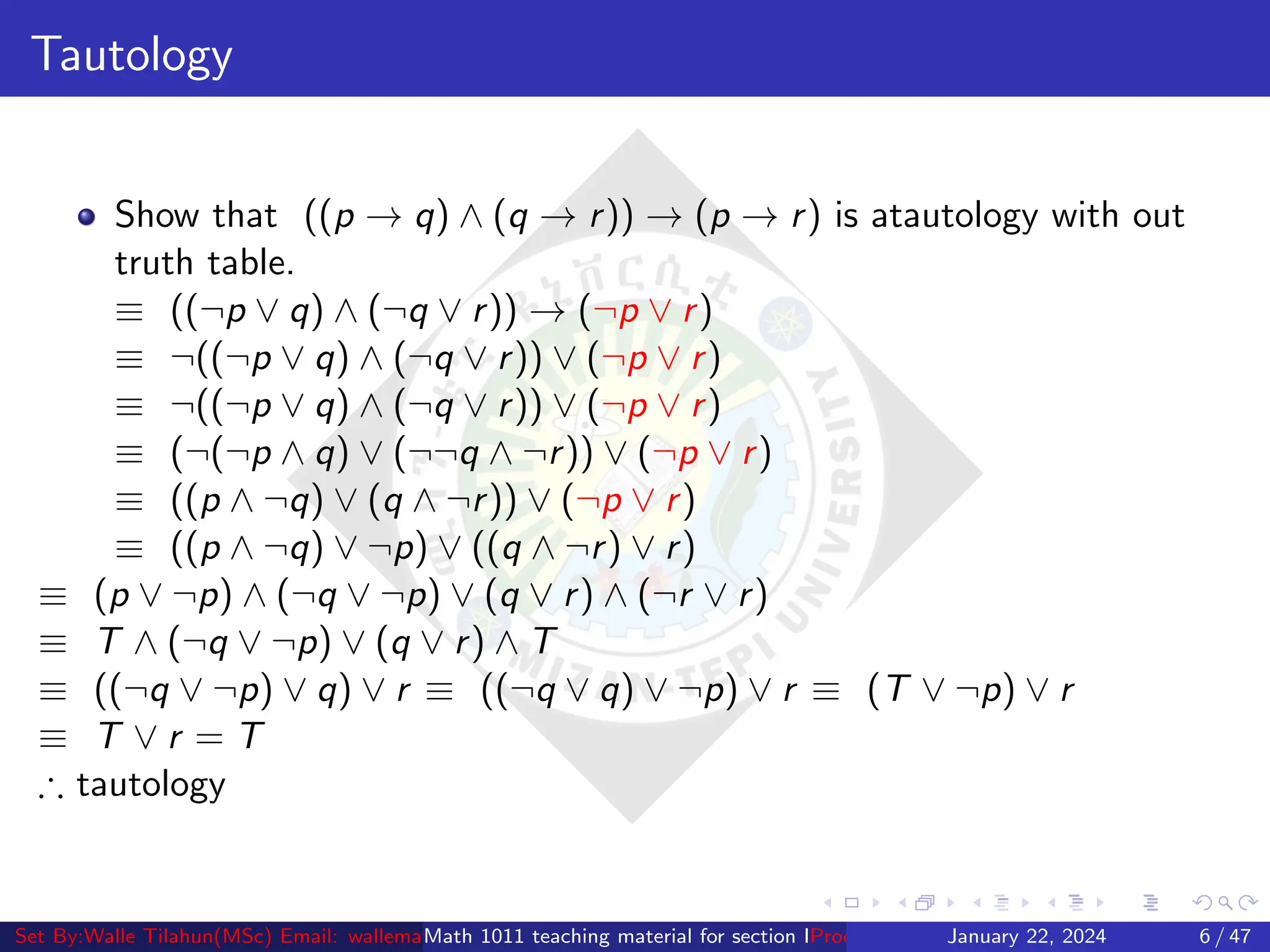
Tautology
Show that ((p → q) ∧ (q → r)) → (p → r) is atautology with out
truth table.
≡ ((¬p ∨ q) ∧ (¬q ∨ r)) → (¬p ∨ r)
≡ ¬((¬p ∨ q) ∧ (¬q ∨ r)) ∨ (¬p ∨ r)
≡ (¬(¬p ∧ q) ∨ (¬¬q ∧ ¬r)) ∨ (¬p ∨ r)
≡ ((p ∧ ¬q) ∨ (q ∧ ¬r)) ∨ (¬p ∨ r)
≡ ((p ∧ ¬q) ∨ ¬p) ∨ ((q ∧ ¬r) ∨ r)
≡ (p ∨ ¬p) ∧ (¬q ∨ ¬p) ∨ (q ∨ r) ∧ (¬r ∨ r)
≡ T ∧ (¬q ∨ ¬p) ∨ (q ∨ r) ∧ T
≡ ((¬q ∨ ¬p) ∨ q) ∨ r ≡ ((¬q ∨ q) ∨ ¬p) ∨ r ≡ (T ∨ ¬p) ∨ r
≡ T ∨ r = T
∴ tautology
Set By:Walle Tilahun(MSc) Email: wallemath2004@gmail.com If there is error reply me!
Math 1011 teaching material for section IProofs and Examples are not included under this M
January 22, 2024 6 / 47
h
le T
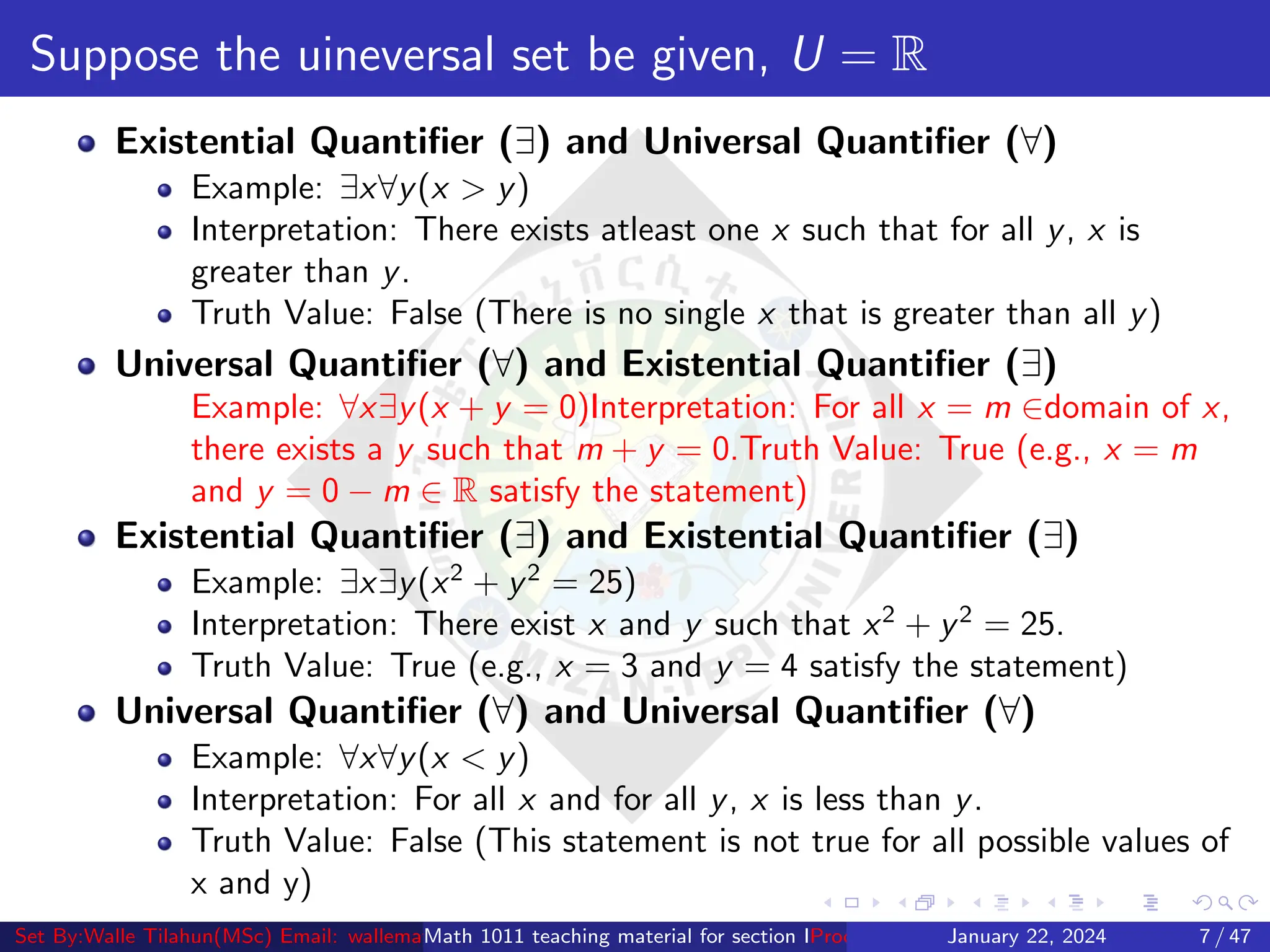
Suppose the uineversal set be given, U = R
Existential Quantifier (∃) and Universal Quantifier (∀)
Example: ∃x∀y(x > y)
Interpretation: There exists atleast one x such that for all y, x is
greater than y.
Truth Value: False (There is no single x that is greater than all y)
Universal Quantifier (∀) and Existential Quantifier (∃)
Example: ∀x∃y(x + y = 0)Interpretation: For all x = m ∈domain of x,
there exists a y such that m + y = 0.Truth Value: True (e.g., x = m
and y = 0 − m ∈ R satisfy the statement)
Existential Quantifier (∃) and Existential Quantifier (∃)
Example: ∃x∃y(x2
+ y2
= 25)
Interpretation: There exist x and y such that x2
+ y2
= 25.
Truth Value: True (e.g., x = 3 and y = 4 satisfy the statement)
Universal Quantifier (∀) and Universal Quantifier (∀)
Example: ∀x∀y(x < y)
Interpretation: For all x and for all y, x is less than y.
Truth Value: False (This statement is not true for all possible values of
x and y)
Set By:Walle Tilahun(MSc) Email: wallemath2004@gmail.com If there is error reply me!
Math 1011 teaching material for section IProofs and Examples are not included under this M
January 22, 2024 7 / 47
h
le T
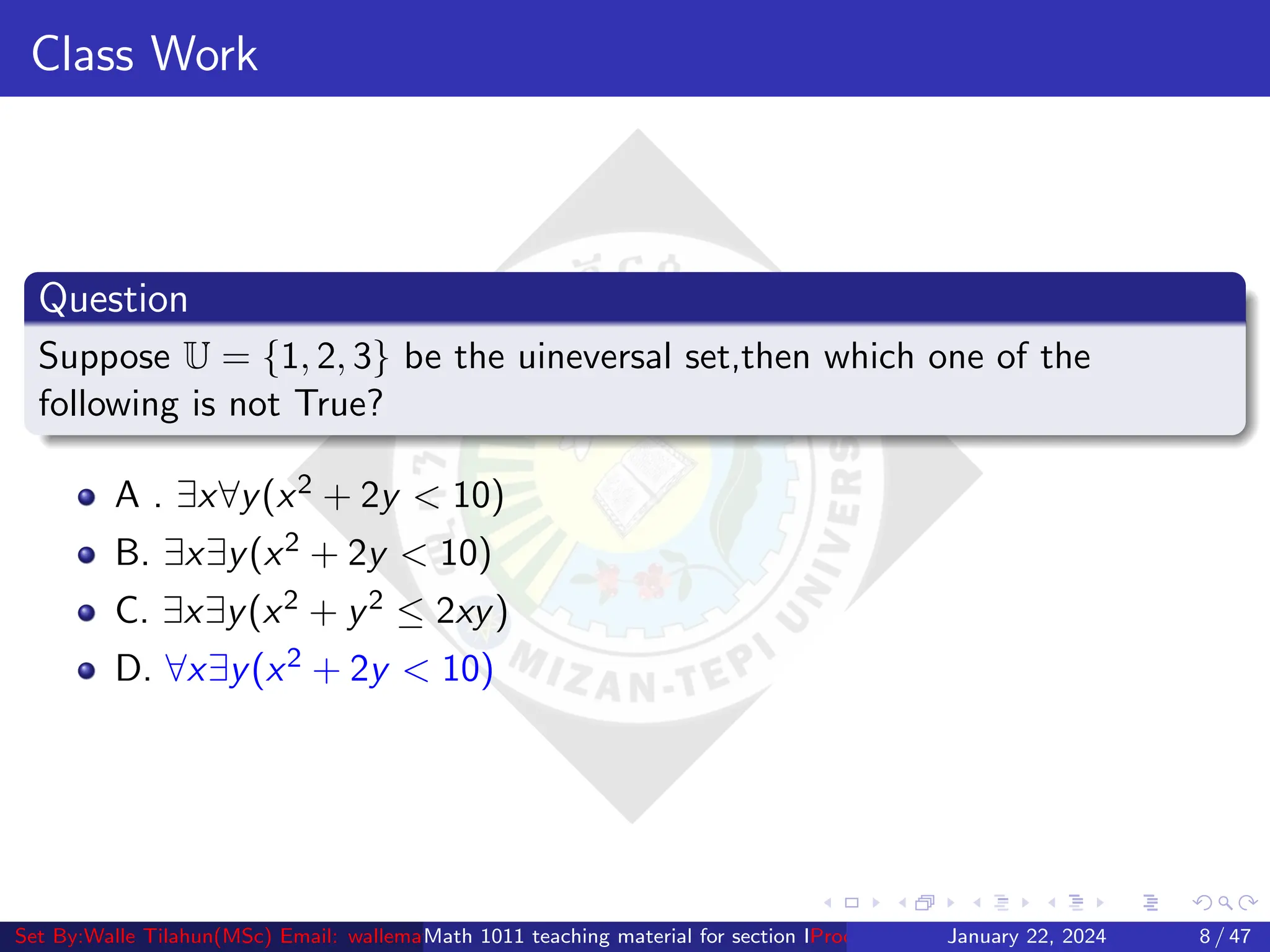
Class Work
Question
Suppose U = {1, 2, 3} be the uineversal set,then which one of the
following is not True?
A . ∃x∀y(x2 + 2y < 10)
B. ∃x∃y(x2 + 2y < 10)
C. ∃x∃y(x2 + y2 ≤ 2xy)
D. ∀x∃y(x2 + 2y < 10)
Set By:Walle Tilahun(MSc) Email: wallemath2004@gmail.com If there is error reply me!
Math 1011 teaching material for section IProofs and Examples are not included under this M
January 22, 2024 8 / 47
h
le T
Argument Formalization and Evaluation
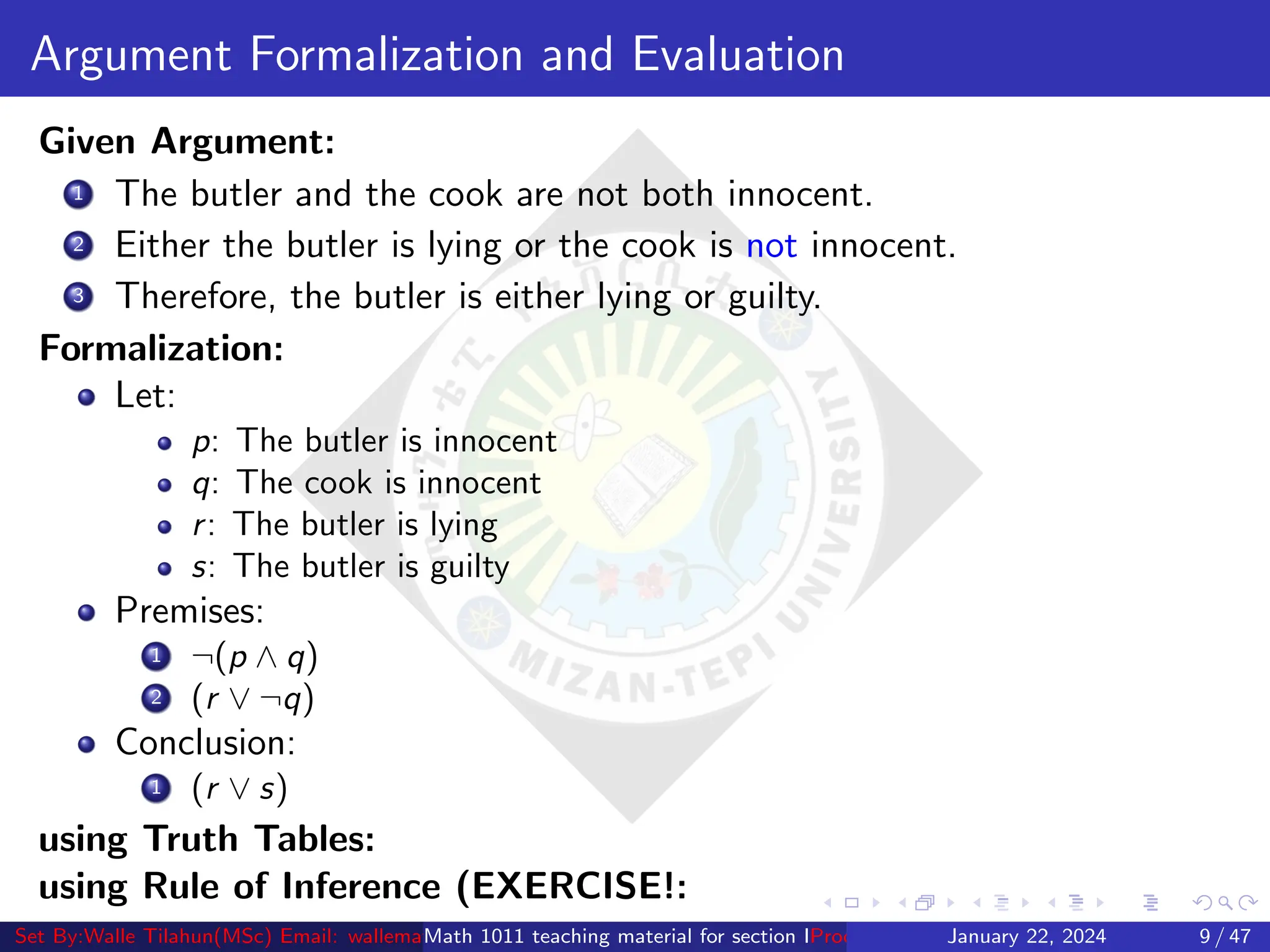
Given Argument:
1 The butler and the cook are not both innocent.
2 Either the butler is lying or the cook is not innocent.
3 Therefore, the butler is either lying or guilty.
Formalization:
Let:
p: The butler is innocent
q: The cook is innocent
r: The butler is lying
s: The butler is guilty
Premises:
1 ¬(p ∧ q)
2 (r ∨ ¬q)
Conclusion:
1 (r ∨ s)
using Truth Tables:
using Rule of Inference (EXERCISE!:
Set By:Walle Tilahun(MSc) Email: wallemath2004@gmail.com If there is error reply me!
Math 1011 teaching material for section IProofs and Examples are not included under this M
January 22, 2024 9 / 47
h
le T
Argument Formalization and Evaluation
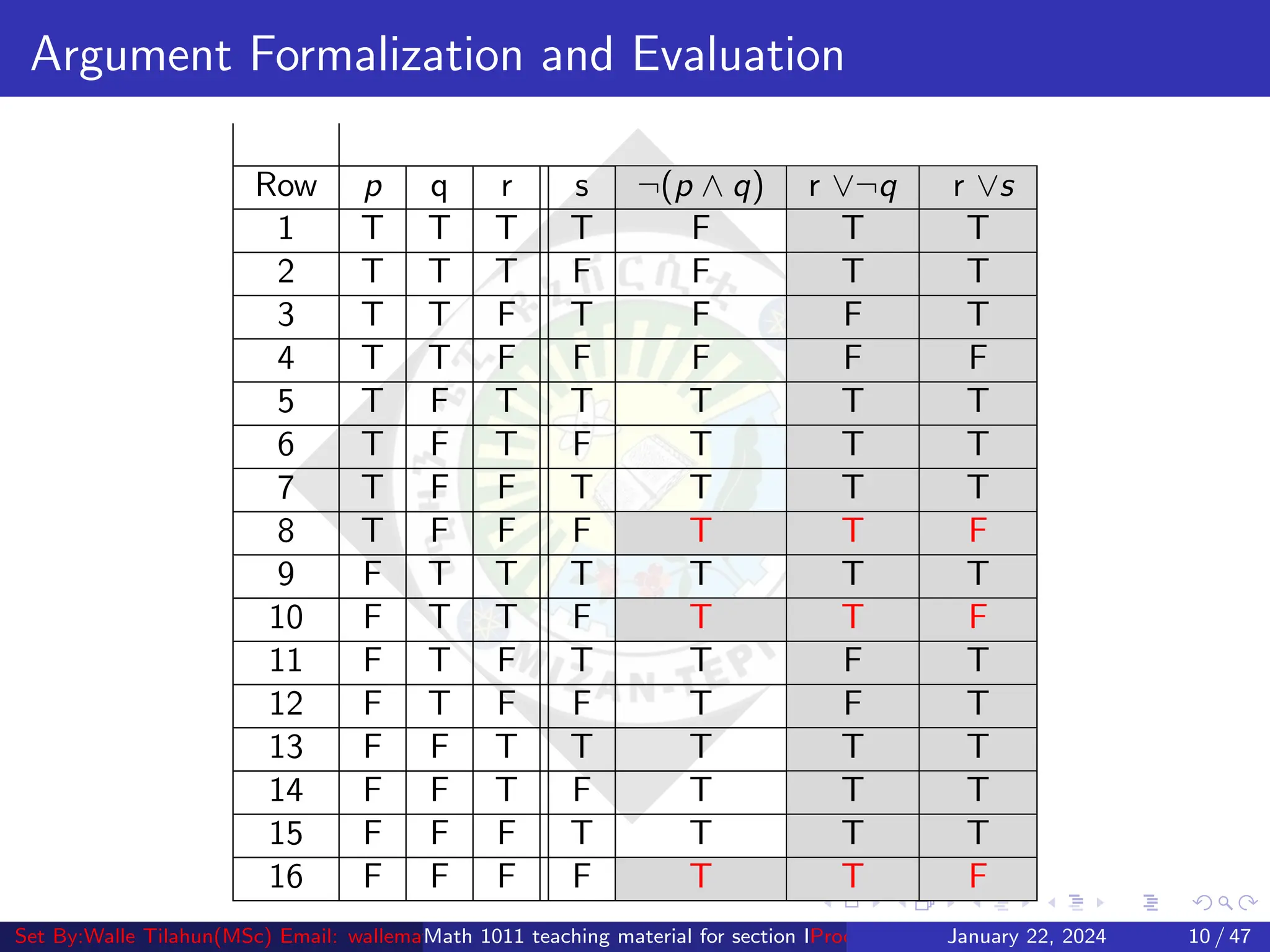
Row p q r s ¬(p ∧ q) r ∨¬q r ∨s
1 T T T T F T T
2 T T T F F T T
3 T T F T F F T
4 T T F F F F F
5 T F T T T T T
6 T F T F T T T
7 T F F T T T T
8 T F F F T T F
9 F T T T T T T
10 F T T F T T F
11 F T F T T F T
12 F T F F T F T
13 F F T T T T T
14 F F T F T T T
15 F F F T T T T
16 F F F F T T F
Set By:Walle Tilahun(MSc) Email: wallemath2004@gmail.com If there is error reply me!
Math 1011 teaching material for section IProofs and Examples are not included under this M
January 22, 2024 10 / 47
h
le T
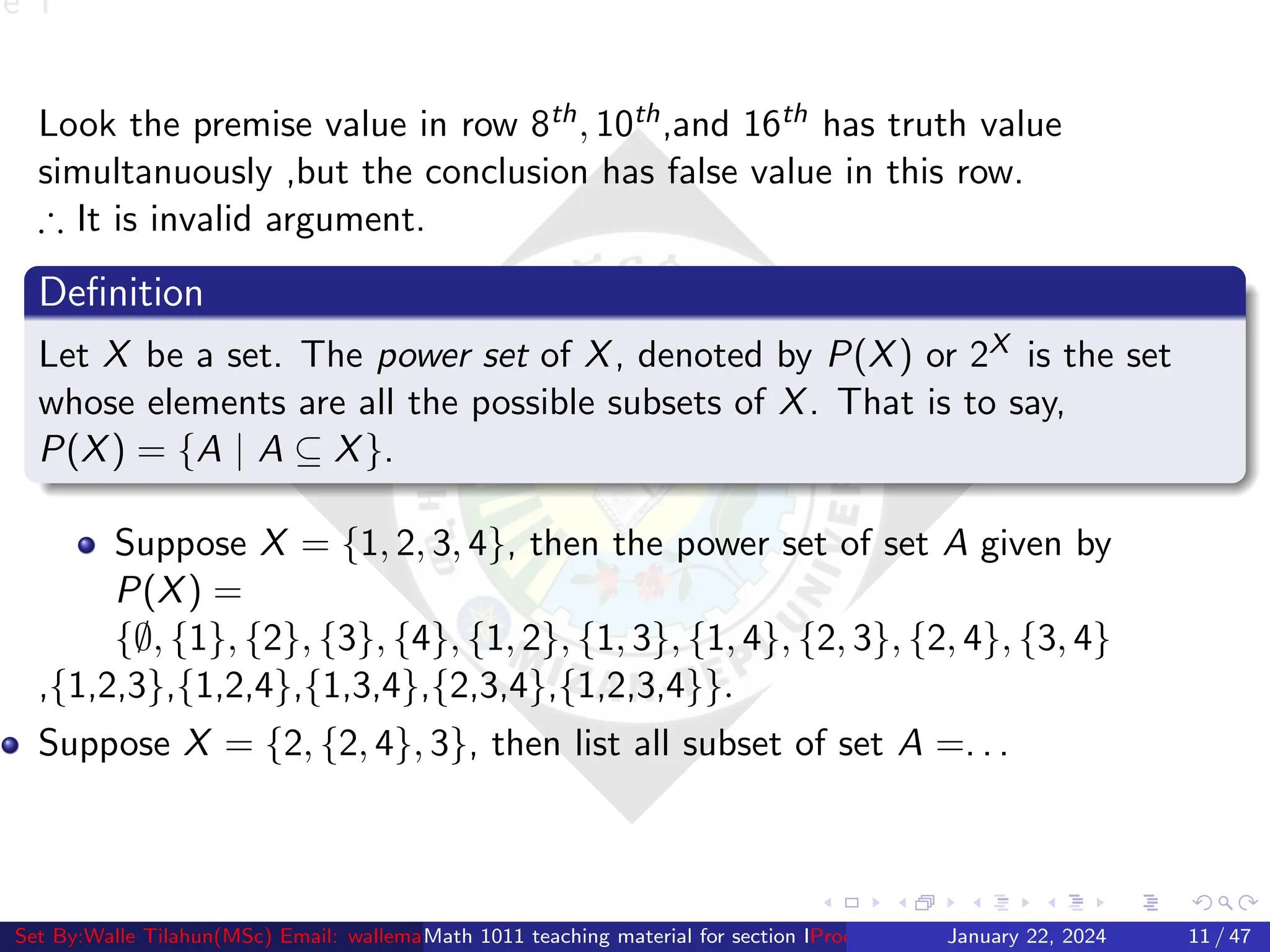
Look the premise value in row 8th, 10th,and 16th has truth value
simultanuously ,but the conclusion has false value in this row.
∴ It is invalid argument.
Definition
Let X be a set. The power set of X, denoted by P(X) or 2X is the set
whose elements are all the possible subsets of X. That is to say,
P(X) = {A | A ⊆ X}.
Suppose X = {1, 2, 3, 4}, then the power set of set A given by
P(X) =
{∅, {1}, {2}, {3}, {4}, {1, 2}, {1, 3}, {1, 4}, {2, 3}, {2, 4}, {3, 4}
,{1,2,3},{1,2,4},{1,3,4},{2,3,4},{1,2,3,4}}.
Suppose X = {2, {2, 4}, 3}, then list all subset of set A =. . .
Set By:Walle Tilahun(MSc) Email: wallemath2004@gmail.com If there is error reply me!
Math 1011 teaching material for section IProofs and Examples are not included under this M
January 22, 2024 11 / 47
h
le T
Set Operations
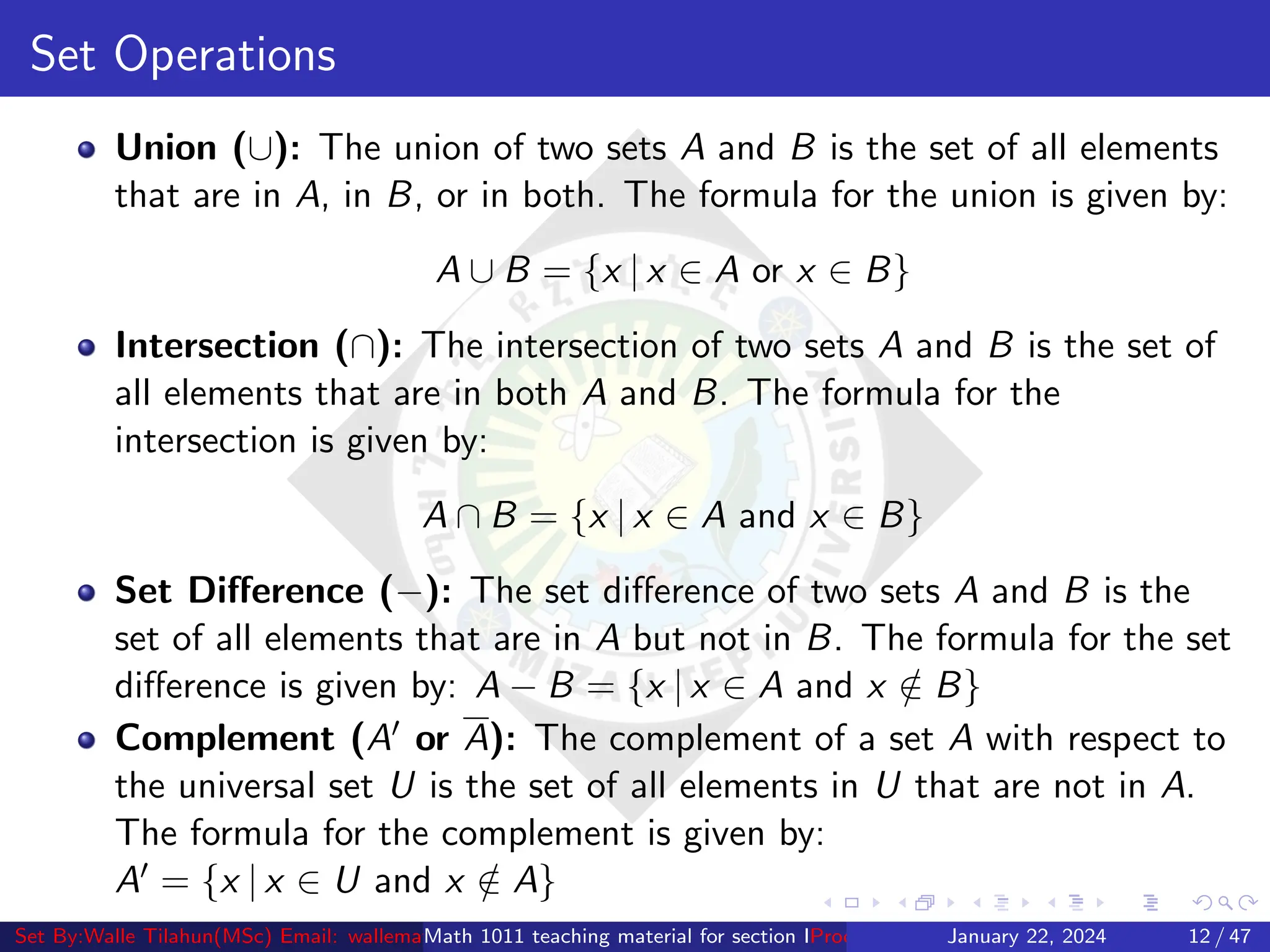
Union (∪): The union of two sets A and B is the set of all elements
that are in A, in B, or in both. The formula for the union is given by:
A ∪ B = {x | x ∈ A or x ∈ B}
Intersection (∩): The intersection of two sets A and B is the set of
all elements that are in both A and B. The formula for the
intersection is given by:
A ∩ B = {x | x ∈ A and x ∈ B}
Set Difference (−): The set difference of two sets A and B is the
set of all elements that are in A but not in B. The formula for the set
difference is given by: A − B = {x | x ∈ A and x /
∈ B}
Complement (A′ or A): The complement of a set A with respect to
the universal set U is the set of all elements in U that are not in A.
The formula for the complement is given by:
A′ = {x | x ∈ U and x /
∈ A}
Set By:Walle Tilahun(MSc) Email: wallemath2004@gmail.com If there is error reply me!
Math 1011 teaching material for section IProofs and Examples are not included under this M
January 22, 2024 12 / 47
h
le T
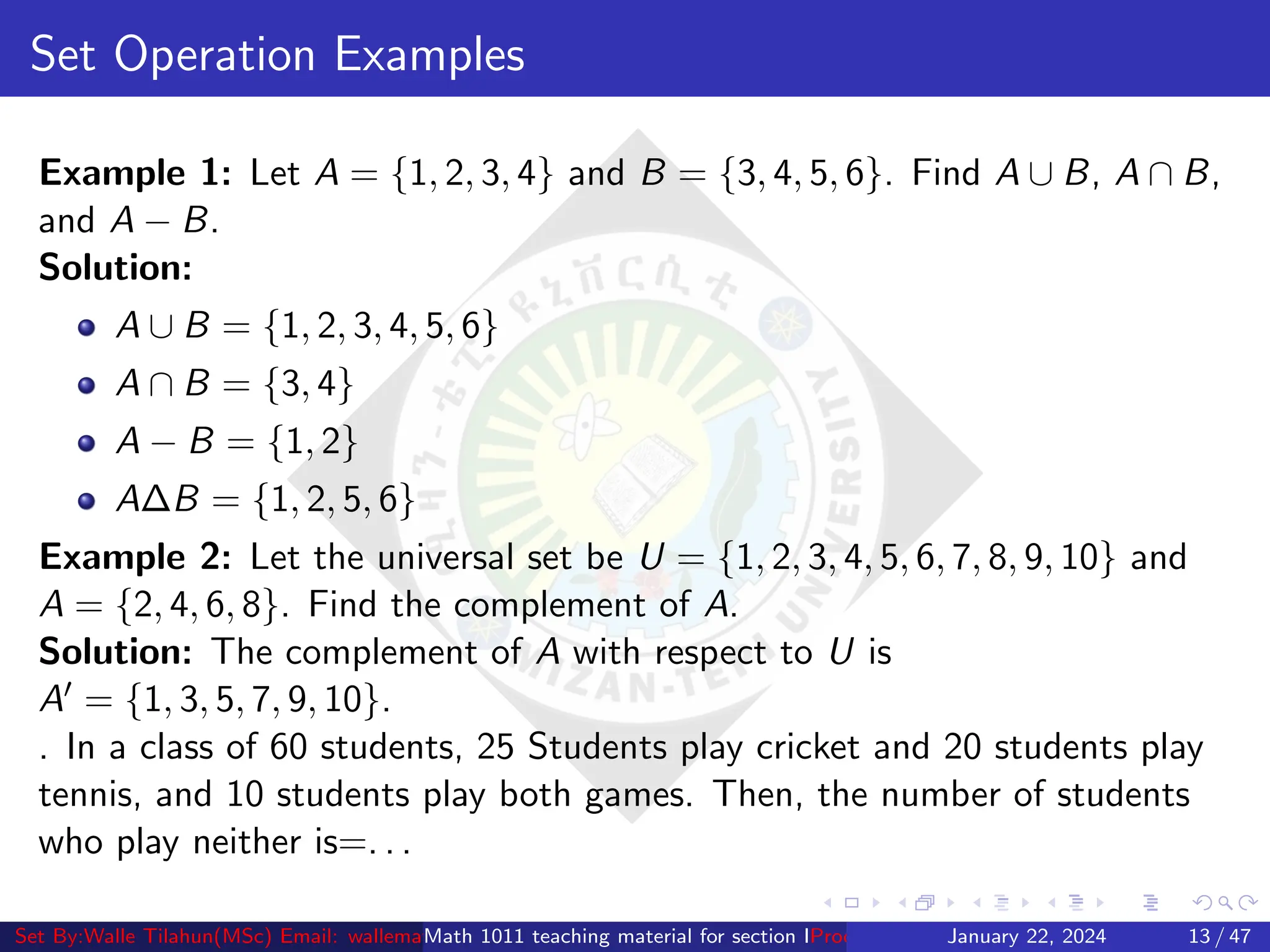
Set Operation Examples
Example 1: Let A = {1, 2, 3, 4} and B = {3, 4, 5, 6}. Find A ∪ B, A ∩ B,
and A − B.
Solution:
A ∪ B = {1, 2, 3, 4, 5, 6}
A ∩ B = {3, 4}
A − B = {1, 2}
A∆B = {1, 2, 5, 6}
Example 2: Let the universal set be U = {1, 2, 3, 4, 5, 6, 7, 8, 9, 10} and
A = {2, 4, 6, 8}. Find the complement of A.
Solution: The complement of A with respect to U is
A′ = {1, 3, 5, 7, 9, 10}.
. In a class of 60 students, 25 Students play cricket and 20 students play
tennis, and 10 students play both games. Then, the number of students
who play neither is=. . .
Set By:Walle Tilahun(MSc) Email: wallemath2004@gmail.com If there is error reply me!
Math 1011 teaching material for section IProofs and Examples are not included under this M
January 22, 2024 13 / 47
h
le T
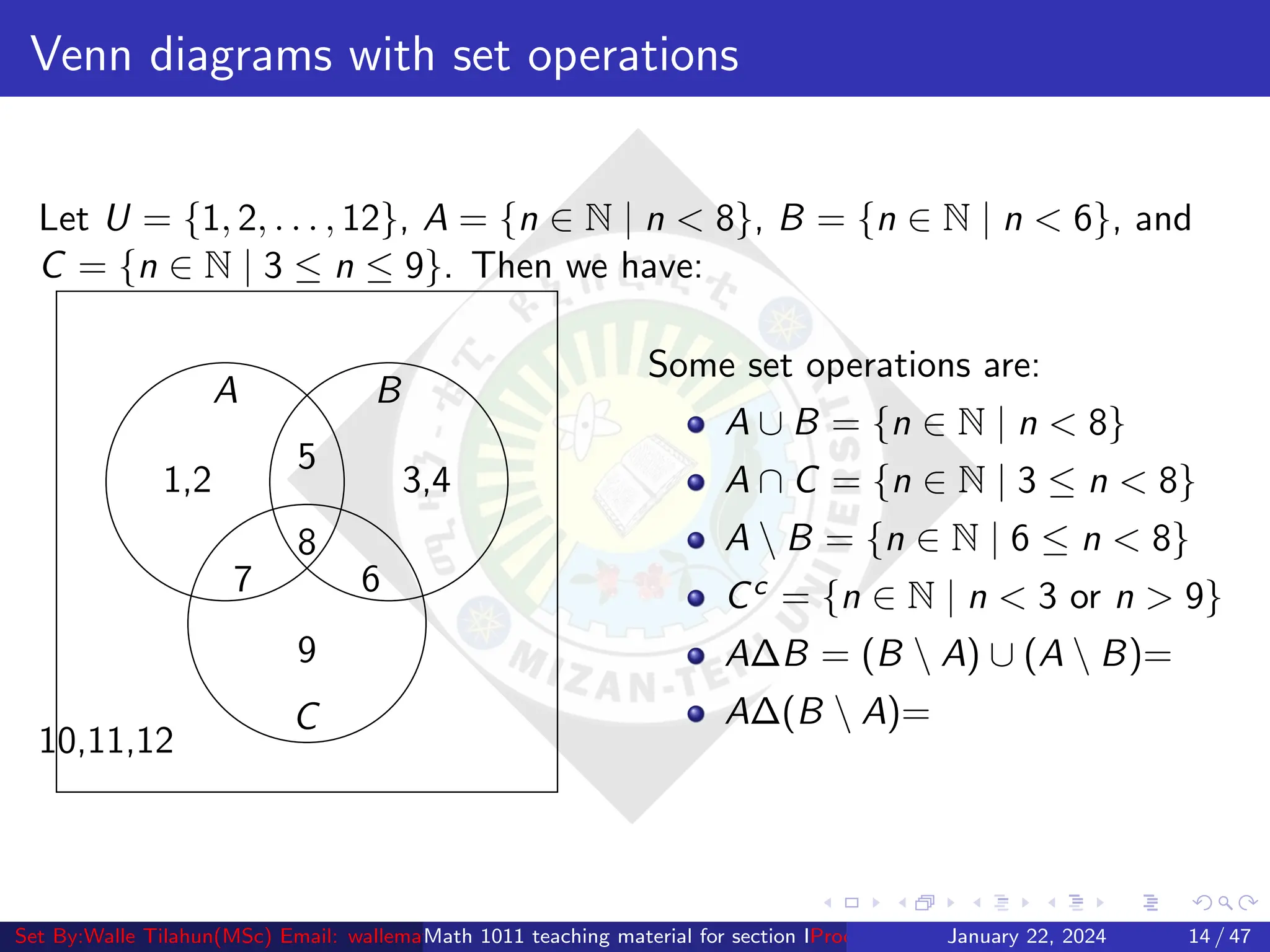
Venn diagrams with set operations
Let U = {1, 2, . . . , 12}, A = {n ∈ N | n < 8}, B = {n ∈ N | n < 6}, and
C = {n ∈ N | 3 ≤ n ≤ 9}. Then we have:
1,2 3,4
9
10,11,12
A B
C
8
5
7 6
Some set operations are:
A ∪ B = {n ∈ N | n < 8}
A ∩ C = {n ∈ N | 3 ≤ n < 8}
A  B = {n ∈ N | 6 ≤ n < 8}
Cc = {n ∈ N | n < 3 or n > 9}
A∆B = (B  A) ∪ (A  B)=
A∆(B  A)=
Set By:Walle Tilahun(MSc) Email: wallemath2004@gmail.com If there is error reply me!
Math 1011 teaching material for section IProofs and Examples are not included under this M
January 22, 2024 14 / 47
h
le T
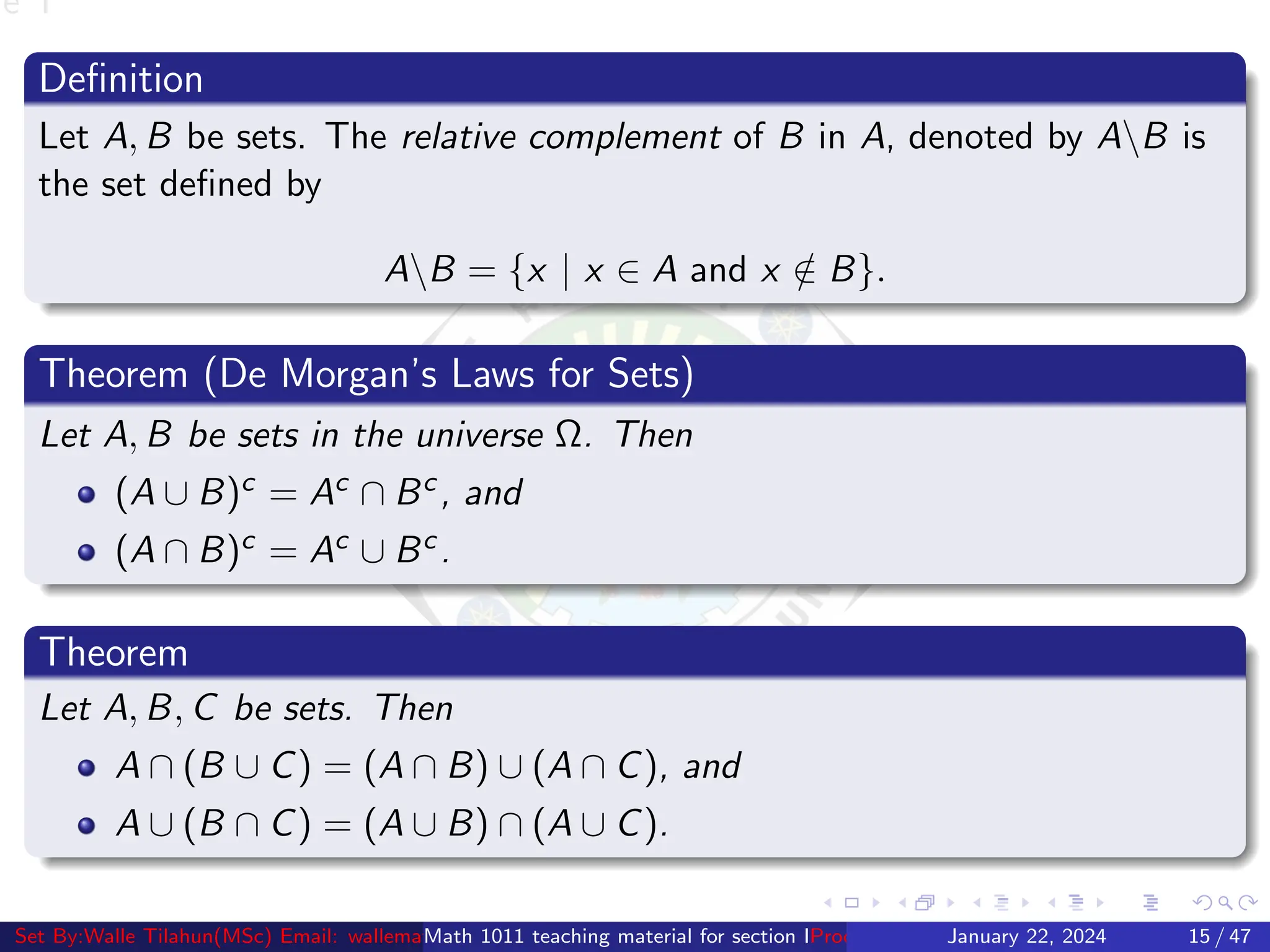
Definition
Let A, B be sets. The relative complement of B in A, denoted by AB is
the set defined by
AB = {x | x ∈ A and x /
∈ B}.
Theorem (De Morgan’s Laws for Sets)
Let A, B be sets in the universe Ω. Then
(A ∪ B)c = Ac ∩ Bc, and
(A ∩ B)c = Ac ∪ Bc.
Theorem
Let A, B, C be sets. Then
A ∩ (B ∪ C) = (A ∩ B) ∪ (A ∩ C), and
A ∪ (B ∩ C) = (A ∪ B) ∩ (A ∪ C).
Set By:Walle Tilahun(MSc) Email: wallemath2004@gmail.com If there is error reply me!
Math 1011 teaching material for section IProofs and Examples are not included under this M
January 22, 2024 15 / 47
h
le T
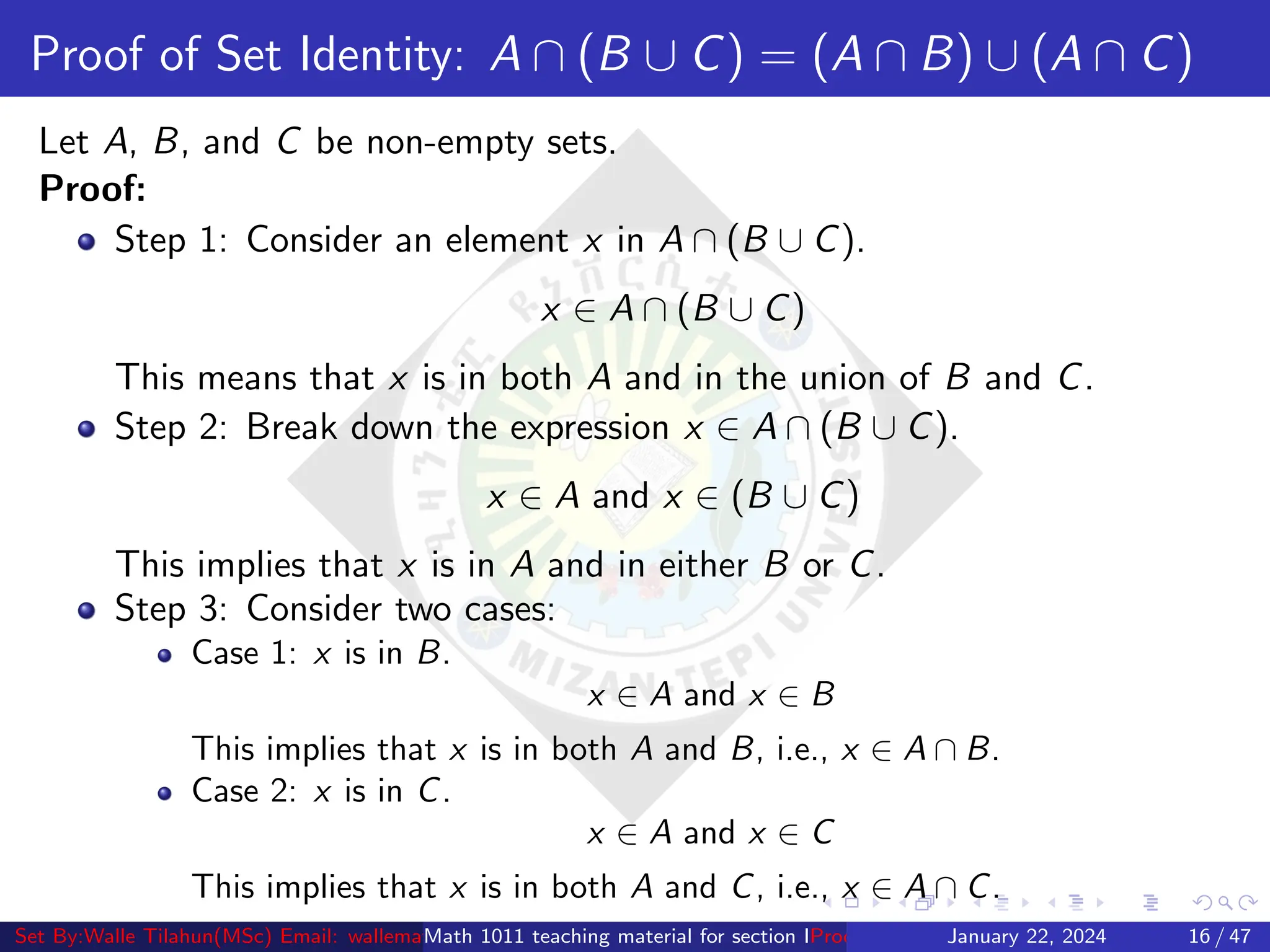
Proof of Set Identity: A ∩ (B ∪ C) = (A ∩ B) ∪ (A ∩ C)
Let A, B, and C be non-empty sets.
Proof:
Step 1: Consider an element x in A ∩ (B ∪ C).
x ∈ A ∩ (B ∪ C)
This means that x is in both A and in the union of B and C.
Step 2: Break down the expression x ∈ A ∩ (B ∪ C).
x ∈ A and x ∈ (B ∪ C)
This implies that x is in A and in either B or C.
Step 3: Consider two cases:
Case 1: x is in B.
x ∈ A and x ∈ B
This implies that x is in both A and B, i.e., x ∈ A ∩ B.
Case 2: x is in C.
x ∈ A and x ∈ C
This implies that x is in both A and C, i.e., x ∈ A ∩ C.
Set By:Walle Tilahun(MSc) Email: wallemath2004@gmail.com If there is error reply me!
Math 1011 teaching material for section IProofs and Examples are not included under this M
January 22, 2024 16 / 47
h
le T
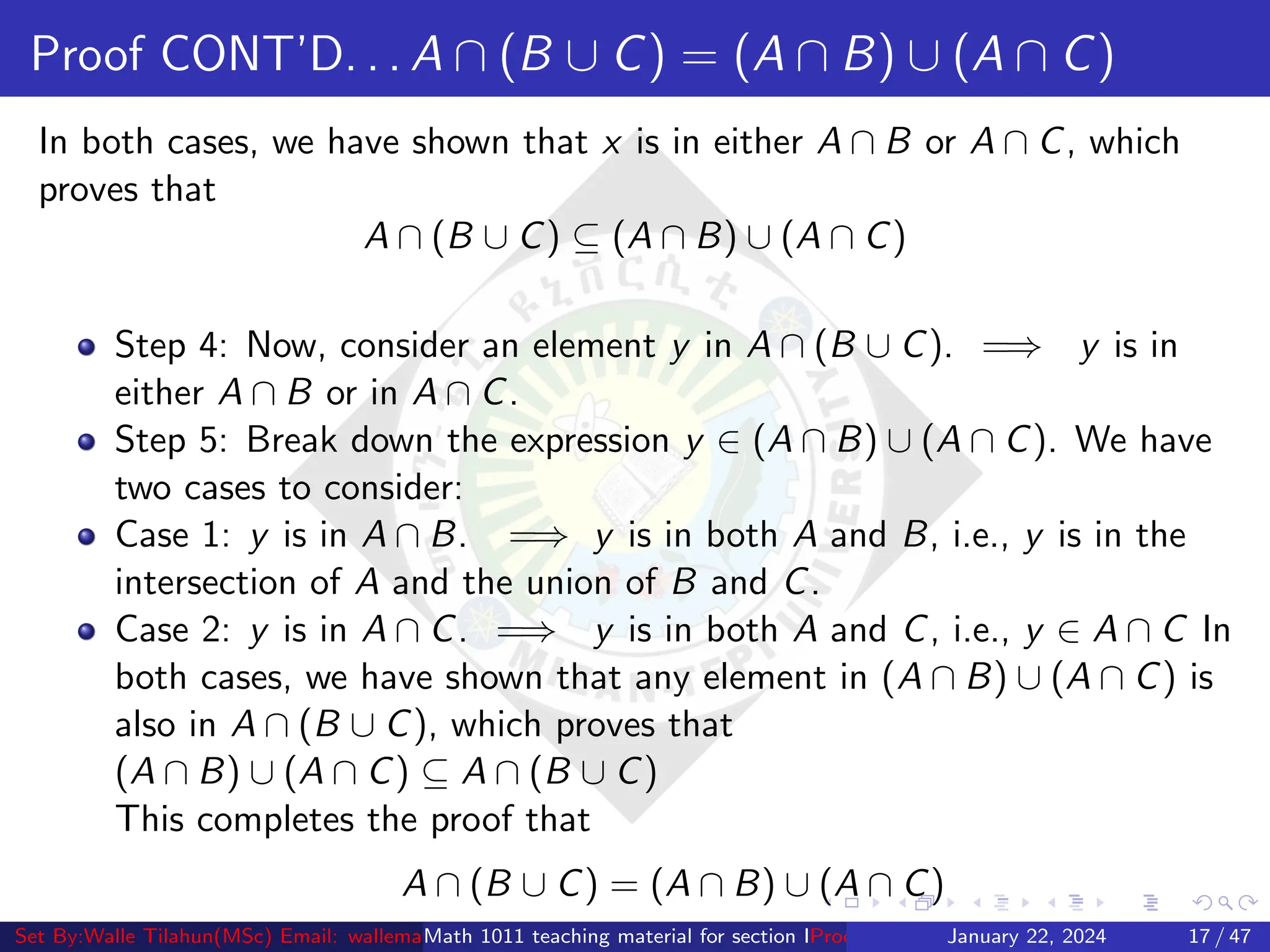
Proof CONT’D. . . A ∩ (B ∪ C) = (A ∩ B) ∪ (A ∩ C)
In both cases, we have shown that x is in either A ∩ B or A ∩ C, which
proves that
A ∩ (B ∪ C) ⊆ (A ∩ B) ∪ (A ∩ C)
Step 4: Now, consider an element y in A ∩ (B ∪ C). =⇒ y is in
either A ∩ B or in A ∩ C.
Step 5: Break down the expression y ∈ (A ∩ B) ∪ (A ∩ C). We have
two cases to consider:
Case 1: y is in A ∩ B. =⇒ y is in both A and B, i.e., y is in the
intersection of A and the union of B and C.
Case 2: y is in A ∩ C. =⇒ y is in both A and C, i.e., y ∈ A ∩ C In
both cases, we have shown that any element in (A ∩ B) ∪ (A ∩ C) is
also in A ∩ (B ∪ C), which proves that
(A ∩ B) ∪ (A ∩ C) ⊆ A ∩ (B ∪ C)
This completes the proof that
A ∩ (B ∪ C) = (A ∩ B) ∪ (A ∩ C)
Set By:Walle Tilahun(MSc) Email: wallemath2004@gmail.com If there is error reply me!
Math 1011 teaching material for section IProofs and Examples are not included under this M
January 22, 2024 17 / 47
h
le T
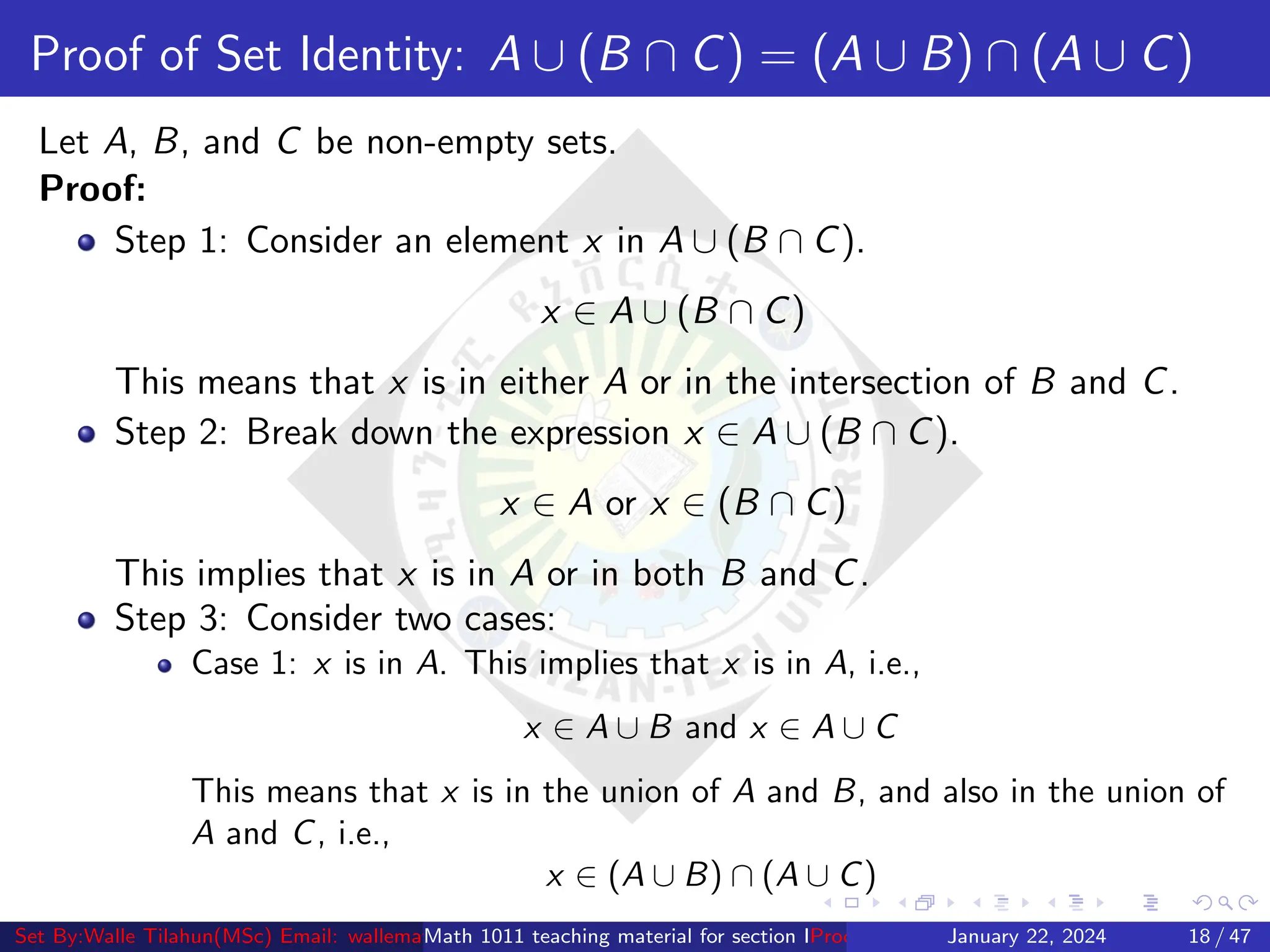
Proof of Set Identity: A ∪ (B ∩ C) = (A ∪ B) ∩ (A ∪ C)
Let A, B, and C be non-empty sets.
Proof:
Step 1: Consider an element x in A ∪ (B ∩ C).
x ∈ A ∪ (B ∩ C)
This means that x is in either A or in the intersection of B and C.
Step 2: Break down the expression x ∈ A ∪ (B ∩ C).
x ∈ A or x ∈ (B ∩ C)
This implies that x is in A or in both B and C.
Step 3: Consider two cases:
Case 1: x is in A. This implies that x is in A, i.e.,
x ∈ A ∪ B and x ∈ A ∪ C
This means that x is in the union of A and B, and also in the union of
A and C, i.e.,
x ∈ (A ∪ B) ∩ (A ∪ C)
Set By:Walle Tilahun(MSc) Email: wallemath2004@gmail.com If there is error reply me!
Math 1011 teaching material for section IProofs and Examples are not included under this M
January 22, 2024 18 / 47
h
le T
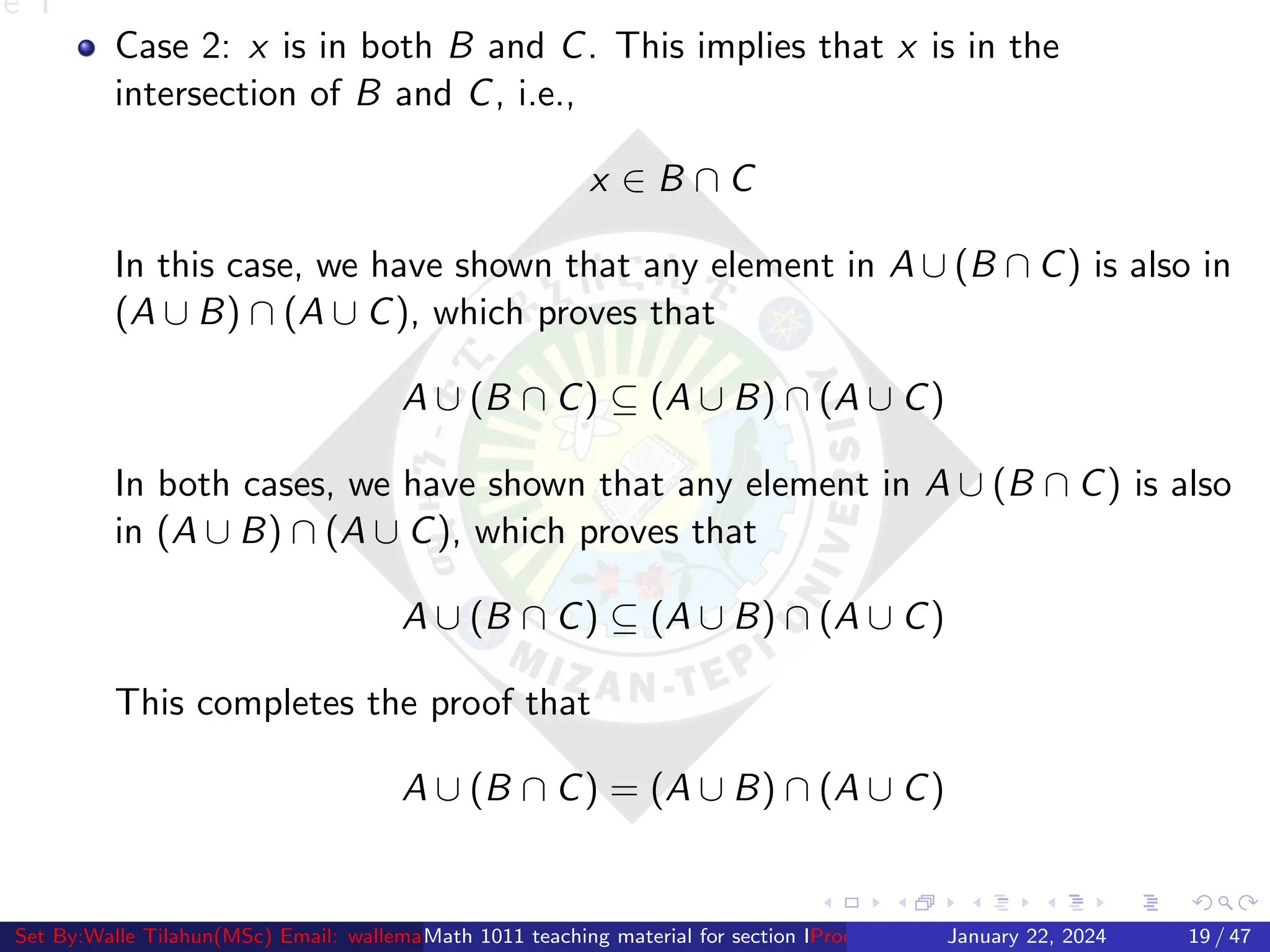
Case 2: x is in both B and C. This implies that x is in the
intersection of B and C, i.e.,
x ∈ B ∩ C
In this case, we have shown that any element in A ∪ (B ∩ C) is also in
(A ∪ B) ∩ (A ∪ C), which proves that
A ∪ (B ∩ C) ⊆ (A ∪ B) ∩ (A ∪ C)
In both cases, we have shown that any element in A ∪ (B ∩ C) is also
in (A ∪ B) ∩ (A ∪ C), which proves that
A ∪ (B ∩ C) ⊆ (A ∪ B) ∩ (A ∪ C)
This completes the proof that
A ∪ (B ∩ C) = (A ∪ B) ∩ (A ∪ C)
Set By:Walle Tilahun(MSc) Email: wallemath2004@gmail.com If there is error reply me!
Math 1011 teaching material for section IProofs and Examples are not included under this M
January 22, 2024 19 / 47
h
le T
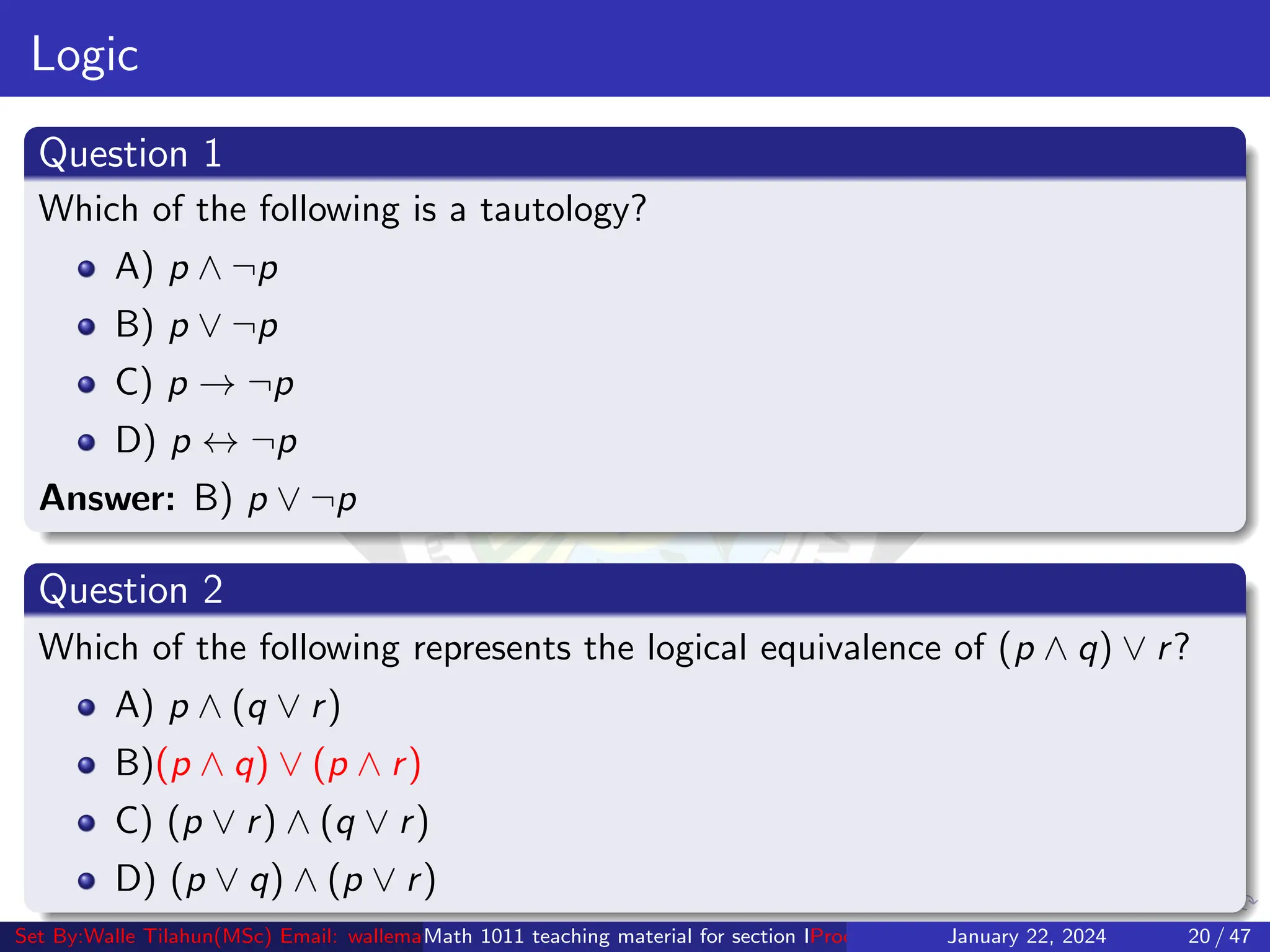
Logic
Question 1
Which of the following is a tautology?
A) p ∧ ¬p
B) p ∨ ¬p
C) p → ¬p
D) p ↔ ¬p
Answer: B) p ∨ ¬p
Question 2
Which of the following represents the logical equivalence of (p ∧ q) ∨ r?
A) p ∧ (q ∨ r)
B)(p ∧ q) ∨ (p ∧ r)
C) (p ∨ r) ∧ (q ∨ r)
D) (p ∨ q) ∧ (p ∨ r)
Set By:Walle Tilahun(MSc) Email: wallemath2004@gmail.com If there is error reply me!
Math 1011 teaching material for section IProofs and Examples are not included under this M
January 22, 2024 20 / 47
h
le T
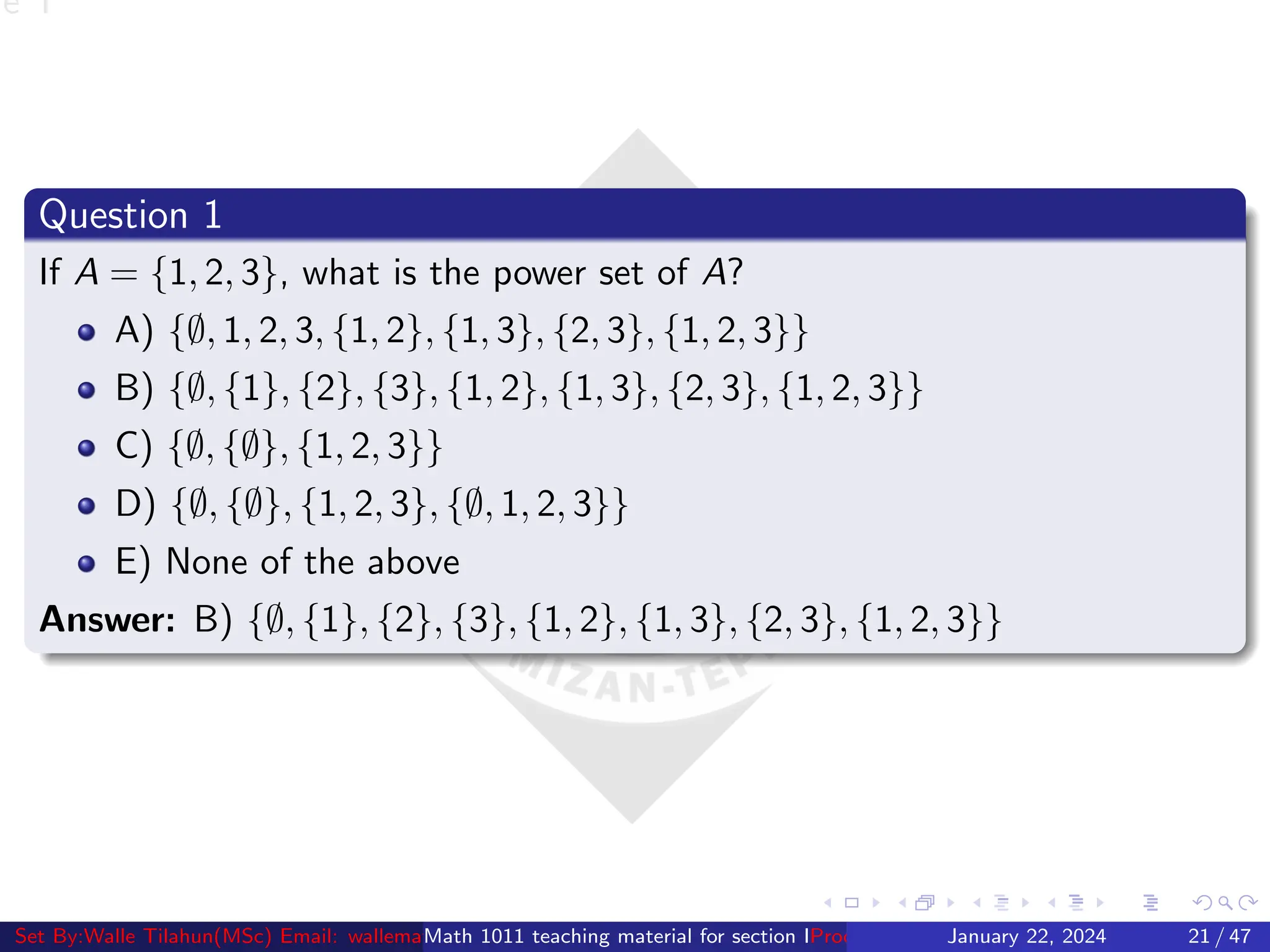
Question 1
If A = {1, 2, 3}, what is the power set of A?
A) {∅, 1, 2, 3, {1, 2}, {1, 3}, {2, 3}, {1, 2, 3}}
B) {∅, {1}, {2}, {3}, {1, 2}, {1, 3}, {2, 3}, {1, 2, 3}}
C) {∅, {∅}, {1, 2, 3}}
D) {∅, {∅}, {1, 2, 3}, {∅, 1, 2, 3}}
E) None of the above
Answer: B) {∅, {1}, {2}, {3}, {1, 2}, {1, 3}, {2, 3}, {1, 2, 3}}
Set By:Walle Tilahun(MSc) Email: wallemath2004@gmail.com If there is error reply me!
Math 1011 teaching material for section IProofs and Examples are not included under this M
January 22, 2024 21 / 47
h
le T
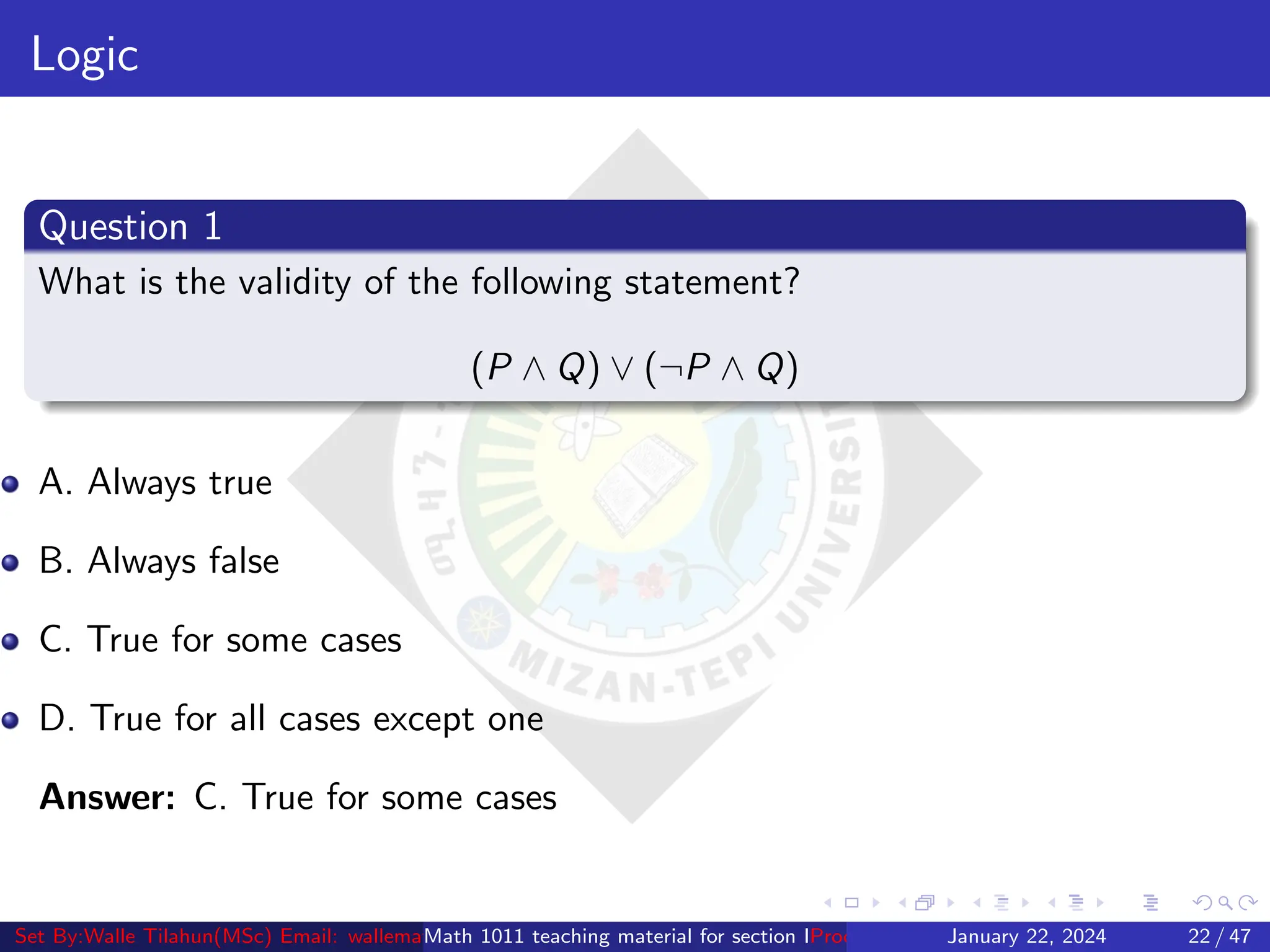
Logic
Question 1
What is the validity of the following statement?
(P ∧ Q) ∨ (¬P ∧ Q)
A. Always true
B. Always false
C. True for some cases
D. True for all cases except one
Answer: C. True for some cases
Set By:Walle Tilahun(MSc) Email: wallemath2004@gmail.com If there is error reply me!
Math 1011 teaching material for section IProofs and Examples are not included under this M
January 22, 2024 22 / 47
h
le T
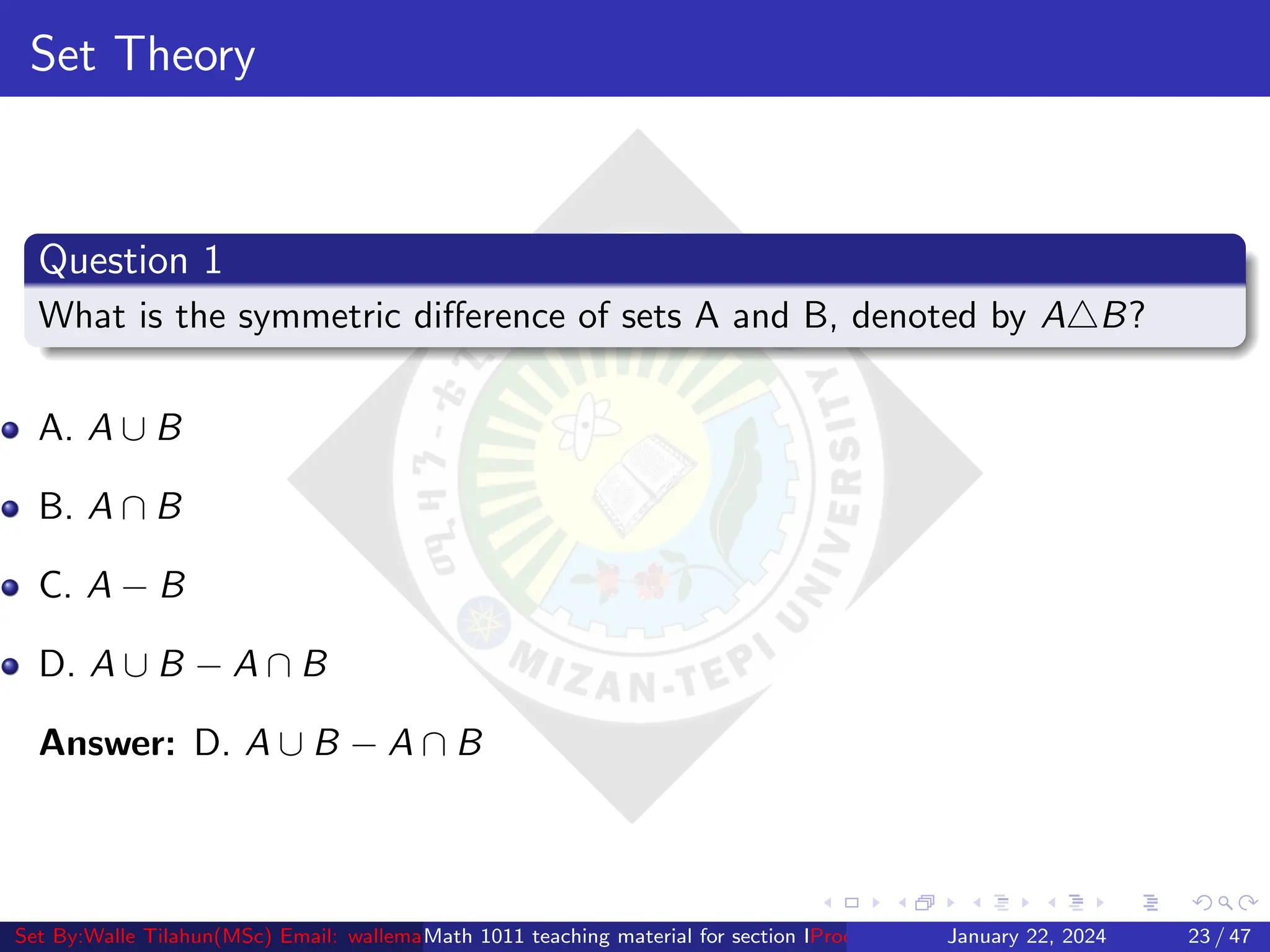
Set Theory
Question 1
What is the symmetric difference of sets A and B, denoted by A△B?
A. A ∪ B
B. A ∩ B
C. A − B
D. A ∪ B − A ∩ B
Answer: D. A ∪ B − A ∩ B
Set By:Walle Tilahun(MSc) Email: wallemath2004@gmail.com If there is error reply me!
Math 1011 teaching material for section IProofs and Examples are not included under this M
January 22, 2024 23 / 47
h
le T
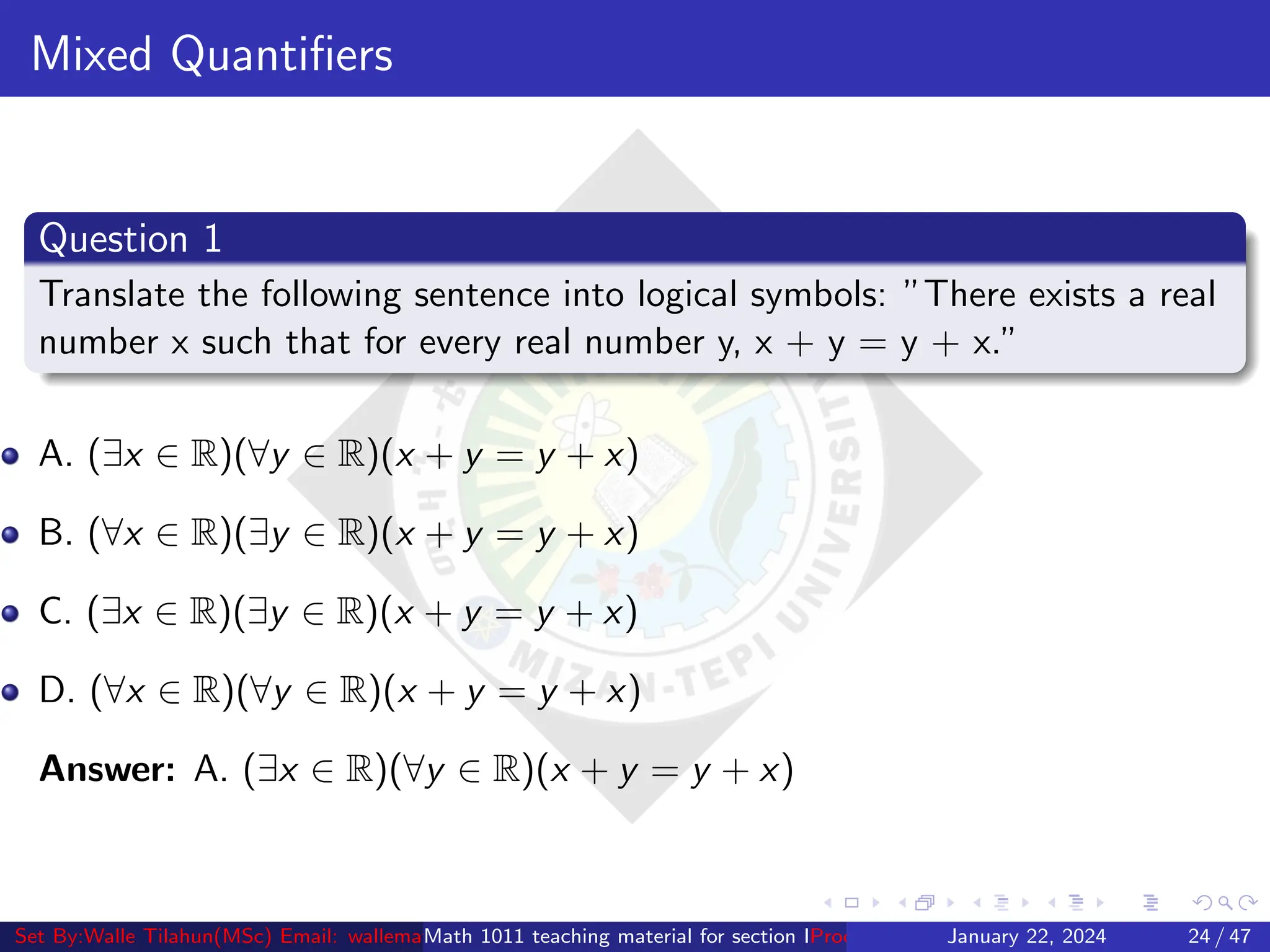
Mixed Quantifiers
Question 1
Translate the following sentence into logical symbols: ”There exists a real
number x such that for every real number y, x + y = y + x.”
A. (∃x ∈ R)(∀y ∈ R)(x + y = y + x)
B. (∀x ∈ R)(∃y ∈ R)(x + y = y + x)
C. (∃x ∈ R)(∃y ∈ R)(x + y = y + x)
D. (∀x ∈ R)(∀y ∈ R)(x + y = y + x)
Answer: A. (∃x ∈ R)(∀y ∈ R)(x + y = y + x)
Set By:Walle Tilahun(MSc) Email: wallemath2004@gmail.com If there is error reply me!
Math 1011 teaching material for section IProofs and Examples are not included under this M
January 22, 2024 24 / 47
h
le T
UNIT TWO: Real Number system
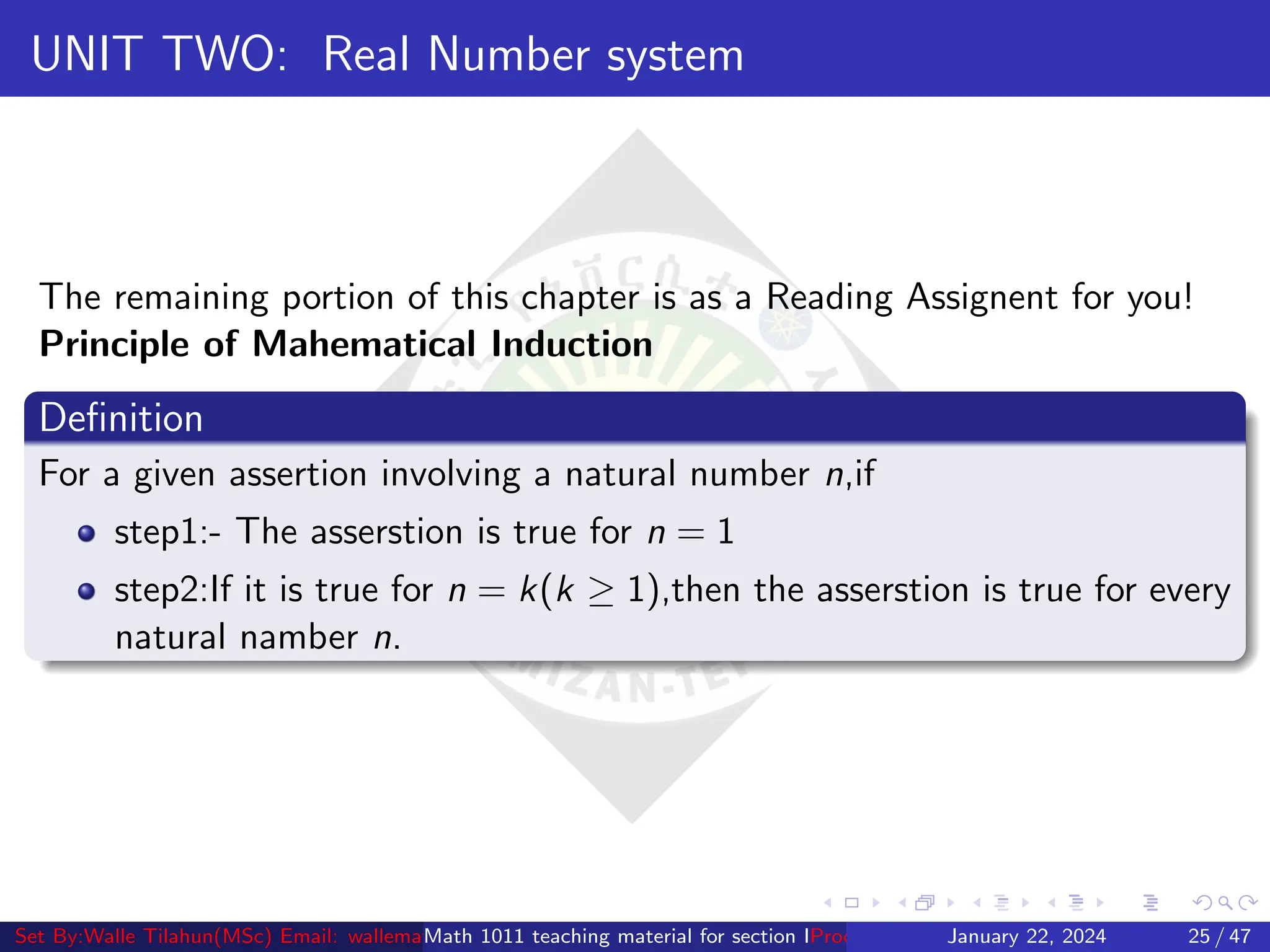
The remaining portion of this chapter is as a Reading Assignent for you!
Principle of Mahematical Induction
Definition
For a given assertion involving a natural number n,if
step1:- The asserstion is true for n = 1
step2:If it is true for n = k(k ≥ 1),then the asserstion is true for every
natural namber n.
Set By:Walle Tilahun(MSc) Email: wallemath2004@gmail.com If there is error reply me!
Math 1011 teaching material for section IProofs and Examples are not included under this M
January 22, 2024 25 / 47
h
le T
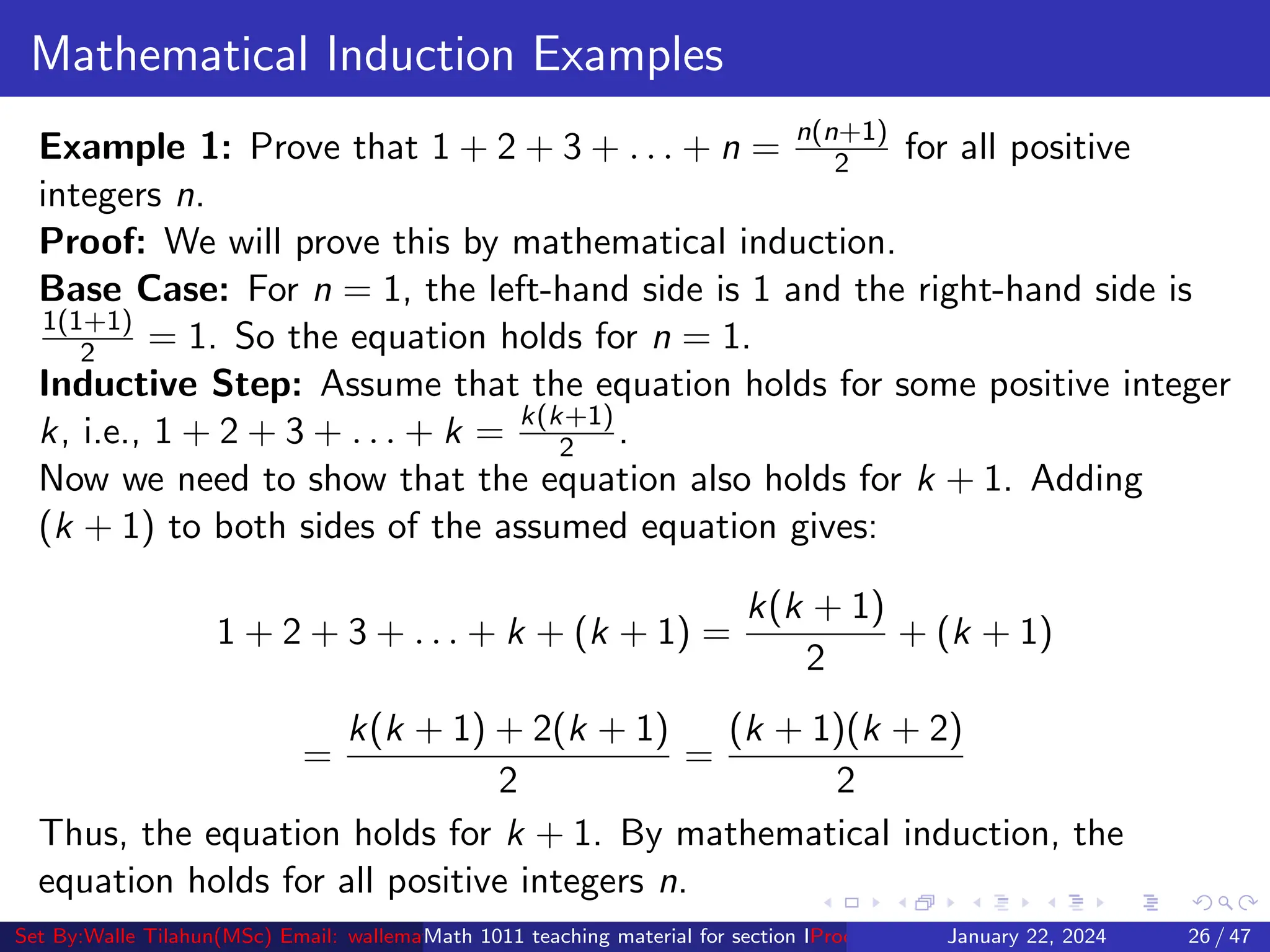
Mathematical Induction Examples
Example 1: Prove that 1 + 2 + 3 + . . . + n = n(n+1)
2 for all positive
integers n.
Proof: We will prove this by mathematical induction.
Base Case: For n = 1, the left-hand side is 1 and the right-hand side is
1(1+1)
2 = 1. So the equation holds for n = 1.
Inductive Step: Assume that the equation holds for some positive integer
k, i.e., 1 + 2 + 3 + . . . + k = k(k+1)
2 .
Now we need to show that the equation also holds for k + 1. Adding
(k + 1) to both sides of the assumed equation gives:
1 + 2 + 3 + . . . + k + (k + 1) =
k(k + 1)
2
+ (k + 1)
=
k(k + 1) + 2(k + 1)
2
=
(k + 1)(k + 2)
2
Thus, the equation holds for k + 1. By mathematical induction, the
equation holds for all positive integers n.
Set By:Walle Tilahun(MSc) Email: wallemath2004@gmail.com If there is error reply me!
Math 1011 teaching material for section IProofs and Examples are not included under this M
January 22, 2024 26 / 47
h
le T
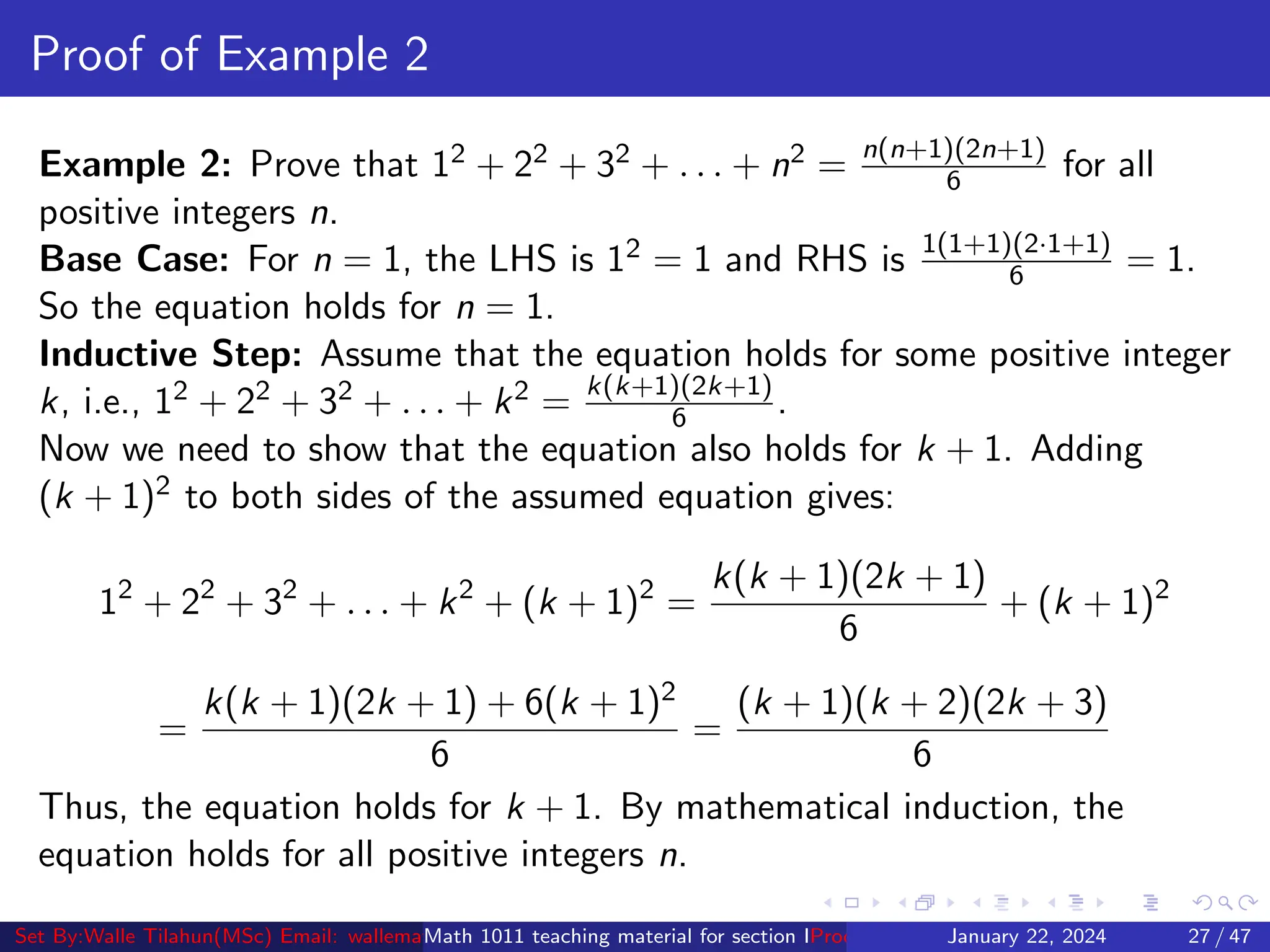
Proof of Example 2
Example 2: Prove that 12 + 22 + 32 + . . . + n2 = n(n+1)(2n+1)
6 for all
positive integers n.
Base Case: For n = 1, the LHS is 12 = 1 and RHS is 1(1+1)(2·1+1)
6 = 1.
So the equation holds for n = 1.
Inductive Step: Assume that the equation holds for some positive integer
k, i.e., 12 + 22 + 32 + . . . + k2 = k(k+1)(2k+1)
6 .
Now we need to show that the equation also holds for k + 1. Adding
(k + 1)2 to both sides of the assumed equation gives:
12
+ 22
+ 32
+ . . . + k2
+ (k + 1)2
=
k(k + 1)(2k + 1)
6
+ (k + 1)2
=
k(k + 1)(2k + 1) + 6(k + 1)2
6
=
(k + 1)(k + 2)(2k + 3)
6
Thus, the equation holds for k + 1. By mathematical induction, the
equation holds for all positive integers n.
Set By:Walle Tilahun(MSc) Email: wallemath2004@gmail.com If there is error reply me!
Math 1011 teaching material for section IProofs and Examples are not included under this M
January 22, 2024 27 / 47
h
le T
Proof of Example 3
Example 3: Prove that 2n > n2 for all positive integers n such that n ≥ 5
by mathematical induction.
Base Case: For n = 5, we have 25 = 32 and 52 = 25, so 25 > 52. The
base case holds.
Inductive Step: Assume that the inequality holds for some positive
integer k ≥ 5, i.e., 2k > k2.
Now we need to show that the inequality also holds for k + 1. Multiplying
both sides of the assumed inequality by 2 gives:
2k+1
= 2 · 2k
> 2 · k2
Since k ≥ 5, we have 2k > k2, so 2 · k2 > k2. Therefore, 2k+1 > k2. By
mathematical induction, the inequality holds for all positive integers n such
that n ≥ 5.
Set By:Walle Tilahun(MSc) Email: wallemath2004@gmail.com If there is error reply me!
Math 1011 teaching material for section IProofs and Examples are not included under this M
January 22, 2024 28 / 47
h
le T
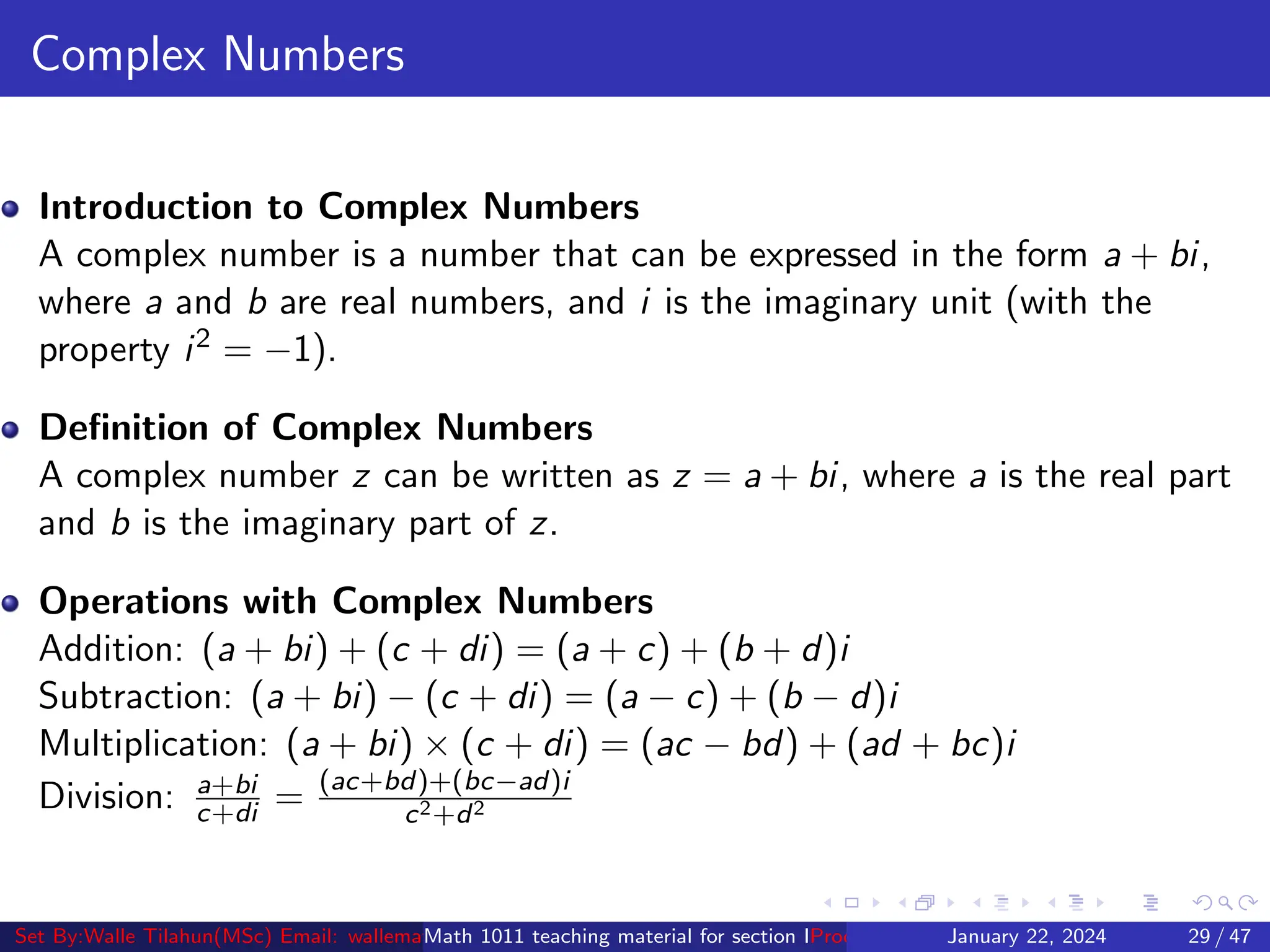
Complex Numbers
Introduction to Complex Numbers
A complex number is a number that can be expressed in the form a + bi,
where a and b are real numbers, and i is the imaginary unit (with the
property i2 = −1).
Definition of Complex Numbers
A complex number z can be written as z = a + bi, where a is the real part
and b is the imaginary part of z.
Operations with Complex Numbers
Addition: (a + bi) + (c + di) = (a + c) + (b + d)i
Subtraction: (a + bi) − (c + di) = (a − c) + (b − d)i
Multiplication: (a + bi) × (c + di) = (ac − bd) + (ad + bc)i
Division: a+bi
c+di = (ac+bd)+(bc−ad)i
c2+d2
Set By:Walle Tilahun(MSc) Email: wallemath2004@gmail.com If there is error reply me!
Math 1011 teaching material for section IProofs and Examples are not included under this M
January 22, 2024 29 / 47
h
le T
Proof of Commutative Property of Addition and
Subtraction for Complex Numbers
Let z1 = a1 + b1i and z2 = a2 + b2i be complex numbers.
Addition:
Step 1: Consider the sum z1 + z2.
z1 + z2 = (a1 + b1i) + (a2 + b2i)
Step 2: Rearrange the terms in the sum.
z1 + z2 = (a1 + a2) + (b1 + b2)i
Step 3: Consider the sum z2 + z1.
z2 + z1 = (a2 + b2i) + (a1 + b1i)
Step 4: Rearrange the terms in the sum.
z2 + z1 = (a2 + a1) + (b2 + b1)i
Step 5: Compare the results from Steps 2 and 4. We have
z1 + z2 = z2 + z1, which proves the commutative property of addition for
Set By:Walle Tilahun(MSc) Email: wallemath2004@gmail.com If there is error reply me!
Math 1011 teaching material for section IProofs and Examples are not included under this M
January 22, 2024 30 / 47
h
le T
Complex Numbers
Conjugate of Complex Numbers
The conjugate of complex numberz = a + bi is denoted by z = a − bi.
Triangular Inequality . . . proof!
For two complex numbers z1 = a1 + b1i and z2 = a2 + b2i, the triangular
inequality states that:
|z1 + z2| ≤ |z1| + |z2|
. Example: Let z1 = 3 + 4i and z2 = 1 − 2i. We have:
|z1 + z2| = |4 + 2i| =
√
20
|z1| + |z2| = |3 + 4i| + |1 − 2i| = 5 +
√
5
Since
√
20 ≤ 5 +
√
5, the triangular inequality holds
Operations with Complex Numbers
The Additive inverse of: z = (x + yi) is −z = (−x − yi)
The Multiplicative inveverse of: z = (x + yi) is given
by1
z = 1
x+yi = x−yi
√
x2+y2
Set By:Walle Tilahun(MSc) Email: wallemath2004@gmail.com If there is error reply me!
Math 1011 teaching material for section IProofs and Examples are not included under this M
January 22, 2024 31 / 47
h
le T
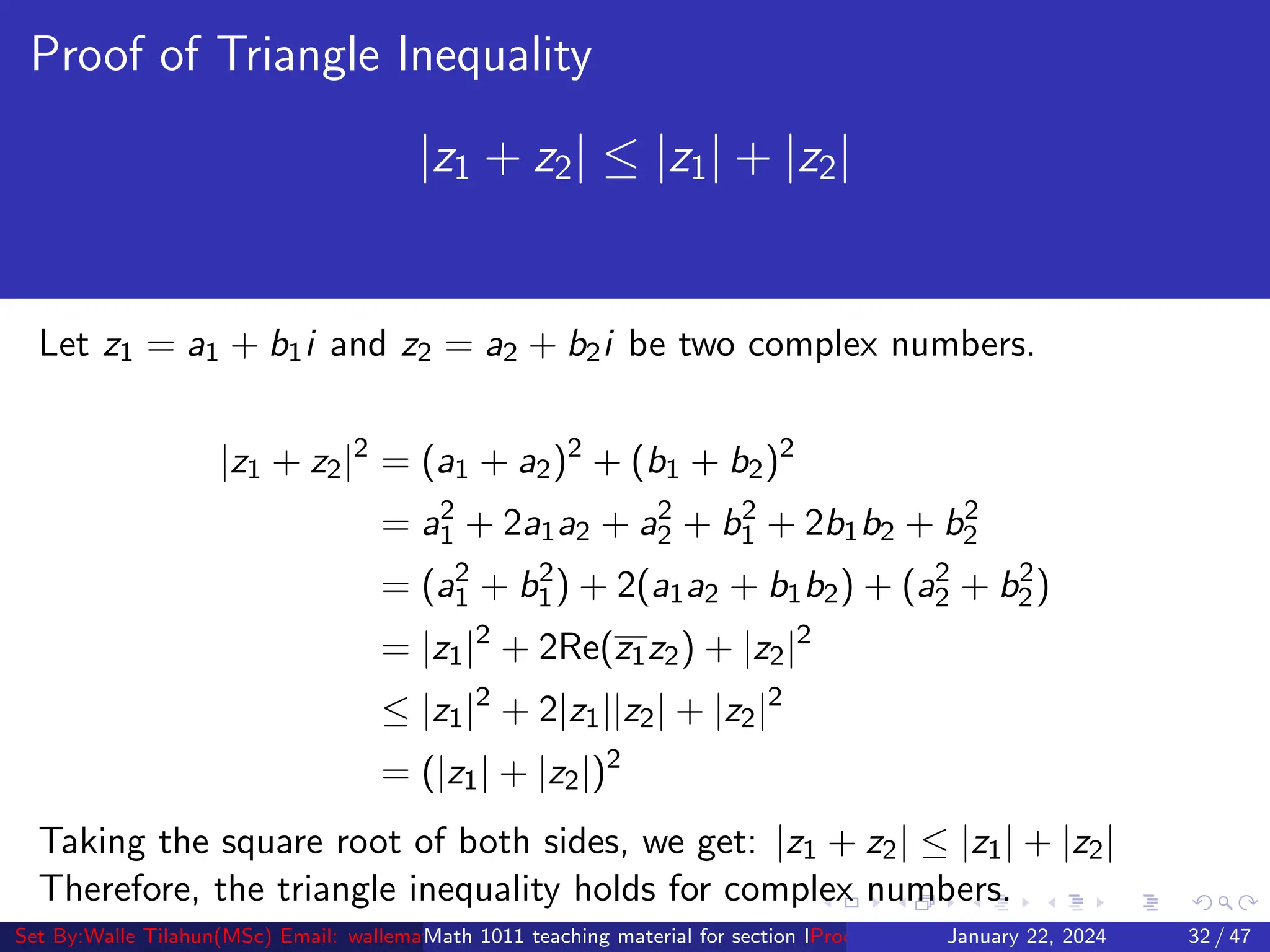
Proof of Triangle Inequality
|z1 + z2| ≤ |z1| + |z2|
Let z1 = a1 + b1i and z2 = a2 + b2i be two complex numbers.
|z1 + z2|2
= (a1 + a2)2
+ (b1 + b2)2
= a2
1 + 2a1a2 + a2
2 + b2
1 + 2b1b2 + b2
2
= (a2
1 + b2
1) + 2(a1a2 + b1b2) + (a2
2 + b2
2)
= |z1|2
+ 2Re(z1z2) + |z2|2
≤ |z1|2
+ 2|z1||z2| + |z2|2
= (|z1| + |z2|)2
Taking the square root of both sides, we get: |z1 + z2| ≤ |z1| + |z2|
Therefore, the triangle inequality holds for complex numbers.
Set By:Walle Tilahun(MSc) Email: wallemath2004@gmail.com If there is error reply me!
Math 1011 teaching material for section IProofs and Examples are not included under this M
January 22, 2024 32 / 47
h
le T
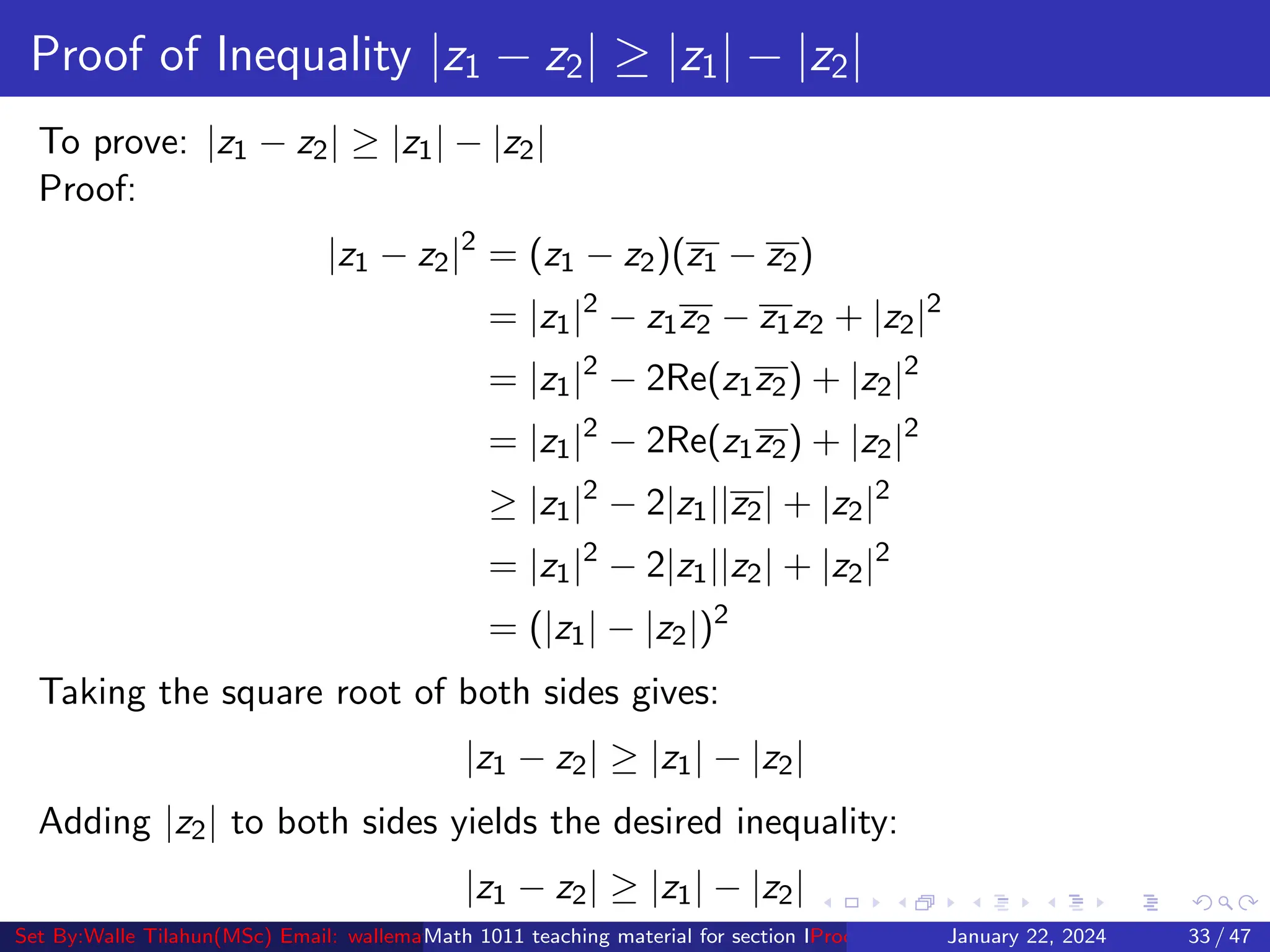
Proof of Inequality |z1 − z2| ≥ |z1| − |z2|
To prove: |z1 − z2| ≥ |z1| − |z2|
Proof:
|z1 − z2|2
= (z1 − z2)(z1 − z2)
= |z1|2
− z1z2 − z1z2 + |z2|2
= |z1|2
− 2Re(z1z2) + |z2|2
= |z1|2
− 2Re(z1z2) + |z2|2
≥ |z1|2
− 2|z1||z2| + |z2|2
= |z1|2
− 2|z1||z2| + |z2|2
= (|z1| − |z2|)2
Taking the square root of both sides gives:
|z1 − z2| ≥ |z1| − |z2|
Adding |z2| to both sides yields the desired inequality:
|z1 − z2| ≥ |z1| − |z2|
Set By:Walle Tilahun(MSc) Email: wallemath2004@gmail.com If there is error reply me!
Math 1011 teaching material for section IProofs and Examples are not included under this M
January 22, 2024 33 / 47
h
le T
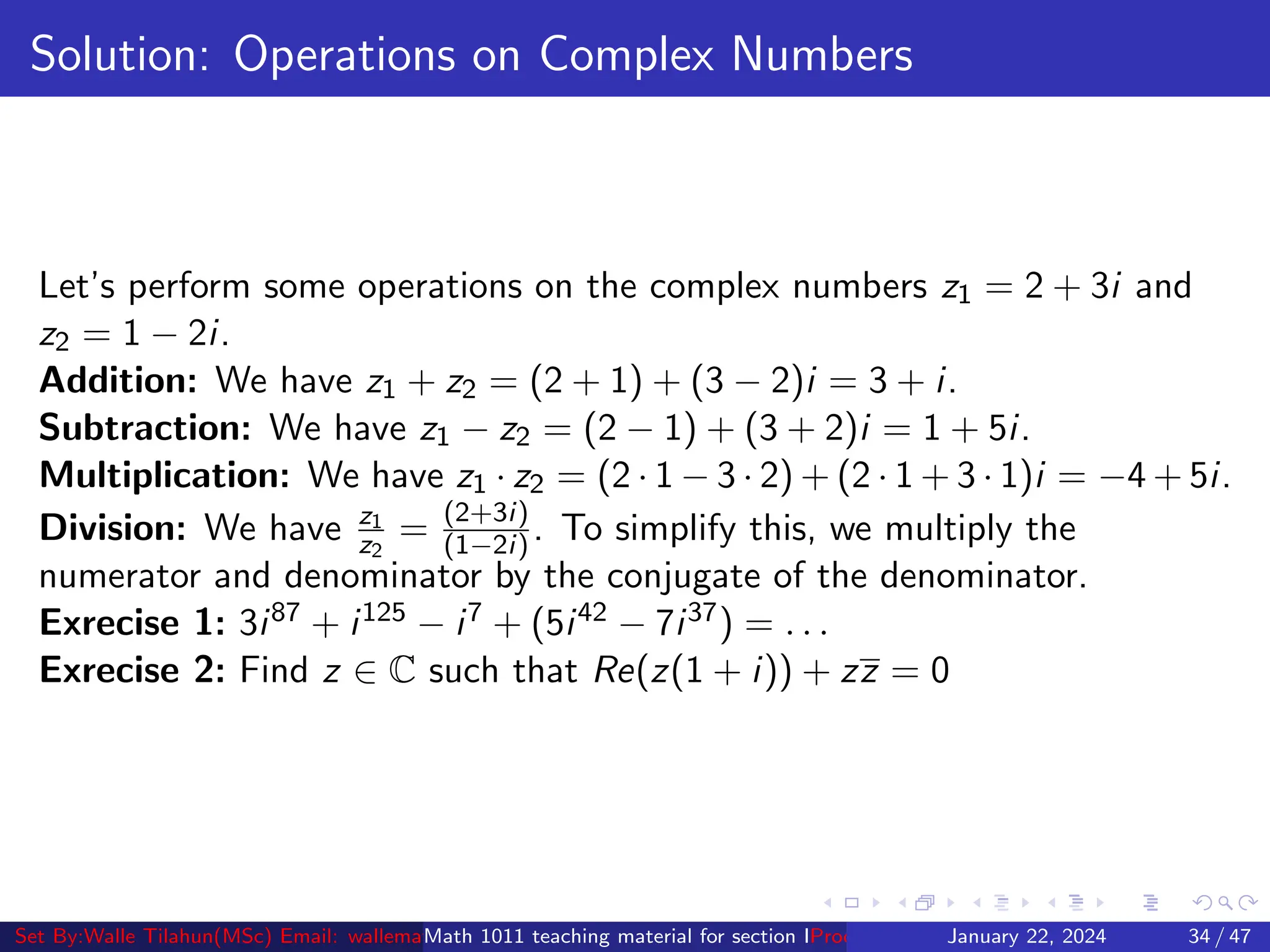
Solution: Operations on Complex Numbers
Let’s perform some operations on the complex numbers z1 = 2 + 3i and
z2 = 1 − 2i.
Addition: We have z1 + z2 = (2 + 1) + (3 − 2)i = 3 + i.
Subtraction: We have z1 − z2 = (2 − 1) + (3 + 2)i = 1 + 5i.
Multiplication: We have z1 · z2 = (2 · 1 − 3 · 2) + (2 · 1 + 3 · 1)i = −4 + 5i.
Division: We have z1
z2
= (2+3i)
(1−2i) . To simplify this, we multiply the
numerator and denominator by the conjugate of the denominator.
Exrecise 1: 3i87 + i125 − i7 + (5i42 − 7i37) = . . .
Exrecise 2: Find z ∈ C such that Re(z(1 + i)) + zz = 0
Set By:Walle Tilahun(MSc) Email: wallemath2004@gmail.com If there is error reply me!
Math 1011 teaching material for section IProofs and Examples are not included under this M
January 22, 2024 34 / 47
h
le T
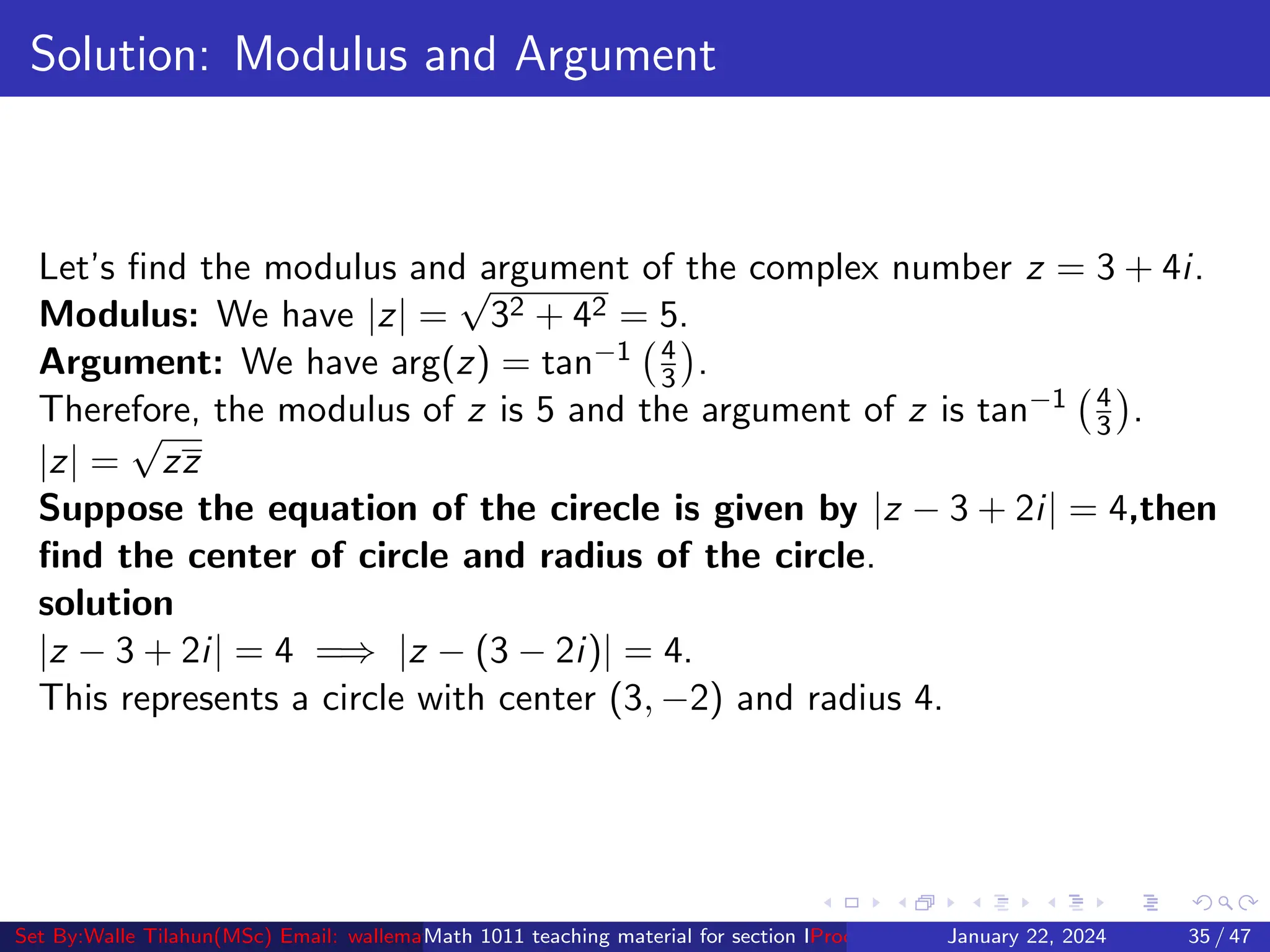
Solution: Modulus and Argument
Let’s find the modulus and argument of the complex number z = 3 + 4i.
Modulus: We have |z| =
√
32 + 42 = 5.
Argument: We have arg(z) = tan−1 4
3

.
Therefore, the modulus of z is 5 and the argument of z is tan−1 4
3

.
|z| =
√
zz
Suppose the equation of the cirecle is given by |z − 3 + 2i| = 4,then
find the center of circle and radius of the circle.
solution
|z − 3 + 2i| = 4 =⇒ |z − (3 − 2i)| = 4.
This represents a circle with center (3, −2) and radius 4.
Set By:Walle Tilahun(MSc) Email: wallemath2004@gmail.com If there is error reply me!
Math 1011 teaching material for section IProofs and Examples are not included under this M
January 22, 2024 35 / 47
h
le T
Complex Plane and Modulus/Argument
ℜ
ℑ
z = a + bi
a
b
|z|
θ
Modulus: |z| =
√
a2 + b2
Argument: θ = arctan b
a

Set By:Walle Tilahun(MSc) Email: wallemath2004@gmail.com If there is error reply me!
Math 1011 teaching material for section IProofs and Examples are not included under this M
January 22, 2024 36 / 47
h
le T
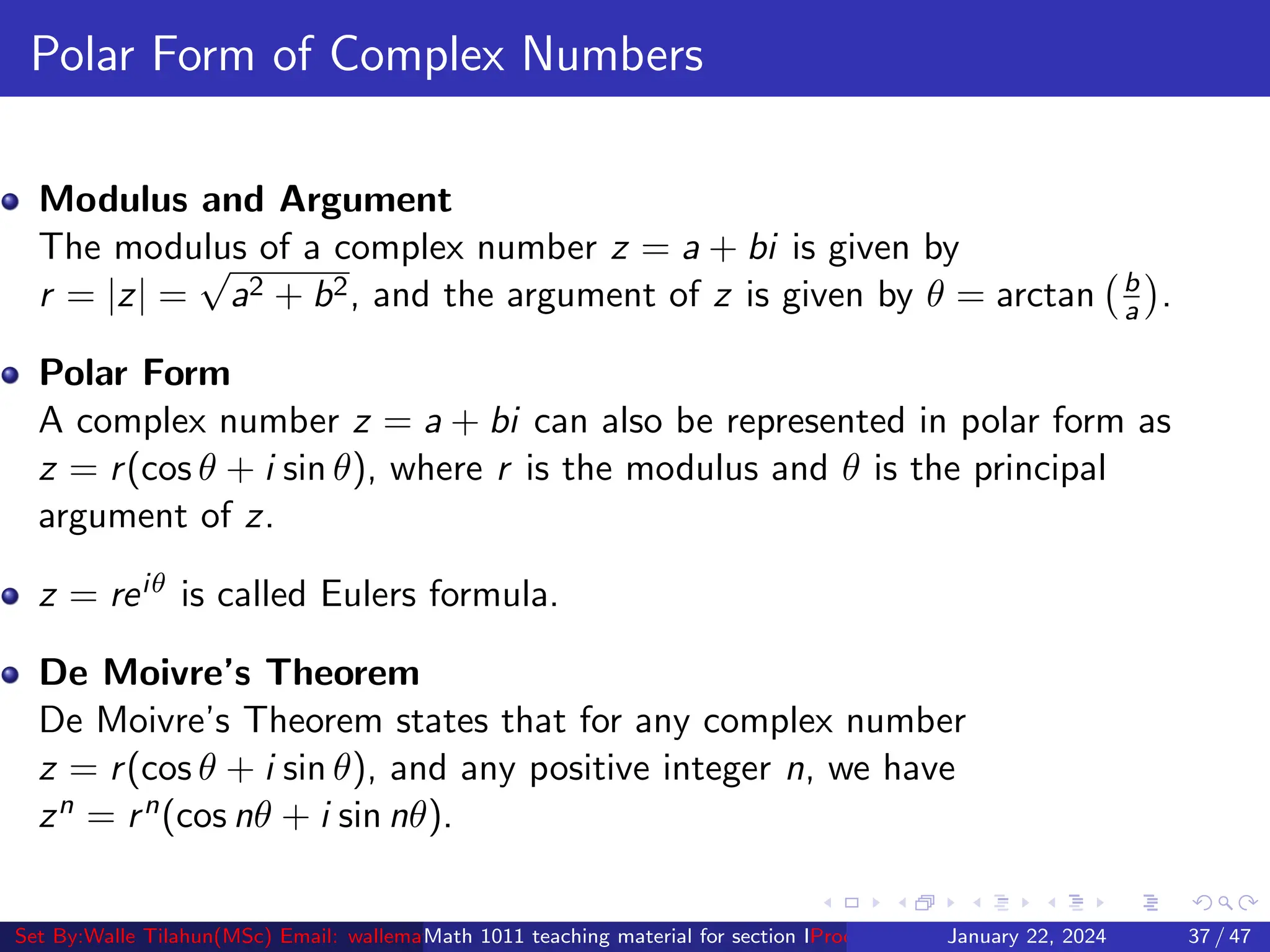
Polar Form of Complex Numbers
Modulus and Argument
The modulus of a complex number z = a + bi is given by
r = |z| =
√
a2 + b2, and the argument of z is given by θ = arctan b
a

.
Polar Form
A complex number z = a + bi can also be represented in polar form as
z = r(cos θ + i sin θ), where r is the modulus and θ is the principal
argument of z.
z = reiθ is called Eulers formula.
De Moivre’s Theorem
De Moivre’s Theorem states that for any complex number
z = r(cos θ + i sin θ), and any positive integer n, we have
zn = rn(cos nθ + i sin nθ).
Set By:Walle Tilahun(MSc) Email: wallemath2004@gmail.com If there is error reply me!
Math 1011 teaching material for section IProofs and Examples are not included under this M
January 22, 2024 37 / 47
h
le T
Extraction of Roots and Triangular Inequality
Extraction of Roots
The nth roots of a complex number z = r(cos θ + i sin θ) can be found
using the formula:
zk = n
√
r

cos

θ + 2kπ
n

+ i sin

θ + 2kπ
n

or
Zk = r
1
n ei(θ+2kπ
n
)
where k = 0, 1, 2, ..., n − 1.
For two complex numbers z1 = 1 +
√
2i and z2 = 1 + 2i, then evaluate
a. arg(z1 + z2) = b.Im(z1 + z2)= c.Im(z2z2)= d.z2 + z2 =
Set By:Walle Tilahun(MSc) Email: wallemath2004@gmail.com If there is error reply me!
Math 1011 teaching material for section IProofs and Examples are not included under this M
January 22, 2024 38 / 47
h
le T
Solution: Extraction of nth
Root of Complex Number
Example 1: Let’s find the fourth roots of the complex number
z = 16 cos π
3 + i sin π
3

.
Solution: The modulus of z is |z| =
√
162 = 16. The argument of z is π
3 .
The fourth roots of z are given by:
wk =
4
√
16

cos
 π
3 + 2kπ
4

+ i sin
 π
3 + 2kπ
4

for k = 0, 1, 2, 3.
Plugging in the values of k, we get:
w0 = 2

cos
π
12
+ i sin
π
12

w1 = 2

cos
7π
12
+ i sin
7π
12

w2 = 2

cos
13π
12
+ i sin
13π
12

w3 = 2

cos
19π
12
+ i sin
19π
12

Set By:Walle Tilahun(MSc) Email: wallemath2004@gmail.com If there is error reply me!
Math 1011 teaching material for section IProofs and Examples are not included under this M
January 22, 2024 39 / 47
h
le T
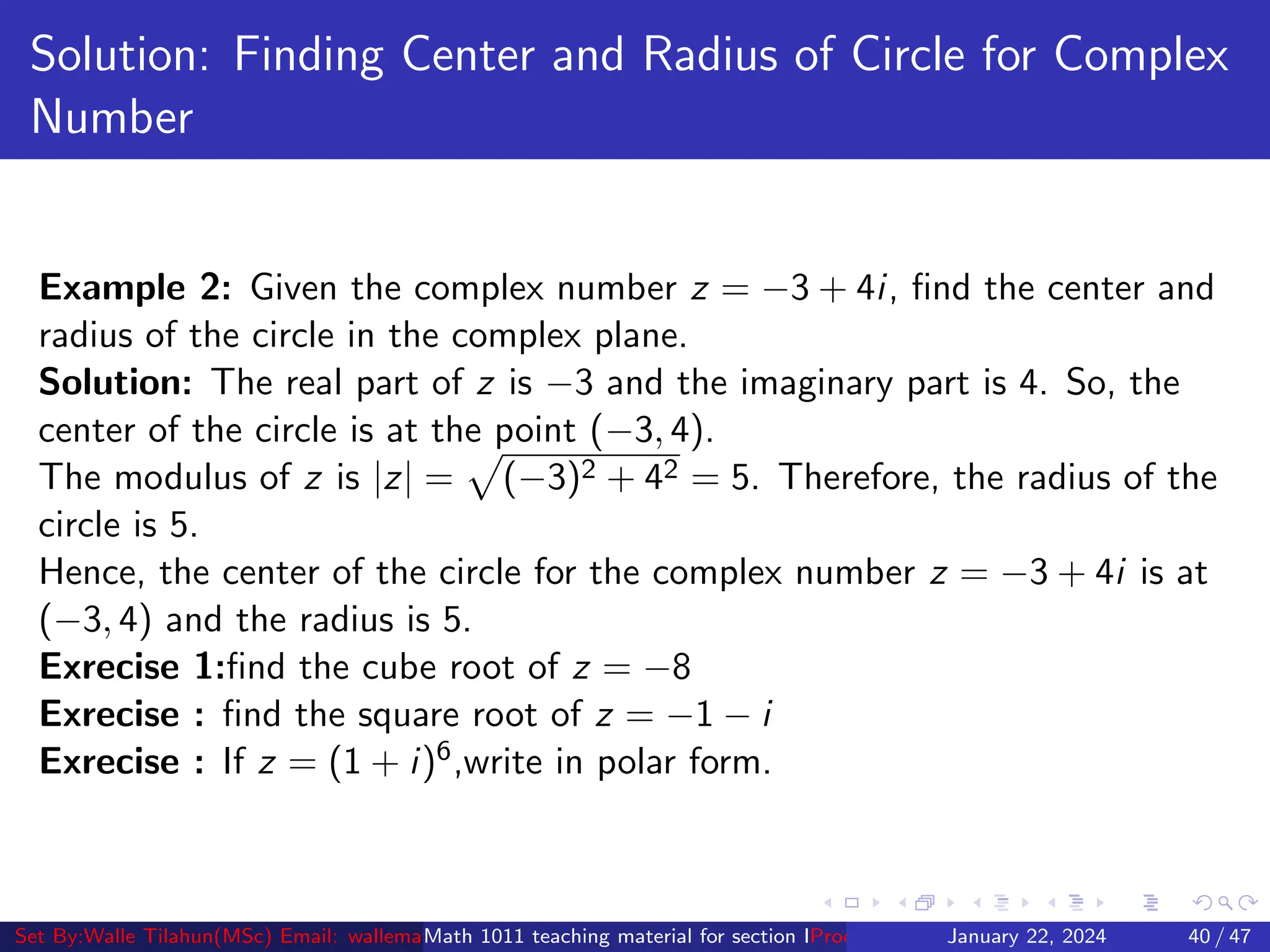
Solution: Finding Center and Radius of Circle for Complex
Number
Example 2: Given the complex number z = −3 + 4i, find the center and
radius of the circle in the complex plane.
Solution: The real part of z is −3 and the imaginary part is 4. So, the
center of the circle is at the point (−3, 4).
The modulus of z is |z| =
p
(−3)2 + 42 = 5. Therefore, the radius of the
circle is 5.
Hence, the center of the circle for the complex number z = −3 + 4i is at
(−3, 4) and the radius is 5.
Exrecise 1:find the cube root of z = −8
Exrecise : find the square root of z = −1 − i
Exrecise : If z = (1 + i)6,write in polar form.
Set By:Walle Tilahun(MSc) Email: wallemath2004@gmail.com If there is error reply me!
Math 1011 teaching material for section IProofs and Examples are not included under this M
January 22, 2024 40 / 47
h
le T
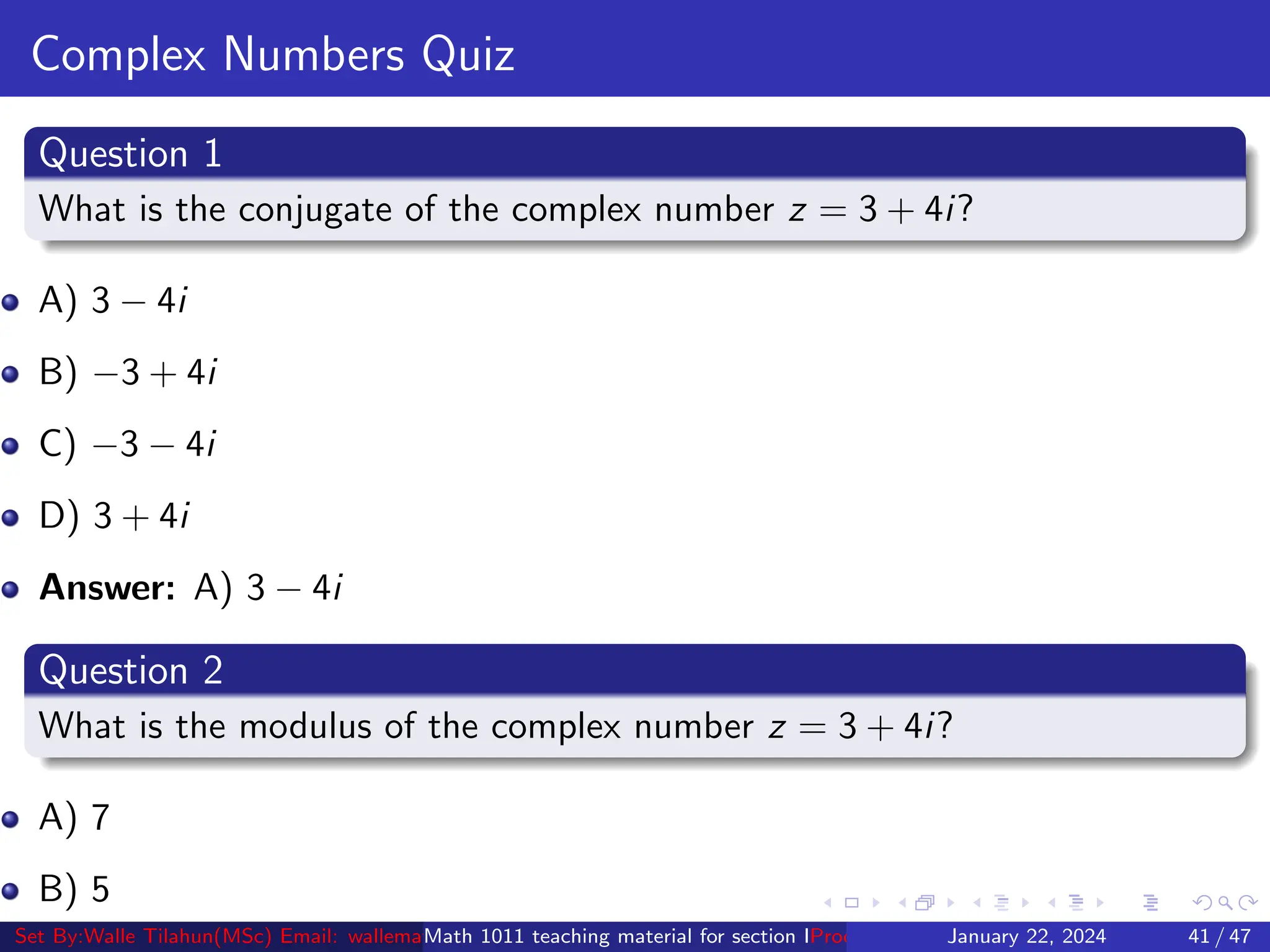
Complex Numbers Quiz
Question 1
What is the conjugate of the complex number z = 3 + 4i?
A) 3 − 4i
B) −3 + 4i
C) −3 − 4i
D) 3 + 4i
Answer: A) 3 − 4i
Question 2
What is the modulus of the complex number z = 3 + 4i?
A) 7
B) 5
√
Set By:Walle Tilahun(MSc) Email: wallemath2004@gmail.com If there is error reply me!
Math 1011 teaching material for section IProofs and Examples are not included under this M
January 22, 2024 41 / 47
h
le T
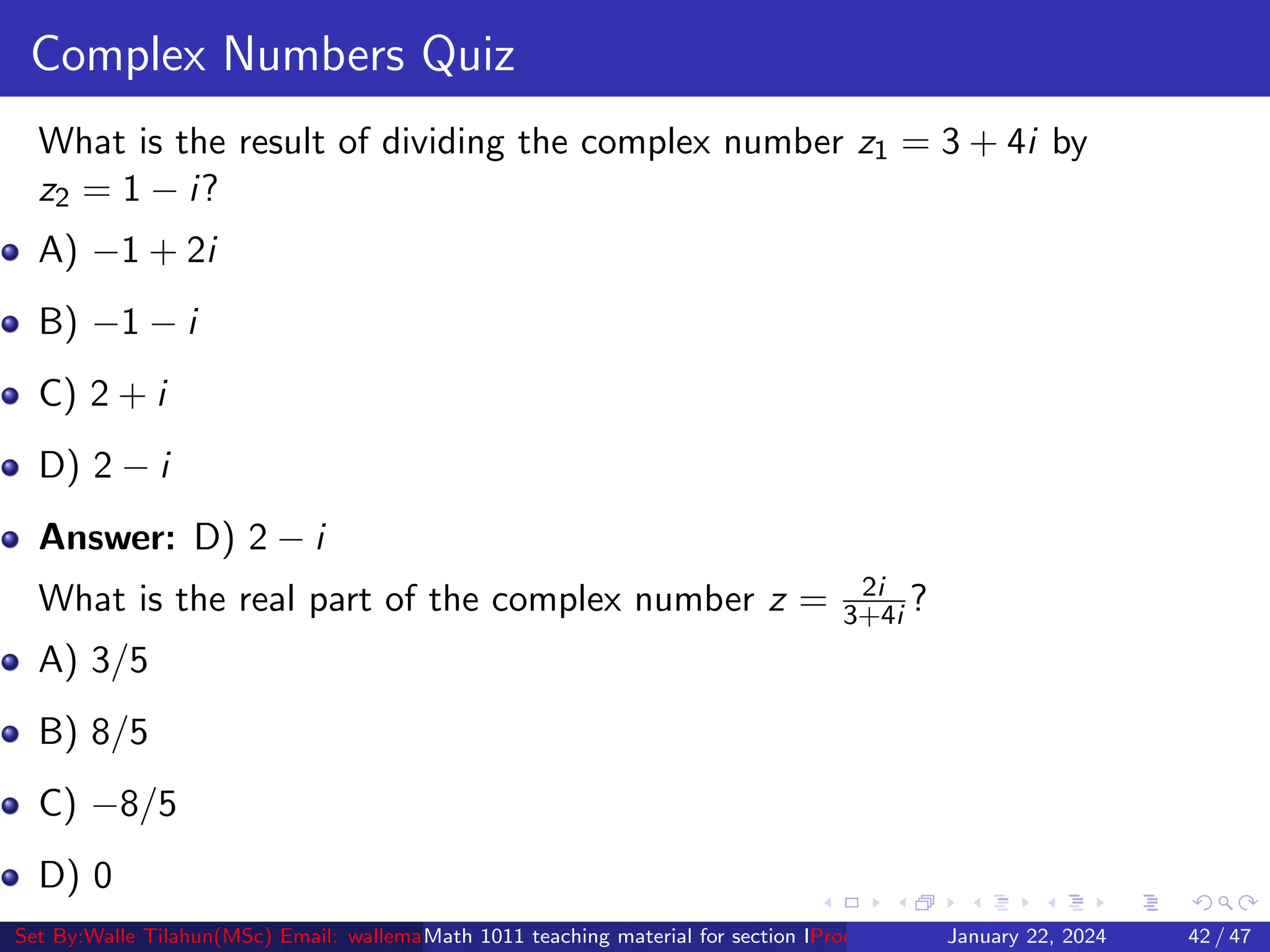
Complex Numbers Quiz
What is the result of dividing the complex number z1 = 3 + 4i by
z2 = 1 − i?
A) −1 + 2i
B) −1 − i
C) 2 + i
D) 2 − i
Answer: D) 2 − i
What is the real part of the complex number z = 2i
3+4i ?
A) 3/5
B) 8/5
C) −8/5
D) 0
Set By:Walle Tilahun(MSc) Email: wallemath2004@gmail.com If there is error reply me!
Math 1011 teaching material for section IProofs and Examples are not included under this M
January 22, 2024 42 / 47
h
le T
Complex Numbers Quiz
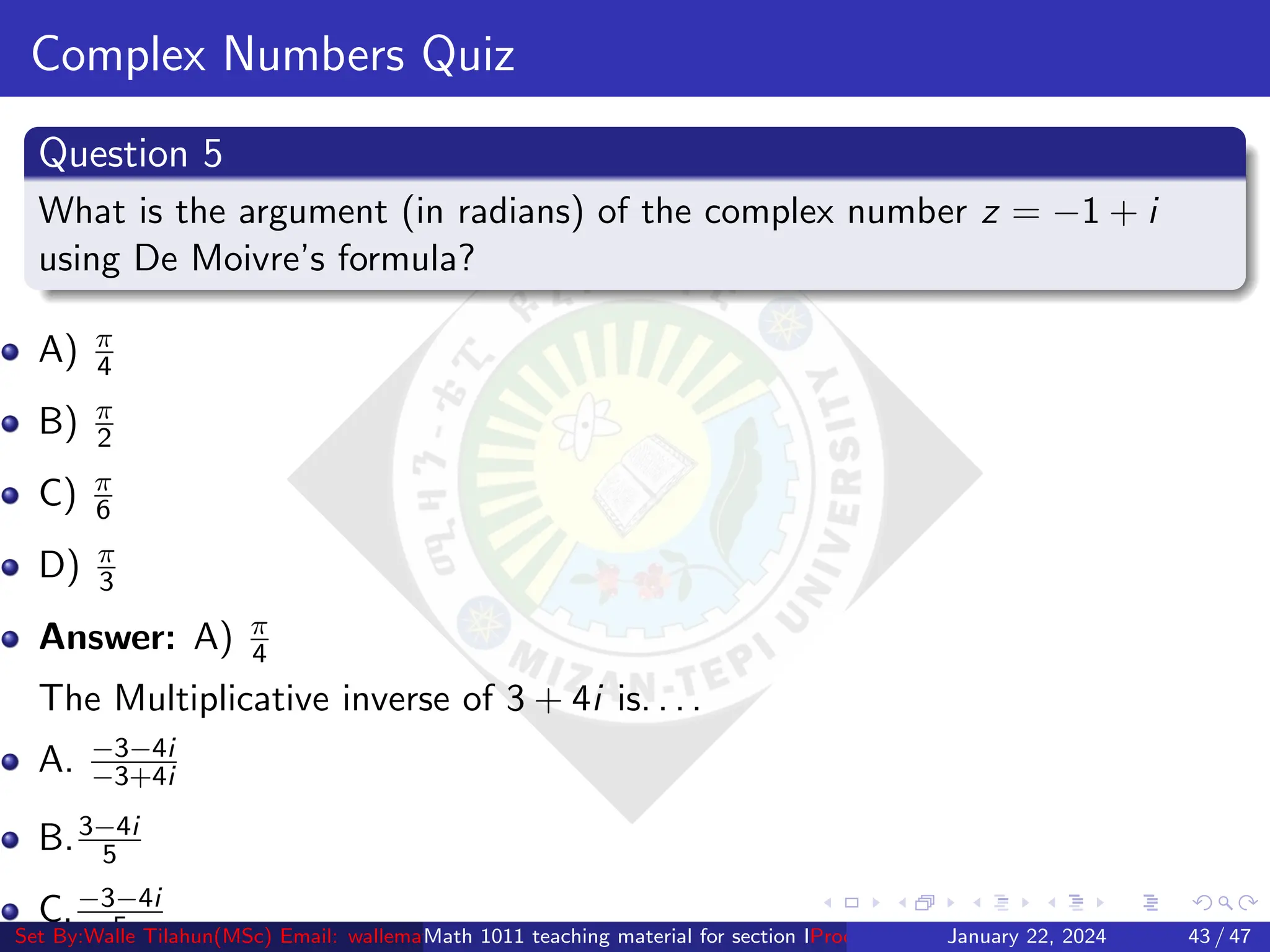
Question 5
What is the argument (in radians) of the complex number z = −1 + i
using De Moivre’s formula?
A) π
4
B) π
2
C) π
6
D) π
3
Answer: A) π
4
The Multiplicative inverse of 3 + 4i is. . . .
A. −3−4i
−3+4i
B.3−4i
5
C.−3−4i
5
Set By:Walle Tilahun(MSc) Email: wallemath2004@gmail.com If there is error reply me!
Math 1011 teaching material for section IProofs and Examples are not included under this M
January 22, 2024 43 / 47
h
le T
Multiple Choice Question
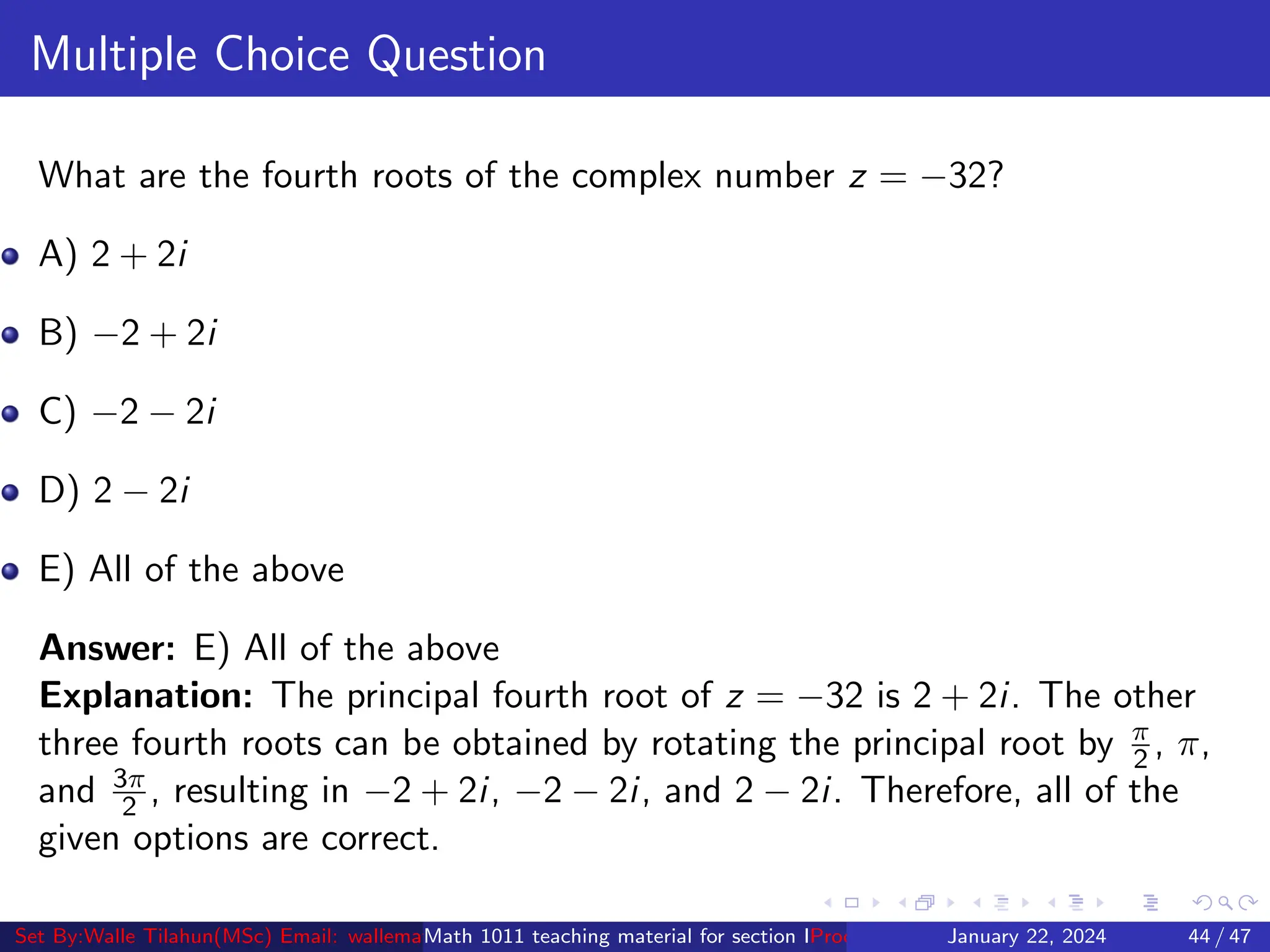
What are the fourth roots of the complex number z = −32?
A) 2 + 2i
B) −2 + 2i
C) −2 − 2i
D) 2 − 2i
E) All of the above
Answer: E) All of the above
Explanation: The principal fourth root of z = −32 is 2 + 2i. The other
three fourth roots can be obtained by rotating the principal root by π
2 , π,
and 3π
2 , resulting in −2 + 2i, −2 − 2i, and 2 − 2i. Therefore, all of the
given options are correct.
Set By:Walle Tilahun(MSc) Email: wallemath2004@gmail.com If there is error reply me!
Math 1011 teaching material for section IProofs and Examples are not included under this M
January 22, 2024 44 / 47
h
le T
Complex Numbers
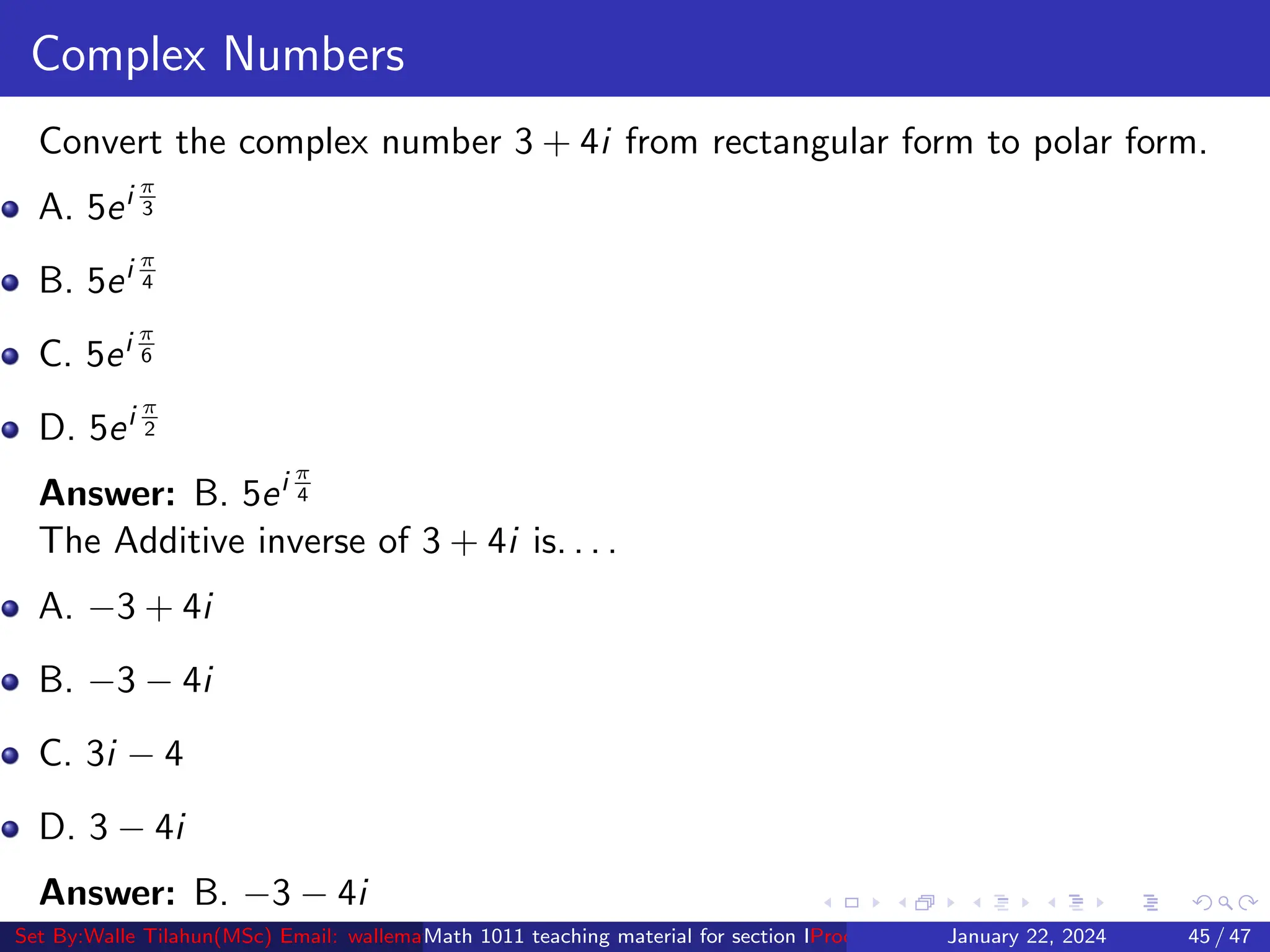
Convert the complex number 3 + 4i from rectangular form to polar form.
A. 5ei π
3
B. 5ei π
4
C. 5ei π
6
D. 5ei π
2
Answer: B. 5ei π
4
The Additive inverse of 3 + 4i is. . . .
A. −3 + 4i
B. −3 − 4i
C. 3i − 4
D. 3 − 4i
Answer: B. −3 − 4i
Set By:Walle Tilahun(MSc) Email: wallemath2004@gmail.com If there is error reply me!
Math 1011 teaching material for section IProofs and Examples are not included under this M
January 22, 2024 45 / 47
h
le T
self exercise
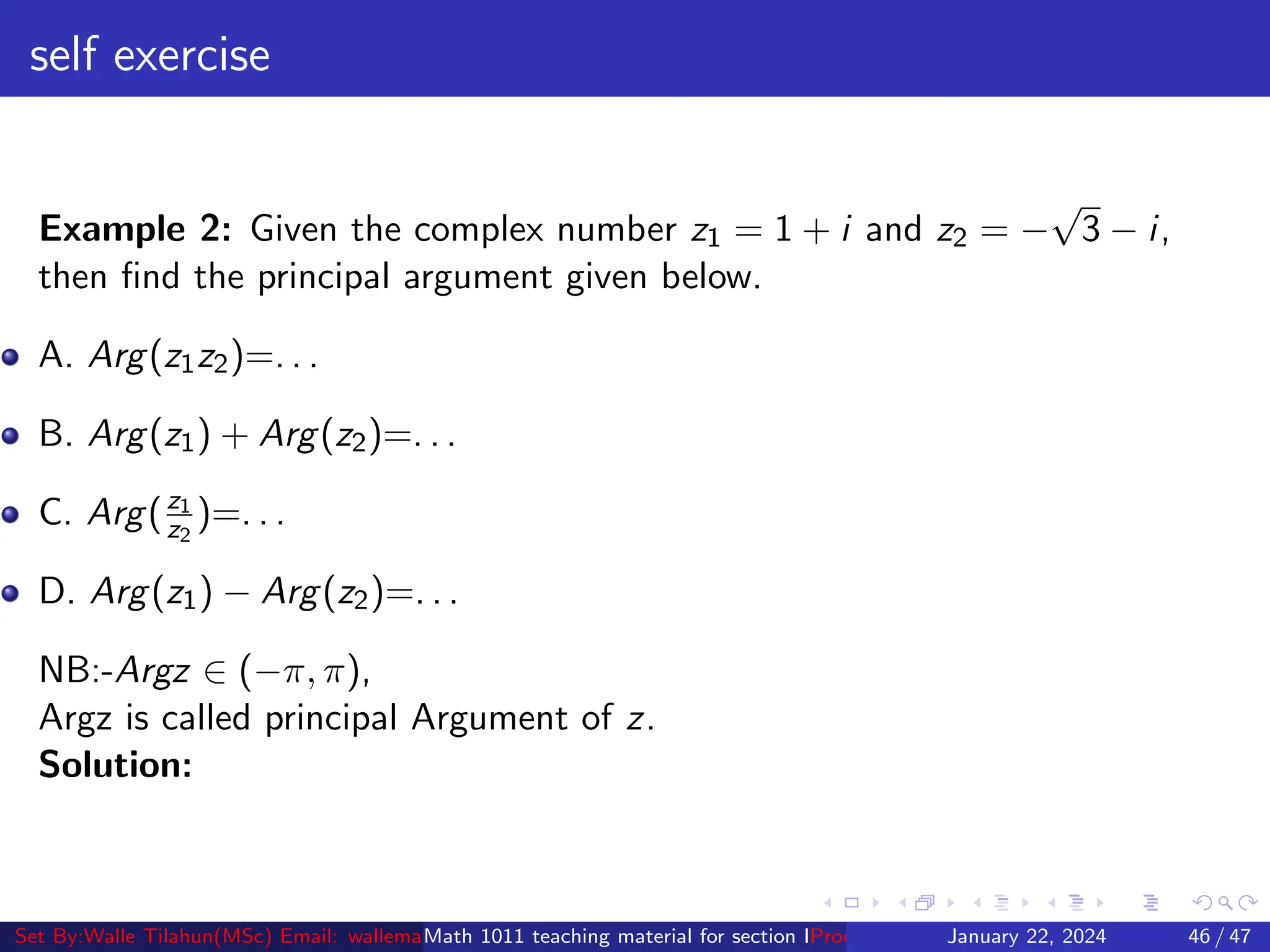
Example 2: Given the complex number z1 = 1 + i and z2 = −
√
3 − i,
then find the principal argument given below.
A. Arg(z1z2)=. . .
B. Arg(z1) + Arg(z2)=. . .
C. Arg(z1
z2
)=. . .
D. Arg(z1) − Arg(z2)=. . .
NB:-Argz ∈ (−π, π),
Argz is called principal Argument of z.
Solution:
Set By:Walle Tilahun(MSc) Email: wallemath2004@gmail.com If there is error reply me!
Math 1011 teaching material for section IProofs and Examples are not included under this M
January 22, 2024 46 / 47
h
le T
self exercise
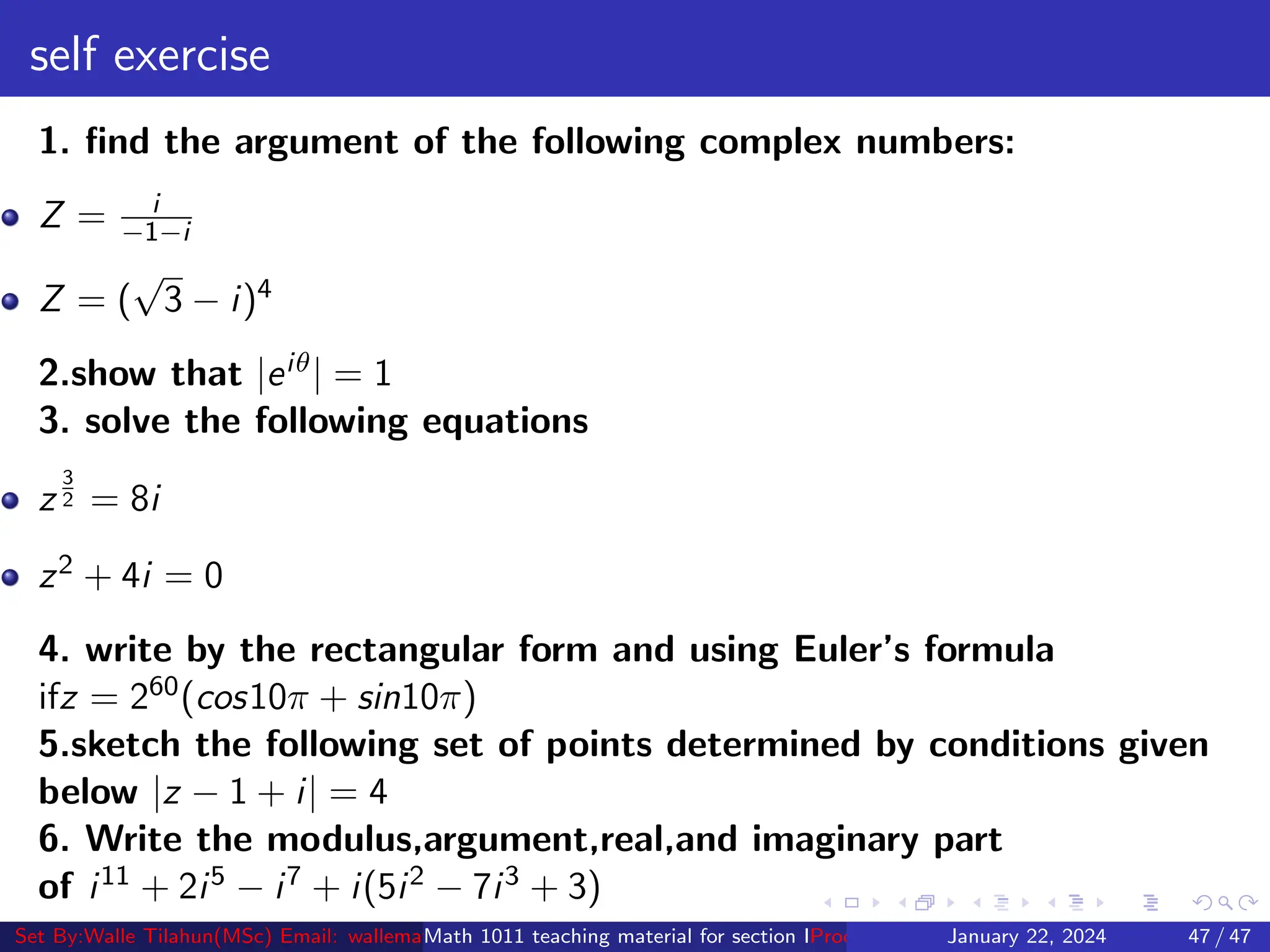
1. find the argument of the following complex numbers:
Z = i
−1−i
Z = (
√
3 − i)4
2.show that |eiθ| = 1
3. solve the following equations
z
3
2 = 8i
z2 + 4i = 0
4. write by the rectangular form and using Euler’s formula
ifz = 260(cos10π + sin10π)
5.sketch the following set of points determined by conditions given
below |z − 1 + i| = 4
6. Write the modulus,argument,real,and imaginary part
of i11 + 2i5 − i7 + i(5i2 − 7i3 + 3)
Set By:Walle Tilahun(MSc) Email: wallemath2004@gmail.com If there is error reply me!
Math 1011 teaching material for section IProofs and Examples are not included under this M
January 22, 2024 47 / 47

not.pdf , freshman Mathematics math1011

  • 1.
    h le T MIZAN TEPIUNIVERSITY COLLEGE OF NATURAL AND COMPUTATIONAL SCIENCES Fresh Man Mathematics for Natural Sciences Set By:Walle Tilahun(MSc) Email: wallemath2004@gmail.com If there is error reply me! Math 1011 teaching material for section IProofs and Examples are not included under this M January 22, 2024 1 / 47
  • 2.
    h le T Math 1011teaching material for section I Proofs and Examples are not included under this Material please try to refer your module! Set By:Walle Tilahun(MSc) Email: wallemath2004@gmail.com If there is error reply me! January 22, 2024 Set By:Walle Tilahun(MSc) Email: wallemath2004@gmail.com If there is error reply me! Math 1011 teaching material for section IProofs and Examples are not included under this M January 22, 2024 2 / 47
  • 3.
    h le T UNIT 1:TheProposition Definition of Proposition In logic and philosophy, a proposition is a statement that declares a fact or asserts a claim that can be either true or false. It is the building block of logical reasoning and argumentation. Proposition Human activities are the primary cause of global warming. Example 1: The increase in greenhouse gas emissions from industrial processes and transportation. Example 2: Deforestation and land use changes leading to higher levels of carbon dioxide in the atmosphere. Non-Proposition Examples Please turn off the lights when you leave the room. (Command) I enjoy hiking in the mountains. (Hobby) Set By:Walle Tilahun(MSc) Email: wallemath2004@gmail.com If there is error reply me! Math 1011 teaching material for section IProofs and Examples are not included under this M January 22, 2024 3 / 47
  • 4.
    h le T Logical Connectivesand Rules Conjunction (∧) Rule: The conjunction p ∧ q is true if and only if both p and q are true. Disjunction (∨) Rule: The disjunction p ∨ q is true if at least one of p or q is true. Negation (¬) Rule: The negation ¬p is true if and only if p is false. Implication (→) Rule: The implication p → q is false only when p is true and q is false. Biconditional (↔) Rule: The biconditional p ↔ q is true if and only if p and q have the same truth value. Suppose the truth values of p,q,andr are T,F,and F respectively,then the truth value of (¬p ∨ q) → [q ↔ (p ∧ r)]is . . . . . . Set By:Walle Tilahun(MSc) Email: wallemath2004@gmail.com If there is error reply me! Math 1011 teaching material for section IProofs and Examples are not included under this M January 22, 2024 4 / 47
  • 5.
    h le T What isthe Converse , Inverse, and Contrapositive of p → q ? I. If a rectangle ”R” is a square, then ”R” is a rhombus p → q. Converse: If ”R” is a rhombus, then ”R” is a square (i.e q → p) . Inverse: If ”R” is not a square, then ”R” is not a rhombus ¬p → ¬q . Contrapositive: If ”R” is not a rhombus, then ”R” is not a square ¬q → ¬p. II. If today is Monday, then tomorrow is Tuesday p → q . Converse: If tomorrow is Tuesday, then today is Monday (i.e q → p) . Inverse: If today is not Monday, then tomorrow is not Tuesday.¬p → ¬q Contrapositive: If tomorrow is not Tuesday, then today is not Monday.¬q → ¬p Set By:Walle Tilahun(MSc) Email: wallemath2004@gmail.com If there is error reply me! Math 1011 teaching material for section IProofs and Examples are not included under this M January 22, 2024 5 / 47
  • 6.
    h le T Tautology Show that((p → q) ∧ (q → r)) → (p → r) is atautology with out truth table. ≡ ((¬p ∨ q) ∧ (¬q ∨ r)) → (¬p ∨ r) ≡ ¬((¬p ∨ q) ∧ (¬q ∨ r)) ∨ (¬p ∨ r) ≡ ¬((¬p ∨ q) ∧ (¬q ∨ r)) ∨ (¬p ∨ r) ≡ (¬(¬p ∧ q) ∨ (¬¬q ∧ ¬r)) ∨ (¬p ∨ r) ≡ ((p ∧ ¬q) ∨ (q ∧ ¬r)) ∨ (¬p ∨ r) ≡ ((p ∧ ¬q) ∨ ¬p) ∨ ((q ∧ ¬r) ∨ r) ≡ (p ∨ ¬p) ∧ (¬q ∨ ¬p) ∨ (q ∨ r) ∧ (¬r ∨ r) ≡ T ∧ (¬q ∨ ¬p) ∨ (q ∨ r) ∧ T ≡ ((¬q ∨ ¬p) ∨ q) ∨ r ≡ ((¬q ∨ q) ∨ ¬p) ∨ r ≡ (T ∨ ¬p) ∨ r ≡ T ∨ r = T ∴ tautology Set By:Walle Tilahun(MSc) Email: wallemath2004@gmail.com If there is error reply me! Math 1011 teaching material for section IProofs and Examples are not included under this M January 22, 2024 6 / 47
  • 7.
    h le T Suppose theuineversal set be given, U = R Existential Quantifier (∃) and Universal Quantifier (∀) Example: ∃x∀y(x > y) Interpretation: There exists atleast one x such that for all y, x is greater than y. Truth Value: False (There is no single x that is greater than all y) Universal Quantifier (∀) and Existential Quantifier (∃) Example: ∀x∃y(x + y = 0)Interpretation: For all x = m ∈domain of x, there exists a y such that m + y = 0.Truth Value: True (e.g., x = m and y = 0 − m ∈ R satisfy the statement) Existential Quantifier (∃) and Existential Quantifier (∃) Example: ∃x∃y(x2 + y2 = 25) Interpretation: There exist x and y such that x2 + y2 = 25. Truth Value: True (e.g., x = 3 and y = 4 satisfy the statement) Universal Quantifier (∀) and Universal Quantifier (∀) Example: ∀x∀y(x < y) Interpretation: For all x and for all y, x is less than y. Truth Value: False (This statement is not true for all possible values of x and y) Set By:Walle Tilahun(MSc) Email: wallemath2004@gmail.com If there is error reply me! Math 1011 teaching material for section IProofs and Examples are not included under this M January 22, 2024 7 / 47
  • 8.
    h le T Class Work Question SupposeU = {1, 2, 3} be the uineversal set,then which one of the following is not True? A . ∃x∀y(x2 + 2y < 10) B. ∃x∃y(x2 + 2y < 10) C. ∃x∃y(x2 + y2 ≤ 2xy) D. ∀x∃y(x2 + 2y < 10) Set By:Walle Tilahun(MSc) Email: wallemath2004@gmail.com If there is error reply me! Math 1011 teaching material for section IProofs and Examples are not included under this M January 22, 2024 8 / 47
  • 9.
    h le T Argument Formalizationand Evaluation Given Argument: 1 The butler and the cook are not both innocent. 2 Either the butler is lying or the cook is not innocent. 3 Therefore, the butler is either lying or guilty. Formalization: Let: p: The butler is innocent q: The cook is innocent r: The butler is lying s: The butler is guilty Premises: 1 ¬(p ∧ q) 2 (r ∨ ¬q) Conclusion: 1 (r ∨ s) using Truth Tables: using Rule of Inference (EXERCISE!: Set By:Walle Tilahun(MSc) Email: wallemath2004@gmail.com If there is error reply me! Math 1011 teaching material for section IProofs and Examples are not included under this M January 22, 2024 9 / 47
  • 10.
    h le T Argument Formalizationand Evaluation Row p q r s ¬(p ∧ q) r ∨¬q r ∨s 1 T T T T F T T 2 T T T F F T T 3 T T F T F F T 4 T T F F F F F 5 T F T T T T T 6 T F T F T T T 7 T F F T T T T 8 T F F F T T F 9 F T T T T T T 10 F T T F T T F 11 F T F T T F T 12 F T F F T F T 13 F F T T T T T 14 F F T F T T T 15 F F F T T T T 16 F F F F T T F Set By:Walle Tilahun(MSc) Email: wallemath2004@gmail.com If there is error reply me! Math 1011 teaching material for section IProofs and Examples are not included under this M January 22, 2024 10 / 47
  • 11.
    h le T Look thepremise value in row 8th, 10th,and 16th has truth value simultanuously ,but the conclusion has false value in this row. ∴ It is invalid argument. Definition Let X be a set. The power set of X, denoted by P(X) or 2X is the set whose elements are all the possible subsets of X. That is to say, P(X) = {A | A ⊆ X}. Suppose X = {1, 2, 3, 4}, then the power set of set A given by P(X) = {∅, {1}, {2}, {3}, {4}, {1, 2}, {1, 3}, {1, 4}, {2, 3}, {2, 4}, {3, 4} ,{1,2,3},{1,2,4},{1,3,4},{2,3,4},{1,2,3,4}}. Suppose X = {2, {2, 4}, 3}, then list all subset of set A =. . . Set By:Walle Tilahun(MSc) Email: wallemath2004@gmail.com If there is error reply me! Math 1011 teaching material for section IProofs and Examples are not included under this M January 22, 2024 11 / 47
  • 12.
    h le T Set Operations Union(∪): The union of two sets A and B is the set of all elements that are in A, in B, or in both. The formula for the union is given by: A ∪ B = {x | x ∈ A or x ∈ B} Intersection (∩): The intersection of two sets A and B is the set of all elements that are in both A and B. The formula for the intersection is given by: A ∩ B = {x | x ∈ A and x ∈ B} Set Difference (−): The set difference of two sets A and B is the set of all elements that are in A but not in B. The formula for the set difference is given by: A − B = {x | x ∈ A and x / ∈ B} Complement (A′ or A): The complement of a set A with respect to the universal set U is the set of all elements in U that are not in A. The formula for the complement is given by: A′ = {x | x ∈ U and x / ∈ A} Set By:Walle Tilahun(MSc) Email: wallemath2004@gmail.com If there is error reply me! Math 1011 teaching material for section IProofs and Examples are not included under this M January 22, 2024 12 / 47
  • 13.
    h le T Set OperationExamples Example 1: Let A = {1, 2, 3, 4} and B = {3, 4, 5, 6}. Find A ∪ B, A ∩ B, and A − B. Solution: A ∪ B = {1, 2, 3, 4, 5, 6} A ∩ B = {3, 4} A − B = {1, 2} A∆B = {1, 2, 5, 6} Example 2: Let the universal set be U = {1, 2, 3, 4, 5, 6, 7, 8, 9, 10} and A = {2, 4, 6, 8}. Find the complement of A. Solution: The complement of A with respect to U is A′ = {1, 3, 5, 7, 9, 10}. . In a class of 60 students, 25 Students play cricket and 20 students play tennis, and 10 students play both games. Then, the number of students who play neither is=. . . Set By:Walle Tilahun(MSc) Email: wallemath2004@gmail.com If there is error reply me! Math 1011 teaching material for section IProofs and Examples are not included under this M January 22, 2024 13 / 47
  • 14.
    h le T Venn diagramswith set operations Let U = {1, 2, . . . , 12}, A = {n ∈ N | n < 8}, B = {n ∈ N | n < 6}, and C = {n ∈ N | 3 ≤ n ≤ 9}. Then we have: 1,2 3,4 9 10,11,12 A B C 8 5 7 6 Some set operations are: A ∪ B = {n ∈ N | n < 8} A ∩ C = {n ∈ N | 3 ≤ n < 8} A B = {n ∈ N | 6 ≤ n < 8} Cc = {n ∈ N | n < 3 or n > 9} A∆B = (B A) ∪ (A B)= A∆(B A)= Set By:Walle Tilahun(MSc) Email: wallemath2004@gmail.com If there is error reply me! Math 1011 teaching material for section IProofs and Examples are not included under this M January 22, 2024 14 / 47
  • 15.
    h le T Definition Let A,B be sets. The relative complement of B in A, denoted by AB is the set defined by AB = {x | x ∈ A and x / ∈ B}. Theorem (De Morgan’s Laws for Sets) Let A, B be sets in the universe Ω. Then (A ∪ B)c = Ac ∩ Bc, and (A ∩ B)c = Ac ∪ Bc. Theorem Let A, B, C be sets. Then A ∩ (B ∪ C) = (A ∩ B) ∪ (A ∩ C), and A ∪ (B ∩ C) = (A ∪ B) ∩ (A ∪ C). Set By:Walle Tilahun(MSc) Email: wallemath2004@gmail.com If there is error reply me! Math 1011 teaching material for section IProofs and Examples are not included under this M January 22, 2024 15 / 47
  • 16.
    h le T Proof ofSet Identity: A ∩ (B ∪ C) = (A ∩ B) ∪ (A ∩ C) Let A, B, and C be non-empty sets. Proof: Step 1: Consider an element x in A ∩ (B ∪ C). x ∈ A ∩ (B ∪ C) This means that x is in both A and in the union of B and C. Step 2: Break down the expression x ∈ A ∩ (B ∪ C). x ∈ A and x ∈ (B ∪ C) This implies that x is in A and in either B or C. Step 3: Consider two cases: Case 1: x is in B. x ∈ A and x ∈ B This implies that x is in both A and B, i.e., x ∈ A ∩ B. Case 2: x is in C. x ∈ A and x ∈ C This implies that x is in both A and C, i.e., x ∈ A ∩ C. Set By:Walle Tilahun(MSc) Email: wallemath2004@gmail.com If there is error reply me! Math 1011 teaching material for section IProofs and Examples are not included under this M January 22, 2024 16 / 47
  • 17.
    h le T Proof CONT’D.. . A ∩ (B ∪ C) = (A ∩ B) ∪ (A ∩ C) In both cases, we have shown that x is in either A ∩ B or A ∩ C, which proves that A ∩ (B ∪ C) ⊆ (A ∩ B) ∪ (A ∩ C) Step 4: Now, consider an element y in A ∩ (B ∪ C). =⇒ y is in either A ∩ B or in A ∩ C. Step 5: Break down the expression y ∈ (A ∩ B) ∪ (A ∩ C). We have two cases to consider: Case 1: y is in A ∩ B. =⇒ y is in both A and B, i.e., y is in the intersection of A and the union of B and C. Case 2: y is in A ∩ C. =⇒ y is in both A and C, i.e., y ∈ A ∩ C In both cases, we have shown that any element in (A ∩ B) ∪ (A ∩ C) is also in A ∩ (B ∪ C), which proves that (A ∩ B) ∪ (A ∩ C) ⊆ A ∩ (B ∪ C) This completes the proof that A ∩ (B ∪ C) = (A ∩ B) ∪ (A ∩ C) Set By:Walle Tilahun(MSc) Email: wallemath2004@gmail.com If there is error reply me! Math 1011 teaching material for section IProofs and Examples are not included under this M January 22, 2024 17 / 47
  • 18.
    h le T Proof ofSet Identity: A ∪ (B ∩ C) = (A ∪ B) ∩ (A ∪ C) Let A, B, and C be non-empty sets. Proof: Step 1: Consider an element x in A ∪ (B ∩ C). x ∈ A ∪ (B ∩ C) This means that x is in either A or in the intersection of B and C. Step 2: Break down the expression x ∈ A ∪ (B ∩ C). x ∈ A or x ∈ (B ∩ C) This implies that x is in A or in both B and C. Step 3: Consider two cases: Case 1: x is in A. This implies that x is in A, i.e., x ∈ A ∪ B and x ∈ A ∪ C This means that x is in the union of A and B, and also in the union of A and C, i.e., x ∈ (A ∪ B) ∩ (A ∪ C) Set By:Walle Tilahun(MSc) Email: wallemath2004@gmail.com If there is error reply me! Math 1011 teaching material for section IProofs and Examples are not included under this M January 22, 2024 18 / 47
  • 19.
    h le T Case 2:x is in both B and C. This implies that x is in the intersection of B and C, i.e., x ∈ B ∩ C In this case, we have shown that any element in A ∪ (B ∩ C) is also in (A ∪ B) ∩ (A ∪ C), which proves that A ∪ (B ∩ C) ⊆ (A ∪ B) ∩ (A ∪ C) In both cases, we have shown that any element in A ∪ (B ∩ C) is also in (A ∪ B) ∩ (A ∪ C), which proves that A ∪ (B ∩ C) ⊆ (A ∪ B) ∩ (A ∪ C) This completes the proof that A ∪ (B ∩ C) = (A ∪ B) ∩ (A ∪ C) Set By:Walle Tilahun(MSc) Email: wallemath2004@gmail.com If there is error reply me! Math 1011 teaching material for section IProofs and Examples are not included under this M January 22, 2024 19 / 47
  • 20.
    h le T Logic Question 1 Whichof the following is a tautology? A) p ∧ ¬p B) p ∨ ¬p C) p → ¬p D) p ↔ ¬p Answer: B) p ∨ ¬p Question 2 Which of the following represents the logical equivalence of (p ∧ q) ∨ r? A) p ∧ (q ∨ r) B)(p ∧ q) ∨ (p ∧ r) C) (p ∨ r) ∧ (q ∨ r) D) (p ∨ q) ∧ (p ∨ r) Set By:Walle Tilahun(MSc) Email: wallemath2004@gmail.com If there is error reply me! Math 1011 teaching material for section IProofs and Examples are not included under this M January 22, 2024 20 / 47
  • 21.
    h le T Question 1 IfA = {1, 2, 3}, what is the power set of A? A) {∅, 1, 2, 3, {1, 2}, {1, 3}, {2, 3}, {1, 2, 3}} B) {∅, {1}, {2}, {3}, {1, 2}, {1, 3}, {2, 3}, {1, 2, 3}} C) {∅, {∅}, {1, 2, 3}} D) {∅, {∅}, {1, 2, 3}, {∅, 1, 2, 3}} E) None of the above Answer: B) {∅, {1}, {2}, {3}, {1, 2}, {1, 3}, {2, 3}, {1, 2, 3}} Set By:Walle Tilahun(MSc) Email: wallemath2004@gmail.com If there is error reply me! Math 1011 teaching material for section IProofs and Examples are not included under this M January 22, 2024 21 / 47
  • 22.
    h le T Logic Question 1 Whatis the validity of the following statement? (P ∧ Q) ∨ (¬P ∧ Q) A. Always true B. Always false C. True for some cases D. True for all cases except one Answer: C. True for some cases Set By:Walle Tilahun(MSc) Email: wallemath2004@gmail.com If there is error reply me! Math 1011 teaching material for section IProofs and Examples are not included under this M January 22, 2024 22 / 47
  • 23.
    h le T Set Theory Question1 What is the symmetric difference of sets A and B, denoted by A△B? A. A ∪ B B. A ∩ B C. A − B D. A ∪ B − A ∩ B Answer: D. A ∪ B − A ∩ B Set By:Walle Tilahun(MSc) Email: wallemath2004@gmail.com If there is error reply me! Math 1011 teaching material for section IProofs and Examples are not included under this M January 22, 2024 23 / 47
  • 24.
    h le T Mixed Quantifiers Question1 Translate the following sentence into logical symbols: ”There exists a real number x such that for every real number y, x + y = y + x.” A. (∃x ∈ R)(∀y ∈ R)(x + y = y + x) B. (∀x ∈ R)(∃y ∈ R)(x + y = y + x) C. (∃x ∈ R)(∃y ∈ R)(x + y = y + x) D. (∀x ∈ R)(∀y ∈ R)(x + y = y + x) Answer: A. (∃x ∈ R)(∀y ∈ R)(x + y = y + x) Set By:Walle Tilahun(MSc) Email: wallemath2004@gmail.com If there is error reply me! Math 1011 teaching material for section IProofs and Examples are not included under this M January 22, 2024 24 / 47
  • 25.
    h le T UNIT TWO:Real Number system The remaining portion of this chapter is as a Reading Assignent for you! Principle of Mahematical Induction Definition For a given assertion involving a natural number n,if step1:- The asserstion is true for n = 1 step2:If it is true for n = k(k ≥ 1),then the asserstion is true for every natural namber n. Set By:Walle Tilahun(MSc) Email: wallemath2004@gmail.com If there is error reply me! Math 1011 teaching material for section IProofs and Examples are not included under this M January 22, 2024 25 / 47
  • 26.
    h le T Mathematical InductionExamples Example 1: Prove that 1 + 2 + 3 + . . . + n = n(n+1) 2 for all positive integers n. Proof: We will prove this by mathematical induction. Base Case: For n = 1, the left-hand side is 1 and the right-hand side is 1(1+1) 2 = 1. So the equation holds for n = 1. Inductive Step: Assume that the equation holds for some positive integer k, i.e., 1 + 2 + 3 + . . . + k = k(k+1) 2 . Now we need to show that the equation also holds for k + 1. Adding (k + 1) to both sides of the assumed equation gives: 1 + 2 + 3 + . . . + k + (k + 1) = k(k + 1) 2 + (k + 1) = k(k + 1) + 2(k + 1) 2 = (k + 1)(k + 2) 2 Thus, the equation holds for k + 1. By mathematical induction, the equation holds for all positive integers n. Set By:Walle Tilahun(MSc) Email: wallemath2004@gmail.com If there is error reply me! Math 1011 teaching material for section IProofs and Examples are not included under this M January 22, 2024 26 / 47
  • 27.
    h le T Proof ofExample 2 Example 2: Prove that 12 + 22 + 32 + . . . + n2 = n(n+1)(2n+1) 6 for all positive integers n. Base Case: For n = 1, the LHS is 12 = 1 and RHS is 1(1+1)(2·1+1) 6 = 1. So the equation holds for n = 1. Inductive Step: Assume that the equation holds for some positive integer k, i.e., 12 + 22 + 32 + . . . + k2 = k(k+1)(2k+1) 6 . Now we need to show that the equation also holds for k + 1. Adding (k + 1)2 to both sides of the assumed equation gives: 12 + 22 + 32 + . . . + k2 + (k + 1)2 = k(k + 1)(2k + 1) 6 + (k + 1)2 = k(k + 1)(2k + 1) + 6(k + 1)2 6 = (k + 1)(k + 2)(2k + 3) 6 Thus, the equation holds for k + 1. By mathematical induction, the equation holds for all positive integers n. Set By:Walle Tilahun(MSc) Email: wallemath2004@gmail.com If there is error reply me! Math 1011 teaching material for section IProofs and Examples are not included under this M January 22, 2024 27 / 47
  • 28.
    h le T Proof ofExample 3 Example 3: Prove that 2n > n2 for all positive integers n such that n ≥ 5 by mathematical induction. Base Case: For n = 5, we have 25 = 32 and 52 = 25, so 25 > 52. The base case holds. Inductive Step: Assume that the inequality holds for some positive integer k ≥ 5, i.e., 2k > k2. Now we need to show that the inequality also holds for k + 1. Multiplying both sides of the assumed inequality by 2 gives: 2k+1 = 2 · 2k > 2 · k2 Since k ≥ 5, we have 2k > k2, so 2 · k2 > k2. Therefore, 2k+1 > k2. By mathematical induction, the inequality holds for all positive integers n such that n ≥ 5. Set By:Walle Tilahun(MSc) Email: wallemath2004@gmail.com If there is error reply me! Math 1011 teaching material for section IProofs and Examples are not included under this M January 22, 2024 28 / 47
  • 29.
    h le T Complex Numbers Introductionto Complex Numbers A complex number is a number that can be expressed in the form a + bi, where a and b are real numbers, and i is the imaginary unit (with the property i2 = −1). Definition of Complex Numbers A complex number z can be written as z = a + bi, where a is the real part and b is the imaginary part of z. Operations with Complex Numbers Addition: (a + bi) + (c + di) = (a + c) + (b + d)i Subtraction: (a + bi) − (c + di) = (a − c) + (b − d)i Multiplication: (a + bi) × (c + di) = (ac − bd) + (ad + bc)i Division: a+bi c+di = (ac+bd)+(bc−ad)i c2+d2 Set By:Walle Tilahun(MSc) Email: wallemath2004@gmail.com If there is error reply me! Math 1011 teaching material for section IProofs and Examples are not included under this M January 22, 2024 29 / 47
  • 30.
    h le T Proof ofCommutative Property of Addition and Subtraction for Complex Numbers Let z1 = a1 + b1i and z2 = a2 + b2i be complex numbers. Addition: Step 1: Consider the sum z1 + z2. z1 + z2 = (a1 + b1i) + (a2 + b2i) Step 2: Rearrange the terms in the sum. z1 + z2 = (a1 + a2) + (b1 + b2)i Step 3: Consider the sum z2 + z1. z2 + z1 = (a2 + b2i) + (a1 + b1i) Step 4: Rearrange the terms in the sum. z2 + z1 = (a2 + a1) + (b2 + b1)i Step 5: Compare the results from Steps 2 and 4. We have z1 + z2 = z2 + z1, which proves the commutative property of addition for Set By:Walle Tilahun(MSc) Email: wallemath2004@gmail.com If there is error reply me! Math 1011 teaching material for section IProofs and Examples are not included under this M January 22, 2024 30 / 47
  • 31.
    h le T Complex Numbers Conjugateof Complex Numbers The conjugate of complex numberz = a + bi is denoted by z = a − bi. Triangular Inequality . . . proof! For two complex numbers z1 = a1 + b1i and z2 = a2 + b2i, the triangular inequality states that: |z1 + z2| ≤ |z1| + |z2| . Example: Let z1 = 3 + 4i and z2 = 1 − 2i. We have: |z1 + z2| = |4 + 2i| = √ 20 |z1| + |z2| = |3 + 4i| + |1 − 2i| = 5 + √ 5 Since √ 20 ≤ 5 + √ 5, the triangular inequality holds Operations with Complex Numbers The Additive inverse of: z = (x + yi) is −z = (−x − yi) The Multiplicative inveverse of: z = (x + yi) is given by1 z = 1 x+yi = x−yi √ x2+y2 Set By:Walle Tilahun(MSc) Email: wallemath2004@gmail.com If there is error reply me! Math 1011 teaching material for section IProofs and Examples are not included under this M January 22, 2024 31 / 47
  • 32.
    h le T Proof ofTriangle Inequality |z1 + z2| ≤ |z1| + |z2| Let z1 = a1 + b1i and z2 = a2 + b2i be two complex numbers. |z1 + z2|2 = (a1 + a2)2 + (b1 + b2)2 = a2 1 + 2a1a2 + a2 2 + b2 1 + 2b1b2 + b2 2 = (a2 1 + b2 1) + 2(a1a2 + b1b2) + (a2 2 + b2 2) = |z1|2 + 2Re(z1z2) + |z2|2 ≤ |z1|2 + 2|z1||z2| + |z2|2 = (|z1| + |z2|)2 Taking the square root of both sides, we get: |z1 + z2| ≤ |z1| + |z2| Therefore, the triangle inequality holds for complex numbers. Set By:Walle Tilahun(MSc) Email: wallemath2004@gmail.com If there is error reply me! Math 1011 teaching material for section IProofs and Examples are not included under this M January 22, 2024 32 / 47
  • 33.
    h le T Proof ofInequality |z1 − z2| ≥ |z1| − |z2| To prove: |z1 − z2| ≥ |z1| − |z2| Proof: |z1 − z2|2 = (z1 − z2)(z1 − z2) = |z1|2 − z1z2 − z1z2 + |z2|2 = |z1|2 − 2Re(z1z2) + |z2|2 = |z1|2 − 2Re(z1z2) + |z2|2 ≥ |z1|2 − 2|z1||z2| + |z2|2 = |z1|2 − 2|z1||z2| + |z2|2 = (|z1| − |z2|)2 Taking the square root of both sides gives: |z1 − z2| ≥ |z1| − |z2| Adding |z2| to both sides yields the desired inequality: |z1 − z2| ≥ |z1| − |z2| Set By:Walle Tilahun(MSc) Email: wallemath2004@gmail.com If there is error reply me! Math 1011 teaching material for section IProofs and Examples are not included under this M January 22, 2024 33 / 47
  • 34.
    h le T Solution: Operationson Complex Numbers Let’s perform some operations on the complex numbers z1 = 2 + 3i and z2 = 1 − 2i. Addition: We have z1 + z2 = (2 + 1) + (3 − 2)i = 3 + i. Subtraction: We have z1 − z2 = (2 − 1) + (3 + 2)i = 1 + 5i. Multiplication: We have z1 · z2 = (2 · 1 − 3 · 2) + (2 · 1 + 3 · 1)i = −4 + 5i. Division: We have z1 z2 = (2+3i) (1−2i) . To simplify this, we multiply the numerator and denominator by the conjugate of the denominator. Exrecise 1: 3i87 + i125 − i7 + (5i42 − 7i37) = . . . Exrecise 2: Find z ∈ C such that Re(z(1 + i)) + zz = 0 Set By:Walle Tilahun(MSc) Email: wallemath2004@gmail.com If there is error reply me! Math 1011 teaching material for section IProofs and Examples are not included under this M January 22, 2024 34 / 47
  • 35.
    h le T Solution: Modulusand Argument Let’s find the modulus and argument of the complex number z = 3 + 4i. Modulus: We have |z| = √ 32 + 42 = 5. Argument: We have arg(z) = tan−1 4 3 . Therefore, the modulus of z is 5 and the argument of z is tan−1 4 3 . |z| = √ zz Suppose the equation of the cirecle is given by |z − 3 + 2i| = 4,then find the center of circle and radius of the circle. solution |z − 3 + 2i| = 4 =⇒ |z − (3 − 2i)| = 4. This represents a circle with center (3, −2) and radius 4. Set By:Walle Tilahun(MSc) Email: wallemath2004@gmail.com If there is error reply me! Math 1011 teaching material for section IProofs and Examples are not included under this M January 22, 2024 35 / 47
  • 36.
    h le T Complex Planeand Modulus/Argument ℜ ℑ z = a + bi a b |z| θ Modulus: |z| = √ a2 + b2 Argument: θ = arctan b a Set By:Walle Tilahun(MSc) Email: wallemath2004@gmail.com If there is error reply me! Math 1011 teaching material for section IProofs and Examples are not included under this M January 22, 2024 36 / 47
  • 37.
    h le T Polar Formof Complex Numbers Modulus and Argument The modulus of a complex number z = a + bi is given by r = |z| = √ a2 + b2, and the argument of z is given by θ = arctan b a . Polar Form A complex number z = a + bi can also be represented in polar form as z = r(cos θ + i sin θ), where r is the modulus and θ is the principal argument of z. z = reiθ is called Eulers formula. De Moivre’s Theorem De Moivre’s Theorem states that for any complex number z = r(cos θ + i sin θ), and any positive integer n, we have zn = rn(cos nθ + i sin nθ). Set By:Walle Tilahun(MSc) Email: wallemath2004@gmail.com If there is error reply me! Math 1011 teaching material for section IProofs and Examples are not included under this M January 22, 2024 37 / 47
  • 38.
    h le T Extraction ofRoots and Triangular Inequality Extraction of Roots The nth roots of a complex number z = r(cos θ + i sin θ) can be found using the formula: zk = n √ r cos θ + 2kπ n + i sin θ + 2kπ n or Zk = r 1 n ei(θ+2kπ n ) where k = 0, 1, 2, ..., n − 1. For two complex numbers z1 = 1 + √ 2i and z2 = 1 + 2i, then evaluate a. arg(z1 + z2) = b.Im(z1 + z2)= c.Im(z2z2)= d.z2 + z2 = Set By:Walle Tilahun(MSc) Email: wallemath2004@gmail.com If there is error reply me! Math 1011 teaching material for section IProofs and Examples are not included under this M January 22, 2024 38 / 47
  • 39.
    h le T Solution: Extractionof nth Root of Complex Number Example 1: Let’s find the fourth roots of the complex number z = 16 cos π 3 + i sin π 3 . Solution: The modulus of z is |z| = √ 162 = 16. The argument of z is π 3 . The fourth roots of z are given by: wk = 4 √ 16 cos π 3 + 2kπ 4 + i sin π 3 + 2kπ 4 for k = 0, 1, 2, 3. Plugging in the values of k, we get: w0 = 2 cos π 12 + i sin π 12 w1 = 2 cos 7π 12 + i sin 7π 12 w2 = 2 cos 13π 12 + i sin 13π 12 w3 = 2 cos 19π 12 + i sin 19π 12 Set By:Walle Tilahun(MSc) Email: wallemath2004@gmail.com If there is error reply me! Math 1011 teaching material for section IProofs and Examples are not included under this M January 22, 2024 39 / 47
  • 40.
    h le T Solution: FindingCenter and Radius of Circle for Complex Number Example 2: Given the complex number z = −3 + 4i, find the center and radius of the circle in the complex plane. Solution: The real part of z is −3 and the imaginary part is 4. So, the center of the circle is at the point (−3, 4). The modulus of z is |z| = p (−3)2 + 42 = 5. Therefore, the radius of the circle is 5. Hence, the center of the circle for the complex number z = −3 + 4i is at (−3, 4) and the radius is 5. Exrecise 1:find the cube root of z = −8 Exrecise : find the square root of z = −1 − i Exrecise : If z = (1 + i)6,write in polar form. Set By:Walle Tilahun(MSc) Email: wallemath2004@gmail.com If there is error reply me! Math 1011 teaching material for section IProofs and Examples are not included under this M January 22, 2024 40 / 47
  • 41.
    h le T Complex NumbersQuiz Question 1 What is the conjugate of the complex number z = 3 + 4i? A) 3 − 4i B) −3 + 4i C) −3 − 4i D) 3 + 4i Answer: A) 3 − 4i Question 2 What is the modulus of the complex number z = 3 + 4i? A) 7 B) 5 √ Set By:Walle Tilahun(MSc) Email: wallemath2004@gmail.com If there is error reply me! Math 1011 teaching material for section IProofs and Examples are not included under this M January 22, 2024 41 / 47
  • 42.
    h le T Complex NumbersQuiz What is the result of dividing the complex number z1 = 3 + 4i by z2 = 1 − i? A) −1 + 2i B) −1 − i C) 2 + i D) 2 − i Answer: D) 2 − i What is the real part of the complex number z = 2i 3+4i ? A) 3/5 B) 8/5 C) −8/5 D) 0 Set By:Walle Tilahun(MSc) Email: wallemath2004@gmail.com If there is error reply me! Math 1011 teaching material for section IProofs and Examples are not included under this M January 22, 2024 42 / 47
  • 43.
    h le T Complex NumbersQuiz Question 5 What is the argument (in radians) of the complex number z = −1 + i using De Moivre’s formula? A) π 4 B) π 2 C) π 6 D) π 3 Answer: A) π 4 The Multiplicative inverse of 3 + 4i is. . . . A. −3−4i −3+4i B.3−4i 5 C.−3−4i 5 Set By:Walle Tilahun(MSc) Email: wallemath2004@gmail.com If there is error reply me! Math 1011 teaching material for section IProofs and Examples are not included under this M January 22, 2024 43 / 47
  • 44.
    h le T Multiple ChoiceQuestion What are the fourth roots of the complex number z = −32? A) 2 + 2i B) −2 + 2i C) −2 − 2i D) 2 − 2i E) All of the above Answer: E) All of the above Explanation: The principal fourth root of z = −32 is 2 + 2i. The other three fourth roots can be obtained by rotating the principal root by π 2 , π, and 3π 2 , resulting in −2 + 2i, −2 − 2i, and 2 − 2i. Therefore, all of the given options are correct. Set By:Walle Tilahun(MSc) Email: wallemath2004@gmail.com If there is error reply me! Math 1011 teaching material for section IProofs and Examples are not included under this M January 22, 2024 44 / 47
  • 45.
    h le T Complex Numbers Convertthe complex number 3 + 4i from rectangular form to polar form. A. 5ei π 3 B. 5ei π 4 C. 5ei π 6 D. 5ei π 2 Answer: B. 5ei π 4 The Additive inverse of 3 + 4i is. . . . A. −3 + 4i B. −3 − 4i C. 3i − 4 D. 3 − 4i Answer: B. −3 − 4i Set By:Walle Tilahun(MSc) Email: wallemath2004@gmail.com If there is error reply me! Math 1011 teaching material for section IProofs and Examples are not included under this M January 22, 2024 45 / 47
  • 46.
    h le T self exercise Example2: Given the complex number z1 = 1 + i and z2 = − √ 3 − i, then find the principal argument given below. A. Arg(z1z2)=. . . B. Arg(z1) + Arg(z2)=. . . C. Arg(z1 z2 )=. . . D. Arg(z1) − Arg(z2)=. . . NB:-Argz ∈ (−π, π), Argz is called principal Argument of z. Solution: Set By:Walle Tilahun(MSc) Email: wallemath2004@gmail.com If there is error reply me! Math 1011 teaching material for section IProofs and Examples are not included under this M January 22, 2024 46 / 47
  • 47.
    h le T self exercise 1.find the argument of the following complex numbers: Z = i −1−i Z = ( √ 3 − i)4 2.show that |eiθ| = 1 3. solve the following equations z 3 2 = 8i z2 + 4i = 0 4. write by the rectangular form and using Euler’s formula ifz = 260(cos10π + sin10π) 5.sketch the following set of points determined by conditions given below |z − 1 + i| = 4 6. Write the modulus,argument,real,and imaginary part of i11 + 2i5 − i7 + i(5i2 − 7i3 + 3) Set By:Walle Tilahun(MSc) Email: wallemath2004@gmail.com If there is error reply me! Math 1011 teaching material for section IProofs and Examples are not included under this M January 22, 2024 47 / 47