Inclusiveness
SNIE 1012
The course of fairness
1
Chapter 1
Understanding Disabilities and Vulnerabilities
1.1 Definitions of Basic Terms (Impairment,
Disability and Handicap)
Impairment
Impairment means a lack/abnormality of an
anatomic, physiological or psychological structure
or function or deviation on a person.
2
• Disability
• The term disability is ambiguous as there is no single agreement on
the concept (Mitra, 2006)
• It is not synonymous with AKAL-GUDATENGA (የአካል ጉዳተኛ)
meaning impairment
• The concept of disability is complex, dynamic, multidimensional,
and contested (WHO and World Bank, 2011).
• The full inclusion of people with impairments in society can be
inhibited by:
• 1. Attitudinal (societal barriers, such as stigma)
• 2. Physical barriers (environmental barriers, such as absence of
stairs), and
• 3. Policy barriers (systemic barriers),
3
What is disability?
1. Medical Approach
• Disability is pathology (physiological, biological and
intellectual). Disability means functional limitations due to
physical, intellectual or psychic impairment, health or psychic
disorders on a person.
• The medical definition has given rise to the idea that people
are individual objects to be “treated‖, “changed" or
“improved" and made more “normal”.
4
The social definition of disability:
• Disability is a highly varied and complex condition with a
range of implications for social identity and behavior.
• Disability largely depends on the context and is a
consequence of discrimination, prejudice and exclusion.
• Emphasizes the shortcomings in the environment and in
many organized activities in society,
• for example on information, communication and education,
which prevent persons with disabilities from participating on
equal terms.
5
Causes of disability
• Disability can be caused by the following factors.
• Genetic Causes
• Abnormalities in genes and genetic inheritance can cause
intellectual disability in children. In some countries, Down
syndrome is the most common genetic condition
• Environmental
• Poverty and malnutrition in pregnant mothers can cause a
deficiency in vital minerals and result in deformation issues in the
unborn child.
• The use of drugs, alcohol, tobacco, the exposure to certain toxic
chemicals and illnesses, toxoplasmosis, cytomegalovirus, rubella
and syphilis by a pregnant mother can cause intellectual disability
to the child.
6
• Unknown Causes
• The human body is a phenomenal thing. Scientists have still
not figured out what and how some things in the body, cells,
brain, and genes come about.
• Inaccessible environments
• Sometimes society makes it difficult for people with some
impairment to function freely. When society develops
infrastructure such as houses, roads, parks and other public
places without considerations of people with some
disabilities.
7
Some type of disabilities
• 1. Visual impairment
• Visual impairment in general designates two sub-
classifications. These are blindness and low vision.
• Blindness, total or partial inability to see because of disease
or disorder of the eye, optic nerve, or brain.
• Low vision is used for moderately impaired vision. People
with low vision may have a visual impairment that affects only
central vision—the area directly in front of the eyes—or
peripheral vision—the area to either side of and slightly
behind the eyes.
8
2. Hearing Impairment
hearing impairment as a generic term indicating a continuum of hearing loss from
mild to profound, which includes the sub-classifications of the hard of hearing and
deaf.
Hard of Hearing: "A hearing impairment, whether permanent of fluctuating, which
adversely affects a child's educational performance but which is not included under
the definition of 'deaf'."
Deaf: Those who have difficulty understanding speech, even with hearing aids but
can successfully communicate in sign language. Cultural definitions of deafness, on
the other hand,
9
• 3. Specific learning disability
• Specific Learning Disability means a disorder in one or more
of the basic psychological processes involved in
understanding or in using language, spoken or written, that
may manifest itself in the imperfect ability to listen, think,
speak, read, write, spell, or to do mathematical calculations.
• The term includes such conditions as perceptual disabilities,
brain injury, minimal brain dysfunction, dyslexia, and
developmental aphasia.
• The term does not include learning problems that are
primarily the result of visual, hearing, or motor disabilities; of
intellectual disability; of emotional disturbance; or of
environmental, cultural, or economic disadvantage.
10
Types of Specific Learning Disabilities
Auditory Processing Disorder (APD)
• this is a condition that adversely affects how sound that
travels unimpeded through the ear is processed or
interpreted by the brain.
A. Dyscalculia
• Dyscalculia is a specific learning disability that affects a perso
B. Dysgraphia
• Dyscalculia is a specific learning disability that affects a
person‘s handwriting ability and fine motor skills. n‘s ability to
understand numbers and learn math.
C. Dyslexia
• Dyslexia is a specific learning disability that affects reading
and related language-based processing skills.
11
D. Language Processing Disorder
• Language Processing Disorder is a specific type of Auditory
Processing Disorder (APD) in which there is difficulty attaching
meaning to sound groups that form words, sentences and
stories.
E. Non-Verbal Learning Disabilities
• Non-Verbal Learning Disabilities is a disorder which is usually
characterized by a significant discrepancy between higher
verbal skill
F. Visual Perceptual/Visual Motor Deficit
• Visual Perceptual/Visual Motor Deficit is a disorder that
affects the understanding of information that a person sees,
or the ability to draw or copy. s and weaker motor, visual-
spatial and social skills.
12
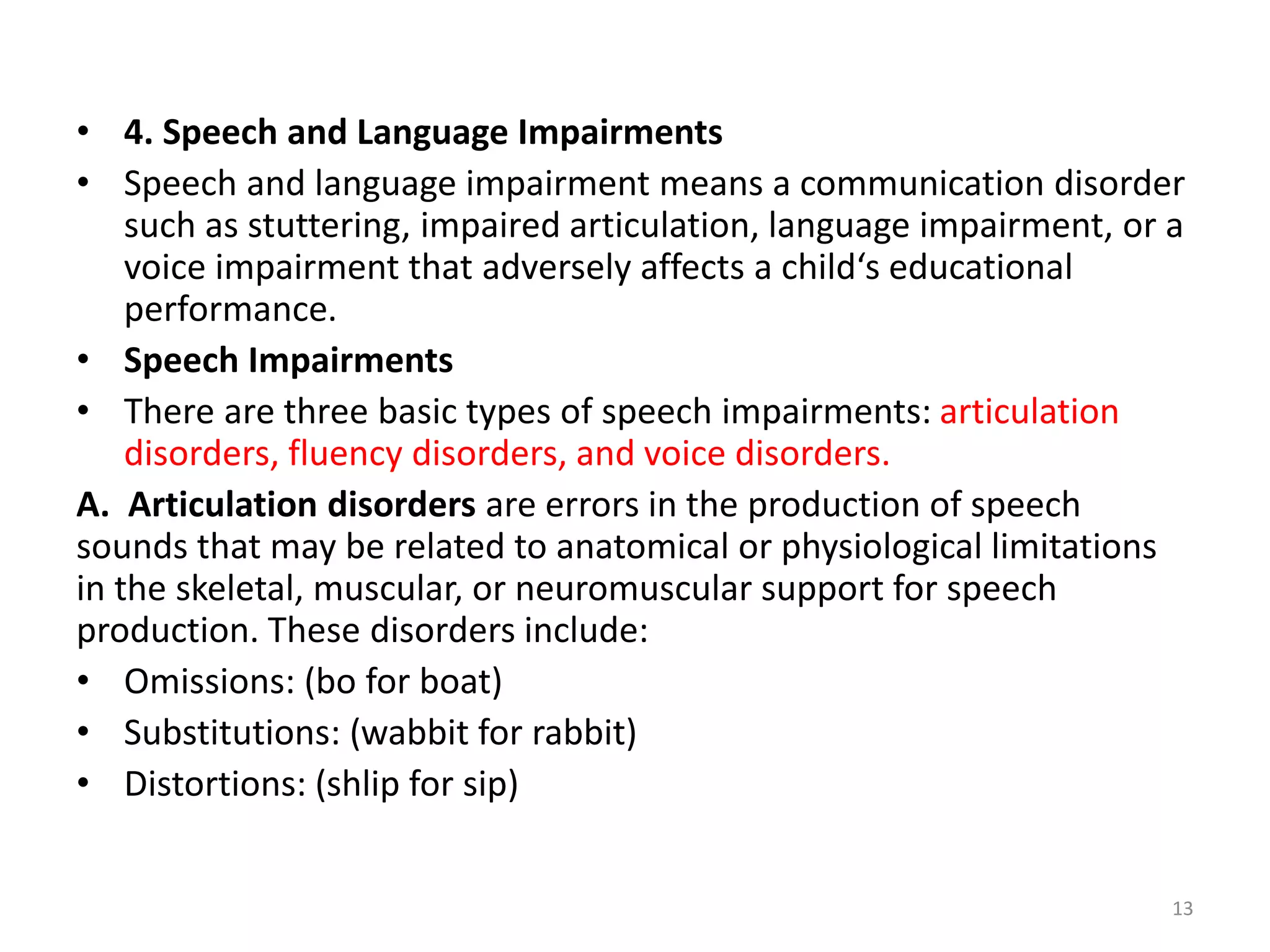
• 4. Speech and Language Impairments
• Speech and language impairment means a communication disorder
such as stuttering, impaired articulation, language impairment, or a
voice impairment that adversely affects a child‘s educational
performance.
• Speech Impairments
• There are three basic types of speech impairments: articulation
disorders, fluency disorders, and voice disorders.
A. Articulation disorders are errors in the production of speech
sounds that may be related to anatomical or physiological limitations
in the skeletal, muscular, or neuromuscular support for speech
production. These disorders include:
• Omissions: (bo for boat)
• Substitutions: (wabbit for rabbit)
• Distortions: (shlip for sip)
13
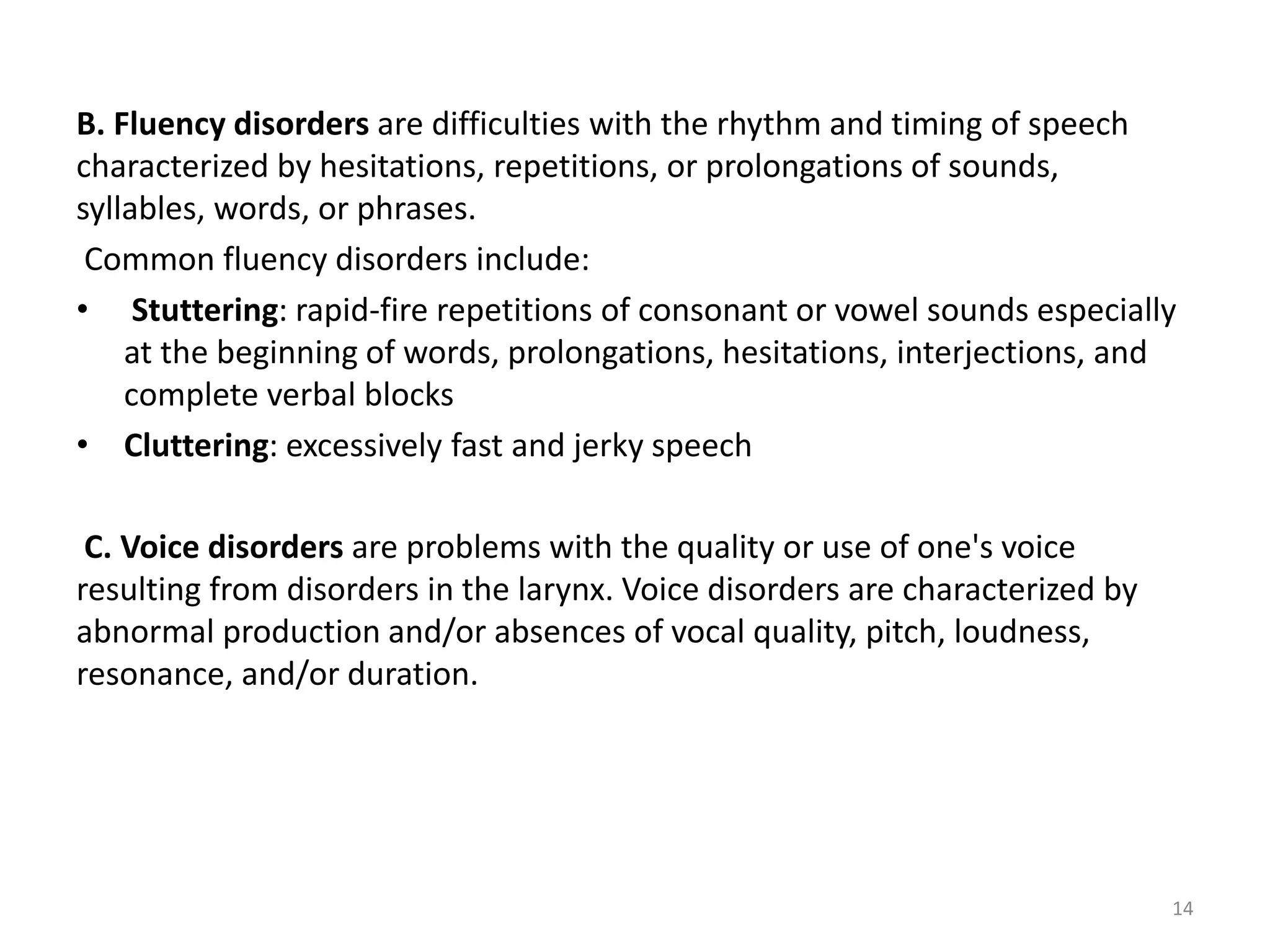
B. Fluency disorders are difficulties with the rhythm and timing of speech
characterized by hesitations, repetitions, or prolongations of sounds,
syllables, words, or phrases.
Common fluency disorders include:
• Stuttering: rapid-fire repetitions of consonant or vowel sounds especially
at the beginning of words, prolongations, hesitations, interjections, and
complete verbal blocks
• Cluttering: excessively fast and jerky speech
C. Voice disorders are problems with the quality or use of one's voice
resulting from disorders in the larynx. Voice disorders are characterized by
abnormal production and/or absences of vocal quality, pitch, loudness,
resonance, and/or duration.
14
• Language Impairments
• There are five basic areas of language impairments:
phonological disorders, morphological disorders, semantic
disorders, syntactical deficits, and pragmatic difficulties.
• 1. Phonological disorders are defined as the abnormal
organization of the phonological system, or a significant
deficit in speech production or perception. A child with a
phonological disorder may be described as hard to
understand or as not saying the sounds correctly. Apraxia of
speech is a specific phonological disorder where the student
may want to speak but has difficulty planning what to say and
the motor movements to use.
15
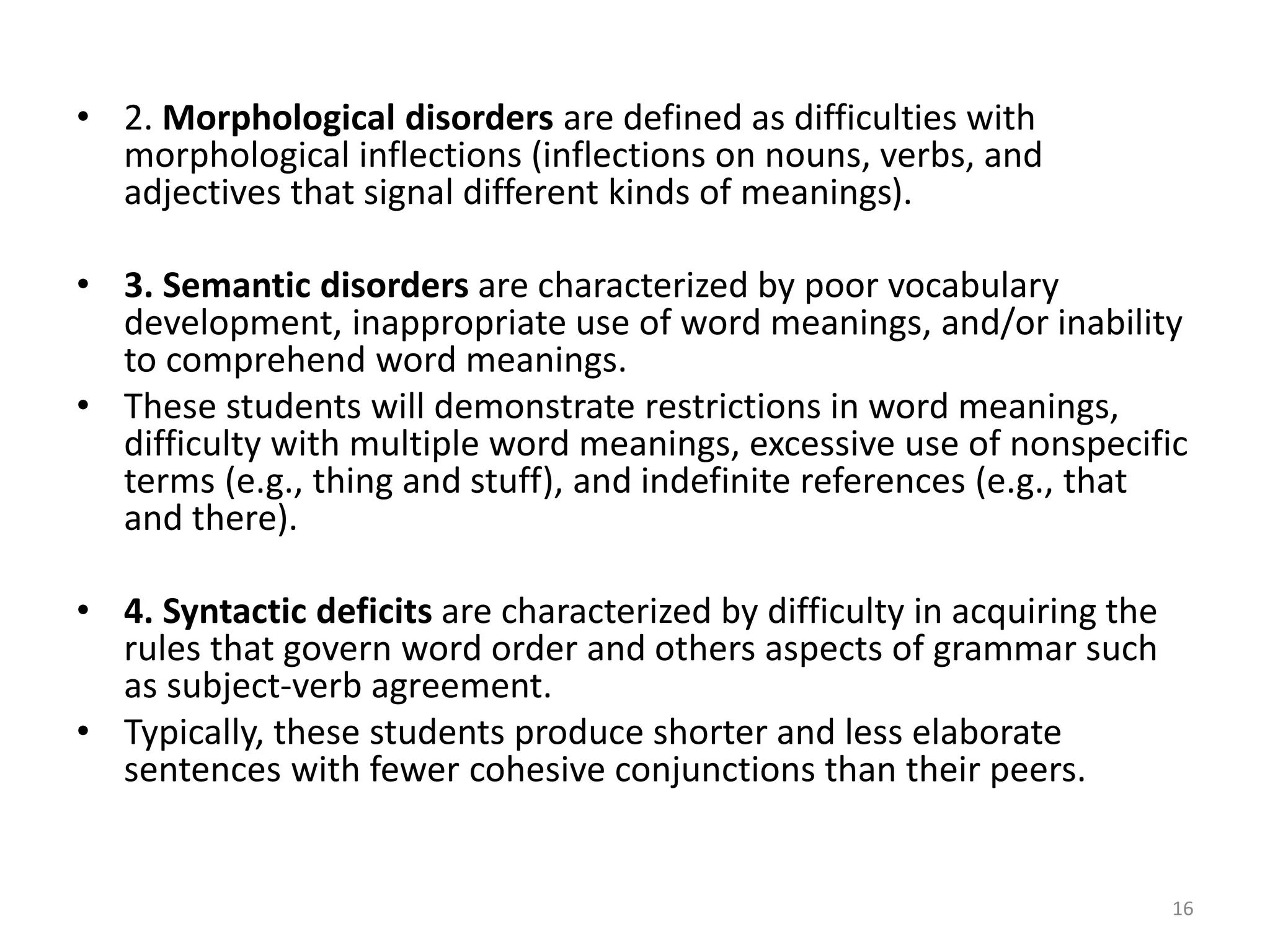
• 2. Morphological disorders are defined as difficulties with
morphological inflections (inflections on nouns, verbs, and
adjectives that signal different kinds of meanings).
• 3. Semantic disorders are characterized by poor vocabulary
development, inappropriate use of word meanings, and/or inability
to comprehend word meanings.
• These students will demonstrate restrictions in word meanings,
difficulty with multiple word meanings, excessive use of nonspecific
terms (e.g., thing and stuff), and indefinite references (e.g., that
and there).
• 4. Syntactic deficits are characterized by difficulty in acquiring the
rules that govern word order and others aspects of grammar such
as subject-verb agreement.
• Typically, these students produce shorter and less elaborate
sentences with fewer cohesive conjunctions than their peers.
16
• 5. Pragmatic difficulties are characterized as problems in
understanding and using language in different social contexts.
These students may lack an understanding of the rules for
making eye contact, respecting personal space, requesting
information, and introducing topics.
17
5. Autism
• Autism means a developmental disability significantly
affecting verbal and nonverbal communication and social
interaction, generally evident before age three that adversely
affects a child‘s educational performance.
• Other characteristics often associated with autism are
engaging in repetitive activities and stereotyped movements,
resistance to environmental change or change in daily
routines, and unusual responses to sensory experiences.
18
• Autism is a neurodevelopment disorder defined by
impairments in social and communication development,
accompanied by stereotyped patterns of behavior and
interest
• Autism is pervasive developmental disorder characterized by
lack of normal sociability, impaired communication and
repetitive obsessive behavior such as politeness, turn-taking
19
6. Emotional and Behavioral Disorders
• Behavioral Disorders means a condition exhibiting one or more of
the following characteristics over a long period of time and to a
marked degree that adversely affects educational performance
1) An inability to learn that cannot be explained by intellectual,
sensory, or health factors;
2) An inability to build or maintain satisfactory interpersonal
relationships with peers and teachers;
3) Inappropriate types of behavior or feelings under normal
circumstances;
4) A general pervasive mood of unhappiness or depression; or
5) A tendency to develop physical symptoms or fears associated with
personal or school problems.
20
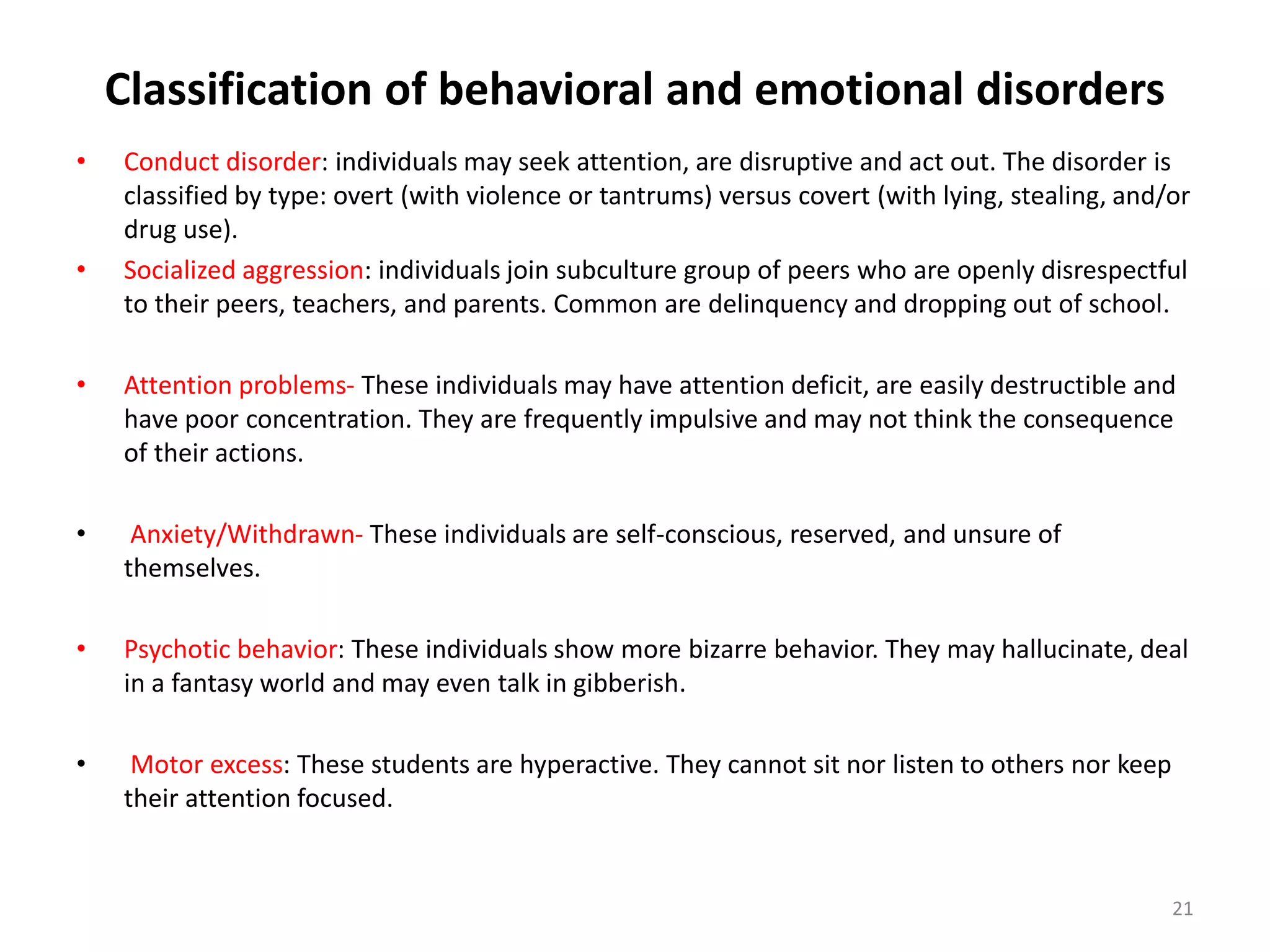
Classification of behavioral and emotional disorders
• Conduct disorder: individuals may seek attention, are disruptive and act out. The disorder is
classified by type: overt (with violence or tantrums) versus covert (with lying, stealing, and/or
drug use).
• Socialized aggression: individuals join subculture group of peers who are openly disrespectful
to their peers, teachers, and parents. Common are delinquency and dropping out of school.
• Attention problems- These individuals may have attention deficit, are easily destructible and
have poor concentration. They are frequently impulsive and may not think the consequence
of their actions.
• Anxiety/Withdrawn- These individuals are self-conscious, reserved, and unsure of
themselves.
• Psychotic behavior: These individuals show more bizarre behavior. They may hallucinate, deal
in a fantasy world and may even talk in gibberish.
• Motor excess: These students are hyperactive. They cannot sit nor listen to others nor keep
their attention focused.
21
• Kauffman (1993) conclude that emotion or behavioral disorders fall into
two broad classifications:
• 1) Externalizing Behavior: also called under controlled disorder, include
such problems disobedience, disruptiveness, fighting, tempers tantrums,
irresponsibility, jealous, anger, attention seeking etc…
• 2) Internalizing Behavior: also known as over controlled disorders, include
such problems anxiety, immaturity, shyness, social withdrawal, feeling of
inadequacy (inferiority), guilt, depression and worries a great deal.
22
Causes of behavioral and emotional disorders
Behavioral and emotion disorders result from many causes,
these includes the following.
1. Biological- includes genetic disorders, brain damage, and
malnutrition, allergies, temperament and damage to the central
nervous system.
2. Family factors- include family interactions, family influence,
child abuse, neglect, and poor disciplinary practices at home.
3. Cultural factors- include some traditional and cultural negative
practices, for example watching violence and sexually oriented
movies and TV programs.
4. Environmental factors- include peer pressure, living in
impoverished areas, and schooling practices that are
unresponsive to individual needs.
23
7.Intellectual Disability
• Intellectual disability is a disability characterized by significant
limitations in both intellectual functioning and in adaptive
behavior, which covers many everyday social and practical
skills.
• This disability originates before the age of 18.
• An individual is considered to have an intellectual disability
based on the following three criteria:
• 1. Sub average intellectual functioning: It refers to general
mental capacity, such as learning, reasoning, problem solving,
and so on. One way to measure intellectual functioning is an
IQ test. Generally, an IQ test score of around 70 or as high as
75 indicates a limitation in intellectual functioning.
24
• 2. Significant limitations exist in two or more adaptive skill
areas: It is the collection of conceptual, social, and practical
skills that are learned and performed by people in their
everyday lives.
Conceptual skills: language and literacy; money, time, and
number concepts; and self-direction.
 Social skills: interpersonal skills, social responsibility, self-
esteem, gullibility, innocence (i.e., suspicion), social problem
solving, and the ability to follow rules/obey laws and to avoid
being victimized.
 Practical skills: activities of daily living (personal care),
occupational skills, healthcare, travel/transportation,
schedules/routines, safety, use of money, use of the telephone.
25
• General Cognition: People with intellectual disabilities vary
physically and emotionally, as well as by personality,
disposition, and beliefs. Their apparent slowness in learning
may be related to the delayed rate of intellectual
development
• Learning and Memory: The learning and memory capabilities
of people with intellectual disabilities are significantly below
average in comparison to peers without disabilities.
• Attention: To acquire information, children must attend to the
learning task for the required length of time and control
distractions. Children with intellectual disabilities may have
difficulty distinguishing and attending to relevant questions in
both learning and social situations.
26
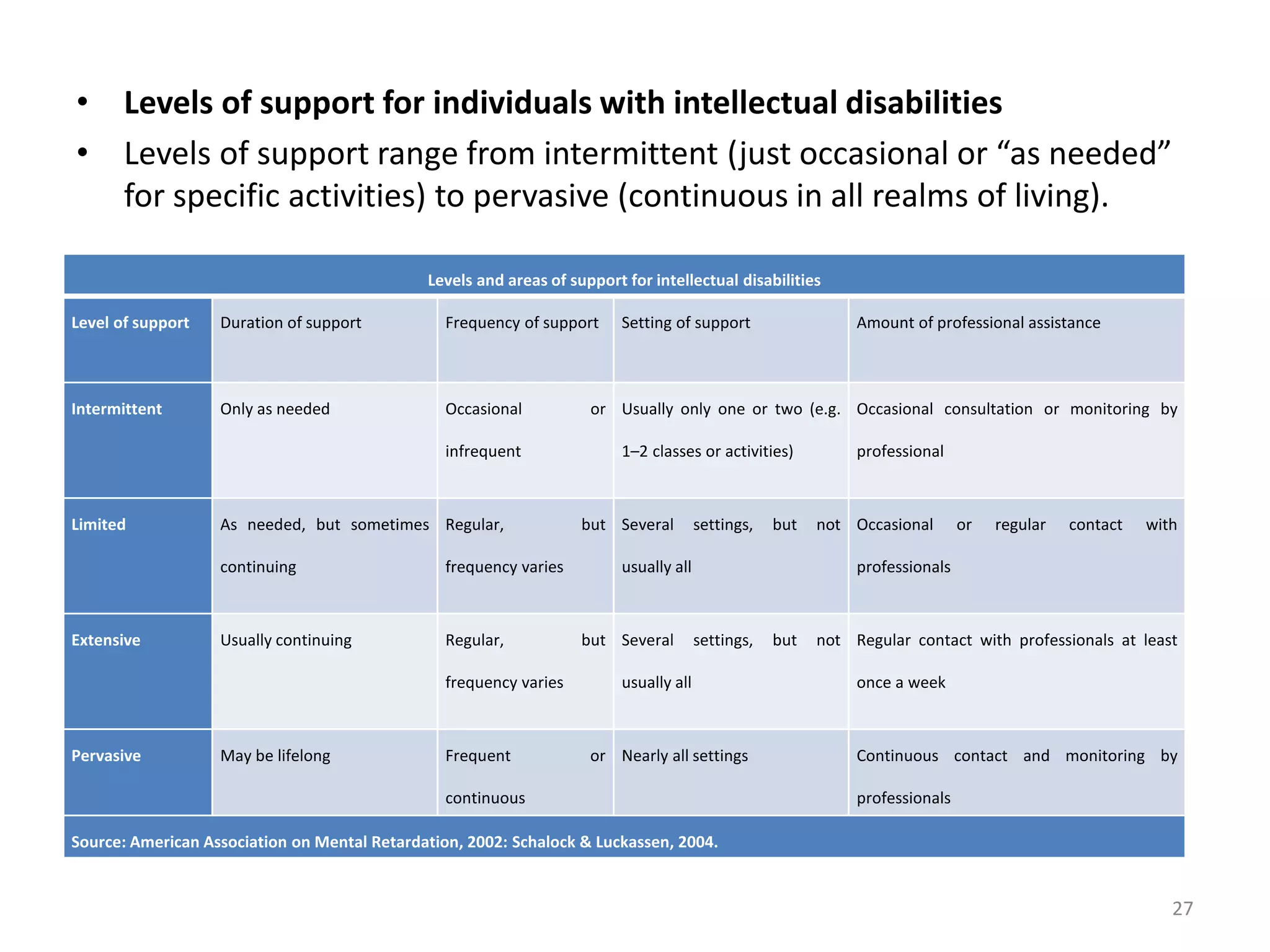
• Levels of support for individuals with intellectual disabilities
• Levels of support range from intermittent (just occasional or “as needed”
for specific activities) to pervasive (continuous in all realms of living).
Levels and areas of support for intellectual disabilities
Level of support Duration of support Frequency of support Setting of support Amount of professional assistance
Intermittent Only as needed Occasional or
infrequent
Usually only one or two (e.g.
1–2 classes or activities)
Occasional consultation or monitoring by
professional
Limited As needed, but sometimes
continuing
Regular, but
frequency varies
Several settings, but not
usually all
Occasional or regular contact with
professionals
Extensive Usually continuing Regular, but
frequency varies
Several settings, but not
usually all
Regular contact with professionals at least
once a week
Pervasive May be lifelong Frequent or
continuous
Nearly all settings Continuous contact and monitoring by
professionals
Source: American Association on Mental Retardation, 2002: Schalock & Luckassen, 2004.
27
8. Physical disability/Orthopedic Impairment
and Health impairment
• Physical disability is a condition that interferes with the
individual‘s ability to use his or her body.
• Many but not all, physical disabilities are orthopedic
impairments.
• The term orthopedic impairment generally refers to
conditions of muscular or skeletal system and sometimes to
physical disabling conditions of the nervous system.
• Health impairment is a condition that requires ongoing
medical attention.
• It includes asthma, heart defects, cancer, diabetes,
hemophilia. HIV/AIDS, etc.
28
• Classification and Characteristics
How can you classify physical impairment?
• Physical disabilities :- based on the impact of physical disability on mobility
and motor skills, it is divided into three.
• These are :-
• A. Mild physical disability :- these individuals are able to walk without
aids and may make normal developmental progress.
• B. Moderate physical disability:- individuals can walk with braces and
crutches and may have difficulty with fine-motor skills and speech
production.
• C. Severe physical disability:-these are individuals who are wheel-chair
dependent and may need special help to achieve regular development.
29
• The physical disability could be broadly classified in to two
• The neurological system (the brain , spinal cord & nerve)
related problems.
• Musculo skeletal system ( the muscles, bones and joints) are
deficient due to various causes.
1. Neurological system :-with a neurological condition like
cerebral palsy or a traumatic brain injury, the brain either
sends the wrong instructions or interprets feedback
incorrectly. In both cases, the result is poorly coordinated
movement.
With the spinal cord injury or deformity, the path ways between
the brain and the muscles are interrupted, so messages are
transmitted but never received.
The result is muscle paralysis and loss of sensation beyond the
point where the spinal cord or the nerve is damaged.
30
• cerebral palsy include learning disabilities, mental retardation.
Seizures, speech impairments, eating problems, sensory
impairments, and joint and bone deformities such as spinal
curvatures and contractures.
• Epilepsy:- is disorder that occurs when the brain cells are not
working properly and is often called a seizure disorder.
Spinal bifida and spinal cord injury :-
• damage to the spinal cord leads to paralysis and loss of
sensation in the affected areas of the body.
• The spinal bifida is a birth defect of the backbone (spinal
column). The cause is unknown but it usually occurs in the
first twenty-six days of pregnancy.
31
• Musculoskeletal system: it includes the muscles and their supporting
framework and the skeleton.
1. Progressive muscle weakness (muscular dystrophy);
2. Inflammation of the joints (arthritis), or
3. Loss of various parts of the body (amputation)
A. Muscular dystrophy:- is an inherited condition accruing mainly in males, in
which the muscles weaken and deteriorate. The weakness usually appears
around 3 to 4 years of age and worsens progressively.
B. Arthritis:-is an inflammation of the joints. Symptoms include swollen and
stiff joints, fever, and pain in the joints during acute periods.
Prolonged inflammation can lead joint deformities that can eventually affect
mobility.
C. Amputation:- a small number of children have missing limbs because of
congenital abnormalities or injuiry or disease (malignant bone tumors in the
limbs).
These children can use customized prosthetic devices (artificial hands, arms,
or legs) to replace limp functions and increase independence in daily
activities.
32
D. Marfan syndrome is a genetic disorder in which the muscles are poorly
developed and the spine is curved. Individuals with marfan syndrome may
have either long, thin limbs, prominent shoulder blades, spinal curvature, flat
feet, or long fingers & thumbs.
The heart and blood vessels are usually affected. The greatest danger is
damage to aorta, which can lead to heart failure. Individuals with marfan
syndrome need to avoid heavy exercise and lifting heavy objects.
E. Achondroplasis:- is a genetic disorder that affects 1 in 10,000 births.
Children with this disorder usually develop a normal torso but have a straight
upper back and a curved lower back (sway back).
Polio:- is viral disease that invade the brain and cause severe paralysis of the
total body system. In its mild form results in partial paralysis. Post polio
muscles that were previously damaged weaken, and in some persons, other
muscles that were not previously affected weaken as well.
Club foot:- is a major orthopedic problem affecting about 9,000 infants each
year. This term is used to describe various ankle or foot deformities, i.e
• Twisting inward (equino varus), the most severe form
• Sharply angled at the heel (calcanel vaigus), most common
• The front part of the foot turned inward.
33
• Cleft lip and cleft palate:- are openings in the lip or roof of
the mouth, respectively, that fail to close before birth, the
cause is unknown. Most cleft problems can be repaired
through surgery.
34
Health Impairments
• What are the common health problems of students?
• Any disease that interferes with learning can make students eligible for
special services. These disease caused problems are as follow.
1. Heart disease:- this is common among young people. It is caused by
improper circulation of blood by the heart some of the disorders are
congenital )present at birth);others are the product of inflammatory heart
disease. Some students have heart value disorders; others have disorders of
the blood vessels.
2. Cystic fibrosis:- is a hereditary disease that affects the lungs and pancreas.
It leads to recurrent respiratory and digestive problems including abnormal
amounts of thick mucus, sweet and saliva.
3. Acquired immune deficiency syndrome (AIDS):- is a very severe disease
caused by human immunodeficiency virus (HIV) infection and transmitted
primarily through exchange of bodily fluids in transfusions or unprotected sex,
and by contaminated needles in addictive drug use.
35
4. Hemophilia:- is a hereditary disease in which the blood clots very slowly or not
all. The disorder is transmitted by sex-linked recessive gene and nearly always
occurs in males.
5. Asthma: is a chronic respiratory condition characterized by repeared eplosde of
breathing difficulties especially while exhaling.
6. Diabetes: Developmental or hereditary disorder characterized by inadequate
secretion or use of insulin
7. Nephrosis & Nephritis. Kidney disorders or diseases caused by infections,
poisoning, burns, accidents or other diseases
8. Sickle-cell anemia. Hereditary and chronic blood disease (occurring primarily in
African Americans) characterized by red blood cells that are distorted and that do
not circulate properly
9. Leukemia: Disease characterized by excessive production of white blood Cells
10. Lead poisoning Disorder caused by ingesting lead-based paint chips or other
substances containing lead.
11. Rheumatic fever Disease characterized by painful swelling and inflammation
of the joints that can spread to the hear and central nervous system.
12. Tuberculosis Infectious disease that commonly affects the lungs and may
affect other tissues of the body.
13. Cancer Abnormal growth of cells that can affect any organ system
36
9. Vulnerability
• Vulnerable means being at risk of being harmed. Everyone can
be harmed, so being vulnerable is part of being human.
• In principle, everyone is vulnerable to some adverse event or
circumstance, but some people are more vulnerable than
others.
• For instance, people with disabilities are more likely as a
group to experience greater vulnerability.
• They are also often more severely affected by the
vulnerability they experience.
• Based on the existing literature, vulnerability can be generally
defined as a complex phenomenon that refers to the
following dimensions:
37
1. Economic difficulties/lack of financial resources: poverty, low living
standards, housing problems (e.g. too damp, too expensive, too cold or
difficult to heat) etc.;
2. Social exclusion: limited access to facilities such as transportation, schools,
libraries or medical services;
3. Lack of social support from social networks: no assistance from family
members, friends, neighbors or colleagues (referring to practical help as well
as emotional support) like highly gifted individuals;
4. Stigmatization: being a victim of stereotypes, being devalued, confronted
with disgraceful behavior because of belonging to a particular social or ethnic
group;
5. Health difficulties: disadvantages resulting from poor mental health,
physical health or disabilities;
6. Being a victim of crime: in family context especially of violence.
38
Causes of Vulnerability
• Vulnerability may be causes by
• rapid population growth,
• poverty and hunger,
• poor health,
• low levels of education,
• gender inequality,
• fragile and hazardous location, and
• lack of access to resources and services, including knowledge and
technological means, disintegration of social patterns (social
vulnerability).
• Other causes includes; lack of access to information and
knowledge, lack of public awareness, limited access to political
power and representation (political vulnerability
39
Characteristics of Vulnerable People
• The following are thought to be characteristics of vulnerable
people (with examples of groups of potentially vulnerable
people):
1. Less physically or mentally capable (infants, older adults,
people with disabilities)
2. Fewer material and/or financial resources (low-income
households, homeless)
3. Less knowledge or experience (children, illiterate, foreigners,
tourists)
4. Restricted by society to grow and develop according to their
needs and potentials
40
Who are vulnerable people?
A. Women: particularly women in developing nations and those who
are living in rural areas
B. Children: Significant number of children are vulnerable and at risk
for development (Morrow, 1999;
C. Minorities: some people are vulnerable due to their minority
background. Particularly, ethnic (cultural and linguistic minority),
religious minority. These people are political and socially discriminated
D. Poverty: People are vulnerable for many undesirable phenomena
due to poverty. This may be resulted in, poor households and large
households, inequality, absences of access to health services,
important resources for life, lack of access to education, information,
financial and natural resources and lack of social networks
41
E. Disabilities: People with disabilities very much vulnerable for many
kind of risks
F. Age: Old people or very young children are vulnerable for all kinds
evils
G. Illiteracy and less education: People with high rates of illiteracy and
lack quality educational opportunities are vulnerable for absence all
kinds of developments
H. Sickness: Uncured health problems for example people living with
HIV/AIDS are much vulnerable for psychosocial problems, poverty and
health (Vincent, 2004; Adger et al., 2004; Naudé et al., 2007).
I. Gifted and Talentedness: Gifted and talented children are vulnerable
for socio-emotional developments. Due to lack of psychological
support they may feel isolation as they are pulled from their regular
classrooms and given instruction in separate settings and due to myths
and expectations of themselves and the public
42
43
Chapter two
concept of inclusion
• Inclusion in education/service refers to ―
• an ongoing process aimed at offering quality education/services for
all while respecting diversity and the different needs and abilities,
characteristics and learning expectations of the students and
communities and eliminating all forms of discrimination.
• Inclusion is seen as a process of addressing and responding to the
diversity of needs of all persons through increasing participation in
learning, employment, services, cultures and communities, and
reducing exclusion at all social contexts.
• It involves changes and modifications in content, approaches,
structures and strategies, with a common vision which covers all
people, a conviction that it is the responsibility of the social system
44
• It is part of a wider strategy promoting inclusive development, with the goal of
creating a world where there is peace, tolerance, and sustainable use of
resources, social justice, and where the basic needs and rights of all are met.
• This definition has the following components:
Concepts about learners
• Education is a fundamental human right for all people
• Learning begins at birth and continues throughout life
• All children have a right to education within their own community
• Everyone can learn, and any child can experience difficulties in learning
• All learners need their learning supported child-focused teaching benefits all
children.
Concepts about the education system and schools
• It is broader than formal schooling
• It is flexible, responsive educational systems
• It creates enabling and welcoming educational environments
• It promotes school improvement – makes effective schools
• It involves whole school approach and collaboration between partners.
45
Concepts about diversity and discrimination
• It promotes combating discrimination and exclusionary pressures at any social
sectors
• It enables responding to/embracing diversity as a resource not as a problem
• It prepares learners for an inclusive society that respects and values
difference.
Concepts about processes to promote inclusion
• It helps to identifying and overcoming barriers to participation and
exclusionary pressures
• It increases real participation of all collaboration, partnership between all
stakeholders
• It promotes participatory methodology, action research, collaborative enquiry
and other related activities
Concepts about resources
• Promotes unlocking and fully using local resources redistributing existing
resources
• It helps to perceive people (children, parents, teachers, members of
marginalized groups, etc) as key resources
• It helps to use appropriate resources and support within schools and at local
levels for the needs of different children, e.g. mother tongue tuition, Braille,
assistive devices.
46
inclusion and non-inclusive practices
inclusion includes the following components:
• Students with disabilities and vulnerability
attend their neighborhood schools
• Each student is in an age-appropriate general
education classroom
• Every student is accepted and regarded as a
full and valued member of the class and the
school community.
• Special education supports are provided to
each student with a disability within the
context of the general education classroom.
• All students receive an education that
addresses their individual needs
• No student is excluded based on type or
degree of disability.
• All members of the school (e.g.,
administration, staff, students, and parents)
promote cooperative/collaborative teaching
arrangements
• There is school-based planning, problem-
solving, and ownership of all students and
programs
• Employed according to their capacities
without discriminations.
On the other hand, they argue that inclusion does
not mean:
• Placing students with disabilities into general
education classrooms without careful
planning and adequate support.
• Reducing services or funding for special
education services.
• Placing all students who have disabilities or
who are at risk in one or a few designated
classrooms.
• Teachers spending a disproportionate
amount of time teaching or adapting the
curriculum for students with disabilities.
• Isolating students with disabilities socially,
physically, or academically within the general
education school or classroom.
• Endangering the achievement of general
education students through slower
instruction or a less challenging curriculum.
• Relegating special education teachers to the
role of assistants in the general education
classroom.
• Requiring general and special education
teachers to team together without careful
planning and well-defined responsibilities.
47
Principles of Inclusion
• The fundamental principle of inclusion is that all persons
should learn, work and live together wherever possible,
regardless of any difficulties or differences they may have.
• Inclusive education extends beyond special needs arising
from disabilities, and includes consideration of other sources
of disadvantage and marginalization, such as gender, poverty,
language, ethnicity, and geographic isolation.
• Inclusion begins with the premise that all persons have
unique characteristics, interests, abilities and particular
learning needs and, further, that all persons have equal access
education, employment and services.
48
• Inclusion implies transition from separate, segregated learning and
working environments for persons with disabilities to community based
systems.
• Moreover, effective transitions from segregated services to inclusive
system requires careful planning and structural changes to ensure that
persons with disabilities are provided with appropriate accommodation
and supports that ensure an inclusive learning and working environment.
The inclusion principles that support inclusive practice
1. Inclusion is a process. It has to be seen as a never-ending search to find
better ways of responding to diversity. It is about learning how to live with
difference and learning how to learn from difference
2. Inclusion is concerned with the identification and removal of barriers that
hinders the development of persons with disabilities
3. Inclusion is about the presence, participation and achievement of all
persons.
4. Inclusion invokes a particular emphasis on those who may be at risk of
marginalization, exclusion or underachievement. This indicates the moral
responsibility to ensure that those at risk‘ are carefully monitored
49
2. Rationale for Inclusion
Implementation of inclusion has number of rationales. The
major ones include: educational, social, legal, economic and
inclusive society building foundations.
Educational Foundations
• Children do better academically,
psychologically and socially in
inclusive settings.
• A more efficient use of education
resources.
• Decreases dropouts and
repetitions
• Teachers competency(
knowledge, skills, collaboration,
satisfaction
• Social Foundation
• Segregation teaches individuals to be
fearful, ignorant and breeds prejudice.
• All individuals need an education that
will help them develop relationships
and prepare them for life in the wider
community.
• Only inclusion has the potential to
reduce fear and to build friendship,
respect and understanding.
50
• Legal Foundations
• All individuals have the right to learn
and live together.
• Human being shouldn‘t be devalued
or discriminated against by being
excluded or sent away because of
their disability.
• There are no legitimate reasons to
separate children for their education
• Economic Foundation
• Inclusive education has economic
benefit, both for individual and for
society.
• Inclusive education is more cost-
effective than the creation of special
schools across the country.
• Children with disabilities go to local
schools
• Reduce wastage of repetition and
dropout
• Children with disabilities live with
their family use community
infrastructure
• Better employment and job creation
opportunities for people with
disabilities
51
Foundations for Building Inclusive Society
• Formation of mutual understanding and appreciation of
diversity
• Building up empathy, tolerance and cooperation
• Promotion of sustainable development
52
• 2.3. Factors that Influenced Development of
Inclusion
• Brainstorming questions
– As stated earlier, inclusive education has got priority
as the main education policy in many countries of the
world. Why do you think it has got the world’s
attention?
– Is it possible to solve different crises that the world is
acing these days by implementing inclusion
philosophy? If your answer is “Yes,” how it is
possible? If your answer is “No,” why it is not
possible?
– 3. What do you think are the drivers of inclusion to
be materialized in reality?
53
Inclusive education is facilitated by many influencing actors. Some of the
major drivers include:
• Communities: pre-colonial and indigenous approaches to education and
community-based programs movement that favor inclusion of their
community members.
• Activists and advocates: the combined voices of primary stakeholders –
representatives of groups of learners often excluded and marginalized
from education (e.g. disabled activists; parents advocating for their
children; child rights advocates; and those advocating for women/girls and
minority ethnic groups).
• The quality education and school improvement movement: in both North
and South, the issues of quality, access and inclusion are strongly linked,
and contribute to the understanding and practice of inclusive education as
being the responsibility of education systems and schools.
• Special educational needs movement: the new thinking‘ of the special
needs education movement – as demonstrated in the Salamanca
Statement – has been a positive influence on inclusive education, enabling
schools and systems to really respond to a wide range of diversity.
54
• Involvement of International agencies: the UN is a major
influence on the development of inclusive education policy
and practice. Major donors have formed a partnership –
the Fast Track Initiative – to speed progress towards the
EFA goals. E.g. UNESCO, etc.
• Involvement of NGOs movements, networks and
campaigns: a wide range of civil society initiatives, such as
the Global Campaign for Education, seek to bring policy and
practice together and involve all stakeholders based on
different situations.
• Other factors: the current world situation and practical
experiences in education. The current world situation
presents challenges such as the spread of HIV/AIDS,
political instability, trends in resource distribution, diversity
of population, and social inclusion.
55
• Benefits of Inclusion
It is now understood that inclusion benefits communities,
families, teachers, and students by ensuring that children with
disabilities attend school with their peers and providing them
with adequate support to succeed both academically and
socially.
56
• Benefits for Students with Special Needs Education
• In inclusive settings people will develop:
• Appropriate models of behavior. They can observe and imitate socially
acceptable behaviors of the students without special needs
• Improved friendships with the social environment
• Increased social initiations, interactions, relationships and networks
• Gain peer role models for academic, social and behavior skills
• Increased achievement of individualized educational program (IEP) goals
• Greater access to general curriculum
• Enhanced skill acquisition and generalization in their learning improved
academic achievement which leads to quality education services
• Attending inclusive schools increases the probability that students with SEN
will continue to participate in a variety of integrated settings throughout their
lives (increased inclusion in future environments that contribute building of
inclusive society).
• Improved school staff collaboration to meet these students‘ needs and ability
differences
• Increased parental participation to meet these students‘ needs and ability
differences
• Enhanced family’s integration into the community.
57
Benefits for persons without Special Needs Education
Students without special educational needs (SEN) will:
• Have a variety of opportunities for interacting with their age peers who experience SEN
in inclusive school settings.
• serve as peer tutors during instructional activities
• Play the role of a special buddy‘during lunch, in the bus or playground.
• Gain knowledge of a good deal about tolerance, individual difference, and human
exceptionality.
• Learn that students with SEN have many positive characteristics and abilities.
• Have chance to learn about many of the human service profession such as special
education, speech therapy, physical therapy, recreation therapy, and vocational
rehabilitation. For some, exposure to these areas may lead to career choices.
• Have increased appreciation, acceptance and respect of individual differences among
human beings that leads to increased understanding and acceptance of diversity
• Get greater opportunities to master activities by practicing and teaching others
• Have increased academic outcomes
• have opportunity to learn to communicate, and deal effectively with a wide range of
individuals; this prepares them to fully participate in society when they are adults that
make them build an inclusive society
58
Benefit for teachers and parents
• Inclusive education has benefit to teachers.
• The benefit includes: developing their knowledge and skills
that meet diverse students‘ needs and ability differences to
enhancing their skills to work with their stakeholders; and
gaining satisfaction in their profession and other aspects.
Similarly, parents/family benefit from inclusive education.
• parents benefit from implementation of inclusive education in
developing their positive attitude towards their children‘s
education, positive feeling toward their participation, and
appreciation to differences among humankinds and so on.
59
Benefits of the society
• Communities become more accepting of difference, and
everyone benefits from a friendlier, open environment that
values and appreciates differences in human beings.
• Meaningful participation in the economic, social, political and
cultural life of communities own cost effective non-segregated
schooling system that services both students with and
without special needs education.
Ultimate Goal of Inclusion
• The goal of inclusive education is to create schools where
everyone belongs.
60
Features of Inclusive Environment
• An inclusive environment is one in which members feel
respected by and connected to one another.
• An inclusive environment is an environment that welcomes all
people, regardless of their disability and other vulnerabilities.
• It recognizes and uses their skills and strengthens their
abilities.
• An inclusive service environment is respectful, supportive,
and equalizing.
• An inclusive environment reaches out to and includes
individuals with disabilities and vulnerabilities at all levels —
from first time participants to board members.
61
It has the following major characteristics:
• it ensures the respect and dignity of individuals with
disabilities.
• It meets current accessibility standards to the greatest extent
possible to all people with special needs
• provides accommodations willingly and proactively
• Persons with disabilities are welcomed and are valued for
their contributions as individuals.
62
Barriers to Inclusion
Though many countries seem committed to inclusion their rhetoric, and even
in their legislation and policies, practices often fall short. Reasons for the
policy-practice gap in inclusion are diverse. The major barriers include:
• Problems related with societal values and beliefs- particularly the
community and policy makers negative attitude towards students with
disability and vulnerabilities.
• Inclusion cannot flourish in a society that has prejudice and negative
attitude towards persons with disability.
• Economic factors- this is mainly related with poverty of family, community
and society at large
• Lack of taking measures to ensure conformity of implementation of
inclusion practice with policies
• Lack of stakeholders taking responsibility in their cooperation as well as
collaboration for inclusion.
• Conservative traditions among the community members about inclusion
Lack of knowledge and skills among teachers regarding inclusive
education.
63
• Rigid curricula, teaching method and examination systems that do not
consider students with dives needs and ability differences.
• Fragile democratic institutions that could not promote inclusion.
• Inadequate resources and inaccessibility of social and physical
environments.
• Large class sizes that make teachers and stakeholders meet students‘
diverse needs
• Globalization and free market policy that make students engage in fierce
completion, individualism and individuals‘ excellence rather than teaching
through cooperation, collaboration and group excellence.
• Using inclusive models that may be imported from other countries.
64
Chapter 4
Promoting Inclusive Culture
Definition of Inclusive Culture
• Inclusion is a sense of belonging, connection and community
at work. And inclusive organizations help people feel
welcomed, known, valued and encouraged to bring their
whole, unique selves to work.
• Culture is ―the ideas, customs, and social behavior of a
particular people or society. That shared by members of the
group.
65
• an inclusive culture involves the full and successful integration of
diverse people into a workplace or industry.
• Additionally, inclusive cultures extend beyond basic or token
presence of workers who have disabilities.
• They encompass both formal and informal policies and practices,
and involve several core values: -
• Representation: The presence of people with disabilities across a
range of employee roles and leadership positions
• Receptivity: Respect for differences in working styles and flexibility
in tailoring positions to the strengths and abilities of employees and
• Fairness: Equitable access to all resources, opportunities, networks
and decision making processes.
66
Dimensions of Inclusive culture
There are three dimensions/ elements of an inclusive culture:
1. Universal Design
2. Recruitment, Training and Advancement Opportunities
3. Workplace Accommodations and Accessibility: Policy & Practice
• 1. universal design
• Universal design refers to the construction of structures,
spaces, services, communications and resources that are
organically accessible to a range of people with and without
disabilities, without further need for modification or
accommodation.
67
2. Recruitment, Training, & Advancement Opportunities
A. Recruitment: Effective recruitment of people with disabilities
involves two components:
1. Accessible outreach and hiring practices and
2. Targeted recruitment of workers with disabilities.
• Accessible outreach and hiring practices essentially entail making
sure that outreach materials, networking and recruitment sites,
communications, and application processes all include a range of
accessible options, or are free of barriers that might inhibit people
with disabilities from participating.
• Wherever possible, outreach and hiring resources generally should
be equally accessible to workers with and without disabilities.
68
• Targeted recruitment involves specific outreach to people
with disabilities
• targeted recruitment enables employers to reach and
interview qualified people with disabilities.
B. Training: Training plays a dual role in the creation of inclusive
workplace culture.
The first consideration involves the degree to which people with
disabilities have equitable access to training sites, events, and
materials.
The second concern relates to the training of managers,
particularly middle management, and human resources staff, to
work effectively with all people, including those with disabilities.
69
• C. Advancement: Research demonstrates that in order to
have equitable opportunities for promotion and professional
development, like most employees, workers with disabilities
typically require access to mentoring.
• As with recruitment, mentoring and coaching involves a dual
dynamic in which: - Existing mentoring programs are
advertised, implemented and maintained with attention to
inclusion of workers with disabilities, and - Targeted
mentoring and coaching programs specifically assist
employees with disabilities.
• These may include the creation of explicit disability
affirmative action policies related to promotion, targeted
professional networking opportunities, and the establishment
of disability affinity networks and related supports to
encourage full integration into the workplace culture.
70
3. Workplace Accommodations and Accessibility: Policy &
Practice
• Policy plays a critical role in generating meaningful inclusion
of people with disabilities.
• In addition to recruitment, training and advancement,
workplace policies need to carefully plan for the provision of
reasonable accommodations.
• When assessing the effectiveness of existing
accommodations policies, employee experiences can be
described based on two measures of equity.
71
• The first indicator of an inclusive workplace culture involves
the perception of ―procedural justice, meaning that
employees with disabilities perceive the accommodations
policy as fair, accessible and functional.
• The practice of negotiating and providing accommodations
constitutes an additional opportunity for generating an
experience of ―interactional justice.
• Interactional justice refers to the experience of feeling that
the managers or colleagues with whom one is interacting are
behaving fairly, reasonably and respectfully.
72
• The Benefits of Inclusive cultures are specifically beneficial for
employees with disabilities, but also have positive results for all
employees, as they include a number of elements of a healthy work
environment.
• Specific positive outcomes include: -
• Reduced expenses corresponding to reduced employee turn-over
• Increased worker commitment to and identification with
organizational success
• Improved employee health and well-being
• Improved productivity
• Increased employee investment in work performance
• Reduced perception of discrimination and inequity
• Improved cooperation and collaboration between co-workers, and
between employees and management.
73

Inclusiveness unit 1&2 note.pptx

  • 1.
  • 2.
    Chapter 1 Understanding Disabilitiesand Vulnerabilities 1.1 Definitions of Basic Terms (Impairment, Disability and Handicap) Impairment Impairment means a lack/abnormality of an anatomic, physiological or psychological structure or function or deviation on a person. 2
  • 3.
    • Disability • Theterm disability is ambiguous as there is no single agreement on the concept (Mitra, 2006) • It is not synonymous with AKAL-GUDATENGA (የአካል ጉዳተኛ) meaning impairment • The concept of disability is complex, dynamic, multidimensional, and contested (WHO and World Bank, 2011). • The full inclusion of people with impairments in society can be inhibited by: • 1. Attitudinal (societal barriers, such as stigma) • 2. Physical barriers (environmental barriers, such as absence of stairs), and • 3. Policy barriers (systemic barriers), 3
  • 4.
    What is disability? 1.Medical Approach • Disability is pathology (physiological, biological and intellectual). Disability means functional limitations due to physical, intellectual or psychic impairment, health or psychic disorders on a person. • The medical definition has given rise to the idea that people are individual objects to be “treated‖, “changed" or “improved" and made more “normal”. 4
  • 5.
    The social definitionof disability: • Disability is a highly varied and complex condition with a range of implications for social identity and behavior. • Disability largely depends on the context and is a consequence of discrimination, prejudice and exclusion. • Emphasizes the shortcomings in the environment and in many organized activities in society, • for example on information, communication and education, which prevent persons with disabilities from participating on equal terms. 5
  • 6.
    Causes of disability •Disability can be caused by the following factors. • Genetic Causes • Abnormalities in genes and genetic inheritance can cause intellectual disability in children. In some countries, Down syndrome is the most common genetic condition • Environmental • Poverty and malnutrition in pregnant mothers can cause a deficiency in vital minerals and result in deformation issues in the unborn child. • The use of drugs, alcohol, tobacco, the exposure to certain toxic chemicals and illnesses, toxoplasmosis, cytomegalovirus, rubella and syphilis by a pregnant mother can cause intellectual disability to the child. 6
  • 7.
    • Unknown Causes •The human body is a phenomenal thing. Scientists have still not figured out what and how some things in the body, cells, brain, and genes come about. • Inaccessible environments • Sometimes society makes it difficult for people with some impairment to function freely. When society develops infrastructure such as houses, roads, parks and other public places without considerations of people with some disabilities. 7
  • 8.
    Some type ofdisabilities • 1. Visual impairment • Visual impairment in general designates two sub- classifications. These are blindness and low vision. • Blindness, total or partial inability to see because of disease or disorder of the eye, optic nerve, or brain. • Low vision is used for moderately impaired vision. People with low vision may have a visual impairment that affects only central vision—the area directly in front of the eyes—or peripheral vision—the area to either side of and slightly behind the eyes. 8
  • 9.
    2. Hearing Impairment hearingimpairment as a generic term indicating a continuum of hearing loss from mild to profound, which includes the sub-classifications of the hard of hearing and deaf. Hard of Hearing: "A hearing impairment, whether permanent of fluctuating, which adversely affects a child's educational performance but which is not included under the definition of 'deaf'." Deaf: Those who have difficulty understanding speech, even with hearing aids but can successfully communicate in sign language. Cultural definitions of deafness, on the other hand, 9
  • 10.
    • 3. Specificlearning disability • Specific Learning Disability means a disorder in one or more of the basic psychological processes involved in understanding or in using language, spoken or written, that may manifest itself in the imperfect ability to listen, think, speak, read, write, spell, or to do mathematical calculations. • The term includes such conditions as perceptual disabilities, brain injury, minimal brain dysfunction, dyslexia, and developmental aphasia. • The term does not include learning problems that are primarily the result of visual, hearing, or motor disabilities; of intellectual disability; of emotional disturbance; or of environmental, cultural, or economic disadvantage. 10
  • 11.
    Types of SpecificLearning Disabilities Auditory Processing Disorder (APD) • this is a condition that adversely affects how sound that travels unimpeded through the ear is processed or interpreted by the brain. A. Dyscalculia • Dyscalculia is a specific learning disability that affects a perso B. Dysgraphia • Dyscalculia is a specific learning disability that affects a person‘s handwriting ability and fine motor skills. n‘s ability to understand numbers and learn math. C. Dyslexia • Dyslexia is a specific learning disability that affects reading and related language-based processing skills. 11
  • 12.
    D. Language ProcessingDisorder • Language Processing Disorder is a specific type of Auditory Processing Disorder (APD) in which there is difficulty attaching meaning to sound groups that form words, sentences and stories. E. Non-Verbal Learning Disabilities • Non-Verbal Learning Disabilities is a disorder which is usually characterized by a significant discrepancy between higher verbal skill F. Visual Perceptual/Visual Motor Deficit • Visual Perceptual/Visual Motor Deficit is a disorder that affects the understanding of information that a person sees, or the ability to draw or copy. s and weaker motor, visual- spatial and social skills. 12
  • 13.
    • 4. Speechand Language Impairments • Speech and language impairment means a communication disorder such as stuttering, impaired articulation, language impairment, or a voice impairment that adversely affects a child‘s educational performance. • Speech Impairments • There are three basic types of speech impairments: articulation disorders, fluency disorders, and voice disorders. A. Articulation disorders are errors in the production of speech sounds that may be related to anatomical or physiological limitations in the skeletal, muscular, or neuromuscular support for speech production. These disorders include: • Omissions: (bo for boat) • Substitutions: (wabbit for rabbit) • Distortions: (shlip for sip) 13
  • 14.
    B. Fluency disordersare difficulties with the rhythm and timing of speech characterized by hesitations, repetitions, or prolongations of sounds, syllables, words, or phrases. Common fluency disorders include: • Stuttering: rapid-fire repetitions of consonant or vowel sounds especially at the beginning of words, prolongations, hesitations, interjections, and complete verbal blocks • Cluttering: excessively fast and jerky speech C. Voice disorders are problems with the quality or use of one's voice resulting from disorders in the larynx. Voice disorders are characterized by abnormal production and/or absences of vocal quality, pitch, loudness, resonance, and/or duration. 14
  • 15.
    • Language Impairments •There are five basic areas of language impairments: phonological disorders, morphological disorders, semantic disorders, syntactical deficits, and pragmatic difficulties. • 1. Phonological disorders are defined as the abnormal organization of the phonological system, or a significant deficit in speech production or perception. A child with a phonological disorder may be described as hard to understand or as not saying the sounds correctly. Apraxia of speech is a specific phonological disorder where the student may want to speak but has difficulty planning what to say and the motor movements to use. 15
  • 16.
    • 2. Morphologicaldisorders are defined as difficulties with morphological inflections (inflections on nouns, verbs, and adjectives that signal different kinds of meanings). • 3. Semantic disorders are characterized by poor vocabulary development, inappropriate use of word meanings, and/or inability to comprehend word meanings. • These students will demonstrate restrictions in word meanings, difficulty with multiple word meanings, excessive use of nonspecific terms (e.g., thing and stuff), and indefinite references (e.g., that and there). • 4. Syntactic deficits are characterized by difficulty in acquiring the rules that govern word order and others aspects of grammar such as subject-verb agreement. • Typically, these students produce shorter and less elaborate sentences with fewer cohesive conjunctions than their peers. 16
  • 17.
    • 5. Pragmaticdifficulties are characterized as problems in understanding and using language in different social contexts. These students may lack an understanding of the rules for making eye contact, respecting personal space, requesting information, and introducing topics. 17
  • 18.
    5. Autism • Autismmeans a developmental disability significantly affecting verbal and nonverbal communication and social interaction, generally evident before age three that adversely affects a child‘s educational performance. • Other characteristics often associated with autism are engaging in repetitive activities and stereotyped movements, resistance to environmental change or change in daily routines, and unusual responses to sensory experiences. 18
  • 19.
    • Autism isa neurodevelopment disorder defined by impairments in social and communication development, accompanied by stereotyped patterns of behavior and interest • Autism is pervasive developmental disorder characterized by lack of normal sociability, impaired communication and repetitive obsessive behavior such as politeness, turn-taking 19
  • 20.
    6. Emotional andBehavioral Disorders • Behavioral Disorders means a condition exhibiting one or more of the following characteristics over a long period of time and to a marked degree that adversely affects educational performance 1) An inability to learn that cannot be explained by intellectual, sensory, or health factors; 2) An inability to build or maintain satisfactory interpersonal relationships with peers and teachers; 3) Inappropriate types of behavior or feelings under normal circumstances; 4) A general pervasive mood of unhappiness or depression; or 5) A tendency to develop physical symptoms or fears associated with personal or school problems. 20
  • 21.
    Classification of behavioraland emotional disorders • Conduct disorder: individuals may seek attention, are disruptive and act out. The disorder is classified by type: overt (with violence or tantrums) versus covert (with lying, stealing, and/or drug use). • Socialized aggression: individuals join subculture group of peers who are openly disrespectful to their peers, teachers, and parents. Common are delinquency and dropping out of school. • Attention problems- These individuals may have attention deficit, are easily destructible and have poor concentration. They are frequently impulsive and may not think the consequence of their actions. • Anxiety/Withdrawn- These individuals are self-conscious, reserved, and unsure of themselves. • Psychotic behavior: These individuals show more bizarre behavior. They may hallucinate, deal in a fantasy world and may even talk in gibberish. • Motor excess: These students are hyperactive. They cannot sit nor listen to others nor keep their attention focused. 21
  • 22.
    • Kauffman (1993)conclude that emotion or behavioral disorders fall into two broad classifications: • 1) Externalizing Behavior: also called under controlled disorder, include such problems disobedience, disruptiveness, fighting, tempers tantrums, irresponsibility, jealous, anger, attention seeking etc… • 2) Internalizing Behavior: also known as over controlled disorders, include such problems anxiety, immaturity, shyness, social withdrawal, feeling of inadequacy (inferiority), guilt, depression and worries a great deal. 22
  • 23.
    Causes of behavioraland emotional disorders Behavioral and emotion disorders result from many causes, these includes the following. 1. Biological- includes genetic disorders, brain damage, and malnutrition, allergies, temperament and damage to the central nervous system. 2. Family factors- include family interactions, family influence, child abuse, neglect, and poor disciplinary practices at home. 3. Cultural factors- include some traditional and cultural negative practices, for example watching violence and sexually oriented movies and TV programs. 4. Environmental factors- include peer pressure, living in impoverished areas, and schooling practices that are unresponsive to individual needs. 23
  • 24.
    7.Intellectual Disability • Intellectualdisability is a disability characterized by significant limitations in both intellectual functioning and in adaptive behavior, which covers many everyday social and practical skills. • This disability originates before the age of 18. • An individual is considered to have an intellectual disability based on the following three criteria: • 1. Sub average intellectual functioning: It refers to general mental capacity, such as learning, reasoning, problem solving, and so on. One way to measure intellectual functioning is an IQ test. Generally, an IQ test score of around 70 or as high as 75 indicates a limitation in intellectual functioning. 24
  • 25.
    • 2. Significantlimitations exist in two or more adaptive skill areas: It is the collection of conceptual, social, and practical skills that are learned and performed by people in their everyday lives. Conceptual skills: language and literacy; money, time, and number concepts; and self-direction.  Social skills: interpersonal skills, social responsibility, self- esteem, gullibility, innocence (i.e., suspicion), social problem solving, and the ability to follow rules/obey laws and to avoid being victimized.  Practical skills: activities of daily living (personal care), occupational skills, healthcare, travel/transportation, schedules/routines, safety, use of money, use of the telephone. 25
  • 26.
    • General Cognition:People with intellectual disabilities vary physically and emotionally, as well as by personality, disposition, and beliefs. Their apparent slowness in learning may be related to the delayed rate of intellectual development • Learning and Memory: The learning and memory capabilities of people with intellectual disabilities are significantly below average in comparison to peers without disabilities. • Attention: To acquire information, children must attend to the learning task for the required length of time and control distractions. Children with intellectual disabilities may have difficulty distinguishing and attending to relevant questions in both learning and social situations. 26
  • 27.
    • Levels ofsupport for individuals with intellectual disabilities • Levels of support range from intermittent (just occasional or “as needed” for specific activities) to pervasive (continuous in all realms of living). Levels and areas of support for intellectual disabilities Level of support Duration of support Frequency of support Setting of support Amount of professional assistance Intermittent Only as needed Occasional or infrequent Usually only one or two (e.g. 1–2 classes or activities) Occasional consultation or monitoring by professional Limited As needed, but sometimes continuing Regular, but frequency varies Several settings, but not usually all Occasional or regular contact with professionals Extensive Usually continuing Regular, but frequency varies Several settings, but not usually all Regular contact with professionals at least once a week Pervasive May be lifelong Frequent or continuous Nearly all settings Continuous contact and monitoring by professionals Source: American Association on Mental Retardation, 2002: Schalock & Luckassen, 2004. 27
  • 28.
    8. Physical disability/OrthopedicImpairment and Health impairment • Physical disability is a condition that interferes with the individual‘s ability to use his or her body. • Many but not all, physical disabilities are orthopedic impairments. • The term orthopedic impairment generally refers to conditions of muscular or skeletal system and sometimes to physical disabling conditions of the nervous system. • Health impairment is a condition that requires ongoing medical attention. • It includes asthma, heart defects, cancer, diabetes, hemophilia. HIV/AIDS, etc. 28
  • 29.
    • Classification andCharacteristics How can you classify physical impairment? • Physical disabilities :- based on the impact of physical disability on mobility and motor skills, it is divided into three. • These are :- • A. Mild physical disability :- these individuals are able to walk without aids and may make normal developmental progress. • B. Moderate physical disability:- individuals can walk with braces and crutches and may have difficulty with fine-motor skills and speech production. • C. Severe physical disability:-these are individuals who are wheel-chair dependent and may need special help to achieve regular development. 29
  • 30.
    • The physicaldisability could be broadly classified in to two • The neurological system (the brain , spinal cord & nerve) related problems. • Musculo skeletal system ( the muscles, bones and joints) are deficient due to various causes. 1. Neurological system :-with a neurological condition like cerebral palsy or a traumatic brain injury, the brain either sends the wrong instructions or interprets feedback incorrectly. In both cases, the result is poorly coordinated movement. With the spinal cord injury or deformity, the path ways between the brain and the muscles are interrupted, so messages are transmitted but never received. The result is muscle paralysis and loss of sensation beyond the point where the spinal cord or the nerve is damaged. 30
  • 31.
    • cerebral palsyinclude learning disabilities, mental retardation. Seizures, speech impairments, eating problems, sensory impairments, and joint and bone deformities such as spinal curvatures and contractures. • Epilepsy:- is disorder that occurs when the brain cells are not working properly and is often called a seizure disorder. Spinal bifida and spinal cord injury :- • damage to the spinal cord leads to paralysis and loss of sensation in the affected areas of the body. • The spinal bifida is a birth defect of the backbone (spinal column). The cause is unknown but it usually occurs in the first twenty-six days of pregnancy. 31
  • 32.
    • Musculoskeletal system:it includes the muscles and their supporting framework and the skeleton. 1. Progressive muscle weakness (muscular dystrophy); 2. Inflammation of the joints (arthritis), or 3. Loss of various parts of the body (amputation) A. Muscular dystrophy:- is an inherited condition accruing mainly in males, in which the muscles weaken and deteriorate. The weakness usually appears around 3 to 4 years of age and worsens progressively. B. Arthritis:-is an inflammation of the joints. Symptoms include swollen and stiff joints, fever, and pain in the joints during acute periods. Prolonged inflammation can lead joint deformities that can eventually affect mobility. C. Amputation:- a small number of children have missing limbs because of congenital abnormalities or injuiry or disease (malignant bone tumors in the limbs). These children can use customized prosthetic devices (artificial hands, arms, or legs) to replace limp functions and increase independence in daily activities. 32
  • 33.
    D. Marfan syndromeis a genetic disorder in which the muscles are poorly developed and the spine is curved. Individuals with marfan syndrome may have either long, thin limbs, prominent shoulder blades, spinal curvature, flat feet, or long fingers & thumbs. The heart and blood vessels are usually affected. The greatest danger is damage to aorta, which can lead to heart failure. Individuals with marfan syndrome need to avoid heavy exercise and lifting heavy objects. E. Achondroplasis:- is a genetic disorder that affects 1 in 10,000 births. Children with this disorder usually develop a normal torso but have a straight upper back and a curved lower back (sway back). Polio:- is viral disease that invade the brain and cause severe paralysis of the total body system. In its mild form results in partial paralysis. Post polio muscles that were previously damaged weaken, and in some persons, other muscles that were not previously affected weaken as well. Club foot:- is a major orthopedic problem affecting about 9,000 infants each year. This term is used to describe various ankle or foot deformities, i.e • Twisting inward (equino varus), the most severe form • Sharply angled at the heel (calcanel vaigus), most common • The front part of the foot turned inward. 33
  • 34.
    • Cleft lipand cleft palate:- are openings in the lip or roof of the mouth, respectively, that fail to close before birth, the cause is unknown. Most cleft problems can be repaired through surgery. 34
  • 35.
    Health Impairments • Whatare the common health problems of students? • Any disease that interferes with learning can make students eligible for special services. These disease caused problems are as follow. 1. Heart disease:- this is common among young people. It is caused by improper circulation of blood by the heart some of the disorders are congenital )present at birth);others are the product of inflammatory heart disease. Some students have heart value disorders; others have disorders of the blood vessels. 2. Cystic fibrosis:- is a hereditary disease that affects the lungs and pancreas. It leads to recurrent respiratory and digestive problems including abnormal amounts of thick mucus, sweet and saliva. 3. Acquired immune deficiency syndrome (AIDS):- is a very severe disease caused by human immunodeficiency virus (HIV) infection and transmitted primarily through exchange of bodily fluids in transfusions or unprotected sex, and by contaminated needles in addictive drug use. 35
  • 36.
    4. Hemophilia:- isa hereditary disease in which the blood clots very slowly or not all. The disorder is transmitted by sex-linked recessive gene and nearly always occurs in males. 5. Asthma: is a chronic respiratory condition characterized by repeared eplosde of breathing difficulties especially while exhaling. 6. Diabetes: Developmental or hereditary disorder characterized by inadequate secretion or use of insulin 7. Nephrosis & Nephritis. Kidney disorders or diseases caused by infections, poisoning, burns, accidents or other diseases 8. Sickle-cell anemia. Hereditary and chronic blood disease (occurring primarily in African Americans) characterized by red blood cells that are distorted and that do not circulate properly 9. Leukemia: Disease characterized by excessive production of white blood Cells 10. Lead poisoning Disorder caused by ingesting lead-based paint chips or other substances containing lead. 11. Rheumatic fever Disease characterized by painful swelling and inflammation of the joints that can spread to the hear and central nervous system. 12. Tuberculosis Infectious disease that commonly affects the lungs and may affect other tissues of the body. 13. Cancer Abnormal growth of cells that can affect any organ system 36
  • 37.
    9. Vulnerability • Vulnerablemeans being at risk of being harmed. Everyone can be harmed, so being vulnerable is part of being human. • In principle, everyone is vulnerable to some adverse event or circumstance, but some people are more vulnerable than others. • For instance, people with disabilities are more likely as a group to experience greater vulnerability. • They are also often more severely affected by the vulnerability they experience. • Based on the existing literature, vulnerability can be generally defined as a complex phenomenon that refers to the following dimensions: 37
  • 38.
    1. Economic difficulties/lackof financial resources: poverty, low living standards, housing problems (e.g. too damp, too expensive, too cold or difficult to heat) etc.; 2. Social exclusion: limited access to facilities such as transportation, schools, libraries or medical services; 3. Lack of social support from social networks: no assistance from family members, friends, neighbors or colleagues (referring to practical help as well as emotional support) like highly gifted individuals; 4. Stigmatization: being a victim of stereotypes, being devalued, confronted with disgraceful behavior because of belonging to a particular social or ethnic group; 5. Health difficulties: disadvantages resulting from poor mental health, physical health or disabilities; 6. Being a victim of crime: in family context especially of violence. 38
  • 39.
    Causes of Vulnerability •Vulnerability may be causes by • rapid population growth, • poverty and hunger, • poor health, • low levels of education, • gender inequality, • fragile and hazardous location, and • lack of access to resources and services, including knowledge and technological means, disintegration of social patterns (social vulnerability). • Other causes includes; lack of access to information and knowledge, lack of public awareness, limited access to political power and representation (political vulnerability 39
  • 40.
    Characteristics of VulnerablePeople • The following are thought to be characteristics of vulnerable people (with examples of groups of potentially vulnerable people): 1. Less physically or mentally capable (infants, older adults, people with disabilities) 2. Fewer material and/or financial resources (low-income households, homeless) 3. Less knowledge or experience (children, illiterate, foreigners, tourists) 4. Restricted by society to grow and develop according to their needs and potentials 40
  • 41.
    Who are vulnerablepeople? A. Women: particularly women in developing nations and those who are living in rural areas B. Children: Significant number of children are vulnerable and at risk for development (Morrow, 1999; C. Minorities: some people are vulnerable due to their minority background. Particularly, ethnic (cultural and linguistic minority), religious minority. These people are political and socially discriminated D. Poverty: People are vulnerable for many undesirable phenomena due to poverty. This may be resulted in, poor households and large households, inequality, absences of access to health services, important resources for life, lack of access to education, information, financial and natural resources and lack of social networks 41
  • 42.
    E. Disabilities: Peoplewith disabilities very much vulnerable for many kind of risks F. Age: Old people or very young children are vulnerable for all kinds evils G. Illiteracy and less education: People with high rates of illiteracy and lack quality educational opportunities are vulnerable for absence all kinds of developments H. Sickness: Uncured health problems for example people living with HIV/AIDS are much vulnerable for psychosocial problems, poverty and health (Vincent, 2004; Adger et al., 2004; Naudé et al., 2007). I. Gifted and Talentedness: Gifted and talented children are vulnerable for socio-emotional developments. Due to lack of psychological support they may feel isolation as they are pulled from their regular classrooms and given instruction in separate settings and due to myths and expectations of themselves and the public 42
  • 43.
  • 44.
    Chapter two concept ofinclusion • Inclusion in education/service refers to ― • an ongoing process aimed at offering quality education/services for all while respecting diversity and the different needs and abilities, characteristics and learning expectations of the students and communities and eliminating all forms of discrimination. • Inclusion is seen as a process of addressing and responding to the diversity of needs of all persons through increasing participation in learning, employment, services, cultures and communities, and reducing exclusion at all social contexts. • It involves changes and modifications in content, approaches, structures and strategies, with a common vision which covers all people, a conviction that it is the responsibility of the social system 44
  • 45.
    • It ispart of a wider strategy promoting inclusive development, with the goal of creating a world where there is peace, tolerance, and sustainable use of resources, social justice, and where the basic needs and rights of all are met. • This definition has the following components: Concepts about learners • Education is a fundamental human right for all people • Learning begins at birth and continues throughout life • All children have a right to education within their own community • Everyone can learn, and any child can experience difficulties in learning • All learners need their learning supported child-focused teaching benefits all children. Concepts about the education system and schools • It is broader than formal schooling • It is flexible, responsive educational systems • It creates enabling and welcoming educational environments • It promotes school improvement – makes effective schools • It involves whole school approach and collaboration between partners. 45
  • 46.
    Concepts about diversityand discrimination • It promotes combating discrimination and exclusionary pressures at any social sectors • It enables responding to/embracing diversity as a resource not as a problem • It prepares learners for an inclusive society that respects and values difference. Concepts about processes to promote inclusion • It helps to identifying and overcoming barriers to participation and exclusionary pressures • It increases real participation of all collaboration, partnership between all stakeholders • It promotes participatory methodology, action research, collaborative enquiry and other related activities Concepts about resources • Promotes unlocking and fully using local resources redistributing existing resources • It helps to perceive people (children, parents, teachers, members of marginalized groups, etc) as key resources • It helps to use appropriate resources and support within schools and at local levels for the needs of different children, e.g. mother tongue tuition, Braille, assistive devices. 46
  • 47.
    inclusion and non-inclusivepractices inclusion includes the following components: • Students with disabilities and vulnerability attend their neighborhood schools • Each student is in an age-appropriate general education classroom • Every student is accepted and regarded as a full and valued member of the class and the school community. • Special education supports are provided to each student with a disability within the context of the general education classroom. • All students receive an education that addresses their individual needs • No student is excluded based on type or degree of disability. • All members of the school (e.g., administration, staff, students, and parents) promote cooperative/collaborative teaching arrangements • There is school-based planning, problem- solving, and ownership of all students and programs • Employed according to their capacities without discriminations. On the other hand, they argue that inclusion does not mean: • Placing students with disabilities into general education classrooms without careful planning and adequate support. • Reducing services or funding for special education services. • Placing all students who have disabilities or who are at risk in one or a few designated classrooms. • Teachers spending a disproportionate amount of time teaching or adapting the curriculum for students with disabilities. • Isolating students with disabilities socially, physically, or academically within the general education school or classroom. • Endangering the achievement of general education students through slower instruction or a less challenging curriculum. • Relegating special education teachers to the role of assistants in the general education classroom. • Requiring general and special education teachers to team together without careful planning and well-defined responsibilities. 47
  • 48.
    Principles of Inclusion •The fundamental principle of inclusion is that all persons should learn, work and live together wherever possible, regardless of any difficulties or differences they may have. • Inclusive education extends beyond special needs arising from disabilities, and includes consideration of other sources of disadvantage and marginalization, such as gender, poverty, language, ethnicity, and geographic isolation. • Inclusion begins with the premise that all persons have unique characteristics, interests, abilities and particular learning needs and, further, that all persons have equal access education, employment and services. 48
  • 49.
    • Inclusion impliestransition from separate, segregated learning and working environments for persons with disabilities to community based systems. • Moreover, effective transitions from segregated services to inclusive system requires careful planning and structural changes to ensure that persons with disabilities are provided with appropriate accommodation and supports that ensure an inclusive learning and working environment. The inclusion principles that support inclusive practice 1. Inclusion is a process. It has to be seen as a never-ending search to find better ways of responding to diversity. It is about learning how to live with difference and learning how to learn from difference 2. Inclusion is concerned with the identification and removal of barriers that hinders the development of persons with disabilities 3. Inclusion is about the presence, participation and achievement of all persons. 4. Inclusion invokes a particular emphasis on those who may be at risk of marginalization, exclusion or underachievement. This indicates the moral responsibility to ensure that those at risk‘ are carefully monitored 49
  • 50.
    2. Rationale forInclusion Implementation of inclusion has number of rationales. The major ones include: educational, social, legal, economic and inclusive society building foundations. Educational Foundations • Children do better academically, psychologically and socially in inclusive settings. • A more efficient use of education resources. • Decreases dropouts and repetitions • Teachers competency( knowledge, skills, collaboration, satisfaction • Social Foundation • Segregation teaches individuals to be fearful, ignorant and breeds prejudice. • All individuals need an education that will help them develop relationships and prepare them for life in the wider community. • Only inclusion has the potential to reduce fear and to build friendship, respect and understanding. 50
  • 51.
    • Legal Foundations •All individuals have the right to learn and live together. • Human being shouldn‘t be devalued or discriminated against by being excluded or sent away because of their disability. • There are no legitimate reasons to separate children for their education • Economic Foundation • Inclusive education has economic benefit, both for individual and for society. • Inclusive education is more cost- effective than the creation of special schools across the country. • Children with disabilities go to local schools • Reduce wastage of repetition and dropout • Children with disabilities live with their family use community infrastructure • Better employment and job creation opportunities for people with disabilities 51
  • 52.
    Foundations for BuildingInclusive Society • Formation of mutual understanding and appreciation of diversity • Building up empathy, tolerance and cooperation • Promotion of sustainable development 52
  • 53.
    • 2.3. Factorsthat Influenced Development of Inclusion • Brainstorming questions – As stated earlier, inclusive education has got priority as the main education policy in many countries of the world. Why do you think it has got the world’s attention? – Is it possible to solve different crises that the world is acing these days by implementing inclusion philosophy? If your answer is “Yes,” how it is possible? If your answer is “No,” why it is not possible? – 3. What do you think are the drivers of inclusion to be materialized in reality? 53
  • 54.
    Inclusive education isfacilitated by many influencing actors. Some of the major drivers include: • Communities: pre-colonial and indigenous approaches to education and community-based programs movement that favor inclusion of their community members. • Activists and advocates: the combined voices of primary stakeholders – representatives of groups of learners often excluded and marginalized from education (e.g. disabled activists; parents advocating for their children; child rights advocates; and those advocating for women/girls and minority ethnic groups). • The quality education and school improvement movement: in both North and South, the issues of quality, access and inclusion are strongly linked, and contribute to the understanding and practice of inclusive education as being the responsibility of education systems and schools. • Special educational needs movement: the new thinking‘ of the special needs education movement – as demonstrated in the Salamanca Statement – has been a positive influence on inclusive education, enabling schools and systems to really respond to a wide range of diversity. 54
  • 55.
    • Involvement ofInternational agencies: the UN is a major influence on the development of inclusive education policy and practice. Major donors have formed a partnership – the Fast Track Initiative – to speed progress towards the EFA goals. E.g. UNESCO, etc. • Involvement of NGOs movements, networks and campaigns: a wide range of civil society initiatives, such as the Global Campaign for Education, seek to bring policy and practice together and involve all stakeholders based on different situations. • Other factors: the current world situation and practical experiences in education. The current world situation presents challenges such as the spread of HIV/AIDS, political instability, trends in resource distribution, diversity of population, and social inclusion. 55
  • 56.
    • Benefits ofInclusion It is now understood that inclusion benefits communities, families, teachers, and students by ensuring that children with disabilities attend school with their peers and providing them with adequate support to succeed both academically and socially. 56
  • 57.
    • Benefits forStudents with Special Needs Education • In inclusive settings people will develop: • Appropriate models of behavior. They can observe and imitate socially acceptable behaviors of the students without special needs • Improved friendships with the social environment • Increased social initiations, interactions, relationships and networks • Gain peer role models for academic, social and behavior skills • Increased achievement of individualized educational program (IEP) goals • Greater access to general curriculum • Enhanced skill acquisition and generalization in their learning improved academic achievement which leads to quality education services • Attending inclusive schools increases the probability that students with SEN will continue to participate in a variety of integrated settings throughout their lives (increased inclusion in future environments that contribute building of inclusive society). • Improved school staff collaboration to meet these students‘ needs and ability differences • Increased parental participation to meet these students‘ needs and ability differences • Enhanced family’s integration into the community. 57
  • 58.
    Benefits for personswithout Special Needs Education Students without special educational needs (SEN) will: • Have a variety of opportunities for interacting with their age peers who experience SEN in inclusive school settings. • serve as peer tutors during instructional activities • Play the role of a special buddy‘during lunch, in the bus or playground. • Gain knowledge of a good deal about tolerance, individual difference, and human exceptionality. • Learn that students with SEN have many positive characteristics and abilities. • Have chance to learn about many of the human service profession such as special education, speech therapy, physical therapy, recreation therapy, and vocational rehabilitation. For some, exposure to these areas may lead to career choices. • Have increased appreciation, acceptance and respect of individual differences among human beings that leads to increased understanding and acceptance of diversity • Get greater opportunities to master activities by practicing and teaching others • Have increased academic outcomes • have opportunity to learn to communicate, and deal effectively with a wide range of individuals; this prepares them to fully participate in society when they are adults that make them build an inclusive society 58
  • 59.
    Benefit for teachersand parents • Inclusive education has benefit to teachers. • The benefit includes: developing their knowledge and skills that meet diverse students‘ needs and ability differences to enhancing their skills to work with their stakeholders; and gaining satisfaction in their profession and other aspects. Similarly, parents/family benefit from inclusive education. • parents benefit from implementation of inclusive education in developing their positive attitude towards their children‘s education, positive feeling toward their participation, and appreciation to differences among humankinds and so on. 59
  • 60.
    Benefits of thesociety • Communities become more accepting of difference, and everyone benefits from a friendlier, open environment that values and appreciates differences in human beings. • Meaningful participation in the economic, social, political and cultural life of communities own cost effective non-segregated schooling system that services both students with and without special needs education. Ultimate Goal of Inclusion • The goal of inclusive education is to create schools where everyone belongs. 60
  • 61.
    Features of InclusiveEnvironment • An inclusive environment is one in which members feel respected by and connected to one another. • An inclusive environment is an environment that welcomes all people, regardless of their disability and other vulnerabilities. • It recognizes and uses their skills and strengthens their abilities. • An inclusive service environment is respectful, supportive, and equalizing. • An inclusive environment reaches out to and includes individuals with disabilities and vulnerabilities at all levels — from first time participants to board members. 61
  • 62.
    It has thefollowing major characteristics: • it ensures the respect and dignity of individuals with disabilities. • It meets current accessibility standards to the greatest extent possible to all people with special needs • provides accommodations willingly and proactively • Persons with disabilities are welcomed and are valued for their contributions as individuals. 62
  • 63.
    Barriers to Inclusion Thoughmany countries seem committed to inclusion their rhetoric, and even in their legislation and policies, practices often fall short. Reasons for the policy-practice gap in inclusion are diverse. The major barriers include: • Problems related with societal values and beliefs- particularly the community and policy makers negative attitude towards students with disability and vulnerabilities. • Inclusion cannot flourish in a society that has prejudice and negative attitude towards persons with disability. • Economic factors- this is mainly related with poverty of family, community and society at large • Lack of taking measures to ensure conformity of implementation of inclusion practice with policies • Lack of stakeholders taking responsibility in their cooperation as well as collaboration for inclusion. • Conservative traditions among the community members about inclusion Lack of knowledge and skills among teachers regarding inclusive education. 63
  • 64.
    • Rigid curricula,teaching method and examination systems that do not consider students with dives needs and ability differences. • Fragile democratic institutions that could not promote inclusion. • Inadequate resources and inaccessibility of social and physical environments. • Large class sizes that make teachers and stakeholders meet students‘ diverse needs • Globalization and free market policy that make students engage in fierce completion, individualism and individuals‘ excellence rather than teaching through cooperation, collaboration and group excellence. • Using inclusive models that may be imported from other countries. 64
  • 65.
    Chapter 4 Promoting InclusiveCulture Definition of Inclusive Culture • Inclusion is a sense of belonging, connection and community at work. And inclusive organizations help people feel welcomed, known, valued and encouraged to bring their whole, unique selves to work. • Culture is ―the ideas, customs, and social behavior of a particular people or society. That shared by members of the group. 65
  • 66.
    • an inclusiveculture involves the full and successful integration of diverse people into a workplace or industry. • Additionally, inclusive cultures extend beyond basic or token presence of workers who have disabilities. • They encompass both formal and informal policies and practices, and involve several core values: - • Representation: The presence of people with disabilities across a range of employee roles and leadership positions • Receptivity: Respect for differences in working styles and flexibility in tailoring positions to the strengths and abilities of employees and • Fairness: Equitable access to all resources, opportunities, networks and decision making processes. 66
  • 67.
    Dimensions of Inclusiveculture There are three dimensions/ elements of an inclusive culture: 1. Universal Design 2. Recruitment, Training and Advancement Opportunities 3. Workplace Accommodations and Accessibility: Policy & Practice • 1. universal design • Universal design refers to the construction of structures, spaces, services, communications and resources that are organically accessible to a range of people with and without disabilities, without further need for modification or accommodation. 67
  • 68.
    2. Recruitment, Training,& Advancement Opportunities A. Recruitment: Effective recruitment of people with disabilities involves two components: 1. Accessible outreach and hiring practices and 2. Targeted recruitment of workers with disabilities. • Accessible outreach and hiring practices essentially entail making sure that outreach materials, networking and recruitment sites, communications, and application processes all include a range of accessible options, or are free of barriers that might inhibit people with disabilities from participating. • Wherever possible, outreach and hiring resources generally should be equally accessible to workers with and without disabilities. 68
  • 69.
    • Targeted recruitmentinvolves specific outreach to people with disabilities • targeted recruitment enables employers to reach and interview qualified people with disabilities. B. Training: Training plays a dual role in the creation of inclusive workplace culture. The first consideration involves the degree to which people with disabilities have equitable access to training sites, events, and materials. The second concern relates to the training of managers, particularly middle management, and human resources staff, to work effectively with all people, including those with disabilities. 69
  • 70.
    • C. Advancement:Research demonstrates that in order to have equitable opportunities for promotion and professional development, like most employees, workers with disabilities typically require access to mentoring. • As with recruitment, mentoring and coaching involves a dual dynamic in which: - Existing mentoring programs are advertised, implemented and maintained with attention to inclusion of workers with disabilities, and - Targeted mentoring and coaching programs specifically assist employees with disabilities. • These may include the creation of explicit disability affirmative action policies related to promotion, targeted professional networking opportunities, and the establishment of disability affinity networks and related supports to encourage full integration into the workplace culture. 70
  • 71.
    3. Workplace Accommodationsand Accessibility: Policy & Practice • Policy plays a critical role in generating meaningful inclusion of people with disabilities. • In addition to recruitment, training and advancement, workplace policies need to carefully plan for the provision of reasonable accommodations. • When assessing the effectiveness of existing accommodations policies, employee experiences can be described based on two measures of equity. 71
  • 72.
    • The firstindicator of an inclusive workplace culture involves the perception of ―procedural justice, meaning that employees with disabilities perceive the accommodations policy as fair, accessible and functional. • The practice of negotiating and providing accommodations constitutes an additional opportunity for generating an experience of ―interactional justice. • Interactional justice refers to the experience of feeling that the managers or colleagues with whom one is interacting are behaving fairly, reasonably and respectfully. 72
  • 73.
    • The Benefitsof Inclusive cultures are specifically beneficial for employees with disabilities, but also have positive results for all employees, as they include a number of elements of a healthy work environment. • Specific positive outcomes include: - • Reduced expenses corresponding to reduced employee turn-over • Increased worker commitment to and identification with organizational success • Improved employee health and well-being • Improved productivity • Increased employee investment in work performance • Reduced perception of discrimination and inequity • Improved cooperation and collaboration between co-workers, and between employees and management. 73