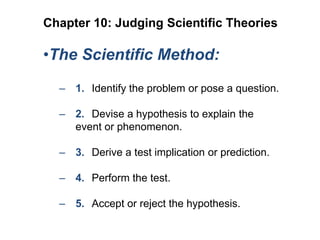
Chapter 10: Judging Scientific Theories

•The Scientific Method:
– 1. Identify the problem or pose a question.
– 2. Devise a hypothesis to explain the
event or phenomenon.
– 3. Derive a test implication or prediction.
– 4. Perform the test.
– 5. Accept or reject the hypothesis.
1. Identify the problem or pose a
question
• The questions we ask are a reflection of our
interests. Science is not disinterested
knowledge accumulation – we are interested
in significant knowledge.
• What makes knowledge significant is that it is
knowledge that addresses our interests.
• What questions is the theory answering? Why
are we seeking knowledge?
2. Devise a hypothesis to explain a
phenomenon.
• Where do hypotheses come from?
– Do we collect data and generalize from it –
enumerative induction? No!
– Hypotheses generally contain theoretical concepts
that are not in the observational data. Scientific
knowledge is not just generalization from
observation.
– Hypotheses also must be considered in relation to
alternatives – we never just look at one
hypothesis in isolation.
3. Derive a test implication or
prediction.
• Typically scientific theories cannot be tested
directly (in part because they include
theoretical concepts that are not observable).

• We indirectly test a scientific hypothesis by
deriving observable test implications.
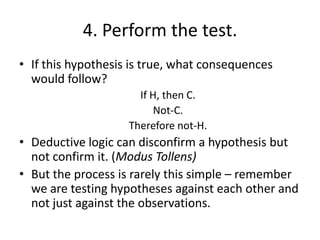
4. Perform the test.
• If this hypothesis is true, what consequences
would follow?
If H, then C.
Not-C.
Therefore not-H.

• Deductive logic can disconfirm a hypothesis but
not confirm it. (Modus Tollens)
• But the process is rarely this simple – remember
we are testing hypotheses against each other and
not just against the observations.
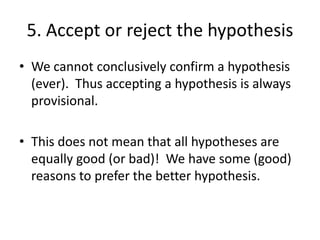
5. Accept or reject the hypothesis
• We cannot conclusively confirm a hypothesis
(ever). Thus accepting a hypothesis is always
provisional.

• This does not mean that all hypotheses are
equally good (or bad)! We have some (good)
reasons to prefer the better hypothesis.
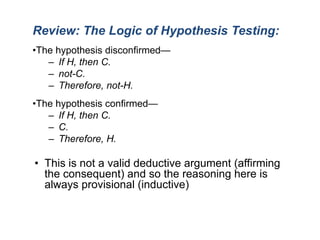
Review: The Logic of Hypothesis Testing:
•The hypothesis disconfirmed—
– If H, then C.
– not-C.
– Therefore, not-H.
•The hypothesis confirmed—
– If H, then C.
– C.
– Therefore, H.

• This is not a valid deductive argument (affirming
the consequent) and so the reasoning here is
always provisional (inductive)
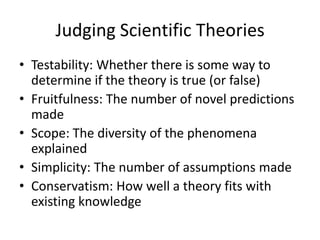
Judging Scientific Theories
• Testability: Whether there is some way to
determine if the theory is true (or false)
• Fruitfulness: The number of novel predictions
made
• Scope: The diversity of the phenomena
explained
• Simplicity: The number of assumptions made
• Conservatism: How well a theory fits with
existing knowledge
Making Weird Mistakes
• Leaping to the weirdest theory: Just because you can’t
think of a natural explanation does not mean that there
isn’t one.
• Mixing what seems with what is: just because something
seems real, it is real. (A better principle: It’s reasonable to
accept the evidence provided by personal experience
only if there’s no good reason to doubt it.)
• Misunderstanding the possibilities: confusing logical
possibility and physical possibility. Also, believing that if
something is logically possible, it must be actual.
• Common Mistakes in Assessing “Weird”
Theories:
 Believing that just because you can’t think of a
natural explanation, a phenomenon must be
paranormal.
 Thinking that just because something seems real, it
is real. (A better principle: It’s reasonable to accept
the evidence provided by personal experience only
if there’s no good reason to doubt it.)
 Misunderstanding logical possibility and physical
possibility. Also, believing that if something is
logically possible, it must be actual.

Chapter 10

  • 1.
    Chapter 10: JudgingScientific Theories •The Scientific Method: – 1. Identify the problem or pose a question. – 2. Devise a hypothesis to explain the event or phenomenon. – 3. Derive a test implication or prediction. – 4. Perform the test. – 5. Accept or reject the hypothesis.
  • 2.
    1. Identify theproblem or pose a question • The questions we ask are a reflection of our interests. Science is not disinterested knowledge accumulation – we are interested in significant knowledge. • What makes knowledge significant is that it is knowledge that addresses our interests. • What questions is the theory answering? Why are we seeking knowledge?
  • 3.
    2. Devise ahypothesis to explain a phenomenon. • Where do hypotheses come from? – Do we collect data and generalize from it – enumerative induction? No! – Hypotheses generally contain theoretical concepts that are not in the observational data. Scientific knowledge is not just generalization from observation. – Hypotheses also must be considered in relation to alternatives – we never just look at one hypothesis in isolation.
  • 4.
    3. Derive atest implication or prediction. • Typically scientific theories cannot be tested directly (in part because they include theoretical concepts that are not observable). • We indirectly test a scientific hypothesis by deriving observable test implications.
  • 5.
    4. Perform thetest. • If this hypothesis is true, what consequences would follow? If H, then C. Not-C. Therefore not-H. • Deductive logic can disconfirm a hypothesis but not confirm it. (Modus Tollens) • But the process is rarely this simple – remember we are testing hypotheses against each other and not just against the observations.
  • 6.
    5. Accept orreject the hypothesis • We cannot conclusively confirm a hypothesis (ever). Thus accepting a hypothesis is always provisional. • This does not mean that all hypotheses are equally good (or bad)! We have some (good) reasons to prefer the better hypothesis.
  • 7.
    Review: The Logicof Hypothesis Testing: •The hypothesis disconfirmed— – If H, then C. – not-C. – Therefore, not-H. •The hypothesis confirmed— – If H, then C. – C. – Therefore, H. • This is not a valid deductive argument (affirming the consequent) and so the reasoning here is always provisional (inductive)
  • 8.
    Judging Scientific Theories •Testability: Whether there is some way to determine if the theory is true (or false) • Fruitfulness: The number of novel predictions made • Scope: The diversity of the phenomena explained • Simplicity: The number of assumptions made • Conservatism: How well a theory fits with existing knowledge
  • 9.
    Making Weird Mistakes •Leaping to the weirdest theory: Just because you can’t think of a natural explanation does not mean that there isn’t one. • Mixing what seems with what is: just because something seems real, it is real. (A better principle: It’s reasonable to accept the evidence provided by personal experience only if there’s no good reason to doubt it.) • Misunderstanding the possibilities: confusing logical possibility and physical possibility. Also, believing that if something is logically possible, it must be actual.
  • 10.
    • Common Mistakesin Assessing “Weird” Theories:  Believing that just because you can’t think of a natural explanation, a phenomenon must be paranormal.  Thinking that just because something seems real, it is real. (A better principle: It’s reasonable to accept the evidence provided by personal experience only if there’s no good reason to doubt it.)  Misunderstanding logical possibility and physical possibility. Also, believing that if something is logically possible, it must be actual.