The Argumentative Essay

“. . .a writer tries to persuade readers
   to adopt his or her point of view
         about a given issue.”

     “. . .the underlying aim of
argumentative essays is to use words
       to make a difference.”
                 drawn from Section 7 of Scribner
A good persuasive argument. . .

. . .conveys a reasonable conclusion--often
called a thesis or a claim--about a
controversial topic.
. . .presents supporting evidence that is
always incorporated, explained and
documented clearly and precisely..
Furthermore, a good
Argumentative Essay. . .

 . . .considers and often presents the
 conflicting point of view about the
 controversy.
 . . .reflects thorough research
Things to consider:
 Your audience
 Why is this subject important?
 Answer the position of the other side
   refute
   concede
 Build your own position.
Think of your audience; you
do not want to invite your
readers' opposition or hostility.
  you need to show a real concern about how
 your readers might think about a given
 subject
 Also you need to consider how they might
 react to the way you think about that
 subject.
 All audiences within our western academic
 culture respond to logic and reasonableness.
Logical Thinking

         Using
inductive and deductive
        reasoning
Inductive Reasoning
  . . .used to attribute causes to events or
  circumstances rather than to determine the
  truth about them with absolute certainty.
   Your generalizations about causes may be
  right or wrong, but you cannot be certain
  because inductive thinking depends on
  probability.
   Probability refers to the likelihood, rather
  than to an absolute conviction, that
  something is true.
  Errors in inductive reasoning typically
  involve oversimplification.
An example of inductive
reasoning
  If you break out in hives every time you eat
 chocolate, you most likely will generalize
 from those specific instances and reason that
 eating chocolate caused the hives in you .
Be aware that observations need to be accurate:
  You may consider whether you are allergic to
 other things besides chocolate. (Did the pizza
 with anchovies you ate before the chocolate
 dessert have something to do with your
 reaction?)
Elements of Inductive Reasoning
 begins with a specific observation
 continues with additional specific
 observations
 arrives at a general claim or a reasonable
 conclusion that is based on available
 evidence
 attributes causes to events or circumstances,
 resulting in a hypothesis that can be tested
 further (an educated guess).
 offers probability rather than certainty
Deductive Reasoning
  occurs when you take a general principle or
 truth and apply it to a more specific
 instance.
  Deductive thinking is syllogistic reasoning.
    A syllogism is an argument arranged in
   three parts:
       a major premise,
      a minor premise, and
      a conclusion.
MAJOR PREMISE When Gabriele drinks
  coffee she alwaysgets a headache. [Fact]
  MINOR PREMISE Gabriele is drinking
  coffee. [Fact]
   CONCLUSION Gabriele will get a
  headache.
The premises can be facts or
assumptions.
  A major premise stipulates a general principle
  (e.g., that all spiders have eight legs),
  and a minor premise reflects a specific instance
  (e.g., that the creature on your desk has six
  legs).
A syllogism is valid when the conclusion
 follows logically from the premises. When
 the conclusion does not follow logically
 from the premises, a syllogism (along with
 the argument it states) is invalid, even if the
 premises are facts, as in the following
 example.
    MAJOR PREMISE: When Gabriele drinks
    coffee she always gets a headache. [Fact]
    MINOR PREMISE: Gabriele has a headache.
    [Fact]
    CONCLUSION: Gabriele must have been
    drinking coffee.
When a premise is an assumption
rather than a fact, you must be able
to support the premise with
evidence.
  MAJOR PREMISE If you wear Gap clothes to
  school, you will be accepted by the school's most
  popular group. [Assumption]
  MINOR PREMISE Jose wears Gap clothes to
  school. [Fact]
  CONCLUSION Jose will be accepted by the
  school's most popular group.
Since the major premise of this
example rests on a shaky
assumption (it cannot be
supported with evidence), the
argument is not true. But the
structure is valid.
     In most instances, wearing Gap clothes (or
     any other brand or type of clothing) does not
     ensure automatic popularity. Other factors,
     such as academic or athletic ability, sense of
     humor, physical characteristics, friends, and
     others, influence acceptance.
Elements of Deductive
Reasoning
 DEDUCTIVE REASONING
  begins with a general idea or major
  premise
  continues with an additional minor
  premise applied to a particular case
  concludes with a specific statement
  derived from the premise
Further Elements of Deductive
Reasoning
 DEDUCTIVE ARGUMENTS
  can be true or false, depending on how
  true or false the premise is
  can be valid or invalid, depending on the
  structureof their syllogisms
  when true, provides certainty rather than
  probability
Checklist of Common Logical
Fallacies
 Non sequitor: A statement that does not
 follow logically from another.
 Hasty generalization: A conclusion based
 on insufficient evidence.
 Stereotyping: Assuming without sufficient
 evidence that members of a group think or
 behave alike.
 Either-or thinking: Limiting possible
 explanations to two.
Post hoc, ergo propter hoc: Assuming that
an event is caused by another simply
because one event occurs after the other.
Begging the question: Assuming as true
what needs to be proven.
Circular reasoning: Asserting the same
point in different words.
Special pleading: Arguing without
considering opposing viewpoints.
Red herring: Introducing an irrelevant or
distracting consideration into an argument.
Appeal to ignorance: Assuming something
is true because the contrary cannot be
proven.
Ad populum: Appealing to the prejudices of
an audience.
Ad hominem: Attacking a person's
character rather than addressing the issue at
hand.
False analogy: Making an illogical
connection based on irrelevant similarities.
Audiences respond if you adopt a
fair-minded and reasonable tone in
your arguments. Therefore avoid. . .
  . . .exaggeration and anger
   For example, never use name-calling as a tactic
   (you should not refer to your opposition as
   stupid or ludicrous).
 . . .wording that sounds pompous or
 borrowed.
 . . .wording that overstates your case and
 thereby distorts the truth.
Be thorough. . .
Look at the whole controversy so that you
do not overlook important evidence.
 Jumping to conclusions tends to lead to
using evidence that supports preliminary
and, perhaps, unfounded bias for a
particular solution.
 Ignoring other points of view can only
weaken your argument by suggesting to
readers that you have considered no other
position except your own.
A thesis should reflect
 thoughtfulness:
 The topic, in this example, is how best to use a high
school's library budget. One special interest group
in the community wants to build new storage space
for books that few people consult; the other group
wants to weed out the older books and spend most
of the money for new books. These two groups are
locked in a standoff, recognizing no middle ground.

   The library must create additional space so
  that its collection can be supplemented .
Although our local library has a significant
problem with dwindling storage space, gaps in
the social studies, science, and fiction
collections make it imperative that additional
books be purchased. Placing low-circulation
books into secondary storage at an alternative
location and a concerted effort by the librarian
to replace bulky periodicals with microfilm can
create sufficient space for supplementing the
collection for five more years.
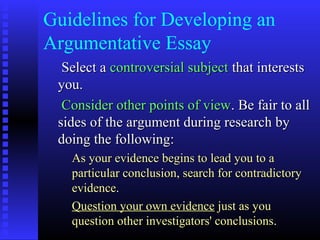
Guidelines for Developing an
Argumentative Essay
  Select a controversial subject that interests
 you.
  Consider other points of view. Be fair to all
 sides of the argument during research by
 doing the following:
   As your evidence begins to lead you to a
   particular conclusion, search for contradictory
   evidence.
   Question your own evidence just as you
   question other investigators' conclusions.
Avoid jumping to conclusions, and never be
  satisfied d if your evidence leads to only one
  way of seeing your topic.
  Try to imagine how your audience will interpret
  your evidence.
  Let the principles of logic guide your effort.
 Write a short account explaining what you
have discovered about your controversy .
Sketch out the various points of view.
Based on the evidence you have gathered
formulate a tentative thesis, one that you
will reconsider and modify as you do more
reading, writing, and analysis.
Make a tentative outline of how you think
you will develop your argument, listing the
major and support ideas, or premises, and
the order in which you will present them.
Keep in mind that the way you organize
your evidence will help determine just how
convincing your argument will be.
 Write a draft beginning, and then develop
the middle of your essay. Write an ending.
Present your argument to your work group
or to another classmate. Ask your readers to
resist your argument and to indicate weak
spots
A Review of the main
Features of the Argumentative Essay

 It presents supporting evidence that is
 always incorporated, explained, and
 documented clearly and precisely.
 It presents the conflicting points of view.
  It reflects thorough research.
  It conveys a reasonable conclusion.

Argumentative essay

  • 1.
    The Argumentative Essay “.. .a writer tries to persuade readers to adopt his or her point of view about a given issue.” “. . .the underlying aim of argumentative essays is to use words to make a difference.” drawn from Section 7 of Scribner
  • 2.
    A good persuasiveargument. . . . . .conveys a reasonable conclusion--often called a thesis or a claim--about a controversial topic. . . .presents supporting evidence that is always incorporated, explained and documented clearly and precisely..
  • 3.
    Furthermore, a good ArgumentativeEssay. . . . . .considers and often presents the conflicting point of view about the controversy. . . .reflects thorough research
  • 5.
    Things to consider: Your audience Why is this subject important? Answer the position of the other side refute concede Build your own position.
  • 6.
    Think of youraudience; you do not want to invite your readers' opposition or hostility. you need to show a real concern about how your readers might think about a given subject Also you need to consider how they might react to the way you think about that subject. All audiences within our western academic culture respond to logic and reasonableness.
  • 7.
    Logical Thinking Using inductive and deductive reasoning
  • 8.
    Inductive Reasoning . . .used to attribute causes to events or circumstances rather than to determine the truth about them with absolute certainty. Your generalizations about causes may be right or wrong, but you cannot be certain because inductive thinking depends on probability. Probability refers to the likelihood, rather than to an absolute conviction, that something is true. Errors in inductive reasoning typically involve oversimplification.
  • 9.
    An example ofinductive reasoning If you break out in hives every time you eat chocolate, you most likely will generalize from those specific instances and reason that eating chocolate caused the hives in you . Be aware that observations need to be accurate: You may consider whether you are allergic to other things besides chocolate. (Did the pizza with anchovies you ate before the chocolate dessert have something to do with your reaction?)
  • 10.
    Elements of InductiveReasoning begins with a specific observation continues with additional specific observations arrives at a general claim or a reasonable conclusion that is based on available evidence attributes causes to events or circumstances, resulting in a hypothesis that can be tested further (an educated guess). offers probability rather than certainty
  • 11.
    Deductive Reasoning occurs when you take a general principle or truth and apply it to a more specific instance. Deductive thinking is syllogistic reasoning. A syllogism is an argument arranged in three parts: a major premise, a minor premise, and a conclusion.
  • 12.
    MAJOR PREMISE WhenGabriele drinks coffee she alwaysgets a headache. [Fact] MINOR PREMISE Gabriele is drinking coffee. [Fact] CONCLUSION Gabriele will get a headache. The premises can be facts or assumptions. A major premise stipulates a general principle (e.g., that all spiders have eight legs), and a minor premise reflects a specific instance (e.g., that the creature on your desk has six legs).
  • 13.
    A syllogism isvalid when the conclusion follows logically from the premises. When the conclusion does not follow logically from the premises, a syllogism (along with the argument it states) is invalid, even if the premises are facts, as in the following example. MAJOR PREMISE: When Gabriele drinks coffee she always gets a headache. [Fact] MINOR PREMISE: Gabriele has a headache. [Fact] CONCLUSION: Gabriele must have been drinking coffee.
  • 14.
    When a premiseis an assumption rather than a fact, you must be able to support the premise with evidence. MAJOR PREMISE If you wear Gap clothes to school, you will be accepted by the school's most popular group. [Assumption] MINOR PREMISE Jose wears Gap clothes to school. [Fact] CONCLUSION Jose will be accepted by the school's most popular group.
  • 15.
    Since the majorpremise of this example rests on a shaky assumption (it cannot be supported with evidence), the argument is not true. But the structure is valid. In most instances, wearing Gap clothes (or any other brand or type of clothing) does not ensure automatic popularity. Other factors, such as academic or athletic ability, sense of humor, physical characteristics, friends, and others, influence acceptance.
  • 16.
    Elements of Deductive Reasoning DEDUCTIVE REASONING begins with a general idea or major premise continues with an additional minor premise applied to a particular case concludes with a specific statement derived from the premise
  • 17.
    Further Elements ofDeductive Reasoning DEDUCTIVE ARGUMENTS can be true or false, depending on how true or false the premise is can be valid or invalid, depending on the structureof their syllogisms when true, provides certainty rather than probability
  • 18.
    Checklist of CommonLogical Fallacies Non sequitor: A statement that does not follow logically from another. Hasty generalization: A conclusion based on insufficient evidence. Stereotyping: Assuming without sufficient evidence that members of a group think or behave alike. Either-or thinking: Limiting possible explanations to two.
  • 19.
    Post hoc, ergopropter hoc: Assuming that an event is caused by another simply because one event occurs after the other. Begging the question: Assuming as true what needs to be proven. Circular reasoning: Asserting the same point in different words. Special pleading: Arguing without considering opposing viewpoints. Red herring: Introducing an irrelevant or distracting consideration into an argument.
  • 20.
    Appeal to ignorance:Assuming something is true because the contrary cannot be proven. Ad populum: Appealing to the prejudices of an audience. Ad hominem: Attacking a person's character rather than addressing the issue at hand. False analogy: Making an illogical connection based on irrelevant similarities.
  • 21.
    Audiences respond ifyou adopt a fair-minded and reasonable tone in your arguments. Therefore avoid. . . . . .exaggeration and anger For example, never use name-calling as a tactic (you should not refer to your opposition as stupid or ludicrous). . . .wording that sounds pompous or borrowed. . . .wording that overstates your case and thereby distorts the truth.
  • 22.
    Be thorough. .. Look at the whole controversy so that you do not overlook important evidence. Jumping to conclusions tends to lead to using evidence that supports preliminary and, perhaps, unfounded bias for a particular solution. Ignoring other points of view can only weaken your argument by suggesting to readers that you have considered no other position except your own.
  • 23.
    A thesis shouldreflect thoughtfulness: The topic, in this example, is how best to use a high school's library budget. One special interest group in the community wants to build new storage space for books that few people consult; the other group wants to weed out the older books and spend most of the money for new books. These two groups are locked in a standoff, recognizing no middle ground. The library must create additional space so that its collection can be supplemented .
  • 24.
    Although our locallibrary has a significant problem with dwindling storage space, gaps in the social studies, science, and fiction collections make it imperative that additional books be purchased. Placing low-circulation books into secondary storage at an alternative location and a concerted effort by the librarian to replace bulky periodicals with microfilm can create sufficient space for supplementing the collection for five more years.
  • 25.
    Guidelines for Developingan Argumentative Essay Select a controversial subject that interests you. Consider other points of view. Be fair to all sides of the argument during research by doing the following: As your evidence begins to lead you to a particular conclusion, search for contradictory evidence. Question your own evidence just as you question other investigators' conclusions.
  • 26.
    Avoid jumping toconclusions, and never be satisfied d if your evidence leads to only one way of seeing your topic. Try to imagine how your audience will interpret your evidence. Let the principles of logic guide your effort. Write a short account explaining what you have discovered about your controversy . Sketch out the various points of view. Based on the evidence you have gathered formulate a tentative thesis, one that you will reconsider and modify as you do more reading, writing, and analysis.
  • 27.
    Make a tentativeoutline of how you think you will develop your argument, listing the major and support ideas, or premises, and the order in which you will present them. Keep in mind that the way you organize your evidence will help determine just how convincing your argument will be. Write a draft beginning, and then develop the middle of your essay. Write an ending. Present your argument to your work group or to another classmate. Ask your readers to resist your argument and to indicate weak spots
  • 28.
    A Review ofthe main Features of the Argumentative Essay It presents supporting evidence that is always incorporated, explained, and documented clearly and precisely. It presents the conflicting points of view. It reflects thorough research. It conveys a reasonable conclusion.

Editor's Notes