CHAPTER-ONE
1. Conceptual Odyssey of Moral and Civic
Education
Opening Remarks
Nomenclature
Defining Civics, Ethics, Morality
Nature of Ethics and Morality
Ethics and Law
The Importance/Goal of Moral and Civic
Education
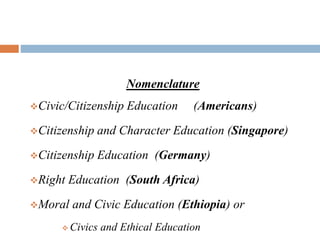
Nomenclature
Civic/Citizenship Education (Americans)
Citizenship and Character Education (Singapore)
Citizenship Education (Germany)
Right Education (South Africa)
Moral and Civic Education (Ethiopia) or
 Civics and Ethical Education
1.1. Defining Civics/Civic Education
i) Etymological Origin;
 From the Latin word “civitas”
which means citizens.
 Citizen:- a person who is full members of politically organized
unit called “state”;
 Aristotle described as ‘all who share in the civic life of
ruling and being ruled in turn’.
ii). Current Application
 No universally accepted definition
 Different attempts
 It means different things for different individuals
Mostly cited definition;
 Civic education is an education that studies about the rights
and duties of citizens.
 Right:- advantage or privilege that he /she can obtain from the
concerned body/ies.
 Duty :- It is Responsibility which is expected to be accomplished.
Some other Attempts;
 Patrick (1986) defines as “the knowledge of the
constitutions, and its principles, values, history and
application to contemporary life”.
 UNDP (2004) defines as “a way of learning for effective
participation in a democratic and development process”.
In Nutt Shell
 Civics education deals with the reciprocal relationships
established between citizens and the state and among
citizens respectively.
o Rights and duties is its heart.
reciprocal relations with respect to the economic,
cultural, social, political domains of the society.
1.2. Defining Ethics and Morality
i) Etymological Origin;
 Monotonous treadmill of definition
Ethics derived from Greek-ethos
Latin term mos/mores.
Morality from Latin- mores/mos
Character
Behavior
Both implies Temperament
Principles or standards
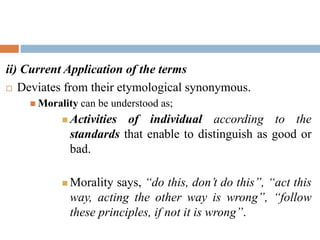
ii) Current Application of the terms
 Deviates from their etymological synonymous.
 Morality can be understood as;
 Activities of individual according to the
standards that enable to distinguish as good or
bad.
 Morality says, “do this, don’t do this”, “act this
way, acting the other way is wrong”, “follow
these principles, if not it is wrong”.
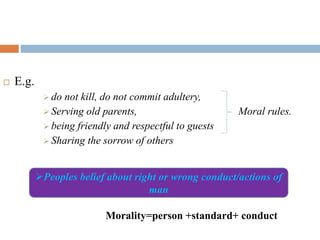
 E.g.
 do not kill, do not commit adultery,
 Serving old parents, Moral rules.
 being friendly and respectful to guests
 Sharing the sorrow of others
Morality=person +standard+ conduct
Peoples belief about right or wrong conduct/actions of
man
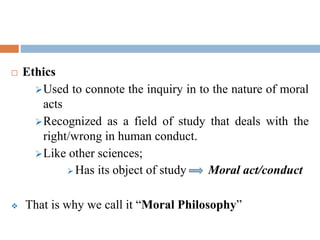
 Ethics
Used to connote the inquiry in to the nature of moral
acts
Recognized as a field of study that deals with the
right/wrong in human conduct.
Like other sciences;
 Has its object of study Moral act/conduct
 That is why we call it “Moral Philosophy”
 Generally, Ethics is:
 The critical examination of what is good, evil, right and
wrong in human conduct (Guy, 2001).
 A specific set of principles, values and guidelines for a
particular group or organization (Guy, 2001).
 The study of goodness/rightness of an action and what
moral principles should govern our pursuits and
choices (Madden, 2000).
Brainstorm Question
Identify their commonalities and differences of
Civics and Ethics
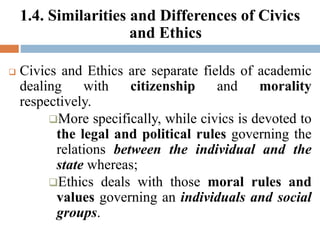
1.4. Similarities and Differences of Civics
and Ethics
 Civics and Ethics are separate fields of academic
dealing with citizenship and morality
respectively.
More specifically, while civics is devoted to
the legal and political rules governing the
relations between the individual and the
state whereas;
Ethics deals with those moral rules and
values governing an individuals and social
groups.
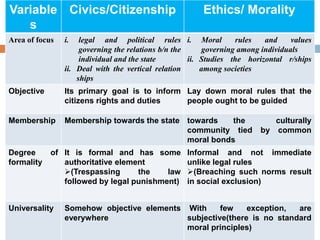
Variable
s
Civics/Citizenship Ethics/ Morality
Area of focus i. legal and political rules
governing the relations b/n the
individual and the state
ii. Deal with the vertical relation
ships
i. Moral rules and values
governing among individuals
ii. Studies the horizontal r/ships
among societies
Objective Its primary goal is to inform
citizens rights and duties
Lay down moral rules that the
people ought to be guided
Membership Membership towards the state towards the culturally
community tied by common
moral bonds
Degree of
formality
It is formal and has some
authoritative element
(Trespassing the law
followed by legal punishment)
Informal and not immediate
unlike legal rules
(Breaching such norms result
in social exclusion)
Universality Somehow objective elements
everywhere
With few exception, are
subjective(there is no standard
moral principles)
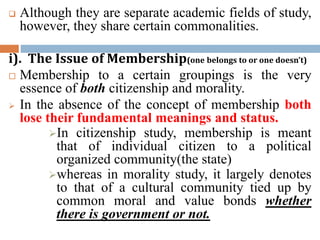
 Although they are separate academic fields of study,
however, they share certain commonalities.
i). The Issue of Membership(one belongs to or one doesn’t)
 Membership to a certain groupings is the very
essence of both citizenship and morality.
 In the absence of the concept of membership both
lose their fundamental meanings and status.
In citizenship study, membership is meant
that of individual citizen to a political
organized community(the state)
whereas in morality study, it largely denotes
to that of a cultural community tied up by
common moral and value bonds whether
there is government or not.
B. The Issue of Rights and Obligations
 Citizenship entails a set of rights and legal obligations
for individual members
thus violation or respect of which results punishment
or reward by the state.
 Morality is nothing but a list of standardizing bad and
good behaviors and dispositions of the individual by the
larger mass or group.
 thus violation or respect of which results punishment or
reward by the group.
C. Institutional Protection and supervision
 Both c/ship and morality are founded on
institutionalized origin, supervision and protection
within the community.
 The institution obtains its legitimacy and maintains to
rule over the behaviors of the individual member of
the group.
State through its agencies regulate and
administer citizenship on a day-to-day basis;
while such social institutions like the church,
family, neighborhood and others inspect
morality and ethical standards more
informally.
1.3. Sources and Interdisciplinary
Nature of Civic and Ethical Education
An interdisciplinary subject is a subject that borrows its
contents and methods from different fields of studies.
Therefore, Civics and Ethics is based upon the
principles, findings and theories of various disciplines.
 Civics and Ethics is a discipline that draws its contents
from various sources. These are:
theoretical,
documentary and
societal sources-positive values, harmless
traditions, cultures and the likes
A. Theoretical Sources of Civic and Ethical
Education
Philosophy:-
Questions, inquire everything(whole gamut).
As rational and critical inquire of basic questions
of man.
 Formulating proper questions and attempt to
solve by rigorous reasoning.
 e.g. ultimate causes and final goal of all
things in a rational and critical manner.
 Why philosophy?
 human kinds since ancient time had the desire
to know the essence of nature, the meaning of
life, death, the ups and downs.
1
 Many sub-branches
i. Metaphysics (theory of being).
 what is the ultimate source of reality is raised
 Origin(source) of creation and existence of
reality.
 What is reality(existence)?
 Is their a creator? How creator’s existence or
could be proved?
 What is man? What is the purpose of man’s
life?
 Is reality predetermined? Do people have free
will?
E.g. Chemist may argue atoms are the base of everything
which built from electrons, protons, and neutrons. These
particles made from leptons, mesons etc then Meta-physicists
can raise the question of from which those particles are made.
ii. Epistemology (theory of knowledge)
 Greak word episteme-which means knowledge
The study of knowledge
 Address the nature, source (reason, sense
experience), extent and certainty of knowledge.
What is knowledge itself? What is truth?
Is it mind the source of knowledge?
Do we have innate(inborn) knowledge or mind
lacks knowledge itself?
What is the difference or similarities between
knowledge, truth, belief, fact, opinion etc?
 “Unexamined life is not worth living”-Socrates
iii. Logic/Reasoning Skills-devoted with human
reasoning.
Its focus is on methods and principles in
which correct reasoning could be
established.
Rational reasoning—that is, well conceived, well
evidenced, well stated, and persuasive
The key to philosophizing.
 Questions of logic:-
 How our ideas, beliefs, thought, be justified?
 How do we know that our ideas and expressions are
correct or incorrect?
 What are those principles that would help us to
iv. Aesthetics- it is the philosophy of beauty and the
beauty of art.
What is beauty? What is the nature of beauty?
How ugliness is distinguished from beauty?
What makes things beautiful? What is art?
v. Ethics/Moral Philosophy/
 Intention behind ethics is how to attain good
things and avoid evil things.
 The contribution it will help to identify
 truth from falsehood, knowledge from
opinion,
ii. Political Science:- the study/ analysis of
political ideas, institutions, behaviors, and
practices.
deals with power/ authority and legitimacy
distribution of political power
Activities, principles, procedures of
governments
 Politics: politics is all about in the words of
Harold Lasswell, “who gets what, when and
how.”
Therefore, Political Science, is the analysis of
politics
2
The major sub fields, among other things, are:
i. Comparative Politics:
any study of foreign government and politics.
uniformities, differences, and interrelationship among
various political systems.
ii. International Politics(power politics)
 politics between states
 It is the making of common decisions b/n states
 Like wars, diplomacy…
iii. Political Theory:
 Political thinkers formulate and develop concepts and
theories.
 ideas about politics and critical discussion of political
values-like justice, democracy….
iv. Political behavior(political psychology):
Why certain individual behave in a certain way.
why they do what they do.
To know how motives and emotions work
in the field of political activities.
v. Political Institutions:
 Administrative organizations
national government bodies, the congress, the
presidency, the bureaucracy, and in part the
courts.
Law:-
 According to Black’s Law Dictionary [Garner;
2004: 900] law consists of rules of action or
conduct. These rules are issued by an authority.
 Broadly:- law is a collection of rules laid down
by the government binding all member of the
society.
combination of declarations, rules, orders,
directives, etc.
 As a Science:- deal with the system of rules and
regulations that govern the relations of legal
persons in a society
3
 These are intended to govern the
activities of the members of a society.
 these rules have binding force and are
obeyed and followed by citizens. Sanction or
other legal consequence may help the law to
be abided by citizens.
 Civics deals with
 constitutions,
 legal rights and duties of
citizens,
 rule of law and
Sociology: -
 As the name indicates, it is the study of society in
its entirety, human groups and organization.
concerned with social interaction
Civics and Ethics also in sociology deals the
pattern of social interactions
 It will help as to understand the culture, norm
of different societies.
help to develop the notion of tolerance,
respect in terms of differences of culture,
 can appreciate diversities
4
History: -
 on the total experience of human beings
 deals past events, interprets the present, possible to
predict what will happen in the future.
 Civics also studies human experience at different times,
in relation with the growth and development of
governments and systems.
 Enable to understanding of the politico-economic time
events of a given society
 competent and an active citizen can exhibit civic
virtues, patriotism and national pride
 appreciation and understanding of how the present life
has come in to being.
5
 Geography/Political Geography/Geo-politics
What is Geography?
o Geography devoted the earth’s physical
characteristics, its inhabitants and cultures,
phenomena and the earth’s place within the
universe.
o Geography is a “science of earth’s surface, form,
physical features, natural and political divisions, climate,
population”
The importance of geographic factors/influence
on domestic and international politics.
We obtain information and knowledge
about geographical size and location.
Influence of environment on state,
6
Economics/Political Economy/
 It tries to harmonize the unlimited wants of human being with
available scarce resources.
 Devoted on production, distribution and consumption of
goods and services.
 Adopting different alternatives(studying economic
activities, decisions and policies) for economic
problems.
 Unless man able to address economic problems, it would be
very hard to have a prevalence of;
 Rule of law,
 good governance,
 lasting peace and so forth.
 Therefore, economic issues and civic are inseparable.
7
B. Documentary Sources of Civic and Ethical
Education
 Constitution-written/unwritten
 decisions and enactments of legal bodies,
 historical sources, films, photographs
 international instruments
Universal Declaration of Human Rights
(1948)
 Convention on the Right of the Child
(1989)
convention on the Elimination of All Forms
of Discrimination against Women (1979)
C. Social source
 Some of this includes family, model
individuals, clubs, professional associations,
churches, mosques
1.4. Goals of Civic and Ethical
Education
 Democratic society can be realized by the active
participation of citizens in a society.
Citizen’s engagement to participate in civic
life is not similar across different countries.
 intensity of citizen’s active participation reflect the
realization of the goals
i). Developing of Democratic Outlook
 Democratic outlook should inculcate in the
minds of students
It is possible by teaching students
 democratic values, principles
 could shoulder the responsibility of their
country
ii). Providing Citizens with knowledge and
Intellectual Skills.
 So as to monitor and influence government
rules, decisions and actions.
 Since with out which the good of the society
do not materialize.
Thus, Civic Education is a tool of
democratization of the State
iii). Strengthening National character/patriotism
 For a country to progress effectively its
citizens must be soaked in the spirit of
patriotism.
 sacrifice every thing for their motherland
 should also be proud of their identity, cultural
heritage ,values of the society
iv). Create an Ideal Citizenship: -
 armed students the qualities of an ideal citizen.
It includes
 believes in equality for all people;
 puts the general welfare above ones own
interest;
 Respecting and upholding the rule of law
v) Promoting the Culture of Civic Responsibility: - Civic
responsibility is the commitment to fulfilling obligations
as a citizen. It include;
 obeying the law,
 informed of public issues,
 Monitoring leaders and governmental agencies
 Keeping public property, cultural and historical heritage
 Protecting the boundary/independence of one’s own
state.
vi). Building Civic Competence : - It is the ability and
willingness to participate effectively in civic life.
Engaging on socio-economic and political arena.
Enable keen observers of their nation’s issue
 Thus, it is a tool to empowering
1.5. Competences of Good Citizens
i). Civic Knowledge: concerned with the content or what
citizens ought to know.
 awareness about the socio-cultural, politico-
economic realities of the past and the present.
ii). Civic Skills: need to acquire relevant intellectual and
participatory skills.
 critical thinking skills (To be able to think critically)
 skills of decision making, communication, conflict
resolution, compromise, persuasion e.t.c
iii). Civic Attitudes: It refers to the behaviors that are
desirable and acceptable. Ex
 Giving community service, citizens need to develop
positive out look and concern for the community.
E.g. Altruistic qualities to help in needy
1.2. Understanding of Citizenship:
Ethiopia’s
 Introduction
 States can not be understood in the absence
of citizenship and vise versa.
 What does citizenship mean really?
i. it denotes a basic re/ship between the state
and its individual members.
It is a legal relationship b/n citizens and
their government.
 Rights and obligations lie at the heart of citizenship.
ii. it refers to the legal and political status
of an individual member to be a citizen
of the state.
 the status of individuals in a state and
outside a state.
 Attached benefits and
responsibilities
 official recognition of an individual’s
integration into the political system.
iii. An instrument of identification.
 it is an official identity that distinguishes
from others.
it is a way by which citizens of a state can
be distinguished from citizens of other
For example, someone is officially
identified with an Ethiopian citizenship you
can be differentiated from citizens of other
countries because you are associated with
the Ethiopian state.
iv). Citizenship is not static or rigid in
nature; rather it is characterized by its
flexibility.
 Members of various states may have
differing status, rights and privileges
depending on the nature of the states
In other words, all individuals residing
within a state may not be citizens.
 In nutshell, Citizenships means
It implies a relationship b/n individual
and state.
It is a legal member of a state- the
status of getting membership in a
certain political society.
It is official recognition in to the political
system.
It is a right and duties of citizen.
It is an identification of an individuals
1.2.1. Process of Acquiring and Loosing of Citizenship
i). Modes of Acquiring Citizenship
 How citizenship is acquired?
 Laws and the status of citizenship is not the same
across different states.
varies in different countries depending upon the
specific laws of each country.
There is no clear uniformity.
each state has the right to determine who its
citizens are and who are not.
Since you are an Ethiopian Citizen. How do you obtain it?
1). Citizenship by Birth
 Acquisition by birth takes place in either of the
following rules.
i. jus soli which means the law of soil (by place of
birth)
Children are citizens of the nation in which they
are born, no matter what the parents’
nationalities are.
E.g. U.S.A, Britain, Canada
Exception:-
delegates of foreign countries with
diplomatic mission
International organization representatives
ii. Jus Sanguineous - the law of
blood/decent
 one’s parents and ancestors is the
determining factor.
 Nationality of a state may also be
acquired by a person on the basis of the
nationality of either parent. Thus a child
may become a national of that - state –
of which his parents are nationals.
Ethiopia, Canada, France, U S A,
German
2. Naturalization(Citizenship by
Law):-
 is a mode of acquiring citizenship after
birth.
 It can be defined as a process by which
a state confers (gives) its citizenship on
an individual, who is originally not its
citizen.
 It means granting a new citizenship to
an alien person
 It is purely under the authority of the
 There are a number of ways that state
required. The most common ones
include:
 Marriage,
when aliens engages into a marriage
with other citizen
Legitimizing (adoption)
 by which stateless children are
legitimized or legally acquire
citizenship through parenthood or
guardianship
Application
involves a direct application of a
foreign individual
 Special Case:- owing to outstanding contribution
for host state.
 Substitution/Merger or Separation
Apart from by birth and naturalization,
people residing on a specific territory of a
state annexed (either peacefully or
forcefully), would be united to another
state and hence be citizens of the latter,
which means acquire its citizenship. Such
process is known as substitution.
When Austria was annexed by
Germany, all the nationals of Austria
became the nationals of Germany.
3.2.2. Ways of Loosing Citizenship
1. Renunciation/Expatriation
 If state harasses the person and when the
person dislikes the politics or ideologies pursued
by the state.
 search for citizenship in another state in
accordance with his/her interest.
It is a voluntary means
 make personal decisions to stop citizenship of
their native state and go somewhere else
primarily because of political, economic and
social reasons.
 Even the Universal Declaration of Human Rights of
1948 lays down under article 15(2) that no one shall
be denied the rights to change his or her nationality
2. Deprivation
 when citizens commit certain serious crimes
against the regime and national interest.
 For instance:-
 transferring secrets(spy on military, political
intelligence ) to other states,
 to side enemy state in time of war or
if a citizen enters into foreign civil or military
service with out permission
Deprivation is done for committing crimes
Whereas
Renunciation is on the basis of the individual
will
3. Substitution
 It is one way of acquiring citizenship. But
here, also way of losing citizenship at the
same time.
 When the people leave their former
state(secede) they are losing citizenship, and
while they are joining/form another state they
are at the same time acquiring citizenship.
4. Lapse/Expiration:
 because of staying outside of one’s state for a long time.
 For example, according to the law of India, if an Indian
citizen goes abroad and stays there for more than seven
yeas, constitutionally he/she will no longer be Indian
citizen or be with Indian citizenship.
Brainstorming Question
How about in Ethiopia?
3.3. Overview of Citizenship and
Nationality Laws in Ethiopia
3.3.1. Way of acquiring citizenship in
Ethiopia
1. By birth:
 proc No 378/ 2003, article 3(1) any
person shall be an Ethiopian national by
descent where both or either of his parent
is Ethiopian.
2. By law (naturalization):
foreigner may acquire Ethiopian nationality
by law ;Articles 5-12 proc
i. Marriage:
 Proc No 378/2003 Article 6 clearly explains the
foreigner who is married to an Ethiopian national
may acquire Ethiopian nationality by law when one
fulfills the following requirements:
1) The marriage is concluded in accordance
with the Ethiopian laws.
2) He has lived in Ethiopian for at least one
year preceding the submission of his
application; and
3) He fulfilled the conditions stated under
Article 5(1,7,8) of the proclamation.
 Citizenship cannot be obliterated even if the
partners get divorced.
ii. Legitimation (case of adoption):
 An illegitimate child has the right to get his
biological or caretaker father/ Mather citizenship
after legitimating.
 Any child adopted by Ethiopian national, based on
proc No 378/2003, may obtain Ethiopian nationality
when the following conditions are fulfilled;
He has not attained the age of majority,
He lives in Ethiopia together with his adopting
parent;
Where one of his adopting parents is a foreigner,
such parent has expressed his stated in writing;
and
The condition stated under Article 5 (7) of the
proclamation has been fulfilled.
iii. Grant on Application:
 According to the Ethiopian nationality
proclamation of 2003 article 5, the following
are requirements:
His age must be 18 and above it
One who lived in Ethiopia for a total of at
least four years
must have sufficient and lawful source of
income
One who is a person of good character
One have no record of criminal conviction
He/she shall be required to take the oath of
allegiance stated under article 12 of this
proclamation.
iv. Re integration (restoration):
 a person who has lost his / her citizenship due to
some reasons may get back if he/ she fulfill some
conditions.
 nationality proclamation article 22,
Returns to domicile in Ethiopia
Renounces his foreign nationality
Applies to the security, immigration and
refugee affairs authority.
V. Citizenship by Special Case:
 article 8, a foreigner who has made an
outstanding contribution in the interest of Ethiopia
may get Ethiopia nationality irrespective of the
3.3.2. Way of Loosing citizenship in
Ethiopia
1. Renunciation
 when the following conditions are fulfilled
(Article 19 of proclamation No 378/2003):
i) Any Ethiopian who has been guaranteed
nationality of another state shall have the right
to renounce his Ethiopian nationality.
ii) An Ethiopian who intends to renounce his
nationality in accordance with this Article sub
Article (1) shall in advance inform the authority
in the form prescribed by the authority
iii) renunciation of child pursuant to sub-Article
(1) of this Article shall be effected by the joint
decision of his parents or, where one of his
parents is a foreigner, by the decision of the
Ethiopian parent.
iv) An Ethiopian who has declared his intention
to renounce his nationality may not be
released until
He has discharged his outstanding
national obligations, or
Where he has been accused of or
convicted for a crime, he has been
acquitted or served the penalty.
3.3.3. Dual nationality
 is impossible in Ethiopian context Article 20 of proclamation
No 378/ 2003 supports the above statement by stating the
following sub-Article:
1) any Ethiopian who voluntarily acquires another nationality
shall be deemed to have voluntarily renounced his Ethiopian
nationality.
2) An Ethiopian who acquires another nationality by virtue of
being born to a parent having a foreign nationality or by being
born abroad shall be deemed to have voluntarily renounced his
other nationality unless he has declared to the Authority his
option to retain it by renouncing his other nationality with in one
year after attaining the age of majority.
Brainstorming Question
What do you recommend about Dual Nationality in
Ethiopia?. Is it better to allow dual nationality or not?
CHAPTER-TWO
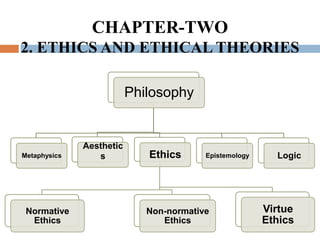
2. ETHICS AND ETHICAL THEORIES
Philosophy
Metaphysics
Aesthetic
s Ethics
Normative
Ethics
Non-normative
Ethics
Virtue
Ethics
Epistemology Logic
Opening Remarks
 Moral philosophy/ Ethics is concerned with the
elucidation of moral principles, clarification of
fundamental ethical concepts and critical
discussion of positions and perspectives.
 Ethical Rules or Moral Values:- those values that
define personal decisions and actions as moral or
immoral.
guide the action and behaviors of
individuals and groups with in a society.
 Ethical Theories/thought are view points,
doctrines, beliefs or perspectives of various school
of thought on the moral life of man.
2.1. Overview of Ethics and Ethical
Theories
 Traditionally, Ethics is normative in its character
Develop and provide moral principles
 Is Ethics a science?
Scrutiny analysis of moral life of man
 Ethics only concern moral value
 Any action many not have moral value(moral versus amoral)
 It aims at the attainments of the highest good
Man pursue all good things and avoid all bad things.
Goodness or badness is structured under highest good
 But, what is this highest good?
Is it money or intellectual, power, religious life,
happiness, health of the body, or peace of the mind?
Its ultimate goal is the attempt to answer all the above
questions. Thereby, man lead stable, peaceful, pleasant life
2.2. Origin and Development of Ethical
Theories
i). Ancient Origin of Ethics
 The origin of Ethical thought goes back to ancient
societies.
 The ancient Greek philosophers were the first to
speculate the good life of man that could be
achieved independent of religious and traditional
belief system.
Protagoras ‘man is the measures of all
things’- moral ideas are a matter of
convention.
 They conceived that religious rules did not bring
good life. They felt that they need to go beyond
ii). Divine Origin of Ethics
 In medieval period, ethics was conceived in
accordance with religious rules, beliefs and
practices of the time.
Ethics was highly affiliated with the
Christian church.
 Philosophers like St. Augustine and St.
Aquinas forwarded the view that we have a
freedom to disobey it, man’s moral goodness
emanates from the law of super natural
being-God.
iii). Modern Origin of Ethics
 Since 16th C., due to urbanization, science and decline of
the acceptance of Roman Christianity, ethics has got the
opportunity to remove the veil(curtain) of religion and
began to demand rational basis for morality.
 modern political thinkers tried to base ethical code on
human reasoning rather than on religion and faith.
were the attempt to establish ethical code on the basis
of rationalism and intellect.
 Ethics in the modern history is
attempts to focusing on secular
ethical issues.
 John Locke- associated good with pleasure and evil with pain.
2.1. Why the Study of Ethics and Ethical
Theories
 a means of curing moral evils of the society and
maintain well-order good life of society.
 solve moral dilemma that needs us to conflicting
decisions.
Euthanasia(peaceful death assisted by
medical workers)
 develop moral values and principles that we
should follow in our life experiences.
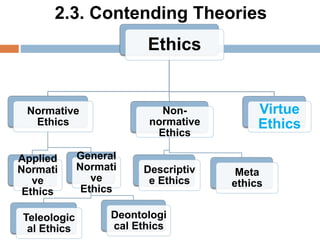
2.3. Contending Theories
Ethics
Normative
Ethics
Applied
Normati
ve
Ethics
General
Normati
ve
Ethics
Teleologic
al Ethics
Deontologi
cal Ethics
Non-
normative
Ethics
Descriptiv
e Ethics
Meta
ethics
Virtue
Ethics
2.3. 1. Normative/Prescriptive Ethics
 The word normative is derived from the Latin
word “norma” which means rule.
This day, normative refers that which should
be done since it establish norms of moral
conduct
 concerned with developing rational moral rules,
principles or standards of conduct to govern the
activities of human beings.
 It tell us;
 What is good or bad in human conduct
 What people ought to do or not to do in specific
situation
E.g; man should love justice(should be just),
respectful, truthful, kindness and so forth
i). Applied Normative Ethics: is the attempt to explain
and justify positions on specific moral problems,
 deals with moral issues, when they are found to be
controversial.
 Every moral issues is not the subject of applied ethics
To be applied ethics, the case should be:
i. Moral value
ii. Specific moral problem
iii. controversial/hot issues of moral problem.
 such as sex outside marriage, capital punishment,
euthanasia, abortion, reverse discrimination.
Determining the rightness or wrongness of these
issues is very difficult, b/se public opinion is
always divided.
ii). General Normative Ethics: attempts to
determine guidelines to be followed so that our
actions may be morally right/just.
 When and How our moral decision is just or
unjust? Permissible or impermissible?
a) Teleological ethics(consequentialist) theory
b) Deontological ethics (non-consequentialist)
theory
Teleological Ethics
 The Greek word ‘teleo’, which means ends,
result or purposes.
Refers things/act which determined by its
consequences
Every individual act/action has its own
outcome, end or consequences
Also called consequentialism.
 According to teleological ethics the consequence
of moral act(as opposed to its intension or motive,
moral principle)determine the act’s correctness.
An action is judged moral or immoral on
what happens as a result of it.
“The end justifies the means”.
 They are hedonistic in their nature since they believe
that pleasure is the highest and final aim of life.
Pleasure has intrinsic values/only preferred
thing
Goodness of a human act is determined by the pleasure it
produces.
 To give an answer this question, consequentialist
theories has two folds;
Ethical Egoism/egoistic hedonism
Social Hedonism/Utilitarianism
Should we consider one’s own satisfaction(our
self) or for the greatest people involved?
i). Ethical Egoism(egoistic hedonism)
 Greek word “ego” refer that “I” or “my self” and you can
understand that literally refers to self-concern.
Egoism refers human act to fulfill their own desire at
the expense of others.
 According to this ethical theory, the morality of an action is
determined in reference to the doer of the action.
the greatest good for all will be served
only if we all pursue our own self-
interest
An action is moral right if it maximizes the
interests of the doer of the action.
It is a cost-benefit analysis of moral decision.
Example: Thomas Hobess (1588-1679)
 Thus, such kind of perception and self-centeredness
always leads to it corrupted Society.
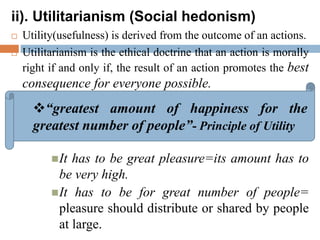
ii). Utilitarianism (Social hedonism)
 Utility(usefulness) is derived from the outcome of an actions.
 Utilitarianism is the ethical doctrine that an action is morally
right if and only if, the result of an action promotes the best
consequence for everyone possible.
It has to be great pleasure=its amount has to
be very high.
It has to be for great number of people=
pleasure should distribute or shared by people
at large.
“greatest amount of happiness for the
greatest number of people”- Principle of Utility
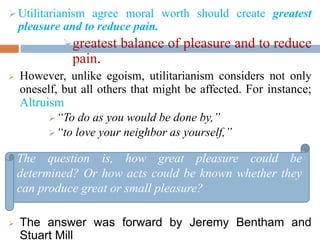
Utilitarianism agree moral worth should create greatest
pleasure and to reduce pain.
greatest balance of pleasure and to reduce
pain.
 However, unlike egoism, utilitarianism considers not only
oneself, but all others that might be affected. For instance;
Altruism
“To do as you would be done by,”
“to love your neighbor as yourself,”
 The answer was forward by Jeremy Bentham and
Stuart Mill
The question is, how great pleasure could be
determined? Or how acts could be known whether they
can produce great or small pleasure?
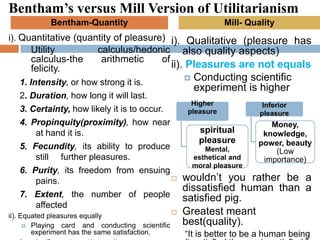
Bentham’s versus Mill Version of Utilitarianism
i). Quantitative (quantity of pleasure)
 Utility calculus/hedonic
calculus-the arithmetic of
felicity.
1. Intensity, or how strong it is.
2. Duration, how long it will last.
3. Certainty, how likely it is to occur.
4. Propinquity(proximity), how near
at hand it is.
5. Fecundity, its ability to produce
still further pleasures.
6. Purity, its freedom from ensuing
pains.
7. Extent, the number of people
affected
ii). Equated pleasures equally
 Playing card and conducting scientific
experiment has the same satisfaction.
i). Qualitative (pleasure has
also quality aspects)
ii). Pleasures are not equals
 Conducting scientific
experiment is higher
 wouldn’t you rather be a
dissatisfied human than a
satisfied pig.
 Greatest meant
best(quality).
.”
“It is better to be a human being
Bentham-Quantity Mill- Quality
Higher
pleasure
spiritual
pleasure
Mental,
esthetical and
moral pleasure
Inferior
pleasure
Money,
knowledge,
power, beauty
(Low
importance)
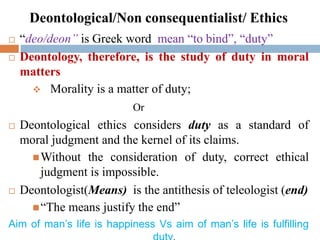
Deontological/Non consequentialist/ Ethics
 “deo/deon” is Greek word mean “to bind”, “duty”
 Deontology, therefore, is the study of duty in moral
matters
 Morality is a matter of duty;
Or
 Deontological ethics considers duty as a standard of
moral judgment and the kernel of its claims.
Without the consideration of duty, correct ethical
judgment is impossible.
 Deontologist(Means) is the antithesis of teleologist (end)
“The means justify the end”
Aim of man’s life is happiness Vs aim of man’s life is fulfilling
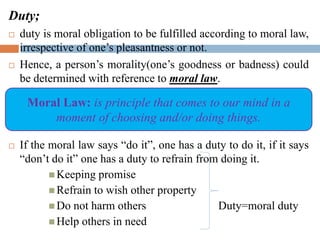
Duty;
 duty is moral obligation to be fulfilled according to moral law,
irrespective of one’s pleasantness or not.
 Hence, a person’s morality(one’s goodness or badness) could
be determined with reference to moral law.
 If the moral law says “do it”, one has a duty to do it, if it says
“don’t do it” one has a duty to refrain from doing it.
 Keeping promise
 Refrain to wish other property
 Do not harm others Duty=moral duty
 Help others in need
Moral Law: is principle that comes to our mind in a
moment of choosing and/or doing things.
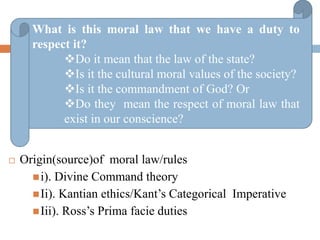
 Origin(source)of moral law/rules
i). Divine Command theory
Ii). Kantian ethics/Kant’s Categorical Imperative
Iii). Ross’s Prima facie duties
What is this moral law that we have a duty to
respect it?
Do it mean that the law of the state?
Is it the cultural moral values of the society?
Is it the commandment of God? Or
Do they mean the respect of moral law that
exist in our conscience?
i). Divine Command Theory
 What makes an action right or wrong is that it is
commanded or forbidden by God/Allah.
 Whatever the situation, if we do what God/Allah
wills, then we do the right thing; if we do not do
what God wills, then no matter what the
consequences, we do wrong.
In nut shell, this theory equates what is right
with what God/Allah wills.
ii). Kant’s Categorical Imperative
He believed that morality is independent
of God or every ones’ will.
For Kant moral law within the
individual(not from society or God).
Hypothetical versus Categorical Imperatives
A). Hypothetical Imperative
 It is conditional on (“if… then”) or subject to circumstances,
goals, and desires.
 (Forced by external circumstances or by
calculating one’s advantage or disadvantage)
 If you want Y then you ought to do X
 Study day and night then you will score good result.
 E.g; help the needy one b/se you will get to heaven.
 In this case, helping others(poor) is depend up on certain
goals. Thus, Kant conclude that such act is not good moral
act. Since it lacks the motive to respect the moral law. Or
“Treating others as means to your end” Stop!
B). Categorical Imperative
 Morality is unconditional
 Unconditional (no “ifs”) and independent of any
circumstances, goals, or desires.
 For this reason, only a categorical imperative is valid at
all times.
 Imperative-principle on which we ought to act
 Categorical – uniform and universal in its applicability
without exception in every situation.
You ought to do X since it is your obligation
(regardless of any result)
Example:
Love your country b/se it is your obligation

 Thus, good man(right man) is a person who has good
will.
 Good here refers the moral law itself
 Will is human ability to decide and act in respect
of moral law.
 Thus, good will is the capacity to make choices on
the base of moral law.
 Our mind has the natural capacity to distinguish
what is good and bad
 Thus, a good man act consciously and abide by moral
law.
“treat people as an end never as a means to an
end”.
 That is, we should always treat people
with dignity, and never use them as
mere instruments.
iii). Prima Facie Duties(William David
Ross)
 Ross’s interest is to solve one of the problem that
Kant left unsolved
The dilemma of choosing
 We have various duties that oftentimes come into
conflict with each other.
For instance; choosing either to speak a
truth or to keep one’s promise(moral
law/rule in conflict)
 For Ross, as in the case of Kant, moral rules
without exception should be obeyed, but when
they are in conflict , we should be situational-
prefer prima facie duty.
 Ross identified the following as prima facie duties that
every moral action should obey always:
1) Duties of fidelity(the duty to keep promises b/se of our
previous act)
2) Duties of reparation(the duty to compensate others
when we harm them)
3) Duties of gratitude/respect(the duty to thank those who
help us).
4) Duties of justice(duties involving treating in a fair and
equal manner whenever possible)
5) Duties of beneficence(charitable act for the good life of
others or act for the happiness of other people if
possible)do what is best for others
6) Duties of self-improvement(improving ourselves with
respect to good moral character, intelligence and
happiness).
7) Duties nonmaleficence: (the duty not to hurt, harm or
2.3.2. Non normative Ethics
 It concerned with factual investigation of moral behavior and
analysis of the meaning and nature of ethical terms .
 i). Descriptive Study
 How people do in fact behave.
 Its goal is to describe or explain the phenomena of morality.
 how the values, behavior and code differ from society
to society.
 which aims to discover and describe the moral
beliefs(rightness or wrongness) of a specific culture.
 But, it do not tell us(prescribe) what is right or wrong. Rather,
it describe what those people think about right and wrong
belief.
 Ethical Relativism versus Ethical Absolutism
 Moral relativism asserts
that moral values are not
uniform to every society.
 Morality could not be
independent of cultural
belief.
 Its judgment is varies
from individual to
individual
 (Right and wrong is varied
across society). Or there
is no universal principles
of morality.
“beauty is in the eyes of the
holder”
 Moral principles are
universal
(People can practice
moral principles
uniformly)
 What is good for one
individual must also be
considered good for
any other individuals.
 people have the same
feeling everywhere;
For instance;
 All dislike public
humiliation (dignity)
Relativism/subjectivism Absolutism/Universalist
ii). Meta Ethics
 When the word “meta” appears as a prefix, it means the
study of characteristics(nature) of things.
 It concerned and attempt to analysis
meaning ethical terms, nature of ethical
statements and attitudes.
 provide linguistics and logical analysis of
ethical concepts.
 For instance; “tell only the truth” is right
 Meta Ethics ask:
What does it mean truth it self?
What makes telling the truth necessary?
How is it possible to justify telling the truth is
good?
Is their a relation b/n truth and goodness e.t.c
2.3.3. Virtue Ethics
Introductory Notice
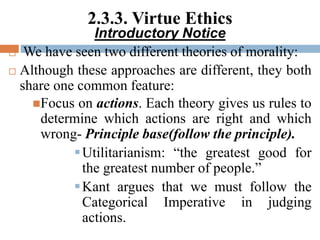
 We have seen two different theories of morality:
 Although these approaches are different, they both
share one common feature:
Focus on actions. Each theory gives us rules to
determine which actions are right and which
wrong- Principle base(follow the principle).
Utilitarianism: “the greatest good for
the greatest number of people.”
Kant argues that we must follow the
Categorical Imperative in judging
actions.
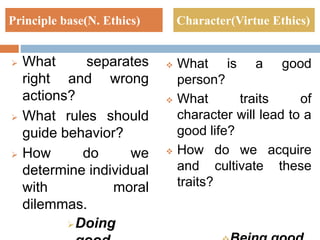
 What separates
right and wrong
actions?
 What rules should
guide behavior?
 How do we
determine individual
with moral
dilemmas.
Doing
 What is a good
person?
 What traits of
character will lead to a
good life?
 How do we acquire
and cultivate these
traits?
Principle base(N. Ethics) Character(Virtue Ethics)
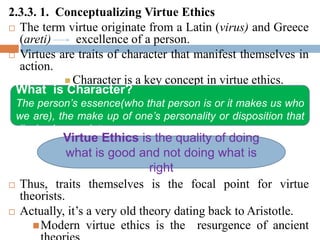
2.3.3. 1. Conceptualizing Virtue Ethics
 The term virtue originate from a Latin (virus) and Greece
(areti) excellence of a person.
 Virtues are traits of character that manifest themselves in
action.
 Character is a key concept in virtue ethics.
 Thus, traits themselves is the focal point for virtue
theorists.
 Actually, it’s a very old theory dating back to Aristotle.
Modern virtue ethics is the resurgence of ancient
What is Character?
The person’s essence(who that person is or it makes us who
we are), the make up of one’s personality or disposition that
display in a society.
Virtue Ethics is the quality of doing
what is good and not doing what is
right
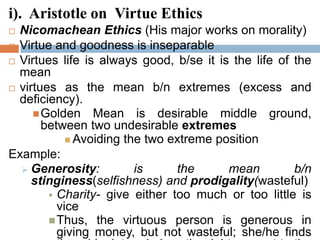
i). Aristotle on Virtue Ethics
 Nicomachean Ethics (His major works on morality)
 Virtue and goodness is inseparable
 Virtues life is always good, b/se it is the life of the
mean
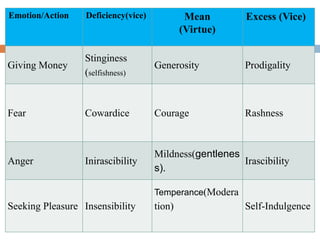
 virtues as the mean b/n extremes (excess and
deficiency).
Golden Mean is desirable middle ground,
between two undesirable extremes
 Avoiding the two extreme position
Example:
 Generosity: is the mean b/n
stinginess(selfishness) and prodigality(wasteful)
 Charity- give either too much or too little is
vice
Thus, the virtuous person is generous in
giving money, but not wasteful; she/he finds
Emotion/Action Deficiency(vice) Mean
(Virtue)
Excess (Vice)
Giving Money
Stinginess
(selfishness)
Generosity Prodigality
Fear Cowardice Courage Rashness
Anger Inirascibility
Mildness(gentlenes
s).
Irascibility
Seeking Pleasure Insensibility
Temperance(Modera
tion) Self-Indulgence
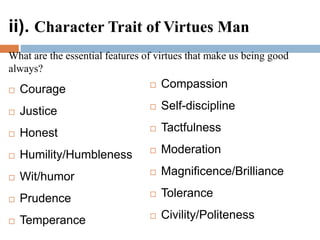
ii). Character Trait of Virtues Man
What are the essential features of virtues that make us being good
always?
 Courage
 Justice
 Honest
 Humility/Humbleness
 Wit/humor
 Prudence
 Temperance
 Compassion
 Self-discipline
 Tactfulness
 Moderation
 Magnificence/Brilliance
 Tolerance
 Civility/Politeness
For Virtue is its own
reward !
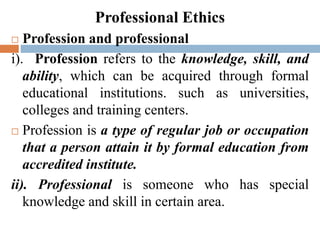
Professional Ethics
 Profession and professional
i). Profession refers to the knowledge, skill, and
ability, which can be acquired through formal
educational institutions. such as universities,
colleges and training centers.
 Profession is a type of regular job or occupation
that a person attain it by formal education from
accredited institute.
ii). Professional is someone who has special
knowledge and skill in certain area.
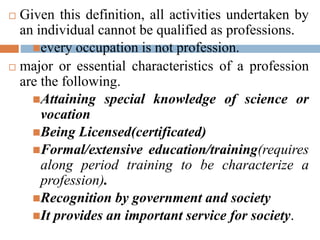
 Given this definition, all activities undertaken by
an individual cannot be qualified as professions.
every occupation is not profession.
 major or essential characteristics of a profession
are the following.
Attaining special knowledge of science or
vocation
Being Licensed(certificated)
Formal/extensive education/training(requires
along period training to be characterize a
profession).
Recognition by government and society
It provides an important service for society.
Aims and Nature of Profession
 Professional practice of one person is hardly exist.
It is a common occupation.
 Each profession is organized to serve the public
Expected to promote public good-must
contribute for the wellbeing of the people.
 Now a day having a certain certificate is not
sufficient.
Having degree by it self is not a guarantee to
obtain and maintain good job.
 Thus, should guided by moral ideas.
 require morally permissible way
iii). Professional Ethics:
 It is specific and general guideline that should be
followed and exhibited by every professionals.
 It refers to the code of conduct that guide our
conduct while we are providing professional
services to the clients.
It is significant to determine the proper
behavior and discipline that individuals
should conform to their profession.
 Different professions may have different codes of
ethics since services provided by each profession
are different.
 But there are also common codes of ethics and rules of
conduct that must be universally applied.
a) Punctuality: It is a belief that across all professions
a worker must always be on time.
b) Honesty : refers to the art of telling the truth.
Employees are expected to be honest.
c) Integrity: the worker should devote his/her time,
skill and knowledge for his/her profession.
d) Confidentiality: professional should keep some
information that should be kept secret.
e) Impartiality professional is expected to treat all
clients equally during service delivery without
any forms of discrimination.
CHAPTER-THREE
2.Understnding of Society, State &
Government: Ethiopian Focus
Opening Remarks
 Definition, Attributes, and Theories of
Society.
 Perspectives on the Meaning and Origin of
State
 Element of State and State Structures
 Meaning, Functions and System of
2.1. Society
Introduction:-
 Society is a focal point in the stream of social sciences,
particularly in sociology and political science.
 The nature or type of society is not similar across time &
place.
Social Structure:-an aspect of social ranking and
roles.
Social Change:-Social relation/interaction is not
something static-it is always changing.
 society does not remain unchanged over time.
 It has a persistent process of action and
interaction.
2.1. Definition and Attributes of
Society
 Indeed, the meaning of society is a point of discourse
among scholars in social science.
 The concept of society is given different meanings by
different writers.
 Different sociologists look at society from different
angles.
i) In its broad sense:-
 A Society is an organized group of people living together
in a given territory.
A group of people living together or an assemblage
ii. Society represents totality of relationships among
humans.
a). It is the integrated whole system that consists of
other activities as sub systems.
Society is a broad term that consists of state
and other realm.
b). In political science;
 the term is to mean the totality of human
relationships, generally in contrast to the state,
i.e., the apparatus of rule or government
iii. A group of humans broadly distinguished
from other groups by mutual interests, shared
institutions, and a common culture.
a collections of individuals united by
certain modes of behavior.
Their mode mark them off from others who
do not inter into these relations/who differ
from them in behavior. For instance;
Sidama Society;
 nation state, such as
Ethiopians/Society
to a broader cultural group, such as African
Society.
iv. It can also be explained as an organized
group of people associated with association,
religious, scientific grouping.
Christian/Muslim society
 Society of physics. Society of philosophy
 In Nutt Shell
How ever, most scholars
commonly defined as a
sizeable community of
persons who are interacted
together for some
considerable period of time ,
possessing common
institutions, accepting
common values and norms
which regulate their
interaction.
2.2. Attributes/ elements of Society
 In fact, any assemblage of people cannot be
regarded as a society.
 In order to be considered as a society a group of
people must fulfill the following principles:
A. Common Geographical Area/Defined Territory
 particular society has been demarcated by:-
 natural boundaries such as the rivers,
mountain ranges or forests, canals,.
 artificial boundaries - demarcated by
political settlements
B. Variety of Interactions:
• people of the society interact each other for
their survival.
• Having diverse, multifaceted and endless
interactions.
• People share certain interests, attitudes,
abilities/skills, traditions, values, objectives
C. Total Culture/Common Culture:
• The society will be differentiated by the other
because of its unique culture institutions.
D. Feeling of Solidarity:
 Since society has a common territory, customs,
common history, common cultures,
 causes feelings oneness and solidarity
among themselves.
 they never lose their identity and remains
united as long as their society survives.
E. Functional Differentiation
 All individuals never perform similar activities
 different functions depending upon their sex, age,
interest, abilities, skills and other qualifications.
2.3. CONTENDING THEORIES ABOUT SOCIAL
SYSTEMS
 There are various theories, which basically deal
about the social system and social interaction of the
society-How the Social world is working?
understand how the entire world works.
 Sociologist views society in different ways:
i. Functionalist perspective
ii. Conflict perspectives
iii. Inter-actionist perspectives
i. Functionalist Perspectives/Functionalism.
 They see the world as a stable and ongoing entity to
survive over time.
 A social system made up of interdependent parts.
 parts of a society are structured to maintain its stability.
 Any society as a vast network of connected parts, each
of which .
Think about society as a living organism in which
each part of the organism contributes to its survival.
If an aspect of social life does not contribute to a
society’s stability or survival(if it does not have
function),it will not be passed on from one
generation to the next.
ii. Conflict Perspectives
 Because society is made up of individuals
competing for limited resources
Social behavior is best understood in terms of
conflict/tension between competing groups.
 The social order is based on coercion and
exploitation.
Society as composed of many groups in conflict
like;
Social unrest resulting from battles over civil rights
Party politics, competition b/n religious groups
The rise of feminist and gay liberation movements
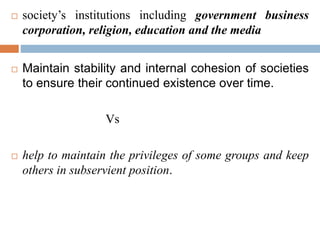
 society’s institutions including government business
corporation, religion, education and the media
 Maintain stability and internal cohesion of societies
to ensure their continued existence over time.
Vs
 help to maintain the privileges of some groups and keep
others in subservient position.
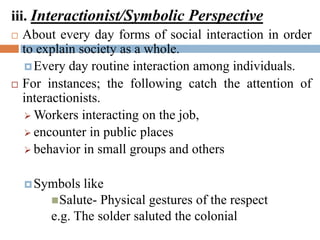
iii. Interactionist/Symbolic Perspective
 About every day forms of social interaction in order
to explain society as a whole.
Every day routine interaction among individuals.
 For instances; the following catch the attention of
interactionists.
 Workers interacting on the job,
 encounter in public places
 behavior in small groups and others
Symbols like
Salute- Physical gestures of the respect
e.g. The solder saluted the colonial
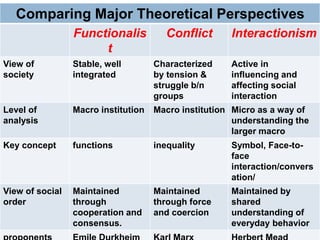
Comparing Major Theoretical Perspectives
Functionalis
t
Conflict Interactionism
View of
society
Stable, well
integrated
Characterized
by tension &
struggle b/n
groups
Active in
influencing and
affecting social
interaction
Level of
analysis
Macro institution Macro institution Micro as a way of
understanding the
larger macro
Key concept functions inequality Symbol, Face-to-
face
interaction/convers
ation/
View of social
order
Maintained
through
cooperation and
consensus.
Maintained
through force
and coercion
Maintained by
shared
understanding of
everyday behavior
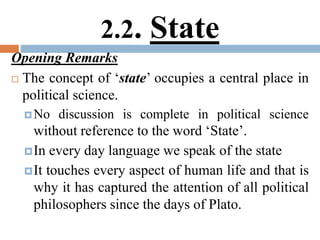
2.2. State
Opening Remarks
 The concept of ‘state’ occupies a central place in
political science.
No discussion is complete in political science
without reference to the word ‘State’.
In every day language we speak of the state
It touches every aspect of human life and that is
why it has captured the attention of all political
philosophers since the days of Plato.
2.2. Defining and Understanding of State
2.2.1. Conceptual Discourses
 State as a concept is a perplexing one to
understand it easily.
there is no commonly agreed definition
regarding the concept of the state
some social scientists developed a theoretical
kits.
Organizational and Functional Approaches
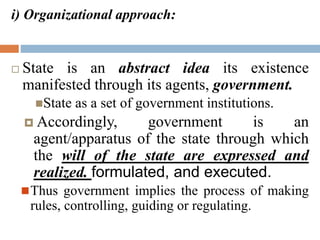
i) Organizational approach:
 State is an abstract idea its existence
manifested through its agents, government.
State as a set of government institutions.
 Accordingly, government is an
agent/apparatus of the state through which
the will of the state are expressed and
realized. formulated, and executed.
Thus government implies the process of making
rules, controlling, guiding or regulating.
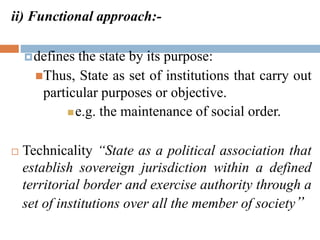
ii) Functional approach:-
defines the state by its purpose:
Thus, State as set of institutions that carry out
particular purposes or objective.
e.g. the maintenance of social order.
 Technicality “State as a political association that
establish sovereign jurisdiction within a defined
territorial border and exercise authority through a
set of institutions over all the member of society”
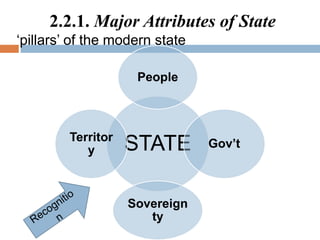
2.2.1. Major Attributes of State
‘pillars’ of the modern state
STATE
People
Gov’t
Sovereign
ty
Territor
y
i. Permanent population
 no state unless people live together an associated
life.
 more or less permanent population (not mobile
population).
 The question is how much people constitute state?
ancient writers said much stress on it.
 Plato -an ideal state around 5, 040.
Aristotle -considered 100,000 too many.
Rousseau- 10,000 would be an ideal
number.
 number of population is one of the factors that
influencing the power and maintenance of state.
 However, it is not a determining factor for
the existence of a state. Whether it is small
or large, the state can exist.
 There is no standard with regard to the
number of people in a state.
large number of population like China,
India, Indonesia, Japan, while other states
like Vatican, Malta, Djibouti and etc.
ii. Sovereignty/Supreme/exclusive power/
 Sovereignty implies the ultimate authority,
an authority from which there can be no
appeal.
a). Internal sovereignty:
 power of the state to make and enforce laws over its
people.
 state as the ultimate decision maker in its territory.
 Thus, all individuals and groups of
individuals have to submit to the will of the
state.
b). External sovereignty/Non- intervention/
freedom from the control of external governments
since each state is recognized by other states as
equal member and participant in the international
system.
 states do not have the right to interfere with
iii) Fixed Territory
 modern state requires a definite portion of territory
over which it can have undisputed authority.
No state can exist without fixed territory.
 Nomadic tribes- gypsy people, Jews before
1948
Territory includes the surface of land, lakes and
rivers and air space above the land .
Contiguous territory, but there are exceptions
like Alaska and Hawaii of the USA.
iv) Government/Ruling & Managing Body/
 It is the instrumentality through which the
sovereign will of the state finds concrete
expression.
State is the organization of which government
is the administrative machine.
 Soul and Brian of State- state can no
function without the governmental
machinery.
V. Recognition /Acknowledgement/
 No state is completely isolated from the rest of the world.
 Political unit(State) to gain international personality, it must
be recognized by large portions of international community.
 To be a legal actor in the international stage, it must
be recognized by other actors.
 By state actors and non-state actors
 But, the failure to recognize by one or few states in the world
does not deprive its statehood.
 Thus, it is not indispensable attribute
 Example:
 Israel continues to be a state, albeit some state do not
recognize
A. Theory of Divine Origin
 State is the creation of God.
 state is established and governed by God/Allah
himself
 God rule the state directly or indirectly through
some ruler who is regarded as the agent or vice-
regent of God/Allah.
 some are born to rule while other are born to be
ruled
the king has derived his authority directly from
God. Therefore, he/she is above the people
and the law.
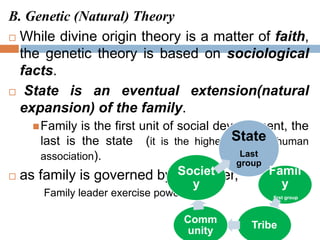
B. Genetic (Natural) Theory
 While divine origin theory is a matter of faith,
the genetic theory is based on sociological
facts.
 State is an eventual extension(natural
expansion) of the family.
Family is the first unit of social development, the
last is the state (it is the highest form of human
association).
 as family is governed by the elder,
Family leader exercise power
State
Last
group
Famil
y
first group
Tribe
Comm
unity
Societ
y
C. Force Theory
 State is created by the use of physical
force.
It originates as a result of superior physical
force;
Subjugation of the weaker by the
stronger.
 one group conquers another by force and
leader of the victor’s assumes ultimate
authority
in primitives times the man of
physical strengths was able to
exercise some kind of authority over
other
this condition of conquest resulted
more territories and finally led to the
 Thus, State is nothing but the result of
wars and conflicts.
According to this theory, it is war that
begets the state.
force must have been an
important factor in the evolution
of' the state
‘Blood and iron make the state.’
 That is why military allegiance and
territorial character as fundamental
features of modern political society .
D. The Social Contract Theory
 State is the result of a deliberate and
voluntary agreement on the part of
primitive men emerging from a state of
nature.
 man lived in the state-of-nature prior the
formation of a state.
State of Nature- a period without
authority of any kind.
How was the real appearance of
i). Hobbes and His View
State of Nature
It was a period in human history that was no
state at all and no political order (lawless).
Was a thoroughly unpleasant one.
"solitary, poor, nasty, brutish and
short" life.
Man was the enemy of man
 Such condition forced persons to form a
contract that ensures them liberty, property
and the entire of a good life.
Thus, state emerged to terminate
anarchism(lawless), which threatens the life of
all individuals in the state of nature.
ii). John Lock
State of Nature;
It was a pre-political period that man live
peacefully and enjoy natural rights.
was a state of peace, good will and mutual
assistance.
Each man was a police man as well as
magistrate(maker & executer).
Thus, how State being?
In these circumstances, there was a need
for common judge (superior authority) for
common agenda since men are biased or
not impartial judges in their own cases.
iii). Jean-Jacques Rousseau
 State of nature was a normal condition.
Man was a noble savage. Man’s life was very
simple and happy in the oldest phase of
civilization.
Man is naturally good/innocent and
independent life. But, primitive goodness did
not exist longer.
 An existence of private property erodes the
goodness and peace of man.
It all led to the rise of selfish, evil
desire(aggressive) and natural life was
destroyed.
 Thus, the people living in that condition desire to
form a union for common good;
To terminate the state of nature, contract
E. The Marxist View
 no state in the most primitive stage of social life.
The state arose when society divided in to two
hostile classes, each having its own interest.
 Bourgeoisie(the have class) and
Proletariat(have not)
 State is “ a necessary evil”
 It is necessary b/se it provides law and order for
citizens.
 It is evil b/se it restricts the freedom of individuals.
 Thus, Marxist writers consider the state as
instruments of oppression, exploitation and capital
accumulation used by the rich against the poor in a
class-based society.
F. Evolutionary/Historical Theory
 The theory mainly emphasizes on two important
arguments.
i). The state is not a make(suddenly rise) but a
growth.
 It is the product of a long process of
evolution covering hundreds and thousands
of years.
ii). Not only one but many factors have played their
part.
Thus, state is a result of many factors it
includes kinship, religion, force, economics,
political consciousness, etc.
State Structure
 This day, we find many states. All of
these are not similar in many ways. For
instance;
very small or very large in their
territorial extent and population.
Some states are highly developed
others are less developed or very
poor.
socio-economic, and technological
difference.
Some provide freedoms and rights
and others provide little or no
freedom.
Basic Features of Unitary State
Structure
i). Supremacy of central government
 central government has exclusively control
the power(strong single center).
All the authorities and powers are
exclusively in the hands of the central
government.
local and regional political bodies(unit)
over ruled by the central government.
ii).Absence of subsidiary sovereign bodies
No devolution of power(indivisible) but
may delegates certain administrative
responsibilities.
iii). Sub-national units are created or
abolished by the will of the center
existence of local units is on the interest
of the central government.
Local units do not have an independent
constitutional status.
unlike federal states where their
existence and power is legally
defined by the states
constitution.
 so, central government may
increase or decrease their
Potential Advantages and
Disadvantages
i). Merits may include:-
it can bring about uniformity of law,
policy and administration through out
country.
no conflict of authority, no confusion of
responsibility, no overlapping of
jurisdiction.
less expensive because the absence of
duplication of governmental
departments and services.
ii). Demerits can be explained as
follows:
Regulations of local policies and affairs by
distant since no strong regional institutions.
additional burden of responsibility on the
central government
Central authorities often lack knowledge of
local conditions and needs; and the
consequence of it is that local interests
suffer.
unitary state structure tends to suppress
local initiative and discourage interest in
Features of Federal State Structure
 power is formally divided between the central
government and regional governments.
each of which is locally supreme in its own
sphere
powers are clearly specified in the constitution.
 States apply different principle and reasons for
federation. However;
 Some common features/federal principles
Written constitution
Division of power
Dual set of gove’t (shared rule and self
rule)
Tiers of government
Level of gov’t act in their own
jurisdiction
Brainstorming Questions
1. Could it be possible to say the Ethiopian state
structure is federal in nature?
2. Does federalism is a panacea for all problem
in political association?
 Pros and Cons of Federal System
i). Advantages of Federal System
 It allows unity without uniformity
 Encourages experimentation and innovation
States as testing grounds or laboratories for new
policies and programs.
States are labs to see what works
It keeps government closer to the people
 Large number of citizens are involve
 More access for political participation
ii). Disadvantages/Drawback
 Makes national unity difficult to achieve and maintain.
State governments may resist national policies
It empowers regional elites to sustain and exacerbate
conflict (Centre-peripheral conflict)
 May permit economic inequality and racial
discrimination
Promotes inequality because state resources differ
 Law enforcement and justice are uneven
 Lacks uniformity in laws
 Services vary from state to state
 May promote local dominance by special interests
 Increase pressure for secession.
 Lack of effective central control
Process on the Formation of Federation
 There are two ways of forming federations.
 Federations could be established in one of the two
ways.
1. Coming Together/Aggregation/
Independent states voluntarily form a bigger
union.
Evolved from formerly independent states
 had all had a previous existence and desired to
unite.
Centripetal force like threat of big states
 E.g. U.S.A.(1789)-13 colonies
 Swiss(1848)- 25 cantons
 Australia
Initially, central gov’t is weak compared to states.
2.Holding Together/Disaggregation/
 Previously unitary state or a retiring colonial state
 A large country decides to divide its power b/n the
states and central governments
 Centrifugal forces/devolution/ like desire for local
autonomy.
 E.g. India, Germany Belgium,
Spain, Nigeria, Ethiopia.
 central gov’t is always more powerful than
regional states.
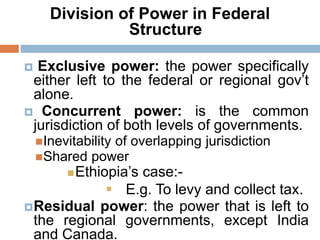
Division of Power in Federal
Structure
 Exclusive power: the power specifically
either left to the federal or regional gov’t
alone.
 Concurrent power: is the common
jurisdiction of both levels of governments.
Inevitability of overlapping jurisdiction
Shared power
Ethiopia’s case:-
 E.g. To levy and collect tax.
Residual power: the power that is left to
the regional governments, except India
and Canada.
 Quiz 2.
True/False
 1. According to divine right origin, state is the
result of social agreement_________
 Federation through aggregation is while
independent states form one big political
union____
Short Answer
 Point out at least three principles of federal
political system
i)____________________
ii)________________________
iii).________________________
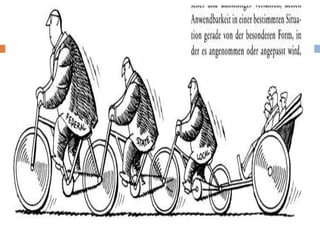
3.3. Defining, Functions and Forms of
Government
3.3.1. Defining Government
essential components and also an
administrative wing of a state.
it is the body of the people and
institution that make, enforce and
interpret laws.
It is machinery or the arms or brains of
the state
It is the executive agent that acts in the
name of the state and its people.
3.3.2. Functions of
Government/State
i). Self-preservation:
Maintenance of law and order in society.
Protect the security of citizens territory from
internal and external threats.
Protect human, democratic, political,
social, economic and cultural rights.
(using its police, defense and court
institutions)
ii). Conflict Management:
government also involves conflict
management and resolution. i.e it builds
iii). Protection of Property
 State provide means to protect private and public
property.
iv) Provision of Goods and Services:
 Providing services and welfare to citizens
 through participating heavily in the provision of goods
and services.
v). Distribution of Resources:
 all governments invariably play the role of distributing
resources in their societies.
vi). Fulfillment of Social or Group Aspirations:
 strive to fulfill the goals and interests of the society as a
whole.
promotion of human rights, common good and
international peace.
 3.3.3. Forms and Systems of Government
Variables Parliamentarian System Presidential System
i). Power r/n of Executive
and Legislative
Fusion of Power
 Fusion mean executive
emerge from Assembly
They are member of
paria...
Clear separation of
power
Separate mean through
popular election
ii). Accountability of
Executive
For parliament/Assembly For the electorate/people
iii. Head of State& Gov’t Is divided as
Head of State-president
Head of Gov’t- Prime
Minister
Is not divided
President is both head of
State and Gov’t
iv). Resign No vote of confidence
At all time subject to
potential dismissal
Impeachment
Can not be easily ousted
by legislative body
v). focus of power
 Supreme political body
Assembly/legislature president
vi). Voters Has one tickets(can not
split)
Elect the assembly only
Has two tickets
Elect president
&congress
iii. Semi-presidential Systems.
 Also termed as hybrid-that is neither purely presidential
nor parliamentary.
 Semi-presidentialism may be defined by three features:
 A president who is popularly elected.
 president has considerable constitutional authority.
 exists also a prime minister and cabinet, subject to the
confidence of the assembly majority.
 Thus, there is an existence of both president & prime Minster
 power relationship between two offices may vary
 France for example, the president enjoys supremacy.
 South Africa, Germany, Russia, France
Comparative Analysis of Society, State and
Government
Society State
It is a web of social relationship It is an instrument to serve
the members.
Held together a society
In terms of time. It comes
first to state
It is historically as well as
logically prior to the state.
It came in to existence at a
certain stage of human
development.
Society is natural to human
beings. Man can’t live outside
it.
There have been times when
man has lived without the
state.
It operate on the bases of
customs and conventions.
can punish through moral
persuasion and social
It exercises authority with the
help of laws enacted and
enforced by Government.
 Through force
State Government
It is the whole It is only a part of the state that
is its working machinery
It is abstract
Soft ware(know based
on its function)
It is concrete
Hard ware (tangible)
Its membership
comprises all the
nationals
Only a small part of the total
population participates in the
various organs of government
It is more or less
permanent
Government come and go
Sovereignty is an
attribute of the
state
In practice all governments are
subject to varies limitations.
An Overview of Society, State and
Government in Ethiopian
(Reading Assignment)
Say True or False
1. Federal political structure is a panacea for all
political problem of human association
Fill in the Blank
2. For whom residual power is given in almost all
federal state_____________
3. Name one state that has parliamentarians system
of government________
Short Essay
4. Compare and Contrast Hybrid system vis-à-vis
parliamentarian system of government(2 pt).
 Quiz 2
Well Come to The
Session of Chapter
Four
Democracy,
Constitution & Human
Rights
CHAPTER-FOUR
4.Constitution, Democracy and Human
Rights
4.1. Understanding Constitution
Introduction:
 State/government cannot run according to the sudden,
and fanciful idea.
 Thus, there has to be certain rules and principles.
This set of principle is called the Constitution.
What a constitution mean?
What a constitution does to the society and
state?
Why do we need a constitution?
What does Constitutionalism mean also?
4.1.1. Defining Constitution and
Constitutionalism
i)Constitution;
 Constitution can be defined as a fundamental law
written or unwritten that establishes the basic
characteristics of both the society and government.
contains basic principles according to
which a state is governed.
 determine the form of government/state structure. (E.g.
Art 1 FDREC)
 defines the scope of governmental sovereign
powers(vertical/horizontal division).
 govern internal/external affairs of the state
 specifies the relation between citizen and state(right
and duties).
ii) Constitutionalism
 A doctrine that gov’t should be faithful to their
constitution.
Government is subject to limitations in accordance
with the general rules rather than arbitrarily.
Thus, is it more than simply having a document.
Mere existence of a constitution itself does not imply
Constitutionalism.
 Even a dictator could create a rulebook calling it
Constitution.
 Thus, its connotations:-
 enshrines respect for human dignity
perfectly mirroring the popular will
limits government power
should be practical on the ground/not nominal
4.1.2. Major Characteristic of a
Constitution
 Constitution has distinctive features that
distinguish it from any other laws
i) Generality:
 general framework of the law and the government
 Constitutional principles are a guideline for others
laws
Other laws provide the details of the subject
ii) Supremacy:-
 As a mother law of the land.
 The source of other laws in a county-other laws should
derived from the constitution.
 To ensure this supremacy, the constitution needs to have
 a supremacy clause( E.g: Art 9 FDRE)
judicial review-Supreme Court or specialized
constitutional court, HoF(Ethiopia)
need special amending procedures
iii) Permanency:
 unlike laws, constitution is made for undefined period of
time
 serve for a long lap of ages
 constitutional amendment can keep its permanency
iv) Original:-
 because it is directly made by the people as the direct
expression of the will of the people.
 It requires public legitimacy.
4.1.3. Functions of Constitution
i). It served as a Framework for Government.
Constitution of state is a brief and a general
outline of duties and rights of governments.
Thus, it guides effectively the power of gov’t
ii). It Provides Government Stability
 Since it acts as “organizational chart”, “institutional
blue prints”;
provide a mechanism through which any potential
conflicts can be adjudicated and resolved.
iii). It Limits the Powers of Government-Constitutionalism
 In a constitutionally limited government officials are
always abided by the constitution.
iv). It Protects Individual and Collective Rights.
 provide or lay down the relationship between the state
and the individual/collective ones.
Like FDRE conspicuously provide on- Art 13-44
v). It served as Vehicle for Empowering States and
Weapon for Legitimizing Regimes
 It mark out the existence of states, and claims their
sphere of independent authority.
 Constitution is also building legitimacy for regimes.
the right to rule or the validity power to govern.
Vi). Blue Prints for establishing Values and Goals
 the fundamental aims and principles are described
explicitly in preambles to constitutional documents.
i) Based on
Forms
• Written
• Unwritten
Amendment
Procedure
• Rigid Constitution
• Flexible
Constitution
State
Structure
distribution of
power b/n the
different levels of
governments
• Federal vs
• Unitary
4.1.4. Typology of Constitutions
Constitution of a states differ one another in pertaining to:
Distribution of political power-vertical
Separation of power among branches of government
The procedure employed for amending the constitution
In their forms and appearances
1. Written and Unwritten Constitution
(codified/uncodified)
 classification of constitution on the basis
of whether they are unwritten or written
is illusory(unclear)
This dichotomy is false distinction as
there is no constitution which is
entirely unwritten and nor is there a
constitution which is entirely written.
1. Based on its forms-it means
First- with the degree of codification,
second- with the degree of written detail.
i) Written Constitution: is key constitutional provisions are
found compiled together.
 having an assemblage of a single document
For instance-all Federal Nations
ii) Unwritten Constitution: is a set of rules, regulations
passed by parliament at different time that are not
collected in a single document.
Statute law(law enacted by legislature)
dispersed legal documents, which serve as
constitution.
 For instance, in Britain dispersed document like
Magna carat (great charter) of 1215
The bill of rights of 1689,
 People Representation Act of 1832,
 Women Franchise Act of 1928
 the Acts of Union (1707 and 1800) when the British
were united with Scotland and Ireland respectively.
 Example;
kingdom of Bhutan, Israel
 Advantages of Written Constitution:
 Clear and definite: people have a clear
understanding about the powers of the
government.
 Rights of the people are visible.
 More stable and easily accessible
a text can be made available to all visitors.
 Disadvantages of Written Constitution:
 it fails to adapt itself to changing conditions easily.
 It is rigid and may retard the growth of the country.
Advantages of Unwritten Constitution:
 adaptability to changing circumstances
 prevents revolutions/less controversial
 It covers from shocks.
Disadvantages of Unwritten Constitution:
 Unstable
it would be difficult to quickly determine which
aspects of the constitution is violated
 unsuitable to democracies.
2. Rigid Vs Flexible Constitution
 Based on the degree or complexity of amending the
constitution.
The procedural requirements of their
amendment
i) Rigid constitution which set-up complex and special
amendment procedure.
 amendment procedure relatively complex.
Some Examples
USA, it needs 2/3 majorities in both houses
and ¾ of federating states.
Ethiopia-requires majority support from
regional states and 2/3 from both house
ii)Flexible Constitution: Constitutional amendment is easy
and immediately to changing circumstances.
Amendment procedures are relatively simple.
central legislature is vested to amend the constitution
UK and Israel
Advantage and Disadvantage of Rigid and
Flexible Constitution
Advantages of Rigid Constitution:
 Rights properly safeguarded;
 Suited to all kinds of people;
 Commands the confidence of the people.
Disadvantages of Rigid Constitution:
 Conservative in its character;
 Advantages of Flexible Constitution:
adaptability
country may be saved from revolutions
 Disadvantages of Flexible Constitution:
unstable
It may not be suitable for democracies.
3.2. Constitutional History and
Dev’t in Ethiopia
Pre-1931 constitutional history.
 Fetha Negest-religions and legal
provision
 kibre Negest -defined who should
become king in Ethiopia i.e., succession of
the throne.
 Ser’ate Mengist-provided certain
administrative protocol and directives.
 are known to be traditional documents of
constitutionally relevant in nature.
i.1931 Constitution
 unwritten era of the constitution came
to its end in1931 with the promulgation
of the first written constitution
 Motivation-Two reasons
to join the international organization.
to be a legal weapon in the process of
centralizing governmental power and
in limiting the authority of the nobility.
 containing fifty-five articles
1931 Constitution
Chapters Issues
Had Seven
chapters and 55
Articles.
Chapter I The Ethiopian Empire and the Succession to the Throne
Chapter II The Powers and Prerogatives of the Emperor
Chapter III The Rights Recognized by the Emperor as Belonging to
the Nation, and the Duties Incumbent on the Nation
Chapter IV The Deliberative Chambers of the Empire
Chapter V The Ministers of the Empire
Chapter VI Jurisdiction of Judges
Chapter VII The Budget of the Imperial Government
1955 Revised Constitution
Chapter Issues
Chapter-
1
The Succession to the Throne
had 8 chapters &
121 Articles.
Chapte-2 The Powers and Prerogatives
of the Emperor
Chapte-3 Rights and Duties of the
People
Chapte-4 The Ministers of the Empire
Chapte-5 The Legislative Chambers
Chapte-6 The Judicial Power
Chapte-7 Finance
Chapte-8 General Provisions
1987 PDRE
Chapter Issues
Chapter 1 Political System
Chapter 2 Economic System
Chapter 3 Social and Cultural Policy
Chapter 4 Defense of country, protection
of people and Revolution.
Chapter 5 Foreign Policy
Chapter 6 Citizenship, Freedom, Rights
and Duties.
Chapter 7 Fundamental Freedom,
Rights and Duties of Citizens.
Chapter 8 Forms of state
17 CHAPTERS
and 119
ARTICLES.
Chapter 9 The National Shengo
Chapter
10
Council of state
Chapter
11
President of the Republic
Chapter
12
Council of Minister
Chapter
13
Organs of Power and Administration
administrative and autonomous
Regions.
Chapter
14
The Judiciary
Chapter Procuracy
 Some achievements:-
 introduced some very important
innovations(branch of government) to the
Ethiopian political history;
i, established a bicameral parliament of the
upper and the lower house.
heralded the establishment of chamber of
Deputies and the Senate
 served as Communication Bridge
between the government and the people
than making laws.
These chambers can neither propose
policy nor oppose a policy proposed by
the emperor.
ii,. institutionalized the ministerial system.
Individually and collectively responsible to
monarch
iii. judicial branch
ordinary courts and administrative
tribunals. At the apex of the court system
was the emperor’s chilot.
ii. The 1955 Revised Constitution
 Italian occupation over Ethiopia
Socio-economic transformation of the country
 increased the country’s access to the outside world
and caused slight diffusion of western ideas in to the
mind of the people.
 Motivation-the Ethio-Eritrian federation
 Eritrea is an italic word it mean Read Sea(በ1890
ጣሌያን ኤሪትሪያ ሴሉ ቀይ ባህር ማለት ነዉ)
Before 1952 Eritrea was under the colonial rule
of Italy since 1889.
 It was the defeat of the Italian forces in the
WWII that brought the Eritrean issue in to
attention.
 British mandate between 1942-1952 Eritrea
finally decided federate with Ethiopia.
 Outcome of the federation
 led to the incorporation of two other
documents
i. Federal Act- was a document that
specified the terms of agreements for the
federation between Eritrea and Ethiopia
ii. Eritrean Constitution- Eritrean
established their own constitution
 Both documents were far modern and better
than the previous 1931 Ethiopian
constitution.
Since they incorporated progressive
political elements like democracy and
human right, which were unimagined in
the 1931 constitution.
 it has given a textual recognition for the
 Departure from predecessor:-
chamber of Deputies whose members were
elected on the basis of universal adult suffrage
legal charter for the consolidation of
absolutism
nobility drawn from Showa-
Showanization of the state
creation of a modern army
creation of modern civilian and military
bureaucracy
iii. The 1987 Constitution of PDRE(Dergue)
 Before the birth of the PDRE constitution a
number of historical events took place within the
state
 The preceding two monarchical constitutions were
failed to address the basic questions.
like religious and ethnic diversity
 1960 and early 1970 was the fermentation of
revolutionary forces.
 Immediately after coming to power the Derg
issued proc No 1/1974. The proclamation
addressed some basic issues.
 It suspended the 1955-revised constitution
 Dissolved the two chamber parliaments
Replace by National Shengo
 Legally suspended the Emperor from power and
established the military government.
 This proclamation cannot be given a constitutional status
because it does not touch basic constitutional issues
other than deposing the Emperor from power.
 between 1974-1987 was a period of constitutional
vacuum in Ethiopia.
IV. The Transitional Charter (1991-1994)
 Derge regime crumble
External-Economic stagnation and global
changes
Internal factors- the struggle of several
liberation movement operating along ethnic
lines.
 Ethiopian People’s Revolutionary Democratic
Front (EPRDF) was born in 1989.
OPDO,TPLF,ANDM, (SEPDF in 1994)
 National conference was held in Addis
Ababa from July 1-5, 1991 at Africa Hall.
Herman Cohen
 signing of the Charter by the representatives
of some ’31” political parties-
 Transitional Charter:-it was a very
short document that addressed only
some fundamental issues adopted as
interim constitution.
It served as the law of the land for
the transitional period
 establishment TGE.
 also agreed on the modalities of the
transition process.
Established a “Constitutional Commission”
Comprised
29 general assembly
Executive committee
Various other expert committee
general elections for electing members of the
constitutional assembly that ratifies the
constitution were to be held
creation of an 87 seat Council of
Representatives
In total EPRDF secured 32 seats.
The OLF secured 12 seats.
 Other ethnically based parties
ranging from 1 to 3.
 nationalities to preserve their identity,
 administer their own affairs within their own
defined territory
the right to participate in the central government
based on fair and proper representation,
 the right to self-determination.
TGE also establish by law local and
regional councils defined on the basis of
nationality
Article 3 of Proc. 7/92 enumerated sixty-
four identified nations, nationalities.
 set up fourteen regions(proc No
1/1991).
five region decided to amalgamate
national/regional governments had law-
making, executive and judicial powers.
But the TC did not use the terminology-
federalism.
V. The post-1995 Federal System of FDRE.
 Since 21 August 1995 the constitution was
put in to effect
 The constitution was drafted to address the
ills of the previous regime.
 With a view to:-
addressing the age old cause of the state
crisis,
 intends to decentralize power; resources
 accommodating the country's various
ethno-linguistic groups.
 Part of the 1995 FDRE constitution
 Federal state structure
 Parliamentary form of government
 Multi-culture system
 Decentralization of power
4.2. Democracy
4.2.1. Meaning and Concepts of Democracy
 Democracy as a virtuous good/moral value,
 All states today profess to be democracies.
 has attained a marked popularity in the world.
 a demand of all freedom-loving.
 Democracy is a “mantra” term.
 it seems obvious that everybody understands what it
is all about.
 Democracy is a very contested concept.
 No political terms is subject to contradictory definition
as democracy.
 Like the former Soviet union, Chinese or North
Korea … call themselves democratic state.
 As a concept defies a simple answer.
Albeit, most commonly used terms in political
science lexicon and mass media.
Lack conceptual precision
 Strictly speaking, there are conceptual and
methodological difficulties.
i). Owing to political systems always in a continual
state of evolution.
 Unimaginable in political climate of one period
become possible in other period.
ii). Multi-headed concept.
 cover wide ranges of political systems
 Despite these facts, scholars, and others attempted
to define democracy in various ways.
i). The lexicon definition entails ‘……...people hold
the ruling power either directly or indirectly
through their elected representatives’.
ii). From the perspective of Participation,
the mobilization of peoples around common issues.
the set-up forums for the expression of alternative
views.
the implementation of decision-making based on
majority rule.
iii). Statesman, Abraham Lincoln defined
democracy as;
"…. government of the people, by the
people and for the people."
i. government of the people.
 source of legitimacy /government officials is
from nothing but the people)
ii. Government for the people
 officials should act for the advantage and
interest of the people.
iii. government by the people
 implies public participation in government
affairs and governs themselves(popular self-
government).
In Nutt Shell,
 This day, among the various definitions of them
are: Democracy as a system of governments;
It is the in which ultimate authority resides with
the people.
 it preaches about liberty of individuals/ groups.
It is a way of cooperation, and compromise and
living and working together.
It is a majority rule in which the minority rights are
protected or respected.
It is an institutionalization of freedom
Forms of Democracy
i. Direct Democracy/ Pure Democracy
 required all citizens assemble together to enact, approve the
laws and they implement these rules too.
 It is the most complete and pure model of democracy.
Allowed all/every citizen to participate in the decision
making process.
 without intermediary elected body to make public
decisions.
 Citizens directly engaged in the judicial process. No
separate officials or court systems existed as are followed
now.
 Classical Democracy
Brainstorm Question
 Would you think that direct democracy can be
applied in Ethiopia? If your answer is Yes or No,
please would you give your justification?
 It is more practical in small community,
organizations, parties, local units /kebeles,
trade unions
ii. Representative/Indirect Democracy
 Indirect:
 Because people rule themselves through their
representative.
people elect their representatives and
representative’s rule for the people.
 Indirect democracy now a day prevails in the present
world.
 What could be the reason for this change?
1. Small city states gave way to nation states/Diversity
2. Higher growth of population in nation states than in city
states.
3.Growth of the ideas of equality, and equal opportunity for all.
4. Modern states allow suffrage to women
Fundamental Values and Principles of
Democracy
 What distinguishes democratic political system
from anti-democratic systems?.
A given political system to be qualified as
democratic, it must exhibit certain
universal and fundamental values and
principles.
signposts denoting that a particular state
is on the democracy track;
Standards/Pillars upon which
democracy is founded and formulated
i). Popular Sovereignty
 Governments’ legitimacy is remaining on the
peoples
or
 people are the sources of authority
People is authoritative to authorize as well as
depose officials from power.
Governments derive their power and
authority from the people.
ii). Popular Participation
 Active participation of people in decision-
making process, i.e. self-government.
Active participation is cornerstone to
build a better democracy.
 Its facets include;
 standing and voting for election
becoming informed, debating on issues,
attending community or civic meetings,
being members of party,
 private voluntary organizations,
paying taxes, and
 even peaceful protesting etc.
iii). Equality/Justice as fairness/
 Equality means all individuals are valued equally,
have equal opportunities, and do not be
discriminated
enjoy similar right and duties.
 every law should apply to all citizens in equal
manner; regardless of their differences:
sex, colors, language, religion, culture, and
other ethnic and historical backgrounds.
iv). Rule of Law
 law is a legal body governing the relations among the people.
 It implies that no one is above the law.
Everyone is equal before law including top
government officials
 With the absence of rule of law;
Unlimited government who can jeopardize the
freedom of the people.
Conflicts, instability and upheavals.
Destruction of mutual respect and tolerance.
Absence of human and democratic rights
protection
v). Majority Rule with Minority Rights:
 decisions are made with the;
interest and the will of majority, and
Majorities voice prevail over that of the
minorities.
Like in election, parliament, or local community
meetings prevails over those who disagree.
 Nevertheless, it is not a system in which the views
of minorities is suppressed or ignored.
Minorities should be given with the right to
freely air their views.
vii). Regular, Free and Fair Election
 Regular: Elections must take place within
specified time.
 Free: there should not be intimidations and
threats to citizens before, during or after
election.
 Fair: candidates running for elections should
be provided with equal opportunities
without any discrimination.
voters to choose their representatives correctly.
counting of votes must provide accurate results
reporting of the results should be made public
honesty.
vi). Accountability and Transparency
 government officials responsible for their
actions.
answerable to the decisions and acts they
took.
Officials must make decisions and
perform their duties according to the will
and wishes of the people, not for
themselves.
 Transparency information is accessible, open
and, clear to the public about what
government is doing or plan to do. Or
implies institutional activities are
openness to the public.
For government to be accountable
Viii). Political Tolerance:
o Tolerance as a culture-Political
culture
 refers to the accommodation of divergent
views, believes, cultures, languages etc.
It means accepting and respecting other
people's customs, beliefs, opinions etc.
It enable for the peaceful co-
existence of people.
enables you to hold opinions, beliefs
and positions that are different from
your own.
Major Theories of
Democracy
 On the basis of the degree to which a
government intervention in the economic
affairs of people,
democracy can further be categorized in
to liberal and non- liberal types.
i). Liberal Democracy
 Advocate the principle of private enterprise .
 discourages state intervention in economic
affairs.
 The role of the government in the
economic spheres is laissez fair
(minimal).
 based on free market economy.
 accept inequality or privilege to safeguard
individual freedom.
political &legal equality but not economic
equality.
ii). Socialist Democracy
 emphasis to strong state intervention in the
economy.
 it is based on the acceptance of economic and
social equality.
 social democracy calls for social justice and
economic empowerment of the subaltern
classes.
 To this effect, it concerned with the provision of
social security service, housing, free education,
health and medical cares, and the like.
Liberal democracy encourages a society where
there is class contradiction and private property.
Where as, socialist democracy attempts to create
classless society by eliminating private properties
Actors in Democratization
Process
1. Political Parties:
Political Party is a group of persons professing
the same political doctrine.
 Organized group trying to secure control
over government.
 Political parties perform key tasks like;
 working out alternative programs to the
government.
 Articulating public policy priorities and
civic needs.
 Channeling public opinion from citizens to
government.
 provide a means through which
 individuals influence public affairs,
express their discontent or support
governmental action.
 Activating and mobilizing citizens in
to participating political decisions.
Enforce gov’t to be more responsible,
transparent and accountable to the
people.
 by criticizing and commenting on
government policies and actions.
2. NGO/Civil Society
organized groups and institutions that are independent of
the state, voluntary, and self-generating and self-reliant.
They differ from political parties only in their final
goal, but they all contribute to:
consciousness raising.
protection of individual and collective rights
Educating the people about their rights and
responsibilities
Supporting and Widening the Democratic Process
3. Interest Groups
 an associations on the basis of the free will
of individuals.
 nonprofit oriented and no political objectives.
 major objective is to influence government
officials to support certain policies.
 Through interest groups, citizens
communicate their wants on policy goals to
government leaders.
 For example, a labor union works to
gain higher wages and other benefits
 Organizations of disabled persons,
Women’s Association and
Student’s Association and Trade
Union
5. Mass Media and Democratization Process
 It includes newspapers, television, radio, books,
posters, magazines, and cinema etc
 media play a vital role by:-
 creating, moulding and reflecting public opinion.
being channels of expression of public opinion.
set public agenda; it is a list of societal problems
that both political leaders and citizens agree for need
to concerted action of government
make government officials accountable to the people
Potential Advantage and Disadvantage
Merits/Advantages of Democracy
 Democracy creates an efficient form of government
 Democracy upholds individual and collective Rights
 Democracy Educates the Mass
 Order and progress and stable goes together in
democracy
Demerits/Disadvantages of Democracy
 Begs the question who the people are and how they
can participate in rule.
 Prefers quantity rather than quality(majority voice),
 Inefficient /short vision/
 Political parties mislead, misinform and misguide
electorate.
 Plutocracy/rule of the rich)
4. 3. Human Rights
4.3.1. Defining What HR mean?
o The precise definition of Right is controversial.
 At a very basic level, HR can be defined as
entitlements that all human beings assert merely
because we are human.
are right which belong to all of us, simply
because we are human beings.
The rights we have simply because we are
human.
A person inherently entitled simply because
he/she is a human being .
4.3.2. Basic Features of Human Rights
1. HRs are Based on Equality: Applied equally at any
condition,
 irrespective of sex, ethnic group, color, language,
nation, age, citizenship, religion, political
outlook, social position, etc.
2. HRs are Universal: applied to all people everywhere at
all times (place and time ).
3. HRs are Indisputable: not subjected to different
arguments.
 As they are natural, we cannot argue over the elements
of human rights.
 Since, an extension of Natural Rights
4. HRs are Eternal.
 As far as human society exists on earth human rights
continue to exist.
 any change in government or social, political, economic
phenomenon do not have impact.
lost only at death
5. HRs are Irreducible.
 Human rights cannot be reduced to different
interpretation.
Should applied in their fuller forms.
Example: Right to life could be realized as
far as the right to food is secured
6. HRs are Inalienable: cannot be separated from human
nature.
No body can alienate(taken away)human rights from
human nature because they are fundamental.
7. HRs are Inviolable: do not attack during promotion and
protection.
No state and individual can deprive an individual
human rights.
8. HRs are not to be given by government.
 Government is not a body that gives human rights.
we cannot inherit it rather we possess them by our
nature of human being.
 They are not transferred rights.
4.3.3. SCOPE AND CONTENTS OF HUMAN
RIGHTS
 developed from time to time in terms of scope and
content
 Karel. Vasak a French jurist classify HRs as:-
they are closely interdependent
i. First Generation Rights
 closely associated with the English, French and
American Revolutions
 include those rights which are called civil and
political rights
 set out in the first eighteen articles of the UDHR and
political rights are those set out in Articles 19 to 21 of
the UDHR
 also referred as “ Negative Rights”
But some right like right to security of person and
right government actions
 It includes:-
 Freedom from racial and equivalent forms of discrimination
 Freedom of Expression
 Freedom from slavery or involuntary servitude.
 Protection from unlawful acts by the state such as imprisonment,
forced labor, freedom from torture and from inhuman or cruel or
degrading treatment or punishment.
 right to life, fair trial etc….
 right to vote and to stand for office
 Freedom of assembly and Association
ii. Second Generation of Rights
 Also named as “Economic, social and cultural
rights”
 Its origin was the socialist movement of the
nineteenth century in Europe.
especially, the 1917 Bolshevik revolution
 also termed as “positive rights”
 require positive state intervention in fulfilling
the quest for these rights.
 For instance, the right to social security.
Social and Economic Rights like:
o stated in article 22- 27 of the UDHR. Like:-
right to work and protection against
unemployment
 Equality of opportunity (in education, labor market
etc…)
 right to get adequate standard of education, health
services
 right to adequate standard of living (includes basic
needs- food, shelter and clothing)
Cultural Rights: Art 15 of ICESCR/27and 28 of
UDHR
 express, develop and promote ones own culture
 speak, to write and develop one’s language
 preserve one’s history and cultural heritage.
iii. Third Generations of Rights
 claimed right in article 28 of UDHR.
 Emerged due to the emergence of independent
countries from colonial rule.
 referred to as Environmental and Developmental
Rights.
 It includes:-
 right to self determination of people
(Economic, social, political and cultural)
 participate in the common heritage of mankind
 right to clean environment
 right to global peace
 right to humanitarian disaster relief.
4.3.4. Human Rights
Instruments
 serve as ‘patrons’ of the human rights
i). Human Rights Commissions:
 protection of citizens from, civil and other
human rights violation, discrimination through:
 receive and investigate the complaints of
human rights abuses.
 improving community awareness of human
rights.
 provoking discussion about human rights
 organizing seminars;
ii). Ombudsmen
 Investigate the individual complaints at public
administration.
 Ensure fairness and legality in the
public institution
protect the rights of individuals who are
victims at public administration.
acts as an important mediator between
an injured individual and government.
to ensure fairness and legality in the
public administration
iii). Specialized Institutions: -
 It establish for vulnerable groups facing them
all discrimination.
 persons belonging to ethnic, linguistics
or religious minorities.
providing material and consultative
assistance
responsible for monitoring the
effectiveness of existing laws relate to the
group.
The END
Best of Luck!!!

Moral-and-Civic-Education-PPT-2020.pptxt

  • 1.
    CHAPTER-ONE 1. Conceptual Odysseyof Moral and Civic Education Opening Remarks Nomenclature Defining Civics, Ethics, Morality Nature of Ethics and Morality Ethics and Law The Importance/Goal of Moral and Civic Education
  • 2.
    Nomenclature Civic/Citizenship Education (Americans) Citizenshipand Character Education (Singapore) Citizenship Education (Germany) Right Education (South Africa) Moral and Civic Education (Ethiopia) or  Civics and Ethical Education
  • 3.
    1.1. Defining Civics/CivicEducation i) Etymological Origin;  From the Latin word “civitas” which means citizens.  Citizen:- a person who is full members of politically organized unit called “state”;  Aristotle described as ‘all who share in the civic life of ruling and being ruled in turn’.
  • 4.
    ii). Current Application No universally accepted definition  Different attempts  It means different things for different individuals Mostly cited definition;  Civic education is an education that studies about the rights and duties of citizens.  Right:- advantage or privilege that he /she can obtain from the concerned body/ies.  Duty :- It is Responsibility which is expected to be accomplished.
  • 5.
    Some other Attempts; Patrick (1986) defines as “the knowledge of the constitutions, and its principles, values, history and application to contemporary life”.  UNDP (2004) defines as “a way of learning for effective participation in a democratic and development process”.
  • 6.
    In Nutt Shell Civics education deals with the reciprocal relationships established between citizens and the state and among citizens respectively. o Rights and duties is its heart. reciprocal relations with respect to the economic, cultural, social, political domains of the society.
  • 7.
    1.2. Defining Ethicsand Morality i) Etymological Origin;  Monotonous treadmill of definition Ethics derived from Greek-ethos Latin term mos/mores. Morality from Latin- mores/mos Character Behavior Both implies Temperament Principles or standards
  • 8.
    ii) Current Applicationof the terms  Deviates from their etymological synonymous.  Morality can be understood as;  Activities of individual according to the standards that enable to distinguish as good or bad.  Morality says, “do this, don’t do this”, “act this way, acting the other way is wrong”, “follow these principles, if not it is wrong”.
  • 9.
     E.g.  donot kill, do not commit adultery,  Serving old parents, Moral rules.  being friendly and respectful to guests  Sharing the sorrow of others Morality=person +standard+ conduct Peoples belief about right or wrong conduct/actions of man
  • 10.
     Ethics Used toconnote the inquiry in to the nature of moral acts Recognized as a field of study that deals with the right/wrong in human conduct. Like other sciences;  Has its object of study Moral act/conduct  That is why we call it “Moral Philosophy”
  • 11.
     Generally, Ethicsis:  The critical examination of what is good, evil, right and wrong in human conduct (Guy, 2001).  A specific set of principles, values and guidelines for a particular group or organization (Guy, 2001).  The study of goodness/rightness of an action and what moral principles should govern our pursuits and choices (Madden, 2000).
  • 12.
    Brainstorm Question Identify theircommonalities and differences of Civics and Ethics
  • 13.
    1.4. Similarities andDifferences of Civics and Ethics  Civics and Ethics are separate fields of academic dealing with citizenship and morality respectively. More specifically, while civics is devoted to the legal and political rules governing the relations between the individual and the state whereas; Ethics deals with those moral rules and values governing an individuals and social groups.
  • 14.
    Variable s Civics/Citizenship Ethics/ Morality Areaof focus i. legal and political rules governing the relations b/n the individual and the state ii. Deal with the vertical relation ships i. Moral rules and values governing among individuals ii. Studies the horizontal r/ships among societies Objective Its primary goal is to inform citizens rights and duties Lay down moral rules that the people ought to be guided Membership Membership towards the state towards the culturally community tied by common moral bonds Degree of formality It is formal and has some authoritative element (Trespassing the law followed by legal punishment) Informal and not immediate unlike legal rules (Breaching such norms result in social exclusion) Universality Somehow objective elements everywhere With few exception, are subjective(there is no standard moral principles)
  • 15.
     Although theyare separate academic fields of study, however, they share certain commonalities. i). The Issue of Membership(one belongs to or one doesn’t)  Membership to a certain groupings is the very essence of both citizenship and morality.  In the absence of the concept of membership both lose their fundamental meanings and status. In citizenship study, membership is meant that of individual citizen to a political organized community(the state) whereas in morality study, it largely denotes to that of a cultural community tied up by common moral and value bonds whether there is government or not.
  • 16.
    B. The Issueof Rights and Obligations  Citizenship entails a set of rights and legal obligations for individual members thus violation or respect of which results punishment or reward by the state.  Morality is nothing but a list of standardizing bad and good behaviors and dispositions of the individual by the larger mass or group.  thus violation or respect of which results punishment or reward by the group.
  • 17.
    C. Institutional Protectionand supervision  Both c/ship and morality are founded on institutionalized origin, supervision and protection within the community.  The institution obtains its legitimacy and maintains to rule over the behaviors of the individual member of the group. State through its agencies regulate and administer citizenship on a day-to-day basis; while such social institutions like the church, family, neighborhood and others inspect morality and ethical standards more informally.
  • 18.
    1.3. Sources andInterdisciplinary Nature of Civic and Ethical Education An interdisciplinary subject is a subject that borrows its contents and methods from different fields of studies. Therefore, Civics and Ethics is based upon the principles, findings and theories of various disciplines.  Civics and Ethics is a discipline that draws its contents from various sources. These are: theoretical, documentary and societal sources-positive values, harmless traditions, cultures and the likes
  • 19.
    A. Theoretical Sourcesof Civic and Ethical Education Philosophy:- Questions, inquire everything(whole gamut). As rational and critical inquire of basic questions of man.  Formulating proper questions and attempt to solve by rigorous reasoning.  e.g. ultimate causes and final goal of all things in a rational and critical manner.  Why philosophy?  human kinds since ancient time had the desire to know the essence of nature, the meaning of life, death, the ups and downs. 1
  • 20.
     Many sub-branches i.Metaphysics (theory of being).  what is the ultimate source of reality is raised  Origin(source) of creation and existence of reality.  What is reality(existence)?  Is their a creator? How creator’s existence or could be proved?  What is man? What is the purpose of man’s life?  Is reality predetermined? Do people have free will? E.g. Chemist may argue atoms are the base of everything which built from electrons, protons, and neutrons. These particles made from leptons, mesons etc then Meta-physicists can raise the question of from which those particles are made.
  • 21.
    ii. Epistemology (theoryof knowledge)  Greak word episteme-which means knowledge The study of knowledge  Address the nature, source (reason, sense experience), extent and certainty of knowledge. What is knowledge itself? What is truth? Is it mind the source of knowledge? Do we have innate(inborn) knowledge or mind lacks knowledge itself? What is the difference or similarities between knowledge, truth, belief, fact, opinion etc?  “Unexamined life is not worth living”-Socrates
  • 22.
    iii. Logic/Reasoning Skills-devotedwith human reasoning. Its focus is on methods and principles in which correct reasoning could be established. Rational reasoning—that is, well conceived, well evidenced, well stated, and persuasive The key to philosophizing.  Questions of logic:-  How our ideas, beliefs, thought, be justified?  How do we know that our ideas and expressions are correct or incorrect?  What are those principles that would help us to
  • 23.
    iv. Aesthetics- itis the philosophy of beauty and the beauty of art. What is beauty? What is the nature of beauty? How ugliness is distinguished from beauty? What makes things beautiful? What is art? v. Ethics/Moral Philosophy/  Intention behind ethics is how to attain good things and avoid evil things.  The contribution it will help to identify  truth from falsehood, knowledge from opinion,
  • 24.
    ii. Political Science:-the study/ analysis of political ideas, institutions, behaviors, and practices. deals with power/ authority and legitimacy distribution of political power Activities, principles, procedures of governments  Politics: politics is all about in the words of Harold Lasswell, “who gets what, when and how.” Therefore, Political Science, is the analysis of politics 2
  • 25.
    The major subfields, among other things, are: i. Comparative Politics: any study of foreign government and politics. uniformities, differences, and interrelationship among various political systems. ii. International Politics(power politics)  politics between states  It is the making of common decisions b/n states  Like wars, diplomacy… iii. Political Theory:  Political thinkers formulate and develop concepts and theories.  ideas about politics and critical discussion of political values-like justice, democracy….
  • 26.
    iv. Political behavior(politicalpsychology): Why certain individual behave in a certain way. why they do what they do. To know how motives and emotions work in the field of political activities. v. Political Institutions:  Administrative organizations national government bodies, the congress, the presidency, the bureaucracy, and in part the courts.
  • 27.
    Law:-  According toBlack’s Law Dictionary [Garner; 2004: 900] law consists of rules of action or conduct. These rules are issued by an authority.  Broadly:- law is a collection of rules laid down by the government binding all member of the society. combination of declarations, rules, orders, directives, etc.  As a Science:- deal with the system of rules and regulations that govern the relations of legal persons in a society 3
  • 28.
     These areintended to govern the activities of the members of a society.  these rules have binding force and are obeyed and followed by citizens. Sanction or other legal consequence may help the law to be abided by citizens.  Civics deals with  constitutions,  legal rights and duties of citizens,  rule of law and
  • 29.
    Sociology: -  Asthe name indicates, it is the study of society in its entirety, human groups and organization. concerned with social interaction Civics and Ethics also in sociology deals the pattern of social interactions  It will help as to understand the culture, norm of different societies. help to develop the notion of tolerance, respect in terms of differences of culture,  can appreciate diversities 4
  • 30.
    History: -  onthe total experience of human beings  deals past events, interprets the present, possible to predict what will happen in the future.  Civics also studies human experience at different times, in relation with the growth and development of governments and systems.  Enable to understanding of the politico-economic time events of a given society  competent and an active citizen can exhibit civic virtues, patriotism and national pride  appreciation and understanding of how the present life has come in to being. 5
  • 31.
     Geography/Political Geography/Geo-politics Whatis Geography? o Geography devoted the earth’s physical characteristics, its inhabitants and cultures, phenomena and the earth’s place within the universe. o Geography is a “science of earth’s surface, form, physical features, natural and political divisions, climate, population” The importance of geographic factors/influence on domestic and international politics. We obtain information and knowledge about geographical size and location. Influence of environment on state, 6
  • 32.
    Economics/Political Economy/  Ittries to harmonize the unlimited wants of human being with available scarce resources.  Devoted on production, distribution and consumption of goods and services.  Adopting different alternatives(studying economic activities, decisions and policies) for economic problems.  Unless man able to address economic problems, it would be very hard to have a prevalence of;  Rule of law,  good governance,  lasting peace and so forth.  Therefore, economic issues and civic are inseparable. 7
  • 33.
    B. Documentary Sourcesof Civic and Ethical Education  Constitution-written/unwritten  decisions and enactments of legal bodies,  historical sources, films, photographs  international instruments Universal Declaration of Human Rights (1948)  Convention on the Right of the Child (1989) convention on the Elimination of All Forms of Discrimination against Women (1979)
  • 34.
    C. Social source Some of this includes family, model individuals, clubs, professional associations, churches, mosques
  • 35.
    1.4. Goals ofCivic and Ethical Education  Democratic society can be realized by the active participation of citizens in a society. Citizen’s engagement to participate in civic life is not similar across different countries.  intensity of citizen’s active participation reflect the realization of the goals
  • 36.
    i). Developing ofDemocratic Outlook  Democratic outlook should inculcate in the minds of students It is possible by teaching students  democratic values, principles  could shoulder the responsibility of their country ii). Providing Citizens with knowledge and Intellectual Skills.  So as to monitor and influence government rules, decisions and actions.  Since with out which the good of the society do not materialize. Thus, Civic Education is a tool of democratization of the State
  • 37.
    iii). Strengthening Nationalcharacter/patriotism  For a country to progress effectively its citizens must be soaked in the spirit of patriotism.  sacrifice every thing for their motherland  should also be proud of their identity, cultural heritage ,values of the society iv). Create an Ideal Citizenship: -  armed students the qualities of an ideal citizen. It includes  believes in equality for all people;  puts the general welfare above ones own interest;  Respecting and upholding the rule of law
  • 38.
    v) Promoting theCulture of Civic Responsibility: - Civic responsibility is the commitment to fulfilling obligations as a citizen. It include;  obeying the law,  informed of public issues,  Monitoring leaders and governmental agencies  Keeping public property, cultural and historical heritage  Protecting the boundary/independence of one’s own state. vi). Building Civic Competence : - It is the ability and willingness to participate effectively in civic life. Engaging on socio-economic and political arena. Enable keen observers of their nation’s issue  Thus, it is a tool to empowering
  • 39.
    1.5. Competences ofGood Citizens i). Civic Knowledge: concerned with the content or what citizens ought to know.  awareness about the socio-cultural, politico- economic realities of the past and the present. ii). Civic Skills: need to acquire relevant intellectual and participatory skills.  critical thinking skills (To be able to think critically)  skills of decision making, communication, conflict resolution, compromise, persuasion e.t.c iii). Civic Attitudes: It refers to the behaviors that are desirable and acceptable. Ex  Giving community service, citizens need to develop positive out look and concern for the community. E.g. Altruistic qualities to help in needy
  • 40.
    1.2. Understanding ofCitizenship: Ethiopia’s  Introduction  States can not be understood in the absence of citizenship and vise versa.  What does citizenship mean really? i. it denotes a basic re/ship between the state and its individual members. It is a legal relationship b/n citizens and their government.  Rights and obligations lie at the heart of citizenship.
  • 41.
    ii. it refersto the legal and political status of an individual member to be a citizen of the state.  the status of individuals in a state and outside a state.  Attached benefits and responsibilities  official recognition of an individual’s integration into the political system. iii. An instrument of identification.  it is an official identity that distinguishes from others. it is a way by which citizens of a state can be distinguished from citizens of other
  • 42.
    For example, someoneis officially identified with an Ethiopian citizenship you can be differentiated from citizens of other countries because you are associated with the Ethiopian state. iv). Citizenship is not static or rigid in nature; rather it is characterized by its flexibility.  Members of various states may have differing status, rights and privileges depending on the nature of the states In other words, all individuals residing within a state may not be citizens.
  • 43.
     In nutshell,Citizenships means It implies a relationship b/n individual and state. It is a legal member of a state- the status of getting membership in a certain political society. It is official recognition in to the political system. It is a right and duties of citizen. It is an identification of an individuals
  • 44.
    1.2.1. Process ofAcquiring and Loosing of Citizenship i). Modes of Acquiring Citizenship  How citizenship is acquired?  Laws and the status of citizenship is not the same across different states. varies in different countries depending upon the specific laws of each country. There is no clear uniformity. each state has the right to determine who its citizens are and who are not. Since you are an Ethiopian Citizen. How do you obtain it?
  • 45.
    1). Citizenship byBirth  Acquisition by birth takes place in either of the following rules. i. jus soli which means the law of soil (by place of birth) Children are citizens of the nation in which they are born, no matter what the parents’ nationalities are. E.g. U.S.A, Britain, Canada Exception:- delegates of foreign countries with diplomatic mission International organization representatives
  • 46.
    ii. Jus Sanguineous- the law of blood/decent  one’s parents and ancestors is the determining factor.  Nationality of a state may also be acquired by a person on the basis of the nationality of either parent. Thus a child may become a national of that - state – of which his parents are nationals. Ethiopia, Canada, France, U S A, German
  • 47.
    2. Naturalization(Citizenship by Law):- is a mode of acquiring citizenship after birth.  It can be defined as a process by which a state confers (gives) its citizenship on an individual, who is originally not its citizen.  It means granting a new citizenship to an alien person  It is purely under the authority of the
  • 48.
     There area number of ways that state required. The most common ones include:  Marriage, when aliens engages into a marriage with other citizen Legitimizing (adoption)  by which stateless children are legitimized or legally acquire citizenship through parenthood or guardianship Application involves a direct application of a foreign individual
  • 49.
     Special Case:-owing to outstanding contribution for host state.  Substitution/Merger or Separation Apart from by birth and naturalization, people residing on a specific territory of a state annexed (either peacefully or forcefully), would be united to another state and hence be citizens of the latter, which means acquire its citizenship. Such process is known as substitution. When Austria was annexed by Germany, all the nationals of Austria became the nationals of Germany.
  • 50.
    3.2.2. Ways ofLoosing Citizenship 1. Renunciation/Expatriation  If state harasses the person and when the person dislikes the politics or ideologies pursued by the state.  search for citizenship in another state in accordance with his/her interest. It is a voluntary means  make personal decisions to stop citizenship of their native state and go somewhere else primarily because of political, economic and social reasons.  Even the Universal Declaration of Human Rights of 1948 lays down under article 15(2) that no one shall be denied the rights to change his or her nationality
  • 51.
    2. Deprivation  whencitizens commit certain serious crimes against the regime and national interest.  For instance:-  transferring secrets(spy on military, political intelligence ) to other states,  to side enemy state in time of war or if a citizen enters into foreign civil or military service with out permission Deprivation is done for committing crimes Whereas Renunciation is on the basis of the individual will
  • 52.
    3. Substitution  Itis one way of acquiring citizenship. But here, also way of losing citizenship at the same time.  When the people leave their former state(secede) they are losing citizenship, and while they are joining/form another state they are at the same time acquiring citizenship.
  • 53.
    4. Lapse/Expiration:  becauseof staying outside of one’s state for a long time.  For example, according to the law of India, if an Indian citizen goes abroad and stays there for more than seven yeas, constitutionally he/she will no longer be Indian citizen or be with Indian citizenship. Brainstorming Question How about in Ethiopia?
  • 54.
    3.3. Overview ofCitizenship and Nationality Laws in Ethiopia 3.3.1. Way of acquiring citizenship in Ethiopia 1. By birth:  proc No 378/ 2003, article 3(1) any person shall be an Ethiopian national by descent where both or either of his parent is Ethiopian. 2. By law (naturalization): foreigner may acquire Ethiopian nationality by law ;Articles 5-12 proc
  • 55.
    i. Marriage:  ProcNo 378/2003 Article 6 clearly explains the foreigner who is married to an Ethiopian national may acquire Ethiopian nationality by law when one fulfills the following requirements: 1) The marriage is concluded in accordance with the Ethiopian laws. 2) He has lived in Ethiopian for at least one year preceding the submission of his application; and 3) He fulfilled the conditions stated under Article 5(1,7,8) of the proclamation.  Citizenship cannot be obliterated even if the partners get divorced.
  • 56.
    ii. Legitimation (caseof adoption):  An illegitimate child has the right to get his biological or caretaker father/ Mather citizenship after legitimating.  Any child adopted by Ethiopian national, based on proc No 378/2003, may obtain Ethiopian nationality when the following conditions are fulfilled; He has not attained the age of majority, He lives in Ethiopia together with his adopting parent; Where one of his adopting parents is a foreigner, such parent has expressed his stated in writing; and The condition stated under Article 5 (7) of the proclamation has been fulfilled.
  • 57.
    iii. Grant onApplication:  According to the Ethiopian nationality proclamation of 2003 article 5, the following are requirements: His age must be 18 and above it One who lived in Ethiopia for a total of at least four years must have sufficient and lawful source of income One who is a person of good character One have no record of criminal conviction He/she shall be required to take the oath of allegiance stated under article 12 of this proclamation.
  • 58.
    iv. Re integration(restoration):  a person who has lost his / her citizenship due to some reasons may get back if he/ she fulfill some conditions.  nationality proclamation article 22, Returns to domicile in Ethiopia Renounces his foreign nationality Applies to the security, immigration and refugee affairs authority. V. Citizenship by Special Case:  article 8, a foreigner who has made an outstanding contribution in the interest of Ethiopia may get Ethiopia nationality irrespective of the
  • 59.
    3.3.2. Way ofLoosing citizenship in Ethiopia 1. Renunciation  when the following conditions are fulfilled (Article 19 of proclamation No 378/2003): i) Any Ethiopian who has been guaranteed nationality of another state shall have the right to renounce his Ethiopian nationality. ii) An Ethiopian who intends to renounce his nationality in accordance with this Article sub Article (1) shall in advance inform the authority in the form prescribed by the authority
  • 60.
    iii) renunciation ofchild pursuant to sub-Article (1) of this Article shall be effected by the joint decision of his parents or, where one of his parents is a foreigner, by the decision of the Ethiopian parent. iv) An Ethiopian who has declared his intention to renounce his nationality may not be released until He has discharged his outstanding national obligations, or Where he has been accused of or convicted for a crime, he has been acquitted or served the penalty.
  • 61.
    3.3.3. Dual nationality is impossible in Ethiopian context Article 20 of proclamation No 378/ 2003 supports the above statement by stating the following sub-Article: 1) any Ethiopian who voluntarily acquires another nationality shall be deemed to have voluntarily renounced his Ethiopian nationality. 2) An Ethiopian who acquires another nationality by virtue of being born to a parent having a foreign nationality or by being born abroad shall be deemed to have voluntarily renounced his other nationality unless he has declared to the Authority his option to retain it by renouncing his other nationality with in one year after attaining the age of majority. Brainstorming Question What do you recommend about Dual Nationality in Ethiopia?. Is it better to allow dual nationality or not?
  • 62.
    CHAPTER-TWO 2. ETHICS ANDETHICAL THEORIES Philosophy Metaphysics Aesthetic s Ethics Normative Ethics Non-normative Ethics Virtue Ethics Epistemology Logic
  • 63.
    Opening Remarks  Moralphilosophy/ Ethics is concerned with the elucidation of moral principles, clarification of fundamental ethical concepts and critical discussion of positions and perspectives.  Ethical Rules or Moral Values:- those values that define personal decisions and actions as moral or immoral. guide the action and behaviors of individuals and groups with in a society.  Ethical Theories/thought are view points, doctrines, beliefs or perspectives of various school of thought on the moral life of man.
  • 64.
    2.1. Overview ofEthics and Ethical Theories  Traditionally, Ethics is normative in its character Develop and provide moral principles  Is Ethics a science? Scrutiny analysis of moral life of man  Ethics only concern moral value  Any action many not have moral value(moral versus amoral)  It aims at the attainments of the highest good Man pursue all good things and avoid all bad things. Goodness or badness is structured under highest good  But, what is this highest good? Is it money or intellectual, power, religious life, happiness, health of the body, or peace of the mind? Its ultimate goal is the attempt to answer all the above questions. Thereby, man lead stable, peaceful, pleasant life
  • 65.
    2.2. Origin andDevelopment of Ethical Theories i). Ancient Origin of Ethics  The origin of Ethical thought goes back to ancient societies.  The ancient Greek philosophers were the first to speculate the good life of man that could be achieved independent of religious and traditional belief system. Protagoras ‘man is the measures of all things’- moral ideas are a matter of convention.  They conceived that religious rules did not bring good life. They felt that they need to go beyond
  • 66.
    ii). Divine Originof Ethics  In medieval period, ethics was conceived in accordance with religious rules, beliefs and practices of the time. Ethics was highly affiliated with the Christian church.  Philosophers like St. Augustine and St. Aquinas forwarded the view that we have a freedom to disobey it, man’s moral goodness emanates from the law of super natural being-God.
  • 67.
    iii). Modern Originof Ethics  Since 16th C., due to urbanization, science and decline of the acceptance of Roman Christianity, ethics has got the opportunity to remove the veil(curtain) of religion and began to demand rational basis for morality.  modern political thinkers tried to base ethical code on human reasoning rather than on religion and faith. were the attempt to establish ethical code on the basis of rationalism and intellect.  Ethics in the modern history is attempts to focusing on secular ethical issues.  John Locke- associated good with pleasure and evil with pain.
  • 68.
    2.1. Why theStudy of Ethics and Ethical Theories  a means of curing moral evils of the society and maintain well-order good life of society.  solve moral dilemma that needs us to conflicting decisions. Euthanasia(peaceful death assisted by medical workers)  develop moral values and principles that we should follow in our life experiences.
  • 69.
    2.3. Contending Theories Ethics Normative Ethics Applied Normati ve Ethics General Normati ve Ethics Teleologic alEthics Deontologi cal Ethics Non- normative Ethics Descriptiv e Ethics Meta ethics Virtue Ethics
  • 70.
    2.3. 1. Normative/PrescriptiveEthics  The word normative is derived from the Latin word “norma” which means rule. This day, normative refers that which should be done since it establish norms of moral conduct  concerned with developing rational moral rules, principles or standards of conduct to govern the activities of human beings.  It tell us;  What is good or bad in human conduct  What people ought to do or not to do in specific situation E.g; man should love justice(should be just), respectful, truthful, kindness and so forth
  • 71.
    i). Applied NormativeEthics: is the attempt to explain and justify positions on specific moral problems,  deals with moral issues, when they are found to be controversial.  Every moral issues is not the subject of applied ethics To be applied ethics, the case should be: i. Moral value ii. Specific moral problem iii. controversial/hot issues of moral problem.  such as sex outside marriage, capital punishment, euthanasia, abortion, reverse discrimination. Determining the rightness or wrongness of these issues is very difficult, b/se public opinion is always divided.
  • 72.
    ii). General NormativeEthics: attempts to determine guidelines to be followed so that our actions may be morally right/just.  When and How our moral decision is just or unjust? Permissible or impermissible? a) Teleological ethics(consequentialist) theory b) Deontological ethics (non-consequentialist) theory
  • 73.
    Teleological Ethics  TheGreek word ‘teleo’, which means ends, result or purposes. Refers things/act which determined by its consequences Every individual act/action has its own outcome, end or consequences Also called consequentialism.  According to teleological ethics the consequence of moral act(as opposed to its intension or motive, moral principle)determine the act’s correctness. An action is judged moral or immoral on what happens as a result of it. “The end justifies the means”.
  • 74.
     They arehedonistic in their nature since they believe that pleasure is the highest and final aim of life. Pleasure has intrinsic values/only preferred thing Goodness of a human act is determined by the pleasure it produces.  To give an answer this question, consequentialist theories has two folds; Ethical Egoism/egoistic hedonism Social Hedonism/Utilitarianism Should we consider one’s own satisfaction(our self) or for the greatest people involved?
  • 75.
    i). Ethical Egoism(egoistichedonism)  Greek word “ego” refer that “I” or “my self” and you can understand that literally refers to self-concern. Egoism refers human act to fulfill their own desire at the expense of others.  According to this ethical theory, the morality of an action is determined in reference to the doer of the action. the greatest good for all will be served only if we all pursue our own self- interest An action is moral right if it maximizes the interests of the doer of the action. It is a cost-benefit analysis of moral decision. Example: Thomas Hobess (1588-1679)  Thus, such kind of perception and self-centeredness always leads to it corrupted Society.
  • 76.
    ii). Utilitarianism (Socialhedonism)  Utility(usefulness) is derived from the outcome of an actions.  Utilitarianism is the ethical doctrine that an action is morally right if and only if, the result of an action promotes the best consequence for everyone possible. It has to be great pleasure=its amount has to be very high. It has to be for great number of people= pleasure should distribute or shared by people at large. “greatest amount of happiness for the greatest number of people”- Principle of Utility
  • 77.
    Utilitarianism agree moralworth should create greatest pleasure and to reduce pain. greatest balance of pleasure and to reduce pain.  However, unlike egoism, utilitarianism considers not only oneself, but all others that might be affected. For instance; Altruism “To do as you would be done by,” “to love your neighbor as yourself,”  The answer was forward by Jeremy Bentham and Stuart Mill The question is, how great pleasure could be determined? Or how acts could be known whether they can produce great or small pleasure?
  • 78.
    Bentham’s versus MillVersion of Utilitarianism i). Quantitative (quantity of pleasure)  Utility calculus/hedonic calculus-the arithmetic of felicity. 1. Intensity, or how strong it is. 2. Duration, how long it will last. 3. Certainty, how likely it is to occur. 4. Propinquity(proximity), how near at hand it is. 5. Fecundity, its ability to produce still further pleasures. 6. Purity, its freedom from ensuing pains. 7. Extent, the number of people affected ii). Equated pleasures equally  Playing card and conducting scientific experiment has the same satisfaction. i). Qualitative (pleasure has also quality aspects) ii). Pleasures are not equals  Conducting scientific experiment is higher  wouldn’t you rather be a dissatisfied human than a satisfied pig.  Greatest meant best(quality). .” “It is better to be a human being Bentham-Quantity Mill- Quality Higher pleasure spiritual pleasure Mental, esthetical and moral pleasure Inferior pleasure Money, knowledge, power, beauty (Low importance)
  • 79.
    Deontological/Non consequentialist/ Ethics “deo/deon” is Greek word mean “to bind”, “duty”  Deontology, therefore, is the study of duty in moral matters  Morality is a matter of duty; Or  Deontological ethics considers duty as a standard of moral judgment and the kernel of its claims. Without the consideration of duty, correct ethical judgment is impossible.  Deontologist(Means) is the antithesis of teleologist (end) “The means justify the end” Aim of man’s life is happiness Vs aim of man’s life is fulfilling
  • 80.
    Duty;  duty ismoral obligation to be fulfilled according to moral law, irrespective of one’s pleasantness or not.  Hence, a person’s morality(one’s goodness or badness) could be determined with reference to moral law.  If the moral law says “do it”, one has a duty to do it, if it says “don’t do it” one has a duty to refrain from doing it.  Keeping promise  Refrain to wish other property  Do not harm others Duty=moral duty  Help others in need Moral Law: is principle that comes to our mind in a moment of choosing and/or doing things.
  • 81.
     Origin(source)of morallaw/rules i). Divine Command theory Ii). Kantian ethics/Kant’s Categorical Imperative Iii). Ross’s Prima facie duties What is this moral law that we have a duty to respect it? Do it mean that the law of the state? Is it the cultural moral values of the society? Is it the commandment of God? Or Do they mean the respect of moral law that exist in our conscience?
  • 82.
    i). Divine CommandTheory  What makes an action right or wrong is that it is commanded or forbidden by God/Allah.  Whatever the situation, if we do what God/Allah wills, then we do the right thing; if we do not do what God wills, then no matter what the consequences, we do wrong. In nut shell, this theory equates what is right with what God/Allah wills.
  • 83.
    ii). Kant’s CategoricalImperative He believed that morality is independent of God or every ones’ will. For Kant moral law within the individual(not from society or God).
  • 84.
    Hypothetical versus CategoricalImperatives A). Hypothetical Imperative  It is conditional on (“if… then”) or subject to circumstances, goals, and desires.  (Forced by external circumstances or by calculating one’s advantage or disadvantage)  If you want Y then you ought to do X  Study day and night then you will score good result.  E.g; help the needy one b/se you will get to heaven.  In this case, helping others(poor) is depend up on certain goals. Thus, Kant conclude that such act is not good moral act. Since it lacks the motive to respect the moral law. Or “Treating others as means to your end” Stop!
  • 85.
    B). Categorical Imperative Morality is unconditional  Unconditional (no “ifs”) and independent of any circumstances, goals, or desires.  For this reason, only a categorical imperative is valid at all times.  Imperative-principle on which we ought to act  Categorical – uniform and universal in its applicability without exception in every situation. You ought to do X since it is your obligation (regardless of any result) Example: Love your country b/se it is your obligation 
  • 86.
     Thus, goodman(right man) is a person who has good will.  Good here refers the moral law itself  Will is human ability to decide and act in respect of moral law.  Thus, good will is the capacity to make choices on the base of moral law.  Our mind has the natural capacity to distinguish what is good and bad  Thus, a good man act consciously and abide by moral law. “treat people as an end never as a means to an end”.  That is, we should always treat people with dignity, and never use them as mere instruments.
  • 87.
    iii). Prima FacieDuties(William David Ross)  Ross’s interest is to solve one of the problem that Kant left unsolved The dilemma of choosing  We have various duties that oftentimes come into conflict with each other. For instance; choosing either to speak a truth or to keep one’s promise(moral law/rule in conflict)  For Ross, as in the case of Kant, moral rules without exception should be obeyed, but when they are in conflict , we should be situational- prefer prima facie duty.
  • 88.
     Ross identifiedthe following as prima facie duties that every moral action should obey always: 1) Duties of fidelity(the duty to keep promises b/se of our previous act) 2) Duties of reparation(the duty to compensate others when we harm them) 3) Duties of gratitude/respect(the duty to thank those who help us). 4) Duties of justice(duties involving treating in a fair and equal manner whenever possible) 5) Duties of beneficence(charitable act for the good life of others or act for the happiness of other people if possible)do what is best for others 6) Duties of self-improvement(improving ourselves with respect to good moral character, intelligence and happiness). 7) Duties nonmaleficence: (the duty not to hurt, harm or
  • 89.
    2.3.2. Non normativeEthics  It concerned with factual investigation of moral behavior and analysis of the meaning and nature of ethical terms .  i). Descriptive Study  How people do in fact behave.  Its goal is to describe or explain the phenomena of morality.  how the values, behavior and code differ from society to society.  which aims to discover and describe the moral beliefs(rightness or wrongness) of a specific culture.  But, it do not tell us(prescribe) what is right or wrong. Rather, it describe what those people think about right and wrong belief.  Ethical Relativism versus Ethical Absolutism
  • 90.
     Moral relativismasserts that moral values are not uniform to every society.  Morality could not be independent of cultural belief.  Its judgment is varies from individual to individual  (Right and wrong is varied across society). Or there is no universal principles of morality. “beauty is in the eyes of the holder”  Moral principles are universal (People can practice moral principles uniformly)  What is good for one individual must also be considered good for any other individuals.  people have the same feeling everywhere; For instance;  All dislike public humiliation (dignity) Relativism/subjectivism Absolutism/Universalist
  • 91.
    ii). Meta Ethics When the word “meta” appears as a prefix, it means the study of characteristics(nature) of things.  It concerned and attempt to analysis meaning ethical terms, nature of ethical statements and attitudes.  provide linguistics and logical analysis of ethical concepts.  For instance; “tell only the truth” is right  Meta Ethics ask: What does it mean truth it self? What makes telling the truth necessary? How is it possible to justify telling the truth is good? Is their a relation b/n truth and goodness e.t.c
  • 92.
    2.3.3. Virtue Ethics IntroductoryNotice  We have seen two different theories of morality:  Although these approaches are different, they both share one common feature: Focus on actions. Each theory gives us rules to determine which actions are right and which wrong- Principle base(follow the principle). Utilitarianism: “the greatest good for the greatest number of people.” Kant argues that we must follow the Categorical Imperative in judging actions.
  • 93.
     What separates rightand wrong actions?  What rules should guide behavior?  How do we determine individual with moral dilemmas. Doing  What is a good person?  What traits of character will lead to a good life?  How do we acquire and cultivate these traits? Principle base(N. Ethics) Character(Virtue Ethics)
  • 94.
    2.3.3. 1. ConceptualizingVirtue Ethics  The term virtue originate from a Latin (virus) and Greece (areti) excellence of a person.  Virtues are traits of character that manifest themselves in action.  Character is a key concept in virtue ethics.  Thus, traits themselves is the focal point for virtue theorists.  Actually, it’s a very old theory dating back to Aristotle. Modern virtue ethics is the resurgence of ancient What is Character? The person’s essence(who that person is or it makes us who we are), the make up of one’s personality or disposition that display in a society. Virtue Ethics is the quality of doing what is good and not doing what is right
  • 95.
    i). Aristotle onVirtue Ethics  Nicomachean Ethics (His major works on morality)  Virtue and goodness is inseparable  Virtues life is always good, b/se it is the life of the mean  virtues as the mean b/n extremes (excess and deficiency). Golden Mean is desirable middle ground, between two undesirable extremes  Avoiding the two extreme position Example:  Generosity: is the mean b/n stinginess(selfishness) and prodigality(wasteful)  Charity- give either too much or too little is vice Thus, the virtuous person is generous in giving money, but not wasteful; she/he finds
  • 96.
    Emotion/Action Deficiency(vice) Mean (Virtue) Excess(Vice) Giving Money Stinginess (selfishness) Generosity Prodigality Fear Cowardice Courage Rashness Anger Inirascibility Mildness(gentlenes s). Irascibility Seeking Pleasure Insensibility Temperance(Modera tion) Self-Indulgence
  • 97.
    ii). Character Traitof Virtues Man What are the essential features of virtues that make us being good always?  Courage  Justice  Honest  Humility/Humbleness  Wit/humor  Prudence  Temperance  Compassion  Self-discipline  Tactfulness  Moderation  Magnificence/Brilliance  Tolerance  Civility/Politeness
  • 98.
    For Virtue isits own reward !
  • 99.
    Professional Ethics  Professionand professional i). Profession refers to the knowledge, skill, and ability, which can be acquired through formal educational institutions. such as universities, colleges and training centers.  Profession is a type of regular job or occupation that a person attain it by formal education from accredited institute. ii). Professional is someone who has special knowledge and skill in certain area.
  • 100.
     Given thisdefinition, all activities undertaken by an individual cannot be qualified as professions. every occupation is not profession.  major or essential characteristics of a profession are the following. Attaining special knowledge of science or vocation Being Licensed(certificated) Formal/extensive education/training(requires along period training to be characterize a profession). Recognition by government and society It provides an important service for society.
  • 101.
    Aims and Natureof Profession  Professional practice of one person is hardly exist. It is a common occupation.  Each profession is organized to serve the public Expected to promote public good-must contribute for the wellbeing of the people.  Now a day having a certain certificate is not sufficient. Having degree by it self is not a guarantee to obtain and maintain good job.  Thus, should guided by moral ideas.  require morally permissible way
  • 102.
    iii). Professional Ethics: It is specific and general guideline that should be followed and exhibited by every professionals.  It refers to the code of conduct that guide our conduct while we are providing professional services to the clients. It is significant to determine the proper behavior and discipline that individuals should conform to their profession.  Different professions may have different codes of ethics since services provided by each profession are different.
  • 103.
     But thereare also common codes of ethics and rules of conduct that must be universally applied. a) Punctuality: It is a belief that across all professions a worker must always be on time. b) Honesty : refers to the art of telling the truth. Employees are expected to be honest. c) Integrity: the worker should devote his/her time, skill and knowledge for his/her profession. d) Confidentiality: professional should keep some information that should be kept secret. e) Impartiality professional is expected to treat all clients equally during service delivery without any forms of discrimination.
  • 104.
    CHAPTER-THREE 2.Understnding of Society,State & Government: Ethiopian Focus Opening Remarks  Definition, Attributes, and Theories of Society.  Perspectives on the Meaning and Origin of State  Element of State and State Structures  Meaning, Functions and System of
  • 105.
    2.1. Society Introduction:-  Societyis a focal point in the stream of social sciences, particularly in sociology and political science.  The nature or type of society is not similar across time & place. Social Structure:-an aspect of social ranking and roles. Social Change:-Social relation/interaction is not something static-it is always changing.  society does not remain unchanged over time.  It has a persistent process of action and interaction.
  • 106.
    2.1. Definition andAttributes of Society  Indeed, the meaning of society is a point of discourse among scholars in social science.  The concept of society is given different meanings by different writers.  Different sociologists look at society from different angles. i) In its broad sense:-  A Society is an organized group of people living together in a given territory. A group of people living together or an assemblage
  • 107.
    ii. Society representstotality of relationships among humans. a). It is the integrated whole system that consists of other activities as sub systems. Society is a broad term that consists of state and other realm. b). In political science;  the term is to mean the totality of human relationships, generally in contrast to the state, i.e., the apparatus of rule or government
  • 108.
    iii. A groupof humans broadly distinguished from other groups by mutual interests, shared institutions, and a common culture. a collections of individuals united by certain modes of behavior. Their mode mark them off from others who do not inter into these relations/who differ from them in behavior. For instance; Sidama Society;  nation state, such as Ethiopians/Society to a broader cultural group, such as African Society.
  • 109.
    iv. It canalso be explained as an organized group of people associated with association, religious, scientific grouping. Christian/Muslim society  Society of physics. Society of philosophy
  • 110.
     In NuttShell How ever, most scholars commonly defined as a sizeable community of persons who are interacted together for some considerable period of time , possessing common institutions, accepting common values and norms which regulate their interaction.
  • 111.
    2.2. Attributes/ elementsof Society  In fact, any assemblage of people cannot be regarded as a society.  In order to be considered as a society a group of people must fulfill the following principles: A. Common Geographical Area/Defined Territory  particular society has been demarcated by:-  natural boundaries such as the rivers, mountain ranges or forests, canals,.  artificial boundaries - demarcated by political settlements
  • 112.
    B. Variety ofInteractions: • people of the society interact each other for their survival. • Having diverse, multifaceted and endless interactions. • People share certain interests, attitudes, abilities/skills, traditions, values, objectives C. Total Culture/Common Culture: • The society will be differentiated by the other because of its unique culture institutions.
  • 113.
    D. Feeling ofSolidarity:  Since society has a common territory, customs, common history, common cultures,  causes feelings oneness and solidarity among themselves.  they never lose their identity and remains united as long as their society survives. E. Functional Differentiation  All individuals never perform similar activities  different functions depending upon their sex, age, interest, abilities, skills and other qualifications.
  • 114.
    2.3. CONTENDING THEORIESABOUT SOCIAL SYSTEMS  There are various theories, which basically deal about the social system and social interaction of the society-How the Social world is working? understand how the entire world works.  Sociologist views society in different ways: i. Functionalist perspective ii. Conflict perspectives iii. Inter-actionist perspectives
  • 115.
    i. Functionalist Perspectives/Functionalism. They see the world as a stable and ongoing entity to survive over time.  A social system made up of interdependent parts.  parts of a society are structured to maintain its stability.  Any society as a vast network of connected parts, each of which . Think about society as a living organism in which each part of the organism contributes to its survival. If an aspect of social life does not contribute to a society’s stability or survival(if it does not have function),it will not be passed on from one generation to the next.
  • 116.
    ii. Conflict Perspectives Because society is made up of individuals competing for limited resources Social behavior is best understood in terms of conflict/tension between competing groups.  The social order is based on coercion and exploitation. Society as composed of many groups in conflict like; Social unrest resulting from battles over civil rights Party politics, competition b/n religious groups The rise of feminist and gay liberation movements
  • 117.
     society’s institutionsincluding government business corporation, religion, education and the media  Maintain stability and internal cohesion of societies to ensure their continued existence over time. Vs  help to maintain the privileges of some groups and keep others in subservient position.
  • 118.
    iii. Interactionist/Symbolic Perspective About every day forms of social interaction in order to explain society as a whole. Every day routine interaction among individuals.  For instances; the following catch the attention of interactionists.  Workers interacting on the job,  encounter in public places  behavior in small groups and others Symbols like Salute- Physical gestures of the respect e.g. The solder saluted the colonial
  • 119.
    Comparing Major TheoreticalPerspectives Functionalis t Conflict Interactionism View of society Stable, well integrated Characterized by tension & struggle b/n groups Active in influencing and affecting social interaction Level of analysis Macro institution Macro institution Micro as a way of understanding the larger macro Key concept functions inequality Symbol, Face-to- face interaction/convers ation/ View of social order Maintained through cooperation and consensus. Maintained through force and coercion Maintained by shared understanding of everyday behavior
  • 120.
    2.2. State Opening Remarks The concept of ‘state’ occupies a central place in political science. No discussion is complete in political science without reference to the word ‘State’. In every day language we speak of the state It touches every aspect of human life and that is why it has captured the attention of all political philosophers since the days of Plato.
  • 121.
    2.2. Defining andUnderstanding of State 2.2.1. Conceptual Discourses  State as a concept is a perplexing one to understand it easily. there is no commonly agreed definition regarding the concept of the state some social scientists developed a theoretical kits. Organizational and Functional Approaches
  • 122.
    i) Organizational approach: State is an abstract idea its existence manifested through its agents, government. State as a set of government institutions.  Accordingly, government is an agent/apparatus of the state through which the will of the state are expressed and realized. formulated, and executed. Thus government implies the process of making rules, controlling, guiding or regulating.
  • 123.
    ii) Functional approach:- definesthe state by its purpose: Thus, State as set of institutions that carry out particular purposes or objective. e.g. the maintenance of social order.  Technicality “State as a political association that establish sovereign jurisdiction within a defined territorial border and exercise authority through a set of institutions over all the member of society”
  • 124.
    2.2.1. Major Attributesof State ‘pillars’ of the modern state STATE People Gov’t Sovereign ty Territor y
  • 125.
    i. Permanent population no state unless people live together an associated life.  more or less permanent population (not mobile population).  The question is how much people constitute state? ancient writers said much stress on it.  Plato -an ideal state around 5, 040. Aristotle -considered 100,000 too many. Rousseau- 10,000 would be an ideal number.  number of population is one of the factors that influencing the power and maintenance of state.
  • 126.
     However, itis not a determining factor for the existence of a state. Whether it is small or large, the state can exist.  There is no standard with regard to the number of people in a state. large number of population like China, India, Indonesia, Japan, while other states like Vatican, Malta, Djibouti and etc.
  • 127.
    ii. Sovereignty/Supreme/exclusive power/ Sovereignty implies the ultimate authority, an authority from which there can be no appeal. a). Internal sovereignty:  power of the state to make and enforce laws over its people.  state as the ultimate decision maker in its territory.  Thus, all individuals and groups of individuals have to submit to the will of the state. b). External sovereignty/Non- intervention/ freedom from the control of external governments since each state is recognized by other states as equal member and participant in the international system.  states do not have the right to interfere with
  • 128.
    iii) Fixed Territory modern state requires a definite portion of territory over which it can have undisputed authority. No state can exist without fixed territory.  Nomadic tribes- gypsy people, Jews before 1948 Territory includes the surface of land, lakes and rivers and air space above the land . Contiguous territory, but there are exceptions like Alaska and Hawaii of the USA.
  • 129.
    iv) Government/Ruling &Managing Body/  It is the instrumentality through which the sovereign will of the state finds concrete expression. State is the organization of which government is the administrative machine.  Soul and Brian of State- state can no function without the governmental machinery.
  • 130.
    V. Recognition /Acknowledgement/ No state is completely isolated from the rest of the world.  Political unit(State) to gain international personality, it must be recognized by large portions of international community.  To be a legal actor in the international stage, it must be recognized by other actors.  By state actors and non-state actors  But, the failure to recognize by one or few states in the world does not deprive its statehood.  Thus, it is not indispensable attribute  Example:  Israel continues to be a state, albeit some state do not recognize
  • 131.
    A. Theory ofDivine Origin  State is the creation of God.  state is established and governed by God/Allah himself  God rule the state directly or indirectly through some ruler who is regarded as the agent or vice- regent of God/Allah.  some are born to rule while other are born to be ruled the king has derived his authority directly from God. Therefore, he/she is above the people and the law.
  • 132.
    B. Genetic (Natural)Theory  While divine origin theory is a matter of faith, the genetic theory is based on sociological facts.  State is an eventual extension(natural expansion) of the family. Family is the first unit of social development, the last is the state (it is the highest form of human association).  as family is governed by the elder, Family leader exercise power State Last group Famil y first group Tribe Comm unity Societ y
  • 133.
    C. Force Theory State is created by the use of physical force. It originates as a result of superior physical force; Subjugation of the weaker by the stronger.  one group conquers another by force and leader of the victor’s assumes ultimate authority in primitives times the man of physical strengths was able to exercise some kind of authority over other this condition of conquest resulted more territories and finally led to the
  • 134.
     Thus, Stateis nothing but the result of wars and conflicts. According to this theory, it is war that begets the state. force must have been an important factor in the evolution of' the state ‘Blood and iron make the state.’  That is why military allegiance and territorial character as fundamental features of modern political society .
  • 135.
    D. The SocialContract Theory  State is the result of a deliberate and voluntary agreement on the part of primitive men emerging from a state of nature.  man lived in the state-of-nature prior the formation of a state. State of Nature- a period without authority of any kind. How was the real appearance of
  • 136.
    i). Hobbes andHis View State of Nature It was a period in human history that was no state at all and no political order (lawless). Was a thoroughly unpleasant one. "solitary, poor, nasty, brutish and short" life. Man was the enemy of man  Such condition forced persons to form a contract that ensures them liberty, property and the entire of a good life. Thus, state emerged to terminate anarchism(lawless), which threatens the life of all individuals in the state of nature.
  • 137.
    ii). John Lock Stateof Nature; It was a pre-political period that man live peacefully and enjoy natural rights. was a state of peace, good will and mutual assistance. Each man was a police man as well as magistrate(maker & executer). Thus, how State being? In these circumstances, there was a need for common judge (superior authority) for common agenda since men are biased or not impartial judges in their own cases.
  • 138.
    iii). Jean-Jacques Rousseau State of nature was a normal condition. Man was a noble savage. Man’s life was very simple and happy in the oldest phase of civilization. Man is naturally good/innocent and independent life. But, primitive goodness did not exist longer.  An existence of private property erodes the goodness and peace of man. It all led to the rise of selfish, evil desire(aggressive) and natural life was destroyed.  Thus, the people living in that condition desire to form a union for common good; To terminate the state of nature, contract
  • 139.
    E. The MarxistView  no state in the most primitive stage of social life. The state arose when society divided in to two hostile classes, each having its own interest.  Bourgeoisie(the have class) and Proletariat(have not)  State is “ a necessary evil”  It is necessary b/se it provides law and order for citizens.  It is evil b/se it restricts the freedom of individuals.  Thus, Marxist writers consider the state as instruments of oppression, exploitation and capital accumulation used by the rich against the poor in a class-based society.
  • 140.
    F. Evolutionary/Historical Theory The theory mainly emphasizes on two important arguments. i). The state is not a make(suddenly rise) but a growth.  It is the product of a long process of evolution covering hundreds and thousands of years. ii). Not only one but many factors have played their part. Thus, state is a result of many factors it includes kinship, religion, force, economics, political consciousness, etc.
  • 141.
    State Structure  Thisday, we find many states. All of these are not similar in many ways. For instance; very small or very large in their territorial extent and population. Some states are highly developed others are less developed or very poor. socio-economic, and technological difference. Some provide freedoms and rights and others provide little or no freedom.
  • 142.
    Basic Features ofUnitary State Structure i). Supremacy of central government  central government has exclusively control the power(strong single center). All the authorities and powers are exclusively in the hands of the central government. local and regional political bodies(unit) over ruled by the central government. ii).Absence of subsidiary sovereign bodies No devolution of power(indivisible) but may delegates certain administrative responsibilities.
  • 143.
    iii). Sub-national unitsare created or abolished by the will of the center existence of local units is on the interest of the central government. Local units do not have an independent constitutional status. unlike federal states where their existence and power is legally defined by the states constitution.  so, central government may increase or decrease their
  • 144.
    Potential Advantages and Disadvantages i).Merits may include:- it can bring about uniformity of law, policy and administration through out country. no conflict of authority, no confusion of responsibility, no overlapping of jurisdiction. less expensive because the absence of duplication of governmental departments and services.
  • 145.
    ii). Demerits canbe explained as follows: Regulations of local policies and affairs by distant since no strong regional institutions. additional burden of responsibility on the central government Central authorities often lack knowledge of local conditions and needs; and the consequence of it is that local interests suffer. unitary state structure tends to suppress local initiative and discourage interest in
  • 146.
    Features of FederalState Structure  power is formally divided between the central government and regional governments. each of which is locally supreme in its own sphere powers are clearly specified in the constitution.  States apply different principle and reasons for federation. However;  Some common features/federal principles Written constitution Division of power Dual set of gove’t (shared rule and self rule) Tiers of government Level of gov’t act in their own jurisdiction
  • 147.
    Brainstorming Questions 1. Couldit be possible to say the Ethiopian state structure is federal in nature? 2. Does federalism is a panacea for all problem in political association?
  • 148.
     Pros andCons of Federal System i). Advantages of Federal System  It allows unity without uniformity  Encourages experimentation and innovation States as testing grounds or laboratories for new policies and programs. States are labs to see what works It keeps government closer to the people  Large number of citizens are involve  More access for political participation
  • 149.
    ii). Disadvantages/Drawback  Makesnational unity difficult to achieve and maintain. State governments may resist national policies It empowers regional elites to sustain and exacerbate conflict (Centre-peripheral conflict)  May permit economic inequality and racial discrimination Promotes inequality because state resources differ  Law enforcement and justice are uneven  Lacks uniformity in laws  Services vary from state to state  May promote local dominance by special interests  Increase pressure for secession.  Lack of effective central control
  • 150.
    Process on theFormation of Federation  There are two ways of forming federations.  Federations could be established in one of the two ways. 1. Coming Together/Aggregation/ Independent states voluntarily form a bigger union. Evolved from formerly independent states  had all had a previous existence and desired to unite. Centripetal force like threat of big states  E.g. U.S.A.(1789)-13 colonies  Swiss(1848)- 25 cantons  Australia Initially, central gov’t is weak compared to states.
  • 151.
    2.Holding Together/Disaggregation/  Previouslyunitary state or a retiring colonial state  A large country decides to divide its power b/n the states and central governments  Centrifugal forces/devolution/ like desire for local autonomy.  E.g. India, Germany Belgium, Spain, Nigeria, Ethiopia.  central gov’t is always more powerful than regional states.
  • 152.
    Division of Powerin Federal Structure  Exclusive power: the power specifically either left to the federal or regional gov’t alone.  Concurrent power: is the common jurisdiction of both levels of governments. Inevitability of overlapping jurisdiction Shared power Ethiopia’s case:-  E.g. To levy and collect tax. Residual power: the power that is left to the regional governments, except India and Canada.
  • 154.
     Quiz 2. True/False 1. According to divine right origin, state is the result of social agreement_________  Federation through aggregation is while independent states form one big political union____ Short Answer  Point out at least three principles of federal political system i)____________________ ii)________________________ iii).________________________
  • 156.
    3.3. Defining, Functionsand Forms of Government 3.3.1. Defining Government essential components and also an administrative wing of a state. it is the body of the people and institution that make, enforce and interpret laws. It is machinery or the arms or brains of the state It is the executive agent that acts in the name of the state and its people.
  • 157.
    3.3.2. Functions of Government/State i).Self-preservation: Maintenance of law and order in society. Protect the security of citizens territory from internal and external threats. Protect human, democratic, political, social, economic and cultural rights. (using its police, defense and court institutions) ii). Conflict Management: government also involves conflict management and resolution. i.e it builds
  • 158.
    iii). Protection ofProperty  State provide means to protect private and public property. iv) Provision of Goods and Services:  Providing services and welfare to citizens  through participating heavily in the provision of goods and services. v). Distribution of Resources:  all governments invariably play the role of distributing resources in their societies. vi). Fulfillment of Social or Group Aspirations:  strive to fulfill the goals and interests of the society as a whole. promotion of human rights, common good and international peace.
  • 159.
     3.3.3. Formsand Systems of Government Variables Parliamentarian System Presidential System i). Power r/n of Executive and Legislative Fusion of Power  Fusion mean executive emerge from Assembly They are member of paria... Clear separation of power Separate mean through popular election ii). Accountability of Executive For parliament/Assembly For the electorate/people iii. Head of State& Gov’t Is divided as Head of State-president Head of Gov’t- Prime Minister Is not divided President is both head of State and Gov’t iv). Resign No vote of confidence At all time subject to potential dismissal Impeachment Can not be easily ousted by legislative body v). focus of power  Supreme political body Assembly/legislature president vi). Voters Has one tickets(can not split) Elect the assembly only Has two tickets Elect president &congress
  • 160.
    iii. Semi-presidential Systems. Also termed as hybrid-that is neither purely presidential nor parliamentary.  Semi-presidentialism may be defined by three features:  A president who is popularly elected.  president has considerable constitutional authority.  exists also a prime minister and cabinet, subject to the confidence of the assembly majority.  Thus, there is an existence of both president & prime Minster  power relationship between two offices may vary  France for example, the president enjoys supremacy.  South Africa, Germany, Russia, France
  • 161.
    Comparative Analysis ofSociety, State and Government Society State It is a web of social relationship It is an instrument to serve the members. Held together a society In terms of time. It comes first to state It is historically as well as logically prior to the state. It came in to existence at a certain stage of human development. Society is natural to human beings. Man can’t live outside it. There have been times when man has lived without the state. It operate on the bases of customs and conventions. can punish through moral persuasion and social It exercises authority with the help of laws enacted and enforced by Government.  Through force
  • 162.
    State Government It isthe whole It is only a part of the state that is its working machinery It is abstract Soft ware(know based on its function) It is concrete Hard ware (tangible) Its membership comprises all the nationals Only a small part of the total population participates in the various organs of government It is more or less permanent Government come and go Sovereignty is an attribute of the state In practice all governments are subject to varies limitations.
  • 163.
    An Overview ofSociety, State and Government in Ethiopian (Reading Assignment)
  • 164.
    Say True orFalse 1. Federal political structure is a panacea for all political problem of human association Fill in the Blank 2. For whom residual power is given in almost all federal state_____________ 3. Name one state that has parliamentarians system of government________ Short Essay 4. Compare and Contrast Hybrid system vis-à-vis parliamentarian system of government(2 pt).  Quiz 2
  • 165.
    Well Come toThe Session of Chapter Four Democracy, Constitution & Human Rights
  • 166.
    CHAPTER-FOUR 4.Constitution, Democracy andHuman Rights 4.1. Understanding Constitution Introduction:  State/government cannot run according to the sudden, and fanciful idea.  Thus, there has to be certain rules and principles. This set of principle is called the Constitution.
  • 167.
    What a constitutionmean? What a constitution does to the society and state? Why do we need a constitution? What does Constitutionalism mean also?
  • 168.
    4.1.1. Defining Constitutionand Constitutionalism i)Constitution;  Constitution can be defined as a fundamental law written or unwritten that establishes the basic characteristics of both the society and government. contains basic principles according to which a state is governed.
  • 169.
     determine theform of government/state structure. (E.g. Art 1 FDREC)  defines the scope of governmental sovereign powers(vertical/horizontal division).  govern internal/external affairs of the state  specifies the relation between citizen and state(right and duties).
  • 170.
    ii) Constitutionalism  Adoctrine that gov’t should be faithful to their constitution. Government is subject to limitations in accordance with the general rules rather than arbitrarily. Thus, is it more than simply having a document. Mere existence of a constitution itself does not imply Constitutionalism.
  • 171.
     Even adictator could create a rulebook calling it Constitution.  Thus, its connotations:-  enshrines respect for human dignity perfectly mirroring the popular will limits government power should be practical on the ground/not nominal
  • 172.
    4.1.2. Major Characteristicof a Constitution  Constitution has distinctive features that distinguish it from any other laws i) Generality:  general framework of the law and the government  Constitutional principles are a guideline for others laws Other laws provide the details of the subject
  • 173.
    ii) Supremacy:-  Asa mother law of the land.  The source of other laws in a county-other laws should derived from the constitution.  To ensure this supremacy, the constitution needs to have  a supremacy clause( E.g: Art 9 FDRE) judicial review-Supreme Court or specialized constitutional court, HoF(Ethiopia) need special amending procedures
  • 174.
    iii) Permanency:  unlikelaws, constitution is made for undefined period of time  serve for a long lap of ages  constitutional amendment can keep its permanency iv) Original:-  because it is directly made by the people as the direct expression of the will of the people.  It requires public legitimacy.
  • 175.
    4.1.3. Functions ofConstitution i). It served as a Framework for Government. Constitution of state is a brief and a general outline of duties and rights of governments. Thus, it guides effectively the power of gov’t ii). It Provides Government Stability  Since it acts as “organizational chart”, “institutional blue prints”; provide a mechanism through which any potential conflicts can be adjudicated and resolved. iii). It Limits the Powers of Government-Constitutionalism  In a constitutionally limited government officials are always abided by the constitution.
  • 176.
    iv). It ProtectsIndividual and Collective Rights.  provide or lay down the relationship between the state and the individual/collective ones. Like FDRE conspicuously provide on- Art 13-44 v). It served as Vehicle for Empowering States and Weapon for Legitimizing Regimes  It mark out the existence of states, and claims their sphere of independent authority.  Constitution is also building legitimacy for regimes. the right to rule or the validity power to govern. Vi). Blue Prints for establishing Values and Goals  the fundamental aims and principles are described explicitly in preambles to constitutional documents.
  • 177.
    i) Based on Forms •Written • Unwritten Amendment Procedure • Rigid Constitution • Flexible Constitution State Structure distribution of power b/n the different levels of governments • Federal vs • Unitary 4.1.4. Typology of Constitutions Constitution of a states differ one another in pertaining to: Distribution of political power-vertical Separation of power among branches of government The procedure employed for amending the constitution In their forms and appearances
  • 178.
    1. Written andUnwritten Constitution (codified/uncodified)  classification of constitution on the basis of whether they are unwritten or written is illusory(unclear) This dichotomy is false distinction as there is no constitution which is entirely unwritten and nor is there a constitution which is entirely written.
  • 179.
    1. Based onits forms-it means First- with the degree of codification, second- with the degree of written detail. i) Written Constitution: is key constitutional provisions are found compiled together.  having an assemblage of a single document For instance-all Federal Nations
  • 180.
    ii) Unwritten Constitution:is a set of rules, regulations passed by parliament at different time that are not collected in a single document. Statute law(law enacted by legislature) dispersed legal documents, which serve as constitution.
  • 181.
     For instance,in Britain dispersed document like Magna carat (great charter) of 1215 The bill of rights of 1689,  People Representation Act of 1832,  Women Franchise Act of 1928  the Acts of Union (1707 and 1800) when the British were united with Scotland and Ireland respectively.  Example; kingdom of Bhutan, Israel
  • 182.
     Advantages ofWritten Constitution:  Clear and definite: people have a clear understanding about the powers of the government.  Rights of the people are visible.  More stable and easily accessible a text can be made available to all visitors.  Disadvantages of Written Constitution:  it fails to adapt itself to changing conditions easily.  It is rigid and may retard the growth of the country.
  • 183.
    Advantages of UnwrittenConstitution:  adaptability to changing circumstances  prevents revolutions/less controversial  It covers from shocks. Disadvantages of Unwritten Constitution:  Unstable it would be difficult to quickly determine which aspects of the constitution is violated  unsuitable to democracies.
  • 184.
    2. Rigid VsFlexible Constitution  Based on the degree or complexity of amending the constitution. The procedural requirements of their amendment i) Rigid constitution which set-up complex and special amendment procedure.  amendment procedure relatively complex. Some Examples USA, it needs 2/3 majorities in both houses and ¾ of federating states. Ethiopia-requires majority support from regional states and 2/3 from both house
  • 185.
    ii)Flexible Constitution: Constitutionalamendment is easy and immediately to changing circumstances. Amendment procedures are relatively simple. central legislature is vested to amend the constitution UK and Israel
  • 186.
    Advantage and Disadvantageof Rigid and Flexible Constitution Advantages of Rigid Constitution:  Rights properly safeguarded;  Suited to all kinds of people;  Commands the confidence of the people. Disadvantages of Rigid Constitution:  Conservative in its character;
  • 187.
     Advantages ofFlexible Constitution: adaptability country may be saved from revolutions  Disadvantages of Flexible Constitution: unstable It may not be suitable for democracies.
  • 188.
    3.2. Constitutional Historyand Dev’t in Ethiopia Pre-1931 constitutional history.  Fetha Negest-religions and legal provision  kibre Negest -defined who should become king in Ethiopia i.e., succession of the throne.  Ser’ate Mengist-provided certain administrative protocol and directives.  are known to be traditional documents of constitutionally relevant in nature.
  • 189.
    i.1931 Constitution  unwrittenera of the constitution came to its end in1931 with the promulgation of the first written constitution  Motivation-Two reasons to join the international organization. to be a legal weapon in the process of centralizing governmental power and in limiting the authority of the nobility.  containing fifty-five articles
  • 190.
    1931 Constitution Chapters Issues HadSeven chapters and 55 Articles. Chapter I The Ethiopian Empire and the Succession to the Throne Chapter II The Powers and Prerogatives of the Emperor Chapter III The Rights Recognized by the Emperor as Belonging to the Nation, and the Duties Incumbent on the Nation Chapter IV The Deliberative Chambers of the Empire Chapter V The Ministers of the Empire Chapter VI Jurisdiction of Judges Chapter VII The Budget of the Imperial Government
  • 191.
    1955 Revised Constitution ChapterIssues Chapter- 1 The Succession to the Throne had 8 chapters & 121 Articles. Chapte-2 The Powers and Prerogatives of the Emperor Chapte-3 Rights and Duties of the People Chapte-4 The Ministers of the Empire Chapte-5 The Legislative Chambers Chapte-6 The Judicial Power Chapte-7 Finance Chapte-8 General Provisions
  • 192.
    1987 PDRE Chapter Issues Chapter1 Political System Chapter 2 Economic System Chapter 3 Social and Cultural Policy Chapter 4 Defense of country, protection of people and Revolution. Chapter 5 Foreign Policy Chapter 6 Citizenship, Freedom, Rights and Duties. Chapter 7 Fundamental Freedom, Rights and Duties of Citizens. Chapter 8 Forms of state
  • 193.
    Chapter 8 Formsof state 17 CHAPTERS and 119 ARTICLES. Chapter 9 The National Shengo Chapter 10 Council of state Chapter 11 President of the Republic Chapter 12 Council of Minister Chapter 13 Organs of Power and Administration administrative and autonomous Regions. Chapter 14 The Judiciary Chapter Procuracy
  • 194.
     Some achievements:- introduced some very important innovations(branch of government) to the Ethiopian political history; i, established a bicameral parliament of the upper and the lower house. heralded the establishment of chamber of Deputies and the Senate  served as Communication Bridge between the government and the people than making laws. These chambers can neither propose policy nor oppose a policy proposed by the emperor.
  • 195.
    ii,. institutionalized theministerial system. Individually and collectively responsible to monarch iii. judicial branch ordinary courts and administrative tribunals. At the apex of the court system was the emperor’s chilot.
  • 196.
    ii. The 1955Revised Constitution  Italian occupation over Ethiopia Socio-economic transformation of the country  increased the country’s access to the outside world and caused slight diffusion of western ideas in to the mind of the people.  Motivation-the Ethio-Eritrian federation  Eritrea is an italic word it mean Read Sea(በ1890 ጣሌያን ኤሪትሪያ ሴሉ ቀይ ባህር ማለት ነዉ) Before 1952 Eritrea was under the colonial rule of Italy since 1889.  It was the defeat of the Italian forces in the WWII that brought the Eritrean issue in to attention.  British mandate between 1942-1952 Eritrea finally decided federate with Ethiopia.
  • 197.
     Outcome ofthe federation  led to the incorporation of two other documents i. Federal Act- was a document that specified the terms of agreements for the federation between Eritrea and Ethiopia ii. Eritrean Constitution- Eritrean established their own constitution  Both documents were far modern and better than the previous 1931 Ethiopian constitution. Since they incorporated progressive political elements like democracy and human right, which were unimagined in the 1931 constitution.  it has given a textual recognition for the
  • 198.
     Departure frompredecessor:- chamber of Deputies whose members were elected on the basis of universal adult suffrage legal charter for the consolidation of absolutism nobility drawn from Showa- Showanization of the state creation of a modern army creation of modern civilian and military bureaucracy
  • 199.
    iii. The 1987Constitution of PDRE(Dergue)  Before the birth of the PDRE constitution a number of historical events took place within the state  The preceding two monarchical constitutions were failed to address the basic questions. like religious and ethnic diversity  1960 and early 1970 was the fermentation of revolutionary forces.
  • 200.
     Immediately aftercoming to power the Derg issued proc No 1/1974. The proclamation addressed some basic issues.  It suspended the 1955-revised constitution  Dissolved the two chamber parliaments Replace by National Shengo  Legally suspended the Emperor from power and established the military government.  This proclamation cannot be given a constitutional status because it does not touch basic constitutional issues other than deposing the Emperor from power.  between 1974-1987 was a period of constitutional vacuum in Ethiopia.
  • 201.
    IV. The TransitionalCharter (1991-1994)  Derge regime crumble External-Economic stagnation and global changes Internal factors- the struggle of several liberation movement operating along ethnic lines.  Ethiopian People’s Revolutionary Democratic Front (EPRDF) was born in 1989. OPDO,TPLF,ANDM, (SEPDF in 1994)
  • 202.
     National conferencewas held in Addis Ababa from July 1-5, 1991 at Africa Hall. Herman Cohen  signing of the Charter by the representatives of some ’31” political parties-  Transitional Charter:-it was a very short document that addressed only some fundamental issues adopted as interim constitution. It served as the law of the land for the transitional period
  • 203.
     establishment TGE. also agreed on the modalities of the transition process. Established a “Constitutional Commission” Comprised 29 general assembly Executive committee Various other expert committee
  • 204.
    general elections forelecting members of the constitutional assembly that ratifies the constitution were to be held creation of an 87 seat Council of Representatives In total EPRDF secured 32 seats. The OLF secured 12 seats.  Other ethnically based parties ranging from 1 to 3.  nationalities to preserve their identity,  administer their own affairs within their own defined territory the right to participate in the central government based on fair and proper representation,
  • 205.
     the rightto self-determination. TGE also establish by law local and regional councils defined on the basis of nationality Article 3 of Proc. 7/92 enumerated sixty- four identified nations, nationalities.  set up fourteen regions(proc No 1/1991). five region decided to amalgamate national/regional governments had law- making, executive and judicial powers. But the TC did not use the terminology- federalism.
  • 206.
    V. The post-1995Federal System of FDRE.  Since 21 August 1995 the constitution was put in to effect  The constitution was drafted to address the ills of the previous regime.  With a view to:- addressing the age old cause of the state crisis,  intends to decentralize power; resources  accommodating the country's various ethno-linguistic groups.
  • 207.
     Part ofthe 1995 FDRE constitution  Federal state structure  Parliamentary form of government  Multi-culture system  Decentralization of power
  • 208.
    4.2. Democracy 4.2.1. Meaningand Concepts of Democracy  Democracy as a virtuous good/moral value,  All states today profess to be democracies.  has attained a marked popularity in the world.  a demand of all freedom-loving.
  • 209.
     Democracy isa “mantra” term.  it seems obvious that everybody understands what it is all about.  Democracy is a very contested concept.  No political terms is subject to contradictory definition as democracy.  Like the former Soviet union, Chinese or North Korea … call themselves democratic state.
  • 210.
     As aconcept defies a simple answer. Albeit, most commonly used terms in political science lexicon and mass media. Lack conceptual precision
  • 211.
     Strictly speaking,there are conceptual and methodological difficulties. i). Owing to political systems always in a continual state of evolution.  Unimaginable in political climate of one period become possible in other period. ii). Multi-headed concept.  cover wide ranges of political systems
  • 213.
     Despite thesefacts, scholars, and others attempted to define democracy in various ways. i). The lexicon definition entails ‘……...people hold the ruling power either directly or indirectly through their elected representatives’. ii). From the perspective of Participation, the mobilization of peoples around common issues. the set-up forums for the expression of alternative views. the implementation of decision-making based on majority rule.
  • 214.
    iii). Statesman, AbrahamLincoln defined democracy as; "…. government of the people, by the people and for the people." i. government of the people.  source of legitimacy /government officials is from nothing but the people) ii. Government for the people  officials should act for the advantage and interest of the people. iii. government by the people  implies public participation in government affairs and governs themselves(popular self- government).
  • 215.
    In Nutt Shell, This day, among the various definitions of them are: Democracy as a system of governments; It is the in which ultimate authority resides with the people.  it preaches about liberty of individuals/ groups. It is a way of cooperation, and compromise and living and working together. It is a majority rule in which the minority rights are protected or respected. It is an institutionalization of freedom
  • 216.
    Forms of Democracy i.Direct Democracy/ Pure Democracy  required all citizens assemble together to enact, approve the laws and they implement these rules too.  It is the most complete and pure model of democracy. Allowed all/every citizen to participate in the decision making process.  without intermediary elected body to make public decisions.  Citizens directly engaged in the judicial process. No separate officials or court systems existed as are followed now.  Classical Democracy
  • 217.
    Brainstorm Question  Wouldyou think that direct democracy can be applied in Ethiopia? If your answer is Yes or No, please would you give your justification?  It is more practical in small community, organizations, parties, local units /kebeles, trade unions
  • 218.
    ii. Representative/Indirect Democracy Indirect:  Because people rule themselves through their representative. people elect their representatives and representative’s rule for the people.  Indirect democracy now a day prevails in the present world.  What could be the reason for this change? 1. Small city states gave way to nation states/Diversity 2. Higher growth of population in nation states than in city states. 3.Growth of the ideas of equality, and equal opportunity for all. 4. Modern states allow suffrage to women
  • 219.
    Fundamental Values andPrinciples of Democracy  What distinguishes democratic political system from anti-democratic systems?. A given political system to be qualified as democratic, it must exhibit certain universal and fundamental values and principles. signposts denoting that a particular state is on the democracy track; Standards/Pillars upon which democracy is founded and formulated
  • 220.
    i). Popular Sovereignty Governments’ legitimacy is remaining on the peoples or  people are the sources of authority People is authoritative to authorize as well as depose officials from power. Governments derive their power and authority from the people.
  • 221.
    ii). Popular Participation Active participation of people in decision- making process, i.e. self-government. Active participation is cornerstone to build a better democracy.  Its facets include;  standing and voting for election becoming informed, debating on issues, attending community or civic meetings, being members of party,  private voluntary organizations, paying taxes, and  even peaceful protesting etc.
  • 222.
    iii). Equality/Justice asfairness/  Equality means all individuals are valued equally, have equal opportunities, and do not be discriminated enjoy similar right and duties.  every law should apply to all citizens in equal manner; regardless of their differences: sex, colors, language, religion, culture, and other ethnic and historical backgrounds.
  • 223.
    iv). Rule ofLaw  law is a legal body governing the relations among the people.  It implies that no one is above the law. Everyone is equal before law including top government officials  With the absence of rule of law; Unlimited government who can jeopardize the freedom of the people. Conflicts, instability and upheavals. Destruction of mutual respect and tolerance. Absence of human and democratic rights protection
  • 224.
    v). Majority Rulewith Minority Rights:  decisions are made with the; interest and the will of majority, and Majorities voice prevail over that of the minorities. Like in election, parliament, or local community meetings prevails over those who disagree.  Nevertheless, it is not a system in which the views of minorities is suppressed or ignored. Minorities should be given with the right to freely air their views.
  • 225.
    vii). Regular, Freeand Fair Election  Regular: Elections must take place within specified time.  Free: there should not be intimidations and threats to citizens before, during or after election.  Fair: candidates running for elections should be provided with equal opportunities without any discrimination. voters to choose their representatives correctly. counting of votes must provide accurate results reporting of the results should be made public honesty.
  • 226.
    vi). Accountability andTransparency  government officials responsible for their actions. answerable to the decisions and acts they took. Officials must make decisions and perform their duties according to the will and wishes of the people, not for themselves.  Transparency information is accessible, open and, clear to the public about what government is doing or plan to do. Or implies institutional activities are openness to the public. For government to be accountable
  • 227.
    Viii). Political Tolerance: oTolerance as a culture-Political culture  refers to the accommodation of divergent views, believes, cultures, languages etc. It means accepting and respecting other people's customs, beliefs, opinions etc. It enable for the peaceful co- existence of people. enables you to hold opinions, beliefs and positions that are different from your own.
  • 228.
    Major Theories of Democracy On the basis of the degree to which a government intervention in the economic affairs of people, democracy can further be categorized in to liberal and non- liberal types.
  • 229.
    i). Liberal Democracy Advocate the principle of private enterprise .  discourages state intervention in economic affairs.  The role of the government in the economic spheres is laissez fair (minimal).  based on free market economy.  accept inequality or privilege to safeguard individual freedom. political &legal equality but not economic equality.
  • 230.
    ii). Socialist Democracy emphasis to strong state intervention in the economy.  it is based on the acceptance of economic and social equality.  social democracy calls for social justice and economic empowerment of the subaltern classes.  To this effect, it concerned with the provision of social security service, housing, free education, health and medical cares, and the like. Liberal democracy encourages a society where there is class contradiction and private property. Where as, socialist democracy attempts to create classless society by eliminating private properties
  • 231.
    Actors in Democratization Process 1.Political Parties: Political Party is a group of persons professing the same political doctrine.  Organized group trying to secure control over government.  Political parties perform key tasks like;  working out alternative programs to the government.  Articulating public policy priorities and civic needs.
  • 232.
     Channeling publicopinion from citizens to government.  provide a means through which  individuals influence public affairs, express their discontent or support governmental action.  Activating and mobilizing citizens in to participating political decisions. Enforce gov’t to be more responsible, transparent and accountable to the people.  by criticizing and commenting on government policies and actions.
  • 233.
    2. NGO/Civil Society organizedgroups and institutions that are independent of the state, voluntary, and self-generating and self-reliant. They differ from political parties only in their final goal, but they all contribute to: consciousness raising. protection of individual and collective rights Educating the people about their rights and responsibilities Supporting and Widening the Democratic Process
  • 234.
    3. Interest Groups an associations on the basis of the free will of individuals.  nonprofit oriented and no political objectives.  major objective is to influence government officials to support certain policies.  Through interest groups, citizens communicate their wants on policy goals to government leaders.  For example, a labor union works to gain higher wages and other benefits  Organizations of disabled persons, Women’s Association and Student’s Association and Trade Union
  • 235.
    5. Mass Mediaand Democratization Process  It includes newspapers, television, radio, books, posters, magazines, and cinema etc  media play a vital role by:-  creating, moulding and reflecting public opinion. being channels of expression of public opinion. set public agenda; it is a list of societal problems that both political leaders and citizens agree for need to concerted action of government make government officials accountable to the people
  • 236.
    Potential Advantage andDisadvantage Merits/Advantages of Democracy  Democracy creates an efficient form of government  Democracy upholds individual and collective Rights  Democracy Educates the Mass  Order and progress and stable goes together in democracy Demerits/Disadvantages of Democracy  Begs the question who the people are and how they can participate in rule.  Prefers quantity rather than quality(majority voice),  Inefficient /short vision/  Political parties mislead, misinform and misguide electorate.  Plutocracy/rule of the rich)
  • 237.
    4. 3. HumanRights 4.3.1. Defining What HR mean? o The precise definition of Right is controversial.  At a very basic level, HR can be defined as entitlements that all human beings assert merely because we are human. are right which belong to all of us, simply because we are human beings. The rights we have simply because we are human. A person inherently entitled simply because he/she is a human being .
  • 238.
    4.3.2. Basic Featuresof Human Rights 1. HRs are Based on Equality: Applied equally at any condition,  irrespective of sex, ethnic group, color, language, nation, age, citizenship, religion, political outlook, social position, etc. 2. HRs are Universal: applied to all people everywhere at all times (place and time ). 3. HRs are Indisputable: not subjected to different arguments.  As they are natural, we cannot argue over the elements of human rights.  Since, an extension of Natural Rights
  • 239.
    4. HRs areEternal.  As far as human society exists on earth human rights continue to exist.  any change in government or social, political, economic phenomenon do not have impact. lost only at death 5. HRs are Irreducible.  Human rights cannot be reduced to different interpretation. Should applied in their fuller forms. Example: Right to life could be realized as far as the right to food is secured
  • 240.
    6. HRs areInalienable: cannot be separated from human nature. No body can alienate(taken away)human rights from human nature because they are fundamental. 7. HRs are Inviolable: do not attack during promotion and protection. No state and individual can deprive an individual human rights. 8. HRs are not to be given by government.  Government is not a body that gives human rights. we cannot inherit it rather we possess them by our nature of human being.  They are not transferred rights.
  • 241.
    4.3.3. SCOPE ANDCONTENTS OF HUMAN RIGHTS  developed from time to time in terms of scope and content  Karel. Vasak a French jurist classify HRs as:- they are closely interdependent i. First Generation Rights  closely associated with the English, French and American Revolutions  include those rights which are called civil and political rights
  • 242.
     set outin the first eighteen articles of the UDHR and political rights are those set out in Articles 19 to 21 of the UDHR  also referred as “ Negative Rights” But some right like right to security of person and right government actions  It includes:-  Freedom from racial and equivalent forms of discrimination  Freedom of Expression  Freedom from slavery or involuntary servitude.  Protection from unlawful acts by the state such as imprisonment, forced labor, freedom from torture and from inhuman or cruel or degrading treatment or punishment.  right to life, fair trial etc….  right to vote and to stand for office  Freedom of assembly and Association
  • 243.
    ii. Second Generationof Rights  Also named as “Economic, social and cultural rights”  Its origin was the socialist movement of the nineteenth century in Europe. especially, the 1917 Bolshevik revolution  also termed as “positive rights”  require positive state intervention in fulfilling the quest for these rights.  For instance, the right to social security.
  • 244.
    Social and EconomicRights like: o stated in article 22- 27 of the UDHR. Like:- right to work and protection against unemployment  Equality of opportunity (in education, labor market etc…)  right to get adequate standard of education, health services  right to adequate standard of living (includes basic needs- food, shelter and clothing) Cultural Rights: Art 15 of ICESCR/27and 28 of UDHR  express, develop and promote ones own culture  speak, to write and develop one’s language  preserve one’s history and cultural heritage.
  • 245.
    iii. Third Generationsof Rights  claimed right in article 28 of UDHR.  Emerged due to the emergence of independent countries from colonial rule.  referred to as Environmental and Developmental Rights.  It includes:-  right to self determination of people (Economic, social, political and cultural)  participate in the common heritage of mankind  right to clean environment  right to global peace  right to humanitarian disaster relief.
  • 246.
    4.3.4. Human Rights Instruments serve as ‘patrons’ of the human rights i). Human Rights Commissions:  protection of citizens from, civil and other human rights violation, discrimination through:  receive and investigate the complaints of human rights abuses.  improving community awareness of human rights.  provoking discussion about human rights  organizing seminars;
  • 247.
    ii). Ombudsmen  Investigatethe individual complaints at public administration.  Ensure fairness and legality in the public institution protect the rights of individuals who are victims at public administration. acts as an important mediator between an injured individual and government. to ensure fairness and legality in the public administration
  • 248.
    iii). Specialized Institutions:-  It establish for vulnerable groups facing them all discrimination.  persons belonging to ethnic, linguistics or religious minorities. providing material and consultative assistance responsible for monitoring the effectiveness of existing laws relate to the group.
  • 249.

Editor's Notes

  • #7 Right:- advantage or privilege for every one that he /she can obtain from the concerned body/ies. Duty :- It is Responsibility which is expected to be accomplished by everyone being as a citizen of a particular state.
  • #120 Micro interaction implies focuses on easily observable face-to-face interactions rather than on macro-level structural relationships involving social institutions.
  • #132 Theories on the Origin of State
  • #133 "community", It suggests a group of people even more closely knit together than a society willing to help each other, and even die for one another when necessity arises.
  • #154 Allegorical expression-symbolic expression of unitary state. Local gov’t= vehicle, weak, lack autonomy
  • #177 Blue print= guide to something(plan)
  • #209 Mantra- often repeated expression or idea.