Homework
Listen to and read the Russell & Copleston Debate.
Fill in the answers on the question sheet for next
lesson (THURSDAY)
You will find it on the shared area Wdrive-RE-SM-
Philosophy-homework
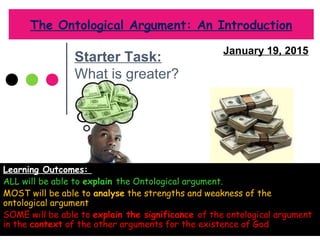
The Ontological Argument: An Introduction
Learning Outcomes:
ALL will be able to explain the Ontological argument.
MOST will be able to analyse the strengths and weakness of the
ontological argument
SOME will be able to explain the significance of the ontological argument
in the context of the other arguments for the existence of God
January 19, 2015
Starter Task:
What is greater?
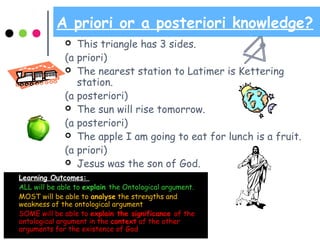
A priori or a posteriori knowledge?
 This triangle has 3 sides.
(a priori)
 The nearest station to Latimer is Kettering
station.
(a posteriori)
 The sun will rise tomorrow.
(a posteriori)
 The apple I am going to eat for lunch is a fruit.
(a priori)
 Jesus was the son of God.
(a posteriori) Learning Outcomes:
 ALL will be able to explain the Ontological argument.
 MOST will be able to analyse the strengths and
weakness of the ontological argument
 SOME will be able to explain the significance of the
ontological argument in the context of the other
arguments for the existence of God
A priori – a proposition based on a definition
and the use of logic alone, no experience
needed.
A posteriori – a proposition based upon
experience alone.
 Learning Outcomes:
 ALL will be able to explain the Ontological argument.
 MOST will be able to analyse the strengths and
weakness of the ontological argument
 SOME will be able to explain the significance of the
ontological argument in the context of the other
arguments for the existence of God
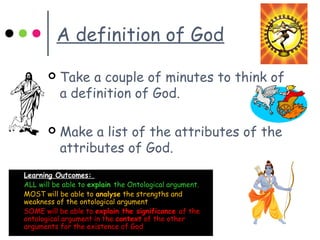
A definition of God
 Take a couple of minutes to think of
a definition of God.
 Make a list of the attributes of the
attributes of God.
 Learning Outcomes:
 ALL will be able to explain the Ontological argument.
 MOST will be able to analyse the strengths and
weakness of the ontological argument
 SOME will be able to explain the significance of the
ontological argument in the context of the other
arguments for the existence of God
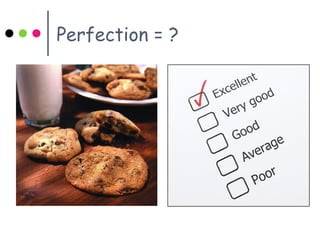
Perfection = ?
Anselm says
 God is “that than which
nothing greater can be
conceived”
 “you can’t imagine anything
greater than God”
 “God is perfect in every way”
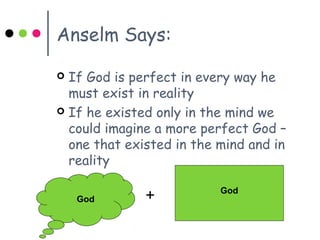
Anselm Says:
 If God is perfect in every way he
must exist in reality
 If he existed only in the mind we
could imagine a more perfect God –
one that existed in the mind and in
reality
God
God
+
Ontological Argument in a nutshell
- Something is greater if it exists
than if it doesn’t.
- If God is the greatest thing
imaginable, he must exist. For if he
didn’t, you could imagine something
greater – something with all his
qualities, but which did actually
exist. Learning Outcomes:
 ALL will be able to explain the Ontological argument.
 MOST will be able to analyse the strengths and
weakness of the ontological argument
 SOME will be able to explain the significance of the
ontological argument in the context of the other
arguments for the existence of God
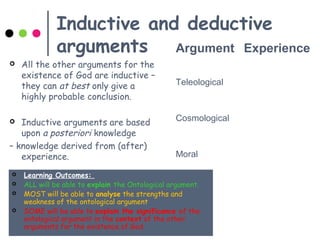
Inductive and deductive
arguments
 All the other arguments for the
existence of God are inductive –
they can at best only give a
highly probable conclusion.
 Inductive arguments are based
upon a posteriori knowledge
– knowledge derived from (after)
experience.
Argument Experience
Teleological
Cosmological
Moral
 Learning Outcomes:
 ALL will be able to explain the Ontological argument.
 MOST will be able to analyse the strengths and
weakness of the ontological argument
 SOME will be able to explain the significance of the
ontological argument in the context of the other
arguments for the existence of God
Inductive/deductive
cont’d…
 A deductive argument is based upon a priori knowledge.
 The conclusion is implied directly by the premises, i.e. flows
directly from them.
 If the premises are true and the structure is valid, then the
conclusion must be true.
 The Ontological Argument is the only deductive argument
for the existence of God.
→ This means ontological arguments are the only arguments
that could…
prove God’s existence conclusively
Task
 You will watch these clips and use the question
sheet to help you learn about the ontological
arguments and the arguments against it.
 You will have 45 mins to complete this.
 Part 1
 Part 2
 When you finish you need to attempt this 10 mark
question:
‘‘The ontological argument is convincing’ DiscusThe ontological argument is convincing’ Discus
The Ontological Argument
Ontological. (From the Greek ontos,
meaning being.)
Lesson objectives:
•DESCRIBE the ontological argument (Grade E & D)
•EXPLAIN the strengths and weaknesses of the
ontological argument (Grade C)
•EVALUATE the ontological argument and express
your own view of it. (Grade B & A)
January 19, 2015
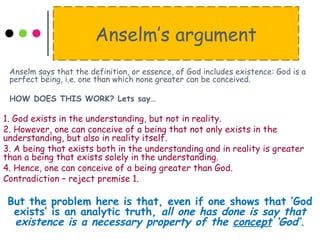
Anselm’s argument
Anselm says that the definition, or essence, of God includes existence: God is a
perfect being, i.e. one than which none greater can be conceived.
HOW DOES THIS WORK? Lets say…
1. God exists in the understanding, but not in reality.
2. However, one can conceive of a being that not only exists in the
understanding, but also in reality itself.
3. A being that exists both in the understanding and in reality is greater
than a being that exists solely in the understanding.
4. Hence, one can conceive of a being greater than God.
Contradiction – reject premise 1.
But the problem here is that, even if one shows that ‘God
exists’ is an analytic truth, all one has done is say that
existence is a necessary property of the concept ‘God’.
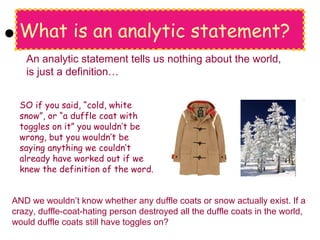
What is an analytic statement?
SO if you said, “cold, white
snow”, or “a duffle coat with
toggles on it” you wouldn’t be
wrong, but you wouldn’t be
saying anything we couldn’t
already have worked out if we
knew the definition of the word.
An analytic statement tells us nothing about the world,
is just a definition…
AND we wouldn’t know whether any duffle coats or snow actually exist. If a
crazy, duffle-coat-hating person destroyed all the duffle coats in the world,
would duffle coats still have toggles on?
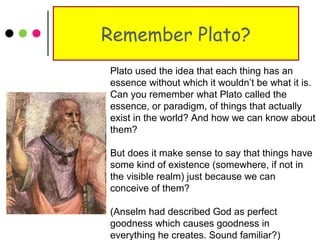
Remember Plato?
Plato used the idea that each thing has an
essence without which it wouldn’t be what it is.
Can you remember what Plato called the
essence, or paradigm, of things that actually
exist in the world? And how we can know about
them?
But does it make sense to say that things have
some kind of existence (somewhere, if not in
the visible realm) just because we can
conceive of them?
(Anselm had described God as perfect
goodness which causes goodness in
everything he creates. Sound familiar?)
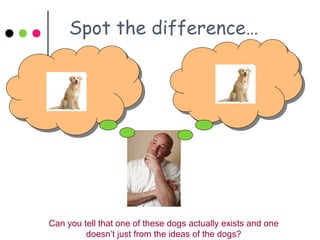
Spot the difference…
Can you tell that one of these dogs actually exists and one
doesn’t just from the ideas of the dogs?
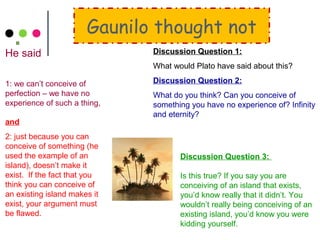
Gaunilo thought not
He said
1: we can’t conceive of
perfection – we have no
experience of such a thing,
and
2: just because you can
conceive of something (he
used the example of an
island), doesn’t make it
exist. If the fact that you
think you can conceive of
an existing island makes it
exist, your argument must
be flawed.
Discussion Question 1:
What would Plato have said about this?
Discussion Question 2:
What do you think? Can you conceive of
something you have no experience of? Infinity
and eternity?
Discussion Question 3:
Is this true? If you say you are
conceiving of an island that exists,
you’d know really that it didn’t. You
wouldn’t really being conceiving of an
existing island, you’d know you were
kidding yourself.
Descartes had his own version
of the ontological argument
Descartes has an idea of God as being one, perfect being.
Plato thought that we gain knowledge of concepts by
recollecting the time when we resided in the realm of Forms.
Descartes thought that we must have got our knowledge of
perfection from God, because we can have no experience of
perfection in this life. Unlike Plato he doesn’t believe in a cycle
of rebirth, but he does believe that God has imprinted some
knowledge on us so that we know certain things whatever
experience we have had in the world. Descartes says that we
get our knowledge of God from God, who has left his imprint
on our souls like the trademark a craftsman leaves on his work.
Question: Is this feasible? Do you think we have any innate
knowledge? What?
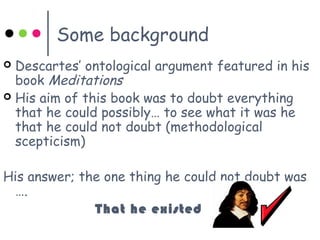
Some background
 Descartes’ ontological argument featured in his
book Meditations
 His aim of this book was to doubt everything
that he could possibly… to see what it was he
that he could not doubt (methodological
scepticism)
His answer; the one thing he could not doubt was
….
That he existed
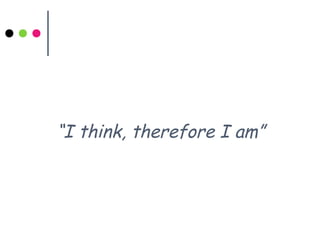
“I think, therefore I am”
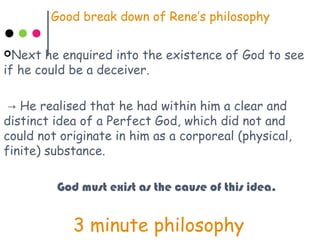
3 minute philosophy
Good break down of Rene’s philosophy
Next he enquired into the existence of God to see
if he could be a deceiver.
→ He realised that he had within him a clear and
distinct idea of a Perfect God, which did not and
could not originate in him as a corporeal (physical,
finite) substance.
God must exist as the cause of this idea.
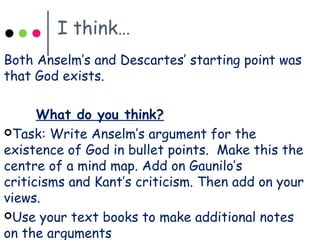
I think…
Both Anselm’s and Descartes’ starting point was
that God exists.
What do you think?
Task: Write Anselm’s argument for the
existence of God in bullet points. Make this the
centre of a mind map. Add on Gaunilo’s
criticisms and Kant’s criticism. Then add on your
views.
Use your text books to make additional notes
on the arguments

The ontological argument

  • 1.
    Homework Listen to andread the Russell & Copleston Debate. Fill in the answers on the question sheet for next lesson (THURSDAY) You will find it on the shared area Wdrive-RE-SM- Philosophy-homework
  • 2.
    The Ontological Argument:An Introduction Learning Outcomes: ALL will be able to explain the Ontological argument. MOST will be able to analyse the strengths and weakness of the ontological argument SOME will be able to explain the significance of the ontological argument in the context of the other arguments for the existence of God January 19, 2015 Starter Task: What is greater?
  • 3.
    A priori ora posteriori knowledge?  This triangle has 3 sides. (a priori)  The nearest station to Latimer is Kettering station. (a posteriori)  The sun will rise tomorrow. (a posteriori)  The apple I am going to eat for lunch is a fruit. (a priori)  Jesus was the son of God. (a posteriori) Learning Outcomes:  ALL will be able to explain the Ontological argument.  MOST will be able to analyse the strengths and weakness of the ontological argument  SOME will be able to explain the significance of the ontological argument in the context of the other arguments for the existence of God
  • 4.
    A priori –a proposition based on a definition and the use of logic alone, no experience needed. A posteriori – a proposition based upon experience alone.  Learning Outcomes:  ALL will be able to explain the Ontological argument.  MOST will be able to analyse the strengths and weakness of the ontological argument  SOME will be able to explain the significance of the ontological argument in the context of the other arguments for the existence of God
  • 5.
    A definition ofGod  Take a couple of minutes to think of a definition of God.  Make a list of the attributes of the attributes of God.  Learning Outcomes:  ALL will be able to explain the Ontological argument.  MOST will be able to analyse the strengths and weakness of the ontological argument  SOME will be able to explain the significance of the ontological argument in the context of the other arguments for the existence of God
  • 6.
  • 7.
    Anselm says  Godis “that than which nothing greater can be conceived”  “you can’t imagine anything greater than God”  “God is perfect in every way”
  • 8.
    Anselm Says:  IfGod is perfect in every way he must exist in reality  If he existed only in the mind we could imagine a more perfect God – one that existed in the mind and in reality God God +
  • 9.
    Ontological Argument ina nutshell - Something is greater if it exists than if it doesn’t. - If God is the greatest thing imaginable, he must exist. For if he didn’t, you could imagine something greater – something with all his qualities, but which did actually exist. Learning Outcomes:  ALL will be able to explain the Ontological argument.  MOST will be able to analyse the strengths and weakness of the ontological argument  SOME will be able to explain the significance of the ontological argument in the context of the other arguments for the existence of God
  • 10.
    Inductive and deductive arguments All the other arguments for the existence of God are inductive – they can at best only give a highly probable conclusion.  Inductive arguments are based upon a posteriori knowledge – knowledge derived from (after) experience. Argument Experience Teleological Cosmological Moral  Learning Outcomes:  ALL will be able to explain the Ontological argument.  MOST will be able to analyse the strengths and weakness of the ontological argument  SOME will be able to explain the significance of the ontological argument in the context of the other arguments for the existence of God
  • 11.
    Inductive/deductive cont’d…  A deductiveargument is based upon a priori knowledge.  The conclusion is implied directly by the premises, i.e. flows directly from them.  If the premises are true and the structure is valid, then the conclusion must be true.  The Ontological Argument is the only deductive argument for the existence of God. → This means ontological arguments are the only arguments that could… prove God’s existence conclusively
  • 12.
    Task  You willwatch these clips and use the question sheet to help you learn about the ontological arguments and the arguments against it.  You will have 45 mins to complete this.  Part 1  Part 2  When you finish you need to attempt this 10 mark question: ‘‘The ontological argument is convincing’ DiscusThe ontological argument is convincing’ Discus
  • 13.
    The Ontological Argument Ontological.(From the Greek ontos, meaning being.) Lesson objectives: •DESCRIBE the ontological argument (Grade E & D) •EXPLAIN the strengths and weaknesses of the ontological argument (Grade C) •EVALUATE the ontological argument and express your own view of it. (Grade B & A) January 19, 2015
  • 14.
    Anselm’s argument Anselm saysthat the definition, or essence, of God includes existence: God is a perfect being, i.e. one than which none greater can be conceived. HOW DOES THIS WORK? Lets say… 1. God exists in the understanding, but not in reality. 2. However, one can conceive of a being that not only exists in the understanding, but also in reality itself. 3. A being that exists both in the understanding and in reality is greater than a being that exists solely in the understanding. 4. Hence, one can conceive of a being greater than God. Contradiction – reject premise 1. But the problem here is that, even if one shows that ‘God exists’ is an analytic truth, all one has done is say that existence is a necessary property of the concept ‘God’.
  • 15.
    What is ananalytic statement? SO if you said, “cold, white snow”, or “a duffle coat with toggles on it” you wouldn’t be wrong, but you wouldn’t be saying anything we couldn’t already have worked out if we knew the definition of the word. An analytic statement tells us nothing about the world, is just a definition… AND we wouldn’t know whether any duffle coats or snow actually exist. If a crazy, duffle-coat-hating person destroyed all the duffle coats in the world, would duffle coats still have toggles on?
  • 16.
    Remember Plato? Plato usedthe idea that each thing has an essence without which it wouldn’t be what it is. Can you remember what Plato called the essence, or paradigm, of things that actually exist in the world? And how we can know about them? But does it make sense to say that things have some kind of existence (somewhere, if not in the visible realm) just because we can conceive of them? (Anselm had described God as perfect goodness which causes goodness in everything he creates. Sound familiar?)
  • 17.
    Spot the difference… Canyou tell that one of these dogs actually exists and one doesn’t just from the ideas of the dogs?
  • 18.
    Gaunilo thought not Hesaid 1: we can’t conceive of perfection – we have no experience of such a thing, and 2: just because you can conceive of something (he used the example of an island), doesn’t make it exist. If the fact that you think you can conceive of an existing island makes it exist, your argument must be flawed. Discussion Question 1: What would Plato have said about this? Discussion Question 2: What do you think? Can you conceive of something you have no experience of? Infinity and eternity? Discussion Question 3: Is this true? If you say you are conceiving of an island that exists, you’d know really that it didn’t. You wouldn’t really being conceiving of an existing island, you’d know you were kidding yourself.
  • 19.
    Descartes had hisown version of the ontological argument Descartes has an idea of God as being one, perfect being. Plato thought that we gain knowledge of concepts by recollecting the time when we resided in the realm of Forms. Descartes thought that we must have got our knowledge of perfection from God, because we can have no experience of perfection in this life. Unlike Plato he doesn’t believe in a cycle of rebirth, but he does believe that God has imprinted some knowledge on us so that we know certain things whatever experience we have had in the world. Descartes says that we get our knowledge of God from God, who has left his imprint on our souls like the trademark a craftsman leaves on his work. Question: Is this feasible? Do you think we have any innate knowledge? What?
  • 20.
    Some background  Descartes’ontological argument featured in his book Meditations  His aim of this book was to doubt everything that he could possibly… to see what it was he that he could not doubt (methodological scepticism) His answer; the one thing he could not doubt was …. That he existed
  • 21.
  • 22.
    3 minute philosophy Goodbreak down of Rene’s philosophy Next he enquired into the existence of God to see if he could be a deceiver. → He realised that he had within him a clear and distinct idea of a Perfect God, which did not and could not originate in him as a corporeal (physical, finite) substance. God must exist as the cause of this idea.
  • 23.
    I think… Both Anselm’sand Descartes’ starting point was that God exists. What do you think? Task: Write Anselm’s argument for the existence of God in bullet points. Make this the centre of a mind map. Add on Gaunilo’s criticisms and Kant’s criticism. Then add on your views. Use your text books to make additional notes on the arguments

Editor's Notes

  • #6 Would your God have to exist as part of it’s definition?