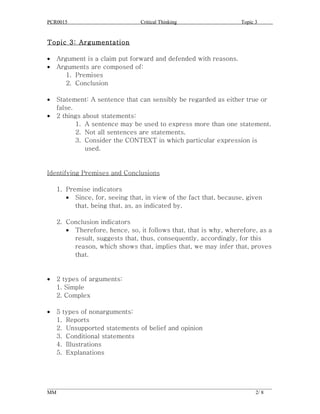
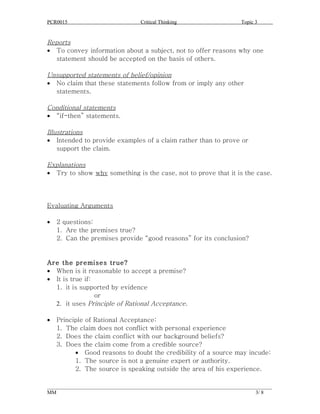
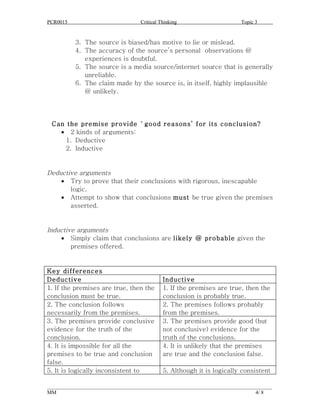
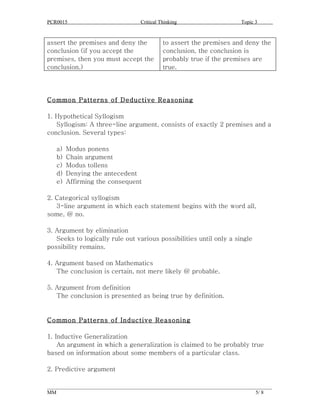
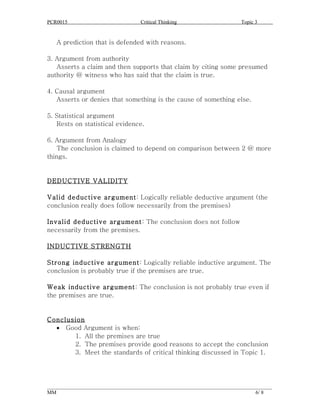
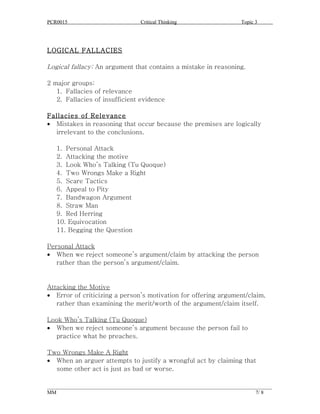
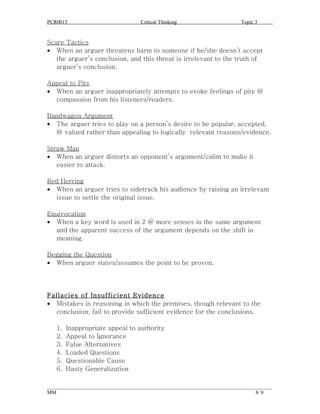
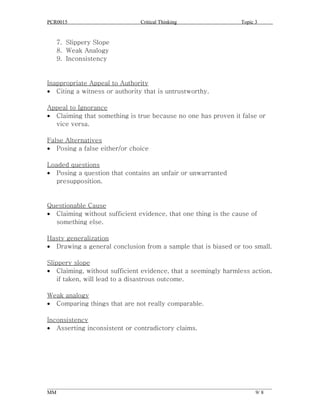
This document provides an overview of argumentation and critical thinking. It defines an argument as a claim defended with reasons, and identifies the key components of arguments as premises and conclusions. It also distinguishes between simple and complex arguments, and defines five types of non-arguments. The document discusses how to evaluate arguments by assessing whether premises are true and whether premises provide good reasons for the conclusion. It also contrasts deductive and inductive arguments and provides examples of common patterns of reasoning for each. Finally, it defines logical fallacies and identifies two major groups - fallacies of relevance and fallacies of insufficient evidence.


![Rogerian argumentpp[1]](https://cdn.slidesharecdn.com/ss_thumbnails/rogerianargumentpp1-140530112706-phpapp02-thumbnail.jpg?width=640&height=640&fit=bounds)


![Rebuttals [A Report in Argumentation]](https://cdn.slidesharecdn.com/ss_thumbnails/rebuttalsreportinargu-151202143305-lva1-app6891-thumbnail.jpg?width=640&height=640&fit=bounds)


![Critical Thinking powerpoint [Autosaved].pptx](https://cdn.slidesharecdn.com/ss_thumbnails/criticalthinkingppautosaved-250903164812-5d17f9e0-thumbnail.jpg?width=640&height=640&fit=bounds)


