Slides for Chapter 1  Characterization of Distributed Systems From  Coulouris, Dollimore and Kindberg Distributed Systems:  Concepts and Design Edition 4, © Pearson Education 2005
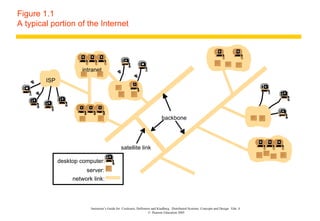
Figure 1.1 A typical portion of the Internet  Instructor’s Guide for  Coulouris, Dollimore and Kindberg  Distributed Systems: Concepts and Design  Edn. 4  ©  Pearson Education 2005  intranet ISP desktop computer: backbone satellite link server:  network link:   
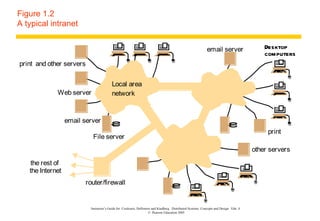
Figure 1.2 A typical intranet  Instructor’s Guide for  Coulouris, Dollimore and Kindberg  Distributed Systems: Concepts and Design  Edn. 4  ©  Pearson Education 2005
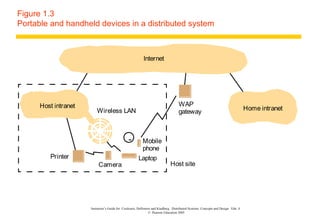
Figure 1.3 Portable and handheld devices in a distributed system Instructor’s Guide for  Coulouris, Dollimore and Kindberg  Distributed Systems: Concepts and Design  Edn. 4  ©  Pearson Education 2005
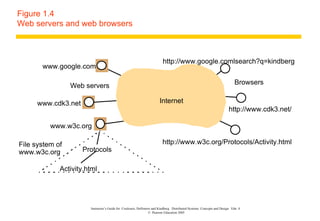
Figure 1.4 Web servers and web browsers Instructor’s Guide for  Coulouris, Dollimore and Kindberg  Distributed Systems: Concepts and Design  Edn. 4  ©  Pearson Education 2005  Internet Browsers Web servers www.google.com www.cdk3.net www.w3c.org Protocols Activity.html http://www.w3c.org/Protocols/Activity.html http://www.google.comlsearch?q=kindberg http://www.cdk3.net/ File system of www.w3c.org
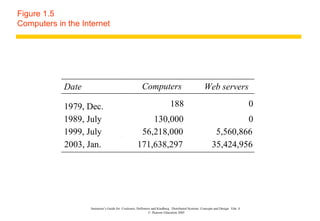
Figure 1.5 Computers in the Internet Instructor’s Guide for  Coulouris, Dollimore and Kindberg  Distributed Systems: Concepts and Design  Edn. 4  ©  Pearson Education 2005  Date Computers Web servers 1979, Dec. 188 0 1989, July 130,000 0 1999, July 56,218,000 5,560,866 2003, Jan. 171,638,297 35,424,956
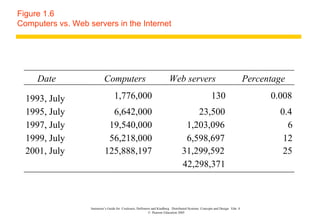
Figure 1.6 Computers vs. Web servers in the Internet Instructor’s Guide for  Coulouris, Dollimore and Kindberg  Distributed Systems: Concepts and Design  Edn. 4  ©  Pearson Education 2005  Date Computers Web servers Percentage 1993, July 1,776,000 130 0.008 1995, July 6,642,000 23,500 0.4 1997, July 19,540,000 1,203,096 6 1999, July 56,218,000 6,598,697 12 2001, July 125,888,197 31,299,592 25 42,298,371
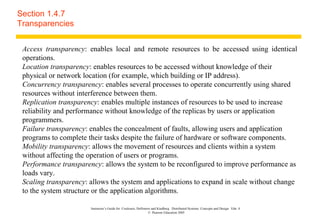
Section 1.4.7 Transparencies Instructor’s Guide for  Coulouris, Dollimore and Kindberg  Distributed Systems: Concepts and Design  Edn. 4  ©  Pearson Education 2005  Access transparency : enables local and remote resources to be accessed using identical operations. Location transparency : enables resources to be accessed without knowledge of their physical or network location (for example, which building or IP address). Concurrency transparency : enables several processes to operate concurrently using shared resources without interference between them. Replication transparency : enables multiple instances of resources to be used to increase reliability and performance without knowledge of the replicas by users or application programmers. Failure transparency : enables the concealment of faults, allowing users and application programs to complete their tasks despite the failure of hardware or software components. Mobility transparency : allows the movement of resources and clients within a system without affecting the operation of users or programs. Performance transparency : allows the system to be reconfigured to improve performance as loads vary. Scaling transparency : allows the system and applications to expand in scale without change to the system structure or the application algorithms.

Chapter 1 slides

  • 1.
    Slidesfor Chapter 1 Characterization of Distributed Systems From Coulouris, Dollimore and Kindberg Distributed Systems: Concepts and Design Edition 4, © Pearson Education 2005
  • 2.
    Figure 1.1 Atypical portion of the Internet Instructor’s Guide for Coulouris, Dollimore and Kindberg Distributed Systems: Concepts and Design Edn. 4 © Pearson Education 2005 intranet ISP desktop computer: backbone satellite link server:  network link:   
  • 3.
    Figure 1.2 Atypical intranet Instructor’s Guide for Coulouris, Dollimore and Kindberg Distributed Systems: Concepts and Design Edn. 4 © Pearson Education 2005
  • 4.
    Figure 1.3 Portableand handheld devices in a distributed system Instructor’s Guide for Coulouris, Dollimore and Kindberg Distributed Systems: Concepts and Design Edn. 4 © Pearson Education 2005
  • 5.
    Figure 1.4 Webservers and web browsers Instructor’s Guide for Coulouris, Dollimore and Kindberg Distributed Systems: Concepts and Design Edn. 4 © Pearson Education 2005 Internet Browsers Web servers www.google.com www.cdk3.net www.w3c.org Protocols Activity.html http://www.w3c.org/Protocols/Activity.html http://www.google.comlsearch?q=kindberg http://www.cdk3.net/ File system of www.w3c.org
  • 6.
    Figure 1.5 Computersin the Internet Instructor’s Guide for Coulouris, Dollimore and Kindberg Distributed Systems: Concepts and Design Edn. 4 © Pearson Education 2005 Date Computers Web servers 1979, Dec. 188 0 1989, July 130,000 0 1999, July 56,218,000 5,560,866 2003, Jan. 171,638,297 35,424,956
  • 7.
    Figure 1.6 Computersvs. Web servers in the Internet Instructor’s Guide for Coulouris, Dollimore and Kindberg Distributed Systems: Concepts and Design Edn. 4 © Pearson Education 2005 Date Computers Web servers Percentage 1993, July 1,776,000 130 0.008 1995, July 6,642,000 23,500 0.4 1997, July 19,540,000 1,203,096 6 1999, July 56,218,000 6,598,697 12 2001, July 125,888,197 31,299,592 25 42,298,371
  • 8.
    Section 1.4.7 TransparenciesInstructor’s Guide for Coulouris, Dollimore and Kindberg Distributed Systems: Concepts and Design Edn. 4 © Pearson Education 2005 Access transparency : enables local and remote resources to be accessed using identical operations. Location transparency : enables resources to be accessed without knowledge of their physical or network location (for example, which building or IP address). Concurrency transparency : enables several processes to operate concurrently using shared resources without interference between them. Replication transparency : enables multiple instances of resources to be used to increase reliability and performance without knowledge of the replicas by users or application programmers. Failure transparency : enables the concealment of faults, allowing users and application programs to complete their tasks despite the failure of hardware or software components. Mobility transparency : allows the movement of resources and clients within a system without affecting the operation of users or programs. Performance transparency : allows the system to be reconfigured to improve performance as loads vary. Scaling transparency : allows the system and applications to expand in scale without change to the system structure or the application algorithms.