Slides for Chapter 5:
Remote invocation


From Coulouris, Dollimore, Kindberg and Blair
Distributed Systems:
          Concepts and Design
Edition 5, © Addison-Wesley 2012
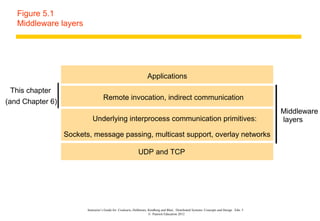
Figure 5.1
   Middleware layers


                                                                   Applications
  This chapter
                                    Remote invocation, indirect communication
(and Chapter 6)
                                                                                                                                            Middleware
                            Underlying interprocess communication primitives:                                                               layers

                  Sockets, message passing, multicast support, overlay networks

                                                             UDP and TCP


                         Instructor’s Guide for Coulouris, Dollimore, Kindberg and Blair, Distributed Systems: Concepts and Design Edn. 5
                                                                      © Pearson Education 2012
Request-reply communication


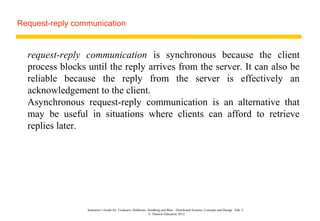
  request-reply communication is synchronous because the client
  process blocks until the reply arrives from the server. It can also be
  reliable because the reply from the server is effectively an
  acknowledgement to the client.
  Asynchronous request-reply communication is an alternative that
  may be useful in situations where clients can afford to retrieve
  replies later.


                 Instructor’s Guide for Coulouris, Dollimore, Kindberg and Blair, Distributed Systems: Concepts and Design Edn. 5
                                                              © Pearson Education 2012
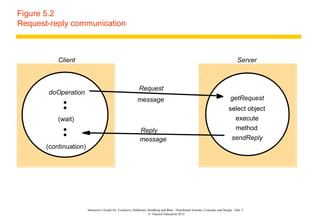
Figure 5.2
Request-reply communication


           Client                                                                                                                  Server


                                                            Request
       doOperation
                                                           message                                                            getRequest
                                                                                                                             select object
           (wait)                                                                                                              execute
                                                             Reply                                                             method
                                                             message                                                          sendReply
       (continuation)


                        Instructor’s Guide for Coulouris, Dollimore, Kindberg and Blair, Distributed Systems: Concepts and Design Edn. 5
                                                                     © Pearson Education 2012
Operations of the request-reply protocol


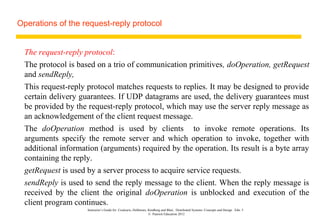
  The request-reply protocol:
  The protocol is based on a trio of communication primitives, doOperation, getRequest
  and sendReply,
  This request-reply protocol matches requests to replies. It may be designed to provide
  certain delivery guarantees. If UDP datagrams are used, the delivery guarantees must
  be provided by the request-reply protocol, which may use the server reply message as
  an acknowledgement of the client request message.
  The doOperation method is used by clients to invoke remote operations. Its
  arguments specify the remote server and which operation to invoke, together with
  additional information (arguments) required by the operation. Its result is a byte array
  containing the reply.
  getRequest is used by a server process to acquire service requests.
  sendReply is used to send the reply message to the client. When the reply message is
  received by the client the original doOperation is unblocked and execution of the
  client program continues.
                     Instructor’s Guide for Coulouris, Dollimore, Kindberg and Blair, Distributed Systems: Concepts and Design Edn. 5
                                                                  © Pearson Education 2012
Figure 5.3
Operations of the request-reply protocol


  public byte[] doOperation (RemoteRef s, int operationId, byte[] arguments)
     sends a request message to the remote server and returns the reply.
     The arguments specify the remote server, the operation to be invoked and the
         arguments of that operation.
  public byte[] getRequest ();
    acquires a client request via the server port.
  public void sendReply (byte[] reply, InetAddress clientHost, int clientPort);
    sends the reply message reply to the client at its Internet address and port.


                    Instructor’s Guide for Coulouris, Dollimore, Kindberg and Blair, Distributed Systems: Concepts and Design Edn. 5
                                                                 © Pearson Education 2012
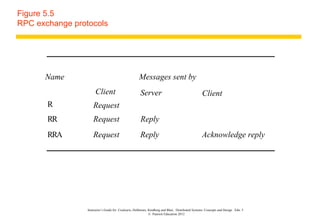
Styles of exchange protocols


Three protocols that produce differing behaviours in
   the presence of communication failures are used for
   implementing various types of request behaviour.
   They were originally identified by Spector [1982]:
• the request (R) protocol;
• the request-reply (RR) protocol;
• the request-reply-acknowledge reply (RRA) protocol.


                                                   7
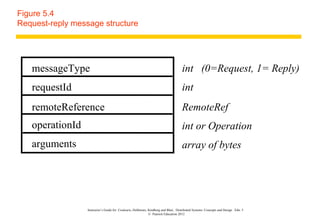
Figure 5.4
Request-reply message structure


   messageType                                                                       int (0=Request, 1= Reply)
   requestId                                                                         int
   remoteReference                                                                   RemoteRef
   operationId                                                                       int or Operation
   arguments                                                                         array of bytes


                  Instructor’s Guide for Coulouris, Dollimore, Kindberg and Blair, Distributed Systems: Concepts and Design Edn. 5
                                                               © Pearson Education 2012
Figure 5.5
RPC exchange protocols


      Name                                            Messages sent by
                      Client                          Server                                       Client
       R             Request
       RR            Request                           Reply
       RRA           Request                          Reply                                        Acknowledge reply


                 Instructor’s Guide for Coulouris, Dollimore, Kindberg and Blair, Distributed Systems: Concepts and Design Edn. 5
                                                              © Pearson Education 2012
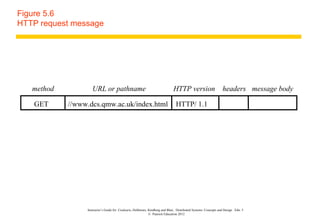
HTTP


HTTP is a protocol that specifies the messages
   involved in a request-reply exchange, the methods,
   arguments and results, and the rules for
   representing them in the messages.
It supports a fixed set of methods (GET, PUT,POST,
   etc) that are applicable to all of the server’s
   resources.


                                                 10
HTTP


In addition to invoking methods on web resources, the protocol allows
   for content negotiation and password-style authentication:
Content negotiation: Clients’ requests can include information as to
   what data representations they can accept (for example, language
   or media type), enabling the server to choose the representation
   that is the most appropriate for the user.
Authentication: Credentials and challenges are used to support
   password-style authentication. On the first attempt to access a
   password-protected area, the server reply contains a challenge
   applicable to the resource. When a client receives a challenge, it
   gets the user to type a name and password and submits the
   associated credentials with subsequent requests.


                                                                11
Figure 5.6
HTTP request message


   method           URL or pathname                                           HTTP version                        headers message body

   GET      //www.dcs.qmw.ac.uk/index.html                                      HTTP/ 1.1


                 Instructor’s Guide for Coulouris, Dollimore, Kindberg and Blair, Distributed Systems: Concepts and Design Edn. 5
                                                              © Pearson Education 2012
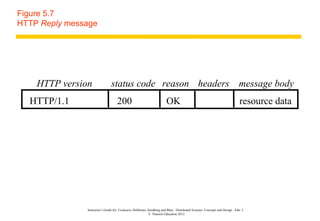
Figure 5.7
HTTP Reply message


    HTTP version               status code reason headers message body
  HTTP/1.1                          200                                OK                                                   resource data


               Instructor’s Guide for Coulouris, Dollimore, Kindberg and Blair, Distributed Systems: Concepts and Design Edn. 5
                                                            © Pearson Education 2012
Interface definition languages IDL


An RPC mechanism can be integrated with a particular programming
   language if it includes an adequate notation for defining interfaces,
   allowing input and output parameters to be mapped onto the language’s
   normal use of parameters.
This approach is useful when all the parts of a distributed application can be
   written in the same language. It is also convenient because it allows the
   programmer to use a single language, for example, Java, for local and
   remote invocation.
However, many existing useful services are written in C++ and other
   languages. It would be beneficial to allow programs written in a variety of
   languages, including Java, to access them remotely.
Interface definition languages (IDLs) are designed to allow procedures
   implemented in different languages to invoke one another.
An IDL provides a notation for defining interfaces in which each of the
   parameters of an operation may be described as for input or output in
   addition to having its type specified.                                 14
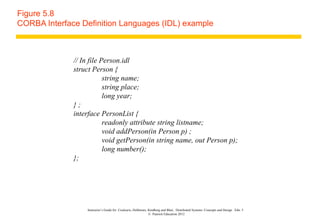
Figure 5.8
CORBA Interface Definition Languages (IDL) example


              // In file Person.idl
              struct Person {
                          string name;
                          string place;
                          long year;
              };
              interface PersonList {
                          readonly attribute string listname;
                          void addPerson(in Person p) ;
                          void getPerson(in string name, out Person p);
                          long number();
              };


                  Instructor’s Guide for Coulouris, Dollimore, Kindberg and Blair, Distributed Systems: Concepts and Design Edn. 5
                                                               © Pearson Education 2012
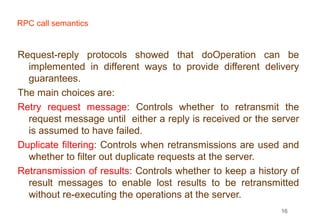
RPC call semantics


Request-reply protocols showed that doOperation can be
  implemented in different ways to provide different delivery
  guarantees.
The main choices are:
Retry request message: Controls whether to retransmit the
  request message until either a reply is received or the server
  is assumed to have failed.
Duplicate filtering: Controls when retransmissions are used and
  whether to filter out duplicate requests at the server.
Retransmission of results: Controls whether to keep a history of
  result messages to enable lost results to be retransmitted
  without re-executing the operations at the server.
                                                           16
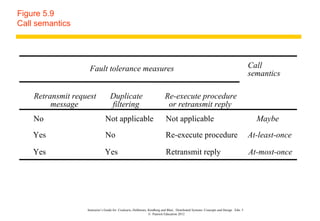
Figure 5.9
Call semantics


                    Fault tolerance measures                                                                                          Call
                                                                                                                                      semantics

    Retransmit request             Duplicate                              Re-execute procedure
         message                   filtering                               or retransmit reply
    No                         Not applicable                              Not applicable                                               Maybe
    Yes                        No                                          Re-execute procedure                                       At-least-once

    Yes                        Yes                                         Retransmit reply                                           At-most-once


                   Instructor’s Guide for Coulouris, Dollimore, Kindberg and Blair, Distributed Systems: Concepts and Design Edn. 5
                                                                © Pearson Education 2012
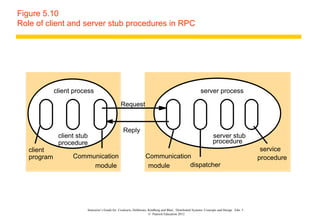
Figure 5.10
Role of client and server stub procedures in RPC


             client process                                                                              server process

                                               Request


                                                 Reply
              client stub                                                                                         server stub
              procedure                                                                                           procedure
   client                                                                                                                                   service
   program         Communication                                 Communication                                                             procedure
                        module                                    module      dispatcher


                        Instructor’s Guide for Coulouris, Dollimore, Kindberg and Blair, Distributed Systems: Concepts and Design Edn. 5
                                                                     © Pearson Education 2012
Figure 5.11
Files interface in Sun XDR


         const MAX = 1000;
         typedef int FileIdentifier;
         typedef int FilePointer;
         typedef int Length;                                                             struct readargs {
         struct Data {                                                                       FileIdentifier f;
             int length;                                                                     FilePointer position;
             char buffer[MAX];                                                               Length length;
         };                                                                              };
         struct writeargs {
             FileIdentifier f;                                                           program FILEREADWRITE {
             FilePointer position;                                                         version VERSION {
             Data data;                                                                      void WRITE(writeargs)=1;                  1
         };                                                                                  Data READ(readargs)=2;                    2
                                                                                           }=2;
                                                                                         } = 9999;

                    Instructor’s Guide for Coulouris, Dollimore, Kindberg and Blair, Distributed Systems: Concepts and Design Edn. 5
                                                                 © Pearson Education 2012
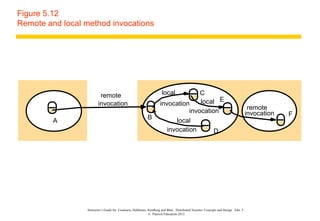
Figure 5.12
Remote and local method invocations


                          remote                                       local         C
                         invocation                                   invocation     local E
                                                                                                                                      remote
                                                                                 invocation                                          invocation   F
                                                             B              local
         A
                                                                         invocation       D


                  Instructor’s Guide for Coulouris, Dollimore, Kindberg and Blair, Distributed Systems: Concepts and Design Edn. 5
                                                               © Pearson Education 2012
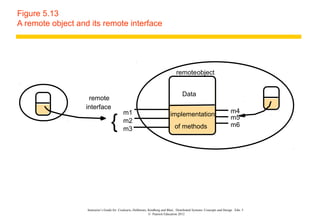
Figure 5.13
A remote object and its remote interface


                                                                                  remoteobject


                                                                                       Data
                   remote
                  interface
                                            m1                                                                           m4

                                   {
                                                                              implementation                             m5
                                            m2
                                                                                 of methods                              m6
                                            m3


                   Instructor’s Guide for Coulouris, Dollimore, Kindberg and Blair, Distributed Systems: Concepts and Design Edn. 5
                                                                © Pearson Education 2012
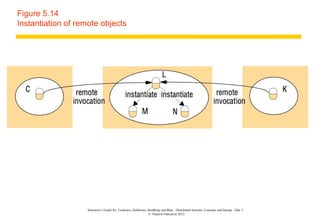
Figure 5.14
Instantiation of remote objects


                   Instructor’s Guide for Coulouris, Dollimore, Kindberg and Blair, Distributed Systems: Concepts and Design Edn. 5
                                                                © Pearson Education 2012
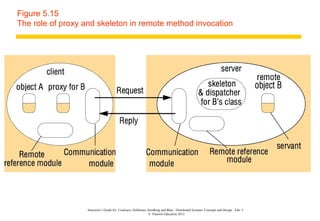
Figure 5.15
The role of proxy and skeleton in remote method invocation


                  Instructor’s Guide for Coulouris, Dollimore, Kindberg and Blair, Distributed Systems: Concepts and Design Edn. 5
                                                               © Pearson Education 2012
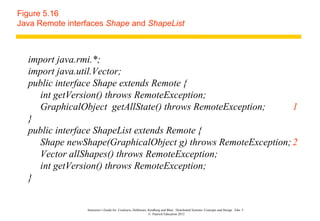
Figure 5.16
Java Remote interfaces Shape and ShapeList


  import java.rmi.*;
  import java.util.Vector;
  public interface Shape extends Remote {
    int getVersion() throws RemoteException;
    GraphicalObject getAllState() throws RemoteException;     1
  }
  public interface ShapeList extends Remote {
    Shape newShape(GraphicalObject g) throws RemoteException; 2
    Vector allShapes() throws RemoteException;
    int getVersion() throws RemoteException;
  }


                 Instructor’s Guide for Coulouris, Dollimore, Kindberg and Blair, Distributed Systems: Concepts and Design Edn. 5
                                                              © Pearson Education 2012
Figure 5.17
The Naming class of Java RMIregistry


 void rebind (String name, Remote obj)
    This method is used by a server to register the identifier of a remote object by
      name, as shown in Figure 15.18, line 3.
 void bind (String name, Remote obj)
    This method can alternatively be used by a server to register a remote object by
    name, but if the name is already bound to a remote object reference an
      exception is thrown.
 void unbind (String name, Remote obj)
    This method removes a binding.
 Remote lookup(String name)
    This method is used by clients to look up a remote object by name, as shown in
      Figure 5.20 line 1. A remote object reference is returned.
 String [] list()
 This method returns an array of Strings containing the names bound in the registry.


                    Instructor’s Guide for Coulouris, Dollimore, Kindberg and Blair, Distributed Systems: Concepts and Design Edn. 5
                                                                 © Pearson Education 2012
Figure 5.18
Java class ShapeListServer with main method


  import java.rmi.*;
  public class ShapeListServer{
     public static void main(String args[]){
          System.setSecurityManager(new RMISecurityManager());
          try{
             ShapeList aShapeList = new ShapeListServant();                                                                            1
                 Naming.rebind("Shape List", aShapeList );                                                                             2
             System.out.println("ShapeList server ready");
             }catch(Exception e) {
             System.out.println("ShapeList server main " + e.getMessage());}
     }
  }


                    Instructor’s Guide for Coulouris, Dollimore, Kindberg and Blair, Distributed Systems: Concepts and Design Edn. 5
                                                                 © Pearson Education 2012
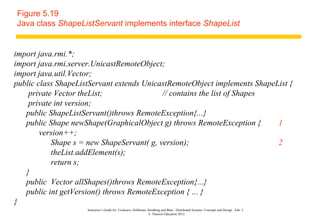
Figure 5.19
Java class ShapeListServant implements interface ShapeList


import java.rmi.*;
import java.rmi.server.UnicastRemoteObject;
import java.util.Vector;
public class ShapeListServant extends UnicastRemoteObject implements ShapeList {
    private Vector theList;                // contains the list of Shapes
    private int version;
   public ShapeListServant()throws RemoteException{...}
   public Shape newShape(GraphicalObject g) throws RemoteException {       1
        version++;
           Shape s = new ShapeServant( g, version);                        2
           theList.addElement(s);
           return s;
   }
   public Vector allShapes()throws RemoteException{...}
   public int getVersion() throws RemoteException { ... }
}
                     Instructor’s Guide for Coulouris, Dollimore, Kindberg and Blair, Distributed Systems: Concepts and Design Edn. 5
                                                                  © Pearson Education 2012
Figure 5.20
Java client of ShapeList


    import java.rmi.*;
    import java.rmi.server.*;
    import java.util.Vector;
    public class ShapeListClient{
      public static void main(String args[]){
        System.setSecurityManager(new RMISecurityManager());
        ShapeList aShapeList = null;
        try{
             aShapeList = (ShapeList) Naming.lookup("//bruno.ShapeList")                                                               ;
        1
             Vector sList = aShapeList.allShapes();                                                                                    2
        } catch(RemoteException e) {System.out.println(e.getMessage());
        }catch(Exception e) {System.out.println("Client: " + e.getMessage());}
      }
    }

                    Instructor’s Guide for Coulouris, Dollimore, Kindberg and Blair, Distributed Systems: Concepts and Design Edn. 5
                                                                 © Pearson Education 2012
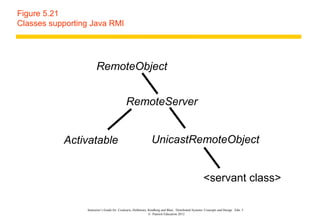
Figure 5.21
Classes supporting Java RMI


                       RemoteObject


                                            RemoteServer


           Activatable                                        UnicastRemoteObject


                                                                                                    <servant class>

                 Instructor’s Guide for Coulouris, Dollimore, Kindberg and Blair, Distributed Systems: Concepts and Design Edn. 5
                                                              © Pearson Education 2012

Chapter 5 slides

  • 1.
    Slides for Chapter5: Remote invocation From Coulouris, Dollimore, Kindberg and Blair Distributed Systems: Concepts and Design Edition 5, © Addison-Wesley 2012
  • 2.
    Figure 5.1 Middleware layers Applications This chapter Remote invocation, indirect communication (and Chapter 6) Middleware Underlying interprocess communication primitives: layers Sockets, message passing, multicast support, overlay networks UDP and TCP Instructor’s Guide for Coulouris, Dollimore, Kindberg and Blair, Distributed Systems: Concepts and Design Edn. 5 © Pearson Education 2012
  • 3.
    Request-reply communication request-reply communication is synchronous because the client process blocks until the reply arrives from the server. It can also be reliable because the reply from the server is effectively an acknowledgement to the client. Asynchronous request-reply communication is an alternative that may be useful in situations where clients can afford to retrieve replies later. Instructor’s Guide for Coulouris, Dollimore, Kindberg and Blair, Distributed Systems: Concepts and Design Edn. 5 © Pearson Education 2012
  • 4.
    Figure 5.2 Request-reply communication Client Server Request doOperation message getRequest select object (wait) execute Reply method message sendReply (continuation) Instructor’s Guide for Coulouris, Dollimore, Kindberg and Blair, Distributed Systems: Concepts and Design Edn. 5 © Pearson Education 2012
  • 5.
    Operations of therequest-reply protocol The request-reply protocol: The protocol is based on a trio of communication primitives, doOperation, getRequest and sendReply, This request-reply protocol matches requests to replies. It may be designed to provide certain delivery guarantees. If UDP datagrams are used, the delivery guarantees must be provided by the request-reply protocol, which may use the server reply message as an acknowledgement of the client request message. The doOperation method is used by clients to invoke remote operations. Its arguments specify the remote server and which operation to invoke, together with additional information (arguments) required by the operation. Its result is a byte array containing the reply. getRequest is used by a server process to acquire service requests. sendReply is used to send the reply message to the client. When the reply message is received by the client the original doOperation is unblocked and execution of the client program continues. Instructor’s Guide for Coulouris, Dollimore, Kindberg and Blair, Distributed Systems: Concepts and Design Edn. 5 © Pearson Education 2012
  • 6.
    Figure 5.3 Operations ofthe request-reply protocol public byte[] doOperation (RemoteRef s, int operationId, byte[] arguments) sends a request message to the remote server and returns the reply. The arguments specify the remote server, the operation to be invoked and the arguments of that operation. public byte[] getRequest (); acquires a client request via the server port. public void sendReply (byte[] reply, InetAddress clientHost, int clientPort); sends the reply message reply to the client at its Internet address and port. Instructor’s Guide for Coulouris, Dollimore, Kindberg and Blair, Distributed Systems: Concepts and Design Edn. 5 © Pearson Education 2012
  • 7.
    Styles of exchangeprotocols Three protocols that produce differing behaviours in the presence of communication failures are used for implementing various types of request behaviour. They were originally identified by Spector [1982]: • the request (R) protocol; • the request-reply (RR) protocol; • the request-reply-acknowledge reply (RRA) protocol. 7
  • 8.
    Figure 5.4 Request-reply messagestructure messageType int (0=Request, 1= Reply) requestId int remoteReference RemoteRef operationId int or Operation arguments array of bytes Instructor’s Guide for Coulouris, Dollimore, Kindberg and Blair, Distributed Systems: Concepts and Design Edn. 5 © Pearson Education 2012
  • 9.
    Figure 5.5 RPC exchangeprotocols Name Messages sent by Client Server Client R Request RR Request Reply RRA Request Reply Acknowledge reply Instructor’s Guide for Coulouris, Dollimore, Kindberg and Blair, Distributed Systems: Concepts and Design Edn. 5 © Pearson Education 2012
  • 10.
    HTTP HTTP is aprotocol that specifies the messages involved in a request-reply exchange, the methods, arguments and results, and the rules for representing them in the messages. It supports a fixed set of methods (GET, PUT,POST, etc) that are applicable to all of the server’s resources. 10
  • 11.
    HTTP In addition toinvoking methods on web resources, the protocol allows for content negotiation and password-style authentication: Content negotiation: Clients’ requests can include information as to what data representations they can accept (for example, language or media type), enabling the server to choose the representation that is the most appropriate for the user. Authentication: Credentials and challenges are used to support password-style authentication. On the first attempt to access a password-protected area, the server reply contains a challenge applicable to the resource. When a client receives a challenge, it gets the user to type a name and password and submits the associated credentials with subsequent requests. 11
  • 12.
    Figure 5.6 HTTP requestmessage method URL or pathname HTTP version headers message body GET //www.dcs.qmw.ac.uk/index.html HTTP/ 1.1 Instructor’s Guide for Coulouris, Dollimore, Kindberg and Blair, Distributed Systems: Concepts and Design Edn. 5 © Pearson Education 2012
  • 13.
    Figure 5.7 HTTP Replymessage HTTP version status code reason headers message body HTTP/1.1 200 OK resource data Instructor’s Guide for Coulouris, Dollimore, Kindberg and Blair, Distributed Systems: Concepts and Design Edn. 5 © Pearson Education 2012
  • 14.
    Interface definition languagesIDL An RPC mechanism can be integrated with a particular programming language if it includes an adequate notation for defining interfaces, allowing input and output parameters to be mapped onto the language’s normal use of parameters. This approach is useful when all the parts of a distributed application can be written in the same language. It is also convenient because it allows the programmer to use a single language, for example, Java, for local and remote invocation. However, many existing useful services are written in C++ and other languages. It would be beneficial to allow programs written in a variety of languages, including Java, to access them remotely. Interface definition languages (IDLs) are designed to allow procedures implemented in different languages to invoke one another. An IDL provides a notation for defining interfaces in which each of the parameters of an operation may be described as for input or output in addition to having its type specified. 14
  • 15.
    Figure 5.8 CORBA InterfaceDefinition Languages (IDL) example // In file Person.idl struct Person { string name; string place; long year; }; interface PersonList { readonly attribute string listname; void addPerson(in Person p) ; void getPerson(in string name, out Person p); long number(); }; Instructor’s Guide for Coulouris, Dollimore, Kindberg and Blair, Distributed Systems: Concepts and Design Edn. 5 © Pearson Education 2012
  • 16.
    RPC call semantics Request-replyprotocols showed that doOperation can be implemented in different ways to provide different delivery guarantees. The main choices are: Retry request message: Controls whether to retransmit the request message until either a reply is received or the server is assumed to have failed. Duplicate filtering: Controls when retransmissions are used and whether to filter out duplicate requests at the server. Retransmission of results: Controls whether to keep a history of result messages to enable lost results to be retransmitted without re-executing the operations at the server. 16
  • 17.
    Figure 5.9 Call semantics Fault tolerance measures Call semantics Retransmit request Duplicate Re-execute procedure message filtering or retransmit reply No Not applicable Not applicable Maybe Yes No Re-execute procedure At-least-once Yes Yes Retransmit reply At-most-once Instructor’s Guide for Coulouris, Dollimore, Kindberg and Blair, Distributed Systems: Concepts and Design Edn. 5 © Pearson Education 2012
  • 18.
    Figure 5.10 Role ofclient and server stub procedures in RPC client process server process Request Reply client stub server stub procedure procedure client service program Communication Communication procedure module module dispatcher Instructor’s Guide for Coulouris, Dollimore, Kindberg and Blair, Distributed Systems: Concepts and Design Edn. 5 © Pearson Education 2012
  • 19.
    Figure 5.11 Files interfacein Sun XDR const MAX = 1000; typedef int FileIdentifier; typedef int FilePointer; typedef int Length; struct readargs { struct Data { FileIdentifier f; int length; FilePointer position; char buffer[MAX]; Length length; }; }; struct writeargs { FileIdentifier f; program FILEREADWRITE { FilePointer position; version VERSION { Data data; void WRITE(writeargs)=1; 1 }; Data READ(readargs)=2; 2 }=2; } = 9999; Instructor’s Guide for Coulouris, Dollimore, Kindberg and Blair, Distributed Systems: Concepts and Design Edn. 5 © Pearson Education 2012
  • 20.
    Figure 5.12 Remote andlocal method invocations remote local C invocation invocation local E remote invocation invocation F B local A invocation D Instructor’s Guide for Coulouris, Dollimore, Kindberg and Blair, Distributed Systems: Concepts and Design Edn. 5 © Pearson Education 2012
  • 21.
    Figure 5.13 A remoteobject and its remote interface remoteobject Data remote interface m1 m4 { implementation m5 m2 of methods m6 m3 Instructor’s Guide for Coulouris, Dollimore, Kindberg and Blair, Distributed Systems: Concepts and Design Edn. 5 © Pearson Education 2012
  • 22.
    Figure 5.14 Instantiation ofremote objects Instructor’s Guide for Coulouris, Dollimore, Kindberg and Blair, Distributed Systems: Concepts and Design Edn. 5 © Pearson Education 2012
  • 23.
    Figure 5.15 The roleof proxy and skeleton in remote method invocation Instructor’s Guide for Coulouris, Dollimore, Kindberg and Blair, Distributed Systems: Concepts and Design Edn. 5 © Pearson Education 2012
  • 24.
    Figure 5.16 Java Remoteinterfaces Shape and ShapeList import java.rmi.*; import java.util.Vector; public interface Shape extends Remote { int getVersion() throws RemoteException; GraphicalObject getAllState() throws RemoteException; 1 } public interface ShapeList extends Remote { Shape newShape(GraphicalObject g) throws RemoteException; 2 Vector allShapes() throws RemoteException; int getVersion() throws RemoteException; } Instructor’s Guide for Coulouris, Dollimore, Kindberg and Blair, Distributed Systems: Concepts and Design Edn. 5 © Pearson Education 2012
  • 25.
    Figure 5.17 The Namingclass of Java RMIregistry void rebind (String name, Remote obj) This method is used by a server to register the identifier of a remote object by name, as shown in Figure 15.18, line 3. void bind (String name, Remote obj) This method can alternatively be used by a server to register a remote object by name, but if the name is already bound to a remote object reference an exception is thrown. void unbind (String name, Remote obj) This method removes a binding. Remote lookup(String name) This method is used by clients to look up a remote object by name, as shown in Figure 5.20 line 1. A remote object reference is returned. String [] list() This method returns an array of Strings containing the names bound in the registry. Instructor’s Guide for Coulouris, Dollimore, Kindberg and Blair, Distributed Systems: Concepts and Design Edn. 5 © Pearson Education 2012
  • 26.
    Figure 5.18 Java classShapeListServer with main method import java.rmi.*; public class ShapeListServer{ public static void main(String args[]){ System.setSecurityManager(new RMISecurityManager()); try{ ShapeList aShapeList = new ShapeListServant(); 1 Naming.rebind("Shape List", aShapeList ); 2 System.out.println("ShapeList server ready"); }catch(Exception e) { System.out.println("ShapeList server main " + e.getMessage());} } } Instructor’s Guide for Coulouris, Dollimore, Kindberg and Blair, Distributed Systems: Concepts and Design Edn. 5 © Pearson Education 2012
  • 27.
    Figure 5.19 Java classShapeListServant implements interface ShapeList import java.rmi.*; import java.rmi.server.UnicastRemoteObject; import java.util.Vector; public class ShapeListServant extends UnicastRemoteObject implements ShapeList { private Vector theList; // contains the list of Shapes private int version; public ShapeListServant()throws RemoteException{...} public Shape newShape(GraphicalObject g) throws RemoteException { 1 version++; Shape s = new ShapeServant( g, version); 2 theList.addElement(s); return s; } public Vector allShapes()throws RemoteException{...} public int getVersion() throws RemoteException { ... } } Instructor’s Guide for Coulouris, Dollimore, Kindberg and Blair, Distributed Systems: Concepts and Design Edn. 5 © Pearson Education 2012
  • 28.
    Figure 5.20 Java clientof ShapeList import java.rmi.*; import java.rmi.server.*; import java.util.Vector; public class ShapeListClient{ public static void main(String args[]){ System.setSecurityManager(new RMISecurityManager()); ShapeList aShapeList = null; try{ aShapeList = (ShapeList) Naming.lookup("//bruno.ShapeList") ; 1 Vector sList = aShapeList.allShapes(); 2 } catch(RemoteException e) {System.out.println(e.getMessage()); }catch(Exception e) {System.out.println("Client: " + e.getMessage());} } } Instructor’s Guide for Coulouris, Dollimore, Kindberg and Blair, Distributed Systems: Concepts and Design Edn. 5 © Pearson Education 2012
  • 29.
    Figure 5.21 Classes supportingJava RMI RemoteObject RemoteServer Activatable UnicastRemoteObject <servant class> Instructor’s Guide for Coulouris, Dollimore, Kindberg and Blair, Distributed Systems: Concepts and Design Edn. 5 © Pearson Education 2012