BRIDGE
PRESENTED BY-
Jagrata Das(Roll No-18),
Kaushik Jha (Roll No.-19),
Madhushree Ghosh(Roll No.-20),
Mrinmoyee Rana(Roll No.-21)
OF B-TECH(IT), 3RD YR, 6TH SEMESTER
CONTENTS
• INTRODUCTION
• BRIDGES
• HOW BRIDGE WORK
• CHARECTERISTIC OF BRIDGING
• TYPES OF BRIDGING
• ADVANTAGE AND DISADVANTAGE
• WHAT IS ETHERNET BRIDGE
• TYPE OF ETHERNET BRIDGE
• FUNCTION OF ETHERNET BRIDGE
• ROUTER VS BRIDGE
• BROUTER
INTRODUCTION
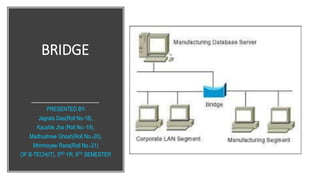
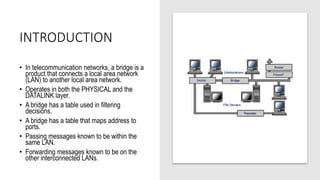
• In telecommunication networks, a bridge is a
product that connects a local area network
(LAN) to another local area network.
• Operates in both the PHYSICAL and the
DATALINK layer.
• A bridge has a table used in filtering
decisions.
• A bridge has a table that maps address to
ports.
• Passing messages known to be within the
same LAN.
• Forwarding messages known to be on the
other interconnected LANs.
BRIDGES
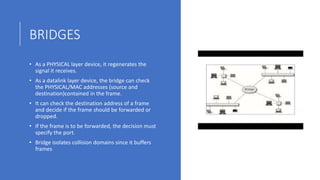
• As a PHYSICAL layer device, it regenerates the
signal it receives.
• As a datalink layer device, the bridge can check
the PHYSICAL/MAC addresses (source and
destination)contained in the frame.
• It can check the destination address of a frame
and decide if the frame should be forwarded or
dropped.
• If the frame is to be forwarded, the decision must
specify the port.
• Bridge isolates collision domains since it buffers
frames
BRIDGES
Link Layer devices:Link
Operate on Ethernet frames, examining frame header and
selectively forwarding frame based on its destination
Operate on
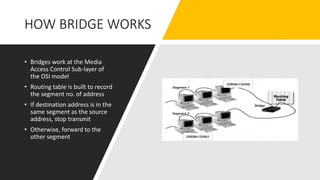
HOW BRIDGE WORKS
• Bridges work at the Media
Access Control Sub-layer of
the OSI model
• Routing table is built to record
the segment no. of address
• If destination address is in the
same segment as the source
address, stop transmit
• Otherwise, forward to the
other segment
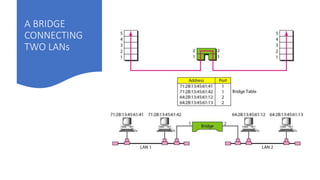
A BRIDGE
CONNECTING
TWO LANs
CHARECTERISTIC OF BRIDGE
• Routing Table:
-Contains one entry per station of network to
which bridge is connected.
• Filtering:
-Is used by bridge to allow only those packets
destined to the remote network.
• Forwarding:
-the process of passing a packet from one
network to another.
• Learning algorithm:
-the process by which the bridge learns how to
reach stations on the internetwork.
Simple Bridging :
• A simple bridge connects two network
segments.
• Typically by operating transparently and
deciding on a frame-by-frame.
• A store and forward technique is
typically used so, during forwarding
• Bridges reduce collisions by partitioning
the collision domain.
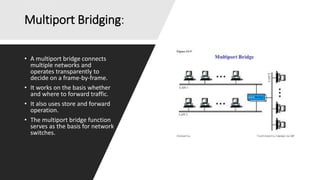
Multiport Bridging:
• A multiport bridge connects
multiple networks and
operates transparently to
decide on a frame-by-frame.
• It works on the basis whether
and where to forward traffic.
• It also uses store and forward
operation.
• The multiport bridge function
serves as the basis for network
switches.
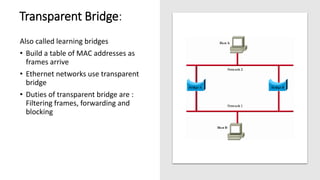
Transparent Bridge:
Also called learning bridges
• Build a table of MAC addresses as
frames arrive
• Ethernet networks use transparent
bridge
• Duties of transparent bridge are :
Filtering frames, forwarding and
blocking
Source Routing Bridge:
Used in Token Ring networks
• Each station should determine the
route to the destination.
• Addresses of these bridges are
included in the frame.
• Frame contains the source and
destination address.
• Frame also contains the bridge
addresses.
ADVANTAGES AND DISADVANTAGES OF BRIDGE
Advantage:
• Extend Physical network
• Reduce network traffic with minor segmentation
• Creates separate collision domains
• Reduce collisions
• Connect different architecture
Disadvantages of using bridges:
• –Slower that repeaters due to filtering
• –Do not filter broadcasts
• –More expensive than repeaters
what is an Ethernet bridge?
• Device that connects two different local area
networks together.
• Both networks must connect using the same
Ethernet protocol.
• Bridges can also be used to add remote
computers to a LAN.
• Many bridges can connect multiple
computers or other compatible devices with
or without wires.
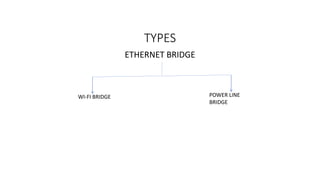
TYPES
ETHERNET BRIDGE
WI-FI BRIDGE POWER LINE
BRIDGE
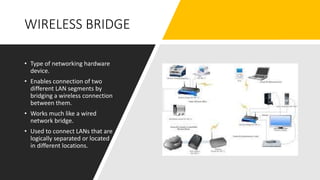
WIRELESS BRIDGE
• Type of networking hardware
device.
• Enables connection of two
different LAN segments by
bridging a wireless connection
between them.
• Works much like a wired
network bridge.
• Used to connect LANs that are
logically separated or located
in different locations.
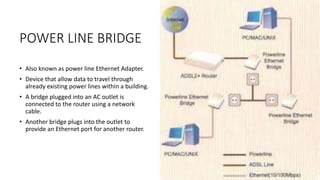
POWER LINE BRIDGE
• Also known as power line Ethernet Adapter.
• Device that allow data to travel through
already existing power lines within a building.
• A bridge plugged into an AC outlet is
connected to the router using a network
cable.
• Another bridge plugs into the outlet to
provide an Ethernet port for another router.
FUNCTIONS
• Uses Data Layer of the OSI Reference Model to
find computers on network.
• Finds devices using Media Access
Control(MAC)addresses.
• They can’t find internet protocol addresses.
• Addressing
– Routers are explicitly addressed.
– Bridges are not addressed.
• Availability
– Routers can handle failures in links, stations, and other
routers.
– Bridges use only source and destination MAC address.
• Message Size
» Routers can perform fragmentation on packets and thus
handle different packet sizes.
» Bridges cannot do fragmentation .
• Forwarding
» Routers forward a message to a specific destination.
» Bridges forward a message to an outgoing network.
ROUTER VS BRIDGE
• Priority
» Routers can treat packets according to priorities
» Bridges treat all packets equally.
• Error Rate
» Network layers have error-checking algorithms
that examines each received packet.
» The MAC layer provides a very low undetected
bit error rate.
• Security
» Both bridges and routers provide the ability to
put “security walls” around specific stations.
» Routers generally provide greater security than
bridges because
– they can be addressed directly and
– they use additional data for implementing
security.
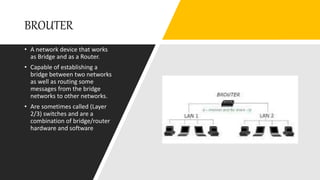
BROUTER
• A network device that works
as Bridge and as a Router.
• Capable of establishing a
bridge between two networks
as well as routing some
messages from the bridge
networks to other networks.
• Are sometimes called (Layer
2/3) switches and are a
combination of bridge/router
hardware and software
Conclusion:
• The awareness for network bridging issues is slowly rising.
• A possible future holds network zones that communicate with each other on well
defined paths.
• Bridging zones is only possible by design at security gateways that link zones each
other.
• Security will be essential part of every member in each zone down to the single
client.

Bridge

  • 1.
    BRIDGE PRESENTED BY- Jagrata Das(RollNo-18), Kaushik Jha (Roll No.-19), Madhushree Ghosh(Roll No.-20), Mrinmoyee Rana(Roll No.-21) OF B-TECH(IT), 3RD YR, 6TH SEMESTER
  • 2.
    CONTENTS • INTRODUCTION • BRIDGES •HOW BRIDGE WORK • CHARECTERISTIC OF BRIDGING • TYPES OF BRIDGING • ADVANTAGE AND DISADVANTAGE • WHAT IS ETHERNET BRIDGE • TYPE OF ETHERNET BRIDGE • FUNCTION OF ETHERNET BRIDGE • ROUTER VS BRIDGE • BROUTER
  • 3.
    INTRODUCTION • In telecommunicationnetworks, a bridge is a product that connects a local area network (LAN) to another local area network. • Operates in both the PHYSICAL and the DATALINK layer. • A bridge has a table used in filtering decisions. • A bridge has a table that maps address to ports. • Passing messages known to be within the same LAN. • Forwarding messages known to be on the other interconnected LANs.
  • 4.
    BRIDGES • As aPHYSICAL layer device, it regenerates the signal it receives. • As a datalink layer device, the bridge can check the PHYSICAL/MAC addresses (source and destination)contained in the frame. • It can check the destination address of a frame and decide if the frame should be forwarded or dropped. • If the frame is to be forwarded, the decision must specify the port. • Bridge isolates collision domains since it buffers frames
  • 5.
    BRIDGES Link Layer devices:Link Operateon Ethernet frames, examining frame header and selectively forwarding frame based on its destination Operate on
  • 6.
    HOW BRIDGE WORKS •Bridges work at the Media Access Control Sub-layer of the OSI model • Routing table is built to record the segment no. of address • If destination address is in the same segment as the source address, stop transmit • Otherwise, forward to the other segment
  • 7.
  • 8.
    CHARECTERISTIC OF BRIDGE •Routing Table: -Contains one entry per station of network to which bridge is connected. • Filtering: -Is used by bridge to allow only those packets destined to the remote network. • Forwarding: -the process of passing a packet from one network to another. • Learning algorithm: -the process by which the bridge learns how to reach stations on the internetwork.
  • 9.
    Simple Bridging : •A simple bridge connects two network segments. • Typically by operating transparently and deciding on a frame-by-frame. • A store and forward technique is typically used so, during forwarding • Bridges reduce collisions by partitioning the collision domain.
  • 10.
    Multiport Bridging: • Amultiport bridge connects multiple networks and operates transparently to decide on a frame-by-frame. • It works on the basis whether and where to forward traffic. • It also uses store and forward operation. • The multiport bridge function serves as the basis for network switches.
  • 11.
    Transparent Bridge: Also calledlearning bridges • Build a table of MAC addresses as frames arrive • Ethernet networks use transparent bridge • Duties of transparent bridge are : Filtering frames, forwarding and blocking
  • 12.
    Source Routing Bridge: Usedin Token Ring networks • Each station should determine the route to the destination. • Addresses of these bridges are included in the frame. • Frame contains the source and destination address. • Frame also contains the bridge addresses.
  • 13.
    ADVANTAGES AND DISADVANTAGESOF BRIDGE Advantage: • Extend Physical network • Reduce network traffic with minor segmentation • Creates separate collision domains • Reduce collisions • Connect different architecture Disadvantages of using bridges: • –Slower that repeaters due to filtering • –Do not filter broadcasts • –More expensive than repeaters
  • 14.
    what is anEthernet bridge? • Device that connects two different local area networks together. • Both networks must connect using the same Ethernet protocol. • Bridges can also be used to add remote computers to a LAN. • Many bridges can connect multiple computers or other compatible devices with or without wires.
  • 15.
  • 16.
    WIRELESS BRIDGE • Typeof networking hardware device. • Enables connection of two different LAN segments by bridging a wireless connection between them. • Works much like a wired network bridge. • Used to connect LANs that are logically separated or located in different locations.
  • 17.
    POWER LINE BRIDGE •Also known as power line Ethernet Adapter. • Device that allow data to travel through already existing power lines within a building. • A bridge plugged into an AC outlet is connected to the router using a network cable. • Another bridge plugs into the outlet to provide an Ethernet port for another router.
  • 18.
    FUNCTIONS • Uses DataLayer of the OSI Reference Model to find computers on network. • Finds devices using Media Access Control(MAC)addresses. • They can’t find internet protocol addresses.
  • 19.
    • Addressing – Routersare explicitly addressed. – Bridges are not addressed. • Availability – Routers can handle failures in links, stations, and other routers. – Bridges use only source and destination MAC address. • Message Size » Routers can perform fragmentation on packets and thus handle different packet sizes. » Bridges cannot do fragmentation . • Forwarding » Routers forward a message to a specific destination. » Bridges forward a message to an outgoing network.
  • 20.
    ROUTER VS BRIDGE •Priority » Routers can treat packets according to priorities » Bridges treat all packets equally. • Error Rate » Network layers have error-checking algorithms that examines each received packet. » The MAC layer provides a very low undetected bit error rate. • Security » Both bridges and routers provide the ability to put “security walls” around specific stations. » Routers generally provide greater security than bridges because – they can be addressed directly and – they use additional data for implementing security.
  • 21.
    BROUTER • A networkdevice that works as Bridge and as a Router. • Capable of establishing a bridge between two networks as well as routing some messages from the bridge networks to other networks. • Are sometimes called (Layer 2/3) switches and are a combination of bridge/router hardware and software
  • 22.
    Conclusion: • The awarenessfor network bridging issues is slowly rising. • A possible future holds network zones that communicate with each other on well defined paths. • Bridging zones is only possible by design at security gateways that link zones each other. • Security will be essential part of every member in each zone down to the single client.