Chapter – 2
Research Process of
choosing topic
(Series of Steps in
Research(
2
Contents
 Research process
 Steps in problem formulation
 Review of literature
 Formulating hypothesis
 Research design – sample design,
observational design and statistical design
 Data collection, processing and analysis
 Report writing
3
Research Process
 Research task is a sequential process
involving several clearly defined steps.
 Despite certain variations, the idea of
sequence is useful for developing a
research project and keeping it orderly.
4
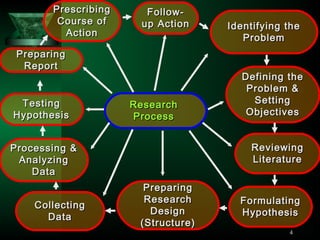
ResearchResearch
ProcessProcess
Identifying theIdentifying the
ProblemProblem
ReviewingReviewing
LiteratureLiterature
FormulatingFormulating
HypothesisHypothesis
PreparingPreparing
ResearchResearch
DesignDesign
(Structure)(Structure)
CollectingCollecting
DataData
Processing &Processing &
AnalyzingAnalyzing
DataData
TestingTesting
HypothesisHypothesis
PreparingPreparing
ReportReport
Defining theDefining the
Problem &Problem &
SettingSetting
ObjectivesObjectives
PrescribingPrescribing
Course ofCourse of
ActionAction
Follow-Follow-
up Actionup Action
5
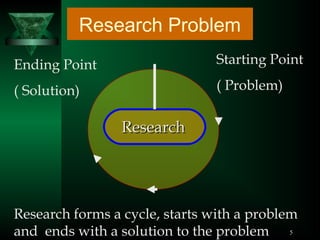
Research Problem
Ending Point
( Solution)
Starting Point
( Problem)
Research forms a cycle, starts with a problem
and ends with a solution to the problem
ResearchResearch
6
First Step in Research
 Defining the true nature of the research
problem – first step.
 Need to work directly on an identified
problem.
1. Understand the problem thoroughly.
2. Define it into meaningful terms.
 Two Important Tasks
7
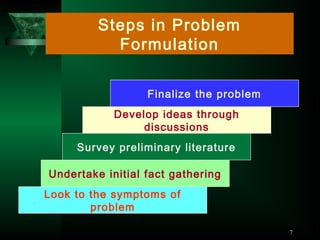
Steps in Problem
Formulation
Look to the symptoms of
problem
Undertake initial fact gathering
Survey preliminary literature
Develop ideas through
discussions
Finalize the problem
8
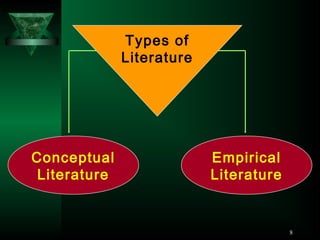
Types of
Literature
Conceptual
Literature
Empirical
Literature
9
Review of Conceptual Literature
Concerning concepts and theories
(Comprehension literature)- books and
articles by experts expressing opinions,
experiences, theories and ideas on
concepts.
Review of Empirical Literature
Studies made earlier which are similar to the
one proposed, indicates successes and
problems in respect of research design,
hypotheses, techniques and instruments.
Also look into the results/ findings of the
10
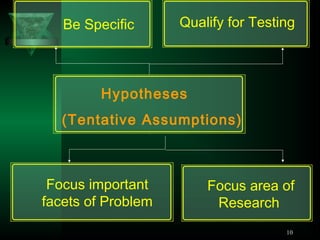
Hypotheses
(Tentative Assumptions)
Qualify for Testing
Focus important
facets of Problem
Focus area of
Research
Be Specific
11
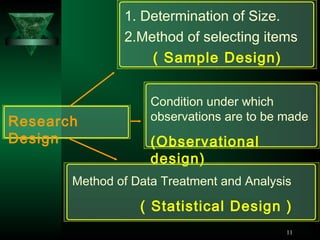
Research
Design
1. Determination of Size.
2.Method of selecting items
( Sample Design)
Condition under which
observations are to be made
(Observational
design)
Method of Data Treatment and Analysis
( Statistical Design )
12
Collection of
Data
Observation
Schedules sent
through Enumerators
Personal
Interviews
Mailed
Questionnaire
Telephonic Interviews
13
Data Processing
1. Editing 2. Coding 3. Classification
5. Percentages 4. Tabulation
14
Data Analysis
Statistical AnalysisDescriptive & Causal
Analysis
Multi-variate
Analysis
Uni-dimensional
Analysis
( measures
concerning one
variable)
Mean, Median,
Mode, G.M., H.M.,
SD, Variance, C.V.
etc.
Bivariate
Analysis
Testing
Hypothesis
( Analysis of
two
variables)
Simple
Correlation,
Simple
Regression,
(Simultaneous
analysis of more
than two variables)
Multiple Correlation,
Multiple Regression,
MDA, etc.
15
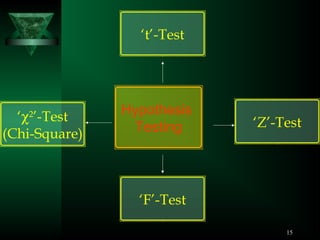
Hypothesis
Testing
‘t’-Test
‘Z’-Test
‘F’-Test
‘χ2
’-Test
(Chi-Square)
16
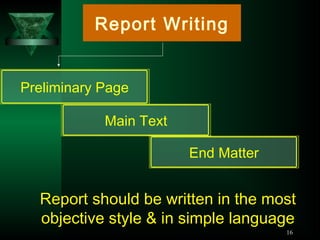
Report Writing
Preliminary Page
Main Text
End Matter
Report should be written in the mostReport should be written in the most
objective style & in simple languageobjective style & in simple language
17
Discussions, Questions
and Answers

Chapter 2 (research process)